Also known as
No aliases recorded.
Canterbury
User Contributed Collection
Documents and descriptions supplied by archive contributors. All submissions are reviewed in accordance with our Terms and Conditions.
No user-contributed documents have been approved for this vessel yet. Use the forms below to contribute images or documents relating to this vessel.

Help complete the archive
Do you have a photo of this vessel you can share?
Contribute photographs of Canterbury to the archive for editorial review. Submissions remain private and will only be published following approval by an administrator.
How your photograph will be credited
Exterior · 1940 · Copyright © Example Contributor
Source: Copyright ownership confirmed at submission by Example Contributor.
This example uses the photograph group, year and copyright-holder name supplied in the form. Your own details will replace the example above when an approved image is published.
Already have an account? Log in before uploading to link new photographs immediately.

Help complete the archive
Contribute a document
Share documents or images relating to Canterbury for editorial review. Upload up to 12 PDF, JPG, PNG or WebP files per submission, with a maximum size of 20 MB each. Your submission remains private and will only be published following approval by an administrator.
How your document will be credited
Example Document Title · Contributed by Example Contributor
Source: Archive reference supplied by Example Contributor.
This example uses the document title, contributor name and source or archive reference supplied in the form. Your own details will replace the example above when an approved document is published.
ORDE Registry
3 records3 potential matching records have been identified.
These records may contain vessel particulars, reported movements, participation assessments, named personnel and source references. A match does not by itself prove that the vessel participated in Operation Dynamo.
“Potential match” means a candidate returned by one or more indexing rules; it is not necessarily an exact identity match. Depending on the source, matching may use a normalised vessel name, a partial text or OCR hit, an alias, or related metadata. Roman-numeral suffixes such as I, II, III, IV and V may be absent, misread or separated from the base name, so records for similarly named vessels can be grouped incorrectly. Multi-word names can also produce candidates where only one significant word matches. Confirm the full name, numeral, vessel type, dimensions, builder, ownership, dates and source context before treating two records as the same vessel.
We are compiling and checking transcriptions, metadata, vessel-name matches, source references and reuse permissions before publishing further detail. This work helps prevent incomplete OCR, historic spelling variations or unverified associations from being presented as established fact.
Account registrations and access to these developing records are temporarily unavailable. Existing account holders may log in, and everyone can join the newsletter for publication updates.
Small Craft Service List
1 record1 potential matching record has been identified.
These records may contain service-list entries, vessel metadata, source-page references and protected full-size document images. A match does not by itself prove that the vessel participated in Operation Dynamo.
“Potential match” means a candidate returned by one or more indexing rules; it is not necessarily an exact identity match. Depending on the source, matching may use a normalised vessel name, a partial text or OCR hit, an alias, or related metadata. Roman-numeral suffixes such as I, II, III, IV and V may be absent, misread or separated from the base name, so records for similarly named vessels can be grouped incorrectly. Multi-word names can also produce candidates where only one significant word matches. Confirm the full name, numeral, vessel type, dimensions, builder, ownership, dates and source context before treating two records as the same vessel.
We are compiling and checking transcriptions, metadata, vessel-name matches, source references and reuse permissions before publishing further detail. This work helps prevent incomplete OCR, historic spelling variations or unverified associations from being presented as established fact.
Account registrations and access to these developing records are temporarily unavailable. Existing account holders may log in, and everyone can join the newsletter for publication updates.
Details
A source-page icon is available. Sign in to view the indexed details and protected full-size image.
Red List (1939–40) — OCR
0 records0 potential matching records have currently been identified.
Further indexing may identify OCR text matches, source files, page references and digitised page imagery. The absence of a current match does not establish that no relevant source exists.
We are compiling and checking transcriptions, metadata, vessel-name matches, source references and reuse permissions before publishing further detail. This work helps prevent incomplete OCR, historic spelling variations or unverified associations from being presented as established fact.
Account registrations and access to these developing records are temporarily unavailable. Existing account holders may log in, and everyone can join the newsletter for publication updates.
Ship Details
These details have been aggregated from multiple sources and may include contemporary records, later recollections, claims or assertions for which no corroborating evidence has been identified. Inclusion does not establish that any account or assertion is accurate. The information may be incomplete, out of date, disputed or incorrect and should be checked against the underlying source records and independent evidence before being relied upon.
- Ship type: Troopship
Lloyd’s Yacht Register (1939)
Source: Lloyd’s Register Foundation, Heritage & Education Centre, Lloyd’s Register of Yachts 1939, digitised via Internet Archive. Licensed under CC BY-NC-SA 4.0. Images have been converted, resized and watermarked for web display; machine-generated table OCR has been added.
No Lloyd’s records.
Document Collections — Tagged Pages
119 pagesImaged document collections containing pages whose OCR text or table data has been tagged with the name Canterbury. Open a collection to view the page images and transcriptions.
Source: Lloyd’s Register Foundation, Heritage & Education Centre, Lloyd’s Register of Yachts 1939, digitised via Internet Archive. Licensed under CC BY-NC-SA 4.0. Images have been converted, resized and watermarked for web display; machine-generated table OCR has been added.

Details
| Allison, Robert R., Elmsfield, Ottinge, nr. Canterbury, Kent.-Cnq. a. Odile II 5 | Bryn Bras Castle, Caernarvonshire. Wel. m. Montreal 16 Ambrose, Charles, | Principe Eugenio di Savoia- Genova, Duca di, Palazzo Chiablese, Turin, Italy. R.Y.C.I. (V.C.). Alcione 2 | Anderson, Stanley, Starboard Light," Marine Parade, Tankerton-on-Sea, Kent.-Wbl. a. Seasalter 12 | Andreae, H. K., 49. Hallam Street, London, W.1. Bem.-Lon.-Lym.-Srn.-Y.R.A. Prawn 2 |

Details
| Carrard, E., 11, Rue de Longpont, Neuilly-sur-Seine, France.-Msl. a. Folly 11 | Carslaw, Chas. H., Dunrowan, Rhu, Dumbartonshire. Nor. Gerda (P.O.) 4 | Carter, Mrs. M. P., Berkeley, 1, Belltrees Grove, Streatham Common, London, S.W.16. m. Mary Pauline 4 | Cassidi, Surg. Comdr. F. L., R.N.V.R., St. Dunstans House, Canterbury, Kent. Nav.-Tem. a. Richard Davey 16 | Cave, C.J.P., Stoner Hill. Petersfield, Hants. R.Y.S.-Bos.-Cam.-Ems. a. Laura 10 |

Details
| Court, E. F., Plomesgate House, Wickham Market, Suffolk. Nicolete 7 | Cowburn, D., 20, Rosehill Mount, Manchester Road, Burnley, Lanes. m. Escape 14 | Cox, Maj. H. J. H., O.B.E., 23, The Embankment, Bedford.-Cor. | Cozens, W. S., 92A, Broad Street, Canterbury, Kent. Tem.-Wbl. m. Iris 9 | Cramsie, Charles M., 1401, McGill College Avenue, Montreal, Canada. a. Lilith 7 |

Details
| Dyer, Mrs. V. E., Earley House, Petham, nr. Canterbury, Kent.-Mtr. m. Dawn 27 | Earl, Stanley, Royal Cinque Ports Yacht Club, Marine Parade, Dover, Kent.-Cnq.-Med. a. Haughty Belle 128 | Ebbisham, Lord, G.B.E., 41, Upper Brook Street, London, W.1. Bem.-Svw.-Tms. m. Betsie Jane 14 | Eddison, C. R., Joint Launch Committee, c/o First Church of Christ, Scientist, Sloane Terrace, London, S.W.1. m. Noah (P.O.) 10 | Edman, Gösta V., Sveavägen 100, Stockholm.-K.S.S.S. m. Thalatta 16 |

Details
| Nielsen, Aage, Örstedhus, Vester Farimagsgade 41, Copenhagen.-Dan. Tons | Nightingale, Lt.-Comdr. E. G. J., R.N., Winchcombe, Bishopton Road. Stockton- on-Tees, Co. Durham.-Nav. | Nisbet, R. A., 47, Mecklenburgh Square. London, W.C.1.-Crz. Tons | Nockolds, Humphrey, D.S.O., Lewisham Hospital, 388, High Street, Lewisham, London, S.E.13. C.A.-Lon. | Noott, A. W., White Hill, nr. Canterbury, Kent. Tem.(R.C.)-Tms.-Wbl. Tons |

Details
| Söderlund, C. A., Strandvägen, 41, Stockholm.-K.M.K. m. Nefertiti 10 | Somerset, Capt. Alan F., c/o Lloyds Bank, Ltd., 6, Pall Mall, London, S. W.1.-Art.-M.B.A. | m. Philante 1629 No. 478 (building) 33 (See page 609) | Southby, A. R. J., Bart., R.N., M.P., The Priory, Burford, Oxfordshire. R.Y.S. a. Morena 17 | Spanton, Henry B., Lenhall, Bishopsbourne, Canterbury, Kent. a. Memory 17 |

Details
| Wilson, Major T. K., Green Tubs, Farnham, Surrey. C.A.-Cnq. m. Lady Betty 15 | Wiltshier, Eric C., Stour Street, Canterbury, Kent.-Wbl. a. Mignonette 7 | Winfrey, Richard F., Ashwell, Long Sutton, Holbeach, Lincoln.-Crn. Provident 78 | Winstone, Eric G., Takapuna, Auckland, N.Z.-N.Z. Nga-Toa 18 | Withers, D. S., Ballard Lee, Swanage, Dorset. C.A.-Swn. a. William and Sam (P.O.) 63 |
Contains public sector information licensed under the Open Government Licence v3.0.
Details
CANTERBURY P/V
S.Ry. Co.
Captain C. Hancock, Master.
25th May
1446
1709
Left Dover for Dunkirk.
Arrived Dunkirk, having been shelled by
1850
shore batteries en route.
2131
Proceeded with 1,246 troops on board.
Dover. Disembarked 1,299 troops(1)
26th May
1758
To Dunkirk.
-
Escorted between Gravelines and Dunkirk
by dr. Wild Swan.
lb
2030
Berthed outside the P/V Maid of Orleans.
Embarked 1340 troops during contin-
27th May
0020
uous air attacks. Proceeded.
0309
Dover. Disembarked 1,340 troops.
1438
To Dunkirk.
2000
Dunkirk. Embarked 457 troops including.
140 stretcher cases.
2058
Proceeded, with orders from the S.T.O.
to turn back ships attempting to
enter Dunkirk. This instruction(
was conveyed to two H/C's [Isle of
Thanet and Worthing] and one Ts.
Maid of Orleans]
28th May
0225
Dover. Disembarked 457 troops.
1700ca
Capt. Hancock informed the naval
authorities that he felt too worn out
to take the ship to sea(2) [Since 19th
May the ship had carried out evacua-
tions at Cherbourg, Boulogne and
Calais].
29th May
Lt. Cdr. R.W. Soper R.N.R. relieved the
Chief Officer( who was discharged
sick, and some naval ratings and
stokers were embarked to augment
the crew.
0930
Left Dover for Dunkirk with an armed
guard on board.
1400
Arrived Dunkirk, East Pier, being
shelled en route. Embarked 1950
troops during dive bomb attacks.
1650
Proceeded. Air attacks; 1 casualty,
and ship damaged.
2146
Dover. Disembarked 1960 troops (1)
30th May
0145
Sent to anchor.
31st May
2040
Entered Granville Dock, Dover, for
repairs.
3rd June
1030
Un-docked.
1916
To Dunkirk.
2315
Alongside Dunkirk East Pier.
Embarked French Troops.
is clearly prior the commencement peration Dynamo.
(1) (2) Apparently D.R. states however, Captain Hancock remained
that this disembackalisis Took place on 26 the may. in command.
(3) only made one trip.
(4) At Lt. Cdr. Soper S.N.O. Dunkirk signalled V.A. Dover, Embarkation "Port
possible continuously only from beaches east of
2005/27, bombed all day and on fire. harbour. Send
all ships there.
156
Details
CANTERBURY (continued)
4th June
0045
0645
Proceeded Dover. with 659 troops on board(1).
Disembarked 659 troops.
Total 5,715-1299
4,416
Authority - R.O. III pp. 116, 560.
Γ.M.6213/40.
The following award was made:
D.S.C.
Capt. C.A. Hanoook, Master.
(1) Surg. Lieut. B.D. Stutter, Racuated including states that 1 woman "about
2,000 and 2 children evacues." 157
Details
DORRIEN ROSE
Richard Hughes & Co. Capt. W. Thompson, Master
P/V
(Liverpool) Ltd.
26th May
-
Loaded with army stores at anchor in
the Downs.
27th May
1430
Left the Downs for Dunkirk.
28th May
0100
Proceeding through Zuydecote Pass.
Three vessels (see Canterbury)
passing outwards signalled, "Unsafe
to approach Dunkirk" - so reversed
course and proceeded outwards
towards West Hinder buoy.
0300
As dawn was breaking, set course for
Middel Kirke buoy en route for
Dunkirk.
0420
Air attack.
0430
P/V Queen of the Channel seen to be
sinking. Proceeded to her assistance.
0505
Commenced to transfer troops under
the direction of Cdr. M.L. Musson,
R.N.R.
0525
Troops and crew transferred. Proceeded.
Escorted part of the way by the dr.
Greyhound.
1245(2)
Dover. Disembarked 904 troops.
29th May
1340ca
To Dunkirk.
1610
Struck a submerged wreck.
1620
Anchored off Elbow buoy. Repairs to
pump.
1830
Proceeded towards Dunkirk.
30th May
0400
1 mile west of Middel Kirke buoy was
fired on by two enemy motor craft.
0650
Made fast to East Mole, Dunkirk.
Landed some food stuffs.
Embarked 590 troops.
1220
Proceeded.
2045
Folkestone. Disembarked 590 troops. (1)
Boilers leaking.
lst June
To Newhaven for repairs.
Total 1,494.
Authority - R.O. III, 19-27.
TM. 6213/40.
(1) Not mentioned in D.R.
he
(2) Capt. gives Thompson his time wrote of arrival 2 reports. as 1420; In one other of them times too
appear to be very approximate.
249
Details
FYLDEA
Oropesa trawler (Dover
M/S Command)
Lieut. R. Bill, R.N.
Asst. to Cdr. M/S Dover.
Lieut. J.K.N. Warde,
R.N.V.R., Unit Officer.
Skipper G. Whamond.
27th May
-
Mine-sinking duties, under orders of
the M/S Skipjack.
29th May
0430
Sailed from Ramsgate, in company the 5
Oropesa trs. Arley, Brock, Calvi,
John Cattling and Polly Johnson.
1330
Off Dunkirk harbour, Fyldea and Arley
were ordered inside to pull the P/V
Lochgarry away from the Western (1.e.
inner) side of the East pier.
1420
The other 4 trawlers entered the harbour
and all six of them (triple-banked)
occupied the Lochgarry's berth.
Ahead of the six trawlers was the dr.
Grenade, and outside the Grenade was
the dr. Jaguar. Astern of the
use
then
trawlers was the P/V Canterbury, and
astern of the Canterbury a French
destroyer.
On the eastern (or outer) side of the
east pier was the P/V Fenella, and
at about 1430, the Sp. S/V Crested
Eagle berthed astern of her.
Two French destroyers were on the
opposite side of the harbour.
1530
First air attack, by 6 or 7 bombers;
20/30 bombs dropped, mostly wide.
Polly Johnson damaged by a near miss.
One bomber shot down by fighters.
The six trawlers commenced embarking
troops.
1550ca
The Jaguar, full of trcops, left
harbour to escort the Lochgarry.
1630
Second air attack; 20/30 bombs dropped.
The Jaguar, off the harbour entrance
severely damaged by a near miss.
Raiders driven off by fighters.
The P/V Canterbury left harbour, and
a destroyer [the Verity] took her
Third berth. air attack, by waves of bombers;
1800
about 100 bombs dropped. The
Grenade and the Calvi hit; the
latter sank immediately, the former
shortly after. The east pier was hit
abreast of the Fenella, which was
so damaged that, after transferring
her troops to the Crested Eagle, she
had to be abandoned. [The Crested
Eagle swung clear and proceeded;
but she was hit almost at once,
caught fire and (she was a wooden
Verity slipped and turned ship in
ship) had to be beached. The
the channel. At this stage there
was the troops who began climbing of
an inclination to panic among out
one [cdr. J.C. Clouston,
ship into another. The R.N.] Piermast-
instructed er Lieut. Bill to draw his
revolver, and order was restored.
349
Details
2
GRENADE (contd.)
1630ca
29th (contd. May
(contd.)
harbour entrance, was
Fenella, east which was berthed on P/V
damaged by & near miss. severely The
and had to be abandoned; her
side of the east pier was the hit
troops were transferred to the
Crested Eagle.
1700ca
The dr. Verity berthed ahead of the
six trawlers, in a berth which
had just been vacated by the P/V
Canterbury.
1750ca
Attack by dive bombers. A near miss
blew a hole in Grenade's side.
The tr. Calvi, ahead of the
Grenade, was hit and sank.
The Grenade then received two hits
which put the engines out of action
and started a fire.
1800ca
The Verity left the harbour.
The Grenade, now on fire in the
boiler room, the upper mess deck
and the canteen flat, swung round
enabling many of her officers and
men to step on board the tr.
The Grenade was ordered to abandon ship
Polly Johnson.
1815ca
some of her survivors were picked
up board the tr. Fyldea.
by the tr. Brock, others
Boyle The jumped Grenade stepped on was into the now the awash, last water of and the and Cdr. was
Cdr. master,
-
Belgian Cdr. clear hauled and trawlers [the Boyle arranged J.C. John of on then tug the Cattling in Clouston board to fairway. with landed push the the R.N., on the Pier the Crested He the Grenade for harbour then pier, a was
they set to be
board very shortly on fire after (she
hit wooden and had
beached.].
Total 1,000.
Authority - R.O.I. p.68.
R.O.II, p.518.
R.O.VI, p.182.
Date
Lad
Contains public sector information licensed under the Open Government Licence v3.0.
Details
ISLE OF THANET
Hospital Carrier
(s. Ry. Co.)
Capt. A.J. Hammond,
Master.
[on 23rd May the Isle of Thanet brought 296 wounded
from Dunkirk, i.e. before Operation Dynamo commenced].
25th May
1556
Left Dover for Dunkirk the H/C Paris in
company.
1815
Arrived Dunkirk. The P/V Canterbury
having moored at Gare Maritime;
the Isle of Thanet moored alongside
her, with Paris on the outside berth.
1910
[Canterbury sailed, and Isle of Thanet
took the quayside berth].
2200
Commenced loading. Air attacks were
frequent throughout the operation.
Raging fires lit up the quayside and
the white painted hospital carriers
showed up prominently.
26th May
0100
608 wounded embarked.
0115
Proceeded.
0730
Arrived Newhaven. Disembarked 608
wounded. (1)
27th May
0634
Left the Downs for Dunkirk.
0800
Shelled by shore batteries when off
Calais
Returned to Dover for alternative
route instructions.
1709
Left Dover for Dunkirk.
1750
The H/C Worthing asked for route, and
joined company.
2118
Dunkirk east roads. The Canterbury
came out of Dunkirk and signalled
that all casualties were aboard her,
and that it was impossible to enter.
Isle of Thanet and Worthing proceeded
to Dover.
28th May
0210
Off Dover. Ordered to Newhaven.
0254
Collided with the Exam. vessel
Ocean Reward, which sank immediately.
Searched for survivors, assisted by
the tug Lady Brassey. None were
found.
1051
Arrived Newhaven. Assisted to berth
by the tug Foremost 22.
Nil
Authority - M.6213/40.
(1) Not mentioned in D.R., no doubt because Operation Dynamo
did not commence until 1857 on 26th May.
67
Details
JUTLAND
Skoot
Lieut. G.L. Barwell, R.N. (Retd.)
Lt. Cdr. W.R.T. Clements, R.N.R.
(30th-31st May)
Lt. L. Hutchinson, R.N.R. (1st
Lieut).
27th May
0500
Lt. Barwell in command. Proceeded.
1500
from Sheerness to the Downs.
Sailed for Dunkirk via West Hinder Light
2200ca
and Kwinte Bank buoy.
A hospital ship coming from Dunkirk
signalled "Dunkirk has fallen".
[See Canterbury] Then another ship
made the same signal adding "I am
returning". Jutland replied "I am
proceeding".
-
Waited 3 hours near Nieuport Bank buoy
for orders. Then, in company with
the sk. Patria decided to return.
28th May
1000
Arrived in the Downs.
1730
Sailed for Dunkirk.
-
Arrived Dunkirk. Shifted 4 miles to the
east.
29th May
0250
No troops found. Decided to return.
0830
Arrived Ramsgate.
1000
Sailed for Dunkirk.
1715
Off Middel Kerke Bank buoy. Air attack.
-
Arrived La Panne. Embarked French
troops. Air attack.
-
Proceeded with about 275 troops on board.
1830ca
Encountered the P.M/S Gracie Fields
which had been damaged by bombs.
While the Gracie Fields, (out of
control) steamed round in a circle,
the Jutland took off some of her
troops from the port side. Another
ship [the M/S Pangbourne] did the
same on her starboard side.
2130ca
Proceeded on homeward voyage.
30th May
0630
Arrived Ramsgate. Disembarked 300
troops. (1)
Lt. Barwell and crew relieved by
Lt. Cdr. Clements (ex-Tilly) and a
fresh crew.
1530ca(3) Left Ramsgate for Dunkirk beaches,
towing the eel-boat Johanna(2)
the M/B Constant Nymph and a whaler
and a cutter.
2330ca
Arrived Dunkirk beaches. Embarked
troops, assisted by the Constant
Nymph and Johanna.
31st May
Took in tow 5 boats which were adrift,
0300ca
and proceeded.
(1) (2) Not Johanna mentioned in D.R. In one she says she was towed
sent in 2 reports. on 29th the on the "Thursday correct
(3)
Lt. date over night" was by [i.e. the 30th Jutland 30th May, May ]. when Officer Lt. It Cdr. of Clements the Jutland, sailed was in under for command.
J. Bald R.N.V.R., lat says that the Jutland 1st June.
Lt. Dunkirk Cdr. on Clements, 31st May and returned on
104
Details
MAID OF HONOUR
M/B (Owner, H. Sands).
Capt.
Reported to have left Chatham in charge of
Muster.
a Sub. Lieutenant and 2 naval ratings. with
No further information 1B available, except that
the Maid of Honour did not return.
to
effect entrance and returned to
Doyer*,
Dover
1)
*
Authority - J.D.C.
Processed to Denkirk, escorted by dr.
TO.9436/40.
W124 Swan
Intered Dunkirk and barthed slongside
r
MOTATA ween, which was already loaded:
with troops, at the Gare Maritime)
where the P/V None's Queen proceeded,
Maid 02 Orders Look her borth
elongside and landed water and stores.
Troops were than emberked.
2030
1/1 Canterbury borthed outside Mid of
Crienns and embarked troops.
my
0020
Cepterbury procesded.
0300cm
Hard of Orleans prosseded.
0600
Dovers Disambarked 980 Groops and 8
Date
To Donkirs.
Kids
punkirk roads. The I/V Centerbury
signalled to Maid of Orleans the
B.T.O. (TO.N.O.) Dunkirk's order not
to ontsr. Proceeded.
Vehicle
May
Dovers Capt. Larkins reported sick.
Walker took command.
1918 way
0437
To Dunkirk,
1
Berthed alongside Dunkirk East 10)6.
Embarked troops. Alongside about
5 hours. Shirted barth 3 times 00 the
tido ebbed. Proceeded.
Off Hieuport picked BD 2 Frendo afficers
I
from & small open boat.
Dover. Disemberked 1372 troors,
-
50th May
2145
TO Dunking.
Stat May
0100ca
Serthod alongaide Seat 8026.
Arrived Dover, Disembarks 1253
1253 troops.
A.M.
(including U stretcher 0009014
300 June
0030
To Berthed at East Hole. Alomgride dostreyers about
Dunkirk.
033008
during which too while 23,
imbursed 5 hours troops anross the decise
Embarked sir 1,056 troops. processed.
attacks were in progrees.
090068
air attents 4 bombo
(1) D.R. states 986 troops Landed or 25th days this eppears
(2) Insure to be and incorrect. Venguisher out the anys abs WASHINGTON 614 borthes not APPLYS anys alongaide at she
81. Donkirk Hillior", on let June until 1530* EXPIRES declare
secured
alongaide
217
Details
MAID OF ORLEANS
S.Ry.Co.
Capt. A.E. Larkins, Master.
P/V Ts,
Capt. G.D. Walker, Master.
26th May
1100
Left Dover (Capt. Larkins 1/c), with
6,000 2-gallon cans of water,
stores and 250 troops.
-
Off Dunkirk. Air raid. "Unable to
effect an entrance and returned to
1503
p.m.
Dover 1) and created back to Dover.
Dover". was mer in mid Channel by the dr. wildSwan
1726
Proceeded to Dunkirk, escorted by dr.
W1ld Swan.
2000ca
Entered Dunkirk and berthed alongside
E
Mona's Queen, which was already loaded
with troops, at the Gare Maritime;
where the P/V Mona's Queen proceeded,
Maid of Orleans took her berth
alongside and landed water and stores.
Troops were then embarked.
2030
P/V Canterbury berthed outside Maid of
Orleans and embarked troops.
27th May
0020
Canterbury proceeded.
0300ca
Maid of Orleans proceeded.
0600
Dover. Disembarked 980 troops and 8
civillans.
p.m.
To Dunkirk.
-
Dunkirk roads. The P/V Canterbury
Captain Albert Edward Larkins, master
of the railway-owned cross-Channel vessels
signalled to Maid of Orleans the
for 20 years, died on Wednesday at Canter-
S.T.O. [?S.N.O.] Dunkirk's order not
bary at the age of 57. He was in command
to enter. Proceeded.
of the Maid of Orleans at the evacuation
of Dunkirk. Times 20.7.1956
28th May
-
Dover. Capt. Larkins reported sick.
Capt. Walker took command.
29th May
0437
To Dunkirk.
-
Berthed alongside Dunkirk East Mole.
Embarked troops. Alongside about
5 hours. Shifted berth 3 times as the
tide ebbed. Proceeded.
-
off Nieuport picked up 2 French officers
from a small open boat.
Dover. Disembarked 1372 troops.
-
30th May
2145
To Dunkirk.
31st May
0100ca
Berthed alongside East Mole. Embarked
Arrived Dover. Disembarked 1253 troops
1253 troops.
a.m.
including 42 stretcher cases).
lst June
0030
To Dunkirk.
0330ca
Berthed at East Nole. Alongside about
6 embarked troops across the decks while
hours during which two destroyers (2)
Embarked 1,856 troops. Proceeded.
air attacks were in progress.
0900ca
Air attack; 4 bombs dropped.
(1) D.R. states 988 troops landed on 26th May. This appears
(2) Icarus to be incorrect. Icarus says she berthed arrive alongside at she
"Sto and Vanquisher. but the St. Helier did Vanquisher not says
Dunkirk secured Hillier", alongside on 1st June Icarus; until 1530. Windsor outside Vanquisher.
218
Contains public sector information licensed under the Open Government Licence v3.0.
Details
SABRE (continued)
1st June
0700
Proceeded to Dover with about 500
(contd.)
troops.
1000
Arrived Dover. Disembarked 451 troops.
2030
Proceeded to Dunkirk in company with
the dr. Codrington.
2315
Secured to east pier and filled up
with troops.
2400
Proceeded to Dover, coming up with the
dr. Icarus en route.
2nd June
0400
Arrived Dover. Disembarked 756 troops.
1845
Proceeded to Dunkirk in company with
the Shikari.
2000ca
Near Ruytingen Bank buoy the H/C Paris
was seen to be sinking and to have
boats away. Sent a cross channel
steamer which had just been overtaken
to her assistance.
2110
Secured inside the wrecked trawler
100
Calvi at east pier and embarked
troops. These were all part of the
B.E.F. rearguard and included men of
the Green Howards.
On leaving harbour, took off 3 Royal
Artillery officers from the wreck of
the G/B Mosquito.
2200
Proceeded with the Shikari.
3rd June
0120
Arrived Dover. Disembarked 500 troops.
2023
Left Dover for Dunkirk the dr.
Venomous in company.
2250
Entered Dunkirk and lay off while the
transports berthed.
2300ca
Berthed between 2 transports [probably
the Canterbury and the Newhaven].
2400ca
The dr. Whitshed placed her stern
alongside Sabre's bow and her bow
alongside a transport's [the
Canterbury's stern.
4th June
0025
Shoved off with nearly 600 French
troops and Admiral Abrial's Flag
Lieutenant. Difficult getting out of
harbour because of "the mass of ships
trying to berth or to get away".
Proceeded, following a minesweeper,
and later, a transport, until she
was lost sight of in the fog near U
N. buoy. Goodwin L.V. was found by sound,
and Sabre then proceeded from buoy
to buoy.
0500
Arrived Dover. Disembarked 592 troops.
Total 5765
Authority - R.O.I., p.118
54
Details
Southern Railway Company
The following ships of the S. Ry.Co. took part in Dynamo:
Personnel ships
Autocarrier
Biarritz
Canterbury( 2)
Lorina (1)
Maid of Orleans( 2)
Normania (1)
Whippingham.
Whitstable
Hospital carriers
Dinard
Isle of Guernsey
Isle of Thanet
Paris
Worthing
Coaster
Hythe
Tugs
Foremost 22
800
{1} Designated Sunk. a troop transport.
D.R.
165
Details
Skoot
TILLY
Lt. Cdr. W.R.T. Clements, R.N.R.
Lt. Cdr. C.M. Ramus, R.N.R.
Lt. L.H. Holman, R.N.V.R., lst
Lieut.
27th May
1035
Arrived in the Downs, from Southend,
1500
Lt. Cdr. Clements in command.
Left for Dunkirk, via West Hinder,
Dyck and Middelkerke buoys, 5 small
motor vessels [ the skoots,
Brandaris, Hondsrug,
2300
Jutland and Twente in company.
8/9 miles from Dunkirk, an "armed
merchant cruiser" the P/V Canterbury
escorting two hospital carriers
[the Isle of Thanet and the Worthing],
signalled, "Dunkirk has fallen and
is in enemy hands. Keep clear".
One of the 5 small motor vessels
with which Tilly had sailed in
company was in charge of Lt. Barwell
[i.e. the Jutland], and she was now
2 a mile distant. The Tilly
repeated the above signal to her.
-
Proceeded towards Dunkirk, but when
close to Nieuport buoy altered course
for the Downs. On passage, met the
Sk. Brandaris which, having received
the same information was also
returning.
28th May
1745
Left Deal for Dunkirk, followed by 6
small motor vessels.
Proceeded via "U", and "W" buoys,
followed close astern by 5 other
skoots, including the Patria, the
Twente, and the Rian.
2300ca
Off Dunkirk.
2400ca
Entered Dunkirk harbour with Patria.
Moored alongside the mole, outside
the Patria. The M/S Medway Queen
berthed outside the Tilly.
Embarked troops.
29th May-
0330ca
Full of troops, the Tilly was towed
out stern first by the Patria, and
proceeded, followed by Patria.
0845
Arrived Ramsgate. Disembarked 107
troops. (1)
[Lt. Cdr. Clements left the Tilly,
and (on 30th May) took command of the
Sk. Jutland].
Lt. Cdr. C.M. Ramus took command of
the Tilly.
p.m.
Proceeded via X route to Dunkirk,
towing 2 cutters.
30th May
a.m.
Off Bray. Sent cutters ashore for
troops which were embarked.
Left the cutters to assist other ships.
-
0940
Arrived Proceeded. Ramsgate. Disembarked 295
troops. (2)
(1) D.R.
(2) Ramsgate report. D.R. gives 294.
235
Details
11 & 12 VERITY
Movements may 22-25
22nd
1150 Escorted Canterbury & Maid of Orleans to Calais.
1418
Back at Dover
23rd
2140
To Calais with McNaughton and Canadian staff.
2255
Entered harbour; landed McN. in Gulzar.
Paris (h.s.) slipped and Verity took her place alongside,
24th
0137 McN. re-embarked. To Dunkirk along swept channel.
0247
Attacked by single a/c.
0327
Arrd. Dunkirk; alongside Quai Felix Faure. Quiet.
0500
McN. landed, said would be 2 hours.
0700
Tide falling, nothing from McN., so patrolled outside,
leaving motor boat inside.
0850 Heavy air attack. Another at 0943.
1035 McN. returned. Back to Dover.
1120 Shot down one float plane.
1206 Shelled by Calais shore battery.
1255
Arrd. Dover. Oiled & embarked military ammunition.
1914 Proceeded to salvage Wessex; reported sunk so returned.
1950
Went to assistance of Burza, damaged by bombs. Escorted
her in to Dover (2050).
2120
War Office ordered land military ammunition.
2127 VA Dover ordered embark 80 (actually 76) RM and ammunitia
2230
Somerville took passage.
2335 Proceeded to Calais.
25th
0050 Entered harbour; alongside Gare Maritime.
0105 Shelled by battery to westward - not hit.
0120 Shifted berth to Quai de Maree, ahead of Wolfhound.
Landed men & stores without casualties.
0215
Left for Dover; Somerville still on shore.
0415
Arrd. Dover.
270A
Details
WILD SWAN (D.62) 19th Destroyer Flotilla Lt. Cdr. J.L. Young-
husband, R.N.
1430
Sailed from Dover and proceeded
26th May
towards Dunkirk.
1503
Met the P/V Maid of Orleans in mid-
Dover. channel and escorted her back to
Downe
free
1726
Left Dover, escorting the Maid of
Orleans to Dunkirk.
1929
Attacked by an A/C on entering Dunkirk
Channel; 4 bombs dropped. A/C
driven off by 3 fighters.
2000ca
Having seen Maid of Orleans into
Dunkirk harbour proceeded westward to
find the P/V Canterbury.
-
Sighted Canterbury off Gravelines and
2030
escorted her into Dunkirk harbour.
After some delay due to the P/V Mona's
2040
Queen sailing, Wild Swan went along-
side Canterbury at Monitor's Quay[?]
T.R.
and embarked General/Bastwood, 2
other generals and their staffs.
2145
Proceeded out of harbour, and patrolled
in the vicinity of Calais No.6 buoy,
while waiting for the Maid of Orleans
which was to be escorted to Dover.
27th May
0324
As Maid of Orleans was not sighted
[actually she left Dunkirk about
0300], the Wild Swan proceeded
Arrived to Dover. Dover. Disembarked about 12(1).
-
Total 12
Authority - R.O.I., p.175.
Details
WORTHING
Hospital Carrier
(S. Ry. Co).
Capt. C.G.G.Munton, Master
1200
26th May
Left Mona's the Dover H/C Queen. Isle for Dunkirk of Guernsey in company and the with
1630
The berthed Worthing and the Isle of P/V
-
Proceeded. embarked alongside wounded. Dunkirk pier, Guernsey and
27th May
-
-
Disembarked 300 wounded. (1)
Salled for Dunkirk.
1700ca
In from Dunkirk roads, received a
the P/V Canterbury to return. message
31st May
Disembarked 300 wounded. (2)
2nd June
1255
Left the Downs for Dunkirk.
1432
Air attack. Nine bombs dropped and
ship machine-gunned. Damaged by
near misses. (3) Visibility good.
The only other ships in sight were
2 sailing barges.
1459
The corvette Mallard was detached by the
cr. Calcutta to stand by the Worthing.
The Worthing returned to harbour.
Total 600
Authority - R.O.III, p.234.
T.M. 6213/40.
8 D.R. disembarkation 30th May.
fired
D.R. According dates this 89, had been Downs with
Wilson Lad
at [by shore to D.R. batteries] para. is
slight
damage.
This
340
Details
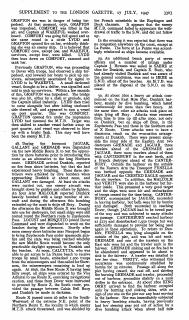
SUPPLEMENT TO THE LONDON GAZETTE, 17 JULY, 1947                                            3303
GRAFTON she was in danger of being tor-               the French minefields hi the Ruytingen and
pedoed. At that moment, 0250, GRAFTON                 Dyck channels.       It appears that the enemy
was torpedoed, COMFORT was lifted in the              M.T.B. command failed to appreciate the with-
air, and Captain of WAKEFUL washed over-              drawal of traffic to the S.W. and did not follow
board. COMFORT was going full speed and as            up.
she came round in a circle "LYDD and                    In the evening it was reported that there was
GRAFTON opened fire on her, evidently think-          no congestion anywhere on the coast, except at
ing she was an enemy ship. It is believed that        La Panne. The force at La Panne was accord-
COMFORT crew, except one, and WAKEFUL                 ingly reinforced as ships became available.
survivors, except four, were killed.        LYDD
then bore down on COMFORT, rammed and                    29. An additional beach party of seven
sank her.                                             officers and a number of ratings under
   Previously GRAFTON, who was proceeding             Captain J. Howson was sailed in SABRE at
to Dover with troops, had observed a ship tor-        1600 for Dunkirk, and Captain E. Bush, who
pedoed, and lowered her boats to pick up sur-         had already visited Dunkirk and was aware of
vivors, subsequently ascertained by signal to         the general conditions, was sent to HEBE as
LYDD to be WAKEFUL. A small darkened                  S.N.O. afloat off the beaches. An M.T.B. was
vessel, thought to be a drifter, was signalled and    placed at the disposal of the S.N.O. on the
told to pick up survivors. Within a few seconds       coast.
of this, GRAFTON was torpedoed. The bridge               30. At about 1600 a heavy air attack com-
was also hit, either by a shell or grenade, and       menced on the East Mole Pier, Dunkirk har-
the Captain killed instantly. LYDD then tried         bour, mainly by dive bombing, which lasted
to come alongside but after hitting starboard         continuously for more than two hours. At
side sheered off, and appeared to ram a vessel        the same time, other air attacks took place on
on port quarter. This was COMFORT.                    ships lying off Bray. Attacks were renewed
GRAFTON opened fire under .the impression             from time to time up till after 2000, not only
LYDD had rammed the M.T.B. Target was                 on Dunkirk, but on ships off Bray, in the
then shifted to another vessel further away on        Zuydecoote Pass and those in the Southern end
port quarter, and vessel was observed to blow         of X Route. These attacks were to have a
up with a bright flash. This may well have            disastrous result on the evacuation arrange-
been the enemy M.T.B.                                 ments at Dunkirk. There were present along-
                                                      side the inner side of the Eastern Arm two
   28. During     the     forenoon     JAGUAR,        destroyers GRENADE and JAGUAR, three
GALLANT and GRENADE were dispatched                   trawlers ahead of the GRENADE and
via the new Middle Route X to test the opposi-        JAGUAR, three more trawlers ahead of them
tion by shore batteries prior to introducing this     with CANTERBURY in the next berth, and
route as an alternative to the long Northern          a French destroyer ahead of the CANTER-
route. GRENADE arrived Dunkirk, reported              BURY. Outside the harbour on the outside
no fire from shore batteries, but that she had        of the Eastern Arm the Transport FENELLA
experienced heavy bombing. These three des-           was berthed opposite the GRENADE and
troyers were attacked by dive bombers when            JAGUAR and the CRESTED EAGLE opposite
approaching Dunkirk at about noon, and                the six trawlers. In addition, the MALCOLM
GALLANT was damaged. At least six attacks             and VERITY were also in the harbour but fur-
were carried out, one enemy aircraft was              ther inside. This presented a very good target
brought down by gunfire and others by fighters.       and the ships were soon hit and embarkation
An hour .-later MALCOLM reported Dunkirk              of troops ceased for the time being. CANTER-
heavily bombed with a large number of air-            BURY, accompanied by JAGUAR, succeeded
craft and during the afternoon this bombing           in leaving harbour, but both were hit by bombs
extended up the coast to ships off Bray. During       and damaged. Both succeeded in reaching
the afternoon the Middle Route X was brought          Dover, though JAGUAR had to be towed part
into use for destroyers, but small ships were still   of the way and was subjected to many attacks
routed round the Northern route to Zuydecoote         on passage. CANTERBURY reached harbour
Pass. LOCUST and MOSQUITO joined Dover                at 2115 and disembarked 1,950 troops but was
Command and were dispatched to work on the            sufficiently damaged to prevent her being used
beaches during the afternoon. Shortly after           again in these operations. To return to Dun-
noon enemy shore batteries near Nieuport began        kirk, FENELLA was lying alongside on the
to bring Zuydecoote Pass under spasmodic gun-         outside of the pier,n and was hit and sunk.
fire and the state was being reached whereby           GRENADE and one of the trawlers on the
the new Middle Route would become the only            East side were hit and the trawler sank in the
practicable daylight approach to Dunkirk and          fairway. GRENADE sinking and on fire had to
the beaches. At noon, CALCUTTA, who was               be abandoned and appeared to be about to
able to get across to La Panne beach to receive        sink in the fairway. A trawler was detailed to
troops by small boats, embarked 1,200 troops          tow her clear. VERITY, who witnessed this
from the minesweepers and then sailed for Sheer-      occurrence • was continuously straddled by
ness, the minesweepers remaining to load up           bombs for 35 minutes. Passage all along the
again. At 1606, the New Route X having been            pier having ceased, she cast off, and skirting
fully swept, all ships were ordered by the Vice        the burning GRENADE and trawler, proceeded
Admiral to use Route X, exercising navigational        out of harbour, grounding: slightly on a sunk
 caution, and those from Dover were instructed         drifter in the entrance. At about 1800 KING
 to proceed by Route Z, the South route, pro-          ORRY arrived to find the harbour occupied
vided the passage between Calais Bell Buoy             only by burning and sinking ships, with no
 and Dunkirk be made in darkness.                      sign of any one on the pier nor any boat moving
   Route X passed some 26 miles to the South-          in the harbour. She was immediately subjected
 Westward of the extreme N.E. point of the             to heavy bombing attacks, having previously
 Northern Route Y, the locality in which enemy         had her steering gear put out of action by^ a
 M.T.B. attack threatened, and was shielded by         dive bombing attack when about half mile
Details
SUPPLEMENT TO THE LONDON GAZETTE, 17 JULY, 1947
M.T.Bs. 16, 67, 68, ioo, 102 and 107.
M.A.S.Bs. 6, 7 and 10.
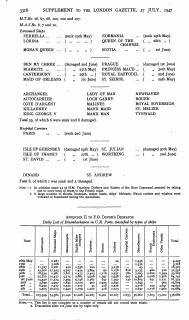
Personnel Ships
  FERRELLA                        (sunk 29th May)          NORMANIA         (sunk 29th May)
  LORINA                          ( „ „ „ )                QUEEN OF THE     ( „ 28th „ )
                                                                  CHANNEL
   MONA'S QUEEN ...               ( „     „      „ )       SCOTIA       ... ( „ ist June)


   BEN MY CHREE ...              (damaged 2nd June)        PRAGUE           (damaged ist June)
   BIARRITZ                      (    „ 27th May)          PRINCESS MAUD... (    „ aoth May)
   CANTERBURY   ...              (    „ 29th „ )           ROYAL DAFFODIL   (    „ 2nd June)
   MAID OF ORLEANS               (   „ ist June)           ST. SEIROL   ... (   „ 2gth May)


  ARCHANGEL                            LADY OF MAN                                    NEWHAVEN
  AUTOCARRIER                          LOCH GARRY                                     ROUEN
  COTE D'ARGENT                        MALINES                                        ROYAL SOVEREIGN
  KILLARNEY                            MANX MAID                                      ST. HELIER
  KING GEORGE V                         MANX MAN                                      TYNWALD
Total 29, of which 6 were sunk and 8 damaged.

Hospital Carriers
  PARIS                    ...   (sunk 2nd June)


  ISLE OF GUERNSEY (damaged 2gth May) ST. JULIAN                                              (damaged soth May)
  ISLE OF THANET   (   „ 27th „ ) WORTHING                                                    (    „ 2nd June)
  ST. DAVID        (    „    ist June)


  DINARD                               ST. ANDREW
Total 8, of which i was sunk and 5 damaged.
Note.—i. In addition some 23 of H.M. Trawlers, Drifters and Yachts of the Nore Command assisted by taking
           one or more tows of boats to the French coast.
      2. A large number of skoots, launches, motor boats, ships' lifeboats, Naval cutters and whalers were
           wrecked or foundered during the operations.


                              APPENDIX II TO F.O. DOVER'S DESPATCH
                Daily List of Disembarkation in U.K. Ports, classified by types of ships
                                                                           Carriers


                                                                                       to
                       1
                                   ft
                                         0 <D                                                         •3
                                                                                                      |  CO

   Date                                                                                                  Total
                       !1
                                   0>                                                  I
                                   <0

                                         |l
                                                                   a       1
              I                   _p               1
                                                   (6
                                                           1
                                                                                                 0>
                                                                                                         8
                                                   £
              Q        £                 &                 %       «       a           §
                                                                                                        0

26th May             2,287        _        _       _       _
                                                                     24     ___       1,936
                                                                                                 ^        -
                                                                                                                 4,247
27th          —      3,168                 —                                —         2,550                      5,718
28th        ",327 2,161           —
                                  420    i,336     —
                                                   IOO            3,138     —       45           —       —
                                                                                                         —      18,527
29th        15,972 17.525        4,307   1,454    3,894     90    2,158     818 3,133            —
                                                                                                 460     520    50,331
30th        18,554 2,981         7,671   1,477    7.405   1,116   2,931     780 5,293           2,620   2,399   53,227
3ist        25,722 12,477        4,714   2,682    3,976   1,797   2,938     907 4,596           2,026   2,306   64,141
 ist June   14,440               7,594   9,148    2,762     647   1,797     130 10,803           651    2,271   6i,557
 2nd         5,649 4,977         1,842   2,075     900    1,975   2,632          2,649                    905   23,604
 3rd         6,432 7,477         2,552              50      418   2,526          3,oi8           —
                                                                                                 750    4,641   29,641
                                         1,777                              —
 4th         5,303 10,013        1,940   1,079    1,200     418   2,023     —    2,637          1,116   1,960   27,689
  Total... 103,399 74,380 31,040 21,028          20,287   6,461 20,167    2,635 36,660          7,623 15,002 338,682

Notes.—i. This list is not complete as a number of vessels did not record their totals.
       2. Evacuation after ist June was by night only.
Source: The National Archives, Kew, ADM 116 4649. Contains public sector information licensed under the Open Government Licence v3.0.

Details
Page 227
Operation "DYNAMO" -
Recom endations of Personnel.
BIARRITZ - William Hay Baker, Master.
to Boulogne and Calais prior to the operation, and on
In addition to this trip the ship completed two trips,
this last trip to Dunkirk whilet off the French coast near
Calais, was subjected to very heavy gunfire. Four shells
struck the ship.
Recommendations.
OFFICER
Master, William Hay Baker.
Showed great skill and initiative in being able
to get his ship back to harbour.
Recommended for mention.
RATING.
Engineer, Mr. J. Crockett.
Whilst in charge of the after boiler room, closed
down the fuel supply to the forward boiler, and under
very great difficulty was able to maintain steam
pressure and water level in the boilers. He displayed
great initiative and gallantry in the circumstances,
in view of the fact that there was steam escaping.
Recommended for decoration.
CANTERBURY - Charles Archibald Hancock, Master.
This ship completed four trips. On the third trip
she was bombed and a near miss damaged the ship and put
her out of action. In addition to those four trips, she
had completed three other trips to Calais and Boulogne,
continually subjected to bombing and also gunfire from
shore batteries. Near miss put the ship out of use for
the remainder of the operation.
Recommendation.
OFFICER.
Master, Charles Archibald Hancock.
Displayed great initiative and seamanship in
getting the ship into Dunkirk, and also after the
ship had been severely damaged, in getting her back
to Dover.
Recommended for decoration.
HOSPITAL

Details
Page 150
Operation "DYNAMO" - Recommendations of Personnel.
SEA TRANSPORT OFFICERS.
The work done by the Sea Transport Officers
throughout the Operation of Dynamo, entailed an
enormous amount of labour, which was carried out
in a highly efficient manner.
Commodore Jukes-Hughes was in charge at Dover,
and it was entirely due to his organisation and
smooth working that enabled nearly 181,000 to be
disembarked at Dover without any hitch whatsoever,
and at Folkestone, nearly 32,000.
Commodore Edward Glyn de Styrap Jukes-Hughes.,R.N. (Retd.)
As P.S.T.O. was responsible for the successful
disembarkation of troops, and the greatest credit
is due to the capable and efficient way in which
the troops were disembarked and able manner in
which he was able to arrange for the quick turn
rounds of the various transports that came into
harbour.
Recommended for decoration.
Lieutenant Allan Raymond MacKewn, R.N.R.
In addition to carrying out the ordinary duties
of Sea Transport Officer, Lieutenant MacKewn went
in command of an armed party to the ST. SEIRIOL,
where the Master had refused to sail, thereby
showing great devotion to duty.
Recommended for decoration.
Lieutenant-Commander Ralph William Soper, R.N.R.
In addition to carrying out his ordinary duties,
this officer volunteered to take over the duty of
Chief Officer of Transport, Canterbury, as there
was no relief available, thereby showing great
devotion to duty.
Recommended for decoration.
Major Lionel Steele Wilkinson, R.M.
During the period of the operation he was in
almost constant attendance at the office and was
only absent for very brief periods for sleep. His
local knowledge was of great assistance to the
P.S.T.O., and a great deal of the success of the
organisation is due to his great devotion to duty.
Recommended for decoration.
Lieutenant/

Details
DSC.
Lieutenant Alexander Harper Turner,
Skipper George Hattan, W.S.3022, REED.
Skipper William Francis
L Sub-Lieutenant John Kenneth Barton
Miles, R. R.V.R.,
Sub-Lieutenant Robert Walter Timbrell, R.C.N., H.M.M.M.M.
Lieutenant Robert Hunter Irving, R.N.R., TRITON.
Sub-Lieutenant George Arthur Gabbett-Mulhallen, E.M.B. R.N.,
Lieutenant Charles Waterland Read, R.N.R., VERNON Motor Boat I, etc.
BONNIE HEATHER.
Sub-Lieutenant William Ronald Williams, R.N., Motor Boat
Sub-Lieutenant John Cambridge Clarke, R.N.V.R., Etc. Motor
SWALLOW,
Captain Master, W. Thompson, S.S. DORIEN ROSE.
Boat RAPIDE.
Chief Engineer B. Murphy, S.S. DORIEN ROSE.
Ans kvimate, T.O. Hanlon S.S. DORIEN ROSE.
Captana Master, J. Freyer Tug FOREMOST Thames 87. Cockle Boat Flotilla.
Sub-Lieutenant Michael Herbert Bernard Soloman, R.N.V.R.,
&
Lieutenant Commander Stratford Hercules Dennis, R.N.,
Lieutenant Christopher William Stuart Dreyer, Base, R.N.,
Commanding M.T.B. Dover.
Lieutenant Donald Terry McBarnet, R.N., M..T.B. Dutch 102. Skoot
Sea Cadet Lieutenant Harry Sidmouth-Willing, H.M.S. DOGGERSBANK. Dutch Skoot
Lieutenant Frederick Thomas Renny, H.M.S. R.N.R., HILDA. Dutch Skoot
Engineer Mr. J. Crockett, - BIARRITZ.
H.M.S. HONDSRUG.
Captarize Master, Charles Archibald Hancock,
Captain Master, Ernest Leonard Hill, CANTERBURY.
Captain Master, Robert Mallum McLean, Hospital Personnel GUERNSEY. Carrier ISLE GEORGE OF
Captaus Master, Reginald Richard Pittman, Transport
Captained Master, William Oswald Young, H.M. Ship LEVENWOOD. KING
Second Second Officer Frank Edward Martin, - St. - ST. Helier. HELIER
xv Sub Acting Chief Able hightenant Seaman Engineer Officer Allan Seaman Watterson, Ronald Thirwall, - TYNWALD Medal. C/JX. H.M.S. - ROYAL 139421,
HARVESTER DAFFOD
(Cook) J.H. Elton, LT/JX.180250, H.M.S. MOSQUITO. R.N. Patro
Service,
H.M.Y. BYSTANDER
Source: The National Archives, Kew, ADM 199 2429. Contains public sector information licensed under the Open Government Licence v3.0.

Details
| CANTERBURY (W. J. Russell, c/o W. J. R. Whitehair, Ltd.) | DB | " R(T98B) " | 150 " | WD DW CS | 18.11.40 17. 1.41 | 16. 1.41 | 2 £3.13. 4 £16.13. 4 |
Source: The National Archives, Kew, ADM 199 788 A. Contains public sector information licensed under the Open Government Licence v3.0.

Details
237
213
ISLE OF MAN STEAM PACKET COMPANY.
Dynamo sb, B14/0/
Sea Transport Office
1121
Lord Warden Hotel,
212
Dover.
5th.June 1940.
236 eet.
B.
The Vice Admiral,
The Castle,
Dover.
OPERATION DYNAMO.
irth
Submitted:
The following cases of ships refusing to
me,
sail occurred.
by
1. At Dover.
29th. May S/S"Canterbury" Special report.
29th. May S/S"Ngaroma" (Sailed when Armed Guard arrived)
30th. May s/s"St.Seiriol"
3rd. June S/S"Manxman" Special report.
lly
2. At Folkestone.
g.
2/3rd. June s/s"Ben-my-Chree. On the afternoon of the 2nd.
at
the Guard had to force the crew back on board at the point
of the bayonet in order to keep them on board until the
relief crew arrived.
2nd. June S/S"Tynwald" and S/S"Malines"
S/S"Tynwald" subsequently sailed in accordance with
instructions. S/S"Malines" proceeded to Southampton, without
orders.
VICE ADDI
14
6- JUN 1940
*
#
DOVER
Commodore R.N.
D
PRINCIPAL SEA TRANSFORT OFFICER, DOVER.
2.
Lyranno
t
Never completed a trip. Should have sailed on
3 separate occasions. On the last occasion, at 1745/2, she
produced an engine breakdown as excuse.
Was given up
as hopeless and other ships made use of instead.

Details
Dyram.
21.
Lord Sea 1099
B14/016
4th.June 1940.
101
The Vice Admiral,
Dover.
Submitted:
that H. T"Canterbury's Master was not prepared to take his
On the afternoon of the 28th. May I was informed
also refuse to sail.
ship to sea and that probably a number of the crew would
I went aboard H.T. "Canterbury" and interviewed
the Master who repeated, in spite of my having explained
the gravity of the situation, that he was unable to take
the ship as he was worn out. He also informed me that he
could not vouch for the crew sailing either.
I had orders given to him to raise steam and
to proceed to sea at 2230/28 I then discovered that the
Master had given leave to the crew and in consequence
some were missing. I sent Commander Church aboard and
he reported that he considered the Chief Officer was in
an unfit state to go to sea.
A medical Officer was sent aboard and reported
that he was unfit. I placed an officer from my staff on
board to replace the Chief Officer and put some seamen
and stokers to augment the crew. The ship was with an
armed guard on board and duly sailed.
VICE ADMIRAL
4- JUN 1940
Commodore R.N.
*
PRINCIPAL SEA TRANSPORT OFFICER, DOVER.
#
DOVER
Source: The National Archives, Kew, ADM 199 788 B. Contains public sector information licensed under the Open Government Licence v3.0.

Details
737
213
ISLE OF MAN STEAM PACKET COMPANY.
Personnel Vessels.
Dynamo sb, 814/0/121
Sea Transport Office
Lord Warden Hotel,
212
et.
Dover.
5th.June 1940.
236
The Vice Admiral,
The Castle,
rth
Dover.
OPERATION DYNAMO.
Submitted:
ne,
The following cases of ships refusing to
by
sail occurred.
1. At Dover.
29th.May S/S"Canterbury" Special report.
3
29th.May S/S"Ngaroma" (Sailed when Armed Guard arrived)
ally
30th.May S/S"St.Seiriol"
3rd.June S/S"Manxman" Special report.
ag.
hat
2. At Folkestone.
2/3rd.June S/S"Ben-my-Chree. On the afternoon of the 2nd.
the Guard had to force the crew back on board at the point
of the bayonet in order to keep them on board until the
relief crew arrived.
DW
2nd.June S/S"Tynwald" and S/S"Malines"
S/S"Tynwald" subsequently sailed in accordance with
instructions. S/S"Malines" proceeded to Southampton, without
the
orders.
at
pt
ng
VIOE ARE
12
0
to
6- JUN 1940
DOVER
Commodore ,R.N.
PRINCIPAL SEA TRANSPORT OFFICER DOVER.
it
145/2.
thout
Leferance
on
3 separate occasions. on the last occasion, SU 1740/2, she
produced an engine breakdown as excuse.
Was given up
as hopeless and other ships made use of instead.
Source: The National Archives, Kew, ADM 199 790. Contains public sector information licensed under the Open Government Licence v3.0.

Details
293
299
(continuation)
0. I embirited the Officers concerned and sailed
at 3146 in accordance rith your provious instructions
to keep clear.
The Master of the "Canterbury" reported that be had been
fired at are Chinis by TIDO from the shore. I ro orted
this to you In 17 3181/06
10. I directed that I could nont unsfully fill In the
time writing for the transports to Lond, by tving ouver
to any other 11 ins passing Calada Dob. Ducy; I accordingly
patrolled in Wis vicinity. I could see richt = to Dunkirk
in the ginro of fires burnin: there,
11. Transports nat Ban thi ships geared DI vero not fired
at but "Exid of Orlend" C10 not motori line.
At 0334 1 unitimed her 3 Illn: bid been cricolled IS my
Intest information from 2 2 turning the port WAT that she was
be due to leave it 0100. I therefore returned to Dovor to disemberk
one - General Officers not their States; ore General being
wounded and in rather a poor my,
12. 7th reference to your 2480 B. 14/0/1101/40 of
4/6/40 all recomandations Date Doen formided previously is 17
submi ions C. 3/6 and C. 1/5, *po orts of proceedings" OZ the
evacuation of Bonlogne and operation "CD". 11d Smas part
in operation "Dyn no° being limited to the above.
VICE ADMIRAL
I have the HODOUR to DO,
Sir,
(QUUN1940)
Your Chedient Servent,
DOVER
fek-zel Communitor,
In Commission
The Vice - Admini Commission
Dover.

Details
295
- 301
(continu tion)
9. I embarked the Officers concerned and sailed
at 2145 in accordance with your previous in tructions
to keep clear.
The Master of the "Canterbury" reported that be had been
fired at off Calais by uns from the shore. I reported
this to you in my 2121/26.
10. I decided that I could most usefully fill in the
time waiting for the transports to load, by living cover
to any other shipping passing Calais Поб. Bucy; I accordingly
patrolled in this vicinity. I could see right By to Dunkirk
in- the glare of fires burning there.
11. Transports and Hos ital ships passed DE were not fired
at but "Maid of Orle ns" did not materi lise.
At 0324 I assumed her suiling had been cancelled as my
latest information from a turning tran port was that she was
LE due to leave at 0100. I therefore returned to Pover to disembark
are the General Officers and their Statts; ONE General being
wounded and in rather a poor way.
12. With reference to your nemo B. 14/0/1101/40 of
4/6/40 all recomendations have been forwarded previously in by
submi ions C. 8/5 and C. 1/5, *reports of proceedings" on the
evacu tion of Boulogne and operation "XD". * 11d Swans' part
in operation "Dynamo" being limited to the above.
I have the Honour to be,
Sir,
Your Obedient Servent,
flygel
Lieutenant Commander,
In Command.
The Vice - Admiral Commanding
Dover.

Details
512
PRINCIPAL
ler "LORD HOWE".
71111 Henry Pollock, 483
ROOM 8009
his Trawler was ordered to Caldis with a dara of amminition.
7
sand dunes Port to she the was eavily shelled by concealed On
hong the South of the Port. thout
possible to force an entrance, the trawler drov and reported to
Dover. On receiving the order "Proceed to Chints intediately",
was decided to approach. the entrance to the Port from the North.
nder a heavy barrage of H.E. and shrapnel fire the Skipper of the trawler
ucceeded in entering the port and taking up position alongside the Quad
aixtime - Eastern end. As there was no labour or assistance to be
btained from the Quai the crew of the trawler started to discharge the
argo of ammunition. This entailed hauling the boxes of ammunition by
and from the deck of the trawler to the top of the Qual, a distance of
ome 22 feet, and dragging them across the Cuai to a place of safety
he whole proceeding under & devastating fire from the enemy. There was no
rotection of any sort and none of Mic energy were souipped with steel
elmets. The discharge continued orderly and efficiently until ordered to
top by Commodore Gandell, R.N., who decided that the danger was too great,
nd sent the trawler to sea. Again the trawler came under a heavy direct
ire from the enemy, but with great skill the Skipper succeeded in bringing
is
cannot ship too highly commend Skipper W.I. Pollock, who in ad ition to his
safely
out
of
danger.
uty with regard to his cargo, gave me every possible assistance, chabling
e to report to Commodore Gandell, R.N., also contacti S.
ho with the aid of a plan given to me by the Commodore was able to holl
:he Port and so relieve the pressure on our Troops.
town, suspicions were confirmed when the landing
ashore and had to return hurriedly to the yasht.
lover. 29th May 1940. Brammell slipped his (signed) very L. C. WHITELE,
just in time, as a heavy fire from rifled Lieutenant R.N.R.
TDS opened on the yacht from the ghbourhood of the
08 she procesded down the entrance.
It WBB due to the quiet discipline in his ship that the
tending party got ashore unnoticed, and due to his scamachip
martness that we got quickly away; any dolay might have
severe casualties.
Date
ne Commanding Officer,
e men received shrapnel wounds
"Canterbury" "Calvi", "Polly
Hms. hulzar,
90 W. On
the one by "Jaguan", "Jaguan"
raiders were driven off.
London
think to their wounded. the
and got
from "Grenade" for the more

Details
512
Trayler "LORD HOWE".
PRINCIPAL 483
21JUN1940
71111 Honry Pollock,
ROGM 8009
Trawler was Port ordered to Calai with a oar of amminittion.
7
dunes she to the was leavily shelled by concesled On
mong South of the Port. atmost
mpossible to force an entrance, the trawler drow and reported to
Dover. On receiving the order "Proceed to Childre
was decided to approach the entrance to the Port from the North.
Inder a heavy barrage of H.E. and shrapnel fire the Skipper of the travler
ucceeded in entering the port and taking up position alongside the Quat
mitime - Eastern end. As there was no labour or assistance to be
btained from the Quai the crew of the trawler started to discharge the
argo of ammunition. This entailed hauling the boxes of ammunition by
land from the deck of the trawler to the top of the Qual, a distance of
ome 22 feet, and dragging them across the Duai to a place of safety .
he whole proceeding under a devastating. fire from the enemy. There was no
rotection of any sort and none of the enemy were equipped with steel
elmets. The discharge continued orderly and efficiently until ordered to
top by Commodore Gandell, R.N., who decided that the danger was too great,
nd sent the trawler to sea. Again the trawler came under a heavy direct
'ire from the enemy, but with great skill the Skipper succeeded in bringing
is ship safely out of danger.
[ cannot too highly commend Skipper W.H. Pollock, WHO in ition to his
luty with regard to his cargo, gave me every possible assistance, enabling
me to report to Commodore Gandell, R.N., also contacting S.
who with the aid of a plan given to me by the Commodore was able to hell
the Port and so relieve the pressure on our Troops.
town,
suspicions
ashore
and
had
to
Dover. 29th May 1940.
Brammell
(signed) L.C. WHITTLE.
Lieutenant R.N.R.
just
in
time,
as
4
ogened on the rechs
procesded
down
It due to the quiet
party got
that
navere
OUR
Commanding Officer,
C men received shrapnel wounds
"Canterbury" "Calvi", "Polly
Hms. Gulzar,
% W. O,
think the one by "Jaguar". "Jaguar"
raiders were driven off.
London
to their wounded. the
and got
from "Grenade" for the more

Details
NAVAL
21 JUNISTANT
PRINCIPAL SEA TRANSPORT OFFICE, .
7-
FRENCH PORTS,
MINISTRY OF SHIPPING,
ROOM 8009
*
BERKELEY SQUARE HOUSE,
7
FP/YX/4.
of
BERKELEY SQUARE,
LONDON. W.1.
20th June, 1940.
The Director of Sea Transport.
Sir,
C.V. Brammell, R.N.R. of H.M.S. "GULZAR".
I have the honour to bring to your notice Lieutenant
2. On the evening of 26/27th May, 1940, I was informed by
Vice Admiral, Dover, that H.M.S. "GULZAR" was placed at my
disposal to go to Calais to take water and stretchers, and to
bring back wounded.
3. Lieutenant Brammell brought his ship into Calais, it
being a very dark night, turned round, and secured with slip
lines alongside the steps of the Gare Maritime. All this was
done without noise, which enabled the officers landing to get
ashore unnoticed. On entering the channel, the complete absence
of any firing raised suspicions that the enemy might already have
taken the town, suspicions which were confirmed when the landing
party got ashore and had to return hurriedly to the yacht.
4. Lieutenant Brammell slipped his lines very quickly and
got away just in time, as a heavy fire from rifles and machine
guns was opened on the yacht from the neighbourhood of the
steps as she proceeded down the entrance.
5. It was due to the quiet discipline in his ship that the
landing party got ashore unnoticed, and due to his seamanship
and smartness that we got quickly away; any delay might have
entailed severe casualties.
/6.
be were dropped, but they were
Commanding Officer,
HMS. Gulzar,
"Canterbury," "Calvi", "Polly
e men received shrapnel wounds
% W.P. Oi,
the raiders were driven off.
London
think one by "Jaguar". "Jaguar"
hips attended to their wounded.
18 "Canterbury" and got the
from "Grenade" for the more

Details
517
CONFIDENTIAL.
Ref No. GD.445/57 445/58
48548
4
7
FROM:
CAPTAIN M/S, DOVER.
DATE:
1ST JULY, 1940.
TO:
COMMANDER MARTINEAU R.N.
às
the
The attached in connection with "Dynamo"
Operation is forwarded for your perusal.
him RN.
to
Captain M/S.
d
de
Ia"
be were dropped, but they were
he Commanding Officer,
HMS. Gulzar,
"Canterbury," "Calvi", "Polly
e men received shrapnel wounds
90 W.P. O,
London
the raiders were driven off.
think one by "Jaguar". "Jaguar"
hips attended to their wounded.
10 "Canterbury" and got the
from "Grenade" for the more

Details
488
48
FROM:
LIEUTENANT C.V. BRAMMALL R.N.R.
DATE:
30TH JUNE, 1940.
TO:
CAPTAIN M/S, DOVER.
Ref. G. Gipson, A.B. (T.124).
Reference my report on operations carried out by
"Gulzar" during the period 21st/27th May, 1940, on the
French Coast. I beg to submit the name of A.B.,Gipson (T.124)
for special mention who volunteered, and landed at Calais
at the Gare Maritime with Captain Robinson R.A. to assist
locating wounded, and afterwards was forced to return by enemy
fire.
I am enclosing a note from Commodore V.P. Gandell R.N
referring to the above.
Grammall
Lieutenant R.N.R.
be were dropped, but they were
Commanding Officer,
tms. hulzar,
"Canterbury," "Calvi", "Polly
T men received shrapnal wounds
90 W. On
the raiders were driven off.
London
think one by "Jaguar". "Jaguan"
tips attended to their wounded.
18 "Canterbury" and rot the
from "Grenade" for the more

Details
Report Operations of - LIEUTENANT R. BILL
G.D.
517
Wednesday with M/S Trawlers at R.N. on
48
Trawlers 29th May, 1940, and the Dunkerque loss of
N°
"CALVI" & "POLLY JOHNSON
To: Commander M/S,
Dover.
arley
Brach
oux
calve
Sir,
Fylder (So)
John Getting
Wednesday 29th May, 1940.
connection operations by M/S Trawlers at Dunkerque report on
I with have the honour to submit the following Pic/der Johnson in
routes, and impressed on them that they must act independently
explained what we were going to do, issued and explained their
Before sailing I collected all Unit Officers. and
in the case of an emergency. I then instructed them to and
0400. independently and meet me in the vicinity of the Gull Buoy by
Ladders were embarked off Ramsgate by 0430 and we
rriving at 1330.
no No.: ABBEY 7711.
MINISTRY OF SHIPPIK?
ignalled to S.N.O. through
nter harbour. The reply
reply to this communication
BERKELEY SQUARE HOUSE, our after 1600". I then
quote the following reference
BERKELEY SQUARE,
he beach", as there were
nsports alongside the vall.
LONDON, W.I. harbour and pull off"Loch
rth".
Prammal
25th June, 1940.
0 follow no in. and TO pulled
Dear Branwal,
eeded to take her berth. The
harbour and berthed alongaide
If you are sending in any report
mmander
yat about
on our midnight trip to Calais, I
should like to remind you of one of
your A.B.'s, Gibson by name, who was
he Piermaster and asked for
plucky enough to go ashore into the
wait and to fill up my ships
Gare Maritime with Captain Robinson, R.A.
renade" had completed. Ladders
3 were prepared to receive
Yours W.P.Gandell sincerely
be no troops had appeared at
was nearly full and "Tynella"
also nearly full and was
animed other traffic along the
E ships at this time.
about 1530, by about six or
re and a fairly effective
be were dropped, but they were
Commanding Officer,
tms. hulzar,
"Canterbury," "Calvi", "Polly
e men received shrapnel wounds
% his On
London
the raiders were driven off.
think one by "Jaguar". "Jaguar"
hips attended to their wounded.
18 "Canterbury" and not the
from "Grenade" for the more

Details
Report Operations of - LIEUTENANT R. BILL R.N.
G.D.
517
Wednesday with M/S Trawlers at on
29th May, 1940, and the Dunkerque loss of
N:
Trawlers "CALVI" & "POLLY JOHNSON
7
To: Commander M/S,
Dover.
arley
Brack
oux
calvi
Sir,
Fyldax (So)
Telm Getting
connection with operations by M/S Trawlers at Dunkerque on
I have the honour to submit the following report in
Paller Johnson
Wednesday 29th May, 1940.
Before sailing I collected all Unit Officers and
explained what we were going to do, issued and explained their
routes, and impressed on them that they must act independently
in the case of an emergency. I then instructed them to onil
0400. independently and meet me in the vicinity of the Gull Buoy by
Ladders were embarked off Ramsgate by 0430 and we
proceeded in company to Dunkerque, arriving at 1330.
On arrival I hove to and signalled to S.N.O. through
"Grenade" requesting permission to enter harbour. The reply
came back "Wait - you may enter harbour after 1600". I then
signalled - "Can I be more use off the beach", as there were
already three destroyers and the transports alongside the wall.
I then received the signal - "Enter harbour and pull off"Loch
Garry," trawlers may then take her berth".
I then signalled "Arley" to follow ne in. and we pulled
"Lock Garry" from the wall, and proceeded to take her berth. The
remaining four trawlers then entered harbour and berthed alongside
us as directed by the Piermaster (Commander
yat about
1420.
I landed and reported to the Piermaster and asked for
instructions. I was instructed to wait and to fill up my ships
after the transport "Fynella" and "Grenade" had completed. Ladders
were rigged up the wall and the ships were prepared to receive
troops.
Fenella
Up to this time practically no troops had appeared at
the far end of the pier, and "Jaguar" was nearly full and "Fynella"
about half full. "Canterbury" was also nearly full and was
embarking wounded which completely jammed other traffic along the
pier. Sketch "A" shews positions of ships at this time.
The first raid occurred at about 1530, by about six or
seven bombers. All ships opened fire and a fairly effective
barrage was put up. About 20/30 bombs were dropped, but they were
mostly wide.
There were near misses on "Canterbury," "Calvi", "Polly
Johnson" and "Jaguar" and a number of men received shrapnel wounds
in all these ships.
One down by fighters and I think one by "Jaguar", "Jaguan"
Fighters then appeared and the raiders were driven off.
left was shot and the remainder of ships attended to their wounded. the
I harbour, to place all wounded in the "Canterbury" and got the
assistance arranged of the Surgeon Lieutenant from "Grenade" for more
serious cases.

Details
-2-
518
Skipper considered not to embark made the return journey and instructed damaged I 489
I she inspected could "Polly Johnson" and although
more them to "Brock".
serious to transfer more than fifty men, and if damage became the
7
"Fynella" I was "Canterbury" then and a few other troops wandered in the
During and this lull more wounded troops were embarked
and I all Officers abreast each ship and instructed my ships them
jetty. stationed told that I could try and fill up up
unwilling in what they considered "fishing boats" at
order unwounded to embark men down into the trawlers. They were mostly to
first and made various excuses to try and get to the larger ships.
As the rate of filling up was so slow I asked the Pier-
master if I could send the four outside ships to sea to wait their
turns and decrease the target, but I was told that there would be
a large number of men ready as soon as the wounded had been
embarked and that the ships were to remain alongside.
I was then asked by the Piermaster if I would place a
trawler alongside the Western Jetty and light some smoke floats,
and he suggested that I might like to volunteer for the job. I
said that I was quite prepared to do the job by boat, but that I
did not consider it possible to place a ship alongside the jetty
as the foundations of the pier were shewing when I entered harbour,
and that my trawlers were all drawing over 15 feet while the rise and
fall on that day was only 11 feet.
"Jaguar" completed and left harbour during this period,
and a large paddle steamer (I think Crested Eagle) berthed shead
of "Fynella".
At about 1630 the second raid was carried out, but this
was a rather half-hearted affair. All ships opened fire as before,
and no damage was done to the ships alongside. About 20/30 bombs
were dropped as before but they were divided between three targets
"Jaguar" leaving the harbour - the ships alongside, and two French
destroyers on the opposite side of the harbour. The "Jaguar" was
damaged.
Fighters again appeared and the raiders were driven off.
The Canterbury completed and left harbour, and a destroyer
came in to take her place.
After this raid more troops started to come down the pier
and although traffic was still hampered by the wounded and stretcher
cases quite a large number were embarked in the trawlers.
At about 1800 the third raid started. This was a very
much more determined attack, and the bombers came over in waves at
a few minute intervals - fire was opened but fighters appeared and
it was impossible to tell if they were enemy or not and it hanpered
the firing to a great extent.
About 100 bombs were dropped, and the attack appeared to
be directed entirely on the pier and the ships alongside.
The "Calvi" and "Grenade" received direct hits and sank
ensign remained flying from the foremast. There was a Mrect hit
immediately. "Calvi's" masts and funnel were above water and her
amount of panic ensued and men started climbing out of one shore. ship
on the pier close to the end and "Fynella" was damaged. A cortain
into another, and some attempted to run back towards the
At this time I was with the Piermaster and he instructed with
me to draw revolver to quell the panto and to load up
survivors and my troops and to get the ships out as quickly as possible.

Details
| FROM: | GROUP OFFICER "LL" TRAWLERS. Dyrams G.D. 522 |
| DATE: | 28TH MAY, 1940. No 3.493 |
| TO: | COMMANDER M/S. |

Details
| FROM: | GROUP OFFICER "LL" TRAWLERS. Dyrams G.D. 522 |
| DATE: | 28TH MAY, 1940. No: 3 493 |
| TO: | COMMANDER M/S. |
Source: The National Archives, Kew, ADM 199 792. Contains public sector information licensed under the Open Government Licence v3.0.

Details
131
1?9
CONFIDENTIAL.
Page 9, 130
Operation "DYNAMO" - Narrative of Events.
128
7/5
Wednesday, 29th May (continued).
route provided the passage between Calais Bell Buoy and
Dunkirk be made in darkness.
Route X passed some 26 miles to the South-westward of the
extreme N.E. point of the Northern Route Y, the locality in
which enemy M.T.B. attack threatened, and was shielded by the
French minefields in the Ruytingen and Dyck channels. It
appears that the enemy M.T.B. command failed to appreciate the
withdrawal of traffic to the S.W. and did not follow up.
In the evening it was reported that there was no congestion
anywhere on the coast, except at La Panne. The force at La
Panne was accordingly reinforced as ships became available.
30. An additional beach party of 7 officers and a number
of ratings under Captain J. Howson was sailed in SABRE at
1600 for Dunkirk, and Captain E. Bush, who had already visited
Dunkirk and was aware of the general conditions, was sent to
HEBE as S.N.O. afloat off the beaches. An M.T.B. was placed at
the disposal of the S.N.O. on the coast.
31. At about 1600 a heavy air attack commenced on the
East Mole Pier, Dunkirk harbour, mainly by dive bombing,
which lasted continuously for more than 2 hours. At the same
time, other air attacks took place on ships lying off Bray.
Attacks were renewed from time to time up till after 2000,
not only on Dunkirk, but on ships off Bray, in the Zuydecoote
Pass and those in the Southern end of x Route. These attacks
were to have a disastrous result on the evacuation arrangements
at Dunkirk. There were present alongside the inner side of
the Eastern Arm 2 destroyers GRENADE and JAGUAR, 3 Trawlers
ahead of the GRENADE and JAGUAR, 3 more trawlers ahead of them
with the CANTERBURY in the next berth, and a French destroyer
ahead of the CANTERBURY. Outside the harbour on the outside of
the Eastern Arm the Transport FENELLA was berthed opposite the
GRENADE and JAGUAR and the CRESTED EAGLE opposite the 6 trawlers.
In addition, the MALCOLM and VERITY were also in the harbour
but further inside. This presented a very good target and the
ships were soon hit and embarkation of troops ceased for the
time being. CANTERBURY, accompanied by JAGUAR, succeeded in
leaving harbour, but both were hit by bombs and damaged. Both
succeeded in reaching Dover, though JAGUAR had to be towed
part of the way and was subjected to many attacks on passage.
CANTERBURY reached harbour at 2115 and disembarked 1950 troops
but was sufficiently damaged to prevent her being used again
in these operations. To return to Dunkirk - FENELLA was lying
alongside on the outside of the pier, and was hit and sunk.
GRENADE and one of the trawlers on the East side were hit and
the trawler sank in the fairway. GRENADE sinking and on fire
had to be abandoned and appeared to be about to sink in the
fairway. A trawler was detailed to tow her clear. VERITY,
who witnessed this occurrence was continuously straddled by
bombs for 35 minutes. Passage all along the pier having
ceased, she cast off, and skirting the burning GRENADE and
trawler, proceeded out of harbour, grounding slightly on a
sunk drifter in the entrance. At about 1800 KING ORRY arrived
to find the harbour occupied only by burning and sinking ships, was
with no sign of any one on the pier nor any boat moving in thantly
harbour
uld
little
36

Details
133
22
.
131
CONFIDENTIAL.
Page 12.
Operation "DYNAMO"
-
Narrative of Events.
29/5
Tuesday, 28th May (continued).
Personnel Vessel FENELLA attacked by enemy aircraft and
sunk alongside EASTERN ARM at Dunkirk.
Personnel Vessel MONA'S QUEEN sunk by mine whilst off
Dunkirk.
Paddle Minesweeper WAVERLEY sunk by enemy aircraft off
Dunkirk. Bombed for 1½ hours.
Trawler POLLY JOHNSON damaged by enemy aircraft off
Dunkirk and finally sunk by ARLEY.
Paddle Minesweeper GRACIE FIELDS sunk by enemy aircraft
in position 51° 14' N, 2° 40' E. Troops were transferred to
other ships.
Danlayer COMFORT sunk in collision by LYDD.
Drifter GIRL PAMELA sunk in collision.
Danlayer NAUTILUS damaged by bombs when off La Panne.
Transferred troops to GREYHOUND, then set on fire and
abandoned, finally sinking.
The following ships were all damaged by enemy aircraft,
either by direct hits or near misses -
INTREPID
SALADIN
ST. SEIRIOL (Personnel Vessel)
BIDEFORD
KELLETT
CANTERBURY
(Personnel Vessel)
M/S
PANGBOURNE
GALLANT
WOLFHOUND.
GREYHOUND
JAGUAR
Particulars of bombing attacks taken from reports are as
follows:-
SALADIN approached Dunkirk at 1845 and was attacked 10 times
by bombers. Steam pipes were fractured and fire started in
"ready" cordite aft. This was thrown overboard. Ship
returned to Dover owing to damage, the Commanding Officer
deciding that the ship would be a hindrance to further
operations.
GREYHOUND. Damaged by near miss. Steam pipes cut. Returned
eventually under own steam.
INTREPID. Continuously bombed during approach to La Panne.
One boiler room was put out of action. Ship returned to Dover.
BIDEFORD, attacked by enemy aircraft, bomb hit stern and put
her out of action. Ship was towed back to Dover. Troops were
transferred to KELLETT.
PANGBOURNE was damaged below water line by several near misses
necessitating dockyard repairs.
Thursday 30th May

Details
164
163
APPENDIX I.
Page 2
of
and final.
181
Operation "DYNAMO"
-
Narrative of Events.
FLARE BURNING
BOY ROY
GOLDEN GIFT
PAXTON
DRIFTER:
EILEEN EMMA
GOLDEN SUNBEAM
SHIPMATES
FORECAST
LORD HOWARD
THE BOYS
GERVAIS RENTOUL
LORD HOWE
TORBAY II
GIRL GLADYS
MIDAS
UT PROSIM
GIRL PAMELA
NETSUKIS
YORKSHIRE LASS
YOUNG MUN
GUARDSHIPS AND
LORMONT
MONA'S ISLA
KING ORRY
A.B.V's:
LLANTHONY
CORVETTES:
KINGFISHER
G
ILLEMOT
F.A.A.
AIR FORCE
GRIEVE
AMULREE
TRAINING VESSEL:
M.T.B's:
16
M.A.S.B's:
6
67
7
68
10
100
102
107
PERSONNEL SHIPS:
ARCHANGEL
LOCH GARRY
PRINCESS MAUD
AUTOCARRIER
LORINA
QUEEN OF THE CHANNEL
BEN MY CHREE
HAID OF ORLEANS
ROUEN
BIARRITZ
MALINES
ROYAL DAFFODIL
CANTERBURY
MANX MAID
ROYAL SOVEREIGN
COTE D'ARGENT
MANX- MAN
SCOTIA
FENELLA
MONA'S QUEEN
ST. HELIER
KILLARNEY
NEWHAVEN
ST. SEIRIOL
KING GEORGE V
NORMANIA
TYNWALD
LADY OF MAN
PRAGUE
OSPITAL CARRIERS: DINARD
ISLE OF GUERNSEY ST. ANDREW
ISLE OF THANET ST DAVID
PARIS
ST JULIAN
WORTHING
OTE:
In addition, some 23 of H.M. Trawlers, Drifters and
Yachts of the Nore Command assisted by taking one or more
tows of boats to the coast.

Details
| ERSONNEL | 29/5 CANTERBURY | 27/5 BIARRITZ | 1/6 MAID OF |

Details
| CANTERBURY 1299 MAID OF ORLEANS 988 2287 |

Details
| ROYAL DAFFODIL 840 CANTERBURY 1340 MAID OF ORLEANS 988 3168 |

Details
| WOLSEY 206 | CANTERBURY 457 | MEDWAY QUEEN 550 |

Details
CONFIDENTIAL.
Page 9.
Operation "DYNAMO" - Narrative of Events.
Wednesday, 29th May (continued).
route provided the passage between Calais Bell Buoy and
Dunkirk be made in darkness.
Route X passed some 26 miles to the South-westward of the
extreme N.E. point of the Northern Route Y, the locality in
which enemy M.T.B. attack threatened, and was shielded by the
French minefields in the Ruytingen and Dyck channels. It
appears that the enemy M.T.B. command failed to appreciate the
withdrawal of traffic to the S.W. and did not follow up.
In the evening it was reported that there was no congestion
anywhere on the coast, except at La Panne. The force at La
Panne was accordingly reinforced as ships became available.
30. An additional beach party of 7 officers and a number
of ratings under Captain J. Howson was sailed in SABRE at
1600 for Dunkirk, and Captain E. Bush, who had already visited
Dunkirk and was aware of the general conditions, was sent to
HEBE as S.N.O. afloat off the beaches. An M.T.B. was placed at
the disposal of the S.N.O. on the coast.
31. At about 1600 a heavy air attack commenced on the
East Mole Pier, Dunkirk harbour, mainly by dive bombing,
which lasted continuously for more than 2 hours. At the same
time, other air attacks took place on ships lying off Bray,
Attacks were renewed from time to time up till after 2000,
nt only on Dunkirk, but on ships off Bray, in the Zuydecoote
Pass and those in the Southern end or X Route. These attacks
vere to have a disastrous result on the evacuation arrangements
at Dunkirk. There were present alongside the inner side of
the Eastern Arm 2 destroyers GRENADE and JAGUAR, 3 Trawlers
head of the GRENADE and JAGUAR, 3 more trawlers ahead of them
vith the CANTERBURY in the next berth, and a French destroyer
head of the CANTERBURY. Outside the harbour on the outside of
;he Eastern Arm the Transport FENELLA was berthed opposite the
RENADE and JAGUAR and the CRESTED EAGLE opposite the 6 trawlers.
in addition, the MALCOLM and VERITY were also in the harbour
ut further inside. This presented a very good target and the
hips were soon hit and embarkation of troops ceased for the
ime being. CANTERBURY, accompanied by JAGUAR, succeeded in
eaving harbour, but both were hit by bombs and damaged. Both
succeeded in reaching Dover, though JAGUAR had to be towed
art of the way and was subjected to many attacks on passage.
ANTERBURY reached harbour at 2115 and disembarked 1950 troops
ut was sufficiently damaged to prevent her being used again
n these operations. To return to Dunkirk - FENELLA was lying
longside on the outside of the pier, and was hit and sunk.
RENADE and one of the trawlers on the East side were hit and
he trawler sank in the fairway. GRENADE sinking and on fire
ad to be abandoned and appeared to be about to sink in the
airway. A trawler was detailed to tow her clear. VERITY,
no witnessed this occurrence was continuously straddled by
ombs for 35 minutes. Passage all along the pier having
eased, she cast off, and skirting the burning GRENADE and
rawler, proceeded out of harbour, grounding slightly on a
ink drifter in the entrance. At about 1800 KING ORRY arrived
o find the harbour occupied only by burning and sinking ships,
th no sign of any one on the pier nor any boat moving in the
harbour/

Details
CONFIDENTIAL.
Page 12,
Operation "DYNAMO"
-
Narrative of Events.
Tuesday, 28th May (continued).
Personnel Vessel FENELLA attacked by enemy aircraft and
sunk alongside EASTERN ARM at Dunkirk.
Personnel Vessel MONA'S QUEEN sunk by mine whilst off
Dunkirk.
Paddle Minesweeper WAVERLEY sunk by enemy aircraft off
Dunkirk. Bombed for 1½ hours.
Trawler POLLY JOHNSON damaged by enemy aircraft off
Dunkirk and finally sunk by ARLEY.
Paddle Minesweeper GRACIE FIELDS sunk by enemy aircraft
in position 51° 14' N, 2° 40' E. Troops were transferred to
other ships.
Danlayer COMFORT sunk in collision by LYDD.
Drifter GIRL PAMELA sunk in collision.
Danlayer NAUTILUS damaged by bombs when off La Panne.
Transferred troops to GREYHOUND, then set on fire and
abandoned, finally sinking.
The following ships were all damaged by enemy aircraft,
either by direct hits or near misses -
INTREPID
SALADIN
ST. SEIRIOL (Personnel Vessel)
BIDEFORD
KELLETT
CANTERBURY (Personnel Vessel)
PANGBOURNE
GALLANT
WOLFHOUND.
GREYHOUND
JAGUAR
Particulars of bombing attacks taken from reports are as
follows:-
SALADIN approached Dunkirk at 1845 and was attacked 10 times
by bombers. Steam pipes were fractured and fire started in
"ready" cordite aft. This was thrown overboard. Ship
returned to Dover owing to damage, the Commanding Officer
deciding that the ship would be a hindrance to further
operations.
GREYHOUND. Damaged by near miss. Steam pipes cut. Returned
eventually under own steam,
INTREPID. Continuously bombed during approach to La Panne.
One boiler room was put out of action. Ship returned to Dover.
BIDEFORD, attacked by enemy aircraft, bomb hit stern and put
her out of action. Ship was towed back to Dover. Troops were
transferred to KELLETT.
PANGBOURNE was damaged below water line by several near misses
necessitating dockyard repairs.
Thursday 30th May
!

Details
APPENDIX I.
Page 2
of
and final.
Operation "DYNAMO" - Narrative of Events.
URNING
BOY ROY
GOLDEN GIFT
PAXTON
:
EILEEN EMMA
GOLDEN SUNBEAM
SHIPMATES
FORECAST
LORD HOWARD
THE BOYS
GERVAIS RENTOUL
LORD HOWE
TORBAY II
GIRL GLADYS
MIDAS
UT PROSIM
GIRL PAMELA
NETSUKIS
YORKSHIRE LASS
YOUNG MUN
IPS AND
LORMONT
MONA'S ISLE
KING ORRY
:
LLANTHONY
ES:
KINGFISHER
GUILLEMOT
CE
GRIEVE
G VESSEL:
i
16
M.A.S.B's:
6
67
7
68
10
100
102
107
EL SHIPS:
ARCHANGEL
LOCH GARRY
PRINCESS MAUD
AUTOCARRIER
LORINA
QUEEN OF THE CHANNEL
BEN MY CHREE
HAID OF ORLEANS
ROUEN
BIARRITZ
MALINES
ROYAL DAFFODIL
CANTERBURY
MANX MAID
ROYAL SOVEREIGN
COTE D'ARGENT
MANX MAN
SCOTIA
FENELLA
MONA'S QUEEN
ST. HELIER
KILLARNEY
NEWHAVEN
ST. SEIRIOL
KING GEORGE V
NORMANIA
TYNWALD
LADY OF MAN
P. LGUE
L CARRIERS: DINARD
ISLE OF GUERNSEY ST. ANDREW
ISLE OF THANET ST. DAVID
PARIS
ST. JULIAN
WORTHING
In addition, some 23 of H.M. Trawlers, Drifters and
achts of the Nore Command assisted by taking one or more
OWS of boats to the coast.

Details
| SONNEL | 29/5 CANTERBURY | 27/5 BIARRITZ | 1/6 MAID OF |

Details
APPENDIX III
to
26th May, 1940.
Operation "DYNAMO" - Narrative of Events
DESTROYERS
PERSONNEL SHIPS
MINESVREPERS
-
PADDLE MINESWEEPERS
SKOOTS
FRENCH DESTROYERS
CANTERBURY 1299
MAID OF
ORLEANS 988
DRIFTERS
TRAWLERS
MISCELLANEOUS
HOSPITAL SHIPS
FOREIGN VESSELS
Drifter
24
JORDAN (A.B.V. 624
(Store Carrier)
MONA's ISLE 1312
(A.B.V.)

Details
| ROYAL DAFFODIL 840 CANTERBURY 1340 MAID OF ORLEANS 988 |

Details
| WOLSEY 206 | CANTERBURY 457 | MEDWAY QUEEN 550 |

Details
| ANTHONY 550 | CANTERBURY 1960 | DUCHESS OF | CARIBIA 320 |

Details
Sub-Lieutenant John Francis Worthington, R.N.V.R., H.M.S. Halcyon.
Temporary Sub-Lieutenant James Tomkin, R.N.V.R., H.M.S. Princess
Probationary Sub-Lieutenant Eric Sidney Flint, R.N.R., Elizabeth. H.M.S.
Midshipman Ian Kinloch Bryce, R.N.R., H.M.S. Fitzroy. Mosquito.
Midshipman Malcolm John Ball, R.N.R., H.M.S. Scimitar.
Commissioned Engineer Reginald Thomas Jones, Royal Navy, H.M.S.
Commissioned Engineer Thomas Kirby Reynolds, Royal Sabre. Navy, H.M.S.
Gunner Frederick William Benoy, Royal Navy, H.M.S. Salamander. Wolsey.
Gunner (T) Reginald William Clare, Royal Navy, H.M.S. Grenade.
Skipper Andrew Buchan, R.N.R., H.M.Drifter The Boys.
Skipper George Hattan, R.N.R.,
Reed.
Skipper Herbert Holden, R.N.R., H.M.Drifter Midas.
Skipper William Francis Reynolds, R.N.R., H.M.Drifter Dorienta.
Captain Clifford Rowland Baxter, Master, S.S. Prague.
e.
Captain John Fréyer, Master, Tug Foremost 87.
Captain Charles Archibald Hancock, Master, S.S. Canterbury.
or
Captain Ernest Leonard Hill, Master, Sx8x Hospital Carrier Isle
of Guernsey.
Captain William Henry Hughes, Master, S.S. Scotia.
C Captain Robert McCallum McLean, Master, H M.hanspat King yearge V.
Captain Reginald Richard Pitman, Master, S.S. St. Helier.
Captain William Thompson, Master, S.S. Dorrien Rose.
Captain William Oswald Young, Master, H.M. Transport Levenwood.
Captain a ohn Henry Whiteway, Master, S.S. Tynwald.
Mr. Terence O'Hanlon, Mate, S.S. Dorrien Rose. S.S.
S.S.
Mr. Hubert Donald Freeman, First Officer, St. Helier. S.S.
Mr Arthur Patrick Joseph Paterson, Chief S.S. Officer, Royal Daffodil.
Mr. Frank Edward Martin, Second Officer, 1/1 St. Helier.
SS.
15.5 Mr. Allan Watterson, Second Officer of Tynwald.
Mr. Joseph William fred Coulthard, Chief Engineer, Royal Daffodil.
Mr. William MagGregor, Chief Engineer, H.M. Transport King George V
Mr. Bernard Murphy, Chief Engineer, S.S. Dorrien Rose.
Mr. Walter Ernest Oxenham, Chief Engineer S.S. Prague.
Mr. David Douglas Robb, Chief Engineer M.V. Hospital Guernsey. Carrier Isle of
Mr. Andrew Sinclair, Chief Engineer, S. Royal Sovereign.
D
Mr. George Frederick Todley, Second Engineer, S.S. Maid of Orleans.
all
MR. James Lang Crockart, Engineer S.S. Biarritz.
Mr. Charles/Mason, Radio Officer Tynwald.
Queen.

Details
CONFIDENTIAL.
Operation "DYNAMO" - Work of Personnel Vessels.
PERSONNEL VESSELS.
Twenty-nine personnel vessels were used during
operation "Dynamo"; a list is given in the enclosure.
Of these, seven were sunk, five so damaged by bombing
or gunfire as to render them unfit for further use during the
operation, and two were damaged in collision.
of these ships the following, namely MONA'S QUEEN,
BIARRITZ, CANTERBURY, QUEEN OF THE CHANNEL, MAID OF ORLEANS,
AUTO CARRIER and ARCHANGEL; ST. HELIER and KING GEORGE V, had
been engaged prior to Dynamo, in operations at Dunkirk,
Boulogne and Calais, and had completed the following trips:
MONA'S QUEEN 3 QUEEN OF THE CHANNEL 1 ARCHANGEL
1
BIARRITZ
2 MAID OF ORLEANS
3 ST.HELIER
2
CANTERBURY
3
AUTO
CARRIER
2 KING GEORGE V.1
2. There was no doubt that the Captains and crews of
these ships were feeling the strain when operation Dynamo
started. After completing two round trips to Dunkirk harbour
in operation Dynamo the Master of the CANTERBURY stated on the
28th that he would not take his ship to sea for a third trip.
The P.S.T.O. went on board and explained the gravity of the
situation and ordered him to sail at 2230, but discovered some
of the crew had been given leave. The P.S.T.O. therefore put
an officer and some seamen and stokers on board to augment and
stiffen the crew. The ship sailed at 0930/29, but was bombed
and damaged on her return voyage from Dunkirk, and after landing
troops did not take any further part in the operation.
3. After completing one round trip the Captain of the
St. SEIRIOL refused to sail, and accordingly one officer, an
armed guard and 7 stokers were put on board at 1000 on the 29th.
The Captain was placed under open arrest and the ship sailed at
1100. On her return voyage the ship was bombed and damaged and
did not sail again.
4.
The TYNWALD transported 7534 troops in 5 voyages; she
should have completed 0 voyages. When due to commence her
fourth voyage at 1945/1, she refused to sail and did not sail
again until 1945/2.
On a written enquiry from the S.T.O., Folkestone, on
the 2nd June, whether or not the ship would sail for Dunkirk if
required, the Master, W. Qualbrough, replied by letter as follows:
"Dear Sir,
Your letter received. I had a signal from
the master of the MALINES last night to say him and
the master of the BEN MY CHREE had considered it
hopeless to proceed to Dunkirk. Our crews have been
continually on their feet all the week and especially
the deck officers who have had to be on their feet
for so long. I myself have had 4 hours rest for the
week and am at present physically unfit for another
trip like what we have had. If it is absolutely
necessary to go I will abide with the masters of the
other ships decision.
P.S. absolutely nervous wrecks and certified by the naval
There is two more of the crew going ashore now
doctor.
In/

Details
| CANTERBURY | 3 | 3811 | Bomb. |

Details
Page 127
Operation "DYNAMO" -
Recommendations of Personnel.
BIARRITZ - William Hay Baker, Master.
In addition to this trip the ship completed two trips,
to Boulogne and Calais prior to the operation, and on
this last trip to Dunkirk whilst off the French coast near
Calais, was subjected to very heavy gunfire. Four shells
struck the ship.
Recommendations.
OFFICER
Master, William Hay Baker.
Showed great skill and initiative in being able
to get his ship back to harbour.
M
Recommended for mention.
RATING.
Engineer, Mr. J. Crockett.
In
Whilst in charge of the after boiler room, closed
down the fuel supply to the forward boiler, and under
very great difficulty was able to maintain steam
pressure and water level in the boilers. He displayed
S
great initiative and gallantry in the circumstances,
t
in view of the fact that there was steam escaping.
Recommended for decoration.
CANTERBURY - Charles Archibald Hencock, Master.
This ship completed four trips. On the third trip
she was bombed and a near miss damaged the ship and put
her out of action. In addition to those four trips, she
had completed three other trips to Calais and Boulogne,
continually subjected to bombing and also gunfire from
shore batteries. Near miss put the ship out of use for
the remainder of the operation.
Recommendation.
OFFICER.
V
Master, Charles Archibald Hancock.
Displayed great initiative and seamanship in
getting the ship into Dunkirk, and also after the
ship had been severely damaged, in getting her backs
to Dover.
DSC
Recommended for decoration.
HOSPITAL

Details
pt. C.W. 29685
40
Page 150
Operation "DYNAMO" - Recommendations of Personnel.
3.
SeaTransport
SEA TRANSPORT OFFICERS.
adminal Shipway
The work done by the Sea Transport Officers
throughout the Operation of Dynamo, entailed an
enormous amount of labour, which was carried out
in a highly efficient manner.
0/
Commodore Jukes-Hughes was in charge at Dover,
ing
and it was entirely due to his organisation and
smooth working that enabled nearly 181,000 to be
disembarked at Dover without any hitch whatsoever,
8
and at Folkestone, nearly 32,000.
Commodore Edward Glyn de Styrap Jukes-Mughes. R.N. (Retd.)
As P.S.T.O. was responsible for the successful
disembarkation of troops, and the greatest credit
is due to the capable and efficient way in which
the troops were disembarked and able manner in
d
CBE
which he was able to arrange for the quick turn
rounds of the various transports that came into
ion
harbour.
h
and
in
Recommended for decoration.
Lieutenant Allan Raymond MacKewn, R.N.R.
In addition to carrying out the ordinary duties
of Sea Transport Officer, Lieutenant MacKewn went
in command of an armed party to the ST. SEIRIOL,
where the Master had refused to sail, thereby
showing great devotion to duty.
n,
Min
Recommended for decoration.
Lieutenant-Commander Ralph William Soper, R.N.R.
In addition to carrying out his ordinary duties
this officer volunteered to take over the duty of
Chief Officer of Transport, Canterbury, as there
was no relief available, thereby showing great
is
devotion to duty.
ly
Mit
Recommended for decoration.
m
Major Lionel Steele Wilkinson, R.M.
During the period of the operation he was in
almost constant attendance at the office and was
only absent for very brief periods for sleep. His
0
local knowledge was of great assistance to the
alty
P.S.T.O., and a great deal of the success of the
organisation is due to his great devotion to duty.
this
in
on
Recommended for decoration.
Lieutenant/
td.

Details
Operation "DYNAMO" -
Recommendations of Personnel.
Page 127
ARRITZ " William Hay Baker, Master.
to this Boulogne In last addition trip and to Calais to Dunkirk this prior trip whilst the to the ship completed two trips,
Calais, struck the was ship. subjected to very heavy off operationsh gunfire. Four and coast on shells near
Recommendations.
OFFICER
Master, William Hay Baker.
to get Showed his great ship back skill to and harbour. initiative in being able
Recommended for mention.
RATING.
Engineer. Mr. J. Crockett.
Whilst in charge of the after boiler room, closed
5
down the fuel supply to the forward boiler, and under
very great difficulty was able to maintain steam
pressure and water level in the boilers. He displayed
great initiative and gallantry in the circumstances,
in view of the fact that there was steam escaping.
Recommended for decoration.
DSM
CANTERBURY - Charles Archibald Hancock, Master.
This ship completed four trips. On the third trip
she was bombed and a near miss damaged the ship and put
her out of action. In addition to those four trips, she
had completed three other trips to Calais and Boulogne,
continually subjected to bombing and also gunfire from
shore batteries. Near miss put the ship out of use for
the remainder of the operation.
Recommendation.
OFFICER.
Master, Charles Archibald Hancock.
Displayed great initiative and and also seamanship after in the
getting ship had the been ship severely into Dunkirk, damaged, in getting her back
to Dover.
Recommended for decoration.
of
HOSPITAL/

Details
Page 150
Operation "DYNAMO"
-
Recommendations of Personnel.
SEA TRANSPORT OFFICERS.
The work done by the Sea Transport Officers
throughout the Operation of Dynamo, entailed an
enormous amount of labour, which was carried out
in a highly efficient manner.
Commodore Jukes-Hughes was in charge at Dover,
and it was entirely due to his organisation and
smooth working that enabled nearly 181,000 to be
disembarked at Dover without any hitch whatsoever,
and at Folkestone, nearly 32,000.
Commodore Edward Glyn de Styrap Jukes-Hughes.R.N. (Retd.)
As P.S.T.O. was responsible for the succes
disembarkation of troops, and the greatest cre
is due to the capable and efficient way in whi
the troops were disembarked and able manner in
which he was able to arrange for the quick tur
rounds harbour. of the various transports that came into
CBE
Recommended for decoration.
Lieutenant Allan Raymond Mackewn, R.N.R.
In addition to carrying out the ordinary dut
of Sea Transport Officer, Lieutenant MacKewn wen
in command of an armed party to the ST. SEIRIOL,
where the Master had refused to sail, thereby
showing great devotion to duty.
Recommended for decoration.
Lieutenant-Commander Ralph William Soper, R.N.R.
In addition to carrying out his ordinary duti
this officer volunteered to take over the duty 03
Chief Officer of Transport, Canterbury, as there
was no relief available, thereby showing great
devotion to duty.
Recommended for decoration.
Major Lionel Steele Wilkinson, R.M.
During the period of the operation he we
almost constant attendance at the office and
only absent for very brief periods for sleep.
local knowledge was of great assistance to the
P.S.T.O., and a great deal of the success of th
organisation is due to his great devotion to du
Recommended for decoration.
Lieutens
Source: The National Archives, Kew, ADM 199 795. Contains public sector information licensed under the Open Government Licence v3.0.

Details
CONFIDENTIAL.
Operation "DYNAMO" - Work of Personnel Vessels.
PERSONNEL VESSELS.
Twenty-nine personnel vessels were used during
operation "Dynamo"; a list is given in the enclosure.
(i
Of these, seven were sunk, five so damaged by bombing
a:
or gunfire as to render them unfit for further use during the
operation, and two were damaged in collision.
er
Of these ships the following, namely MONA'S QUEEN,
nd
BIARRITZ, CANTERBURY, QUEEN OF THE CHANNEL, MAID OF ORLEANS,
le
AUTO CARRIER and ARCHANGEL; ST. HELIER and KING GEORGE V, had
been engaged prior to Dynamo, in operations at Dunkirk,
Boulogne and Calais, and had completed the following trips:
MONA'S QUEEN 3 QUEEN OF THE CHANNEL 1 ARCHANGEL
1
BIARRITZ
2
MAID OF ORLEANS
3 ST.HELIER
2
CANTERBURY
3 AUTO CARRIER
2 KING GEORGE V.1
a
2. There was no doubt that the Captains and crews of
these ships were feeling the strain when operation Dynamo
started. After completing two round trips to Dunkirk harbour
in operation Dynamo the Master of the CANTERBURY stated on the
28th that he would not take his ship to sea for a third trip.
The P.S.T.O. went on board and explained the gravity of the
situation and ordered him to sail at 2230, out discovered some
of the crew had been given leave. The P.S.T.O. therefore put
os,
an officer and some set nen and stokers on board to augment and
stiffen the crew. The ship sailed at 0930/29, but was bombed
and damaged on her return voyage from Dunkirk, and after landing
troops did not take any further part in the operation.
3. After completing one round trip the Captain of the
St. SEIRIOL refused to sail, and accordingly one officer, an
armed guard and 7 stokers were put on board at 1000 on the 29th.
The Captain was placed under open arrest and the ship sailed at
1100. On her return voyage the ship was bombed and damaged and
did not sail again.
should 4. have completed 6 voyages. When due to commence her
The TYNWALD transported 7534 troops in 5 voyages; she
fourth voyage at 1945/1, she refused to sail and did not sail
again until 1945/2.
On a written enquiry from the S.T.O., Folkestone, on
the 2nd June, whether or not the ship would sail for Dunkirk if
required, the Master, W. Qualbrough, replied by letter as follows:
"Dear Sir,
Your letter received. I had a signal from
the master of the MALINES last night to say him and
the master of the BEN MY CHREE had considered it
hopeless to proceed to Dunkirk. Our crews have been
continually on their feet all the week and especially
the deck officers who have had to be on their feet
for so long. I myself have had 4 hours rest for the
week and am at present physically unfit for another
necessary to jo I will abide with the masters of the
trip like what we have had. If it is absolutely
other ships decision.
P.S. absolutely There nervous wrecks and certiffed by the naval
is two more of the crew going ashore now
doctor.
In/

Details
| CANTERBURY | 3 | 3811 | Bomb. |

Details
| CANTERBURY. |

Details
-2-
Depramo 273.
117
Dynam-
21.
B14/0/16
Sea Transport Officer,
1099/2
2
to ascertain the happenings and to assist if required. He closs
Lord Warden Hotel,
Dover,
101
21
the supply of fuel to the forward boilers and then began to encolly
4th.June 1940.
very great difficulty in maintaining steam pressure and water lity
in boilers.
The Vice Admiral,
Due to the necessity of keeping way on the ship
Dover.
out of range and to avoid stopping in the mine field into which
ship had to be turned, it was imperative to keep fires under the
mo
Submitted:
after boilers in spite of the fact that at times the water could
On the afternoon of the 28th. May I was informed his
seen in the gauge glasses.
It was impossible for a time
T"Canterbury's Master was not prepared to take would
ship that H. to sea and that probably a number of the crew
locate the damage in the forward boiler room.
also refuse to sail.
Mr. Crockart also attempted to enter the compartment,
I repeated, in spite of my having explained to take
went aboard H.T. "Canterbury" and interviewed
10
through the water-tight door, but escaping steam made this 1mpossib
the Master who the situation, that he was unable that he
It was also the cause of others being unable to ente
the gravity as he of was worn out. He also either. informed me
120
could the ship not vouch for the crew sailing
by the main deck entrance.
orders given to him to raise steam that and the
Fireman Phillips showed a high level of courage and
I to had sea at 2230/28 I then discovered consequence
devotion to duty.
to proceed had leave to the crew and in aboard and
Mr. J. Crockart, Third Engineer, also showed great
Master some he reported were missing. given that he I considered sent Commander the Chief Church Officer was in
an unfit state to go to sea.
courage and determination under trying circumstances.
Officer was sent aboard and staff reported on
her
that he was unfit. I Chief Officer and put some with an
A medical placed an officer from my seamen
board and stokers to replace to augment the the crew. The ship was
mttBaku
armed guard on board and duly sailed.
master
VICE ADMIRAL
JUN 1940
FRINCIPAL SEA TRANSFORT OFFICER ,DOVER.
Commodore
ed
DOVER
490+
personnel behaved splendidive as NO GOUTO throughout, ship numbering as quickly carrying by and the
crew their and duties R.A.M.C. and although doing their the ship utmost was in shaken to the water. every few Leaving minutes found the quay the
n as possible, falling on the quay and and just outside we had
a.m. of we bombs proceeded swimming and out shouting of the harbour for standing help, presumably by picking a these transport Dover. men up,
n of sunk. men As two carefully destroyers through were them and stop proceeded and try to towards save any overhead, of these It
ded ve been our way fatal for us to attempt target for to the aircraft hovering paintwork up. before
we made such & wonderful showing way all across, our white except that straight just
ng flames the the comparatively quist.ded THE us the off as we were heading received orders for
ly 0 laid off Dover at 7-0 a.m. we

Details
Deprements 273.
117
Southern Railway
102
Reference
DESABLED
ROYAL MAIL SERVICE,
My
TELEGRAPHIC ADDRESS:
"FOREMOST, DOVER.
Your
TELEPHONE No.
DOVER 000.
H.M.T. "CANTERBURY",
EXTN.
c/o G.P.O.,
Slower
London.
7th June, 1940.
Commodore Dukes-Hughes, R.N.,
Principal Sea Transport Officer,
Lord Warden Hotel,
Dover.
Dear Sir,
narrative of In events covering the period 26th May to 4th June in
reply to your request of the 5th instant, re a
which the above the ship 26th was May employed; we left Dover for Dunkirk at 17.58,
24/5
passing on by a German shore battery, the shots and after short.
Calais On through the Dunkirk channel. When off No. falling 6 buoy,
We arrived at troops, left again at 00.20 on the 27th, the arriving same day
we were fired the Gare Maritime, Dunkirk, at 20.30
27/6
embarking 1,340 at 03.09. Orders were received through
at No. 4 berth Dover this vessel left Dover at 14.38, passing Arriving at the the
Maritime, we Maritime at 20.58, we returned by and stood by for
Downs, across embarked to 457 personnel & wounded, including the same route,
to return, and Zuidcote pass thence into Dunkirk. 140 stretcher
arriving alongside day short notice. Vessel Pier at 14.00,
cases. Leaving the Dover at 02.25 on the 28th May, again left for 29/5 28/5
the remainder of the the 29th, on arriving at the East vessel was
when 1950 troops were aircraft, embarkation being delayed. from the time left she
Dunkirk at 09.30 on embarked. During this operation, Vessel
bombed by hostile & was bombed continually, salvo of bombs
left until she passed Port Quarter that damage crew's was galley and to
at 16.50 on her return Neuport Bank buoy, the last sustained
bursting 80 close delivery to the lines, coupling bolts, funnel guys
steam pipes, oil peak bulkhead strained & buckled, has since been
lavatories, carried away after & the gun put A seaman out of member action of (this the the gun's same crew evening was wounded at
replaced by a new gun). Vessel arrived at Dover the Granville
21.46. Vessel was taken May, remaining there until had been the effected. of
during these attacks. off the service & entered morning
Dock, the 3rd Dover June, on by the which 31st time temporary repairs

Details
Dynam 26%
148
132
Transport A@
H.M.T.Maid of Orleans
he P.S.T.O.
SOUTHAMPTON
OVER
June 6th 40
Narrative of events-Period 26th May-4th June 40
Sir On to 26th leaving 6,000 (2gall) cans of water were put aboard of maps use etc.
May, this vessel received orders to proceed to Dunkirk. for
Prior at that port, together with other stores, cases of A.S.C.
A. of detachment troops of troops, 250 in number, consisting of details
Signals etc.were at II00 also and embarked. proceeded to Dunkirk, taking the short falling sea route.
Came Left Dover under fire from a battery near Calais. Shells although close,
registered Arrived off no Dunkirk, hits on but this did vessel. not enter port, but returned to Dover, arriving
off that port during return the afternoon. to Dunkirk, this time with an escort and at arrived the
Received about 5.30 orders pm.Entered to Dunkirk and berthed alongside Monas Queen
Gare Maritime. was already loaded with troops and thus this allowing vessel could this
The latter vessel until the Mona's Queen had pulled water out, and stores.
not ship dischage to go alongside interference the quay from to aircraft, land the probably due to oil the reservoirs fact that a
There thick was pall no of smoke covered the ship from the burning
nearby. collaborated in discharging the water. This This work was proceeded done by
until All forming hands an a order then chain from from the the quay Well was deck given to the to gangway. stop.The water supply being
Troops considered were sufficient. then was embarked experienced and the on ship leaving left damaged. owing about to 3.0am. the low state of
water Some difficulty and the port propeller plane which was slightly dropped two bombs, carried but did on not this succeed trip
Were attacked by enemy The total number of troops and discharged.
were 988, including 8 (May 27th) this vessel returned the Dunkirk (Conveyed
in touching this vessel. civilians Arrived at Dover at 0600 to Dunkirk, but, on
The same afternoon received orders from anchored in Harbour. by
arrival S.S. Canterbury at the )not Roads to enter, go 0437 returned this ship to Dover returned and to Dunkirk and berth-
On the morning of 29th Mole,a May.at far in as possible.Shirted untenable. ship three times
as Vessel ed alongside tide was ebbed alongside the making East about inner berths five hours, at an pier area during where which a submarine time the hunt pier was was in
shelled. On leaving, passed through to bombing attacks.Arrived included number at Dover of and dis-
progress. charged the Vessel I372 subjected troops carried and which the a long route stretcher
cases. Left again for Dunkirk at the usable being
and
arriving at the East Mole heavy damage
from the cases)! one shell The at latter fire the extreme and were made and as of the troops was as possible exemplary. but in the Restaurant 42 stretcher
Subjected this vessel, as which usual returned to attacks to Dover 0030 on on the the Tat morning inst.arriving 31st. just before touch
and Saloons. The disciplina from bombing planes of May which did not
Proceeded daybreak berthing again to at Dunkirk the end at borth TIME adjusts IND. Sast Mole.Low alongside water this and wroks ship
making berthing more difficult QUESTE can usevel at
and loaded over DDD RESE shing duag
This ship then wasse
when By this the time ship it SEAL THE ÉELIC Dan carwas neibs serve Dewoite aDover,
at
which port we GREE backed CORIA inconce 2010 48 minutse Nasse
and While this leaving vessel LIMIT Via séuides to -
On the evening of VISA MENT anênial was SQRATED the Wilnes

Details
| S.B.D.O.(R) | (a) Waller Tong, George Kendriak, Self "Canterbury" | 1371 0.8.740872 |

Details
416
390
APPENDIX 11. TO LETTER OF 6TH JUNE 1940, FROM THE OFFICER
IN CHARGE NO.3.PARTY: R.N.BARRACKS CHATHAM to VICE
ADMIRAL: dover.
Armed Guards had to be placed on the following
ships at various times during the operation.
S.S. "St. Helier"
S.S. "Manxman"
S.S. "Seiriol"
S.S. "Ben-my-Chree"
S.S. "Tynewald"
S.S. "Malines"
2.
A guard was sent to the Dutch boat *Ngaroma*
but she sailed on their arrival.
Parties to supplement ships' crews were also
lent 3. to the following ships, besides those mentioned
above.
S.S. "Canterbury"
S.S. "Lady of Mann*
S.S. *Princess Maud"
h.s. "St.Julien"
and various Drifters and Motor-boats.

Details
54
520
al Sick Quarters at Ramsgate 4 SION HILL
June 7th 19 40
Contd 4
hospitals viz Tunbridge Wells Preston Hall Maid
stone Dartford Canterbury and Farnborough. Many
Officers and men and civillians who had been engaged
in transporting the force were seen by the Medical
Officers for effects of nervouststrain and loss of
sleep -
At the peak period of the evacuation approximately
I70 wounded were dealt with in 24 hours.
About I2 wounded enemy soldiers and airmen were seen
and dressed on the oier.
As far as I am aware no undue delay was experienced in
dealing with the wounded and in transporting them to
hospital.
Your obedient servant
Bittlaner.
Surz Lieut REVE' 3
1ed

Details
ENCLOSURE NO.2. to LETTER DATED 27th JUNE, 1940 FROM
560
THE PRINCIPAL SEA TRANSPORT OFFICER SOUTHAMPTON
536
LIEUTENANT COMMANDER RALPH WILLIAM SOPER ,R.N.R
On 29th May, 1940 the Chief Officer of H.T.
"CANTERBURY" had to be removed owing to nervous
exhaustion due to enemy action.
As it was important to get the ship to sea
and there was no relief available, I called for
volunteers from my own staff.
Lieut-Commander Soper offered to go, and took
over the duties of Chief Officer for the trip.
He carried out these duties satisfactorily,
and was instrumental in assisting in the rescue
of a number of troops under fire.
Southampton
27th June,1940
PRINCIPAL COMMODORE, SEA TRANSPORT OFFICER.
Source: The National Archives, Kew, ADM 199 xxx. Contains public sector information licensed under the Open Government Licence v3.0.

Details
Dynams 315
176
173
CONFIDENTIAL
H.U.S. "GREEH_UND"
12th.June 1940
LETTER 09 PROCEEDINGS FOR PERIOD
25th.My - Dth.My
Sir,
I bard the h.a ur to submit the 1 llusing
letter in houordance with your 314/0/1101/40 datad 1th.June.
Whilst on patrol OIL Calais on 25th.Way a
German 5"H.A. battery to the aist of Sangatto WAS located
and engaged, no fire being returnal,During the course of the
day a number 01 refugees and soldiers wore taken cut of
small boats and an C Officer Allon, resourd
These parties were Dovor duria: the afternals
ir a the 333 no having parachuted IT.S his Langod aircraft.
and ship salled again is 1750 t. locato and escort the
transp rt Canterbury, processing ina Dualtirk to Dover
On passago, when :II Calais,I closed the
drifter Lord Howe, In which an officer Ir.D the Calais
garrison requested Dobbartment supp It OIL that town.At
the SIDE time I received your signal 1007/25/5/40 ordering
no to benbard St.Pierre.To do this a course was set 067°
from No.3 Bucy and fire spened.
The H.A.battery proviously mentl and
shortly, at 2000, scored a sincle hit through the Director
started firing at us from nearly right astern and very
Of whose crew P.O.Lush WAS HILLOL, 1.B.Daughtery wounded
and the First Lieutenant, Lientement Chanaader the Twaodie,
was controlling the gaas in narters firing.The shall passed through
also wounded la the loot but centinued action,
Blennor the Hassett and seriously wounded this Sub.Licutement
director and fraguents Hillou Lieutemant Sir Marmaduke
Having turned to engage battery
for 15 minutes a now D sities 10P benbardment was shot taken
up, be scon,it was considered that Dembardment wall as Quarters foo
but after a 130 salvoss, 08 which 3. fill la 01 could
target was been firing at us.it this time returned "Grafton" to Dover arrived
Firing was chisted to a 6" (?) gun tothe west of Sangatte
likely to endonger friend as and
when and oneased darkness rondomed 1400 on further 37th May action "Grayn und saildi in
which had fire, with whom *Groyb und sugatory.
company with "Grafton" At to establish patrol between
Fairy Bank and Kwinte During this Bu 15. aight orders wore received to
embark treeps from La Panas.
Both ships arrived off
*****

Details
Sir,
ENCLOSURE NO.2. to LETTER DATED 27th JUNE,1940 FROM
347
THE PRINCIPAL SRA TRANSPORT OFFICER .SOUTHAMPTON
351
3
LIEUTENANT COMMANDER RALPH WILLIAM SOPER,R.N.R
...
to.
On 29th May, 1940 the Chief Officer of H.T.
thed
"CANTERBURY" had to be removed owing to nervous
exhaustion due to enery action.
ing
As it was important to get the ship to see
and there was no relief available, I called for
nly
eing
volunteers from If own staff.
Lieut-Commander Soper offered to go, and took
0
a be
over the duties of Chief Officer for the trip.
1
He carried out these duties satisfactorily, reacue
and was instrumental in assisting in the
a
of a number 01" troops under fire.
or
(al) GlyJuRes longhes
feet
ere
nt
Southempton
PRINCIPAL BEA TRANSPORT OFFICER.
COMMODORS,
27th June,1940
e of
Source: The National Archives, Kew, ADM 234 360. Contains public sector information licensed under the Open Government Licence v3.0.

Details
| Canterbury damaged | 42 |

Details
CHAP. III
THE EVACUATION FROM DUNKIRK
with a view to lifting up to 45,000 of the B.E.F. within two days, at the end of
which it was probable that evacuation would be terminated by enemy action".
A further step was taken when, at 1800, Captain W. G. Tennant, M.V.O.,
R.N., was ordered by the Vice-Chief of the Naval Staff, Vice-Admiral T.S. V.
Phillips, C.B., to proceed to Dunkirk to take control of the naval shore em-
barkation parties. Captain Tennant's appointment as S.N.O., Dunkirk, was
promulgated, his duties to commence the following day2, and beach masters
and pier parties were ordered to proceed from the Nore to Dover.
Then, at 1857, there went out from the Admiralty, by teleprinter, the historic
signal, "Operation Dynamo is to commence "3, which was to save our Army
in France, and to have the most momentous results for the Nation, the Empire
and the World.
Mona's Isle makes the first round trip
Except for the destroyer Wolsey, which left Dover at 1930 to act as W/T
link ship, the first ship to sail on this great mission was the armed boarding
vessel Mona's Isle, which left the Downs at 2116. After some delay with a
fouled propeller she berthed at the Quai Félix Faure during an air attack, and
embarked 1420 troops. On the return journey, she was straddled by shore
guns off Gravelines, and shortly after, was heavily machine-gunned from the
air; these attacks caused 83 casualties, including 23 dead. She reached
Dover at noon on the 27th May escorted by the destroyer Windsor, which had
put her doctor on board and landed her troops. Mona's Isle was the first ship
to complete the round trip in Operation "Dynamo".
Mona's Queen first ship back on 27th May
This, however, was not the first passage on 26th May. Even before the
Admiralty signal, the despatch of personnel vessels to Dunkirk had begun, a
flow of 2 vessels every 4 hours having been accepted by the B.E.F.4. The
armed boarding vessel King Orry had sailed at 0930, and the Mona's Queen at
noon. The Maid of Orleans had sailed at 1100 (with 6,000 two-gallon cans of
water), but arriving off Dunkirk during an air attack was unable to effect an
entrance and returned to Dover"; she was sailed again at 1726, escorted by
the destroyer Wild Swan, which had also taken out the Canterbury at 1728,
and escorted her part of the way.
The Mona's Queen (carrying 1200 troops) was the first of these ships to
arrive back from Dunkirk, reaching Dover shortly after midnight on the
26th/27th May ; the Canterbury arrived at 0309/27 (with 1,340 troops), the
store ship Ngaroma at 0500/27 (with a hundred troops), the Maid of Orleans at
0600/27 (with 980 troops), and the King Orry at 1100/27 (with 1,131). As a
result of these sailings on the 26th May 6,083 troops were landed in England
on the 27th May, of which Mona's Isle had contributed 1,420 towards the
two days".
tentative Admiralty target of "lifting up to 45,000 of the B.E.F. within
Hospital carriers
under Hague Convention was ignored, and their conspicuous white hulls
The the work of the hospital carriers was specially hazardous; their immunity
I D.R. page ii.
2 Appendix M. 2.
3 Appendix M. 1.
4
D.R.
16

Details
CHAP. IV
THE EVACUATION FROM DUNKIRK
attacked misses, and, twice arrival by dive-bombers at Dunkirk en at route, 1655, receiving found some damage
was
in progress. on an air attack by 21 from aircraft near
enveloped air raid casualties lying about depots the and The was
investigate in the a vast pall of smoke from the oil area of Naval Headquarterters to
Captain Tennant local proceeded situation. ashore The whole to the Bastion
with was blazing, masses of wreckage. were streets, which were littered town
Parminter ; On arrival at Colonel the Bastion, Whitfeld, Captain Sub-Area Tennant Commandant; held a meeting and with Brigadier
H. P. Henderson, R.N., the B.N.L.O. It to was retain decided that the harbour Commander
as a W/T link.
untenable, and that it was impracticable the Wolfhound at Dunkirk was
At 1900 Captain Tennant assumed the duties of S.N.O. Dunkirk,
ordered the Wolfhound and Wolsey to proceed to the beach east of Dunkirk and
and embark troops, using their own boats. This they proceeded to do, but
did not get away unscathed; the Wolfhound grounded as she left Dunkirk
harbour and received further damage from a bomb which struck the jetty six
feet away. She made no more trips to Dunkirk, but on that evening she and
the Wolsey became the pioneers of beach evacuation.
Beach evacuation begins
Meanwhile, during the afternoon, four personnel vessels and two hospital
carriers had sailed for Dunkirk¹. Of these, the personnel vessels Queen of the
Channel and St. Seiriol left Dover at 1330, by Route Y, and entered Channel Dunkirk
at about 1930, during an air raid. The Queen of the beaches. had At
harbour barely embarked 50 troops when both boats ships were had started diverted ferrying, to the S.N.O. Dun-
kirk to troyers' passed 2230, boats, embark signalled however, which this motor 1,000 order were the boats. before men. Wolfhound manned to the the The The St. St. as Queen to Wolfhound, Seiriol's necessary Seiriol send of a beach by the personnel by then megaphone Channel, naval and with ship then, ratings the using to and Wolsey returning the or her commandeered east towed own off pier, to the by except boats, Dunkirk, Dunkirk the beaches des- em- the her
she harbour, destroyers barked was about unfortunately picked Wolfhound 150 up troops a and further sunk Wolsey, from by 700 aircraft the to troops. embark early She next troops was morning from the first the (May ship, beaches, 28th) shortly though
after leaving Dunkirk.
" tomorrow night is problematical "
S.N.O. local By 1958, Dunkirk, and Captain he sent Tennant this dramatic had arrived signal to at immediately.
Evacuation on 27th May, only an hour after he a the duties of the of
situation, available craft to beaches T.O.Of.1988."kirk
" Evacuation tomorrow transmission, night is was not received until 2055, but in and the
Please send every problematical.
This I The signal, Queen delayed of the Channel, in St. Seiriol, Canterbury, Maid of Orleans, Isle of Thanet
Worthing.
22

Details
THE EVACUATION FROM DUNKIRK
CHAP. IV
from the St. Seiriol and Queen of the Channel, in addition to the drifters'
beaches during the night
dinghies, enabled these drifters of the to 27th/28th lift some May. 2,000 troops from Malo and Bray own
Results of S.N.O. Dunkirk's 2005/27
assembling off the beaches on 1 cruiser, 27th/28th May the Wolfhound,
As a result of the action taken the on night S.N.O. of Dunkirk's signals, there
3 Channel skoots and (the the Lena, St. Hebe Seiriol). other II and All small Oranje) these ships boats, were ordered to use Queen of thers, their own
Wolsey and 6 other destroyers¹, a
pulling boats, were yet available.
boats for ferrying, as no power cutters, whalers or other
S.N.O. Dunkirk's signals had therefore a big result; but owing to the diffi-
culty of passing orders at night in a shattered harbour his decision to divert
vessels to the beaches had unforeseen repercussions, and it was associated with
a false report that Dunkirk had fallen, and the failure of one personnel vessel
and 7 skoots to reach the beaches that night. The circumstances are described
below.
The P/V Canterbury, which had entered Dunkirk harbour at 2000, left at
2058 with 457 troops, including 140 stretcher cases. Before leaving, she was
ordered by the Sea Transport Officer to turn back ships attempting to
enter Dunkirk the order, evidently intended to divert ships to the beaches,
was misunderstood. In the Dunkirk road, the Canterbury passed the order
to the P/V Maid of Orleans and to the H/C's Isle of Thanet and Worthing, and
those vessels thereupon turned back to Dover. Later the order became
definitely garbled, for the skoot Tilly (which was in company with the 4 skoots
Hondsrug, Jutland, Patria and Brandaris) met the Canterbury (in company
with the 2 hospital carriers) 8 or 9 miles from Dunkirk, and received from her
the signal "Dunkirk is in enemy hands. Keep clear." This signal was
variously recorded by some of the other skoots, as Dunkirk has fallen. Re-
turn"; and all five of them, as well as the skoots Bornrif and Twente, did in
fact return to the Downs, although the Jutland and the Patria first closed
Nieuport Bank buoy in an unsuccessful endeavour to obtain more definite
information. Some of the skoots, in turn, promulgated this false report to
other ships, notably to the P/V Dorrien Rose; this ship, which received the
signal, unsafe to approach Dunkirk," did at first alter course to the north-
ward, but, shortly after, again set course for Dunkirk. It was subsequently
thought by some of the vessels concerned that the false information had been
passed by fifth columnists," though there is very little proof of this.³
Chronic shortage' of beaching boats
Such was the beginning of the great build-up of ships4 and of the inaugura-
tion of beach evacuation. The successful development of the latter was
necessarily good in into I the The of northern situation the dependent chronic having sector shortage changed on between the by continuation the south-west of beaching and of boats⁵. fine north-east weather, A wind would and and of any Wakeful the have strength making made went
from Dunkirk. The Windsor remained time they arrived, Anthony the Gallant had not yet returned
2 Portsmouth whither she had escorted on the patrol. S.S. Kyno. The
Canterbury's report.
4 3 See Appendices H.30 and H.32.
5 Appendices D, E and F.
D.R. page 3, para. 11.
24

Details
TUESDAY, 28TH MAY
CHAP. V
had all come under fire from the shore guns at Calais and Gravelines. At
0415 on the 28th May the Queen of the Channel, loaded with 904. troops, was
attacked by one aircraft; 3 or 4 bombs were dropped, which straddled the ship
abaft the mainmast and broke her back, the starboard propeller shaft and the
rudder. By good fortune the Dorrien Rose, en route for Dunkirk, was in the
vicinity and rescued the troops : the Queen of the Channel sank about 1/2 hour
later. The St. Seiriol, which left Dunkirk at about 0415 with 494 troops,
reached Folkestone in safety.
Civilian crews feel the strain
Some 45 personnel vessels were used during operation "Dynamo"
Of these eight were sunk, at least six were so damaged by bombing or gunfire
as to render them unfit for further use during the operation, and two were
damaged in collision. Nine of the largest of these personnel vessels had been
engaged prior to "Dynamo" in operations at Dunkirk, Calais and Boulogne,
and their Captains and crews were beginning to feel the strain when Operation
"Dynamo" started.
Thus it was that the Master of the Canterbury, which had already completed
2 round trips to Dunkirk in operation "Dynamo", reported, on the 28th May,
that he was too worn out to make a third trip. The P.S.T.O. went on board
and explained the gravity of the situation to the Master, and the Canterbury
sailed at 0930 the next day. On her return voyage from Dunkirk she was
bombed and damaged, and after landing her 1960 troops went into dock for
repairs. In the 3 trips she made the Canterbury brought back 4,416 troops;
her Master, Captain C. A. Hancock, was awarded the D.S.C.
Personnel vessels not to be employed during full daylight
On the 28th May, however, it had become apparent that development of
the German air threat over the evacuation area, and the increasing artillery
fire from shore batteries covering the sea approaches to Dunkirk, prohibited
the employment of personnel and similar vessels during daylight, until the
position was restored, and that evacuation from Dunkirk by day must for the
moment be confined to warships and small vessels².
It was not, therefore, until later in the day, that the P/V Royal Daffodil
sailed for Dunkirk, and eight other personnel vessels and a hospital carrier³
received their sailing orders during the afternoon and evening.
The northern Route Y was by this time in general use⁴, but ships proceeding
from Dover to Dunkirk were ordered to use the southern and shorter Route Z,
if the passage from Calais Bell buoy to Dunkirk could be made in darkness.
N.O.I.C. Ramsgate responsible for servicing skoots
In these circumstances some 20 skoots reached Dunkirk, or arrived off the
beaches during the day and evening of the 28th May; others were on the way.
Their speed varied, but most of them were very slow. Eight of them went
into Dunkirk harbour⁵, and four to Bray beach⁶. The Abel Tasman, loaded
with ammunition, the Alice and Kaap Falga, loaded with food, and three
I This number includes 3 store ships, 3 motor vessels and a few freighters, coasters and
tramps.
2 D.R. p. 4, para. 13.
3 The Scotia, Malines, Prague, Manxman, Royal Sovereign, Tynwald, Lochgarry, Killarney
and the H.C. Paris.
4 Appendix K.1.
5 The Caribia, Fredanja, Friso, Jutland, Tilly, Patria, Sursum-Corda, and Twente.
6 The Amazone, Doggersbank, Hilda, and Oranje.
29

Details
WEDNESDAY, 29TH MAY
CHAP. VI
Gallant put out of action
The destroyers Jaguar, Gallant and Grenade, en route for Dunkirk by the new
middle Route x with instructions to test it for opposition by shore batteries,
were attacked at 1155 off. Snouw Bank by about 17 dive bombers. The attack
was concentrated on the Gallant which was damaged by a near miss and had to
retire; she was unable to take any further part in Operation "Dynamo".
"One dive-bomber, was seen to be hit by pom-pom, and while losing height
observes the Jaguar, was despatched by a fighter". This attack appears to
have taken place just when one of our main [fighter] patrols had turned for
home."¹
On arrival at Dunkirk, the Grenade reported that there had been no inter-
ference from shore batteries. Shipping was thus able to make use of the route
directly it had been swept. The minesweepers completed this work late on
the same afternoon, and the route was taken into use within a few hours of both
the other routes, Y and Z, being rendered unsafe for use by day owing to
the German shore gunfire.
Bombing of Dunkirk and beaches commences
At 1358 the S.N.O., Dunkirk reported to V.A. Dover that the bombing of
the beaches and of Dunkirk pier had commenced without fighter opposition.
This attack occurred while Hurricanes were sweeping inland to Cassel.¹
At 1250 the Grenade berthed alongside the east pier in Dunkirk outer har-
bour (the Nouvel Avant-Port), the Jaguar securing alongside her. The
Grenade was ordered by S.N.O., Dunkirk, to remain at his disposal and not to
embark troops. Between 1400 and 1525, the Jaguar embarked about 1,000;
level bombers were being held off by fighters and A/A fire during this period,
and two patterns of heavy bombs which were dropped close to the pier did no
damage to ships.²
Fourteen ships lying at Dunkirk
In the meantime, at 1330, six Oropesa trawlers of the Dover M/S Command,
viz. : the Fyldea (Lieut. R. Bill, R.N., S.O.), the Arley, Brock, Calvi, John
Cattling and Polly Johnson, arrived off Dunkirk harbour and the Fyldea and
Arley were ordered inside to pull the personnel vessel Lochgarry, which had
embarked over 1,000 troops, away from the east pier³. By 1420 when they had
done this, the six trawlers, triple-banked, occupied the Lochgarry's berth.
Ahead of the six trawlers were the Grenade and Jaguar; astern of the trawlers
was the personnel vessel Canterbury, and astern of her, at the Quai Félix Faure
in Dunkirk inner harbour (the Avant-Port), was the French destroyer Cyclone.
On the opposite side of the outer harbour, at the west Quay, lay the French
destroyers Mistral and Siroco. Outside the harbour, on the seaward side of
the east pier opposite the Grenade, was the P/V Fenella, and at 1430 the Special
Service Vessel Crested Eagle berthed astern of her (see Diagram p.40). Off Malo,
Bray and La Panne beaches were numbers of destroyers, minesweepers, skoots,
personnel vessels, trawlers, tugs and small craft.
I R.A.F. Narrative, p.326.
2 Jaguar's report.
3 See Fyldea's report.
39

Details
THE EVACUATION FROM DUNKIRK
CHAP. VI
West Pier
Grenade
Fenella
Jaguar
000
Crested Eagle
DOC
Canterbury
ASEA
Guiding
Inner
Jetty.
West
GH
Pier
Key
A: Polly Johnson
B: Brock
C: Fyldea
D Calvi
E:John Cattling
F : Arley
G: Mistral
H: Siroco
Ships Berthed
at Dunkirk,
Cyclone
1530,29ᵗʰMay,1940
The Tenb
TSD/HS(545)
This was the first occasion on which a massed target of ships had been pre-
sented in Dunkirk harbour, and the scene was thus set for one of the most
that disastrous air onslaughts of the operation ; indeed, it was only by good fortune
this early date. The air onslaught, which took place between 1530 and 2000,
the vital Dunkirk harbour channel was not blocked by sinking ships at
appears follows : to - have comprised 4 separate air attacks; the manner of it was as
Air onslaught begins
bombers¹. The first air attack over Dunkirk commenced at and made by 12
wide, but The 20 or 30 bombs which were 1530, harbour was fell mostly
One bomber the Polly Johnson was severely damaged dropped by on a the near miss (see p.44).
was shot down by fighters².
2 I See Mistral's report.
Fyldea's report.
40

Details
THE EVACUATION FROM DUNKIRK
CHAP. VI
and abandoned her.
The Pangbourne slipped the tow, Fields' ship's company
Fields (in approx. position 51° 20' N., took 02° off 05' the E) Gracie reported that she was sinking.
Grenade damaged
the Express (with 500 troops she and embark picked more up Bray beach) entered
Meanwhile, at about the time that had the Jaguar from had left Dunkirk harbour,
so, to berth however, alongside near-missed the previously the Grenade ahead mentioned and astern. second Only air troops. splinters attack took Before place, she could and the do it
Express, but the Grenade was damaged harbour. some casualties. The Express
Express was and had came on board the
thereupon cleared out of the
Greyhound severely damaged, Nautilus sunk
Anthony, which left La Panne for Dover at 1525 with 550 troops, was bombed
The bombing between 1530 and 1600 was widespread¹. The destroyer
at 1555 (and 1645), but the bombs fell wide. Off La Panne, at about 1600,
high level bombing attack was made on the destroyer Greyhound, on the mine- a
sweepers Sutton and Salamander, and on the paddle-minesweeper Sandown.
The Sutton was straddled but no damage was done. In the dive-bomb attack
which followed, however, the Greyhound was severely damaged by 2 near
misses, and had 90 casualties, 20 of which were fatal. The Sp. S/V
Royal Eagle, which was assisting in rescue work, escaped damage, but the
trawler Nautilus, which had already ferried some 600 troops from the beach,
was straddled by bombs and had her engines and steering gear put out of action.
Making water rapidly, she managed to get alongside the Greyhound and transfer
to her the 150 troops she was carrying. The Nautilus, already 6 feet down in
the water and sinking, was then abandoned and set on fire.
The Greyhound limped back to Dover carrying 506 troops, but for 4 hours
of the passage she was in tow of the Polish destroyer Blyskawica which had
been on patrol with the destroyer Vega in the vicinity of the West Hinder buoy.
The Greyhound took no further part in "Dynamo."
Waverley sunk
Meanwhile, at about 1630, the Cyclone left the harbour with 500 troops on
board en route for Dover. Near Kwint Bank buoy she saw the minesweeper
through her bottom, leaving a hole about 6 feet in diameter. Four of the 600
Waverley sinking; a bomb had struck her on the port quarter and passed right
troops she had embarked from La Panne beach were killed and a number
wounded. When the Waverley sank, many of her troops were left swimming or
trying to keep afloat, but the numbers thinned out considerably within 15/20
minutes². Golden The Cyclone picked up 158. About hour later the Sp. S/V
picked up a few more.
Eagle picked up 285 and, guided by a plane, an the tug Java and 2 drifters
Canterbury damaged
1,960 While these air attacks had been going on the had embarked
troops from the east pier. During a brief lull Canterbury in the bombing, at about
hours, 1" From to the the effect vessels that off-shore there came a series of 1545 and 1555
attacks (R.A.F. 2 seem Narrative, to have p.327). begun the at anchorages about 1430 at Bray when and none La Panne of signals, our were aircraft between being were bombed. on the line. These
Report by the Captain of the Waverley.
42

Details
TUESDAY, 28TH MAY
CHAP. VI
1650, she left the harbour, but soon after was damaged by a near miss. She
was able to reach Dover, but took no further part in "Dynamo." At 1720
the berth vacated by the Canterbury in Dunkirk harbour was taken by the
destroyer Verity.
Intrepid severely damaged
Meanwhile, at 1700, the Intrepid, hurrying back to Dunkirk from Dover
(where she had disembarked 661 troops), was bombed between Middelkerke
Bank and La Panne. A near miss caused severe damage, started fires, and
killed 2 and wounded 19. The Intrepid had to return to Dover, and took no
further part in Operation "Dynamo."
Hospital ship deliberately bombed
At 1700 also, the H/C St. Julien, en route for Dunkirk harbour, was de-
liberately bombed for a considerable period" in the vicinity of Nieuport
Bank buoy1; she was slightly damaged by near misses. The St. Julien lay
off Dunkirk harbour for about 1/2 an hour waiting for an opportunity to enter;
when air attacks recommenced, however, she sailed for Dover without having
entered the harbour.
At 1730 the Siroco sailed from Dunkirk harbour with 500 troops and a little
later was joined outside by the Mistral which had only embarked 4 troops.
Both the French destroyers proceeded to Dover. The Mistral took no further
part in "Dynamo."
Grenade hit, Calvi and Fenella sunk
At about 1750 the third air attack was made over Dunkirk harbour by waves
of bombers; some 100 bombs were dropped. Allied fighters, being engaged
by enemy fighters, were unable to interfere with the bombing². A near miss
blew a hole in the Grenade's side; the trawler Calvi, lying outside the John
Cattling, received a direct hit and sank immediately. Her masts and funnel
were above water, and her ensign remained flying from the foremast. The
personnel vessel Fenella, which by then had 650 troops on board, was hit on
the promenade deck; a second bomb hit the pier, and blew some concrete
through the Fenella's side below the waterline; a third bomb, falling between
the pier and the Fenella's side, wrecked the engine room. The Fenella's
troops were disembarked on to the pier and re-embarked in the Crested Eagle.
The Fenella was abandoned while sinking. The P/V St. Seiriol, which shortly
before had secured alongside the outer east pier, astern of the Crested Eagle,
cast off and shifted eastward to the beaches.
Grenade hit, set on fire, and abandoned
Then five minutes after the third air attack had begun the Grenade received
two direct hits; her engines were put out of action and she caught fire. As
she swung round, some of her ships company were able to step on board the
damaged trawler Polly Johnson. The Verity (which had been continuously
I Reports by Pangbourne and Lydd.
2 According to the R.A.F. Narrative, p.327, two Hurricane squadrons which arrived at
1710 were attacked by large numbers of Me. 109's ; one Spitfire squadron was attacked
from above and behind at 1715, and another was in combat with enemy fighters at 1740.
" None of our squadrons encountered enemy bombers, and the attacks on our shipping
between 1630 and 1745 hours (resulting, amongst other casualties, in the Crested Eagle
being hit and beached off Bray) can thus not have been interfered with by our patrols'
R.A.F. Narrative, p.327).
43

Details
THE EVACUATION FROM DUNKIRK
CHAP. VI
and returned to harbour; the remainder Chantecler reached and the La Panne at 0500/30.
Dutch eel-boats Johanna and Chantecler M.B. Golden Lily also The
and Ramsgate " compass at which 2200/29. was reached situated The the over beaches, the was engine. however, only capable revolved at 0900 of slowly 4 knots, round and and left her
she had no charts, lost way 30th Later darkness, and returned to
and brought back 30 troops. her in the Downs in the get over on May,
round"¹. She The Johanna did not on the 30th
Ramsgate on the morning of the May. on that day she was towed
to the beaches by the skoot Jutland.
Troops transported on 29th May
reduction in the number of destroyers available and with failure to achieve
The 29th May closed with a formidable list of ships lost or damaged, a marked
the high rate of evacuation hoped for. The effect of the day's occurrences
even more marked next day, when instead of the 50,000 to 60,000 British was
troops which had been calculated as the probable achievement, only 48,000 odd
were in fact transported.²
Nevertheless, 47,310 troops (including some 2,000 casualties) were landed
in England on the 29th May (see Table 2), 13,752 having been lifted from the
beaches and 33,558 from the harbour. Only about 11 per cent of these were
French troops³, whose organised evacuation had not yet begun. (See Appen-
dices Y.2 to Y.5).
During the morning and forenoon of the 29th May, when there was no
bombing of Dunkirk harbour, 1Q personnel vessels⁴ lifted 14,760 troops from
the east pier; during the afternoon, in spite of the bombing, the Canterbury
lifted a further 1,960.
The development of beach evacuation is indicated by the fact that nearly
21 times the number of troops were lifted from the beaches on 29th May as
compared with the number lifted on the previous day. Seventeen destroyers
each made one round trip during the 24 hours of the 29th May and an eighteenth
destroyer, the Icarus, made two such trips. On these trips the 18 destroyers
embarked and transported to England 10,694 troops of which 6,198 were
lifted from the beaches and 4,506 from Dunkirk harbour. Nine minesweepers⁶
together lifted 2,426 troops from the beaches although one of them, the Albury
did not land her troops in England until the next day.⁷ Among other ships
which brought back troops from the beaches was the cruiser Calcutta with
1,200.
The record of troops landed in England now stood as follows :-
From the
From the
Total for
beaches
harbour
the day
26th May
Nil
Nil
Nil
27th May
Nil
7,669
7,669
28th May
5,930
11,874
17,804
29th May
13,752
33,558
47,310
I Report by Chantecler.
40,724. This figure probably puts does not include troops carried by foreign ships (See Prague,
3 2 D.R., D.R. p.11, which para. incidentally 38. the total of troops and casualties landed on 29th Table May 2). as
The Côte d'Argent, Killarney, King George V, Maid of Orleans, Manxman,
Javelin, Malcolm, Express, Verity, Wolsey and Marmion
Royal 5 The Daffodil, Anthony, Royal Codrington, Sovereign, Esk, Scotia, and Tynwald. Greyhound, Harvester, Intrepid, Worcester. Ivanhoe,
6 The Albury, Duchess Sabre, of Scimitar, Fife, Emperor Shikari, of Vanquisher, India, Fitzroy, Halcyon, Hebe, Leda,
and Sharpshooter.
7 See Table 3, in conjunction with the reports of ships' proceedings in Vol. II.
54

Details
WEDNESDAY, 29TH MAY
CHAP. VI
Ships lost or damaged on 29th May
H.M. SHIPS SUNK
The destroyers Wakeful, Grafton and Grenade.
The armed boarding vessel King Orrry
The Special Service Vessel Crested Eagle.
The Paddle Minesweepers Waverley and Gracie Fields.¹
The Personnel Vessels Normania,1 Lorina, Fenella and Mona's Queen.
The trawlers Polly Johnson and Calvi.
The danlayers Comfort and Nautilus.
The drifter Girl Pamela².
H.M. SHIPS DAMAGED AND PUT OUT OF ACTION.
The destroyers Saladin, Greyhound, Intrepid, Montrose, Mackay, Gallant
and Jaguar.
The sloop Bideford.
The minesweeper Pangbourne (required dockyard repairs).
The personnel vessel Canterbury.
The hospital carrier Isle of Guernsey.
OTHER VESSELS
SUNK A.L.C.16, the S.S. Clan Macalister (6,900 tons), the M/B's Minikoi,
Viewfinder, Bobeli, Hanora, Sceneshifter and Queen of England.
DAMAGED AND PUT OUT OF ACTION The tug Sun V.
Destroyers of the "H," "I" and "J" Classes withdrawn
As a result of the heavy casualties and losses amongst the destroyer force,
particularly the misfortunes which befell those of the larger and more modern
types, a consultation was held between the Admiralty and the Vice-Admiral,
Dover, on 29th May, which led to a decision to withdraw the 7 destroyers of
the "H", "I" and "J" Classes from "Dynamo"3; they were the only
modern destroyers remaining with Vice-Admiral, Dover. All destroyers of
the "G" class⁴ were already out of action.
There remained available for "Dynamo" 15 destroyers : :-
Esk
Malcolm
Verity
Express
Whitehall
Vanquisher
Anthony
Winchelsea
Sabre
Keith
Worcester
Scimitar
Codrington
Windsor
Shikari
Excluding any casualties, this number of destroyers might be expected to
maintain a flow of one destroyer per hour to the coast and would lift 17,000
troops in 24 hours⁵. It is noteworthy that in spite of their unsuitability for
the work of troop carrying, the 39 destroyers so employed in Dynamo"
brought off more troops-96,000-than any other type of ship (see Table 1).
The 45 personnel vessels brought off 87,000; the 36 minesweepers 46,000;
the 39 skoots 22,000 ; and among the smaller vessels, the 51 drifters brought
off 12,000.
I Actually sank on 30th May, as a result of damage received on 29th May.
2 In collision with the Lydd off Dunkirk harbour on the night of 28th/29th May.
3 The Icarus, Impulsive, Intrepid, Ivanhoe, Harvester, Havant and Javelin.
4 The Gallant, Grafton, Grenade and Greyhound.
5 D.R. p.11, para. 37.
55

Details
CHAP. VI
THE EVACUATION FROM DUNKIRK
Ramsgate at 2200/29. situated over the engine. capable of 4 knots, also and left
Dutch eel-boats Johanna The Chantecler was only M.B. Golden Lily The
and returned to harbour; and the remainder Chantecler reached and the La Panne at 0500/30.
and brought back lost troops. her in the Downs in the get over on May,
and round"¹. She 30 The Johanna did not on the 30th and
compass which was reached the beaches, however, revolved at 0900 slowly round her
Ramsgate on the morning on that day she was towed
she had no charts, of way the 30th May. Later darkness, and returned to
to the beaches by the skoot Jutland.
Troops transported on 29th May
reduction in the number of destroyers and with failure to
The 29th May closed with a formidable available list of ships lost or damaged, a marked
the high rate of evacuation hoped for. The effect of the day's occurrences achieve
even more marked next day, when instead of the 50,000 to 60,000 British was
were in fact transported.²
troops which had been calculated as the probable achievement, only 48,000 odd
Nevertheless, 47,310 troops (including some 2,000 casualties) were landed
in England on the 29th May (see Table 2), 13,752 having been lifted from the
beaches and 33,558 from the harbour. Only about 11/2 per cent of these were
French troops³, whose organised evacuation had not yet begun. (See Appen-
dices Y.2 to Y.5).
During the morning and forenoon of the 29th May, when there was no
bombing of Dunkirk harbour, 1Q personnel vessels⁴ lifted 14,760 troops from
the east pier; during the afternoon, in spite of the bombing, the Canterbury
lifted a further 1,960.
The development of beach evacuation is indicated by the fact that nearly
2½ times the number of troops were lifted from the beaches on 29th May as
compared with the number lifted on the previous day. Seventeen destroyers⁵
each made one round trip during the 24 hours of the 29th May and an eighteenth
destroyer, the Icarus, made two such trips. On these trips the 18 destroyers
embarked and transported to England 10,694 troops of which 6,198 were
lifted from the beaches and 4,506 from Dunkirk harbour. Nine minesweepers6
together lifted 2,426 troops from the beaches although one of them, the Albury
did not land her troops in England until the next day.⁷ Among other ships
which brought back troops from the beaches was the cruiser Calcutta with
1,200.
The record of troops landed in England now stood as follows :-
From the
From the
Total for
beaches
harbour
the day
26th May
Nil
Nil
Nil
27th May
Nil
7,669
7,669
28th May
5,930
11,874
17,804
29th May
13,752
33,558
47,310
I Report by Chantecler.
3 D.R., which incidentally puts the total of and casualties landed on 29th Table May 2). as
2 D.R. p.11, para. 38.
40,724. This figure probably does not include troops carried by foreign ships (See Prague,
4 The Côte d'Argent, Killarney, King George troops V, Maid of Orleans, Manxman,
Royal Daffodil, Royal Sovereign, Scotia, and
Javelin, Malcolm, Sabre, Scimitar, Verity, Wolsey and Worcester. Marmion
5 The Anthony, Codrington, Esk, Express, Tynwald. Greyhound, Harvester, Intrepid, Ivanhoe,
6 The Albury, Duchess of Fife, Emperor Shikari, of Vanquisher, India, Fitzroy, Halcyon, Hebe, Leda,
and Sharpshooter.
7 See Table 3, in conjunction with the reports of ships' proceedings in Vol. II.
54

Details
WEDNESDAY, 29TH MAY
CHAP. VI
Ships lost or damaged on 29th May
H.M. SHIPS SUNK
The destroyers Wakeful, Grafton and Grenade.
The armed boarding vessel King Orrry
The Special Service Vessel Crested Eagle.
The Paddle Minesweepers Waverley and Gracie Fields.¹
The Personnel Vessels Normania,1 Lorina, Fenella and Mona's Queen.
The trawlers Polly Johnson and Calvi.
The danlayers Comfort and Nautilus.
The drifter Girl Pamela².
H.M. SHIPS DAMAGED AND PUT OUT OF ACTION.
The destroyers Saladin, Greyhound, Intrepid, Montrose, Mackay, Gallant
and Jaguar.
The sloop Bideford.
The minesweeper Pangbourne (required dockyard repairs).
The personnel vessel Canterbury.
The hospital carrier Isle of Guernsey.
OTHER VESSELS
SUNK A.L.C.16, the S.S. Clan Macalister (6,900 tons), the M/B's Minikoi,
Viewfinder, Bobeli, Hanora, Sceneshifter and Queen of England.
DAMAGED AND PUT OUT OF ACTION The tug Sun V.
Destroyers of the "H," "I" and "J" Classes withdrawn
As a result of the heavy casualties and losses amongst the destroyer force,
particularly the misfortunes which befell those of the larger and more modern
types, a consultation was held between the Admiralty and the Vice-Admiral,
Dover, on 29th May, which led to a decision to withdraw the 7 destroyers of
the "H", "I" and "J" Classes from "Dynamo"3; they were the only
modern destroyers remaining with Vice-Admiral, Dover. All destroyers of
the "G" class4 were already out of action.
There remained available for "Dynamo" 15 destroyers :-
Esk
Malcolm
Verity
Express
Whitehall
Vanquisher
Anthony
Winchelsea
Sabre
Keith
Worcester
Scimitar
Codrington
Windsor
Shikari
Excluding any casualties, this number of destroyers might be expected to
maintain a flow of one destroyer per hour to the coast and would lift 17,000
troops in 24 hours⁵. It is noteworthy that in spite of their unsuitability for
the work of troop carrying, the 39 destroyers so employed in ' Dynamo "
brought off more troops-96,000-than any other type of ship (see Table 1).
The 45 personnel vessels brought off 87,000; the 36 minesweepers 46,000 ;
the 39 skoots 22,000 ; and among the smaller vessels, the 51 drifters brought
off 12,000.
I Actually sank on 30th May, as a result of damage received on 29th May.
2 In collision with the Lydd off Dunkirk harbour on the night of 28th/29th May.
3 The Icarus, Impulsive, Intrepid, Ivanhoe, Harvester, Havant and Javelin.
4 The Gallant, Grafton, Grenade and Greyhound.
5 D.R. p.11, para. 37.
55

Details
THE EVACUATION FROM DUNKIRK
CHAP. XI
The Admiralty had already continued (2312/2) for the undertaken evacuation that ships would be
night the evacuation 3rd to 4th on June, this and night. they To this the French agreed. complete on the
vided and air protection now urged the French of Admiralty trops pro-
Plan for the night
embarkation, the hours of 2230/3 and with such ships for
For this last and night the maximum it was decided effort to was cut to down be made, by one hour the time
mained available, between to be made by personnel 0230/4. From the as re-
Pier, liftings were to be sent to the entire vessels, destroyers, and East
minesweepers; be ships received, were and it was estimated that length of the pier as paddle
as they could Drifters and fast
thus be provided and for docks 14,000 of men. the inner harbour. small craft were to go would
up to the quays be French ships, for which right
latter pier the remaining would also lift ships (minesweepers the other than paddle, the
beach, the Quai Félix Faure, British Avant Port (West Pier) ; from
numbers could be estimated, were and the to New responsible for evacuation from Malo no
boats. Locust was to remain loads ferried out to her by small
vettes and skoots) outside and troops, receive to number of 5,000. The gunboat cor-
It was intended to employ on the work a force of 9 personnel vessels, 9
destroyers (all that were available), 4 paddle minesweepers, 7 fleet minesweepers,
9 drifters, the Locust, 2 corvettes, 4 French torpedo boats, and a number of
organised motor boats flotillas including lifeboats from Ramsgate and Dover,
together with a large number of French and Belgian fishing vessels. Eleven
small French ships and 3 small tugs left Cherbourg for Dover on the night
2nd-3rd June ; Le Havre was scheduled to send 8 trawlers, 2 minesweepers,
1 tug, and 20 small dinghies ; and Fécamp sent 14 trawlers.
During the afternoon of the 3rd the French authorities transmitted the figure
of French troops still remaining in Dunkirk. This was about 30,000, a pro-
portion of whom belonged to other than combatant units. The total capacity
of the lifting force, if used to the full, was 30,000, but this was about 5,000 more
than the facilities within the port would permit of being embarked in 4 hours,
even if the French troops moved with the greatest rapidity at all points of
embarkation. On previous occasions there had been some instances of difficulty
in persuading French troops to embark otherwise than as complete units.
Vice-Admiral Ramsay consequently impressed on the French liaison officers
the necessity of speed, and he added a number of French officers and ratings
to the augmented pier parties which were despatched to Dunkirk at 2200, in
I The following ships landed troops in England on 4th June (numbers landed in brackets)
British - destroyers Express (611), Malcolm (736), Sabre (592), Shikari (383), Vanquisher
Minesweepers Albury (400), Halcyon (501), Kellett (30), Leda (500), Medway Queen (266),
ferred to trawler off Dunkirk on account of collision damage) Gunboat Locust (196)
(414), Venomous (1200), Whitshed (444); Corvettes Guillemot (460), Kingfisher (200, trans-
Princess Elizabeth (329), Queen of Thanet (150), Speedwell (396) Trawler Saturn (418)
Drifters Forecast (123), "L.H.W.D." (90) Skoots Bornrif (96), Hondsrug (308), Pascholl
(255), Ruja (300) ; Yacht Gulzar (140) ; Personnel vessels Autocarrier (712), Canterbury
Princess (659), Côte d'Argent (1349), King George V (817), Lady of Mann (1244), Newhaven (729),
(1350), Tynwald (3000) ; Tugs Racia (123), Sun XV (37) War Dept. M.Ls.
Maud (1270), Royal Sovereign (took the place of Manxman which refused to sail)
Pigeon (23), Swallow (23) ; Sailing Barge Beatrice Maud (31), Tanga not reach England until 5th
and June) launches (260) ; R.N.L.I. lifeboats Edward Z. Dresden (50), Greater (did London (48) ; Motor boats
Nayland Bonny Heather (210), Diana Mary (28), Elizabeth Green (10), Meuse (50),
Coliath trawlers (355), 3 patrol vessels (836), 13 trawlers and M.F.Vs. (1416), 1104. Belgian Tug
3 M/S (55), Walker II (76). French 5 Torpedo boats 2 S/M chasers (127),
(183), 5 trawlers (554).
114

Details
THE EVACUATION FROM DUNKIRK
CHAP. XII
were the trawler Saturn which An brought unknown 418 drifter troops to England, and the
Gulzar which brought 140. Maud, while brought 90, and
abandoned Dover by a destroyer by her crew, on the and 5th were June. up mid-Channel and towed to
boarded the sailing barge Beatrice picked in she was lying at
the staff of Rear-Admiral Pier at 2230, Maintenance on
Pier for the embarkation on A. H. Taylor, "Dynamo" R.N., West
The Leda paid tribute in her this report night. to the Commander excellent arrangements at
him assumed number of charge men they at the could Centre take quickly. and then Commander getting making the Troup ships French fast, officers finding to out Officer, assist the
embarked at least 10,000 troops.
to embark the troops estimated that he
Embarkations at the East Pier
despite a hold up which threw out the programme of ships entering the harbour
Meanwhile, there had been some heavy liftings of troops from the East Pier
and caused great congestion in the entrance. The flow of French troops to
the East Pier was better than on the preceding night, though there were some
bad pauses.
The first ship to arrive off the pier was the destroyer Whitshed at 2215, with
Commander H. J. Buchanan, R.A.N. and pier party on board. In consequence
of the fresh easterly wind and the westgoing tide the ship could not get alongside
the East Pier, where there was nobody who could be persuaded to take a line.
However, after disembarking part of her pier party into Rear-Admiral Wake-
Walker's M.T.B. for transfer to the pier, she got her bows alongside the per-
sonnel ship Autocarrier and her stern alongside the Sabre and commenced
embarking troops. The Sabre had been working since 30th May with a com-
pass damaged and rendered unreliable by a shell splinter, and had been led
across by the Venomous. She got away from the East Pier at 0025 with 592
troops and followed other ships towards England until they were lost to sight
near U buoy at the south end of the South Falls. This was within hearing of
the North Goodwin Light Vessel, which the Sabre located by sound, subse-
quently proceeding from buoy to buoy until she reached Dover at 0500.
When the Autocarrier left in her turn at 0035 she carried 712 French troops.
The Canterbury left ten minutes later with 659, while the Côte Argent had
shoved off from the pier five minutes earlier with 1,349 troops. After these
three practically simultaneous sailings of personnel ships some time elapsed
before another bunch got away. The Princess Maud had berthed at the
extreme end of the pier, and sailed at 0150 with 1,270 troops and dogs of all
kinds" that managed to get aboard. The Lady of Mann which berthed about
the time when the first three personnel vessels left, took 1,244 troops at 0200.
The Tynwald seems to have been the last to leave the East Pier. She sailed
at 0305 with the record lift, only equalled by the Scotia on 29th May, of 3,000
French troops : in 4 trips she had evacuated 8,953 men. With a single ex-
ception all destroyers had now gone; the Malcolm went at 0245 with 736
troops, Vanquisher at 0240 with 414, and the Venomous, which had arrived at
0245 to find the harbour very congested and ordered to wait outside until
0130, 5 took out no less than 1,200 troops. In four was days the Venomous had made
trips, evacuating 4,410 men in all,
to fog, did not arrive at Dunkirk until 0230 on the 4th. She left half an hour
The British pier party was taken off by the destroyer Express which, owing
later, having embarked 611 troops.
118

Details
| Bullfinch (M/V) Canterbury | 600 |

Details
| Pangbourne | Canterbury (29/5) | Isle of Guernsey (29/5) |

Details
INDEX
cut off, 8; to be held, by 13; E-boat), falls, 17.
27 (attacked 32, 46, 47, 54, 88 (shoots down Heinkel), 99'
104, 126.
71n.
Caleta, Calvi, 13n, 39, 43 (sunk), 44.
Canterbury, 16, 22n, 24, 29, 39, 42-3 (damaged), 48n, 54, 114n.
Cameron, Lieut., 79.
Canvey Queen, lost, 53.
Cap d' Antifer, 102.
Carama, 60.
Caribia, 29n.
Cassidi, Cdr. R. A., 51.
Caryandra, 71n, 74.
Casualties: Embarkation, 17, 32, 36, 64, 87 (final), 115.
Cecil and Lilian Philpot, 107n.
Cayton Wyke, 34n, 107n.
Cervia, 71n.
Chamois, 72n.
Chantecler, 54.
Chasse-Marée, 62n, 73n, 102.
Chico, 13n, 60n.
Christabel II, 71n.
Civilians, crews feel strain, 29, 48; supplemented by R.N., 48, 99.
Clan Macalister, sunk 41.
Claude, 59.
Clouston, Cdr., J. C., 44, 105, 110 (drowned).
Coastal Command, XIIIn, 38, 64, 83, 88-9, 93, 99-100, 115.
Coats, Lt. Cdr. E. C., 112.
Cockburn, Lt. Cdr., 49.
Cockle Bawley boats, 73.
Codrington, 28, 54n, 55, 61, 64n, 75, 77, 97, 101, 107n, 108-9 (sent back empty), 112n.
Coggins, Mr. C., 73.
Comfort, 36, 37 (sunk).
Commandant Delage, 35n.
Communications. Difficulties and delays, 57, 60, 122 ; on beaches, 67; established
between Dunkirk and Dover, 67-8; closed down, 76-7.
Commodore, abandoned, 74.
Conidaw, 13, 60n.
Constant Nymph, 60n.
Corap, General 1.
Cordelia, 60n.
Côte d'Argent, 54n, 94, 102, 107n, 109, 112n, 114n, 118.
Coulthard, J. W., 110.
Coxyde. See Beaches.
Crested Cock, 71n.
Crested Eagle, 32n, 39, 43, 44 (beached), 46, 58 (burnt out),
Croswell, S/Lt., E. C., 36, 47 (lands at La Panne), 76n, 77.
Cyclone, 39, 42, 68-9 (damaged).
Dangerfield, Capt., 111, 119-20.
Daylight evacuation abandoned, 97-8; French Admiralty wish resumption, 105.
Decoster, F., 116.
Defender, 73n.
Dench, Mr. A. J., 73.
Denis Papin, sunk, 93.
Denny, Capt. M. M., 94.
Destroyers bombard Calais, 13; brought from W. A. and Portsmouth Commands, 20,
61, and from patrol and escort, 28, 34 not to stop to aid ships, 38; brought off most
troops 55; H, 1, J classes withdrawn, 55, and ordered back, 61; G class all out of action,
55; not sent to Dunkirk harbour, 61 ; exhaustion of crews, 64, 113; heavy losses, 94
sent back empty, 108.
Devonia, beached to form pier, 83.
Diana Mary, 117.
Diligente, 73.
Dill, General Sir John, 10, 12 (becomes C.I.G.S.).
Dinard, 64.
197
Source: The National Archives, Kew, CAB 103 191. Contains public sector information licensed under the Open Government Licence v3.0.

Details
3.
14.
Landing Controls will always appoint an O.C. train and will
explain to him the general arrangements made. So far as is practicable
the normal instructions for Os. C. trains will be adhered to.
Disposal of allied troops
15.
Large parties will be routed to their normal destinations, i.e.
French
Tidworth
Bolgian
Tenby
Dutch
Haverfordwest
with an escort provided by local O.C. Troops.
Small parties should be takon over by O.C. troops and accommodated
locally until a sufficient number have been collected to justify a special
train. Meanwhile they should be confined to barracks and kept under close
watch. W.O. (M.I.11) will be informed telephonically by O.C. Troops giving
strength and nationality of all such parties. Demands for interpreters,
if really necessary, will be made on M.I.11.
Medical arrangements
16.
Instructions have been issued separately through Eastern Command.
Feeding arrangements
17.
Refreshment halts have already been established at Headcorn and
Paddock Wood and are being provided at Faversham, Chichester and Salisbury.
Intercommunication
18.
24 D.R. Sec., now at Dover, will be allotted as follows -
15 D.Rs to Redhill Control
10D.Rs to M.C. Dover (incl. requirements of liaison officer).
19.
A direct telephone line is boing put in between liaison officer
with V.A. and Southern Railway Control Dover.
20.
A direct wireless link is being provided between Dover (Movement
Control) and Redhill : but not between Dover and Ashford or Faversham.
Wireless messages may be intercepted by the enemy and for this reason the
wireless link must be regarded only as an emergency means of communication.
Road transport
21.
Coaches have been allotted as follows -
To Dover, Folkestone, Margato, Ramsgate, Hastings, Eastbourne,
Brighton and Newhaven 10 each for local work to stations reporting
to Landing Control for orders. 10 coaches are also held spare at
each of Canterbury and Madistone, while a reserve is held of 50
coaches at Canterbury and Tunbridgo Wells all under control of
Redhill, Each coach lifts 30.
This road transport is under the general control of Eastern Command
for administration.
Liar
27/5/40
for
Director of Movements.
Source: The National Archives, Kew, MT 40 36. Contains public sector information licensed under the Open Government Licence v3.0.

Details
Page 4.
OF SHIPS WHICH TOOK PART IN OPERATION "DYN/MO" - 26TH MAY - 4TH JUNE, 1940.
PART I - - BRITISH SHIPS (contimued)
PERSONNEL AND HOSPITAL SHIPS
ARCHANGEL
MANXMAN
AUTOCARRIER
MONA'S QUEEN
BEN-MY-CREE
NEWHAVEN
BIARRITZ
NEPHRITE (Store Ship)
CANTERBURY
NGAROMA
CLAN MACALISTER
NORMANIA
COTE D'ARGENT
PARIS (Hospital)
COTE D'AZUR
PRAGUE
DINARD (Hospital)
PRINCESS MAUD
DORIAN ROSE (Store Ship)
QUEEN OF THE CHANNEL
FENELLA
ROEBUCK
FOAM QUEEN
ROUEN
ISLE OF GUERNSEY (Hospital)
ROYAL DAFFODIL
ISLE OF THANET (Hospital)
ROYAL SOVEREIGN
KILLARNEY
ST. ANDREW (Hospital)
KING GEORGE V
ST. DAVID (Hospital)
LADY OF MAN
ST. HELIER
LEVENWOOD (Store Ship)
ST. JULIAN
LOCH GARRY
ST. SEIRIOL
LORINA
SCOTIA
MAID OF ORLEANS
TYNWALD
MALINES name
WORTHING (Hospital)
MANXMAID
of Inen
WHITSTABLE
OTHER BRITISH SHIPS
ADVENTURESS
BONNY BELLE
AGNESS CROSS (Life-boat)
BOURNEMOUTH LIFE-BOAT
ALBATROSS III
B.P. ONE
ALOUETTE
BRITANNIA
ANDORA
BULLFINCH
ANDORA II (R.A.F. Launch)
CABBY
ANNE IV
CANVEY QUEEN
ATHOLA
CAVERSHAM (M.B.)
AURA
CHAMOIS (Lighter)
BAIL
CHERFIELD
BAT (Lighter)
CLAUDE (Water Boat)
BEE (Lighter)
COMMODORE
BELFAST
CONSTANT NYMPH
BLACK ARROW
CORDELIA
BLACK JAVA
CORNELIA
BLACKPOOL
C. 9
)
BOBELI (Motor Cruiser)
(Tugs)
C. 11
)
BONNY HEATHER
C.Y. 63
DABB II
DEFENDER
DHOON (Trawler)
Sunk
(Continued)
Source: The National Archives, Kew, MT 40 66. Contains public sector information licensed under the Open Government Licence v3.0.

Details
Page 4.
LIST OF SHIPS WHICH TOOK PART IN OPERATION "DYNAMO" - 26TH MAY - 4TH JUNE, 1940.
PART I - BRITISH SHIPS (contimued)
PERSONNEL AND HOSPITAL SHIPS
ARCHANGEL
MANXMAN
AUTOCARRIER
MONA'S QUEEN
BEN-MY-CREE
NEWHAVEN
BIARRITZ
NEPHRITE (Store Ship)
CANTERBURY
NGAROMA
CLAN MACALISTER
NORMANIA
COTE D'ARGENT
} french
PARIS (Hospital)
COTE D'AZUR
PRAGUE
DINARD (Hospital)
PRINCESS MAUD
DORIAN ROSE (Store Ship)
QUEEN OF THE CHANNEL
FENELLA
ROEBUCK
FOAM QUEEN
ROUEN
ISLE OF GUERNSEY (Hospital)
ROYAL DAFFODIL
ISLE OF THANET (Hospital)
ROYAL SOVEREIGN
KILLARNEY
ST. ANDREW (Hospital)
KING GEORGE V
ST. DAVID (Hospital)
LADY OF MAN
ST. HELIER
LEVENWOOD (Store Ship)
ST. JULIAN
LOCH GARRY
ST. SEIRIOL
LORINA
#
SCOTIA
MAID OF ORLEANS
TYNWALD
MALINES
WORTHING (Hospital)
MANXMAID
WHITSTABLE
OTHER BRITISH SHIPS
ADVENTURESS
BONNY BELLE
AGNESS CROSS (Life-boat)
BOURNEMOUTH LIFE-BOAT
ALBATROSS III
B.P. ONE
ALOUETTE
BRITANNIA
ANDORA
BULLFINCH
ANDORA II (R.A.F. Launch)
CABBY
ANNE IV
CANVEY QUEEN
ATHOLA
CAVERSHAM (M.B.)
AURA
CHAMOIS (Lighter)
BAIL
CHERFIELD
BAT (Lighter)
CLAUDE (Water Boat)
BEE (Lighter)
COMMODORE
BELFAST
CONSTANT NYMPH
BLACK ARROW
CORDELIA
BLACK JAVA
CORNELIA
BLACKPOOL
C. 9 (Tugs)
BOBELI (Motor Cruiser)
C. 11
BONNY HEATHER
C.Y. 63
DABB II
DEFENDER
DHOON (Trawler)
Sunk
(Continued)

Details
S.S. "BIARRITZ"
D.S.C.
James Lang Crockart
1000
Engineer
finall Howl
S.S. "CANTERBURY"
D.S C.
Master
Charles Archibald Hancock
Motor Boat "CONSTANT NYMPH"
D.B.M.
Owner
Basil Arthur Smith
setuall
S.S. "DORRIEN ROSE" Teldo
tal
I
повтоляз
D.O.C.
hamesthod
Master
Chief Engineer
D.S.C.
William Thompson
Bernard Murphy
D.S.C.
Mate
Terence O'Hanlon
D.S.M.
Gunner
D.S.M.
J. W. Watson
TOJEBN
A.B.
D.S.M.
J. O'Rowe
doonignS Totdo
0.8.
W. Barnett
D.S.M.
A. Gibson
Drawers Ieldo
Fireman
Tug "FOREMOSH 87"
D.S.C.
IntooM
Master
James Fryer
JRL
S.S. "ISLE OF GUERNSEY" bee
Francis waugh Hodges.
D.S.C.
Master
Brnest Leonard Hill
Chief Engineer
D.S.C.
David Douglas Robb
D.S.M.
A.B.
John Fowles
retual well
Tug "JAVA"
7001290 and
Seaman
D.S.M
Master
Harry Griffith
4001990
S.S. "KING GEORGE V"
Master
D.S.G
Robert McCallum McLean
Chief Engineer
D.S.C.
William MacGregor
Greaser
D.S.M.
Angus Macdonald
D.S.M.
A.B.
Donald Joseph McKinnon
S.S. "LEVENWOOD"
Master
D.S.C.
William Oswald Young
M.N. Gunner
D.S.M.
George. Knight
niewaxe0
D.S.M.
Fireman
Robert Moody
S.S. "MAID OF ORLEANS"
Master
D.S.C.
Gordon Dyer Walter
Chief Engineer
D.S.C.
George Frederick Tooley
D.S.M.
Q.M.
Harry Russell
Motor Yacht "MASHYRA"
D.S.M.
Skipper
G. D. Oliver
8.8. "PRAGUE"
Master
D.S.C.
Clifford Roland Baxter
Chief Engineer
D.S.C.
Walter Ernest Oxenham
D.S.M.
Frederick Wm. John Rushby
Boy
in

Details
Tune,
31 B
CONFIDENTIAL.
Operation "DYNAMO" - Work of Personnel Vessels.
PERSONNEL VESSELS.
Twenty-nine personnel vessels were used during
operation "Dynamo"; a list is given in the enclosure.
of these, seven were sunk, five so damaged by bombing
or gunfire as to render them unfit for further use during the
operation, and two were damaged in collision.
Of these ships the following, namely MONA'S QUEEN,
BIARRITZ, CANTERBURY, QUEEN OF THE CHANNEL, MAID OF ORLEANS,
AUTO CARRIER and ARCHANGEL; ST. HELIER and KING GEORGE V, had
been engaged prior to Dynamo, in operations at Dunkirk,
Boulogne and Calais, and had completed the following trips:
MONA'S QUEEN 3 QUEEN OF THE CHANNEL 1 ARCHANGEL
1
BIARRITZ
2 MAID OF ORLEANS
3 ST. HELIER
2
CANTERBURY
3 AUTO CARRIER
2 KING GEORGE V.1
2. There was no doubt that the Captains and crews of
these ships were feeling the strain when operation Dynamo
started. After completing two round trips to Dunkirk harbour
in operation Dynamo the Master of the CANTERBURY stated on the
28th that he would not take his ship to sea for a third trip.
The P.S.T.O. went on board and explained the gravity of the
situation and ordered him to sail at 2230, but discovered some
of the crew had been given leave. The P.S.T.O. therefore put
an officer and some seamen and stokers on board to augment and
stiffen the crew. The ship sailed at 0930/29, but was bombed
and damaged on her return voyage from Dunkirk, and after landing
troops did not take any further part in the operation.
3. After completing one round trip the Captain of the
St. SEIRIOL refused to sail, and accordingly one officer, an
armed guard and 7 stokers were put on board at 1000 on the 29th.
The Captain was placed under open arrest and the ship sailed at
1100. On her return voyage the ship was bombed and damaged and
did not sail again.
4.
The TYNWALD transported 7534 troops in 5 voyages; she
should have completed 6 voyages. When due to commence her
fourth voyage at 1945/1, she refused to sail and did not sail
again until 1945/2.
On a written enquiry from the S.T.O., Folkestone, on
the 2nd June, whether or not the ship would sail for Dunkirk if
required, the Master, W. Qualbrough, replied by letter as follows:
"Dear Sir,
Your letter received. I had a signal from
the master of the MALINES last night to say him and
the master of the BEN MY CHREE had considered it
apt R.
hopeless to proceed to Dunkirk. Our crews have been
continually on their feet all the week and especially
the deck officers who have had to be on their feet
for 30 long. I myself have had 4. hours rest for th
week and am at present physically unfit for another
trip like what we have had. If it is absolutely
necessary to go I will abide with the masters of the
other ships decision.
i
P.S. There is two more of the crew going ashore now
g
absolutely nervous wrecks and certified By the naval
ER
doctor.
In/
rized.

Details
| CANTERBURY | 3 | 3811 | Bomb. |

Details
-2-
of Ship.
Name & Address of Owners
Name of Master.
LAN MACALISTER
Clan Line Steamers, Ltd.
Capt. R.W. Mackie
Tylney Hall,
longuines are still learning
Rotherwick,
made as to whicher
Near Basingstoke, Hants.
office is still alive.
KOHISTAN *
F.C. Strick & Co. Ltd.
Capt. W.C. Robertson
117-121, Leadenhall St.
E.C.3.
BENLAWERS *
Petrograd Steamers Ltd.,
Capt. J.P. Drummond.
28, Bernard Street,
Leith
(Managers: Wm. Thompson
& Co.)
K
L
CITY OF CHRISTCHURCH
Ellerman & Bucknall
Capt. A.W. Wooster
S.S. Co., Ltd.
Tudor Court,
Cobham, Surrey.
K1
ROEBUCK
c/o Chief Docks Manager,
Capt. .Larbalestier.
G.W. Railway Company,
Cardiff.
ST
KITTY
Basso & Company,
Mr. W. McCondach,
Weymouth.
13, Ox Street,
Weymouth.
ST
SPINEL +
William Robertson Ltd.,
Capt. R. Humphreys
ST
Glasgow, C.1.
ST
QUEEN OF THE CHANNEL
The General Steam
Capt. W.J. O'Dell
PAR
Navigation Co., Ltd.,
"
ROYAL DAFFODIL
G. Johnston
ISL
ROYAL SOVEREIGN
15, Trinity Square,
"
T. Aldis
DIN
E.C.3.
WOR
ISLI
MONA'S QUEEN
Isle of Man Steam Packet
~~
Capt. A. Holkham
"
R. Duggan $
FENELLA
Company Limited,
Capt. W. Cubbon
MANXMAN
x
Imperial Buildings,
If
P.B. Cowley
TYNWALD
*
Douglas,
-
qual
&
Isle of Man.
Chief Officer
J.Whiteway 0
BEN-MY-CHREE
X
Capt. G. Woods and
Chief Officer
T. Cain /
LADY OF MANN
Capt. T.C. Woods
LORINA
Southern Railway Co.,
Capt. A. Light.
NORMANNIA
Waterloo Station,
Capt. M.C. Whiting
CANTERBURY
S.W.1.
Captain C. Hancoc
MAID OR ORLEANS
2
(Capt. A.E. Larki
(Capt. G. Walker
BIARRITZ
Capt. M.H. Bake
AUTOCARRIER
Capt. C. Maste
orized.

Details
STATE
STATE
131
OF
UPOX
55
For
COPY.
OF
H.C.T.S.S. ISLE OF THANET.
Report of Trips to and from Dunkirk,
On 23rd May left Newhaven at 00.08 bound for Dover for orders and
arrived off Dover at 03.38. Immediately we received orders to proceed
to. the Downs and anchor. 10.45 destroyer L.0.2. gave orders to follow
him to Dunkirk. At 14.17 we arrived at Dunkirk and an air raid was in
progress. H.C.T.S.S. Worthing lying at quayside berth and H.C.T.S.S.
Isleoof Thanet took outer berth, both vessels lying alongside each
other. At 14.49 we hove astern to quayside berth to await casualties.
There were continuous air raid warnings and numerous German planes
kept hovering overhead but no bombs were dropped. Ship moored head up
by Gare Maritime which had been bombed before our arrival. Gun firing
id
continued from ships and shore batteries at frequent intervals,
18.00 we commenced embarking casualties and at 19.50 the embarkation
was completed. Number of wounded on board totalled 296. At 20.37
in
order given Standby below and we were outside harbour at 21.05. Heavy
ne
pall of smoke hung over the coast this coming from fires around the
docks caused by bombing. At 22.57 arrived off Dover and received
S
orders to proceed to Newhaven. At 23.15 we were on our course. At
ond
02.20 on 24th we arrived off Newhaven but were detained for 45 mins.
r,
for signals. At 03.48 we moored alongside at No. 2 berth and at 6.20
ck
the disembarkation was completed. Vessel on immediate notice.
besga
On morning of the 25th we again left Newhaven at 11.46 and arrived off
Dover at 15.16. At 15.56 received orders to proceed to Dunkirk
adcompanied by s/s PARIS. Ships off Calais between us and the shore
being shelled by German batteries in wood west of Calais.
Arrived at Dunkirk at 18.15 "Canterbury" moored at Gare Maritime on our
arrival. We moored alongside her with the s/s "Paris" on the outside
berth. s/s "Canterbury" sailed at 19.10 and we took quayside berth.
X
At 22.00 commenced loading and air raid attacks were frequent during
the whole period of embarkation. One salvo of bombs fell close to
vessel, but although vessel was sprayed with shrapnel no damage was
done. Fires were raging all around the docks and lit the quayside where
we were lying, the white painted vessels shewing up prominently.
Loading of casualties was completed at 01.00 on the 26th. total number
on board 608 casualties. Left Dunkirk quay at 01.15 and proceeded to
Newhaven. Arrived off Newhaven at 07,20 received signals to enter
at 07.30 and moored at No. 2 berth at 08.00. At about 08.30
disembarkation of casualties commenced and at 11.15 completed.
Again, on the morning of the 27th at 01.10 we left Newhaven
for Dover for orders, arriving off Dover at 04.38. We received
orders to proceed to the Downs until 06.30 and at 06.34 left the
Downs and proceeded to Dunkirk. At 08.00 when off Calais we were
shelled from batteries on the French coast, several shells falling
close to my vessel. At the same time a vessel ahead of me between
Calais and Gravelines was being subjected to shell fire from another
battery on the coast. I deemed it prudent to return to Dover for
alternative route instructions and at 08.59 arrived off Dover.
At/

Details
At
09.30
reported
SOUTHERN RAILWAY
Chief
Engineer
Northern tank. No route leak to could Dunkirk, be located, that which only but 4' owing water to remained longer in OPY
Middlekirke 17.09 abreast route and I proceeded chart Bouy. and At on I At requested my 17.50 15.30 way spoke to fresh him Dunkirk to water Master via tanks H.C. Downs, Dover were time wouth tour North Goodwin and have ref
fresh undertaken, water tanks. I requested permission I to knew enter by this reserve
BiddlMarine Esq. Manager,
off uistance the the last N. town mentioned away Goodwin of the nationality marks Light we vessel. of which to a is plane fall into sea At required
near s/s Canterbury Ostend. At Nieuport 21.18 we and arrived anti aircraft unknown. batteries At 20.49 Between in were
Bouthampton. sir, ton. O.H.M.S. the .s. at honour enishmellent with wi report of ST
casualties were came out the that of Dunkirk vessel in and and Dunkirk signalled that East by Roads more were and seen We the
instructions. H.C. Worthing and myself it was impossible that all to
taken at at I 1930 Afterd on 30th made the May. coursels took of an a +
moving were. approximately across 02.54 I then I gave received proceed orders orders to the At Downs to 02.10 proceed and arrived at turned 02.40 off vessel these Dover and ente and
No survivors. were survivors Tug once "Lady and Brassey" search sinking was amongst a and 4
causing I struck lowered her this to at vessel, by heel bows over which towards and proved Dover Full to Speed to At orders
untill Dunkerque the raid At and the Roading 90 was At ons gi 02 $
instructi as
back found, examined was not and letting damage I came then and proceeded out sounded from Dover at alow the and wreckage speed assisted to for Newhaven, search. boats
Newhaven buckled. 03.40 Bow I proceeded rudder and forced over to starboard angles water. Five Damage to plates round. ship. to each stem Ascertained bow as badly follows:-
that
from steered small The from vessel just N. east was GO
cord w
at No. 8 berth at 10.51. at 1325 Pilot assisted to boarded Newhaven by at tug at 11.32. Foremost slow speed Entered No. and 22. harbour arrived and off berthed
boimed
JA
for
(Signed)
A.J.
Hammond.
Master.
of they er
no
beach weach off wast Bithe on sh
Je
on
fereves
,nisyA
id
betwe
cond
$8.000
12
stuar

Details
SOUTHERN RAILWAY
At
09.30
reported
Chief
Engineer
Northern tank. No route leak could be located, that only but 4' owing water to remained longer in reserve
OPY.
fresh undertaken, I requested to Dunkirk, permission which I to knew enter by this
Middlekirke 17.09 water I proceeded tanks. on At my 15.30 way fresh to Dunkirk water via tanks Dover were full have by ref
abreast route and N. chart Bouy. and At I requested 17.50 spoke him to to Master H.C. Downs, Worthing North Goodwin and
R.P. BiddlMarine Esq. Manager,
re
the last Goodwin Light vessel. follow in my wake. who
off uistance the town mentioned away of the nationality marks we witnessed of which 20.29 a is plane Middlekirke fall into Bouy. sea At 18.11
Southampton. sir, the at honour with th
s/s near Canterbury Ostend. At Nienport 21.18 we and arrived anti aircraft unknown. batteries At 20.49 We in were
casualties were came out the that of Dunkirk vessel in and and Dunkirk signalled that it East by Roads more were that and seen
taken I 30th
instructions. H.C. Worthing and myself was turned impossible the all to ente
at
moving were approximately cancelled. across 02.54 I then I gave to received proceed orders orders to the At Downs to 02.10 proceed and arrived at 02.40 off vessel these Dover and and
at untill 1930 Duringsting During During thus on coursel took Road
causing I struck this vessel, by bows which towards Dover Full Speed to Newhaven. At orders
were survivors. lowered her to at heel once over and search and proved sinking to a
the raid At and the 90 was At o
No survivors Tug "Lady found, examined was Brassey" and damage I came then was and proceeded out from amongst Dover at alow the and Nos. wreckage assisted 3 and 4 for search. boats Reward
buckled. back and not letting water. sounded round. Ascertained speed to Newhaven, that
03.40 Bow I rudder forced over to at starboard. right angles Five Damage to plates to each stem bow as follows:-
from steered The from just ea
buoy a
Newhaven at No. 8 berth at 10.51. proceeded at 1325 Pilot assisted to boarded Newhaven by at tug at 11.32. Foremost slow speed Entered ship. No. and 22. harbour arrived and off badly berthed
W
becommos
00.88
JA
for
Intoj (Signed) A.J. Hammond. botred
appeared
Master. 20
they
T20
DEVITTA
no
off on Approved eit or
by
beloom
01.10
JB
we Pa
mas
.nisyA
fereves
202
asvoc
707
be
beade DEVICE Hade feeer 02 JEBOD unted bebsecome Isessv Time of of beffede etated 879670 smole annod
for
of

Details
127
COPY.
S.S. MAID OF ORLEANS
60
Southampton
June 20th '40.
R.P. Biddle Esq.,
Docks and Marine Mngr.
Southampton.
EVACUATION OF B.E.F. FROM DUNKIRK.
Sir,
On May 26th, this vessel received orders to proceed to Dunkirk.
Prior to leaving 6.000 (2 gall) cans of water were put aboard for use
of troops at that port, together with other stores, cases of maps etc.
A detachment of troops 250 in number, consisting of details of A.S.C.
Signals etc. were also embarked. Left Dover at 1100 and proceeded to
Dunkirk, taking the short sea route. Came under fire from a battery
near Calais. Shells although falling cloas. registered no hits on
the ship.
Arrived off Dunkirk, but did not enter port, but returned to
Dover, arriving off the port during the afternoon.
Received orders to return to Dunkirk, this time with an escort
and arrived off there at about 1730. Entered and berthed alongside
Mona's Queen at the Gare Maritime. She was already loaded with
troops and we could not discharge until she had pulled out, thus
allowing us to go alongside the quay to land the water and stores.
There was no interference from aircraft, probably due to the
fact that a thick pall of smoke covered the ship from the oil
reservoirs burning nearby. All hands then discharged the cans of
water. This was done by forming a chain quay from the Well deck to
the gangway. Work proceeded until an order from the quay was given
to stop. The water supply being considered sufficient. Troops were
embarked and the ship left about 0300.
Some difficulty was experienced on leaving owing to the low
state of water and the port propeller was slightly damaged on vessel
sunk in fairway. The total number carried on this trip was 988,
including 8 civilians. Arrived at Dover at 0600 and discharged.
The same afternoon (May 27th) we returned to Dunkirk, but on
arrival at the Roads received orders from the S.T.O. Dunkirk
(transmitted by S.S. CANTERBURY) not to enter, so returned to Dover
and anchored in Harbour.
On the morning of the 29th May, at 0437, returned to Dunkirk,
and berthed alongside East Mole, as far inshore as possible. Shifted
ship three times as tide ebbed making inner berths at pier untenable.
Vessel was alongside about five hours, during which time the pier
was shelled. On leaving, passed through an area where a submarine
hunt was in progress. Stopped off Nieuport and picked up two French
officers who were attempting crossing in a small open boat.
The vessel was subjected to bombing attacks. Arrived at Dover
and discharged the 1372 troops carried and which included a number
of stretcher cases. On May 30th, at 2145 we left again for Dunkirk
and arrived at the East Mole at approximately 0100. The only berth
now usable being the one at the extreme end as the pier had been
subjected to heavy damage from shell fire and bombs.
Embarked 37 Officers and 1216 O.R. (including 42 stretcher cases)
The/

Details
125
R.P. Biddle, Esq.,
Docks & Marine Manager,
H.M.T. "CANTERBURY"
63
Southampton.
14th June, 1940.
Dear Sir,
hereunder 19th details of the work performed by this June, I the
In response to your requests of the 7th and 10th give
from May to 4th June inclusive. In addition to vessel, the from
At 00.04 Canterbury was present during the operations at the Hook Havre, Holland.
the the French ports of Boulogne, Calais, Dunkerque evacuations and Le
19/5
owing arriving to alongside at 05.48 and laid there under steam Cherbourg (2 hours
on the 19th May vessel left Southampton for of
20/5 Weymouth 11.25 on the 20th vessel left for Weymouth, were
and at refugee train being 24 hours late. 1264 Refugees embarked notice)
Roads from 15.45 to 16.44 when she proceeded anchoring to in
Pier arriving at alongside 17.45. After disembarking passengers, Weymouth vessel Pier
Oiler at 20.45 and steamed to Portland Harbour, going alongside left
21/5
at in Harbour, 0620, anchor watches were set and steam maintained. ship
21.39. Oiling commenced at 22.43 and at 2300 anchored R.F.A.
proceeding afterwards going alongside Oiler 15.49 Dover Harbour then
at 1500, vessel left anchorage for Dover and anchored in On 21st.
19.35. direct to Boulogne at 17.50, arriving at No. refuelling and
assistance Conditions in Boulogne were very difficult, low 4 berth at
from the embarked. During these operations Boulogne was a struggle attacked
troops as regards mooring, this was achieved after water and and no
air. On completion of embarkation, vessel left being at
22/5
were arriving at anchorage in Dover Harbour at 22.08 when anchor 20.18
were at the Admiralty Pier, when the troops, numbering 529,
and berthed set and steam maintained. At 05.25 on the 22nd ship left watches anchorage
13.20. embarked 571 officers and men and arrived at No. the at
meantime disembarked. At 11.52 vessel left forCalais, having in
loaded, Troops were landed and 198 refugees, prisoners and 4 berth
at when vessel left for Dover at 16.20, anchoring in wougded Harbour
23/5
The prisoners were disembarked, this being completed in 24
the 1748, thence to Ferry jetty at 19.42. At 20.46, the wounded Dover and
not refugees were kept on board until 04.00 on the 23rd, and minutes. it
at the until 06.15 that the ship was finally discharged. Ship was
24/5 when she proceeded to No.3 berth Admiralty Pier. At 07.30
24th, Ferry Jetty under immediate steaming orders until 03.30 remained on the
embarkation of troops commenced, but at 21.30 orders were received
25/5 left the night until 11.00 on the 25th. At 14.46 on this day, the
discharge equipment and personnel, the operation continuing throughout to
batteries for Dunkirk, arriving at 17.09 after being shelled by German vessel shore
26/5 then 18.50, arrived Dover No.2 berth 2131 and thence to anchor at 24.00,
at on route. After embarking 1246 troops, vessel left Dunkirk
shore. Dover for Dunkirk. German batteries again opened fire from the she
left remained under immediate steam until 1758 on the 26th, when
at Arriving at Dunkirk ship was berthed outside the"MAID OF ORLEANS'
27/5
bombing and by enemy aircraft being continuous. 1340 troops were loaded
20.30. Loading operations were carried out under difficulties,
discharged vessel left Dunkirk at 00.20 arriving Dover No. 4 berth at
by 05.10, when immediate steam was maintained until 14.38 03.09,
when she again left for Dunkirk. Arriving Dunkirk at 20.00, 457
troops were embarked, the majority of these were wounded and included
active. When leaving at 20.58 orders were received from the S.T.O.
140 stretcher cases, conditions were again bad, enemy aircraft being
to turn back to their base any vessel attempting to enter Dunkirk,
this instruction was conveyed to two Hospital Carriers and one Transport
28/5
During the crossing, enemy aircraft continually dropped paraghute flares
at various points along the route. Arriving at Dover, at 02.25,
disembarkation commenced and continued until 05.45, all hands being
engaged in this duty. Left berth at 05.45 for Ferry Jetty, left Ferry
Jetty 12.00 and went to No.4 berth to oil. Left No.4 berth at 16.30
to berth at Ferry Jetty. All this time ship wasunder full steam.
At 17.00, lacking receipt of orders, I decided to shut down with a view
to giving the crew some rest and granted partial leave. On the morning
of the 29th, the Chi ef Officer and the Chief Engineer reported sick
being/
P.T.O

Details
110
CONFIDENTIAL.
OR 29 RECEIVED 16 AUG 1940
FROM.
FLAG OFFICER COMMANDING DOVER.
DATE
27th AUGUST, 1940.
No. B14/0/1829/40.
TO
DIRECTOR OF SEA TRANSPORT.
90
40
REPORTS OF PROCEEDINGS OF SOUTHERN
RAILWAY VESSELS IN "DYNAMO".
In reply to your letter of 15th August, 1940,
all reports received by me in connection with Operation
"Dynamo" have been sent to the Admiralty for record.
2. reports were forwarded from "Canterbury", "Maid of Orleans",
Of the ships named by you, it is known that
"Biarritz", "Autocarrier", "Isle of Guernsey", "Worthing"
and "Whitstable".
There was also a report from Commodore E. G. Jukes
3. Hughes, C.B.E., who acted as Principal Sea Transport
Officer, Dover, during the Operation.
It is possible
M
that he will have copies of all reports made by the
Personnel vessels, whether forwarded to me or not.
VICE ADMIRAL.
mane une ship fast ourselves. At 11.30
locks went to look for lock gatemen managed to get them to p.m.
for us to enter Dock planes still bombing and kept open
bombing all night. Midnight made fast in berth.
The Naval Officer who spoke to us at 8 p.m.
promised to berth us but we did not see him until 5 a.m.
on the 23rd, we were on the wrong berth. 5.15 a.m. shifted.
1.

Details
YO
sa to bas so visa your 0.03m bne benes 20
39
3
DBY
Lenns
&
GT6
196
&
se,
tw del Nest
.4.6213/40/S.T.A.6.
W.L.
15th August, 1940.
loat
7
Vice-Admiral, Dover.
A record is being compiled in the Ministry of Shipping of
the part played by the Merchant Navy in the Dunkirk operation,
and the owners of the vessels concerned have been approached for
copies of any reports they may have received from the Musters.
The Southern Railway state that reports from the Masters of
their steamers have been submitted to you through the P.S.T.O.
In the circumstances, would it be possible, please, for you to
supply copies of the reports, or, alternatively, to loan the
originals for inspection ? The names of the Southern Railway
steamers in question are:-
LORINA, NORMANNIA, CANTERBURY, MAID OF ORL ANS, BIARRITZ,
AUTOCARRIER, PARIS, ISLE OF GUERNSEY, DINARD, WORTHING,
ISLE OF THANET, HYTHE and WHITSTABLE.
(Sgd.) B. E. BELLAMY.
for
La
Director of Sea Transport.
o
ship)ii
p.s. "GOLDEN
SOVEREIGN"
channel
#
cl
#
S.S. "ABUKIR"
passenge
for by steamer G.S.N.
r
the Ministry)
Lo
in
GS an
our
Newmar
entrance enemy ---
A call for
th an es
bombs. the British Mission had previously would be waiting
for
me
off
consisting port. This of attack two destroyers lasted for half an hour when the airc
returned to Ostend.
Source: The National Archives, Kew, Unclassified 1. Contains public sector information licensed under the Open Government Licence v3.0.

Details
512
PRINCIPAL 483
ler "LORD HOWE". 21JUN1948
Ifiliam Henry Pollock,
ROOM
his Trawler was ordered to Caldin with a car 60 amminition. on
Port she was heavily shelled by battery concealed
the sand dunes to the South of the Port. almost
mong possible to force an entrance, the trawler, drow and reported to
Dover. On receiving the order "Proceed to Chints immediately",
was decided to approach the entrance to the Port from the North.
nder a heavy barrage of H.E. and shrapnel fire the Skipper of the trawler
ucceeded in entering the port and taking up position alongside the Qual
sixtime Eastern end. As there was no labour or assistance to be
btained from the Quai the crew of the trawler started to discharge the
argo of ammunition. This entailed hauling the boxes of ammunition by
and from the deck of the trawler to the too of the Juni, a distance of
one 22 feet, and dragging them across the Cuai to a place of safety
he whole proceeding under a devastating fire from the enemy. There was no
rotection of any sort and none of Mie enemy were coulpped with steel
elmets.c The di scharge continued orderly and efficiently until ordered to
top by Commodore Gandell, R.N., who decided that the danger was too great,
nd sent the trawler to sea. Again the trawler came under a heavy direct
ire from the enemy, but with great skill the Skipper succeeded in bringing
is ship safely out of danger.
cannot too highly commend Skipper W.H. Pollock, WHO in ad ition to his
uty with regard to his cargo, gave me every possible assistance, chabling
ie to report to Commodore Gandell, R.N., also contacting S.
ho with the aid of a plan given to me by the Commodore was able to hell
;he Port and so relieve the pressure on our Troops.
town, suspicions which were when the landing
ashore and had to return hurriedly to the yasht.
lover. 29th May 1940. Brammell slipped his (signed) L. C. Lieutenant WHITTLE.
R.U.R.
just in time, as a heavy fire from rifled and
TDS opened on the yacht from the net rhbourhood of the
0.8 she procesded down the entrance.
It WGB due to the quiet discipline in his ship that the
Lending party got ashore unnoticed, and due to his scomanship
and martness that we got quickly away; any dolay night have
severe casualties.
OUR
he Commanding Officer,
HMS. hulzar,
"Canterbury," "Calvi", "Polly
e men received shrapnel wounds
90 W.P. On
the raiders were driven off.
London
think one by "Jaguar", "Jaguan"
hips attended to their wounded.
he "Canterbury" and got the
from "Grenade" for the more

Details
512
PRINCIPAL
Travler "LORD HOWE". 21JUN1940
Sictor Hillian Henry Pollock, 483
ROOM
7
Trawler was Port ordered sine to Calais with a car of amminition. On
dunes South of the Port. atmost
to the was leavily shelled by concesled
mong mpossible to force an entrance, the trawler, drow and reported to
Dover. On receiving the order "Proceed to Childre
was decided to approach the entrance to the Port from the North.
inder a heavy barrage of H.E. and shrapnel fire the Skipper of the travler
ucceeded in entering the port and taking up position alongside the Cuat
mixtime - Eastern end. As there was no labour or assistance to be
btained from the Quai the crew of the trawler started to discharge the
argo of ammunition. This entailed hauling the boxes of ammunition by
and from the deck of the trawler to the too of the Juni, a Matance of
iome 22 feet, and dragging them across the Cuai to a place of safety -
he whole proceeding under a devastating fire from the enemy. There was no
rotection of any sort and none of the enemy were equipped with steel
elmets. The discharge continued orderly and efficiently until ordered to
top by Commodore Gandell, R.N., who decided that the danger was too great,
ind sent the trawler to sea. Again the trawler came under a heavy direct
'ire from the enemy, but with great skill the Skipper succeeded in bringing
is ship safely out of danger.
I iuty with regard to his cargo, gave me every possible assistance, enabling
cannot too highly commend Skipper W.H. Pollock, THE in ition to his
ie to report to Commodore Gandell, R.N., also contacting S.
who with the aid of a plan given to me by the Commodore was able to hell
the Port and so relieve the pressure on our Troops.
town,
ashore and had to
Dover. 29th May 1940.
(signed) L.C. WHITTLE.
Brammell
Lieutenant R.U.R.
just
in
time,
as
&
ogened on the yachs Dran
who procesded down the
It due to the quiet
got
that ve
he Commanding Officer,
HMS. Gulzar,
"Canterbury" "Calvi", "Polly
e men received shrapnel wounds
% W.P. O,
the raiders were driven off.
London
think one by "Jaguar". "Jaguar"
tips attended to their wounded.
10 "Canterbury" and got the
from "Grenade" for the more

Details
NAVAL
21 JUNISTANT
PRINCIPAL SEA TRANSPORT OFFICE, 481
#
7-
FRENCH PORTS,
*
MINISTRY OF SHIPPING,
ROOM 8009
*
BERKELEY SQUARE HOUSE,
7
FP/YX/4.
of S.T
BERKELEY SQUARE,
LONDON. W.1.
20th June, 1940.
The Director of Sea Transport.
Sir,
I have the honour to bring to your notice Licutenant
C.V. Brammell, R.N.R. of H.M.S. "GULZAR".
2. On the evening of 26/27th May, 1940, I was informed by
Vice Admiral, Dover, that H.M.S. "GULZAR" was placed at my
disposal to go to Calais to take water and stretchers, and to
bring back wounded.
3. Lieutenant Brammell brought his ship into Calais, it
being a very dark night, turned round, and secured with slip
lines alongside the steps of the Gare Maritime. All this was
done without noise, which enabled the officers landing to get
ashore unnoticed. On entering the channel, the complete absence
of any firing raised suspicions that the enemy might already have
taken the town, suspicions which were confirmed when the landing
party got ashore and had to return hurriedly to the yacht.
4. Lieutenant Brammell slipped his lines very quickly and
got away just in time, as a heavy fire from rifles and machine
guns was opened on the yacht from the neighbourhood of the
steps as she proceeded down the entrance.
5. It was due to the quiet discipline in his ship that the
landing party got ashore unnoticed, and due to his seamanship
and smartness that we got quickly away; any delay might have
entailed severe casualties.
/6.
be were dropped, but they were
Commanding Officer,
Ams. hulzar,
"Canterbury," "Calvi", "Polly
e men received shrapnel wounds
90 W.P. Oi,
London
the raiders were driven off.
think one by "Jaguar", "Jaguar"
hips attended to their wounded.
18 "Canterbury" and not the
from "Grenade" for the more

Details
517
CONFIDENTIAL.
48548
Ref No. GD.445/57
4
FROM:
CAPTAIN M/S, DOVER.
DATE:
1ST JULY, 1940.
TO:
COMMANDER MARTINEAU R.N.
The attached in connection with "Dynamo"
Operation is forwarded for your perusal.
him RN.
to
Captain M/S.
Ia"
be were dropped, but they were
he Commanding Officer,
HMS. hulzar,
"Canterbury," "Calvi", "Polly
e men received shrapnel wounds
% W.P. O,,
London
the raiders were driven off.
think one by "Jaguar". "Jaguar"
hips attended to their wounded.
10 "Canterbury" and not the
from "Grenade" for the more

Details
488
FROM:
LIEUTENANT C.V. BRAMMALL R.N.R.
7
DATE:
30TH JUNE, 1940.
TO:
CAPTAIN M/S, DOVER.
Ref. G. Gipson, A.B. (T.124).
Reference my report on operations carried out by
"Gulzar" during the period 21st/27th May, 1940, on the
French Coast. I beg to submit the name of A.B.,Gipson (T.124)
for special mention who volunteered, and landed at Calais
at the Gare Maritime with Captain Robinson R.A. to assist
locating wounded, and afterwards was forced to return by enemy
fire.
I am enclosing a note from Commodore V.P. Gandell R.N
referring to the above.
Grammall
Lieutenant R.N.R.
be were dropped, but they were
e
Commanding Officer,
tms. hulzar,
"Canterbury" "Calvi", "Polly
: men received shrapnal wounds
90 W. O,
London
the raiders were driven off.
think one by "Jaguar". "Jaguar"
rips attended to their wounded.
10 "Canterbury" and got the
from "Grenade" for the more

Details
G.D.
Report of - LIEUTENANT R. BILL R.N.
517
Wednesday 29th May, 1940, and the loss of
Operations with M/S Trawlers at Dunkerque on
48
N°
Trawlers "CALVI" & "POLLY JOHNSON
To: Commander M/S,
artey
Dover.
Brach
oux
calve
Fylder (So)
Sir,
John Getting
I have the honour to submit the following report in
Pather Johnson
Wednesday 29th May, 1940.
connection with operations by M/S Trawlers at Dunkerque on
Before sailing I collected all Unit Officers and
explained what we were going to do, issued and explained their
routes, and impressed on them that they must act independently
in the case of an emergency. I then instructed them to and
0400. independently and meet me in the vicinity of the Gull Buoy by
Ladders were embarked off Ramsgate by 0430 and we
rriving at 1330.
MINISTRY OF SHIPPA&?
ignalled to S.N.O. through
no No.: ABBEY 7711.
nter harbour. The reply
BERKELEY SQUARE HOUSE, our after 1600". I then
reply to this communication
quote the following reference
BERKELEY SQUARE,
he beach", as there were
nsports alongside the vall.
LONDON, W.I. harbour and pull off"Loch
rth".
Prommal
25th June, 1940.
O follow no in. and we pulled
Dear Branwal,
eeded to take her berth. The
harbour and berthed alongaide
If you are sending in any report
umander
yat about
on our midnight trip to Calais, I
should like to remind you of one of
he Piermaster and asked for
your A.B.'s, Gibson by name, who was
plucky enough to go ashore into the
wait and to fill up my ships
Gare Maritime with Captain Robinson, R.A
renade" had completed. Ladders
3 were prepared to receive
Yours W.P.Gan.dell sincerely
byt no troops had appeared at
was nearly full and "Tynella"
also nearly full and was
animed other traffic along the
: ships at this time.
about 1530, by about aix or
re and a fairly effective
be were dropped, but they were
Commanding Officer,
tms. hulzar,
"Canterbury," "Calvi", "Polly
: men received shrapnel wounds
% W.P. O,,
London
the raiders were driven off.
think one by "Jaguar". "Jaguar"
hips attended to their wounded.
18 "Canterbury" and got the
from "Grenade" for the more

Details
G.D.
Report of - LIEUTENANT R. BILL R.N.
517
Wednesday 29th May, 1940, and the loss of
Operations with M/S Trawlers at Dunkerque on
487
N:
5 A
Trawlers "CALVI" & "POLLY JOHNSON
7
To: Commander M/S,
arley
Dover.
Brach
oux
calvi
Sir,
Fylder - (So)
Tehn Getting
connection with operations by M/S Trawlers at Dunkerque on
I have the honour to submit the following report in
Paller Johnson
Wednesday 29th May, 1940.
Before sailing I collected all Unit Officers and
explained what we were going to do, issued and explained their
routes, and impressed on them that they must act independently
in the case of an emergency. I then instructed them to onil
0400. independently and meet me in the vicinity of the Gull Buoy by
Ladders were embarked off Ramsgate by 0430 and we
proceeded in company to Dunkerque, arriving at 1330.
On arrival I hove to and signalled to S.N.O. through
"Grenade" requesting permission to enter harbour. The reply
came back "Wait - you may enter harbour after 1600". I then
signalled - "Can I be more use off the beach", as there were
already three destroyers and the transports alongside the vall.
I then received the signal - "Enter harbour and pull off"Loch
Garry," trawlers may then take her berth".
"Lock Garry" from the wall, and proceeded to take her berth. The
I then signalled "Arley" to follow ne in. and we pulled
remaining four trawlers then entered harbour and berthed alongside
1420. us as directed by the Piermaster (Commander
)at about
I landed and reported to the Piermaster and asked for
instructions. I was instructed to wait and to fill up my ships
after the transport "Fynella" and "Grenade" had completed. Ladders
were troops. rigged up the wall and the ships were prepared to receive
Fenella
Up to this time practically no troops had appeared at
the far end of the pier, and "Jaguar" was nearly full and "Fynella"
about half full. "Canterbury" was also nearly full and was
embarking wounded which completely jammed other traffic along the
pier. Sketch "A" shews positions of ships at this time.
The first raid occurred at about 1530, by about six or
seven bombers. All ships opened fire and a fairly effective
barrage was put up. About 20/30 bombs were dropped, but they were
mostly wide.
There were near misses on "Canterbury," "Calvi", "Polly
Johnson" and "Jaguar" and a number of men received shrapnel wounds
in all these ships.
Fighters then appeared and the raiders were driven off.
One was shot down by fighters and I think one by "Jaguar". "Jaguar"
left harbour, and the remainder of ships attended to their wounded.
I arranged to place all wounded in the "Canterbury" and not the
assistance of the Surgeon Lieutenant from "Grenade" for the more
serious cases.

Details
-2-
518
Skipper more than fifty men, and if damage became the
considered not to could embark made the return journey and instructed I
I she inspected "Polly Johnson" and although damaged
489
more serious to transfer them to "Brock".
7
During this lull more wounded troops were embarked in
"Fynella" and "Canterbury" and a few other troops wandered up the
jetty. I was then told that I could try and fill up my ships
and I stationed Officers abreast each ship and instructed them to
order all unwounded men down into the trawlers. They were mostly
unwilling to embark in what they considered "fishing boats" at
first and made various excuses to try and get to the larger ships.
As the rate of filling up was so slow I asked the Pier-
master if I could send the four outside ships to sea to wait their
turns and decrease the target, but I was told that there would be
a large number of men ready as soon as the wounded had been
embarked and that the ships were to remain alongside.
I was then asked by the Piermaster if I would place a
trawler alongside the Western Jetty and light some smoke floats,
and he suggested that I might like to volunteer for the job. I
said that I was quite prepared to do the job by boat, but that I
did not consider it possible to place a ship alongside the jetty
as the foundations of the pier were shewing when I entered harbour,
and that my trawlers were all drawing over 15 feet while the rise and
fall on that day was only 11 feet.
"Jaguar" completed and left harbour during this period,
and a large paddle steamer (I think Crested Eagle) berthed shead
of "Fynella".
At about 1630 the second raid was carried out, but this
was a rather half-hearted affair. All ships opened fire as before,
and no damage was done to the ships alongside. About 20/30 bombs
were dropped as before but they were divided between three targets -
"Jaguar" leaving the harbour - the ships alongside, and two French
destroyers on the opposite side of the harbour. The "Jaguar" was
damaged.
Fighters again appeared and the raiders were driven off.
The Canterbury completed and left harbour, and a destroyer
came in to take her place.
After this raid more troops started to come down the pier
and although traffic was still hampered by the wounded and stretcher
cases quite a large number were embarked in the trawlers.
At about 1800 the third raid started. This was a very
much more determined attack, and the bombers came over in waves at
a few minute intervals fire was opened but fighters appeared and
it was impossible to tell if they were enemy or not and it hampered
the firing to a great extent.
About 100 bombs were dropped, and the attack appeared to
be directed entirely on the pier and the ships alongside.
The "Calvi" and "Grenade" received direct hits and sank
immediately. "Calvi's" masts and funnel were above water and her
ensign remained flying from the foremast. There was a Mrect hit
on the pier close to the end and "Fynella" was damaged, A cortain
amount of panic ensued and men started climbing out of one ship
into another, and some attempted to run back towards the shore.
At this time I was with the Piermaster and he instructed
me to draw my revolver to quell the panic and to load up with
survivors and troops and to get the ships out as quickly as possible.

Details
| Canterbury bury. (left after 2ⁿᵈ raid) | lett's" |

Details
| FROM: | GROUP OFFICER "LL" TRAWLERS. Dyrams G.D. 522 |
| DATE: | 28TH MAY, 1940. No: 3.493 3 |
| TO: | COMMANDER M/S. |
Operation Dynamo Map — Movement Logs
Movements recorded for Canterbury during the evacuation period, as plotted on the Operation Dynamo map.
No reviewed movement log is currently published for this vessel.
Log in to suggest an evidence-backed edit or a new movement log.