Also known as
GRENADE
User Contributed Collection
Documents and descriptions supplied by archive contributors. All submissions are reviewed in accordance with our Terms and Conditions.
No user-contributed documents have been approved for this vessel yet. Use the forms below to contribute images or documents relating to this vessel.

Help complete the archive
Do you have a photo of this vessel you can share?
Contribute photographs of GRENADE to the archive for editorial review. Submissions remain private and will only be published following approval by an administrator.
How your photograph will be credited
Exterior · 1940 · Copyright © Example Contributor
Source: Copyright ownership confirmed at submission by Example Contributor.
This example uses the photograph group, year and copyright-holder name supplied in the form. Your own details will replace the example above when an approved image is published.
Already have an account? Log in before uploading to link new photographs immediately.

Help complete the archive
Contribute a document
Share documents or images relating to GRENADE for editorial review. Upload up to 12 PDF, JPG, PNG or WebP files per submission, with a maximum size of 20 MB each. Your submission remains private and will only be published following approval by an administrator.
How your document will be credited
Example Document Title · Contributed by Example Contributor
Source: Archive reference supplied by Example Contributor.
This example uses the document title, contributor name and source or archive reference supplied in the form. Your own details will replace the example above when an approved document is published.
Wikipedia vessel details
Secondary-source table data; verify against primary records where available.
- Name
- HMS Grenade (H86)
- Pennant number
- H86
- Flag
- Royal Navy
- Description
- Destroyer
- Built
- 1936
- Tonnage
- 1,335
- Commanding officer
- Cdr. Richard Courtnay Boyle, RN
- Trips to Dunkirk
- 2
- Troops landed
- 871
- Notes
- Sunk by air attack in Dunkirk harbour on 29 May
Dunkirk-related passages from the linked page
HMS Grenade (H86) was a G-class destroyer built for the Royal Navy during the 1930s. She was transferred from the Mediterranean Fleet shortly after the beginning of World War II for service in home waters. The ship participated in the early stages of the Norwegian Campaign in April 1940. German Junkers Ju 87 Stuka dive bombers sank Grenade as she evacuated Allied troops during Operation Dynamo on 29 May 1940. Grenade was then transferred to the English Channel and collided with the anti-submarine trawler Clayton Wyke on 14 May in heavy fog. Her repairs were completed at Sheerness Dockyard on 25 May. During the initial stages of the evacuation from Dunkirk the ship provided cover in the northern part of the Channel to the evacuation forces and took part in the rescue of 33 survivors on 28 May from the coaster SS Abukir, which had been torpedoed by an E-boat. She made one trip to Dunkirk during the night of 28/29 May and was caught in Dunkirk harbour by German Stukas during the following day.[9] Grenade was hit by two bombs which set her afire and killed 14 sailors and mortally wounded another four men. The ship was cast off from her berth, in case she sank there, and then drifted into the harbour channel. The trawler John Cattling towed Grenade over to the west side of the outer harbour where her magazines exploded later that evening.[10] .mw-parser-output cite.citation{font-style:inherit;word-wrap:break-word}.mw-parser-output .citation q{quotes:"\"""\"""'""'"}.mw-parser-output .citation:target{background-color:rgba(0,127,255,0.133)}.mw-parser-output .id-lock-free.id-lock-free a{background:url("//upload.wikimedia.org/wikipedia/commons/6/65/Lock-green.svg")right 0.1em center/9px no-repeat}.mw-parser-output .id-lock-limited.id-lock-limited a,.mw-parser-output .id-lock-registration.id-lock-registration a{background:url("//upload.wikimedia.org/wikipedia/commons/d/d6/Lock-gray-alt-2.svg")right 0.1em center/9px no-repeat}.mw-parser-output .id-lock-subscription.id-lock-subscription a{background:url("//upload.wikimedia.org/wikipedia/commons/a/aa/Lock-red-alt-2.svg")right 0.1em center/9px no-repeat}.mw-parser-output .cs1-ws-icon a{background:url("//upload.wikimedia.org/wikipedia/commons/4/4c/Wikisource-logo.svg")right 0.1em center/12px no-repeat}body:not(.skin-timeless):not(.skin-minerva) .mw-parser-output .id-lock-free a,body:not(.skin-timeless):not(.skin-minerva) .mw-parser-output .id-lock-limited a,body:not(.skin-timeless):not(.skin-minerva) .mw-parser-output .id-lock-registration a,body:not(.skin-timeless):not(.skin-minerva) .mw-parser-output .id-lock-subscription a,body:not(.skin-timeless):not(.skin-minerva) .mw-parser-output .cs1-ws-icon a{background-size:contain;padding:0 1em 0 0}.mw-parser-output .cs1-code{color:inherit;background:inherit;border:none;padding:inherit}.mw-parser-output .cs1-hidden-error{display:none;color:var(--color-error,#bf3c2c)}.mw-parser-output .cs1-visible-error{color:var(--color-error,#bf3c2c)}.mw-parser-output .cs1-maint{display:none;color:#085;margin-left:0.3em}.mw-parser-output .cs1-kern-left{padding-left:0.2em}.mw-parser-output .cs1-kern-right{padding-right:0.2em}.mw-parser-output .citation .mw-selflink{font-weight:inherit}@media screen{.mw-parser-output .cs1-format{font-size:95%}html.skin-theme-clientpref-night .mw-parser-output .cs1-maint{color:#18911f}}@media screen and (prefers-color-scheme:dark){html.skin-theme-clientpref-os .mw-parser-output .cs1-maint{color:#18911f}}Dildy, Douglas C (2010). Dunkirk 1940: Operation Dynamo. Campaign. Vol. 219. Oxford: Osprey Publishing. ISBN 978-1-84603-457-2. Winser, John de D (1999). B.E.F. Ships Before, At and After Dunkirk. Gravesend: World Ship Society. ISBN 0-905617-91-6. 29 May: HMS Grafton, HMS Grenade, Lorina, Mona's Queen, HMS Wakeful 30 May: Fenella, Bourrasque, HMS King Orry, Normannia, HMS Cambrian 31 May: Siroco, U-13 29 May: HMS Bideford, HMS Montrose
ORDE Registry
6 records6 potential matching records have been identified.
These records may contain vessel particulars, reported movements, participation assessments, named personnel and source references. A match does not by itself prove that the vessel participated in Operation Dynamo.
“Potential match” means a candidate returned by one or more indexing rules; it is not necessarily an exact identity match. Depending on the source, matching may use a normalised vessel name, a partial text or OCR hit, an alias, or related metadata. Roman-numeral suffixes such as I, II, III, IV and V may be absent, misread or separated from the base name, so records for similarly named vessels can be grouped incorrectly. Multi-word names can also produce candidates where only one significant word matches. Confirm the full name, numeral, vessel type, dimensions, builder, ownership, dates and source context before treating two records as the same vessel.
We are compiling and checking transcriptions, metadata, vessel-name matches, source references and reuse permissions before publishing further detail. This work helps prevent incomplete OCR, historic spelling variations or unverified associations from being presented as established fact.
Account registrations and access to these developing records are temporarily unavailable. Existing account holders may log in, and everyone can join the newsletter for publication updates.
Small Craft Service List
0 records0 potential matching records have currently been identified.
Further indexing may identify service-list entries, vessel metadata, source-page references and protected full-size document images. The absence of a current match does not establish that no relevant source exists.
We are compiling and checking transcriptions, metadata, vessel-name matches, source references and reuse permissions before publishing further detail. This work helps prevent incomplete OCR, historic spelling variations or unverified associations from being presented as established fact.
Account registrations and access to these developing records are temporarily unavailable. Existing account holders may log in, and everyone can join the newsletter for publication updates.
No Small Craft records.
Red List (1939–40) — OCR
0 records0 potential matching records have currently been identified.
Further indexing may identify OCR text matches, source files, page references and digitised page imagery. The absence of a current match does not establish that no relevant source exists.
We are compiling and checking transcriptions, metadata, vessel-name matches, source references and reuse permissions before publishing further detail. This work helps prevent incomplete OCR, historic spelling variations or unverified associations from being presented as established fact.
Account registrations and access to these developing records are temporarily unavailable. Existing account holders may log in, and everyone can join the newsletter for publication updates.
Ship Details
These details have been aggregated from multiple sources and may include contemporary records, later recollections, claims or assertions for which no corroborating evidence has been identified. Inclusion does not establish that any account or assertion is accurate. The information may be incomplete, out of date, disputed or incorrect and should be checked against the underlying source records and independent evidence before being relied upon.
No additional ship details available.
Lloyd’s Yacht Register (1939)
Source: Lloyd’s Register Foundation, Heritage & Education Centre, Lloyd’s Register of Yachts 1939, digitised via Internet Archive. Licensed under CC BY-NC-SA 4.0. Images have been converted, resized and watermarked for web display; machine-generated table OCR has been added.
No Lloyd’s records.
Document Collections — Tagged Pages
2 pagesImaged document collections containing pages whose OCR text or table data has been tagged with the name GRENADE. Open a collection to view the page images and transcriptions.
Details
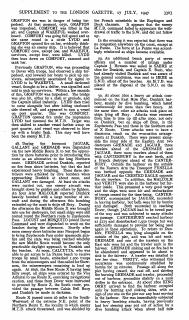
SUPPLEMENT TO THE LONDON GAZETTE, 17 JULY, 1947                                            3303
GRAFTON she was in danger of being tor-               the French minefields hi the Ruytingen and
pedoed. At that moment, 0250, GRAFTON                 Dyck channels.       It appears that the enemy
was torpedoed, COMFORT was lifted in the              M.T.B. command failed to appreciate the with-
air, and Captain of WAKEFUL washed over-              drawal of traffic to the S.W. and did not follow
board. COMFORT was going full speed and as            up.
she came round in a circle "LYDD and                    In the evening it was reported that there was
GRAFTON opened fire on her, evidently think-          no congestion anywhere on the coast, except at
ing she was an enemy ship. It is believed that        La Panne. The force at La Panne was accord-
COMFORT crew, except one, and WAKEFUL                 ingly reinforced as ships became available.
survivors, except four, were killed.        LYDD
then bore down on COMFORT, rammed and                    29. An additional beach party of seven
sank her.                                             officers and a number of ratings under
   Previously GRAFTON, who was proceeding             Captain J. Howson was sailed in SABRE at
to Dover with troops, had observed a ship tor-        1600 for Dunkirk, and Captain E. Bush, who
pedoed, and lowered her boats to pick up sur-         had already visited Dunkirk and was aware of
vivors, subsequently ascertained by signal to         the general conditions, was sent to HEBE as
LYDD to be WAKEFUL. A small darkened                  S.N.O. afloat off the beaches. An M.T.B. was
vessel, thought to be a drifter, was signalled and    placed at the disposal of the S.N.O. on the
told to pick up survivors. Within a few seconds       coast.
of this, GRAFTON was torpedoed. The bridge               30. At about 1600 a heavy air attack com-
was also hit, either by a shell or grenade, and       menced on the East Mole Pier, Dunkirk har-
the Captain killed instantly. LYDD then tried         bour, mainly by dive bombing, which lasted
to come alongside but after hitting starboard         continuously for more than two hours. At
side sheered off, and appeared to ram a vessel        the same time, other air attacks took place on
on port quarter. This was COMFORT.                    ships lying off Bray. Attacks were renewed
GRAFTON opened fire under .the impression             from time to time up till after 2000, not only
LYDD had rammed the M.T.B. Target was                 on Dunkirk, but on ships off Bray, in the
then shifted to another vessel further away on        Zuydecoote Pass and those in the Southern end
port quarter, and vessel was observed to blow         of X Route. These attacks were to have a
up with a bright flash. This may well have            disastrous result on the evacuation arrange-
been the enemy M.T.B.                                 ments at Dunkirk. There were present along-
                                                      side the inner side of the Eastern Arm two
   28. During     the     forenoon     JAGUAR,        destroyers GRENADE and JAGUAR, three
GALLANT and GRENADE were dispatched                   trawlers ahead of the GRENADE and
via the new Middle Route X to test the opposi-        JAGUAR, three more trawlers ahead of them
tion by shore batteries prior to introducing this     with CANTERBURY in the next berth, and
route as an alternative to the long Northern          a French destroyer ahead of the CANTER-
route. GRENADE arrived Dunkirk, reported              BURY. Outside the harbour on the outside
no fire from shore batteries, but that she had        of the Eastern Arm the Transport FENELLA
experienced heavy bombing. These three des-           was berthed opposite the GRENADE and
troyers were attacked by dive bombers when            JAGUAR and the CRESTED EAGLE opposite
approaching Dunkirk at about noon, and                the six trawlers. In addition, the MALCOLM
GALLANT was damaged. At least six attacks             and VERITY were also in the harbour but fur-
were carried out, one enemy aircraft was              ther inside. This presented a very good target
brought down by gunfire and others by fighters.       and the ships were soon hit and embarkation
An hour .-later MALCOLM reported Dunkirk              of troops ceased for the time being. CANTER-
heavily bombed with a large number of air-            BURY, accompanied by JAGUAR, succeeded
craft and during the afternoon this bombing           in leaving harbour, but both were hit by bombs
extended up the coast to ships off Bray. During       and damaged. Both succeeded in reaching
the afternoon the Middle Route X was brought          Dover, though JAGUAR had to be towed part
into use for destroyers, but small ships were still   of the way and was subjected to many attacks
routed round the Northern route to Zuydecoote         on passage. CANTERBURY reached harbour
Pass. LOCUST and MOSQUITO joined Dover                at 2115 and disembarked 1,950 troops but was
Command and were dispatched to work on the            sufficiently damaged to prevent her being used
beaches during the afternoon. Shortly after           again in these operations. To return to Dun-
noon enemy shore batteries near Nieuport began        kirk, FENELLA was lying alongside on the
to bring Zuydecoote Pass under spasmodic gun-         outside of the pier,n and was hit and sunk.
fire and the state was being reached whereby           GRENADE and one of the trawlers on the
the new Middle Route would become the only            East side were hit and the trawler sank in the
practicable daylight approach to Dunkirk and          fairway. GRENADE sinking and on fire had to
the beaches. At noon, CALCUTTA, who was               be abandoned and appeared to be about to
able to get across to La Panne beach to receive        sink in the fairway. A trawler was detailed to
troops by small boats, embarked 1,200 troops          tow her clear. VERITY, who witnessed this
from the minesweepers and then sailed for Sheer-      occurrence • was continuously straddled by
ness, the minesweepers remaining to load up           bombs for 35 minutes. Passage all along the
again. At 1606, the New Route X having been            pier having ceased, she cast off, and skirting
fully swept, all ships were ordered by the Vice        the burning GRENADE and trawler, proceeded
Admiral to use Route X, exercising navigational        out of harbour, grounding: slightly on a sunk
 caution, and those from Dover were instructed         drifter in the entrance. At about 1800 KING
 to proceed by Route Z, the South route, pro-          ORRY arrived to find the harbour occupied
vided the passage between Calais Bell Buoy             only by burning and sinking ships, with no
 and Dunkirk be made in darkness.                      sign of any one on the pier nor any boat moving
   Route X passed some 26 miles to the South-          in the harbour. She was immediately subjected
 Westward of the extreme N.E. point of the             to heavy bombing attacks, having previously
 Northern Route Y, the locality in which enemy         had her steering gear put out of action by^ a
 M.T.B. attack threatened, and was shielded by         dive bombing attack when about half mile
Details
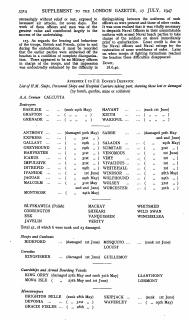
33^4          SUPPLEMENT TO THE LONDON GAZETTE, 17 JULY, 1947
unceasingly without relief or rest, exposed to         distinguishing between the uniforms of such
incessant air attacks, for seven days. The             officers as were present and those of other ranks.
work of these officers and men was of the              It was soon realised that it was vitally necessary
greatest value and contributed largely to the          to despatch Naval Officers in their unmistakable
success of the undertaking.                            uniform with armed Naval beach parties to take
                                                       charge of the soldiers on shore immediately
   113. As regards the bearing and behaviour           prior to embarkation. Great credit is due to
of the troops, British and French, prior to and        the Naval officers and Naval ratings for the
during the embarkation, it must be recorded            restoration of some semblance of order. Later
that the earlier parties were embarked off the         on when troops of fighting formations reached
beaches in a condition of complete disorganisa-        the beaches these difficulties disappeared.
tion. There appeared to be no Military officers
in charge of the troops, and this impression           Dover,
was undoubtedly enhanced by the difficulty in             18.6.40.


                             APPENDIX I TO F.O. DOVER'S DESPATCH
List of H.M. Ships, Personnel Ships and Hospital Carriers taking part, showing those lost or damaged
                               (by bomb, gunfire, mine or collision)
A.A. Cruiser CALCUTTA
Destroyers
  BASILISK                    (sunk 2gth May)          HAVANT                    (sunk ist June)
  GRAFTON                     ( „ „       „ )          KEITH                     ( „ „ „ )
  GRENADE                                              WAKEFUL


  ANTHONY ...                 (damaged soth May) SABRE                           (damaged 30th May
  EXPRESS ...                 (    >?   jISl    ,, )                                    and 2nd June)
  GALLANT ...                 (         29th   „ ) SALADIN ...                   (   „     29th May)
  GREYHOUND                   (    „    29th „ ) SCIMITAR ...                     (   „ 3ist „ )
  HARVESTER                   (         3ist „ ) VENOMOUS                         (   „     ist June)
  ICARUS                      (         3ist „ ) VIMY                             (   „     ist „ )
  IMPULSIVE                   (         3ist „ ) VIVACIOUS ...                    (   „     ist „ )
  INTREPID ...                (         29th „ ) WHITEHALL                        (   „     ist „ )
  IVANHOE ...                 (    „     ist June) WINDSOR ...                    (   „ 28th May)
  JAGUAR                      (    „    2gth May) WOLFHOUND                       (   „ 29th „ )
  MALCOLM ...                 (    „    3ist May WOLSEY     ...
                                    and 2nd June) WORCESTER                                 30th    „
   MONTROSE                    (   ,, 29th May)


   BLYSKAWICA (Polish)                  MACKAY                               WHITSHED
   CODRINGTON                           SHIKARI                              WILD SWAN
   ESK                                  VANQUISHER                           WINCHELSEA
   JAVELIN                               VERITY
 Total 41, of which 6 were sunk and 23 damaged.

 Sloops and Gunboats
   BIDEFORD             ...    (damaged ist June) MOSQUITO ..                     (sunk ist June)
                                                  LOCUST
 Corvettes
   KINGFISHER           ...    (damaged ist June) GUILLEMOT


 Guardships and Armed Boarding Vessels
   KING ORRY (damaged 27th May and sunk 30th May)                            LLANTHONY
   MONA ISLE (        „ 27th May and ist June)                               LORMONT

 Minesweepers
   BRIGHTON BELLE              (sunk 28th May)          SKIPJACK .                (sunk ist June)
  DEVONIA                      ( „ 3Ist „ )             WAVERLEY                  ( „ 29th May)
   GRACIE FIELDS ...           ( „ 28th „ )
Operation Dynamo Map — Movement Logs
Movements recorded for GRENADE during the evacuation period, as plotted on the Operation Dynamo map.
| Departed | Route | Arrived | Troops | Notes | Source |
|---|---|---|---|---|---|
| 28 May 1940, 18:00 | Dover → Dunkirk harbour | 29 May 1940, 05:00 | — |
Attempt
Assumed inbound journey inferred from a dated loss; departure time is not logged
|
Wikipedia: List of ships at Dunkirk — https://en.wikipedia.org/wiki/List_of_ships_at_Dunkirk |
Log in to suggest an evidence-backed edit or a new movement log.