Also known as
No aliases recorded.
Killarney
User Contributed Collection
Documents and descriptions supplied by archive contributors. All submissions are reviewed in accordance with our Terms and Conditions.
No user-contributed documents have been approved for this vessel yet. Use the forms below to contribute images or documents relating to this vessel.

Help complete the archive
Do you have a photo of this vessel you can share?
Contribute photographs of Killarney to the archive for editorial review. Submissions remain private and will only be published following approval by an administrator.
How your photograph will be credited
Exterior · 1940 · Copyright © Example Contributor
Source: Copyright ownership confirmed at submission by Example Contributor.
This example uses the photograph group, year and copyright-holder name supplied in the form. Your own details will replace the example above when an approved image is published.
Already have an account? Log in before uploading to link new photographs immediately.

Help complete the archive
Contribute a document
Share documents or images relating to Killarney for editorial review. Upload up to 12 PDF, JPG, PNG or WebP files per submission, with a maximum size of 20 MB each. Your submission remains private and will only be published following approval by an administrator.
How your document will be credited
Example Document Title · Contributed by Example Contributor
Source: Archive reference supplied by Example Contributor.
This example uses the document title, contributor name and source or archive reference supplied in the form. Your own details will replace the example above when an approved document is published.
ORDE Registry
0 records0 potential matching records have currently been identified.
Further indexing may identify vessel particulars, reported movements, participation assessments, named personnel and source references. The absence of a current match does not establish that no relevant source exists.
We are compiling and checking transcriptions, metadata, vessel-name matches, source references and reuse permissions before publishing further detail. This work helps prevent incomplete OCR, historic spelling variations or unverified associations from being presented as established fact.
Account registrations and access to these developing records are temporarily unavailable. Existing account holders may log in, and everyone can join the newsletter for publication updates.
Small Craft Service List
0 records0 potential matching records have currently been identified.
Further indexing may identify service-list entries, vessel metadata, source-page references and protected full-size document images. The absence of a current match does not establish that no relevant source exists.
We are compiling and checking transcriptions, metadata, vessel-name matches, source references and reuse permissions before publishing further detail. This work helps prevent incomplete OCR, historic spelling variations or unverified associations from being presented as established fact.
Account registrations and access to these developing records are temporarily unavailable. Existing account holders may log in, and everyone can join the newsletter for publication updates.
No Small Craft records.
Red List (1939–40) — OCR
0 records0 potential matching records have currently been identified.
Further indexing may identify OCR text matches, source files, page references and digitised page imagery. The absence of a current match does not establish that no relevant source exists.
We are compiling and checking transcriptions, metadata, vessel-name matches, source references and reuse permissions before publishing further detail. This work helps prevent incomplete OCR, historic spelling variations or unverified associations from being presented as established fact.
Account registrations and access to these developing records are temporarily unavailable. Existing account holders may log in, and everyone can join the newsletter for publication updates.
Ship Details
These details have been aggregated from multiple sources and may include contemporary records, later recollections, claims or assertions for which no corroborating evidence has been identified. Inclusion does not establish that any account or assertion is accurate. The information may be incomplete, out of date, disputed or incorrect and should be checked against the underlying source records and independent evidence before being relied upon.
- Ship type: MN Passenger Ship
Lloyd’s Yacht Register (1939)
Source: Lloyd’s Register Foundation, Heritage & Education Centre, Lloyd’s Register of Yachts 1939, digitised via Internet Archive. Licensed under CC BY-NC-SA 4.0. Images have been converted, resized and watermarked for web display; machine-generated table OCR has been added.
No Lloyd’s records.
Document Collections — Tagged Pages
36 pagesImaged document collections containing pages whose OCR text or table data has been tagged with the name Killarney. Open a collection to view the page images and transcriptions.
Source: Lloyd’s Register Foundation, Heritage & Education Centre, Lloyd’s Register of Yachts 1939, digitised via Internet Archive. Licensed under CC BY-NC-SA 4.0. Images have been converted, resized and watermarked for web display; machine-generated table OCR has been added.

Details
| Jörgensen, A., Masnedsund, Denmark. Kaddara 7 Jourdan, Louis, c/o Sport Nautique Alger, Algiers. Fromista IV 5 | Juliana of the Nether- lands, H.R.H. The Princess, Soestdijk, Holland. m. Piet Hein (P.O.) 141 Junel, | Kay, John, 17, Cleve Road. W. Hampstead, London, N.W.6.-Br.M. m. Noah's Lark 8 | Kearney, John B., 7, Killarney Avenue, Dublin. C.Crz.-Dub.-How.-Ish.C.-Nat. a. Mavis 10 Kearney, P. J., | m. Kaydee 17 Kelham, R. Langdale, M.R.C.S., L.R.C.P., Ulvik, Suffolk Road, Barnes, London, S. W.13.- Mtr. Molly K. 5 |
Contains public sector information licensed under the Open Government Licence v3.0.
Details
/
KILLARNEY (P/V)
(Coast Lines Ltd.)
Capt. R. Hughes,
Master.
28th May
2230
Sailed from the Downs.
29th May
0500
Off Dunkirk.
0700ca
Saw the P/V Nona's Queen blown up by
a mine.
0822
Alongside mole. Embarked approximately
900 troops.
1030
Proceeded.
1123
Off Gravelines, under fire from shore
batteries for 35 minutes. One
direct hit caused damage and 37
casualties of which 8 were fatal.
1200ca
Air attack. saw enemy plane shot
down by R.A.F. fighters.
1230ca
Directed by 3 R.A.F. bombers, picked
up a French officer and 2 Belgian
soldiers from a raft.
1530
Dover. Disembarked 900 troops.
Note: The Killarney was not degaussed.
Authority - R.O.III. p.123.
TM. 6213/40.
The following awards were made:`
Mention in Despatches.
Capt. R. Hughes, Master.
Details
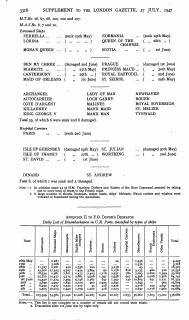
SUPPLEMENT TO THE LONDON GAZETTE, 17 JULY, 1947
M.T.Bs. 16, 67, 68, ioo, 102 and 107.
M.A.S.Bs. 6, 7 and 10.
Personnel Ships
  FERRELLA                        (sunk 29th May)          NORMANIA         (sunk 29th May)
  LORINA                          ( „ „ „ )                QUEEN OF THE     ( „ 28th „ )
                                                                  CHANNEL
   MONA'S QUEEN ...               ( „     „      „ )       SCOTIA       ... ( „ ist June)


   BEN MY CHREE ...              (damaged 2nd June)        PRAGUE           (damaged ist June)
   BIARRITZ                      (    „ 27th May)          PRINCESS MAUD... (    „ aoth May)
   CANTERBURY   ...              (    „ 29th „ )           ROYAL DAFFODIL   (    „ 2nd June)
   MAID OF ORLEANS               (   „ ist June)           ST. SEIROL   ... (   „ 2gth May)


  ARCHANGEL                            LADY OF MAN                                    NEWHAVEN
  AUTOCARRIER                          LOCH GARRY                                     ROUEN
  COTE D'ARGENT                        MALINES                                        ROYAL SOVEREIGN
  KILLARNEY                            MANX MAID                                      ST. HELIER
  KING GEORGE V                         MANX MAN                                      TYNWALD
Total 29, of which 6 were sunk and 8 damaged.

Hospital Carriers
  PARIS                    ...   (sunk 2nd June)


  ISLE OF GUERNSEY (damaged 2gth May) ST. JULIAN                                              (damaged soth May)
  ISLE OF THANET   (   „ 27th „ ) WORTHING                                                    (    „ 2nd June)
  ST. DAVID        (    „    ist June)


  DINARD                               ST. ANDREW
Total 8, of which i was sunk and 5 damaged.
Note.—i. In addition some 23 of H.M. Trawlers, Drifters and Yachts of the Nore Command assisted by taking
           one or more tows of boats to the French coast.
      2. A large number of skoots, launches, motor boats, ships' lifeboats, Naval cutters and whalers were
           wrecked or foundered during the operations.


                              APPENDIX II TO F.O. DOVER'S DESPATCH
                Daily List of Disembarkation in U.K. Ports, classified by types of ships
                                                                           Carriers


                                                                                       to
                       1
                                   ft
                                         0 <D                                                         •3
                                                                                                      |  CO

   Date                                                                                                  Total
                       !1
                                   0>                                                  I
                                   <0

                                         |l
                                                                   a       1
              I                   _p               1
                                                   (6
                                                           1
                                                                                                 0>
                                                                                                         8
                                                   £
              Q        £                 &                 %       «       a           §
                                                                                                        0

26th May             2,287        _        _       _       _
                                                                     24     ___       1,936
                                                                                                 ^        -
                                                                                                                 4,247
27th          —      3,168                 —                                —         2,550                      5,718
28th        ",327 2,161           —
                                  420    i,336     —
                                                   IOO            3,138     —       45           —       —
                                                                                                         —      18,527
29th        15,972 17.525        4,307   1,454    3,894     90    2,158     818 3,133            —
                                                                                                 460     520    50,331
30th        18,554 2,981         7,671   1,477    7.405   1,116   2,931     780 5,293           2,620   2,399   53,227
3ist        25,722 12,477        4,714   2,682    3,976   1,797   2,938     907 4,596           2,026   2,306   64,141
 ist June   14,440               7,594   9,148    2,762     647   1,797     130 10,803           651    2,271   6i,557
 2nd         5,649 4,977         1,842   2,075     900    1,975   2,632          2,649                    905   23,604
 3rd         6,432 7,477         2,552              50      418   2,526          3,oi8           —
                                                                                                 750    4,641   29,641
                                         1,777                              —
 4th         5,303 10,013        1,940   1,079    1,200     418   2,023     —    2,637          1,116   1,960   27,689
  Total... 103,399 74,380 31,040 21,028          20,287   6,461 20,167    2,635 36,660          7,623 15,002 338,682

Notes.—i. This list is not complete as a number of vessels did not record their totals.
       2. Evacuation after ist June was by night only.
Source: The National Archives, Kew, ADM 116 4649. Contains public sector information licensed under the Open Government Licence v3.0.

Details
Page 16.
Page 15.
Operation "DYNAMO" - Recommendations of Personnel - List 'B'
PERSONNEL SHIPS AND HOSPITAL CARRIERS.
KILLARNEY.
Commanding Officer.
Richard Hughes, Master.
LADY OF MANN.
Commanding Officer.
Thomas C. Woods, Master.
LOCH GARRY.
Commanding Officer.
Ewen Mackinnon, Master.
PRAGUE.
Commanding Officer.
Clifford Roland Baxter, Master.
PRINCESS MAUD.
Commanding Officer.
Harry Clark, Master.
TYNWALD.
Officers.
Radio Officer Charles Mason.
Purser William Edward Lister.
Ratings.
3351
Carpenter, John Gawne.
Donkeyman, A. Allen.
or/

Details
Wt. 22622/4318 50M 9/38 S.E.R. Ltd. Gp. 671.
09)
base 6801 Val 2
03VC
Register No.
Minute Sheet No.
Naval of the Secretary. Merchant have been inserted on the instructions and men of
The following Navy additional names of officers
D.S.C.
Mr. David Douglas Robb, Chief Engineer, ISLE OF GUERNSEY.
Mr. William MacGregor, Chief Engineer, KING GEORGE V.
Mr. George Clifford Frederick Todley, Second Engineer, MAID OF ORLEANS.
Mr. Rowland Baxter, Master, PRAGUE.
Mr. Walter Ernest Oxenham, Chief Engineer, PRAGUE.
Mr. A.Patterson, Chief Officer, ROYAL DAFFODIL.
Mr. Andrew Sinclair, Chief ineer, ROYAL SOVEREIGN.
Mr. A.B. Freeman, First Officer, ST. HELIER.
Mr. H.Whiteway, Master, TYNWALD.
Mr. Charles Mason, Radio Officer, TYNWALD.
D.S.M.
Quartermaster Henry Russell, MAID OF ORLEANS.
Donkeyman Albert Delamain, ROYAL DAFFODIL.
Chief Steward Thomas Edward Manser, ROYAL SOVEREIGN.
Quartermaster Clarence T. Walkey, ST.HELIER.
Mention in Despatches. (Posthumous)
Fireman A. Phillips, BIARRITZ.
Mention in Despatches.
Captain R.Hughes, Master, KILLARNEY.
Captain C.G. West, O.B.E., Master, NEPHRITE.
Captain H. Clarke, Master, PRINCESS MAUD.
Captain J.N. Larbalestier, Master, ROEBUCK.
Mr. W.Lister, Purser, TYNWALD.
Carpenter J.Garre, TYNWALD.
Donkeyman A.Allen, TYNWALD.
Jumph 25th July, 1940.
Naral Secretary.
Naval Secretary has given orders for the following further
names to be inserted:-
Mention in Despatches.
Captain Thomas C. Woods, Master, LADY OF MANN.
/Captain A.M. Poole, Master, LADY SOUTHBOROUGH. (Hopper Barge).
Captain Ewen Mackinnon, Master, LOCH GARRY.
Captain R.G. Banks, Acting Master, Lighter X.209.
Captain William Josiah Penny, Master, Tug St. Clears.
/Captain Robert Durrant, Master, Drifter LORD RODNEY.
/Captain John William Dickinson, Master, NGORAMA.
vMr. Victor Smith, Mate, Drifter JAVA.
/Mr. Raymond Crane, Engineer, M.V. LAROC.
Mr. Jack Lynn, Mate, M.V. LAROC.
Xxxx Steward H.A.E. Frost, M.V. LAROC.
Deckhand Leonard Lynn, M.V. LAROC.
deshington
for Naval Secretary
28th July, 1940.
Source: The National Archives, Kew, ADM 199 792. Contains public sector information licensed under the Open Government Licence v3.0.

Details
164
163
APPENDIX I.
Page 2
of
and final.
181
Operation "DYNAMO"
-
Narrative of Events.
FLARE BURNING
BOY ROY
GOLDEN GIFT
PAXTON
DRIFTER:
EILEEN EMMA
GOLDEN SUNBEAM
SHIPMATES
FORECAST
LORD HOWARD
THE BOYS
GERVAIS RENTOUL
LORD HOWE
TORBAY II
GIRL GLADYS
MIDAS
UT PROSIM
GIRL PAMELA
NETSUKIS
YORKSHIRE LASS
YOUNG MUN
GUARDSHIPS AND
LORMONT
MONA'S ISLA
KING ORRY
A.B.V's:
LLANTHONY
CORVETTES:
KINGFISHER
G
ILLEMOT
F.A.A.
AIR FORCE
GRIEVE
AMULREE
TRAINING VESSEL:
M.T.B's:
16
M.A.S.B's:
6
67
7
68
10
100
102
107
PERSONNEL SHIPS:
ARCHANGEL
LOCH GARRY
PRINCESS MAUD
AUTOCARRIER
LORINA
QUEEN OF THE CHANNEL
BEN MY CHREE
HAID OF ORLEANS
ROUEN
BIARRITZ
MALINES
ROYAL DAFFODIL
CANTERBURY
MANX MAID
ROYAL SOVEREIGN
COTE D'ARGENT
MANX- MAN
SCOTIA
FENELLA
MONA'S QUEEN
ST. HELIER
KILLARNEY
NEWHAVEN
ST. SEIRIOL
KING GEORGE V
NORMANIA
TYNWALD
LADY OF MAN
PRAGUE
OSPITAL CARRIERS: DINARD
ISLE OF GUERNSEY ST. ANDREW
ISLE OF THANET ST DAVID
PARIS
ST JULIAN
WORTHING
OTE:
In addition, some 23 of H.M. Trawlers, Drifters and
Yachts of the Nore Command assisted by taking one or more
tows of boats to the coast.

Details
| WORCESTER (I) 450 | KILLARNEY 900 | FITZROY 107 | MARMION 290 | TWENTE 390 |

Details
APPENDIX I.
Page 2
of
and final.
Operation "DYNAMO" - Narrative of Events.
URNING
BOY ROY
GOLDEN GIFT
PAXTON
:
EILEEN EMMA
GOLDEN SUNBEAM
SHIPMATES
FORECAST
LORD HOWARD
THE BOYS
GERVAIS RENTOUL
LORD HOWE
TORBAY II
GIRL GLADYS
MIDAS
UT PROSIM
GIRL PAMELA
NETSUKIS
YORKSHIRE LASS
YOUNG MUN
IPS AND
LORMONT
MONA'S ISLE
KING ORRY
:
LLANTHONY
ES:
KINGFISHER
GUILLEMOT
CE
GRIEVE
G VESSEL:
i
16
M.A.S.B's:
6
67
7
68
10
100
102
107
EL SHIPS:
ARCHANGEL
LOCH GARRY
PRINCESS MAUD
AUTOCARRIER
LORINA
QUEEN OF THE CHANNEL
BEN MY CHREE
HAID OF ORLEANS
ROUEN
BIARRITZ
MALINES
ROYAL DAFFODIL
CANTERBURY
MANX MAID
ROYAL SOVEREIGN
COTE D'ARGENT
MANX MAN
SCOTIA
FENELLA
MONA'S QUEEN
ST. HELIER
KILLARNEY
NEWHAVEN
ST. SEIRIOL
KING GEORGE V
NORMANIA
TYNWALD
LADY OF MAN
P. LGUE
L CARRIERS: DINARD
ISLE OF GUERNSEY ST. ANDREW
ISLE OF THANET ST. DAVID
PARIS
ST. JULIAN
WORTHING
In addition, some 23 of H.M. Trawlers, Drifters and
achts of the Nore Command assisted by taking one or more
OWS of boats to the coast.

Details
| WORCESTER (I) 450 | KILLARNEY 900 | FITZROY 107 | MARMION 290 | TWENTE 390 |

Details
Page 15.
Operation "DYNAMO" - Recommendations of Personnel - List 'B'
PERSONNEL SHIPS AND HOSPITAL CARRIERS.
KILLARNEY.
Commanding Officer.
Richard Hughes, Master.
LADY OF MANN.
Commanding Officer.
Thomas C. Woods, Master.
LOCH GARRY.
Commanding Officer.
Ewen Mackinnon, Master.
PRAGUE.
Commanding Officer.
Clifford Roland Baxter, Master.
PRINCESS MAUD.
Commanding Officer.
Harry Clark, Master.
TYNWALD.
Officers.
Radio Officer Charles Mason.
Purser William Edward Lister.
Ratings.
Carpenter, John Gawne.
Donkeyman, A. Allen.

Details
18.
Han
Ordinary Seaman Bert Marston, P/JX.175182, H.M.S. Worcester.
Ordinary Seaman John Philip Charles Mead, LT/JX.193106, H.M.Y.Christock
Ordinary Seaman Hugh Watson Miller, C/JX.170010, H.M.S. Royal Eagle.
Ordinary Seaman Frank Arthur Victor Patrick, C/JX.171302, H.M.S.Crest
Eagle.
Ordinary Seaman Thomas Edgar Whyte, R.N.V.R., CD/X.133, Newhaven
Life Boat Rosa Wood and Phyll
Lund.
Seaman Arthur George Farrow, LT/JX.179655, H.M.S. Glenavon.
Seaman George Fred Mathews, R.N.P.S., LT/JX.185264, H.M.D.The Boys.
Seaman Raymond Allenby Stone, R.M.R., X.19746A, H.M.S. Jaguar.
Ordinary Signalman Victor Albert Leslie Shallis, LD/X.4505, H.M.
Danlayer Gulzar.
Stoker Second Class Ralph Kearvell, P/KX,87052,H.M.S. Worcester
Stoker John Pirie, R.N.R., X.10415,S., H.M.D. Dorienta.
Second Hand John Malcolm Fenwick, LT/JX.185753, H.M.Y. Alouette 1.
Engineman James Smith, H.M. H Drifter Douenta.
Fireman John Develand Connell, T.124, H.M.S. Medway Queen.
Cook George Henry Cliefe, T.124, H.M.Danlayer Gulzar.
Deckhand Charles
E
Baldry, T.124, H.M.Danlayer Gulzar.
Captain William Hay Baker, Master, S.S. Biarritz.
Captain Herbert Cecil Bond, Master, S.S. St. Andrew.
Captain II
F
Boyce, Master, Hopper Barge 24,
Captain George Beaumont Butler, Master, M.V.Laroc.
Captain John Willimm Dickinson, Master, Ngorama.
Captain Henry Clarke, Master, Princess Maud.
Captain RederickJohn Hopwood, Master, Tug Lady Brassey.
Captain Eyril Glad west Hughes, O.B.E., S.S. Master, S.S. Nephrite.
Captain R chard Hughes, Master, Killarney.
Captain Welfred # yvon Larbalestier, Master, S.S Roebuck.
Captain Ewen Mackinnon, Master, Loch Garry.
Captain William Josiah Penny, Master,
Lord Rodney.
Captain
A
M
Pooke, Master,
Lady Southborough.
Captain Thomas C
Woods, Master,
Lady of Mann.
Captain R
G
Banks, Acting Master, Lighter X.209.
Mr. John William Ailwyn Jones, Chief Officer, Hospital Carrier Vinard
Mr. Reginald Frederick Pembry, Chief Officer, Hospital Carrier Isle
Mn Arthur Patrick Joseph Paterson, First Officer, M.
Mr. Jack Lynn, Mate, M.V.Laroc.
Mr. Victor Smith, Mate, Java.
Service,
Mr. John Bingham Woodhouse, Second Officer, S.S. Prague it Massey Shaw
London Fire
Brigade Wire Flo

Details
CONFIDENTIAL.
Page 3.
Operation "DYNAMO" - Work of Personnel Vessels.
Personnel Vessels (continued).
remaining; she started a trip but failed to make Dunkirk. On
return, original Captain rejoined with some of the original
crew. She should then have sailed at 2010/3, but the Captain
reported 3 engineers short at the last minute. It was not
to wait for the engineers and the Master
and the new crew provided for the second
time. Before further use could be made of her, however, the
evacuation terminated.
9. The MONA'S QUEEN was sunk by a mine on her second
voyage to Dunkirk, and the FENELLA was bombed and sunk on her
first voyage.
10. The MALINES who had completed two trips, refused to
sail on the 1st, left Dover at 1600 on the 2nd without orders and
was subsequently found to have proceeded to Southampton.
11. It was felt that trouble might occur in the ST. HELIER
and PRINCESS MAUD, and accordingly a naval party was put on
board to supplement the ships crews, and in consequence no
trouble occurred,
12. The outstanding ships were the MAID OF ORLEANS 6 trips,
one being diverted without completing the trip, and once
returning due to collision. ROYAL DAFFODIL 7 trips, on one of
which she was turned back by a French destroyer -
ROYAL SOVEREIGN 6 trips
KING GEORGE V
5 trips
COTE a' ARGENT
5 trips
ST. HELIER
4 trips after having refused to
sail once.
PRAGUE
3 trips with full loads, bombed,
severely damaged and
beached on the last return
trip.
13. Eleven other ships were concerned in the Operation,
details of which are as follows:
27th May BIARRITZ
Damaged by shell fire and returned.
27th May
ARCHANGEL
Damaged by shell fire and returned.
27th May
QUEEN OF THE
Sunk by bombing attack.
CHANNEL
28th May LORINA
Sunk by bombing attack.
29th May
NORMANIA
Sunk by bombing attack.
28th May LOCH GARRY
One trip.
28th May SCOTIA
One trip.
2nd June
1111
Sunk by bombing attack.
28th May KILLARNEY
One trip.
2nd June ROUEN
One trip.
2nd and 3rd
June AUTO CARRIER Two trips.
2nd and 3rd
June
NEWHAVEN
Two trips.
ce
of
Enclosure:-
ER. Officer Commanding,
Details of Personnel
June, 1940.
Ships used.

Details
| KILLARNEY | 1 | 800 |

Details
Page 15.
Operation "DYNAMO" - Recommendations of Personnel - List 'B'
PERSONNEL SHIPS AND HOSPITAL CARRIERS.
KILLARNEY.
Commanding Officer.
Richard Hughes, Master.
LADY OF MANN.
Commanding Officer.
Thomas C. Woods, Master.
LOCH GARRY.
Commanding Officer.
Ewen Mackinnon, Master,
PRAGUE.
Commanding Officer.
Clifford Roland Baxter, Master.
PRINCESS MAUD.
Commanding Officer.
Harry Clark, Master.
TYNWALD.
Officers.
Radio Officer Charles Mason.
Purser William Edward Lister.
Ratings.
Carpenter, John Gawne.
Donkeyman, A. Allen.
Source: The National Archives, Kew, ADM 199 795. Contains public sector information licensed under the Open Government Licence v3.0.

Details
| 28th May KILLARNEY 2nd | Sunk by bombing attack. One trip. |

Details
| KILLARNEY | 1 | 800 |

Details
| KILLARNEY | 125 |

Details
14
All Cheques and Money Orders to be made payable to DATED MACBRATSE Lro., and crossed.
8'
ALL PASSENGERS, LUCGAGE, 00008 AND LIVE STOON, ARE CARRIED SUBJECT TO THE CONDITIONS
SPECIFIED ON THE COMPANY'S SAILING BILLS, NOTICES AND ANNOUNCEMENTS.
125
GLASGOW AND HIGHLAND ROYAL MAIL STEAMERS
DAVID MACBRAYNE Limited,
REFER TO
STEAM PACKET OFFICE.
19
To
II
Subject
it Vessel which was not lit, we chopped the Slar
wer with 4 5. fthms cable, as the night was chark +
until 3 some on the 29 may when we proceeded at the
may, -gmal 00 11. 25, am alongside and Demkingue we had to wait
but Hinder Buy st 6.48am and at Breakwater. nieupost
ary, speed along the route channel, 8.45am arriving at the
im in the offing, slow there to respond being so to many the helm ships alongside. m the
tide was low, and falling, our
wr turn for going alongside when * shallow "Killarney"
hallow the vissel water, was and drawing 16 ft aft draft. the We missed
sipped in ahead of us and pinshed birth I
inished loading. a turn screw vissel the of berth we draft
ight to will have gott the The brakwater next available where the water was mishap, could were
EM was shallow, but up we slipped into it without any DN three
nd immediately commenced embarking troops for of aft.
have ang Leistenant ways we met which commander, two wore very regged brave who up wore min, temporary carrying The Ammander on their and work,
nd directing operations shells the wore some chroping as of no in but danger the Harhar
his cisted bout 50 yards The Jerry from the fow There of the was vessel, nothing ama but Comate they
longside of every us, and loaded his our
and not pine appear where to explode around, a Destroyer complainent THE up
XIII
E A
to DUILKIPK at 0030 on the Tat inst. Mole. arriving Low water just and before wroks
Proceeded again at the end borth of the Tast alongaide this ship
daybreak berthing berthing more difficult. destroyers ship. berthed
making and loaded over I856 the deck troops of this (including about 400 French active, troops) both
when By this the time ship it was alongside and after she had at
This ship then embarked was daylight and enemy bombers left became to more return to Dover,
which On the port evening we arrived of the during same day the orders morning. were received to proceed to Dunkirk
and while this leaving vessel Dover laft Harbour, at 2030 H.M.S. Worcester collided with this ship, holing
third tal thi @ ar
inileile 1smg of th
this Dover laft Ha
Source: The National Archives, Kew, ADM 234 360. Contains public sector information licensed under the Open Government Licence v3.0.

Details
TUESDAY, 28TH MAY
CHAP. V
had all come under fire from the shore guns at Calais and Gravelines. At
0415 on the 28th May the Queen of the Channel, loaded with 904. troops, was
attacked by one aircraft; 3 or 4 bombs were dropped, which straddled the ship
abaft the mainmast and broke her back, the starboard propeller shaft and the
rudder. By good fortune the Dorrien Rose, en route for Dunkirk, was in the
vicinity and rescued the troops : the Queen of the Channel sank about 1/2 hour
later. The St. Seiriol, which left Dunkirk at about 0415 with 494 troops,
reached Folkestone in safety.
Civilian crews feel the strain
Some 45 personnel vessels were used during operation "Dynamo"
Of these eight were sunk, at least six were so damaged by bombing or gunfire
as to render them unfit for further use during the operation, and two were
damaged in collision. Nine of the largest of these personnel vessels had been
engaged prior to "Dynamo" in operations at Dunkirk, Calais and Boulogne,
and their Captains and crews were beginning to feel the strain when Operation
"Dynamo" started.
Thus it was that the Master of the Canterbury, which had already completed
2 round trips to Dunkirk in operation "Dynamo", reported, on the 28th May,
that he was too worn out to make a third trip. The P.S.T.O. went on board
and explained the gravity of the situation to the Master, and the Canterbury
sailed at 0930 the next day. On her return voyage from Dunkirk she was
bombed and damaged, and after landing her 1960 troops went into dock for
repairs. In the 3 trips she made the Canterbury brought back 4,416 troops;
her Master, Captain C. A. Hancock, was awarded the D.S.C.
Personnel vessels not to be employed during full daylight
On the 28th May, however, it had become apparent that development of
the German air threat over the evacuation area, and the increasing artillery
fire from shore batteries covering the sea approaches to Dunkirk, prohibited
the employment of personnel and similar vessels during daylight, until the
position was restored, and that evacuation from Dunkirk by day must for the
moment be confined to warships and small vessels².
It was not, therefore, until later in the day, that the P/V Royal Daffodil
sailed for Dunkirk, and eight other personnel vessels and a hospital carrier³
received their sailing orders during the afternoon and evening.
The northern Route Y was by this time in general use⁴, but ships proceeding
from Dover to Dunkirk were ordered to use the southern and shorter Route Z,
if the passage from Calais Bell buoy to Dunkirk could be made in darkness.
N.O.I.C. Ramsgate responsible for servicing skoots
In these circumstances some 20 skoots reached Dunkirk, or arrived off the
beaches during the day and evening of the 28th May; others were on the way.
Their speed varied, but most of them were very slow. Eight of them went
into Dunkirk harbour⁵, and four to Bray beach⁶. The Abel Tasman, loaded
with ammunition, the Alice and Kaap Falga, loaded with food, and three
I This number includes 3 store ships, 3 motor vessels and a few freighters, coasters and
tramps.
2 D.R. p. 4, para. 13.
3 The Scotia, Malines, Prague, Manxman, Royal Sovereign, Tynwald, Lochgarry, Killarney
and the H.C. Paris.
4 Appendix K.1.
5 The Caribia, Fredanja, Friso, Jutland, Tilly, Patria, Sursum-Corda, and Twente.
6 The Amazone, Doggersbank, Hilda, and Oranje.
29

Details
THE EVACUATION FROM DUNKIRK
CHAP. VI
and returned to harbour; the remainder Chantecler reached and the La Panne at 0500/30.
Dutch eel-boats Johanna and Chantecler M.B. Golden Lily also The
and Ramsgate " compass at which 2200/29. was reached situated The the over beaches, the was engine. however, only capable revolved at 0900 of slowly 4 knots, round and and left her
she had no charts, lost way 30th Later darkness, and returned to
and brought back 30 troops. her in the Downs in the get over on May,
round"¹. She The Johanna did not on the 30th
Ramsgate on the morning of the May. on that day she was towed
to the beaches by the skoot Jutland.
Troops transported on 29th May
reduction in the number of destroyers available and with failure to achieve
The 29th May closed with a formidable list of ships lost or damaged, a marked
the high rate of evacuation hoped for. The effect of the day's occurrences
even more marked next day, when instead of the 50,000 to 60,000 British was
troops which had been calculated as the probable achievement, only 48,000 odd
were in fact transported.²
Nevertheless, 47,310 troops (including some 2,000 casualties) were landed
in England on the 29th May (see Table 2), 13,752 having been lifted from the
beaches and 33,558 from the harbour. Only about 11 per cent of these were
French troops³, whose organised evacuation had not yet begun. (See Appen-
dices Y.2 to Y.5).
During the morning and forenoon of the 29th May, when there was no
bombing of Dunkirk harbour, 1Q personnel vessels⁴ lifted 14,760 troops from
the east pier; during the afternoon, in spite of the bombing, the Canterbury
lifted a further 1,960.
The development of beach evacuation is indicated by the fact that nearly
21 times the number of troops were lifted from the beaches on 29th May as
compared with the number lifted on the previous day. Seventeen destroyers
each made one round trip during the 24 hours of the 29th May and an eighteenth
destroyer, the Icarus, made two such trips. On these trips the 18 destroyers
embarked and transported to England 10,694 troops of which 6,198 were
lifted from the beaches and 4,506 from Dunkirk harbour. Nine minesweepers⁶
together lifted 2,426 troops from the beaches although one of them, the Albury
did not land her troops in England until the next day.⁷ Among other ships
which brought back troops from the beaches was the cruiser Calcutta with
1,200.
The record of troops landed in England now stood as follows :-
From the
From the
Total for
beaches
harbour
the day
26th May
Nil
Nil
Nil
27th May
Nil
7,669
7,669
28th May
5,930
11,874
17,804
29th May
13,752
33,558
47,310
I Report by Chantecler.
40,724. This figure probably puts does not include troops carried by foreign ships (See Prague,
3 2 D.R., D.R. p.11, which para. incidentally 38. the total of troops and casualties landed on 29th Table May 2). as
The Côte d'Argent, Killarney, King George V, Maid of Orleans, Manxman,
Javelin, Malcolm, Express, Verity, Wolsey and Marmion
Royal 5 The Daffodil, Anthony, Royal Codrington, Sovereign, Esk, Scotia, and Tynwald. Greyhound, Harvester, Intrepid, Worcester. Ivanhoe,
6 The Albury, Duchess Sabre, of Scimitar, Fife, Emperor Shikari, of Vanquisher, India, Fitzroy, Halcyon, Hebe, Leda,
and Sharpshooter.
7 See Table 3, in conjunction with the reports of ships' proceedings in Vol. II.
54

Details
CHAP. VI
THE EVACUATION FROM DUNKIRK
Ramsgate at 2200/29. situated over the engine. capable of 4 knots, also and left
Dutch eel-boats Johanna The Chantecler was only M.B. Golden Lily The
and returned to harbour; and the remainder Chantecler reached and the La Panne at 0500/30.
and brought back lost troops. her in the Downs in the get over on May,
and round"¹. She 30 The Johanna did not on the 30th and
compass which was reached the beaches, however, revolved at 0900 slowly round her
Ramsgate on the morning on that day she was towed
she had no charts, of way the 30th May. Later darkness, and returned to
to the beaches by the skoot Jutland.
Troops transported on 29th May
reduction in the number of destroyers and with failure to
The 29th May closed with a formidable available list of ships lost or damaged, a marked
the high rate of evacuation hoped for. The effect of the day's occurrences achieve
even more marked next day, when instead of the 50,000 to 60,000 British was
were in fact transported.²
troops which had been calculated as the probable achievement, only 48,000 odd
Nevertheless, 47,310 troops (including some 2,000 casualties) were landed
in England on the 29th May (see Table 2), 13,752 having been lifted from the
beaches and 33,558 from the harbour. Only about 11/2 per cent of these were
French troops³, whose organised evacuation had not yet begun. (See Appen-
dices Y.2 to Y.5).
During the morning and forenoon of the 29th May, when there was no
bombing of Dunkirk harbour, 1Q personnel vessels⁴ lifted 14,760 troops from
the east pier; during the afternoon, in spite of the bombing, the Canterbury
lifted a further 1,960.
The development of beach evacuation is indicated by the fact that nearly
2½ times the number of troops were lifted from the beaches on 29th May as
compared with the number lifted on the previous day. Seventeen destroyers⁵
each made one round trip during the 24 hours of the 29th May and an eighteenth
destroyer, the Icarus, made two such trips. On these trips the 18 destroyers
embarked and transported to England 10,694 troops of which 6,198 were
lifted from the beaches and 4,506 from Dunkirk harbour. Nine minesweepers6
together lifted 2,426 troops from the beaches although one of them, the Albury
did not land her troops in England until the next day.⁷ Among other ships
which brought back troops from the beaches was the cruiser Calcutta with
1,200.
The record of troops landed in England now stood as follows :-
From the
From the
Total for
beaches
harbour
the day
26th May
Nil
Nil
Nil
27th May
Nil
7,669
7,669
28th May
5,930
11,874
17,804
29th May
13,752
33,558
47,310
I Report by Chantecler.
3 D.R., which incidentally puts the total of and casualties landed on 29th Table May 2). as
2 D.R. p.11, para. 38.
40,724. This figure probably does not include troops carried by foreign ships (See Prague,
4 The Côte d'Argent, Killarney, King George troops V, Maid of Orleans, Manxman,
Royal Daffodil, Royal Sovereign, Scotia, and
Javelin, Malcolm, Sabre, Scimitar, Verity, Wolsey and Worcester. Marmion
5 The Anthony, Codrington, Esk, Express, Tynwald. Greyhound, Harvester, Intrepid, Ivanhoe,
6 The Albury, Duchess of Fife, Emperor Shikari, of Vanquisher, India, Fitzroy, Halcyon, Hebe, Leda,
and Sharpshooter.
7 See Table 3, in conjunction with the reports of ships' proceedings in Vol. II.
54

Details
| Killarney (Capt. R. Hughes, Master) | 900 |

Details
INDEX
Johanna,54, 60.
John, and Norah, 71n.
39, 43-4. D.
G., 76.
G. de S. (P.S.T.O. 60. Dover), 48.
Jutland, 47n, 54,
Keith, at Boulogne, 9-10; In Dynamo, 55, 64, 66, 67 (flag of R.A. Dover), 71, 74, 76, 86,
Kaap Falga, 20, 29.
88-90 (sunk).
Kellett, 28n, 32, 41, 46, 97, 107n, 89. 109, 114n, 116-7, 119.
Kenward, Lt. (E) W. H., killed,
Kestrel, 72n.
Kingfisher, 60, 87, 89 (damaged), 114n, 116 (rammed), 117.
Killarney, 29n, 54n.
King George V, 54n, 94, 107n, 108-9, 114n, 116, 119.
King Orry, 16, 19, 28, 45 (sunk), 97 (damages Dunkirk pier).
Kingston Alalite, 34n, 110.
Kingston Andalusite, 34n.
Kingston Galena, 34n.
Kingston Olivine, 110.
Koeltz, General, 19.
Kuno, 20n, 24n.
Lady Brassey, 28n, 36, 91, 104.
Lady Haig, 72n.
Lady of Mann, 48n, 87, 107n, 109 (sent back empty), 114n, 118.
Lady Philomena, 34n, 91.
Lady Robinson, 94 (sunk).
Lady Rosebery, 71n.
Lady Sheila, 60.
Lady Southborough, 72n.
La Flore, 107n, 109.
Lahloo, 66, 71n.
Laidsell, Lt. Gen. W. G. (Q.M.G.), 8, 26, 59, 90.
Lambart, Capt. Hon. L. J. O., R.N. (ret.), lost, 93.
Lansdowne, 72n.
La Panne. See Beaches.
Lark, 71n, 95 (sunk).
Laroc, 60.
Leda, 28n, 32, 54n, 97, 114n, 116 (sinks Maréchal Foch), 118.
Lena, 20, 24, 27-8, 100, 116 (lost), 117.
Léopard, 73, 99, 107n.
Letitia, 73.
Lewes, Lt. Cdr. J. H., 45.
Lewis, Cdr. E. R., 106.
L.H.W.D., 114n.
L'Impétueuse, 62.
Llanthony, 71n.
Lloyd, General, 84.
Lochgarry, 29n, 39, 41.
Locust, 46, 58, 87, 107n, 108, 114, 116, 119.
Lord Barham, 71n.
Lord Cavan, 32n, 98 (sunk).
Lord Collingwood, 32n, 47n.
Lord Grey, 45.
Lord Hood, 71n.
Lord Howard, 23n, 107n.
Lord Howe, 13, 23n.
Lord Keith, 32n, 47n.
Lord Melchett, 85.
Lord Rodney, 47n.
Lord St. Vincent, 32n, 47n.
201
Source: The National Archives, Kew, MT 40 36. Contains public sector information licensed under the Open Government Licence v3.0.

Details
Page 4.
OF SHIPS WHICH TOOK PART IN OPERATION "DYN/MO" - 26TH MAY - 4TH JUNE, 1940.
PART I - - BRITISH SHIPS (contimued)
PERSONNEL AND HOSPITAL SHIPS
ARCHANGEL
MANXMAN
AUTOCARRIER
MONA'S QUEEN
BEN-MY-CREE
NEWHAVEN
BIARRITZ
NEPHRITE (Store Ship)
CANTERBURY
NGAROMA
CLAN MACALISTER
NORMANIA
COTE D'ARGENT
PARIS (Hospital)
COTE D'AZUR
PRAGUE
DINARD (Hospital)
PRINCESS MAUD
DORIAN ROSE (Store Ship)
QUEEN OF THE CHANNEL
FENELLA
ROEBUCK
FOAM QUEEN
ROUEN
ISLE OF GUERNSEY (Hospital)
ROYAL DAFFODIL
ISLE OF THANET (Hospital)
ROYAL SOVEREIGN
KILLARNEY
ST. ANDREW (Hospital)
KING GEORGE V
ST. DAVID (Hospital)
LADY OF MAN
ST. HELIER
LEVENWOOD (Store Ship)
ST. JULIAN
LOCH GARRY
ST. SEIRIOL
LORINA
SCOTIA
MAID OF ORLEANS
TYNWALD
MALINES name
WORTHING (Hospital)
MANXMAID
of Inen
WHITSTABLE
OTHER BRITISH SHIPS
ADVENTURESS
BONNY BELLE
AGNESS CROSS (Life-boat)
BOURNEMOUTH LIFE-BOAT
ALBATROSS III
B.P. ONE
ALOUETTE
BRITANNIA
ANDORA
BULLFINCH
ANDORA II (R.A.F. Launch)
CABBY
ANNE IV
CANVEY QUEEN
ATHOLA
CAVERSHAM (M.B.)
AURA
CHAMOIS (Lighter)
BAIL
CHERFIELD
BAT (Lighter)
CLAUDE (Water Boat)
BEE (Lighter)
COMMODORE
BELFAST
CONSTANT NYMPH
BLACK ARROW
CORDELIA
BLACK JAVA
CORNELIA
BLACKPOOL
C. 9
)
BOBELI (Motor Cruiser)
(Tugs)
C. 11
)
BONNY HEATHER
C.Y. 63
DABB II
DEFENDER
DHOON (Trawler)
Sunk
(Continued)
Source: The National Archives, Kew, MT 40 66. Contains public sector information licensed under the Open Government Licence v3.0.

Details
Page 4.
LIST OF SHIPS WHICH TOOK PART IN OPERATION "DYNAMO" - 26TH MAY - 4TH JUNE, 1940.
PART I - BRITISH SHIPS (contimued)
PERSONNEL AND HOSPITAL SHIPS
ARCHANGEL
MANXMAN
AUTOCARRIER
MONA'S QUEEN
BEN-MY-CREE
NEWHAVEN
BIARRITZ
NEPHRITE (Store Ship)
CANTERBURY
NGAROMA
CLAN MACALISTER
NORMANIA
COTE D'ARGENT
} french
PARIS (Hospital)
COTE D'AZUR
PRAGUE
DINARD (Hospital)
PRINCESS MAUD
DORIAN ROSE (Store Ship)
QUEEN OF THE CHANNEL
FENELLA
ROEBUCK
FOAM QUEEN
ROUEN
ISLE OF GUERNSEY (Hospital)
ROYAL DAFFODIL
ISLE OF THANET (Hospital)
ROYAL SOVEREIGN
KILLARNEY
ST. ANDREW (Hospital)
KING GEORGE V
ST. DAVID (Hospital)
LADY OF MAN
ST. HELIER
LEVENWOOD (Store Ship)
ST. JULIAN
LOCH GARRY
ST. SEIRIOL
LORINA
#
SCOTIA
MAID OF ORLEANS
TYNWALD
MALINES
WORTHING (Hospital)
MANXMAID
WHITSTABLE
OTHER BRITISH SHIPS
ADVENTURESS
BONNY BELLE
AGNESS CROSS (Life-boat)
BOURNEMOUTH LIFE-BOAT
ALBATROSS III
B.P. ONE
ALOUETTE
BRITANNIA
ANDORA
BULLFINCH
ANDORA II (R.A.F. Launch)
CABBY
ANNE IV
CANVEY QUEEN
ATHOLA
CAVERSHAM (M.B.)
AURA
CHAMOIS (Lighter)
BAIL
CHERFIELD
BAT (Lighter)
CLAUDE (Water Boat)
BEE (Lighter)
COMMODORE
BELFAST
CONSTANT NYMPH
BLACK ARROW
CORDELIA
BLACK JAVA
CORNELIA
BLACKPOOL
C. 9 (Tugs)
BOBELI (Motor Cruiser)
C. 11
BONNY HEATHER
C.Y. 63
DABB II
DEFENDER
DHOON (Trawler)
Sunk
(Continued)

Details
| S.S. "KILLARNEY" | JAYOR" .8.8 |

Details
June,
CONFIDENTIAL.
Page 3.
Operation "DYNAMO" - Work of Personnel Vessels.
Personnel Vessels (continued).
remaining; she started a trip but failed to make Dunkirk. On
return, the original Captain rejoined with some of the original
crew. She should then have sailed at 2010/3, but the Captain
reported 3 engineers short at the last minute. It was not
considered necessary to wait for the engineers and the Master
and crew disembarked and the new crew provided for the second
time. Before further use could be made of her, however, the
evacuation terminated.
9. The MONA'S QUEEN was sunk by a mine on her second
voyage to Dunkirk, and the FENELLA was bombed and sunk on her
first voyage.
10. The MALINES who had completed two trips, refused to
sail on the 1st, left Dover at 1600 on the 2nd without orders and
was subsequently found to have proceeded to Southampton.
11. It was felt that trouble might occur in the ST.HELIER
and PRINCESS MAUD, and accordingly a naval party was put on
board to supplement the ships crews, and in consequence no
trouble occurred.
12. The outstanding ships were the MAID OF ORLEANS 6 trips,
one being diverted without completing the trip, and once
returning due to collision. ROYAL DAFFODIL 7 trips, on one of
which she was turned back by a French destroyer -
ROYAL SOVEREIGN 6 trips
KING GEORGE V
5 trips
COTE d'ARGENT
5 trips
ST. HELIER
4 trips after having refused to
158 rgdl
sail once.
PRAGUE
3 trips with full loads, bombed,
85mght
severely damaged and
beached on the last return
trip.
13. Eleven other ships were concerned in the Operation,
details of which are as follows:
27th May BIARRITZ
27th May
Damaged by shell fire and returned.
ARCHANGEL
27th May
Damaged by shell fire and returned.
QUEEN OF THE
Sunk by bombing attack.
CHANNEL
28th May
LORINA
Sunk by bombing attack.
29th May
NORMANIA
Sunk by bombing attack.
28th May LOCH GARRY
One trip.
28th May SCOTIA
One trip.
2nd June
THE
28th May KILLARNEY
Sunk by bombing attack.
One trip.
2nd June ROUEN
One trip.
2nd and 3rd
Acapt R.
June AUTO CARRIER
Two trips.
2nd and 3rd
June NEWHAVEN
Two trips.
fice of
Enclosure:-
g Officer Commanding,
Details of Personnel
ER.
Ships used.
2 June, 1940.
authorized.

Details
| KILLARNEY | 1 | 800 |

Details
-3-
nip.
Name & Address of Owners
Name of Master.
SS MAUD
London Midland & Scottish
Capt. H. Clarke.
IA
Railway,
Capt. W.H. Hughes.
L.M.S. Railway Headquarters,
Watford, Herts.
ST. SEIRIOL
Liverpool & North Wales
Capt. R.D. Dobb
S.S. Co., Ltd.,
40, Chapel Street,
Liverpool, 3.
/PRAGUE
London & North Eastern
Capt. C. Baxter.
Railway Company,
26, Glengall Road,
Woodford Green,
Essex.
KING GEORGE V
David MacBrayne Limited,
Capt. R.E. MacLean.
LOCHGARRY
44, Robertson Street,
Capt. E. MacKinnon.
Glasgow, C.2.
KILLARNEY
Coast Lines Limited,
Capt. R. Hughes.
2, Crescent Road,
Kingston-on-Thames,
Surrey.
ST. HELIER
Great Western Railway Co.,
Capt. R. Pitman
c/o Chief Docks Manager,
Cardiff.
ST JULIEN
Great Western Railway Co.,
Capt.L.S.Richard
ST ANDREW
Paddington Station, W. .2.
Capt. H.C. Bond
ST DAVID
Capt. C.Joy.
PARIS
Capt. E. Biles
ISLE OF GUERNSEY
Southern Railway Co.,
Capt. F.W. Hodges
DINARD
Waterloo Station,
Capt. P. Lewis
WORTHING
S.E.L.
Capt. C.J. Munton
ISLE OF THANET
>
Capt. A.J. Hammond
60
&
These Masters took over when original Masters were too exhausted to
carry on.
x Evacuation of Calais.
+ This vessel was ordered to Dunkerque laden with B.E.F. petrol and
did not actually evacuate, troops.
INED
orized.

Details
Time
THE
145
to
впогов
.
wode
bus
OF
DUNKIRK OPERATIONS.
BLUOW
123RF
*
yous
RECEIVED
11111121
S.S. "LOCHGARRY"
-
bases DEVITIS Salamod TTTS Mod %
(Lirt
16
Report by Captain Ewen MacKinnon.
35
SW
BROW
The "LOCHGARRY" having been fitted out in Greenock for a special charter,
Les
we were placed on six hours' notice, and having got over the ordeal of signing
on for foreign articles, and the vessel really ready for sea - trimmed
with ballast, and fitted with equipment of all kind, all of us were "straining
OF
at the leash" to get away from the Clyde, somewhere. It did not matter very
Sags Jedw
much where, so long as we were away from the Clyde!
When the orders did come at last they came at the most unexpected and
awkward hour - at 10 p.m. Proceed to sea, so and so. Nearly every one of
Juods
the crew were now at their homes having waited till late, and all being satisfied
that there would be no orders till next morning. But it was my lookout to sail
ONJ
the ship on time, and the crew had to be roped in someway. The P.O. was closed
load
for telegrams and telephone, but I managed to get in touch with them all by
another method, and with one or two exceptions I got them all together before
sailing time.
We then started off from the Clyde for an altogether different destination
from what we expected, and what we fitted out particularly for. We arrived in
Liverpool in good order and waited for some days expecting to do some useful
work, but in this we were disappointed, for the job we were hoping to do did
not come off, viz., to carry Belgian refugees to a certain Island.
We spent several days in Liverpool in the Stanley Dock in company with the
S.S. "KILLARNEY", and everything went very well until one night after 6 p.m.
orders were received to raise steam at once and proceed to Dover without a
moment's delay on any account - get out of the dock by midnight and proceed at
full speed on a certain track down channel. In this we were successful, but
the "KILLARNEY" did not manage, so we missed her company that night! Pilot on
board and all ready we left the dock on time, and proceeded to the Bar where we
discharged the Pilot, shouting, "Good-Night, Captain, Good-Night, and the best
of luck, for I know you need all the luck you can get tonight". So we plunged
forth into a pitch black night without a speck of light, nor was there any
light to be seen for some time after.
We got along very well that night, and at daybreak we got all the points of
land we were looking for. We had hundreds of charts on board, but none of
them was of any use to us for navigating through the Irish and English Channels
except a magnetic variation chart of the British Isles, so when we got down as
far as the Bishop Light we were so to speak "off the map". The magnetic
variation chart was a rough guide, but surely we could get to Dover even
without that itself, for Captain Pell took good care to see that we were
supplied with Norie's Epitome and all other essential books and instruments on
which we could "at a pinch" navigate on a blank sheet of paper. However, we
got to Dover in record time and were all ready for action as soon as we had fuel
and water.
We approached the Downs in the early hours of the morning before daybreak,
and were picking out a suitable anchorage, when a hail of machine-gun bullets
from either an enemy or one of our own, hit us on the vessel's port side - I
cannot say which as a fight was in process overhead at the time. The Mate,
with a smile, commented that he did not think this was very healthy. "Well,
whether healthy or not you better get the anchor ready for dropping!" This
being done, we anchored until after breakfast time, when a Pilot came on board
and put us in the right anchorage.
During/

Details
- 2 -
56
During the time we were anchored in this place we could, during the
day, hear the roar and fury of the guns and mines on the French coast, the
concussion of which was shaking the "LOCHGARRY" at her anchorage twenty-one
miles away, and at night the same pounding went on with the addition of
immense fires shooting up in the sky - "Calais" on fire? I took bearings by
compass to verify this; it came out to a degree and next morning we heard the
wat" asid OMJ 202 STOW ent
news. At night the dropping of magnetic mines round about was a common
occurrence, and the rat-tat-tat of the Spitfires chasing the enemy away, until
at last nobody was going to bother getting out of his bed to see them. But
if you did get up you were sure to find you were not the only one, although
they had faithfully promised to stick to their bunks. They would be in their
stocking soles, keeking out in some corner. It would be like a great display
adw dom
of fireworks, and one would wonder how many tons of lead were active in the
sky after the minelayer, or whether he would manage to get clear.
On May 28th at 4.30 a.m. orders were received to proceed to Dover for
one
fuel and water at 6 a.m., and at 7.5 p.m. same day we loaded provisions and
made various preparations for going to Dunkirk. At 8.56 p.m. we cast off from
one
Admiralty Pier bound for Dunkirk by a certain route. The night was dark and
hazy, and when we nearly bumped up against the North Goodwin Light vessel,
which was not lit, and after a bit of shouting to the light vessel, I dropped
anchor and we were at stand-easy till 3 a.m. Having no light of any kind we
had to keep a very good lookout. We felt a mighty wash rocking the ship fore
and aft, and right close beside us five destroyers passed at full speed, without
apparently taking the slightest notice. Shortly after another large ship
was bearing down on us, and passed quite close, and after heaving up anchor we
could still see her hull faintly in the gloom. We made up on her and afterwards
learned this was the "CLAN MACALISTER" which I guessed to be going the same way
as ourselves, as by now Dunkirk was the only place on the coast where she could
be going.
At 6.48 a.m. on the 29th May we were at the West Hinder Buoy. Behind us,
tearing along at top speed, was what well may have been termed the "Channel
Fleet". the swift steamers that had left Dover in the early morning, among
them being the "KING GEORGE V". Each as they passed the "LOCHGARRY" gave us
a hearty wave of hands and bonnets. All of them soon passed; on our port
bow was a British Destroyer, and one which we recognised as the one funnel
Polish Destroyer. They were going round in a circle which was gradually
getting smaller, both of them, I believe, taking cross bearing on a submarine.
When the circle got to the smallest possible round they each dropped several
depth charges about the same spot. We were watching for wreckage, but did not
successfully. see any. This would be the smallest depth at which a submarine could operate
A while later the Mate said he saw what appeared to be a spent torpedo
on the surface, but I did not see it. But if there was a submarine in that circle
he certainly is there yet! Now we were in the channel from which the enclosed
photo was taken (bottom picture), and the Mate and I argued as to whether it
was whin bushes or men that covered the sand dunes. On looking through the
binoculars we found that what appeared to be whin bushes were really armies of
the B.E.F. It was hardly credible, but true, the beach was strewn with wrecks
of ships at all angles, and motor lorries which were hardly visible, being
camouflaged, were dashing backwards and forwards.
We steamed along the channel which was some ten miles to Dunkirk Breakwater.
The Breakwater was fully occupied when we arrived there - two and three steamers
abreast. They were the steamers that had passed on the way in, and as many
destroyers, and who would be at the outer end of the Breakwater but the
S.S. "KILLARNEY" our sparring partner. This was a great surprise. How did
she get there? We left her in Dover, and they certainly did not pass us on the
way. But the secret was that the "KILLARNEY" was not degaussed and for that
reason they came by a different route from us! She was loaded with troops to
full capacity and had a very heavy list to starboard, away from the Breakwater,
and it was apparent that there was something wrong. Her belting had caught on
the Breakwater with the falling tide; eventually the belting gave way and she
was free to go, and backed out of the Harbour, closed up to us and waved, then
full away the way she had come good luck to them.
The/

Details
- 3 -
37
code is Doe to
The tide was low, and falling, and we had to wait our turn in the offing.
The channel was narrow and shallow. My ship was very slow to respond to the
helm in such shallow water. The current was fairly strong and sweeping us
or
STORE BALL CBP & STATE STATES ROZ
in a westerly direction. I was greatly concerned as to whether there was
sufficient water alongside the Breakwater for the "LOCHGARRY" as we were
drawing 16 ft. of water by the stern, and if there was a possibility of
JBP
sticking in the entrance to the Breakwater, for if the vessel grounded in that
particular part not only would I have to wait till she floated again, but the
entire traffic to the Breakwater, in and out, would be suspended. This would
be disastrous when every moment counted a day. There were much larger vessels
than the "LOCHGARRY" at the Breakwater, but they were shallow drafts. But
the "KILLARNEY" was in and out, and there was not much difference between our
drafts. A shallow draft vessel which was in the offing with us quickly
OF
manoeuvred and nipped into the "KILLARNEY'S" berth which should have been ours
1991
by turn. The next available berth I could see was well up the Breakwater
e.b.e.
where the water was even more shallow, so we slipped into it without any
mishap and immediately commenced embarking troops on three gangways which were
used
rigged up temporarily fore and aft.
know
There we met two very brave and cheerful men - the Commander and the
Lieutenant Commander, who were carrying on their work and directing operations
as if no danger existed. There was no bustle or commotion, but everything
was orderly and well regulated. The Jerry shells were dropping in the
Harbour about 50 yards from the bow of the "LOCHGARRY" at 11.25 a.m. when we
were fixed in our berth, but they did not appear to explode, and all of them
could be heard coming, screaming through the air, through the smoke and haze,
and dropping in the very centre of the harbour. They had the range perfectly.
Well, it was all right so long as they did not alter it a degree the one way
or the other. There was nothing but thick black smoke and fire everywhere
round the harbour, and parts of several sunken vessels were projecting in the
inner harbour at low water.
A destroyer came alongside of us and loaded his complement over our
vessel. While this was taking place we had our first sample of an air raid,
as the pall of haze to the westward had now cleared up and the sun was breaking
through the clouds, and the day generally was brightening up and getting warm.
The Jerry planes we saw as mere specks in the sky, working sunwards to get in
a straight line between us and the sun, then swinging round and,
"Ere he pounces in the ring,
Selects the object of his spring".
When they started on the dive, down sun, you could hear the death zoom
getting clearer and clearer, down and down they came, the A.A. guns on the
destroyers going like electric sewing machines. In a fraction of a second,
about the time the bombs were due to arrive, there was a mighty roar and a
blast of hot air which nearly carried us off our feet. The destroyer had
fired one of his heavy guns which burst a shell in front of the enemy and
shattered him and his bombs to matchwood. I don't think that pilot had time
to jump in his parachute at least I did not see him!
The next wave came along shortly after, and the tactics on both sides
were somewhat similar to the first. Then the embarking went on as before.
I had hoped to count the exact number that came on board, and told the Mate
to place a man at each gangway to count. The man who was placed at the
forward gangway had a yarn with every one that came on and soon forgot the
count. The man at No. 2. gangway, which was constructed of oars across the
lifeboat, told me when I asked him for the count, that it took him all his
time to keep the men from falling in the water, far less count them. The
man at No. 3. gangway did not know he was supposed to count until nearly
half the troops were on board; and then what about the ones that were passing
through to the destroyer? It was hopeless! However, the estimated number
on board the "LOCHGARRY" was about 2,500, and we cast off the Breakwater at
2.00 p.m.

Details
LINES. LIMITED.
of
inch
Crescant
the
40
Kingston-m Lurrey Kimmes
the
assist ine day in in the May, we 194
M.6213/40/S.T.A.6
15th August, 1940.
lternative routes,
As we left at night,
TM.
round past Calais
192
11 navigational aids
The Sir, Director have of to acknowledge the receipt WF/MH,
chor off Gravelines
e. With the break of
The sky was
of your Square letter of the 14th August'
ng oil dumps and
ilitary to prevent
and to thank you for the most
ving off Dunkirk
interesting report made by the Master
'S, while other vessels
;ime, we were keeping
and Chief Officer of the s.s. "KILLARNEY" letter
Company's ships, which
of the regarding 7th their experiences during to
ng her come up astern
which you of account by the
were watching her,
Mas Dunkirk operations. the
a terrific explosion, and
of the the "KILLARNEY" in the Sir, of the
ud of smoke. When the
from Dunkirk am,
the mainmast aft had
I am, Your obedient Servant,
ard part heeled over
result of a magnetic
Your (Sgd.) obedient B. E. BELLAMY
nt alongside the
Director of Sea Transport.
ing troops of all
ases. Some of these
Secretary.
ur days and four
The Secretary
Lines Limited,
extreme difficulty
canine population
vith us. These
IS, as their own
SURREY.
see them trying to
were shot on the
nessed an attack
aircraft.
Bombs fell all
planes drove them off.
ner, but none registered a hit. Eventually our fighter
to
This
On completion of loading troops we returned by
the same route as we had taken to come in, and on passing
Gravelines again the fun started. Sailing quietly along, the tired
and weary troops stretched R. out all over the ship, snatching their
for the Ministry) managed
by
G.S.N.)
Lowed
ing th
GS and
our
entrance enemy
Newman of
bombs. A call for assisted
th an escort
the British Mission two destroyers had previously would INIVIA be waiting for the me aircraft off the
consisting port. This of attack lasted for half an hour when
returned to Ostend.

Details
COAST LINES, ADMINISTRATIVE LIMITED. 4
TELEGRAMS
2, Crescent Road,
40
COASTWISE.
KINGSTON-ON-THAMES
Kingston on Thames,
ine day in May, we
TELEPHONE
assist in the
194
KINGSTON 4541-4
Surrey.
lternative routes,
YOUR REF.
OUR REF.
TM. 6213/40/8.T. 6.
As we left at night,
WF/MH
ALL COMMUNICATIONS TO BE ADDRESSED TO THE COMPANY.
round past Calais
14th August, 1940
11 navigational aids
The Director of Sea Transport,
chor off Gravelines
20
e. With the break of
Ministry of Shipping,
193
The sky was
one
Berkeley Square House,
ng oil dumps and
Berkeley Square.
ilitary to prevent
LONDON W. 1.
ving off Dunkirk
PS, while other vessels
"KILLARNEY"
ime, we were keeping
Sir,
Company's ships, which
With reference to your letter
of the 7th instant, I beg to enclose here- to
for the purposes of the record
ng her come up astern
with, which you refer, copy of an account by the
were watching her,
and Chief Officer of the experience
a terrific explosion, and
Master of the "KILLARNEY" in the evacuation of the
ud of smoke. When the
the mainmast aft had
B.E.F. from Dunkirk.
ard part heeled over
I am, Sir,
result of a magnetic
Your obedient Servant,
Drame
nt alongside the
ing troops of all
ases. Some of these
Secretary.
r days and four
extreme difficulty
anine population
15/16/19
15
ith us. These
GROUP
AUG
S, as their own
12
940
see them trying to
were shot on the
ENCLOSURE.
nessed an attack
aircraft.
Bombs fell all
ner, but none registered a hit. Eventually our fighter
planes drove them off.
On completion of loading troops we returned by
the same route as we had taken to come in, and on passing
Gravelines again the fun started. Sailing quietly along, the tired
and weary troops stretched out all over the ship, snatching their
for the Ministry)
by
G.S.N.)
Lowed
ing the
GS and
ouo
Newman of
entrance enemy
bombs. A call for assistance
an escort
the British of Mission two destroyers had previously would INIVIA be waiting hour when for the me aircraft off the
consisting port. This attack lasted for half an
returned to Ostend.

Details
COPY
S. Y. "KILLARNEY"
40
Anchored in the Downs, one fine day in May, we
received orders to proceed to Dunkirk to assist in the
194
evacuation of the B.E.F. We were given alternative routes,
one for daylight and one for night time. As we left at night,
we took the darkness route, which took us round past Calais
and then along the coastline eastward.
Owing to misty weather, and all navigational aids
being obliterated, we were compelled to anchor off Gravelines
till daylight. This we did without trouble. With the break of
day, we hove up and proceeded to Dunkirk. The sky was
absolutely black with the smoke from burning oil dumps and
tanks, which had been set on fire by the military to prevent
their being of any use to the enemy. Arriving off Dunkirk
Breakwater, we had to lay off for some hours, while other vessels
were filling up with troops. During this time, we were keeping
a look-out for the "LOCHGARRY" one of our Company's ships, which
was also on the same mission.
We saw a steamer much resembling her come up astern
of us, using the daylight route. Whilst we were watching her,
trying to ascertain who she was, there was a terrific explosion, and
the centre part of her disappeared in a cloud of smoke. When the
smoke cleared away, her stern portion from the mainmast aft had
vanished, and in about two minutes the forward part heeled over
and sank. So passed the "MONA'S QUEEN" as a result of a magnetic
mine.
About an hour after this, we went alongside the
Breakwater, and immediately commenced embarking troops of all
regiments, and including several stretcher cases. Some of these
cases had been carried by their chums for four days and four
nights. Whilst embarking the troops, we had extreme difficulty
in preventing what appeared to be the whole canine population
of France and Belgium from taking a passage with us. These
animals had attached themselves to the Tommies, as their own
people had fled, and it was rather pitiful to see them trying to
get aboard after their new friends. Hundreds were shot on the
quay to prevent their starving to death.
Whilst we were alongside, we witnessed an attack
on a ship just outside, by German aircraft. Bombs fell all
round her, but none registered a hit. Eventually our fighter
planes drove them off.
On completion of loading troops we returned by
the same route as we had taken to come in, and on passing
Gravelines again the fun started. Sailing quietly along, the tired
and weary troops stretched out all over the ship, snatching their
for the Ministry) maged
by
G.S.N.
Lowed
ing the
GS and
our
Newman of
entrance enemy
bombs. A call for assisted
an escort
the British of Mission two destroyers had previously would be waiting hour when for the me aircraft off the
consisting port. This attack lasted for half an
returned to Ostend.

Details
OTH
To
BERO
-2-
195
barl
first decent rest for days, three German batteries of six inch
sht
30%
TOTAL
guns opened fire on us. The first shot fell just short of the port
wing of the bridge. We immediately put the ship astern on to the
STATE
shore and increased speed and zigzagged. Our engineers rendered
yeoman service by belching out smoke in an effort to form a screen.
This manoeuvring also caused a certain amount of anxiety owing to
the fact that we were sailing over sand banks out of a swept
channel, and we were not degaussed. In all, about ninety shots
were fired, and the whole action lasted about forty minutes. It
0808
FLAT
is with great regret that we have to report that one shell
registered a hit on the after end of the boat deck, and falling
amongst a group of men, killed eight and wounded thirty. We
happened to have one R.A.M.C. doctor on board, and he tackled his
task with great zeal, and very mediocre assistance from our
Medicine Chest, as gunshot wounds and the dressings thereof are not
included in the Board of Trade statutes!
About a quarter of an hour after the shelling had
ceased, and we were once more breathing more or less freely, an
enemy aircraft appeared overhead and let a burst of machine gun
fire just over our masts. We manned our Lewis guns and waited to
welcome the raider on his next round, but to our great delight a
Spitfire came right out of the clouds on to the German's tail, and
giving him a good burst of his guns sent the enemy crashing in
flames into the sea, on our port side, about 600 yards away. We
did not dally any further to look for survivors.
Later, in response to our wireless signals sent out
during the bombardment by the shore batteries, three of our bombers
appeared and escorted us. After flying round a bit they indicated
to us to alter course, which we did, and eventually sighted a raft
bearing one French Officer and two Belgian soldiers. The raft, when
we got alongside of it, was a very flimsy affair, made of old wood
and an old door. The commissariat of the raft was most complete -
two tins of biscuits and six demi johns of wine. Also, carefully
lashed on the raft was a bicycle of ancient vintage. We picked up
the occupants, and the troops had extreme difficulty in explaining
that they could not accommodate the bicycle, but could manage to
find efficient storage for the demi johns. In the finish we
didn't get either.
On proceeding, quietness reigned, and never to any of
the crew have the white cliffs of Dover looked so welcome as when
se
they loomed up through a slight haze. We steamed into Dover Harbour
g
and alongside the quay, discharged our troops, and landed the killed
and wounded. When this was accomplished, we went to the oil jetty,
and had to wait for several hours while other ships were bunkering.
This did not really cause a great deal of inconvenience, as, in
the manner of all good sailor men we turned in and slept.
So ended an episode of the "KILLARNEY" at Dunkirk.
R. HUGHES. Master.
G.H. Clark. CHIEF OFFICER.
in-
for the Ministry) managed by
Lowed
ing the
GS and
our
entrance enemy
Newman of
bombs. A call for assistance
an escort
the British of Mission two destroyers had previously would be waiting for the me aircraft off the
consisting port. This attack lasted for half an hour when
returned to Ostend.
Operation Dynamo Map — Movement Logs
Movements recorded for Killarney during the evacuation period, as plotted on the Operation Dynamo map.
No reviewed movement log is currently published for this vessel.
Log in to suggest an evidence-backed edit or a new movement log.