Also known as
MEDWAY QUEEN
User Contributed Collection
Documents and descriptions supplied by archive contributors. All submissions are reviewed in accordance with our Terms and Conditions.
No user-contributed documents have been approved for this vessel yet. Use the forms below to contribute images or documents relating to this vessel.
Help complete the archive
Do you have a photo of this vessel you can share?
Contribute photographs of MEDWAY QUEEN to the archive for editorial review. Submissions remain private and will only be published following approval by an administrator.
How your photograph will be credited
Exterior · 1940 · Copyright © Example Contributor
Source: Copyright ownership confirmed at submission by Example Contributor.
This example uses the photograph group, year and copyright-holder name supplied in the form. Your own details will replace the example above when an approved image is published.
Already have an account? Log in before uploading to link new photographs immediately.
Help complete the archive
Contribute a document
Share documents or images relating to MEDWAY QUEEN for editorial review. Upload up to 12 PDF, JPG, PNG or WebP files per submission, with a maximum size of 20 MB each. Your submission remains private and will only be published following approval by an administrator.
How your document will be credited
Example Document Title · Contributed by Example Contributor
Source: Archive reference supplied by Example Contributor.
This example uses the document title, contributor name and source or archive reference supplied in the form. Your own details will replace the example above when an approved document is published.
Wikipedia vessel details
Secondary-source table data; verify against primary records where available.
- Name
- HMS Medway Queen (J48)
- Pennant number
- J48
- Flag
- Royal Navy
- Description
- Paddle minesweeper
- Built
- 1924
- Tonnage
- 316
- Commanding officer
- T/Lt. Alfred Thomas Cook, RNR
- Trips to Dunkirk
- 7
- Troops landed
- 2,914
- Notes
- Not stated
Dunkirk-related passages from the linked page
The PS Medway Queen is a paddle driven steamship, the only mobile estuary paddle steamer left in the United Kingdom. She was one of the "little Ships of Dunkirk", making a record seven trips and rescuing 7,000 men in the evacuation of Dunkirk.[3] In May 1940 Operation Dynamo was launched to rescue retreating British Army soldiers from Dunkirk in northern France. HMS Medway Queen became part of the flotilla of little ships.[11] She left with paddle steamers Sandown, Thames Queen, Gracie Fields, Queen of Thanet, PS Princess Elizabeth, Laguna Belle and Brighton Belle.[11] She made seven crossings.[11] On her second trip she took about 450 soldiers directly off the beach;[12] this required more skill, but was much faster. Soldiers used a technique with oily bags to conceal their distinctive wash from patrolling aircraft. On later trips, the Medway Queen penetrated the damaged Dunkirk port and took off men from a concrete jetty or mole.[11] Men were discharged at Ramsgate rather than Dover, where the vessel was fuelled and reprovisioned.[11] On Monday 3 June Vice Admiral Ramsey gave the order that all ships were to leave Dunkirk by 2.30 the following morning. This was the Medway Queen's seventh trip. She was at the mole in Dunkirk when a destroyer moored astern of her was driven forwards by an explosion and smashed her starboard paddle box, she sustained considerable damage.[11] Medway Queen limped back to Dover with 400 French soldiers on board. On arriving back at Dover the crew of the Medway Queen discovered that the Admiralty had reported their ship as having been sunk (news which was reported throughout the UK);[14] the Admiralty published a correction the following morning.[15] Her crew gained seven awards for gallantry – two Distinguished Service Crosses,[16] three Distinguished Service Medals[17] and two mentions in dispatches[18] – having made seven crossings and rescued 7,000 men.[11] In view of this remarkable achievement in rescuing so many Allied troops from France, she earned the title of "The Heroine of Dunkirk".[13] After repairs in Portsmouth Dockyard, she returned to minesweeping duties, and in 1942 she was converted to a minesweeping training ship, serving out the war in this capacity, and was returned to her owners in January 1946.[10][9] She made her last sailing on 8 September 1963,[19] and was scheduled to be scrapped in Belgium.[20] The Belgian ship-breaker, upon discovering that the vessel he was expecting to break up was "The Heroine of Dunkirk", declined to continue (it is reported that he felt that no one should dare to destroy such a gallant and important little ship). The Daily Mail campaigned to save her.[21] In 2025 it was announced that, for about eleven days in May, the Medway Queen would be a centrepiece at Ramsgate harbour during the 85th Anniversary of Operation Dynamo. She was expected to see off around 70 Little Ships, accompanied by naval warships,[30] which planned to cross the Channel to Dunkirk on 21 May, and to welcome their return to Ramsgate on 26 May, weather permitting.[31][32][33] 1940 – became part of the flotilla of ships evacuating British Army soldiers from Dunkirk during Operation Dynamo. After making seven trips (the record number of crossings by any merchant navy ship involved in the evacuation), she rescued over 7,000 men, gaining for the ship's crew seven awards for gallantry, and shot down three enemy aircraft. At one time during the evacuation, she was overdue and was thought to have been lost with all hands and troops – but she eventually arrived back at Dover, ready to return to France for more troops. The efforts of the ship and her crew earned the paddle steamer the title of "Heroine of Dunkirk" 1963 – taken out of service, with the possibility of being broken up, but the Belgian shipbreaker declined to break up the "Heroine of Dunkirk" ↑ .mw-parser-output cite.citation{font-style:inherit;word-wrap:break-word}.mw-parser-output .citation q{quotes:"\"""\"""'""'"}.mw-parser-output .citation:target{background-color:rgba(0,127,255,0.133)}.mw-parser-output .id-lock-free.id-lock-free a{background:url("//upload.wikimedia.org/wikipedia/commons/6/65/Lock-green.svg")right 0.1em center/9px no-repeat}.mw-parser-output .id-lock-limited.id-lock-limited a,.mw-parser-output .id-lock-registration.id-lock-registration a{background:url("//upload.wikimedia.org/wikipedia/commons/d/d6/Lock-gray-alt-2.svg")right 0.1em center/9px no-repeat}.mw-parser-output .id-lock-subscription.id-lock-subscription a{background:url("//upload.wikimedia.org/wikipedia/commons/a/aa/Lock-red-alt-2.svg")right 0.1em center/9px no-repeat}.mw-parser-output .cs1-ws-icon a{background:url("//upload.wikimedia.org/wikipedia/commons/4/4c/Wikisource-logo.svg")right 0.1em center/12px no-repeat}body:not(.skin-timeless):not(.skin-minerva) .mw-parser-output .id-lock-free a,body:not(.skin-timeless):not(.skin-minerva) .mw-parser-output .id-lock-limited a,body:not(.skin-timeless):not(.skin-minerva) .mw-parser-output .id-lock-registration a,body:not(.skin-timeless):not(.skin-minerva) .mw-parser-output .id-lock-subscription a,body:not(.skin-timeless):not(.skin-minerva) .mw-parser-output .cs1-ws-icon a{background-size:contain;padding:0 1em 0 0}.mw-parser-output .cs1-code{color:inherit;background:inherit;border:none;padding:inherit}.mw-parser-output .cs1-hidden-error{display:none;color:var(--color-error,#bf3c2c)}.mw-parser-output .cs1-visible-error{color:var(--color-error,#bf3c2c)}.mw-parser-output .cs1-maint{display:none;color:#085;margin-left:0.3em}.mw-parser-output .cs1-kern-left{padding-left:0.2em}.mw-parser-output .cs1-kern-right{padding-right:0.2em}.mw-parser-output .citation .mw-selflink{font-weight:inherit}@media screen{.mw-parser-output .cs1-format{font-size:95%}html.skin-theme-clientpref-night .mw-parser-output .cs1-maint{color:#18911f}}@media screen and (prefers-color-scheme:dark){html.skin-theme-clientpref-os .mw-parser-output .cs1-maint{color:#18911f}}"Medway Queen". adls.org.uk. Association of Dunkirk Little Ships. 2021. Retrieved 5 April 2025. ↑ "Medway Queen". Association of Dunkirk Little Ships. Retrieved 18 September 2021. 1 2 3 4 5 6 7 Kempton, John. "Dunkirk - Operation Dynamo 1940". Medway Queen Preservation Society. Retrieved 13 January 2022. 1 2 3 4 Mace, Martin (30 July 2017). The Royal Navy at Dunkirk: Commanding Officers' Reports of British Warships In Action During Operation Dynamo. Frontline Books. ISBN 978-1-4738-8672-8. ↑ "900 British Craft in the Dunkirk Operations". The Yorkshire Post and Leeds Mercury. 4 June 1940. ↑ "Minesweeper "Lost" - Now Safe". The Evening Telegraph. 4 June 1940. ↑ "Dunkirk rescue boat gets revamp". BBC News Online. 17 April 2009. Retrieved 17 April 2009. ↑ Lawrie, Sam (9 May 2025). "70 Dunkirk Little Ships to sail from Ramsgate Royal Harbour to Dunkirk for the 85th anniversary of Operation Dynamo". Kent Online. Retrieved 11 May 2025. ↑ "Medway Queen Dunkirk Commemoration 2025". allatsea.co.uk. All At Sea. March 2025. Retrieved 11 May 2025. ↑ "85th Anniversary of Operation Dynamo, Ramsgate" (PDF). visitramsgate.co.uk. Visit Ramsgate. 2025. Retrieved 11 May 2025. ↑ "Medway Queen to return to Ramsgate for Dunkirk Commemoration". nationalhistoricships.org.uk. National Historic Ships UK. Retrieved 11 May 2025.
ORDE Registry
7 records7 potential matching records have been identified.
These records may contain vessel particulars, reported movements, participation assessments, named personnel and source references. A match does not by itself prove that the vessel participated in Operation Dynamo.
“Potential match” means a candidate returned by one or more indexing rules; it is not necessarily an exact identity match. Depending on the source, matching may use a normalised vessel name, a partial text or OCR hit, an alias, or related metadata. Roman-numeral suffixes such as I, II, III, IV and V may be absent, misread or separated from the base name, so records for similarly named vessels can be grouped incorrectly. Multi-word names can also produce candidates where only one significant word matches. Confirm the full name, numeral, vessel type, dimensions, builder, ownership, dates and source context before treating two records as the same vessel.
We are compiling and checking transcriptions, metadata, vessel-name matches, source references and reuse permissions before publishing further detail. This work helps prevent incomplete OCR, historic spelling variations or unverified associations from being presented as established fact.
Account registrations and access to these developing records are temporarily unavailable. Existing account holders may log in, and everyone can join the newsletter for publication updates.
Small Craft Service List
0 records0 potential matching records have currently been identified.
Further indexing may identify service-list entries, vessel metadata, source-page references and protected full-size document images. The absence of a current match does not establish that no relevant source exists.
We are compiling and checking transcriptions, metadata, vessel-name matches, source references and reuse permissions before publishing further detail. This work helps prevent incomplete OCR, historic spelling variations or unverified associations from being presented as established fact.
Account registrations and access to these developing records are temporarily unavailable. Existing account holders may log in, and everyone can join the newsletter for publication updates.
No Small Craft records.
Red List (1939–40) — indexed references
These references come from the Red List index. Printed page numbers may differ from digitised image numbers; OCR may not reproduce the vessel name accurately.
- Medway Queen — ADM 208/2, printed page 10
- Medway Queen — ADM 208/2, printed page 7
- Medway Queen — ADM 208/2, printed page 10
Red List (1939–40) — OCR
8 records8 potential matching records have been identified.
These records may contain OCR text matches, source files, page references and digitised page imagery. A match does not by itself prove that the vessel participated in Operation Dynamo.
“Potential match” means a candidate returned by one or more indexing rules; it is not necessarily an exact identity match. Depending on the source, matching may use a normalised vessel name, a partial text or OCR hit, an alias, or related metadata. Roman-numeral suffixes such as I, II, III, IV and V may be absent, misread or separated from the base name, so records for similarly named vessels can be grouped incorrectly. Multi-word names can also produce candidates where only one significant word matches. Confirm the full name, numeral, vessel type, dimensions, builder, ownership, dates and source context before treating two records as the same vessel.
We are compiling and checking transcriptions, metadata, vessel-name matches, source references and reuse permissions before publishing further detail. This work helps prevent incomplete OCR, historic spelling variations or unverified associations from being presented as established fact.
Account registrations and access to these developing records are temporarily unavailable. Existing account holders may log in, and everyone can join the newsletter for publication updates.
Ship Details
These details have been aggregated from multiple sources and may include contemporary records, later recollections, claims or assertions for which no corroborating evidence has been identified. Inclusion does not establish that any account or assertion is accurate. The information may be incomplete, out of date, disputed or incorrect and should be checked against the underlying source records and independent evidence before being relied upon.
No additional ship details available.
Lloyd’s Yacht Register (1939)
Source: Lloyd’s Register Foundation, Heritage & Education Centre, Lloyd’s Register of Yachts 1939, digitised via Internet Archive. Licensed under CC BY-NC-SA 4.0. Images have been converted, resized and watermarked for web display; machine-generated table OCR has been added.
No Lloyd’s records.
Document Collections — Tagged Pages
1 pageImaged document collections containing pages whose OCR text or table data has been tagged with the name MEDWAY QUEEN. Open a collection to view the page images and transcriptions.
Details
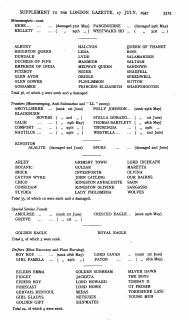
SUPPLEMENT TO THE LONDON GAZETTE, 17 JULY, 1947                                 3315
Minesweepers—cont.
  HEBE                       (damaged aist May) PANGBOURNE ... (damaged agth May)
  KELLETT                    (   „ 2gth „ ) WESTWARD HO ... (      „ 3ist „ )


  ALBURY                               HALCYON                QUEEN OF THANET
  BRIGHTON QUEEN                       LEDA                   ROSS
  DUNDALK                              LYDD                   SALAMANDER
  DUCHESS OF FIFE                      MARMION                SALTASH
  EMPEROR OF INDIA                     MEDWAY QUEEN           SANDOWN
  FITZROY                              NIGER                  SNAEFELL
  GLEN AVON                            ORIOLE                 SPEEDWELL
  GLEN GOWER                           PLINLIMMON             SUTTON
  GOSSAMER                             PRINCESS ELIZABETH     SHARPSHOOTER
Total 36, of which 5 were sunk and 4 damaged.

Trawlers (Minesweeping, Anti-Submarine and " LL " sweep)
  ARGYLLSHIRE        ... (sunk ist June)      POLLY JOHNSON...    (sunk 2gth May)
  BLACKBURN
              ROVERS (          2nd „ )       STELLA DORADO...    (      ist June)
  CALIR                         29th May)     THOMAS BARTLETT     (     28th May)
  COMFORT                       29th „ )      THURINGIA     ...   (     29th „
  NAUTILUS                (     29th „ )      WESTELLA            (      2nd June)

  KINGSTON
       ALALITE            (damaged 2nd June)   SPURS              (damaged 2nd June)


  ARLEY                               GRIMSBY TOWN            LORD INCHCAPE
  BOTANIC                             GULZAR                  MARETTA
  BIOCK                               INVERFORTH              OLVINA
  CAYTON WYKE                         JOHN CATLING            OUR BAIRNS
  CHICO                               KINGSTON ANDALUSITE     SAON
  CORRIDAW                            KINGSTON OLIVINE        SARGASSO
  FLYDEA                             LADY PHILOMENA           WOLVES
Total 33, of which 10 were sunk and 2 damaged.

Special Service Vessels
  AMULREE ...                (sunk ist June)   CRESTED EAGLE... (sunk 29th May)
  GRIEVE                     ( „ ist „ )


  GOLDEN EAGLE                                  ROYAL EAGLE
Total 5, of which 3 were sunk.

Drifters (Mine Recovery and Flare Burning).
  BOY ROY                  (sunk 28th May)     LORD CAVAN      ... (sunk ist June)
  GIRL PAMELA          ... ( „ 29th „ )        PATON           ... ( „ 28th May)


  EILEEN EMMA                           GOLDEN SUNBEAM         SILVER DAWN
  FIDGET                                JACKETA                THE BOYS
  FISHER BOY                            LORD HOWARD            TORBAY II
  FORECAST                              LORD HOWE              UT PROSIM
  GERVAIS RENTOUL                       MIDAS                  YORKSHIRE LASS
  GIRL GLADYS                           NETSUKIS               YOUNG MUN
  GOLDEN GIFT                           SHIPMATES
Total 24, of which 4 were sunk,
Operation Dynamo Map — Movement Logs
Movements recorded for MEDWAY QUEEN during the evacuation period, as plotted on the Operation Dynamo map.
| Departed | Route | Arrived | Troops | Notes | Source |
|---|---|---|---|---|---|
| — | Dunkirk | — | — |
Stationary
HMS report explicitly names this location; a complete dated movement is unavailable
|
TNA ADM 116 4649, page 95 |
| 29 May 1940, 19:00 | Margate → Ramsgate | 30 May 1940, 12:00 | — | NMM 940.542.1 1940 Orde vol ii, page 273 |
Log in to suggest an evidence-backed edit or a new movement log.