Also known as
ORIOLE
User Contributed Collection
Documents and descriptions supplied by archive contributors. All submissions are reviewed in accordance with our Terms and Conditions.
No user-contributed documents have been approved for this vessel yet. Use the forms below to contribute images or documents relating to this vessel.

Help complete the archive
Do you have a photo of this vessel you can share?
Contribute photographs of ORIOLE to the archive for editorial review. Submissions remain private and will only be published following approval by an administrator.
How your photograph will be credited
Exterior · 1940 · Copyright © Example Contributor
Source: Copyright ownership confirmed at submission by Example Contributor.
This example uses the photograph group, year and copyright-holder name supplied in the form. Your own details will replace the example above when an approved image is published.
Already have an account? Log in before uploading to link new photographs immediately.
Help complete the archive
Contribute a document
Share documents or images relating to ORIOLE for editorial review. Upload up to 12 PDF, JPG, PNG or WebP files per submission, with a maximum size of 20 MB each. Your submission remains private and will only be published following approval by an administrator.
How your document will be credited
Example Document Title · Contributed by Example Contributor
Source: Archive reference supplied by Example Contributor.
This example uses the document title, contributor name and source or archive reference supplied in the form. Your own details will replace the example above when an approved document is published.
Wikipedia vessel details
Secondary-source table data; verify against primary records where available.
- Name
- HMS Oriole (J110)
- Pennant number
- J110
- Flag
- Royal Navy
- Description
- Paddle minesweeper
- Built
- 1910
- Tonnage
- 441
- Commanding officer
- T/Lt. Edwin L Davies, RNVR (relieved with entire crew 3 June); T/Lt. Geoffrey P Baker, RNVR (and crew from HMS Plinlimmon)
- Trips to Dunkirk
- 5
- Troops landed
- 2,587
- Notes
- Not stated
Dunkirk-related passages from the linked page
With the outbreak of the Second World War, in October 1939, she and other Clyde steamers like the PS Waverley were requisitioned again by the Admiralty for minesweeping duties.[1] Renamed HMS Oriole to avoid confusion with the pre-existing ship called Eagle, she was modified again for war service with her main saloon being reduced in size to allow the installation of minesweeping gear at her stern, and an anti-aircraft gun being installed on her foredeck.[1] In 1940 Oriole and the other active members of her minesweeper flotilla were ordered away from their regular duties patrolling the coast from their base at Harwich to take part in the Dunkirk evacuation.[1] Arriving at La Panne beach, seeing the difficulty troops were having getting from the shallow beach to the ships, the captain of the Oriole Lieutenant E. L. Davies decided to beach the ship.[1][3] This allowed the Oriole to act as a temporary pier speeding up the process of getting troops onto other ships and smaller boats.[1][3] The Oriole stayed beached for ten hours open to attack from enemy positions on the beach and from the air, but left at dusk as the tide rose lifting her off the beach, returning to Harwich relatively unscathed.[1][3] She made four more trips, and was finally credited with landing 2587 troops.[1][3] In recognition of his actions, Lieutenant Davies was awarded the Distinguished Service Cross.[1] In April 1941, she was transferred from Harwich to Kingston-upon-Hull. In 1945 when she was used to ferry food supplies to aid the Dutch famine.[4]
ORDE Registry
3 records3 potential matching records have been identified.
These records may contain vessel particulars, reported movements, participation assessments, named personnel and source references. A match does not by itself prove that the vessel participated in Operation Dynamo.
“Potential match” means a candidate returned by one or more indexing rules; it is not necessarily an exact identity match. Depending on the source, matching may use a normalised vessel name, a partial text or OCR hit, an alias, or related metadata. Roman-numeral suffixes such as I, II, III, IV and V may be absent, misread or separated from the base name, so records for similarly named vessels can be grouped incorrectly. Multi-word names can also produce candidates where only one significant word matches. Confirm the full name, numeral, vessel type, dimensions, builder, ownership, dates and source context before treating two records as the same vessel.
We are compiling and checking transcriptions, metadata, vessel-name matches, source references and reuse permissions before publishing further detail. This work helps prevent incomplete OCR, historic spelling variations or unverified associations from being presented as established fact.
Account registrations and access to these developing records are temporarily unavailable. Existing account holders may log in, and everyone can join the newsletter for publication updates.
Small Craft Service List
0 records0 potential matching records have currently been identified.
Further indexing may identify service-list entries, vessel metadata, source-page references and protected full-size document images. The absence of a current match does not establish that no relevant source exists.
We are compiling and checking transcriptions, metadata, vessel-name matches, source references and reuse permissions before publishing further detail. This work helps prevent incomplete OCR, historic spelling variations or unverified associations from being presented as established fact.
Account registrations and access to these developing records are temporarily unavailable. Existing account holders may log in, and everyone can join the newsletter for publication updates.
No Small Craft records.
Red List (1939–40) — indexed references
These references come from the Red List index. Printed page numbers may differ from digitised image numbers; OCR may not reproduce the vessel name accurately.
- Oriole — ADM 208/2, printed page 13
- Oriole — ADM 208/2, printed page 3
- Oriole — ADM 208/2, printed page 13
- Oriole — ADM 208/2, printed page 3
Red List (1939–40) — OCR
20 records20 potential matching records have been identified.
These records may contain OCR text matches, source files, page references and digitised page imagery. A match does not by itself prove that the vessel participated in Operation Dynamo.
“Potential match” means a candidate returned by one or more indexing rules; it is not necessarily an exact identity match. Depending on the source, matching may use a normalised vessel name, a partial text or OCR hit, an alias, or related metadata. Roman-numeral suffixes such as I, II, III, IV and V may be absent, misread or separated from the base name, so records for similarly named vessels can be grouped incorrectly. Multi-word names can also produce candidates where only one significant word matches. Confirm the full name, numeral, vessel type, dimensions, builder, ownership, dates and source context before treating two records as the same vessel.
We are compiling and checking transcriptions, metadata, vessel-name matches, source references and reuse permissions before publishing further detail. This work helps prevent incomplete OCR, historic spelling variations or unverified associations from being presented as established fact.
Account registrations and access to these developing records are temporarily unavailable. Existing account holders may log in, and everyone can join the newsletter for publication updates.
Ship Details
These details have been aggregated from multiple sources and may include contemporary records, later recollections, claims or assertions for which no corroborating evidence has been identified. Inclusion does not establish that any account or assertion is accurate. The information may be incomplete, out of date, disputed or incorrect and should be checked against the underlying source records and independent evidence before being relied upon.
No additional ship details available.
Lloyd’s Yacht Register (1939)
Source: Lloyd’s Register Foundation, Heritage & Education Centre, Lloyd’s Register of Yachts 1939, digitised via Internet Archive. Licensed under CC BY-NC-SA 4.0. Images have been converted, resized and watermarked for web display; machine-generated table OCR has been added.
No Lloyd’s records.
Document Collections — Tagged Pages
7 pagesImaged document collections containing pages whose OCR text or table data has been tagged with the name ORIOLE. Open a collection to view the page images and transcriptions.
Source: Lloyd’s Register Foundation, Heritage & Education Centre, Lloyd’s Register of Yachts 1939, digitised via Internet Archive. Licensed under CC BY-NC-SA 4.0. Images have been converted, resized and watermarked for web display; machine-generated table OCR has been added.

Details
| 5300 124475 | Oriole | Wood | Cutter Ratsey | 5:00 8 | 33.5 - 27.6 | 76 5.9 978 | Field&Co.Ld J.S.Helyer | Southmpton 1903 | D. W. Massey | Southmptn | |||
| 5301 | Oriole IV | Steel | AuxKch | 40.04 | 77.1 | 19:0 I 103 | G.Lawley& | Neponset, | Oil Engine | George H. Gooderham | Toronto |

Details
| Odin | 15 | Siri. | Oriole | 6 | a. Gelasma. | Pallanza II | 17 | m. Undine. | Peggy | 11 | m. Doé. |

Details
| a. Oriole IV | 112 | a. Alexandria | 90 | Black Fox | 81 | a. Minstrel | 74 | m. Haidée | 67 |

Details
| a. Oriole IV 112 | a. Atla 9 | Ltd., | a. Themis | 22 | a. Ondina | 9 | McAlister, R., & Son, |

Details
| Goncet, Joseph, 16A, Rue Bel Air, Marseilles. a. Romorin 46 | Gooderham, George H., 49, Wellington Street East, Toronto, Canada.-Can.-Ham. a. Oriole IV 112 | Garth, Alderton Hill, Loughton, Essex. L.S. a. Strombus 19 Göranson, Gust., | Gort, Viscount, V.C., K.C.B., C.B.E., D.S.O., M.V.O., M.C., 98, Mount Street, London, W.1. R.Y.S.-Bem.-Bxm.-C.A.-Crz.-Cws.- | Gould, , Wootton, I.W. m. Kookumburra 4 Mrs. Barbara |

Details
| Massey, D. W., New Cleveland Street Chambers, Hull. Oriole 8 Massie, H. H. I., | Dainty Mathiesen, Julius, Great Tomkyns, Upminster Common, Essex. a. Coquette 9 | Matthews, Rev. Basil W. B., Holy Trinity Vicarage, Carlisle Lane, Lambeth, London, S.E.1.-Msa.-Nav. a. Daisy 13 | Maury, Jacques, 17, Quai St. Pierre, Cannes (A.-M.), France. a. Ombre Blanche - | May, Fred, 4, Edwin Road, Twickenham, Middx. Ssx.M.-Tms. m. Nirvana 36 |
Details
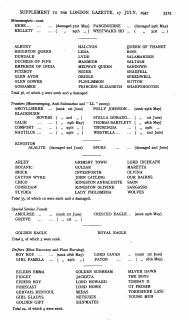
SUPPLEMENT TO THE LONDON GAZETTE, 17 JULY, 1947                                 3315
Minesweepers—cont.
  HEBE                       (damaged aist May) PANGBOURNE ... (damaged agth May)
  KELLETT                    (   „ 2gth „ ) WESTWARD HO ... (      „ 3ist „ )


  ALBURY                               HALCYON                QUEEN OF THANET
  BRIGHTON QUEEN                       LEDA                   ROSS
  DUNDALK                              LYDD                   SALAMANDER
  DUCHESS OF FIFE                      MARMION                SALTASH
  EMPEROR OF INDIA                     MEDWAY QUEEN           SANDOWN
  FITZROY                              NIGER                  SNAEFELL
  GLEN AVON                            ORIOLE                 SPEEDWELL
  GLEN GOWER                           PLINLIMMON             SUTTON
  GOSSAMER                             PRINCESS ELIZABETH     SHARPSHOOTER
Total 36, of which 5 were sunk and 4 damaged.

Trawlers (Minesweeping, Anti-Submarine and " LL " sweep)
  ARGYLLSHIRE        ... (sunk ist June)      POLLY JOHNSON...    (sunk 2gth May)
  BLACKBURN
              ROVERS (          2nd „ )       STELLA DORADO...    (      ist June)
  CALIR                         29th May)     THOMAS BARTLETT     (     28th May)
  COMFORT                       29th „ )      THURINGIA     ...   (     29th „
  NAUTILUS                (     29th „ )      WESTELLA            (      2nd June)

  KINGSTON
       ALALITE            (damaged 2nd June)   SPURS              (damaged 2nd June)


  ARLEY                               GRIMSBY TOWN            LORD INCHCAPE
  BOTANIC                             GULZAR                  MARETTA
  BIOCK                               INVERFORTH              OLVINA
  CAYTON WYKE                         JOHN CATLING            OUR BAIRNS
  CHICO                               KINGSTON ANDALUSITE     SAON
  CORRIDAW                            KINGSTON OLIVINE        SARGASSO
  FLYDEA                             LADY PHILOMENA           WOLVES
Total 33, of which 10 were sunk and 2 damaged.

Special Service Vessels
  AMULREE ...                (sunk ist June)   CRESTED EAGLE... (sunk 29th May)
  GRIEVE                     ( „ ist „ )


  GOLDEN EAGLE                                  ROYAL EAGLE
Total 5, of which 3 were sunk.

Drifters (Mine Recovery and Flare Burning).
  BOY ROY                  (sunk 28th May)     LORD CAVAN      ... (sunk ist June)
  GIRL PAMELA          ... ( „ 29th „ )        PATON           ... ( „ 28th May)


  EILEEN EMMA                           GOLDEN SUNBEAM         SILVER DAWN
  FIDGET                                JACKETA                THE BOYS
  FISHER BOY                            LORD HOWARD            TORBAY II
  FORECAST                              LORD HOWE              UT PROSIM
  GERVAIS RENTOUL                       MIDAS                  YORKSHIRE LASS
  GIRL GLADYS                           NETSUKIS               YOUNG MUN
  GOLDEN GIFT                           SHIPMATES
Total 24, of which 4 were sunk,
Operation Dynamo Map — Movement Logs
Movements recorded for ORIOLE during the evacuation period, as plotted on the Operation Dynamo map.
| Departed | Route | Arrived | Troops | Notes | Source |
|---|---|---|---|---|---|
| 2 Jun 1940, 12:00 | Margate → Dunkirk | 4 Jun 1940, 00:15 | — | NMM 940.542.1 1940 Orde vol ii, page 385 | |
| 4 Jun 1940, 00:45 |
Assumed return journey
Return data not logged
Large-vessel default via Route Z
Dunkirk → Dover
|
5 Jun 1940, 13:00 | — | Derived for map animation; no historical return log. Large-vessel rule: Dover via Route Z. |
Log in to suggest an evidence-backed edit or a new movement log.