Also known as
No aliases recorded.
Amiens
User Contributed Collection
Documents and descriptions supplied by archive contributors. All submissions are reviewed in accordance with our Terms and Conditions.
No user-contributed documents have been approved for this vessel yet. Use the forms below to contribute images or documents relating to this vessel.

Help complete the archive
Do you have a photo of this vessel you can share?
Contribute photographs of Amiens to the archive for editorial review. Submissions remain private and will only be published following approval by an administrator.
How your photograph will be credited
Exterior · 1940 · Copyright © Example Contributor
Source: Copyright ownership confirmed at submission by Example Contributor.
This example uses the photograph group, year and copyright-holder name supplied in the form. Your own details will replace the example above when an approved image is published.
Already have an account? Log in before uploading to link new photographs immediately.

Help complete the archive
Contribute a document
Share documents or images relating to Amiens for editorial review. Upload up to 12 PDF, JPG, PNG or WebP files per submission, with a maximum size of 20 MB each. Your submission remains private and will only be published following approval by an administrator.
How your document will be credited
Example Document Title · Contributed by Example Contributor
Source: Archive reference supplied by Example Contributor.
This example uses the document title, contributor name and source or archive reference supplied in the form. Your own details will replace the example above when an approved document is published.
ORDE Registry
1 record1 potential matching record has been identified.
These records may contain vessel particulars, reported movements, participation assessments, named personnel and source references. A match does not by itself prove that the vessel participated in Operation Dynamo.
“Potential match” means a candidate returned by one or more indexing rules; it is not necessarily an exact identity match. Depending on the source, matching may use a normalised vessel name, a partial text or OCR hit, an alias, or related metadata. Roman-numeral suffixes such as I, II, III, IV and V may be absent, misread or separated from the base name, so records for similarly named vessels can be grouped incorrectly. Multi-word names can also produce candidates where only one significant word matches. Confirm the full name, numeral, vessel type, dimensions, builder, ownership, dates and source context before treating two records as the same vessel.
We are compiling and checking transcriptions, metadata, vessel-name matches, source references and reuse permissions before publishing further detail. This work helps prevent incomplete OCR, historic spelling variations or unverified associations from being presented as established fact.
Account registrations and access to these developing records are temporarily unavailable. Existing account holders may log in, and everyone can join the newsletter for publication updates.
Small Craft Service List
0 records0 potential matching records have currently been identified.
Further indexing may identify service-list entries, vessel metadata, source-page references and protected full-size document images. The absence of a current match does not establish that no relevant source exists.
We are compiling and checking transcriptions, metadata, vessel-name matches, source references and reuse permissions before publishing further detail. This work helps prevent incomplete OCR, historic spelling variations or unverified associations from being presented as established fact.
Account registrations and access to these developing records are temporarily unavailable. Existing account holders may log in, and everyone can join the newsletter for publication updates.
No Small Craft records.
Red List (1939–40) — OCR
1 record1 potential matching record has been identified.
These records may contain OCR text matches, source files, page references and digitised page imagery. A match does not by itself prove that the vessel participated in Operation Dynamo.
“Potential match” means a candidate returned by one or more indexing rules; it is not necessarily an exact identity match. Depending on the source, matching may use a normalised vessel name, a partial text or OCR hit, an alias, or related metadata. Roman-numeral suffixes such as I, II, III, IV and V may be absent, misread or separated from the base name, so records for similarly named vessels can be grouped incorrectly. Multi-word names can also produce candidates where only one significant word matches. Confirm the full name, numeral, vessel type, dimensions, builder, ownership, dates and source context before treating two records as the same vessel.
We are compiling and checking transcriptions, metadata, vessel-name matches, source references and reuse permissions before publishing further detail. This work helps prevent incomplete OCR, historic spelling variations or unverified associations from being presented as established fact.
Account registrations and access to these developing records are temporarily unavailable. Existing account holders may log in, and everyone can join the newsletter for publication updates.
Ship Details
These details have been aggregated from multiple sources and may include contemporary records, later recollections, claims or assertions for which no corroborating evidence has been identified. Inclusion does not establish that any account or assertion is accurate. The information may be incomplete, out of date, disputed or incorrect and should be checked against the underlying source records and independent evidence before being relied upon.
- Ship type: D
Lloyd’s Yacht Register (1939)
Source: Lloyd’s Register Foundation, Heritage & Education Centre, Lloyd’s Register of Yachts 1939, digitised via Internet Archive. Licensed under CC BY-NC-SA 4.0. Images have been converted, resized and watermarked for web display; machine-generated table OCR has been added.
No Lloyd’s records.
Document Collections — Tagged Pages
32 pagesImaged document collections containing pages whose OCR text or table data has been tagged with the name Amiens. Open a collection to view the page images and transcriptions.
Contains public sector information licensed under the Open Government Licence v3.0.
Details
AMETHYST
A/S Trawler (?)
01000
30th May
On patrol, 9.2.5.60 (see Appx. J,
1st June
2300
Sailed
signal from J.16a and J.20).
2nd June
2nd June
On the patrol line with the tr. Spurs
1035
and another trawler (see Appx. J,
signals J.40 and 41) when they from
university
Di came under fire from shore guns.
1700
Salled. Ust for 11. Goodwin and
route X as for se Dunkirk west
channel.
3rd June
0010
Observed the first of the returning
transports, end escorted her.
0150
Opened fire on a plane.
0250
Opened fire on a plane.
0430
Pound 8 wooden M/S from Dunkirk with
100 Prench troops on board. This
ship, demaged in collision, had lost
her any, her crew being overshelmed
and unable to pull themselves
together.
The Amlena put a petty officer and
three men on board, and they brought
the vessel to Dover.
0900
Anchored off Dover.
2000
Sailed with the name orders as before.
yog very thick; compelled to return
and anchor off the N. Goodein.
4th June
0450
Bailed, to essort the transports from
Dunkirk which bed anchored in the
vicinity of the Amiens.
1850
Ordered to proceed under orders of the
dr. Spervier, and in company with the
Bl. Amiral Houches, to find and
take in LOW the French motor boat
V.T.B.26.
2100
Under orders of the Knervier.
Arrenged to sail in search of the
V.T.B. as about dawn [0400].
During the night, was informed that
V.T.B.26 had arrived at Clacton.
5th June
0600
Sent the Mouchet to Ramegate, and
proceeded to Largate.
N11
Authority - French Admiralty record, Polio No.22.
(1) Not mentioned in D.R.'s list of ships.
46
Details
AMIENS
French sloop (Aviso)
Capitaine de corvette
Monick.
1st June
2300
Sailed from Cherbourg.
2nd June
1035
Anchored off Dover. Received orders
to protect transports returning from
Dunkirk.
1700
Sailed. Set course for N. Goodwin and
route X as far as Dunkirk west
channel.
3rd June
0010
Observed the first of the returning
transports, and escorted her.
0150
Opened fire on a plane.
0250
Opened fire on a plane.
0430
Found a wooden M/S from Dunkirk with
100 French troops on board. This
ship, damaged in collision, had lost
her way, her crew being overwhelmed
and unable to pull themselves
together.
The Amiens put a petty officer and
three men on board, and they brought
the vessel to Dover.
0900
Anchored off Dover.
2000
Sailed with the same orders as before.
Fog very thick; compelled to return
and anchor off the N. Goodwin.
4th June
0450
Sailed, to escort the transports from
Dunkirk which had anchored in the
vicinity of the Amiens.
1850
Ordered to proceed under orders of the
dr. Epervier, and in company with the
sl. Amiral Mouchez, to find and
take in tow the French motor boat
V.T.B.26.
2100
Under orders of the Epervier.
Arranged to sail in search of the
V.T.B. at about dawn [0400].
During the night, was informed that
V.T.B.26 had arrived at Clacton.
5th June
0600
Sent the Mouchet to Ramsgate, and
proceeded to Margate.
Nil
Authority - French Admiralty record, Folio No.22.
47
Contains public sector information licensed under the Open Government Licence v3.0.
Details
V.T.B.25
V.T.B.26
French fast M/B's (Vedettes)
3rd June
1500
Rear sloop Admiral Landriau (on board
ordered Savorgnan de Brazza at Dover) the
these two new French
Cherbourg, to proceed to Dunkirk and
vedettes, which had just arrived from
2200
report to Admiral Abrial.
The two vedettes arrived at Dunkirk and
2300
Admiral Abrial sailed for Dover in
secured alongside the Chasseur 11.
V.T.B.25. En route, this vessel
struck a wreck and damaged a propeller
but speed. was able to proceed at slow
4th June
0400ca
Near the North Goodwin, the V.T.B.25
assisted in picking up survivors
from the Belgian trawler Marechal
Foch. The dr. Malcolm, which was also
there, embarked Admiral Abrial, and
took V.T.B.25 in tow to Dover.
The V.T.B.26 with a damaged engine,
finished by securing to a buoy in
the mouth of the Thames. (1) No. of
passengers, if any, not known.
Authority - French Admiralty record, Folio No.9.
(1) The Amiens was ordered to search for the V.T.B.26 and states
that during the night of 4th/5th June, she was informed
that the V.T.B.26 had arrived at Clacton.
88 290
Source: The National Archives, Kew, RED LIST INDEX 1939 40. Contains public sector information licensed under the Open Government Licence v3.0.

Details
30
ORKNEYS AND SHETLANDS COMMANDS-continued.
30A
KIRKWALL.
KIRKWALL
Base Ship.-Pyramus,
Armed (Trawlers.) Boarding Vessels.
SUMMARY OF MINOR FRENCH VESSELS.
Ship.
Type.
Crew.
Proposed
Service.
Ship.
Type.
Crew.
Proposed
[34] D Aquamarine A-
Service.
24th A/S Group (Trawlers).
[34] D Kingston Beryl D
At Portsmouth.
At Plymouth-contd.
Kirkwall.
[34] D Kingston
[34] Pentland Firth (S.O.) A D
Jacinth D
Chevxeuil A
-
Mine-
British
Auxiliary Patrol,
Pedrant
-
-
Trawler
British
sweeper
Portsmouth.
L/L Sweep.
[34] Arctic Explorer AD
Aberdeen.
Gaston Riviere
-
[34] D Kingston Onyx
Trawler
British
L/L Sweep.
La Capricieuse A
Mine-
British
Auxiliary Patrol,
[34] Hugh Walpole A D
Left Scapa 17 July.
A
sweeper
Portsmouth.
Andree et Louis -
Trawler
British
[34] P Kingston Peridot
L/L Sweep.
-
[34] Scalby Wyke A D
Aberdeen.
Patrol
British
D
Auxiliary Patiol,
Arras
Pessac
-
-
Boat
Portsmouth.
Auxiliary
British
Auxiliary Patrol,
[34] P Kingston
Portsmouth.
[34] Tekoura A D
-
Aberdeen.
Sapphire D
-
-
Patrol
British
Epinal
Auxiliary Patrol,
[34] P Kingston Topaz
Boat
Portsmouth.
Sauterne -
-
Auxiliary
British
Auxiliary Patrol,
Portsmouth.
D
[34] P Kingston
Diligente
-
Patrol
British
Auxiliary Patrol,
Boat
Portsmouth.
Turquoise D
Lucien Gougy
-
Auxiliary
-
Conversion
Under Pink.C.NorthernPat
W.L/L.
See
Amiens
-
Patrol
British
Auxiliary Patrol,
M/S Trawler (Ungrouped).
[34] D Northern Chief D
Boat
Portsmouth.
Groeland
-
Auxiliary
British
Auxiliary Patrol,
[34] Lune X D
-
Aberdeen. Repairs. Date
Lucienne Jean
-
Trawler
French
M/S Nore.
W.A.
uncertain.
[34] D Northern Duke
(L/L)
AD
Trawler
French
M/S Nore.
Poulmic
-
Auxiliary
1
[34] D Northern Foam D
Congre
-
-
1
Mine Watching,
(L/L)
Plymouth.
Beaulne-Verneuil
Boom
No
Asie A
-
-
Trawler
British
A/S trials,
[34] D Northern Gift D
Portsmouth.
Vessel
decision
La Frene
1
-
Tug
Contraband Control Service.
[34] D Northern Isles A D
Reine des Flots A
Trawler
British
A/S trials,
Portsmouth.
Peuplier - -
Tug
(Vessels of C.C. are being considered for reallocation to
other services.)
[34] P Northern
Quentin Roosevelt
Trawler
French
Auxiliary Patrol,
No
Princess A
Portsmouth.
Caporal Peugeot
Tug
decision
[34] P Northern Reward
Pierre Audre
-
Trawler
British
Auxiliary Patrol,
No. 4
1
-
Tug
Portsmouth.
[34] P Northern Sky A D
No. 5
-
Tug
La Nantaise A
-
Trawler
British
27 A/S Group.
C.C.S. Drifters.
[34] P Northern Sun A D
Phase
-
Marie Elena
-
Drifter
British
L/L Sweep.
At Falmouth.
Kirkwall
Rose Valley
Port Duties.
-
Lydd II D -
-
Kirkwall.
Commandant
Mine-
French
Nore.
At Plymouth.
Domine
sweeper
La Moqueuse
-
Mine-
French
Nore.
Rescue Tug.
Commandant
Mine-
French
Nore.
sweeper
Duboc
Conquerante
Patrol
British
Falmouth.
sweeper
-
Auxiliary Patrol,
St. Mellons D
-
Examination Vessels.
Coucy
Patrol
-
No decision.
Boat
W.A.
-
mood
Boat
Belle o' Moray
Belfort
Patrol
-
No decision.
Jaques Morgan
-
Trawler
British
Auxiliary Patrol,
-
-
W.A.
-
Boat
Beryl II - -
LERWICK.
Pomerol
-
-
Patrol
Polish
Tyne.
Nadine
-
Trawler
British
L/L Sweep.
Boat
Rambler Rose
Kirkwall.
Drifter.
Medoc
-
-
Patrol
Polish
Tyne.
Autioche
Trawler
British
L/L Sweep,
-
[33] Seabreeze
Boat
Strenuous
Listrac A
-
Trawler
British
A/S trials,
Dutch
-
(Flag F.O.I.C
Lerwick.
Jean Frederick
Trawler
Holyhead,
Plymouth.
Lemnos
Shetland)
L'Atlantique A
Trawler
British
A/S trials,
Notre Dame
Trawler
Dutch
Holyhead,
-
Aberdeen.
-
-
Repairs.
uncertain.
Date
Examination Service.
Plymouth.
De france
Jeanne Antoine
Trawler
No
Fear Not
Ambrose Pase A
Trawler
British
A/S trials,
decision
-
Lerwick.
Plymouth.
La Belle Poule
-
Schooner
No
decision
Heather Belle
-
Aiglon
-
Trawler
British
L/L Sweep.
-
L'Etoile
-
Schooner
No
decision
[34] St. Sunniva
Accommodation Ship.
Roche Velen
-
Trawler
British
L/L Sweep.
President T.
Survey
French
Nore.
Aberdeen.
Tissier
Ship
SULLOM VOE.
Louis et Marie
Trawler
British
L/L Sweep.
Notre Dame
f
Drifter
de Lourdes
No
Base Ship-Fox.
Nazareth
-
Trawler
British
L/I. Sweep.
decision
Armed Boarding Vessel.
Harbour Defence Patrol Craft.
Cambre
-
Drifter
Monique Audrer
Trawler
British
L/L Sweep.
[34] P Discovery II Under See Pink V.A.C. List. Northern Patrol.
[23] Aliped VF
-
Sullom Voe.
[23] Learig F
-
-
(C38488)
Details
SUPPLEMENT TO THE LONDON GAZETTE, 17 OCTOBER, 1941
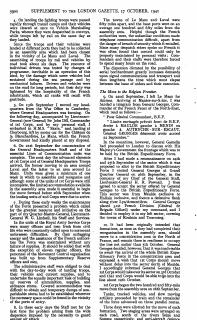
   4. On landing the fighting troops were passed        The towns of Le Mans and- Laval were
rapidly through transit camps and their vehicles     fifty miles apart, and the base ports were on an
were cleared at once to Vehicle Marshalling          average one hundred and fifty miles from the
Parks, whence they were despatched in convoys,       assembly area. Helpful though the French
while troops left by rail on the same day as         authorities were, the unfamiliar conditions made
they landed.                                         telephone communication difficult, apart from
    Since the troops and their vehicles were         the danger of breach of security which it entailed.
landed at different ports they had to be collected   Since many despatch riders spoke no French it
in an assembly area which had been chosen            was often found that control could only be
in the vicinity of Le Mans and Laval. The            properly maintained by personal visits; Com-
assembling of troops by rail and vehicles by         manders and their staffs were therefore forced
road took about six days. The resource of            to spend many hours on the road.
individual drivers was tested by changes of             The dispersion dictated by the possibility of
programme, inevitable in an operation of this        aerial bombardment greatly increases demands
kind, by the damage which some vehicles had          upon signal communications and transport and
sustained during the sea passage and by              thus lengthens the time which must elapse
mechanical failures. Drivers and vehicles were       between the issue of orders and their execution.
on the road for long periods, but their duty was
lightened by the hospitality of the French           The Move to the Belgian Frontier.
inhabitants, which all ranks will recall with          9. On 22nd September, I left Le Mans for
gratitude.                                           Amiens. Arriving at Mantes-sur-Saine, I was
    5. On i3th September I moved my head-            handed a telegram from General Georges, Com-
quarters from the War Office to Camberley,           mander of the French Front of the North-East,
where General Headquarters was forming. On           which read as follows :—
the following day, accompanied by Lieutenant-          " Pour General Commandant, B.E.F.
General (now General) Sir John Dill, Commander            " Limite envisaged prevoit front de B.E.F.
of ist Corps, and by my personal staff, I              droite a MAULDE gauche a MENIN ou
embarked in H.M.S. " Skate," and, landing at           gauche a AUTRYCHE - SUR - ESCAUT.
Cherbourg, left by motor car for the Chateau de        Ge"n6ral GEORGES d6sirerait avoir accord
la Blanchardiere, Le Mans, which the French            22 Septembre."
Government had kindly placed at my disposal.           In the meantime, however, General Gamelin
    6. On 2ist September the concentration of        had proceeded to London to discuss with His
the General Headquarters Staff and of the            Majesty's Government the frontage which was to
essential Lines of Communication units was           be held by the British Expeditionary Force.
complete. The next day the advanced elements            After I had made a reconnaissance on 24th
of ist Corps and of General Headquarters Troops      and 25th September of the sector which it was
arrived, the former moving to an area around         proposed to allot to the British Expeditionary
Laval and the latter to an area around Le            Force I visited General Georges at Grand
Mans. Units were given a minimum of one              Quartier General on 26th September, in the
week in which to assemble and reorganise and         company of my Chief of the General Staff,
although some of the units of ist Corps were still   Lieutenant-General H. R. Pownall. I then
incomplete, the limited accommodation available      agreed to accept the sector offered by General
in the assembly area made it essential to begin      Georges to the British Expeditionary Force.
the move forward before 26th September when          This sector was from Maulde exclusive to
the leading units of 2nd Corps were due to arrive.   Halluin inclusive, and thence a defensive flank
   7. During these early weeks the maintenance       along river Lys/Armentieres. General Georges
of the Force presented a problem which called        placed 5ist French Division (Ge'ne'ral de
for the greatest resource and initiative on the      Brigade Gillard) under my command, and I
part of my Quarter-Master-General, Lieutenant-       decided to employ it in my left sector, covering
 General W. G. Lindsell, his Staff and Services.     the towns of Roubaix and Tourcoing.
    In the units of the Royal Army Service Corps
were many officers and men fresh from civil             10. It had been originally intended that
life who were constantly called upon to surmount     formations, as soon as they had completed their
unforeseen difficulties.    By their unflagging      reorganisation in the assembly area, should
energy and the assistance of the French authori-     move to a concentration area in the North of
ties the Force was maintained without any            France, and remain there in readiness to occupy
failure of supplies. It should be added that with    the line not earlier than 5th October. General
the exception of eleven regular officers, the        Georges decided, however, that it was inadvisable
personnel of the Movement Control organisation       to await the arrival of the whole British Expe-
was built up from Supplementary Reserve              ditionary Force in 'the concentration area and
officers and men.                                    expressed a wish that ist Corps should move
                                                     without delay into the sector north of Maulde.
    The administrative staff were obliged to deal    I accordingly informed General Georges that
with the day-to-day work of landing troops,          ist Corps would take over its sector on 3rd October
their vehicles and current supplies, and to          and that 2nd Corps would be able to^o into the
undertake the equally important task of building     line about I2th October.
up reserves of ammunition, supplies, and
ordnance stores. Covered accommodation was              ist Corps began the two hundred and fifty-mile
 difficult to obtain and temporary dumps of non-     move from the assembly area on 26th September.
perishable stores had to be established wherever        Tanks, tracked vehicles, and slow moving
the necessary space could be found in the vicinity   artillery proceeded by train and the remainder
 of the ports of entry.                              of the force advanced on three parallel routes.
    8. In these early days the Staff met for the        Three days were allotted for the move of each
first time the problem arising from the wide         formation. Two staging areas were arranged on
 dispersion imposed by the necessity to guard        each road, south of the rivers Seine and
against air at.ta.gk,                                Somme respectively, and anti-aircraft defence
Details
SUPPLEMENT TO THE LONDON GAZETTE, 17 OCTOBER, 1941                                 ^5901
was provided at these river crossings. The             certain French technical troops continued to
weather was fine throughout the whole period of        work in the sector under the command of the
the move.                                              French Commander of the Defensive Sector
   The first stage was one hundred and                 of Lille, Colonel (now General de Brigade)
twenty miles. An average of five hundred               Bertschi.
vehicles moved daily over each stage of the route,        While defences continued to develop on the
maintaining a distance of one hundred yards            lines of the original plan, based on the close
between each vehicle as a precaution against           defence of the frontier, it was also necessary to
air attack. A halt of one day for maintenance          organise the position.
purposes was made after the first day's move.             The priority of work envisaged the eventual
   In the initial stages of the move, the Provost      construction of three positions in the forward
service were responsible for the regulation of         area, and a Corps reserve position was sited
traffic, but on entering the French Zone des           across the base of the Lille salient formed by
Armees, columns came under the direction of            the frontier. Further in rear, a second position
the French road control (Regulatrice Routiere)         had been sited, following the line of the Haute
organisation, which gave valuable help in              Deule, Sense"e and La Basse"e canals.
marking detours and in directing traffic through          The whole scheme involved the immediate
towns. A French-speaking British officer was           construction of field defences and the duplica-
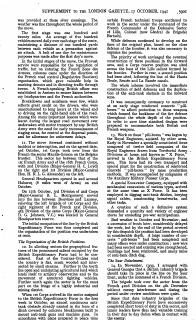
established in Amiens to ensure liaison between        tion of the anti-tank obstacle in the forward
my headquarters and the French authorities.            zone.
   Breakdowns and accidents were few, which               It was consequently necessary to construct
reflects great credit on the drivers, who were         at an early stage reinforced concrete " pill-
unaccustomed to long hours at the wheel and            boxes " to afford protection to those weapons
to driving on the right-hand side of the road.         which formed the backbone of the fire defence
Among the many important lessons which were            throughout the whole depth of the position.
learnt during the largest road movement ever           In order to save time standard designs were
undertaken with motor transport by any British         prepared to accommodate both British and
Army were the need for early reconnaissance of         French weapons.
staging areas, for control at the dispersal points,
and for allowance for unforeseen delays.                  13. Work on these " pill-boxes " was begun by
                                                       the Royal Engineers, assisted by other arms.
   11. The move forward continued without              Early in November a specially constituted force
incident or interruption, and on the agreed date,      composed of twelve field companies of the
3rd October, ist Corps took over from the              Royal Engineers drawn from Territorial Army.
French the sector Maulde-Gruson on the Belgian         Divisions at home, and known as " X Force,"
frontier. This sector lay between that of the          arrived in the British Expeditionary Force
 ist French Army and of the i6th French Corps,         area. This force had its own transport and
with 2nd Division (Major-General H. C. Loyd)           special plant for the construction of reinforced
on the right and ist Division (Major-General           concrete " pill-boxes" by mass production
Hon. H. R. L. G. Alexander) on the left.               methods. It was accompanied by companies of
   General Headquarters opened in and around           the Auxiliary Military Pioneer Corps.
Habarcq (8 miles west of Arras) on 2nd                    A special Excavator Company, equipped with
October.                                               mechanical excavators of various types, arrived
   On I2th October, 3rd Division of 2nd Corps          at the same time as X Force. It has been
 (Major-General B. L. Montgomery) moved                employed in digging anti-tank ditches, burying
into the line between Bouvines and Lannoy,             signal cables, constructing breastworks, and
relieving the left brigade of ist Corps and the        other tasks.
right regiment of the French 5ist Division.               A creation of such a defensive system
4th Division of the same Corps (Major-General          demanded a quantity and variety of engineer
D. G. Johnson, V.C.) was located in General            stores far exceeding pre-war anticipations.
Headquarters reserve.                                     Bad weather in October and November, and
   The initial occupation of the line by the British    a succession of frosts later, considerably delayed
Expeditionary Force was thus completed arid            the work, but by the end of the period covered
the organisation of the position was undertaken         by this despatch the position had been developed
at once.                                               in considerable depth. A large number of con-
                                                       crete " pill-boxes" had been completed and
The Organisation of the British Positions.             many others were under construction ; new wire
   12. In allotting sectors the geographical fea-      had been erected and existing wire strengthened,
tures of the pronounced salient occupied by the        buildings had been reinforced, and many miles
British Expeditionary Force had to be con-             of anti-tank ditch dug.
sidered. East of the Tournai-Orchies road
the country is flat, much wooded and inter-             The Saar Detachment.
sected by small streams. Further to the north             14. In November, 1939, I arranged with
lies open and undulating agricultural land which        General Georges that a British infantry brigade
lends itself to artillery observation and to the       should take its place in the line on the Saar
movement of armoured fighting vehicles.                front, under the command of a French Division.
Further north again the sector is for the most            The brigade took over the sector from the
part on the fringe of a highly industrial and          French 42nd Division on the 4th December
mining district.                                       without enemy interference and during the
   When ist Corps arrived in the sector assigned       period under review conditions were quiet.
to the British Expeditionary Force in the first           Since that date infantry brigades of the
week in October, an almost continuous anti-            British Expeditionary Force have successively
tank obstacle already existed in the form of a         completed short tours of duty in this sector, and
ditch covered by concrete blockhouses built to         junior leaders have thus had valuable training
mount anti-tank guns and machine guns. In              in their day to day duties when in contact with
accordance with plans prepared in peace time           the enemy.
Details
SUPPLEMENT TO THE LONDON GAZETTE, 17 OCTOBER, 1941                                  5907

28th March; 44th Division, on disembarkation,         The sub-machine gun was taken into experi-
moved into 3rd Corps reserve in the St. Pol area,   mental use by patrols in the Saar front: its
and 50th Division into 2nd Corps reserve, south-    value had already been recognised and I trust
west of Lille ; 42nd Division, on arrival, moved    that a weapon of this type will be permanently
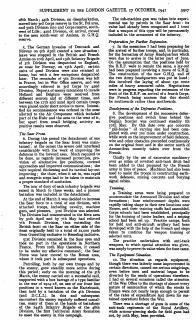
to the area south-west of Amiens, in G.H.Q.         included in the armament of the infantry.
reserve.
                                                    Preparation for Further Expansion.
   5. The German invasion of Denmark and               7. In the meantime I had been preparing for
Norway on gth April created a new situation;        the arrival of further troops, and, in particular,
leave was stopped in the British and French         for the formation of Army Headquarters which
Armies on loth April, and i5th Infantry Brigade     were due to arrive in the latter part of June.
of 5th Division was despatched to England,          On the assumption that the positions held by
en route for Norway, on I5th April; certain         the B.E.F. were to remain the same, a lay-out
units of 42nd Division were also retained at        had been prepared involving a move of G.H.Q.
home, but with a few exceptions despatched          The construction of the new G.H.Q. and of
later. The remainder of 5th Division was left       the two Army headquarters.was put in hand;
in France, but in War Office reserve, and was       this involved the laying of about 150 route
accordingly relieved in 3rd Corps by 42nd           miles of heavy armoured cable. Negotiations
Division. Reports of enemy intentions to invade     were in progress regarding the extension of the
Holland and Belgium were received from              front of the B.E.F. on arrival of a fourth Corps,
different sources and at different times, and       the French being anxious that this should
between the nth and 22nd April certain troops       be southwards rather than northwards.
were placed under short notice to move. Intensi-
fied air reconnaissance .was ordered in the zone    Development of the Defensive Positions..
allotted to the Air Component which included           8. The development of the successive defen-
part of the Ruhr and the area to the west of it,    sive positions and switch lines behind the
but apart from small bridging activity no           Belgian frontier was continued steadily till
positive results were observed.                     loth May. By this date over 400 concrete
       o
                                                    " pill-boxes " of varying size had been com-
The Soar Front.                                     pleted with over ibo more under construction,
   6. During this period the detachment of one      while work on the improvement of field defences,
infantry brigade on the Saar front was main-        wire and other obstacles proceeded continuously
tained ; at the outset the severe cold interfered   on the original front and in the sector north of
considerably with the work of improving the         Armentieres recently taken over from the
defences in the forward area. Much required to      French.
be done, as regards increased protection, pro-         Chiefly by the use of excavator machinery
vision of alternative fire positions, covered       over 40 miles of revetted anti-tank ditch had
approaches and improved communications ; the        been added to that prepared by the French
wire required thickening and its tactical lay-out   army in time of peace. Machines had also been
improving; the thaw, when it set in, was rapid      used to assist the troops in constructing earth-
and energetic steps had to be taken to maintain     work defences, mixing concrete and burying
a proper standard of sanitation.                    signal cables.
   The tour of duty of each infantry brigade was    Training.
raised in March to three weeks, and a pioneer
battalion was included in the detachment.              9. Training areas were being prepared to
                                                    accommodate the Armoured Division and other
   At the end of March it was decided to increase   formations; base reinforcement depdts were
the Saar force to a total of one division, with     rapidly taking shape in their new locations near
attached troops, including cavalry, machine         Rouen, and their training staffs had assembled.
guns, and pioneers. 5ist Division was selected.     Corps schools had been established, principally
The Division had concentrated in the Metz area      for the training of junior leaders, and a sniping
by 30th April and by 7th May had relieved           school had been set up. Practice camps, both
7th French Division, thus extending the             for field and anti-aircraft artillery had been
British front on the Saar on either side of the     developed with the help of the French and steps
front originally held to a total of 12,000 yards    taken to continue the weapon training of
from Guerstling exclusive to Remeling inclusive.    selected units.
   5ist Division remained in the Saar area and         The practice undertaken with anti-tank
took no part in the operations in Northern          weapons, to which special attention was given,
France. From loth May therefore, it ceased          was amply to prove its value when the time came.
to be under my effective command; the Saar
Force was later moved to the Rouen area,            The Equipment Situation.
where it took part in subsequent operations.           10. The situation as regards equipment,
   Patrolling, both by our own troops and by        though there was latterly some improvement in
the enemy, grew steadily more active during         certain directions, caused me serious misgivings,
this period; early on the morning of the 5th        even before men and material began to be
March, the enemy carried out a successful raid,     diverted by the needs of operations elsewhere.
supported with a box barrage of a type familiar     I had on several occasions called the attention
in the war of 1914-18, on one of our front line     of the War Office to the shortage of almost every
positions in a wood known as the Hartebusch,        nature of ammunition of which the stocks in
then held by a battalion of the 4th Division        France were not nearly large enough to permit
(2nd D.C.L.I.). In this and subsequent              of the rates of expenditure laid down for sus-
encounters the enemy regularly suffered casual-     tained operations before the War.
ties, many of them at the hands of battalions          There was a shortage of guns in some of the
of the I44th Infantry Brigade of the 48th           anti-tank regiments of the Royal Artillery,
Division, the first Territorial Army formation      while armour-piercing shells for field guns had
to meet the enemy in.this campaign.                 not, by loth May, been provided.
Details
SUPPLEMENT TO THE LONDON GAZETTE, 17 OCTOBER, 1941

declared an open town and that British troop         Air Force to impede the enemy advance; but
movements would prejudice its safety, but no         such opportunities were of a fleeting character,
adequate alternative routes to the Dyle were         since the enemy established strong anti-aircraft
available and I was therefore compelled to           defences soon after his arrival, particularly in
adhere to the original plan of using the outskirts   towns at which roads converged. Tactical
of the city.                                         reconnaissance became virtually impossible
    The 3rd Division, on arrival, reported that a    without fighter support, and the demands made
 Belgian division was holding the bridgehead at      on the fighter group of the Air Component were
 Louvain, although I had assumed that this           extremely heavy. They had been met with
 should be a British responsibility. 2nd Corps       unfailing skill and courage, and with marked
 therefore took up a narrow front on their right     success, but by now the group was reduced to
 with a strong reserve in rear of Louvain.           some 50 aircraft, and although I had asked for
    5th Division, which was training in the area     four fresh squadrons from home, only one had
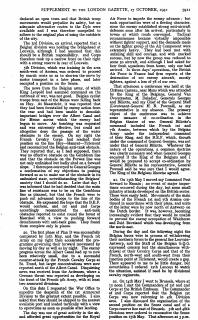
 south-west of Amiens, was ordered to proceed        arrived. In three days' operations, the British
 by march route so as to shorten the move by         Air Force in France had firm reports of the
 motor transport in a later phase, and later         destruction of 101 enemy aircraft, mostly
 occupied a position on the Senne.                   fighters, against a loss of 78 of our own.
    The news from the Belgian army, of which            That afternoon a conference was held at the
 King Leopold had assumed command on the             Chateau Casteau, near Mons which was attended
 outbreak of war, was not good. Belgian cyclist      by the King of the Belgians, General Van
 troops from east of the Meuse were falling back     Overstraeten, M. Daladier, Generals Georges
 on Huy. At Maastricht, it was reported that         and Billotte, and my Chief of the General Staff
 they had been forestalled by enemy action from      (Lieutenant-General H. R. Pownall), as my
 the rear and had been unable to demolish            representative in my absence. The primary
 important bridges over the : Albert Canal and       object of the conference was to achieve
 the Meuse across which the enemy had                some measure of co-ordination in the
 begun to move. Air bombing was requested            Belgian theatre of war. General Billotte's
 and was extremely effective, but could not          command included the French ist and
 altogether deny the passage of the water            7th Armies, between which lay the Belgian
 obstacles to the enemy. On my right the             Army under the independent command
 French Cavalry Corps had reached their              of their King, and the B.fe.F. which, though
 position on the line Huy—Hannut—Tirlemont           under the command of General Georges, was not
 and reconnoitred the Belgian anti-tank obstacle.    under that of General Billotte. Whatever the
 They reported that, as I had supposed, there        nature of the operations, a common doctrine
 was no effective obstacle on the Gembloux line      was clearly necessary and when General Georges
 and that the obstacle on the Perwez line was        enquired if the King of the Belgians and I
 not only unfinished but badly sited on a forward    would be prepared to accept co-ordination by
 slope. I thereupon conveyed to General Georges      General Billotte as bis representative, General
 a confirmation of my objections to pushing          Pownall said he was sure that I would agree.
 forward so as to make use of the obstacle in its    The King of the Belgians likewise agreed.
 unfinished state, notwithstanding the Belgians'      . 21. On I3th May I moved my Command Post
 anxiety that I should do so. Later that day I       forward to Renaix; no event of major impor-
 was informed that he had decided that the main      tance occurred during the day, but some small
line of resistance was to be on the Gembloux         infantry attacks developed on the British sector.
 line as planned, but that the French were to        These were easily held. Movements of the main
 push out advanced troops to the line of the         bodies of the French ist and 7th Annies con-
obstacle. He expressed the hope that the B.E.F.      tinued in accordance with their plans, and units
would conform, and ist and 2nd Corps                 of the latter were by now north of Antwerp on
 accordingly      reconnoitred   the     anti-tank   the Dutch border. It was, however, becoming
obstacles reported to exist round the forest of      increasingly evident that they would be unable
Meerdael with a view to pushing forward              to prevent the enemy occupation of Walcheren
detachments with anti-tank guns. They found          and Zuid Beveland which was developing from
them complete only in places.                        the north-east.
    20. The first phase of Plan D was successfully      During the day and the following night the
completed by i2th May, and the French ist            Belgian forces were in process of withdrawing
Army on my right then accelerated the pro-           their northern forces to the general line Louvain-
gramme governing their forward movement by           Antwerp, and the Staff of the Belgian G.Q.G.
moving by day as well as by night. The enemy         expressed concern lest the simultaneous with-
progress across the Albert Canal had up to now       drawal of their Cavalry Corps and that of the
been relatively small, due to a successful           French, north-west and south-west from their
counter-attack by the French Cavalry Corps at        junction point at Tirlemont, would create a gap.
St. Trend, but larger concentrations were now        There appeared to me to be little danger, but
reported north of the Albert Canal. Disquieting      nevertheless I ordered I2th Lancers to watch
news was received from the Ardennes, where a         the situation, assisted if need be by divisional
German thrust was reported as developing on          cavalry regiments.
the front of the French gth Army, with at least         22. On I4th May I went to Brussels, where at
two armoured divisions.                              12 noon I met the Commanders of ist and 2nd
    On this date I requested the War Office to       Corps at the British Embassy. The Commander
expedite the despatch of the ist Armoured            of 2nd Corps reported that the Belgian ist
Division to the greatest extent possible. I also     Corps was now reforming in 4th Division
asked that they should be shipped to the nearest'    area. I also discussed the organisation of the
available port and loaded tactically with a view     second position on the Senne canal and of a
to operations as soon as possible after landing.     Corps reserve line east of Brussels. 5th and 48th
    The day was one of great activity in the air,    Divisions were ordered to reconnoitre the Senne
and afforded great opportunities for the Royal       position on I5th May. That afternoon at 3 p.m.
Details
SUPPLEMENT TO THE LONDON GAZETTE, 17 OCTOBER, 1941                                      59*3
vulnerable points, were ordered to relieve units           23rd Division moved to their positions during
of ist and 2nd Corps on protection and traffic         I7th May; they were provided with about forty
control of main routes in Belgium. Railheads,          field, anti-tank, and anti-aircraft guns from
which had been advanced on i3th May to the             ordnance reserves.
general line Enghien—Ninove, were now moved                The enemy break-through was now offering
back across the frontier.                              an imminent threat to rear G.H.Q., to the
   During the night i6/i7th May the withdrawal         communications over the Somme at Amiens
to the Senne positions began, and was success-         and Abbeville, and to the base areas. To meet
fully completed by the afternoon of the lyth.          this, every available man and weapon was
Some enemy tanks and motor cycle units had             collected and orders were issued to the
been reported on the right flank of ist Corps,         commander, Lines of Communication Area, for
west of the forest of Soignies, and as a precaution,   the remainder of I2th and 46th Divisions to be
part of the ist Army Tank Brigade, which had           despatched to the forward zone. One brigade
started to withdraw for entrainment, was                (36th Infantry Brigade of I2th Division)
turned about to meet the thrust.                       arrived during the day, and the leading
    By the time the tanks reached their entraining     battalion was despatched with four field guns
stations railway difficulties prevented the trucks     to cover the north-western exits from PeYonne,
being moved, and the remainder of the move             while engineer parties, organised by the
was carried out by road; this gave rise to             Commander, G.H.Q. Troops, were sent to
inevitable mechanical trouble later on. *              prepare for demolition the crossings over the
                                                        Canal du Nord between the river Somme and
    By.the early morning of iyth May the situation     the right of 23rd Division at Ruyalcourt.
in the south had become grave, and enemy                The remainder of 36th Infantry Brigade were
 armoured and mobile forces were reported to            moved forward to Albert, and the other two
 have crossed the Oise. At St. Quentin the              brigades of I2th Division ordered to the Abbe-
 situation was obscure, and though by this time         ville area. These latter, however, arrived too
 General Giraud, lately commanding the French           late to come under my effective command, and
 7th Army, had been ordered to take command             their operations on the Somme were carried
 of the forces in that region, it was clear from        out under the Commander Lines of Communi-
 reports and from visits of liaison officers that       cation Area.
 he had not yet succeeded in establishing effective        Elsewhere in the area between Corps rear
 control. A gap of at least twenty miles existed        boundaries and the Somme, local defence
 south of the Forest of Mormal in which there           schemes were put into operation under the
 appeared to be no organised resistance. Later          orders of the Commanders of G.H.Q. Troops
 in the day information was received from the           and of " X " Lines of Communication Sub-Area*.
 French that ten enemy armoured divisions were          Few if any of these units or their commanders
 engaged in the battle.                                 had any experience in fighting, but their
    During the whole of this period, communi-           determination was beyond all praise.
 cation with my liaison officer at General Georges'         A mobile bath unit, for example, took part
 Headquarters was maintained so as to keep in           in the defence of St. Pol, while, both now and
 touch with events as they developed. However,          later, the General Construction Companies of
 I received no infoimation thiough this channel         the Royal Engineers, and many units of the
 of any steps it was proposed to take to close the      Royal Army Service Corps, set to work to
 gap, which might have affected my own                  place their localities in a state of defence and
 command.                                               manned them until they were overwhelmed,
    It was not till later, on the night of iqth/zoth    relieved or ordered to withdraw. Wherever
 May, that General Billotte informed me of the          possible, transport was collected or requisitioned
 action which was being taken to this end by            to enable parachute detachments to be dealt
 the French Armies in the south.                        with.
                                                           These many small delaying actions all contri-
 The defence of rearward areas.                         buted to gain the time required for the.with-
   25. Rear G.H.Q. at Arras had intensified the         drawal of the main forces.
precautions already being taken against sabotage           The defence of the town of Arras itself was
and air landing units, but on the early morning         entrusted to the O.C. ist Bn. Welsh Guards
of I7th May a telegram was received from                who had under his command some units of the
General Georges ordering 23rd Division to move          Royal Engineers, an Overseas Defence battalion
at once to occupy the line of the Canal du Nord,         (gth West Yorks), and various details including
on a frontage of fifteen miles from Ruyalcourt          an improvised tank squadron.
(10 miles north of Pdronne) to Arleux (6 miles
south of Douai).                                            Orders were issued for all administrative troops
                                                        not required for defence to move forthwith north
   The division, which, like the I2th and 46th          of a line Orchies-Lens-Fre'vent.
Divisions had joined the B.E.F. for work in
rearward areas, consisted of eight battalions only         At the same time to guard against a more
with divisional engineers, but no artillery, and        immediate threat to my right flank a force was
signals and administrative units in no more than        organised consisting of I27th Infantry Brigade
skeleton form. Its armament and transport was           of 42nd Division, ist Army Tank Brigade,
on a much reduced scale and training was far            a Field Artillery Regiment and the Hopkinson
from complete.                                          Missionf, all under the command of Major-
                                                        General F. N. Mason-MacFarlane, my Director
   Nevertheless, troops of these three divisions
fought and marched continuously for a fortnight,         * This Sub-Area had been formed to deal with units
and proved, were proof needed, that they were          which, remained in the old G.H.Q. and Corps areas
composed of soldiers who, despite their                when the B.E.F. moved into Belgium.
inexperience and lack of equipment, could hold           f The Hopkinson Mission, under the Command oi
                                                       Lieut.-Colonel G. F. Hopkinson, had been formed to
their own with a better found and more numerous        secure certain information for the R.A.F. and for
enemy.                                                 G.H.Q. immediately on entry into Belgium.
Details
59^4          SUPPLEMENT TO THE LONDON GAZETTE, 17 OCTOBER, 1941
of Military Intelligence. The force was known         occupied by the French. It was not however
as Macforce and its task was to cover the            practicable to move the 23rd Division again
crossings over the Scarpe between Raches (3          and G.Q.G. were informed to this effect. Yet,
miles N.E. of Douai) and St. Amand. It began         by next morning no French troops had appeared
to assemble at Orchies on the afternoon of i7th      either on the right of 23rd Division or to relieve
May.                                                 them. Later in the day, however, an order was
                                                     received by which the commander of the French
Withdrawal to the Escaut begun.                      2nd Region was ordered to fill the gap. En-
   26. It had now to be decided whether or not       quiries by a liaison officer at Amiens, where the
the withdrawal from the Senne to the Dendre          staff of the French 7th Army was in process of
was to begin on the night of 17/18 May, and the      taking over from the 2nd Region, established
situation in the South was such that I felt that     that no troops would be likely to arrive for
to spend a day on the Senne would be to risk         twenty-four hours at least.
being outflanked on the right and so imperil            By the afternoon, however, some enemy had
the force under my command to no good purpose.       reached Pe"ronne, and were in contact with
General Billotte had issued orders for withdrawal    36th Infantry Brigade.
to the Dendre that night, but I had also seen           On this day Major-General R. L. Petre,
an order from General Georges which envisaged        commanding the I2th Division, was given
remaining on the Senne for a further twenty-         command of the troops engaged on this flank,
four hours. I therefore sent a liaison officer to    namely 23rd Division, 36th Infantry Brigade
General Billotte to represent my views. In           and the garrison of Arras.*
the result, General Billotte's orders stood             In the meantime an order issued by the French
confirmed.                                           First Group of Armies had laid down the
   By 4 p.m. on i7th May therefore ist and 2nd       boundary between the French ist Army and
Corps were on the Senne with 5th, ist and 4th        the B.E.F. through Maulde, Orchies, Raches
Divisions in line right to left. 48th Division       and He*nin Li6tard. Arras was thus excluded
was covering the right flank from Enghien to         from the zone of the B.E.F., but its defence
Lembecq. 5oth Division was on the Dendre, to         was necessarily continued by British troops.
which line 2nd and 3rd Divisions were now            All troops not required for defence left on the
withdrawing,, whilst 3 Corps was in position on      igth, including rear G.H.Q. which moved in two
the Escaut with 42nd Division (less one infantry     echelons to Hazebrouck and Boulogne in accord-
brigade) and 44th Division.                          ance with plans prepared on i7th May when
                                                     the threat to Arras became serious.
   27. On i8th May I held a conference at the
headquarters of ist Corps at which were settled         On the evening of i8th May I moved back
the details of the withdrawal to the Escaut.         my command post from Renaix to its previous
This line was to be held with six divisions, right   location at Wahagnies.
to left ist Corps (48th and 42nd Divisions, less     Moves of the Royal Air Force.
one infantry brigade, with 2nd Division in              29. On this day also, the bulk of the Advanced
reserve), 2nd Corps (ist and 3rd Divisions with      Air Striking Force moved from the neighbour-
50th Division in reserve), 3rd Corps (4th and 44th   hood of Rheims to Central France and the Air
Divisions), on a front from the bridge over the      Component moved one of their main operational
Escaut at Binaries to Audenarde, both inclu-         aerodromes from Poix to Abbeville. On the
sive. 5th Division was in G.H.Q. reserve.            evening of I9th May enemy action obliged them
   There was little pressure during the day on       to evacuate this aerodrome also. The Ah*
the British front or on that of the Belgians to      Officer Commanding the Air Component then
the North. Owing to the late arrival of orders       moved his headquarters to England, but an
the Belgian Army had started their withdrawal        advanced landing ground was maintained at
after the B.E.F.; they had therefore asked for       Merville until 22nd May.
and received protection to their right flank at         From the 2 ist May onwards all arrangements
Brusseghem up to 7 a.m. and Assche up to             for air co-operation with the B.E.F. were made
8 a.m. on i8th May. On withdrawal they               by the War Office in conjunction with the Air
effected a junction with the B.E.F. on the           Ministry at home. The air liaison work was
Dendre at Alost.                                     carried out in England at Hawkinge and the
   Southward from their junction with the            targets selected in accordance with telephone
B.E.F. the French line ran through Mons and          or telegraphic requests from the B.E.F. so long
Maubeuge, and enemy tanks were attacking             as communications remained open, supple-
the front of the French Corps on my immediate        mented by information received from the Royal
right. Enemy air action had by now intensified       Air Force, and other sources.
on the front of the B.E.F. and continuous fighter
support was necessary during the hours of day-       Alternative plans considered.
light, both to enable our reconnaissances to take       30. On the night of 18/19 May, the ist, 2nd
place and to hold off enemy bombers. The             and 3rd Corps completed then: withdrawal to
enemy did not confine bis attention to troops        the line of the Escaut without interference, and
but attacked the long columns of refugees            prepared to defend the line of the river. Soon
which continued to move westwards.                   after arrival, however, the level of the water
                                                     became dangerously low, at places less than
The position on the Canal du Nord.                   three feet deep. It looked, therefore, as if, apart
   28. The position on the Canal du Nord had         from the unusually dry weather, some of the
caused some anxiety, partly on account of con-       sluices in the neighbourhood of Valenciennes had
tradictory orders received. Shortly after orders     been closed in order to produce inundations
had been issued on I7th May for the occupation       in the low lying ground in that area, even if
of the position by 23rd Division, an order was       at the expense of the water on the front of the
received from G.Q.G. allotting to the B.E.F.         B.E.F.
the sector Pe'ronne-Ruyalcourt instead of the          * Major-General Petre's command was known as
sector Ruyalcourt-Arleux which was now to be                            Petreforce.
Details
SUPPLEMENT TO THE LONDON GAZETTE, 17. OCTOBER/1941                                  "59*5
    The enemy had, during the previous day,           the abandonment of large quantities of equip-
 penetrated as far as Amiens, and rail communica-     ment. It would obviously be unwelcome to
 tion with the bases was severed' at that'point.      the Belgians who would be faced with the
'Communications by road and rail over the             alternatives of withdrawing with us and aban-
 Sorrime at Abbeville were still holding on igth      doning Belgian soil, fighting on a perimeter of
 May and the town was being placed in a state         their own, or seeking an armistice.
 of defence with such resources as were available,       So far as I am aware, the French High
 mainly, units of I2th Division. However, there       Command had never suggested such a move-
 was little doubt that enemy armoured forces          ment up to that date and it is doubtful whether
 in'that area, which at the time I estimated at       even had they, decided on immediate withdrawal
 five armoured divisions, would shortly break         as soon as the French gth Army front on the
 through to the coast.                                Meuse had been penetrated, there would ever
    The force could then no longer be supplied        have been sufficient time for the troops in the
 through the ports south of the Somme, and the        north to conform.
 great bulk of the reserves, which were in the           Thirdly there was the possibility of with-
 rearward areas, would • shortly cease to be          drawal north-westwards or northwards towards
 available to the force for the purposes of main-     the Channel ports, making use of the successive
tenance or replacement. Several days' reserve         river and canal lines, and of holding a defensive
 had, however, for some time past been maintained     perimeter there, at any rate sufficiently long to
 north of the Somme.                                  enable the force to be withdrawn, preferably in
    The prospect of securing the reinforcement of     concert with the French and Belgians. I
 the Armoured Division had likewise become            realised that this course was in theory a last
 remote/ I had been advised that two Armoured         alternative, as it would involve the departure
 Brigades, of this division would disembark at        of the B.E.F. from the theatre of war at a time
 Havre on i6th May, and were to concentrate at        when the French might need all the support
 Bolbec, and I had therefore sent instructions by     which Britain could give them. It involved
 the hand of a staff officer to the Commander         the virtual certainty that even if the excellent
 (Major-General R. Evans). He was to move the         port facilities at Dunkirk continued to be
leading brigade on disembarkation with all            available, it would be necessary to abandon
 speed to secure, the crossings of the Somme west     all the heavier guns and much of the vehicles
 of Amiens, from Picquigny to Pont Remy, both         and equipment. Nevertheless, I felt that in
inclusive, with a view to .the concentration of the   the circumstances there might be no other
 remaining -brigade behind the Somme and the          course open to me. It was therefore only
 move of his division to join the main body of        prudent to consider what the adoption of such
 the B.E.F. However, in the meantime, orders          a plan might entail. On this day therefore at
 had been issued locally to concentrate the           about 1.30 p.m. the Chief of the General Staff
 Division south of the Seine, and the plan to         telephoned to the Director of Military Opera-
 cross the Somme and join the B.E.F. proved           tions and Plans at the War Office and discussed
 impossible to execute. The division therefore        this situation with him.
 remained in the Lines of Communication Area
 and never came under my effective command.           The Position of the French ist Army and the
    About midnight on the iSth/igth May,                   British right flank reinforced.
 General Billotte came to see me, and gave me            31. The French ist Army had by igth May
 an account of the situation as he saw it. He         completed its withdrawal and was in touch
 also told me of the measures which were being        with the right of ist Corps. On the night of
 taken to restore the situation on the front of       i9/20th May they took up positions on the line
 the French Qth Army, though clearly he had           of the Escaut as far south as Bouchain ; but at
 little hope that they would be effective. Reports    that point, instead of continuing to hold that
 from the liaison officers with French formations     river towards Cambrai (which according to my
.were likewise not encouraging ; in particular        information was not held in strength by the
 I was unable to verify that the French had           enemy) they had drawn back westwards along
 enough reserves at their disposal south of the       the river Sensee. Thus in the quadrilateral
 gap to enable them to stage counter-attacks          Maulde—Va-lenciennes—Arleux—Douai, some
 sufficiently strong to warrant the expectation       nineteen miles by ten, there was assembled the
 that the gap would be closed.                        bulk of the French ist Army, amounting to
    Thus, in my opinion, there was an imminent        three Corps of two divisions and two divisions
 danger of the forces in the north-eastern area,      in reserve—a total of eight divisions. The
 that is to say the French forces next to the sea,    Commander of the French 3rd Corps, General
 the Belgian Army, the B.E.F. and the bulk of         de la Laurencie, remained that night in close
 the French ist Army on our right, being              touch with General Mason-MacFarlane, at the
 irretrievably cut off from the main French           headquarters of Macforce.
 forces in the south.                                    Further west the French Cavalry Corps was
    There were three alternative courses of action    assembling at Oppy, north-east of Arras.
 open to the northern forces under General               None of these forces were being seriously
 Billotte : first, in the event of the gap being      pressed at this stage, but since the enemy had
 closed by successful counter-attacks made            already penetrated, so deeply further south, I
 simultaneously from north and south it would         felt it necessary, without more delay, to
 in theory be possible to maintain the line of the    strengthen the dispositions for the defence of
 Escaut, or at any rate the frontier defences,        what had become the bastion of Arras. It was
 and thence southwards on one or other of the         also necessary to secure crossings westwards
 canal lines.                                         from the right of Macforce, along the line
     Secondly, there was the possibility of a with-   Carvin—La Basse"e.
 drawal to the-line of the Somme as far as its           I therefore ordered soth Division, then in
 mouth. This plan had the attraction that we          G.H.Q. reserve, to send one Infantry Brigade
 should be falling back on our lines of communi-      (25th) to take up positions on the Canal on the
 cation and if it was successful would not entail     line La Bassee—Carvin under the command of
Details
•5916        -SUPPLEMENT TO THE. LONDON GAZETTE, -17 -OCTOBER:
 Macforce. The remainder of the division was           - I .discussed,--these- instructions- with,'.the
 moved that night (i9/20th) to the same area,        .C.I.G.S. at- my Command Post at Wahagnies
 and was thus suitably placed for the counter         at 8.15 a.m.; I put to him my view that
 attack in which they took part on 2ist May.          withdrawal to "the south-westwards, however
    I also ordered I2th Lancers with a field          desirable in principle, was not. in the circum-
 battery to move to Arras and carry'out necessary     stances practicable. ;
 reconnaissances south and south-westwards,          . In the first place, it would involve the dis-
 and to gain touch with the outlying portions of      engagement of seven divisions which were at
 Petreforce.                                          the time in close contact with the enemy on the
   Arras was heavily bombed for the first time'       Escaut, and would be immediately followed up.
 on igth May, but 23rd Division, though in an            In addition to this-rearguard action the B.E.F.
exposed position, was not seriously attacked.         in its retirement to the Somme would have to
 However, at 5 a.m., 6th Royal West Kent, of          attack into 'an area already strongly occupied
 36th Infantry Brigade, on the Canal du Nord          by the enemy armoured and mobile formations.
north-west of Peronne, had been attacked by           Some of these indeed now appeared to be holding
enemy tanks and had been withdrawn to Sailly        •the line of the Somme whilst others were already
on the road to Albert.                              -within a short distance of the coast, and might
                                                      turn northwards at any time. Thus the B.E.F.
   General Petre that night issued orders for         would be obliged to disengage its seven divisions
23rd Division to withdraw from the Canal du           in contact with the enemy, fighting a rearguard
Nord to the line of the Grinchon river south of     'action, at the same tune to attack south-west-
Arras to join up at La Herliere with 36th             wards, and finally to break through enemy
Infantry Brigade which was to hold a line             forces on the Somme. During this manoeuvre
thence to Doullens. 23rd Division was, how-          both flanks would have to be guarded.
ever, caught by enemy aircraft when embussed
and finally occupied posts on the line of the            Secondly, the administrative situation made
Scarpe for some six miles East of Arras.             it unlikely that sustained offensive operations
                                                     could be undertaken. Communication with the
   Thus, by the evening of igth May, the situa-      bases was on the point of being interrupted.
tion was somewhat relieved in that the defensive     The mobile echelons of gun and small arms
flank had begun to take shape. On the other          ammunition were full, but once they were
hand, the character of the operation had now         exhausted I could not safely reckon on being
radically altered with the arrival of German         able to replenish them.
troops in Amiens. The picture was now no                 Lastly, though I was not in a position to
longer that of a line bent or temporarily broken,    judge, I had the impression that even if I had
but of a besieged fortress. To raise such a          decided to attempt this manoeuvre, neither the
siege, a relieving force must be sent from the       French ist Army nor the Belgians would have
south and to meet this force a sortie on the         been in a position to conform.
part of the defenders was indicated.
                                                         Nevertheless, I told the C.I.G.S. that I fully
                                                     realised the importance of an attack in a
  The attack of $th and 50$ Divisions.               southerly direction and that I already had plans
    32. On 2oth May, the breach South of Arras       in hand to counter-attack with the 5th and
 deepened and widened. From indications              5oth Divisions to the south of Arras and that
 received during the day the enemy armoured          these divisions would be ready to attack on
 forces appeared to be directed on two main          the following morning (2ist May). These were
 objectives; one down the valley of the Somme       the only reserves which I then had available,
 on Abbeville, the other by Hesdin and Montreuil,   apart from one armoured reconnaissance brigade,
 doubtless making for the Channel Ports.            and one infantry brigade of 2nd Division. To
 I2th Lancers, early in the day, reported tanks     create a further reserve I had already begun
"from the direction of Cambrai approaching          negotiations with Belgian G.Q.G. for the relief
 Arras, where they were held off by the Welsh       of 44th Division on the Escaut, but these were
 Guards; a strong request for bomber support        not yet completed.
 was therefore made through the War Office to           The C.I.G.S. agreed with this action and accom-
 the Air Ministry. Later in the day enemy           panied by the C.G.S. he left for Lens to meet
 tanks were reported to be ten miles west of        Generals Billotte and Blanchard. At that
 Arras, and all endeavours by I2th Lancers to       interview the C.I.G.S. explained the action to
 reach Doullens had failed. By 6 p.m. they          be taken by 5th and 5oth Divisions. General
 were back on the line Arras—St. Pol.               Billotte fully agreed to this plan, and said that
    Early in the morning General Sir Edmund         the French would co-operate with two divisions.
 Ironside, the Chief of the Imperial General            On return to my headquarters, the C.I.G.S.
 Staff arrived at G.H.Q.; he brought with him       sent a telegram to General Georges which made
instructions from the Cabinet that the B.E.F.       it clear that, in his opinion, General Billotte's
was to move southwards upon Amiens, attacking       Army Group would be finally cut off unless the
 all enemy forces encountered and to take station   French ist Army made an immediate move on
 on the left of the French Army. He was also        Gambrai or unless General Georges launched a
to inform General Billotte and the Belgian          counter-attack northwards from Peronne. My
 command, making it clear to the latter that        liaison officers with Generals Billotte and Blan-
their best chance was to. move that night           chard conveyed a similar message from me to
between the B.E.F. and the coast.                   those commanders, making it clear that if our
    Similar information was to be given by the      counter-attack was not successful the French
 War Office to General Georges. During the          and British Armies north of the gap would
 day however, it appeared that operations were      have their flank turned and could no longer
actually being directed by General Weygand          remain in their present positions.
who later, on 23rd May, announced in a General          On 2ist May I sent a formal acknowledgement
Order that he was now Commander-in-Chief            of the instructions brought by the C.I.G.S.
in all theatres of war.                             adding that, in my opinion, withdrawal to the
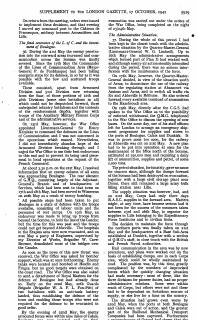
Details
SUPPLEMENT to THE LONDON GAZETTE, 17 OCTOBER, 1941                                        5919
   On return from the meeting, orders were issued           evacuation was carrie.d out under the orders of
 to implement these decisions, and that evening            the War Office, being completed on the night
 I moved my command post to the Chateau de                 of 23/24th May.
 Premesques, midway between Armenti&res and
 Lille.                                                     The Administrative Situation.
                                                               37. During the whole of this period I had
 The final severance of the L. of C. and the invest-        been kept in the closest touch with the adminis-
     ment of Boulogne.                                      trative situation by the Quarter-Master-General
      36. During the gist May the enemy penetra-            (Lieutenant-General W. G. Lindsell). Up to
   tion into the rearward areas increased and com-          i6th May the administrative arrangements
  munication across the Somme was finally                  which formed part of Plan D had worked well,
   severed. Since the I7th May the Commander                and although enemy air action steadily intensified
   of the Lines of Communication Area (Major-               during the period, there was no serious inter-
   General P. de Fonblanque) had been taking               ference with the maintenance of the force.
   energetic steps for its defence, in so far as it was        On i7th May, however, the Quarter-Master-
  possible with the few and scattered troops                General decided, in view of the situation south
   available.                                              of Arras, to discontinue the use of the railway
      These consisted, apart from Armoured                 from the regulating station at Abancourt via
  Division and 5ist Division now returning                 Amiens and Arras, and to switch all traffic via
  from the Saar, of those portions of I2th and             Eu and Abbeville to Bethune. He also ordered
  46th Divisions (some nine battalions in all)             forward every available trainload of ammunition
   which could not be despatched forward, three            to the Hazebrouck area.
  unbrigaded infantry battalions and the contents              On igth May, directly after the C.G.S. had
  of the reinforcement depdts, together with               spoken to the War Office as to the possibility
  troops of the Auxiliary Military Pioneer Corps           of enforced withdrawal, the Q.M.G. telephoned
   and of the administrative services.                     to the War Office to discuss the opening of new
      On '23rd May, however, the War Office                bases. On the same day, one of his staff officers
  appointed Lieutenant-General- Sir Henry                 .left for London to arrange an emergency ship-
  Karslake to command the defences on the Lines            ment programme for supplies and stores to
  of Communication and I was not concerned in              the ports of Boulogne, Calais and Dunkirk. It
  the operations which ensued. Nevertheless,               was to prove none too soon, for the railway
  I did not immediately abandon hope of the                at Abbeville was cut on 2ist May. A new plan
  Armoured Division breaking through, and I                had to be put into operation at once for the
  urged the War Office to use their best endeavours.       maintenance of the fcfrce north of the Somme,
  to this end and to prevent its being used piece-         estimated at 250,000 men and requiring a daily
  meal in local operations at the request of the           lift of ammunition, supplies and petrol, of some
  French Command.                                          2,000 tons.
      At about 3.30 p.m. on the 2ist May, I received          The petrol situation, fortunately, gave no cause
  information that an enemy column of all arms             for concern since, although the dumps forward
  was approaching Boulogne. The rear element               of the Somme had been destroyed on evacuation,
  of G.H.Q., consisting largely of the Adjutant-           together with a large civil storage plant near
  General's Branch and of headquarters of                  Douai, there still remained a large army bulk
  Services, which had been sent to that town on            filling station near Lille.
  I7th and i8th May, had been moved to Wimereux               The supply situation was however, bad, and
  on 20th May as a result of enemy bombing.                on 2ist May, Corps had only three days
  * All possible steps had been taken to put               R.A.S.C. supplies in the forward area. Matters
  Boulogne in a state of defence with the troops           might, at any time, have become serious had it
  available, consisting of labour units and the            not been for the success of the measures taken
  personnel of rest camps. On igth May, an                 between 23rd and 26th May, to organise the
  endeavour was made to bring up troops from               supplies in Lille belonging to the Expeditionary
  beyond the Somme, to hold the line of the Canche;        Force Institutes and to civilian firms.
  but the time for this was past and the troops               The decision to maintain the force through
  could not get beyond Abbeville. The hospitals            the northern ports was finally taken on 2ist
  in the Etaples area were now evacuated, and on           May and the headquarters of a Base Sub-Area
  2ist May a party of Engineers, supervised by             established at Dunkirk, together with a section
  my Director of Works, Brigadier W. Cave-                 of Q.M.G's staff, in close touch with the British
  Browne, demolished most of the bridges over              and French Naval authorities.
  the Canche.                                                 Rail communication in the area was by now
      As soon as the news of this new threat was           precarious, and plans were worked out on the
  received, the War Office was asked for bomber            basis of establishing dumps, one in each Corps
. support, which was at once forthcoming. Enemy            area, which could be wholly maintained by
  tanks were located and bombed at Hesdin and             road. The position was, by this time, greatly
  Fruges, but no good targets were obtained on            complicated by the numbers of improvised
  the coast road. The War Office was also asked           forces which the quickly changing situation
  to send a detachment of Royal Marines for the           had made necessary: most of these, like the
  defence of Boulogne but had already done                three divisions for pioneer duties, had no proper
  so. Early on the 22nd May, 2oth Guards                  administrative echelons. Some were within
 Brigade (Brigadier W. A. F.' L. Fox-Pitt) of             reach of Corps, but others were not and these
 two battalions with an anti-tank battery                 had to be dependent on fortuitous sources of
.landed, thus establishing the defence of the             supply, or else live for a time on the country.
 town and enabling those troops who were not                  The situation had" grown even worse by
  required for the defence to be evacuated in             22nd May, when the ports at both Boulogne
 good order.                                              and Calais were out of action, and the greater
     By the evening of 22nd May, the enemy                part of the Railhead Mechanical Transport
 armoured forces were within nine miles of Calais.        Companies had been captured. Furthermore
                                           if-g   final   a^ reconnaissance of Ostend had shewn that the
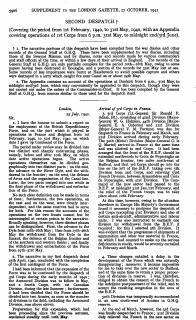
Details
5906          SUPPLEMENT TO THE LONDON GAZETTE, 17 OCTOBER, 1941

                           SECOND DESPATCH f
(Covering the period from ist February, 1940, to 3ist May, 1940, with an Appendix
covering operations of ist Corps from 6 p.m. 3ist May, to midnight 2nd/3rd June).

   | i. The narrative portions of this despatch have been compiled from the war diaries and other
records of the General Staff at G.H.Q. These have been supplemented by war diaries, including
those of the Swayne Mission, and by diaries, notes and records made by various commanders
and staff officers at the time, or within a few days of their arrival in England. The records of the
General Staff at G.H.Q. are only partially complete for the period loth—i8th May, owing to some
papers having been destroyed at Boulogne, and a portion of the records for 3ist May lost at sea.
Some records of less importance were burnt at Hazebrouck to avoid possible capture and others
were destroyed in a lorry which caught fire near Cassel on or about 24th May.
     2. The Appendix contains an account of the operations at Dunkirk from 6 p.m., 3ist May, to
midnight 2nd/3rd June, which may conveniently be appended to this despatch, though they were
not carried out under the orders of the Commander-in-Chief. It has been compiled by the General
Staff at G.H.Q., from sources similar to those used for the despatch itself.


                               London,               Arrival of yd Corps in France.
                                   25 July, 1940.       3. 3rd Corps (Lt.-General Sir Ronald F.
Sir,                                                 Adam, Bt.), consisting of 42nd Division (Major-
   1. I have the honour to submit a report on        General W. G. Holmes), 44th Division (Major-
the employment of the British Expeditionary          General E. A. Osborne) and 5ist Division
Force, and on the part which it played in             (Major-General V. M. Fortune) was due for
operations in France and -Belgium from ist           despatch to France in February and March, and
February, 1940, to 3ist May, 1940, on which          5 ist Division arrived during early February.
date I gave up Command of the Force.                 The 5oth (Motor) Division (Major-General G. le
                                                     Q. Martel) arrived in France at the same time
   The period under review may be divided into       and was allotted to 2nd Corps. It had been
two distinct and sharply contrasting phases,         arranged that the front of the B.E.F. should be
namely, before and after loth May, on which          extended northwards to Croix de Poperinghe on
date active operations began. The active             the Belgian frontier, two miles north-east of
operations themselves can be divided geo-            Bailleul, and that 3rd Corps should go into the
graphically into two distinct parts ; on the east,   line on the left of the B.E.F. taking over 5th
the advance to the River Dyle, and the with-         Division from 2nd Corps, and relieving 53rd
drawal to the frontier; on the west, the defence     French Division, between Armentieres and Croix
of Arras and the organisation of the Canal line.     de Poperinghe, with 5ist Division. The Com-
Later, the two parts merged into one whole in        mand of the new sector had passed to the
the final phase of the withdrawal and embarka-       B.E.F. at midnight 3ist Jan./ist February, and
tion of the Force.                                   the relief of the French troops was to take
   No such clear definition can be made in terms     place about I2th February.
of time; furthermore, the two operations, on            At this time, however, owing to the situation
the east and on the west, were closely inter-        elsewhere in Europe His Majesty's Government
dependent, and the same reserves had to serve        found it necessary to postpone the despatch of
for both. For this reason the accounts of the        3rd Corps (excepting 5 ist Division) and also of
operations on the two fronts cannot but be           certain anti-aircraft, administrative and labour
intermingled at certain points in the narrative.     units. I was also instructed to earmark one
Broadly speaking, however, three distinct phases     division for withdrawal from the B.E.F. if
can be distinguished. First, the advance to the      required ; for this I selected 5th Division. It
Dyle from ioth-i6th May; then from i7th-26th         was evident that the programme of shipments of
May the withdrawal from the Dyle to the              ammunition and other war material to France,
Escaut, the defence of the Belgian frontier and      on which I had counted to make up the serious
of the southern and western flanks ; and finally     deficiencies in stocks, would be severely curtailed
the withdrawal and embarkation of the Force          in February and March.
from 27th-3ist May.
   2. The narrative in my first despatch dated          4. These changes entailed a delay in the
25th April, 1940, concluded with the completion      development of the Force which was naturally
of the first contingent of the Force.                disappointing; moreover, it became impossible
   I had been informed that the expansion of the     for me to take over the new sector to Bailleul,
Force was to be continued by the despatch of         and at the same time to retain a proper propor-
3rd Corps during the early months of 1940;           tion of divisions in reserve. I was, therefore,
the Armoured Division was to follow in May,          obliged to obtain the consent of the French to
and a fourth Corps, with ist Canadian                the indefinite postponement of the relief, and to
Division, during the late Summer ; furthermore,      accept the resulting congestion in the area of
it had been decided that the Force should be         the B.E.F.
divided into two Annies, as soon as the number          5oth Division was temporarily accommodated
of divisions in the field, excluding the Armoured    in an area south-west of Amiens in G.H.Q.
Division, rose above eleven.                         reserve.
   Preparation for this expansion, which had            At the end of March, however, the 3rd Corps
been proceeding since the previous autumn,           was finally despatched to France ; 5ist Division
continued steadily until loth May.                   duly relieved the French in the new sector on
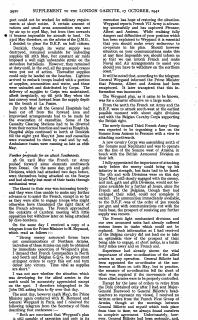
Details
5920           SUPPLEMENT TO THE LONDON GAZETTE, 17 OCTOBER, 1941

 port could not be worked for military require-             execution has hope of restoring the situation.
 ments at short notice. A certain amount of                Weygand reports French VII Army is advanc-
 rations and small arms ammunition was sent                ing successfully and has captured Peronne,
 by air up to 23rd May, but from then onwards              Albert and Amiens. While realising fully
 it became impossible for aircraft to land. On             dangers and difficulties of your position which
 23rd May therefore, on the advice of the Q.M.G.,          has been explained to Weygand it is essential
 I decided to place the B.E.F. on half rations.            that you should make every endeavour to
    Dunkirk, though its water supply was                   co-operate in his plan. Should however
 destroyed, remained available for unloading               situation on your communications make this
 supplies till 26th May, but constant air raids            at any time impossible you should inform us
 imposed a well nigh unbearable strain on the              so that we can inform French and make
 stevedore battalions. However, they remained              Naval and Air arrangements to assist you
 at duty until, in the end, all the quays and cranes       should you have to withdraw on the northern
 were put out of action. Thereafter supplies               coast."
 could only be landed on the beaches. Lighters             It will be noted that, according to the telegram
 arrived to embark troops loaded with a portion         General Weygand informed the Prime Minister
 of supplies, ammunition and water, and these           that Peronne, Albert and Amiens had- been
were unloaded and distributed by Corps. The             recaptured. It later transpired that this in-
delivery of supplies to Corps was maintained,           formation was inaccurate.
albeit irregularly, up till 30th May when the              The Weygand plan, as it came to be known,
last convoy went forward from the supply depdt          was for a counter offensive on a large scale.
on the beach at La Panne.                                  From the north the French ist Army and the
    By 20th May all the General Hospitals had           B.E.F. were to attack south-west at the earliest
been cut off from the forward area and                  possible moment with about eight divisions
improvised arrangements had to be made for              and with the Belgian Cavalry Corps supporting
the evacuation of casualties. Some of the               the British right.
Casualty Clearing Stations had to be diverted             The newly formed Third French Army Group
from their normal function and used as Hospitals.      was reported to be organising a line on the
Hospital ships continued to berth at Dunkirk            Somme from Amiens to Peronne with a view to
till the night 3ist May/ist June and casualties        attacking northwards.
were evacuated to them by road and by rail.
Ambulance trains were running as late as 26th             A new cavalry Corps was assembling south of
May.                                                   the Somme near Neufchatel and was to operate
            *                                           on the line of the Somme west of Amiens, in
Further proposals for an attack Southwards.            'touch with the British Armoured Division on
   38. On 23rd May the French ist Army                 their left.
pushed forward some elements southwards                    I fully appreciated the importance of attacking
from Douai. On the same day, 5th and 5oth               early before the enemy could bring up his
Divisions, which had attacked two days before,          infantry in strength, but facts had to be faced.
were themselves being attacked on the Scarpe            The 5th and 5oth Divisions were on this day
and had already lost most of their tanks through        (23rd May) still closely engaged with the enemy,
mechanical wear.                                        and 2nd, 44th and 48th Divisions, would not be-
                                                        come available for a further 48 hours, since the
   The threat to their rear was increasing hourly       French and the Belgians> though they had
and they were thus unable to make any further           arranged their relief, could not complete it
advance or to assist the French, except in so far       earlier. The ammunition immediately available,
as they were able to engage troops who might -          to the B.E.F. .was of the order of 300 rounds
otherwise have threatened the right flank of            per gun and with communications cut with the
the French advance. The French approached               main base, the prospect of receiving any further
the outskirts of Cambrai meeting with little           supply was remote.
opposition but withdrew later on being attacked
by dive-bombers.                                          The French light mechanised divisions and
                                                        our own armoured units had already suffered
   On the same day I received a copy of a               serious losses in tanks which could not be
telegram from the Prime Minister to M. Reynaud,        replaced. Such information as I. had received
which read as follows:—                                of the Belgian cavalry did not lead me to take
      " Strong enemy armoured forces have               an optimistic view of the prospect of their
   cut communications of Northern Armies.              being able to engage, at short notice, in a battle
   Salvation of these Armies can only be obtained      forty miles away and on French soil.
   by immediate execution of Weygand's plan.              Experience had already shown the vital
   I demand that French Commanders in North            importance of close co-ordination of the allied
   and South and Belgian G.Q.G. be given most           armies in any operation. General Billotte had
   stringent orders to carry this out and turn         been appointed the co-ordinator at the con-
   defeat into victory. Time vital as supplies         ference at Mons on I2th May, but in practice,
   are short."                                         the measure of co-ordination fell far short of
   I was not sure whether the situation which          what was required if the movements of the
was developing for the allied armies in the            three allied armies were to be properly controlled.
north could be accurately appreciated except              Except for the issue of orders to retire from
on the spot. I therefore telegraphed to Sir            the Dyle (obtained only after I had sent Major-
John Dill asking him to fly over that day.             General Eastwood to General Billotte's head-
   The next day, however (24th May), the Prime         quarters to represent my views), I received no
Minister again conferred with M. Reynaud and           written orders from the French First Group of
General Weygand in Paris, and I received the           Armies, though at the meetings between
following telegram from the Secretary of State         General Billotte and myself which took place
describing that conference :—                          from time to time, we always found ourselves
      " Both are convinced that Weygand's plan         in complete agreement. Unfortunately, how-
   is still capable of execution and only in its       ever, General Billotte had been seriously.-and.
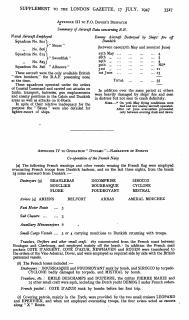
Details
SUPPLEMENT TO THE LONDON GAZETTE, 17 JULY, 1947                                             3317

                            APPENDIX III TO P.O. DOVER'S DESPATCH
                            Summary of Aircraft Data concerning R.N.
Naval Aircraft Employed                              Enemy Aircraft       Destroyed by Ships' fire off
  Squadron No. 801")                                    Dunkirk
                      Y' Skuas"                       (between O3oo/27th May and 20oo/ist June)
             No. 8o6J
  Squadron No. 815 "|                                  27th May                              4
                      Y" Swordfish "                   28th „                                3
             No. 825J                                  2Qth „                                4
                                                       30th „                                Nil*
  Squadron No. 826 " Albacore "                        3ist „                               ii
   These aircraft were the only available British      ist June                             13
" dive bombers," the R.A.F. possessing none
at the time.                                                      TOTAL                     35
   These squadrons operated under the orders
of Coastal Command and carried out attacks on           In addition over the same period 21 others
tanks, transport, batteries, gun emplacements        were heavily damaged by ships' fire and seen
and enemy positions in the Calais and Dunkirk        in distress but not seen to crash definitely.
areas as well as attacks on E-Boats.
   In spite of their relative inadequacy for the          Notes.—* On 3oth May flying conditions were
                                                                   bad and few enemy aircraft operated.
purpose the " Skuas " were also detailed for                     After ist June evacuation proceeded
fighter-escort of ships.                                           only between evening dusk and dawn.


                APPENDIX IV TO OPERATION " DYNAMO "—NARRATIVE OF EVENTS
                                   Co-operation of the French Navy
  (a) The following French warships and other vessels wearing the French flag were employed
evacuating French troops from Dunkirk harbour, and on the last three nights, from the beach
i£ miles eastward from Dunkirk :—
     Destroyers (9)     BRANLEBAS                   INCOMPRISE                SIROCCO
                        BOUCLIER                    BOURRASQUE                CYCLONE
                        FLORE                       FOUDROYANT                MISTRAL

     Avisos (4) AMIENS             BELFORT              ARRAS               AMIRAL MOUCHEZ

     Fast Motor Boats     ... 3

     Sub Chasers               3

     Auxiliary Minesweepers 6            „

     Small Cargo Vessels ...   3 or 4 carrying munitions to Dunkirk returning with troops.

       Trawlers, Drifters and other small craft. 167 concentrated from the French coast between
 Boulogne and Cherbourg, and employed mainly off the beach. - In addition the French mail
 packets COTE D'ARGENT, COTE D'AZUR, NEWHAVEN and ROUEN were transferred to
 the orders of the Vice-Admiral, Dover, and were employed as required side by side with the British
 personnel vessels.
    (b) The French losses included :—
       Destroyers : BOURRASQUE and FOUDROYANT sunk by bomb, and SIROCCO by torpedo.
            CYCLONE badly damaged by torpedo, and MISTRAL by bomb.
     Trawlers, etc. : EMILE DESCHAMPS and DUPERRE, the drifter PIERRE MARIE and
         15 other small craft were sunk, including the Dutch yacht DEMOG I under French orders.
     French packet: COTE D'AZUR sunk by bombs before her first trip.

    (c) Covering patrols, mainly in the Dyck, were provided by the two small cruisers LEOPARD
 and EPERVIER, and when not employed evacuating troops, the four avisos acted as escorts
 along " X " Route.
Source: The National Archives, Kew, ADM 199 792. Contains public sector information licensed under the Open Government Licence v3.0.

Details
| Fast Motor Boats: | 3 | ||
| Sub Chasers: | 3 | ||
| Auxiliary Minesweepers: | 6 | ||
| ate of | French troops in | disembarked in U.K. | Total per day French and Brit sh |
| isembarkation in U.K. | Carried by French vessels. | Total by French and British vessels | Troops disembar! U.K. (excdg. ambilce. traffic). |
| 8 7th May | Nil | Nil | 3373 |
| " | Nil | Nil | 13,948 |
| 9 11 0 | 655 MiL | 655 | 38,843 |
| " 1 | 5,444 | 8,616 | 48,474 |
| " | 4,032 | 14,874 | 58,312 |
| st June | 2,765 | 35,013 | 60,203 |
| " | 905 | 16,049 | 31,427 |
| " | 4,235 | 19,803 | 27,011 |
| " | 2,349 | 26,989 | 26,995 |
| " | 140 | 1,096 | 1,096 |
| sides TOTALS | 20,525 | 123,095 | 309,682 |

Details
| 3 of | French troops in | disembarked in U.K. | Total per day French and British |
| embarkation U.K. | Carried by French vessels. | Total by French and British vessels | Troops disembarked in U.K. (excdg.amblce. traffic). |
| 1 May | Nil | Nil | 3373 |
| " | Nil | Nil | 13,948 |
| " | 655 | 655 | 38,843 |
| 11 | 5,444 | 8,616 | 48,474 |
| " | 4,032 | 14,874 | 58,312 |
| ; June | 2,765 | 35,013 | 60,203 |
| " | 905 | 16,049 | 31,427 |
| 11 | 4,235 | 19,803 | 27,011 |
| " | 2,349 | 26,989 | 26,995 |
| " | 140 | 1,096 | 1,096 |
| TOTALS | 20,525 | 123,095 | 309,682 ght. |
Source: The National Archives, Kew, ADM 199 795. Contains public sector information licensed under the Open Government Licence v3.0.

Details
APPENDIX 'B'
SURMARY OF OPERATIONS ON B.E.F. IN FRANCE
FROM 1ST TO 18TH JUNE 1940
1. After the evacuation of the main British Expeditionary
Force from Flanders in the first week of June the only
British troops remaining in France were the 51st Division,
which had been holding 3 sector of the Sarre Front, and
the incomplete 1st Armoured Division, which had begun its
disembarkation on 20th May and had been rushed up piscemeal
in a desperate effort to relieve the sorely tried right
flank of the B.E.F. By the 1st June this attenuated
Division, which was incomplete when disanbarked and had
lost heavily in its first engagement on the Somme, could
only muster roughly one third of its quota of tanks.
2. These two formations, the 51st Division and the 1st
Armoured Division, the only British fighting formations
General Altmayer, commanding Tenth French Army, which held
remaining in France, were placed under the orders of
the left sector of the Some front from Amiens to the S88.
The handling of the British troops, which had been delegated
to General Altmayer by General leygand, was co-ordinated
and supervisied by a British ilitary Mission at Tenth Army
Headquarters.
Somme sector was sixteen miles in-extent, an excessive
3. The frontage allotted to the 51st Division on the
Fre ch divisions were holding at the time owing to
amount, but probably not much greater than that which their many
action the Sarre front, and had had & long and arduous On
depleted resources. The Division had already been in
4th June the 51st Division Commander was ordered which to carry
journey on from the Eastern frontier to its new sector.
out the Abbeville bridgshead, for
operation an attack the newly on arrived French 31st Division and was 8 placed
under as well PS 160 French tanks
of was effective co-operation between British notice,
however, considerable not a success, ainly owing to the and
his orders, reinforcement of French artillery. difficulty The attack,
French arranging guns and tanks at such casualties... short and
the 51st infantry, Division suffered fairly heavy
4. On the following against the whole front to the
day (5th June) the Garmang held launched by the
Seventh a powerful and offensive Tenth French Armies, from in an St. exhausted uentin condition, sea.
Tenth The The after from too Division 51st wide the Army 12 a days Division front, Commander, front fought of replied to continual was bravely, be when by able that widely this asked movement to but he time resist scattered had was to no relieve and forced effectively. reserves battle, posts. back the available. Division and by Owing German was The holding
to infiltration the extent between of its frontago its the division had no depth
/in its

Details
in its defences, had had no time to organize rearward
defences, nor any reserves with which to counter-attack.
It was forced back to the line of the river Bresle, the
next natural obstacle, 15 miles in rear.
5. Meanwhile the 1st Armoured Division was refitting
south of the Seine. Its tanks were in poor mechanical
condition, owing not only to battle casualties but also to
the long road distances they had been forced to cover,
and to the lack of opportunity for adequate maintenance.
It was in fact in no condition for offensive operations.
6. On the 7th June the Garmans out in & smashing attack
with their 5th and 7th Amoured Divisions on the point of
junction between the two Corps of the Tenth French Army.
This drive was directed from west of Amiens on Rouen and
the lower Seine, with the object of splitting the Tenth
Army and cutting off its IX Corps between the Saina
Estuary and Dieppe. The IX French Corps than comprised
the British 51st Division on the extrema left, and then
further east the 31st and 40th French Divisions and the
2nd and 5th Light Cavalry Divisions. The wh le of this
force was completely sundered from the X Corps on its
right by the penetration of the German tanks.
British base at Rouen, General Sir Henry Karslake, 0.0.0.
7. Meanwhile, owing to the threat developing to the
the Lines of Communication, had scraped together an
improvised force for its local defence. This force
comprised nine infantry battalions of a sort; they
out to France for pioneer duties and partly of composite
consisted partly of second line Territorial units sent
base. They had no war equipment except rifles and &
units made up from miscellaneous reinforcements at the
never fired before. guns They were without artillery, wans
few odd Bren and enti-tank weapons, which they had
District, units were of the formation, this transport command heterogeneous thus was Lines misled given complete of and Brigadier the of signal into Communication. collection with t tile thinking equipment. artillery Besuman, of had of Division; that untrained been in and Vary it They charge given was ancillary unfortunately were The $ and the of righting French the placed task ill-aquipped services. orth of under
Beauman's holding back so-called line along Division the Rivers Bethung and Andella the
covering a Rouen, and had done good work in organizing
defence of this position.
on While the Cerman of the 7th June, General Weygand personally impressed
8. armoured attack was at its height
visited the afternoon Headquarters east of Rouen and the
on Tenth Army and on General Evans commanding holding the
German attack Armoured on the Seine at all costs as this
British General Altmayer, Division, the necessity for was "the
decisive battle of the war.
/It

Details
It was now becoming obvious that to enable the IX Corps
to fall back in good order to the line of the Lower Seine,
a cover position would have to be held along. the River
Andelle, some 12 miles east of Rouen. General Evans, there-
fore, at once ordered his 3rd Armoured Brigade (in fact
reduced to some four weak squadrons of 30 tanks in all)
to stiffen up the right flank of Beauman's defensive line.
9. On the 8th June the German amoured drive continued
on the Axis Amiens - Rouen, and succeeded in penetrating
the weak British defences on the watershed butween the
Rivers Andelle and Bethune, west of Forges-Les-Baux.
Beauman's ill-equipped units, with the British tanks
supporting them, fell back to the line of the Soino.
That night German armoured units penstrated into Rouen,
and the French Tenth Army lost all touch from then onward
with its IX Corps in the Pouen - Dieppe cul-de-sac.
10. The 51st Division was thus completely cut off from
its proper line of retirement via Rouen. This was mainly
due to the failure or inability of the French High Command
to withdraw their left wing while there was still time
and space for this manoeuvre. Throughout all these
operations it was becoming clear that the French High
Command was issuing "die in the last ditch orders, which
their troops had no intention of carrying out. From this
time onwards, until the final evacuation of the B.E.F. on
was crushed and that it had little Intention of offering
the 18th, it was obvious that the spirit of the French Aray
serious resistance. This spirit was also shared by the
Headquarters literally ceased to function for 48 hrs; It
higher commanders; on the 8th June the Tenth French Army
had lost all touch, and its X Corps was broken and in full
retreat.
11. The had on the 9th June reached the line of
The 3rd Armoured and Brigada and Beauman's fragmentary units
the Seine Germans had ustablished bridgeheads at several points.
which had been refitting at Louviers, was put in to support
were withdrawn to reorganize, and the 2nd Amounted Brigade,
General hold de la Laurencie's south III Corps of Rouen. which was It was trying now to
being apparent to the 12. drive Tenth the It employed was Seine Laurie, that south-west French at sent an the elsewhere, this crossings able was out Army German critical towards and rushed to from France. cool-headed armoured while the up On Alencon juncture and the Armee three Its units ni placed with commander, de leading ht that Army Paris. and of & under Corps the view 12th/13th air brigade, 52nd Brigadier the to force were separating Division orders June were detached the
or it the Tenth Freuch right Army. sector of the III Corps frontenst of 8 miles of
Conches, took over the very exposed position, with & battalions gap on
on its right, in a and two newly arrived French
its left west of Evreux.
/AS
Source: The National Archives, Kew, ADM 234 360. Contains public sector information licensed under the Open Government Licence v3.0.

Details
PRELIMINARY EVENTS
CHAP. I
17TH MAY
French 9th Army front broken
By the early morning of the 17th May, the situation on the French 9th Army's
front had become grave. The French line was broken, and enemy armoured
and mobile forces had crossed the river Oise. East of St. Quentin, there was
a gap of at least 20 miles in which there appeared to be no organised resistance.¹
The enemy break-through was now offering an imminent threat to the British
rear G.H.Q. at Arras, to the communications over the Somme at Amiens and
Abbeville, and to the base areas. To meet this, every available man and
weapon were collected. A mobile bath unit, for example, took part in the
defence of St. Pol; General Construction Companies of the Royal Engineers,
and many units of the Royal Army Service Corps, set to work to place their
localities in a state of defence, and manned them until overwhelmed, relieved
or ordered to withdraw.
These numerous delaying actions, though small in themselves, all contributed
to gain the time required for the withdrawal of the main forces.2 A force was
also organised to guard against a more immediate threat to the B.E.F.'s right
flank; and, as a further precaution against the risk of being out-flanked on
the right, the withdrawal to the Dendre and thence to the Escaut was continued
without pause.³
18TH MAY
Allied rail communications severed
By the merning of the 18th May the Belgians had effected a junction with the
B.E.F. left flank at Alost, on the Dendre. From the B.E.F.'s right flank the
French line ran through Mons and Maubeuge.
During the day, the enemy, pounding westward, had penetrated as far as
Amiens in sufficient strength to sever rail communications with the Allies'
bases.
On the night of the 18th-19th May, the 1st, 2nd and 3rd Corps of the B.E.F.
completed their withdrawal to the line of the Escaut without interference, and
prepared to defend the line of that river. (The French 1st Army completed its
withdrawal by the following day and was in touch with the right of the British
1st Corps).
Meanwhile, inundations were being carried out southward by the French;
unfortunately however, without regard to the front of the B.E.F.,4 where it was
soon found that the level of water in the Escaut was becoming so low that the
river was fast ceasing to form a serious obstacle.
After a conference that night with General Billotte, Lord Gort formed the
opinion that there was an imminent danger of the forces in the north-eastern
area - that is the French forces next to the sea, the Belgian Army, the B.E.F.
and the bulk of the French 1st Army on its right - being irretrievably cut off
from the main French forces in the south.⁴ The event three days later showed
this opinion to have been fully justified.
I Lord Gort's Second Despatch, para. 24.
2 Lord Gort's Second Despatch, para. 25.
3 Lord Gort's Second Despatch, para. 26.
4 Lord Gort's Second Despatch, para. 30.
3

Details
CHAPTER II
THE WEEK BEFORE OPERATION "DYNAMO,"
19TH - 25TH MAY, 1940
19TH MAY
Compulsory withdrawal of B.E.F. foreseen
Gort was forced to the conclusion Continent possibility of a compulsory with-
A crisis was now approaching. After that considering the various alternatives, Lord
General Staff, Lieut-General H. the R. War Pownall, telephoned to the Director
drawal of the B.E.F. from the must be faced, and so his Chief of the
Military Operations and Plans at Office and discussed this possibility. of
at Abbeville were still holding, but there was little doubt that enemy armoured
On this 19th day of May communications by road and rail over the Somme
forces in that area would shortly break through to the coast. The force could
then no longer be supplied through in the ports south of the Somme, and the great
be available for maintaining replacements.¹
bulk of the reserves, which were the rearward areas, would shortly cease to
R.A.F. Component begins return to England
The growing failure of communications had now made it impracticable for
the British air organisation to function, and by the evening orders had to be
given for a large proportion of the R.A.F. Component of the B.E.F. (Air Vice-
Marshal C.H.B. Blount) to return to England.
Equally serious was the fact that, by the evening, German troops had arrived
in Amiens. The picture was no longer that of a line bent or temporarily
broken, but of a besieged fortress.²
Vice-Admiral, Dover, represented at War Office conference
Meanwhile, in London, following the receipt of General H. R. Pownall's
message, a meeting had been held at the War Office at which Vice-Admiral
B. H. Ramsay (Vice-Admiral, Dover), was represented.
This meeting discussed the temporary maintenance of the B.E.F.-and the
evacuation other of its personnel through Dunkirk, Calais and Boulogne. Among
questions considered was the possiblity of "the hazardous evacuation of
known very large forces." So little, apparently, was the true military situation then
seven of days later it developed into Operation "Dynamo". "The main decision
in London that this problem was regarded as "unlikely," though only
delegated disposal." to the Vice-Admiral Dover, and available shipping placed at his
this meeting," says Vice-Admiral Ramsay, "was that the control must be
Channel ports the German objective
enemy down the armoured forces appeared to be directed deepened
On the 20th May the breach south of Arras and widened; the
the Channel valley ports. of the Somme on Abbeville, the on other two main doubtless objectives - making one for
2 Lord Gort's Second Despatch, para. 30.
2 I Lord Lord Gort's Second Despatch,
Gort's Second Despatch, para. para, 31. 32.
4

Details
THE WEEK BEFORE OPERATION "DYNAMO"
CHAP. II
General Weygand directing Allied operations
During this day also, Lord Gort became aware that Allied operations were
actually being directed by General Weygand (successor to General Gamelin),
who announced later, on 23rd May, that he was Commander-in-Chief in all
theatres of war.¹
The first move in this so-called "Weygand plan," (see under 23rd-24th May),
now became apparent when General Sir Edmund Ironside, the Chief of the
Imperial General Staff, arrived at Lord Gort's G.H.Q. with instructions from
the British Cabinet that the B.E.F. was to move southward upon Amiens,
attacking all enemy forces encountered and taking station on the left of the
French Army. This move, Lord Gort pointed out, was impracticable because
it would involve the disengagement of seven British divisions which were actually
in close contact with the enemy on the Escaut, and would be immediately
followed up by the enemy. In any case, owing to the prospective interruption
by the enemy of the B.E.F.'s line of supply, imminent at any moment, it was
unlikely that the B.E.F. could undertake sustained offensive operations.
Lord Gort had, however, already made plans to counter-attack with two
divisions southward of Arras, and now proposed that they should make this
attack on the following day. The C.I.G.S. agreed with this action.¹
R.A.F. Component to set up rear H.Q. at Hawkinge
Meanwhile, the evacuation of the R.A.F. Component was proceeding, and
it was decided to set up its rear headquarters at Hawkinge, in England.2
Naval Staff at Dover considers large-scale evacuation
At Dover, the possiblity of a large-scale evacuation was now definitely fore-
seen for a meeting of the Naval Staff was held there during the day to consider
the emergency evacuation across the channel of very large forces. This meeting,
which was attended by Liaison Officers from the War Office Movement Control
and the Ministry of Shipping, considered the number of personnel vessels and
small craft available; it agreed that the air protection of sailings, embarkations
and disembarkations was to be arranged by Vice-Admiral, Dover, direct with
Fighter Command; and it called attention to the necessity, in the event of
evacuation, for a large number of small boats to carry the troops from the very
gradually shoaling beaches to the off-shore ships. Furthermore, as it was
considered extremely doubtful whether the whole of the troops to be evacuated
could be lifted from the beaches, it was urged that if at all possible, the ports
must be used as well"3. It is evident that, at this date, it was not yet realised
that the only port available for the evacuation would be Dunkirk.
Provision of small craft considered
After this meeting at Dover, a long series of telephone conversations took
place between the V-A. Dover, the Admiralty, the Ministry of Shipping and
the C. in C. Nore, as to the provision of small craft for the final evacuation
and the provision of naval personnel for manning the skoots⁴ and small boats
required for transport and ferrying.
I Lord Gort's Second Despatch, para. 32.
2 R.A.F. Narrative.
3 D.R.
4 Dutch schuyts or coasters.
5

Details
THE EVACUATION FROM DUNKIRK
CHAP. II
refugees who got on board. The numbers evacuated by the destroyers con-
cerned were approximately :-
Keith
180
Vimy
...
...
150
Whitshed
...
...
580
Vimiera
...
...
Wild Swan
1955 403 (in two trips)
...
...
Windsor
...
600
Venomous
...
500
Total
...
4368
The Venetia, damaged, did not get alongside a quay. During the night
22 23rd May, before the evacuation under fire, the Verity took off two General
Officers and some 150 troops.
In addition to the Venetia, the Wild Swan, Whitshed, Keith and Venomous
all received damage during the evacuation. The Keith lost Captain D. (19) and
7 ratings killed, and had 28 wounded; the Vimy had one officer killed and her
Commanding Officer, Lieut.-Comdr. C. G. W. Donald R.N. was seriously
wounded and died subsequently ; the Whitshed lost one officer killed and had
12 ratings wounded; the Venetia had 20 ratings killed or missing and 11
wounded; the Commanding Officer of the Verity, Lt. Cdr. A. R. M. Black R.N.
was wounded and subsequently died.
23RD 24TH MAY
The "Weygand" Plan
In the midst of this changing panorama of events, on the 23rd May, General
Weygand became Commander-in-Chief in all theatres of war". He had,
however, previously formulated the ' Weygand plan". This plan contem-
plated a counter-offensive on a large scale¹ and, briefly, it consisted of 3
operations:- :-
(a) An attack south-westward from the north, by the French 1st Army
and the B.E.F., with the Belgian Cavalry Corps supporting the
British right.
(b) An attack northward from the line of the Somme, which line the newly
formed Third French Army Group was reported to be organising.
(c) Operations on the line of the Somme west of Amiens, by a new Cavalry
Corps which was assembling south of the river near Neufchatel.
On the 23rd May Lord Gort received a telegram from the British Prime Minister
to extract:- the French Prime Minister, M. Reynaud, of which the following is an
"Strong Salvation enemy armoured forces have cut Armies.
gand's plan. of these I Armies can only be obtained communications by immediate of execution Northern of Wey-
north Not could feeling sure that the situation armies in the
to General be accurately appreciated developing for the Lord Allied Gort telegraphed
I Sir John Dill asking him to except fly over on the that spot, day.
Lord Gort's Second Despatch, para. 38
10

Details
THE WEEK BEFORE OPERATION "DYNAMO"
CHAP. II
On the following day (24th May), however, the Prime Minister again con-
ferred with M. Reynaud and General Weygand in Paris ; an extract is quoted
below from the telegraphic report of this conference which Lord Gort received
from the Secretary of State for War :
"Both are convinced that Weygand's plan is still capable of execution and only in
its execution has [?lies] hope. of restoring the situation. Weygand reports French
VII Army is advancing successfully and has captured Péronne, Albert, and
Amiens It is essential that you should make every endeavour to co-operate in
this plan. Should however, situation on your communications make this at any
time impossible you should inform us so that we can inform French and make
Naval and Air arrangements to assist you should you have to withdraw on the
north coast"¹.
Lord Gort says that he fully appreciated the importance of attacking
early, before the enemy could bring up his infantry in strength, but facts had
to be faced "!. These were some of the facts :-
(a) General Weygand's report of the recapture of Péronne, Albert and
Amiens was, says Lord Gort, 'inaccurate None of these three
towns on the line of the Somme had been recaptured.
(b) Two British divisions were still closely engaged with the enemy, and
three others were awaiting relief by the French and Belgians, and
would not become available for a further 48 hours.¹
(c) Only about 300 rounds per gun were immediately available to the
B.E.F., and with communications cut the prospect of further supply
was remote.¹
(d) Serious losses in Allied tanks had already been suffered and could
not be replaced.¹
(e) The Belgian cavalry was unlikely to be able to engage, at short notice,
in a battle 40 miles away, and on French soil.¹
Nevertheless, after consultation with General Blanchard, Lord Gort agreed
that in order to implement their share of the Weygand plan they should attack
southwards with 2 British divisions, one French division and a French Cavalry
Corps. The attack however, could not take place till the 26th May at the
earliest, owing to the reliefs in progress and the need to assemble the 2 British
divisions which were still closely engaged with the enemy.¹ Furthermore,
Lord Gort emphasised, both to the Secretary of State and to General Blanchard,
that the principal effort must come from the south, and that the operation of
the northern forces could be nothing more than a sortie.
It will be seen therefore that the British and the French Governments were
both urging a counter offensive on a large scale, barely 48 hours before the
Dunkirk evacuation became a desperately urgent necessity.
24TH MAY
The Allied position on the canal line was considerably strengthened during
the 24th May. On this day also Lord Gort prepared for the proposed counter-
attack southwards on the 26th May, with the ultimate objective Plouvain -
Marquion - Cambrai. In effect, this attack was never carried out.
Fighting troops hold on at Calais
In the meantime the evacuation of Boulogne was completed. At Calais
evacuation was limited to non-fighting personnel. The fighting troops held
on, and a supply ship [the Benlawers]² with stores and transport unloaded for
them at Calais.
1 Lord Gort's Second Despatch, para. 38.
2 T.M. 6213/40.
11

Details
| Amiens |

Details
PLAN 1
Soate of Miles
10
5
o
10
20
30
40
N
The German
break-through
on 17th.18th
KENT
OSTEND
ANTWERP
DUNKIRK LA PANNE NIEUPORT
BRUGES
18th MAY
may
13th
MAY ON MAPS IN LORD CORTS DESPATCH
R.M.
FURNES
Yser
GAND
MALINES
GRAVELINES
a
BERGUES
CALAIS
SPYKE
RIYS
R.Senna
ALOST
WORMHOUTE
th
F.
LOUVAIN
YPRES
18MAY
Phyle
WATTEN
COURTRAI
MENIN
Escaut
BRUSSELS
13th MAY
CASSEL
COMINES
BOULOGNE
StOMER
R.Dendre
WAVRE
HAZEBROUCK
ARMENTIERES
P.LYS
AIRE
MERVILLE
LILLE
ATH
R.Meuse
EXOLISH
NAMUR
StAMAND
LA BASSEE
R.Sambre
VALE CIENNES
DOUAI
Fscaut
RRA
R.
18th MAY
18thMAY
13th:MAY
CAMBRAI
DOULLENS
ABBEVILLE
R
2.50mm
ALBERT
DIEPPE
PERONNE
AMIENS
st QUENTINE
18th MAY
MEZIERES
SEDAN
R.Oire
Approximiste BritishFrenchead Belgiadine on 13ᵗʰ May:
R.Aisne
"
" " 18th " :
German break break-through shewn in blue
RMass
TSD/HS (655)
C.B.H. 16675- Wt.41534 Dd. -625-6/49

Details
PLAN 2
Scale ofMiles
to
5
o
10
20
30
40
N
The Allied
withdrawal into
18th MAY
the Dunkirk
KENT
GSTEND
.
30ᵗMAY
BRUGES
ANTWERP
PANNE
perimeter on the
+
NIEUPORT
23rd MAY
30th May
May
+
4.
FURNES
MALINES
Yser
GAND
BASED ON MAPS IN LORD GORT'S DESPATCH
LINES
C
GRAVE
STATES
BERGUES
R.Lys
ALOST
R
WORMHOUTE
LOUVAIN
CHANNEL
YPRES
COURTRAI
Escant
R.Dyle
WATTE
MENIN
BRUSSELS
.
R
St. OMER
CASSEL
COMINES
Dandre
WAVRE
BOULDONE
.
ZEBROUCK
INS
ARMENTIERES
R.
R
AIRE
MERVILLE
ATH
LILLE
23rd:MAY
Meuse
23rd MAY
St. AMAND
NAMUR
.
BASSEE
CARVIN
.
18th MAY
R.
Sambre
St.POL
.
VALENCIENNES
DOUAI
BARRAS
Escaut
a
CAMBRAI
OULLENS
BEVILLE
B
ALBERT
R.Somme
PERONNE
him
AMIENS
StQUENTIN
French 10th Arm
MEZIERES
SEDAN
R.Oise
Mause
The Dunkirk Perimeter on 30th May.
Allied line on 18th Щау
French 3rd Army R.Aisne
Approximate British, French and Belgiantine on 23rd May
German progress shewn in blue
TSD/HS (ESG)
C.B.H.16675

Details
PLAN 2
Scale ofMiles
to
5
o
10
20
30
40
&
The Allied
withdrawal into
18th MAY
the Dunkirk
KENT
GSTEND
30thmay
BRUGES
ANTWERP
PANNE
perimeter on the
NIEUPORT
23rd MAY
+ 30th May May +
+
x
FURNES
GAND
MALINES
LINES
Yser
BASED ON MAPS IN LORD GORT'S DESPATCH
C
SAYKER
BERGUES
R.Lys
ALOST
a
WORMHOUTE
LOUVAIN
CHANNEL
YPRES
COURTRAI
R.Dyle
WATTE
MENIN
BRUSSELS
.
R
St. OMER
CASSEL
COMINES
WAVRE
BOULDONE
.
Dandre
ZEBROUCK
IVS
ARMENTIERES
R.
AIRE
LALT
MERVILLE
ATH
LILLE
23rd:MAY
Meuse
23rd MAY
.
St. AMAND
NAMUR
BASSEE
CARVIN
.
18th MAY
R
Sambre
St.POL
VALENCIENNES
DOUAI
ARRAS
R.Escaut
CAMBRAI
DOULLENS
BEVILLE
B
ALBERT
Somme
PERONNE
AMIENS
him
St.QUENTIN
French 10th Army
MEDIERES
SEDAN
R.Oise
RMause
The Dunkirk Perimeter on 30th May
Allied line on 18th Щау
French 3rd Army R.Aisne
Approximate British, French and Belgiantine on 23rd May
German progress shown in blue
TSD/HS (E56)
C.B.H.16675
Source: The National Archives, Kew, MT 40 36. Contains public sector information licensed under the Open Government Licence v3.0.

Details
Page 8.
s OF SHIPS WHICH TOOK PART IN OPERATION "DYNAMO" - 26TH MAY - 4TH JUNE, 1940
PART II - FOREIGN WARSHIPS
POLISH
BLYSKAWICA
FRENCH
AMIENS
DILIGENTE
MARCEAU
AMIRAL MOUCHEZ
EPERVIER
MISTRAL
ARRAS
FLORE
M.T.B. 24
BELFORT
#
FOUDROYANT
SIMOUN
BOUCLIER
IMPETUEUSE
SIROCCO
#
BOURRASQUE
INCOMPRISE
T. 112
BRANLEBAS
LEOPARD
T. 113
CYCLONE
T. 143
DUTCH
NETHERLAND MOTOR-BOAT M 74
# Sunk
Source: The National Archives, Kew, MT 40 66. Contains public sector information licensed under the Open Government Licence v3.0.

Details
Page 8.
LIST OF SHIPS WHICH TOOK PART IN OPERATION "DYNAMO" - 26TH MAY - 4TH JUNE, 1940
PART II - FOREIGN WARSHIPS
POLISH
BLYSKAWICA
FRENCH
AMIENS
DILIGENTE
MARCEAU
AMIRAL MOUCHEZ
EPERVIER
MISTRAL
ARRAS
FLORE
M.T.B. 24
BELFORT
#
FOUDROYANT
SIMOUN
BOUCLIER
IMPETUEUSE
#
SIROCCO
#
BOURRASQUE
INCOMPRISE
T. 112
BRANLEBAS
LEOPARD
T. 113
CYCLONE
T. 143
DUTCH
NETHERLAND MOTOR-BOAT M 74
#
Sunk
Operation Dynamo Map — Movement Logs
Movements recorded for Amiens during the evacuation period, as plotted on the Operation Dynamo map.
| Departed | Route | Arrived | Troops | Notes | Source |
|---|---|---|---|---|---|
| 1 Jun 1940, 23:00 | Cherbourg → Dover | 2 Jun 1940, 10:35 | — | NMM 940.542.1 1940 Orde vol i, page 48 |
Log in to suggest an evidence-backed edit or a new movement log.