Also known as
No aliases recorded.
England
User Contributed Collection
Documents and descriptions supplied by archive contributors. All submissions are reviewed in accordance with our Terms and Conditions.
No user-contributed documents have been approved for this vessel yet. Use the forms below to contribute images or documents relating to this vessel.

Help complete the archive
Do you have a photo of this vessel you can share?
Contribute photographs of England to the archive for editorial review. Submissions remain private and will only be published following approval by an administrator.
How your photograph will be credited
Exterior · 1940 · Copyright © Example Contributor
Source: Copyright ownership confirmed at submission by Example Contributor.
This example uses the photograph group, year and copyright-holder name supplied in the form. Your own details will replace the example above when an approved image is published.
Already have an account? Log in before uploading to link new photographs immediately.

Help complete the archive
Contribute a document
Share documents or images relating to England for editorial review. Upload up to 12 PDF, JPG, PNG or WebP files per submission, with a maximum size of 20 MB each. Your submission remains private and will only be published following approval by an administrator.
How your document will be credited
Example Document Title · Contributed by Example Contributor
Source: Archive reference supplied by Example Contributor.
This example uses the document title, contributor name and source or archive reference supplied in the form. Your own details will replace the example above when an approved document is published.
ORDE Registry
0 records0 potential matching records have currently been identified.
Further indexing may identify vessel particulars, reported movements, participation assessments, named personnel and source references. The absence of a current match does not establish that no relevant source exists.
We are compiling and checking transcriptions, metadata, vessel-name matches, source references and reuse permissions before publishing further detail. This work helps prevent incomplete OCR, historic spelling variations or unverified associations from being presented as established fact.
Account registrations and access to these developing records are temporarily unavailable. Existing account holders may log in, and everyone can join the newsletter for publication updates.
Small Craft Service List
2 records2 potential matching records have been identified.
These records may contain service-list entries, vessel metadata, source-page references and protected full-size document images. A match does not by itself prove that the vessel participated in Operation Dynamo.
“Potential match” means a candidate returned by one or more indexing rules; it is not necessarily an exact identity match. Depending on the source, matching may use a normalised vessel name, a partial text or OCR hit, an alias, or related metadata. Roman-numeral suffixes such as I, II, III, IV and V may be absent, misread or separated from the base name, so records for similarly named vessels can be grouped incorrectly. Multi-word names can also produce candidates where only one significant word matches. Confirm the full name, numeral, vessel type, dimensions, builder, ownership, dates and source context before treating two records as the same vessel.
We are compiling and checking transcriptions, metadata, vessel-name matches, source references and reuse permissions before publishing further detail. This work helps prevent incomplete OCR, historic spelling variations or unverified associations from being presented as established fact.
Account registrations and access to these developing records are temporarily unavailable. Existing account holders may log in, and everyone can join the newsletter for publication updates.
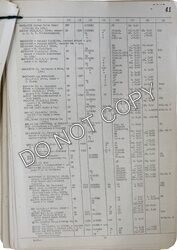
Details — result 1
A source-page icon is available. Sign in to view the indexed details and protected full-size image.
Details — result 2
A source-page icon is available. Sign in to view the indexed details and protected full-size image.
Red List (1939–40) — OCR
4 records4 potential matching records have been identified.
These records may contain OCR text matches, source files, page references and digitised page imagery. A match does not by itself prove that the vessel participated in Operation Dynamo.
“Potential match” means a candidate returned by one or more indexing rules; it is not necessarily an exact identity match. Depending on the source, matching may use a normalised vessel name, a partial text or OCR hit, an alias, or related metadata. Roman-numeral suffixes such as I, II, III, IV and V may be absent, misread or separated from the base name, so records for similarly named vessels can be grouped incorrectly. Multi-word names can also produce candidates where only one significant word matches. Confirm the full name, numeral, vessel type, dimensions, builder, ownership, dates and source context before treating two records as the same vessel.
We are compiling and checking transcriptions, metadata, vessel-name matches, source references and reuse permissions before publishing further detail. This work helps prevent incomplete OCR, historic spelling variations or unverified associations from being presented as established fact.
Account registrations and access to these developing records are temporarily unavailable. Existing account holders may log in, and everyone can join the newsletter for publication updates.
Ship Details
These details have been aggregated from multiple sources and may include contemporary records, later recollections, claims or assertions for which no corroborating evidence has been identified. Inclusion does not establish that any account or assertion is accurate. The information may be incomplete, out of date, disputed or incorrect and should be checked against the underlying source records and independent evidence before being relied upon.
- Ship type: Thames Launch
Lloyd’s Yacht Register (1939)
Source: Lloyd’s Register Foundation, Heritage & Education Centre, Lloyd’s Register of Yachts 1939, digitised via Internet Archive. Licensed under CC BY-NC-SA 4.0. Images have been converted, resized and watermarked for web display; machine-generated table OCR has been added.
No Lloyd’s records.
Document Collections — Tagged Pages
520 pagesImaged document collections containing pages whose OCR text or table data has been tagged with the name England. Open a collection to view the page images and transcriptions.
Source: Lloyd’s Register Foundation, Heritage & Education Centre, Lloyd’s Register of Yachts 1939, digitised via Internet Archive. Licensed under CC BY-NC-SA 4.0. Images have been converted, resized and watermarked for web display; machine-generated table OCR has been added.

Details
| 2799 162491 | Happy Delivery (exInyoni, Steel exTusculum) Pet.Mot. | TwnSc Slp | 14:61 25:49 28 | 55.3 560 | 108 | 38 | Dr.Loos | Cöpenick 1925 | 2 Petrol Motors each6Cy.85mm.-140 Fiat(England),Ld.29 | Miss Ann Houghton- mm. Smith | London |

Details
| Royal Welsh Yacht Club of England | 6 | 661 | Torbay Sailing Club | 11 | 659 |

Details
| THE HURLINGHAM YACHT CLUB. Est. 1911. Entrance Fee, £1 1 0. Annual Subscription, £1 1 0. Ladies (not Boatowners) £0 10 6. COM. W. J. French. V.-C. A. C. Matlock. R.-C. W.N. Hewson. H. TREAS. €.C. A. Jackson. H. SEC. C. Geri, 56, Glenburnie Road, Upper Tooting, London, S.W.17. Club House 43a, Deodar Road, Putney, London, S.W.15. | INTERNATIONAL MOTOR YACHTING UNION. (Union Internationale du Yachting Automobile.) PRES. A. Pierrard (Belgium). V.-PRS. Count V. Borromeo & C. F. Antheunissen. MEMBERS OF COMMITTEE Representatives of England, United States, Germany, Holland, Italy, Argentine and Switzerland. TREAS. G. Kestens. SEC. M. C. Pauwaert, 83, Rue du Patyntje, Ghent. | ROYAL IRISH YACHT CLUB. Est. 1846. Entrance Fee, £5 0 0. Annual Subscription, £6 6 0. COM. Herbert Dudgeon. V.-C. W. M. A. Wright, M.D. R.-C. J. B. Stephens. SEC. A. W. Taylor. Club House Kingstown, Co. Dublin. |

Details
| V R VR ROYAL VICTORIA YACHT CLUB | ROYAL WELSH YACHT CLUB | ROYAL WESTERN YACHT CLUB OF ENGLAND |

Details
| P. Nc. Royal Port | St. G Royal St. George | Tig. Tigre Sailing | England |

Details
| Mitchell, F. G., Albyns, nr. Romford, Esser. Cor.-Tms.-Y.R.A. Nauta - Nona 5 Mitchell, Mrs. F. G., | Mitchell, Robt. A., Marmont, Strandtown, Belfast. N.Ir. a. Capella 9 Mitchell, Robt. A., jun., | R.Y.C.I. Bamba 11 Moe, Dr. Reidar, Abbedikollen 22, Ullern, pr. Oslo, Norway.-Nsk. Boreas 4 | Molins, Longwood, Bexley, Kent.-Cor.-Dan.- Ocn.-Y.R.A. a. The Blue Peter 42 Moll, Ir. J. A., Zuider Gasfabriek, Amsterdam. Het Y.-Maas. | Money, Capt. E. W., O.B.E., R.N., Royal Western Yacht Club of England, Plymouth, Devon.-R.Y.S.-Nav.- S.W.(c.)-Wes. Redemoney 2 |

Details
| Suomi 3 Tansy 3 Preston, J. P., Gatehouse, Lymington, Hants. Lym.S.-Sth. | Price, Albert Austin, 858, Washwood Heath Road, Ward End, Birmingham.-Hbl.Y. a. Louisette II (P.O.) 16 | Prince, Frederick H., Villa Sainte Hélène, Pau, Basses Pyre- nées, France; & Newport, R.I., U.S.A.--N.Yk.-Y.C.F. m. Lone Star - | Privett, George, 45, New England Road. Brighton, Susser.-Bri.-Ssx. Me Too 2 | Pugh, Lt.-Comdr. C.R.V.,R.N. Titania (P.O.) 18 |
Contains public sector information licensed under the Open Government Licence v3.0.
Details
ABEL DEWULF (N.58) Belgion trawler 3rd June - Together with the tr. Andre Lucienne (N.53) disembarked at Dover 35 May troops. (1) Dover, stori in company were the skoots Alica and KARD Falgu, both londed with food. Total 17 Senior Officer. usy 0500en Arrived La Panner The 3 skoots were beached shortly after high seter. Lt. Cdr. went ashore to arrange for 07300a unlonding. He located 0.11.0. and reported to General who was of puramount importance to evacuate troops. 1400ca Six bombers attack the 3 skoots and 15 beach. Lt. Car. Crick wounded, Licot. Griffiths subsequently died of his wounds. One rating tus mm Liest. O.E.S. Beal R.N. commenting the KS80 Falga assumed the daty or senior officer of the 3 skoots, and took command of the Abal Tasman. Lt. Cdr. Crick took passage to England in the or. Calcutta. 1530 Emberked troops. 1700 Kasp Falgs and Alice refloated on the rising tide and got under way. 1730ca The Alice broke down while trying to tow the Abel Tasmon's atern off. 1765 High water. The Abel Tasman refloated and proceeded. time 0700 Arrived Dover. Discrborked and 20 French start officero. 2200 Sailed to Newhaven to disembark ammunition. Took no further part in Operation Dynamo. Total 220(1) - R.O.II, vp.3, 6. the Abel Yoamon, 8h 29th on Alice and MAY. Knap THIS Palga 10 900 (1) D.R. the Alles were abundoned 4 troops. at Dunkirk and the brought 5
Details
ABEL TASMAN Skoot Lt. Cdr. T.G.P. Crick, R.N. Lieut. Griffiths R.N.V.R., 1st Lieut. 27th May 1900 Sailed from Dover, loaded with ammuni- tion; in company were the skoots Alice and Kaap Falga, both loaded with food. Lt. Cdr. Crick, Senior Officer. 28th May 0500ca Arrived La Panne. The 3 skoots were beached shortly after high water. Lt. Cdr. went ashore to arrange for 0730ca unloading. He located G.H.C. and reported to General Adam who said it was of paramount importance to evacuate troops. 1400ca Six bombers attack the 3 skoots and the beach. Lt. Cdr. Crick wounded. Lieut. Griffiths subsequently died of his wounds. One rating was killed. Lieut. C.E.S. Beal R.N. commanding the Kaap Falga assumed the duty of senior officer of the 3 skoots, and took command of the Abel Tasman. Lt. Cdr. Crick took passage to England in the cr. Calcutta. 1530 Embarked troops. 1700 Kaap Falga and Alice refloated on the rising tide and got under way. 1730ca The Alice broke down while trying to tow the Abel Tasman's stern off. 1745 High water. The Abel Tasman refloated and proceeded. 29th May 0700 Arrived Dover. Disembarked 200 troops and 20 French staff officers. 2200 Sailed to Newhaven to disembark ammunition. Took no further part in Operation Dynamo. Total 220(1) Authority - R.O.II, pp.3, 6. (1) According to D.R. the Abel Tasman, Alice and Kaap Falga together disembarked 900 troops on 29th May. This is incorrect; the Alice was abandoned at Dunkirk and the Kaap Falga only brought back 4 troops. 6
Details
in ALBATROSS M/B (Owner ? H.W. Copeland). THE 20th May 1200 Left Did not return from Operation Dyanmo. the 5th 2130 Arrived off Bray bench- Sent boats inshore to embark troops. Tide low, and 0 smill but troublesome surf. Authority - TO.9144 Troops in good spirite though short of rations. TO.9436 Landed dry provisions in the skiff. 2330 A bomb dropped about 1 mile to seasord of the Albery. 29th May 0230 Proceeded to Margate. 1340 Arrived Margate, Disemburked 162 troops. Sailed for the beaches, 1930 Arrived off Malo. Considerable bombing in progress. Proceeded towards 8 grounded and burning paddle-steamer [the Created Eagle which was full of troops and survivore and in a bad way. All boats and Carley floats were sent away and many survivors picked up. Bonba dropped continually around the Albury and the P/S during this operation. Signalled for fighter assistance, which arrived later in the evening. 57 cot cases were brought off, mostly suffering from severe burns. The C.O. and other survivors from the dr. Gronade were also embarked. Having embarked all known survivors, the Albury proceeded to Bray and embarked troops from several boats. A Captain Churchill, from the H.O. Staff came off and said that he had to get over to England to see his uncle, the Prime Minister, by 0600. Proceeded to Margate, 30th May 0550 Arrived Margate. Disembarked AS and survivors and Captain Churchill, Bailed to Shoerness for coal and comunition. That usy USDO Left Sheerness for the beaches. OTTO Arrived off Malo benon. Considerable surf. Embarkation greatly nosleted by a large power boat. 1230 Bailed for Margate. 1700 Arrived Margate, Disembarked 130 troops 18000s Sailed from Margate under the orders of the 8,0,, 5th M.S.F. 2200 The 51h M.S.F. rendezvoused at W buoy. 2345 Anothered off T.S. Funne, Spasmodic bombardment by shore gune. 2310 riotilla VISA ordered to carry on ambarkation, using shiph' boats. AUGUSTER now en there were practically construons bombing attreke, mostly W DAVA nombers. to the M/D Speedwell 903 aground and towed her off. 18
Details
ALBURY (N.41) 5th M.S.F. Cdr. C.H.Corbet-Singleton R.N. 28th May 1200 Left Harwich in company with the 5th M.S.F. 2130 Arrived off Bray beach. Sent boats inshore to embark troops. Tide low, and a small but troublesome surf. Troops in good spirits though short of rations. Landed dry provisions in the skiff. 2330 A bomb dropped about 1 mile to seaward of the Albury. 29th May 0230 Proceeded to Margate. 1340 Arrived Margate. Disembarked 161 troops. - Sailed for the beaches. 1930 Arrived off Malo. Considerable bombing in progress. Proceeded towards a grounded and burning paddle-steamer [the Crested Eagle] which was full of troops and survivors and in a bad way. All boats and Carley floats were sent away and many survivors picked up. Bombs dropped continually around the Albury and the P/S during this operation. Signalled for fighter assistance, which arrived later in the evening. 57 cot cases were brought off, mostly suffering from severe burns. The C.O. and other survivors from the dr. Grenade were also embarked. Having embarked all known survivors, the Albury proceeded to Bray and embarked troops from several boats. A Captain Churchill, from the H.Q. Staff came off and said that he had to get over to England to see his uncle, the Prime Minister, by 0600. -0020 Proceeded to Margate. 30th May 0530 Arrived Margate. Disembarked 445 troops and survivors and Captain Churchill. Sailed to Sheerness for coal and ammunition. 31st May 0300 Left Sheerness for the beaches. 0930 Arrived off Malo beach. Considerable surf. Embarkation greatly assisted by a large power boat. 1230 Sailed for Margate. 1700 Arrived Margate. Disembarked 130 troops. 1800ca Sailed from Margate under the orders of the S.O., 5th M.S.F. 2200 The 5th M.S.F. rendezvoused at W buoy. 2345 Anchored off La Panne. Spasmodic bombardment by shore guns. lst June 0230ca The flotilla was ordered to carry on embarkation, using ships' boats. 0400ca From now on there were practically continuous bombing attacks, mostly by dive bombers. 0500ca Passed a wire to the M/S Speedwell which was aground and towed her off. 19
Details
A.L.C.16 Landing Craft S/Lt. R.O. Wilcoxon, R.N.V.R. 29th May 0900ca Off Dunkirk the first A.L.C. to be hoisted out of the S.S. Clan Macalister Proceeded to Dunkirk beach and ferried troops. After about 7 successful trips, "she was boarded by a mob of French soldiers, who overwhelmed the boat to such an extent that she became partially swamped, the star- board battery was flooded and both engines failed". "Eventually, sufficient French were evicted to enable A.L.C.16 to be floated off and the port engine started." 1800ca In going astern however, the port stern tube was damaged and water poured in to the boat. Continually pumping and baling, A.L.C.16 continued ferrying for a further 1½ hours. She then went alongside the sloop Bideford and transferred her load of troops. S/Lt. Wilcoxon went on board Bideford to arrange for a tow back to England. 2007 Dive bomb attack. Bideford's stern blown off; S/Lt. Wilcoxon, in Bideford, mortally wounded; (1) A.L.C.16 was heavily damaged, and sank in a few minutes. 2030 M/S Kellett came alongside Bideford, and took off the crew of A.L.C.16 together with other survivors and wounded. Note: The capacity of the A.L.C's was about 50 men, so that A.L.C.16 probably ferried about 600 troops Authority - R.O.III, p.523. (1) S/Lt. Wilcoxon was found by P/O Gill and Sto. Hardstaff of A.L.C. 16 sitting on a bollard, just for'd of the Bideford's Q.D. with one of his legs blown off above the knee. They used a rifle pull-through as a tourniquet. s/Lt. Wilcoxon sent them in search of a doctor, but they were unable to rind one. 29
Details
BART BARBE JUGUSTE (D.812) 'ronch M.F.V. (Rata.) 3rd June - Discmburked 65 troops in England. 1) 26th Day Taken 27th May Arrived 300 100 Barbe 1830 Auguste A1)396 thence 8 further 240 28th May auxiliary menetweeper Lieutenant de vaetteau RAOUL 7th June to and und Note by Cdr. Cras, of French Historical Section (1) D.h., D. which numes the ship "Barbara upuste". un 84
Details
R.N. 0300 h May Arrived Dover from Sheerness. 0815 Left Dover in company with 5 other boats, (see Viewfinder). Later joined by M/B Reda. 1730ca Arrived La Panne. Towed boats from beach to ships. Received some damage while alongside a destroyer which suddenly went full ahead. 2400ca Lngines giving trouble; foul screw and rudder. - Made fast to the M/S Albury, which th May a.m. later proceeded to Margote. [The Boheli was apparently left behind] [s/Lt. Bonham transferred to the Sk. Horst on 31st] d June - Bobeli, stranded on the beach at Dunkirk, was sighted by the M/B Advance. She did not return to England. Nil uthority - R.O.II, p..392, 393. R.O.III, p.320. TO.9436. 111
Details
| - | - | The Britannic apparently made another trip to Dunkirk, but did not return to England. |
Details
CALCUTTA Cruiser (lst A/A Squadron) Capt. D.M. Lees, R.N. 27th May 2310 Sailed from the Downs for La Panne. 28th May 0125 Torpedo track crossing from port to 0135 starboard missed ship 100 yards astern M.T.B. heard and vaguely seen bearing green 60°. No subsequent torpedo tracks seen. 0248 Anchored off La Panne. Motor cutter and 2 whalers sent into beach, to ferry troops to the P.M/S. Sandown and Gracie Fields. The drs. Grafton, Greyhound and Impulsive also evacuating from this beach. 0615 Impulsive ordered to Dunkirk east pier. 0625 Evacuation of beach completed. Grafton and Greyhound proceeded. Sandown and Gracie Fields transferred their 700 troops to Calcutta. 0715 Proceeded to Sheerness. 1215 Sheerness. Disembarked 700/troops.(1) 1710 Sailed for La Panne. 2157 Arrived La Panne. Sent boats in to same beach as before. Only 1 skoot [the Reiger] to assist embarking 70 wounded. 29th May 0300 All wounded taken by the skoot and ships boats to Calcutta. The skoot, with some wounded, sent back to England. 0345 Boats sent in again. Mr. F.J. March, Gunner, the officer in charge of then, contacted Lord Gort 8 miles inland and placed Calcutta at his disposal. At this stage however, Lord Gort did not wish to be evacuated. (2) 0430 One of Calcutta's whalers lost. 0710 Embarkation continued. 0735 M/S Sutton alongside to transfer her troops to Calcutta. 0810 M/S Salamander alongside for same 1210 A purpose. partyof tugs and drifters towing own boats, and proceeding homewards full of troops, ordered to transfer them to Calcutta. 1227 Tug Java, towing a launch, alongside to transfer troops. 1228 dfr. Golden Sunbeam alongside to transfer troops. 1230 dfr. Lord Rodney alongside to transfer dfr. troops. Lord Keith towing launch alongside 1237 to transfer troops. 1247 dfr. Lord St. Vincent alongside to transfer troops. 1250 dfr. Lord Collingwood alongside to transfer troops. (1) D.R. gives 581. (2) D.R. states that shortly efter midnight may, the Calcutta was informed that the 3ʳᵈ Corps efthe B.E.F. and the C:-ai-C. (1) were all at La Panue. 151
Details
CHAMOIS( 1) M/V (Pickford's Ltd.) A.E. Brown, Captain. 1330ca L. Church, Engineer. 29th May Left Portsmouth with a Lieutenant a 5 naval ratings on board "and towing and tug". 30th May 1700 Arrived Ramagate. 31st May a.m. Ordered to Dunkirk. Obliged to come back twice owing to air raids, but got away on the 3rd attempt. - When 2 or 3 miles from Dunkirk saw 2 troop transports being heavily bombed. Went to the rescue - found the survivors were French and Belgian troops. Their clothes were on fire and the ammunition in their pouches was exploding as they were lifted out of the water. Several got caught up in our propeller and had to be released with boat hooks. Rescued about 120 and transferred them to a French trawler, which was on the way to Dunkirk. 1st June 0400ca Unable to reach Dunkirk as it was day- light and the beach was being heavily bombed and shelled. 2000 Arrived at a south-east coast port ?Ramsgate 2nd June "We had a day off". 3rd June "started off for Dunkirk". "Unable to reach the beach owing to the air raids and shells ..... no troops on the shore as it was daylight ..... BO returned to England without any troops." Nil Authority - Pickford's Ltd. (1) The Brown's report are one day accordingly. ahead of the dates correct in Captain dates. They have been amended 173
Details
DEMOK I(1) Dutch Yacht. D.R. records that this vessel landed 100 troops in England on 31st May, and 114 on 1st June. It is also stated elsewhere in D.R. that the "Demog I" was a Dutch yacht, under French orders, and that she was sunk. No date 1s given for the sinking. Total 214 (1) Also to in D.R. as "Demog I" of and this shown name. as a The skoot. ship There 18 not was mentioned in Lloyd's ships referred however, no skoot Register of or of yachts. 228
Details
| troops. (2) | ||
| The Denis Panin for | ||
| Arrived during on about 30 killed by | ||
| Bailed for In the a 50 to of one | ||
| Denia Papin 228 (1) | ||
| of | ||
| of of a a |
Details
DU GUESCLIN (D.G.910) French M.F.V. 30th May 1030 The Du Guesclin and the Surcouf together landed 35 troops in England.(1) 31st May 1335 Routed from the Downs to Dunkirk by 2000 the destroyer Leopard. (see under Margaux (D.692)) left 1st June 0920 With 4 naval ratings 18 sailed from Remagate, wi Total Princess, both tugs towing the I.O.W. forry boat Fishbourne. 1030ca But the Duke's tow rope into the Princess and went ahead. [1120ca The Princess's tow rope broke, She got another connected.] 1250ca The Commander on board the Fishbourne ordered the Dute to contact the tog Bun III and her 4 sailing barges. Did DO, and took the 8/B Heate Away from the Bun III. Bed visibility, lost contact with other tugs and the Fishbourne. The B/B Ada Mary having twice broken away from the Sun III. the Dake took her in tow. 1440ca Approx. 2 miles from Denkirk. Air raid in progress. Picked up 20 soldiers from n drifting life bost and left 20 others and 1 naval rating for the Sun III to pick up. 1620es Took from the dr. Basilisk's lifeboat 11 ratings and midshiman; their lifeboat WILLS then put astern or the 2 sailing barges. 1705 Directed by 2 aircraft to net course 181508 south, and was led to two lifeboate. The Sun III tock the larger; the Duke took from the other, 13 Spaniards and 1 Canadian. 20200a Another 8/B [the Bhannon) broke adrift from the Sun III and the puke look her in tow. 7x8 June 0600ca Arrived Ramagate. Small craft were sent out to take off the 44 survivors. 0730ea The Duks left the 3 sailing barges off the DOWNE, and went into harbour. 083000 Was sent out to retch the Fichbourgs This was done- [See tog Primeral into herbour, as she was diasbled, Jane 0800(2) Proceeded with the Log context to Shosburyness. 7000140 Authority W.W. (1) D.R., which records that "Sourcouf du Quesclin" lunded the 35 troops. 1115. 258
Details
EASTBOURNE BELLE M/B (Owner, Allchorn) 1st June a. m. Her motor having broken down, she was M/B Skylark 6. towed in to Dunkirk beach by the The Skylark 6 then reports that the Eastbourne Belle ran on to a submerged car. full The Eastbourne Belle '18 however, reported to have returned to England. Nil Authority - T.0.9144/40. (1) 265
Details
EDINA ESEX Wherry (Owner, T.H. Read) The Did not return from Dunkirk. 3rd June 2255 Went alongaide vest pier, Dunkirk harbour, and #dbarked 210 French troops who possessed practically Authority - TO.9144. all their equipment. TO.9436. Slipped and proceeded. There was considerable congestion in the harbours 2331 Just cleared harbour entrange where Kingfleher was purmed by French travier Edmond Rend and her port bow, 20 fest from the stern, opened up to the water line. The too ships owung alongside one another after the collision, and the troops transferred to the trawler which was undamaged. The Edmond Rene is not mentioned in any report as having transported the troops to England. Total 210 Authority - R.O.II, P.267. Edmond Resca AD 51 varbeau GUÉZENNEC aux. M/S Hase Fronth STATE 268
Details
EDMOND RENE French trawler The corvette Kingfisher reports: 3rd June 2255 Went alongside west pier, Dunkirk harbour, and embarked 210 French troops who possessed practically 2319 all their equipment. Slipped and proceeded. There was considerable congestion in the harbour. 2331 Just cleared harbour entrance where Kingfisher was rammed by French trawler Edmond Rene and her port bow, 20 feet from the stern, opened up to the water line. The two ships swung alongside one another after the collision, and the troops transferred to the trawler which was undamaged. The Edmond Rene is not mentioned in any report as having transported the troops to England. Total 210 Authority - R.O.II, p.267. Edmoud Rene' AD 51 vaiseau Enseigue are GUÉZENNEC aux. M/S Note of French Historical Section 269
Details
EDWARD z. DRESDEN R.N.L.I. (Clacton) Lt. Cdr. R.W. Faulkner, life boat R.N.R.[?Reta.] W.P. Trotter (Bank of England), a Lieut. R.N.R., a Lieut. R.N.V.R. and the Naval crew. 2nd June p.m. Left Ramsgate too late to get to Dunkirk and had to return. 3rd June Lt. Cdr. Faulkner joined on this day. 1730ca Left Ramsgate with several other vessels in company. Outside Ramsgate was taken in tow by a London tug, [the Tanga] bound for Dunkirk. Four other vessels were on the tow, one of them being the M/B Madame Sans- Gene. - En route, the Sans Gene and another M/B got rope round their propellers, and the latter had to be cut adrift. - Sighted a floating mine. Unsuccessfully tried to sink it by M/G fire. 2300ca Off Dunkirk, the tug cast off the tow. One of Edward Z. Dresden's propellers became fouled. - Attempted to tow off a stranded skoot [the Lena] without success. Ferried French and other troops to ships outside the harbour. Made several such trips. 4th June 0300 Proceeded. 10 miles out picked up a ship's life boat full of soldiers, and embarked them. 0730ca Arrived Ramsgate. Disembarked troops. Estimated Total 50(1) Authority - J.D.C. (1) Ramsgate report states "Two life boats - 184 Allied troops." 272
Details
EM GERBERA M/L's WINDSORA (Owner, Charles Hill & son, Windsor) [+++ 10% June 0715 Taken in tow by the are. Thettix. Other ships in the top sere the N.L/Ba These vessels were unsuitable and took no 1975, part 0725 in Dynamo. d White Bear. Moid Left Dover. 1537 Net the Yvonne of Mombe (of Oravalines) with 1 English soldier heading for England - she turned and headed towards Dunicise. 1615 Air attach Tow broken by blast. Men thrown in water; all picked up. About this time, the Yvonne 03 Nombe was sunk by a direct hit. 1635 Air attack continues. 1652 Bombe heard dropping. Drifters heading home without leaving orders. Some small boats turn back. 1710 Abdy Beanclork, only, in company. 1718 The life boat "Hosa Bood" [1.00 the ROBS good and Phyllis Lunn Joined company. The None Wood and Phyllis Lunn decided to return to Dover. 1740 Closed B. drifter. 1821 Air attack continues, The Abdy Resueler's and the Rosa wood turn back. 1854 Lieut. Meed in the carried on towards Dunkirk. 1926 The M/B Cairngory in reply to B query, signalled "steer 0.55 E. for Dustirk". 2030ca Joined company with the tog SUN IV . 2044 Arrived off Dunking vith son IV. 2100 Lt. Mond boarded the Sen IT- 2135 Dunkirk harbour. PASSION Eroope to the M/S Nisst and other ships lying out- side the harbour, shilst coming alongside the towing a boat in which was Bee Codet Jest, 31dmouth- Willing), a sholl exploded nearby; Lientenent Head WSS mortally wounded, and died in 15 minutes.(1) 2nd June 0423 The left Dankirk in tow of the 1010 Arrived Bun IV. 1030 The Bun XY and the LEER together disembarked 142 $20000. (See Qua IV) 3rd June 1026 Left Benagate. 1355 Arrived Dover- Total S Authority - R.O.II, D.230+ The following evards Hentton in Degratches (Posthunous) 17, Linot. R.H. Head, B.S.V.R. Brassen in Despatchee A.D. Tol. Wells Gooley* Mecksnus. (1) Report by Burg. Lieut. 278 of EXHIR
Details
X E.M.E.D. Walton & Frinton life boat Lieut. R.H. Mead, R.N.V.R. [see Tel. W.H. Cooley. 1st June 0715 Taken in tow by the dfr. Thrifty. Other ships in the tow were the M.L/Bs Greater London, Abdy Beauclerk, and the M/B's P.E.42 Summer Maid and White Bear. 0725 Left Dover. 1537 Met the Yvonne et Moabe (of Gravelines) with 1 English soldier heading for England - she turned and headed towards Dunkirk. 1615 Air attack. Tow broken by blast. Men thrown in water; all picked up. About this time, the Yvonne et Moabe was sunk by a direct hit. 1635 Air attack continues. 1652 Bombs heard dropping. Drifters heading home without leaving orders. Some small boats turn back. 1710 Abdy Beauclerk, only, in company. 1718 The life boat'Rosa Wood" [i.e. the Rosa Wood and Phyllis Lunn] joined company. The Rosa Wood and Phyllis Lunn decided to return to Dover. 1740 Closed a drifter. 1821 Air attack continues. The Abdy Beauclerk and the Rosa Wood turn back. 1854 Lieut. Mead in the E.M.E.D. carried on towards Dunkirk. 1926 The M/B Cairngorm in reply to a query, signalled "steer S.55 E. for Dunkirk". 2030ca Joined company with the tug Sun IV. 2044 Arrived off Dunkirk with Sun IV. 2100 Lt. Mead boarded the Sun IV. 2135 Dunkirk harbour. Ferried troops to the M/S Niger and other ships lying out- side the harbour. Whilst coming alongside the Niger [towing a boat in which was Sea Cadet Lieut. Sidmouth- Willing], a shell exploded nearby; Lieutenant Mead was mortally wounded, and died in 15 minutes. (1) 2nd June 0423 The E.M.E.D. left Dunkirk in tow of the Sun IV. 1010 Arrived Ramsgate. 1030 The Sun IV and the E.M.E.D. together disembarked 142 troops. (See Sun IV) 3rd June 1026 Left Ramsgate. 1355 Arrived Dover. Total 39 Authority - R.O.II, p.230. The following awards were made: Mention in Despatches (Posthumous) Ty. Lieut. R.H. Mead, R.N.V.R. Mention 1n Despatches P.O. Tel. W.H. Cooley. A.B. J.L. MacManus. (1) Report by Surg. Lieut. of Niger. 279
Details
EMILE DESCHAMPS French fleet auxiliary 4th June - This vessel was en route for England from Dunkirk, crowded with troops and refugees. 0558ca The M/S Albury, about 5 cables ahead of the Emile Deschamps, signalled her the course to the N. Goodwin L.V. which she had missed. 0600 21 miles east of the N. Foreland (near the Elbow Buoy), the Emile Deschamps struck a mine and sank in about a minute. The fire-float Massey Shaw, which was about 1 cableaway, picked up 40 French sailors and transferred them to the Albury. Nelson's M/B picked up survivors, the most seriously injured of which she transferred to the Albury. The P/V King George V which had just passed the Emile Deschamps before she was sunk, lowered 4 boats and picked up 67 survivors; she put 10 aboard "H.M.S. Leader" [this was (1) either the M/S Kellett or the Albury 0615 The M/S Kellett, to whom the Albury had signalled, picked up some very badly injured survivors. A fog came down as the rescue operations were completed. The survivors which included 7 French women and a boy, were landed at Margate. Authority - R.O.I., pp.221, 281. R.O.III, p.51. RM,6213/40. TO.9144/41. Emile Deschamps AD 20 accx. M/S Enseigne de vaineau Tellier (Kifled 4 th your) Note by Cdr. Cras of French Historical Dept. (1) There damaged was M/S no vessel Leda was present some distance named "Leader". away, being The escorted by the corvette Kingfisher. 280
Details
EMMA OF INDIA French trawler E.E See under Pierre & Marie Disldays Ender. Fill 28th May 2034 Left Dover for La Panne via 20016 PATAL 2. 29th May 0315 0415 Anchored off beneh armiting daylight. Sufficient collect to Tannch honts which towed the shelers until potrol troops. Assisted by a U/E ran out. 0908 1921 Proceeded by route Y to Dover Dover, Disemberked 274 EXPORT 30th May 1000 1735 Left Dover via route I for Malo beach. Anchored off Malo benon, Embarked troops with ship's two sholers. The fire. beach under sir attack and shall 1930 2117 Proceeded by route X to Doves. Enemy destroyer. A/C simed 4 bombs as coarby 31st May 0100 Anchored daylight. off No Goodwin L.V., swaiting 0430 Dover. Disembarked 215 troops. lat June 1558 Left Dover by route L. N.L/B Mary Goott in toy [the M/B Bluebird was also in tow]. 2315 Anchored off Malo beach. Mary Scott ferried troops to the Emperor of India and towed the ship's whalers, until she broke down and had to be abandoned on the beach. (1) [8/Lt. Diokinson who was in charge of her, obtained a passage in M.L/B. Louise Stephene (2)]. 200 June 0230 Proceeded by route X towards Dover. 0300 The 2 whalers broke away from the toy in Dunkirk Channel one TO CSTA 1015 Dover, Disemberked 733 troops. 3rd June Under repair. Total 642 Authority - R.O.I, D+237. G sary Referred Boott to eventually in Lt. Pasley's returned report so England. as "Louise stephenson". 283282
Details
EMPEROR OF INDIA (P.M/S) 10th M.S.F Ty.Lieut. C. Pawley, R.N.R. 28th May 2034 Left Dover for La Panne via route Z. 29th May 0315 0415 Anchored off beach awaiting daylight. Sufficient daylight to launch boats and collect troops. Assisted by a M/B which towed the whalers until petrol ran out. 0908 1921 Proceeded by route Y to Dover. Dover. Disembarked 214 troops. 30th May 1000 Left Dover via route X for Malo beach. 1735 Anchored off Malo beach. Embarked troops with ship's two whalers. The beach under air attack and shell fire. 1930 Proceeded by route X to Dover. 2117 Enemy A/C aimed 4 bombs at nearby destroyer. 31st May 0100 Anchored off N. Goodwin L.V., awaiting daylight. 0430 Dover. Disembarked 215 troops. 1st June 1558 Left Dover by route X, M.L/B Mary Scott in tow [the M/B Bluebird was also in tow]. 2315 Anchored off Malo beach. Mary Scott ferried troops to the Emperor of India and towed the ship's whalers, until she broke down and had to be abandoned on the beach. (1) [s/Lt. Dickinson who was in charge of her, obtained a passage in M.L/B. Louise Stephens( 2) 2nd June 0230 Proceeded by route X towards Dover. 0300 The 2 whalers broke away from the tow in Dunkirk Channel and were lost. 1015 Dover. Disembarked 213 troops. 3rd June Under repair. Total 642 Authority - R.O.I, p.237. (1) (2) Mary Referred Scott to eventually in Lt. Pawley's returned report to England. as "Louise stephenson". 283
Details
FOUDROYANT French torpedo boat Flotilla) (2nd Division, 2nd Capitaine de corvette Fontaine 30th May 1000ca 1530ca Sailed from Dover for Dunkirk. (1) Off Zuydecoote, met the T/B Bourrasque - coming from Dunkirk. (2) Returned to England, with 763 troops( 31st May - Went to Dunkirk. - Returned to England with 487 troops( 1st June 0800 Sailed for Dunkirk. The M/S Speedwell reports: 1030ca When some distance south-east of W buoy, two consecutive salvos of bombs were seen to hit a French destroyer which was in company with another vessel. "This vessel [presumably the French destroyer] sank within 2 or 3 minutes of being hit. (4) The tr. Gava reports: 1400ca Embarked from a damaged French trawler 137 members of the Foudroyant's ship's company. The M/B Naiad Errant reports: - About 3 miles from Dunkirk a French destroyer blew up. The Naiad Errant picked up about 20 survivors and transferred them to a nearby French tug. The French M/S Bernadette also picked up survivors. (5) Total 1250 (1) Cyclone's report. (2) Bourrasque's report. (4) The D.R. was sunk in Dunkirk channel, Landriau, at commanding the beginning (3) of route X Flotilla of the Pas No.17. de Foudroyant TReport by Rear Admiral Calais). (5) French the French Admiralty record, Folio 338
Details
FRONSAC (517 tons) French cargo ship No movements reported, but on lst June, D.R. records that the "Fransah" [?Frousac] landed Tixier) 500 troops in England, (see also Francois 4th June The Fronsac, Margaux and Normanville left Dover in company for Brest, escorted by the sloop Belfort. Total 500 be Fronsac est Signale' anx Dunes b fer frim 2amenaut 500 hournes. (Regishe des signaux du Savorguan de Brazza) Note by Cdr. Cras of French Historical Section 347
Details
GAVINE M/B (Owner F.A. Cooper) 31st May - The M/B Mary Spearing II, at Dunkirk, sighted the Gavine ashore. The Gavine 1s reported (T0.9144/40) to have returned to England and subsequently 1s recorded (T0.9436/40) to have become a total loss. Authority - R.O.II, p.392. 363
Details
GOLDEN LILY M/B (Owner, Capt. Cullen Lt. Cdr. - ? 29th May 2200 Left Ramsgate in company with the Lily out-distanced the eel-boats. With her superior speed the Golden eel-boats Johanna and Chantecler. The Golden Lily evidently got to Dunkirk - and returned to England - but ties. there is no report of her activi- Nil Authority - T.O.9436/40. 387
Details
GUIDE OF DUNKIRK(1) R.N.L.I. life boat S/Lt. [s/Lt. M/B Iote Amos and had S/Lt. already been to Dunkirk Frinton. 1700 Wallace in M. L/B Orient in the IV] 3rd June S/Lt. and Wallace sailed embarked in the the tug Sun from XV. Ramsgate in V.L/B tow of 2200ca The tow rope parted and fouled the propeller. Signalled many ships but 0400ca could get no reply. S/Lts. Amos and Wallace went over the side and made an unsuccessful attempt to clear the screw with knives. Blankets were then rigged as sails in order to keep the vessel away from the French coast. 1300 Cleared the propeller and set course N.W. for England, having no charts and not knowing the position. 4th June 2000 Contacted No.82 light-ship near Harwich, and the M.L/B's complement of 7, put up in her for the night. 5th June 0800 Left for Sheerness. 1130 Arrived Sheerness. Nil Authority - R.O.II, p.391. R.O.III, p.307. Na Date William Lad had just ink she
Contains public sector information licensed under the Open Government Licence v3.0.
Details
HILDA - Continued 31st May 0600 Six volunteer motor boat drivers joined. Lieut. Beery, suffering from exhaustion, was discharged ashore, sick. The Hilda sailed for Deal. 0830 Arrived Deal. The ship was placed under the orders of Captain R. Pim, R.N.V.R. - Sailed for Dunkirk, towing six M/B's [ the Britannic, the Rose Marie, the Lady Haig, the Moss Rose, the Golden Spray II and the Gipsy King] (1) and two life boats [ex the Belgian steamer Flandres (1). 1600ca Arrived La Panne. Lay off for 30 minutes until the enemy shore guns ceased shelling. 1630ca Closed the beach slightly and Capt. Pim went ashore to organise the embarkation. 2030 Having embarked 600 troops, they were transferred to the dr. Scimitar. Returned to the beach and embarked 100 troops. Capt. Pim re-embarked and the Hilda shifted to the westward. 1st June 0400ca Closed the beach and embarked about 100 stragglers from the main body of troops marching on Dunkirk. 0800ca Closed the dr. Keith, which was flying the flag of Rear-Admiral Wake-Walker. Captain Pim reported the situation and was ordered to close the beaches east of Dunkirk and if there were no troops to proceed to England. 0820ca Shortly after, the Keith was repeatedly attacked by strong formations of bombers, put out of action and abandoned. During this period, the Hilda remained under way, zig- zagging (as apart from the Keith and the M/S Skipjack, there was little else for the A/C to attack). The Hilda at once proceeded to rescue Keith's survivors, and assisted by M/B's, recovered a large number, including 2 British brigadiers and a French general. (2) While so engaged, 0849 aircraft re-appeared and sank the Skipjack half a mile distant. Hilda then proceeded to pick up all Skipjack's survivors( except about 12, which were recovered by a tug [the St. Abbs]. 1100ca Sailed for England with more than a full load of troops. 1130ca Passed Dunkirk breakwater. Shortly after passing 6 W buoy, was overtaken and passed by the P/V Scotia and a paddle steamer [the P.M/S Brighton Queen] laden with troops. When these 2 ships were about 1 mile ahead, dive bombers appeared and sank them very rapidly. The Hilda proceed to the spot and (1) George Hammond & Co. Lloyd's Agency, Deal. (2) Capt. Pim says "some 50, including the Q.M.G. of the B.E.F. and other Staff Officers". (3) Capt. Pim says "some 60 or 70". 32
Details
INDEPENDENCE (0.308) French Belgian trawler vessel 31st May 1335 Routed from the Downs to Dunkirk by 31st May 0550 the dr. Leopard, she sailed in company with the tr. Chasse-Maree and six other trawlers. Cap D'Antifer, Francois Tixier No other details are available. 1. 1200 Arrived Dunkirs [and unloaded munitions]. There 1s no further information, but D.R. states that troops were landed in England 8.8 follows: On 31st May, 600, by the "Cachin". On 1st June, 1, by the Ingenieur Cachin. Total 601 Ingrien Cachin X 24 Licutenant de veitreau Helie was an auxiliary minelayer She disemberkad I 778 Soldiers of the French Goally Corple in Le Havre 1st june 21 30. Note by Car. Cres of French Historical Sootier (1) Also referred to as an auxiliary minesweeper. 56 57
Details
INGENIEUR CACHIN French cargo May vessel (1) 31st May 0550 Sailed from Dover to Dunkirk, escorted by the patrol vessel Reine des Flots; in company were the cargo ships Cap D'Antifer, Francois Tixier and Emma. 1200 Arrived Dunkirk [and apparently unloaded munitions]. There is no further information, but D.R. states that troops were landed in England as follows: On 31st May, 600, by the "Cachin". On lst June, 1, by the Ingenieur Cachin. Total 601 Ingrien Cachin X 24 Lieutenaut de vaitreau Helie was an auxiliary minalayer. She disemBarKed 1 778 solder's of the French Cavalry Corpse in Le Havre 1st june 21 30. Note by Cdr. Cras of French Historical Section (1) Also referred to as an auxiliary minesweeper. 57
Details
JESUS FLAGELLE (B.1853) French M.F.V. 4th June 0900 The Jesus Flagelle disembarked at Ramsgate about 90 French troops May 1335 and about 8 French sailors. (1) the Total 98 Disembarked 12 in England. (2) (1) (1) Ramagate report states that the Meuse, B.1853, H.81 and LHWD disembarked 354 Allied troops and 33 French sailors. (2) 91
Details
JEUNE FRANCE (D1.1213)(1 French M.F.V. 30th May Disembarked about 174 troops in England. (See under Chasse-Maree) 31st May 1335 Routed from the Downs to Dunkirk by 2200 the Destroyer Leopard (see under Margaux (D.692)). Cdr. in 3rd June - Disembarked 12 troops in England. (2) The Golden esl-boats, whic Estimated total 186 separated from Having no charts, the Johanna secured to B ship near the North Goodwine, and stayed there the night. May Ballo Returned to Remegate. 1530ca In company with the M/B Constant and a outter and a whaler, was towed to Dunkirk beaches by the sk. Jutland. (1) 2330 The Jutland enchored 2 miles east of Dunkirk, The Constant Nymph towed in the outter and whaler. About 200 troops were ferried to the Jutland and the Johanna, the letter assisting to load the former. May 0300 Proceeded with 10 troops on board [whether in company with, on to of, the Jutland is not closs]. 1100ca Disamberged TO 8/16 Cares-Russ then the Total 10 Authority - R.O.III, pp.302, 308, 329. (1) Believed to be referred to in D.R. as the "Dame Franche". No vessel named the "Dame Franche" is known by the Ministere de la Marine Marchande, Paris. (2) D.R. the May. 9202 92
Details
KEITH (continued). May 1st (continued). June Some of Keith's survivors reached the wreck of the S.S. Clan Macalister when they were taken off by a motor lighter and transferred to the lighter 1110 Y.C.63, (which already had a full load of soldiers). Survivors of Keith thus reached England in the 1220 following ways: 1530 The Captain, 3 Officers and 13 ratings in Y.C.63; 1 Officer, 83 ratings and 10 officers 1830 of the Army H.Q. Staff in the Vincia; 1950 2 Officers, and 20 ratings in the Hilda; 7 ratings in the Salamander; 1 Officer swam to Dunkirk and took passage in a M.A/S.B. 3 officers and 33 ratings were lost. [the St. 2100 2200 Left the Total 1,200 the Gracie Fields [about 3 hours the Gracis Fields had to be Authority - M.017681/40. T bucy]. 30th May R.O.III. p.374. Margate. 1020 Disembarked 550 (1) 1130 for Sheerness to The following awards were made: 1600 Sailed for Bray beach. D.S.C. Lieut. C.P. Adams, R.N. Arrived off Bray. The expected boats had not arrived. A military officer came aboard with 40 troops. D.S.M. 0130 Lt. Odr. Craig embarked. Shelling of Ch. Yeo.Sigs. F. Laister. the beach commenced and continued. Actg. P.O. E.F. Standley. The troops could not be induced to L/sea. E.I.J.A.G. Joplin. off in the ship's A.B. E.B. Wilkinson. gun fire and shelling of A.B. G.E. Davies, R.F.R. beach. to find troops so Mention in Despatches. Capt. E.L. Berthon, D.S.C., R.Noned by 3 Lieut. R.W. Highes, R.N. Lieut. G.J.A. Lumsden, R.N. found the Midshipman L/Tel. H.B. Poustie, R.NeRtsod. E.J.M. Beeley. A.B. T.F. Asprey. A.B. I.A. Nethercott. A.B. J. Wallis. troops. for A.B. G.J. Woodger. the for 350 and of Wargate a disembarkation Le 110
Details
LADY HAIG (D.R.19) M/B (H. Meakins) 31st May 1100ca Left Deal in tow of the Sk. Hilda 1800 with 5 other M/B's and 2 life boats. Worked off the beaches. There is however no information as to her activities, except that she returned to England. Authority - T.O.9436/40. 136
Details
I) LA NANTAISE - Continued. Bon) 8/Lt, R.A.E.Cornich, R.N.V.D 4th June Sailed for Cherbourg with a convoy of 1500 17 ships. 2030 dr. Openn Broces. bench, ferried troops to the Ocean leaving her proce whale Total 15. magate, Lenadowne. 2100 Lanadowne and the whaler forried troops to the Sk. Atlantic. Authority - French Admiralty record, Folio No.6. ble to clear 15. 1st June 0300 Left Dunkirk in tow of the Atlantic. 0445 The Lansdoyne broke adrift and to be absndoned. She did not return to England. [on 3rd June s/Lt. Minchin embarked in the N/B Hilfranor]. Authority - R.O.II, pp.33, 393, 547- TO. 9436. 148
Details
LANSDOWNE M/B (Owner, V. Messum & son) S/Lt. E.A.E.Cornish, R.N.V.R 31st May - 1500 Towed over to Dunkirk. Off Malo beach, ferried troops to the dfr. Ocean Breeze. 2030 Ocean Breeze proceeded to Ramsgate, leaving her whaler with the Lansdowne. 2100 Lansdowne and the whaler ferried troops to the Sk. Atlantic. 2400ca Propeller fouled. Unable to clear it. 1st June 0300 Left Dunkirk in tow of the Atlantic. 0445 The Lansdowne broke adrift and had to be abandoned. She did not return to England. [on 3rd June S/Lt. Minchin embarked in the M/B Hilfranor]. Authority - R.O.II, pp.33, 393, 547. TO. 9436. 149
Details
LEOPARD - Continued 1115 (contd.) 3rd June Disembarked at Dover the 19 rescued men. 1300 Sailed for Cherbourg. [The 1940 Arrived Cherbourg. 4th June 1200 Sailed for Dover. May 2130 Anchored off Dover. 5th June 0900 Sailed for Cherbourg, the T/B Incomprise in company. Dover. Total 19 May 1600ca for 30 the left or Authority - French Admiralty record, Folio No.18. 1st June 0300ca 120 engineers, although orders MM been given not to 100 per tragler, 0530 Sailed with 12 ships - not in rermation, 80 no not to attract the attention of bonbers. H.76 took the lead, the convoy having delayed; her skipper had no charts, no compane, and no precise information of the channels to England, 1800ca The convoy arrived at Dover with about 800/900 troops (2) [Six other ships of the original convoy landed 350 troops at Remagate (see 3.50). Received orders to proceed to Romagate. - The convoy errived at Ramsgate and disembarked troope. report is not sufficiently accurate to enable details to be 2100ca Bailed givenj. in a convoy or 12 ehipe [see 8.50] for Dankirk. 2nd June Arrived off Dunkirk beach [i.e. Malo] 010000 The 1476 grounded on a sand bank. Onnole to get off on the falling tide, No Terrier boarded the convoy Lesder's ship. 0400 At drun be re-embarked in the 11.76 and after an hour's effort, by another trawler, he got his ship afloat. The other trawler not wishing to enter the harbour, the H.75 alone, and embarited 80 English troops including "s commodore and a 09000a 11. 76 then sailed, after having seen that young Lientenant*. there were no more troops. (1) According to 2.50, there wore 17 ships in the convoy, (2) Dover and their registered a numbers number are of small given. vessels "chalutier" by name, such Report mentions River (120 troops), Marie French BE 68 the Goston (100 troops). the Chasseur Reine Plots (117 troops), (62 the Onders the Patrie (157 troops), names or DO one (95 troopa), the but there is information troops), to and show that these were the V. Terrier's ships. 164
Details
LEOPOLD ANNA (H.76) Belgian trawler Maitre de Manoeuvre (M.F.V. R. Terrier, Skipper. [The times in this account are from the Z.50's and St. Pierre IV's reports. M. Terrier gave none] 29th May Took command of H. 76 at Havre. 30th May 0400ca Sailed a convoy (commanded by Dover. Officer des equipages Vigne) for 2000ca Arrived Dover. 31st May 1600ca Sailed for Dunkirk in a convoy of about 30 ships;( (1) the H.76 leading the left hand column of ships. 1st June 0300ca Entered Dunkirk harbour. Embarked 120 engineers, although orders had been given not to embark more than 100 per trawler. 0530 Sailed with 12 ships - not in formation, so as not to attract the attention of bombers. H.76 took the lead, the convoy commander having been delayed; her skipper had no charts, no compass, and no precise information of the swept channels to England. 1800ca The convoy arrived at Dover with about 800/900 troops. (2) [Six other ships of the original convoy landed 350 troops at Ramsgate (see Z.50) - Received orders to proceed to Ramsgate. - The convoy arrived at Ramsgate and disembarked troops. Ramsgate report is not sufficiently accurate to enable details to be given]. 2100ca Sailed in a convoy of 12 ships [see z.50] for Dunkirk. 2nd June - Arrived off Dunkirk beach [1.e. Malo] 0100ca The H.76 grounded on a sand bank. Unable to get off on the falling tide, M. Terrier boarded the convoy leader's ship. 0400 At dawn he re-embarked in the H.76 and after an hour's effort, assisted by another trawler, he got his ship afloat. The other trawler not wishing to enter the harbour, the H.76 entered alone, and embarked about 80 English troops including "a commodore and a young Lieutenant". 0900ca H.76 then sailed, after having seen that there were no more troops. (1) According to there were 17 ships in the convoy, (2) Dover and Report their registered mentions Z.50, a numbers number are of small given. vessels by name, such as the Gaston River (120 troops), "Chalutier" [French = trawler] (100 troops), the Chasseur Marie (117 troops), the Onders Ons (95 troops), the Reine de Flots (62 troops), and the Patrie (157 troops), but there is no information to show that these were the names of Terrier's ships. 165
Details
MADELEINE CAMILLE (H.81) Belgian trawler Reported by D. Geselle, Belgian telegraphist "We saved 350 soldiers at Dunkirk". From Ramsgate report: 4th June 0900 354 B.E.F. and 33 French sailors were landed by the following 4 vessels: B.1853, H.81, L.H.W.D., E and the Meuse. (Estimated) Total 90 Authority - C.W. 26612/41. La Madeleine Camille with 3 french naval latings on board in a convoy commanded by Ensergued various DuvaR, landed 173 troops in England (hate by bat bras of french Phystomal Dept) 216
Details
1462 MARETTA Oropesa trawler vessel 25th my Maretta was damaged at Calais on 26th May and was 3 weeks refitting]. 26th May Took no part in Dynamo, but shown in D.R. as having done BO. There is no Further information, bot according to DiRey 00 31st May, the "Margeanx" landed 369 troops in England. (1) 4th June Salled from Dover for Brest escorted by the Bloop Belfect, the and Propase in company. Total 369 Plate by the la) Margaws left Deen Kurk with 134 3 twops one of them died (night of 30 02/3/14 of May) Ican't pracise if sha Panded Harry in U.K. arin France. (1) D.R. "Mergeanx" monz the French destroyers) The destroyer Maroeau 1a took given no part 10 D.R's 1141 of visits there was, however, in Dynamidy eud S worships. places the not one of that DRIVE vossel named 235
Details
MARGAUX (1462 tons) French cargo vessel 25th May - The Margaux and the French S.S. Hebe were escorted to the Downs by the sloop Belfort. 26th May Anchored in the Downs. There is no further information, but according to D.R., on 31st May, the "Margeaux" landed 369 troops in England. (1) 4th June Sailed from Dover for Brest escorted by the sloop Belfort, the Normanville and Fronsac in company. Total 369 Phote by film fros of french In see) Margaux left Dunkirk with 1343 troofs one of them died. (night of 30 ,H/3/50 of May) Ican't precise if she Panded them in U.K. os in France. (1) D.R. "Margeaux" among the French destroyers; The there places the not one of that name. named destroyer Marceau larceau is took given no in D.R's list of French was, however, part in Dynamo, but a vessel warships. 236
Details
MARY SCOTT R.N.L.I. (Southwold) M.L/B 1st June 1558 Left Dover, by route X, in tow of the M/S Emperor of India; also on the tow was the M/B Bluebird. 2315 The Emperor of India anchored off Malo beach. Towing the ship's whalers, the Mary Scott ferried troops from the shore, until she broke down, and was abandoned on the beach. S/Lt. S.C. Dickinson, R.N.V.R. (of the Emperor of India) who was in charge of the Mary Scott, got a passage home in the M.L/B Louise Stephens. 2nd June 0845 The Mary Scott proceeded independently to England. (see Appendix S.17). Authority - R.O.I., p.238.
Details
MARY SPEARING( 1) M/B (Owner, W.G.S. Crouch & Sons) s/Lt.W.G.M. Christian, R.N.V.R. [Date?] Ran aground at Dunkirk. - Later she was sighted in tow of a tug. [s/Lt. Christian sighted the M/B at Margherite floating but abandoned]. The Mary Spearing did not return to England. Authority - TO.9144/40. TO.9436/40. R.O.II, p.392. 1) referred to in D.R. as "Mary 15 Spearing I". Incorrectly
Details
2 M.A/3.B.6 - Continued. 31st May 2400ca (contd. On return to the Keith, General Leese was embarked and instructions were given to collect Lord Gort from the M/S Hebe and return to England. 1st June 0030ca By the time the Hebe was reached, Lord Gort had gone over to the Keith; M.A/S.B.6 therefore returned to the Keith. 0304 Sailed for Dover with Lord Gort and General Leese. 0547 Arrived Dover. Disembarked Lord Gort and General Leese. 2nd June 1201 Left Dover to search for the dfr. Girl Gladys (reported broken down 7 miles east of Dunkirk) and also for about 30 soldiers in an open boat (reported by aircraft to be 3 miles off Dunkirk). 1330 3 miles off Dunkirk, collected 5 Spaniards and about 6 troops from 2 open boats. Then went alongside a Thames barge( 1) (containing about 220 troops including 2 colonels, an artillery major and some wounded), which was endeavouring to sail to England. An attempt to repair the barges diesel engine was unsuccessful. M.A/S.B.6's First Lieutenant, S/Lt. T.E.B. de Hammel, R.N.V.R. was transferred to the barge with instructions to sail the barge to M.A/S.B.6 Dover. continued unsuccessfully to search for the Girl Gladys. Two miles to the east, M.A/S.B.6 When east of La Panne, abandoned the picked up 18 troops from an open boat. search for the Girl Gladys, and set to intercept the barge. When course out of sight of land, M.A/S.B.6 was 20 1720ca attacked by about 7 dive bombers. 50 ahead and M.A/S.B.6 passed to yards of the ship. One exploded 30 bombs were dropped within 10 to through just the splash. Two casualties. Arrived Dover. Sent out a tug to troops search Proceeded to Dover. 1922 for the barge. Disembarked 24 The and barge 5 was found by the tug(2) about. Spaniards. [2100 10 miles fron Dover.] Total 26(3) Authority - R.O.II, pp. 391, 468. (1) Not identified. (2) Not identified (3) Not mentioned in D.R. 253
Details
MEANDER M/B (Owner, H. Graham) Skpr. G.W. Halliday, R.N.R. 2nd June - went over to Dunkirk. There 1a no report of her activities, except that she returned to England. Authority - R.O.II, p.392. 263
Details
la MOSQUITO - Continued. 1st June 0500ca Arrived Dover. Disembarked 620 troops. (1) 0830 [1024] Sailed for Dunkirk. 15 miles from Dunkirk attacked by 1 dive-bomber. One near miss caused damage, (2) but was able to continue on course. 1230ca Arrived off Dunkirk. Embarked about 30 French and Belgian troops from a M/B [the Rapid] with life-boat in tow. Telling the M/B to follow, the Mosquito proceeded to the assistance of a transport [the Scotia] reported to be sinking at the west end of the channel. Almost immediately, the 1330ca Mosquito was attacked from different directions by at least 6 of a flight of 20 Ju.87's. The 4th Salvo "literally enveloped" the ship; there was a direct hit and a near miss. Boiler and engine rooms were badly holed, the sick bay wrecked, and the steering gear jammed with the rudders hard over; the ship took a heavy list to port. The pom-pom's crew were all killed or knocked out except L/Sea. Thirlwall; he "although shockingly badly wounded in at least 4 places", kept the one undamaged barrel firing until ammunition ran out. Able seaman Hirschfield proceeded aft, where the 0.5" gun's crew were all wounded, and single-handed brought the gun into action. After giving the order to abandon ship Lieut. Gardiner went below to burn the books. The executive officer, Lieut. A.H. Manwaring, R.N., having been mortally wounded, S/Lt. Flint took charge of the abandoning of the ship. Survivors were picked up by a motor boat [the Rapid] and 2 drifters (one of them the Lord Cavan) (3). Mosquito then had a list to port of about 20 degrees and water was pouring in through 3 holes in the boiler room and a large hole in the condenser. Lieut. Gardiner was taken [in the Lord Cavan] to Dunkirk where he embarked in the dr. Worcester. During an air attack on the way to England he was wounded. Total 1183. Authority - M.017681/40. (2) Calcutta says, "At 1024 detached Shearwater to stand by (1) D.R. states 610. (3) Lieut. Hosquito." Gardiner says, the "Earl of Cavan". 303
Details
E EGI ONLY [Open] Motor life boat - S/Lt. R.H.C. Amos, R.N.V.I S/Lt. R.H. Wallace, R.N.V. 3rd June 1700 2300 Left Ramsgate in tow of the tug Sun XV. Tow parted and fouled propeller. Signalled many ships but could get no reply. 4th June 1300 Propeller cleared. Set course N.W. for England. No charts, and where- abouts unknown. 2000 Contacted No.82 L.V. near Harwich. 10.2 Stayed on board the L.V. for the nigh 10.8 additional 5th June 1130 Arrived Sheerness. Took no part in the evacuation. 1D 78 Authority - R.O.III, p.307. ) Bourgain any M/S (hotoly form of learn) 1 306
Details
OPERATION C.K. COMMITION 7.5, CARRIED our NT See under "Blockships". Can Plan Nsval Denolition Party under the document of Consider U.S. Banks , Ban Banded RE Duskiss ON 23:0 Eng. on the duy, A PTR hold with the vrenche at WHICH the fallowing demollisions 16 the dockyard DO DC undertaken by the Grition French Pospectively were agreed uponse arindon responsibility: The Toaky the Tryation look and the Qualimin 100% Presen responsibility: Lo Ests Look (betseen the Commercial Dook and the tinks and all The sampling atations and the pridgen other the looks and Communder one seateted by A Royal Englaner desolition party unier Captain Scot, this private emberged for ongland on 2608 MAY The French Gemolition jurty consisted or an officer and 20 sounch ratings, On 27th May, on the orders of do 80M Abrial), charges were placed end primot at the Weng Prystram and Outlloin Looks. The charges of the Last too Yorks were later hauled up egain DD permit or e-cmer this going through On 28th May, the B.H.L.D. Henderson) introduced Commandee Docks to the Donkirk who approductly wus unaware of the proposed Operation X.D. (ach alan appendix No signal 14.22), Commander Banks then subscried to the Grifter of Promis and apent an hour OF two seateting in the evacuation or trdops. A rether confused situation 145 to Communder Banks misbakonly returning to England before the demolitions had bach entried out; he returned to Demkinst, hosever, the following days 30th Jana. It was not until 205 June that Admirsi Abrici necided to carry out the following codified programs of Yes lock. Gates and bridge to be Trystree look, The two gates of the action Add inter ends to be compliated, Cuillain look. The two northven gates to be comolished. Le Wain look. The gate 80 be 421 bridges had to be left, ou 1arge numbers of Freich trooph Para ##111 withdrowing BAUCOS the Das By the 20d June, COOM prémore bed been exploded but supplies OF however, two of the charges which by heab sere under tive; water they and had been replaced and pe-fused, demolition stores were running short. 363
Details
OPERATION X.D. DEMOLITIONS CARRIED OUT AT DUNKIRK (See Plan ) Naval Demolition Party "E", under the command of Commander W.E. Banks, R.N. landed at Dunkirk on 23rd May. on the following day, a conference was held with the French, at which the following demolitions in the dockyard to be undertaken by the British and French respectively were agreed upon:- British responsibility: The New lock, the Trystram lock and the Guillain lock. French responsibility: Le Main lock (between the Commercial Dock and the tidal basin), and all the pumping stations and the bridges over the locks and canals. Commander Banks was assisted by a Royal Engineer demolition party under Captain West, R.E., this party embarked for England on 26th May. The French demolition party consisted of an officer and 20 Beamen ratings. On 27th May, on the orders of Amiral du Nord (Admiral Abrial), charges were placed and primed at the New, Trystram and Guillain locks. The charges at the last two locks were later hauled up again to permit of some ships going through. On 28th May, the B.N.L.O. (Commander H.P. Henderson) introduced Commander Banks to the S.N.O. Dunkirk who apparently was unaware of the proposed Operation X.D. (see also Appendix N, signal N.22). Commander Banks then embarked in the drifter Ut Prosim and spent an hour or two assisting in the evacuation of troops. A rather confused situation led to Commander Banks mistakenly returning to England before the demolitions had been carried out; he returned to Dunkirk, however, the following day, 30th June. It was not until 2nd June that Admiral Abrial decided to carry out the following modified programme of demolitions:- New lock. Gates and bridge to be demolished. Trystram lock. The two gates at the outer and inner ends to be demolished. Guillain lock. The two northern gates to be demolished. Le Main lock. The gate to be demolished. All bridges had to be left, as large numbers of French troops were still withdrawing across them. not under water and four primers had been exploded by bomb or By the 2nd June, however, two of the charges which were shell fire; they had been replaced and re-fuzed, but supplies of demolition stores were running short. 364
Details
3 PANGBOURNE - Continued. 0646 30th May Sighted the S. Goodwin L.V. and was (contd. Mosquito. (1) led into Dover by the G/B 1000 At Dover, disembarked 450 troops, and the wounded and dead. 2000 1st June Damage repaired but compasses still out of action. Sailed to rendezvous with the M/S Halcyon at N. Goodwin. Did not find her. (2) - Now too late to go to the beaches, BO proceeded eastward to assist ships returning in difficulties. 2nd June 0532 Passed T buoy. Off S buoy, transferred 23 British troops from the tr. Stella Rigel. 1030 Arrived Dover. Disembarked 23 troops. 2000 Proceeded to Dunkirk in company with the M/S's Halcyon and Speedwell. 3rd June 0030 Entered Dunkirk harbour. Ordered by R.A. Dover to wait outside, as there were no troops. 0200 A life-boat with 43 French troops and 4 officers came alongside and embarked They stated that they were from a French vessel, which had run aground on a sandbank. (3) Ordered by R.A. Dover to return to England. 0215 Followed the M/S Albury until clear of the channel and then made for Folkestone. - Arrived Folkestone. Disembarked 47 troops. Total 920 Authority - R.O.I, p.327. The following awards were made: D.S.O. Actg. Cdr. F. Douglas-Watson, R.N. C.G.M. L/sto. R.K. Robb. Mention in Despatches (Posthumous) P.O. W.G. Hoare. Mention in Despatches. L/Sea. A. Reid. (1) Not mentioned in Mosquito's report. (3) Probably the French mail packer Rouen. (2) She was delayed and had not left harbour. 378
Details
PAULETER MIRASOL( 1) M/B 35 ft. (Owner, M/B (Owner R.C. Kyle) Mrs. D. Ashton) Sto.D. T. Banks [sto. Banks cannot remember any times or dates for the nine trips he says he made; nor does he know the names of his crew]. [29ᵗʰ May?] - - Arrived at Dunkirk beaches. The Pauleter sailed from Ramsgate. Embarked about 40 British and French troops. Proceeded. - Air attacks. - Arrived Ramsgate. Disembarked troops. sto. Banks with his crew of 2 ordinary seamen then transferred to the Mirasol, and sailed to Dunkirk. - The Mírasol, alongside Dunkirk Mole was damaged by a near mios. She was taken in tow by a trawler, but later, sank. At Ramsgate, Sto. Banks returned with his crew to the Pauleter and in her "did seven more trips to the beaches or mole", bringing to "England a total of about 400 Allied troops". On one trip, 2nd, June, Sto. Banks rescued 3 survivors from the tr. Blackburn Rovers, which was sunk by a mine between T and S buoys. on the same day, the Pauleter is reported by M.L.C.21 to have come alongside for a supply of petrol and ammunition. On one night Sto. Banks says he gave his men "a run ashore" in Dunkirk, and they spent 1/2 hour collecting souvenirs. Total 400 Authority - R.O.III, pp.304, 532. The following awards were made: D.S.M. Stoker D.T. Banks. (1) Referred to in Sto. Banks report as the "Marasole"
Details
M/B (Owner F. Bridge) PEGGY IV S.H. Hughes, Skipper. Reported by Mr. Bridge. company with the soth [Date?] gay The Peggy IV went to Dunkirk. 0200ca 31st usy She did 2 trips from the shore to a 1000ca motor boat - carrying about 150 troops. On the 2nd trip, the boat was over- crowded and shipped a lot of water. After the troops had been transferred to the motor boat, the Peggy IV was abandoned. She did not return to England. and broke the steering. Closed the dr. Woroester, about 1] miles off-shore. Ordered by the Worcester to abandon ship. An effort Authority - TC.9144/40. TO.9436/40. to sink the ship during on of attack was unsuccessfal, 1st June 0500ca The Pellag II was found adrift by a party of Royal Engineers, which under Major M.C.A. Henniker R.E., had left Dunkirk in rowing boats. They boarded the yacht and managed to got the engines running. 0545 The G/B Locust closed the Pellag IL. transferred her troops and took her in tow. Shortly afterwards the tow parted. Two further attempts were made to tow, but as enemy aircraft were in the vicinity, it was events- ally decided to abandon her. An attempt to sink the Peling II by gunfire was not DDS she may have Nill Perried 33 troops. Additionalty R.O.II, 241. H.O. Case 6256. Not 1dentiried. (England) B.K. Vilson Ltd not -
Details
PRESIDENT BRIAND French M/S trawler Brought back 283 troops. Left Portamouth for Remogate. Lieutenant Talaer. de vaisseau( ?) you 0630 See under Left Denis Remagate, Papin board, with in 0 M/L with navel Near "D.16" the Prenoh [i.e. 0.91 tooj the with Deatroyers started attack. shore sinking. one in in action of tow. them destroyer 1030ca Air under own power. Slipped the M/L which got Tug in 0.9 "warned off", 80 proceeded Picked company with her to M/B Bonny Heather. up the partially Dunkirk. disabled Proceeded through yessels heavily 1130ca attacked by air. The M/S Brighton Queen, the P/V 1200ca Slipped the M/B and rescued 75 British Scotia and another ship, sinking, and French survivors. Bombed and machine gunned. "Warned off" by a French destroyer. 1250ca Proceeded back to England, tug 0.9(2) 1730ca towing the Bonny Heather. Arrived Ramagate. Disembarked 75 troops Total 75(1) Authority - R.O.III, D.87. The mentioned Remagate report sives "Prima and 0.9 tory"i?]n tary does not 55" mention D.R. 407
Details
Tug (C.E. in C. Portsmouth) J.B. Morran, Master. 0130 Arrived Ramsgate. Left Portsmouth for Ramagate. 2030 10th May 0630 Left ratings Ramsgate, with a M/L with 3 naval on board, in tow; the 1st June coaling tug C.9 in company. Near the French coast, passed destroyer "D.16" [i.e. the Ivanhoe in tow. Destroyers on port hand in action with shore batteries; one of them started sinking. 1030ca Air attack. Slipped the M/L which got under own power. Tug C.9 "warned off", BO proceeded in company with her to Dunkirk. Picked up the partially disabled M/B Bonny Heather. Proceeded through vessels heavily attacked by air. The M/S Brighton Queen, the P/V 1130ca Scotia and another ship, sinking. 1200ca slipped the M/B and rescued 75 British and French survivors. Bombed and machine gunned. "Warned off" by a French destroyer. Proceeded back to England, tug C.9(2) 1250ca towing the Bonny Heather. Arrived Ramsgate. Disembarked 75 troops 1730ca Total 75(1) Authority - R.O.III, p.87. (2) (1) Not report gives"Prima and Tug not in 55" mention D.R. Ramsgate this. 408
Details
PROVIDER (R.19) (1) M.F.V. (Owner, Stanley Rowden) F. Hannaford, Skipper a.m. 31st May At Mr. Dunkirk, embarking troops. 1420 drowned Penn, one of the crew, 30th pay in when the small boat was he The was swamped. Scate (montly was Provider returned to England. 2000 Arrived or the boats beach Nil ratinges pont One bunking 2.2, 3100 HAT The boats ferried troops to the life bost and the life boat to off+lying ships. About 800 Ferried on Authority - T.O. 9144/40. the 00 Mr. Enight BOYS that troope were refried to the One Mian, which proceeded to Esmagate with faulty engines (sea 11th 2 of Prodentials' ozew on board to state in mavigation). let June The life best continued ferrying throughout the night or 32st Ney/ 1st June. 0130 Left Dunkirk. 0630 Applyed an evener of trough Cervice 2600 THE ns these occretions wherries Authority - TO-9144/41. The following awards were meder D.S.K. NPC H.P.O. Enight, Coxsvain. (1) Ramsgate fishing trawler. 119
Details
| OF ENGLAND | (1.30) | M/L (7th HIGHTS Asse. TV Cir. 8,2, |
Details
M/B (Owner C.L. Hunt) QUEST 0500ca 31st May Arrived Sheerness from Putney. This boat went over to Dunkirk, with the Hurlingham Yacht Club burgee nailed to the mast stepping. No information of her activities at Dunkirk is available. She returned, damaged, to England. 0100 Authority - TO.9436/40. TO.9144/40. two enslare. 50 beach and sent in I by but the were by Quicksflver, with 0 in steamed along off the beach. 0400ca to Hilda but found she to proceed, Quickstlyer went into the 25 Allied Air attack. 0900 Disembarked 20 2100 Left Insurate with Capt. Revoir (Fre NAD on board. [He intended to go in the D/M.L. Swallow which however, left at 20001- Delayed weather, Arrived Dunkirk. by French N.A. to Encountered tog. 0800 Arrived Deal. 20 Da 571. s/Lt. "31st trip the 2000 as the "let the 422
Contains public sector information licensed under the Open Government Licence v3.0.
Details
ROSE EFFEUILLEE (C.2716) French M.F.V. 1st June 1755 31st May Disembarked at Ramsgate about 65 French troops. (1) the Hilds, 2 lifeboats also in the tow, on arrival off Dunkirk, 4 of the W/B's were taken over by 5 motor launch. 1740 Two or the W/B's and the 2 lifeboate were sent into the beaches. No other information, except that the Rose Marie eventually returned to England. Authority - TO.9436/40. J.D.C. gate Ramsge ; Ramsgate report, which names the ship "Rose Fenilla". 36
Details
ROSE MARIE (D.R.78) M/B (Owner, F. Upton) 31st May 1100ca 28th May Left Deal in tow of the skoot Hilda, 1210 Le with 5 other M/B's and 2 lifeboats also in the tow. 2140 On arrival off Dunkirk, 4 of the M/B's were taken over by a motor launch. 1740 Two of the M/B's and the 2 lifeboats were sent into the beaches. 29th May 0506 No other information, except that the Rose Marie eventually returned to 0828 England. to rendezvous with the M/S Gosssmer at N. Goodwin L.V. The two M/S's swept the channel between the Dyck and Middel- Authority - TO.9436/40. kerke buoys. No mines were found. J.D.C. Both M/S's commenced double Oropesa sweep along route X, from W buoy towards No Goodwin L.V. No mines were swept. 2100 Gosssmer and Ross proceeded by route X towards Dunkirk. 30th May 0210 Off 11 W buoy in Dunkirk channel, closed the P/V Normania, which had been bombed and was sinking by the stern, and took off 53 survivors including 43 troops [the G/B Mosquito which had been towing the Normania, also picked up survivors]. Proceeded. 0405 Anchored off Bray. 0630 Sailed by route X for Margate, with a further 410 troops on board. 1032 Arrived Margate. 1240 Disembarked 453 troops. (2) Proceeded to Sheerness to coal. 31st May 0248 Left Sheerness, the M/S's Sutton and Lydd in company. by route X to Dunkirk. 0815ca Cdr. Apps slipped on the bridge, fell heavily and broke a rib. The 1st Lieutenant, Lieut. Gadd took command. 0910 Anchored off Zuydooote and embarked troops. The army had constructed an improvised jetty of motor lorries and other vehicles; unfortunately the wind had got up during the night, causing a wind of about 3, which made boat work difficult. Beveral boats were damaged when going alongside the jetty, by striking under water projections of the vehicles. Consequently, after 2 hours, only 121 troops were embarked. 1110 Transferred 121 troops to the Lydd, and proceeded in company with Button and Lydd by route X. 1553 Rose anchored off Margate. Cdr. Appa was landed by boat and taken to hospital. 300. 3⁻ 37
Details
STE. ELISABETH (A.D.385) French M/S ( Registered number CAEN, trawler Enseigne de vaisseau port of origin - C.1478) Section. Vergonzane, S.O., 156th [Note: The G.M.T.] times in this report appear to be 1st June 1300 Sailed from Dunkirk harbour, in company with the M/S Ste. Bernadette de Lourdes, to sweep the channel up to No. W buoy. [see La Majo] Carried attack. out sweeping during an air 1545 Several shells from enemy guns at 1548 Mardyck fell between the two ships. Returned to Dunkirk. 3rd June 2200 With her fuel tanks and minesweep damaged, the Ste. Elisabeth sailed from Dunkirk for England with Lieutenant de vaisseau Monrousseau(1) on board. 4th June 0700ca Observed the A.D.20, Emile Deschamps; exchanged position signals, and proceeded about 4 cables astern of her en route for Dover. Shortly after, the Emile Deschamps struck a magnetic mine. The Ste. Elisabeth at once lowered boats, but by the time they could reach the spot the survivors had been picked up by various English ships [among them the M/S Kellett]. - Set course for Margate. (2) 0930ca Arrived Margate. Disembarked 60 troops and 4 Belgian refugees. (3) 6th June - Arrived Cherbourg. Total 60 Authority - French Admiralty record, Folios No. 20 and 29. (1) Lieutenant de vaisseau Mourousseau had been carrying of out the functions of second in command of the Group (2) The minesweepers states that a "Belgian Scoot" Margate. appeared on and patrol craft of Dunkirk. the M/S Kellett that she led the "scoot" into 0845 (3) Margate scene, and which however, gives the 389". time as [B.S.T.] report, and names the trawler "A. D. 76
Details
SAMBRE Ex-Belgian Canal Boat S/Lt. C.A. Thompson, the R.N.V.R. (M/B Cordelia) reports on Sambre as follows: 29th May 1800 Three the ex-Belgian boats, the Sambre, 1815 tow of the drifter G.R.1740.6) (2) Yser and one other left Dover in One Belgian boat got a rope round its 1830 propeller and returned to Dover. The M/B Cordelia now joined company with G.R.1740 and the 2 remaining Belgian boats. 2000 A destroyer( 1) took one of the two Belgian boats in tow. [2010 The Cordelia tied up astern of the remaining Belgian boat and proceeded in tow of G.R.1740 towards La Panne]. I According to Cdre. A.H. Taylor: 170 30th May The Sambre was towed over to Dunkirk with a sister ship the Ambleve, by the M/S Skipjack. The Sambre, subsequently returned to England. Total Unknown Authority - R.O.II, pp.239, 391. )ᵃ (1) No mentions this. (2) destroyer Gerrais Bentrus where Fishing Number 740; 11 designation "G.R.17ap" s incomect. 86
Details
M/L SHAMROCK A. Barrell, Owner Skipper PRINCESS MAUD(1) CANVEY M/L's QUEEN OF ENGLAND (2) 1138 29th May The Shamrock left Southend; in ep. (manned by naval ratings), the company were the M.L's Princess Maud Canvey Queen (1 naval rating and 1 civilian), and the Queen of England (manned by 3 civilians). About 10 miles west of Dunkirk, the Queen of England was rammed amidships by one of H.M. ships(3) and sank immediately. The crew were picked up by the Shamrock and transferred to the ship, which proceeded. der 30th May - Canvey Queen's engines stopped and she was taken in tow by Shamrock. 0430ca Arrived Dunkirk. Shamrock, Canvey Queen and Princess Maud ferried troops to destroyers, including the "H.40" [i.e. the Anthony] During these operations the Princess Maud went aground and had to be abandoned. Shamrock's propeller became fouled and she was towed by the Canvey Queen 31 to the "H.40" which embarked her crew. The Shamrock was abandoned. 1645 The Canvey Queen at this time was able to perform useful service towing boats for the drifter Fairbreeze. - The Canvey Queen fouled her propeller, and was abandoned off Dunkirk. (4) 1) Mr. Barrell estimates that about 1500 troops were ferried by the above motor vessels. Authority TO.9436. TO.9144. (1) Owner - W.H. Wilson. (3) Owner According - E. to Crouch. TO.9144, this was the M/S "Tilly"; but there was a report no minesweeper in of that name, the skoot (4) Tilly does the matter. Report by N.C.S.O. not mention Thames, dated 15/6/40. 124
Details
SODALITY (107) F.T. Everard & Sons Ltd. R. Roberts, Master. 3rd June This ship did not take part in England Operation 16 troops. Dynamo. (1) [She was at Dunkirk from 22nd to 24th May]. Soizle 40414 aux M/S officiences Equapages SUEUR (hot by finbus of treach of beated E D.R. records the "Sarzik" landed 16 troops. 160
Details
SOIZIC (L.4107) French M.F. V. 3rd June Disembarked in England 16 troops. (1) Soizic AD 414 aux. M/S officier des Equipages SUEUR (hote by of French Histonical Socition) (1; D.R. records that the "Sarzik" landed 16 troops. 161
Details
SPINAWAY M/V (Owner, S. Figg Kaygee Contracts) 1630 1st June Sailed tow from Sheerness for Dunkirk in of the P. M/S Duchess of Fife. 2310 Apparently arrived at Malo beach, but there is no information of the Spinaway's activities. The Spinaway returned to England. Total - Authority - T.O. 9436/40. C. in C. Nore, 1640/1 169
Details
SURCOUF (D.G.921) French M.F.V. - 30th May The landed Surcouf and the Du Guesclin together 35 troops in England. (1) Total 17 70.9144. (1) D.R. which records that "Sourcouf du Quesclin" landed 35 troops. 196
Details
SURCOUF (D.G.921) French M.F.V. - 30th May The Surcouf and the Du Guesclin together landed 35 troops in England. (1) Total 17 I is landed
Details
SWIFT WING M/S drifter French torpedo boats. 1.143 see under Yarmouth Base (H.M.S. Watchful). According troops to D. R., these three vessels transport 1 to England on 4th June G.B. follows: T.112 - 117 troops. T.113 - 275 troops. T.143 - 406 troops. Note: These HT" numbers are probably pendents, but of which vessels is not known. T. 112 et 113 are 4'Incomprise and Branlebas T 143 = la Flore ( hate by bdr.breo of Fren eh Histon cal Section) 206
Details
French torpedo boats. According to to D. R., these three vessels transported troops England on 4th June as follows: T.112 - 117 troops. T.113 - 275 troops. T.143 - 406 troops. Note: These "T" numbers are probably pendents, but of which vessels is not known. T. 112 et 113 are L'Incomprine and Bzaulebas T 143 = la Flore (hate by bdr.bruo of Inen Histon cal Section) 207
Details
THERESE LOUIS (B.1741) French M.F.V. 30th May Together Angele with the Chasse-Maree, disembarked 697 troops in England. (1) Marie and "Dame Franche", Estimated total 174 [see also under Chasse-Maree]. 1 in the to Possa (1) D.R. The "Dame Franche" is not known by the Ministere de la Marine Marchande, paris. It 1s probably a miscript for Jeune France. 222
Details
M/L. TIGRIS I H. Hastings, Owner, Skipper - 28th May Left Kingston for Sheerness. 0230 29th May Left Sheerness for Ramsgate. 1100 Arrived Ramsgate. "We were still without a pilot, having one naval officer and two ratings". 1430 30th May Left for Dunkirk, with orders "to follow a pilot boat". - 31st May The "Pilot boat" broke down. Tigris I was ordered to steer for the flames of Dunkirk, about 2 hours distant. a.m. Arrived Dunkirk. Tigris I ferried troops in conjunction' with the M/B's Lansdowne and Princess Lily, off La Panne. - Engines gave trouble and the boat went back to Dunkirk, where 5 ferrying trips were made. - On the 4th ferrying trip at Dunkirk, Mr. Hastings was blown overboard by bomb blast, but got back on board. - The Tigris I became disabled and was abandoned. 1st June - The crew returned to Ramsgate "in the same boat as the troops". The Tigris I eventually returned to England. Mr. Hastings estimates that 800 troops were ferried. Authority - TO.9144/40. 233
Details
TUNG [?] This vessel is stated by D.R. to have been a Dutch skoot and to have landed 400 troops in England on 4th June. There was no skoot of this name among those reported to be lying in the port of London (Admty. Tel. 1704/22 of 22nd May 1940); nor was she among those lying at Poole (Admty. Tel. 1703/22 of 22nd May 1940). There is no ship named "Tung" mentioned in Lloyds Register of ships. Doubtless 400 troops were landed by a ship on the 4th June - but not apparently by the "Tung". Total 400 246
Details
| 30th May 0500 1400 2100 | All four trawlers anchored off Dover. The four trawlers sailed for Dunkirk to bring French troops to England. Arrived Dunicipe and sent alongside |
Details
VENUS (A.D.76) French M/S trawlers MOUSSAILLON (2nd Section of Enseigne de vaisseau Minesweepers) de R. Rosec. [Note: The times in this report appear to be G.M.T.] 29th May 0700 Sailed from Cherbourg for Dover, in (s.o. 2nd Section), President Briand company with the trawlers Denis Papin, and Moussaillon. 30th May 0500 All four trawlers anchored off Dover. 1400 The four trawlers sailed for Dunkirk to bring French troops to England. 2100 Arrived Dunkirk and went alongside the quay opposite the "gare maritime Shelled by a 4 inch battery; one shell exploded on the Venus's stern rail. Embarked 115 troops and 1 officer in 1 hour. 2120ca Sailed for Dover. 31st May 0400 Arrived Dover. The Denis Papin and the 1 President Briand first disembarked their troops. After which the Venus and the Moussaillon disembarked theirs The numbers disembarked were as 0 follows: Denis Papin 177(1); President Briand 166(2); Venus 116 (3); Moussaillon 1000 The Venus wastordered to wait for the Moussaillon; the Denis Papin and President Briand sailed for Dunkirk. 1115 The Moussaillon having disembarked her troops, she and the Venus sailed for Dunkirk. 2000 The Venus and Moussaillon arrived at Dunkirk after having been delayed at No. 5 buoy off Mardyck by an air attack. 2045 Secured alongside the landing quay and embarked 350 troops in all, in the two ships. 2055 The Venus and Moussaillon sailed, during an artillery bombardment. 1st June 0400 The Venus and Moussaillon arrived at Ramsgate. 0955(5) The Moussaillon disembarked 156 French 1040(5) The troops. Venus disembarked 102 British troops. (7) (1) D.R., which names the ship "Devins Papin". D.R., which names the ship "president Buars". (3) Not mentioned in D.R. Estimated; not mentioned in D.R. (6) B.S.T. Ramsgate report, which names the ship "Mensaillon". D.R. does not mention. (7) Ramsgate report. 268
Details
VISCOUNTESS WAKEFIELD R.N.L.I. (Hythe) life boat According to the Coxswain of the Ramsgate life boat (the Prudential) on 31st May, he had seen the Hythe life boat approaching La Panne. "She was put aground. The soldiers waded out to her, and with the men on board she was knocking up on the shore, and there she stopped" The Viscountess Wakefield was the only R.N.L.I. life boat which did not return to England. a 284
Details
WESTERLEY (1) M/B (Owner, R.A.B. Christie) 0400 31st May Left motor Ramsgate boats among in company them with the 7 other Naiad Errant. 1425 1st June The tween M/B Sundowner - half way the 25 Ramsgate ft. and Dunkirk - out be- and from Dunkirk, Westerley, down returning motor cruiser sighted Dunkirk) (and badly 3 naval on fire. ratings The picked broken crew of at 2 Sundowner and the Westerley was were transferred to up the abandoned. England. She did not return to [The Sundowner continued on to Dunkirk]. Authority - TO.9144/41. TO.9436/40. (1) Naiad both refer to a a "Westerly" Westerley AUZZI and DOODL Boe D. ame was among the and the Sundowner GLORemeyer only record vessels
Details
WHITE HEATHER M/B (Owner, E. Smith & Lt. Seal. ? Sons) 1400 30th May Left Sheerness for Ramsgate with a convoy of 9 craft, among them the M/Y Naiad Errant. M/B Forty Two 1630ca also with 9 craft, in company. The White Heather broke down, and was taken in tow. Her convoy was taken over by Lt. R. Nimmo, R.N.R. of the M/B Forty Two. [s/Lt. I.F. Smith R.N.V.R. in the M/Y Jong, returning to Ramsgate from Dunkirk on 1st June, sighted the White Heather "empty but at anchor". The White Heather eventually returned to England]. Authority - TO.9436/46. R.O.II, pp.391, 582.
Source: The National Archives, Kew, RED LIST INDEX 1939 40. Contains public sector information licensed under the Open Government Licence v3.0.

Details
11A NORE COMMAND 12 DOVER RAMSGATE-continted. LONDON. NORE COMMAND continued. Fast Motor Boats. Base Ship-Pembroke. (THE NORE AREA.) THAMES AND MEDWAY. THAMES AND MEDWAY-continued. Jano Ramsgate. M/S Craft. Harbour Defence Patrol Craft. Cirrus Boom Defence Gate Trawlers. Portland. New Prince of Sea Lord [45] Aisha [45] Ristango Wales I Sheerness. Mireille Ramsgate. [43] Amalfi [45] Natal II Colette - - [45] Caleta [45] Coronatia Sheerness. Buzzard Girl Pat - - [45] Caterina Contraband Control Base closed. [45] Chrystobel II Sheerness. Collingwood (All C.C. vessels are being considered for allocation to other services.) [43] Clorinde Echo Sounding Yacht. [32] Myris - [45] Glala - Boom Defence Gate Lighters. [43] Majesta f.o. Cowes. [45] Idyll I - [45] Ma Joie II Sheerness. Guardship. [45] Cecil Margetts - Ramsgate. Auxiliary Patrol Vessels. Janetha IV Inverness. [18] D Holdfast [45] Song - (Motor Boats.) [45] Lizard Acushla. Sheerness. Bluebird. [45] Lyric Armed Boarding Vessel. Comet II. [45] Dorothy - Chatham. Repairs. Completes Crescent. [18] P Monas Isle D 18 July. Eyaine. [45] Ode - - Exile. Drifters. [45] New World Falaise. [45] Constant Friend Fidalga. Forrard Away. Ocean Retriever Other C.C.B. Vessel. Goddess. Ocean Toiler Mooring Lighter. New Pride of Essex Ramsgate. Grilse. Sheerness. Gull. Peacemaker Sheerness. [45] Sparsholt Ingloo. Receptive Ineen Dhu. Iris. Phyllis Rose - Rescue Tug. Isis. Ocean Treasure Examination Vessels. Kenia Ramsgate. Refit. Completes Ivaly. [45] Danube III 2 Aug. Jake II. Sheerness. Le Bon. [45] Danube IV Miss England. Mullion. [45] Danube V Chatham. Repairs. Date Murghabi. uncertain. Musca. Boom Defence Tenders. [45] Keverne Narisa. Sheerness. Narwale. [45] Glitter II Sheerness. [45] St. Katherine Nomad III. Pengouin. [45] Queen of South I f.o. Queenborough. Safari. [45] Queen of South II Balloon Barrage Drifters (Sheerness). Samaki. Sarah Munro. Boy Scout J.T. Hendry [45] Crevice Scorpion. Carry on Kiddaw Shemaun, [45] Kelpy Sheerness. Vivace. Citron Lavinia L. Wanda. [45] Silver Queen Comely Bank Marinus Wanderbird. Wanderlust. Constant Hope Newspray Sheerness. Wanganui. Elsie and Nellie Our Kate Water Gipsy. Ex Fortis Rose Emma Weno (Tug). West Breeze. Boom Defence Vessels. George and Albert Triumph Westcliffe Belle. White Ghost II, [45] Buckingham Inverugie Young Alfred Wima. [45] Caliban Sheerness. Windelf. Winona. [45] Sarba Rescue Tug. Wittington. [45] Moorgate Chatham. Zwarte Zee D Falmouth. [45] Thomas Conolly Sheerness. (Dutch) (C38488) that

Details
| Laurel | 16 | Lord Howe | 10 | Marcia 23 | Miss England | 11A | 52 | 2 | Norma | 3B |

Details
| - Jano - - Cirrus - | Ramsgate. | |
| Sea Lord - - | Portland. | |
| Mireille - - | Ramsgate. | |
| [45] Aisha - - | Sheerness. | |
| [45] Amalfi - - | ||
| [45] Caleta - - | ||
| [45] Caterina - - | ||
| [45] Chrystobel II - | ||
| [45] Clorinde - - | Sheerness. | |
| [45] Glala - - | ||
| [43] Majesta - - | ||
| [45] Ma Joie II - - | ||
| Janetha IV - | Left Rosyth 28 July for Sheerness. | |
| Drifters. | ||
| [45] Constant Friend - | ||
| Ocean Retriever - | ||
| Ocean Toiler - | ||
| Peacemaker - | Sheerness. | |
| Receptive - | ||
| Phyllis Rose - | ||
| Ocean Treasure - | ||
| Boom | Defence Tenders. | |
| [45] Glitter II - - | Sheerness. | |
| [45] Queen of South I | } f.o. Queenborough. | |
| [45] Queen of South II | ||
| [45] Crevice - - | ||
| [45] Kelpy - - | Sheerness. | |
| [45] Silver Queen - | ||
| Boom | Defence Vessels. | |
| [45] Buckingham | - | |
| [45] Caliban - | Sheerness. - | |
| [45] Sarba - | - | |
| [45] Moorgate - | - Chatham. | |
| [45] | ||
| Boy Scout | J. T. Hendry | |
| Carry on | Kiddaw | |
| Citron | Lavinia L. | |
| Comely Bank | Marinus | |
| Constant Hope | Newspray | Sheerness. |
| Elsie and Nellie | Our Kate | |
| Ex Fortis | Rose Emma | |
| George and Albert | Triumph | |
| Inverugie | Young Alfred |

Details
| Leander II | Lord Melchet | 13 | Marconi | 14B | Miss England | 11A | 46 | 15 | Nordland | 37 |
Details
SUPPLEMENT TO THE LONDON GAZETTE, 17 OCTOBER, 1941 5903
the weight of modern aircraft, has made it neces- requisite selective censorship on the abnormally
sary to construct concrete runways, often of large number of letters now despatched daily.
considerable extent, on the principal aero- Extremely useful reports on the outlook of the
dromes in use. A number of special units of British Expeditionary Force as a whole and on
the Royal Engineers had consequently to be its relations with the local French inhabitants
raised, and a large amount of plant, grass seed are produced periodically. These are based
and materials had to be provided. largely on information supplied by the censorship
organisation supplemented by reports from the
Frontier Control. Field Security Police.
19. The sector of the frontier occupied by the
British Expeditionary Force presented a very Publicity and Propaganda.
difficult control problem. There were initially The section of the Intelligence branch dealing
over ten thousand Belgians working on the with publicity and propaganda has worked in
beet harvest in the British zone and on the close co-operation with the organisations con-
average considerably more than twenty thousand cerned both in England and France, and has
local inhabitants passed the frontier daily on fulfilled a r61e which has assumed far more
their normal business. importance than in previous campaigns. Much
The strength of the frontier organisations has been done to counter German propaganda.
charged with the control of the frontier traffic Material has been provided for the Miniform
had been seriously reduced on mobilisation. It Committee in Paris in this connection, and
was therefore essential to supplement the normal information bulletins are issued periodically to all
machinery of control. units of the British Expeditionary Force.
The system devised in co-operation with the
ist French Region and the commander of the Cipher Personnel.
fortified sector of Lille included a primary Up to date the whole of the cipher work in the
control on the frontier proper and a secondary Force has been carried out most efficiently
control on the line of the foremost anti-tank by Army Educational Corps personnel. This
obstacle wherever the latter did not coincide personnel is now required to revert to its normal
with the frontier. duties in the United Kingdom and is being
Co-operation with the French authorities replaced.
has been close and harmonious throughout.
The Field Security Police have played an Press.
important role in this unusual and difficult 21. The significance and requirements of the
task and have contributed largely to the success Press and of the press and cinematographic
of the organisation. publicity in the field in modern war have proved
greater than was appreciated prior to the out-
Intelligence. break of hostilities. Shortly after mobilisation
20. Conditions on the operational side of a Public Relations unit was hastily formed and
intelligence work in the field have naturally incorporated in the Intelligence branch of
been abnormal. Much valuable preliminary General Headquarters.
work and re-organisation has been carried out Since its formation in October this unit has
and full advantage has been taken of the unusual administered and arranged facilities for a total
situation, to complete the training of the of some fifty-five War Correspondents perma-
Intelligence staffs. Co-operation with the French nently accredited to the British Expeditionary
Intelligence service has been close and cordial. Force, besides representatives of the principal
It became apparent at an early date that the news-reel companies. Some sixty visiting
staff and organisation provided for dealing with editors, correspondents, broadcasters and cine-
wireless intelligence were inadequate for this matographers, in addition to selected repre-
increasingly important branch of operational sentatives of the neutral Press, have been given
intelligence. The expansion of the wireless facilities for visiting the Force.
intelligence units is now, therefore, in progress. There has also been a small unit of the British
Closest co-operation has been maintained with Broadcasting Corporation with the Force since
the French Wireless Intelligence Service. October, and facilities have been provided for
It has been necessary to increase the air intelli- selected official photographers to meet the
gence section of the Intelligence branch at requirements of the British Press.
General Headquarters, which has performed The Newspaper Proprietors Association gener-
valuable work in the collection and distribution ously makes a large supply of papers available
of information. free daily for the Force. In the matter of
The problem of security has presented many distribution, close touch has been kept with
unusual difficulties. This has been largely due them and with the "Continental Daily Mail,"
to the long period of inactivity, the geographical which supplies the troops with their latest news.
position of the Force, the length of the Lines of The Press and photographic censorship is now
Communication, and the congestion in the rear working efficiently and co-operation with the
areas owing to the presence of evacuees. The French is close and harmonious.
French authorities have co-operated most
closely in the matter of civil security and have Development of the Rearward Services.
throughout given all the assistance in their 22. The work of the administrative staffs
power. and services in back areas has in many respects
been fully as heavy as it would have been if
Censorship. fighting had been in progress. It was their
The postal censorship discipline of the British duty, while maintaining a continually growing
Expeditionary Force is on the whole good. force, to make and put into execution long term
Very considerable increases in personnel have plans in preparation for the arrival of future
been found necessary in order to impose the contingents.
Details
SUPPLEMENT TO THE LONDON GAZETTE, 17 OCTOBER, 1941 59<>5
as instructors to assist in the training of new I wish to express my sincere gratitude to the
formations, while an equal number have been chief of the Mission, General de Division Voruz,
attached to the Force, for instruction, from and to all his staff for their ever ready help to
units at home. the-British Army on all occasions.
Despite the almost complete absence of battle Thanks to their efforts, matters relating to
casualties the supply of officers has caused me billeting, hire of land, and local purchase of
concern. Over four hundred candidates have material have been handled without friction.
been sent home for training as officers, while a To them is due, in large measure, the friendliness
further four hundred have been recommended of the relations which exist between the French
for immediate commissions. population and the troops, and also as between
These have been drawn to a large extent from French and British staffs and regiments.
Warrant Officers Class III. A British Military Mission under Brigadier
A large number of War Establishments, par- J. G. des R. Swayne was established with the
ticularly for the Intelligence Corps and for units Headquarters of General Georges under whose
on the Lines of Communication, were found to immediate command the British Expeditionary
need adjustment and steps have been taken to Force is serving.
this end.
The existing War Establishment of an infantry Distinguished Visitors.
battalion, which was not designed for Continental 26. On 4th December His Majesty The King
warfare, has called for modification and I am visited his troops in France and was received
grateful that my recommendations for an in- -everywhere with enthusiasm. During the three
crease have been accepted. days tour His Majesty was able to make a
The Royal Corps of Signals has been put to detailed inspection of forward and rear areas.
great strain in providing communications not On his return to England, His Majesty was
only for the Army, but for the whole of the Air graciously pleased to send a message to his
Forces in France. The degree of dispersion Army which was warmly appreciated by all
required in modern warfare has materially ranks.
added to their difficulties. The President of the French Republic has
The success with which these demands have spent a day with the British Expeditionary
been met is due not only to the spirit in which Force.
the personnel of that Corps have faced and The Prime Minister and other members of the
overcome difficulties, but to the successful War Cabinet, the Ministers from the Dominions,
arrangements for co-operation with the French many members of the Army Council and seven
military and civil organisations, and with the Field Marshals are amongst those who have
General Post Office. The Wireless Intelligence visited my Headquarters at various times.
Staff have done valuable work, and the cipher
duties of the Force have been most efficiently Honours and Awards.
performed by personnel of the Army Educational 27. I am submitting separately the names
Corps. of officers and other ranks whom I wish to
The Survey Directorate has been called upon recommend for reward or to bring to your notice
to carry out a great deal of work under difficult for gallant or distinguished service.
conditions and has fulfilled all the demands
made upon it.
I have the honour to be,
Liaison with the French. Sir,
25. On the arrival of the British Expeditionary Your obedient Servant,
Force in France a French Military Mission was
established at my headquarters to deal with GORT.
French military and civil authorities and to act
as a link with Grand Quartier General. In
addition, officers and non-commissioned officers General,
of the French Army are attached for liaison Commander-in-Chief,
duties to the headquarters of each formation British Expeditionary Force.
and unit as it arrives.
Details
SUPPLEMENT TO THE LONDON GAZETTE, 17 OCTOBER, 1941 5907
28th March; 44th Division, on disembarkation, The sub-machine gun was taken into experi-
moved into 3rd Corps reserve in the St. Pol area, mental use by patrols in the Saar front: its
and 50th Division into 2nd Corps reserve, south- value had already been recognised and I trust
west of Lille ; 42nd Division, on arrival, moved that a weapon of this type will be permanently
to the area south-west of Amiens, in G.H.Q. included in the armament of the infantry.
reserve.
Preparation for Further Expansion.
5. The German invasion of Denmark and 7. In the meantime I had been preparing for
Norway on gth April created a new situation; the arrival of further troops, and, in particular,
leave was stopped in the British and French for the formation of Army Headquarters which
Armies on loth April, and i5th Infantry Brigade were due to arrive in the latter part of June.
of 5th Division was despatched to England, On the assumption that the positions held by
en route for Norway, on I5th April; certain the B.E.F. were to remain the same, a lay-out
units of 42nd Division were also retained at had been prepared involving a move of G.H.Q.
home, but with a few exceptions despatched The construction of the new G.H.Q. and of
later. The remainder of 5th Division was left the two Army headquarters.was put in hand;
in France, but in War Office reserve, and was this involved the laying of about 150 route
accordingly relieved in 3rd Corps by 42nd miles of heavy armoured cable. Negotiations
Division. Reports of enemy intentions to invade were in progress regarding the extension of the
Holland and Belgium were received from front of the B.E.F. on arrival of a fourth Corps,
different sources and at different times, and the French being anxious that this should
between the nth and 22nd April certain troops be southwards rather than northwards.
were placed under short notice to move. Intensi-
fied air reconnaissance .was ordered in the zone Development of the Defensive Positions..
allotted to the Air Component which included 8. The development of the successive defen-
part of the Ruhr and the area to the west of it, sive positions and switch lines behind the
but apart from small bridging activity no Belgian frontier was continued steadily till
positive results were observed. loth May. By this date over 400 concrete
o
" pill-boxes " of varying size had been com-
The Soar Front. pleted with over ibo more under construction,
6. During this period the detachment of one while work on the improvement of field defences,
infantry brigade on the Saar front was main- wire and other obstacles proceeded continuously
tained ; at the outset the severe cold interfered on the original front and in the sector north of
considerably with the work of improving the Armentieres recently taken over from the
defences in the forward area. Much required to French.
be done, as regards increased protection, pro- Chiefly by the use of excavator machinery
vision of alternative fire positions, covered over 40 miles of revetted anti-tank ditch had
approaches and improved communications ; the been added to that prepared by the French
wire required thickening and its tactical lay-out army in time of peace. Machines had also been
improving; the thaw, when it set in, was rapid used to assist the troops in constructing earth-
and energetic steps had to be taken to maintain work defences, mixing concrete and burying
a proper standard of sanitation. signal cables.
The tour of duty of each infantry brigade was Training.
raised in March to three weeks, and a pioneer
battalion was included in the detachment. 9. Training areas were being prepared to
accommodate the Armoured Division and other
At the end of March it was decided to increase formations; base reinforcement depdts were
the Saar force to a total of one division, with rapidly taking shape in their new locations near
attached troops, including cavalry, machine Rouen, and their training staffs had assembled.
guns, and pioneers. 5ist Division was selected. Corps schools had been established, principally
The Division had concentrated in the Metz area for the training of junior leaders, and a sniping
by 30th April and by 7th May had relieved school had been set up. Practice camps, both
7th French Division, thus extending the for field and anti-aircraft artillery had been
British front on the Saar on either side of the developed with the help of the French and steps
front originally held to a total of 12,000 yards taken to continue the weapon training of
from Guerstling exclusive to Remeling inclusive. selected units.
5ist Division remained in the Saar area and The practice undertaken with anti-tank
took no part in the operations in Northern weapons, to which special attention was given,
France. From loth May therefore, it ceased was amply to prove its value when the time came.
to be under my effective command; the Saar
Force was later moved to the Rouen area, The Equipment Situation.
where it took part in subsequent operations. 10. The situation as regards equipment,
Patrolling, both by our own troops and by though there was latterly some improvement in
the enemy, grew steadily more active during certain directions, caused me serious misgivings,
this period; early on the morning of the 5th even before men and material began to be
March, the enemy carried out a successful raid, diverted by the needs of operations elsewhere.
supported with a box barrage of a type familiar I had on several occasions called the attention
in the war of 1914-18, on one of our front line of the War Office to the shortage of almost every
positions in a wood known as the Hartebusch, nature of ammunition of which the stocks in
then held by a battalion of the 4th Division France were not nearly large enough to permit
(2nd D.C.L.I.). In this and subsequent of the rates of expenditure laid down for sus-
encounters the enemy regularly suffered casual- tained operations before the War.
ties, many of them at the hands of battalions There was a shortage of guns in some of the
of the I44th Infantry Brigade of the 48th anti-tank regiments of the Royal Artillery,
Division, the first Territorial Army formation while armour-piercing shells for field guns had
to meet the enemy in.this campaign. not, by loth May, been provided.
Details
59^4 SUPPLEMENT TO THE LONDON GAZETTE, 17 OCTOBER, 1941
of Military Intelligence. The force was known occupied by the French. It was not however
as Macforce and its task was to cover the practicable to move the 23rd Division again
crossings over the Scarpe between Raches (3 and G.Q.G. were informed to this effect. Yet,
miles N.E. of Douai) and St. Amand. It began by next morning no French troops had appeared
to assemble at Orchies on the afternoon of i7th either on the right of 23rd Division or to relieve
May. them. Later in the day, however, an order was
received by which the commander of the French
Withdrawal to the Escaut begun. 2nd Region was ordered to fill the gap. En-
26. It had now to be decided whether or not quiries by a liaison officer at Amiens, where the
the withdrawal from the Senne to the Dendre staff of the French 7th Army was in process of
was to begin on the night of 17/18 May, and the taking over from the 2nd Region, established
situation in the South was such that I felt that that no troops would be likely to arrive for
to spend a day on the Senne would be to risk twenty-four hours at least.
being outflanked on the right and so imperil By the afternoon, however, some enemy had
the force under my command to no good purpose. reached Pe"ronne, and were in contact with
General Billotte had issued orders for withdrawal 36th Infantry Brigade.
to the Dendre that night, but I had also seen On this day Major-General R. L. Petre,
an order from General Georges which envisaged commanding the I2th Division, was given
remaining on the Senne for a further twenty- command of the troops engaged on this flank,
four hours. I therefore sent a liaison officer to namely 23rd Division, 36th Infantry Brigade
General Billotte to represent my views. In and the garrison of Arras.*
the result, General Billotte's orders stood In the meantime an order issued by the French
confirmed. First Group of Armies had laid down the
By 4 p.m. on i7th May therefore ist and 2nd boundary between the French ist Army and
Corps were on the Senne with 5th, ist and 4th the B.E.F. through Maulde, Orchies, Raches
Divisions in line right to left. 48th Division and He*nin Li6tard. Arras was thus excluded
was covering the right flank from Enghien to from the zone of the B.E.F., but its defence
Lembecq. 5oth Division was on the Dendre, to was necessarily continued by British troops.
which line 2nd and 3rd Divisions were now All troops not required for defence left on the
withdrawing,, whilst 3 Corps was in position on igth, including rear G.H.Q. which moved in two
the Escaut with 42nd Division (less one infantry echelons to Hazebrouck and Boulogne in accord-
brigade) and 44th Division. ance with plans prepared on i7th May when
the threat to Arras became serious.
27. On i8th May I held a conference at the
headquarters of ist Corps at which were settled On the evening of i8th May I moved back
the details of the withdrawal to the Escaut. my command post from Renaix to its previous
This line was to be held with six divisions, right location at Wahagnies.
to left ist Corps (48th and 42nd Divisions, less Moves of the Royal Air Force.
one infantry brigade, with 2nd Division in 29. On this day also, the bulk of the Advanced
reserve), 2nd Corps (ist and 3rd Divisions with Air Striking Force moved from the neighbour-
50th Division in reserve), 3rd Corps (4th and 44th hood of Rheims to Central France and the Air
Divisions), on a front from the bridge over the Component moved one of their main operational
Escaut at Binaries to Audenarde, both inclu- aerodromes from Poix to Abbeville. On the
sive. 5th Division was in G.H.Q. reserve. evening of I9th May enemy action obliged them
There was little pressure during the day on to evacuate this aerodrome also. The Ah*
the British front or on that of the Belgians to Officer Commanding the Air Component then
the North. Owing to the late arrival of orders moved his headquarters to England, but an
the Belgian Army had started their withdrawal advanced landing ground was maintained at
after the B.E.F.; they had therefore asked for Merville until 22nd May.
and received protection to their right flank at From the 2 ist May onwards all arrangements
Brusseghem up to 7 a.m. and Assche up to for air co-operation with the B.E.F. were made
8 a.m. on i8th May. On withdrawal they by the War Office in conjunction with the Air
effected a junction with the B.E.F. on the Ministry at home. The air liaison work was
Dendre at Alost. carried out in England at Hawkinge and the
Southward from their junction with the targets selected in accordance with telephone
B.E.F. the French line ran through Mons and or telegraphic requests from the B.E.F. so long
Maubeuge, and enemy tanks were attacking as communications remained open, supple-
the front of the French Corps on my immediate mented by information received from the Royal
right. Enemy air action had by now intensified Air Force, and other sources.
on the front of the B.E.F. and continuous fighter
support was necessary during the hours of day- Alternative plans considered.
light, both to enable our reconnaissances to take 30. On the night of 18/19 May, the ist, 2nd
place and to hold off enemy bombers. The and 3rd Corps completed then: withdrawal to
enemy did not confine bis attention to troops the line of the Escaut without interference, and
but attacked the long columns of refugees prepared to defend the line of the river. Soon
which continued to move westwards. after arrival, however, the level of the water
became dangerously low, at places less than
The position on the Canal du Nord. three feet deep. It looked, therefore, as if, apart
28. The position on the Canal du Nord had from the unusually dry weather, some of the
caused some anxiety, partly on account of con- sluices in the neighbourhood of Valenciennes had
tradictory orders received. Shortly after orders been closed in order to produce inundations
had been issued on I7th May for the occupation in the low lying ground in that area, even if
of the position by 23rd Division, an order was at the expense of the water on the front of the
received from G.Q.G. allotting to the B.E.F. B.E.F.
the sector Pe'ronne-Ruyalcourt instead of the * Major-General Petre's command was known as
sector Ruyalcourt-Arleux which was now to be Petreforce.
Details
SUPPLEMENT TO THE LONDON GAZETTE, 17 OCTOBER, 1941 5923
The remaining infantry brigade of 48th Cavalry Corps for this attack. Therefore, even
Division (i43rd) was later placed under 2nd if no British divisions could be made available,
Corps, and a pioneer battalion sent to begin the possibility of carrying out the operation
preparations for the defence of Ypres in case would not be entirely precluded. I did realise
Belgian measures for the purpose should prove however that the French Were unlikely to take
inadequate. the offensive unless British support was forth-
The Belgians had at this time one division coming.
in reserve between Menin and Ypres, and this Even so, however, the situation on my northern
was ordered to counter-attack at 2 p.m. "How- flank was deteriorating so rapidly that I was
ever it is doubtful whether it was found possible convinced that there was no alternative but to
ever to launch this counter-attack. Orders were occupy, as quickly as troops could be made
also issued for the Belgian ist Corps to come available, the line of the Ypres-Comines canal
into line on the right of their 4th Corps between and the positions covering Ypres. I therefore
Ghelewe and Ledeghem; this move was carried issued orders to 5oth Division to join 2nd
out on the 26th May. Corps at once, and shortly afterwards I ordered
Sir John Dill (who had now become C.I.G.S.) 5th Division to follow. 2nd Corps placed
and whom I had asked to visit me, 'arrived on 5th Division on its left flank northwards
the morning of 25th May, and I explained the from Halluin along the Ypres-Comines canal
position to him. He then telegraphed to the with 5oth Division on its left around Ypres. At
Prime Minister and to the Secretary of State, this time also, the greater part of the medium
that there could be no disguising the seriousness and lieavy artillery of ist and 2nd Corps was
of the situation. He added that in his opinion grouped under 2nd Corps, and the successful
the proposed counter-attack to the south could defence of the positions on the Ypres-Comines
not be an important affair in view of the enemy canal and around Ypres, which was maintained
attacks which had penetrated the Belgian during the next three days; was greatly assisted
defences. by these artillery units, which remained in
General Blanchard arrived during Sir John action till they had fired all their ammunition.
Dill's visit and took part in our discussions. The Commander of 3rd Corps, who was no
During the day the Belgians continued to longer required to take part in the attack
withdraw in a north-westerly direction under southwards, was now ordered to take over the
enemy pressure. Reports also indicated that a command of the front from St. Omer to Raches
fresh enemy attack would take place next day from Major-General Eastwood, whom he relieved
on the northern end of the Lys position. on 26th May. .
I immediately communicated my decision to
the headquarters of the French First Group of
OPERATIONS—THIRD PHASE Armies, but I was unable to get-into personal
touch with General Blanchard that evening as
26th-3ist MAY he was visiting the Belgian G.Q.G. at Bruges.
The decision taken, in agreement with the French, However, I went to see General Blanchard at
to withdraw behind the Lys. H.M. Covernment his headquarters at Attiches early next morning
authorises withdrawal to the coast. The Dunkirk (26th May), at a moment when the enemy was
perimeter organised by Sir Ronald Adam. attacking at Carvin and had penetrated the
The Belgians ask for an armistice. General front of a North African Division near Bois
Blanchard at first determines to remain in d'Epinoy. I found that General Blanchard also
position but later French yd and Cavalry Corps feared the collapse of the Belgian Army and felt
withdraw to Dunkirk. Occupation of perimeter that the time for a counter attack southwards
completed. Problems of embarkation of British was past. Indeed he had already decided that
and French troops. Withdrawal of 2nd and the situation on both flanks made it necessary
yd Corps. G.H.Q. closes and C.-in-C. embarks to withdraw.
for England. After an hour's discussion, we arrived at a
joint plan for the withdrawal of the main bodies
The decision to Withdraw. behind the line of the Lys. These arrangements
43. By 6 p.m. that night (25th May) I was were subject to there being no further deteriora-
convinced that the steps I had taken to secure tion in the Belgian situation.
my left flank would prove insufficient to meet With this decision, there vanished the last
the growing danger in the north. opportunity for a sortie. The layout of the
The pattern of the enemy pincer attack was B.E.F. was now beginning to take its final
becoming clearer. One movement from the shape. Starting from what could be described
south-west on Dunkirk had already developed as a normal situation with Allied troops on
and was being held; the counterpart was now the right and left, there had developed an
developing on the Belgian front. ever lengthening defensive right flank. This
The gap between the British left and the had then become a semi-circular line, with
Belgian right, which had been threatening the both flanks resting on the sea, manned by
whole day, might at any time become impossible British, French ' and Belgians. Later the
to close : were this to happen, my last hope of position became, a corridor in shape. The
reaching the coast would be gone. At this southern end of this corridor was blocked by
tune, it will be recalled, I had no reserves beyond the French ist Army; and each side was
a single cavalry regiment, and the two divisions manned, for the greater part of its length, by
(5th and 5oth) already earmarked for the attack British troops. Next to the sea were French
southwards. troops on the west, and French and Belgian
The French ist Army, which was not troops on the eastern flank.
affected in the same way as the B.E.F.^ The immediate problem was to shorten this
by the situation which was developing on perimeter. British and French forces were
the Belgian front, had, it will be remembered, together holding a front of 128 miles of which
agreed to provide three divisions and the 97 miles were held by British troops, though
Details
SUPPLEMENT TO THE LONDON GAZETTE, 17 OCTOBER, 1941 5927
beaches were organised at La Panne, Bray Dunes While at the Bastion, General Koeltz asked
and Malo-les-Bains, one being allotted to each me, shortly after n p.m. whether I had yet
Corps ; and military beach parties were impro- heard that H.M. the King of the Belgians had
vised on each Corps beach. They carried on asked for an armistice from midnight that
without naval assistance for two days, but were night. This was. the first intimation I had
hampered by a.shortage of small boats and by a received of this intention, although I had
lack of experience in their use. The troops were already formed the opinion that the Belgian
unable to handle boats on a falling tide, and Army was now iqcapable of offering serious
during daylight on the 27th, when only one or prolonged resistance to the enemy. I now
destroyer and two whalers were available for found myself suddenly faced with an open gap
work on the beaches, not more than two hundred of 20 mile's between Ypres and the sea through
men were embarked. which enemy armoured forces might reach the
Dunkirk, which for some days had been •beaches.
heavily bombed, received a particularly severe Owing to the congestion on the roads, I did
attack on 27th May; lorry columns had been not get back to my headquarters at Houtkerque
set on fire in the town and a pall of black smoke until about 4.30 a.m. on 28th May. There I
from the burning oil tanks .hung continuously found that a telegram had been received from
over the town and docks, impeding the air the War Office at 1.30 a.m. saying that H.M.
defence. the King of the Belgians was capitulating at
Though the outer mole could still be used midnight.
the inner harbour was now blocked except to
small ships. Withdrawal- to' the Sea.
Dunkirk was therefore cleared of all troops 52. .Next morning (28th May), General
and they were sent to the dunes east of the Blanchard arrived at my headquarters at
town to await embarkation. The port itself Houtkerque at about n a.m., and I read him
was kept under the control of G.H.Q. and .the telegram which I had received the previous
manned by naval ratings. At one time it day from the Secretary of State. It was then
seemed likely to go out of use at any moment, clear to me that whereas we had both received
but troops were in fact embarked there till the similar instructions from our own Government
end, in numbers which far exceeded expecta- for the establishment of a bridgehead he had,
tions. as yet, received no instructions to correspond
Supplies, water and ammunition were des- with those I had received to evacuate my troops.
patched from England to the beaches, and General Blanchard therefore could not see his
on 28th May the first convoy arrived. Unfortu- way to contemplate evacuation.
nately a high proportion of these stores were I then expressed the opinion that now the
destroyed on the way over or sunk when. Belgian Army had ceased to exist, the only
anchored off the shore. Nevertheless consider- alternatives could be evacuation or surrender.
able quantities were landed at Coxyde and La The enemy threat to the North-Eastern flank
Panne and served to create a badly needed appeared certain to develop during the next
reserve. forty-eight hours. The long South-Western flank
• During 27th May, the move of 5th and 5oth was being subjected to constant and increasing
Divisions was completed and the left flank thus pressure, especially at Cassel and Wormhoudt,
extended as far as Ypres. On the front from and the arrival of the enemy heavy columns
Bergues to Hazebrouck enemy pressure steadily could not be long delayed. These considerations
increased. could not be lightly dismissed. While this dis-
On the same afternoon, G.H.Q. moved from cussion was taking place, a liaison officer arrived
Premesques to Houtkerque (six miles W.N.W. from General Prioux, now in command of the
of Poperinghe). Communications were difficult French ist Army, to say that the latter did not
throughout. the day since Corps headquarters consider his troops were fit to make any further
were all on the move, and it had not yet been move and that he therefore intended to remain
possible to re-establish line communications in the area between Bethune and Lille, protected
which hitherto had run through Lille. by the quadrangle of canals.
I then begged General Blanchard, for the sake
of France, the French Army and the Allied
The Belgian Armistice. Cause to order General Prioux back. Surely,
51. During 27th May, I received a further I said, his troops were not all so tired as to be
telegram from the Secretary of State which incapable of moving. The French Government
read " . . . want to make it quite clear that would be able to provide ships at least for some
sole task now-is to evacuate to England maxi- of his troops, and the chance of saving a part of
mum of your force possible ". It was therefore his trained soldiers was preferable to the cer-
very necessary to discuss further plans with tainty of losing them all. I could not move
General Blanchard, for no policy had yet been him. Finally he asked me formally whether it
laid down by G.Q.G. or any other French higher was my intention to withdraw that night to the
authority for a withdrawal northward of the Lys. line Cassel-Poperinghe-Ypres.
I had no idea what plans either he or Admiral I replied in the affirmative and informed him
Abrial had in mind. that I now had formal orders from His Majesty's
In the evening, I left my headquarters at Government to withdraw the B.E.F. and that
Houtkerque with the C.G.S. and the French if I was to have any hope of carrying them out
liaison officer from .General Blanchard's head- I must .continue niy move that night. General
quarters to try and 'get into touch with General Blanchard's parting was not unfriendly, and
Blanchard. I failed to find him at La Panne, when he left I issued my orders for withdrawal
so I went on to Bastion No. 32 at Dunkirk to to provide for that change of mind on the part
visit Admiral Abrial, only to find- that both he of the French High Command for which I so
and General Fagalde were equally unaware of sincerely hoped and which in fact took place
his whereabouts. later.
Details
SUPPLEMENT TO THE LONDON GAZETTE, 17 OCTOBER, 1941 5933
creation of a road control organisation under APPRECIATIONS
the Quarter-Master-General, on the linos of that The Royal Navy; the Royal Air Force;
in use in the French Army, had already been Commanders and Staffs
submitted, but unfortunately too late for more
than preliminary results to be achieved. The Royal Navy.
70. I have already referred to the embarkation
Security. of the Force from Dunkirk and its transport to
67. Akin to the foregoing problem is that of England which evoked the wholehearted admira-
security/ Until loth May the work of the tion of the Army. The operation was carried out
Intelligence Service in this respect had been in accordance with the finest traditions of the
heavy and constant, but when operations began, Royal Navy. The plan involved the use of
it 'assumed almost unmanageable proportions. hundreds of privately-owned small craft, and
This was due to the opening of the Belgian was put into execution at short notice and at a
frontier, the mass movement of refugees, and time when Naval resources were severely
the arrival of enemy saboteurs and agents by strained by demands elsewhere. It was carried
parachute/ through regardless of danger and loss by enemy
bombing. My deep gratitude is due -to all
The troops, however, soon became aware of concerned, particularly to Vice-Admiral Sir B. H.
the danger and realised the importance, of Ramsay, Vice-Admiral at Dover, Rear-Admiral
security measures and the paramount need for W. F. Wake Walker, who superintended the
discretion. • actual embarkation and Captain -W. G. Tennant,
R.N., the senior naval officer ashore. Nor can
Supply and Transport. the Army forget the sterling work of all those
68. As has been already indicated in this members of the Merchant Navy and the civilian
Despatch, the operations showed clearly how owners of small craft, in many instances
complete reliance cannot be placed on any one volunteers, who unhesitatingly and regardless of
channel of movement or maintenance. Enemy dangers gave their services to the British
action by mobile forces or by air may put Expeditionary Force.
important road or railway routes out of action
for hours or days at a time, or even completely The Royal Air Force.
sever communications with the bases.
71. Successful operations on land depend more
The proportion of reserves held forward, and than ever before on the closest co-operation
under load, on rail or on lorry, must therefore be between aircraft and troops on the ground, and
high, despite the resultant extravagance in trans- the B.E.F. owes a deep debt of gratitude to the
port. The War Office had provided Lines of Royal Air Force for their work throughout the
Communication Railhead Companies, R.A.S.C., operations. Pilots returned to the air again and
to operate in the event of a railhead being out of again to carry out essential tasks for both French
action for a time, and these units fully justified and British Armies, when they were long overdue
their existence. for rest and sleep.
During the final phases of the operations, the The embarkation of the Force would have
civilian employees pf the French and Belgian been well-nigh impossible but for the fighter
railways were often not to be found, and the protection afforded. The toll taken* of the
Railway Operating Companies, R.E., had to take enemy aircraft on this and earlier occasions has
over the working of the trains at short notice. once again established the individual superiority
The change of bases made necessary after of the British airman in the air.
20th May was a fine example of quick decision, I wish specially to record my thanks to Air-
flexible administration, and the power of the Marshal A. S. Barratt (now Sir Arthur Barratt),
administrative staffs at home and in France to Air Officer Commanding-in-Chief, British Air
improvise at short notice. Forces in France, and to the Air Officer- Com-
manding my Air Component, Air-Vice-Marshal
The Behaviour of the Troops. C. H. B. Blount.
69. Most important of all, the Campaign has
proved beyond doubt that the British Soldier Commanders and Staffs.
has once again deserved well of his country. 72. The course of operations in May afforded
The troops under my command, whatever their ' very unequal opportunities for the several
category, displayed those virtues of steadiness, branches of the Staff, Services and departments
patience, courage and endurance for which their to show thek efficiency, and it would, therefore,
corps and regiments have.long been famous. perhaps, be invidious to deal with their work in
In addition to the fighting troops, the rear- detail to a .greater extent than I have already
ward units, as well -as the three divisions sent to done in this Despatch. Some, however, were
France for pioneer duties, all found themselves, required with their Staffs to bear a specially
at one time or another, engaged with the enemy heavy and prolonged strain of responsibility
although often incompletely trained and short and I wish to refer particularly to the valuable
of the proper complement of weapons. services of my Chief of the General Staff (Lieut.-
General H. R. Pownall), my Quarter-Master
Time and again, the operations proved the. ^General (Lieut.-General W. G. Lindsell), and my
vital importance of the good junior leader, who Engineer-in-Chief (Major-General R. P. Paken-
has learned to encourage, by his example, the ham Walsh), my Signal Officer-in-Chief (Major-
men whom he leads, and whose first care is the. General R. Chenevix-Trench), and my Military
well-being of the troops placed under his com- Secretary (Brigadier Sir Colin Jardine, Bart.).
mand. Firm discipline, physical fitness, efficiency From the narrative of events, it will be evident
in marching and digging, and'skill at arms, old- how great is the debt I owe to the Commanders
fashioned virtues though they may be, are as
important in modern warfare as ever they were *On one day, 77 enemy machines were shot down at'
in -J-hp nact the loss of only 16 of our own.
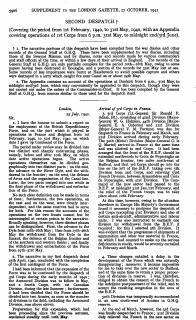
Details
5906 SUPPLEMENT TO THE LONDON GAZETTE, 17 OCTOBER, 1941
SECOND DESPATCH f
(Covering the period from ist February, 1940, to 3ist May, 1940, with an Appendix
covering operations of ist Corps from 6 p.m. 3ist May, to midnight 2nd/3rd June).
| i. The narrative portions of this despatch have been compiled from the war diaries and other
records of the General Staff at G.H.Q. These have been supplemented by war diaries, including
those of the Swayne Mission, and by diaries, notes and records made by various commanders
and staff officers at the time, or within a few days of their arrival in England. The records of the
General Staff at G.H.Q. are only partially complete for the period loth—i8th May, owing to some
papers having been destroyed at Boulogne, and a portion of the records for 3ist May lost at sea.
Some records of less importance were burnt at Hazebrouck to avoid possible capture and others
were destroyed in a lorry which caught fire near Cassel on or about 24th May.
2. The Appendix contains an account of the operations at Dunkirk from 6 p.m., 3ist May, to
midnight 2nd/3rd June, which may conveniently be appended to this despatch, though they were
not carried out under the orders of the Commander-in-Chief. It has been compiled by the General
Staff at G.H.Q., from sources similar to those used for the despatch itself.
London, Arrival of yd Corps in France.
25 July, 1940. 3. 3rd Corps (Lt.-General Sir Ronald F.
Sir, Adam, Bt.), consisting of 42nd Division (Major-
1. I have the honour to submit a report on General W. G. Holmes), 44th Division (Major-
the employment of the British Expeditionary General E. A. Osborne) and 5ist Division
Force, and on the part which it played in (Major-General V. M. Fortune) was due for
operations in France and -Belgium from ist despatch to France in February and March, and
February, 1940, to 3ist May, 1940, on which 5 ist Division arrived during early February.
date I gave up Command of the Force. The 5oth (Motor) Division (Major-General G. le
Q. Martel) arrived in France at the same time
The period under review may be divided into and was allotted to 2nd Corps. It had been
two distinct and sharply contrasting phases, arranged that the front of the B.E.F. should be
namely, before and after loth May, on which extended northwards to Croix de Poperinghe on
date active operations began. The active the Belgian frontier, two miles north-east of
operations themselves can be divided geo- Bailleul, and that 3rd Corps should go into the
graphically into two distinct parts ; on the east, line on the left of the B.E.F. taking over 5th
the advance to the River Dyle, and the with- Division from 2nd Corps, and relieving 53rd
drawal to the frontier; on the west, the defence French Division, between Armentieres and Croix
of Arras and the organisation of the Canal line. de Poperinghe, with 5ist Division. The Com-
Later, the two parts merged into one whole in mand of the new sector had passed to the
the final phase of the withdrawal and embarka- B.E.F. at midnight 3ist Jan./ist February, and
tion of the Force. the relief of the French troops was to take
No such clear definition can be made in terms place about I2th February.
of time; furthermore, the two operations, on At this time, however, owing to the situation
the east and on the west, were closely inter- elsewhere in Europe His Majesty's Government
dependent, and the same reserves had to serve found it necessary to postpone the despatch of
for both. For this reason the accounts of the 3rd Corps (excepting 5 ist Division) and also of
operations on the two fronts cannot but be certain anti-aircraft, administrative and labour
intermingled at certain points in the narrative. units. I was also instructed to earmark one
Broadly speaking, however, three distinct phases division for withdrawal from the B.E.F. if
can be distinguished. First, the advance to the required ; for this I selected 5th Division. It
Dyle from ioth-i6th May; then from i7th-26th was evident that the programme of shipments of
May the withdrawal from the Dyle to the ammunition and other war material to France,
Escaut, the defence of the Belgian frontier and on which I had counted to make up the serious
of the southern and western flanks ; and finally deficiencies in stocks, would be severely curtailed
the withdrawal and embarkation of the Force in February and March.
from 27th-3ist May.
2. The narrative in my first despatch dated 4. These changes entailed a delay in the
25th April, 1940, concluded with the completion development of the Force which was naturally
of the first contingent of the Force. disappointing; moreover, it became impossible
I had been informed that the expansion of the for me to take over the new sector to Bailleul,
Force was to be continued by the despatch of and at the same time to retain a proper propor-
3rd Corps during the early months of 1940; tion of divisions in reserve. I was, therefore,
the Armoured Division was to follow in May, obliged to obtain the consent of the French to
and a fourth Corps, with ist Canadian the indefinite postponement of the relief, and to
Division, during the late Summer ; furthermore, accept the resulting congestion in the area of
it had been decided that the Force should be the B.E.F.
divided into two Annies, as soon as the number 5oth Division was temporarily accommodated
of divisions in the field, excluding the Armoured in an area south-west of Amiens in G.H.Q.
Division, rose above eleven. reserve.
Preparation for this expansion, which had At the end of March, however, the 3rd Corps
been proceeding since the previous autumn, was finally despatched to France ; 5ist Division
continued steadily until loth May. duly relieved the French in the new sector on
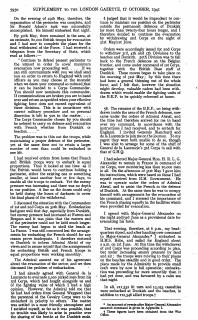
Details
5930 SUPPLEMENT TO THE LONDON GAZETTE, 17 OCTOBER, 1941
On the evening of 2gth May, therefore, the -I judged that it would be imprudent to con-
organisation of the perimeter was complete, and tinue to maintain our position on the perimeter
Sir Ronald Adam's task was successfully outside the permanent defences of Dunkirk
accomplished. He himself embarked that night. for more than twenty-four hours longer, and I
By 3oth May, there remained in the area, at therefore decided to continue the evacuation
an estimate, 80,000 British troops for evacuation by withdrawing 2nd Corps on the night of
and I had now to complete the plans for the 3ist May/ist June.
final withdrawal of the Force. I had received a Orders were accordingly issued for 2nd Corps
telegram from the Secretary of State, which to withdraw 3rd, 4th and 5th Divisions to the
read as follows :— beaches and Dunkirk. 5oth Division was to fall
" Continue to defend present perimeter to back to the French defences on the Belgian
the utmost in order to cover maximum frontier, and come under command of ist Corps,
evacuation now proceeding well. . . . If we together with the British Base staff at
can still communicate with you we shall send Dunkirk. These moves began to take place on
you an order to return to England with such the morning of 3 ist May; by this time there
officers as you may choose at the moment had been a general thinning out of the whole
when we deem your command so reduceduthat force, and I felt that, however the situation
it can be handed to a Corps Commander. might develop, valuable cadres had been with-
You should now nominate this commander. drawn which would enable the fighting units of
If communications are broken you are to hand the B.E.F. to be quickly reformed at home.
over and return as specified when your effective
fighting force does not exceed equivalent of
three divisions. This is in accordance with 58. The remains of the B.E.F., on being with-
correct military procedure and no personal drawn inside the area of the French defences, now
discretion is left to you in the matter. . . . came under the orders of Admiral Abrial, and
The Corps Commander chosen by you should the time had therefore arrived for me to hand
be ordered to carry on defence and evacuation over my command, in accordance with the
with French whether from Dunkirk or instructions I had received, and to embark for
beaches. . . ." England. I invited Generals Blanchard and
The problem was to thin out the troops, while de la Laurencie to j oin me on the j ourney. To my
maintaining a proper defence of the perimeter, regret they were both unable to do so, though
yet at the same time not to retain a larger 1 was able to arrange for some of the staff of
number of men than could be embarked in General de la Laurencie's 3rd Corps to sail with
one lift. that of G.H.Q.
I had received orders from home that French I had selected Major-General Hon. H. R. L. G.
and British troops were to embark in equal Alexander to remain in France in command of
proportions. Thus it looked at one time as if ist Corps, now numbering less than 20,000 men
the British would have to continue holding a in all. On the afternoon of 3ist May I gave him
perimeter, either the existing one or something his instructions, which were based on those I had
smaller, at least another four or five days, to myself received from H.M. Government. He
enable all the troops to embark. Yet the enemy was to operate under the orders of Admiral
pressure was increasing and there was no depth Abrial, and to assist the French in the defence
in our position. A line on the dunes could only of Dunkirk. At the same time he was to occupy
be held during the hours of darkness to cover himself with arrangements for the evacuation of
the final phase of the withdrawal. his command, and I stressed the importance of
I discussed the situation with the Commanders the French sharing equally in the facilities which
of ist and 2nd Corps on 3oth May. Embarkation were provided for evacuation.
had gone well that day, especially from Dunkirk,
but enemy pressure had increased at Furnes and I agreed with Major-General Alexander on
Bergues and it was plain that the eastern end the night 2nd/3rd June as a provisional date for
of the perimeter could not be held much longer. evacuating his force.
The enemy had begun to shell the beach at That evening, therefore, at 6 p.m., my head-
La Panne. I was still concerned lest the arrange- quarters closed, and after handing over command
ments for embarking the French should for any to Major-General Alexander,* I embarked in
reason prove inadequate. I therefore motored H.M.S. Hebe, and sailed for England about
to Dunkirk to inform Admiral Abrial of my 2 a.m. on ist June. At this time the withdrawal
views and to assure myself that the arrangements of 2nd Corps was proceeding according to plan,
for embarking British and French troops in but under increasing enemy pressure by land
equal proportions were working smoothly. and air; the troops were moving to their places
The Admiral assured me of his agreement "on the beaches steadily and in good order. The
about the evacuation of the sector, and we then plans made by the Admiralty to provide small
discussed the problem of embarkation. craft were by now in full operation; embarka-
I had already agreed with General de la tion was proceeding far more smoothly than it
Laurencie to evacuate 5,000 picked men from his had yet done, and was favoured by a calm sea
3rd Corps, which had fought alongside us and that night.
of the fighting value-of which I had a high In all, 211,532 fit men and 13,053 casualties
opinion. However, the Admiral told me that were embarked at Dunkirk and the beaches, in
he had had orders from General Weygand that addition to 112,546 allied troops, f
the personnel of the Cavalry Corps were to be
embarked in priority to others. The matter
was settled in a most friendly atmosphere and * An account of events after Major-General Alexander
I satisfied myself, so far as it was possible, that assumed command is given in Appendix I.
no trouble was likely to arise in practice over f These figures have been obtained from the-War
Office.
the sharing of the berths at the Dunkirk mole.
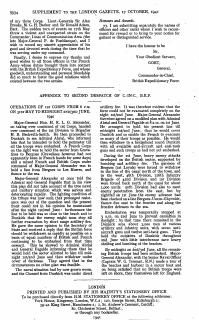
Details
5934 SUPPLEMENT TO THE LONDON GAZETTE, 17 OCTOBER, 1941
of my three Corps. Lieut.-Generals Sir Alan Honours and Awards.
Brooke, M. G. H. Barker and Sir Ronald Adam, 73. I am submitting separately the names of
Bart. The sudden turn of events on iyth May officers and other ranks whom I wish to recom-
threw a violent and unexpected strain on the mend for reward or to bring to your notice for
Commander, Lines of Communication Area (the gallant or distinguished service.
late Major-General P. de Fonblanque), and I
wish to record my sincere appreciation of his I have the honour to be
good and devoted work during the time that he
was serving under my command. Sir,
Finally, I desire to express my thanks and Your Obedient Servant,
good wishes to all those officers in' the' French GORT,
Army whose duties brought them into contact
with the British Expeditionary Force, and whose General,
goodwill, understanding and personal friendship
did so much to foster the good relations which Commander-in-Chief,
existed between the two armies. British Expeditionary Force.
APPENDIX TO SECOND DESPATCH OF C.-IN-C., B.E.F.
OPERATIONS OF IST CORPS FROM 6 P.M. artillery fire. It was therefore evident that the
ON 3isT MAY TO MIDNIGHT SND/SED JUNE, force could not be evacuated completely on the
1940 night ist/2nd June. Major-General Alexander
therefore agreed on a modified plan with Admiral
Major-General Hon. H. R. L. G. Alexander, Abrial and General Fagalde at 8 a.m. on ist June.
on taking over command of ist Corps, handed He arranged to hold his present line till
over command of the ist Division to Brigadier midnight ist/2nd June; thus he would cover
M. B. Beckwith-Smith. He then proceeded to Dunkirk and so enable the French to evacuate
Dunkirk to see Admiral Abrial, who informed as many of their troops as possible. He would
him that he intended to hold the perimeter till then withdraw to a bridgehead round Dunkirk
all the troops were embarked. A French Corps with all available anti-aircraft and anti-tank
on the right was to hold the sector from Grave- guns and such troops as had not yet embarked.
lines to Bergues (Gravelines however had not During the ist June, heavy enemy attacks
apparently been in French hands for some days) developed on the British sector, supported by
and a mixed French and British Corps under bombing and artillery fire. The garrison of
command of Major-General Alexander was to Bergues (ist Loyals) were forced to withdraw
hold a line from Bergues to Les Moeres, and to the line of the canal north of the town, and
thence to the sea. to the west, 46th Division, i26tH Infantry
Major-General Alexander at once • told the Brigade of 42nd Division and ist Division
Admiral and General Fagalde that in his view were forced back north of the canal for about
this plan did not take account of the true naval 1,000 yards. 5oth Division had also to meet
and military situation which was serious and enemy penetration from the east, but by
deteriorating rapidly. The fighting condition of nightfall on ist June the enemy advance had
the tro'ops was now such that prolonged resist- been checked on a line Bergues-Uxem-Ghyvelde,
ance was out of the question and the present thence due east to the frontier and along the
front could riot in his opinion be maintained frontier defences to the sea.
after.the night ist/2nd June : furthermore the
line to be held was so close to the beach and to Embarkation was temporarily stopped at
Dunkirk that the enemy might soon stop all 3 a.m. on 2nd June to prevent casualties in
further evacuation by short range artillery fire. daylight; by that time there remained in the
He gave the same opinion to the Secretary of Dunkirk area about 3,000 men of various
State and received a reply that the British force artillery and infantry units, with seven anti-
should be withdrawn as rapidly as possible on a aircraft guns and twelve anti-tank guns. They
basis of equal numbers of British and French held the outskirts of Dunkirk throughout
continuing to be embarked from that time - 2nd June with little interference save heavy
onward. This he showed to Admiral Abrial shelling and bombing of the beaches.
and General Fagalde informing'them that he By midnight on 2nd/3rd June, all the remain-
would hold the sector allotted to him till mid- ing British troops had been embarked. Major-
night ist/2nd June and then withdraw under General Alexander, with the Senior Naval Officer
cover of darkness. They agreed that in the. (Captain W. G. Tennant, R.N.) made a tour of
circumstances no other plan was feasible. the beaches and harbour in a motor boat and
The naval situation had by now grown worse, on being satisfied that no British troops were
and the Channel from Dunkirk was under direct left on shore, they themselves left for England.
LONDON
PRINTED AND PUBLISHED BY HIS MAJESTY'S STATIONERY OFFICE
To be purchased directly from H.M. STATIONERY OFFICE at the following addresses :
York House, Kingsway, London, W.C.2; 120, George Street, Edinburgh 2;
39-41 King Street, Manchester 2; i, St. Andrew's Crescent, Cardiff;
80, Chichester Street, Belfast;
or through any bookseller.
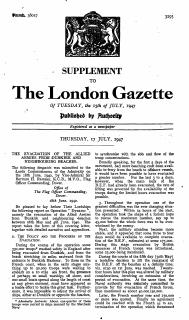
Details
ftumb. 38017 329.5
SUPPLEMENT
TO
The London Gazette Of TUESDAY, the i$th of JULY, 1947
published by ?listi)0rftp
Registered as a newspaper
THURSDAY, 17 JULY, 1947
THE EVACUATION OF THE ALLIED to synchronise with the ebb. and- flow of the
ARMIES FROM DUNKIRK AND troop concentrations. •
NEIGHBOURING BEACHES. Broadly speaking, for the first 5 days of the
The following despatch was submitted to the movement, had more beaching craft ibeen avail-
(Lords Commissioners of the Admiralty on able to ferry from the beach to offshore vessels,
the i8th June, 1940, by Vice-Admiral Sir it would have been possible to have evacuated
Bertram H. Ramsay, K.C.B., M.V.O., Flag a greater number. For the last 3 to 4 days,
Officer Commanding, Dover. however, when the main bulk of the
B.E.F. had already been evacuated, the rate of
Office of lifting was governed 'by the availability of the
The Flag Officer Commanding, troops during the limited hours evacuation was
Dover. possible.
i8th June, 1940.
3. Throughout the operation one of the
Be pleased to 'lay before Their Lordships greatest difficulties was the ever changing situa-
the following report on Operation " Dynamo ", tion presented. Within 24 hours of the start,
namely the evacuation of the Allied Annies the operation took the shape of a forlorn hope
from Dunkirk and neighbouring *beaches to rescue the maximum number, say up to
between 26th May and 4th June, 1940. The 45,000 before Dhe whole force was to be over-
report takes the form of this covering letter, whelmed by the enemy.
together with detailed narrative and appendices. Next, the military situation became more
stable, and it appeared that some three to four
2. THE POLICY AND THE PROGRESS OF THE days would be available to complete evacua-
EVACUATION. tion of the B.E.F., estimated-at some 175,000.
During the course of the operation some During this stage evacuation by British
330,000 troops* reached safety in England after resources of French troops was introduced,
being evacuated from Dunkirk, and from the some 25,000 being mentioned.
beach stretching 10 miles eastward from the During the course of the fifth day (30th May)
entrance to Dunkirk Harbour. To those on the a tentative decision to lift the rearguard of
French coast, when in the early stages any- the B.E.F. off the beaches at a definite1 time,
thing -up to 50,000 troops were waiting to viz. 0130 on ist June, was reached. Twenty-
embark on a 10 mile sea front, the presence four hours later this plan was altered by military
of perhaps 20 small warships off shore, and considerations, involving an extension of the
200 small boats spread along the length of coast period of evacuation. At the same time, the
at any given moment, must have appeared as Naval authority was definitely committed to
a feeble effort to tackle this great task. Further- provide for the evacuation of French forces,
more, it was impossible to adjust the arrival of then mentioned as about 40,000/50,000.
ships, either at Dunkirk or opposite the beaches, Later, the French -number rose and 150,000
* Admiralty footnote: About one-quarter of these or more was quoted. Finally no agreement
troops were carried in ships manned by the Merchant could be reached with the French as to an>
Navy termination of the operation which threatened
Details
3296 SUPPLEMENT TO THE LONDON GAZETTE, 17 JULY, 1947
to drag on painfully, and finally to lose nights. Not only were the Dunkirk Roads
momentum and expire through the exhaustion mined, including the Zuydecoote Pass, but also
of Naval personnel and the 'liquidation of Route X and the area round the Kwinte Buoy.
shipping. Folkestone and Dover Harbour entrances were
It will be seen, therefore, that • the initial also mined* Considering the number of mines
problem called for a maximum effort over a laid, it is interesting to note that only two
limited period regardless of the future, and British ships are known for certain to have been
accordingly all resources in the way of small mined, the personnel vessel MONA'S QUEEN
boats were thrown on the beaches, before ade- and the F.A.A. Yacht GRIEVE. One Hospital
quate provision had been made for their main- Carrier was damaged at anchor off Dover when
tenance off the coast in such matters as relief a mine was blown up by a LL. Trawler sweep-
of the personnel and the provision of large ing close at hand. Two A/S trawlers on patrol
beach parties. to the northward of the operational area were
• It was only due to the foresight of the blown up by what was at first thought to be a
Admiralty in making arrangements for a con- M.T.B., but later evidence suggests they were
tinued flow in ever increasing numbers of small victims of moored mines. The impunity with
power boats and beach craft, which became which degaussed ships were able to operate
available on the fifth day onwards, that the in this heavily mined area alone made the opera-
continued evacuation from the beaches remained tion possible and one reaches the conclusion
a reasonable proposition after the initial 'crisis that if the enemy on this occasion had had at
had passed. hand the means of laying moored contact mines
4. A perusal of the signals that passed by aircraft, instead of magnetic mines, the re-
between Dover and the (French coast reveals sults would have been very different.
the many occasions on which the responsible (b) Air Attack. On the evening of the 29th,
officers stationed on the coast considered so the first occasion on which a massed target of
little had been achieved from the beadhes that ships was presented in Dunkirk Harbour, the
they advocated restriction of evacuation to enemy seized the opportunity for air attack in
Dunkirk Harbour. Many complaints of "no ' great strength, and it was only by good fortune
boats," " no ships," might lead a detached that the vital Dunkirk Harbour channel was not
observer to the conclusion that the great effort blocked by sinking ships at this early date.
that was being made was proving abortive. From then onwards the scale and vigour of the
At Dover, where the whole operation could be air attack increased, and during the ist June
viewed in truer perspective, the number and all ships in Dunkirk, off the beaches, or in .the
origin of the troops being landed in England approach channels, were subjected every two
being always to hand, it was clear that the hours to an unprecedented scale of air attack
evacuation from the beaches required by the by aircraft in such numbers, that the R.A.F.
military situation, was, in fact, achieving a con- were unable to deal with the situation. The scale
siderable success, as the following figures will of enemy air attack on June ist, and the fact
show. Of the 248,000 troops landed in the that the Germans could by now command the
United Kingdom, between May 28th and June newly-swept central route at its exits into the
ist inclusive—the period during which both Dunkirk Roads with gunfire from the shore,
Dunkirk and the beaches eastward were avail- were responsible for the suspension of daylight
able day and night except for enemy interfer- evacuation on June 2nd.
ence—no fewer than 100,000 were lifted from
the beaches. (c) Attack by M.T.B.s. These caused 4
casualties, namely two destroyers and two
5. WEATHER CONDITIONS. trawlers, while the north Route Y* was in use.
The operation was favoured by extremely When the middle Route X*, some 26 miles
good weather. It was found, however, that any further to the South Westward, was brought
northerly wind caused a considerable surf, into use the enemy M.T.B. units failed to follow
which greatly reduced the rate of lifting from up, though the continuous stream of unescorted
the beaches. It must be fully realised that a traffic during the dark hours and the ships lying
wind of any strength in the northern sector in Dunkirk Roads provided a tempting target
between South West and North East would to any enterprising Commander. *
have made beach evacuation impossible. At •(d) Shore Artillery. At the commencement
no time did this happen. of the operation, the southern Route Z* was
6. DISPOSAL OF TROOPS AFTER REACHING found to be under gunfire from batteries near
ENGLAND. Calais, and consequently could only be used by
night. The northern Route Y was usable only
On arrival in England the despatch of troops by night when later the batteries near Nieuport
from the points of disembarkation proceeded brought fire to bear on the Zuydecoote Pass,
with great smoothness under the War Office which was too narrow to permit a reasonable
movement control organisation. chance of ships running the gauntlet of fire. By
7. ENEMY EFFORTS TO FRUSTRATE OPERATION. this time, however, Route X was available, and
Attempts by the enemy to frustrate the opera- was free of gunfire until German batteries near
tion consisted of the following: — Gravelines brought its exit into the Dunkirk
Roads under gunfire. This occurred in the
(a) Minelaying by aircraft. afternoon on Saturday, ist June, and in con-
(6) Intensive air attack. junction with the result of enemy air attack,
(c) Action by Motor Torpedo Boats. led to the suspension of daylight traffic alto-
(d) Gunfire by coast artillery. gether.
(e) Submarine operations.
(a) Minelaying by aircraft. Minelaying (e) Submarines. U-Boats do not appear to
during the dark hours probably "Commenced have caused any casualties. It is unlikely that
during the night 28th-29th and was maintained * Admiralty footnote: For Routes X, Y and Z see
' with great intensity during the following two Diagram.
Details
3298 SUPPLEMENT TO THE LONDON GAZETTE, 17 JULY, 1947
embarkation staff or organisation a strong naval 14. CO-OPERATION OF THE FRENCH NAVY.
party was required to form up and embark the French warships and other vessels were
troops. Later, no difficulty was experienced employed evacuating French troops from
when troops of fighting formations were en- Dunkirk Harbour, and on the last three nights
countered. Difficulty was experienced in con-- from the beach i£ miles eastward from Dunkirk.
trolling some French 'troops, whilst others were Details are given in Appendix IV.
so rigidly bound by discipline and tradition that
they would not embark except by complete 15. BASE ORGANISATION.
formation under their own unit officers. In
either case the rate of embarkation was much An operation of this magnitude involving the
slower than with British troops. maintenance and movements of close on 900
vessels and boats could not have been conducted
12. INITIATIVE SHOWN BY COMMANDING without the wholehearted and unceasing efforts
OFFICERS AND SUBORDINATE PERSONNEL. of the base establishments at Dover and
A most satisfactory feature of the operation Ramsgate, as well as those at Sheerness and
>was the high degree of initiative shown by Harwich in the Nore Command. At all these
Commanding and Subordinate Officers of units places officers and men, Naval and civilian,
operating off the coast, ranging from H.M. laboured unceasingly throughout the Operation.
Destroyers to commandeered motor boats. The In particular I wish to acknowledge the great
majority of officers and ratings in command assistance received from the Commander-in-
were in situations requiring independent action Chief, Nore, Admiral the Hon. Sir Reginald
in extremely difficult conditions. Often the A. R. Plunkett-Ernle-Erle-Drax, K.C.B.,
easiest course was to be satisfied with work D.S.O., who in many cases anticipated my re-
already achieved and to return to the United quests for assistance through his constant watch
Kingdom with a final load of troops. The on the progress of the Operation.
reverse action was invariably executed, namely, The prompt and unfailing assistance afforded
continued operation off the coast as long as by the Chatham Depot in providing personnel
there were both -troops ashore to be evacuated for .the numerous small craft, working parties
and vessels offshore to receive them. If the and beach parties, was a feature essential to the
craft in use was damaged or sunk the crew in- successful outcome of the Operation.
variably seized some other boat to continue The Naval Officer-in-Charge, Ramsgate,
their efforts. Captain W. R. Phillimore, R.N., by taking
Unaware of the military situation ashore and over the servicing and control of the great
often forced to move westward by bombard- majority of the small craft of the inshore
ment from German artillery or even by rifle flotillas relieved Dover of an immense volume
fire from advancing German forces, the majority of work which it would otherwise have been
of these boats, commanded often by stokers or impossible to handle.
" hostility only " seamen, had only one object It was also brought to my notice that at
an view, to lit from the beach any, and all Harwich an exceptional Naval and Military
troops, British or Allied, within sight of the system was in being for assisting those ships
water's edge. which called there to make a quick turn round,
On their return to the United Kingdom when relieving the tired ships' companies of the work
asked to report their proceedings it was only of cleaning and clearing their vessels.
in answer to direct enquiry that it would trans- 16. SERVICES OF STAFF, INCLUDING OFFICERS
pire that these young men had been subjected TEMPORARILY APPOINTED.
in many cases, to an unparalleled bombard- I was fortunate in having the services of
ment from the air. They appeared to consider Roar Admiral W. F. Wake-Walker, C.B.,
that this was part of the day's work requiring O.B.E., as Flag Officer afloat off Dunkirk, and
no comment. Captain W. G. Tennant, C.B., M.V.O., as
13. LOSSES OF TROOPS AFTER EMBARKATION. Senior Naval Officer, Dunkirk on shore.
It is a distressing fact -that many ships were Admiral Wake-Walker was responsible for
sunk or damaged on the return voyage when supervising the embarkation afloat and Captain
laden with troops. But it is fortunate that in Tennant for organising embarkation from the
most of such cases the majority of troops were shore, keeping touch with the French Naval
saved owing to the large volume of traffic that Authorities and the staff of the British
was coming and going between Dunkirk and Commander-in-Chief.
the United Kingdom. Exceptions to this were I cannot conclude this despatch without
due to the rapidity with which certain ships reference to the splendid work of my staff under
sank after having been bombed or torpedoed. the guidance of my Chief Staff Officer, Captain
Such cases are as follows: — L. V. Morgan, C.B.E., M.V.O., D.S.C.
Augmented by additional officers, including
WAKEFUL. Torpedoed. Ship broke in both Army and Royal Air Force, especially
half and only those on the upper deck were appointed for the occasion, their task of
saved. About 600 troops were below. organising and operating the large and varied
CRESTED EAGLE. Was bombed and collection of H.M. Ships continued without a
then beached in a burning condition. Only pause day and night .throughout the 10 days
about 300 saved out of 600 on board. that the Operation lasted, and I can never
SKIPJACK. 250-300 troops on board, testify adequately to the excellence of their
most of whom, unfortunately, went down work, upon the efficiency of which successful
with the ship when she sank. results depended.
WAVERLEY. 600 troops were on board Finally I would like to pay tribute to the
before ship was abandoned in sinking condi- valuable support and assistance which I received
tion, but only 200-300 were picked up. throughout the whole course of the evacuation
In all it is regretted that about 2,000 troops from Vice Admiral Sir James Somerville,
must have been lost through these and similar K.C.B., D.S.O., who was appointed to H.M.S.
disasters on the return voyages to England. LYNX for special service in connection with
Details
3306 SUPPLEMENT TO THE LONDON GAZETTE, 17 JULY, 1947
Friday, ^ist May. final evacuation plan during the night of
48. The Admiralty informed the Vice Admiral 31/5-1/6. Accordingly, instructions were
that the policy of H.M. Government was that issued for the special tows to leave Ramsgate
both British and French troops be given an at 1300/31 for Dunkirk via Route X, and the
equal opportunity of being evacuated in British Commander-dn-Chief, Nore and Flag Officer in
ships and boats. Charge, Harwich, were requested to provide
all available M.T.B.s to escort this convoy
49. Personnel ships had been sailed the pre- for as much of the outward passage as possible,
vious evening and throughout the night of the which was timed to commence from Ramsgate
30th/3ist to provide for a continuous flow into at 1300/31. Speed of advance—5 knots. A
Dunkirk harbour. But at 0320 the S.N.O. party of Naval officers had been assembled at
reported that once again the majority of these Dover to embark in these tows and had been
personnel ships had failed to enter the harbour given detailed instructions on the plan. Two
during the dark hours. MALCOLM, however, M.A/S. boats and two M.T.B.s in the Dover
left Dunkirk with 1,200 troops at 0300, during Command were ordered to accompany the boat
heavy shelling, on relief by IVANHOE. convoy and subsequently embark the Com-
S.N.O. Dunkirk, however, continued to call for mander-an-Chief, B.E.F. and Staff off the
more ships. 'No more destroyers were avail- beaches.
able and there were no means of accelerating
the arrival of the vessels despatched there.1 By 53. Shortly after sunrise an on-shore wind
0700 the Vice Admiral had no news of the fate arose and boat work became difficult, many
of the personnel ships that had sailed the pre- whalers capsizing and the prospects of com-
vious evening and during the night. None of pleting the evacuation to plan began to be less
these ships had reached the U.K. to unload, favourable. The following extract from the
and it appeared probable that these ships report of Captain Howson, S.N.O. on the
may thave concentrated in the narrow beaches illustrates conditions at Bray at this
waters close to Dunkirk, inviting a repetition time:
of the heavy air attacks with consequent " At 0400 there was a very considerable
damage and loss to transports which had number of destroyers, paddlers, trawlers,
occurred on the two previous occasions when skoots, etc., off Bray, and embarkation was
personnel vessels, together with other ships, proceeding satisfactorily, but a lop had
had been concentrated in large numbers in the already started. There were about 10 motor
approaches to Dunkirk. yachts which had arrived from England.
At this time there were no less than nine These > craft drew 6-7 feet and were
personnel vessels and three hospital carriers unable to get close in to any of the beaches.
known to be on the round trip U.K.—Dunkirk During the forenoon, considerable towing
and back and one other personnel vessel had of empty craft towards the beach was carried
been ordered to sail during the night, but her out, and only about two boats were allowed
whereabouts was unknown. In addition, three to get adrift and ultimately ground. With
other personnel vessels were under orders to the falling tide, however, a number of boats
sail between 0900 and 1030. Pending the were seen to ground and remain ashore until
return of the ships en passage, and while the the tide rose in the afternoon. These in-
coal-burners were being rebunkered, the further cluded an A.L.C.* motor boat and a life-
sailing of personnel vessels was in suspense. boat. Other power boats broke down. Never-
Note :—Owing to the casualties to personnel vessels theless, the embarkation, much hindered by
at this stage, coal burning cross channel the lop, proceeded satisfactorily. ; As further
steamers had to be used for some of the destroyers and sloops arrived, they were
trips and short endurance necessitated
coaling between trips which could not be directed to lower their motor boats and
done in the vicinity of Dover, thus whalers as this had not already been done;
preventing a quick turn round. these boats were quite invaluable. About
50. During the night a considerable amount noon, the lop began to subside and with
of enemy mdnelaying activity by air was re- the rising tide conditions for embarkation
ported. Shelling was heavy during the evening very greatly improved, more boats were
and night, and operations were greatly ham- sent in and more boats floated off and matters
pered. Nevertheless, with the cessation of were proceeding very well, when the gun at
shelling at about 0300, very good progress was La Panne started to shell the beaches and
made and by full dawn the beaches were very foreshore with great accuracy. A certain
nearly clear of troops. At 0530 attacks on number of light craft were sunk. The A.L.C.
Dunkirk Harbour and the beach from Dunkirk broke down and was towed away by a
to Bray developed more strength and the 'bom- steamer. MOSQUITO, destroyers and sloops
bardment of Dunkirk continued. Neverthe- proceeded westward clear of the firing."
less, the S.N.O. reported that the embarkation 54. Rear-Admiral Wake-Walker was able to
there was proceeding satisfactorily but stressed make a survey of the general conditions of the
the need for more ships and constant fighter beaches, and at 1130 the Vice-Admiral received
protection. At this time French troops began
to appear at Dunkirk Pier and on the'beaches, a signal from him stating that the majority of
and were embarked with the British troops. the pulling boats were broached to and without
crews, conditions on the beaches .being very bad
51. At 0600 VIMY sighted submarine off the owing to a freshening shore wind, only small
N.W. Goodwins and commenced to hunt. numbers being embarked. Under present condi-
52. The arrivals at the home ports indicated tions any large-scale embarkation from beach
that in spite of the frequent requests for more impracticable. Motor boats could not get close
ships and more boats received from the various in. He considered only hope of embarking any
authorities on the French coast, the rate of number was at Dunkirk, and further stated he
evacuation was steadily increasing and would * Admiralty footnote: A.L.C. = Assault Landing
permit, all being well, of implementing the Craft.
Details
3308 SUPPLEMENT TO THE LONDON GAZETTE, 17 JULY, 1947
It should be noted that in spite of (fc) the Route X, and occurred between 1000 and 1040,
rate of embarkation had, in fact, come up to to be again resumed at noon. After that there
expectations, and if other circumstances had was a lull until 1550, when another attack was
permitted it would have been possible to adhere delivered on Dunkirk Harbour and all shipping
to the original plan of lifting the final 4,000 therein for over half an hour. At 1800 the
B.E.F. off the beaches between 0130 and 0300 Vice Admiral received the following signal from
ist June. Dunkirk: " Things are getting very hot for
Saturday, ist June. ships; over 100 bombers on ships here since
0530, many casualties. Have directed that no
62. Two Hospital Carriers which had sailed ships sail during daylight. Evacuation by
the previous evening returned shortly after transports therefore ceases at 0300. If perimeter
dawn. Only one had succeeded in entering holds will complete evacuation to-morrow,
Dunkirk Harbour, the other had laid off four Sunday night, including most French. General
hours under heavy fire and returned to Dover. concurs." The sense of this message was passed
Four personnel vessels failed to enter Dunkirk on to Rear Admiral, Dover, off the coast.
during the night, but succeeded in the early
flours of the morning. One of these, the 65. In addition to the heavy scale of air
PRAGUE, was bombed and severely damaged attack during the afternoon the sea traffic was
half-way across on the return journey, but suc- very seriously interrupted by artillery fire
.ceeded in making the Downs with the assistance brought to bear on Route X near No. 5 buoy.
of tugs, where troops transferred to other ships The fire appeared to be accurate and it is be-
particularly A/S trawlers LADY PHILOMENA lieved some French ships were sunk. Two
and OLVINA. The supply of personnel vessels French destroyers in the vicinity stopped
was maintained throughout the day, not with- British ships approaching from England on X
out a series of setbacks caused by 3 ships failing Route short of this point, and it became evident
to sail and by 2 being turned back when on that a very serious threat -to daylight evacuation
passage by French Destroyers owing to heavy was in being.. Meantime, the toll of casualties
bombing and shelling of the approaches to of ships during the day was mounting, particu-
Dunkirk. Of those that operated during the larly amongst the destroyers and shortly after
24 hours, i was sunk, 2 damaged by bombs and midday the Commander-in-Chief, Nore, called
shell-fire and i by collision. the attention of the Admiralty to this, suggesting
the discontinuation of the use of destroyers by
63. During the middle watch it transpired day off the French coast. The summarisation
that no further troops were attempting to of all these incidents led to the Admiralty
evacuate from La Panne off which were directing the Vice Admiral, Dover, to suspend
stationed one paddle minesweeper, a fleet evacuation from Dunkirk at 0700, Sunday 2nd
sweeper and two destroyers, probably due to June, and for it to be resumed the following
the heavy shelling from German guns eastward, night or from 1730/2, depending upon the cir-
and later information was received that the cumstances. From the above it will be seen
troops were marching from La Panne through that there were to be no ships proceeding to
Bray towards Dunkirk. Accordingly, during Dunkirk between 0700/2 and 1730/2. The
the night the Rear Admiral, Dover, instructed above Admiralty directions crossed a message
all small craft to move west, with boats in tow, from the Vice Admiral stating th'at all ships had
towards Dunkirk, and the Vice Admiral directed been ordered to withdraw from Dunkirk before
all ships under orders for La Panne to other daylight the following day, owing to the heavy
positions further west, concentrating the main casualties to shipping.
effort on the beach immediately east of 66. In spite of enemy action more than
Dunkirk.
60,000 troops were landed in the United King-
To a request from Dunkirk for Hospital Ships, dom during the 24 hours, thanks to the unremit-
the Vice Admiral replied at 0715 that the large ting determination of Naval vessels who all
ship berths alongside at Dunkirk must be executed a succession of round trips, interrupted
occupied by personnel ships and the wounded only by necessary refuelling and who accounted
that could conveniently be embarked should go for 70 per cent, of this total. The majority
with personnel. This direction was in of the surviving vessels had been operating
accordance with the Government policy pre- ceaselessly for at least five days, and officers
viously communicated to the Vice Admiral. and men were approaching a condition of com-
plete exhaustion.
64. Soon after dawn enemy aircraft were
active and heavy bombing and machine gun 67. As for personnel ships, steps were taken
attacks developed at 0500 over the whole area to place on board each a Naval Lieutenant
from Dunkirk to La Panne. A second series of Commander or Commander to advise the
attacks commenced at 0830 and lasted until Master, and ten seamen to assist in handling
0900, during which time nearly every ship off the wires in going alongside under fire. By this
the coast was subjected to intensive bombing means it was hoped not only to ensure the
and machine gunning, formations of 30 and 40, timely sailing of these essential ships, but also
machines being noted. During this attack to eliminate the occasions when these vessels
BASILISK was put out of action off La Panne had remained outside Dunkirk Harbour to
and later sank while struggling home. KEITH, await a quiet opportunity to enter.
SALAMANDER and SKIPJACK, who were 68. Early in the forenoon a number of Senior
moving westward along the coast as the Bray Officers were despatched from Dover in fast
and La Panne beaches had been emptied, were motor boats to round up all stray motor boats
heavily bombed, the former was hit and set on in the Downs and along the routes, and direct
fire and the latter sank. KEITH was aban- them back in the evening to the beach stretching
doned and finally sank. Nearly all troops on i£ miles eastward of Dunkirk, and a second
board KEITH and the crews of both vessels large flight of tugs with lifeboats was prepared
were rescued by other ships. A third attack at Ramsgate to send over for what was hoped
started over Dunkirk, extending well out along to be a final effort off the beach. In addition
Details
3312 SUPPLEMENT TO THE LONDON GAZETTE, 17 JULY, 1947
95. The initial despatch of requisitioned and day, probably none of them had been under
1
volunteer small craft was controlled from— gun fire before and certainly none of them had
ever been under Naval discipline. These boats
Naval Control Service, London, were Thames Estuary fishing boats which never
Westminster Pier, Ramsgate, left the estuary and only one of their crews ihad
Gravesend, Dover, been further afield than Ramsgate before. In
" Southend, Newhaven, spite of this fact perfect formation was main-
Sheerness, Portsmouth, tained throughout the day and night under the
preliminary action in most cases having origi- control of a Sub-Lieutenant, R.N.V.R., in com-
nated in the Admiralty Small Vessels Pool. mand of the Unit and all orders were carried
As the operation proceeded, Ramsgate was out with great diligence even under actual shell
used as the main base for such craft, as being fire and aircraft attack.
nearest to Dunkirk, 'but a small number: of 98. The difficulties of passage from the United
motor boats and skoots continued to work from Kingdom to the Flanders coast were great.
Dover. With compasses of doubtful accuracy and no
96. The work of servicing this multitude of navigational instruments other than a lead
small craft entailed an enormous amount of pencil, once a boat lost contact with a main
work by the base organisation at Ramsgate, convoy the chances of making a correct landfall
and to a lesser extent at Dover. Items typical in the strong currents of the straits were slight.
of the work of the Ramsgate organisation are Many of the small craft had not even a com-
as follows: — pass, yet all who left the Flanders coast in safety
(a) Approximately 1,000 charts were issued managed to reach the English coast to refuel
and the majority set off again to repeat the
by the Naval Control Service, Ramsgate, to adventure. Cases occurred, however, of boats
the various vessels taking part, some 600 of attempting to enter Calais instead of Dunkirk,
which had the routes laid off on them for where they received a rousing reception from
•those Commanding Officers who had neither the Boche, and yet another case where the
parallel rules nor dividers, together wiiih landfall was made 'between Gravelines and
approximately 500 sets of routeing instruc- Calais and the Sub-Lieutenant in command
tions. landed, finding it necessary to shoot two Ger-
(6) During the period 26th May to 4th man soldiers (before leaving for his proper
June the number of vessels dealt with for destination of Dunkirk.
defects of all kinds, included power, engine Open boats of all kinds, from the naval
and electrical, at Ramsgate, was 170. In- cutters and whalers to seaside dinghies, were
cluded in this number were Dutch Skoots, towed over from England by the motor boats
Tugs, Drifters, Trawlers, Motor Lighters, themselves or in special tows by tugs. Some
Ferry Floats and Motor Boats of every con- of these pulling boats were manned by odd
ceivable type. naval ratings as boat keepers, and others by
(c) All the small craft were initially without soldiers off the beach. One of the principal
armament. Seventy-five of the larger Motor difficulties was to avoid fouling the motor boats'
Boats, Skoots and Tugs were armed with screws with painters and lines attached to all
A.A. Lewis guns at Ramsgate, this arma- these pulling boats. Carley floats and inflated
ment being transferred from vessel to vessel motor inner tubes also played their part in
as requisite during the operation. Twenty- carrying men from the 'beach to the motor
three Lewis gunners arrived from London boats.
and 2 officers with 12 R.A.S.C. cadets were
also accepted for this service at Ramsgate. 99. Having reached the coast the business of
When British fighting troops were being ferrying from the water line to the offshore craft
evacuated in the later stages, the soldiers was by no means easy. Apart from the surf,
invariably mounted and fought their Bren which was usually experienced for some hours
guns as A.A. armament for the ship they every day, derelict lorries, which had been
were in. abandoned below the high tide mark, proved
a serious danger to 'boats. Another source of
97. A large number of boats were quite much trouble close inshore was the large amount
unsuitable for work off an open beach. of floating grass rope which various craft had
For example, a convoy of 6 Thames Bawley used and lost in their rescue work, and
boats were shepherded over from Southend numerous articles of military equipment such
and arrived off Dunkirk beach at 1930/31 but as great coats jettisoned during the evacuation.
owing to ground swell and the many offshore A great number of small power boats were put
obstacles, such as semi-submerged lorries, it temporarily out of action by such ropes and
was considered impracticable to beach these garments fouling the screws, usually resulting
craft. Bawley boats accordingly went along in broaching to and being swamped while they
the outside of the East Pier of Dunkirk Har- were itims unmanageable.
bour and started ferrying service to the Skoots The number of soldiers taken off the beaches
lying empty outside the harbour entrance. The by motor boats cannobbe estimated. One 35 ft.
swell alongside made embarkation duties from motor launch, however, ferried off 600 men to
outside the jetty too difficult, so Bawley boats transports and carried 420 direct to England.
proceeded inside Dunkirk Harbour working
mainly from the inner harbour which was under 100. Of the pulling boats used, the main
heavy shell fire. All Bawley boats were loaded difficulty was insufficient provision made for
up and left harbour about 0300/1. On reach- Naval boat keepers to take charge of the out-
ing Ramsgate at 0930/1 the boats were so much going boats and bring them back to the dis-
damaged as not to be fit for further service. embarkation points. As a result the soldiers
The conduct of the crews of these cookie detailed to act as boat keepers for an outward
boats was exemplary. They were all volun- trip, failed to return the boat on the inward
teers who were rushed over to Dunkirk in one trip and it was necessary for the Naval boat
Source: The National Archives, Kew, ADM 116 4649. Contains public sector information licensed under the Open Government Licence v3.0.

Details
Page 9 Operation "DYNAMO" - Recommendations of Personnel. H.M.S. GRENADE of Commander Richard C. Boyle, R.N. Lost as a result of damage from four large bombs during heavy air attack on her second trip to Dunkirk. Bi Recommendations. OFFICERS. Mr. Reginald William Clare, Gunner (T) R.N. Acted with great coolness and courage, taking complete control of after end of ship when burning and sinking. Closed and flooded magazine at correct moment thereby minimising disaster. Example of gallantry under fire. Recommended for decoration. Mr. Reginald James Crew B.Sc., Schoolmaster, R.N. Displayed conspicuous coolness and devotion to duty during and after the disaster. Saved a number of lives by rescuing ratings in distress in the oil covered water, landing with a party of survivors in Dunkirk. Took charge and eventually navigated an old motor boat back to England. Recommended for mention. RATINGS. Pottv Officer Harold Richard Emery C/JAJh439. Petty Officer Samuel Bennion. C/JX.102723. These two Petty Officers ably backed up Mr.Crew, displaying marked initiative and coolness. Recommended for mention. Leading Stoker Frederick Staples, C/KX.84191. Acted as right hand man to Mr. Clare, taking charge of younger stokers, by calm bearing dispelling any tendancy to panic. Assiduous in his attention to wounded, both in GRENADE and later in the trawler which rescued survivors. Recommended for decoration.

Details
Page 10 Operation "DYNAMO" - Recommendations of Personnel. H.M.S. GREYHOUND - Commander Walter Roger Marshall-A'Deane.R.N. GREYHOUND made 3 trips, 2 to the beaches and 1 to Dunkirk pier, landing about 1,200 men in England, apart Bi from wounded. On the 3rd trip, whilst embarking troops from La Panne beach, an attack was made by bombers and 2 near misses damaged the engine room and No.3 boiler room, splinters killing 20 and wounding 70. GREYHOUND withdrew to Dover to land the wounded, leaving her boats to continue ferrying troops from shore to ship, often under fire and bombing. Recommendations. OFFICER. Commander Walter Roger Marshall-A'Deane, R.N. For efficient handling of his ship when evacuating troops from La Panne beach and Dunkirk. Recommended for mention. RATINGS. Leading Seaman A. W. Saunders, P/SSX. 15620 and Leading Seaman S. H. Setterfield, P/J.102005. Evacuating troops from La Panne beach in difficult conditions and under fire, displaying ability and great endurance. Recommended for mention. Stoker Petty Officer E. Teichert, P/K. 59694. In charge of No. boiler room, showed initiative in quickly shutting down the boiler and keeping a fan running, thus enabling the extent of damage to be discovered, when the whole ship was shaking from bomb explosions and splinters had caused damage in his boiler room. Recommended for mention. in ge

Details
Page 2. Operation "DYNAMO" - Recommendations of Personnel. H.M.S. VANQUISHER. - Lieutenant-Commander Conrad Byron Alers-Hankey, R.N. VANQUISHER had been at sea from 22nd to 26th May patrolling off S.W. Ireland, and arrived at Dover early 28th May - although Officers and men were therefore tired on that date, 7 trips were made to Dunkirk between the 28th May and 4th June, about 4,000 troops being brought home. Having made one trip on 28th and two on 29th, her Commanding Officer found his sight and judgment to be so seriously impaired by lack of rest that he did not consider himself fit to retain command and he therefore arranged for temporary reliefs for himself and his Gunner. During the operation a total of 4 officers and 9 ratings had to be landed to obtain rest. Recommendations. OFFICERS: Lieutenant-Commander Conrad Byron Alers-Hankey. R.N. For skilful handling of his ship throughout the evacuation of Dunkirk, thereby evacuating about 4,000 troops to England. Recommended for mention and early promotion. Lieutenant Reginald Noel Hankey, R.N. For outstanding devotion to duty and ability in arranging the embarkation of troops and handling the ship's company in very trying circumstances. Recommended for mention. Lieutenant Cecil William Clarence Checcucci, R.N. For outstanding skill and devotion to duty as Navigating Officer in difficult and trying conditions. Recommended for mention. RATINGS: C.E.R.A. Francis Patrick, C/M.14987. For outstanding devotion to duty and skill in acting as Engineer Officer, in the absence ashore sick of the Lieutenant (E), in very arduous and difficult times. Recommended for mention. Leading Seaman David Anderson, C/J.107567. Outstanding devotion to duty and for playing an important part in maintaining the morale of the rest ship's company when they were suffering from lack of extending over a long period. Recommended for mention and advancement. qhief/

Details
Page 50 Operation "DYNAMO" - Recommendations of Personnel. H.M.S. HALCYON. - Commander Eric Percival Hinton, R.N. This ship completed 6 trips to the beaches and Dunkirk 40) harbour, embarking and bringing back a large number of troops. Whilst working off the beaches boats were sent ashore. On one occasion two of the whalers embarking were riddled with bullets. Ship was shelled from shore batteries and subjected to many attacks from the air. Recommendations. OFFICERS: Commander Eric Percival Hinton, R.N. Showed great skill and seamanship in the manoeuvring of his ship whilst lying off the beach and also in entering Dunkirk harbour during dark hours due to the number of wrecks in the vicinity. By his perseverance and devotion to duty over 2300 were brought back to England. Recommended for decoration. Sub. -Lieutenant John Francis Worthington, R.N.V.R. Proceeded ashore in order to control the troops, who at that time were in a disorganised state. Further, whilst in charge of ship's whaler, remained perfectly cool whilst under fire transporting a large number of troops. Recommended for mention. RATINGS: Able Seaman Clarence Edward Jarmill, D/J.95955. Showed great devotion to duty and determination as coxswain of a whaler whilst bringing off troops from the beaches under fire. Recommended for decoration. S.P.O. John Henry Salmon, D/K. 66811. In addition to his work in the Boiler Room took devotion to duty and an example to the stokers. charge of a pontoon to bring off troops, showing a great Recommended for mention.

Details
Page 55 Operation "DYNAMO" - Recommendations of Personnel. H.M.S. MEDWAY QUEEN - Lieutenant Alfred Thomas Cook. R.N.R. This ship completed 7 trips to Dunkirk and the beaches between the 27th May and the 3rd June. During the time she was off the beaches she used her own boats for evacuating troops. The boats, whilst embarking the troops, were continually under fire, and the ship herself was bombed and machine gunned several times. Two enemy aircraft were shot down and altogether over 3,500 troops were brought back to England. Recommendations. OFFICERS, Lieutenant Alfred Thomas Cook, R.N.R. By his great skill, pertinacity, devotion to duty and able seamanship, was able to complete 7 trips. The entries into Dunkirk harbour were made in the dark, and under very difficult conditions, due to wrecks and the congestion in Dunkirk. Although the ship was bombed many times, by his skill he was able to avoid any damage being done to the ship. Recommended for decoration. Sub. Lieutenant John David Greaves, R.N.R. With great gallantry and devotion to duty whilst under fire, evacuated troops from the beaches in the boats belonging to the ship. Recommended for decoration. Engineer Sub. Lieutenant James Irvin, R.N.R. By his devotion to duty and leadership kept the engines in an efficient state, although the 1st and 3rd Engineers had collapsed through exhaustion. Recommended for mention. RATINGS. Petty Officer Henry McAllister, C/P.23168. Was in general charge of the boats, and with great gallantry and devotion to duty evacuated many troops from the beaches whilst under fire. Recommended for decoration. Petty Officer Alfred Ernest Crossley, C/J.103237. With great devotion to duty and gallantry remained ashore during the evacuation, organising the troops and arranging for their embarkation in the small boats. Recommended for decoration.

Details
Page 60 Operation "DYNAMO" - Recommendations of Personnel. H.M.S. PRINCESS ELIZABETH. - Lieutenant Cecil John Carp, R.N.V.R. stopping Ship was attacked days, bringing back over 1,600 go without Did for four four trips, being continuously on the the boats when by aircraft on many occasions and troops. also working from the beach. Recommendations. OFFICERS: Lieutenant Cecil John Carp, R.N.V.R. By his skill, seamanship and great devotion duty throughout the operation a large body of troops to were brought back to England without any serious damage to his ship. Recommended for decoration. Temporary Sub.-Lieutenant James Tomkin, R.N.V.R. Was in charge of boats during the operation off the beaches. His ingenuity, courage and gallantry under ceaseless shell fire and bombing was outstanding and his tenacity and leadership in getting his boats loaded created a great impression. Recommended for decoration. RATINGS: Petty Officer Henry George Coalbran, P/JX.127274. Showed great initiative and leadership during the operation. His general bearing, conduct and ability, coolness and devotion to duty under fire whilst towing large numbers of boats from the beach was an example to all. Recommended for decoration. Stoker Ernest Baker, T.124. Showed great zeal and initiative apart from his ordinary work in volunteering for boatwork in which he was thereafter employed. Further, he took charge of the loaned motor-boat. Recommended for mention. Signalman Ernest Savidge, R.N.V.R. Did very valuable work as a volunteer in boat's crew. Although crushed and badly bruised between two boats he continued his work with a cheerfulness and total disregard for his own comfort. Recommended for mention. L2

Details
Page 70 Operation "DYNAMO" - Recommendations of Personnel. H.M.S. BIDEFORD - Lieutenant Commander John Hugh Lewes, R.N. being bombed and machine-gunned on the way across. While May, This vessel proceeded to Bray beach on the 29th bombing attack took place. The ship was struck on the off the beach embarking troops in the evening, the third blown away, No.2 gun put out of action and the 0.5 machir quarter deck, about 40 feet of stern being completely gun platforms wrecked, in addition to much other damage. In spite of the damage done, of the fact that the ship was grounded aft and of the casualties suffered (3 office and 13 men killed, 1 officer and 18 men wounded), BIDEFOR continued to embark troops during the night, and when eventually towed off and home, carried 400 troops to England on the 31st May. Recommendations. OFFICERS, Lieutenant Commander John Hugh Lewes, R.N. In spite of the severe damage to his ship by bombs and the fact that his ship was aground, he continued to rescue troops from Bray beach, and eventually carried 400 to England. Recommended for mention. Surgeon Lieutenant John Jordan. M.B.. B.Ch., R.N. Displayed zeal and unswerving devotion to duty throughout the period 29th-31st May, when he was an outstanding example to all. His sick berth attendant seriously wounded, he dealt with some 50 casualties, many horribly mutilated or dangerously wounded, and performed several major operations, having organised his limited resources to their utmost. Throughout the period tended his patients continuously and at all times displayed great ability, patience and understanding. No effort was too much for him - no call was left unanswered. He was completely selfless and upheld the traditions of the Royal Navy and of his profession in a most worthy manner. Recommended for decoration. RATINGS. Private George William Crowther, 6th Field Ambulance B. Company, No. 7354480. This man had been embarked from Bray beach. After the ship was struck by bombs he immediately volunteer to assist the Surgeon. An hour later, when the troop board had been transferred to another ship, Crowther on said he would remain in BIDEFORD and continu was his work there, knowing full well that BIDEFORD time very it was considered highly improbable that the to severely damaged and aground; and at that ship would reach England, but he gave up his chance Carried get away out his voluntary duties for all but 48 hours in order to tend his wounded comrades. continuously in a most efficient manner.

Details
Page 106, Operation "DYNAMO" - Recommendations of Personnel. 85 foot Motor Boats PAULETEER and MARASOLE. - Stoker D. T. Banks, Recommendations. KX/86174. RATINGS: Stoker D. T. Banks, KX/86174. Lewis gun and a compass he did not know how to gun, With crew of two Ordinary Seamen, a Bren a boats. Brought back more than 400 troops to England. completed seven or eight trips in one or other use, of these Was sunk with his crew in MARASOLE, undeterred resumed duty with PAULETEER. Endured frequent machine gunning from the air. During six days' work off the coast his idea of relaxation was to take "a run ashore" in Dunkirk with his crew, this town burning furiously and under bombardment at the time. Displayed remarkable leadership, initiative and courage under fire. Recommended for decoration and early advancement. Shipwright 2nd Class (Pensioner) Charles Greenwood P/M.8899. Indefatigable in preparing Portsmouth small craft for the operation. As a volunteer proceeded to Dunkirk beaches to effect repairs to boats there. Served in Yacht ERICA and H. M. Drifter ROBERT CLIFF, exceptional devotion to duty. off the beaches assisting in evacuation work. Displayed Recommended for mention. Ships Boats, Fast Motor Boat VERNON I, W.D. Fast Launch PIGEON. (Sub.Lieutenant George Arthur Gabbett-Mulhallen, R.N.) Recommendations. OFFICER: Sub.Lieutenant George Arthur Gabbett-Mulhallen, R.N. This enterprising and determined officer commanded in succession a number of small craft working from Ramsgate and ferried off a large number of troops from the beaches, in surf, and from Dunkirk harbour, on four successive days and nights. Brought off almost the last part from Dunkirk in the PIGEON. Frequently under fire, displayed courage and leadership of high order. Recommended for decoration.

Details
Page 107. Operation "DYNAMO" - Recommendations of Personnel. ft. Motor Lieutenant Boat BONNIE Charles HEATHER (Chris Kraft Boat 18 knots) Waterland Read, R.N.R.). Recommendations. FFICER: Lieutenant Charles Waterland Read. R.N.R. 420 troops. from On the last night ferried off about trips beaches, carrying to England complete Between to Dunkirk 29/5 and a.m. 4/6 made seven round personnel troops Dunkirk Mole to transports lying about off. 600 the water. vessel SCOTIA sank rescued 40 personnel When and was Was periodically bombed and machine from part in under the gunfire in Dunkirk harbour. Played gunned endurance evacuation and showed great determination a great and under fire. Recommended for decoration. TARIOUS SMALL CRAFT: Recommendation. Sub. Lieutenant William Ronald Williams, R.N. Commanded in succession a motor lighter, a tug and motor boat SWALLOW. Completed five round trips between p.m. 30/5 and a.m. 4/6. On first trip made beach between Gravelines and Calais, landed, encountered two German soldiers, shot both, re-embarked and proceeded to Dunkirk. On all trips did very well using pulling boats as well as his own craft. Finally left Dunkirk harbour on 4/6 when German troops penetrated into the harbour area. Recommended for decoration.

Details
Page 130 Operation "DYNAMO" - Recommendations of Personnel. H.M. TRANSPORT - LEVENWOOD (Continued). RATINGS. Merchant Navy Gunner George Knight. gun the enemy planes, although being machine Throughout at the operation he continued firing his bringing down an enemy plane. gunned and bombed the whole time. He succeeded in Recommended for decoration. Fireman Robert Moody. Whilst attempting to take troops off the beach the soldiers had to wade out to the boats, and this Fireman, throughout the whole time swam from the beach to the lifeboats with soldiers who were too weak to do this. Recommended for mention. MAID OF ORLEANS - Gordon Dyer Walker, Master. (Decorated for this operation in London Gazette 7th June, 1940). This ship completed four trips to Dunkirk, and in addition, three trips prior to Operation Dynamo to Calais and Boulogne. A very large number of troops were brought back to England. Ship continually being bombed by aircraft. In one trip the crew discharged a large number Dunkirk. of petrol cans, containing water, on to the jetty at NEPHRITE - Cyril Gifford West, O.B.E.. Master. Recommendation. RATING. Acting Able Seaman Albert Edward Mellis, C/LDX.5187. Showed great gallantry whilst under bombing attack, firing his gun all the time. Was observed to have brought down at least one enemy plane. Recommended for decoration. PRAGUE/

Details
Page 138 Operation "DYNAMO" ted Recommendations of Personnel. Ramsgate and Margate Base Organisation (Continued). Since the outbreak of hostilities he has borne the brunt of all the difficult problems of organising Contraband Control and Naval Officer's in Charge Offices, during which time he never spared himself working long hours and proving an invaluable adviser on all Merchant Shipping and Mercantile problems as well as an able Secretary. Lieutenant Commander St. John George Hanson Pitt, R.N. (Retd.) (Maintenance Lieut. Cdr. MERRIE ENGLAND). For outstanding zeal and devotion to duty as Maintenance Officer in MERRIE ENGLAND Barracks. Throughout the operation he met successfully all the many demands made upon his department. He accommod- ated and detailed all ratings lent, turned part of the building into a casualty clearing station, ran snack bars and clothing depots with the aid of local residents, returned Naval casualties and survivors in large numbers without hitch to their depots and successfully competed with each new aspect of the situation. Recommended for decoration. Temporary Paymaster Sub. Lieutenant Maxwell Kerr Hamilton, R.N.V.R (Assistant Secry) For outstanding zeal and devotion to duty. This young officer, normally Assistant Secretary in my office, was sent to Margate to prepare and take charge of a temporary office instituted for the officer sent to take charge there. Throughout the whole time he remained on duty with only odd hours snatched for sleep and meals, maintaining his office with a complete record of Naval personnel landed there, arranging burials, accommodation, transport, casualties, stores and provisions, all of which he successfully coped with despite his limited experience. Recommended for decoration. Temporary Lieutenant George Christopher Newman, R.N.V.R. For outstanding zeal and devotion to duty while acting as Pier Officer at Margate throughout the operation. He received and despatched all vessels ut sent there, arranged re-servicing for coal, fuel and provisions, and acted as liaison with the Military. Recommended for mention. Paymaster Lieutenant Normal William Collop, R.N.V.R. (Assistant to Base Accountant Officer). This officer was sent to Margate to represent the Base Accountant Officer there. He took charge of all accountant duties, provisions, stores and cash and most/

Details
Page 139 Operation "DYNAMO" - Recomm endations of Personnel. Ramsgate and Margate Base Organisation (Continued). most ably performed the multifarious duties required of him throughout the operation. Recommended for mention. Temporary Surgeon Lieutenant Basil Henry Palmer, R.N.V.R. (Base Medical Officer). For outstanding zeal and devotion to duty in his attention to casualties and survivors both personally and through his Sick Berth Staff. This officer worked continuously on the Pier at Ramsgate and many times went out into the anchorages to vessels waiting to come alongside. He got away all casualties with utmost promptitude and worked in conjunction most successfully with the Military Medical Officers. Recommended for mention. Engineer Captain John Lewis Deacon. R.N. (Retd.) M.V.O. (Base Engineer Officer). For outstanding zeal and devotion to duty in his attention to the fuelling and re-servicing all craft, through his department, at both Margate and Ramsgate. A very large number of mechanically propelled craft were used and all had to be re-fuelled after their various trips, at all hours of the day and night. That there was no hitch in these arrangements throughout, is testimony to the effectiveness of his organisation. 170 vessels were actually repaired during the operation. Recommended for decoration. RATINGS. Sick Berth Petty Officer Wilfred Harry Groves, C/MX.48183. For outstanding zeal and devotion to duty as the senior member of the Medical Officer's Staff throughout the operation. He remained on duty long hours untiringly, and assisted at the temporary casualty clearing station in MERRIE ENGLAND as well as going afloat to ships waiting to come alongside. Recommended for decoration. Chief Yeoman of Signals Lawrence Hamer Hanson, P.229251. For outstanding zeal and devotion to duty while in charge of the signal bridge at the end of the East Pier, Ramsgate, during the entire operation. The signal bridge had to deal with a bewildering complexity of signal work - by day and by night - and/

Details
Page 140 Operation "DYNAMO" - Recommendations of Personnel. Ramsgate and Margate Base Organisation (Continued). hours and this throughout. Chief Petty Officer remained on duty branch The success of the communications long throughout the operation is, in measure, and efficiency. due to this Chief Petty Officer's no small keenness Recommended for decoration. Stoker Petty Officer Frederick George Charman, KX. 75070. For outstanding zeal and devotion to duty while receiving and despatching craft as they came on East Pier, Ramsgate, throughout the operation, alongside with troops. He remained on duty consist- ently sleep. long hours with only odd hours for meals and Recommended for decoration. Petty Officer Alexander Hood Bruce Ireland, J.6530. For outstanding zeal and devotion to duty fulfilling the function of Gunner's Mate in MERRIE ENGLAND throughout the operation. He kept up a running supply of all necessary ammunition and arms throughout, remaining on duty very long hours. Recommended for decoration. Chief Petty Officer Cook James McGilray, P/M. 364250. For outstanding zeal and devotion to duty as Chief Cook in MERRIE ENGLAND mess. He cheerfully and successfully coped with a large number of meals and produced them at any hour day or night - for numbers very much in excess of those to which he is accustomed. Recommended for mention. Leading Signalman James William Bown, C/J.102529. For outstanding zeal and devotion to duty as signalman in charge at Margate Pier. He remained on duty throughout very long hours maintaining communication with all craft arriving at Margate to unload. Recommended for mention. Signalman Wilfred Tracy Burton, P/J. 35971. For outstanding zeal and devotion to duty as Signalman assisting the above at Margate Pier. He remained on duty throughout very long hours main- taining communications with all craft arriving at Margate to unload, in very difficult circumstances. Recommended for mention. Chief/

Details
Wt. 20906/9711 40M 8/39 S.E.R. Ltd. Gp. 671 Register No. Min 1) Minute Sheet No. Captain Eric Fitzgerald Wharton, R.N. (Retd.) (Lent from Admiralty S.V.P.) Paymaster Lieutenant-Commander John Wissett Edelsten, R.N.R. (Secretary to N.O. in C.) Lieutenant-CommanderSt. John George Hanson Pitt, R.N., (Retd.) (Maintenance Lieutenant-Commander MERRIE ENGLAND) Temporary Paymaster Sub-Lieutenant Maxwell Kerr Hamilton, R.N.V.R. (Assistant Secretary) Engineer Captain John Lewis Deacon, R.N., (Retd.), M.V.O., (Base Engineer Officer) Sick Berth Petty Officer Wilfred Harry Groves, C/MX.48183, Chief Yeoman of Signals Lawrence Hamer Hanson, P.229251 Stoker Petty Officer Frederick George Charman, KX.75070 Petty Officer Alexander Hood Bruce Ireland, J.6530 Surgeon-CommanderWilliam Gordon Fitzpatrick, R.N. Sick Berth Petty Officer Harry Munro Hawkins, C/M.37726, Sick Berth Petty Officer (R) Rupert Arthur Lockwood, C/MX.49872 Sick Berth Petty Officer (R) George Robert Wright, X.6227 Sick Berth Attendant (R) Alfred Bassford, X.8080 Captain John George Lawrence Dundas, R.N. Commander Frederick John Walker, R.N. Commander Lewès George Gardner, R.N., (Retired) Mr. William Pearce, Commissioned Signal Boatswain, R.N., (Retired) VAV Chief Yeoman of Signals John William Baker, P.29166, Chief Yeoman of Signals Francis George Ward, C/J.31094 Captain Lionel George Dawson, R.N., (Retd.) Lieutenant-Commander William Canning Eykyn, R.N., (Reted.) Paymaster Commander Cecil John Leary, R.D., R.N.R. Commander Desmond Adair Stride, R.N., (Retd.) N Captain William Vesey Hamilton Harris, M.V.O., D.S.C., R.N., (Retd.) Commodore John Stewart Gordon Fraser, D.S.O., R.N., (Retd.) Commander Francis John Lambert, D.S.C., R.N., (Retd.) Lieutenant-Commander (E) Weston Smith, R.N. Surgeon Captain Arthur Rowland risher, R.N., (Retd.) Surgeon Lieutenant Godfrey Fraser Carey, R.N.V.R., M.B., CH.B M.R.C.S., M.R.C.P. Surgeon Lieutenant George Atherton Hart, R.N.V.R., M.B., B.S., M.R.C.S., M.R.C.P. Captain John Fawcett, R.N., (Retired) Lieutenant-CommanderRobert Glen Wardrop, R.N.R., (Retired) Regulating Petty Officer F.J. Phillips, C/X.39981 Acting Engine Room Artificer 4th Class Hugh Duffie, X.2957, E.A. Regulating Petty OfficerG. Stapley, C/M.39658 Chief Electrical Artificer Edgar James Lovell (Pensioner), P.N.11998, P/M.27540 Leading Sick Berth Attendant Norman Clyde Martin, C/MX.49373 Mr. William Ferguson, Naval Store Officer Mr. R.W.W. Corbitt, Assistant Naval Store Officer Mr. Bakewell, Victualling Store Officer Mr. D.J. Woods, Armament Supply Officer Lieutenant A.A. Raymond MacKewn, R.N.RSea Transport Officer Major Lieutenant-Commander Steele Wilkinson, R.M. Sea Transport Officer Allan Ralph William Soper, R.N.R. Signalman James Walter, R.N.V.R., C/LDT.4178 Lionel S. Duffy, R.N.V.R., C/TDX.1412 Lieutenant Signalman Ronald Charles H. Edward Stoker, R.N.R. Sea Transport Officer Petty office Edward Bastable, PIJX. 127305. X Chief office John William Ailwyn Jones. Hospital Camer DINARD. Stewardess has A. Goodrich. Chief Enjures Norman Smith 5r

Details
:- CAPTAIN M/S HARWICH. E :- 7th June, 1940. :- FLAG OFFICER IN CHARGE, HARWICH. BJECT :- REPORT No. OF OF OF OTIONS, II Officer, May Trawler 31st "GAVA",June, 1940, from Fleetwood also Fishing Section, "EDWINA", "VELIA", EVELYN ROSE", "DHOON", "JACINTA". his by Lieutenant return I have to pleasure Harwich. F.J. Jordan, in forwarding R.N.R., of the the attached Trawler reports "GAVA", given since me on follows Monday, The :- above 27th May, ships and were the apparently work accomplished requisitioned by them at Fleetwood is as D. (i) Eight enemy airplanes destroyed. (ii) Damaged Belgian trawler No. 26 towed into Dover. (iii) 137 French Naval Officers and men rescued. . (iv) A total of 855 French troops brought to England. Casualties sustained: Two ratings wounded in the "EDWINA". The "JACINTA" holed but successfully beached in Pegwell Bay (England). RESUME. "GAVA" - Report of doings attached. "VELIA" - Skipper J. Clarkson (F.124 Agreement.) One plane hit and set on fire by a 12 pdr. shell. No troops embarked, ship being detailed to assist damaged Belgian Trawler No. 26 which she successfully towed into Dover. "EDWINA" - Skipper G. Bedsford (F.124 Agreement). Ship heavily machine gunned by 'planes 31" using 1" Cannon. Two of crew and twelve 120 of evacuated French troops wounded. French Moorish Troops landed. "DHOON" - (Fleetwood have Skipper's name). Ship No casualties. 130 French Troops heavily machine unned Moorish and bombed - landed. "EVELYN ROSE" - (Fleetwood have Skipper's name). Ship heavily machine gunner one Tropeller landed and bombed. on Only lost damage on wreck. sustained 130 French -

Details
| Referred | Referred | NOTATION | ONLY | ||
| to 56. | Date | to | Date | Referred to | Date |
| WHAT Vileadowe CW A+A P.N./L.O. NC 24 | 17/6 JUN 1942 | * H.A.C. PA TR Ohra | halat+3 | ||
| R.N.L.O.J. Dost (stail) | 1/7/42 JUL 1942 3.7.42 |

Details
landed them Lovely at Painsgate on Mai 31ˢᵗ imme- smight I took another 100 English Loldiers on board, I diately If Lailed back to Dunkenque and managed to take another 110 English foldiers on board which I lauded Lovely eat Romsgate on June 14. the evening. In spite of the fierce bardments which On your 2nd y returned back to Dinkergue during we had to fustain during the whole night, y was able to take once more 98 bughish Loldiers mboard and handed them at Paintgate. On June 3rd If returned once again to Dunkerque but owing to the remorklett and heavy to bombardments take which we experienced I was only able a 10 furthermore English Loldiers on board, which bere lavely landud cat Ranulgate On June 4th I was ordered not to sail back to Tukergue the harbour was object to intende bombardments the by the "luftroaffe" and the every leas near point of taking fottetion of Dunkerque on this fort I was ordered by the Freuch Seine to On June 6th y failed to be House, authorities arriving at to ferry troops and refugeed across the river Service till Cronoille. of have done this forrying June 10ᵗʰ During aireal the bombard following ment night eec which we fultained my thip received a heavy or direct hit and was Lunk with the loss of all my On June property I was fortunate to get the on Bhaunel board another ship which took me across to further theated as a Beligian refuges. in England. On your 13th I handed at Phoreham and was Later on I joined my father London who

Details
North Finchley, 7.7.41 The Admiralty, Whitehall, S.W.1. y I, Georges Ragaert, kindly drawn your attention to the following matters. earned recently that the men who took part in the evacuation of the B.E.F. erque last have been rewarded by the Admiralty. I am a Belgian of Zeebruge, year and deemed it my duty to make it known to you that I also took 1 these operations of which feats no acknowledge was received. I have these facts to my own Government on two occasions without the test results, reported and are inclined to doubt wether this report ever reached you. il fore Dear Sir, allow me to make the following statement. On Mai 18th Zeebruge in command of the fishing motorboat at 2.50 ppe d and ZUZANNA, with France several as days. On Mai 29th I received orders arriving the LYDIE 1940, I left destination. I arrived the next day by 10 ere I was ordered Authorities by the to English Authorities to proceed to Dunkerque noh Naval stayed there for proceed with my vessel to Ramsgate On and to sist in the evacuation. p. li with 100 English Soldiers on night board, I soon took th nother fter On landing Mai 30th these arrived men I at sailed Ramsgate back to I Dunkerque landed them and savely during at the Ramsgate another 110 on Mai ii Soldiers on board, Dunkerque and managed to take 1st. c sailed back which to I landed savely at Ramsgate on In June spite of a 2nd I returned on board, back to Dunkerque during during the the evening. whole night, Ramsgate. I was able the fierce to take bombardments once more 98 which English we had Soldiers to sustain on board but and landed owing to them the at remorseless and On June 3rd I returned once again to Dunkerque only able to take a 10 furthermore 16 which board, we landed at Ramsgate. On June 4th on I was ordered by not the to "luftwaffe" sail back to and Dunkerque the enemy the was harbour near the was point object of to taking intense possession bombardments of Dunkerque. I was ordered by the On June 6th I sailed to to ferry Le Havre, troops service on and arriving refugees till June at across this in 10th. which port the During my river ship Seine the received to Brouville. following French night I Authorities done this ferrying heavy the loss aireal of all bombardment my property. ship which took me hit 12th I was England. fortunate to get on board another threated as & Belgian across On the Channel to refugee. On June Later 13th on his I I landed joined poor savings at my Shoreham father he had in and London to was fit in further who me this out was struggle with staying a new forfreedom, there suit as of a clothes. I refugee. Out 1940, Royal anxious Navy, Sheldon. and to do are my proud share to be serving at the present and time in H.M.S. as taking the father's adress: Jules Ragaert, 42 Woodside Park Road, a 1 truet Dear Sirion you the will Services give these rendered, matters I will your expect kind attention, a favorable reply which Finchley you N.12. I am, Sir, Y Your obedient Servant, (Sgd.) Ragaert Georges

Details
over, before taking V.Iydie Zusanne. If we send the case to us M. Ragaert, a Belgian, brought his is ing motor-boat Lydie Zuzanne to and depe when his country was over-run. any From there he was sent to Ramsgate, after thence he sailed on May 29th to Dunkirk, there he took on board 100 British soldiers. These mon he landed at Ramsgate, returning at once to Dunkirk for another 110 mon. Having landed them, he made a third passage to Dunkirk Where he took 98 men on board and brought them to Remagate. The next day, June 3rd he went back again to Dunkirk, where the bombardment was BO heavy that only 10 men could be got on board. These too were landed surve at Ramagate. For 30 On June 6th Iydie Zusame went back to Le Havre to ferry troops across the basiene, and here she WELS sunk by a bomb. Your gaert found his way back to England Seaman he now serving as a Leading berrihe Royal Navy.

Details
Treasury Thambers, B.H.A.C. (B) Whitehall, S.U. B.H.A.M. (B) 7th April, 1942. My dear gleadowe The following Belgian seamen have been honoured for services in the evacuation from Dunkirk. M.B.E. (Civil Division) (Admy. number C.W.26235/40 of 17th Sept. 1940). Captain Maurice Coppin, Master, " Trawler S.S. "Julia". "Guido Gazelle", 0.225. Captain Rene Lusyne, If " "Maréchal Foch", 0.274. Captain Pierre Lusyne, B.E.M. (Civil Division) Engineer Albert Rooman, Trawler " "Cor Jesu", 0.87. 0.227. Seaman Prosper Luca, If S.S. "Julia". Seaman Victor Goes, " "Guido Gazelle", 0.225. Seaman Hector Annys, 11 Boats based on Dartmouth Dunkirk. and manned The with "Julia" volunteers, braved every These danger Belgian in transferring Gazelle" 403, troops the from "Cor Jesu" 274. The last named the "Guido boąt embarked made 1007, one trip, the others two. The "Marechal Foch" of the went soldiers alongside to jumping Dover the in on quay another board at grounded Dunkirk trawler Foch" and but her. and set on went a The Master falling and tide his the one weight assistant day, embarked returned 300 men the in vessel the "Marechal was run of down the by troops. a Warship, which back out for again took England. the next Off these the Goodwin two brave Light Belgians and some 150 these on board 1,800 the and men pertinacity of sea." volunteer Troops and are D.S.C. George François Rayaert, Master of a Belgian (Admy. fishing boat. Letter 13 Nov. 1941). "For services at Dunkirk. The R.M.Y. Gleadowe, Esq.. cw26612/41 Phare set

Details
D. GESELLE. COPY TRANSLATION. Belgian Telegraphist. G.1. Mess. R.N. Barracks. Devonport. 19th May 1942. Dear Madam, address and I am sending you this letter, which will perhaps It is quite by chance that I have learned your be a surprise to you. I am a telegraphist in the Royal Navy, Section Belge I do not know, Madam, if you are conversant with the events which took place during the dark days of Dunkirk, but I would like to have some details on the suject of the decoration bestowed on G. Ragaert. I myself have nothing against this young man, but at Newlyn, Penzance and Brixham, there are nunerous Belgians who remember the fishing-boat 81. It is a scandal that the Belgian Press and its journalists should only learn the truth through the foreign pres I was, with two other Belgians, on board the English aircraft carriers "Furious" and "Illustrious" for seven months; I I was in America for four months on board the latter vessel. the to papers, but I have and now, when I come have had splendid opportunities of having my story appear in England Independant were soldiers at Dunkirk, 600 soldiers at Havre. We With This I see is the just what 81, such always I civilians would "Madeleine a story refused like in and Camille", you them, the 50 to "Belgique know, we Madam: saved 350 - hours the last to leave Le were waiting for thr were for a rear-guard of Havre French , soldiers, where we of which only 50 men able to be rescued. London; Germans for At For half the an entrance hour. to the port to we run were round bombed the by offices the 3 G. Ragaert myself, has I his have no one Ostende; I was father. Royale de Ibis at Navy I at have I the been age a pupil of at 191. sea of the since Oeuvre I was 14 years old, my and affairs, entent you and be that have no relatives here would I look do that not after want my letter to import will in advance, I remain, P.N.L.O. (signed) Désiré Geselle. 27

Details
COPY TRANSLATION. D. GESELLE. Belgian Telegraphist, G.1. Mess. Barracks. Devonport. 19th May 1942. Dear Madam, It is quite by chance that I have learned your P.N.L.O. address and I am sending you this letter, which will perhaps be a to you. 2 surprise telegraphist in the Royal Navy, Section with Belge which I do not took know, place during the dark days of of Dunkirk, the but I am a Madam, if you are conversant Letter the would events like to have some details on the subject decoration bestowed Ragaert. on G. nothing against this young Belgians man, but who at Newlyn, Penzance I myself and have Brixham, H. 81. there are numerous and its remember I aircraft I journalists was in had the America carriers It I splendid should was, fishing-boat is a with "Furious" for only scandal opportunities four two learn months that other and the the "Illustrious" Belgians, truth on of Belgian board having through the on my Press board for latter story the seven foreign the when appear vessel. months; English I pres in come the to have England papers, I but see I just have such always a story refused in 350 We This is what H.81, I Havre. were soldiers the able for last at a to With At Dunkirk, rear-guard be to the the rescued. leave entrance 600 Le of Havre French to the , soldiers, port where we we were of round which bombed the only by offices for the 50 men thre 2 hours were Germans for half an hour. no one to run at London; G. For I Ragaert was myself, been a pupil has at I his sea have of father. since the Oeuvre I was Royale 14 years de after old, l'Ibis my and affaire entent the Ostende; and Navy at I have I the have age no of relatives 191/2. here you. would I do look that not want my letter to importy will be you a With thanks in I (signed) Désiré Geselle. 4 on P.N.L.O.
Source: The National Archives, Kew, ADM 199 2429. Contains public sector information licensed under the Open Government Licence v3.0.

Details
| owner - W. England) | R(T98B) | 5 | AP | .7.40 | 29.8.41 | 84 |

Details
| CAROLE (J. M. England) | MB | 1937 | Sold | ARP | 2.9.39 | 5.44 6.10.39 |

Details
| CLAUSENTUM (Southampton, Isle of Wight & South of England R.M.S.P. Co. Ltd.) | TU | 1926 | R(T98C) | 1200 IHP | Misc.N. | 1.8.41 | £193.12. |

Details
| EMPIRE LILLIPUT (M.O.W.T.: Mgrs. - Southampton, Isle of Wight & South of England R.M.S.P. Co. Ltd.) | TU | 1944 | 138 | Misc.N. | 22.1.44 |

Details
| ENGLAND (John Dudin & Co.) | DB | 11 | 11 | WD | 31.8.41 | |||
| ENGLAND (M.O.W.T.) (Prev. | DB | R(T98B) | 140 DW | Misc.N. | 18.12.41 | 7. 1.42(T) | £14.11. |

Details
| KING OF ENGLAND. | R(T98) | SV(MC) | 27.5.42 | 17.7.42 | £3 per day |

Details
| LIGHTER 158 (Wo J. Parnis, England, Ltd.) | Misc.N. (MC) | 4. 5.43 5.42 | |||||
| LIGHTER 270 (Wo J. Parnis, England, Ltd.) | Misc.N. (MC) | 4. 5.43 | 5.11.43 | 8d per ton |

Details
| England, Ltd.) |
Source: The National Archives, Kew, ADM 199 788 A. Contains public sector information licensed under the Open Government Licence v3.0.

Details
SECRET 9 6 Subject.. Personnel. Recommendations for Services in Action. From The Commanding Officer. H.M.S. BIDEFORD. Date June 6th. 1940. No To The Vice Admiral Commanding. Dover. Sir, I have the honour to forward the following report on the conduct of my officers and ships company during the period May 29th - May 31st. 1940. 2. The general behaviour of the personnel was excellent. There was a feeling of great satisfaction throughout the ship when the orders td proceed to Dunkirk were recieved, 3. The behaviour of the men under fire was exemplary. There were no signs of panic or fear; orders were passed and recieved clearly, and were executed rapidly and correctly. All did their duty calmly and efficiently. 4. Great credit for the general organisation of the ship to meet emergencies is due to the late Lieutenant PAUL ALISTAIR STEWART R.N., the Executive officer and Gunnery officer of the ship. 5. No acts of exceptional gallantry were observed, but I wish to bring to your special notice the two following cases of very great devotion to duty :- I. Surgeon Lieutenant JOHN JORDAN. MB. B.Ch. R.N. This officer by his conduct, zeal and unswerving devotion to duty throughout the period May 29th - May 31st. was an outstanding example to us all. His Sick Berth Attendant seriously wounded; with limited resources, he competed with some fifty casualties, many horribly mutilated or dangerously wounded. He performed several major operations; he organised his limited resources to their utmost,; throughout the period $ he attended his patients continuously, and at all times display- ed great ability, patience and understanding. No effort was too much for him, no call was left unanswered; he was completely selfless. He upheld the traditions of the Royal Navy and of his profession in a most worthy manner. It is considered that he WO would be the very worthy recipient of a decoration in recognition of his services. GEORGE II. No.7354480. Private/WILLIAM CROWDER. 6th. Field Ambulance. 'B' Company. This man wasembarked from Bray Beach for passage to England. After the ship was struck by bombs he volunteered immediately to assist the Surgeon in tending the wounded, About an hour later H.M. Kellett came alongside to take off all troops embarked, because this was considered most advisable. Crowder promptly said he would remain in H.M.S. Bidefoed and continue tending the wounded. He did this knowing full well thatH. M.S. Bideford was very severly damaged and aground; that at that time it was considered highly improbable the ship would reach England

Details
SECRET 10 Page 2. 7 would reach England; yet in he was prepared to give up his chance of getting away order to tend his wounded comrades. He remained in of the greatest possible help to our Surgeon. Crowder H.M.S. Bideford after H.M.S. Kellett had proceeded, and was carried out his voluntary duties for all but forty eight hours continuously, in a most efficient manner. I consider this man showed a great sense of duty and displayed great personal courage in his decision to remain onboard. I wish decoration. to recommend him as being worthy of consideration for a 6. The following men of this ship are recommended for their services. They are placed in order of merit. I.S.P.O. Charles William Donnelly. D/K.59925. A/Ck. Albert Victor HOCKING. D/MX.58549. When the ship was bombed everyone aft was killed or badly wounded, except these two men. S.P.O. Donnelly's duty was "in charge of the after fire and repair party". Hocking formed one of the "First Aid Party". The fire main aft wasblown away, and fire brue out in the cabin flat immediately above the after magazine. These two men working entirely on their own, ran hoses aft from the first sound connection, and succeeded in getting the fire under sontrol, and hoses down the after magazine hatch to flood the magazine, (the magazine flooding arrangements were destroyed) and partly flooded it before assistance came, I consider their very prompt and efficient action probably saved the ship, and I consider them both worthy of consideration for the Distinguished Service Medal. II. Iconsider the following three men worthy of being "mentioned in despatches" for the services set forth against their names. (a) Signalman Charles Raymond CRAIG.D/JX.141848. He was landed with Lieutenant Davey, when that officer landed to organise the embarkation on the beach. Craig joined one of the embarkation posts, took charge of the signalling apparatus and got into communication with several ships. When the station was destroyed by bombing, Craig improvised a signal lamp out of the head light of a lorry, and used this till the battery ran down. He remained ashore all night and was eventually sent off by the embarkation officer. On arrival at Dover he volunteered immediately to go over to Dunkirk Pier, where signalmen were required, and spent another night there. (b) P.O.Tel. Frederick PERRY. D/JX. 127240. After the main mast and all aerials were destroyed this man succeeded in rigging a jury aerial and getting through an importatnt signal to the Vice Admiral, Dover. (c) AB. Leslie Kenneth FOSTER. D/J.108109. This man was quartermaster throughout the time the ship was in Dunkeerke Rade. He performed his duties in a most efficient manner. After the stern was blown off and there was

Details
289 DIARY OF PERSONAL EXPERIENCES AT DUNKIRK. From. 31.5.40 3.6.40 incl. 31.5.40. 1230. In accordance from Southend, with Commander instead Boles' instructions, decided direct closed up. us to our destination. although we had no charts, other traffic bound keep to France Signalled Decided that to the Bawley boats, and ordered them to at Ramsgate. constantly Dunkirk these instructions of closing the Examination Vessel to proceed would lead 1410. Convoy of was 6 closed still up and passed Margate Roads where passing trawler ximately. us that Dunkirk open. Signalled convoy to steer course of S. 50° E. informed appro- 1820. Passing destroyers, etc.; subjected to severe air attack by approximately 25 avoid bombardment. enemy aircraft. Kept 1/4 mile to starboard of main stream of traffic in attempt to 1840. Attacked by enemy aircraft. Our convoy of 6 and other ships in the neighbour- hood subjected to attack by several Heinkels, bombs falling as near as fifteen yards to the ships - no damage however was sustained. In accordance with instructions they had received, skippers broke convoy formation and "starred". 1850. 3 or 4 Spitfires drove off enemy aircraft, 7 planes crashing into the sea. Identity of crashing aircraft uncertain, though 5 at least were presumably German. 1915. Arrived Dunkirk Roads. Beach and shipping subjected to severe bombardment from shore batteries and aircraft. 1930. Attempted to beach boats, and take off men, but abandoned idea - too much ground swell, and semi-submerged trucks, army wagons and other equipment left, destroyed by the B.E.F. on beach, endangered the safety of ships. 2130. Ordered ships to proceed to outside of jetty, instructing them to fill up with soldiers and to ferry same to any larger ships unable to close harbour or beach. Each ship was instructed to transport approximately 30 to 40 men (approximate total - 200) and they were transferred to H.V. Tilly and other ships cruising empty outside harbour entrance. 2240. Instructed ships to keep permanently closed up and to return to inside of harbour as swell made embarkation of troops from outside of jetty too difficult. Contact between Bawley boats maintained by signal of one short flash every two minutes. Formation preserved. 2310. Mole and harbour severely shelled. Morale of the soldiers on all occasions I was there, was superb, and though exhausted and under constant fire, their only thoughts were for the wounded among them, and of saving any equipment possible. 2350. Embarked approximately 200 men; transferred same to the trawler Sarah Hayes and various other craft returning to England not fully laden. Instructed convoy to continue ferry work but if separated from me to return to Ramsgate laden with soldiers. 1.6.40. 0140. Re-entered harbour; jetty crammed with British soldiers but no ships whatever alongside. Started loading troops, sending back to shore two German prisoners attempting to get to England, leaving them in charge of a Lance Corporal. 0200 - 0250. Jetty shelled, bombed and machine-gunned by enemy - very few casualties. 0300. Proceeded to Ramsgate fully laden with soldiers of 1st Division including the Colonel in Charge of the Worcesters and Officers of the Camerons, accompanied by Bawley boat Resolute. Arrived at Ramsgate 0930 approximately on 1.6.40. CONDITION OF BAWLEY BOATS AT RAMSGATE. DEFENDER. Stem damaged. Returned with approximately 60 men. RELIANCE. Damaged side. Returned with 80 men. LETITIA. Undamaged. Returned towing Renown until latter was blown up. (Troops transferred to trawler who took Bawleys in tow). ENDEAVOUR. Steering gear out of order; towed back by Sarah Hayes. RESOLUTE. Engine trouble. Returned with approximately 40 men. RENOWN. Mined and sunk off Dunkirk - all hands lost. (understand the 30 or 40 soldiers aboard were fortunately transferred to a trawler before mining occurred).

Details
447 over inshore a hundred yards out to sea. A long rolling surf flows most of the time and even the shallow draught motor- boats could not approach closely with any degree of safety. Open boats of all kinds from naval cutters and whalers to seaside dinghies were towed over from England by the motor- boats themselves and by other craft. Some of these pulling boats were manned by odd naval ratings, others by the soldiers themselves. One of the principal difficulties was to avoid fouling the motor-boats' screws with painters and odd lines attached to these pulling boats. It is amazing how much sea-room a soldier can take up with a couple of fathoms of rope! Carley floats and inflated motor inner tubes also played their part in carrying men from the beach to the motor boats, which in turn took aboard those on these more precarious perches and towed the loaded pulling boats to larger craft lying off in waiting, picking up their own or any other empty boats and towing them back inshore for further loads. As petrol ran short each motor boat would pick up such men as it could carry and set off back to England for more petrol, then out again for further service. During Wednesday, May 29th, the Mole at Dunkirk was apparently rendered temporarily useless so that most, if not all of the troops had to be taken from the beaches. During this day, too, and for at least a part of the following day, air attack continued almost unabatedly from dawn to dusk; dive-bombing for the larger ships and machine-gunning for the smaller. Later in the week, although the R.A.F. were present in greater numbers to relieve the pressure from the air, shelling added to the difficulties and men were being hit in the pulling boats as they carried on their work. By the week-end evacuation from Dunkirk harbour was in full swing again and the beaches were often almost deserted. - 7

Details
448 The as they slower motor boats still removed stragglers and odd parties with were encountered whilst the faster types co-operated larger ships inside the harbour, even when the enemy had reached the inner part of the harbour itself. Those who lost their little commands returned to England as best they could, some aboard other small motor craft, others aboard larger ships lending a hand with the wounded or snatching a few hours sleep aboard before reporting for further duty. Many officers spent sixty hours or more at a stretch before gaining a much needed sleep. The total number of such small motor craft engaged in the operation cannot at present be assessed. It is doubtful if the exact figure can ever be computed since many who took a part did so with their own boats manned by their own relatives or friends; did their best, shared the dangers and discomforts and, when no further work remained to be done, stole quietly away unrecognised and unrewarded. The numbers, too, of soldiers taken off the beaches by these motor boats can never be more than estimated. Lieut. Read's report of 600 men ferried to transports and 420 brought direct to England in one 35' motor launch gives some idea of the usefulness of this "miniature armada". of

Details
Report on DYNAMO OPERATION in Merrie England. Base. ployment of ratings 5225 On commencement consisted of of 45 the operation the base personnel were working on berthing duties for all ships and Margate ratings. party employed These were divided ratings, up mostly between pensioners Ramsggte and working some H.O. and week, harbour, during the day operation. and night and not leaving the entering pier for the the During the Lowestoft fol lowing three days drafts were sent from Devonport, Bortsmouth, and Chatham, amounting to about 950 men. These were mostly without bedding or clean clothes and WEEE accomodated on the floors of the ball room and buildings adjacen t Merrie England. They were mostly Hostility Ratings with little or no training. Any rating with training or any volunteers were detailed for the various ships and motor boats going to Dunkirk. the remainder being used for base duties, sandbags, carting of ladders, anchors, rope, etc to the ships. Merrie England. The base was used as a clearing station for wounded from the Army and Navy, the supplying of clothing for all survivors and the feeding of them, this duty being carried out by the Womens Volunteer Service to whom the highest praise is due. Routine duties commenced generally about 0300 and continued to Clothing 2400. was supplied by the people of Ramsgate, in answer to a broadcast appeal, and the reply to the appeal was overwhelming. & AFGIR
Source: The National Archives, Kew, ADM 199 790. Contains public sector information licensed under the Open Government Licence v3.0.

Details
41 30th May 30 Th 45 Passenger transport KING ORRY which had been damaged by a near miss p.m. 29th May, still alongside the Pier at midnight. I saw the Captain and told him he must go and gave him the alternative of beaching himself on the Eastern beach if his ship was not seaworthy, or of proceeding wathout Crooks well to England = the escort of a trawler. At 0230 he was ^ observed endeavouring to clear the harbour. It was subsequently found out that he sunk about 4 cables outside the entrance. At 0039/30 made the following signal to Dover:- "There is a shortage of ships and boats. I have no destroyers". There were no air attacks in the early morning Later when ships began to arrive, and all was quiet. 1 In view of the heavy target presented by a number of ships being alongside the Mole at one time, destroyers were ordered alongside the Pier one at a time. Arrival of the first destroyer was a signal for an attack by one bomber. Subsequently, however, the bright sunshine of yesterday gave way to mist and it was possible to speed up embarkation without undue risk. 0755 following signal was made:- "Great opportunity missed during night when only three drifters arrived. No water or food yet provided on Dunkirk beach for large number of troops. Sporadic bombing". Attbout 0800 store ship arrived with provisions but no water. This caused so much congestion on the Pier that in view of the urgent need to send off every possible man, about half the foodhad been unloaded. unloading was, after abandoned and the store ship filled with troops. A certain amount of water was obtained from destroyers. One personnel ship arrived about 0920, the first one since the previous day. Other ships (three drifters) filled shortly

Details
page 5. 83 Sub Lieut. Galbraith. ship 6. was on fire and took some of gun's crew forward to deal with I was by Y gun for first attack. After hit I though it, ordering & torpedoman to start jettisoning Port forrard depth charges, which appeared to be in danger. Found no fire but hauled on board two burned men who were in water Port side. Went aft where it was reported that shell room was flooding. Had all hatches closed. Assisted Gunner with jettisoning depth charged. Tried to render cabin flat water tight. Went forward to assist with tow forward observed bow to be bulged by close bomb near water line. Took cover in P.O's mess for start of 2nd. attack. Captain ordered me to get Vickers in action. Found torpedoman who knew its action and managed to get only three single rounds off during attack. Complete Jam resulted. Later saw G.M. who declared nothing could be done. Took cover for 3rd. attack. Watched destruction of A/S fannel. Tas ordered by 1st. Lieut. to load.Army boat and supervise its manning. Accompanied Sub. Lt. Ellis to Captain's cabin to get C.B's for destruction. Just reached deck when last attack started. Took cover by Y gun and inside after screen. On order to abandon ship, saw boat manned, threw some C.B's which I saw on U.D. over the side and then jumped for boat. A/S C.B's were not destroyed. Lieut. Sowry. bridge 7. on the G.C.O's phones. Soon after bombers were sighted I At the beginning of the first attack I was on the gave the order "All guns with H.E:T.F - load" and "Rapid Salvos". Planes were sighted astern, angle of sight about 60° and at no time was the Director Layer able to report Director on during this attack due to the A of S being too great. Consequently no executive order to shoot was given. After this attack I was told by the Captain to take the motor boat away and commandere two fishing smacks which were passing 12 miles away. The first of these was abandoned and I returned in the second and stood by to tow. A wire was passed and made fast round a stout bean in the smack, which carried away some 15 minutes later. A second wire was then made fast round the foremast but as the tow was not clear of the deck house, the smack veered round and had to be pulled back into position by the motor boat. An additional rope was passed and made fast on the other quarter and the ship was turned through about 60 degrees., but the smack was again in the wrong position for towing, being alongside the forecastle bowe pointing aft. At this point second bombing attack took place and I slipped tow and stood off to about 1 mile, the smack being machine-gunned by four planes. When attack was over I returned and reconnected tow which later parted due to taking up the slack too vaolently. This was due to the language difficulty of giving orders to the French crew of the smack, the only other man on board the smack being an R.A.P. pilot. A further bombing attack started, the final one, and I again stood off from the ship. When I returned the crew was abandoning ship and I picked up all men in the water, two Carley floats, one RE pontoon and some men from each whaler. At this point, with 70 men aboard, Whitehall appeared in the distance and we made out to intercept her, using the smack's airen and the French ensign half way up the foremast. We met her about 12 miles away and passed information to her and requested her to collect men from remaining boats. I then set out on a course for England and in mid-chainel we transferred everyone to H.M. Trawler Olvina.

Details
so 84 Page 6. Leading Seaman Wohdhouse. Motor hoat. Whilst pushing the towing vessel into position, the bombing formation came over. I let go and sheered off, the first salvo lifting the boat almost out of the water. Messerschmidt fighters attacked us with machine gun and cannon (Bombs were also dropped) for just a few minutes short of an hour. L.S. Hicks watched their flight and gave me helm and engine orders, the boat not being hit though a couple of cartridge cases dropped into us. We found our- selves out of sight of the ship, had a little council of war, and decided, knowing the ship was out of wireless communication to make Dunkirk for help. We headed west, and not far outside the harbour two troopships were bombed and sunk. We picked up what we considered a safe complement, tried to get in touch with a vessel to assist Basilisk. In t.is were not successful and were told to make England. We drew a rough chart and set our course, arraving Ramsgate roughly eight hours later. I then turned over the boat to the Naval authorities. We reported that Basilisk was badly hit and were assured that help had been sent.

Details
page 5. 97 101 Sub Lieut. Galbraith. 6. I was by Y gun for first attack. After hit I though ship was on fire and took some of gun's crew forward to deal with it, ordering a torpedoman to start jettisoning Port forrard depth charges, which appeared to be in danger. Found no fire but hauled on board two burned men who were in water Port side. Went aft where it was reported that shell room was flooding. Had all hatches closed. Assisted Gunner with jettisoning depth charged. Tried to render cabin flat water tight. Went forward to assist with tow forward observed bow to be bulged by close bomb near water line. Took cover in P.O's mess for start of 2nd. attack. Captain ordered me to get Vickers in action. Found torpedoman who knew its action and managed to get only three single rounds off during attack. Complete jam resulted. Later saw G.M. who declared nothing could be done. Took cover for 3rd. attack. Watched destruction of A/S Pannel. Tas ordered by 1st. Lieut. to load.Army boat and supervise its manning. Accompanied Sub. Lt. Ellis to Captain's cabin to get C.B's for destruction. Just reached deck when last attack started. Took cover by Y gun and inside after screen. On order to abandon ship, saw boat manned, threw some C.B's which I saw on U.D. over the side and then jumped for boat. A/S C.B's were not destroyed. Lieut. Sowry. 7. At the beginning of the first attack I was on the bridge on the G.C.O's phones. Soon after bombers were sighted I gave the order "All guns with H.E:T.F - load" and "Rapid Salvos". Planes were sighted astern, angle of sight about 60° and at no time was the Director Layer able to report Director on during this attack due to the A of S being too great. Consequently no executive order to shoot was given. After this attack I was told by the Captain to take the motor boat away and commandere two fishing smacks which were passing 18 miles away. The first of these was abandoned and I returned in the second and stood by to tow. A wire was passed and made fast round a stout beam in the smack, which carried away some 15 minutes later. A second wire was then made fast round the foremast but as the tow was not clear of the deck house, the smack veered round and had to be pulled back into position by the motor boat. An additional rope was passed and made fast on the other quarter and the ship was turned through about 60 degrees., but the smack was again in the wrong position for towing, being alongside the forecastle bows pointing aft. At this point second bombing attack took place and I slipped tow and stood off to about 1 mile, the smack being machine-gunned by four planes. When attack was over I returned and reconnected tow which later parted due to taking up the slack too vaolently. This was due to the language difficulty of giving orders to the French crew of the smack, the only other man on board the smack being an R.A.F. pilot. A further bombing attack started, the final one, and I again stood off from the ship. When I returned the crew was abandoning ship and I picked up all men in the water, two Carley floats, one RE pontoon and some men from each whaler. At this point, with 70 men aboard, Whitehall appeared in the distance and we made out half way the foremast. We met her about 12 miles away and to intercept her, using the smack's siren and the French ensign passed information up to her and requested her to collect men from mid-chai.nel we transferred everyone to H.M. Trawler Olvina. remaining boats. I then set out on a course for England and in

Details
98 Page 6. 102 Leading Seaman Wordhouse. Mator boat. Whilst pushing the towing vessel into position, the bombing formation came over. I let go and sheered off, the first salvo lifting the boat almost out of the water. Messerschmidt fighters attacked us with machine gun and cannon (Bombs were also dropped) for just a few minutes short of an hour. L.S. Hicks watched their flight and gave me helm and engine orders, the boat not being hit though a couple of cartridge cases dropped into us. We found our- selves out of sight of the ship, had & little council of war, and decided, knowing the ship was out of wireless communication to make Dunkirk for help. We headed west, and not far outside the harbour two troopships were bombed and sunk. We picked up what we considered a safe complement, tried to get in touch with a vessel to assist Basilisk. In this were not successful and were told to make England. We drew a rough chart and set our course, arraving Ramsgate roughly eight hours later. I then turned over the boat to the Naval authorities. We reported that Basilisk was badly hit and were assured that help had been sent.

Details
page 5. 121 Sub Lieut. Galbraith. 6. I was by Y gun for first attack. After hit I though ship was on fire and took some of gun's crew forward to deal with it, ordering a torpedoman to start jettisoning Port forrard depth charges, which appeared to be in danger. Found no fire but hauled on board two burned men who were in water Port side. Went aft where it was reported that shell room was flooding. Had all hatches closed. Assisted Gunner with jettisoning depth charged. Tried to render cabin flat water tight. Went forward to assist with tow forward observed bow to be bulged by close bomb near water line. Took cover in P.O's mess for start of 2nd. attack. Captain ordered me to get Vickers in action. Found torpedoman who knew its action and managed to get only three single rounds off during attack. Complete Jam resulted. Later saw G.M. who declared nothing could be done. Took cover for 3rd. attack. Watched destruction of A/S Pannel. Tas ordered by 1st. Lieut. to load.Army boat and supervise its manning. Accompanied Sub. Lt. Ellis to Captain's cabin to get C.B's for destruction. Just reached deck when last attack started. Took cover by Y gun and inside after screen. On order to abandon ship, saw boat manned, threw some C.B's which I saw on U.D. over the side and then jumped for boat. A/S C.B's were not destroyed. Lieut. Sowry. 7. At the beginning of the first attack I was on the bridge on the G.C.O's phones. Soon after bombers were sighted I gave the order "All guns with H.E:T.F . load" and "Rapid Salvos". Planes were sighted astern, angle of sight about 60 and at no time was the Director Layer able to report Director on during this attack due to the A of S being too great. Consequently no executive order to shoot was given. After this attack I was told by the Captain to take the motor boat away and commandere two fishing smacks which were passing 18 miles away. The first of these was abandoned and I returned in the second and stood by to tow. À wire was passed and made fast round a stout beam in the smack, which carried away some 15 minutes later. A second wire was then made fast round the foremast but as the tow was not clear of the deck house, the smack veered round and had to be pulled back into position by the motor boat. An additional rope was passed and made fast on the other quarter and the ship was turned through about 60 degrees., but the smack was again in the wrong position for towing, being alongaide the forecastle bows pointing aft. At this point second bombing attack took place and I slipped tow and stood off to about 1 mile, the smack being machine-gunned by four planes. When attack was over I returned and reconnected tow which later parted due to taking up the slack too vaolently. This was due to the language difficulty of giving orders to the French crew of the smack, the only other board the smack being an R.A.P. pilot. A further man on attack started, the final one, and I again stood off from bombing the ship. When I returned the crew was abandoning ship and I picked all men in the water, two Carley floats, one RE pontoon and up men from each whaler. At this point, with 70 men Whitehall some appeared in the distance and we made out half the foremast. We met her about 12 collect away and to intercept aboard, her, using the smack's siren and the miles French ensign remaining boats. I then set out on a course Trawler England Olvina. and in passed way information up to her and requested her to for men from mid-cha.nel we transferred everyone to H.M.

Details
118 Page 6. 122 Leading Seaman Wordhouse. Mator boat. Whilst pushing the towing vessel into position, the bombing formation came over. I let go and sheered off, the first salvo lifting the boat almost out of the water. Messerschmidt fighters attacked us with machine gun and cannon (Bombs were also dropped) for just a few minutes short of an hour. L.S. Hicks watched their flight and gave me helm and engine orders, the boat not being hit though a couple of cartridge cases dropped into us. We found our- selves out of sight of the ship, had a little council of war, and decided, knowing the ship was out of wireless communication to make Dunkirk for help. To headed west, and not far outside the harbour two troopships were bombed and sunk. We picked up what we considered a safe complement, tried to get in touch with a vessel to assist Basilisk. In this were not successful and were told to make England. We drew a rough chart and set our course, arraving Ramsgate roughly eight hours later. I then turned over the boat to the Naval authorities. We reported that Basilisk was badly hit and were assured that help had been sent.

Details
Dynam 106 153 H.M.S. *Pangbourne* 158 At Sea. 5th.June 1940. Sir, 1 have the honour to forward the following narrative in accordance with your signal 2049/4/6. At approximately midnight on Sunday 26th. May, H.M.S. remainder of the 5th.4.S. 147 SLYDLE'S-CLOSE, 152 HIGHTOWN, RINGWOOD. From Lieut.-Commander H.G.Boys-Smith, R.N.R. To Vice-Admiral, Dover. Date June 7th, 1940. Subjet:- Summarized report of part taken by ships and craft under my commend during the evacuation of Dunkirk. th a.m. Joined Dutch Scoot "Trente" at filbury in command. Sailed p.m. for Shoerness where vessel 403 prepared for operations. th p.m. Sailed from Sheerness direct for Dunkirk beaches via Rest Bindar Buoy in company with other "scoots". 3th 6330 When approaching Beaches was turned back by Naval M.L. with orders to return to Ramagate. Half an hour later was attacked by one salvo of bomba and machine gun fire by a German comber which appeared to be returning from the direction of England. Arrived Ramsgate 8.m. same day. 18th p.m. Sailed for Dunkirk via Buoys U, V, 1, and 6 West. Dunkirk harbour entrance was reached just before midnight. A full load of British troops was ferried off in drifters (380). Ship sailed immediately by same route. Fierce fires were blazing all over Dunkirk, lighting up the sea. Continuous distant firing was heard. Local

Details
156 161 Sheet 4. & final embarkation. At 0200 a lifeboat with 43 French troops and 4 Officers came alongside and embarked. They stated that they were from a French vessel which had run aground on & sandbank. Whilst getting this party inboard I was ordered by R.A.D to * return to England. As Albury was leaving harbour at this time I followed her out clear of the channel and then proceeded to Folkestone and disembarked troops, then proceeded to Dover and coaled as I had only 15 tons of coal remaining. Owing to being unable to leave Granville Dock until 2130 Pangbourne did not take part in any further operations. 1 have the honour to be Sir, Your Obsdient Servant VICE ADMIRAL Commander R.N. 9- JUN 1940 * * DOVER

Details
196 211 5. cortly assist after to the first Destroyer to leave. Two motor boats with him tack on the way. I then embarked General Alexander and transferred these on the pler and in the control and berthing of shipping had been parties over dly damaged to be of use. She was sent back to England. sunk. The other arrived, but had one engine out of action and was too were attacked by aircraft on passage, and one with Commander Clouston sent by by 2200. There was a fresh Northerly breese and this, coupled with the The evacuation was timed to start at 2100 and four Destroyers had got Road tide, set ships off the pier and they had difficulty in berthing until the haft moving in and out of the harbours added to the difficulties. de turned and the breeze dropped. Large numbers of French fishing and other 230 the B.E.F. were all away and at 2300 Captain Tennant and the rest of the M.A/S.B. 10 assisted two destroyers to berth by pushing them. By lival party left in M.T.B. 102. The absence of the naval borthing parties, abarked with the last of the B.E.F., was much felt, and the French did nothing replace them. There was then a very long pause before any French troops Roaded. name down to the East pier. One ship was alongside * hours before she was B° There were large numbers of French troops at the West Quay and wo Personnel Ships were sent in there. The second of these, the ROUSE, went ground when clearing and I was reluctant to risk any more. Also this plar as supposed to be used by French ships and some French Destroyers did go there. OUEN refoated at High tide next day and returned safely. 9. The flow of troops was so slow that it was obvious that the ships vailable could not be filled in the time and I sent back three destroyers and several Fleet Sweepers empty and also at least two Personnel Ships. 50. This was a disappointing night. For scose reason the French did not some down and did not appear in any numbers until about half an hoghe before dam. The reason given was that a dounter-attack had to be made. At 0300 there were three Personnel Ships alongaide and I had to order then to leave at 0310. The Slockships arrived at 0310 and I laft for Dover shortly aftermatis. Light 3/4 June. 51. For this night the time available for embarkation, 2230 to 0230, was reduced by an hour, and it was planned to use both Bast and West piers in addition from small boats. For upper the West pier schools, minesweepars, and two correttes to small craft at the quays of the harbour. Vessels also lay off for loading were detailed. East pier was to have 10 Transports, 6 Destroyers, and 4 Paddlers. WEITSHED was to land berthing parties at 2200. 52. I want over in M.T.B. 102 and arrived at 2200 to find the harbour swarming with French fishing boats on their way in and the piers full of troops. very 53. was tide turned at 2330. WHITSHED and three Ships There again a fresh Northerly wind and berthing conditions Personnel were and later difficult until the for over an hour to get alongaide, and finally I took in some of SABRE were trying off WEITSHED and landed them. No ship succeeding berthing the berthing party until 2330 so that only three hours was available for at the It East is pier remarkable that in spite of this only case paddler was unable the East pier. 54. continual Owing to fresh ships, the harbour entrance got very which the delay in borthing, the mmbers of small craft congested and and the the ships there were handled no collisions in these constricted waters. Time and again feared that arrival of is ude solely to the magnificent way in I a ship would were go ashore in some impossible position. /55 I

Details
203 218 5. not on the way. I than embarked General Alexander and transferred him assist on the pier and in the control and borthing of shipping had been sent over rtly after to the first Destroyer to leave. Two motor boats with parties these were attacked by aircraft on passage, and one with Communder Clounton ly damaged to be of use. She ms sent back to England. sunk. The other arrived, but had one engine out of notion and was too by 2200, There was a fresh Northerly breese and this, coupled with the The evacuation was timed to start at 2100 and four Destroyers had got od tide, set ships off the pier and they had difficulty in borthing until the le turned and the brease dropped. Large mmbers of French flabing and other ft moving in and out of the harbours added to the difficulties. M.A/S.B. 10 assisted two destroyers to borth by pushing them.in. By so the B.E.F. were all away and at 2300 Capisin Termant and the rest of the 7al party left in N.T.B. 102. The absence of the naval borthing parties, barked with the last of the B.E.F., was much folt, and the French did nothing replace them. There was then a very long pause before any French troops aded. no down to the East pier. One ship was alongside 28 hours before the - There were large mmbers of French troops at the Yest Quay and O Personnel Ships were sent in there. The second of these, the ROUN, went round when clearing and I was reluctent to risk any more. Also this plar S supposed to be used by French ships and some French Destroyers did go there. USN relibated at High tide next day and returned safely. The flow of troops was so slow that it was obvious that the ships milable could not be filled in the time and I sent back three destroyers and veral Fleet Sweepers expty and also at least two Personnal Ships. This was a disappointing night. For some reason the French did not one down and did not appear in any mmbers until about half an hour before dam. be reason given was that a counter-attack had to be made. At 0300 there were free Personnel Ships alongside and I had to order then to leave at 0310. the lockships arrived at 0310 and I left for Dover shortly aftermatis. 1ght 3/4 June. 1. For this night the time available for enharitation, 2230 to 0230, WAS educed by an hour, and it was planned to use both Bast and West yders in addition rom small boats. upper the West pier schools, minosweepers, and two correttes o mall druft at the quays of the harbour. Vessels also lay off for loading are detailed. East For yder YEAR to have 10 Transports, 6 Destroyers, and 4 Paddlers. HTTSHED was to land borthing parties at 2200. ai swareding with want French over flating boats on their way in and the piers full of troops. I in M.T.B. 102 and arrived at 2200 to fini the harbour some of SABRE were trying WHITSHRD and landed them. No ship succesding and later until the for over an hour to get alongside, and finally in very 53. difficult There was again tide a turned at 2330. SHIPPING and three I Ships took fresh Northerly wind and borthing conditions Pursonnel were borthing party until off 2330 so that only three hours was available was for the It East is pier remarkable that in spite of this only one paddler unable the East pdor. 3 Owing to the ships, the harbour antrance got very congested in which delay in borthing, the mmbers of small cruft and and the continual that arrival of fresh is ulo solely to the magnificant way the ships there were were handled no collisions in these constricted unters. Time and again I feared a ship would go ashore in some impossible position. /55 I

Details
225 240 SECRET Page 3. embarked. ship in tow, but it was found that the vessel was held 17. At about 2130 H.M.Tug St.Clears endeavoured to tak endoned the attempt. aground aft, and at about 2215 the tow parted, and the tu & 18. At about 2300 H.M.S. Havavt endeavoured to take us tow but without success. 19. During the night a further 350 French and 50 glish troops were embarked, and these were brought to England. 20. At 0300 on the 30th. H.M.S.Locust was ordered to ke Locust. us in tow, and by 9400 the ship was waterborne and in tow 21. Between 9400 and 0700 the tow parted three times, we had progressed only three miles. But after 0700 the tow satisfactory and H.M.S. Locust towed us across to the glish coast, arriving at the North Goodwin Light Vessel at 00. Speed made good since 0700 2.4 knots. 22. A single Junker bomber appeared for a moment above fog near the North Goodwin, but made off eastwards. 23. Shaped course to pass eastward of the Goodwins. 2245 a French soldier, fully equipped, was seen to jump over e sideby two of Bidefords shipscompany. The tow was stopped. though a buoy was dropped and a boat lowered to search, it 1 regretted the nan was not recovered. The sea was calm and ae visibility at that time was good. The nan's name is not nown. 24. At 2315 we proceeded. The tow parted again at 330/31st, but after that no further trouble was experienced a nd we arrived at Dover at 1130 on th31st May. 25. The casualties to personnel were :- (a) H.M.S.Bideford's ships company (i) Killed. Three officers and nine men. (11) Missing, believed killed. Four nen. (111) Dangerously wounded. Two nen. (1v) Seriously wounded. Ten men. (v) Slightly wounded. One officer & six nen. Total ship's company casualties. Four officers and thirty one men. (b) Passengers. (11) Nounded. Two officers (one dangerously). (1) Killed. Two officers & ten other ranks. Total passenger casualties. Four officers and ten men. I have the honour to be, Your obedient Sir, servant, TOE ADMIRA 10JUN 1940 Lieutenant Commander in Command.

Details
225 240 SECRET Page 3. had embarked. 17. At about 2130 H.M.Tug St. Clears endeavoured to tak the ship in tow, but it was found that the vessel was held fast aground aft, and at about 2215 the tow parted, and the tu 5 abandoned the attempt. 18. At about 2300 H.M.S. Havavt endeavoured to take us in tow but without success. 19. During the night a further 350 French and 50 English troops were embarked, and these were brought to England. 20. At 0300 on the 30th. S.Locust was ordered to take us in tow, and by 9400 the ship was waterborne and in tow of Locust. 21. Between 9400 and 0700 the tow parted three times, and we had progressed only three miles. But after 0700 the tow was satisfactory and H.M.S. Locust towed as across to the English coast, arriving at the North Goodwin Light Vessel at 2100. Speed made good since 0700 2.4 knots. 22. A single Junker bomber appeared for a moment above the fog near the North Goodwin, but made off eastwards. 23. Shaped course to pass eastward of the Goodwins. At 2245 a French soldier, fully equipped, was seen to jump over the sideby two of Bidefords shipscompany. The tow was stopped. Although a bucy was dropped and a boat lowered to search, it 1 is regretted the nan was not recovered. The sea was calm and the visibility at that time was good. The man's name is not known. 24. At 2315 we proceeded. The tow parted again at 0330/31st, but after that no further trouble was experienced a and we arrived at Dover at 1130 on th31st May. 25. The casualties to personnel were :- (a) H.M.S.Bideford's ships company (i) Killed. Three officers and nine nen. (11) Missing, believed killed. Four nen. (111) Dangerously wounded. Two men. Total ship's company casualties. Four officers (v) Slightly wounded. One officer & six men. (1v) Seriously wounded. Ten men. and thirty one men. (b) Passengers. (1) Killed. Bwo officers & ten other ranks. Total passenger casualties. Four officers and (11) Wounded. Two officers (one dangerously). ten men. I have the honour to be, Your obedient Sir, servant, VICE ADMIRA 10JUN 1940 Lieutemant Commander in Command.

Details
226 SECRET²⁴¹ Subject.. Personnel. Recommendations for Services in Action. From..... Date The Commanding Officer. H.M.S.BIDEFORD. June 6th. 1940. NO..... To The Vice Admiral Commending. Lover. Sir, I have the honour to forward the following report on the conduct of By officers and ships company during the period May 29th - May 31st. 1940. 2. The general behaviour of the personnel was excellent. There was a feeling of great satisfaction throughout the ship when the orders to proceed to Dunkirk were recieved, 3. The behaviour of the nen under fire was exemplary. There were no signs of panic or fear; orders were passed and recleved clearly, and were executed rapidly and correctly. All did their duty caluly and efficiently. 4. Great credit for the general organisation of the ship to meet emergencies is due to the late Lieutenant PAUL ALISTAIR STEWART R.N., the Executive officer and Gunnery officer of the ship. 5. No acts of exceptional gallantry were observed, but I wish to bring to your special notice the two following cases of very great devotion to duty :- I. Surgeon Lieutenant JOHN JORDAN. MB. B.Ch. R.N. This officer by his conduct, zeal and unswerving devotion to duty throughout the period May 29th - May 31st. was an outstanding example to us all. His Sick Borth Attendant seriously wounded; with limited resources, he competed with some fifty casualties, many horribly autilated or dangerously wounded. He performed sever 1 major operations; he organised his limited resources to their utmostn; throughout the period h he attended his patients continuously, and at all times display- ed great Dility, patience and understanding. No effort was too much for him, no call was left unanswered; he was completely selfless. He upheld the traditions of the Royal Navy and of his profession in a most worthy nanner. It is considered that he TO would be the very worthy recipient of a decoration in recogniti of his services. GEORGE CROWDER II. No.7354480. Private WILLIAM CROWDER. 6th. Field Ambulance " Company. England. After the ship was struck by bonbs he volunteered This man wasembarked from Bray Beach for passage to an hour later S.M.S.Kellett came alongside to take off all troops immediately to assist the Surgeon in tending the wounded, About promptly said he would remain in H.W.S.Hideford and continue embarked, because this was considered most advisable. Crowder Bideford the very severly damaged and aground; at that time tending wounded. He did yhis knowing full well that thatH.M.S. it was considered was highly improbable the ship would England. reach

Details
SECRET 242 Page 2. would reach England; yet in he was prepared to give up his chance of getting away of the greatest possible help to our Surgeon. Crowder H.M.S. Bideford after H.M.S.Kellett had proceeded, and was order to tend his wounded comrades. He remained in hours continuously, in a most efficient manner. I consider carried out his voluntary duties for all but forty eight this man showed a great sense of duty and displayed great personal courage in his decision to remain onboard. I wish to decoration. recommend him as being worthy of consideration for a .The following men of this ship are recommended for their services. They are placed in order of merit. I.S.P.O. Charles William Donnelly. D/K.59925. A/Ck. Albert Victor HOCKING. D/MX.58549. When the ship was bombed everyone aft was killed or badly wounded, except these two nen. S.P.O. Donnelly's duty was "in charge of the after fire and repair party". Hocking formed one of the "First Aid Party". The fire main aft wasblown away, and fire brue out in the cabin flat immediately above the after magazine. These two men working entirely on their own, ran hoses aft from the first sound connection, and succeeded in getting the fire under sontrol, and hoses down the after magazine hatch to flood the magazine, (the magazine flooding arrangements were destroyed) and partly flooded it before assistance came, I consider their very prompt and efficient action probably saved the ship, and I consider them both worthy of consideration for the Distinguished Service Medal. II. Iconsider the following three nen worthy of being "mentioned in despatches" for the services set forth against their names. (a) Signalman Charles Raymond CRAIG.D/JX.141848. He was landed with Lieutenant Davey, when that officer lande to organise the embarkation on the beach. Craig joined one of the embarkation posts, took charge of the signalling apparatus and got into communication with several sh ships. When the station was destroyed by bombing, Craig improvised a signal lamp out of the head light of a lorry, and used this till the battery ran down. He remained ashore all night and was eventually sent off by the embarkation officer. On arrival at Dover he volunteered immediately to go over to Dunkirk Pier, where signalmen were required, and spent another night there. (b) P.O.Tel. Frederick PERRY. D/JX. 127240. After the main mast was destroyed and all aerials were destroyed this man succeeded in rigging a jury aerial and getting through an importatnt signal to the Vice Admiral, Dover. (o) AB. Leslie Kenneth FOSTER. D/J.108109. This man was quartermaster throughout the time the ship Dunkeerke Rade. He performed his duties in a most efficient was in manner. Afterethe stern was blown off and there was

Details
SECRET 230 245 city port on operations in connection with the evacuation of the B.B.F. from the Duniciple aroa. (Continued). Wednesday 20th May. 500 All wounded that could be moved evacuated into Schoot or ships boats all of which returned to "Calcutta". Schoot, with a certain number of wounded, sent back to England as she was nearly unmanagoable with her stooring goar in a precarious state. 345 Doats sent in again to collect HOTO troops as they arrived and 18 possible to connect with Lord Corb in view of your message 0127/20th May. Officer in charge of "Calcutta's" bonts, If P.J. Harch Cunner, made personal contact with Lord Corb about 0 miles inland, and placed "Caloutta" at his disposal for his or his staff's evacuation. Lord Cart courteously refused to be evacuated at this stage. 430 One of "Calcutta's a shalers lost. 580 Opened fire on one Dornier. 7710 "Calcutta's" boats returned with more troops and sent in again to La Panno with relief crows. 735 "Sutton" alongside to disembark her troops into "Caloutta" and return close inshore opposite La 0010 Panno. "Salemander alongside and as for "Subton" above. 1810 Party of tuge and drifters towing own boats aighted, proceeding homewards full of troops. All ordered alongside "Calcutta"to disembarkttheir troops and return to La Panno for mr. 1227 "Java" towing launch alongside. 1328 "Colden Sunbean" towing launch alongaide. 1230 "Lord Rodney" alongside. 1237 "Lord Keith" towing Launch alongaide. 1247 "Lord St Vincent" alongsido. 1250 "Lord Collingwood" alongaide. 1335 Panne at this time, informed that bugs and drifters Captain (D) 1st D/Y, who WAD senior officer at La were being sent in to load up again. 1350 "Calcutta's" boats returned to ship. 1357 1000 Weighed. Arrived Shoorness. Diserbarked 1000 troops and completed with oil fuel and amition. Priday 31st Hay. 1040 Anchored off East Margato buoy with "Mallard" and Slipped from buoy at Shoorness. 3130 "shoorwater" in company. Saturday 1st June. 0315 Weighed and proceeded with "Mallard" between and W "sheerwater". and X 0500 Commonded patrolling on X route buoyse to return to Sheerness. 0038 ordered fire on one Heinkel who shot had down. attached and 1015 1018 damaged Opened fire on two more Heinkels diving from Opened "Mosquito". Heinkel Detached "she reator" to stand by "Mosquito". broken clouds. 1024 1312 ********

Details
332 338 7. mostly suffering from severe burns; the Commanding Fifty seven cot-cases alone were brought off, Officer and other survivors from His Majesty's Dest- cleared the steamer out as far as was known, I pro- royer Grenade were amongst those embarked, After having ceeded down the coast towards Bray, and picked up troops from several boats, which they had found on the beach. A Captain Churchill, from the Headquarters Staff, off and told me that he had to get over to England to see his uncle, the Prime Minister,by 0600. 8. I proceeded to Margate, arriving at 0550 on May 30th, disembarked troops,survivors and Cartain Churchill, then sailed for Sheerness for coal and Ammunition. 9. I left Sheerness at 0300 on the 31st and arr- ived without incident off the beach just to the Bast of Dunkirk, at 0930. The rate of embarkation was slow ording to considerable surf on the beach, but valuable assist- ance was given by a large power boat, It was necessary for me to leave at 1230 in order to unload and be at By render-vous by 8300 on May 31st for the evening oper- ations. 10. I sailed from liargate to comply with previous instructions and proceeded, under the orders of the Senior Officer 11 the Fifth Minesweeping Flotila, to By appointed station off the beach; navigation at this period was difficult,a the absence of wind allowed the smoke from Dunkirk to settle over the channel, that visibility The poor. On enchoriz at 2345 a shell from 8 shore battery landed about a cable to securd; this ma repeated spasmodically. Reports were then received of magnetic nines being dropped in the channel. on 11, embarkation, using ships' boats, Short y after a About 0832 the Flotil a ms ordered to carry bombing attack took place,and from then on these attacks were practically continuous. Several Heinkel III type aircraft were observed, but the majority of the attackers were identified as Junkers 87 Dive-bombers. Embarkation was carried out, though the rate ha slow, this operation the ship case under machine-gun fire aground; 12. a vire was passed and I towed her off. During His Majesty's Ship Speedwell ma seal to be tenant for the speed and coolness with which be carried from the air, end great credit is due to ay First Lieu- out the ution. afloat 15. to proceed alongaide in Dunkirk harbour, and to I then received orders from the 7108 Officer comp. ete with troops there. As troops vere being and a machine-gun embarked, attack me delivered, but no casualties were bombs were dropped in the harbour incurred. 14. board, His Majesty's Dostroyer Ivanhoe to was her hit Just before I al ipped, with a full load of by troops a bomb on outside the herbour. Two ships went assistance, 80 I proceeded at full speed,

Details
CONFIDENTIAL 320c. (For use with S. 1320b). NAVAL MESSAGE. (Revised Dynams 805. 356 October, 1935.) te $$ 100 ECRE SS 1 An 60 Dynam 355 65 TER OF PROCEEDINGS - EVACUATION. DN a 70 Decreases 20H. 010 3160 -3- with engines stopped when boats and planes could be detected by sound at a far greater range than visibility permitted. It is submitted that this course might profitably be employed during patrols. May 31st 1940. 1140 to June 1st 1940. 0547. Instructions were received to proceed to Ramsgate, rendezvous and escort small boat convoy to Dunkirk. The Convoy sailed at 1453 approximately 3 hours after scheduled time. Opportunity was taken at Ramsgate to off-load all depth charges as it was considered inadvisable to continue carrying these. The convoy consisted of 5 tugs and 5 drifters each towing between three and fifteen small boats. The convoy straggled somewhat on the way over and when the Reutigen bouy was reached the leaders were eased down to enable the convoy to arrive together. At this time & large force of German bombers and fighters were seen approaching. There were inumerable ships of all shapes and sizes in the vicinity and & general bombing raid was commenced. British fighters arrived at this time and the attack became disorganised, - the bombers eventually disappearing inland. The convoy arrived off Dunkirk from Keith who directed the convoy to the various beaches as at approximately 2110, S.0.6. embarked Lieut. Comdr. Wynne-Edwards required. approximately 2315 when returning to the Keith a collision At occurred with what appeared to be as medium-sized yacht. S.0.6. astern but the yacht's stern swinging round was put into to port stove in S.0.6. on the starboard bow as she altered course ribs and making & large out in the planking the aid above fracturing several the damage was being inspected by On shaded torch fire General Leese was embarked and instructions of a waterline. While was opened on 9.0.6. from at German aeroplane. were arrival given at Keith Lord Gort from Hebe, and to return to England Keith. at Hebe it as Keith and approximately three-quarters embarked dropping arrival General Leese discovered that Lord Gort crossed to to collect in Dunkirk if Lord Gort approved. had of an 9.0.6. returned Gort to also arrived there. He to Dover. was forthwith and the and that it was the first time be any desired. the crew had hour later Lord General Leese taken direct of fire fact their behaviour left nothing to June 2nd 1940. 1201 to 1982 Gladys" Instructions were received down 7 miles east about 3 miles off to carry out a of search Dunkirk for drifter and for "Girl approximately reported 30 broken soldiers in an was open set boat from Dover direct to Dunkirk towards reported tho by aircraft. Course than intended to proceed to slowly put out to clear of land and make allow for the set promised and the coast to search for another the approach to the of coast the tide fro BI the outer Reutigen. It was open boat, subsequently approximately sea 10 miles east of Dunkirk to escort had been time caution the had report to be was exercised received. as Air no ships were operating off Dunkirk

Details
CONFIDENTIAL 320c. (For use with S. 1320b). NAVAL MESSAGE. (Revised Dynamso ds. 356 October, 1935.) te ECRE $5 10 55 1 An Dynam 349 lasman 60 355 65 TER OF PROCEEDINGS - EVACUATION. DNI n 70 7010 3347 4 during daylight. About half-way across a French trawler with an open boat in tow was hailed. He reported having picked the boat up with soldiers off Dunkirk and it was thought this might be the boat for which we were searching. To make sure we proceeded to Dunkirk where two open boats and a Thames barge with sail set were found approximately three miles from the coast. The first open boat yielded five Spaniards, the second one about 6 soldiers, Belgian, French and English. We then went alongside the Thames barge at approximately 1330. This was found to contain about 320 soldiers including two Colonels and a Major of Artillery, and various wounded. They were endeavouring to sail to England but had made approximately three miles in 10 hours, see note below. Motor-mechanic Whittaker fitted a new piston to the air compressor motor while the 1st Lieut. and myself trimmed the sails. They had no charts on board. The air compressor motor was made to run but all efforts to start the diesel failed. I then left 1st Lieut., Leiut. Dehammel with instructions opened the distance to search for the "Girl Gladys". to sail the my barge to Dover; and proceeded along the coast having About two up miles to the east I found an open boat containing 18 soldiers who were embarked, after which we approached to within of La Panne. Visibility was good and no sign of the drifter approximately three miles of the coast slightly to the eastward could be seen, the search was therefore abandoned and course was set to intercept the Thames barge. by approximately eight dive-bombers, 20 to 30 were the dropped At 1720 when out of sight of land bombs we were attacked The fell at to attack in pairs out dive of the sun and eight six distances or varying from 10 to 50 yards of and ship. having bombers appeared their bombs continued their endeavour firing to machine- miss guns. the Course was appeared to explode after entering water, released altered frequently in an the some bombs. Some the surface and & certain number appeared ahead and not the to explode at all. the splash. A certain amount who were exposed was on striking One exploded under the bow right of discomfort ship passed through myself and members of the crew hours or 80. to experienced the by eyes for the next twelve manning Able-Seaman Power of the soldiers in the fore to peak. return to Dover now had splash in the was wounded in the leg when As I the port wounded on board ask for assistance for barge sailing turret also one I considered it advisable the barge. A tug was forthwith and approximately to 2100 and found the Deut. Dehammel well sent out at from Dover. I consider Sub. bombing to performed a very subjected had caused leaks for that night's the about 10 miles creditable operation. The to the hull which and petrol the ship tank had and been the ship was not used again operation.

Details
CONFIDENTIAL 320c. (For use with S. 1320b). NAVAL MESSAGE. (Revised 356 October, 1935.) te ECRE ss 10 55 1 PA Alel Tasman. 60 Dynam 355 65 THER OF PROCEEDINGS - EVACUATION. a 70 352 346 with engines stopped when boats and planes could be detected by sound at a far greater range than visibility permitted. It is submitted that this course might profitably be employed during patrols. May Slst. 1940. 1140 to June 1st. 1940. 0547. Instructions were received to proceed to Ramsgate, rendenvous and escort small boat convoy to Dunkirk. The Convoy sailed at 1453 approximately 3 hours after scheduled time. Opportunity was taken at Ramsgate to off-load all depth charges as It was considered inadvisable to continue carrying these. The convoy consisted of 5 tugs and 5 drifters each towing between three and fifteen small boats. The convoy straggled somewhat on the way over and when the Reutigen bouy was reached the leaders were eased dom to enable the convoy to arrive together. At this the a large force of German bombers and fighters were seen approaching. There were Anumorable ships of all shapes and sizes in the vicinity and a general bombing raid was commenced. British Mighters arrived at this time and the attack because disorganised, The bombers eventually disappearang inland. The convoy arrived off Dunkirk at approximately 2110, S.0.6. embarked Lieut.Comdr.@ynne-Edwardes from Keith who directed the canvoy to the various beaches as required. At approximately 2315 when returning to the Keith a collision occurred with what appeared to be at medium-sized yacht. S.0.6. was put into astern but the yacht's stern subcking swinging round as she altered course to part stove in S.O.6. on the starboard bow fracturing several ribs and making a large out in the planking above waterline. While the damage was being inspected by the aid of a shaded torch fire was opened on S.0.6. from a German aeroplane. were given at to collect Lord Corb from Hebe, and to return to England On arrival Keith General Leese was eurbarked and instructions dropping General Leese in Dunkirk if Lord Gort approved. Keith. arrival at Hebe returned to Keith and approximatly three-quarters On it was discovered that Lord Cort had crossed to of Inc. S.0.6. Lord Gort also arrived there. He was embarked forthwith an hour later and General Leese taken direct to Dover. Considering fire the their behaviour laft nothing to desired. and he fact that it was the first time be any of the crew had June 2nd. 1940. 1801 to 1922. Gladys" were broken down 7 miles east of Dunkirk 3 miles and off for Instructions received to carry out a search for drift."Girl approximately reported 30 soldiers in Course an open was boat set about from Dover direct Dunkirk to reported the by aircraft. It was then intended subsequently to proceed to slowly put out towardds to the outer Reutigen. for the open boat, approximately sea clear coast to search make another approach to the coast the tide from the 10 of land and Dunkirk to allow for the set of been promised and time miles east of received. Air escort had off Dunkrik causion the had report to be was exercised as no ships were operating

Details
CONFIDENTIAL 320c. (For use with S. 1320b). NAVAL MESSAGE. (Revised Dyrams. & S. 356 October, 1935.) te ECRE $5 100 55 1 An Dynam 355 349 Ahel Tasman. 60 65 TTER OF PROCEEDINGS - EVACUATION. a 70 353 during daylight. About half-way across a French trawler with an open boat in tow was hailed. He reported having picked the boat up with soldiers off Dunkirk and it was thought this might be the boat for 14 ich we were searching. To make sure we proceeded to Dunkirk where - two open boats and & Thames barge with sail set were found approximately three miles from the coast. The first open boat yielded five Spanieards, the second one about 6 soldiers, Belgian, French and English. No then went alongside the Thanes barge at approximately 1330. This was found to contain about 220 soldiers including two Colonels and a Major of Artillery, and various wounded. They were endeavouring to sail to England but had made approximately three miles in 10 hours, ⑉ note below. Motor-mechanic Whittaker fitted a new platon to the air compressor motor while the let.Lieut. and myself trimed the sails. They had no charge on board. The air compressor motor was made to run but all efforts to start the diesel failed. I then left my 1st,Lieut., SublLient. Delhamel with instructions to sail the barge to Dover, and proceeded along the coast having opened up the distance to search for the "Girl Gladys". About two miles to the east I found an open boat containing 18 soldiers who were embarked, after which we approached to withing approximately three miles of the coast alightly to the eastward of La Panne. Visibility was good and no sign of the drifter could be seen, the search was therefore abandoned and course was set to intercept the Thanes barge. by eight six or eight dive-bombers, 20 to 30 bomba were dropped At approximately 1720 when out of sight of land we were attached The bombers at appeared to attack in pairs out of the sun and and fell distances varying from 10 to 50 yards of the ship. having released their bombs continued their dive firing machine- to guns. Course was altered frequently in an endeavour miss the bombs. Some appeared to explode after entering the water, at on striking exploded under the box right discomfort a ome the surface and a certain,appeared ahead and not the to ship explode passed all. One the splash* A certain amount who of were exposed was the experienced by the x eyes for the next twelve manning the through myself and members of the crew hours or 80. to splash in wounded in the leg when part Able-Seaman Power of was the soldiers in the fore to peak. return As to Dover I now had wounded on board ask for assistance for the the barge. barge sailing well was turrets also one I considered it advisable A tug sent forthwith out and to 8100 and I consider found Sub.Lieut, Delfammel about performed 10 a very creditable subjected had operation. caused leaks The for to bombing the that bull night's to which and the the petrol ship tank had and been the ship was not used again operation.

Details
366 ENCLOSURE TO REPORT OF PROCEEDINGS - DUNKIRK OPERATIONS. H.M.S.EXPRESS, eutenant Commander As Navigating Officer was of Deane R.N. the greatest assistance in keeping the ships reckoning under most difficult conditions, in charting the routes and ever increasing number of wrecks. Has most ably carried out his duties in this and all minelaying operations in which "Express" has been employed. eutenant D.H. Maitland- An exceptionally able Officer kgill-Crichton R.N. whose attention in promoting the efficiency of the ships company,in the performance of their Seamanlike and at action duties was fully proved by the highly satisfactory manner in which the ship embarked approx: 3500 troops, and was fought when attacked by aircraft and shore batteries. This Officer has maintained an excellent spirit and state of efficiency in all the various services on which the ship has been employed throughout the var. Reficient and 0001 as G.C.O. b Lieutenant ships fire as directed L. Aldridge R.N. R.F. Ably dealt with the large rgeon Lieutenant of casualties embarked in the C. Shelford R.N.V.R. number ship for the passage to England. As Officer of the (marters of fire R.J.A.Baker nner street aft displayed valuable and on which the has the var ship in airing been employed.

Details
SECRET 4 2. ......and as there were only 4 Officers for the three ships only two of the ships sailed. I consider that this was a proper decision having regard to the circumstances. The inexperience of the crew and the strangeness of the ships and also the locality made a passage an extremely arduous affair. The close proximity of the German army made it imperative to return to England as soon as possible. Accordingly I was put on board H.M.S. "Calcutta" early to-day en route for Chatham Hospital. 4. During the time ashore at La Panne I was beseiged with requests for a passage to England or France from French and Belgian Officers. These Officers all stated that their desire was to reform and fight again. I informed them all sympathetically that I could not give them a passage without the approval of General Adam. As this was not forthcoming in the majority of cases, about 20 of them got & Diesel engined boat from the beach and requested that they might come across to England in company with me. I readily acceded to this request and was prepared to tow them if necessary. 5. I understand that the Admiralty were informed by the Military that my 1st Lieutenant and myself had become casualties. 6. I regret that I am unable to inform you of the present whereabouts of the three ships. from 7. Dover I considered it proper that this report should As routeing and instructions were received be submitted to you. If this is not correct it is requested that this report may be forwarded to the proper authority. VIOE ADMI ADMIR 7.5.8.a. A Lieutenant-Commander, R.N. DOV

Details
68 I - 67 to the westward and anchried opposite the French battery until daylisht. During the might I shifted borth further to the westward to avoid "oras" from the Perman batteries shelling the French fort. June 1ˢᵗ 1/6 At darr [ closed the beach ajain where some troops were seen marching lowards Dushisk. They should no particular clesse Is come off and only about 100 straggles were embarled, the main body antioning along the beach. At about 0800 therefore [ closed the "Kith flying the flag of hear Admiral wake-walhor. Captain Pin reported the situation and was andered IS close the beaches close castward of Danhih, and if there were no troops there to proceed Is England. Shortly often this stung formating of enemy chise bonkers appeared and Kith was aepeatedly attached until put out of action and chandmed ship. During this period E remained under way 3ig zagging as apart from Keith and Skipjack there appeared the

Details
69 68 little else for the arrift 5 cittach. I about proceedure to the aid of "Huths survivors and with the heep of mater bouts recovered a large mumber, including two British Brigadies and a French seneral. while this was taking place enemy chise bonhare appeared your and Sanh "Skipsack about half mile from n2. As soon as possible i proceded K their and and piched up all the Survivors except ⑆ but 12 of were recovered by a they. They were in a rong pitcous state being conced in oil fact, and in some uses service wounded. By the time this was completed E had Are then a full load, emadering their condition, and maraded for England. Dive bombus appeared your and finished off the "Kith but by some oversight child not attack Hilda althnish she appeared to the only craft left eflout in the roads. I passed Dunkish breakwah chat 1130. Shortly after passing No bbuy

Details
74 73 -2- 6. I approached a number of trawlers and other small vessels which seemed to be getting under way for Great Britain and asked them to remain until I could fill them up with troops. It seemed to me that the orders which they said they had received to return to Great Britain were not bona fide. 7. I proceeded ashore and interviewed various military officers at as many of the beaches as possible. At the request of a senior military officer I agreed to assume the duties of Beach Master and arranged to continue the organisation until all the troops on the beaches were on board. I told them that if anything went wrong during the night we would return at dawn. I learned that some of the men had been in the dunes for two or three days awaiting embarkation, and they were obviously much cheered up to learn that they would get out that night. The flat-bottomed boats which the military had been using themselves were extremely dangerous in the surf which, although not very great, was sufficient to capsize these boats. 8. I found from experience that it was much quicker to run a load of troops in a single motor boat rather than to fill up one or more lifeboats and tow the greater number. The dangers of controlling boats in tow when they were crowded both near the shore and alongside H.M. ships were considerable. During the night I acquired in one way or another five additional lifeboats, and in many cases the military themselves acted as crews. 9. The pontoon bridges which had been built by the military the previous day were extremely useful, and were largely res- ponsible for the rapid evacuation of troops. It is interesting to note that a few moments after the last men had been taken off one of these bridges it was hit by enemy artillery. 10. All the troops that I could find were embarked by midnight and placed in ships which sailed for England. Just before midnight I went along certain of the beaches to look for stragglers. A Staff Officer informed me that no more troops would embark from these beaches but that they would march to Dunkirk, as it was anticipated these beaches would be shelled and would probably be in German hands the following day. This, as it turned out, was a correct forecast. 11. I estimate that from pontoon bridges and beaches approxi- mately 5,000 troops were probably embarked. 12. The soldiers, though obviously extremely tired, made no complaints of the delay or of the wettings which they got in wading out in the surf to get into the motor boats, and were more than thankful for the kindnesses which were shown them in the various ships. One could not but be impressed by the amount of friendly cheering which occurred when H.M. ships passed the troop ships at sea. The great majority of the troops were carrying their rifles and side-arms, and I insisted that in no case must they be thrown away. I was impressed to notice that the military padres were always amongst the last to leave the beach in their respective parties. 13./

Details
74 -3- 13. Several of the motor boats had now broken down and between midnight and 3 a.m. complete repairs were done to these boats, which was most creditable to the R.N.R. and R.N.V.R. officers and ratings sent from EXCELLENT and KING ALFRED to man them. 14. I found it necessary to shift my anchorage to the west during the night, as shells meant for the beaches were ricocheting over H.M.S. HILDA. 15. In accordance with my undertaking to the troops, I sent off all boats again at 3.15 a.m. to search the beaches, starting from the western end of Bray-Dunnes. During the next three hours approximately only 250 men were taken off the beaches, and these in small parties; they were apparently stragglers. A large rearguard party marching along the beach decided to continue to Dunkirk. June. 16. At 7.30 a.m. approximately I closed H.M.S. KEITH and reported the position to Admiral Wake-Walker. He told me to continue my search of the beaches and if possible transfer my troops to another ship, subsequently returning to England. 17. Unfortunately, with the exception of KEITH, SKIPJACK, one destroyer a considerable distance away and an Admiralty tug, there were no vessels to whom I could transfer these troops, besides which, with the dive bombing and shelling, it would, as it turned out, have been impossible. 18. dive bomber and was abandoned shortly afterwards. At approximately 8 a.m. H.M.S. KEITH received at direct hit closed from KEITH a and picked up some 50 survivors out of the water, including this stage I jettisoned all my spare petrol. The off Admiralty the I the Q.M.G. of the B.E.F. and other Staff Officers. At went alongside KEITH before she sank and took the east majority make a final inspection of the beaches and to see motor- tug of the survivors. I then proceeded to that no to boats had been left behind. 19. dive bomber Half an and sank immediately. I closed SKIPJACK picked hour later SKIPJACK received a direct hit and from a up some 60 or 70 survivors. 20. Dive bombing had been more while or less HILDA continuous proceeded since towards early morning Dunkirk Germans or narrowly 21. three At on and seemed missed 10.30 occasions, passage the to attacks be home. but in in complete during went the British on the control fighters greater for of bomba, of England, two part sink. the were of and air. of H.M. seen being after the transports on day an two the hour's I saw the steaming, latter while struckby dive bombers and 22./

Details
75 -4- 22. As I now had some 530 troops on board my small vessel, many of whom were in an extremely critical condition or badly wounded, and as there were some 15 ships standing by to pick up the survivors from these transports I thought it better to continue my course to England, but succeeded in picking up a number of French survivors. I was impressed by the splendid action of one British army officer, who several times went overboard to tie lines round those in the water. I did not ascertain his name. 23. I passed a signal to V.A. Dover through a destroyer giving E.T.A. for Ramsgate and asking for ambulances. 24. I arrived at Ramsgate at 5.30 p.m. and landed all my British and French troops together with survivors from H.M. ships. One man had died and two others were in an extremely critical condition. 25. I telephoned a full report of the operations and of the final evacuation of the beaches to an officer on the Staff of V.A. Dover, and at 7.30 sailed for Dover. While on passage home I passed a number of motor boats being towed to Dunkirk, and after consultation with the Q.M.G. advised them to continue their journey and ask for instructions on arrival, as they might be of use to the Officer-in-Charge of the evacuation at Dunkirk beach. The only boats brought home by me were two which were completely out of order. The other lifeboats, whalers etc. were left at Dunkirk for further use. 26. HILDA arrived at Dover at 10 o'clock but was not permitted to enter. While at anchor outside at approximately 11 o'clock a magnetic mine was dropped 50 yards south-east of the ship, and this was duly reported to the Examination Officer and sweeping operations carried out next morning. June. 27. Reported at the office of V.A. Dover the results of the operation which I had been ordered to carry out, and was told to submit a full report in writing. GENERAL OBSERVATIONS. 28. The evacuation was carried out without injury to any of the troops, but a number were killed on the beaches by shrapnel while standing by or moving along. 29. I found that the crews of the motor boats, all young officers and ratings, were very steady both under shell fire and while close to dive bombing. 30. The great majority of the troops were carrying their rifles and equipment, and I was particularly struck by the fact that I heard no complaint at any time from these tired men, even when up to their shoulders in water in the surf. They appreciated to the full the efforts we were making. 31./

Details
75 -4- 22. As I now had some 530 troops on board my small vessel, many of whom were in an extremely critical condition or badly wounded, and as there were some 15 ships standing by to pick up the survivors from these transports I thought it better to continue my course to England, but succeeded in picking up a number of French survivors. I was impressed by the splendid action of one British army officer, who several times went overboard to tie lines round those in the water. I did not ascertain his name. 25. I passed a signal to V.A. Dover through B destroyer giving E.T.A. for Ramsgate and asking for ambulances. 24. I arrived at Ramogate at 5.30 p.m. and landed all my British and French troops together with survivors from H.M. ships. One man had died and two others were in an extremely critical condition. 25. I telephoned a full report of the operations and of the final evacuation of the beaches to an officer on the Staff of V.A. Dover, and at 7.30 sailed for Dover. While on passage home I passed a number of motor boats being towed to Dunkirk, and after consultation with the Q.M.O. advised them to continue their Journey and ask for instructions on arrival, as they might be of use to the Officer-in-Charge of the evacuation at Dunkirk beach. The only boats brought home by me were two which were completely out of order. The other lifeboats, whalers etc. were left at Dunkirk for further use. 26. HILDA arrived at Dover at 10 o'clock but was not permitted to enter. While at anchor outside at approximately 11 o'clock a magnetic mine was dropped 50 yards south-east of the ship, and this was duly reported to the Examination Officer and sweeping operations carried out next morning. June. 27. Reported at the office of V.A. Dover the results of the operation which I had been ordered to carry out, and was told to submit a full report in writing. GENERAL OBSERVATIONS. 28. The evacuation was carried out without injury to any of the troops, but a number were killed on the beaches by shrapnel while standing by or moving along. 29. I found that the crews of the motor boats, all young officers and ratings, were very steady both under shell fire and while close to dive bombing. 30. The great majority of the troops were carrying their rifles and equipment, and I was perticularly struck by the fact that I heard no complaint at any time from these tired men, even when up to their shoulders in water in the surf. They appreciated to the full the efforts we were making. S1./

Details
CONFIDENTIAL 97 96 ORANJE's dated 10th June 1940 (cont) communicate. At this time a Blenheim bomber -1th British markings, flew overhead. towards the beach where st dropped all number of small bombs and was fired at with mechine runs and rifles. It was then presumed that the beach was held by German troops, but it was later ascertained that the Germans had obtained and were using a number of aircraft with British markings. Alongside the Barrage vessel we were informed by el number of soldiers wearin British and French uniforms that the B.E.F. was being evacuated, and that they had been told to find their own way back to England as best they could, all their officers having already left them. They also stated that they had nothing to eat and asked us to provide them with bread. I informedthem that I was proceeding to Dunkirk, but would consider pickin them on the return journey. ORANJE then proceeded on her way. 7. On approaching Dunkirk ORANJE met snother scoot coming away who informed us that we were too small to be of use alongside, nor could we land stores there, and should return home. ORANJE turned about, recovered 5 soldiers from the barrage vessel after insuring that they were genuine, supplied the remaining Frenchmen with bread, and sailed for in hom_e. A number of rafts, boats and lifebuoys were observed on the way home, all of which were investigated, but no survivors were found nor were any names found on any of the ORANJE wreckage. arrived off the North Goodwin Light Vessel at 1500 and was ordered to Ramsgate, proceeding alongside about 1630. The majority of the bomb dam_age was made good, and ORANJE sailed at 1930. with orders to disembark provisions at Le Panne, about 10 miles east of Dunkirk. 8. Wednesday 29th May. ORANJE arrived off Le Panne at 0430 and picked up one man off a raft in an exhausted sond condition. An attempt was then made to beach the ship after streaming a kedge anchor, but the kedge would not hold, and so the bower anchor was let go and the ship allowed to swing round with the tide. In view of the fact that the ship was drawing eight feet of water and that the beach shelves very gradually it was not possible to get closer in than è of 8 mile. I then proceeded ashore personmally to interview the military 9. authorities and returned on board at 0730 to move the ship to a more convenient place. An arrangement had been made for one working party to come on board to unload the holds, ano ther to muster on the beach to unload the boats, and as many large boats as pos ible would be commandeered. It was now. - slum Skut who We arbbiny lud ashin, of pan Pacific beauty Kasi then hor and of : belowed, about he the Pause. steat Vein was this party 5 anim at the White of at Here spend have in ausurs & trey our Proceded the beach Ildius were directed C/C for Guild was But & hail In nituition we is line is Cuch or. Here Me Guamanding offer a Inimo

Details
Dynamic 376 8/4/0/139 126 J .6633, c/o Messrs. J.S. White & Co. Cowes, Isle of White, 20th June, 1940. Sir, I have the honour to submit the following report of proceedings during operation "DYNAMO" in accordance with P. G. 0. 1700/6/6/40. In accordance with orders from Commander-in-Chief, Portsmouth, I assumed command of His Majesty's Ship "SURSUM_ CORDA", (Ex Dutch Skoot) at Poole, P.M. Friday 24th May, 1940, sailing for Portsmouth at 1600, arriving at 2130. "SURSUM-CORDA" remained in company with other Skoots under the ordera of Lieutenant Commander Stuart in H.M.S "FREDANJA" until P.M. 28th May, 1940, when ship was sailed for Dunkirk from Dover at 1400 by order of Vice Admiral Dover, for islbe the evacuation of troops via North Goodwin and Middle Kirke. On arrival off beaches at Dunkirk at approximately 2230, decided to enter harbour straight away having sighted large number of soldiers on mole, but apparently no other ships in the harbour, though a transport and other skoots were lying off, and two ships just leaving. The western side of the harbour was ablaze. Having evacuated British troops, approximate number three hundred and seventy, ship sailed for Dover at 0330; & hospital ship and six or seven other skoots having entered and secured to the mole were also embarking troops by this time. Ship arrived off Dover 1130/29, no incidents of 30/5? importance occurring on passage. "SURSUM-CORDA" remained at Dover, storing and provision- ing until orders were received to sail again for Dunkirk at 2100. Short routevia Calais was taken; ship proceeding independently as visibility was decreasing and all skoots were not ready. On arrival off Western beaches of Dunkirk, a wreck was sighted approximately half a mile to West of Harbour 31/5 entrance in the approach channel, and cries of & man in the water were heard, a boat was lowered, but the rescue work was Priso) left finally to a Sloop's whaler the Sloop itself being on her return passage to England. "SURSUM-CORDA" proceeded and arrived off beaches Eastern side of Dunkirk at 0430/30. Many men were sighted waiting on the beach approximately two or three miles east of the mole, and on closing H.M.S. "FITZROY" lying approximately three quarters of a mile off the beach, was asked to assist in ferrying troops from small craft to ITZROY" and "VANQUISHER", three to four cables to Westward. For approximately half an hour my Ship remained stopped three cables from the beach embarking as many troops as possible. This process I considered far tooslow as the number of small boats employed in that area amounted only to four or five and these appeared to be in danger of being swamped by excessive loads, so decided to close the beach while the tide was flooding and endeavour to embark troops over my bows.

Details
127 -2- This method was found successful and two trips were carried out in same manner. For the third endeavour, "VANQUISHER" and"FITZROY" having left for England, and no other larger craft being in the vicinity, my intentions were to close again, fill to capacity and proceed towards La Panne, to transfer troops if requested, or return to England. It is regretted that this effort failed in that "SURSUM"CORDA" was beached too securely and no efforts ot my part were successful in re-floating. Thiswwas due to an error in judgement on my part in allowing too many men on board at the time and my incorrect appreciation of the time of the tide turning, no tide tables being carried. H.M.S. "HEBE" came to my assistance, but unfortunately though a tow was passed, her lack of power and manoeuvreability were strong handicaps, and she herself grounded two cables to Eastward. At 0800/30 it was realised there was no chance of the ship moving until the following High Water. During the period of waiting until High Water that evening, I assisted where possible on the Beach in the vicinity of the Ship, and during periods where there were no small craft operating, took aboard soldiers for shelter and distributed what food remained aboard "SURSUM-CORDA". All members of my crew worked magnificently under somewhat strained conditions, and with no consideration for themselves. Further endeavours to re-float were made between 1800 and 2030 using kedge anchor with soldiers onboard assisting. At 1840 a shell from an enemy shore battery burst & few yards ahead of the ship and four soldiers were hit by splinters. I ordered these and one officer hit whilst on the beach to be placed below and with the assistance of a stretcher bearer my First Lieutenant, Lieutenant Brooks rendered first aid and made them as comfortable as conditions allowed. I then cleared the ship of soldiers and continued my efforts to re-float, but with no success, delay being caused by an influx of soldiers somewhat naturally seeking shelter after the shell fire, whom L'ordered to stand by to board "HEBE" who I could see appeared to shew hopeful signs of clearing the beach. The majority of them carried out these orders and "HEBE" was re-floated at approximately 1945. On receiving report of my engines being temporarily out of action and on point of "seizing-up") decided further efforts were fruitless, and retaining only wounded and completely exhausted men onboard for shelter, until small craft or ambulances could be commandeered to take them off, decided to land and assist on beach where possible. (continued ty d, that too Cing.

Details
-3- The situation was unchanged during the night;a guard being placed on board and making repeated attempts to signal larger craft passing close to send assistance for bne wounded, who were not in a fit state to be moved to the beach. Lieutenant Brooks was despatched with two seamen on a raft to commandeer small boats seen drifting down channel approximately half a mile to seaward, but was caught by the tide and eventually picked up by & destroyer and retained onboard as a watchkeeper. This officer had been of the greatest assistance during the operations. At 0430 an ambulance was procured and three of the wounded transfered to a field station, and at 0520, & motorboat was at last successfully hailed and the remaining wounded were embarked, Shortly afterwards & whaler and motorboat from H.M.S. "KINGFISHER" which was endeavouring to work from the beach close to the ship came alongside and took off parties of twenty to thirty. Use was made of "SURSUM-CORDA" in such & manner during the remainder of the forenoon, parties of men embarking onboard and being transferred to Whalers or Motorboats from the stern. I had reported the situation to the Commanding Officer H.M.S. "KINGFISHER" and asked him if he would take my men onboard, as I had no further use for them. At approximately 1230 I was informed that the mole was to be used again and ships were alongside waiting and that all British troops were to proceed there, but I continued taking off stragglers where necessary. Orders were then received from "KINGFISHER" that myself and crew were to repair onboard. In reporting to the Commanding Officer, I was informed he was returning straight to Ramsgate. My crew were discharged to Ramsgate and ordered to report to Naval Officer-in-Charge. I returned myself in "KINGFISHER"to assist where necessary. Two members of my crew, Leading Seaman Whalley and Sto. Hobbs, volunteered to return with me, but considered that they should remain for some rest and if necessary would be required for other craft later. These two ratings were of very great assistance to me during the operation and had no consideration for themselves whatever. "KINGFISHER" secured alongside the mole at approximately 1930, and I reported to the S.N.O. at Dunkirk informing him of the grounding of "SURSUM-CORDA" and offering to assist where required. I was ordered to return to England again in the "VANQUISHER" arriving in Dover approximately 0200 Saturday, 1st June.

Details
138 147 132 11 From Lieut.-Commander H.G.Boys-Smith, R.N.R. To Vice-Admiral, Dover. Date June 7th, 1940. plain Subjet:- Summarized report of part taken by ships and craft under my command during the evacuation of Dunkirk. th a.m. Joined Dutch Scoot "Ewente" at Tilbury in command. Sailed p.m. for Sheerness where vessel was prepared for ded operations. th p.m. Sailed from Sheerness direct for Dunkirk beaches 300. via West Hinder Buoy in company with other "scoots". 3th 6330 When approaching Beaches was turned back by ans Naval M.L. with orders to return to Ramsgate. Half an hour later was attacked by one salvo of bombs and machine gun fire by a German bomber which appeared to 1. be returning from the direction of England. Arrived Erik Ramsgate a.m. same day. 00 8th p.m. Sailed for Dunkirk via Buoys U, V, If, and 6 West. situal Dunkirk harbour entrance was reached just before midnight. A full load of British troops was ferried off in drifters & k. (380). Ship sailed immediately by same route. Fierce Leh fires were blazing all over Dunkirk, lighting up the sea. Continuous distant firing was heard. Local I 4R ICE ADMIRAL Ell day light an air JUN 1940 the durlsping at * DOVER - disausanted toops, promium stares.

Details
Dyram 162 158 153 The Commanding Officer, HMS "Vernon". From Commanding Office, HMS "Bystander." Isv. June 1940. Report upon the action of seaman cook J.H.H. Elton (RM. Patrol Service) in reseuring survivors from Hims King Orry on 30st cllay 1940. " Sir, I beg to submit the following report upon the action of man cook J.H.H. Elton. a member of the of this ship, when this ship was engaged in reseuring survivors HMS "King Orly: when she foundared off Dunkirk at about +5 30 th ellay, 1940. This ship. an echo-sounding vessel was in the process refitting at Ramsgate when she was given route orders for unkink to assist in transporting troops to England. During this operation. I arrived at Dumkink at 30 of 29th ellay 1940 I was instructed to proceed to HMS ing Pry" and take off her arew as she was in danger of bundering as a result of a bombing raid earlier in the day. the Commanding officer of King Drry : however, decided to attempt

Details
159 154 beach thank her outside the harbow and I therefore left and proceeded to take on board my ship 72 soldiers Dunkirk for transporting to england I left Dumkirk hasbour at 0130, 30sh ellay 1940 and ountered "King Qry smiking in the fairway. The ship turned S and pundered in about fifteen minutes, but I was le to approach her and launch the 8 ft boat with a w of two - seaman cook Elton and seaman R. Scott. These men found that the crew of King Only were impting to swim to my ship but that they were in a ak state owing to the effects of the bombing vaids they had enienced and toof the very cold water. Elton thereupon ed into the water and supported as many of the survivors he could find while Scott rowed boatboads of men back "Bystander: In my estimation Elton remained in the water a half-hour at first supporting swimmers and then swimming and endeavouring to recover chose who could be heard roning. On the last trip back to "Bystander, eight 02 ten were recoured as Elton was able to put survivors on -rafts and tow them across. I regret there was not more time at my disposal to over more men and I was aware of at least two presons

Details
& I 187 made for the coast. All five of us had so far crossed safely. At 0500 arrived at beach near La Panne, and recognised it as Cupola, hundreds upon hundreds of troops waiting to be taken off. I proceeded, stopped just out off the surf and commenced towing boatloads of soldiers to Destroyers and Trawlers. I continued without stopping for any reason until about 1200 30/5/40, when alongside a Destroyer, a voice hailed me, saying, "Well done, motor boat, wait for me". An Officer wearing a lambskin coat came on board. He was wet through, however, he said he wanted me to carry on as I was doing and that then he would have one or two other jobs for me. So I carried on taking off troops to ships. In the late afternoon the Officer above mentioned, whose name I then leanred was Commodore Stephens or Stevens, asked me to run him down to a certain position on the beach, and he instructed me not to do anything until he returned as he was going ashore to look for Lord Gort, and, if he got him, I was to take him straight to England. Enemy shore batteries were now on and off dropping heavy shells quite close. Commodore Stephens waded ashore through the surf, up to the neck in water. In an hour's time he returned, waded out again, but did not mention Lord Gort's name, and I did not ask him why he had not come. I made a good guess. The Commodore then ordered me to close a destroyer, and I had the honour of receiving my Admiral on board with C.O.S. ( I can't remember his name). I closed the surf to land him by his whaler which I was towing. However, he ddd not land and I returned him aboard his ship. shells stillfalling around. Commodore Stephens and I then carried on taking troops to ships. Long before this I had spoken to "SILVER QUEEN" and made sure she had distributed her petrol supplies. She disappeared about this time and I did most of the rescue work myself, (with one or two boats from destroyers) from now on until the following afternoon. At 0100, rescued 7 soldiers from drowning. Continued rescue work until 0200 (approx.) 31/5/40 when, being in very close inshore, I went aground; I knew the tide was rising so didn't worry, but put out my anchor astern and tried to heave her off. Succeeded in floating her at 0400 and carried on as before. Now I was feeling the strain somewhat, but worse lay ahead. At about 0800 strong North wind and very heavy swell, boat rolling and pitching at every turn and going alongside ships was very difficult. Commodore Stephens now asked me to take him out to an M.T.B. which had come in, and he asked me to continue the good work alone. He said I had done good work, but could not allow me to rest, too much remained to be done. I might say that the Commodore said I was "A good fellow", and on other occasions said I was "a bloody fool". It is not my place to pass remarks about Senior Officers, but this Officer, without cap, soaked through, without food, was a great example to me. He helped me to steer, to pass lines, to haul drowning soldiers aboard, and very often would say, "Come on the Army". "Where have I seen you before, you are so good looking, I'm sure I know you". Other times he cursed the lot as stupid. I carried on after he left me and so I come to 1330 on 31/5/40. sight, and heavy shelling was taking place, suddenly the shelling I was heading close inshore at this time, no boats in became terrific, and my Cox. called out "For God's sake get off, Sir, look, all the destroyers have left". It was as he said, but a small Merchant ship remained. I closed her and saw she too was heaving up. so I proceeded after the destroyers towards Dunkerque. the last Naval Boat. The troops had all disappeared from the I was the last Naval Officer to leave La Panne, and beach. to the most Easterly position from Dunkerque in which our ships I proceeded along the beach close inshore, until I came lay. I got a very heavy boat load of troops in tow.

Details
Dynam 232 205 192 LOG of H.M. Motor Boat LADY CABLE of Torquay during operations carried out June 2md and 3rd, 1940. In command: Acting Sub-Lieutenant G.A. Cadell, R.N. Cadet Rating G.R. Price Stoke Worsall Able Seaman or Ordinary Seaman Smith from Newfoundland, Sunday, June 2nd, 1940. Took over boat during forenoon from Mr. Gooding who operates boat for owner at Torquay. She had done one trip to the beaches near Dunkirk. Took on provisions, water, petrol, etc. Mr. Gooding showed Stoker Worsall the working of the engines Cylinder Atlantic - running on petrol. At about 1500 went over to Prince of Wales Pier and was then taken in tow by SUN VI, together with two life-boats and one other craft. Started for Dunkirk at approximately 1530, having been handed previously copy of Sailing Instructions to Drifters, together with rough sketch map of course to follow. After uneventful trip arrived off Dunkirk harbour at about 2230 and received orders to proceed in harbour and go a long way up the Mole to embark soldiers - fill up and return to tug, then go in for further loads. At times had difficulty in persuading French troops to embark in LADY CABLE, the reason apparently being reluctance to break their units or to act without definite orders from their officer who was probably still in the town of Dunkirk. However, we took four boat loads off - each load containing between 40 and 50 soldiers. Three loads I took to tugs and one to H.M.S. WISHART when tug was not in usual position. Spoke to tug after fourth trip and was informed that it would soon be light and that she could'nt wait much longer. In reply to a question if any British officers were still left on the Mole, I replied that on earlier trips I had seen one who had asked me not to leave him behind. This officer was engaged in helping the embarkation of the troops. I had not seen him on my last trip but told tug I would make another trip to see if he was there. Informed tug would be as quick as possible and if tug could not wait, would return to England under own power. Tug said she could only wait a short while. On going in for fifth time engines began to go badly and stopped altogether before reaching point of embarkation. Engines got going again and we went alongside and collected about 24 more French soldiers. There was no sign of British officer and Price reported to me that French on the Mole told him he had gone. I sent Price up on to the Mole to make enquiries. Owing to the improbability of tug waiting for us, I only took 24 soldiers as a greater number would have made trip back to England under own power too hazardous. Just after passing lighthouse at end of harbour, engines stopped again. Noticed we were close to W.D. craft (later found to be HAIG) who I imagined from her position was watching us and would/

Details
208 195 my left foot. especially as I was partially incapacitated by a wound on As we were a long way from the French coast I decided that there was very little chance of HAIG falling into enemy hands and that no doubt help would soon be forthcoming in reply to the wireless message I had asked X440 to send. I hauled down HAIG's ensign and took it aboard LADY CABLE and we tried to make towards the English coast. Unfortunately the engine kept stopping and we made very slow progress and finally nothing would make our engine start again. We drifted helplessly for several hours and then sighted a Bell Buoy which I believe may have been the N.W. Goodwin Bell Buoy, but we did not get close enough to make sure. At last we sighted a warship and waved HAIG's White Ensign to try to attract stention. We were seen and the ship altered course towards us and came up close to LADY CABLE. She was the French transport ROUEN of Dieppe and was packed with troops from Dunkirk. An officer asked what I wanted and I told him that we were broken down and asked to be taken aboard. To my surprise my appeal was met with a blunt "No" - with no explanation, and the ROUEN steamed away. My crew and I felt angry at this in view of the fact that we had rescued over 200 French soldiers during the night. No doubt the ROUEN had good reasons for not taking us aboard but no explanation was given and I would like if possible to discover why she was unable to help us. Luckily another ship some considerable distance away had noticed the ROUEN and observed that she had not picked us up. This ship was the CITY OF CHRISTCHURCH and she came up and took us in tow to the Downs where she was bound for in ballast. On arrival in the Downs where CITY OF CHRISTCHURCH dropped anchor, we were able to start up the engine of LADY CABLE and I decided once again to try to make for Dover. However, we broke down after a run of about 15 minutes and were picked up by a tug (Operational I don't know her name). She had orders to proceed to Ramagate with H.M. Drifter VIKING in tow and was about to do this when we broke down near her. She towed us to the VIKING and I boarded the VIKING to have my injured foot attended to and get some rest. VIKING and LADY CABLE were towed round to Ramsgate where we arrived about 2100. I was landed and taken to "Merrie England" and then to Ramagate General Hospital. The Commanding Officer of VIKING at my request reported the return of LADY CABLE and that one member of my crew, Cadet Rating Price was missing but might be aboard French warship X440. He also reported direct to C. in C., Dover, about HAIG. A little later, while I was still at "Merrie England", the Commanding Officer of VIKING arrived to tell me that he had been informed from Dover that HAIG was safe. Unfortunately he had no news for me of Cadet Rating Price. The behaviour of my crew throughout the operation had been magnificent. The taking off of over 200 French troops and 6 British from the Mole was conducted quickly and calmly under difficult and hazardous conditions. Later, Cadet Rating Price's work in helping to get the HAIG along- side LADY CABLE cannot be too highly praised. Without the great initiative and efficiency he displayed the operation would not have been successful and the HAIG would have drifted ashore to the S.W. of Dunkirk. After/

Details
OPERATION DYNAMO ENCLOSURE NO. 14 2100 Ship: R.N.L.B. "WALTON AND FRINTON" E.M.E.D. Written up by Petty Officer Tel.Cooley Officer Reporting: Commanding Officer Lt.R.H. Mead, R.N.V.R. Sat. June 1st. 0400 Manned Walton Life Boat RNLB - EMID. 0500 To sea. 0536 Made to signal Station "where are drifters that are going to tow lifeboats". From signal station "go alongside". 0550 Lay off drifters. Proceeding to make enqui- ries as regards intentions. 0600 Small boats informed what we are doing. 0614 Secure alongside P.O. steps; Captain ashore for enquiries. 0630 Left P.O. steps. 0645 Lay off drifters. 0715 Taken in tow by drifter "Thrifty". Ships in our tow Southend-on-Sea Lifeboat "Abdybeauclark" lifeboat Walton E.N.E.D. Lifeboat P.E.42 "Summer" Maid" Motor Boat "White Bear". 0725 Left Dover. 0729 Tow slipped second from end. 0733 Tow O.K. Under way - sighted South Goodwin Light Vessel at 0730. 0900 To passing sloop "are there many more to take off". 0901 Reply "Yes". 0910 Destroyers wash parted tow. 0928 Tow O.K. Under way. 1027 Passed E. Goodwins. 1256 Captain H-M passed. 1404 Destroyer H-15 passing broke tow on last boat in line. 1407 Tow O.K. Under way. 1502 Tow broken on last boat in line. 1516 Tow O.K. Under way. 1517 3 planes attacked around. Sloop bombed. 1522 Mine sighted floating. Mine fired at. Result uncertain. 1537 Ybonne et Moabe of Gravelin French Flag with one English soldier with Brenn Gun onboard heading England. Turned on communica- ting with us and headed towards Dunkirk. (Boat just mentioned was sunk about 1615 by bombs direct hit.) 1550 Searching around among very large wreckage. 1605 Turned back for few miles while drifter reports and await results of message by W/T regarding ship in distress further up main 1615 Bombed channel. by (about 30) many planes - 1 trawler sunk (not in our company). Bomb dropped by our trawler and broke tow throwing men in water. Men picked up. Our planes arrived. 1624 Proceeding to investigate Trawler. 1635 Air attack still on. 1652 Bombs heard dropping Drifters heading home 1640 Departed planes. without leaving orders. Tried to communicate with drifters to ask their intentions with Aldis but could get no reply. Tried to collect small boats and motioned life-boat to stop (scored out in log "Comd. Gunner onboard") Lifeboat went on but stopped by Aldis. 1710/

Details
293 Copy. 274 R.N. Chatham. Barracks, The Commanding Officer, H.M.S. "Crested Eagle". Sir, I have the honour to report that during the intense beaching, and burning of the vessel, all men under my con- aerial bombardment of the pier, and the subsequent bombing, trol remained steady at their posts and carried out their duties with great coolness. I should like especially to report on the following men: Tilbury A.B. 1e Frend. A.B. Plack, A.B. Patrick. for their work in keeping the vessel alongside the quay and for assisting the wounded men to board the vessel. I have to report that an unknown A.B. or O.S. a survivor from the "Grenade" suffering from severe facial injuries, requested that he should assist to men the A.A. guns. Being short- handed I posted him as gunlayer and Captain of the Gun at No.2 Pom pom. This Gun he kept in action for 20 minutes after the bombing of the vessel. Four German Prisoners on board were of great al assistance in rescuing wounded from the damaged compart- ments, these men were handed over to a French N.C.O. on reaching shore. side Engineer Lieut. Turnbull, R.N.R. was placed in hospital in a large hotel about 2 miles East of Dunkirk. He was badly burnt about the hands and face and suffering slightly from shock. Owing to the congested state of the beaches it was impossible to collect all survivors. All men seen were instructed to return to England by the earliest availableboat. in. I am, Sir, Your obedient Servant, R.M. Roberts, Sub.Lieut. R.N.R. 1035. Observed large number of troops waiting by Zuidcoote Sanatarium'and no boats or ships in immediate vicinity. 1040 Anchored in 2½ fathoms in position Dunkirk High lighthouse bearing 237 deg. 3.25 miles. Established communication ashore by using ship's ropes secured ashore and by using two ship's boats and two small boats salved from beach, ferried troops from beach to ship. Owing to falling tide, shallow water and inshore swell operations were difficult and troops had to wade into 3 feet of water to keep boats afloat but by changing the boats creews for every trip - about 60 troops per hour were embarked. During this time bombing, shelling and aerial and machine gunning took place, and gun's crews were continually on the alert and in action and embarking operations continued without a break. Embarked about 340 troops.

Details
2. 364 342 Greatly to the Master's disappointment, X 213's machinery was not in a good enough condition for her to be used. 78. Owing to a misunderstending, not here, which I have been unable to trace, the motor boats which should have hours later. Suspecting that the fifth column was at work reached Sheerness from the Thames Adid not arrive until 24 Lou 30ᵗʰ hi I informed your Chief of Staff, D.S.V.P., V.A. Dover, N.O.I.C.s Ramsgate and Margate of the circumstances, and of my intention to ignore any such messages. No possible harm could have been done by sending boats on, at any rate as far as Ramsgate. Had these boats not been delayed, they would have been available on the last day on which evacuation from the beaches was still going on. Some of them were employed on the last two days in the vicinity of Dunkirk. 8. The type of machinery fitted in many of the boats and its defective state, presented F.E.O. and Sheerness Dockyard with some difficult problems and a great deal of hard work, which was tackled, night and day, with great zeal and energy. Some of the boats broke down later on, much to the disappointment of their crews, who had done their best. Most of them, I think succeeded in joining other boats and msking at least one trip to the French coast. 9. The total number of craft prepared for service and sent out from Sheerness was as follows :- 100 Motor Boats 10 Lighters 7 Schuits 1 Oil tanker 6 Paddle Steamers 10. On Sunday June 2nd, having got away all the personnel and everything afloat that was sufficiently in good condition to do useful service, I went to Ramsgate with Commander Troup, arriving about 1600, in order to help N.O.I.C. and to endeavour to assist in the cooperation of motor boats with larger vessels. I went in with a group of Schuits and slow motor boats to the beach at St. Malo les Bains, where a British Officer who had just got back reported that there were British troops who had been unable to get into Dunkirk. None were found. I have no doubt however from later enquiries that they had got into the town. A volunteer whose name I have not yet been able to get, landed from one of the Schuits and walked along the beach to make sure there were none left. We brought him off and his boat's crew, and a number of French soldiers who were pulling for England in a small boat. Commander Troup took the fast Army motor boats into Dunkirk alongside the centre pier and brought off 79 French troops when his boat was rammed by a French tug and had to be abandoned. 11. On Monday night I took a group of slow motor boats up to the Quay Felix Faure, at the top of Dunkirk harbour. I went on ahead in the fast boat "Marlborough" to identify the quay. The motor boats were led in by the "Mermaiden", Sub Lieut who did very well to find the place in the dark, 300 French Marines were embarked in the motor boats and a French Trawler. Their bearing was excellent. As the quay was now clear, and machine gun fire was getting a little near, I decided not to get the motor boats back on the chance of another load of troops. At this period through no fault of the Officer at the wheel, we had the misfortune to scrape over some masonry that had fallen from the quay, losing our propellers and rudder. Sidmonth- willing (Sea cadel Great

Details
Dynams 121. 367 I St. Malo Les Bains. June 2nd - 3rd. - 345 on the 2nd. from operations were to be for fast craft only, I reached The Ramsgate with Commander Troup about 4 p.m. but hearing a Colonel, who had just come ashore, that 2/6 he thought there were some British troops and others near St. Malo who had not been able to get into Dunkirk, I got permission from V.A. Dover to go there with a group of Schuits, motor boats and life boats. Commander Troup was to take the fast boats into the Avant Port and Commendant Anduse - Faru arranged for the French motor fishing boats to go *mto St. Malo and ferry troops to a French ship and a paddle steamer. The larger ships, however did not sail, and the fishing boats went to Avant Port instead of St. Malo. 3 Schuits and 12 motor boats were available. They sailed between 1800 and 1900. I was expecting a M.A.S.B from Harwich and waited as long as I could for her, as I thought her armament might be useful during our withdrawal. As she did not come I went in the 12 know motor boat "White Wings", Sub Lieut. Mullins. We left about 2045 and owing 2/6 to a head sea and some trauble with the starboard engine, did not overtake the slow convoy. 2. I found the three Schuits in the appointed place between E.12 buoy and the shore and went in to close the motor boats. They had already been in and found the beach deserted. After giving one boat which had broken down to a Schuit to tow, I ordered them all to return to Ramsgate and went back to the beach to make sure no one was left behind. 6 3. The battery of four/inch guns near Nieuport, which had been shelling a point somewhere near La Panne, where I supposed some Allied troops to be holding out, and had been dropping an occasional shell in our neigh- bourhood, now started to register on the Eastern Mole. They got the range with about four rounds, and then landed a salvo on the mole itself, these direct hits wore just short of me! Though evidently fired at entreme range, the salvo fell well together. Another round struck and sank a transport which was entering. It was now time to leave, but as it got lighter we made out S ship's lifeboat pulling off with very tired men in her. This was a party from the Schuit "Hilda", in charge of a volunteer from one of the yachting associations. I Ashou hope it will be possible to get his name. He had been and along the beach to make sure therewas no one there. 4. There were hundreds of troops lined up on the Mole, but it was clearly impossible for us to do anything but report. We also discovered a motor boat ashore (The "Singapore") at the foot of the mole. The lifeboat went ashore and our volunteer waded along the beach to help her off. The boats's crew decided to wait till the tide lifted them, keeping under cover so that aircraft should think the boat deserted. As my boat drew too much to get any- where near her, I decided to withdraw. The "Singapore" got away and returned to Ramagate in company with the motor boat "Kitcat", which had been into Dunkirk. who 4. were pulling for England in a small fishing boat. I Off Dunkirk we picked up 6 French soldiers saw in the distance another of my boats towing a life boat full of troops, but I do not know her name. 8 German bombers flew out of the smoke cloud, but turned off to the westward, ignoring us. Many British aircraft were seen on the return voyage.

Details
Dynam 195. 369 Car. HR Troup's report 347 I left Ramsgate on the night 2nd - 3rd June in War Ministry fast motor boat "Haig" with three other fast W.M.M.B's. I took with me the French Naval Attache Captain de Revoir who came over to see how the embarkation was going on on the pier. I gave instructions to the Offi ers in charge of boats to act independently and ferry troops to ships taking a final boat load back to Ramsgate. I entered Dunkirk harbour and proceeded alongside the centre pier and with great fifficulty persuaded 40 French soldiers to come aboard. These I took to a big ship outside and returned for more. After loading 39 I again proceeded out and just in the entrance was rammed by a French tu on the prto beam; as the hole was a good foot above the water line I went on. I had not gone more than 200 yards when another French tug altered course and rammed me in the forecastle, cutting halfway through the upper deck and right up to the keel. I managed to get clear quickly and took the boat alongside the "Westward ho" and got the soldiers out, one of whom got his shoulder smashed in the collision. A destroyer coming across the bow of the "Westward ho" caused her to go astern and the wash from her paddle filled the boat up with water and washed her away from the ship. Asx soon as the ship stopped I again got alongside and as it was now three oclock and the Captain had been ordered to clear out everyone else having gone, I decided to abandon the boat and get on board the ship with my crew and return to Margate. On the way over Captain de Revoir told me there was some difficulty on the pier and suggested he should go there the following night and help. I therefore arranged to take him. On night on 3rd- 4th I left gsate in the W.M.M.B. "Swallow" at 2000, but I left without Captain de Revoir who missed the boat, arriving at Dunkirk at 2230 going straight alongside the centre pier where I landed and sent the boat off ferrying, with orders to come back at 0330 for me. I found I could be useful as was suggested by Captain de Revoir in making ships fast, finding out the number of men they could take and then getting the French Officers to help me embark the troops quickly, So I decided to make myself Piermaster and everything else combined. The French soldiers were very loath to be separated from each other, their companies or their Officers but by promising them they would only be separated for two hours and would meet again in England The French Officer Captain le Comte leChartier de Sedouy they moved quicker. I embarked at least 10,000 troops. on the staff of General Lucas of the 32nd Division was and a staff off with me not later than 0330, I had some very helpful and I arranged with him to take the general somewhat I instructed the Officer in the boat if order qualms about the boat returning for me as her engines were he was in groggy doubt to close one of the other boats and him to any in by 0300 at the latest. It so happened that he come broke down altogether and told no one and it was into harbour about 0305 just at the time I was beginning Just by luck that the motor boat which took me off came to wonder. I would like to put on record the wonderful discipline of the French troops when the last ship left about 0300.

Details
1594/07 FROM: Unit Officer, 40th A.S. Group, H.M.S. "Olvina". DATE: 17th June, 1940. TO: Flag Officer 1/c Portland. Dupram 353 -397 371 narrative. 6th June, 1940, the honour to submit the following of In I have accordance with your Memo No. 2912 proceeded she became to Dover in company with "Topaze". During the On Wednesday, 29th May, at 1700, "Olvina" night detached and reached Dover independently at 1045/30 May. The Examination Vessel was hailed for instructions, and at 1230 orders were received to proceed to the Downs, where the Examination Vessel would have our a steamer off the Goodwins, directed us to the Examination sailing orders. This ship, which was engaged in towing Tug at the North Goodwin Light Vessel, where we anchored at 1545 to await instructions from the shore, since the Tug had no orders for us. At 1810 orders were received pick up troops. to proceed to Bray beaches, 6 miles east of Dunkirk, to At 2210 the anchor was dropped 1 mile to east of Dunkirk, when visibility was very low owing to smoke clouds. Orders were then received from a destroyer to investigate a reported enemy M.T.B. 2 miles to eastward. Anchor was weighed at 2221, and we steamed to Bray beaches without encountering the M.T.B. Pilotage was somewhat hazardous in the intense darkness, owing to wrecks obstruct- ing the channel, and at 2345 the anchor was dropped as close inshore as possible. The ship's boat was taken away soon after midnight, and brought off two loads of troops totalling 32, including one stretcher case, which was put aboard a destroyer. Owing to deterioration of conditions, no more troops were embarked until daylight, when the boat was pulled ashore on two more occasions. At about 0500/31 May, "Sabre" was full of troops and ready to proceed to England, so it was arranged that "Olvina" should provide a crew for "Sabre"s" motorboat and use it for embarking troops. Accordingly, after re- filling with petrol from "Icarus", the motorboat was manned and proceeded to tow off ships' boats and Royal Engineer's pontoon floats from the pier to vessels anchored off. The pier consisted of motor lorries driven into the sea at low water, having planks lashed to the roofs. Owing to a northwesterly breeze, which freshened to force 3/4 at 1100, only the eastern side of the pier could be used, and some difficulty was experienced in handling the boats. Probably about 300 to 350 troops were removed in this manner, of which 240 were put aboard "Olvina". No interference by enemy action was experienced during the embarkation, although enemy aircraft were sand being dunes. fired at, and shrapnel was observed to burst on the

Details
- 3 - - 471 with engines greater stopped range when than boats and planes could be detected 443 by sound at a that far this course might profitably visibility be employed permitted. during patrols. It is submitted May 31st. 1940. 1140 to June 1st. 1940. 0547. Instructions were received to proceed to Ramsgate, rendezvous and escort small boat convoy to Dunkirk. The Convoy sailed at 1453 approximately 3 hours after scheduled time. Opportunity was taken off-load all depth charges as it was considered inadvisable to continue carrying these. The convoy consisted of 5 tugs and 5 drifters each towing between three and fifteen small boats. The convoy straggled somewhat on the way over and when the Reutigen bouy was reached the leaders were eased down to enable the convoy to arrive together. At this time a large force of German bombers and fighters were seen approaching. There were inumerable ships of all shapes and sizes in the vicinity and a general bombing raid was commenced. British fighters arrived at this time and the attack became disorganised, - The bombers eventually disappearing inland. The convoy arrived off Dunkirk at approximately 2110, S.0.6. embarked Lieut Nyme-Edwardes from Keith who directed the convoy to the various beaches as required. At approximately 2315 when returning to the Keith a collision occurred with what appeared to be a medium-sized yacht. S.0.6. was put into astern but the yacht's stern swinging round as she altered course to port stove in S.O.6. on the starboard bow fracturing several ribs and making a large out in the planking above waterline. While the damage was being inspected by the aid of a shaded torch fire was opened on S.0.6. from a German aeroplane. On arrival at Keith General Leese was emvbarked and instructions were given to collect Lord Gort from Hebe, and to return to England dropping General Leese in Dunkirk if Lord Gort approved. On arrival at Hebe it was discovered that Lord Gort had crossed to Keith. S.0.6. returned to Keith and approximatly three-quarters of NX an hour later Lord Gort also arrived there. He was embarked forthwith and he and General Leese taken direct to Dover. Considering the fact that it was the first time any of the crew had been under fire their behaviour left nothing to be desired. June 2nd. 1940. 1201 to 1922. Instructions were received to carry out a search for drift "Girl approximately 30 soldiers in an open boat about 3 miles off Dunkirk to Gladys" reported broken down 7 miles east of Dunkirk and for reported by aircraft. Course was set from Dover direct the coast Reutigen. to search for the open boat, subsequently to put out the outer It was then intended to proceed slowly towardds to sea clear of land and make another approach to the coast approximately the 10 miles Dunkirk to allow for the set of the tide from and time the east of was received. Air escort had been promised causion had report to be exercised as no ships were operating off Dunkrik on passage to Dunkirk. 0115 Arrived Dunkirk and embarked C.O's of block-ships and Captain Dangerfield. Carried out reconnaissance of the harbour. 0200 returned to block-ships.

Details
- 4 472 an open with soldiers off hailed. He reported having picked with the during daylight. boat in tow was About half-way across a French trawler boat up boat for in ich Dunkirk and it was thought this might be the we were searching. To make sure we barge with sail set were found approximately three miles from proceeded to Dunkirk where хихаря two open boats and a Thames the coast. The first open boat yielded five Spanieards, the second one about 6 soldiers, Belgian, French and English. We then went alongside the Thames barge at approximately 1330. This was found to contain about 220 soldiers including two Colonels and a Major of Artillery, and various wounded. They were endeavouring to sail to England but had made approximately three miles in 10 hours, see note below. Motor-mechanic Whittaker fitted a new piston to the air compressor motor while the 1st Lieut. and myself trimmed the sails. They had no charys on board. The air compressor motor was made to run but all efforts to start the diesel failed. I then left my lst.Lieut., SublLieut. Dehammel with instructions to sail the barge to Dover,and proceeded along the coast having opened up the distance to search for the "Girl Gladys". About two miles to the east I found an open boat containing 18 soldiers who were embarked, after which we approached to withing approximately three miles of the coast slightly to the eastward of La Panne. Visibility was good and no sign of the drifter could be seen, the search was therefore abandoned and course was set to intercept the Thames barge. At approximately 1720 when out of sight of land we were attacked by eight six or eight dive-bombers, 20 to 30 bombs were dropped and fell at distances varying from 10 to 50 yards of the ship. The bombers appeared to attack in pairs out of the sun and having released their bombs continued their dive firing machine- guns. Course was altered frequently in an endeavour to miss the bombs. Some appeared to explode after entering the water, some on striking the surface and a certain appeared not to explode at all. One exploded under the bow right ahead and the ship passed through the splash. A certain amount of discomfort was experienced by myself and members of the crew who were exposed. to the splash in the M eyes for the next twelve hours or 30. Able-Seaman Power was wounded in the leg when manning the port turrett also one of the soldiers in the fore peak. As I now had wounded on board I considered it advisable to return to Dover forthwith and to ask for assistance for the barge. A tug was sent out at approximately 2100 and found the barge sailing well about 10 miles from Dover. I consider Sub ,Lieut, Dehammel performed a very creditable operation. The bombing to which the ship had been subjected had caused leaks to the hull and the petrol tank and the ship was not used again for that night's operation. on passage to Dunkirk. 0115 Arrived Dunkirk and embarked C.O's of block-ships and Captain Dangerfield. Carried out reconnaissance of the harbour.

Details
left Ramagah in taw of three skelfs for Duskinh at 2.45pm. as 4pm her were off the Sandethe Bany, other 550 good Yes o - 520 From:- Act. Sub. Lieut. MacIntyre. Date:- 5th June, 1940. To:- Naval Officer in Charge, Ramsgate. 28th May. 2000 Reported to S.N.O. Ramsgate. 2200 Left in Silver Moon for beaches three miles to eastward of Dunkirk. 29th May. 0800 Arrived at beaches - bombed. Ferried soldiers to ships at anchor. 1400 No ships left. Departed for England. No charts or compass. 1800 Off Calais; shelled for twenty minutes. 2230 Arrived Ramsgate. 30th May. ?312r 0900 Took over Balaquain. 0930 Proceeded for beaches. 1300 Arrived off beaches; ferried soldiers during continued shelling. 1700 Rope round port screw. 1710 Given tow by drifter. 1730 Arrived Dunkirk; loaded up with soldiers. 1740 Left for Ramsgate. 2230 Arrived Ramsgate. 31st May. 0900 Reported to Lt. Cdr. Wilson. 1600 Left in "Encore" with him for Dunkirk. 2000 Picked up soldiers in lifeboat. 2200 Arrived Dunkirk. Filled up with soldiers. 2215 Proceeded for Ramsgate. 1st June. 0545 Arrived Ramsgate. 2nd June. 1900 Took out "Santosy"; broke down; returned 2000. 3rd June. 0945 Took over "Letitia". 1630 2300 Arrived Left off Dunkirk; proceeded inside harbour and 9 took in tow with tugs. off troops under the orders of Commodore --- 2400 Arrived alongside gunboat and embarked demolition party. (presumably Rear-Admiral Taylor).

Details
618 I, E.W. Filley am Master of the auxiliary barge "THYRA" 582 6 We were requisitioned on the 29th May at Millwall 11.30 p.m., towed to Tilbury where three days rations were put aboard. Proceeded in tow of Tug "SUN 12" with other barges, to Southend, thence ordered to Remsgate and thenoe to Dover Harbour, arriving 2.30 p.m. on the 30th May and lying at Prince of Wales Pier. May 31st. Volunteers were called for to go to Dunkirk and all the barges crews offered their services. We proceeded outside breakwater with barge "H.A.C." in tow. We were both taken in tow by tug "ST. ABBS" and proceeded to Dunkirk, arriving there at 5.0 a.m. on Saturday June 1st. We were shot off by the tug at Dunkirk Pier Head and told to beach barges. Towed "H.A.C. with me into beach and with their assistance we got eleven French Soldiers off the beach on to our barge. Other groups of Soldiers refused to come as they wanted to di go to France and not to England. ed At that time bombing was very bad and we had no protection of any kind, not even helmets and we went into the beach as close as possible and picked up the crews of the barge "GLENWAY" and the barge "LARK", also eight British Soldiers that were aboard them as they had been left on the beach with 8 tor in for the Frenchmer to get when the tide went out, and the crews had been told to get out of it. Including "H.A.C." crew, we had 28 men aboard. As the tugs had disappeared, the only thing I could do was to proceed with what I had got and come away to England. I sailed half way across and was picked up by the tug "EMPIRE HENCHMAN" arriving at Dover 11.45 p.m. on June lst.
Source: The National Archives, Kew, ADM 199 792. Contains public sector information licensed under the Open Government Licence v3.0.

Details
104 101 31-1 M.011883/40 got Evacuation of allied Troops from N.W. France. 26.5-4.6.40 10 peration "Dynamo") Report submitted by V.A.Dover including:- Narrative of Events. HM ships taking part. 31-1 H.M. ships lost. sembarkations in U.K. ports. - 103 numbers disembarked in England. the French Troops 1 2 destroyed by ships fire. too freatrate operation. Noted. Carb : 28/5 ate etc etc e thing officers. tobe co-operation requested in ing recommendations. 28/5 40. O.D. (H) VCNS tells me this has been dealt with & servens 30/5. NAVY BILL ISSUED

Details
104 f 52 drance 101 31-1 M.011883/40 90.1 Evacuation of allied Troops from N.W. France. 26.5-4.6.40 10 peration "Dynamo") Report submitted by V.A.Dover V. including:- Narrative of Events. HM ships taking part. 31.1 H.M. ships lost. Daily list of disembarkations in u.k. ports. Daily record of numbers disembarked in England. Co - operation of the French Troops Enemy aircraft destroyed by ships fire. Enemy efforts too frustrate operation. 40-19-0 air Co. operation. control of Troops. atc etc etc Report to be forwarded to all thing officers. 90-1 air Ministry & Was Office co-operation tobe requested in analysing report and froming recommendatious. 1940. NAVY BILL ISSUED

Details
111 12 109 CONFIDENTIAL to Report on Operation "DYNAMO". MILITARY BRANC 19 JUN1940 * (Dover Despatch A. 14/0/876/40 of 18th June, 1940). A DMIRALI STATEMENT OF CONTENTS. 1 Pages. Report dated 18th June, 1940 ... 1 - 8 Introduction ... ... 1 - 2 Narrative of Events ... ... 1 - 40 Appendix I : . H. M. Ships, etc. taking part. 1 - 2 Appendix II :. H. M. Ships, etc. lost during 1 - 2 Operation "DYNAMO". d Appendix III : Daily list of disembarkations 1 - 10 in U. K. ports. " :h Appendix IV : Daily record of numbers 1 disembarked in England. Appendix V : Co-operation of the French le e 1 troops. Appendix VI : Enemy aircraft destroyed by 1 ships' fire. istribution made by over. lag Officer Commanding, No. of Copies. dmiralty ... ... 12, together with ... original stencils Ornander-in-Chief, Nore. 1 ... Portsmouth. 1 ve 1 ... 1 er Sheerness 1 an aval Officer-in-charge, Ramsgate. Dover. 1 he 1 0/ : was rench

Details
112 CONFIDENTIAL 110 Office of The Flag DOVER. Officer Commanding, No. A.14/0/876/40. 18th June, 1940. Sir, Be pleased to lay before Their Lordships the following report on Operation "DYNAMO", namely the evacuation of the Allied Armies from Dunkirk and neighbouring beaches between 26th May and 4th June, 1940. The report takes the form of this covering letter, together with detailed narrative and appendices. 2. THE POLICY AND THE PROGRESS OF THE EVACUATION. During the course of the operation 316,663 troops reached safety in England after being evacuated from Dunkirk, and from the beach stretching 10 miles eastward from the entrance to Dunkirk Harbour. To those on the French coast, when in the early stages anything up to 50,000 troops were waiting to embark on a 10 mile sea front, the presence of perhaps 20 small warships offshore, and 200 small boats spread along the length of coast at any given moment, must have appeared as a feeble effort to tackle this great task. Furthermore, it was impossible to adjust the arrival of ships, either at Dunkirk or opposite the beaches, to synchronise with the ebb and flow of the troop concentrations. Broadly speaking, for the first 5 days of the move- ment, had more beaching craft been available to ferry from the beach to offshore vessels, it would have been possible to have evacuated a greater number. For the last 3 to 4 days, however, when the main bulk of the B.E.F. had already been evacuated, the rate of lifting was governed by the availability of the troops during the limited hours evacuation was possible. 3. Throughout the operation one of the greatest difficulties was the ever changing situation presented. Within 24 hours of the start, the operation took the shape of a forlorn hope to rescue the maximum number, say up to 45,000 before the whole force was to be overwhelmed by the enemy. Next, the military situation became more stable, and it appeared that some three to four days would be available to complete evacuation of the B.E.F., estimated at some 175,000. During this stage evacuation by British resources of French troops was introduced, some 25,000 being mentioned. decision to lift the rearguard of the B.E.F. off the beaches During the course of the fifth day (30/5) a tentative at a definite time, viz. 0130/1, was reached. 24 hours later this plan was altered by military considerations, involving an Naval definitely committed to provide for the extension of the period of evacuation. At the same time, the 50,000. evacuation or French forces, then mentioned as about 40,000/ Later, the French number rose and 150,000 or more was quoted. Finally no agreement could be reached with the French Secretary as/ London,,Salty, 1.

Details
CONFIDENTIAL 113 Report OR Operation "DYNAMO". Page 2. 111 as to any termination of the operation which threatened to drag on painfully, and finally to lose momentum and expire through the exhaustion of Naval personnel and the liquidation of shipping. It will be seen, therefore, that the initial problem called for a maximum effort over a limited period regardless of the future, and accordingly all resources in the way of small boats were thrown on the beaches, before adequate provision had been made for their maintenance off the coast in such matters as relief of the personnel and the provision of large beach parties. It was only due to the foresight of the Admiralty in making arrangements for a continued flow in ever increasing numbers of small power boats and beach craft, which became available on the fifth day onwards, that the continued evacuation from the beaches remained a reasonable proposition after the initial crisis had passed. 4. A perusal of the signals that passed between Dover and the French coast reveals the many occasions on which the responsible officers stationed on the coast considered so little had been achieved from the beaches that they advocated restriction of evacuation to Dunkirk Harbour. Many compaints of "no boats", "no ships", might lead a detached observer to the conclusion that the great effort that was being made was proving abortive. At Dover, where the whole operation could be viewed in truer perspective, the number and origin of the troops being landed in England being always to hand, it was clear that the evacuation from the beaches required by the military situation, was, in fact, achieving a considerable success, as the following figures will show. Of the 226,000 troops landed in the United Kingdom, between May 28th and June 1st inclusive - the period during which both Dunkirk and the beaches eastward were available day and night except for enemy interference - 49,000 were landed by personnel vessels and hospital carriers direct from Dunkirk Harbour, 95,000 were lifted from the beaches, leaving 82,000 as having been lifted from Dunkirk Harbour by vessels other than troop transports. 5. WEATHER CONDITIONS. The operation was favoured by extremely good weather. It was found, however, that any northerly wind caused a surf, which greatly reduced the rate of lifting from the beaches. It must be fully realised that a wind of any strength in the northern sector between South West and North East would have made beach evacuation impossible. At no time did this happen. 6. DISPOSAL OF TROOPS AFTER REACHING ENGLAND. On arrival in England the despatch of troops from the points of disembarkation proceeded with great smoothness under the War Office movement control organisation. 7./

Details
Report on Operation "DYNAMO". CONFIDENTIAL18 Page 7. Boulind 116 WAVERLEY. abandoned 600 in troops were on board before ship picked up. sinking condition, but only 200-300 was were have through these and similar disasters on In been all lost it is regretted that about 2,000 troops must the return voyages to England. 14. CO-OPERATION OF THE FRENCH NAVY. French warships and other vessels were employed evacuating French troops from Dunkirk harbour, and on the last three nights from the beach 1½ miles eastward from Dunkirk. Details are given in Appendix V. 15. BASE ORGANISATION. An operation of this magnitude involving the maintenance and movements of close on 900 vessels and boats could not have been conducted without the wholehearted and unceasing efforts of the base establishments at Dover and Ramsgate, as well as those at Sheerness and Harwich in the Nore Command, At all these places officers and men, Naval and civilian, laboured unceasingly throughout the Operation. In particular I wish to acknowledge the great assistance received from the Commander-in-Chief, Nore, who in many cases anticipated my requests for assistance through his constant watch on the progress of the Operation. The prompt and unfailing assistance afforded by the Chatham Depot in providing personnel for the numerous small craft, working parties and beach parties, was a feature essential to the successful outcome of the Operation. The Naval Officer-in-Charge, Ramsgate, by taking over the servicing and control of the great majority of the small craft of the inshore flotillas relieved Dover of an immense volume of work which it would otherwise have been impossible to handle. It was also broughtto my notice that at Harwich an exceptional Naval and Military system was in being for assisting those ships which called there to make a quick turn round, relieving the tired ships' companies of the work of cleaning and clearing their vessels. 16. SERVICES OF STAFF, INCLUDING OFFICERS TEMPORARILY APPOINTED. I was fortunate in having the services or Rear Admiral W.F. Wake-Walker, C.B., O.B.E., as Flag Officer afloat off Dunkirk, and Captain W.G. Tennant, C.B., M.V.O., as Senior Naval Officer, Dunkirk on shore. Admiral Wake- Walker was responsible for supervising the embarkation afloat and Captain Tennant for organising embarkation from the shore, keeping touch with the French Naval Authorities and the Staff of the British Commander-in-Chief. Detailed particulars of their services were given in Dover Despatch No. B.23/862/40 of 4th June, 1940. I cannot conclude this despatch without reference to the splendid work of my staff under the guidance of my Staff/ Chica

Details
132 130 CONFIDENTIAL. Page 11. Operation "DYNAMO" - Narrative of Events. 29/5 Wednesday, 29th May(continued). 36. Rear Admiral Wake-Walker proceeded from Dover in ESK at about 1900 for passage to HEBE off the coast where he was to carry out the duties of S.N.O., Dunkirk in charge of all embarkation arrangements, taking over from Captain Bush who had been working in HEBE under the orders of S.N.O., Dunkirk. He expected to arrive at Dunkirk at 2330. 37. As a result of the heavy casualties and losses amongst the destroyer force, particularly the misfortunes which befell those of the larger and more modern types, a consultation was held between the Admiralty and the Vice Admiral which led to a decision to withdraw destroyers of the 'H', 'I' and 'J' classes from DYNAMO. All destroyers of the 'G' class were already out of action. There remained available for DYNAMO 15 destroyers:- ESK MALCOLM VERITY EXPRESS WHITEHALL VANQUISHER ANTHONY WINCHELSEA SABRE KEITH WORCESTER SCIMITAR CODRINGTON WINDSOR SHIKARI Excluding any casualties, this number of destroyers might be expected to maintain a flow of one destroyer per hour to the coast and would lift 17,000 troops in 24 hours. 38. The day closed with a formidable list of ships lost or damaged, a marked reduction in the number of destroyers available and with failure to achieve the high rate of evacuation hoped for. Some 38,000 were landed in England during the 24 hours, but the effect of the day's occurrences was to be more marked next day when instead of some 50,000 to 60,000 which had been calculated as the probable achievement only 48,000 odd were in fact transported. 39. Casualties to H.M. Ships - 29th May. Destroyer WAKEFUL torpedoed and sunk by M.T.B. off Kwinte Whistle buoy. Destroyer GRAFTON torpedoed and sunk by M.T.B. off Kwinte Whistle buoy. Special Service Vessel CRESTED EAGLE, whilst off the beaches at Dunkirk, was bombed and set on fire. Ship was beached and gutted. Personnel Vessel NORMANIA attacked by enemy aircraft and sunk. Personnel Vessel LORINIA attacked off Dunkirk by enemy aircraft and sunk. Personnel

Details
139 CONFIDENTIAL. Page 18. 137 Operation "DYNAMO". Narrative of Events. 31/5 Friday, 31st May (Continued). Goodwins and commenced to hunt. 55. The arrivals at the home ports indicated that in spite of the frequent requests for more ships and more boats received from the various authorities on the French coast, the rate of evacuation was steadily increasing and would permit, all being well, of implementing the final evacuation plan during the night 31/5 - 1/6, Accordingly, instructions were issued for the special tows to leave Ramsgate at 1300/31 for Dunkirk via Route X, and Commander-in-Chief, Nore, and Flag Officer-in-Charge, Harwich, were requested to provide all available M.T.B.'s to escort this convoy for as much of the outward passage as possible, which was timed to commence from Ramsgate at 1300/31. Speed of advance - 5 knots. A party of Naval officers had been assembled at Dover to embark in these tows and had been given detailed instructions on the plan. Two M.A./S boats and 2 M.T.B,'s in the Dover Command were ordered to accompany the boat convoy and subsequently embark the Commander-in-Chief, B.E.F. and Staff off the beaches. 31MAY 56. Shortly after sunrise an on-shore wind arose and boat work became difficult, many whalers capsizing, and the prospects of completing the evacuation to plan began to be less favourable. The following extract from the report of Captain Howson, S.N.O., on the beaches illustrates conditions at Bray at this time: "At 0400 there was a very considerable number of destroyers, paddlers, trawlers, skoots, etc, off Bray, and embarkation was proceeding satisfactorily, but a lop had already started. There were about 10 motor yachts which had arrived from England, These craft drew 6-7 feet and were unable to get close in to any of the beaches. During the forenoon, considerable towing of empty craft towards the beach was carried out, and only about 2 boats were allowed to get adrift and ultimately ground. With the falling tide, however, a number of boats were seen to ground and romain ashore until the tide rose in the afternoon. These included an A.L.C., New motor boat and a lifeboat. Other power boats broke down. Nevertheless, the embarkation, much hindered by the lop, proceeded satisfactorily. As further destroy- ers and sloops arrived, they were directed to lower their motor boats and whalers as this had not already been done, these boats were quite invaluable. About noon, the lop began to subside and with the rising tide conditions for embarkation very greatly improved, more boats were sent in and more boats floated off and matters were proceeding very well, when the gun at La Panne started to shell the beaches and foreshore with great accuracy. A certain number of light craft were sunk. The A.L.C. broke down and was towed away by a steamer, MOSQUITO, destroyers and sloops proceeded westward clear of the firing. 57/

Details
144 33 CONFIDENTIAL. Page 23 142 Operation "DYNAMO" - Narrative of Events, 1/6 Saturday, 1st June, (continued) machines being noted. During this attack BASILISK was put out of action off La Panne and later sank while struggling home. KEITH, SALAMANDER and SKIPJACK, who were moving westward along the coast as the Bray and La Panne beaches had been emptied, were heavily bombed, t. e former was hit and set on fire and the latter sank. KEITH was abandoned and finally sank. Nearly all troops on board KEITH and the crews of both vessels were rescued by other ships. A third attack started over Dunkirk, extending well out along Route X, and occurred between 1000 and 1040, to be again resumed at noon. After that there was a lull until 1550, when another attack was delivered on Dunkirk Harbour and all shipping therein for over half an hour. At 1800 the Vice Admiral received the following signal from Dunkirk: "Things are getting very hot for ships; over 100 bombers on ships here since 0530, many casualties. Have directed that no ships sail during daylight. Evacuation by transports therefore ceases at 0300. If perimeter holds will complete evacuation tomorrow, Sunday night, including most French. General concurs." The sense of this message was passed on to Rear Admiral, Dover, off the coast. 69. In addition to the heavy scale of air attack during the afternoon the sea traffic was very seriously interrupted by artillery fire brought to bear on X Route near No.5 buoy. The fire appeared to be accurate and it is believed some French ships were sunk. 2 French Destroyers in the vicinity stopped British ships approaching from England on X Route short of this point, and it became evident that a very serious threat to daylight evacuation was in being. Meantime, the toll of casualties of ships during the day was mounting particularly amongst the destroyers and shortly after midday the Commander- in-Chief, Nore, called the attention of the Admiralty to this, suggesting the discontinuation of the use of destroyers by day off the French Coast. The summarisation of all these incidents led to the Admiralty directing the Vice Admiral, Dover, to suspend evacuation from Dunkirk at 0700, Sunday 2nd June, and for it to be resumed the following night or from 1730/2, depending upon the circumstances. From the above it will be seen that there were to be no ships proceeding to Dunkirk between 0700/2 and 1730/2. The above Admiralty directions crossed a message from the Vice Admiral stating that all ships had been ordered to withdraw from Dunkirk before daylight the following day, owing to the heavy casualties to shipping. 70. In spite of enemy action more than 60,000 troops were landed in the United Kingdom during the 24 hours, thanks to the unremitting determination of Naval vessels who all executed a succession of round trips, interrupted only by necessary refuelling. The majority of the surviving vessels had been operating ceaselessly for at least 5 days, and officers and men were approaching a condition of complete exhaustion. the 71./ each of the on

Details
153 CONFIDENTIAL, Page 34. Operation "DYNAMO" - Narrative of Events. 155 Inshore Flotillas and Naval Shore Parties (continued). boats which never left the estuary and only one of their crews had been further afield than Ramsgate before. In spite of this fact perfect formation was maintained throughout the day and night under the control of a Sub-Lieutenant, R.N.V.R. in command of the Unit and all orders were carried out with great diligence even under actual shell fire and aircraft attack. 103. The difficulties of passage from the United Kingdom to the Flanders coast were great. With compasses of doubtful accuracy and no navigational instruments other than a lead pencil, once a boat lost contact with a main convoy the chances of making a correct landfall in the strong currents of the straits were slight. Many of the small craft had not even a compass, yet all who left the Flanders coast in safety managed to reach the English coast to refuel and the majority set off again to repeat the adventure. Cases occurred, however, of boats attempting to enter Calais instead of Dunkirk, where they received a rousing reception from the Boche, and yet another case where the landfall was made between Gravelines and Calais and the Sub-Lieutenant in command landed, finding it necessary to shoot 2 German soldiers before leaving for his proper destination of Dunkirk. Open boats of all kinds, from the naval cutters and whalers to seaside dinghies, were towed over from England by the motor boats themselves or in special tows by tugs. Some of these pulling boats were manned by odd naval ratings as boat keepers, and others by soldiers off the beach. One of the principal difficulties was to avoid fouling the motor boats' screws with painters and lines attached to all these pulling boats. Carley floats and infl: 1 motor inner tubes also played their part in carrying men from the beach to the motor boats. 104, Having reached the coast the business of ferrying from the water line to the offshore craft was by no means easy. Apart from the surf, which was usually experienced for some hours every day, derelict lorries, which had been abandoned below the high tide mark, proved a serious danger to boats. Another source of much trouble close inshore was the large amount of floating grass rope which various craft had used and lost in their rescue work, and numerous articles of military equipment such as great coass jettisoned during the evacuation. A great number of small power boats were put temporarily out of action by such ropes and garments fouling the screws, usually resulting in broaching to and being swamped while they were thus unmanageable. The number of' soldiers taken off the beaches by motor boats cannot be estimated, One 35 ft. motor launch, however, ferried off 600 men to transports and carried 420 direct to England. 105. Of the pulling boats used, the main difficulty was insufficient provision made for Naval boat keepers to take charge of the outgoing boats and bring them back to the disembarkation points. As a result, the soldiers detailed to act as boat keepers for an outward trip, failed to return the boat on the inward trip and it was necessary for the Naval boat keepers to swim or to wade out to the drifting boats/

Details
page 5. 198 Sub Lieut. Galbraith. 196 6. I was by Y gun for first attack. After hit I though ship was on fire and took some of gun's crew forward to deal with it, ordering a torpedoman to start jettisoning Port forrard depth charges, which appeared to be in danger. Found no fire but hauled on board two burned men who were in water Port side. Went aft where it was reported that shell room was flooding. Had all hatches closed. Assisted Gunner with jettisoning depth charged. Tried to render cabin flat water tight. Went forward to assist with tow forward observed bow to be bulged by close bomb near water line. Took cover in P.O's mess for start of 2nd. attack. Captain ordered me to get Vickers in action. Found torpedoman who knew its action and managed to get only three single rounds off during attack. Complete jam resulted. Later saw G.M. who declared nothing could be done. Took cover for 3rd. attack. Watched destruction of A/S Pannel. Was ordered by 1st. Lieut. to load.Army boat and supervise its manning. Accompanied Sub. Lt. Ellis to Captain's cabin to get C.B's for destruction. Just reached deck when last attack started. Took cover by Y gun and inside after screen. On order to abandon ship, saw boat manned, threw some C.B's which I saw on U.D. over the side and then jumped for boat. A/S C.B's were not destroyed. Lieut. Sowry. 7. At the beginning of the first attack I was on the bridge on the G.C.O's phones. Soon after bombers were sighted I gave the order "All guns with H.E:T.F - load" and "Rapid Salvos". Planes were sighted astern, angle of sight about 60° and at no time was the Director Layer able to report Director on during this attack due to the A of S being too great. Consequently no executive order to shoot was given. After this attack I was told by the Captain to take the motor boat away and commandere two fishing smacks which were passing 1/2 miles away. The first of these was abandoned and I returned in the second and stood by to tow. A wire was passed and made fast round a stout beam in the smack, which carried away some 15 minutes later. A second wire was then made fast round the foremast but as the tow was not clear of the deck house, the smack veered round and had to be pulled back into position by the motor boat. An additional rope was passed and made fast on the other quarter and the ship was turned through about 60 degrees., but the smack was again in the wrong position for towing, being alongside the forecastle bows pointing aft. At this point second bombing attack took place and I slipped tow and stood off to about 1 mile, the smack being machine-gunned by four planes. When attack was over I returned and reconnected tow which later parted due to taking up the slack too väolently. This was due to the language difficulty of giving orders to the French crew of the smack, the only other man on board the smack being an R.A.F. pilot. A further bombing attack started, the final one, and I again stood off from the ship. When I returned the crew was abandoning ship and I picked up all men in the water, two Carley floats, one RE pontoon and some men from each whaler. At this point, with 70 men aboard, Whitehall appeared in the distance and we made out to intercept her, using the smack's siren and the French ensign half way up the foremast. We met her about 12 miles away and passed information to her and requested her to collect men from remaining boats. I then set out on a course for England and in mid-chai.nel we transferred everyone to H.M. Trawler Olvina.

Details
Page 6. 197 Leading Seaman Wordhouse. Motor hoat. 199 Whilst pushing the towing vessel into position, the bombing formation came over. I let go and sheered off, the first salvo lifting the boat almost out of the water. Messerschmidt fighters attacked us with machine gun and cannon (Bombs were also dropped) for just a few minutes short of an hour. L.S. Hicks watched their flight and gave me helm and engine orders, the boat not being hit though a couple of cartridge cases dropped into us. We found our- selves out of sight of the ship, had a little council of war, and decided, knowing the ship was out of wireless communication to make Dunkirk for help. We headed west, and not far outside the harbour two troopships were bombed and sunk. We picked up what we considered a safe complement, tried to get in touch with a vessel to assist Basilisk. In this were not successful and were told to make England. We drew a rough chart and set our course, arraving Ramsgate roughly eight hours later. I then turned over the boat to the Naval authorities. We reported that Basilisk was badly hit and were assured that help had been sent.

Details
219 217 SECRET. Appendix II. to report of sinking of H.M.S. GRENADE. After the explosion aft I observed a large number of ratings blown into the oily water, several of whom were badly injured. With the aid of the Gunner T. I cut away the lashing of the after Carley float and launched it. I swam after the drifting float and with the mutual help of one or two ratings we hauled each other on board. I then collected the seriously injured and one or two uninjured men. The First Lieutenant was heard to order men to to remain in the ship and I took the float back to the ship collecting a steward en route. The ship lurched heavily to port as I reached the side and since the forecastle was blazing I ordered the raft to stand off. At this juncture another rating was observed in a patch of oil fuel about 40 yards from the ship. I rescued this man with the float and took in tow a T.S.D.S. float which was supporting two P.Os who had since abandoned ship. Two destroyers and two trawler passed without stopping and a French tug landed our party on the west side of the docks amid the blazing ruins. An ambulance picked up our party and proceeded towards the heart of the town. When the ambulance stopped for more casmalties the party disembarked, and were forced to leave one seriously injured seaman (Coates) who WELE then taken to the base military hospital. At this point a lost Bren gun crew joined forces and the idea of escaping to England in a small boat was formulated. I took the whole party, eight sailors and eight soldiers, and proceeded on the carrier to the docks. A gendarme prevented our embarkation in a drifter, the captain of which had signified his willingness to take us. We then proceeded on the carrier towards the eastern jetty, but our progress was halted by a blazing ammunition lorry. The commencement of intense aerial bombardment forced us to seek shelter in the vaults where Army officers and men provided us with dry clothing etc. I then reported the Naval party to the S.N.O. Dunkirque and after suggesting we remained in the town he gave the party full permission to seek a boat and sail to England. We made our way towards the pier and P.O. Emery and myself became detached from the main party. In the course of a talk with a French soldier I discovered he possessed a motor boat with which he was desirous of escaping to England. P.O. Emery sought out and brought along the remainder of the party, including the Bren gun crew and with P.O. Bennion managed to embark the whole party, with equipment, and against the wishes of the Frenchman. Then after considerable tactful persuasion and adjustment of top weight, plus the encouragement of casting off the painter, the engine was started and the bows pointed towards England at 21.00/29. P.O. Bennion took the wheel and I shaped a course for the harbour mouth and channel buoys. After darkness fell I checked my compass on the stars and found it had a variation of about 10° W. I.was then able to set a course for the S.E. coast of England. All lights were extinguished outside the small cabin and most of the party fell asleep after having eaten a little food. The boat was well equipped with fuel and stores and the small engine gave us an estimated speed of five knots.

Details
-2- was stopped to other engined The trip allow across a German was diesel uneventful. The Several passed one destroyers floating At 03.30 and mine the which engine craft I decided stopped passed to us, leave while we time two drifters hove in sight. I decided to hail th untouched. and about the drifter because I was uncertain of my position, having chart or maps. The drifter altered course towards us took us aboard and the boat in tow. I found my positi to be about 15 miles S.E. of Ramsgate and I estimate the my course made good would have brought us to a point S. Ramsgate (Deal?) at about 0800 on Thursday, May 30th. P.O. Bennion remained at the wheel continuousl from 2100 to 0200 and with P.O. Emery brought the wounde seamen safely to the Naval base in spite of attempts by the Army to claim him as a casualty. The two P.O's mentioned carried out all duties with precision and showe great initiative in the handling of the situation. The behavious of the naval party was exemplary and their unflagging energy and support enabled us to escape and at the same time bring eight English and two French soldiers safely to England. (Sgd) Reginald J. Crews. 5.6.40.

Details
224 " Page 5. OPERATION "DYNAMO" - PRELIMINARY REPORT OF PROCEEDINGS FOR PERIOD 30TH MAY - 1ST JUNE, 1940. (Commanding Officer, H.M.S. "Keith's" No.4/32 of 15th June '40) Junel 51. As the ship was getting lower the order to abandon ship was given and the majority of men, who were able to find some timber to hold on to or to find a place in the floats, left the ship. At this moment the enemy launched a further dive bombing attack and a bomb struck our exposed starboard side in the engine room, making a large hole. Several bombs fell very close to and one fell among the men who had abandoned ship. The aircraft were engaged by pom poms and lewis guns. 52. Some twnety minutes later the tug "St. Abbe" was sighted and eventually came alongside to take men off the ship. This she did with the exception of volunteers who remained or. board. She was ordered to go and pick up "Keith's" men in the water. In this she was assisted by the tug "Vincia" which took back to Margate: Lieutenant Beauchamp, 83 ratings from "Keith" and about ten of the General Headquarters Staff, together with six seriously injured ratings. A grey scoob also assisted and recovered Lieutenant Verney, Pay. Sub. Lieutenant Craig-Waller, P.N.V.R., and about four of "Keith's" men. Having a full load of soldiers, she returned to England. 53. "Keith" was again bombed by dive bombers at this time. 54. After an interval, in which a search was made for wounded and any confidential matter remaining, the tug "St. Abbs" returned and, the ship now being not only immoveable but without H.A. ammunition and sinking slowly, the remaining men left the ship in her at about 0840. 1/6 55. Signals were made to "Salamander" and to "Basilisk" asking them to sink "Keith" finally but both replied that they were out of control and required tug assistance. The minesweep er however proceeded westwardsand shelled "Keith" in vicinity of Asdic cabinet. ed 56. "St. Abbs" proceed/to the recovery of a number of men in the water and on a wreck of the "Skipjack" which had been sunk during, it 1s believed, the last attack on "Keith". 57. After recovering all these men and a number of soldiers from a ship's lifeboat, the "St. Abbe" was attacked by part of a large formation of enemy aircraft but without result. 58. However, somewhat later, another extremely large formation was sighted consisting mainly of high level bombers. These did not attack the "St. Abbs" but proceeded to destroy the "Keith" and attacked "Basilisk" some miles to the East. "Keith" sank in a heavy salvo of bombs at about 0915. 59. A single, high flying twin-engined bomber was then seen returning from Dunkirk. Again the "St. Abbs" circled as fast as she could but this time a single bomb hit her amidships and she sank very rapidly in about 30 seconds and with her many wounded survivors at about 1000.

Details
225 223 Page 6 OPERATION "DYNAMO" - PRELIMINARY REPORT OF PROCEEDINGS FOR PERIOD 30TH MAY - 1ST JUNE, 1940. (Commanding Officer, H.M.S. "Keith's" No.4/32 of 15th June '40) 59 continued. All who had reached the water swam for the shore and a 1/6 number reached the wreck of the "Clan MacAlister" which was resting on her stern after being sunk in one the of the above raids. They were later taken off by a lighter and transferred to Sheerness Yard Craft No.63 then loaded with troops from the beach. 60. Survivors from "Keith" thus reached England in the following ways:- Rear Admiral Dover and his Staff by M.T.B. 1 Officer and 88 ratings by tug "Vincia": also H.Q. Staff. 2 Officers and 4 ratings by a scoot. Captain, 3 Officers and 13 men, some of whom were wounded, in Yard Craft 63. 1 Officer and an II.A.S.B. from Dunkirk, after swimming ashore from "St. Abbs". 7 ratings by "Salanander". D.Jon. Barthan D.jon. CAPTAIN. P.S. In continuation of paragraph 40:- Lord Gort came onboard "Keith", had about 25 minutes conference with Rear Admiral Dover, and then proceeded in a British M.T.B., accompanied by his Chief Staff Officer, for Dover. VICE AD MIRAL # DO O Tu O S

Details
SECRET 34. La Panne anchorage was Nieuport passed or La until Caxide the and town this and became under more shell fire under time continuous shell and machine beach at withdrawn from this gun hit and proceeded to the westward. troops were area. "Vivacious proceeded now reaching. Braye, which the anch 35. At at 0030 slow speed on 1st towards June "Keith" weighed at artillery 0206. were The ship arrived of 36. As dawn broke ships embarking men from weighed anchor, the beach being clear to the eastwa th before returning to England. the ships proceeded towards Dunkirk to fill up with 37. At 0510 ten enemy fighters attacked the "Keith" and other ships with bursts of machine gun which were inaccurate but might have caused serious to bridge personnel if pressed home. 38. Shells, apparently fired from shore batter the eastward, again fell close to the ship at 0520 off Braye. 4.7" 39. barrage and pom-pom fire. This barrage was eff At 0555 enemy bomber aircraft were engaged and split the formation. A fuze setting of 18=4000 considered to be the shortest practical setting than firing this be used the aircraft are above the was at formations of aircraft. If a shorter elevation setti the guns before they get into range. 0630 "Keith" was standing off between ships with and collected La from the beaches during the night. 40. Panne From superintending the departure of At 0737 a very large number dive heavy 41. bomber and fighter round aircraft were vertical "Keith" bombers circling which rapidly carried out extremely a no doubt that at the releasing dive five as bombs 80° and each. that the There bombs is good are released as no with mass tar was 900 is as feet. offered steep The and each flying pilot was delivered extremely was attack able skill ammunition and dash. was The exhausted, enemy normal. attack. effect effective gunners gun 42. until in All keeping The addition 3" 3" H.A.gun ammunition the to attackers the proved hit ship's was in this attack a beating but lineaused there action several jamb 43. of bombs the steering very "Keith" eteering.gearterwards.com near across was misses the not after and one part of of these, the Fore as enemy was manoeuvrentro for hand ship engines continued steering aft to by circle at high vouched were in (NOTE: continually Times from sight. now forward cannot .44. be At about

Details
SECRET PAGE 7. 22? H.M.S. "KEITH" - FINAL REPORT OF PROCEEDINGS 30th MAY - 1st 229 JUNE, 1940, WITH HER EVENTUAL DESTRUCTION. (Captain Berthon's No.31 of 1st July, 1940 to V.A. Dover.) 62. At about 0950 a single high flying twin-engine bomber was seen returning from Dunkirk. Again"St. Abbs" circled as fast as she could but this time a single bomb hit her amidships and she sank very rapidly, (in about 30 seconds), with her many wounded survivors. The "Keith's" medical officer Surgeon Lieutenant R.H.A.Turner Royal Navy, Ret'd, who was attending to wounded below and the Gunner (T) Mr.Gedric James Brown Rpyal Navy, were both lost. 63. All who had reached the surface of the water swam to the shore and a number reached the wreck of the "Clan MacAlister", which was now resting on her step off Braye after being sunk in one of the above raids. They were later taken off by a motor lighter and transferred to Yard Craft 63 which with a full load of soldiers proceeded for England and after further trials by bombing on passage landed at Dover at 0800 Sunday, 2nd June. One officer swam to the shore and returned via Dunkirk in a M.A.S.B. 64. Survivors from "Keith" thus reached England in the Following ways:- Rear Admiral Dover and his staff by M.T.B. Captain, 3 officers and 13 men by yard craft 63. 1 officer and 83 ratings by tug "Vincia": also H.Q. staff. 2 officers and 20 ratings by scoot "Hilda" About 7 ratings by "Salamander" 1 officer by M.A.S.B. from Dunkirk after swimming ashore. There are 3 officers and 33 men lost. 65. The discipline and cheerfulness of the ship's company was most marked and I consider was due to the personality of my predecessor the late Captain David Simpson R.N. who lost his life while in command of "Keith" about ten days previously, and to all the officers. No credit for this high morale can be attributed to myself as my active command of "Keith" amounted to 48 hours only. 66. The cause of "Keith's" loss was the heavy enemy dive bombing attacks carried out when the ship's movements were very restricted owing to shoals, magnetic mines and wrecks and to the lack of effective A.A. fire owing to H.A. ammunition having been expended. The conduct of all officers and men was exempliary but it is desired to bring certain officers and men to your notice who from my personal observations were outstandingly forward in the execution of their duty in action under very trying conditions. Recommendations of these officers and ratings are being made in a separate letter. VICE ADMIRAL JUL 1940 D CAPTAIN. for Dover uy zuyuevote rass and North channel. The night was

Details
260 2 Royal Naval Hospital, Cha tham. Dynamo 251, B14/0/1276 263 6th June, 1940. 259 H.M.S. GRIVE - REPORT OF PROCEEDINGS. 262 to GRIVE (Report from Sub Lt. J.K.B. Miles, R.N.V.R., dated 6th June, 1940.) the movements of 1 The Hon. L.J.O. Lambart bn II. 5m Portsmouth on Wednesday to notify the changes in 80 and which may possibly y in compiling CR ualty list No. 0221/80. ers to proceed from VICE ADMIRAL, DOVER. 5-40) S/Lt. F.B. Hobson seen the Medical Officer Forwarded. It is suggested that e of which he was recommendations for awards to officers should meantime Captain Lambert be made on the contents of this letter, and Lee-on-Solent as an after further reference to Sub Lieut. Miles operations and he joined as regards ratings. I would like to add that Captain the Hon. Lionel Lambart was 67 years of age and was one of the happiest men th at 1530 on the in England when he came to say goodbye before 2400 awaiting further sailing for Dover. re at 0800 30th and mander-in-Chief Dover, the evening tide at Hames 00 and we proceeded Portsmouth. ach with our two whalers 10th June, 1940. Admiral. ed however that for the d carry this method was CADMIRAL VE" remained about two ver A.M. 31st with n air raid on the town 13JUN 1940 but the beach remained SV-R attack at the Eastern guns. at 1400 31st, "GRIVE bout 2000, and took O psoy 400 troops Irom the Jetty, more might have been e 2891 but there was a very severe air raid and as the This were three abreast at the jetty Captain Lambart theade 1 to withdraw and reduce the target. This air maid BMS'S med out to sea and just after clearing the harbour 1th0 uconfidentally thought that "GRIVE'S" after 12 pounder £8006 for an enemy machine. Returning to Dover by Heanr 6. June, "GRIVE" landed her troops, and although having ounds of ammunition per gun, set out again at 0300. IBB-0 moon a NORBE. Joproaching Dunkirk about 0800 "GRIVE" proceeded in spett to a signal to the assistance of H.M.S. "IVANHOE", gruer Accourival found another vessel alongside already. I EBHI SETho armanted to Captain Lambart that I could see a group contien anrine owne on the jetty and he accordingly proceeded alongside ca Bk them off undergoing very heavy bombing attacks in De Domenthe babunately left us unharmed although one salvo dropped Lunde the jetty while we were on the inside. We mcvoe.dh edot missenrom the harbour and proceeded to sea, a tremendous was proceeding all this time. and [over

Details
Decrame 33V. SECRET with the idea of 2% swimming across its bow to attract its attension. The?? next he know was when he was being dragged ouboard a earley floor. This carley theats occupants and many 1/6 on $ bilor timber were picked up by a motor boot which took them to Ramegate. Sub- that is now in 97 The Royal Surrey County Itospital as fuildford and he forwarded me a report of what had happened to him and his party. I consider that this officer throughout the while operation displayed nictiation resource and devotion to duty; he is a reserve oftice of the very best type. 10. Two drifters eventually came alongside and after satisfying myself that then were wo tiering left onbrand, particularly in the Engine and briler 200ms, I lep the ship in the drifter Earl of Canan with the last of the wounded Mosquito then had a list to port of about 20 depects and ce water was pouring in through three holes in the builes wohn anda laye hole in the wondenser. The Earl Cavan took us into Dunkerque while the other drifter look the unainder direct to England. The very badly wounded, including Throwith, had to he left at the medical post at the shore in end 51 the pier to wait for the Hospital slip. I and my party returned in H.M.S. Worcester where I sustained wounds in the thigh. I would like to pay Kibule to the magnificant way in which the Worcester, although liter ally Eurounded by borbs, beat more ofr the attacks and jot her load home. 11. There are oneh Hier and two more whom I wish to bring K your notice. Surgeon Lientenant N.L. Fox RN., an australian who joined the Name on the out break of crar, worked unceasing through out these operations. During our first trip he undoubtedly samed the lives of many soldiers; after we were his, he remained onboard to the last making certain that there were no living Left orkoard and knding

Details
SECRET 0 with the idea of 27 ue, swimming across its bow to attract its attension. The?? 279 next he know was when he was being dragged ouboard a early floor. This carley thats occupants and many 1/6 on $ bito of timber were picked up by a motor boot which took them to Ramegate. Sub- that is now in The Royal Surrey County Itospital as faildford and he 97 forwarded me a report of what had happened to him and his party. I consider that this officer throughout the while operation displayed nictiat in resource and devotion to duty; he is a reserve oftice of the very best type. 10. Two drifters eventually came alongside and after satisfying myself that them were 40 tioning left onboand, particularly in the Engine and briles 200ms, I lep the ship yer in the drifter Earl of Canan with the last of the wounded Hosquits then had a list to ports? about 20 defices and take water was pouring in through three holes in the builes wom men a anda laye hole in the condenser. The Earl Cavan took us into Dunkerque while the other drifter look the unwander had direct to England. The very badly wounded, including ties Throwith, had to he left at the medical post at the shore d. rain and or the pier to wait for the Hospital slip. I and my f anne party returned in H.M.S. Worcester where I sustained wounds and in the thigh. I would like to pay Kibuli to the magnificat id to way in which the Worcester, although liter ally Eworounded set by bombs, beat ofr the attacks and jot her load home. ions 11. There are more and two more whom I wish to bring i/c se to your notice. Surgeon Lientenant N.L. Fox RN,, an austialian who joined the Name on the out break J/war, worked unceasingly through out these operations. During our frist trip he undoubtedly samed the lives of many soldiers; after we were hit, he remained onboard to the last making certain that there were no living Legr orkoard and knding

Details
Dynamo 65. Dyrans. 33V. Royal Chatham. Naval Barracks, 202 90 :que, 285 15th June, 1940. 13 sir, I at have the honour to report the loss of H.M. Tug"St Abbs" 0 at Dunkirk 0930 on 1st June 1940, Lieutenant Brooker in command. 5 2. Blst May, three barges in tow, the "Duchess", the "H.A.C." and H.M. with Tug"St Abbs" sailed from Dover at 10 a.m. on Friday, the "Doris", bound for Dunkirk. ng 3. At 2100 31st May the last barge of the tow, the "Doris" 31/5 ne or broke adrift and was taken in tow by a sloop, name not known. ing 4. At 0030, 1st June, H.M. Tug"St St Abbs" anchored approximately say six miles from Dunkirk, Lieutenant T.E. Brooker considering it unadvisable and dangerous to proceed further before daylight. 5. At 0330 anchor was weighed and ship proceeded towards Dunkirk. 6. At 0600 H.M. Tug"St Abbs" passed the piers and proceeded LE towards the beaches. Enemy aircraft commenced bombing the piers and shipping. yer 7. At 0630 the barges were slipped and ordered to proceed it: inshore to the beaches, the "Duchess" towing the "H.A.C." H.M. Tug"St Abbs" anchored and waited for soldiers to embark. 8. At 0730 attacks by enemy aircraft intensified and anchor take was weighed, it being intended to proceed closer to the beach to a men on facilitate embarking of soldiers. 9. At 0800 approximately, H.M.S. "Keith" was struck by a bomb ng and settled in the water. H.M.Tug " St Abbs" proceeded alongside s: H.M.S. "Keith" and took off survivors. Captain(D) of Nineteenth S Le had Flotilla, First Lieutenant of H.M.S. "Keith" and other ratings remained on board to estimate the damage and consider the possibility of S. "Keith" being towed back to England. H.M.Tug "st Abbs" rties ed. I proceeded to pick up survivors from ship's boats and from the water. train 10. At 0830 H.M.S. "Skipjack" was struck by a bomb and sank of quickly. "Salamander" who was also rescuing survivors Panne sailed for H.M.S. entrance of the harbour. The bombing was very heavy. the Lo and remainder "St Abbs" then continued to pick up survivors. Bombing H.M. Tug the returned alongside H.M.S. "Keith" and took off re and became so of heavy the that crew, it was necessary to keep the ship at full speed S to and at 0900 H. M. Tug "St Abbs" sailed for the entrance. O set 11. Tug "St Abbs" was blown up by four delay-action and ations, bombs At 0930 the water ahead of the ship. The bottom stern dropped were completely into shattered and the ship sank in approximatel p i/c hit 45 seconds. nise 1 H. 12. were swimming in the water and after M. Tug "St About Abbs" thirty sank. men Approximately one hundred thirty que al ratings and soldiers were on the ship. ark 0 13. June, I reached a wreck believed two to ratings be the si "Clan MacAlfister", At 2400, 1st in company with two "Salamander"s" soldiers, whaler's from crew. H.M.S. "Skipjack" and were one from Captain(D), H.M.S. Nineteenth Flotilla, survivors the First Also Lieutenant on the wreck of H.M.S. "Keith" and eight other

Details
| 14. It was decided to wait until nightfall and then sail one of the ship's boats to England. Food and water and dry clothing were available on the wreck. | e | |
| 15. At 1600 approximately two motor lighters and a small motor boat approached the beaches. One camealongside to rescue the survivors from the wreck, the second went inshore for soldiers. The soldiers transferred from the second lighter to the first lighter and the second then proceeded inshore for more soldiers. The lighter then sailed for England. | Ing say |

Details
2 (4) 291 Dark oil tanks when we arrived near Dunkerque. burnin above. lighted up the sky, with Flames from smoke at anchor Saw a ship (CLAN MACALLISTER) a black pall of provided a off Braye: burning until the on fire offshore but plight. Another deserted merchant ship was in similar and guns. useful diversion for German bombers end, deserted, shore 0400 30th May. time, parties in destroyer's boats. South, All landing the We approached beach Dunkerque beaches from the Cdr. and it was not until 0400 that we found HEBE this took (Lieut.- the John Temple) off Braye and transferred to her. At Flat same time the 2 Commodores were put into drifters. to boats off the beaches. Bush (who was in HEBE) seemed and calm: difficult to see in dark; many ships, drifters be rather despondent, having seen the shore black with men standing up to their waists in water; embarkation process being extremely slow. Dawn Arrived ahead. in HEBE off La Panne and got some idea of the task (5) Physical description of the beach. Long stretch of sand dunes rising fairly steeply in places from a gently shelving beach which dries for 200 yards or more at L.W. Offshore the water deepens very gradually and a destroyer cannot get nearer than half a mile, etc. Large groups of men all over the beaches and a dark line of men at the water's edge. Off Braye BIDEFORD was ashore with her stern completely blown off by a bomb: LOCUST - river g.b. - trying to tow her off, which she eventually did and got her back to England. Farther towards Dunkerque another ship (CRESTED EAGLE ?) was high and dry and burnt out; also many boats broached to on the beach. Lying off were destroyers, sloops, drifters, etc., and men making their way off in whalers, motor boats and pontoon craft. A slight swell made landing difficult, and many boats broached to and were stranded on a falling tide. The visibility was not good, with low-lying clouds: very thankful for this, a blessing we were not always to enjoy. Daylight Could now get a clearer idea of situation and conditions. Beaches were packed with troops, but they appeared to be orderly and under proper control. A few ships were lying as close in as possible and were being slowly filled up by their own boats and a few local craft. Ships' motor boats were towing off the whalers assisted by motor launchen but these could not get very close in; pontoon craft were being paddled off by soldiers, but it was not easy to get them back ashore again and often they were left to float away empty. As soon as a sloop or destroyer was full up I she left and took her boats with her - the boats' crews were guns' crews and no one wanted to be without them. To anyone with the appreciation of the practical difficult-l ies of embarking in small boats with a long pull to seaward' the sight of that beach black with troops was dismaying. The number steadily increased and at back of our minds all ore the time was question and fear of how long the defence line could hold and the weather remain fair. (6) 0630 Crux of matter was boats, boats' crews and towage; and at 0630 I signalled the urgent need of these. By about 0730 0730 most of the ships had loaded up and were leaving: I asked r for more ships and again stressed need of boats. I now moved down to Dunkerque to get in communication with hit. Tennant and went alongside pier in response to a signal. nore Description of Dunkerque (see plan). Outer harbour is formed by 2 breakwaters approx at right angles, leaving a and narrow entrance between. Western Arm of solid stone: que Eastern Arm (called here East Pier) only solid for short al part of inshore end, the rest being built of concrete piles.o wide enough for 4 men walking abreast. Alongside short through which tide flows and on which is a narrow pathway East isi Pier is channel to inner harbour and docks. A length

Details
4 296 VA, A destroyer Dover, having reported that Dunkerque was 293 0830 I asked me if ships should be sent there. usable, 0830 signalled from HEBE that destroyers could At into Dunkerque in succession and that troops were waiting come close to the pier. Loading off beaches was proceeding slowly: conditions were not bad, but the slight swell running in was enough to render boats liable to broach to. At La Panne and Braye, lorries were being driven into the sea to form a sort of breakwater. Noon About midday there was an air attack on ships and on La Panne. Later, when it had cleared a bit overhead, there was an attack on Dunkerque. Several French destroyers came in by Y channel and were fired on from the north of La Panne; some guns tried to shell beach between Braye and La Panne, but the steep dunes protected it. On returning to La Panne met Stevenson who had transferred to a motor launch and was doing excellent work. He saw (9) Lord Gort who was anxious to see me. As conditions were getting worse and I did not want to get stranded, decided to go to Dunkerque and drive to La Panne from there. HEBE could not be detained any longer, so sent her back to Dover with troops and wounded and told Bush to explain the boat situation and point out vital necessity for sending out boats and crews. 1530 Transferred my staff to WINDSOR and went into Dunkerque in MTB 102, sent at my request. Badly wanted some means of getting about quickly and a fast boat of light draught would have been invaluable: when I did get one its endur- ance was so low that it had to return almost at once to Dover. On getting to Dunkerque found Tennant was with Gort and that to drive there would take up more time than I cared to be away: decided to land from a boat after all. The MTB had not enough fuel to reach La Panne and return to Døver, SO boarded GOSSAMER and took her to La Panne 1730 where I transferred to WORCESTER at about 1730. La Panne was in telephonic communication with England; also received W/T messages from Dover. One (1749) said ships were urgently wanted off La Panne: actually, at 1900, there were 4 destroyers and 1 minesweeper there and situation was constantly changing. G.H.Q. was in touch with Admiralty and VA, Dover, and gave views and criticisisms of what was happening. This probably accounts for signal from 1st SL on this day asking if boats were distributed along beaches to best advantage. Actually, only boats that could get inshore, except distri- pontoons bution depended on position of ships they belonged but and a few local craft, were the whalers, and their to. (10) badly So hampered by lack of quick transport: once ships had far as possible kept ships off all beaches, was boats away a re-distribution was impracticable. 1900 beaches; with ammunition. Told her to beach cleared at as La Small and about this time the TINY puffer herself their numbers of aircraft attacked La Panne and arrived, ships off loaded tide being then high; did so and was of was Panne, tide fell, though think that a good deal cargo finally on beach in slight swell (thied attempt visual to see Gort), dumped in the sea. 2000 Landed Flag-Lieut. and a few signalmen to and open General went with them to GHQ - last villa but one on communication taking with GHQ. Met by Tennant south edge Lees; of La Panne. situation. Seemed obvious to me back that more the (11) Discussed felt they had successfully fallen it now or soldiers intact inn face of great odds and that was not making up to less the Navy to get them off, but that Navy were Stressed of large scale embarkation from beaches; off said from any real difficulty, effort to do slowness so. and dependence on fine weather that bulk of any troops should move westward and come This Dunkerque.

Details
8 300 KEITH'S I learnt boats he sent in, but Gort was not in 207 and No one his staff: heavy air attack trips necessary time. to bring off was in HEBE already. Three first boat (21) ships and was hit, though narrow escapes. Many during this on increase beaches; HEBE shot down a Heinkel. attacks (19) of shell fire off Braye, where CLAN Great was and a valuable decoy: she was hit and bombed MACALLISTER several times blindly into this area, as shells fell near CLAN MACALLIS- started burning again. Enemy guns seemed to be firing TER but not among ships loading which were some inshore of her. Later, these ships did come under fire, way and VIVACIOUS was hit twice and had 11 casualties - 2-300 troops on board. Ordered her to go into Dunkerque and fill up there. Lees was Senior Staff Officer of H. Q. Staff, and I thought it would be a good education for him to see something of what the naval problem was, so I kept him on the bridge with me. As Gort was in HEBE I felt he was safe, and as HEBE was doing good work embarking troops I did not send her back to Dover with him at once. Therein, perhaps, I was wrong, as I had not realized the anxiety of Government to have him safe and sound at home, but felt he would 1st sooner the ship helped to bring off more men than he should land a few hours earlier in England. During the day made signal to all ships with instructions for supporting fire against enemy tanks and lorries on the beach. Critical place likely to be at La Panne after the line was evacuated; intended to be there myself in KEITH at daybreak next morning. Also kept BASILISK free of (22) troops for same purpose. 1700 Weather improved gradually. Signal = "Weather off beaches now good: many more boats should come into use again as tide rises. General movement of troops westward towards Dunkerque. No petrol supply yet and many boats getting short off La Panne and Braye. Movement from Dunkerque continues. Great air activity. " 1815 Drifters with petrol arrived. After embarking H. Q. Staff I returned to Dunkerque and found Wynne-Edwards had been doing good work. Saw for the first time that strange procession of craft of all kinds that has become famous - small motor yachts, motor launches drifters, Dutch schuyts, Thames barges, fishing boats, pleasure steamers, tugs towing dinghies, lifeboats and all manner of pulling boats. (20) As tows of boats appeared they were told to which beach be they should go; particularly anxious there should sufficient at La Panne which was farthest off. Directed 10 miles up the coast; and as light was beginning the remaining to fail, several tows to go on to La Panne, telling them it was Motor I left and Wynne-Edwards went on up to in La a MA/SB Panne myself. to direct Off Panne Braye were I saw tows I had feared - that tows ordered to La stopping what at Braye: got there just in farther time to on. warn CODRINGTON (off Braye) to send them out to Lees how easy it was to talk about ten-mile distribu- Pointed boats and craft at certain places along different a ting of coast, but that it was a very craft which thing stretch it done in practice, in the dark, by to help to get not been there before and with no lights the first place them. they had inevitable tendency was to stop assembled. at The where other craft were In the (on a his return to me at about off was La Panne. came to end pretty fair distribution was 2230) made, and able Wynne- to Edwards report that it was there this were evening a number that of I boats saw 2 would transports be bombed. go into Dunkerque and out was just as it was getting from dark, that direction. I think very nervous that they and shortly They moved heard very heavy bombing aircraft attacking off Actually, afterwards bombing was from our NOW own dark and I remained batteries La Panne in down company the coast. with HEBE and several other Stayed ships.

Details
9 may 301 208 by Stayed moving off La Panne during the night, as could do much Shelling was continuous and by the sound anywhere. some were about after dark. No lights not falling among the ships at the anchorage. News shells (21) no boats; ship message = boats found no one on beach. conflicting: shore message = thousands of men waiting, very but Probable truth was - Germans had range of lorry breakwater and beaches near it and they shelled them heavily. Boats went in there and found no one, as troops had moved farther west clear of shell fire. Don't know what really took place. Off shore one felt helpless, etc. Aircraft passed close overhead flying down the anchorages and fairway; MALCOLM off Braye reported a number of para- chute mines dropped to westward of there, and suggested ships should leave by Zuidcoote Pass in the morning as passage to west was so heavily mined. Noise of MTB engines often heard to seaward and eastward: ? our own patrol. 2300 Received urgent signal from Admiralty asking where Gort was and why I had detailed the MTBs sent for him to other work. Gort had just left HEBE in a motor launch: after long search for him in the dark, at last found him, transferred 1st (24) June. As a result of the bombing the day before, asked for him to the MA/SB and sent him off to Dover with Lees. fighter protection at dawn. 0215 Heard that troops were moving westward and decided that embarkation at La Panne was no longer possible. MALCOLM and HARVESTER ordered from La Panne to Dunkerque. Also told ships to keep close to fairway buoys to avoid mines in the channel. 0235 (22) To Admiralty and VA, Dover:- "Yesterday ships off Braye under fire. Today's shorter front will bring dangerous area westward. Consider beach work too costly and evac- uation must be confined to Dunkerque. Small craft will be moved westward at dawn. VA, Dover, reply = "While leaving this to your discretion, essential that beaches be used until found impossible. 0330 Growing light. BASILISK with me - kept empty for support- La fire against tanks or lorries along beach. Up by and ing beach was deserted except for lorry breakwater - boats Panne scattered cars. Sea also seemed deserbed small to the westward. some of the boats adrift. Off Braye Ships were had One or two motor launches about: there them was to a vanished, a few empty ones drifting on tide told collect and a paddle minesweeper ashore. and men were minesweeper still loading off Braye and to the westward, moving down westward off Braye along and the hailed beaches. a tug which and was try on to its tow way Moved some soldiers on board to go in was back with minesweeper. Master paid no attention; him and sent an only (86) off the get away. Trained a gun on board anxious to to take charge, put the soldiers on RNVR Sub-Lt. which was nearby, and go off to help the minesweeper with SABRE, was that tugs had been told to regarded go over them- Real trouble boats in tow and load up, and never they informed of this pulling transports only. I was tugs. selves as them as tugs and for use as by All the night, but the degaussing possible. and and regarded this time I was moving in waters mined proved effieient aircraft (27) during to edge of fairway when of the I kept low clouds. Most ships were though full. 0400 (23) Misty with that were not I sent into Dunkerque, and some for of the Those were still many men on beaches, of small craft there small gone back boats to for were England. the still night there, Did and not were majority then going realise back June. as they intended. Troops had had been Reported are evacuating gradually directing to Dunkerque all boats as and eastern small beaches craft sent over "Situation report at 0600, 1st to 0625 are untenable. and loading Am all ships at Dunkerque. and fighter More attacks ships vicinity required. Heavy bombing on Dunkerque About (28) on ships."

Details
313 310 - 5 30/5 at 1017 water. Off shore the water deopons very gradually and a destroyer connot get nosrer than half a mile. At intervals along the coast there ore small towns, seaside resorts, which apposr perched on the top of the dunos which slope there more gently to the beach. Such are La Panno, Braye and St. Malo - red brick houses, protentious villes and the typical modern seaside architecture. But now the growing light showed a different picture - at the water' S câge was a dark line of men and there were large groups of mon all over the beaches. Off Brayo the "BIDEFORD" was ashore with her storn completely blown off by a bomb; the "LOCUST" - a shallow draft river-gunboat - was trying to take her in tow and eventually did BO and got her off and back to England. Further down towards Dunkirk another ship was high and dry and burnt out on the beach - this, I think, was the "CRESTED EAGLE" and there were also many boats of one sort and another broached to on the beach. Lying off the beaches were Destroyers and Sloops, Drifters and other X craft, and men were making their way off in whalers, motor boats and portoon craft. There was a slight swell which made landing difficult and many boats broached to and were stranded by the tide. The visibility was not good and overhead there were low lying clouds - a blossing for which tye were preatly thankful, and which we were not always to enjoy. As soon as it Was light I was able to get some clearer idea of the situation and conditions. The beaches were packed with troops, but they appeared to be orderly and under X proper control. Off the beaches were a few ships as close as they could got and these were being slowly filled up by their own boats and a fow local craft. Ships' motor boats were towing off the whalers assisted by NOVOR launches, but these could not get very close in. Pontoon craft were being paddled off by soldiers but it was not easy to got them back inshere again, often they were left to float away empty. All soon as a Sloop 02' D. Destroyer was full up she left and took her boats with her - the boate' crews were guns' crews and no-one wanted to be without thom. To anyone with an appreciation of the practical difficultion of embarking in small Boats with a long pull to seaverd, the sight of that beach black with troops was dismaying. The musibers increased stoudily as more men filed down the sand dunes and at the back of our minds all the

Details
317 311 M 9 - 30/5 the conditions inshore were getting worse and I did not want to get stranded I decided to go into Dunkirk and drive to La Panne from there. All this time the large number of mon and wounded in "НЯ" had been on my mind. Feeling that I could not keep her any longer I decided to send her back to Dover with Captain Bush to explain the boat situation and point out the vital necessity of sending out boats and crews. Accordingly at 3.30 I transferred my staff to "WINDSOR" and went into Dunkirk in M.T.B. 102 which had come at my request. I had folt badly in need of means of getting about quickly, and a fast boat of X light draft would have been invaluable. The trouble was that when I did get one its endurance was so low that it had to return almost immediately X to Dover. On arrival at Dunkirk I found that Tennant was with Lord Gort and that to drive there would be likely to take a longer time than I cared to be away so I decided that I must land from a boat after all. The M.T.B. had not onough fuel to reach La Panne and roturn to Dover, so I boarded the "GOSSAMER" and took her up to La Panne where I transferred to "WORCESTER" at about 5.30 p.m. There I again found Commodore Stevenson and lent him my spare pair of trousers and underclothea as he got soaked through whenever he landed. La Panne was in telephonic communication with England and sometimes I received messages by W/T from Dover about the situation there - 80 for 31 instance one timed 1749 saying that ships were urgently wanted off In Panne actually at 1900 there were four destroyers and one minesweeper X at LO. Panne and the situation was constantly changing. G.H.Q. wear in touch with Admiralty and Vice Admiral, Dover, and gave their views and criticisms of what was happening. This probably accounts for a signal from the First Sea Lord on this day asking if boats were distributed along the beaches to the best advantago. Actually of course practically the only boats that could get inshore except the pontoons and D. few local craft were whalers and their distribution was dependont on the position of the ships they belonged to.

Details
327 321 - 19 - 31/5 and bombed several times and started burning again. I got the impression that these guns were firing blindly into this area, as sholls foll near the Olan Macallistor" and over her but not among the ships loading which were some way inshore of her. Later, however, these chips did COMO under fire, and "VIVACIOUS" reported she had been hit twice and had eleven casualties, and two or three hundrod troops on board, I ordered her to 80 into Dunkirk and fill up there. General Lees 172.S the Senior Officer of the H.Q. Staff and I thought it 2 would be a good education for him to see something of what the naval problem was, so I kept him on the bridge with ICC. As Lord Gort was in the "EdEE" I felt that he WGB safe, and as the "HEBE" was doing good work caberking troops I did not send her back to Dover with him at once. Thorein perhaps I was wrong, as I had not realized the anxiety of the Government to have him safe and sound at home but had felt he would soonor the ship helped to bring off more men rather than that he should land a few hours carlier in England. During the day I made a signal to all ships with instructions for supporting fire against enemy tanks and lorries on the boach. The critical place was likely to be at La Panne after the line was evacuated, and I intended to be there myself in "KETTH" at deybreak the noxt morning. I also kopt "BASTLISK" free of troops for the same purpose. The weather improved gradually and at 1700 I was able to signal:- " Weather off beaches now good. Many more boats should come into use again Q.B tido rises. General movement of troops westward towards Dunkirk. No petrol supply yet and many basts are getting short off La Panno and Braye, Movement from Dunkirk continuos. Great air activity." Actually drifters with petrol arrived not long after at 1815. 31/5 After embarking the Headquarters Staff I returned to Dunkirk to DOG how the boat situation was getting on. There I found Wynne-Invardo who had been doing good work, and I saw for the first time that strange procession of craft of all kinds that has become Pamous - tuge towing dinghise, life- boats and all manner of pulling boats - small motor yachts, motor Isunchos, drifters, Dutch scoots, Thames barges, fishing boats, pleasure ateamoro,

Details
331 323 - 23 - 1/6 At 0400 it was misty with low clouds and I hailed these conditions with reliof, but unluckily they did not last, Most of the ships were full, Those that were not I sent into Dunkirk for though thore were still many mon on the beaches, and some of the small boats were still there, the majority of small craft had disappeared back to England. Here again I did not realize that they had beon sent over for the night and were making their way back as intended. At 0625 I reported "Situation report at 0600 1st June. Troops DIC evacuating gradually to Dunkirk as Eastern beaches are untonable. I an directing all boats and small craft to vicinity and Ideding all ships at Dunkirk. More ships required. Heavy bombing on Dunkirk and fighter sittacks on ships." About this time I suddenly saw a Bolgian fishing boat appear on the scone Zudcote from seaward down the Ruytigon pass. I WOD suspicious 01 hor and ordered "BASILISK" to investigate, She turned out to be the first of a dozen such beats which shortly after appeared. They were on their way into Dunkirk to assist in the evacuation. As the mists and clouds dispersed many aircraft appeared on the scone and X fighters constantly came low over us. Mot'c often than not they were Spitfires, but owr ships were not taking chances and nearly always opened fire indis- criminately on them. As this kept happening I hoisted 6 Flag "Coase firo," and blow the syren to draw attention and try and stop the firing. In spito of this I can remember our own machine gun aft in "KEITH" firting away regardless of the "cease fire" gong; once started firing they could hear nothing. "KETTH" by this time was running very short of П.А. amminition and had only about 30 rounds left for her H.A. gun. The 4.7's could be used for barrage fire only and had n. limited elevation. I decided in conseguence that I would shortly transfer my flag to "BASILISK" and and "KEX" into Dunktik to fill L13) and return to Dover. Before I had time to do SO a very heavy bombing attack developed, first of all in and around Dunkink itsolf. I remember someone saying "B destroyer has blown up off Dunkirk" and I looked and DAY D. ship entirely enveloped in smoke just off the entrance. This was the "IVANEROS" but she did not below use and = couple of hours later I BOW her boing howell back to Dover- In this attack the "HAVAN was also sunk near the entrence.

Details
CONFIDENTIAL Admiralty, S.W.1. years 1st September, 1940. y Dear Stack, In reply to your letter of August, 24th enclose a statement of Private Crowther's ervices. VX Yours sincerely, EARLY VERIFICATION SERVING LEADING STWARD E WAS THE ONLY STEWARD r later, when the troops on board had been nsferred to another ship, he offered to dn in BIDEFORD and continue his work there, hough he knew that the ship was badly aged and aground, and it was considered y improbable that she would reach England. EARLY VERIFICATION les. remained to tend his wounded comrades and ked continuously and with great efficiency ERVING LEADING STWARD nearly 48 hours. th WAS THE ONLY STEWARD encils. His decision to remain on board showed at courage. SEP 1940

Details
CONFIDENTIAL Lyness VX ADM LDN. ACOS. PASS TO ADMIRALTY ADDRESSED ADMIRALTY FROM PROSERPINE A F 0 3178 PAGE 14 LINE 32. REQUEST EARLY VERIFICATION CHRISTIAN NAMES AND OFFICIAL NUMBER OBSERVING LEADING STWARD BERTIE LAWRENCE P/I 12007 OF PROCERRINE WAS THE ONLY STEWARD Admiralty, S.W.1. 1st September, 1940 vate George William Crowther, 6th Field Ambulance B. Company, No. 1354480. This man had been embarked from Bray ch after the ship was struck by bombs he at e volunteered to help the Surgeon. An r later, when the troops on board had been nsferred to another ship, he offered to in in BIDEFORD and continue his work there, hough he knew that the ship was badly aged and aground, and it was considered y improbable that she would reach England. EARLY VERIFICATION Les. remained to tend his wounded comrades and ERVING LEADING STWARD ced continuously and with great efficiency th nearly 48 hours. WAS THE ONLY STEWARD encils. TUC His decision to remain on board showed it courage. SEP 1940

Details
CONFIDENTIAL Report on Operation "DYNAMO". (Dover Despatch A.14/0/876/40 of 18th June, 1940). STATEMENT OF CONTENTS. Pages. Report dated 18th June, 1940 1 - 8 ... Introduction 1 - 2 ... ... Narrative of Events 1 - 40 ... ... Appendix I : H. M. Ships, etc. taking part. 1 - 2 Appendix II H. M. Ships, etc. lost during 1 - 2 : Operation "DYNAMO". Appendix III Daily list of disembarkations 1 - 10 : in U. K. ports. Appendix IV : Daily record of numbers 1 disembarked in England. Appendix V : Co-operation of the French 1 troops. Appendix VI : Enemy aircraft destroyed by 1 ships' fire. stribution made by lag Officer Commanding, over. No. of Copies. Admiralty ... ... ... 12, together with original stencils. Commander-in-Chief, Nore. ... 1 ommander-in-Chief, Portsmouth. ... 1 Commander-in-Chief, Western Approaches. ... 1 Flag Officer-in-Charge, Harwich. ... 1 Commodore-in-Charge, Sheerness ... 1 Commodore Superintendent, Dover. ... 1 Naval Officer-in-Charge, Ramsgate. ... 1

Details
CONFIDENTIAL Office of The Flag Officer Commanding, DOVER. No. A.14/0/876/40. 18th June, 1940. Sir, Be pleased to lay before Their Lordships the following report on Operation "DYNAMO", namely the evacuation of the Allied Armies from Dunkirk and neighbouring beaches between 26th May and 4th June, 1940. The report takes the form of this covering letter, together with detailed narrative and appendices. 2. THE POLICY AND THE PROGRESS OF THE EVACUATION. During the course of the operation 316,663 troops reached safety in England after being evacuated from Dunkirk, and from the beach stretching 10 miles eastward from the entrance to Dunkirk Harbour. To those on the French coast, when in the early stages anything up to 50,000 troops were waiting to embark on a 10 mile sea front, the presence of perhaps 20 small warships offshore, and 200 small boats spread along the length of coast at any given moment, must have appeared as a feeble effort to tackle this great task. Furthermore, it was impossible to adjust the arrival of ships, either at Dunkirk or opposite the beaches, to synchronise with the ebb and flow of the troop concentrations. Broadly speaking, for the first 5 days of the move- ment, had more beaching craft been available to ferry from the beach to offshore vessels, it would have been possible to have evacuated a greater number. For the last 3 to 4 days, however, when the main bulk of the B.E.F. had already been evacuated, the rate of lifting was governed by the availability of the troops during the limited hours evacuation was possible. 3. Throughout the operation one of the greatest difficulties was the ever changing situation presented. Within 24 hours of the start, the operation took the shape of a forlorn hope to rescue the maximum number, say up to 45,000 before the whole force was to be overwhelmed by the enemy. Next, the military situation became more stable, and it appeared that some three to four days would be available to complete evacuation of the B.E.F., estimated at some 175,000. During this stage evacuation by British resources of French troops was introduced, some 25,000 being mentioned. During the course of the fifth day (30/5) a tentative decision to lift the rearguard of the B.E.F. off the beaches at a definite time, viz. 0130/1, was reached. 24 hours later this plan was altered by military considerations, involving an extension of the period of evacuation. At the same time, the Naval authority was definitely committed to provide for the evacuation of French forces, then mentioned as about 40,000/ 50,000. Later, the French number rose and 150,000 or more was quoted. Finally no agreement could be reached with the French e Secretary as/ of the Admiralty, London, S. W. 1.

Details
CONFIDENTIAL Report OAL Operation "DYHAMO". Page 2. as to any termination of the operation which threatened to drag on painfully, and finally to lose momentum and expire through the exhaustion of Naval personnel and the liquidation of shipping. It will be seen, therefore, that the initial problem called for a maximum effort over a limited period regardless of the future, and accordingly all resources in the way of small boats were thrown on the beaches, before adequate provision had been made for their maintenance off the coast in such matters as relief of the personnel and the provision of large beach parties. It was only due to the foresight of the Admiralty in making avrangements for a continued flow in ever increasing numbers of small power boats and beach craft, which became available on the fifth day onwards, that the continued evacuation from the beaches remained a reasonable proposition after the initial crisis had passed. 4. A perusal of the signals that passed between Dover and the French coast reveals the many occasions on which the responsible officers stationed on the coast considered so little had been achieved from the beaches that they advocated restriction of evacuation to Dunkirk Harbour. Many comdaints of "no boats", "no ships", might lead a detached observer to the conclusion that the great effort that was being made was proving abortive. At Dover, where the whole operation could be viewed in truer perspective, the number and origin of the troops being landed in England being always to hand, it was clear that the evacuation from the beaches required by the military situation, was, in fact, achieving a considerable success, as the following figures will show. of the 226,000 troops landed in the United Kingdom, between May 28th and June 1st inclusive - the period during which both Dunkirk and the beaches eastward were available day and night except for enemy interference - 49,000 were landed by personnel. vessels and hospital carriers direct from Dunkirk Harbour, 95,000 reve lifted from the beaches, leaving 82, 000 as having been lifted from Dunkirk Harbour by vessels ot er than troop transports. 5. WEAT DR CONDITIONS. The operation was favoured by extremely good weather. It was found, however, that any northerly wind caused a surf, which greatly reduced the rate of lifting from the beaches. It must be fully roalised that a wind of any strength in the northern sector between South West and North East would have made beach evacuation impossible. At no time did this happen. 6. DISPOSAL OF TROOPS AFTER REACHING ENGLAND. On arrival in England the despatch of troops from the points of disembarkation proceeded with great smoothness under the War Office movement control organisation. 7./ (a)/

Details
CONFIDENTIAL Report on Operation "DYNAMO". Page 7. WAVERLEY. 600 troops were on board before ship was abandoned in sinking condition, but only 200-300 were picked up, In all it is regretted that about 2,000 troops must have been lost through these and similar disasters on the return voyages to England. 14. CO-OPERATION OF THE FRENCH NAVY. French warships and other vessels were employed evacuating French troops from Dunkirk harbour, and on the last three nights from the beach 1½ miles eastward from Dunkirk. Details are given in Appendix V. 15. BASE ORGANISATION, An operation of this magnitude involving the maintenance and movements of close on 900 vessels and boats could not have been conducted without the wholehearted and unceasing efforts of the base establishments at Dover and Ramsgate, as well as those at Sheerness and Harwich in the Nore Command. At all these places officers and men, Naval and civilian, laboured unceasingly throughout the Operation. In particular I wish to acknowledge the great assistance received from the Commander-in-Chief, Nore, who in many cases anticipated my requests for assistance through his constant watch on the progress of the Operation. The prompt and unfailing assistance afforded by the Chatham Depot in providing personnel for the numerous small craft, working parties and beach parties, was a feature essential to the successful outcome of the Operation. The Naval Officer-in-Charge, Ramsgate, by taking over the servicing and control of the great majority of the small craft of the inshore flotillas relieved Dover or an immense volume of work which it would otherwise have been impossible to handle. It was also broughtto my notice that at Harwich an exceptional Naval and Military system was in being for assisting those ships which called there to make a quick turn round, relieving the tired ships' companies of the work of cleaning and clearing their vessels. 16. SERVICES OF STAFF, INCLUDING OFFICERS TEMPORALLY APPOINTED. I was fortunate in having the services of Rear Admiral W.F. Wake-Walker, C.B., O.B.E., as Flag Officer afloat off Dunkirk, and Captain W.G. Tennant, C.B., M.V.O., as Senior Naval Officer, Dunkirk on shore. Admiral Wake- Walker was responsible for supervising the embarkation afloat and Captain Tennant for organising embarkation from the shore, keeping touch with the French Naval Authorities and the Staff of the British Commander-in-Chief. Detailed particulars of their services were given in Dover Despatch No. B.23/862/40 of 4th June, 1940. I cannot conclude this despatch without reference to the splendid work of my staff under the guidance of my Chica Staff/

Details
CONFIDENTIAL. Page 11. Operation "DYNAMO" - Narrative of Events. Wednesday, 29th May(continued). 36. Rear Admiral Wake-Walker proceeded from Dover in ESK at about 1900 for passage to HEBE off the coast where he was to carry out the duties of S.N.O., Dunkirk in charge of all embarkation arrangements, taking over from Captain Bush who had been working in HEBE under the orders of S.N.O., Dunkirk. He expected to arrive at Dunkirk at 2330. 37. As a result of the heavy casualties and losses amongst the destroyer force, particularly the misfortunes which befell those of the larger and more modern types, a consultation was held between the Admiralty and the Vice Admiral which led to a decision to withdraw destroyers of the 'H', 'I' and 'J' classes from DYNAMO. All destroyers of the 'G' class were already out of action. There remained available for DYNAMO 15 destroyers:- ESK MALCOLM VERITY EXPRESS WHITEHALL VANQUISHER ANTHONY WINCHELSEA SABRE KEITH WORCESTER SCIMITAR CODRINGTON WINDSOR SHIKARI Excluding any casualties, this number of destroyers might be expected to maintain a flow of one destroyer per hour to the coast and would lift 17,000 troops in 24 hours. 38. The day closed with a formidable list of ships lost or damaged, a marked reduction in the number of destroyers available and with failure to achieve the high rate of evacuation hoped for. Some 38,000 were landed in England during the 24 hours, but the effect of the day's occurrences was to be more marked next day when instead of some 50,000 to 60,000 which had been calculated as the probable achievement only 48,000 odd were in fact transported. 39. Casualties to H.M. Ships - 29th May. Destroyer WAKEFUL torpedoed and sunk by M.T.B. off Kwinte Whistle buoy. Destroyer GRAFTON torpedoed and sunk by M.T.B. off Kwinte Whistle buoy. Special Service Vessel CRESTED EAGLE, whilst off the beaches at Dunkirk, was bombed and set on fire. Ship was beached and gutted. Personnel Vessel NORMANIA attacked by enemy aircraft and sunk. Personnel Vessel LORINIA attacked off Dunkirk by enemy aircraft and sunk. Personnel

Details
CONFIDENTIAL. Page 11. Operation "DYNAMO" - Narrative of Events. Wednesday, 29th May(continued). 36. Rear Admiral Wake-Walker proceeded from Dover in ESK at about 1900 for passage to HEBE off the coast where he was to carry out the duties of S.N.O., Dunkirk in charge of all embarkation arrangements, taking over from Captain Bush who had been working in HEBE under the orders of S.N.O., Dunkirk. He expected to arrive at Dunkirk at 2330. 37. As a result of the heavy casualties and losses amongst the destroyer force, particularly the misfortunes which befell those of the larger and more modern types, a consultation was held between the Admiralty and the Vice Admiral which led to a decision to withdraw destroyers of the 'H', 'I' and 'J' classes from DYNAMO. All destroyers of the 'G' class were already out of action. There remained available for DYNAMO 15 destroyers:- ESK MALCOLM VERITY EXPRESS WHITEHALL VANQUISHER ANTHONY WINCHELSEA SABRE KEITH WORCESTER SCIMITAR CODRINGTON WINDSOR SHIKARI Excluding any casualties, this number of destroyers might be expected to maintain a flow of one destroyer per hour to the coast and would lift 17,000 troops in 24 hours. 38. The day closed with a formidable list of ships lost or damaged, a marked reduction in the number of destroyers available and with failure to achieve the high rate of evacuation hoped for. Some 38,000 were landed in England during the 24 hours, but the effect of the day's occurrences was to be more marked next day when instead of some 50,000 to 60,000 which had been calculated as the probable achievement only 48,000 odd were in fact transported. 39. Casualties to H.M. Ships - 29th May. Destroyer WAKEFUL torpedoed and sunk by M.T.B. off Kwinte Whistle buoy. Destroyer GRAFTON torpedoed and sunk by M.T.B. off Kwinte Whistle buoy. Special Service Vessel CRESTED EAGLE, whilst off the beaches at Dunkirk, was bombed and set on fire. Ship was beached and gutted. Personnel Vessel NORMANIA attacked by enemy aircraft and sunk. Personnel Vessel LORINIA attacked off Dunkirk by enemy aircraft and sunk. Personnel

Details
CONFIDENTIAL. Page 18. Operation "DYNAMO". Narrative of Events. Friday, 31st May (Continued). Goodwins and commenced to hunt. 55. The arrivals at the home ports indicated that in spite of the frequent requests for more ships and more boats received from the various authorities on the French coast, the rate of evacuation was steadily increasing and would permit, all being well, of implementing the final evacuation plan during the night 31/5 - 1/6. Accordingly, instructions were issued for the special tows to leave Ramsgate at 1300/31 for Dunkirk via Route X, and Commander-in-Chief, Nore, and Flag Officer-in-Charge, Harwich, were requested to provide all available M.T.B.'s to escort this convoy for as much of the outward passage as possible, which was timed to commence from Ramsgate at 1300/31. Speed of advance - 5 knots. A party of Naval officers had been assembled at Dover to embark in these tows and had been given detailed instructions on the plan. Two M.A./S boats and 2 M.T.B.'s in the Dover Command were ordered to accompany the boat convoy and subsequently embark the Commander-in-Chief, B.E.F. and Staff off the beaches. 56. Shortly after sunrise an on-shore wind arose and boat work became difficult, many whalers capsizing, and the prospects of completing the evacuation to plan began to be less favourable. The following extract from the report of Captain Howson, S.N.O., on the beaches illustrates conditions at Bray at this time: "At 0400 there was a very considerable number of destroyers, paddlers, trawlers, skoots, etc, off Bray, and embarkation was proceeding satisfactorily, but a lop had already started. There were about 10 motor yachts which had arrived from England. These craft drew 6-7 feet and were unable to get close in to any of the beaches. During the forenoon, considerable towing of empty craft towards the beach was carried out, and only about 2 boats were allowed to get adrift and ultimately ground. With the falling tide, however, a number of boats were seen to ground and remain ashore until the tide rose in the afternoon. These included an A.L.C., motor boat and a lifeboat. Other power boats broke down. Nevertheless, the embarkation, much hindered by the lop, proceeded satisfactorily. As further destroy- ers and sloops arrived, they were directed to lower their motor boats and whalers as this had not already been done, began to subside and with the rising tide conditions for these boats were quite invaluable. About noon, the lop embarkation very greatly improved, more boats were sent in and more boats floated off and matters were proceeding very well, when the gun at La Panne started to shell the beaches and fore hore with great accuracy. A certain number of light craft were sunk. The A.L.C. broke down and was towed away by a steamer. MOSQUITO, destroyers and sloops proceeded westward clear of the firing. 57/

Details
CONFIDENTIAL. Page 23 Operation "DYNAMO" - Narrative of Events. Saturday, 1st June, (continued) machines being noted. During this attack BASILISK was put out of action off La Panne and later sank while struggling home. KEITH, SALAMANDER and SKIPJACK, who were moving westward along the coast as the Bray and La Panne beaches had been emptied, were heavily bombed, the former was hit and set on fire and the latter sank. KEITH was abandoned and finally sank. Nearly all troops on board KEITH and the crews of both vessels were rescued by other ships. A third attack started over Dunkirk, extending well out along Route X, and occurred between 1000 and 1040, to be again resumed at noon. After that there was a lull until 1550, when another attack was delivered on Dunkirk Harbour and all shipping therein for over half an hour. At 1800 the Vice Admiral received the following signal from Dunkirk: "Things are getting very hot for ships; over 100 bombers on ships here since 0530, many casualties. Have directed that no ships sail during daylight. Evacuation by transports therefore ceases at 0300. If perimeter holds will complete evacuation tomorrow, Sunday night, including most French. General concurs." The sense of this message was passed on to Rear Admiral, Dover, off the coast, 69. In addition to the heavy scale of air attack during the afternoon the sea traffic was very seriously interrupted by artillery fire brought to bear on X Route near No.5 buoy. The fire appeared to be accurate and it is believed some French ships were sunk. 2 French Destroyers in the vicinity stopped British ships approaching from England on X Route short of this point, and it became evident that a very serious threat to daylight evacuation was in being. Meantime, the toll of casualties of ships during the day was mounting particularly amongst the destroyers and shortly after midday the Commander- in-Chief, Nore, called the attention of the Admiralty to this, suggesting the discontinuation of the use of destroyers by day off the French Coast. The summarisation of all these incidents led to the Admiralty directing the Vice Admiral, Dover, to suspend evacuation from Dunkirk at 0700, Sunday 2nd June, and for it to be resumed the following night or from 1730/2, depending upon the circumstances. From the above it will be seen that there were to be no ships proceeding to Dunkirk between 0700/2 and 1730/2. The above Admiralty directions crossed a message from the Vice Admiral stating that all ships had been ordered to withdraw from Dunkirk before daylight the following day, owing to the heavy casualties to shipping. 70. In spite of enemy action more than 60,000 troops were landed in the United Kingdom during the 24 hours, thanks to the unremitting determination of Naval vessels who all executed a succession of round trips, interrupted only by necessary refuelling. The majority of the surviving vessels had been operating ceaselessly for at least 5 days, and officers and men were approaching a condition of complete exhaustion. 71./

Details
CONFIDENTIAL. Page 340 Operation "DYNAMO" - Narrative of Events. Inshore Flotillas and Naval Shore Parties (continued), boats which never left the estuary and only one of their crews had been further afield than Ramsgate before. In spite of this fact perfect formation was maintained throughout the day and night under the control of a Sub-Lieutenant, R.N.V.R. in command of the Unit and all orders were carried out with great diligence even under actual shell fire and aircraft attack. 103. The difficulties of passage from the United Kingdom to the Flanders coast were great. With compasses of doubtful accuracy and no navigational instruments other than a lead pencil, once a boat lost contact with a main convoy the chances of making a correct landfall in the strong currents of the straits were slight. Many of the small craft had not even a compass, yet all who left the Flanders coast in safety managed to reach the English coast to refuel and the majority set off again to repeat the adventure. Cases occurred, however, of boats attempting to enter Calais instead of Dunkirk, where they received a rousing reception from the Boche, and yet another case where the landfall was made between Gravelines and Calais and the Sub-Lieutenant in command landed, findi it necessary to shoot 2 German soldiers before leaving for his proper destination of Dunkirk. Open boats of all kinds, from the naval cutters and whalers to seaside dinghies, were towed over from England by the motor boats themselves or in special tows by tugs. Some of these pulling boats were manned by odd naval ratings as boat keepers, and others by soldiers off the beach. One of the principal difficulties was to avoid fouling the motor boats' screws with painters and lines attached to all these pulling boats. Carley floats and inflated motor inner tubes also played their part in carrying men from the beach to the motor boats, 104. Having reached the coast the business of ferrying from the water line to the offshore craft was by no means easy. Apart from the surf, which was usually experienced for some hours every day, derelict lorries, which had been abandoned below the high tide mark, proved a serious danger to boats. Another source of much trouble close inshore was the large amount of floating grass rope which various craft had used and lost in their rescue work, and numerous articles of military equipment such as great coads jettisoned during the evacuation. A great number of small power boats were put temporarily out of action by such ropes and garments fouling the screws, usually resulting in broaching to and being swamped while they were thus unmanageable. The number of soldiers taken off the beaches by motor boats cannot be estimated, One 35 ft. motor launch, however, ferried off 600 men to transports and carried 420 direct to England. 105. of the pulling boats used, the main difficulty was insufficient provision made for Naval boat keepers to take charge of the outgoing boats and bring them back to the disembarkation points. As a result, the soldiers detailed to act as boat keepers for an outward trip, failed to return the boat on the inward trip and it was necessary for the Naval boat keepers to swim or to wade out to the drifting boats/

Details
| PORTS | OF | DISE&BARKATION. | NATIONALITY | T 0 | T A | L S | |||||||
| Date | Ramsgate | Folke- stone | Margate | Dover | Sheer- ness | Har- wich | British | French | Total for day. | Accum. total excl8 ambᶜᵉ. traffic | Hosp. Car- riers | Ambce. Train | Accun. Total of all traffic. |
| May 27 | - | - | - | 3,373 | - | - | 3,373 | - | 3,373 | 3,373 | - | - | 3;373 |
| 28 | 827 | 493 | 280 | 11,767 | 581 | - | 13,948 | - | 13,948 | 17,321 | - | 461 | 17,782 |
| 29 | 2,584 | 5,271 | 6,386 | 23,719 | 883 | - | 38,188 | 655 | 38,843 | 56,164 | 1,298 | 583 | 58,506 |
| 30 | 8,501 | 1,797 | 5,785 | 31,741 | - | 650 | 39,858 | 8,616 | 48,474 | 104,638 | - | 547 | 107,527 |
| 31 | 5,629 | 6,993 | 7,471 | 34,484 | 1,810 | 1,925 | 43,438 | 14,874 | 58,312 | 162,950 | 907 | 269 | 167,015 |
| June 1 | 9,696 | 8,507 | 8,403 | 31,311 | 2,286 | - | 25,190 | 35,013 | 60,203 | 223,153 | 130 | 2,379 | 229,727 |
| 2 | 5,880 | 75 | 8,055 | 15,824 | 403 | 1,190 | 15,378 | 16,049 | 31,427 | 254,580 | - | 167 | 261,321 |
| 3 | 3,693 | 4,634 | 3,520 | 14,204 | 960 | - | 7,208 | 19,803 | 27,011 | 281,591 | - | 240 | 288,572 |
| 4 | 4,973 | 4,128 | 3,841 | 14,053 | - | - | 6 | 26,989 | 26,995 | 308,586 | - | - | 315,567 |
| 5 | 174 | - | 416 | 506 | - | - | - | 1,096 | 1,096 | 309,682 | - | - | 316,663 |
| TO- TALS | 41,957 | 31,898 | 44,157 | 180,982 | 6,923 | 3,765 | 186,587 | 123,095 | 309,682 | 2,335 | 4,646 | 316,663 |

Details
Page 21. Operation "DYNAMO" Recommendations of Personnel. H.M.S. KEITH - Captain Edward Lyon Berthon, D.S.C., R.N. After completing a short refit at Chatham the KEITH sailed for Dunkirk at 1732/30/5 when she took off about 1400 troops, these being disembarked at Dover. At 0305/31/5 she again sailed for Dunkirk where she acted as - flagship of the Rear-Admiral, Dover, in charge of all sea forces on the coast. From the time of her arrival until she finally sank at about 0940/1/6 she was patrolling along the French and Belgian coasts during which time she was almost continually opening fire on enemy aircraft, two of which were shot down..J It is to be noted that the 3" H.A. gun was found to be most effective in warding off the attackers and that all 3" ammunition was expended before the arrival of the final attacks which sank the ship. It is evident that few if any ships had to face more severe bombing attacks and that during the whole time the conduct of the ships company was exemplary. On the afternoon of 31st May, the ship survived both dive and high level bombing attacks and early the next day was subjected to machine gun attack followed by an intensive dive bombing attack. A second powerful dive bombing attack followed as a result of which the ship was lost. Further bombing and machine gun attacks took place while the ship was being abandoned. Many survivors went to the Tug St. Abbs, which after escaping one dive bombing attack, was sunk in a further attack; many of "Keith's" survivors being lost in her. Apart from the names given below, there were many incidents of gallant conduct by men who were lost either in "Keith" or after they had left the ship. 3 officers and 33 men in all were lost. RECOMMENDATIONS. OFFICERS: Captain Edward Lyon Berthon, D.S.C., R.N. The Rear-Admiral reports: "Under shell fire and bomb attacks Captain Berthon handled his ship with great coolness and judgment, and met all the calls put upon him and his ship". Recommended for decoration. Lieutenant Charles Paynder Adams, R.N. By his personal example in action maintained a hig state of discipline and fighting spirit in the ship when subjected to heavy bombing attacks. Later organised the return passage of survivors to England in Yard Craft 63. Recommended for decoration

Details
CENTRAL CHANCERY OF THE ORDERS OF KNIGHTHOOD. St. James's Palace, S.W.1. August, 1940. The KING has been graciously pleased to give orders for the following Appeintments to the Most Excellent Order of the British Empire, for good services in orgainising the withdrawal to England, under fire and in the face of many and great difficulties, of 335, 335,490 Officers and Men of the Allied Armies, in about one thousand of His Majesty's Shipa and other craft between the 27th of May and the 4th of June, 1940:- said To be Additional Commanders of the Military Division of the/Most Excellent Order: Captain william Raigersfield Phillimore, Royal Navy / (Retired). Commodore Edward Glyn de Styrap Jukes-Hughes, Royal Navy, (Retired). To be an Additional Officer of the Military Division of the said Most Excellent Order:4 0 Commander Robert Gordon Hood Linzee, Royal Navy / (Retired). To be an Additional Member of the Military Division of the Said Most Excellent Order:- ing Inspector of Shipwrights Frederick Hercules Harvey. The KING has been graciously pleased to approve the following Awards for good services in the thdrawal of the Allied Armies from the beaches at Dunkirk:- The Medal of the Military Division of the Most Excellent Order of the British Empire, for Meritorious Service: Acting Master-at-Arms Sidney Welfare, C/M.36212. Chief 6XXXXXXXX Petty Officer Telegraphist Alexander Arthur Lee, C/J.96386. Chief Shipwright Joseph William Heathcote, P/M.23064 Chief Chief Sick Stoker Ingine Hoom Herbert Artificer John Baxter, Reginald C/K.2659. Francis Fox, P/M.5545. Berth Petty Officer CEcil Ernest Jelley, C/M.39618.

Details
30th July, 40. C.W.22953/40. H.M.S. WORCESTER: Aid given to the Royal Artillery at Dunkerque, June lst. Commander-in-Chier, H. M. Ships and Vessels, Nore. I am to inform you that General the Viscount Gort has requested that an expression of his thanks and appreciation may be conveyed to the Commanding Officer, the Officers and men of H.M. WORCESTER for the gallant assistance rendered by them on June 1st, when a number of Officers and men of the 2nd Field Regiment, Royal Artillery, was embarked at Dunkerque and brought to England. to the at Lord Gort has expressed warm admiration of the cool and skilful handling of WORCESTER during and after enemy air attacks; he has emphasized the calmness and efficiency with which the troops were assisted during the embarkation and he has drawn attention to the bravery and persistence of the guns' crews who served their guns throughout in spite of casualties. Their Lordships cordialls endorse Lord Gort's appreciation and 1 am to request you to cause it to be conveyed to WORCESTER accordingly. by lat, BY COMMAND OF THRIR LORDSHIPS, the erque to Angland, of hir he has the ith the he has to What sweet crows who casualties. Their Lordships cordially endorse Lord Gort's appreciation and I am to request you to cause it to be conveyed to WORCESTER accordingly. BY COMMAND OF THEIR LORDGHIPS, 51-6446

Details
23187 20th August 0 22953/40. 40 DATE ) 18.7.40 è The Flag Belfast. Officer-in-Charge, 3/40 I am to enclose a copy of a letter from the Military Secretary, B.E.F., and to wester". request that you will bring it to the notice Croswell of C. Gesowell. R.N. Commander F A 30th July, 40. C.W.22953/40. to H.M.S. WORCESTER: Aid given to the Royal Artillery at Dunkerque, June lst. Commander-in-Chief, H. M. Ships and Vessels, Nore. I am to inform you that General the Viscount Gort has requested that an expression of his thanks and appreciation 4 may be conveyed to the Commanding Officer, the Officers and men of H.M.S. WORCESTER for the gollant assistance rendered by them on June lst, when a number of Officers and men of the 2nd Field Regiment, Royal Artillery, was embarked at Dunkerque and brought to England. Lord Gort has expressed warm admiration of the cool and skilful handling of WORCESTER during and after enemy air attacks; he has emphasized the calmness and efficiency with which the troops were assisted during the embarkation and he has drawn attention to the bravery and persistence of the guns' crews who served their guns throu hout in spite of casualties. Their Lordships cordially endorse Lord Gort's appreciation and I am to request you to cause it to be conveyed to WORCESTER accordingly. BY COMMAND OF THEIR LORDGHIPS, 51-6446

Details
With the Compliments of the 29685/40. Under Secretary Affairs of State admiralty Esq., 12. for Foreign FOREIGN OFFICE, DATE 19 Dec. 23 1940. 21st S.W.1. December, 1940. - July 1940 7106/6374/372) (Ref: EO. letter eldey ho: T7106/6374/372 Sir, of Dec. m 19 The King has informally approved award of decorations and medals the of to the the Order officers of and the British men of the Empire Belgian Merchant Navy, whose names, HONOURS AND together with details of their valuable services in connexion with the evacuation of Allied troops from Dunkirk, are given in the annexed that, without revealing has been approached these proposals, and inform so as shother the awards be agreeable to These Belgian Boats based on Dartmouth and manned with volunteers, braved every danger in transferring troops from Dunkirk. The "JULIA" embarked 1007, the "GUIDO GAZELLE" 403. the "COR JESU" 274. The last named boat made one trip, the others two. The "MARECHAL FOCH" went alongside the quay at Dunkirk but on a falling tide the weight of the soldiers jumping on board grounded her. The Master and his one assistant returned to Dover in another trawler and went back again the next day, embarked 300 men in the "MARECHAL FOCH" and set out for England. Off the Goodwin Light the vessel was run down by a Warship, which took on board these two brave Belgians and some 150 of the troops. Mr. Gooding of the Torquay Motor Boat "LADY CABLE" - with two Naval Ratings,- carried some 560 men in seven trips between Dunkirk beach and two transports. His seamanship was of a high order and his voluntary service of great value. The bravery, seamanship, high enthusiasm and pertinacity of these volunteer Rescuers effected the saving of some 2,500 men of the Allied Troops and are worth of the highest traditions of the sea. ;inued)

Details
Page 9 Operation "DYNAMO" - Recommendations of Personnel. H.M.S. GRENADE of Commander Richard C. Boyle, R.N. Lost heavy as a air result of damage from four during attack on her second trip large to Dunkirk. bombs Recommendations, OFFICERS Mr. Reginald William Clare, Gunner (T) R.N. C D,S.C. and complete control of after end of ship when taking Acted with great coolness and courage, moment sinking. Closed and flooded magazine at burning correct gallantry under fire. thereby minimising disaster. Example of Recommended for decoration. Mr. Reginald James Crew B.Sc., Schoolmaster, R.N. M Displayed conspicuous coolness and devotion to duty during and after the disaster. Saved a number of lives by rescuing ratings in distress in the oil covered water, landing with a party of survivors in Dunkirk. Took charge and eventually navigated an old motor boat back to England. Recommended for mention. RATINGS. Patty Officer Harold Richard Emery C/JE 144399. k Petty Officer Samuel Bennion. C/JX.102723. M. These two Petty Officers ably backed up Mr.Crew, M displaying marked initiative and coolness. Recommended for mention. Leading Stoker Frederick Staples, C/KX.84191. D.S.M. Acted as right hand man to Mr. Clare, taking charge of younger stokers, by calm bearing dispelling any tendancy to panic. Assiduous in his attention to wounded, both in GRENADE and later in the trawler which rescued survivors. Recommended for decoration.

Details
Page 10 Operation "DYNAMO" - Recommendations of Personnel. H.M.S. GREYHOUND - Commander Walter Roger Marshall-A'Deane.R.N. Dunkirk from wounded. On the about 1,200 men in England, and 1 to GREYHOUND pier, made landing 3 trips, 2 to the beaches from misses an attack was made by bombers troops La Panne beach, 3rd trip, whilst embarking apart room, GREYHOUND killing 20 and wounding 70. 2 near splinters damaged the engine room and No.3 boiler and leaving to to continue ferrying troops from her boats withdrew to Dover to land the wounded, shore ship, often under fire and bombing. Recommendations. OFFICER. X Commander Walter Roger Marshall-A'Deane, R.N. tr8ops from La Panne beach and Dunkirk. For efficient handling of his ship when evacuating Recommended for mention. RATINGS. Leading Seaman A. W. Saunders, P/SSX.15620 and Leading Seaman S. H. Setterfield, P/J.102005. Evacuating troops from La Panne beach in difficult conditions and under fire, displaying ability and great endurance. Recommended for mention. Stoker Petty Officer E. Teichert, P/K. 59694. In charge of No.3 boiler room, showed initiative in quickly shutting down the boiler and keeping a fan running, thus enabling the extent of damage to be discovered, when the whole ship was shaking from bomb explosions and splinters had caused damage in his boiler room. Recommended for mention.

Details
Page 21, Operation "DYNAMO" - Recommendations of Personnel. M.S. KEITH - Captain Edward Lyon Berthon, D.S.C., R.N. sailed for Dunkirk at 1732/30/5 when she took off about After completing a short refit at Chatham the KEITH 1400 troops, these being disembarked at Dover. 0305/31/5 she again sailed for Dunkirk where she At acted flagship of the Rear-Admiral, Dover, in charge of all sea as forces on the coast. at about 0940/1/6 she was patrolling along the French and From the time of her arrival until she finally sank Belgian coasts during which time she was almost continually opening fire on enemy aircraft, two of which were shot down. It is to be noted that the 3" H.A. gun was found to be most effective in warding off the attackers and that all 3" ammunition was expended before the arrival of the final attacks which sank the ship. It is evident that few if any ships had to face more severe bombing attacks and that during the whole time the conduct of the ships company was exemplary. On the afternoon of 31st May, the ship survived both dive and high level bombing attacks and early the next day was subjected to machine gun attack followed by an intensive Sive bombing attack. A second powerful dive bombing attack followed as a result of which the ship was lost. Further bombing and machine gun attacks took place while the ship was being abandoned. Many survivors went to the Tug St. Abbs, which after escaping one dive bombing attack, was sunk in a further attack; many of "Keith's" survivors being lost in her. Apart from the names given below, there were many incidents of gallant conduct by men who were lost either in "Keith" or after they had left the ship. 3 officers and 33 men in all were lost. RECOMMENDATIONS, or OFFICERS: Captain Edward Lyon Berthon, D.S.C., R.N. The Rear-Admiral reports: "Under shell fire and bomb attacks Captain Berthon handled his ship with great coolness and judgment, and met all the calls put upon him and his ship". Recommended for decoration. Lieutenant Charles Paynder Adams, R.N. By his personal example in action maintained a when hig subjected to heavy bombing attacks. Later organised 65. the state of discipline and fighting spirit in the ship return passage of survivors to England in Yard Craft OF nu Recommended for decoration

Details
Operation "DYNAMO" - Recommendations of Personnel. Page 29. N.M.S. VANQUISHER. VANQUISHER - Lieutenant-Commander had Conrad Byron Alers-Hankey, off S.W. Ireland, been at sea from 22nd to patrolling May and that 4th - Having date, although June, 7 made trips about Officers were 4,000 made and troops men and to Dunkirk were arrived being therefore between at Dover 26th tired the early May 28th on R.N. 28th May Commanding seriously impaired by lack his of sight and judgment 29th, to her Officer one found trip on 28th and two brought on home. himself fit to retain rest that he be so temporary reliefs for himself command and he therefore did not consider operation landed to obtain a total rest. of 4 officers and and his 9 Gunner. ratings had arranged During to be the for Recommendations. OFFICERS: / Lieutenant-Commander Conrad Byron Alers-Hankey, R.N. M troops evacuation to England. of Dunkirk, thereby evacuating about 4,000 the For skilful handling of his ship throughout Recommended for mention and early promotion. x Lieutenant Reginald Noel Hankey. R.N. For outstanding devotion to duty and ability in arranging the embarkation of troops and handling the ship's company in very trying circumstances. X Recommended for mention. Lieutenant Cecil William Clarence Checcucci, R.N. M M For outstanding skill and devotion to duty as Navigating Officer in difficult and trying conditions. Recommended for mention. RATINGS: C.E.R.A. Francis Patrick, C/M. 14987. D.S.M. For outstanding devotion to duty and skill in acting as Engineer Officer, in the absence ashore sick of the Lieutenant (E), in very arduous and difficult times. Recommended for mention. Leading Seaman David Anderson, C/J.107567. company when they were suffering from lack of important part in maintaining the morale of the rest ship's Outstanding devotion to duty and for playing an E extending over a long period. Recommended for mention and advancement. Thiof/

Details
Operation "DYNAMO" - Recommendations of Personnel. Page 51 Page 50 Operation "DYNAMO" - Recommendations of Personnel. 0) HALCYON. - Commander Eric Percival Hinton, R.N. harbour, Whilst bringing back a large number This embarking ship completed and 6 trips to the beaches and Dunkirk troops. On one working occasion off the beaches boats were of riddled and Ship was shelled from shore ashore. with bullets. two of the whalers embarking sent were batteries subjected to many attacks from the air. Recommendations. CERS: Commander Eric Percival Hinton, R.N. Showed great skill and seamanship in the manoeuvring of his ship whilst lying off the beach and also in entering Dunkirk harbour during dark hours due to the number of wrecks in the vicinity. By his perseverance and devotion to duty over 2300 were brought back to England. S.O.D.S.O ? (Vice Cox) Recommended for decoration. Sub. -Lieutenant John Francis Worthington, R.N.V.R. Proceeded ashore in order to control the troops, who at that time were in a disorganised state. Further, whilst in charge of ship's whaler, remained perfectly cool whilst under fire transporting a large number of troops. ?m. Recommended for mention. ter vor ATINGS: non Able Seaman Clarence Edward Jarmill. D/J.95955. DSM. Showed great devotion to duty and determination as coxswain of a whaler whilst bringing off troops from the beaches under fire. Recommended for decoration. S.P.O. John Henry Salmon, D/K. 66811. D.SM.? charge of a pontoon to bring off troops, stokers. showing a great In addition to his work in the Boiler Room took devotion to duty and an example to the Recommended for mention.

Details
Operation "DYNAMO" - Recommendations of Personnel. Page 55 H.M.S. MEDWAY QUEEN - Lieutenant Alfred Thomas Cook. R.N.R. between This the the ship 27th completed May and 7 the trips 3rd to June. Dunkirk and the beaches was troops. off The beaches boats, whilst she used her own the continually under fire, embarking the the and shot down and altogether several times. Two was bombed machine gunned and the ship herself to England. over 3,500 troops enemy were aircraft brought were back Recommendations. OFFICERS, Lieutenant Alfred Thomas Cook, R.N.R. The and entries seamanship, was able to complete 7 By able his great skill, pertinacity, devotion to duty and under into Dunkirk harbour were made in trips. the the very difficult conditions, due to wrecks dark, and bombed many times, by his skill he was able to was avoid congestion in Dunkirk. Although the ship any damage being done to the ship. DSC Recommended for decoration. \ Sub. Lieutenant John David Greaves, R.N.R. With great gallantry and devotion to duty whilst under fire, evacuated troops from the beaches in the boats belonging to the ship. DSC IDSC in Recommended for decoration. X Engineer Sub. Lieutenant James Irvin, R.N.R. By his devotion to duty and leadership kept the rin engines in an efficient state, although the 1st and ter 3rd Engineers had collapsed through exhaustion. vor M Recommended for mention. as hom is RATINGS. Petty Officer Henry McAllister. C/P.23168. Was in general charge of the boats, and with great gallantry and devotion to duty evacuated many troops from the beaches whilst under fire. Mail DSM Recommended for decoration. Petty Officer Alfred Ernest Crossley, C/J.103237. DSM ashore great the evacuation, organising the small With devotion to duty and gallantry troops remained OF and arranging during for their embarkation in the boats. Recommended for decoration.

Details
Operation "DYNAMO" - Recommendations of Personnel. Page 60 H.M.S. PRINCESS ELIZABETH. four - Lieutenant Cecil John Carp, stopping Did for four on the R.N.V.R. go without the Ship boats was attacked when working from the on beach. many over occasions 1,600 and troops. also Recommendations. OFFICERS: Lieutenant Cecil John Carp, R.N.V.R. duty brought the operation a large body devotion of troops to By throughout his skill, seamanship and great were damage to back to England without any serious his ship. DSC Recommended for decoration. Temporary Sub.-Lieutenant James Tomkin, R.N.V.R. under ceaseless shell fire and bombing was outstanding the beaches. His ingenuity, courage and gallantry Was in charge of boats during the operation off and his tenacity and leadership in getting his boats loaded created a great impression. DSC Recommended for decoration. RATINGS: Petty Officer Henry George Coalbran, P/JX.127274. Showed great initiative and leadership during the operation. His general bearing, conduct and ability, coolness and devotion to duty under fire whilst towing large numbers of boats from the beach ring was an example to all. tered DSM vors Recommended for decoration. Stoker Ernest Baker, T. 124. as hom Showed great zeal and initiative apart from his ordinary work in volunteering for boatwork in which he was thereafter employed. Further, he took charge of the loaned motor-boat. D.S.M Recommended for mention. Signalman Ernest Savidge, R.N.V.R. Did very valuable work as a volunteer in boat's crew. Although crushed and badly bruised between two boats he continued his work with a cheerfulness and total disregard for his own comfort. DSM Recommended for mention.

Details
Operation "DYNAMO" - Recommendations of Personnel. Page 70 H.M.S. BIDEFORD This - Lieutenant Commander John Hugh Lewes, R.N. being off the bombed beach vessel and proceeded machine-gunned to Bray on beach the on the 29th May bombing blown was quarter gun In spite platforms grounded away, deck, attack of No.2 the aft embarking wrecked, about took damage and gun 40 place. put of done, feet in the troops out addition casualties of The of of stern in the action ship the to fact being was much evening, way and that struck other completely the across. the 0.5 the on damage. ship machi While the third and continued 13 men killed, 1 officer and 18 men suffered (3 BIDEFO offic eventually England towed off and home, carried 400 troops and when to to embark troops during the night, wounded), on the 31st May. Recommendations. OFFICERS. Lieutenant Commander John Hugh Lewes, R.N. In spite of the severe damage to his ship by D.S.C bombs and the fact that his ship was aground, he continued to rescue troops from Bray beach, and eventually carried 400 to England. M Recommended for mention. Surgeon Lieutenant John Jordan, M.B., B.Ch., R.N. Displayed zeal and unswerving devotion to duty throughout the period 29th-31st May, when he was an outstanding example to all. His sick berth attendant seriously wounded, he doalt with some 50 casualties, many horribly mutilated or dangerously wounded, and performed several major operations, having organised his limited resources to their utmost. Throughout the period tended his patients continuously and at all times displayed great ability, patience and understanding. No effort was too much for him - no call was left unanswered. He was completely selfless and upheld the traditions of the Royal Navy and of his profession in a most worthy manner. D.S.O. D.S.C. Recommended for decoration. RATINGS. Private George William Crowther, 6th Field Ambulance B. Company, No. 7354480. DSM. (D.M) This man had been embarked from Bray beach. After was Office to assist the Surgeon. An hour later, when the troop the ship was struck by bombs he immediately volunteer on said he would remain in BIDEFORD and continu was board had been transferred to another ship, Crowther work there, knowing full well that BIDEFORD time his severely damaged. and aground, and at the that ship very considered highly improbable that to would it was reach England, but he gave up his comrades. chance Carried get away out his voluntary duties for all but hor in order to tend his wounded 48 continuously in a most efficient manner.

Details
Page 106 e Operation "DYNAMO" - Recommendations of Personnel. n. 85 foot Motor Boats PAULETEER and MARASOLE. - Stoker D. T. Banks, KX/86174. 7 Recommendations. N RATINGS: Stoker D. T. Banks, KX/86174. With crew of two Ordinary Seamen, a Bren gun, a Lewis gun and a compase he did not know how to use, completed seven or eight trips in one or other of these boats. Brought back more than 400 troops to England. Was sunk with his crew in MARASOLE, undeterred resumed duty with PAULETEER. Endured frequent machine gunning from the air. During six days' work off the coast his idea of relaxation was to take "a run ashore" in Dunkirk ar, with his crew, this town burning furiously and under bombardment at the time. Displayed remarkable leadership, initiative and courage under fire. D.S.M. Recommended for decoration and early advancement. Shipwright 2nd Class (Pensioner) Charles Greenwood P/M.8899. Indefatigable in preparing Portsmouth small craft for the operation. As a volunteer proceeded to Dunkirk beaches to effect repairs to boats there. Served in Yacht ERICA and H. M. Drifter ROBERT CLIFF, off the beaches assisting in evacuation work. Displayed M exceptional devotion to auty. Recommended for mention. during ;istered vivors Ships Boats, Fast Motor Boat VERNON I, W.D. Fast Launch PIGEON. was Sub.Lieutenant George Arthur Gabbett-Mulhallen, R.N.) whom d Recommendations. en m 4 rk 1: OFFICER: as Sub. Lieutenant George Arthur Gabbett-Mulhallen, R.N. en This enterprising and determined officer commanded 3 in succession a number of small craft working from Ramsgate and ferried off a large number of troope from in the beaches, in surf, and from Dunkirk harbour, on four * successive days and nights. Brought off almost the ar last part from Dunkirk in the PIGEON. Frequently under 10 fire, displayed courage and leadership of high order. 1 of D.S.C Recommended for decoration.

Details
Page Operation "DYNAMO" - Recommendations of Person: Motor Launch MERMAIDEN: - Petty Officer F.J. Norton. May 31st Sub, ieutenant Charles Edward Stew R.N. June 3rd - June MOT Page 107. Operation "DYNAMO" - Recommendations of Personnel. or 32 ft. Motor Boat BONNIE HEATHER (Chris Kraft Boat 18 knots). eat (Lieutenant Charles Waterland Read, R.N.R.) a nn. Recommendations. the rsear, OFFICER: Lieutenant Charles Waterland Read, P.N.R. Between 29/5 and a.m. 4/6 made seven complete round trips to Dunkirk beaches, carrying to England about 420 troops. On the last night ferried off about 600 troops from Dunkirk Mole to transports lying off. When personnel vessel SCOTIA sank rescued 40 personnel from the water. Was periodically bombed and machine gunned and was under gunfire in Dunkirk harbour. Played a great part in the evacuation and showed great determination and endurance under fire. Recommended for decoration. $ during egistered urvivors VARIOUS SMALL CRAFT: he was of whom Recommendation. 78 am Sub. Lieutenant William Ronald Williams, R.N. itr ei Commanded in succession a motor lighter, a tug and :e, motor boat SWALLOW. Completed five round trips between p.m. 30/5 and a.m. 4/6. On first trip made beach between Gravelines and Calais, landed, encountered two German soldiers, shot both, re-emberked and proceeded to Dunkirk, On all trips did very well using pulling boats as well as his own craft. Finally left Dunkirk harbour on 4/6 when un German troops penetrated into the harbour area. cer an ASC Recommended for decoration. suc ed ect person

Details
The Page 130 Operation "DYNAMO" - Recommendations of Personnel. H.M. TRANSPORT - LEVENWOOD (Continued). RATINGS. Merchant Navy Gunner George Knight, Throughout the operation he continued firing his gun at the enemy planes, although being machine gunned and bombed the whole time. He succeeded in bringing down an enemy plane. DSM Recommended for decoration. Fireman Robert Moody. Whilst attempting to take troops off the beach the soldiers had to wade out to the boats, and this Fireman, throughout the whole time swam from the beach to the lifeboats with soldiers who were too weak to do this. D.S.M Recommended for mention. MAID OF ORLEANS - Gordon Dyer Walker, Master. (Decorated for this operation in London Gazette 7th June, 1940). This ship completed four trips to Dunkirk, and in addition, three trips prior to Operation Dynamo to Calais and Boulogne. A very large number of troops were brought back to England. Ship continually being bombed by aircraft. In one trip the crew discharged a large number of petrol cans, containing water, on to the jetty at Dunkirk. NEPHRITE - Cyril Gifford West, O.B.E., Master. Recommendation, RATING. Acting Able Seaman Albert Edward Mellis, C/LDX.5187. Showed great gallantry whilst under bombing attack, firing his gun all the time. Was observed to have brought down at least one enemy plane. DSM Recommended for decoration. PRAGUE,

Details
Dane 7113 Page 139 1 Page 138 Operation "DYNAMO" - Recommendations of Personnel. Ramsgate and Margate Base Organisation (Continued). Since the outbreak of hostilities he has borne the brunt of all the difficult problems of organising Contraband Control and Naval Officer's in Charge Offices, during which time he never spared himself working long hours and proving an invaluable adviser on all Merchant Shipping and Mercantile problems as well as an able Secretary. Lieutenant Commander St. John George Hanson Pitt.R.N. (Retd.), (Maintenance Lieut. Cdr. MERRIE ENGLAND). For outstanding zeal and devotion to duty as Maintenance Officer in MERRIE ENGLAND Barracks. Throughout the operation he met successfully all the many demands made upon his department. He accommod- ated and detailed all ratings lent, turned part of the building into a casualty clearing station, ran snack bars and clothing depots with the aid of local residents, returned Naval casualties and survivors in large numbers without hitch to their depots and successfully competed with each new aspect of the situation. M. Recommended for decoration. Temporary Paymaster Sub. Lieutenant Maxwell Kerr Hamilton, R.N.V.E Assistant Secry) For outstanding zeal and devotion to duty. This young officer, normally Assistant Secretary in my office, was sent to Margate to prepare and take charge of a temporary office instituted for the officer sent to take charge there. Throughout the whole time he remained on duty with only odd hours snatched for sleep and meals, maintaining his office with a complete record of Naval personnel landed there, arranging burials, accommodation, transport, casualties, stores and provisions, all of which he successfully coped with despite his limited experience. M Recommended for decoration. lou Temporary Lieutenant George Christopher Newman, R.N.V.R. For outstanding zeal and devotion to duty while acting as Pier Officer at Margate throughout the operation. He received and despatched all vessels sent there, arranged re-servicing for coal, fuel and provisions, and acted as liaison with the Military. Recommended for mention. Paymaster Lieutenant Normal William Collop, R.N.V.R. (Assistant to Base Accountant Officer). This officer was sent to Margate to represent theons Base Accountant Officer there. He took charge of al]nd accountant duties, provisions, stores and cash and most/

Details
Darre 71.2 Page 139 Operation "DYNAMO" - Recommendations of Personnel. Ramsgate and Margate Base Organisation (Continued). most ably performed the multifarious duties required of him throughout the operation. Recommended for mention. Temporary Surgeon Lieutenant Basil Henry Palmer, R.N.V.R. (Base Medical Officer). For outstanding zeal and devotion to duty in his attention to casualties and survivors both personally and through his Sick Berth Staff. This officer worked continuously or the Pier at Ramsgate and many times went out into the anchorages to vessels waiting to come alongside. He got away all casualties with utmost promptitude and worked in conjunction most successfully with the Military Medical Officers. Recommended for mention. Engineer Captain John Lewis Deacon. R.N. (Retd.) M.V.O. (Base Engineer Officer). For outstanding zeal and devotion to duty in his attention to the fuelling and re-servicing all craft, through his department, at both Margate and Ramsgate. A very large number of mechanically propelled craft were used and all had to be re-fuelled after their various trips, at all hours of the day and night. That there was no hitch in these arrangements throughout, is testimony to the effectiveness of his organisation. 170 vessels were actually repaired during the operation. Recommended for decoration. RATINGS. Sick Berth Petty Officer Wilfred Harry Groves, C/MX.48183. For outstanding zeal and devotion to duty as the senior member of the Medical Officer's Staff throughou the operation. He remained on duty long hours untiringly, and assisted at the temporary casualty clearing station in MERRIE ENGLAND as well as going afloat to ships waiting to come alongside. Recommended for decoration. Chief Yeoman of Signals Lawrence Hamer Hanson. P.229251. For outstanding zeal and devotion to duty while in charge of the signal bridge at the end of the East Pier, Ramsgate, during the entire operation. The signal bridge had to deal with a bewildering complexity of signal work - by day and by night - one and/ nd

Details
Page 143. Page 140 141 Operation "DYNAMO" - Recommendations of Personnel. sgate and Margate Base Organisation (Continued). and this Chief Petty Officer remained on duty long hours throughout. The success of the communications branch throughout the operation is, in no small measure, due to this Chief Petty Officer's keenness and efficiency. M Recommended for decoration. Stoker Petty Officer Frederick George Charman, KX. 75070. For outstanding zeal and devotion to duty while on East Pier, Ramsgate, throughout the operation, receiving and despatching craft as they came alongside with troops. He remained on duty consist- ently long hours with only odd hours for meals and sleep. M 1. Recommended for decoration. Petty Officer Alexander Hood Bruce Ireland, J.6530. For outstanding zeal and devotion to duty fulfilling the function of Gunner's Mate in MERRIE ENGLAND throughout the operation. He kept up a running supply of all necessary ammunition and arms throughout, remaining on duty very long hours. M Recommended for decoration. Chief Petty Officer Cook James McGilray, P/M. 364250. For outstanding zeal and devotion to duty as Chief Cook in MERRIE ENGLAND mess. He cheerfully and successfully coped with a large number of meals and produced them at any hour day or night - for numbers very much in excess of those to which he is accustomed. Recommended for mention. Leading Signalman James William Bown. C/J.102529. For outstanding zeal and devotion to duty as signalman in charge at Margate Pier. He remained on duty throughout very long hours maintaining communication with all craft arriving at Margate to unload. Recommended for mention. Signalman Wilfred Tracy Burton, P/J.35971. For outstanding zeal and devotion to duty as Signalman assisting the above at Margate Pier. He remained on duty throughout very long hours main- taining communications with all craft arriving at Margate to unload, in very difficult circumstances. one Recommended for mention. and Chief

Details
Page 9 Operation "DYNAMO" - Recommendations of Personnel. H.M.S. GRENADE ets Commander Richard C. Boyle, R.N. Lost as a result of dama from four large bombs during heavy air attack on her second trip to Dunkirk. Recommendations, OFFICERS. Mr. Reginald William Clare, Gunne, (T) R.N. Acted with great coolness and courage, taking complete control of after end of ship when burning and sinking. Closed and flooded magazine at correct moment thereby minimising disaster. Example of gallantry under fire. Recommended for decoration. Mr. Reginald James Crew B.Sc., Schoolmaster, R.N. Displayed conspicuous coolness and devotion to duty during and after the disaster. Saved a number of lives by rescuing ratings in distress in the oil covered water, landing with a party of survivors in Dunkirk. Took charge and eventually navigated an old motor boat back to England. Recommended for mention. RATINGS. Patty Officer Harold Richard Emary C/JE, 1/1/1399, Petty Officer Samuel Bennion, C/JX.102723. These two Petty Officers ably backed up Mr.Crew, displaying marked initiative and coolness. Recommended for mention. Leading Stoker Frederick Staples, C/KX.84191. Acted as right hand man to Mr. Clare, taking charge of younger stokers, by calm bearing dispelling any tendancy to panic. Assiduous in his attention to wounded, both in GRENADE and later in the trawler which rescued survivors. Recommended for decoration.

Details
Page 10 Operation "DYNAMO" - Recommendations of Personnel. M.S. GREYHOUND - Commander Walter Roger Marshall-A R.N. GREYHOUND made 3 trips, 2 to the beaches and 1 to Dunkirk pier, landing about 1,200 men in England, apart from wounded. On the 3rd trip, whilst embarking troops from La Panne beach, an attack was made by bombers and 2 near misses damaged the engine room and No.3 boiler room, splinters killing 20 and wounding 70. GREYHOUND withdrew to Dover to land the wounded, leaving her boats to continue ferrying troops from shore to ship, often under fire and bombing. Recommendations. OFFICER. Commander Walter Roger Marshall-A'Deane, R.N. For efficient handling of his ship when evacuating troops from La Panne beach and Dunkirk. Recommended for mention. RATINGS. Leading Seaman A. W. Saunders, P/SSX. 15620 and Leading Seaman S. H. Setterfield, P/J.102005. Evacuating troops from La Panne beach in difficult conditions and under fire, displaying ability and great endurance. Recommended for mention. Stoker Petty Officer E. Teichert, P/K.59694. In charge of No. 3 boiler room, showed initiative in quickly shutting down the boiler and keeping a fan running, thus enabling the extent of damage to be discovered, when the whole ship was shaking from bomb explosions and splinters had caused damage in his boiler room. Recommended for mention.

Details
Page 29. Operation "DYNAMO" - Recommendations of Personnel. H.M.S. VANQUISHER. - Lieutenant-Commander Conrad Byron Alers-Hankey, R.N. VANQUISHER had been at sea from 22nd to 26th May patrolling off S.W. Ireland, and arrived at Dover early 28th May - although Officers and men were therefore tired on that date, 7 trips were made to Dunkirk between the 28th May and 4th June, about 4,000 troops being brought home. Having made one trip on 28th and two on 29th, her Commanding Officer found his sight and judgment to be so seriously impaired by lack of rest that he did not consider himself fit to retain command and he therefore arranged for temporary reliefs for himself and his Gunner. During the operation a total of 4 officers and 9 ratings had to be landed to obtain rest. Recommendations. OFFICERS: Lieutenant-Commander Conrad Byron Alers-Hankey, R.N. For skilful handling of his ship throughout the evacuation of Dunkirk, thereby evacuating about 4,000 troops to England. Recommended for mention and early promotion. Lieutenant Reginald Noel Hankey. R.N. For outstanding devotion to duty and ability in arranging the embarkation of troops and handling the M ship's company in very trying circumstances. Recommended for mention. Lieutenant Cecil William Clarence Checcucci, R.N. For outstanding skill and devotion to duty as Navigating Officer in difficult and trying conditions. Recommended for mention. RATINGS: C.E.R.A. Francis Patrick, C/M.14987. For outstanding devotion to duty and skill in acting as Engineer Officer, in the absence ashore sick of the Lieutenant (E), in very arduous and difficult times. Recommended for mention.

Details
Page 50 Operation "DYNAMO" - Recommendations of Personnel. M.S. HALCYON. - Commander Eric Percival Hinton, R.N. This ship completed 6 trips to the beaches and Dunkirk DSO harbour, embarking and bringing back a large number of troops. Whilst working off the beaches boats were sent ashore. On one occasion two of the whalers embarking were riddled with bullets. Ship was shelled from shore batteries and subjected to many attacks from the air. Recommendations. )FFICERS: Commander Eric Percival Hinton, R.N. Showed great skill and seamanship in the manoeuvring of his ship whilst lying off the beach and also in entering Dunkirk harbour during dark hours due to the number of wrecks in the vicinity. By his perseverance and devotion to duty over 2300 were brought back to England. Recommended for decoration. Sub. -Lieutenant John Francis Worthington, R.N.V.R. Proceeded ashore in order to control the troops, who at that time were in a disorganised state. Further, whilst in charge of ship's whaler, remained perfectly cool whilst under fire transporting a large number of troops. Recommended for mention. RATINGS: Able Seaman Clarence Edward Jarmill, D/J.95955. Showed great devotion to duty and determination as coxswain of a whaler whilst bringing off troops from the beaches under fire. Recommended for decoration. S.P.O. John Henry Salmon, D/K. 66811. In addition to his work in the Boiler Room took charge of a pontoon to bring off troops, showing a great devotion to duty and an example to the stokers. Recommended for mention.

Details
Page 55 Operation "DYNAMO" - Recommendations of Personnel. H.M.S. MEDWAY QUEEN - Lieutenant Alfred Thomas Cook, R.N.R. This ship completed 7 trips to Dunkirk and the beaches between the 27th May and the 3rd June. During the time she was off the beaches she used her own boats for evacuating troops. The boats, whilst embarking the troops, were continually under fire, and the ship herself was bombed and machine gunned several times. Two enemy aircraft were shot down and altogether over 3,500 troops were brought back to England. Recommendations. OFFICERS, Lieutenant Alfred Thomas Cook, R.N.R. By his great skill, pertinacity, devotion to duty and able seamanship, was able to complete 7 trips. DSC. The entries into Dunkirk harbour were made in the dark, and under very difficult conditions, due to wrecks and the congestion in Dunkirk. Although the ship was bombed many times, by his skill he was able to avoid any damage being done to the ship. Recommended for decoration. Lieutenant John David Greaves, R.N.R. With great gallantry and devotion to duty whilst DSC under fire, evacuated troops from the beaches in the boats belonging to the ship. Recommended for decoration. Engineer Sub. Lieutenant James Irvin, R.N.R. By his devotion to duty and leadership kept the M engines in an efficient state, although the 1st and 3rd Engineers had collapsed through exhaustion. Recommended for mention. RATINGS. Petty Officer Henry McAllister, C/P.23168. Was in general charge of the boats, and with great gallantry and devotion to duty evacuated many troops 28ml from the beaches whilst under fire. Recommended for decoration. Petty Officer Alfred Ernest Crossley, C/J.103237. With great devotion to duty and gallantry remained ashore during the evacuation, organising the troops Drin and arranging for their embarkation in the small boats. Recommended for decoration.

Details
Page 60 Operation "DYNAMO" - Recommendations of Personnel. H.M.S. PRINCESS ELIZABETH. - Lieutenant Cecil John Carp, R.N.V.R. Did four trips, being continuously on the go without stopping for four days, bringing back over 1,600 troops. Ship was attacked by aircraft on many occasions and also the boats when working from the beach. Recommendations. OFFICERS: Lieutenant Cecil John Carp, R.N.V.R. By his skill, seamanship and great devotion to duty throughout the operation a large body of troops were brought back to England without any serious damage to his ship. Page 59 Operation "DYNAMO" - Recommendations of Personnel. H.M.S. PORTSDOWN - Sub.Lieutenant Richard Hepworth Church, R.N.R. This ship spent the night of lst/2nd June evacuating troops from Dunkirk beaches under heavy gun fire. On return to Ramsgate on the 2nd, she was not allowed to take part in any further operations at Dunkirk as she had not been degaussed. Recommendations. OFFICER. Sub. Lieutenant Richard Hepworth Church, R.N.R. Displayed great initiative, determination and good seamanship. Recommended for mention. 3 RATINGS. Leading Signalman Percy Alfred Kent. P/JX.137932. Showed consistent attention to duty under heavy gunfire. Displayed exceptional qualities. Recommended for mention. E.R.A. Henry White, P/MX.51366. Carried out engine room duties with exceptional ability without a complete equipment of tools. Recommended for mention. Stoker Petty Officer William Ramel, P/11878. Performed valuable service on the uppenti sonennes in addition to his engine room duties. Recommended for mention.

Details
Page 60 Operation "DYNAMO" - Recommendations of Personnel. H.M.S. PRINCESS ELIZABETH. - Lieutenant Cecil John Carp, R.N.V.R. Did four trips, being continuously on the go without stopping for four days, bringing back over 1,600 troops. Ship was attacked by aircraft on many occasions and also the boats when working from the beach. Recommendations. OFFICERS: Lieutenant Cecil John Carp, R.N.V.R. By his skill, seamanship and great devotion to duty throughout the operation a large body of troops were brought back to England without any serious damage to his ship. Recommended for decoration. Temporary Sub.-Lieutenant James Tomkin, R.N.V.R. Was in charge of boats during the operation off the beaches. His ingenuity, courage and gallantry under ceaseless shell fire and bombing was outstanding and his tenacity and leadership in getting his boats loaded created a great impression. Recommended for decoration. RATINGS: Petty Officer Henry George Coalbran, P/JX. 127274. Showed great initiative and leadership during the operation. His general bearing, conduct and ability, coolness and devotion to duty under fire whilst towing large numbers of boats from the beach was an example to all. Recommended for decoration. Stoker Ernest Baker, T.124. Showed great zeal and initiative apart from his ordinary work in volunteering for boatwork in which he was thereafter employed. Further, he took charge of the loaned motor-boat. Recommended for mention. Signalman Ernest Savidge, R.N.V.R. Did very valuable work as a volunteer in boat's crew. Although crushed and badly bruised between two boats he continued his work with a cheerfulness and total disregard for his own comfort. Recommended for mention.

Details
Page 70 Operation "DYNAMO" - Recommendations of Personnel. H.M.S. BIDEFORD - Lieutenant Commander John Hugh Lewes, R.N. This vessel proceeded to Bray beach on the 29th May, being bombed and machine-gunned on the way across. While off the beach embarking troops in the evening, the third bombing attack took place. The ship was struck on the quarter deck, about 40 feet of stern being completely blown away, No.2 gun put out of action and the 0.5 machin gun platforms wrecked, in addition to much other damage. In spite of the damage done, of the fact that the ship was grounded aft and of the casualties suffered (3 office and 13 men killed, 1 officer and 18 men wounded), BIDEFOR continued to embark troops during the night, and when eventually towed off and home, carried 400 troops to England on the 31st May. Recommendations. OFFICERS. Lieutenant Commander John Hugh Lewes, R.N. In spite of the severe damage to his ship by bombs and the fact that his ship was aground, he continued to rescue troops from Bray beach, and D&C eventually carried 400 to England. Recommended for mention. Surgeon Lieutenant John Jordan. M.B., B.Ch., R.N. Displayed zeal and unswerving devotion to duty throughout the period 29th-31st May, when he was an outstanding example to all. His sick berth attendant seriously wounded, he doalt with some 50 casualties, many horribly mutilated or dangerously wounded, and performed several major operations, having organised his limited resources to their DSD. utmost. Throughout the period tended his patients continuously and at all times displayed great ability, patience and understanding. No effort was too much for him - no call was left unanswered. He was completely selfless and upheld the traditions of the Royal Navy and of his profession in a most worthy manner. Recommended for decoration. RATINGS. Private George William Crowther, 6th Field Ambulance B. Company, No. 7354480. = Dsmandard byour This man had been embarked from Bray beach. After to assist the Surgeon. An hour later, when the troops the ship was struck by bombs he immediately volunteere board had been transferred to another ship, Crowther on said he would remain in BIDEFORD BIDEFORD and continue his severely damaged and aground, and that at the work there, knowing full well that that time was very considered highly improbable chance ship to would in order to tend his wounded for all but it was reach England, but he gave up his comrades. get away out his voluntary duties manner. 48 hours Carried continuously in a most efficient

Details
Page 108. Operation "DYNAMO" - Recommendations of Personnel. Launch MERMAIDEN: otor - Petty Sub,Lieutenant Officer R.N. F.J Charles Norton, Edward May 31st Stewart - June Beale, 3rd June 3rd - June 4th. Page 107. Operation "DYNAMO" - Recommendations of Personnel. Motor Boat BONNIE Charles HEATHER (Chris Kraft Boat 18 knots). Lieutenant Waterland Read, R.N.R.). Recommendations. CER: Lieutenant Charles Waterland Read. R.N.R. Between 29/5 and a.m. 4/6 made seven complete round trips to Dunkirk beaches, carrying to England about 420 troops. On the last night ferried off about 600 troops from Dunkirk Mole to transports lying off. When personnel vessel SCOTIA sank rescued 40 personnel from the water. Was periodically bombed and machine gunned and was under gunfire in Dunkirk harbour. Played a great part in the evacuation and showed great determination and endurance under fire. Recommended for decoration. OUS SMALL CRAFT: Recommendation. Sub. Lieutenant William Ronald Williams, R.N. succession a motor lighter, a tug between and motor p.m. boat SWALLOW. on first trip made German Commanded in Completed five round trips beach between 30/5 and a.m. Gravelines shot and to as Dunkirk, well as On soldiers, all trips did very well left using Dunkirk harbour on 4/6 when his German own troops craft. penetrated Finally into the harbour area. Recommended for decoration. 1

Details
Operation "DYNAMO" TRANSPORT Recommendations of Personnel. Page 3. 130 H.M. - LEVENWOOD (continued). RATINGS. Merchant Navy Gunner George Knight, Throughout the gun gunned at the and bombed enemy planes, the operation although he continued being firing his bringing down an enemy whole plane. time. He succeeded machine in Recommended for decoration. Fireman Robert Moody. Fireman, the to wade out to the the beach this Whilst soldiers attempting had to take troops off beach to throughout the whole time boats, and weak to do the this. lifeboats with soldiers swam who from were the too Recommended for mention. Dewr MAID OF ORLEANS - Gordon Dyer Walker, Master. (Decorated for this operation in London Gazette 7th June, 1940). 86 This ship completed four trips to Dunkirk, and in addition, three trips prior to Operation Dynamo to Calais and Boulogne. A very large number of troops were brought back to England. Ship continually being bombed by aircraft. In one trip the crew discharged a large number of petrol cans, containing water, on to the jetty at Dunkirk. NEPHRITE - Cyril Gifford West, O.B.E., Master. Recommendation. RATING. Acting Able Seaman Albert Edward Mellis, C/LDX.5187. Showed great his gallantry gun all whilst the time. under enemy Was bombing plane. observed attack, to have brought firing down at least one Recommended for decoration. PRAGUE of

Details
Page 143. Page 138 ation "DYNAMO" - Recommendations of Personnel. and Margate Base the brunt Since the of he has borne organising Charge Offices, and Naval of himself in working during Officer's adviser on all problems as an as well utenant Commander St. Maintenance John George Hanson Pitt,R.Ns Lieut.Cdr. MERRIE ENGLAND (Retd.) Maintenance in MERRIE ENGLAND Barracks. For outstanding Officer zeal and devotion to duty as Throughout demands the operation he met successfully all the many made upon his department. He accommod- ated and detailed all ratings lent, turned part of the building into a casualty clearing station, ran snack bars and clothing depots with the aid of local residents, returned Naval casualties and survivors in large numbers without hitch to their depots and successfully competed with each new aspect of the situation. Recommended for decoration. Temporary Paymaster Sub. Lieutenant Maxwell Kerr Hamilton, R.N.V.R (Assistant Secry). For outstanding zeal and devotion to duty. This young officer, normally Assistant Secretary in my office, was sent to Margate to prepare and take charge of a temporary office instituted for the officer sent to take charge there. Throughout the whole time he remained on duty with only odd hours snatched for sleep and meals, maintaining his office with a complete record of Naval personnel landed there, arranging burials, accommodation, of which he successfully coped with despite his transport, casualties, stores and provisions, all limited experience. Recommended for decoration. Temporary Lieutenant George Christopher Newman, R.N.V.R. For outstanding Officer at Margate throughout all vessels zeal and devotion to duty the while acting as Pier coal, fuel operation. sent the and provisions, there, and Military. Recommended for mention. Paymaster Lieutenant Normal William to Officer) (Assistant was sent to Margate took shargent and all the Base accountant This Accountant officer duties, Officer provisions, there. stores and cash most/

Details
Page 143. Operation "DYNAMO" to Recommendations of Personnel. Page 139 sgate and most Margate ably Base Organisation (Continued). of him throughout performed the the operation. multifarious duties required Recommended for mention. Temporary Surgeon Lieutenant Basil Henry Palmer, R.N.V.R. (Base attention worked and through his Sick Berth and Staff. survivors This both duty personally in his For outstanding to casualties zeal and devotion to Medical Officer). times went continuously out into on the Pier at Ramsgate officer to come alongside. the anchorages to vessels and many utmost He got away all casualties waiting with successfully with the Military Medical Officers. most promptitude and worked in conjunction Recommended for mention. Engineer Captain John Lewis Deacon, R.N. (Retd.) M.V.O. (Base Engineer Officer). For outstanding zeal and devotion to duty in his 5 attention to the fuelling and re-servicing all craft, through his department, at both Margate and Ramsgate. A very large number of mechanically propelled craft were used and all had to be re-fuelled after their various trips, at all hours of the day and night. That there was no hitch in these arrangements throughout, is testimony to the effectiveness of his organisation. 170 vessels were actually repaired during the operation. Recommended for decoration. RATINGS. Sick Berth Petty Officer Wilfred Harry Groves, C/MX.48183. senior For member of the Medical Officer's Staff hours throughout outstanding zeal and devotion to duty as the the operation. and assisted at the temporary well casualty going He remained on duty long untiringly, station in MERRIE ENGLAND as as clearing afloat to ships waiting to come alongside. Recommended for decoration. Chief Yeoman of Signals Lawrence Hamer Hanson, P. 229251 zeal and devotion the end to duty of the while For outstanding signal at East in charge Pier, of Ramsgate, the - The complexity signal bridge of signal had work to - by and/

Details
Page 143. Operation "DYNAMO" Recommendations of Personnel. Page 140 sgate and Margate and Base Organisation (Continued). branch hours this Chief Petty 0 measure, due to this the and efficiency. Officer throughout Recommended Chief for Petty decoration. the keenness Stoker Petty Frederick George Charman, KX. 75070. receiving on alongside and to operation, duty East For outstanding Pier, zeal and while ently long with hours He remained came sleep. with only odd hours on for duty meals consist- and Recommended for decoration. Petty Officer Alexander Hood Bruce Ireland, J.6530. For outstanding zeal and devotion to duty fulfilling the function of Gunner's Mate in MERRIE 5 ENGLAND throughout the operation. He kept up a 86 running supply of all necessary ammunition and arms throughout, remaining on duty very long hours. Recommended for decoration. Chief Petty Officer Cook James McGilray, P/M. 364250. For outstanding zeal and devotion to duty as Chief Cook in MERRIE ENGLAND mess. He cheerfully and successfully coped with a large number of meals and produced them at any hour day or night - for numbers very much in excess of those to which he is accustomed. Recommended for mention. Leading Signalman James William Bown, C/J.102529. signalman very long hours For in charge at Margate Pier. maintaining He outstanding zeal and devotion to duty remained as on communication duty throughout with all craft arriving at Margate to unload. N'L Recommended for mention. Signalman Wilfred Tracy Burton, P/J.35971. and devotion at Margate to duty Pier. as He Signalman For the the the craft long hours arriving main- at remained Margate taining to unload, very difficult circumstances. Recommended for mention. chief/
Source: The National Archives, Kew, ADM 199 795. Contains public sector information licensed under the Open Government Licence v3.0.

Details
Name of Vessel Date Cause and Position Remarks PRINCESS LILY OWNER 31/5/40 REMARKS Unknown LOST approx. OUR BOYS (Boat) " 11 RENOWN (Cockle Boat) " Lifebont 11 Dutah Mined and sunk with " " Duton all hands. ROBERTA Unknown " ROSABELLE " Dutch " ST. PATRICK " Dutch ASSUMED LOST " SANTOSY " Dutch LOST 11 " SARAH & EMILY " 11 " SEA FALCON (Boat) 11 Dutch Abandoned - Dunkirk " SHAMROCK 11 Dutch " " 17 SKYLARK 3. (SM281) " Dutch 11 Dutch Unknown 19 SCENESHIFTER 11 " SONIA " " " SKYLARK 2. " Duton " 11 SKYLARK 3. 11 Dutals " " SOUTHERN QUEEN 11 Dutan " " STONEHAVEN " " " SUNSHINE " Dutch " " SUE SUE (Rowboat) " Dutor 11 11 THETIS If Lost while being towed " from Dunkirk TRITON 11 Unknown " TWO RIVERS " " If VIEWFINDER " " 11 VIKING 3. " " 12 VANITEE 11 " " WARRIOR " Abandoned off Dunkirk " WAVE QUEEN " Unknown 11 COMMODORE " " 11 WESTERLEY " On fire and abandoned - If Dunkirk GRACE DARLING If Unknown ASSUMED LOST QUEEN OF ENGLAND " Sunk in collision with LOST S.S. TILLY. MARY SPEARING " Unknown " " " " CANVEY QUEEN " HAZARD Did not return from Dunkirk PREVIOUSLY MISS JOSEPHONE I. 11 Do. REQUISITIONED If " MOSS ROSE AND ON NAVAL " 11 SERVICE BUT PELLAG 2. 11 If UTILISED FOR SEAMEW "DYNAMO".

Details
VESSEL OWNER REM ARKS PANDORA A. E. Turner Returned to Owners. PANTO Murray King Repaired, Fuelled, Floated but not 00 taken over. PAPILLION C.P. Macenrot Returned to Owners 19/6 PAPAKURA R. Grayson (Returned 1500 3.6.40 II OJ Re-allocated to A/P. II PAULETER Mrs. D. Ashton Re-allocated to A.P.S. PEGGY IV F. Bridge Sunk off Dunkirk PETRA R.Lewis Returned to Owner. PIKE Golding Bros. Prepared did not go. PIONEER R.F. Bicketts No report received from list of 05 Missing Vessels. POLLY R. Hayes T.98 Returned Owners 6.6.40 POMPADOUR Mr. Ager btb Returned to Owners 19/6. Did not go Dunkirk PRINCE OF WALES E. Golding Returned to Owners 19/6. PRINCESS FREDA G. Whatford & Son Returned to Owner. PRINCESS LILY C. Whatford & Son No report received from List of Missing Vessels. PRINCESS MAUD H. Wilson T.98 Abandoned off Dunkirk PRIDE OF FOLKESTONE J. Brazier Returned to Owner did not go. PROVIDER R19 Mr. Rowden Returned to Owner. PRINCE S. Wiliams & Sons Returned to Owners. PRINCESS Returned to Owners. REARL Cozens Released 3. 6.40. PILOT ME WY12 J.R. Storr to Prepared but did not go to Dunkirk. PORTHLEVEN CORNWALL 14 Fishing Boats Prepared did not go. QUEEN H. Hurrell At Surrey Commercial Docks QUEEN ALEXANDRA Turmaine & Jones Returned to Owners. QUEEN BOADICEA Mrs. Smith Harbour Duties Sheerness. QUEEN BOADICEA II Mrs. Smith Returned to Owner 20/6 QUEEN OF ENGLAND E. Crouch Sunk Collision with S.S. Tilly. QUICKSILVER F. Jones Re-allocated to A. P.S. Q.J.& J. S. Cooper Returned to Owners. QUISISANA S. Eldridge A.P.S. QUEST H. BIDGOOD Taken for Dynamo but did not go. QUEST C.L. Hunt Returned to Owners. RAYON R.L. Glover T.98 A.P. S. REDA 0. A. Reed T.98 Re-allocated to A.P.S. RELIANCE W. Meddle Damaged - Returned to Owner. REMEMBRANCE F. Good Returned to Owner. RENOWN (Cockle Boat E. Osbourne Mined and sunk with all hands. RESOLUTE -do- Damaged - returned to owner. ROBERTA R.B. Grey No information of return from Dunkirk ROBINA TENANT H. Leach (Re-allocated to Special Admiralty Service (6A) ROCINANTE R.F. Fryers No report received from List of Missing Vessels presumed lost. ROSE 0. Grime To V.A. Dover ROSIT YNE Gapt.C. 8. Dines Released 1.6.40 ROSE MARIE нозда if Returned to Owner ROYAL THAMES J. Mears Returned to Owners RUMMY II A.G. Smith A.P.S RYEGATE II A.E. E. Ryland Re allocated to A.P.S. of RAPID P.G. Broom Returned to Owners RUBY J.F. Caine Prepared for Dynamo but aid not go. ROSABELLE J.O. Wood No trace of return from Dynamo ROSE A. Large Returned to Owner 7. 6.40.

Details
(En clair) DISTRIBUTION A AND EMPAX. From: MOROCCO. FROM TANGIER TO FOREION OFFICE. Mr. Gascoigne D. 1.17 p.m. 30th April, 1941. No. EMPAX. 30th April, 1941. R. 7.05 p.m. 30th April, 1941. Depeche Marocaine of 30th April publishes offensive anti-British article from Vichy. Heading as follows: "A page of history. The truth on the epio of Dunkirk. Chivalrous Mr. Churchill claims for the British Army the honour of co-operating in covering the retreat of Allied troops. 3a disregards the orders he gave. Admiral Darlan had to intervene directly with Churchill in order that the British Nest should not abandon one hundred thousand Frenchmen". Summary of article as follows: (Begins): Gaullist propaganda during last for days had claimed that France should be grateful to her former Allies for help given latter during tragedy of Dunkisk. During Supreme War Council held Paris end May, 1940, Churchill had in chivalrous manner insisted that British troops should fight but side by execution the British military Commanders Hill had side with French poilus to cover retreat towards adopted Duskirk different British help could only be given *as Admiral in actual tactics. During Supreme Council General much $ stated that General Cort, however, had informed his best Abrial, Governor of best division. Following day immediately Alexander leaving possible". Dunkirk, that he would send to latter General General and his battalion which he embarked complete the arrived with one duty of defending position. tragedy, To National precise to French and alone irrefutable today exposé following of Dunkirk new at particulare: Dunking had The French radio broadcast what conditions French army armies without assistance covered from British Army, assistance Navy had first refused then have stated rearguard in and evacuation of Allied which had been promised. accepted to evacuations. participate Because this It Dunkirk operation We haveralso stated how British during last 48 is necessary hours in one that of all most 10 will give French you and British THE Prench. repeat possible difficult light statistics should be of Dankirk AP# I aloguent. 204,000 Darlan operations England. troops British night these 31st May 1st figures which that Darlan beach soldiers June Sands should some had sent Gort (sic). and announced have THE only of THE the I to consider Supreme On and Connoil, telegrams Admiralty had the Alexander arrived to French Impossible request at abandoning 'As varaed 1.45 appoaed and in remain that his During must of on to THE soldiers Admiral what Dunkirk last THE Churchill in wall and day only of and 224,000 35,000 vigarous night French from THE sare June/ 3rd/4th June. by reason avacuated 3rd/4th was

Details
COPY 3. Sir, I have the honour to report that, in accordance with the Instructions of 10 June 1940 received by me from the Secretary of State for War, I duly left SOUTHAMPTON by ship at 1400 hours on 12 June, and reached CHERBOURG at 2130 hours the same evening. For reasons connected with local French orders, it was not possible to disembark until 0030 hours on 13 June when Brigadier G. Thorpe (Base Commandant) came out to the ship in a tug and took me ashore with my staff. 2. At 0800 hours 13 June I left CHERBOURC by car, and reached LE MANS at-1400 hours after & journey much hampered by the crowds of refugees on the roads. Communication Troops, and Brigadier J.G. des R. SWAYNE. KARSLAKE, Major-General P. de FONBLANQUE, G.O.C., Lines of There I was met by Lieutenant-General Sir Henry General I at once KARSLAKE. I instructed him to return to England, took command of all British troops in France from which he did by plane that afternoon. 3. At 1500 with General WEYGAND and, after a journey 1 Mission hours I left LE MANS with Brigadier SWAYNE of for ) an interview reached the Headquarters of 2000 No. hours that (Major-Ceneral some 170 miles, Sir Richard HOWARD-VYSE) at evening. was away at a Cabinet meeting, would see but, me on his return, General he WEYGAND sent a message to say that he at 0830 hours on 14 June. 4. I had left as my it was known by The General general inference staff at LE MANS to get KARSLAKE in touch and with of to bulk be of that, the after troops crossing engaged would the SEINE move South in to encircle PARIS. / The FOOTNOTE: ( ) THE THE MARKET

Details
6 15. At 0810 hours I considered that my position at LE MANS was too exposed, since there was no known body of troops covering that area. I therefore moved my Headquarters back to VITRE, just west of LAVAL. I took with me the G.O.C. L. of C. Area, a part of whose Staff I had amalgamated with my own since I was entirely dependent of L. of C. Signals for my communications. My own staff consisted only of 4 officers and 2 clerks, the remainder having been stopped at ST. MALO and sent back to England. 16. At 1230 hours the C.I.G.S. telephoned to say that the Prime Minister was anxious about the withdrawal of the 52nd Division (less the detachment with Tenth French Army). The Prime Minister wished the embarkation to be cancelled, as he feared the effect of such a withdrawal on the morale of the French. I pointed out that my plans had already received approval, that orders had been issued for the move, and that CHERBOURG and might well endanger it. The C.I.G.S., however, any alterations now would complicate the embarkation of at said that the Prime Minister did not wish the division to be embarked without the approval of His Majosty's Government. of At whereabouts of the enemy on the LE MANS front towards caused 17. this time the complete absence of any information me the as any penatration of enemy troops safety LAVAL some and anxiety, RENNES would have seriously endangered the of the B.E.F. 18. again to the C.I.G.S. at 2150 hours. and I I more explained to on him the need to evacuate 52nd The I spoke him the situation as I knew it, Division once (less impressed with Tenth French Army). necessary kept idle. The air situation was also at the detachment shipping was available at CHEREOURG that and time was being favourable. half later the C.I.G.S. gave and permission other details the infantry of 52nd of the Division. Orders implementing to embark one Division which were not needed these An hour and Field a Regiment, one Field Company to support instructions were at once issued. CORNWALL'S tank Guns from orders for the protection of 19. Later that 52nd Division were put under the CHERBOURG night another battalion and General a troop MARSHALL- of Anti- peninsula at ST. SAUVEUR. of the enemy's movements moment could to have be obtained, No information but he did not appear at the exploited the gap at LE MANS. were 20. During reported the to have been avacuated from preceding 24 hours just over the 12,000 different troops ports. / 16 JUNE

Details
5 SECRET 8 Page 3. had embarked. 17. At about 2130 H.M.Tug St. Clears endeavoured to take the ship in tow, but it was found that the vessel was held fast aground aft, and at about 2215 the tow parted, and the tu : abandoned the attempt. 18. At about 2300 H.M.S. Havant endeavoured to take us in tow but without success. 19. During the night a further 350 French and 50 English troops were embarked, and these were brought to England. 20. At 0300 on the 30th. H.M.S.Locust was ordered to take us in tow, and by 9400 the ship was waterborne and in tow of Locust: 21. Between 9400 and 0700 the tow parted three times, and we had progressed only three miles. But after 0700 the tow was satisfactory and H.M.S. Locust towed us across to the English coast, arriving at the North Goodwin Light Tessel at 2100. Speed made good since 0700 2.4 knots. 22. A single Junker bomber appeared for a moment above the fog near the North Goodwin, but made off eastwards. 23. Shaped course to pass eastward of the Goodwins. At 2245 a French soldier, fully equipped, was seen to jump over the sideby two of Bidefords shipscompany. The tow was stopped. Although a buoy was dropped and a boat lowered to search, it 1 is regretted the man was not recovered. The sea was calm and the visibility at that time was good. The man's name is not known. 24. At 2315 we proceeded. The tow parted again at 0330/31st, but after that no further trouble was experienced a and we arrived at Dover at 1130 on 31st May. 25. The casualties to personnel were :- (a) Bideford's ships company (1) Killed. Three officers and nine nen. (11) Missing, believed killed. Four nen. (111) Dangerously wounded. Two men. (iv) Seriously wounded. Ten nen. (v) Slightly wounded. One officer & six nen. Total ship's company casualties. Four officers and thirty one men. (b) Passengers. (1) Killed. Swo officers & ten other ranks. (11) Wounded. Two officers (one dangerously). Total passenger casualties. Four officers and ten men. I have the honour to be, Sir, Your obedient servant, VICE AUNIRAL 1940 * DOVER Lieutenant Commander in Command.

Details
SECRET 9 6 Subject.. Personnel. Recommendations for Services in Action. From..... The Committing Officer. B.M.S.BIDEFORD. Date..... June 6th. 1940. No. To The Vice Admiral Communiting. Dover. Sir, I have the honour to forward the following report on the conduct of my officers and ships company during the period May 29th - May 31st. 1940. 2. The general behaviour of the personnel vas excellent. There ISS % feeling of great satisfaction throughout the ship men the orders to proceed to Dinkirs rere reclaved, 3. The behaviour of the sen under fire 138 exemplary. There were no signs of panio OF car; orders were passed and received clearly, and were executed ragidly and correctly. All 414 their duty calaly and efficiently. 4. Great credit for the general organisation of the ship to neet mergencies is the to the late Lieutenant PAUL ALISTAIN STEWART falley the Executive officer and Cunnery officer of the ship. 5. No acts of exceptional gallantry vere observed, but I wish to bring to your special notice the the following cases of very great devotion to duty :- I. Surgeon Lientement JOHN JORDAN. 12. 10. LL This officer by his conduct, real and inswerving devotion to daty throughout the period May 20th 16. May 31st. was an outstanding example to 15 all, His St.ck Birth Attendant serioualy wounded; with limited resources, be competed with 2019 fifty casualties, many horribly miliated or tangerously wounded. Be performed several sajor operations; De organised his limited resources to their throughout the period he attended his patients continuously, and at all times display- ed great ability, patience and understanding. to affort was too such for his, 30 call was laft managered; 30 vas completely selfless. Be upheld the traditions of the Royal Navy and of his profession in a noat worthy nanner. It is considered that be NO would be the very worthy recipient of a lecoration in recognition. of his services. GEORGE II. No.7354480. Private/WILLTIM CROWDER. 8th. Piaid Anbulance . 1BA Chapany. This an wassabarked from tray Beach for passage to England, After the ship vas struck by homba be volunteered imadiately to austst the Surgeon in tending the wounded, About in hour later H.M.S.Kellett saus alongatile to take off all troops embarked, because this was considered nost advisable, Crowder promptly said he would reads in and continue tending the wounded. He did this knowing fall well thath.M.S. Bideford was very severly imaged and aground; that at that time it was considered highly improdable the ship would England. reach

Details
SECRET 10 7 Page 2. would reach England; yet he was prepared to give up his chance of getting away in order to tend his wounded comrades. He remained in H.M.S.Bideford after H.M. S.Kellett had proceeded, and was of the greatest possible help to our Surgeon. Crowder carried out his voluntary duties for all but forty eight hours continuously, in a most efficient manner. I consider this man showed a great sense of duty and displayed great personal courage in his decision to remain onboard. I wish to recommend him as being worthy of consideration for a decoration. 6.The following men of this ship are recommended for their services. They are placed in order of merit. I.S.P.O. Charles William Donnelly. D/K.59925. A/Ck. Albert Victor HOCKING. D/MX.58549. When the ship was bombed everyone aft was killed or badly wounded, except these two men. S.P.O. Donnelly's duty was "in charge of the after fire and repair party". Hocking formed one of the "First Aid Party". The fire main aft wasblown away, and fire brue out in the cabin flat immediately above the after magazine. These two men working entirely on their own, ran hoses aft from the first sound connection, and succeeded in getting the fire under sontrol, and hoses down the after magazine hatch to flood the magazine, (the magazine flooding arrangements were destroyed) and partly flooded it before assistance came, I consider their very prompt and efficient action probably saved the ship, and I consider them both worthy of consideration for the Distinguished Service Medal. II. Iconsider the following three nen worthy of being "mentioned in despatches" for the services set forth against their names. (a) Signalman Charles Raymond CRAIG.D/JX.141848. He was landed with Lieutenant Davey, when that officer landesto organise the embarkation on the beach. Craig joined one of the embarkation posts, took charge of the signalling apparatus and got into communication with several ships. When the station was destroyed by bombing, Craig improvised a signal lamp out of the head light of a lorry, and used this till the battery ran down. He remained ashore all night and was eventually sent off by the embarkation officer. On arrival at Dover he volunteered immediately to go over to Dunkirk Pier, where signalmen were required, and spent another night there. (b) P.O.Tel. Frederick PERRY. D/JX. 127240. After the main mast and all aerials were destroyed this man succeeded in rigging a jury aerial and getting through an importatnt signal to the Vice Admiral, Dover. (c) AB. Leslie Kenneth FOSTER. D/J.108109. This man was quartermaster throughout the time the ship was in Dunkeerke Rade. He performed his duties in a most efficient manner. After the stern was blown off and there was

Details
10 SECRET 13 2. Report on operations in connection with the evacuation of the B.E.F. from the Dunkirk area. (Continued). Wednesday 29th May. 0300 All wounded that could be moved evacuated into Schoot or ships boats all of which returned to "Calcutta". Schoot, with a certain number of wounded, sent back to England as she was nearly unmanageable with her steering gear in a precarious state. 0345 Boats sent in again to collect more troops as they arrived and if possible to connect with Lord Gort in view of your message 0127/29th May. Officer in charge of "Calcutta's" boats, Mr F.J. March Gunner, made personal contact with Lord Gort about 8 miles inland, and placed "Calcutta" at his disposal for his or his staff's evacuation. Lord Gort courteously refused to be evacuated at this 0430 One stage, of "Calcutta's If whalers lost. 0520 Opened fire on one Dornier. 0710 "Calcutta's" boats returned with more troops and sent in again to La Panne with relief crews. 0735 "Sutton" alongside to disembark her troops into "Calcutta" and return close inshore opposite La 0810 Panne. "Salamander alongside and as for "Sutton" above, 1210 Party of tugs and drifters towing own boats sighted, proceeding homewards full of troops. All ordered alongside "Calcutta" to disembarktheir troops and return to La Panne for more. 1227 "Java" towing launch alongside. 1228 "Golden Sunbeam" towing launch alongside. 1230 "Lord Rodney" alongside. 1237 "Lord Keith" towing launch alongaide. 1247 "Lord St Vincent" alongside. 1250 "Lord Collingwood" alongside. 1335 Captain (D) 1st D/F, who was senior officer at La Panne at this time, informed that tugs and drifters were being sent in to load up again. 1350 "Calcutta's" boats returned to ship. 1357 1900 Weighed. Arrived Sheerness. Disembarked 1000 troops and completed with oil fuel and ammunition. Friday 31st May. 1940 Slipped from buoy at Sheerness. 2130 Anchored off East Margate buoy with "Mallard" and "Sheerwater" in company. Saturday 1st June. 0315 Weighed and proceeded with "Mallard" and "Shearwater" 0500 Commenced patrolling on X route between and Y buoys. 0938 Ordered to return to Sheerness. 1015 Opened fire on one Heinkel who had attacked and damaged "Mosquito". Heinkel shot down. 1018 Opened fire on two more Heinkels diving from broken clouds. 1024 Detached "Shearwater" to stand by "Mosquito". 1312

Details
87 81 P.G.O's 1700 & 1723. VESSELS TAKING PART IN OPERATION DYNAMO. C.E.in C. Dept. Tug "Prima" Report of Master Left Portsmouth 1.30 a.m. Thursday 30/5/40 on passage to Ramsgate. Arrived there at 8.30 p.m. and moored alongside H.B.95, was later ordered to proceed to No. 3 buoy and await orders. 31/5/40 waiting orders, received Arms and Ammunition to repel air attacks. 1/6/40.6.30 a.m. received orders to accompany Coaling Tug C.9 to Dunkirk. Left Ramsgate with motor Launch with 3 naval ratings on board in Tow. Nearing French Coast, passed D.16 Destroyer Damaged and in Tow. Off Port Hand Destroyers in Action with shore batteries, one warned away 30 proceeded in company to Dunkirk Roads, picked Taken up rescue, slipped motor boat who got under own power. Tug 0.9 damaged started sinking. Air attack commenced when going to partially disabled motor cabin cruiser Bonnie Heather. Vessels H.M.S. Brighton Queen, S.S. Scotia, and another, and from Air bombing. Vessela hit and sinking, proceeded to resoue. in Tow, proceeding ahead through vessels being heavily attacked British arriving survivers, on ace was again bombed and machine gunned, with were slipped motor boar and rescued 75 French warned away by French Destroyer. Proceeded back to England at Ramagate survivors, landed Tug wounded and survivers. To anchor and awaited 0.9 Towing Bonnie Heather, on arrival 3/6/40 received 2/6/40 sailing orders. Left Ramagate 0.9 with with Coaling orders. waiting orders to return to Portsmouth. Launch in was joined off Dover by Tug Arrived damaged X Portsmouth 6.45 a.m. 4/6/40 and reported C.3 Boat Tow, 21 in tow, proceeded in Company to arrival Portamouth. to F.W.D. Dredging Office. Sir, by Mate, I wish Eng., to Stokers place on and crew in resoue and running vessel. record the assistance rendered of to me (sa.) J.R. Morran, Master.

Details
0's 1700.&.1723. VESSELS TAKING PART IN OPERATION DYNAMO. TILBURY CONTRACTING & DREDGING CO. LTD. STEAM HOPPER BARGE "LADY SOUTHBOROUGH" - REPORT OF MASTER. I received orders on May 29th to have steam for sailing at 3.00 a.m. on May 30th. We left Portsmouth in company of other Steam Hoppers and proceeded to Ramsgate, arriving there at 9.30 p.m. I was boarded by a Naval Officer who have me my route instructions and charts and orders to leave in the morning at 5.00 a.m. I left Ramsgate on May 31st at 5.40 a.m. and sailed to Dunkirk arriving there at 12.30 p.m. I steamed along the beach to the Eastward of the Harbour, and anchored as near to the beach as I could. I gave orders for the port boat to be lowered and three hand rowed into the shore with instructions to fill up a motor launch and fetch the troops back to us. After being ashore for an hour trying to get a motor launch and failing, they brought back a boat from the in the form of bombing, machine gunning and load of troops. During this time we were under heavy attacks and to load a motor boat with troops, another air raid artillery enemy fire. Sent boat ashore again with three fresh hands and lifted place boat out of water, luckily nobody was hurt but taking proceeded in which four bombs were dropped quite close to the us boat was useless having opened all her planks. Later I was told that the tide was just right for beaching. I got underweigh I ordered starboard boat away for troops. Seeing a motor and steamed head first for the beach. After beaching pleasure the handy filling up with troops my mate the sent a craft quite have him alongaide and took off under troops. heavy This line to him and was we carried out four times while still load of 478 enemy attacks from orders to hoist the boat which ahead and procedure the air. After getting a full had done full astern we England. While steaming down but we two splendid work. were at last clear of the sands the fairway we troops on board I After gave about half an hour of full and began German bombers from their course and once at again 7.30 we a.m. were and lucky was our journey for dived at us and machine gunned us, sheered away We arrived at Margate Pier at 8 a.m. not to get hit. Went alongside Margate provisions disembarked troops, sent off to anchor to await orders go told to anchor. took in fresh water and to for fresh to Dunkirk load again. and was Laid at Margate Portsmouth until June at 4th 3.00 when a.m. orders on came off that Underweigh we were at sailing 3.20 for a.m. but was stopped cleared. at North Hove Goodwin the 5th. and told at to anchor 7.15 a.m. until steamed channel down was channel with a fair and proceeded P.T.O.

Details
| bast off proceeded to England. |

Details
-2- eat 01 Dyscum 259. 170 30 E You ovelved mian 60 innon dud INSURANCE THE GENERAL 21 1 and proctions in an of income hub M/V S.S. Royal Dover Doffored 5.6.40 14t 163 no rat Sheet 2. 162 YAWJIAR иязтгаз нтяои & de kestone, disembarked and the vessel coaled and watered and prepared which port was reached by 1300 and berther by 1330. for Troops the 20 OT ТИЗМТЯА930 countered Generally was the navigational one, there was plennyof sea. enemy voyage. speaking, as regards this voyage the only serious sotion difficulty but ere direct attack upon the ship, by sir or tie MOITATS May was 30th. no 1200 the ship proceeded to anchorage off Folkestone, weather 01881 AMOT, ense £08. accordance orders received, the numerous ship got craft unde 0' RUOY ay and proceeded small, nával and merchant. Certain minor departures but the 1700. In to Dunkink by route EXT in company with from the fficial route fine and much clearer, and "Prague" arriving the Eastern jetty. at arge and were made necessary by the draft of the ship, off Dunkirk TOTAL 2030 eather was well inside the outer harbour alongside before the Troops were the low water depth alongside was only ten feet, was well on berthed embarked immediately so as to clear the ship but despite tide went as full load of troops when ready to the ship and both engines the ground and to get the ship afloat which was Dunkirk there were sir this, with 8 it took the combined efforts of two tugs eventually done by working at full ship power left for England again. Thile in was however & raids in the vicinity of shellfire, and several projectiles from the ship. as 4" 2245 when the but no attack on the ship. There estimated 105 considerable and amount burst in the water about a hundred yards Roads was made 6" fell and along the western part of the Dunkirk back in the To trade Downs at slow at speed 0600 but on the 31st. whence she was ordered to Folkestone The voyage back was otherwise uneventiul, the ship arriving where she zlao attario efdiesog elsos [Lean for DO she duly arrived at 0648 considerable and disembarked difficulty her troops. was experienced and the the of птобтО fills coal During which was this of voyage a type unsulted to the ship's furnaces, speeds all obtained far below the ship's best. Dre end Das and May watering 31st. and From preparing for the next voyage, after which went were 0800 when the troops were clear was spent the in coaling ship 0 ₫ 9dd the %0 thems to off Folkestone. anchorage 0315. Orders to proceed having been received, "I" again, the ship where was Jl trado STASON to got under way at by 0715. From about 0700 onwards the ship was made what June 1st. 0922 and proceeded to Dunkirk by Route subject to viderablanoo elsoa Liama 10 and she arrived attacks in company with other craft, and we that reyly the as 500 J.M. 979W only evoud efgain NL to we intense could air with one Lewis gun and one Bren gun whenever we judged of hostile aircraft were within range. casualties were observed among Ships, but we were take precise too busy VIOV notice of what was side of the outer harbour, close outside the is estimated. then berthing the ship, happening in this direction. The ship locks and Several and later shifting across the harbour, finally to berthed at proceeded the Western to load about three thousand French troops it for England 1st. 0903. Having completed loading the ship ,left channel th once more and of No.6. Buoy, the ship was subjected to a the shells June proceeded down the Western Roads. At the end of the considerable the vicinity shellfire from the shore. The great majority of the buoy and fell amount and of none hit the ship, and apparently after passing and the firing short, to the northwards, we passed out of range this where altering ceased. Ships course passing us on the opposite coursecwere warned of it was 1009, possible. Buoy "" just past the Ruytingen was passed and the ship making by homeward route towards Buoy "V", another intense air the attack vicinity along dive bombers the developed. Heavy fire was opened by all ships in

Details
a 206 189 27/5 entiring, and reaching the quay, I was ordered out immediately by S.T.O. O. without em bar king a Soldier I obey id orders, & remained off the Mar bour for hirly minutis but was not recalled and memy planes again gol active, Therefore decided to return is England, and anchored in the Downs about 11. opm time 28th may to 2nd June, I made four Voyages Wunkirk. Un 30d may 10. 15/min after leaving unkirk, fully loaded will French Troops, Scame collision with H.M.S. sharp Shoolis approx live iles W. of Dunkirk, striking her a violent blow 2 her starboard bow, immediately ordered l boals to be swring out ready for use : the same time had my ship Sounded Through the extine. of my damaged sofar as could be certained, reported to me on the bridge, as ickly as possible, as the port bow was holed ell above the water, and autough The bows are badly buckled both sides the fore peaks mained dry, during this time I kepli my if going slow ahead to prevent the Sudden wish of waler collapsing Sharp shoolir's ilkheads, Inemained in this position until Commander salisfied himself that it was for me is withdraw, Islood by her whilsh Jug got hold of her, then agreed to escosts is Dover, at 11. 12pm whild crawling ahead the yow. the Paddle Sliamur Primass Elenor ayr ame out of the darkness and struck - stem sured me his slip was alrig Li; going alexa heavy blow, Islood by her until her traster owly again found my ship periously near a reck, which we avoided by an act of ovedence. During this Sexies of mis Raps, enemy

Details
LIST OF MORE SERIOUSLY WOUNDED CASES TREATED. 230 "St Hilier". Fracture base of skull. Wound right elbow. Dressed. Morphine. A.G.Serum I0000 units, Name unknown. French Poilu.20.5.40, Compound fracture L.Humerus. Bullet wd R.Thigh. Wd right 5th digit. Morphine. Wds dressed. A.G.Serum. Name unknown. Pesan. Louis. Wd right thigh & leg. Morphine. A.G.Serum Dressed, Wallet. Alle. Infection right arm and fingers. Dressed. Berthon. Jean. Shrapnel wds L.Hand, R.Thigh. Morphine. A.G.Serum. dressings. Andust. Charles. Shrapnel wd. left buttock. Morphine. Dressing. A.G.Serum. Peilleux. Louis. Shrapnel wd. It. shin, Dressed, Morphine. Relley. - Shrapnel wd. R.Elbow. Dressed. Morphine. Florentin. R. Shrapnel wd right buttock, Morphine. Dressed, Lagoutte. Morice. Wd. right knee. Morphine. Dressed. Nury. Adrien. Shrapnel wd right thorax. Dressed. Morphine. "Vimy". Dunlop. John. Shrapnel wd right chest 23.5.40. Svacuated from Dunkirk 31.5.40. Discharged to R.N.S.Q. DOVER. MOTOR BOATS. Bruen. Lt. Francis. RN. Bomb splinter L.Hand. Previously treated by own M.O. A.T.S. M.&.B. 693 4 tablets. To attending list. "Maid of Orleans". 1.6.40. Revd. A. McLeman. C.F. (Cameronians). Shrapnel wd. L.Thigh, Perfor- Wd. of abdomen. A.G.Serum. Morphine M & B. 4 tablets statim. Immediate discharge to hospital upon arrival. (Urgent case). MacDonald. R.W. Comp. fracture left humerus. Dressed, A.G.S. M & B. Immediate transfer to hospital upon arrival in England, Leadbetter. Wallace. Sergt. Shrapnel wd. left buttock and leg. Dreased, A.G.S. M & B. Newberry. Shrapnel wd. R.Buttock. Dressed, A.D.S. M&B. Lean. E.R. 2nd Lieut. Lancashire Regt. Shrapnel wd. L. Thigh. Morph A.G.S. M.&.B. Taylor. F.R. 5111033. Shell blast abdomen. Injury L. knee. Rest. Pimm. M.&B. F. RASC. 134203. Large shrapnel wd. L.Thigh, Injury L.Knee, Morphine. A.E.S. M & B. Dressed, Fraser. Revd. Exhaustion. Rest. Morley. T. Shrapnel wd of foot.. Whyte. W. Shrapnel wd. 1. elbow. Morphine. Dressed. Hsoskin. W. Injury right ankle. Bandaged. The remaining cases were not recorded owing to non severity and lack of paper for doing SO. Labels giving names, treatement carried out and diagnosis, were however attached to each patient prior to to discharge to hospital.

Details
Dynamo 171. 304 281 Admiralty House, Sheerness. 7th.June 1960 REPORT OF STOKER D.T.BANKS, Off.No. KX/86174. (Given verbally to Lieut.Commander D.H.Holland-Martin, R.N.) Banks could not remember any dates nor the names of his men. He sailed from Ramagate in the "Pauleter", a 35ft.motor boat with 2 Ordinary Seamen as crew, a Bren gun, a Lewis gun and a compass which he didi not know how to use. He found his way to the beaches guided by the blaze from Dunkirk. On arrival there some 40 British and French soldiers, including several woynded, waded and swam off to his boat. There were no larger graft near and so he took them on beard and set course for home. It was now night but the fires in Dunkirk illuminated his boat and he was subjected to both bombing and machine gin attacks; one bullet is still in the woodwork of "Pauleter"s" stern sheets. In one attack the plane dived so low that Banks thought it would hit his boat. The Ordinary Seaman the Bren gun seemed frightened of it and so Banks gave him the on wheel and manned the gun himself and "put his finger on the trigger when about 12 came out - a bit of sport!" Banks got safely back to Hamagate and transferred to the "Marasole" with his two Ordinary Semen. He was just taking her alongside the nole when a near miss damaged the boat. She was taken in tow by a trawler but later sank, Banks and his crew transferring to the trawler. The French troops on the sole were very cool, joking and laughing with two lady ambulance drivers whom Banks later saw in Ramagate. At did seven more trips to the beaches or mole, bringing On Ramagate he returned with his grow to the "Paulater" and in her to England a total of about 400 Allied wounded, troops. one straight of these back trips be resousd 3 survivors, one badly form from the trawler "Blackburn Rover". an leaving hour collecting the souvenirs including a mall rosary aloga. One "Paulater" night secured alongaide the nole, they and spent some half be gave his non a "Shin ashore" in Dunkirk Banks finally brought the "Paulater" single-handed from Ramagate to Sheerness on June 7th. He was drafted from R.N.Barracks, Chathas for the Dynamo operation.

Details
Emprome 195 307 284 285 Report from Sub Lieutenant R.H.C. Amos, R.N.V.R. 44 Date The engine of the secong boat I started in for Bunkirk failed at Ramsgate on June 2nd. Engine was put in order and we left in tow of Tug "SunXV" June 3rd. About 2300 the tow rope parted and fouled our propeller. We signalled many ships but could get no reply As soon as it was light, Sub Lieut. Wallace and I went over the side to see if we could clear the screw with knives but failed. We went astern for two hours rigging blankets as sails to keep away from the French coast. At 1300 the screw was cleared and we set course N.W. for England, having no charts and not knowing our position. At 2000 on June 4th we contacted No. 82 Lightship near Harwich. Mr. R.H. Wingfield (in charge) and his crew were very good to us, and put the seven of us up for the night, ours being an open life boat (motor). at 0800 June 5th left for Sheerness arriving 1130.

Details
309 Dynamo. 149. 286 ADMIRALTY, 8th June, 1940. My dear Cull I understand that Captain Tennant's report on the Dunkirk evacuation has been sent to Vice Admiral Dover, and doubtless attached to it was a list of recommendations for Good Service. I have been told by many who were there - Army officers and others - of the splendid services per- formed by Commander E. R. Lewis, Sea Transport Officer, who after evacuating British refugees from Ostend, arrived at Dunkirk on 20th May and was continuously on duty there until he returned to England with the final party on 2nd June. He handed over charge to Captain Tennant on the latter's arrival on 29th May, but remained to assist Captain Tennant to the end. Several of those who saw Lewis's work under the most arduous conditions have rung me up today to say how disappointed they are at the omission of his name from today's Honours List. I have pointed out to them the announcement that this List is a first one only which implies that 8 further List will be issued! In case, however, Lewis's exceptional services may have been overlooked where everyone did such wonderful work, I feel it my duty to bring the foregoing to notice in case you may see fit to submit it to the Vice Admiral, and I can only hope that my action will be understood. Please do not trouble to reply. The award of the K.C.B. to Admiral Ramsay has given tremendous

Details
289 DIARY OF PERSONAL EXPERIENCES AT DUNKIRK. From. 31.5.40 3.6.40 incl. 1.5.40. 230. In accordance with Commander Boles' instructions, decided to proceed direct Dunkirk from Southend, instead of closing the Examination Vessel at Ramsgate. Signalled o these instructions to the Bawley boats, and ordered them to keep constantly :losed up. Decided that although we had no charts, other traffic bound to France would lead us to our destination. IS 410. that Dunkirk was still open. Signalled convoy to steer course of S. 3. appro- Convoy of 6 closed up and passed Margate Roads where passing trawler 50° informed enemy 820. aircraft. Kept 1/4 mile to starboard of main stream of traffic in attempt timately. Passing destroyers, etc.; subjected to severe air attack by approximately 25 to avoid bombardment. Attacked by enemy aircraft. Our convoy of 6 and other ships in fifteen the neighbour- yards to nood the ships - no damage however was sustained. In accordance "starred". with 1840. subjected to attack by several Heinkels, bombs falling as near instructions as 1850. 3 of crashing aircraft uncertain, though 5 at least were presumably bombardment they or 4 Spitfires drove off enemy aircraft, 7 planes crashing into the Cerman. sea. had received, skippers broke convoy formation and 1915. Identity Arrived Dunkirk Roads. Beach and shipping subjected to severe from shore to beach boats, and take off men, but abandoned equipment idea - too left, much batteries and aircraft. ground B.E.F. beach, endangered the safety 1930. Attempted swell, and semi-submerged trucks, army wagons and of other ships. destroyed by the to proceed on to outside of jetty, instructing to close them harbour to fill or up with soldiers to transport approximately 30 to 40 empty outside - 2130. Ordered and ships to ferry same to any larger ships unable men (approximate total beach. Each 200) ship and they was were instructed transferred to B.V. Tilly and other ships cruising harbour entrance. keep permanently closed up and to return to difficult. inside of 2240. Instructed ships embarkation to of troops from outside of jetty flash too every two harbour Contact between as swell Bawley made boats maintained by signal of one short minutes. Formation preserved. shelled. Morale of the soldiers on all their occasions only 2310. I was there, Mole was and harbour superb, severely and though exhausted and of saving under constant any equipment fire, possible. thoughts were for the wounded among them, transferred and same to the Instructed trawler Sarah convoy Hayes 2350. Embarked approximately 200 men; to England not fully laden. laden with and to continue various other ferry craft work but returning if separated from me to return to Ramagate soldiers. 1.6.40. jetty crammed with British soldiers two Cerman but no prisoners ships whatever 0140. alongside. attempting Re-entered to Started get harbour; to loading England, troops, bombed leaving and sending them machine-gunned in back charge to shore of of by a Lance enemy 1st Division Corporal. - very few including casualties. the 0200 0300. - Proceeded 0250. Jetty to Ramsgate shelled, fully laden and Officers with soldiers of the Camerons, accompanied 1.6.40. by Colonel Bawley boat in Charge Resolute. of the Arrived Worcesters at Ramagate 0930 approximately on CONDITION OF BAWLEY BOATS AT RANSGATE. damaged. Returned with approximately 80 men. 60 men. DEFENDER. RELIANCE. Stem side. Returned towing with Renown until latter was in tow). blown up. LETITIA. to trawler who back took Bawleys by Sarah Hayes. out order; towed 40 men. ENDEAVOUR. Steering trouble. gear Returned with all approximately hands lost. (understand the 30 RESOLUTE. RENOWN. Engine Mined 40 soldiers and sunk off aboard Dunkirk were fortunately - transferred to a trawler or before mining occurred).

Details
Thursday 30th May. 325 May Passenger transport KING ORRY which had been damaged by a near miss p.m. 29th May, still alongaide the Pier at midnight. I saw the Captain and told him he must go and gave him the alternative of beaching himself on the Eastern beach if his ship was not searorthy, or of proceeding without troops to England = the escort of a trawler. At 0230 he was observed endeavouring to clear the harbour. It was subsequently found out that he sunk about 4 cables outside the entrance. At 0039/30 made the following signal to Dover:- "There is a shortage of ships and boats. I have no destroyers". There were no air attacks in the early morning Later when Ships seganta arrive and all was quiet., In view of the heavy target presented by a number of ships being alongaide the Hole at one time, destroyers were ordered alongside the Pier one at a time. Arrival of the first destroyer was a signal for an attack by one bomber. Subsequently, however, the bright sunshine of yesterday gave way so nist and 10 was possible to speed up embarkation without undue risk. 0755 following signal was made:- drifters arrived. No water 02 food yet provided on "Great opportunity missed during night when only three Dunkin's beach for large number of troops. Sporadie bombing". Attbout 0800 store ship arrived with provisions but no water. This caused BO such congestion on the Pier that in view of the urgent about half need Thatoad to send had off beer every unloaded possible man, unloading was, after should Has, abandoned and the store ship filled with troops. A certain amount of water was obtained from destroyers. One personnel ship arrived about 0920, the first one Reyal since the previous day. Other ships (three drifters) filled shortly

Details
377 351 5. 2/3/6 attack on the way. I then embarked General Alexander and transferred him shortly after to the first Destroyer to leave. Two motor boats with parties to assist on the pier and in the control and berthing of shipping had been sent over but these were attacked by aircraft on passage, and one with Commander Clouston was sunk. The other arrived, but had one engine cut of action and was too badly damaged to be of use. She was sent back to England. 46. The evacuation was timed to start at 2100 and four Destroyers had got away by 2200. There was a fresh Northerly breeze and this, coupled with the flood tide, set ships off the pier and they had difficulty in berthing until the tide turned and the breeze dropped. Large mmbers of French fishing and other craft moving in and out of the harbours added to the difficulties. 2230 7. the B.E.F. were all away and at 2300 Captain Tennant and the rest of the M.A/S.B. 10 assisted two destroyers to berth by pushing them.in. by Naval party left in M.T.B. 102, The absence of the naval berthing parties, embarked with the last of the B.E.F., was much folt, and the French did nothing to replace them. There was then & very long pause before any French troops came down to the East pier. One ship was alongside 20 hours before she vas loaded. TWO 8. Personnel Ships were sent in there. The second of these, the 300321, went There were large mmbers of French troops at the Test Quar and ground when clearing and I was reluctant to risk any more. Also this ydar ras supposed to be used by French ships and some French Destroyers did & there. OUEN refloated High tide next day and returned safely. vailable 9. could not be filled in the time and I sent back three destroyers and The flow of troops was so slow that it was obvious that the alige several Fleet Sweepers empty and also at least two Personnel Ships. cme 0. down and did was not & appear in any mumbers until about half an hour before there were dam. This disappointing night. For some reason the French did not he was that a counter-attack had to be made. At 0300 The hree reason Personnel given Ships alongside and I had to order then to leave at 0310. lockships arrived at 0310 and I left for Dover shortly afterwants. 1ght 3/4 June. educed by an hour, quays of the harbour. Teasels and lay two correttes 1. For this and night it was planned to use both East and West also piers off for addition loading the time available for embartation, 2230 to 0230, in YES rom ere detailed. small boats. East For pier was to have 10 Transports, 6 Destroyers, Padilers. 0 small creft at the upper the West pier schoots, minesweepers, and s HITSHED was to land berthing parties at 2200. M.T.B. 102 and arrived at 2200 to find full the harbour of warming 2. with I went French over fishing in boats on their way in and the piers troops. There was again a fresh Northerly wind WHITSHED and berthing and three conditions Personnel were Ships ary 3. difficult until the tide for turned over an at hour 2330. to get them. alongaide, No ship and succeeding finally I took in nd later SABRE were trying WHITSHED and landed available for abarkation. erthing at the It is remarkable pier that in spite of one of the berthing East party until off 2330 so that only this three only hours one was paddler was unable load from the East pier. Owing to ships, the harbour entrance got in which the delay in berthing, the numbers of mall very craft congested and and the hat he there were handled no in these constricted waters. feared ontinual arrival of collisions fresh is usle solely to the magnificent Time and way again I ship ships would were go ashore in some impossible position. /55 I

Details
395 2. 369 into two parties, one to work from Le Panne to Bray and one from Bray to Dunkirk. Commander Gorton proceeded along the beach with his party to work East of Bray and later I with Commander Otway-Ruthven and two other officers also proceeded along the beach to Bray. There were vast numbers of troops on the beaches round Malo le Baine. Enemy aircraft were heard overhead and they and the guns west of Dunkirk were bombing and shelling Malo and Dunkirk Fort. The night was very dark, the tide was low and as we proceeded to Bray we met many large bodies of troops making their way westward including a certain number of French, who asked if they could be sent off. I informed these that French ships might be expected in due course. Half way to Bray were sighted some ships at anchor off the beach but heard nothing in reply to our hail. Later we passed the CRESTED EAGLE high and dry and still burning. A little further another ship was sighted to seaward and a boat just observed. On hailing her, she also, proved to be from MEDWAY QUESN lying off. Later & second boat and a power boat also came in. Te sent off 700 to 750 troops in these boats to MEDWAY QUEEN. As we approached Bray in the lightening dawn, a number of destroyers, sloops and scoots were seen to be lying off and embarkation was proceeding in such boats as were available. Several boats were aground, others were hold, and some had no cars. At about 0500 (?) I reached Bray and made contact If had cleared for England and there were no further ships with Headquarters. By about 0600 all destroyers, sloops, etc., available. At Bray I also met some Naval Officers who and had apparently been working on the beaches for some time had some Naval Lieutenants and Naval ratings who apparently later arrived from EXCELLENT and VERNON. The lamps. latter were leaving Dover I had understood that there be few in number and a a certain amount of signal would with 24 Aldis lamps, but these I never saw, and so was Before Signal Ratings along the beaches adequately their supplied need certainly felt. In any case, communication along if not many with so many troops on the shore, with passing also miles of flat beaches was very difficult and I sorely ships anchored off beaches. Similarly between La Panne was impossible felt the need of communication there ship communication or until Thursday afternoon Dunkirk. and no Bray and never any between Bray and About 0800 I proceeded on a motor bicyle in to at La very with whom I discussed the position. La Panne and some were Panne fatigued where and ineffective condition. There to I met Commander Dover who I felt He was took me see Q.M.G. French troops between Bray and British ships, but very many had been allowed to embark in had been before I move westward to Malo. Off Le embarkation were of these took steps to stop this, the French Panne there ordered three to destroyers and sloops, and Not appeared were to in evidence on the beaches, but to Bray an two or be proceeding satisfactoriny. possibly many British they were inshore the sky was then overcast and a the troops among the dunes. On the return Scotch mist hour later which was a Godsend, for throughout British forenoon vast masses were proceeding along the beaches, and aircraft prevailed of French troops quite apart from had attacked, troops the carnage would have been dreadful. No/

Details
397 4. 371 Th-3015 tide, arrangements were to be made to ensure that all craft should be kept afloat in not less than one foot of water pending ships being available to embark troops. I also discussed with the Brigadier, the need for ensuring that troops would be properly fallen in when the final evacuation took place to prevent so far as possible an almost inevitable ugly rush, but nothing definite could be fixed up in this matter pending the promulgation of the final plan not then received. I learnt that the Brench final evacuation was expected to take place on Friday, completing on Friday night, in view of the closing in of the enemy and as soon as I had specific instructions that my beach parties were not to be taken prisoner and in order, for psycholigical reasons, to avoid the undesirability of the Naval personnel embarking to the possible exclusion of Military personnel (even if they could do so), I left instructions that half of the personnel were to embark between midnight and the early hours of Friday. At about 2000 I again set off for La Panne intending to return that night as soon as I had seen the Rear-Admiral. There were many men embarking in the few boats available going off to about 2 or 3 destroyers and sloops lying off La Panne and I had considerable difficulty in getting a WORCESTER as his Flagship, but he himself was ashore. passage off. I eventually found the Rear-Admiral was using I decided to wait for his return which did not occur until about 2230. Meanwhile, enemy aircraft were active in the vicinity and destroyers were filling up with troops. I stressed to the Rear-Admiral the urgent need for ships and boats already obvious), and maintained to him the question of covering fire during the evacuation, but my main object was to get his concurrence which he gave me, to my embarking the following day in at motor boat off the beaches to rectify the projected recurrence of emptied boats being cast adrift. It was too late to return to Bray that night by she sailed for Bray in the early hours, disembarking me land, and after the Rear-Admiral had transferred to EXPRESS into the trawler OLVENA at about 0400(?) At this time there were a very considerable number of destroyers, paddlers, trawlers, acoots, etc., off Bray and embarkation was proceeding satisfactorily, but at 1010 had already started. From Bray I of about ten motor yachts which arrived from England. transferred to SCIMITARY motor boat and later to ANNI, These one 31/5 craft drew 6 to 7 feet and were unable to get across any of the beaches. I used ANRH as my headquarters during the day, and instructed half the yachts to proceed to La Panne and the other half to work off Bray. During the forenoon, considerable firing of empty craft towards the beach was carried out and only about two boats were allwed to get adrift and ultimately aground. with the falling tide, however, till the tide rose in the afternoon. These included the ALC, a quite a number of boats were seen to ground and remained ashore fast motor boat and a lifeboat. Other power boats broke down. Nevertheless the embarkation, much hindeedd by the lop, proceeded satisfactorily. As destroyérs and sloops arrived, I instructed them to lower their motor boats whalers where this had not already been done. These boats, sepecially destroyers motor boats were quite invaluable. During the morning, at certain [Contained in Vol 4, p112 amount/

Details
10. 407 381 at La Panne was contenuing to embart hooton- 06 was too late to return to Anay that evening and the adminal Gamij abtormed my proposal as a my - sous afroat the following day. told me he would disembark me off Bray on his way Hour her coast durning the early hour 15. an anival off Bray above 0300? 20day. houstener E H.M. Prower Olvina" and Cales G Scivitar's motor boat which was engand - busing off- Caren boat, in various destroyan sloops, scoots etc and 8th Bray. 26. Later when 20ml 10 - 12 moter yaoah amired from England to ANKH % and her as my H.Q. for the remarkship of the day. staff of them ordered K La Paune, the remainder to work off Bray. Jesse araft monthly druw 6-7 fast and therefore could not work clan wishon 4- a bracher. du addition then was an and order sower book and as valuable A.L.C. Same of the small yourk Good water boat and was weaken conditions framilas Convence them. but in new Cor then small free Board snaluded ram Gun's much ua Cus. 27. Dunn's reu early hours and termoon then wen amsa scuti tor

Details
139 409 3. The S.N.O. addressed several groups of these men, enjoining them to keep calm and to keep as much as possible under cover. He told them that there were plenty of ships coming and that they would all be able to embark and get back to England safely. His words had a very heartening effect upon them. A signal was made to Dover asking for alli available craft the S.N.O. decided to make use of the beaches and of the Eastern Arm for embarking troops. During our walk along the beaches we had noticed some small boats coming in each of which went off with its load of troops. These boats were not, however, coming in sufficient num- bers. We returned to the Bastion, and awaited the dawn. "WOLFHOUND" and"NORCESTER" had been sailed for England to both full of troops. 10 Tuesday 28th. May. The S.N.O. went down to the Pier to see what the dawn might and I went down to the beaches to await the dawn there. bring vessels or small craft put in an appearance, but berthed later on Very few and other vessels started to arrive and were ered to destroyers the East Pier. The men opposite Malo were or almost inside march into Dunkirk and by Noon the beaches there were clear of troops. I returned to Dunkink and eported the position to the S.N.O. meantime many more destroyers and small craft and I inc- luding some Torpedo Boat which had arrived, and On our way to In the Dutch Scoots had arrived off Bray Beaches, went in her took a Motor of the embarkation down there. opened fire Bray to take we charge were attacked by three Heinkels, He but plunged we into down there guns and brought one of down. smoke with the sea our leaving machine nothing but a cloud

Details
4122 6. and a trawler which were loaded with 500 troops and sailed for home. I afterwards visited the burning wreck of H.M.S. "GRENADE" in the Drifter "LORD CAVAN" in which the S.N.O. was flying his broad pendant. The vessels was a white hot mass and there could have been no doubt that the confidential matter had been destroved Thursday 30th May. No ships had entered the Port of Dunkirk last night. The Transport "KING ORRY" which had endeavoured to enter the port yesterday evening despite signals made to her to keep out, was attacked by bombers when she was attempting to turn in the Western basin, and was damaged by & near miss. Although her en- gines remained undamaged, her steering gear was put out of action and in her attempt to get alongside the 3 stern Mole ,she ranned and made a breach in the mole itself, thus rendering 8 great length of the mole inaccessible to troops Ships had accordingly carried to be berthed to the landward side of this gap, The KING ORRY herself but was making water, and it was decided, although she had managed to get alongside, that it would be undesirable to embark troops in her. She was, however, advised to sail, making use of her engines to clear the harbour and to navigate to England. I SAW her sail at about 2.30 a.m. and she managed to clear the mouth of the harbour. She was making water, and sunk about 4 cables outside the harbour entrance. Her crew or the majority of then were resoued. We were in urgent need of ships but none came, and at 10000 signal was received from PRINCESS MAUD to sar that she & fired at by shore butteries 5 ailes to the westward of had been that in consequence of this she had turned back German to Dunkirkand Dover. This was proved to be erroneous, as there were no batteries in this position. advised ще that he was proceeding to G.H.V. of to The S.N.O. and instructed ne to carry out the duties decision S.N.O. Dunkirk, see Lord in Gort, his absence. It will be remembered that the She we hit 3 times bad 3 Kollow wounded,

Details
415 9. burst close to us and threw us off our feet. Henderson was wounded in the neck and the back and after dressing him, sent him onboard a destroyer for passage to England. I should like to pay my tribute to Commander Henderson who proved himself a loyal and gallant Officer, and who was quite unmoved however black things night look. His cheerfulness and sangfroid was an example to everyone. Coupled with his name I should like to mention Paymaster Lieutenent Brockett. A signal was sent to V. Dover informing him that lights would be exhibited on the Piers at Dunkirk in order that ships might make the entrance at night. Despite this only one ship enetered Dunkirk during the dark hours and that was the destroyer "IVANHOB". Saturday 1st June. Ships continued to arrive and embarkation proceeded satisfactorily. More air attacks were experienced and our losses mounted up. KRITH and IVANHOE were bombed and MOSQUITO on her way to entering the port WAS bombed and sunk. The enemy carried out very severe bombing attacks on vessels which were loaded with troops and which were on their way home. It was therefore decided not to continue the daylight ear barkation but to carry on the evacuation at night only. At 2130 I proceeded to the mouth of the harbour in & motor by & Dutch Naval Officer with a Dutch naval crew boat and led commanded ships into harbour and allocated to then their berths, any 2300 all the night had grown pitch dark, and sometimes once as By were endtering the port of Dunkirk at as 6 or 7 craft leaving at the same time. All were without whilst others were can be too high for the seamenship displar- along- lights, and no praise Sloops, Transports and other craft coming collision. side ed by Destro ers, the Mole. I did not witness & single Embarkation and leaving French troops had collected at the were sent Pier A large in the number Western of Harbour and the requisire vessels thither her propellers The Dutch Motor and her speed was reduced to 6 knots. sccordingly to embark them. Boat collected a long length of net I round

Details
8. 42457 British Representatives. Lieut Colonel Jesper. Commander E.R.Lewis At the first meeting held in the abri of the office of the Ponts et Chaussees Major-General Lindsell opened the proceedings by appealing to the members that they should give eachother every ass- istance and work for the mutual benefit of both France and England. Certain decisions were taken and everything was arranged in armost amicable manner. Work continued under extremely difficult conditions when Comdr. Musson R.N.R. arrived with Lieutenants McEwen and Whittle R.N.R. By this time close co-operation with the military authorities and the Admiral (through the B.N.L.O) was essential 30 I placed Commander Musson in charge of the S.T.O's office and set up my own in the Bastion 32 next door to the B.N.L.O. I attended another conference presided over by Major-General Lindsell when he informed us the-t the Tax Cabinet had decided to evacuate the B.3.F. through Dunkirk using the beaches as much as possible and the hole alongside which several ships could borth at the same time. Captain W.G.Tennant and at naval staff would arrive as soon as they could be got together to organise therecuation but that meanwhile all available ships should be utilised to embark troops. I had to report that the dook area had become almost untenable and that it was doubtful if we should be able to discharge any more cargo from ships.

Details
428 9. 45 During the forenoon of 29th I received a message from S.T.O's that the building next door had been hit. by an incendary ffice omb and that it was considered desirable to evacuate it and would find alternative accommodation. I spent some time arranging for his and finally settled to share the abri office of the Police de lavigation close to the Tristram lock. The staff was preparing to nove into this office when H.M.S.Wolfhound arrived with the naval party under Captain Tennant/for the final evacuation. After consult- ation with Captain Tennant, and as the port was entirely out of action for Sea Transport work except personnel and this was being taken ove by the Navy I decided to send my staff home to the United Kingdom. the orders to the military were to "travel light" and that no kit of any sort should be taken I gave the same orders to the staff and thi order accounts for the fact that on arrival noone had any gear with him. On arrival in England they were instructed to report to the nearest D.S.T.O. for further orders. In view of the fact that I was au fait with the port generally and knew personnallyall the local French and military authorities Captain Tennant accepted my offer to remain and assist him to the best of my ability. The naval party finally embarked on the night of June 1st/2nd and I arrived in Dover during the forenoon of Sunday 2nd June reporting my arrival to the D.S.T.O of that port. I have the honour to be, SIR, Your obedient servant COMMANDER. R.N.

Details
447 over a hundred yards out to sea. A long rolling surf flows inshore most of the time and even the shallow draught motor- boats could not approach closely with any degree of safety. Open boats of all kinds from naval cutters and whalers to seaside dinghies were towed over from England by the motor- boats themselves and by other craft. Some of these pulling boats were manned by odd naval ratings, others by the soldiers themselves. One of the principal difficulties was to avoid fouling the motor-boats' screws with painters and odd lines attached to these pulling boats. It is amazing how much sea-room a soldier can take up with a couple of fathoms of rope! Carley floats and inflated motor inner tubes also played their part in carrying men from the beach to the motor boats, which in turn took aboard those on these more precarious perches and towed the loaded pulling boats to larger craft lying off in waiting, picking up their own or any other empty boats and towing them back inshore for further loads. As petrol ran short each motor boat would pick up such men as it could carry and set off back to England for more petrol, then out again for further service. During Wednesday, May 29th, the Mole at Dunkink was apparently rendered temporarily useless so that most, if not all of the troops had to be taken from the beaches. During this day, too, and for at least a part of the following day, air attack continued almost unabatedly from dawn to dusk: dive-bombing for the larger ships and machine-guming for the smaller. Later in the week, although the R.A.F. were present in greater numbers to relieve the pressure from the air, shelling added to the difficulties and men were being hit in the pulling boats as they carried on their work. By the week-end evacuation from Dunkirk harbour was in full swing again and the beaches were often almost deserted.

Details
448 The slower motor boats still removed stragglers and odd parties as they were encountered whilst the faster types co-operated with larger ships inside the harbour, even when the enemy had reached the inner part of the harbour itself. Those who lost their little commands returned to England as best they could, some aboard other small motor craft, others aboard larger ships lending a hand with the wounded or snatching a few hours sleep aboard before reporting for further duty. Many officers spent sixty hours or more at a stretch before gaining a much needed sleep. The total number of such small motor craft engaged in the operation cannot at present be assessed. It is doubtful if the exact figure can ever be computed since many who took a part did so with their own boats manned by their own relatives or friends; did their best, shared the dangers and discomforts and, when no further work remained to be done, stole quietly away unrecognised and unrewarded. The numbers, too, of soldiers taken off the beaches by these motor boats can never be more than estimated. Lieut. Read's report of 600 men ferried to transports and 420 brought direct to England in one 35' motor launch gives some idea of the usefulness of this miniature armada". 8

Details
519 495 21 had now started to shell the anchorage and beach. In these circumstances I decided to bring the craft back to England, - if she could survive the voyage. I was able to get in touch with H.M. Yacht Caleta and she succeeded in towing A.L.C.5 into Sheerness, where she arrived a.m. Saturday 1st June, When passing Clan Macalister in Caleta, it was seen that Aot.,Co 4 and 18 were still more or less intact on the after deck, but considerably charred and burned. It is impossible to estimate accurately, the number of men A,T,C.S was able to rescue, 'ut it must have been between the and three thousand. Taking everything into con- 10. sideration the engines ran remarkably well. of reverse gears gave a certain amount to The the part engine being unable but go trouble, considerable part of the time, astern a remembered that all the beaches were etc., it must be with everykind of rope, equipment, foul, and littered propellors were constantly ardueus the BO that reverse the gears had to work under most conditions. The main source of anxiety was the fore necessitated continuous from water, in trap door, This leaked pumping contin- order uously, to and keep the floor beards free

Details
80A 523 499 APPENDIX "A" PART II A.L.C. 16. Sub. Lieut. Wilcoxon R.N.V.R. was originally detailed to work in A.L.C. 4, but owing to an accident to this craft when hoisting out, he embarked in A.L.C. 16 on her next coming alongside Clan Macalister with troops. is A.L.C. 16 WILB the first boat to be hoisted out, and proceeded straight inshore to the beach near Old Dunkirk where she evacuated British troops. After setting scee seven trips successfully, she was boarded by a nob of French soldiers, who overwhelmed the boat to such an extent that she became partially swamped, the starboard lattery was flooded and both engines failed. Eventually sufficient French were evicted to erable A.L.C. 16 to be floated off, and the port engine started. Unfortunately in going astern off the beach she rode over the anchor, and did such damage to the part shafting that the port stern tube was loosened in the Presework of the hull, and water poured into the boat. Continually pumping and baling, A.L.C. 10 continued running for a further hour and a half avacuating troops, However, the damage to the boat was such that Sub. Lieut. Wilooxon thought it advisable to arrange for the boat to be towed back to England for repairs. With this in view they went alongaide and put troops aboard H.M.S. Bideford, Sub Ident. Wilmoxon at the - time going inboard to arrange for a tow. While lying alongaids Bideford a heavy attack was made by enemy dive bombers, and Bideford was struck aft. A terrific explosion resulted within a few feet of A.L.C. 16

Details
501470 1 Sick Quarters at Ramsgate 4 SION HILL June 7th 19 40 To NAVAL OF FICER IN CHARGE RAMSGATE Submitted Report on the Medical Organisation at Ramsgate Naval Base during the evacuation of the B.E.F. from the French coast. In such an emergency a basis of procedure had to be rapidly improvised and modified according to circumstances. Collaboration between the Naval. medical personnel and the RAMC was essential and after the first day was found to be working smoothly and efficiently. The suggestion that the floor of the Merrie England base should be used as & Clearing Station was supported by the NOIC, and traffic from the eastern pier head ATO was so organised. Very little delay was found in rapidly clearing the wounded from ships as they berthed. tels Smaller boats were dealt with at the Dover steps further down. A naval and military doctor was always available at the pier head for some time before and after high led tide at which time many of the larger vessels entered the harbour. A pier head rallying point was established for medical personnel, and here stocks of dressings, stretchers and medical essentials were kept. Transport in the form of ambulances Military, ARP, and St.John's was always available and ample. I would RILEA United JUTLAND FREDANJA TYCAP CRASTS JAJA FOAM QUEEN PACIFIC BORNRIO PASCHOLL REIGER SUN IV LINIRED STAR PATRIA QUEEN BRANDARIS TANIA RUJA RESTREL DELFUSE SUN XV HOPPER- HANDBRUG BARGE 24 (INO GEORGE y SWALLOW DWARP CAVA GROUSE BOURNRIFT ROYAL DAFFODIL FABIA PRINCE OF WALES CARISTA BAN CELLETT BOX FRED ROYAL SOVERSION LENA VIRINO SALVINA DUCHESS OF FIFE ORIOLE

Details
Report on DYNAMO OPERATION in Merrie England. Base, 522 loyment of ratings On commencement of the operation the base personnel working party consisted of 45 ratings, mostly pensioners and some H.O. ratings. These were divided up between Ramsgate and Margate and were employed on berthing duties for all ships entering the harbour, working day and night and not leaving the pier for the week during the operation. During the fol lowing three days drafts were sent from Bevonport, Bortsmouth, Lowestoft and Chatham, amounting to about 950 men. These were mostly without bedding or clean clothes and were accomodated on the floors of the ball room and buildings adjacen t Merrie England. They were mostly Hostility Ratings with little or no training. Any rating with training or any volunteers were detailed for the vatious ships and motor boats going to Dunkirk. the remainder being used fr base duties, sandbags, carting of ladders, anchors, roae, etc to the ships. rrie England. The base was used as a clearing station for wounded from the Army and Navy, the supplying of clothing for all survivors Tomens and the feeding of them, this duty being carried out by the Volunteer Service to whom the highest praise is due. Routine duties commenced generally about 0300 and continued to 2400. was supplied by the people of Ramsgate, in overwhelming. answer to & Clothing braadcast appeal, and the reply to the appeal was shir LC(m)
Source: The National Archives, Kew, ADM 199 xxx. Contains public sector information licensed under the Open Government Licence v3.0.

Details
- 2 - 8. From now on until the end of the operation a question of re-servicing, manning and despatching a suitable craft in response to Dover orders, as quickl An endless flow of vessels was thus dealt with. Som were found to be unsuitable on arrival here, others ITE unsuitable after one trip. 9. "Merrie England" value was effectively demon in that, besides accommodating approximately 900 ratin different periods, it was used throughout as a casualt station. It also housed snack bars and clothing depo by local residents. 10. During the actual running of DYNAMO all arr were planned ahead for dispersal of the large numbers and details for routeing to destinations were carried N.C.S.O. On dispersal being ordered all went smoothly p.m. ports. on the 5th June all except craft still required, 1 (Signed) W.R. PHILLIMORE, CAPTAIN. NAVAL OFFICER IN CHAR * RAMSGATE. * DOVER APPENDICES. 1. Recommends. 2. Numbers landed Ramsgate and Margate 3. Reports of individual Commanding Officers. 4. Reports from Base Departments:- (a) N.C.S.O. (b) Medical. (c) Engineer. (d) Accountant. (e) Maintenance. (f) D.E.N.S. 5. Narrative report by Temp. Lieut Dann, R.N.

Details
3 36 No. 3173/15. APPENDIX I. RANSGATE AND MARGATE : DYNANO OPERATION. RECOMMENDS FOR AWARDS. (ii) all Beyond the first recommends forwarded under my 3095/15 of y the 3rd June, which I was personally able to check and verify, It it has not proved possible to check up on any outstanding act. without is knowledge of every other mans' work. Because of this, all felt to be unfair merely to pick out one or two reported cases, reports received to date from any individual Officer, whether in command or otherwise, are forwarded as Appendix 3. in accordance nst with H.G.O. 448. 7 oti BASE AWARDS. difficult hours and, in addition, all Executive Officers who of throughout I a trying and difficult week. They all worked long could and cannot speak too highly of the conduct of my Base officers : of of be spared, made one or more trips to the beaches. The Heads could Base Departments showed that their different organisations strain. stand up to the handling of very large numbers without 2. pleasure to bring to your notice the following Officers and ratings:- AS representative of the Base Staff, it gives no great (A) LIBUTENANT COMMANDER R.N. (RET) MAINTENANCE LIBUTENANT COMMANDER "MERRIE ENGLAND". ST. JOHN GEORGE HANSON PITT. Officer met successfully all the many demands made upon his For in "Merrie England" Barracks. Throughout the entire outstanding zeal and devotion to duty as Maintenance operation he accomodated and detailed all ratings lent, snack turned department. the building He into a easualty clearing station, returned ran Naval bars part of depots with the aid of local residents, hitch to their and clothing and survivors in large numbers without of the casualties depots and successfully competed with each new aspect situation. (B) TEMPORARY PAYMASTER SUB. LIEUTENANT, R.N.V.R. MAXWELL KERR HAMILTON. ASSISTANT SECRETARY. Officer, to and take charge of a temporary the instituted whole For normally Assistant Secretary in my Office, Office was sent outstanding seal and devotion to duty. This young to for the Officer on duty with only odd hours snatched of for Naval and Margate prepare sent to take charge there. Throughout sleep meals, maintaining landed there, arranging burials, accomodation, he successfully transport, time he remained his Office with a complete record personnel casualties, stores and provisions, all of which coped with despite his limited experience. (c) TEMPORARY LIEUTENANT R.N.V.R. GEORGE CHRISTOPHER NEYMAN. For outstanding zeal and devotion operation. to duty while He received acting as and Pier Officer at vessels Margate sent throughout there, arranged the re-servicing the Military. for coal, fue despatched fuel and provisions, all and acted as liaison with (D) PAYMASTER LIEUTENANT, R.N.V.R. NORMAN WILLIAM COLLOP. ASSISTANT TO BASE ACCOUNTANT OFFICER. This officer was sent to Margate to represent Accountant the Base

Details
32 i 37 APPENDIX I. RAWSGATE AND MARGATE : DYNANO OPERATION. RECOMMENDS FOR AWARDS. - 3 - (J) CHIEF YEONAN SIGNALS P. 229251. LAWRENCE HAMER HANSON. signal For bridge at the end of the East Pier, to deal Ramsgate, with a outstanding zeal and devotion to duty while in charge during of the the entire operation. complexity of The signal signal work - bridge by had day and by throughout. night - and bewildering Officer remained on duty long hours operation The in no success small measure, due to this Chief Petty Officer's this Chief Petty of the communications branch throughout the keenness and is, efficiency. (x) STOKER PETTY OFFICER XX 75070. FREDERICK GEORGE CHARMAN. Pier, Ramsgate, alongside with troops. He meals and sleep. For outstanding throughout the operation, receiving remained and on despatching duty zeal and devotion to duty while on East craft consistently as they long came hours with only odd hours for (L) PETTY OFFICER. J. 6530 ALEXANDER HOOD BRUCE IRELAND. For outstanding Mate in "Merrie England" throughout and arms operatic zeal and devotion to duty fulfilling the the He function kept up of a Gunner's running supply of all necessary hours. amunition throughout, remaining on duty very long (II) CHIKF PETTY OFFICER COOK P/364250 JAMES NOGILRAY. in "Merrie England" mmber mess. of meals and produced them at to any which hour he is or For outstanding He cheerfully and successfully day seal and devotion to duty as Chief Cook coped night with a - large for mmbers very much in excess of those accustomed. (II) LEADING SIGNALMAN, C/J 102529 JAMES WILLIAM BOWN. seal and devotion to duty as signalman very hours in charge maintaining For at outstanding Margate communication Pier. He remain with all on craft duty arriving throughout at Margate long to unload. W. R. N. S. to accord some recognition all to the of whom work performed It by is the desired services W.R.N.S. in during B most able the operation, manner. Particular mention gave their fullest is made oft- (0) PETTY OFFICER WREN MISS DOROTHY EVA PASCOE SECRETARY'S OFFICE STAFF. outstanding zeal and devotion personal to duty throughout assistant and the she remained operation. For on duty This night WREN after is the night Secretary's with very little sleep attending to

Details
OA - 2 - 8. From now on until the end of the operation a question of re-servicing, manning and despatching suitable craft in response to Dover orders, as quick An endless flow of vessels was thus dealt with. Son were found to be unsuitable on arrival here, others unsuitable after one trip. 9. "Merrie England" value was effectively demo in that, besides accommodating approximately 900 rati different periods, it was used throughout as a casual station. It also housed snack bars and clothing deposit by local residents. 10. During the actual running of DYNAMO all an were planned ahead for dispersal of the large numbers and details for routeing to destinations were carried N.C.S.O. On dispersal being ordered all went smoothl p.m. ports. on the 5th June all except craft still required, (Signed) W.R. PHILLIMORE VIOE ADMIRAL 1940 CAPTAIN. * NAVAL OFFICER IN CHAR DOV NR R RAMSGATE. APPENDICES. 1. Recommends. 2. Numbers landed Ramsgate and Margate 3. Reports of individual Commanding Officers 4. Reports from Base Departments:- (a) N.C.S.O. (b) Medical. (c) Engineer. (d) Accountant. (e) Maintenance. (f) D.E.M.S. 5. Narrative report by Temp. Lieut Dann, R.N. 5. OA

Details
--34 41 TO. 3173/15. APPENDIX I. RAMSOATS AND MARGATE I DYNANO OPERATION. RECOMMENDS FOR AWARDS. Beyond the first recommends forwarded under my 3095/15 of has not proved possible to check up on any outstanding not. the 3rd June, which I was personally able to check and verify, It it without knowledge of every other mans' work. Because of this, all is felt to be unfair morely to pick out one or two reported cases, reports received to date from any individual Officer, whether in command or otherwise, are forwarded as Appendix 3. in accordance with N.O.O. 448. BASE AWARDS. I cannot speak too highly of the conduct of my Bace Officers and be made one or more trips to the beaches. The Heads could difficult hours and, in addition, all Executive Officers who of throu hout a trying and difficult week. They all worked long could Base spared, Departments showed that their different organisations stand up to the handling of very large numbers without stroin. pleasure 2. to bring to your notice the following Officers and ratings:- As representative of the Base staff, it gives no great (A) LIEUTENANT COMMANDER Rells (RET) MAINTENANCE MEUTSMANT COMMANDER "MERRIE KNGLAID". ST. JOHN GEORGE HANSON PITT. For outstanding zeal and devotion to duty as Maintenance Officer he met successfully all the many demands mde upon his in "Merrie England" Barracks. Throughout the entire operation He accompdated and detailed all ratings lent, snack turned part of depote with the aid of local residents, returned their department. the building into a casualty clearing station, ran Haval bari casualties depote and successfully competed with each now aspect of and clothing and survivors in large numbers without hitch to the situation. (B) TEMPORARY PAYMASTER SUB. LIEUTENANT, R.N.V.R. MAXWELL KERR HAMILTON. ASSISTANT SECRETARY. For outstanding seal and devotion to duty. This young to officer, to prepare and take charge of a temporary Office the instituted whole normally Assistant Secretary in my Office, was sent Margate sent to take charge there. Throughout sleep for the Officer remained on duty with only odd hours snatched for Naval and meals, landed there, arranging burials, accommodation, successfully transport, time he maintaining his office with a complete record of personnel casualties, stores and provisions, all of which he coped with despite his limited experience. (0) TEMPORARY LIEUTEMANT R.N.V.R. GEORGE CHRISTOPHER MAN. For outstanding throughout the operation. He coal, and seal and devotion to duty while received acting as Pier Officer at vessels Margate sent there, arranged rc-servicing the Military. for 17 fuel despatched and provisions, all and acted as linison with (D) PAYMASTER LIEUTENANT, R.N.V.R. NORMAN WILLIAM COLLOP. ASSISTANT TO BASE ACCOUNTANT OFFICER. This officer was sent to Margate to represent Accountant the Base

Details
APPRIDIX I. the RAMSCATE AND MARGATE I DYNANO OPERATION. RECORDENTS FOR AWARDS. 3 Mi el (g) CHINF YEGRAH SIGNALS P. 229251. LAWRENCE HARRR HANSCH. to 83 For outstanding zeal and devotion to tity while in charge to of the signal bridge at the end of the mot Pier, Ramagate, during bewildering the complexity of signal work - by day and by night - and entire operation. The signal bridge had to doal with a this of the communications branch throughout the operation and 10, Chief Patty officer remained on duty long hours throughout. The in no success small measure, due to this chief Petty Officer's koenness efficiency. (X) STOKER PETTY OFFICER XX 75070. FREDERICK GEORGE CHARMAN. If Pier, they came alongside with troops. He meals and on Remagate, throughout the operation, receiving remainer and despatching duty For outstanding zeal and devotion to duty white on East to at craft consistently as long hours with only odd hours for sleep. (L) PETTY OFFICER. J. 6530 ALEXANDER HOOD BRUCE IRELAND. be He function kept up of a running supply of all necessary amunition For Gunner's Mate in "Herrio mgland" throughout andarms operation outstanding zeal and devotion to duty fulfills to the es B throughout, remaining on duty very long hours. (II) CHINF PETTY OFFICER COOK P/364250 JAMES MOOXLRAY. For mess. He cheerfully and successfully hour copil days outstanding zeal and devotion to duty as Chief Code in "Herrie England" of meals and produced then at any which he in of night with a - large for numbers mumber very much in excess of those to accustomed. 11 (II) LEADING STORMLMAN, C/J 102529 JAMES WILLIAM BOWN. For outstanding Pier. He remain on duty arriving throughout at Margate 1on seal and devotion to duty as signalman very hours in charge maintaining at Margate communication with all craft to unload. W.R.I.S. It is the decired W.R.N.S. during the operation, Particular mention gave to accord como recognition all to the of whom work performed their fullest by services in S most able manner. is made 0ft- (0) PETTY OFFICER WREN MISS DOROTHY IVA PASCOE SECRETARY'S OFFICE STAFF. For outstanding seal and devotion personal to duty throughout assistant and the operation. remained on duty This night WREN is after the night Secretary's with very little sleep attendis to

Details
(15) - 788 Dynamo 252 - 888 Lebils Scoght lofa funder alongide LE of Torquay June 2nd Worrall girls sot board Has to le of e (ohe in about A. Cadell, R.N. d Hairs) were all & me at of the Is After this episoch Seaman Smith from Newfoundland. cold rebetats that father efforts at this s wan ally - Din partill from Mr. Gooding who She had done one trip 71 provisions, water, LOG of H.M. M B ker Norsall the working nning on petrol. Lady Cabb TORQUAY + e of Wales Pier and was with two life-boats nkirk at approximately opy of Sailing is camed th rough sketch map ul trip arrived off me and & 3rd 1940 eived orders to up the Mole to embark then go in for 1ty in persuading , the reason apparently Acts Sub- LT or to act without O was probably still took four boat loads RA CADELL RH and 50 soldiers. to H.M.S. WISHART when Lt Ratis G.R. PRICE e to tug after fourth oon be light and that TONER WORSALL eply to a question if Seena or SMITH on the Mole, I replied who had asked me not 9 engaged in helping a not seen him on my for nother trip to see if as quick as possible rn to England under wait a short while. anDAY due end 1940 ea began to go badly g point of embarkation. longside and collected Tork over boat don't e was no sign of British French on the Mole told for Mr Proceing to the Mole to make 4 ohen boat for ty or tug waiting for ter number would have ower too hazardous. Just at Torguag. She & rbour, engines stopped doe are trit sraft (later found to tion was witching us and because seer Darkish would/ hormons, when

Details
, 788 Dynamo 252 Pay 808 spole LE of Torquay June 2nd sot of A. Cadell, R.N. int the Lisch Seaman Smith from Newfoundland. this Lill from Mr. Gooding who She had done one trip provisions, water, ?2 ker Norsall the working nning on petrol. e of Wales Pier and was the with two life-boats nkirk at approximately opy of Sailing I th rough sketch map ul trip arrived off eived orders to up the Mole to embark then go in for lty in persuading , the reason apparently th or to act without O was probably still SUNDI took four boat loads and 50 soldiers. fibrats to H.M.S. WISHART when e to tug after fourth Startal oon be light and that eply to a question if on the Mole, I replied who had asked me not 8 engaged in helping d not seen him on my nother trip to see if as quick as possible rn to England under wait a short while. es began to go badly g point of embarkation. longside and collected e was no sign of British French on the Mole told to the Mole to make ty of tug waiting for ter number would have As ower too hazardous. Just rbour, engines stopped sraft (later found to tion was witching us and ldeis- would/

Details
(15) , 788 Dynamo 252 - 88 98 Lebils Sanght of a funder alongide LE of Torquay June 2nd Worrall quickly sot board Has to le or (whe in already A. Cadell, R.N. Hairs) are all & me at of the After this efrisol Seaman Smith from Newfoundland. ifd lhat the efforts at this was - Din partially from Mr. Gooding who She had done one trip 3 A 73 provisions, water, - ker Norsall the working nning on petrol. write to the e of Wales Pier and was with two life-boats for for the nkirk at approximately At times had opy of Sailing th rough sketch map ul trip arrived off And eived orders to k what - up the Mole to embark then go in for Call the resson 1ty in persuading , the reason apparently 4 bis relatance or to act without 0 was probably still the mits or took four boat loads and 50 soldiers. that difine /- to H.M.S. WISHART when e to tug after fourth from this officer oon be light and that eply to a question if was botally still on the Mole, I replied who had asked me not town of Dinkink 8 engaged in helping a not seen him on my took for nother trip to see if as quick as possible long rn to England under wait a short while. ea began to go badly between 40 - 50 g point of embarkation. Three bads longside and collected e was no sign of British French on the Mole told to Tago - and me to the Mole to make Wishest when ty of tug waiting for ter number would have not usual ower too hazardous. Just was rbour, engines stopped E. Shoke to Tig sraft (later found to tion was watching us and form to this would/ and that world

Details
(15) - 788 Dynamo 252 Pm 888 Lebils Sanght a fuck alongide LE of Torquay June 2nd Worrall quickly sot loavok Has to le or (whe in and A. Cadell, R.N. Hairs) were all & me at of the After this e/mool Seaman Smith from Newfoundland. dd Tabetals that the efforts at tis ware Thank - Doe partill from Mr. Gooding who She had done one trip 64 provisions, water, (4) ker Norsall the working A 74 nning on petrol. hight that e of Wales Pier and was with two life-boats onloh't ml nkirk at approximately opy of Sailing half to - th rough sketch map ul trip arrived off if any Portil eived orders to up the Mole to embark are shee left then go in for 1ty in persuading Mole Smithed , the reason apparently or to act without - casher tab D 0 was probably still are who had took four boat loads and 50 soldiers. not to have to H.M.S. WISHART when e to tug after fourth bld The then oon be light and that eply to a question if googal - help on the Mole, I replied who had asked me not about to to 9 engaged in helping a not seen him on my shed not nother trip to see if as quick as possible l lot rn to England under wait a short while. ht total The es began to go badly she another g point of embarkation. k see if le longside and collected e was no sign of British French on the Mole told Informal Tez to the Mole to make ty or tug waiting for be - goil ter number would have ower too hazardous. Just could - if Try rbour, engines stopped not wait would craft (later found to tion was wetching us and K Englid would/ our have

Details
(18) . 788 Dynamo 252 Pm 888 Like Scoght of a funder alongide LE of Torquay June 2nd Worrall quickly set board Has t le or E (ohe in above A. Cadell, R.N. al Hairs) are all & me at of the in After this efisiah Seaman Smith from Newfoundland. cidd rebetall that farther efforts at this s was Listh ally - Don partially 755 from Hr. Gooding who She had done one trip provisions, water, 5 75 ker Worsall the working nning on petrol. she could al e of Wales Pier and was with two life-boats short while a nkirk at approximately opy or Sailing for fift IS th rough sketch map ul trip arrived off begn to so eived orders to up the Mole to embark - shother alborth then go in for lty in persuading meel fort of the reason apparently or to act without ke ton Eg 0 was probably still took four boat loads wet and 50 soldiers. gride eqain collition but to H.M.S. WISHART when e to tug after fourth Freel soldiers oon be light and that eply to a question if was - sig_ of on the Mole, I replied who had asked me not tol offer & Price S engaged in helping a not seen him on my tol f n that nother trip to see if as quick as possible l - It Mole rn to England under wait a short while. e L lad one es began to go badly E Pree t to g point of embarkation. longside and collected Moh are e was no sign of British French on the Mole told mores and to the to the Mole to make ty of tug waiting for whall of Ty ter number would have ower too hazardous. Just Kif for birth sal rbour, engines stopped sraft (later found to solations - tion was wetching us and the maker would have would/ de this bach to

Details
- 788 Dynamo 252 - 808 Scoght hader alongide LE of Torquay June 2nd quickly sot Has to be of about A. Cadell, R.N. are all & of the this Seaman Smith from Newfoundland. letalls that fats at tis when'th Diam partilly from Mr. Gooding who She had done one trip 46 76 provisions, water, ker Norsall the working nning on petrol. fower e of Wales Pier and was fast after with two life-boats nkirk at approximately the ted opy of Sailing th rough sketch map oldhal ul trip arrived off eived orders to up the Mole to embark were then go in for lty in persuading His) and , the reason apparently who or to act without for la 0 was probably still took four boat loads and 50 soldiers. water to H.M.S. WISHART when e to tug after fourth ath to oon be light and that had eply to a question if cossist on the Mole, I replied who had asked me not S engaged in helping a not seen him on my be nother trip to see if whil boat as quick as possible rn to England under Could wait a short while. At es began to go badly g point of embarkation. start ho longside and collected e was no sign of British will French on the Mole told to the Mole to make can means ty of tug waiting for ter number would have ower too hazardous. Just rbour, engines stopped smili . craft (later found to tion was watching us and then affeared & would/

Details
(18) - 788 Dynamo 252 - 808 Like Sanght of a fucks alongide LE of Torquay June 2nd Dorrall girls sot board Has to le o (ohe in already A. Cadell, R.N. Hairs) were all t me at of the After this efrical Seaman Smith from Newfoundland. rebetall that the efforts at ti ware when'th - Dear partilly from Mr. Gooding who She had done one trip 27 provisions, water, (c) ker Torsall the working 7 nning CD petrol. him X. Heard e of Wales Pier and was the with two life-boats nkirk at approximately opy of Sailing light. By now down th rough sketch map ul trip arrived off had we eived orders to bot Can close to up the Mole to embark then go in for adved an of Ity in persuading , the reason apparently Cashit R.E Prie- or to act without 0 was probably still has He mand took four boat loads and 50 soldiers. abound Lt the to H.M.S. WISHART when e to tug after fourth to shifted about oon be light and that eply to a question if show to that the on the Mole, I replied who had asked me not body aloard. Ket 8 engaged in helping a not seen him on my with soming nother trip to see if pun tral of course. Displays as quick as possible rn to England under wait a short while. white e was all of mike ea began to go badly g point of embarkation. show had to longaide and collected e was no sign of British of stan her French on the Mole told to the Mole to make cash to Lacy ty or tug waiting for ter number would have for - to wh ower too hazardous. Just rbour, engines stopped a firther graft (later found to tion was witching us and 4. ohic between would/ the boots were

Details
, 788 Dynamo 252 - 808 nsht alongide LE of Torquay June 2nd le sot of ready A. Cadell, R.N. abl t the Seaman Smith from Newfoundland. leat at this partially from Mr. Gooding who She had done one trip provisions, water, 78 ker Norsall the working nning on petrol. time e of Wales Pier and was with two life-boats by nkirk at approximately to opy of Sailing th rough sketch map ul trip arrived off solder's eived orders to up the Mole to embark come then go in for lty in persuading hall the reason apparently is or to act without be O was probably still however took four boat loads and 50 soldiers. be to H.M.S. WISHART when e to tug after fourth two oon be light and that eply to a question if It on the Mole, I replied who had asked me not hime S engaged in helping a not seen him on my nother trip to see if as quick as possible b. rn to England under Lack wait a short while. five did es began to go badly g point of embarkation. the longside and collected e was no sign of British French on the Mole told count to the Mole to make K ty of tug waiting for ter number would have ower too hazardous. Just rbour, engines stopped sraft (later found to tion was witching us and wave would/ Dabik

Details
(15) 788 Dynamo 252 - 888 Lebils scoght of a fuck alongide LE of Torquay June 2nd Worrall girls sot board Has to le or (who in above A. Cadell, R.N. Hairs) were all to me at of the After this Seaman Smi th from Newfoundland. idd Tabetals that efforts at this were -Lienth - Din partially from Mr. Gooding who She had done one trip @ 79 provisions, water, Cow ker Norsall the working nning on petrol. e of Wales Pier and was with two life-boats drifted It nkirk at approximately opy of Sailing * were were close th rough sketch map hell of whe ul trip arrived off eived orders to should Ht Gast up the Mole to embark then go in for list of Dukink lty in persuading , the reason apparently hets endition of or to act without D was probably still form that Le took four boat loads and 50 soldiers. fair and - of to H.M.S. WISHART when e to tug after fourth oon be light and that forward go th eply to a question if Bow How s got ex toming on the Mole, I replied who had asked me not 8 engaged in helping a not seen him on my poils to work tt nother trip to see if relays & town as quick as possible rn to England under wait a short while. Cabh 8 going my about were ath its es began to go badly g point of embarkation. progress & hown t longside and collected e was no sign of British forward from French on the Mole told to the Mole to make For Drin we ty or tug waiting for ter number would have not discover thatach ower too hazardous. Just rbour, engines stopped had a share to sraft (later found to lover 5 had bee tion was witching us and would/ slow shad - me

Details
(15) - 788 Dynamo 252 - 808 Like scasht of. a funder alongide LE of Torquay June 2nd Worrall quickly sot board Has to le of (ohe was a heady A. Cadell, R.N. Hairs) were abl t me at of the After this episoch Seaman Smi th from Newfoundland. idd Tabetals let the efforts at this ware Limith - Din partially from Mr. Gooding who She had done one trip 81/ provisions, water, (11) ker Norsall the working 11 nning CO petrol. Define 5 ht e of Wales Pier and was with two life-boats me Gera Alams nkirk at approximately opy of Sailing rechil and The Startard th rough sketch map ul trip arrived off of Have eived orders to at atter about up the Mole to embark then go in for E lty in persuading , the reason apparently buh detailog of or to act without O was probably still Bythin t Stoher took four boat loads and 50 soldiers. had got of to H.M.S. WISHART when e to tug after fourth Cabl to gr age oon be light and that eply to a question if second her on the Mole, I replied who had asked me not - town her S engaged in helping d not seen him on my it as w hort nother trip to see if as quick as possible going - too difficult rn to England under wait a short while. ansidenth the we es began to go badly my stor progress be point of embarkation. ups + bolt bonts longside and collected e was no sign of British Callis eg Bift French on the Mole told to the Mole to make ty or tug waiting for ill meet mr ter number would have my for & Stem ower too hazardous. Just rbour, engines stopped inet At last And craft (later found to tion was watching us and the light animal or would/ destryer X440 (0th)

Details
788 Dynamo 252 - 88 98 Scasht alongide LE of Torquay June 2nd girls 80/- to le of about A. Cadell, R.N. abh to of the this episoch Seaman Smith from Newfoundland. talls lhat at at this Losith partilly from Mr. Gooding who She had done one trip 72 provisions, water, 82 ker Worsall the working nning on petrol. has tot & e of Wales Pier and was with two life-boats Can ah nkirk at approximately opy of Sailing Suca difficulty th rough sketch map ul trip arrived off alogid of eived orders to was and up the Mole to embark then go in for attich of lty in persuading , the reason apparently Angel or to act without 0 was probably still here took four boat loads and 50 soldiers. shats 5 to H.M.S. WISHART when e to tug after fourth she S at oon be light and that eply to a question if at get on the Mole, I replied who had asked me not Oabie S engaged in helping a not seen him on my of It nother trip to see if as quick as possible this atticle rn to England under hal by wait a short while. Heave know es began to go badly g point of embarkation. longside and collected orden't less e was no sign of British French on the Mole told to the Mole to make porthol ty of tug waiting for 80g ter number would have fond it 85 ower too hazardous. Just rbour, engines stopped get it sraft (later found to tion was watching us and ride whil would/ together

Details
(15) I 788 Dynamo 252 - 888 Lebils Sanght a funder alongide LE of Torquay June 2nd Worrall quickly sot loard Has to le or (whe in about A. Cadell, R.N. Hairs) were all to me at of the After this Seaman Smith from Newfoundland. Ld achetall that the efforts at tis was - Due partially from Mr. Gooding who She had done one trip provisions, water, (13) 83 ker Norsall the working nning on petrol. s. dadd keat e of Wales Pier and was with two life-boats Has. & left nkirk at approximately opy of Sailing Rgts Price - th rough sketch map be itt orders that ul trip arrived off eived orders to comp back to up the Mole to embark then go in for lty in persuading Hais are 300 - the reason apparently Frail solding we or to act without o was probably still hard H criser took four boat loads and 50 soldiers. org doe to to H.M.S. WISHART when e to tug after fourth - Dwas classich oon be light and that eply to a question if about two on the Mole, I replied who had asked me not form toooL 8 engaged in helping ld abrard has a not seen him on my nother trip to see if k to a Are as quick as possible rn to England under wait a short while. office - ashed L less Dover that s ea began to go badly g point of embarkation. it W.D anft - longside and collected e was no sign of British that we were French on the Mole told to the Mole to make this - seneed ty or tug waiting for ter number would have Lee He hand ower too hazardous. Just rbour, engines stopped the & also told sraft (later found to tion was watching us and course an should for one Lust would/

Details
- 788 Dynamo 252 - 808 Scasht fucks alongide LE of Torquay June 2nd girls 80+ Has to le of was above A. Cadell, R.N. were abh to of the this episoch Seaman Smith from Newfoundland. betats lhat at tis Lank Diam partially from Mr. Gooding who She had done one trip provisions, water, 8474 ker Norsall the working - nning on petrol. Instinal that e of Wales Pier and was with two life-boats And tools nkirk at approximately opy of Sailing X440, the th rough sketch map ul trip arrived off eived orders to s Hell up the Mole to embark then go in for tall & lty in persuading , the reason apparently sailors Lt or to act without O was probably still took four boat loads igl 80 and 50 soldiers. As 800 to H.M.S. WISHART when e to tug after fourth hosh Don be light and that eply to a question if on the Mole, I replied who had asked me not who aload S engaged in helping aster a not seen him on my nother trip to see if w as quick as possible San (- rn to England under wait a short while. at once t there ea began to go badly g point of embarkation. longside and collected of PRICE e was no sign of British with have French on the Mole told to the Mole to make uboavd webe ty of tug waiting for ter number would have X440 whod ower too hazardous. Just rbour, engines stopped all B craft (later found to tion was witching us and abound Hairs would/ (440 we tahead

Details
(15) 788 Dynamo 252 - 888 00 t. Ichib scasht ol of a fucks alongide LE of Torquay June 2nd 3, Worrall quickly 80t board Has to le of se (ohe in about A. Cadell, R.N. ol Hairs) were all & e me at of the 12 After this chrich Seaman Smi th from Newfoundland. add rebetall that father efforts at I s ware Listh ally - Dia, partially from Mr. Gooding who She had done one trip 855 provisions, water, (15) ker Norsall the working nning CD petrol. no as E e or Wales Pier and was it we with two life-boats nkirk at approximately now left it opy of Sailing th rough aketch map u - sitt to ul trip arrived off eived orders to both it Has up the Mole to embark then go in for Lacy Call The Ity in persuading the reason apparently - den of it or to act without O was probably still 3 tom it Leoly took four boat loads and 50 soldiers. K - to the to H.M.S. WISHART when e to tug after fourth that as Has DOB be light and that eply to a question if tag wals on the Mole, I replied this world have who had asked me not a engaged in helping a not seen him on my starms any nother trip to see if filt also as quick as possible rn to England under led art has h wait a short while. the to hourt ea began to go badly 8 point of embarkation. water for mis longside and collected e was no sign of British werd are there were French on the Mole told to the Mole to make share diadd hads the to ty or tug waiting for ter number would have ower too hazardous. Just rbour, engines stopped Zo - tow Has sraft (later found to hynole Loog Cable tion was witching us and it s stotted Hair would/

Details
(15) I 788 Dynamo 252 - 808 Labils scapht / ofa a fucks alongide LE of Torquay June 2nd Dorrall quickly 800 board Has to le or E (ohe in above A. Cadell, R.N. al Hais) were all to me at of the is After this Seaman Smith th from Newfoundland. cold rebetall that father efforts at time Swon ill partilly from Mr. Gooding who She had done one trip 88 provisions, water, (16) ker Torsall the working nning CD petrol. e the e of Wales Pier and was with two life-boats biet has it nkirk at approximately opy of Sailing It took dera git th rough sketch map ee to chicome how ul trip arrived off eived orders to up the Mole to embark th H april then go in for acts at to days Ity in persuading the reason apparently moreaspel th or to act without D was probably still kelt hats to took four boat loads and 50 soldiers. bollard aft - to H.M.S. WISHART when e to tug after fourth Cath was not oon be light and that eply to a question if & It the on the Mole, I replied who had asked me not faith as engaged in helping a not seen him on my tom Has nother trip to see if as quick as possible in ten bit the rn to England under - that It tow wait a short while. would har to ea began to go badly go point of embarkation. and forward and longaide and collected e was no sign of British most of Look French on the Mole told to the Mole to make h & had at taby ty of tug waiting for ter number would have duck We could ower too hazardous. Just rbour, engines stopped the Dear it mraft (later found to tion was witching us and # role aft would/ to th bollows

Details
(15) , 788 Dynamo 252 - 808 Lebils Sanght of a funder alongide LE of Torquay June 2nd Worrall girls sot board Has to be or (whe was about A. Cadell, R.N. Hairs) were all to me at of the After this exisol Seaman Smith from Newfoundland. gld Tabetalls that the efforts at time ware Listh is - Dia partially from Mr. Gooding who She had done one trip (17) - 87 provisions, water, ker Worsall the working nning on petrol. be anid any e of Wales Pier and was with two life-boats Avenue affor 5. nkirk at approximately towns Has abside opy of Sailing th rough sketch map lind that the ul trip arrived off eived orders to considerate nil up the Mole to embark then go in for S form forward that lty in persuading the reason apparently tow he most in or to act without O was probably still It engine took four boat loads and 50 soldiers. house - stook to H.M.S. WISHART when e to tug after fourth care to water oon be light and that eply to a question if this left we on the Mole, I replied who had asked me not and to mih e 8 engaged in helping Rt world a not seen him on my nother trip to see if tow role send jidd as quick as possible rn to England under - forth wait a short while. ea began to go badly family lettod g point of embarkation. ~ ag had longside and collected e was no sign of British ost atthal & it French on the Mole told to the Mole to make S yourd away to ty of tug waiting for T Twet overtraral ter number would have ower too hazardous. Just rbour, engines stopped a shot from 80 sraft (later found to tion was wetching us and et it of Call britg left would/

Details
(15) 788 Dynamo 252 - 808 t. Lebils Sanght dofa fucks alongide LE of Torquay June 2nd S, Dorrall quickly 80t board Has to le r te loke in already A. Cadell, R.N. ol Hairs) were all t me at of the After this efisich Seaman Smith from Newfoundland. add rebetall that father efforts at his s ware ally / Diam partills from Mr. Gooding who She had done one trip that by and provisions, water, ker Norsall the working r left foot Ase nning on petrol. a las way for a e of Wales Pier and was l crest Toha'd with two life-boats nkirk at approximately the - little opy of Sailing th rough sketch map of Have fill ul trip arrived off eived orders to hads ather up the Mole to embark then go in for dable help would 1ty in persuading the reason apparently be father or to act without 0 was probably still to it amilers took four boat loads and 50 soldiers. shed estand X440 to H.M.S. WISHART when e to tug after fourth DOB be light and that *JARUOT HORE ATOM n'll nrnon ATTR in reply to a question if any British officers were still left on the Mole, I replied that on earlier trips 1 had seen one who had asked me not to leave him behind. This officer was engaged in helping the embarkation of the troops. 1 had not seen him on my last trip but told tug I would make another trip to see if he was there. Informed tug would be as quick as possible and if tug could not wait, would return to England under own power. Tug said she could only wait a short while. On going in for fifth time engines began to go badly and stopped altogether before reaching point of embarkation. Engines got going again and we went alongaide and collected about 24 more French soldiers. There was no sign of British officer and Price reported to me that French on the Mole told him he had gone. 1 sent Price up on to the Mole to make enquiries. Owing to the improbability or tug waiting for us, I only took 24 soldiers as a greater number would have made trip back to England under own power too hazardous. Just after passing lighthouse at end of harbour, engines stopped again. Noticed we were close to W.D. sraft (later found to be HAIG) who 1 imagined from her position was vetching us and would/

Details
(19) 89 Dynamo 252 PM 808 and slould clown ang & both LE of Torquay June 2nd about Lach Call tried to make als it English coast A. Cadell, R.N. tts H eg bult I - we mach my progress - fulls Seaman Smith from Newfoundland. would abe - atat again We ct helplends for l hours of sighted from Mr. Gooding who She had done one trip Bell Bary ie s provisions, water, mg have be ker Worsall the working nning on petrol. N.V. Good Bill e of Wales Pier and was ht - did at with two life-boats nkirk at approximately also though to above opy of Sailing th rough sketch map At last we sightd ul trip arrived off eived orders to reshil world Hass up the Mole to embark then go in for Eng to to to lty in persuading , the reason apparently at a th tion We were or to act without 0 was probably still It shil attend took four boat loads and 50 soldiers. towards - or any to H.M.S. WISHART when e to tug after fourth oon be light and that ane could'nt wait much longer. In reply to a question if any British officers were still left on the Mole, I replied that on earlier trips I had seen one who had asked me not to leave him behind. This officer was engaged in helping the embarkation of the troops. I had not seen him on my last trip but told tug I would make another trip to see if he was there. Informed tug would be as quick as possible and if tug could not wait, would return to England under own power. Tug said she could only wait a short while. On going in for fifth time engines began to go badly and stopped altogether before reaching point of embarkation. Engines got going again and we went alongside and collected about 24 more French soldiers. There was no sign of British officer and Price reported to me that French an the Mole told him he had gone. I sent Price up on to the Mole to make enquiries. Owing to the improbability of tug waiting for us, I only took 24 soldiers as a greater number would have made trip back to England under own power too hazardous. Just after passing lighthouse at end of harbour, engines stopped again. Noticed we were close to W.D. craft (later found to be HAIG) who 1 imagined from her position was witching us and would/

Details
(20) 90 20 Dynamo 252 - 808 to Lach Call". was H Freel LE of Torquay June 2nd ort "ROWEN" + Le von picked hos from A. Cadell, R.N. office askd what hd 8 stold L - and boke Seaman Smith - asked to be from Newfoundland. abound Tomg it a bht from Mr. Gooding who itt - explanation She had done one trip provisions, water, Rouer steand iker Worsall the working nning on petrol. My Gaw - felt e of Wales Pier and was at this visit with two life-boats nkirk at approximately fact that we had opy of Sailing th rough sketch map al over 200 70ml ul trip arrived off eived orders to is dis it night up the Mole to embark then go in for doubt Roner hed lty in persuading the reason apparently man for at this or to act without 0 was probably still brand htm took four boat loads has was go of and 50 soldiers. to H.M.S. WISHART when e to tug after fourth oon be light and that ane could'nt wait much longer. In reply to a question if any British officers were still left on the Mole, I replied that on earlier trips I had seen one who had asked me not to leave him behind. This officer was engaged in helping the embarkation of the troops. 1 had not seen him on my last trip but told tug I would make another trip to see if he was there. Informed tug would be as quick as possible and if tug could not wait, would return to England under own power. Tug said she could only wait a short while. On going in for fifth time engines began to go badly and stopped altogether before reaching point of embarkation. Engines got going again and we went alongside and collected about 24 more French soldiers. There was no sign of British officer and Price reported to me that French oncise Mole told him he had gone. I sent Price up on to the oh 8 nooake enquiries. Owing to the improbability of theenoh for us, I only took 24 soldiers as a greater ntth powe made trip back to England under own power tont of after passing lighthouse at end of harbour, onde and. again. Noticed we were close to W.D. sraftesh sirti be HAIG) who 1 imagined from her position was t

Details
(21) fee 891 Dynamo 252. - 808 ( him if homith chooover who ol wes LE of Torquay June 2nd help Juck's shil some cornolvate in away led noticl A. Cadell, R.N. ROLEN observed that had not picked - This 2LL 1 It Seaman Smith from Newfoundland. of Christel ask -h took - to H Downs be was bond for from Mr. Gooding who lest On and She had done one trip provisions, water, Drans oh a5 ker Worsall the working nning on petrol. Christatal dolld e of Wales Pier and was we an all G with two life-boats nkirk at approximately + eh It es opy of Sailing th rough sketch map Laok Call as ul trip arrived off eived orders to Ld & to once age up the Mole to embark then go in for not for Dover. 1ty in persuading , the reason apparently we book down or to act without O was probably still <= a n of about took four boat loads and 50 soldiers. S arm fibed to H.M.S. WISHART when e to tug after fourth oon be light and that ane could'nt wait much longer. In reply to a question if any British officers were still left on the Mole, I replied that on earlier trips I had seen one who had asked me not to leave him behind. This officer was engaged in helping the embarkation of the troops. 1 had not seen him on my last trip but told tug I would make another trip to see if he was there. Informed tug would be as quick as possible and if tug could not wait, would return to England under own power. Tug said she could only wait a short while. On going in for fifth time engines began to go badly and stopped altogether before reaching point of embarkation. about 24 more French soldiers. There was no sign of British told Engines got going again and we went alongside and collected officer and Price reported to me that French on the Mole him he had gone. I sent Price up on to the Mole to make enquiries. Owing to the improbability of tug waiting have for made us, trip back to England under own power too hazardous. Just I only took 24 soldiers as a greater number would after passing lighthouse at end or barpour, engines stopped again. Noticed we were close re&t (later found and to be HAIG) who I imagined from hd to enanden undetching us Litpse enpat eater at cl 1d/ sterty m ater Owe n nor al

Details
02 (22) 82 Dynamo 252 - 882 98 I a Tag know home). LE of Torquay June 2nd had orders to broand Ransgete Lt H.M. (I) VIRING in tow to A. Cadell, R.N. about to do this any broke does her 8L towed Seaman Smi th to the Vibas & from Newfoundland. archad it Whis have my minord foot and to & set from Mr. Gooding who rest. Vibi of She had done one trip provisions, water, all - towed ker Norsall the working nning on petrol. cl to t e of Wales Pier and was we amind about with two life-boats nkirk at approximately Aves lead & &- opy of Sailing th rough sketch map to Meme England ul trip arrived off eived orders to It to Rasge t up the Mole to embark then go in for l Hostital The lty in persuading , the reason apparently alis office of Vike or to act without 0 was probably still request Lel took four boat loads my return of Leoly Gift and 50 soldiers. to H.M.S. WISHART when e to tug after fourth oon be light and that sne COUID 116 WHIT much longer. In reply to a question if any British officers were still left on the Mole, I replied that on earlier trips I had seen one who had asked me not to leave him behind. This officer was engaged in helping the embarkation of the troops. I had not seen him on my last trip but told tug I would make another trip to see if he was there. Informed tug would be as quick as possible and if tug could not wait, would return to England under own power. Tug said she could only wait a short while. On going in for fifth time engines began to go badly and stopped altogether before reaching point of embarkation. Engines got going again and we went alongside and collected about 24 more French soldiers. There was no sign of British officer and Price reported to me that French on the Mole told him he had gone. I sent Price up on to the Mole to make enquiries. Owing to the improbability or tug waiting for us, I only took 24 soldiers as a greater number would have made trip back to England under own power too hazardous. Just after passing lighthouse at end of harbour, engines stopped again. Noticed we were close to W.D. sraft (later found to be HAIG) who 1 imagined from her position was watching us and would/

Details
(23) 26 Dynamo 252 - 888 that one about + new Cacht Retin LE of Torquay June 2nd was mini be et be aboard l workiL X440 the A. Cadell, R.N. reforted direct CaC Dover about S A lith later, Seaman Smi th from Newfoundland. Dwas stee at ie England It Comel the - that L of Viking anied from Mr. Gooding who / be fond from She had done one trip provisions, water, that ittan's very iker Worsall the working nning on petrol. le e of Wales Pier and was no nas of with two life-boats nkirk at approximately - Rat Prie opy of Sailing th rough sketch map behavior of my ul trip arrived off eived orders to throughout the up the Mole to embark then go in for time led bee lty in persuading i, the reason apparently inform t. The taken or to act without 0 was probably still of over 200 Grayal took four boat loads Is & 6 Britial from and 50 soldiers. to H.M.S. WISHART when e to tug after fourth oon be light and that much longer. In reply to a question if any she COUID British 114 officers WELL were still left on the Mole, I replied that on earlier trips I had seen one who had asked me not to leave him behind. This officer was engaged in helping the embarkation of the troops. 1 had not seen him on my last trip but told tug I would make another trip to see if he was there. Informed tug would be as quick as possible and if tug could not wait, would return to England under own power. Tug said she could only wait a short while. On going in for fifth time engines began to go badly and stopped altogether before reaching point of embarkation. about 24 more French soldiers. There was no sign of British Engines got going again and we went alongside and collected officer and Price reported to me that French on the Mole told him he had gone. I sent Price up on to the Mole to make enquiries. Owing to the improbability or tug waiting for I only took 24 soldiers as a greater number would have made us, trip back to England under own power hep hazardous. Just after passing lighthouse at end of harbwowabiltres stopped again. Noticed we were close to W.D han preate)ilitound and to be HAIG) who I imagined from her posilos han popgreatahe ha pajr tave n to Freinf haters. Just ty to the (NZ pow topped teatity the s Cound to ter or gityhered or pc numestehat of hapharn P powe have or.Dn Pr in poweate r'D dous. Just

Details
(alp) 04 Dynamo 252 PA 808 Moh a conducted bh B and calmed LE of Torquay June 2nd E difficult F wold conditions 111 Cacht Reting A. Cadell, R.N. d work - helt at It ittas = classich Lach all Seaman Smi th from Newfoundland. E be too Thills ad With the t white - efficiency displand it from Mr. Gooding who She had done one trip time would not provisions, water, h roushl f iker Morsall the working nning on petrol. "Han's world have e of Wales Pier and was that ashare to It with two life-boats nkirk at approximately of Ath opy of Sailing th rough sketch map hastered And ul trip arrived off eived orders to No to X440 litte up the Mole to embark then go in for therever of Boolt lty in persuading the reason apparently St.f Price, bott She or to act without 0 was probably still all b Smith took four boat loads and 50 soldiers. Hand great to H.M.S. WISHART when e to tug after fourth oon be light and that 11.4 wase шисл longer. In reply to a question if sue COUID British officers were still left on the Mole, I replied not any that on earlier trips I had seen one who had asked me to leave him behind. This officer was engaged in helping the embarkation of the troops. I had not seen him on my last trip but told tug I would make another trip to see if he was there. Informed tug would be as quick as possible and if tug could not wait, would return to England while. under own power. Tug said she could only wait a short On going in for fifth time engines began to go badly and stopped altogether before reaching point of embarkation. collected Engines got going again and we went alongside and 24 more French soldiers. There was no sign of British told about officer and Price reported to me that French on the Mole him he had gone. I sent Price up on to the Mole to make enquiries. Owing to the improbability of tug waiting would have for made us, trip back to England under Oth a a littoo hazardous. stopped Just I only took 24 soldiers as a greater number after passing lighthouse at end a der a obaby gines found Noticed we were close met enjer a up tter and to again. be HAIG) who I imagined from he up Frenand probab on no us the erˢ a ability C. on thata a a billi the der a guabi on a a HILD Moh to lea B the emba last trip - he was there. and if tug could own power. Tug SI pr

Details
(25) 2 955 Dynamo 252 - 88 98 ciarly who we were to late Has LE of Torquay ; June 2nd tow we save knd overboard th 2 actet itt greet A. Cadell, R.N. d & get showed t cooker their halt job of tor Seaman Smi th from Newfoundland. 821 at 1th shrew that - t physical effort ne world depect from Mr. Gooding who She had done one trip object 2 that ny provisions, water, hohn - the iker Worsall the working nning on petrol. ld at of It e of Wales Pier and was showly Worrall of with two life-boats nkirk at approximately be camed on out my opy of Sailing th rough sketch map 1 perfect b some ul trip arrived off eived orders to life to their up the Mole to embark then go in for its we suet lty in persuading i, the reason apparently board Dwas wear or to act without O was probably still Am Catta Brital took four boat loads and 50 soldiers. - a connolerath to H.M.S. WISHART when le to tug after fourth oon be light and that much longer. In reply to a question if any ane COUID British 114 officers WHIT were still left on the Mole, I replied that on earlier trips I had seen one who had asked me not to leave him behind. This officer was engaged in helping the embarkation of the troops. I had not seen him on my last trip but told tug I would make another trip to see if he was there. Informed tug would be as quick as possible and if tug could not wait, would return to England under own power. Tug said she could only wait a short while. On going in for fifth time engines began to go badly and stopped altogether before reaching point of embarkation. Engines got going again and we went alongside and collected about 24 more French soldiers. There was no sign of British officer and Price reported to me that French on the Mole told him he had gone. I sent Price up on to the Mole to make enquiries. Owing to the improbability or tug waiting for us, I only took 24 soldiers as a greater number would have made trip back to England under own power too hazardous. Just after passing lighthouse at end of harbour, engines stopped again. Noticed we were close to W.D. graft (later found to be HAIG) who I imagined from her position was watching us and would/

Details
(26) / 966 Dynamo 252 - 808 sht- the fact hal itt th provhelse BLE of Torquay June 2nd my least is not l made 2 malise once that to gave A. Cadell, R.N. life smst not a great Hyned t myself The realisation Seaman Smith from Newfoundland. this 4 it was - e Worrall of Sit d at my instructions that - to were from Mr. Gooding who She had done one trip a very mest provisions, water, cleane t TR fine iker Worsall the working inning on petrol. iffor 5 e of Wales Pier and was Worsell e Sath in with two life-boats nkirk at approximately to - H sign opy of Sailing th rough sketch map fed Cabh going ul trip arrived off eived orders to after we had up the Mole to embark then go in for doned Has deserve lty in persuading i, the reason apparently high - praise or to act without O was probably still charfolmers during took four boat loads hours - diffed and 50 soldiers. to H.M.S. WISHART when to to tug after fourth oon be light and that she could'nt wait much longer. In reply to a question if any British officers were still left on the Mole, I replied that on earlier trips I had seen one who had asked me not to leave him behind. This officer was engaged in helping the embarkation of the troops. 1 had not seen him on my last trip but told tug I would make another trip to see if he was there. Informed tug would be as quick as possible and if tug could not wait, would return to England under own power. Tug said she could only wait a short while. On going in for fifth time engines began to go badly and stopped altogether before reaching point of embarkation. Engines got going again and we went alongside and collected about 24 more French soldiers. There was no sign of British officer and Price reported to me that French on the Mole told him he had gone. I sent Price up on to the Mole to make enquiries. Owing to the improbability or tug waiting for us, 1 only took 24 soldiers as a greater number would have made trip back to England under own power too hazardous. Just after passing lighthouse at end of harbour, engines stopped again. Noticed we were close to W.D. craft (later found to be HAIG) who 1 imagined from her position was watching us and would/

Details
(27) no 087 Dynamo 252 - 808 98 lood It Chaml BLE of Torquay be hh ; June 2nd by H Ct of tohnal was magafient A. Cadell, R.N. will be released this rebort thet amot sheck too Seaman Smith S of It are from Newfoundland. se, coolness, & may show b and don't E from Mr. Gooding who + She had done one trip provisions, water, StiCue oker Norsall the working inning on petrol. e of Wales Pier and was with two life-boats inkirk at approximately opy of Sailing 8/6/40 th rough sketch map "ul trip arrived off eived orders to orgat Hoshital General up the Mole to embark then go in for lty in persuading S, the reason apparently 8 or to act without who was probably still we took four boat loads 40 and 50 soldiers. ne to H.M.S. WISHART when Spoke to tug after fourth ld soon be light and that she could'nt wait much longer. In reply to a question if any British officers were still left on the Mole, I replied that on earlier trips I had seen one who had asked me not to leave him behind. This officer was engaged in helping the embarkation of the troops. I had not seen him on my last trip but told tug I would make another trip to see if he was there. Informed tug would be as quick as possible and if tug could not wait, would return to England under own power. Tug said she could only wait a short while. On going in for fifth time engines began to go badly and stopped altogether before reaching point of embarkation. Engines got going again and we went alongside and collected about 24 more French soldiers. There was no sign of British officer and Price reported to me that French on the Mole told him he had gone. I sent Price up on to the Mole to make enquiries. Owing to the improbability or tug waiting for us, I only took 24 soldiers as a greater number would have made trip back to England under own power too hazardous. Just after passing lighthouse at end of harbour, engines stopped again. Noticed we were close to W.D. eraft (later found to be HAIG) who I imagined from her position was watching us and would/

Details
Dynamo 252 - 888 LOG of H.M. Motor Boat LADY CABLE of Torquay during operations carried out June 2nd and 3rd, 1940. In command: Acting Sub-Lieutenant G.A. Cadell, R.N. Cadet Rating G.R. Price Stokev Worsall Able Seaman or Ordinary Seaman Smith from Newfoundland. Sunday, June 2nd, 1940. Took over boat during forenoon from Mr. Gooding who operates boat for owner at Torquay. She had done one trip to the beaches near Dunkirk. Took on provisions, water, petrol, etc. Mr. Gooding showed Stoker Norsall the working of the engines Cylinder Atlantic - running CD petrol. At about 1500 went over to Prince of Wales Pier and was then taken in tow by SUN VI, together with two life-boats and one other craft. Started for Dunkirk at approximately 1530, having been handed previously copy of Sailing Instructions to Drifters, together with rough sketch map of course to follow. After uneventful trip arrived off Dunkirk harbour at about 2230 and received orders to proceed in harbour and go a long way up the Mole to embark soldiers - fill up and return to tug, then go in for further loads. At times had difficulty in persuading French troops to embark in LADY CABLE, the reason apparently being reluctance to break their units or to act without definite orders from their officer who was probably still in the town of Dunkirk. However, we took four boat loads off - each load containing between 40 and 50 soldiers. Three loads I took to tugs - and one to H.M.S. WISHART when tug was not in usual position. Spoke to tug after fourth trip and was informed that it would soon be light and that she could'nt wait much longer. In reply to a question if any British officers were still left on the Mole, I replied that on earlier trips I had seen one who had asked me not to leave him behind. This officer was engaged in helping the embarkation of the troops. 1 had not seen him on my last trip but told tug I would make another trip to see if he was there. Informed tug would be as quick as possible and if tug could not wait, would return to England under own power. Tug said she could only wait a short while. On going in for fifth time engines began to go badly and stopped altogether before reaching point of embarkation. Engines got going again and we went alongside and collected about 24 more French soldiers. There was no sign of British officer and Price reported to me that French on the Mole told him he had gone. I sent Price up on to the Mole to make enquiries. Owing to the improbability or tug waiting for us, I only took 24 soldiers as a greater number would have made trip back to England under own power too hazardous. Just after passing lighthouse at end of harbour, engines stopped again. Noticed we were close to W.D. sraft (later found to be HAIG) who 1 imagined from her position was witching us and would/

Details
101 especially as I was patially incapacitated by a wound on my left foot. As we were a long way from the French coast I decided that there was very little chance of HAIG falling into enemy hands and that no doubt help would soon be forthcoming in reply to the wireless message I had asked X440 to send. I hauled down HAIG's ensign and took it aboard LADY CABLE and we tried to make towards the English coast. Unfortunately the engine kept stopping and we made very slow progress and finally nothing would make our engine start again. We drifted helplessly for several hours and then sighted a Bell Buoy which I believe may have been the N.W. Goodwin Bell Buoy, but we did not get close enough to make sure. At last we sighted a warship and waved HAIG's White Ensign to try to attractattention. We were seen and the ship altered course towards us and came up close to LADY CABLE. She was the French transport ROUEN of Dieppe and was packed with troops from Dunkirk. An officer asked what I wanted and I told him that we were broken down and asked to be taken abcard. To my surprise my appeal was met with a blunt "No" with no explanation, and the ROUEN steamed away. My crew and I felt angry at this in view of the fact that we had rescued over 200 French soldiers during the night. No doubt the ROUEN had good reasons for not taking us aboard but no explanation was given and I would like if possible to discover why she was unable to help us. Luckily another ship some considerable distance away had noticed the ROUEN and observed that she had not picked us up. This ship was the CITY OF CHRISTCHURCH and she came up and took us in tow to the Downs where she was bound for in ballast. On arrival in the Downs where CITY OF CHRISTCHURCH dropped anchor, we were able to start up the engine of LADY CABLE and I decided once again to try to make for Dover. However, we broke down after a run of about 15 minutes and were picked up by a tug (Operational - I don't know her name). She had orders to proceed to Ramsgate with H.M. Drifter VIKING in tow and was about to do this when we broke down near her. She towed us to the VIKING and I boarded the VIKING to have my injured foot attended to and get some rest. VIKING and LADY CABLE were towed round to Ramsgate where we arrived about 2100. I was landed and taken to "Merrie England" and then to Ramsgate General Hospital. The Commanding Officer of VIKING at my request reported the return of LADY CABLE and that one member of my crew, Cadet Rating Price was missing but might be aboard French warship X440. He also reported direct to C. in C., Dover, about HAIG. A little later, while I was still at "Merrie England", the Commanding Officer of VIKING arrived to tell me that he had been informed from Dover that HAIG was safe. Unfortunately he had no news for me of Cadet Rating Price. The behaviour of my crew throughout the operation had been magnificent. The taking off or over 200 French troops and 6 British from the Mole was conducted quickly and calmly under difficult and hazardous conditions. Later, Cadet Rating Price's work in helping to get the HAIG along- side LADY CABLE cannot be too highly praised. Without the great initiative and efficiency he displayed the operation would not have been successful and the HAIG would have drifted ashore to the S.W. of Dunkirk. After/

Details
CONFIDENTIAL --177 174 II Both ships arrived off this beach at 0100 and sent boats inshore, the ships being manceurered closer in as the tide rose. By 0615 the beaches had been cleared and "Grafton", "Grayhound", "Calcutta" and three paddle steamers sailed. (Number of soldiers approximately 100) Whilst returning to Dover "Greyhound" was detached to escort S.S. Dorrien Rose who had on board survivors of "Queen of the Channel ;ultimately berthing at Admiralty Pier at 1230 28th.May. After discharging troops Greghound proceeded to Dunkirk and went alongside the pier as soon as a billet was vacant.It was found difficult to count the troops as they came aboard and the numbers appeared to be regulated from forther down the pier where detachments were assembled and detailed. "Greyhound" embarked 681 and sailed, arriving alongside Admiralty pier at 0030. At 0.430 29th.May "GreyBound" sailed in company with Captain D.lst. Flotilla for La Panne . - in paranthesis, this was the first time I had been at S9A with my Captain D.since 15th.January. Embarkation by whaler and motor boat was carried out steadily until 1600 when an attack was made by bombers the fourth salvo of which scored two near misses, the splinters killing 20 men and wounding 70 and causing the following damage.In the engine Γo: cas air ejector and one forced lubrication pump wars put out of action. In No.3 Doller room main feed pipe was pierced resulting in complete loss of feed water, and an exhaust pipe from a feed heater punctured which caused the boiler room to fill with steam. "Greyhound", then at short stay, weighed and proceeded, her boats which returned undamaged were ordered to go to one of the two minesweepers "Sutton" and "SalamandSr" stillat anchor, as with the number of casualties on the upper deck it was not considered possible to hoist them. The motor boat, Loading Seaman Saunders, continued to run trips ashore until 2200 when the crew went on board H.M.S. "Locust" in which they returned to Dover. The whaler, Leading Seaman Setterfield, embarked crew troops taken on board "Golden Eagle" in which they continually until 2230 when she was holed and the returned to England. water feed, until 1930 when with she was H.M. taken in tow Greyhound proceeded under her own steam, with vicinity of West Hinder Buoy, by salt "Blyskawwica" than on patrol S.Vega in Tow was slipped off Dover at 2330 and "Greyhound" was taken into harbour 0245 30th.May by tugs, and borthed 432 alongside soldiers apart from Admiralty Pier casualties. at landed It is my opinion ****

Details
186 SECRET. Appendix II. to report of sinking of H.M.S. GRENADE. After the explosion aft I observed a large number of ratings blown into the oily water, several of whom were badly injured. With the aid of the Gunner T. I cut away the lashings of the after Carley float and launched it. I swam after the drifting float and with the mutual help of one or two ratings we hauled each other on board. I then collected the seriously injured and one or two uninjured men. The First Lieutenant was heard to order men to remain in the ship and I took the float back to the ship collecting a steward en route. The ship lurched heavily to port as I reached the side and since the forecastle was blazing I ordered the raft to stand off. At this juncture another rating was observed in a patch of oil fuel about 40 yards from the ship. I rescued this man with the float and took in tow a T.S.O.'s float which was supporting two P.Os who had since abandoned ship. Two destroyers and two trawlers passed without stopping and a French tug landed our party on the west side of the docks amid the blazing ruins. An ambulance picked up our party and proceeded towards the heart of the town. When the ambulance stopped for more casualties the party disambarked, and were forced to leave one seriously injured seaman (Coates) who was then taken to the base military hospital. At this point a lost Bren gun crew joined forces and the idea of escaping to England in a small boat was formulated. I took the whole party, eight sailors and eight soldiers, and proceeded on the carrier to the docks. A gendarme prevented our embarcation in a drifter, the captain of which had signified his willingness to take us. We then proceeded on the carrier towards the eastern jetty, but our progress was halted by a blazing ammunition lorry. The commencement of intense aerial bombardment forced up to seek shelter in the vaults where Army officers and men provided us with dry clothing etc. I then reported the Naval party to the S.N.O. Dunkirque and after suggesting we remained in the town he gave the party full permission

Details
1193 -190 187 to seek a boat and sail to England. We made our way towards the pier and P.O. Emery and myself became detached from the main party. In the course of a talk with a French soldier I discovered he possessed a motor boat with which he was desirous of escaping to England. P.O. Emery sought out and brought along the remainder of the party, including the Bren gun crew and with P.O. Bennãon managed to embark the whole party, with equipment, and against the wishes of the Frenchman. Then after considerable tactful persuasion and adjustment of top weight, plus the encouragement of casting off the painter, the engine was started and the bows pointed towards England at 21.00/29. P.O. Bennion took the wheel and I shaped a course for the harbour nouth and channel buoys. After darkness fell I checked my compass on the stars and found it had a variation of about 10°W. I was then able to set a course for the S.E. coast of England. All lights were extinguished outside the small cabin and most of the party fell asleep after having eaten a little food. The boat was well equipped with fuel and stores and the small engine gave us an estimated speed of five knots. The trip across was uneventful. The engine was stopped to allow a German diesel engined boat to pass. Several destroyers and other craft passed us, while we passed one floating mine which I decided to leave untouched. At 03.30 the engine stopped and about the same time two drifters have in sight. I decided to hail the drifter because I was uncertain of my position, having no chart or maps. The drifter altered course towards us and took us aboard and the boat in tow. I found my position to be about 15 miles S.S. of Ramsgate and I estimate that my course made good would have brought us to a point S. of Ramsgate (Deal?) at about 08.00 on Thursday, May 30th. P.O. Bennion remained at the wheel continuously from 21.00 to 02.00 and with P.O. Emery brought the wounded seaman safely to the Naval base in spite of attempts by the Army to claim him as a casualty. The two P.Os. mentioned carried out all duties with precision and showed great initiative in the handling of the situation. The behaviour of

Details
1193 183 the naval party was exemplary and their unflagging energy and support enabled us to escape and at the same time bring eight English and two French soldiers safely to England. (Signed) Reginald J. Crews. 5.6.40.

Details
194 Appendis N. is regard of stating of GRENADE. After the purplems etc.) 1 a large number of retings blown 1836 THE only usuary several of then were badly injured. With the aid of the Connor 2. 3 out away the Labhing of the after Carley flost and Lamohed it. I and defining flash help of one OF tvo passage 10 bauled each other on board. 3 than collegged the (B) penetrated chip's cide above the the First heard to order - to remain in the shill 2:1ack last Hast: Instrib to collecting 8 stamed 00 route. The stip Involved heavily too 200% the blesing X entimed the saft to stand off, At this june ture another reting is again the yards PAR the with the flost and took 18-top Tiest which was supparting too P.Os who hair - / vir.lity wither passed without sughdieties sear 00 the vest stile or Nation entralance picked up instruct of the tom. When the this disu Ities the party and ware forced to leave one suriously injured I (Contribused median tabe in the Bastoon Flat. military hospital.") ship joined forces and the of bont was formulated) Damaged 50. I Boiler, filling Boiler Room with steem and SHOWN 16 SE2 took the and eight soldiers, and gendarne prevented law exherization in 8 drifter, the captain of which had Detagoto take - No then proceeded ⑉ the insurince turards the Sestem Jetty, but our progress was băsates ef setion, commonwent of instructional to be loat, shelter in the veuits share Army officers and MA provided us with dry III, near niss Post Side AFT, 3 then S.B.O. Dunicirque and after Sympolic gave the party full to Ingland. We and uyself become deteched from the ISSS party. In the course of a talk with a 3 discovered is possessed. a motor boat with which be usa destrous of esosping to England. P.O. Enery the party, including STATE been managed to become is against the wishinster vitime encouragement of Registrati badly testful poid naissity started und the been Aumorité Encing Bean caft the after end of Nor III Boilor Room for the harbour mouth and channe3 buys. After derimes fell P.O. Bennion seal: the wheel and EXE shiped a squree DID checked = comples on the stare and found 18 had a-veriation the S.B. of about of England. All lights 1870 extinguished outside having 10 1. 1 was then able to not a course for the small oabin food. The boat use wall equipped with speed fuel coast and most of the party fall deleep after and esten stores a little and the small engine gave us on estimated. of five knots.

Details
Dynam 319. Bir/e/ 1344 FIDENTIAL 203 RECOMMENDS FOR DECORATIONS AND MENTION IN DISPATCHES - H.M.S. "JAGUAR". FROM The Commanding Officer, H.M.S. "JAGUAR" DATE 13th June, 1940 No. Deprome 318. 204 201 H.M.S. King Alfred Hove Sussex ommander Duffet N.O.I.C. Ramsgate H.M.S. Merry England Ramsgate Dear Sir, I arrived at H.M.S. wildfire at 1800 on Wednesday the 29th May direct from H.M.S. King Alfred. 1 was appointed to central cockpit type) the following morning and put to 80a "Jong" (a standard Thornycroft 36' twin screw motor cruiser in company at 1400. were escorted to Ramsgate by H.M.T. Strathelliot where we arrived we at 2200. There we received our instructions and proceeded to Dunkirk arriving at about 0930 Friday. immediately went to a spot about 3 miles northeast the of the harbour I anchored my boat and let her drift as close to means shore as possible. then floated & life line ashore by of followed a life buoy. dozen Belgians. I experienced about considerable 3 ft Immediately I an English soldier came out to me of freeboard at getting the stern of "Jong". I then However, returned we got to the beach man difficulty by in about a these men aboard as there was every aboard them to a Scoot. and Again this time rigged the line ashore and when the men came back of to me and took falls of one of the dinghy davits. out I I sent the life hooked the lower block on to the easily. their went waist overboard belts and and my crew hauled them aboard quite this operation during the day and the also ran for I continued the Captain of a steam hopper who ship. wanted services messages of an experienced engineer off another During the afternoon I took my boat There alongside were a & number supply thers of lighter British that soldiers had been to on the drifted board opposite and ashore. these side of men the went I took lighter on off. to the and experienced were still difficulty coming in getting aboard it. I

Details
Dynam 319. Birlo 1344 CONFIDENTIAL 203 RECOMMENDS FOR DECORATIONS AND MENTION IN DISPATCHES - - H.H.S. "JAGUAR". FROM ... The Commanding Officer, H.M.S. "JAGUAR" DATE ... 13th June, 1940 No. ... Diprome 3.8.204 201 H.M.S. King Alfred Hove Sussex Commander Duffet N.O.I.C. Ramsgate H.M.S. Merry England Ramsgate Dear Sir, I arrived at H.M.S. wildfire at 1800 on Wednesday the 29th May direct from H.M.S. King Alfred. I was appointed to M.Y. "Jong" (a standard Thornycroft 36' twin screw motor cruiser central cockpit type) the following morning and put to sea in company at 1400. We were escorted to Ramsgate by H.M.T. Strathelliot where we arrived at 2200. There we received our instructions and proceeded to Dunkirk arriving at about 0930 Friday. I immediately went to a spot about 3 miles northeast of the harbour anchored my boat and let her drift as close to the shore as possible. I then floated a life line ashore by means of a life buoy. Immediately an English soldier came out to me followed by about a dozen Belgians. I experienced considerable ft of freeboard the stern of "Jong". However, we got every beach man difficulty in getting these men aboard as there was about 3 aboard and took at them to a Scoot. I then returned to the and this time the falls of one of the dinghy davits. out Again I sent the rigged life line ashore and when the men came of to me I went overboard and hooked the lower block on to the back their waist belts and my crew hauled them aboard quite easily. continued this operation during the day and the also ran messages for I the Captain of a steam hopper who wanted services of an experienced engineer off another ship. number lighter that board and these men I supply During had been drifted ashore. There took off. the afternoon I took my boat alongside were a a Others of British soldiers to on the opposite side of the lighter to the and experienced were difficulty still coming in getting aboard it. I went on

Details
CONFIDENTIAL Dyreams 332, 239 244. Royal Naval Barracks, Chatham. 15th June 1940. Sir, I have the honour to report the loss of H.M.Tug "St Abbs" at Dunkirk at 0930 on 1st June 1940, Lieutenant Brooker in command. 2. H.M.Tug "St Abbs" sailed from Dover at 10 a.m. on Friday, 31st May with three barges in tow, the "Duchess", the "H.A.C." and the "Doris", bound for Dunkirk. 3. At 2100, 31st May the last barge of the tow, the "Doris" broke adrift and was taken in tow by a sloop, name not known. N. At 0030, 1st June, H.M.Tug "St Abbs" anchored approximately six miles from Dunkirk, Lieutenant T.E. Brooker considering it unadvisable and dangerous to proceed further before daylight. 5. At 0330 anchor was weighed and ship proceeded towards Dunkirk. 6. At 0600, H.M.Tug"st Abbs" passed the piers and proceeded towards the beaches. Enemy aircraft commenced bombing the piers and shipping. inshore to At the beaches, the "Duchess" towing the "H.A.C.". Y. 0630 the barges were slipped and ordered to proceed H.M. Tug" St Abbs" anchored and waited for soldiers to embark. 8. attackes by enemy aircraft intensified beach and anchor to was weighed, At 0730 it being intended to proceed closer to the facilitate embarking of soldiers. and 9. At Abbs" proceeded Nineteenth "Keith" was struck alongside by a bomb Flotilla, "Keith" and Lieutenant of H.M.S. "Keith" and the H.M.S. settled took off survivors. Captain(D) other of ratings remained of on board towed back to England. and from the First to estimate the damage and consider H.M.Tug"St possibility Abbs" proceeded H.M.S. "Keith" to pick being up survivors from ship's boats water. "Skipjack" was struck by a bomb survivors and sank quickly. H.M.S. of the harbour. "Keith" and took very off heavy. the 10. At 0830 H.M.S. "Salamander" who was also The rescuing bombing was H.M. Tug"St Abbs" returned then continued to pick up the ship at full Bombing speed sailed for the entrance alongside H.M.S. survivors. remainder became of the that crew, it was necessary to the keep entrance. and at 0900 so heavy H.M.Tug "St Abbs" sailed for 'St Abbs" was blown up by The four bottom delay-action and ". At 0930 H.M.Tug water ahead of the ship. sank in approximately bombs stern were dropped completely into the shattered and the ship 45 seconds. H.M. Tug 12. "St About Abbs" thirty sank. Approximately thirty ratings men were swimming one in hundred the water and after and soldiers were on the ship. June, I reached a two wreck soldiers, believed two to ratings be the 13 company with "Salamander's" whaler's S.S. one from H.M.S. Nineteenth Flotilla, from the wreck were Captain(D), eight other survivors the crew. First Also: Lieutenant on of H.M.S. "Keith" and

Details
CONFIDENTIAL - 2 - including Leading Steward Lawrence and Able Seaman Randall from H.M.Tug"St Abbs". 114. It was decided to wait until nightfall and then sail one of the ship's boats to England. Food and water and dry clothing were available on the wreck. 15. At 1600 approximately two motor lighters and & small motor boat approached the beaches. One came alongside to rescue the survivors from the wreck, the second went inshore for soldiers. The soldiers transferred from the second lighter to the first lighter and the second then proceeded inshore for more soldiers. The lighter then sailed for England. 16. At 1800 lighters were bombed by two enemy bombers but DO damage was sustained. 17. At 2400, in the vicinity of the North Goodwin light vessel a tug took the lighter in tow and made for Dover. 18. At 0400 approximately, lighters arrived at Dover and survivors and wounded were disembarked, Able Seaman Randall being sent to hospital. 19. Captain (D), Nineteenth Flotilla, proceeded to Vice-Admiral- in-Charge, Dover to report loss of ships and render list of survivors. 20. I proceeded to H.M.S. "Lynx" where I reported. I then proceeded to the Burlington Hotel with the other survivors for refreshment. 21, At 0900 approximately I proceeded to H.M.S. "Lynx" and reported to the Commander-in-Charge of A/S vessels and was sent to report to the Captain-in-Charge of Fleet Auxiliary Vessels, Captain Tennant. I was then sent to report to the H.M.Tug"st Officer of Abba" the Day, and that railway H.M.S. 3rd reported the two June "Lynx" 23. warrant rating 1940 I arrived and and survivors to again reported Chatham. at Durnobs, Royal reported had to Naval been the Commander the Officer cared Barracks, loss for. Smith, of of Chatham the I Commander Day. was at then 1000 I of than given Royal on a to Sommodore Commander Roberts, Drafting a Weekes, Commodore's Abbs." Secretary, in each case reporting the loss of H.M.Tug"St I am, Sir, COMMON Your obedient Servant, 16 JUN 1940 H.M.S. "PEMB R.B. Boatswain, R.N. The Dover. (Through Vice-Admiral-in-Charge, The Commodore, Royal Naval Barracks, Chatham).

Details
247 M 242 CONFIDENTIAL 4.m. Ing St asss arounded alongside HMS "Lute" and 802 off summirs Captain 0' of 19th Tirst of HMS. cutt and other wakings remaining on soard to istimate to damage and consider the bossibility of HMS. kive being Ford ouck to England. Hm zug stable ovocuded is pick up survivers from ships ooals and from a water at 0830 Hims. skipjack was stawn any a sams and same quickly. HMS. 'Salamander' which was also reserving susvious sailed for a entance as e harbour. The among was very heavy H m Tug 'Stabs' actioned alongside H.MS. 'Lutt' and 1002 off the temounder of a crew the continued in sick us survious someing decame So reasy that it was necessary 8 eup to ship at full speed and at 0900 am sug 'stable saind for the entrance. at 0930 H.M. sing cable was diawn 100 by four away. action bomes dispect into the water ahead of te ship. The ootom and seen in were completely shatered and the Ship same approximately 45 secands about king men were suseraming in a water after HM. zug "stable" same. approximately one hundred and tisty ratings and soldies were on the ship. at 400 June I reached - week, selewed is a ce SS. clan in company win two soldiers, two satings from mms. seep act and one wreek from tims. "Salamander's whaless casw. aso on a were Captain 0 to Jusi wwenkent steward an Hrs Keith and atter survivers including reading so howsence eight and Able Seaman Randall from nm. Ing albs

Details
2264 Page 5. OPERATION "DYNAMO" - PRELIMINARY REPORT OF PROCEEDINGS FOR PERIOD 30TH MAY - 1ST JUNE, 1940. (Commanding Officer, H.M.S. "Keith's" No.4/32 of 15th June '40) 51. As the ship was getting lower the order to abandon ship was given and the majority of nen, who were able to find some timber to hold on to or to find & place in the floats, left the ship. At this moment the enemy launched a further dive bombing attack and a bomb struck our exposed starboard side in the engine room, making a large hole. Several bonks fell very close to and one fell among the nen who had abandoned ship. The aircraft were engaged by pom poms and lewis guns. 52. Some twnety minutes later the tug "St. Abbs" was sighted and eventually came alongside to take men off the ship. This she did with the exception of volunteers who remained or. board. She was ordered to go and pick up "Keith's" men in the water. In this she was assisted by the tug "Vincia" which took back to Margate: Lieutenant Beauchamp, 88 ratings from "Keith" and about ten of the General Headquarters Staff, together with six seriously injured ratings. A grey accor also assisted and recovered Lieutenant Verney, Pay. Sub. Lieutenant Craig-Waller, R.N.V.R., and about four of "Keith's" men. Having a full load of soldiers, she returned to England. 53. "Keith" was again bombed by dive bombers at this time. 54. After an interval, in which a search was made for wounded and any confidential matter remaining, the tug "St. Abbs" returned and, the ship now being not only immoveable but without H.A. ammunition and sinking slowly, the remaining men left the ship in her at about 0840. 55. Signals were made to "Salamander" and to "Basilisk" asking of control and required tug assistance. "Keith" minesweep them to sink "Keith" finally but both replied The that they were or however out proceeded westwardsand ed shelled in vicinity of Asdic cabirat 56. "gt. Abbs" proceed/to the recovery of a number of men which the had been sunk during, it 18 believed, the last attack on in water and on thewreck of the "Skipjack" "Keith". 57. After from a ship's lifeboat, the aircraft but was without attacked recovering all these men "St. and Abbe" a number of by soldiers part of a large formation of enemy result. 58. sighted consisting but proceeded to bombers. However, somewhat later, mainly another of extremely high level large formation not was attack the "St. Aboa" some miles to the destroy East. These did and attacked "Basilisk" bomba at about 0915. "Keith" the "Keith" sank in a heavy salvo of 59. A from Dunkirk. Again bomb hit her as single, high flying twin-engined the "St. bomber Abba" was circled then fast as she and she sank very rapidly about 1000. seconds and seen returning could but this time a single in about 30 with amidships her many wounded survivors at

Details
265 Page 6 OPERATION "DYNAMO" - PRELIMINARY REPORT OF PROCEEDINGS FOR PERIOD 30TH MAY - 1ST JUNE, 1940. (Commanding Officer, H.M.S. "Keith's" No.4/38 of 15th June '40) 59 continued. All who had reached the water swam for the shore and a number reached the wreek of the "Clan MacAlister" which was resting on her stern after being sunk in one the of the above raids. They were later taken off by a lighter and transferred to Sheerness Yard Craft No.63 then loaded with troops from the beach. 60. Survivors from "Keith" thus reached England in the following ways:- Rear Admiral Dover and his Staff by N.T.B. 1 Officer and 88 ratings by tug "Vinoia": also H.Q. Staff. 8 Officers and 4 ratings by a scoot. Captain, 3 Officers and 13 men, some of whom were wounded, in Yard Craft 63. 1 Officer and an H.A.S.B. from Dunkirk, after swimning ashore from "St. Abbs". 7 ratings by "Salanander". D.Jon. Marthan CAPTAIN. P.S. In continuation of paragraph 40:- Gort came onboard "Keith", had and about then 25 proceeded minutes in a British H.T.B., accompanied Chief conference Lord with th Rear Admiral Dover, by his Staff Officer, for Dover. 19JUN ADMIRAL 1940 DOVH

Details
Copy. Dynams 353 2116. FROM: Unit Officer, 40th A.S. Group, H.M.S. "Olvina". DATE: 17th June, 1940. TO: Flag Officer i/c Portland. In accordance with your Memo. No.2912 of 6th June, 1940, I have the honour to submit the following narrative. On Wednesday 29th May, at 1700, "Olvina" proceeded to Dover in company with "Topaze". During the night she became detached and reached Dover independently at 1045/30 May. The Examination Vessel was hailed for instructions, and at 1230 orders were received to proceed to the Downs, where the Examination Vessel would have our sailing orders. This ship, which was engaged in towing a steamer off the Goodwins, directed us to the Examination Tug at the North Goodwin Light Vessel, where we anchored at 1545 to await instructions from the shore, since the Tug had no orders for us. At 1810 orders were received to proceed to Bray beaches, 6 miles east of Dunkirk, to pick up troops. At 2210 the anchor was dropped 1 mile to east of Dunkirk when visibility was very low owing to smoke clouds. Orders were then received from a destroyer to investigate a reported enemy M.T.B. 2 miles to eastward. Anchor was weighed at 2221, and we steamed to Bray beaches without encountering the M.T.B. Pilotage was somewhat hazardous in the intense darkness, owing to wrecks obstructing the channel, and at 2345 the anchor was dropped as close inshore as possible. The ship's boat was taken away soon after midnight, and brought off two loads of troops totalling 32, including one stretcher which was put aboard a destroyer. Owing to deterioration case, of conditions, no more troops were embarked until daylight, when the boat was pulled ashore on two more occasions. provide proceed to "Sabre's" motorboat and use it for embarking to At about England, so it was arranged that "Olvina" should 0500/31 May, "Sabre" was full of troops and ready troops. a crew for after refilling with petrol from "Icarus", boats the Accordingly, manned and proceeded to tow off ships' to vessels and motorboat Engineer's was pontoon floats from the lorries pier driven anchored the off. The having planks lashed to 3/4 at Owing Royal pier consisted of motor the roofs. into to sea at low water, breeze, which freshened be used, to force and some 1100, a northwesterly pier could boats. in handling the Probably of 300 to 350 removed in this manner, which 240 were put aboard "Olvina". by enemy action was experienced fired at, during and the shrapnel embarkation, was observed to burst on the No interference although enemy aircraft were sand being dunes. At 1100, I conditions for proceed to Dover. to decided to discontinue small embarking boats, troops and owing owing the to the fact adverse that the weather ship was almost full, and to "Sabre's" motorboat was handed over to "Vivacious" and at 1120, "Olvina" was under way.

Details
280 G.O's 1700 & 1723. VESSELS TAKING PART IN OPERATION DYNANO. TILBURY CONTRACTING & DREDGING CO. LTD. STEAM HOPPER BARGE "LADY SOUTHBOROUGH* REPORT OF MASTER. at 3.00 s.m. on May 30th. To loft Portsmouth in company of I received. orders on May 29th to have steam for sailing other Steam Hoppers and proceeded to Ramagate, arriving there at 9.30 Dalla I was boarded by a Navel Officer who have 100 my route instructions and charts and orders to leave in the morning at 5.00 a.m. I left Ramagate on Hay 31st at 5.40 s.m. 276 G.O's 1700 & 1723. TESSELS TAKING PART III OPERATION DYNAMO, C.S.in C. Dept. Tup "Pring" Report of Master Loft Portmouth 1.30 Balls Thursday 30/5/40 on peasage to Ramsgate. Arrived there at 8.30 Dalla and mored alongaide H.D.95, was Inter ordered to proceed to No. 3 buay and amit orders. 31/5/40 waiting orders, received AND and Ammunition to repel air attacks. 1/6/40.6.30 fielle received orders to motor Launch Coaling with 3 noval ratings on hoard in Total Hearing ore accompany Tug 0.9 to Dunicipit. Left Ramagato with French D.16 Deatroyer Damaged and in Too. Port Coast, passod in Action with shore batteries, one damaged Hand Destroyers Air attack correnced when going to rescue, started motor sinking. bont who got under oun power. Tug 0.9 warned slipped in company to Dunkin's Roads, picked Taken up away BO proceeded cabin cruiser Bonnio Heather. Vessels Air bombing. Brighton (moon, 8.8. Scotin, and French another, from Vessels hit and dating, proceeded resous. notor shood through vessels being heavily to attacked arriving ware on H.N.S. alipped notor boar and resourd 75 and British BOSS usa again bonbed and machine gunned, with warned away survivers, Proceeded back to England at survivors, by French Destroyer. 0.9 Towing Bonnie Honther, on anchor arrival and Ramagate THE wounded and survivors. To Portanouth. amited Launch received joined off Dover by to 3/6/40 2/6/40 sailing orders. Left Ramagate tug 0.9 with Coaling orders. landed waiting ordors to return to with damaged C.3 in Tow, in vas tow, proceeded in Company arrival Portamouth. to Arrived X Portemouth Boat 21 6.45 Belle 4/6/40 and reported P.W.D. Drodging office. Sir, by Mate, I wish Eng., to Stokers place and order in reacue veasel. on record the assistance and running rendered of to DO (sa.) J.R. Horran, Inster.

Details
280 286 5 G.O's 1700 & 1.723. VESSELS TAKING PART IN OPERATION DYNANO. TILBURY CONTRACTING & DREDGING CO. LTD. STRAM HOPPER BARGE "LADY SOUTHBOROUGH" REPORT OF MASTER. at 3.00 s.m. on May 30th. To loft Portsmouth in company of I received orders on May 29th to have steam for sailing other Steam Hoppers and proceeded to Romsgate, arriving there at 9.30 Palla I was boarded by a Naval Officer who have TO my route instructions and charts and orders to leave in the morning at 5.00 flattle I left Ramagate on May 31st at 5.40 s.m. and sailed to Dunkirk arriving there at 12.30 Dalla I steamed along the beach to the Enstward of the Harbour, and anchored as near to the beach as I could. I gave orders for the port boat to be lowered and three hand rowed into the shore with instructions to fill up a motor launch and fetch the troops back to us. After being ashore for an hour trying to get a motor launch and failing, they brought back a boat load of troops. During this time TO were under heavy attacks from the enemy in the form of bombing, machine gunning and artillery fire. Sent boat ashore again with three fresh hands and proceeded to load a notor boat with troops, another air raid taking place in which four bombs were dropped quite close to us and lifted boat out of water, luckily nobody was hurt but the boat was useless having opened all her was $old that the tide was just right for beaching. I got underweigh and steamed head first for the beach. After beaching I ordered the starboard boat any for troops. Seeing a motor pleasure craft quite handy filling up with troops my mate sent a line to him and we have him alongaide and took off the troops. This procedure was carried out four times while still under heavy onemy attacks from the air. After getting a full load or 478 troops on board I gave orders to hoist the boat which had done full work. at least clear of the sands and so began splendid After about half an hour of full ahoud and German dived at us and machine gunned us, but we our journey aatern we for were England. while stearing down the fairway two not to away from We arrived at Margate at 7.30 Balls and was sheered bonbers their course and once again we were lucky told get hit. went alongside Margate Pier at 8 Balls disembarked to snohor. took in fresh water and provisions for fresh tropps, sent off to anchor to await orders to go came Dunkirk again. were sailing for Portsmouth at 3.00 at s.m. North on to load and was Laid at Margate until June 4th when orders the off that we at 3.20 Salla but was was stopped cleared. Hove up Goodwin and proceeded and told at to 7.15 Salls stoamed down P.T.O. fair 5th. Underweigh anchor until channel channel with a all the time troops were being carried, and the extra speed obtained on the return trips is largely attributed to his devotion to duty and efficiency. Strongly recommended for a decoration. (4) Surgeon Lieut. William Macfarlane David Navy. This medical officer displayed great seal and devotion to duty caring for the wounded under heavy bombing and shelling throughtout operations. strongly recommended for a decoration.

Details
Dynami - 302 308 J .6633, c/o Messrs. J.S.White & Co. This Cowes, Isle of White, carried In 20th June, 1940. larger in Sir, I have the honour to submit the following report of proceedings 1700/6/6/40. during operation "DYNAMO" in accordance with P. G. 0. in Portsmouth, I assumed command of His Hajesty Ship "SURSMM" In accordance with orders from Commander-in-Chief, CORDA", (Ex Dutch Skoot) at Poole, P.M. Friday 24th May, 1940, sailing for Portsmouth at 1600 arriving at 2130. "SURSUM_CORDA" remained in company with other Skoots under the ordera of Lieutenant Commander Stuart in H.M.S "FREDANJA" until 28th May, 1940, when ship was sailed for Dunkirk from Dover at 1400 by order of Vice Admiral Dover, for the evacuation of troops via North Goodwin and Middle Kirke. On arrival off beaches at Dunkirk at approximately 2230, decided to enter harbour straight away having sighted large number of soldiers on mole, but apparently no other ships in the harbour, though & transport and other skoots were lying off, and twosships just leaving. The western side of the harbour was ablaze. Having avacuated British troops, approximate number three hundred and seventy, ship sailed for Dover at 0330; & hospital ship and six or seven other skoots having entered and secured to the mole were also embarking troops by this time. Ship arrived off Dover 1130/29, no incidents of importance occurring on passage. "SURSUM_CORDA" remained at Dover, storing for Dunkirk and provision- ing until orders were received to sail again at 2100. Short routevia Calais was taken; and ship all proceeding skoots independently as visibility was decreasing were not ready. arrival off Weatern beaches Neat of Dunkirk, of Harbour a wreck was On approximately half a mile aries to of a man in water were heard, Sloop's & whaler she Sloop being on her entrance in the boat was lowered, but itself was sighted approach channel, and the rescue work the off return beaches passage Eastern to side of Dunkirk at 0430/30. left finally to a England. "SURSUM_CORDA" proceeded and arrived were sighted waiting on closing the beach H.M.S. approximately "FITEROY" two or three miles three quarters of a small craft to "g ITEROY" Many men east of the mole, and mile on off the beach, was lying approximately ferrying troops from to Westward. and asked "VANQUISHER", to assist in three to four cables For half an hour as many my Ship troops remained as possible. stopped three cables from far to slow as the number of small boats This employed process in be that in danger area amounted of being only swamped to four by excessive or five and these appeared to to close the beach while bows. the tide was flooding and loads, endeavour so decided to embark troops over my

Details
309 to 304 -3- being placed on board and making repeated attempts to signal The situation was unchanged during the night;a guard who were not in a fit state to be moved to the beach. larger craft passing close to send assistance for the wounded, Lieutenant Brooks was despatched with two seamen on a raft to commandeer small boats seen drifting down channel approximately half a mile to seaward, but was caught by the tide and eventually picked up by a destroyer and retained onboard as a watchkeeper. This officer had been of the greatest assistance during the operations. At 0430 an ambulance was procured and three of the wounded transfered to & field station, and at 0520, a motorboat was at last successfully hailed and the remaining wounded were embarked, Shortly afterwards & whaler and motorboat from H.M.S. "KINGFISHER" which was endeavouring to work from the beach close to the ship came alongside and took off parties of twenty to thirty. Use was made of "SURSUM_CORDA" in such & manner during the remainder of the forenoon, parties of men embarking onboard and being transferred to Whalers or Motorboats from the stern. I had reported the situation to the Commanding Officer H.M.S. "KINGFISHER" and asked him if he would take my men onboard, as I had no further use for them. was to be used again and ships were alongside waiting and that At approximately 1230 I was informed that the mole taking off stragglers troops where necessary. Orders were then received all British were to proceed there, but I continued from "KINGFISHER" that myself and crew were to repair onboard. In reporting to the Commanding Officer, I was informed he was returneds straight to Ramsgate. report to Naval My orew.were-discharged to Ramsgate and ordered to I returned myself in "KINGPISHER"to assist where necessary. Hobbs, should volunteered remain for some rest and if necessary Two members to return with me, but would be required of my crew, Leading considered Seaman Whalley that and they Sto. for other craft later. ratings were of very great for assistance themselves to me during the These operation two and had no consideration whatever. alongside Dunkirk the mole informing at approximately him of 1930, the and grounding I of and at offering to assist where required. "VANQUISHER" I arriving was in Dover approximately ordered to return to England 0200 again Saturday, in the 1st June.

Details
especially to report a the following men:- Tilbury A.B. Frend A.B. Plack, A.B. Patrick O.S. / the / was placed in hospital is a large hotel about 2m East of sunkisk He was badly burnt about the hereby and face and suffering shy from shock. 6 maing to to congested state of the bear it was imposible to it all surviso. all men su were instructed to netur to England by the earlier available boat / I am, Sir h to Lour obediest sut

Details
8, 3.60 H British Representatives. Lieut-Colonel N.M.Jesper. Commander E.R.Lewis At the first meeting held in the abri of the office of the Ponts et Chaussees Major-Jeneral Lindsell opened the proceedings by appealing to the members that they should give eschother every ass- istance and work for the mutual benefit of both France and England. Certain decisions were taken and everything was arranged in apmost amicable manner. Work continued under extremely difficult conditions when Comdr. in Musson R.N.R. arrived with Lieutenants Vellwert and Whittle R.N.R. By 4 this time close co-operation with the military authorities and the As Admiral (through the B.N.L.O) THE essential so I placed Commander Musson in charge of the 3.2.0's office and set up my own in the 8 Bastion 32 next door to the 3.N.D.O. I attended another conference presided over by Wajor-General Lindsell when he informed us that the far Cabinet had decided to evacuate the 333. through Dunkirk using the beaches as such as possible and the sole alongside which several ships could berth at the same time. Captain 1.0. Pennant and a navel staff would arrive as soon as they could be got together to organise thefevacuation but that had meanwhile to report all that available the dook ships area had should become be utilised almost untenable to embark and troops. cargo that I it was doubtful if we should be able to discharge any more from ships. 8, 8,

Details
8, 360 british Representatives, Lieut-Colonel If .M.Jesper. Commander E.R.Lewis At the first meeting held in the abri of the office of the Ponts et Chaussees Major General Lindsell opened the proceedings by appealing to the members that they should give eachother every ass- istance and work for the mutual benefit of both France and England. Certain decisions were taken and everything WS8 arranged in apmost amicable manner. Work continued under extremely difficult conditions when Comdr. Musson R.N.R. arrived with Lieutenants lekwen and Whittle R.N.R. By this time close co-operation with the military authorities and the Admiral (through the B.N.L.O) was essential so I placed Commander Musson in charge of the 3.2.0's office and set up my own in the Bastion 32 next door to the B.N.D.O. I attended another conference presided over by Major-General Lindsell when he informed us that the Tax Cubinet had decided to evacuate the 3,3,3. through Dunkirk using the beaches as sich as possible and the hole alongside which several ships could berth at the same time. Captain 1.0. Tennant and a navel staff would arrive as soon as they could be got together to organise theferacuation but that meanwhile all available ships should be utilised to embark troops. I had to report that the dook area had become almost untenable and that it was doubtful if we should be able to discharge any more cargo from ships. E R
Source: The National Archives, Kew, ADM 234 360. Contains public sector information licensed under the Open Government Licence v3.0.

Details
CONTENTS Page Introduction xiii CHAPTER I Preliminary Events, 10th to 18th May, 1940 Germany invades Holland and Belgium 1 Allies reach River Dyle 1 German thrust on French 9th Army front 1 Occupation of Walcheren and Zuid Beveland imminent 2 Germans cross Meuse 2 Dutch Army surrenders 2 Allies withdraw to River Escaut 2 French 9th Army front broken 3 Allied rail communications severed 3 CHAPTER II The week before Operation "Dynamo", 19th to 25th May, 1940 Compulsory withdrawal of B.E.F. foreseen 4 ... R.A.F. Component begins return to England 4 ... Vice-Admiral Dover, represented at War Office Conference 4 Channel ports the German objective 4 Gerneral Weygand directing Allied operations 5 R.A.F. Component to set up rear H.Q. at Hawkinge 5 Naval Staff at Dover considers large scale evacuation 5 Provision of small craft considered 5 Counter-attack south of Arras 6 Germans approach Boulogne 6 Organisation of the canal line 7 Emergency evacuation again considered at the War Office 7 Canal line occupied 7 Boulogne cut off, Calais threatened 7 "The Operation will be known as 'Dynamo' " 7 Enemy within 20 miles of Dunkirk 8 Calais cut off 8 i

Details
| Summary of troops landed in England ... | 34 |

Details
| M/B Queen of England sunk ... | 53 |
| Summary of troops landed in England | 64 |

Details
| Bray beach parties return to England | 79 |

Details
| Sailing of the night flight from England | 107 |

Details
| Tables: Landings in England by British Ships | 124 |

Details
INTRODUCTION The Dunkirk evacuation looms large in the history of the war. It involved the dual problem of lifting a mass of hard-pressed troops from a continually shrinking perimeter under uncertain conditions of wind and sea, the menace of heavy attacks by air, and the onrush of a great hostile army; and then of transporting them to England in the face of air attacks, shore bombardments, torpedoes, mines, and the dangers of unlit shoals and wreck-strewn channels. Despite the heavy losses suffered from all these perils, no less than 239,000 troops were embarked from the shattered quays of a wreck-encumbered har- bour ; while some 99,000 more were lifted from the 10 miles stretch of shoaling beach north-east of the harbour. This was no light task. The evacuation from the beaches was performed by many hundreds of shallow-draught motor boats, fishing craft, lighters, barges, sailing and pulling boats, manned partly by civilian volunteers - which ferried the weary troops to the destroyers, mine-sweepers, skoots, personnel vessels, tugs and other ships lying off in deeper water. Operation "Dynamo" was essentially a combined operation, requiring the devoted co-operation of the Royal Navy and the Royal Air Force, and the cheerful courage and steadiness of an exhausted Army waiting on the beaches with hardly anything to eat or drink. It must at once be said that the stupendous success which crowned Operation "Dynamo," in the face of the determined onslaught of numbers of hostile bombers, could not have been achieved without the air cover provided by Fighter and Coastal Command, which performed its task almost invariably against superior numbers, and with the serious handicap of having no base nearer than England. In spite of the most strenuous efforts, however, the inadequate numbers of aircraft available precluded the possibility of continuous cover, and it is significant that the losses of ships by air attacks were greater than the aggregate of losses from all other enemy action, while their severity varied proportionately with the strength of our fighter cover at the time. I The following five naval aircraft squadrons also operated under Coastal Command 801 815 806 Skuas 825 Swordfish 826 Albacore These aircraft were the only available British dive bombers They carried out attacks on tanks, transport, batteries, gun emplacements, enemy positions in the Calais and Dunkirk areas, and E-boats. In spite of their relative inadequacy for the purpose the Skuas were also detailed for fighter escort for ships. (M.011883/40) The incidence of losses by enemy action is given in the two following tables xiii

Details
CHAPTER II THE WEEK BEFORE OPERATION "DYNAMO," 19TH - 25TH MAY, 1940 19TH MAY Compulsory withdrawal of B.E.F. foreseen Gort was forced to the conclusion Continent possibility of a compulsory with- A crisis was now approaching. After that considering the various alternatives, Lord General Staff, Lieut-General H. the R. War Pownall, telephoned to the Director drawal of the B.E.F. from the must be faced, and so his Chief of the Military Operations and Plans at Office and discussed this possibility. of at Abbeville were still holding, but there was little doubt that enemy armoured On this 19th day of May communications by road and rail over the Somme forces in that area would shortly break through to the coast. The force could then no longer be supplied through in the ports south of the Somme, and the great be available for maintaining replacements.¹ bulk of the reserves, which were the rearward areas, would shortly cease to R.A.F. Component begins return to England The growing failure of communications had now made it impracticable for the British air organisation to function, and by the evening orders had to be given for a large proportion of the R.A.F. Component of the B.E.F. (Air Vice- Marshal C.H.B. Blount) to return to England. Equally serious was the fact that, by the evening, German troops had arrived in Amiens. The picture was no longer that of a line bent or temporarily broken, but of a besieged fortress.² Vice-Admiral, Dover, represented at War Office conference Meanwhile, in London, following the receipt of General H. R. Pownall's message, a meeting had been held at the War Office at which Vice-Admiral B. H. Ramsay (Vice-Admiral, Dover), was represented. This meeting discussed the temporary maintenance of the B.E.F.-and the evacuation other of its personnel through Dunkirk, Calais and Boulogne. Among questions considered was the possiblity of "the hazardous evacuation of known very large forces." So little, apparently, was the true military situation then seven of days later it developed into Operation "Dynamo". "The main decision in London that this problem was regarded as "unlikely," though only delegated disposal." to the Vice-Admiral Dover, and available shipping placed at his this meeting," says Vice-Admiral Ramsay, "was that the control must be Channel ports the German objective enemy down the armoured forces appeared to be directed deepened On the 20th May the breach south of Arras and widened; the the Channel valley ports. of the Somme on Abbeville, the on other two main doubtless objectives - making one for 2 Lord Gort's Second Despatch, para. 30. 2 I Lord Lord Gort's Second Despatch, Gort's Second Despatch, para. para, 31. 32. 4

Details
THE WEEK BEFORE OPERATION "DYNAMO" CHAP. II General Weygand directing Allied operations During this day also, Lord Gort became aware that Allied operations were actually being directed by General Weygand (successor to General Gamelin), who announced later, on 23rd May, that he was Commander-in-Chief in all theatres of war.¹ The first move in this so-called "Weygand plan," (see under 23rd-24th May), now became apparent when General Sir Edmund Ironside, the Chief of the Imperial General Staff, arrived at Lord Gort's G.H.Q. with instructions from the British Cabinet that the B.E.F. was to move southward upon Amiens, attacking all enemy forces encountered and taking station on the left of the French Army. This move, Lord Gort pointed out, was impracticable because it would involve the disengagement of seven British divisions which were actually in close contact with the enemy on the Escaut, and would be immediately followed up by the enemy. In any case, owing to the prospective interruption by the enemy of the B.E.F.'s line of supply, imminent at any moment, it was unlikely that the B.E.F. could undertake sustained offensive operations. Lord Gort had, however, already made plans to counter-attack with two divisions southward of Arras, and now proposed that they should make this attack on the following day. The C.I.G.S. agreed with this action.¹ R.A.F. Component to set up rear H.Q. at Hawkinge Meanwhile, the evacuation of the R.A.F. Component was proceeding, and it was decided to set up its rear headquarters at Hawkinge, in England.2 Naval Staff at Dover considers large-scale evacuation At Dover, the possiblity of a large-scale evacuation was now definitely fore- seen for a meeting of the Naval Staff was held there during the day to consider the emergency evacuation across the channel of very large forces. This meeting, which was attended by Liaison Officers from the War Office Movement Control and the Ministry of Shipping, considered the number of personnel vessels and small craft available; it agreed that the air protection of sailings, embarkations and disembarkations was to be arranged by Vice-Admiral, Dover, direct with Fighter Command; and it called attention to the necessity, in the event of evacuation, for a large number of small boats to carry the troops from the very gradually shoaling beaches to the off-shore ships. Furthermore, as it was considered extremely doubtful whether the whole of the troops to be evacuated could be lifted from the beaches, it was urged that if at all possible, the ports must be used as well"3. It is evident that, at this date, it was not yet realised that the only port available for the evacuation would be Dunkirk. Provision of small craft considered After this meeting at Dover, a long series of telephone conversations took place between the V-A. Dover, the Admiralty, the Ministry of Shipping and the C. in C. Nore, as to the provision of small craft for the final evacuation and the provision of naval personnel for manning the skoots⁴ and small boats required for transport and ferrying. I Lord Gort's Second Despatch, para. 32. 2 R.A.F. Narrative. 3 D.R. 4 Dutch schuyts or coasters. 5

Details
THE WEEK BEFORE OPERATION "DYNAMO" CHAP. II Organisation of the Canal line On the 21st May, also, steps were taken to defend the south-western flank of the Allied force by organising the defence of the canal line from the Escaut to La Bassée, and to continue it to St. Omer and the sea at Gravelines.¹ From this date all arrangements for air co-operation with the B.E.F. were made by the War Office in conjunction with the Air Ministry, the air liaison work being carried out in England at Hawkinge.2 Emergency evacuation again considered at the War Office Meanwhile, in London, a meeting was held at the War Office at which, once again, the emergency evacuation across the channel of very large forces, now 100ming close ahead, was under consideration.³ 22ND MAY Canal line occupied By the 22nd May the 85 miles of canal line from Gravelines, through St. Omer and Aire, to the Escaut (west of St. Amand) had been occupied, so far as was possible, with the 10,000 men available. This line was divided into sectors, for each of which a British commander was responsible,¹ but the number of anti-tank weapons was barely adequate to cover all the crossing places, and no effective watch could be kept against small parties of infantry crossing the canal between the bridges.¹ Boulogne cut off, Calais threatened The ports of Boulogne and Calais were now no longer working and con- sequently the supply situation had grown worse than ever. It was found too that, at such short notice, the port of Ostend could not be adapted to military requirements.4 Boulogne was, in fact, by this time completely cut off, and by the evening enemy armoured forces were within 9 miles of Calais.⁵ At Merville, the last remaining advanced landing ground available for the R.A.F. Component was abandoned. On the night of 22nd/23rd May, according to plan, the Allied withdrawal to the Belgian frontier defences was carried out.⁶ " The operation ... will be known as Dynamo' Meanwhile, the Admiralty had begun to make definite preparations for an evacuation from the Continent. There were at this time, lying at Poole and in the Port of London, some 50 Dutch skoots (schuyts), 200 ton-motor coasters which had escaped from Holland. On the 22nd May the Admiralty, after allocating 8 of these vessels to the War Office for use as supply ships, directed the Commanders-in-Chief Portsmouth and the Nore to take over and man the remainder, arrange for their organisation and assembly, and report the names of the vessels as they became ready for service. At the same time it was in- timated that, when ready, the skoots would be placed at the disposal of V-A. I Lord Gort's Second Despatch, para. 34. 2 Lord Gort's Second Despatch, para. 29. D.R. 4 Lord Gort's Second Despatch, para. 37. 5 Lord Gort's Second Despatch, para. 36. 6 Lord Gort's Second Despatch, para. 39. 7

Details
THE WEEK BEFORE OPERATION "DYNAMO" CHAP. II Communication with England was cut, and all messages had to be sent by des- troyers. By 1530 the Germans had occupied the whole of Boulogne except a bridge- head, all anti-tank guns were out of action, and half of Major Holford's force were estimated to be casualties. The destroyers Keith (D. (19), Captain D. J.R. Simson) and Whitshed went over to Boulogne during the afternoon, and were followed later by the Venetia, Venomous, Vimiera, Wild Swan and Windsor. The arrival of the first two destroyers was followed by an enemy air attack, together with close range mortar, machine gun and rifle fire, which caused damage and casualties, including Captain D. (19) who was killed, and necessi- tated breaking off, the work of evacuating wounded and withdrawing tem- porarily from the port. Fortunately, No. 92 Squadron of the R.A.F. (12 Spitfires) soon encountered the large enemy formation and, with some loss to themselves and much to the enemy, gained a measure of control of the situation; and by 1955 the destroyers were back in harbour and carrying out the evacua- tion of the Welsh Guards. The Keith had received a signal at 1749 ordering all troops to be evacuated. About 2000, while Lieut.-Comdr. Welman was on the point of firing the last of the demolition charges, German tanks towing field guns appeared over the hill north of the harbour and opened heavy fire at the three destroyers coming in to take off Force Buttercup." An amazing engagement, described by eye-witnesses as magnificent, ensued between the German field guns and the destroyers. The Venetia was hit while in mid-channel, but she was got under control and out of the harbour, thus avoiding blocking in the Venomous and Wild who were embarking " Force Buttercup" and the Irish Guards while engaging the enemy tanks and field guns with every gun they had. It was low water when the destroyers eventually backed out of harbour, loaded down with troops. When the Venomous backed out her wheel jammed and she had to steer with her engines; the Wild Swan, following her, grounded for a moment, but both ships got off and both reached Dover safely. When, at 2234 some 3,000 troops had been brought off, the Wild Swan reported that although a considerable number remained further evacuation was impracticable. The Windsor, however, which had been ordered at about 2030 to help in the evacuation, arrived after the rest of the destroyers had left; she entered the harbour after dark, filled to capacity and sailed again without damage or much difficulty. On clearing the harbour, the Windsor informed V.-A. Dover that further evacuation under cover of darkness was still possible and that two more destroyers could lift all the soldiers still left at Boulogne. Vice-Admiral, Dover, therefore, despatched the Vimiera at 0015 on the 24th to try to bring off the remaining troops. She arrived at Boulogne at 0130, and found all silent. At length the Commanding Officer's hail was answered, and it was found that there were more than 1000 troops waiting for a ship. Going alongside the jetty, the destroyer was crowded to the tiller flat by 0230, the only space left being round the guns; and when she slipped at 0245 she was compelled to leave some 200 men behind. Five minutes later shore batteries opened fire on the jetty, and at 0255 a bomber passed close and a bomb ex- ploded 20 yards away. The Vimiera was so over-loaded that even five degrees of helm made the ship list unpleasantly. She reached Dover safely at 0355 and landed some 1400 men, including Belgian and French troops and some I The Whitshed had been at Boulogne helping to evacuate wounded from 0630 to 1045 when she left with two transports for Calais. 9

Details
CHAP. III THE EVACUATION FROM DUNKIRK with a view to lifting up to 45,000 of the B.E.F. within two days, at the end of which it was probable that evacuation would be terminated by enemy action". A further step was taken when, at 1800, Captain W. G. Tennant, M.V.O., R.N., was ordered by the Vice-Chief of the Naval Staff, Vice-Admiral T.S. V. Phillips, C.B., to proceed to Dunkirk to take control of the naval shore em- barkation parties. Captain Tennant's appointment as S.N.O., Dunkirk, was promulgated, his duties to commence the following day2, and beach masters and pier parties were ordered to proceed from the Nore to Dover. Then, at 1857, there went out from the Admiralty, by teleprinter, the historic signal, "Operation Dynamo is to commence "3, which was to save our Army in France, and to have the most momentous results for the Nation, the Empire and the World. Mona's Isle makes the first round trip Except for the destroyer Wolsey, which left Dover at 1930 to act as W/T link ship, the first ship to sail on this great mission was the armed boarding vessel Mona's Isle, which left the Downs at 2116. After some delay with a fouled propeller she berthed at the Quai Félix Faure during an air attack, and embarked 1420 troops. On the return journey, she was straddled by shore guns off Gravelines, and shortly after, was heavily machine-gunned from the air; these attacks caused 83 casualties, including 23 dead. She reached Dover at noon on the 27th May escorted by the destroyer Windsor, which had put her doctor on board and landed her troops. Mona's Isle was the first ship to complete the round trip in Operation "Dynamo". Mona's Queen first ship back on 27th May This, however, was not the first passage on 26th May. Even before the Admiralty signal, the despatch of personnel vessels to Dunkirk had begun, a flow of 2 vessels every 4 hours having been accepted by the B.E.F.4. The armed boarding vessel King Orry had sailed at 0930, and the Mona's Queen at noon. The Maid of Orleans had sailed at 1100 (with 6,000 two-gallon cans of water), but arriving off Dunkirk during an air attack was unable to effect an entrance and returned to Dover"; she was sailed again at 1726, escorted by the destroyer Wild Swan, which had also taken out the Canterbury at 1728, and escorted her part of the way. The Mona's Queen (carrying 1200 troops) was the first of these ships to arrive back from Dunkirk, reaching Dover shortly after midnight on the 26th/27th May ; the Canterbury arrived at 0309/27 (with 1,340 troops), the store ship Ngaroma at 0500/27 (with a hundred troops), the Maid of Orleans at 0600/27 (with 980 troops), and the King Orry at 1100/27 (with 1,131). As a result of these sailings on the 26th May 6,083 troops were landed in England on the 27th May, of which Mona's Isle had contributed 1,420 towards the two days". tentative Admiralty target of "lifting up to 45,000 of the B.E.F. within Hospital carriers under Hague Convention was ignored, and their conspicuous white hulls The the work of the hospital carriers was specially hazardous; their immunity I D.R. page ii. 2 Appendix M. 2. 3 Appendix M. 1. 4 D.R. 16

Details
MONDAY, 27TH MAY CHAP. IV task now is to evacuate to England maximum of your force possible."¹ No policy had yet been laid down by French G.Q.G., or any other French higher authority, for a withdrawal northward of the Lys, and, says Lord Gort, "I had no idea what plans either he [General Blanchard] or Admiral Abrial had in mind".' Lord Gort failed to contact General Blanchard either at La Panne, or at the French naval headquarters, situated at Bastion No. 32, Dunkirk. While at the Bastion, however, at 2300, he was informed in the course of conversation with General Koeltz (General Weygand's deputy) that the King of the Belgians had asked for an armistice from midnight that night. The British Commander- in-Chief thus found himself suddenly faced with an open gap of 20 miles between Ypres and the sea, through which enemy armoured forces might reach the beaches². Owing to congestion on the roads Lord Gort was unable to reach his head- quarters at Houtkerque until 0430 on 28th May; he then found that a telegram had been received from the War Office at 0130/28 saying that the King of the Belgians was capitulating at midnight, 27th/28th May.³ This was the derelict situation facing Lord Gort in the early hours of the morning. Dunkirk locks prepared for demolition On the 27th May, on the orders of Admiral Abrial, the Royal Naval demolition party which had arrived at Dunkirk on the 23rd May placed demolition charges at the New, the Trystram and the Guillain locks in Dunkirk harbour. Route Z under fire Route Y adopted Route x prepared Owing to the great lack of inshore craft for beach work the main naval effort during the day had been confined to maintaining the flow of personnel vessels to Dunkirk at the rate of 2 every 31/2 hours. Even this limited transport service had been seriously interrupted by the fire of shore batteries between Les Hemmes (east of Calais) and Gravelines. At 0623 the Biarritz and Archangel, en route for Dunkirk escorted by the destroyer Verity, were shelled 6 miles E.N.E. of Calais. The Biarritz was hit several times and had 1 killed and 2 wounded. The Archangel was also apparently damaged, and neither ship took any further part in "Dynamo". At 0640, the M/V Sequacity and the freighter Yewdale were also shelled off Calais. The Sequacity was hit four times, and at 1020, when north of Dunkirk channel, after the crew had been transferred to the Yewdale, the Sequacity went down by the head and sank. At 0750 the armed boarding vessel Mona's Isle, loaded with troops, suffered severe casualties and damage from shore guns off Gravelines, and also from an air attack shortly afterwards, and had to go into dock for repairs. At 0800 the H/C Isle of Thanet was shelled off Calais and returned to Dover. At 0900, the A.B/V King Orry, returning from Dunkirk loaded with troops also suffered casualties and damage from the Calais guns. As a result of these happenings the Vice-Admiral, Dover, reported to the Admiralty that the normal or southern route, Dover to Dunkirk (later known as Route Z), was impracticable in daylight. Another, more northern route (later known as Route Y), via the Dyck Whistle buoy, Middelkerk buoy, and Zuydcoote Pass, was accordingly adopted. This, however, increased the I Lord Gort's Second Despatch, para. 51. 2 Lord Gort's Second Despatch, para. 49. 3 Lord Gort's Second Despatch 50. 19

Details
MONDAY, 27TH MAY
CHAP. IV
beach evacuation impossible ; at no time did this happen, but it was not
until the fifth day of the operation (May 30th) that small power boats and beach
craft began to become available in adequate numbers.¹
The reason for this is to be sought mainly in the need for secrecy enjoined
by the British and French Governments, even after the operation had been
ordered. The necessity for avoiding any action that might have given rise to
talk rendered the collection of small craft slow. It was not until 31st May
that the British public learnt from the press that evacuation had begun.
Disembarkation ports designated
In these early days the limiting factors seemed likely to be the scale of enemy
attacks at Dunkirk and on the beaches, and the difficulty of concentrating the
ships and the troops at a common point or points².
Meanwhile, in order to ensure air protection, Blenheims maintained a patrol
by single aircraft over the Dunkirk area during the night.³
At 2330, the Vice-Admiral, Dover, promulgated the names of ports for the
disembarkation of troops in England as follows :-
The Calcutta at Sheerness;
destroyers at Dover ;
drifters, minesweepers,
skoots and coasters
}{
At Margate or Ramsgate as directed
by N.O.I.C. Ramsgate;
personnel vessels at Folkestone.
Throughout the whole course of the operation the despatch of troops from
the points of disembarkation in England was directed by the War Office Move-
ments Control Organisation, and proceeded with great smoothness⁴.
Summary of troops evacuated
The ships which had sailed for Dunkirk on the 26th May brought back
6,183 troops and 646 stretcher cases next day.
During the 27th May only two personnel vessels actually made the round
trip, viz. : the Royal Daffodil, which brought back 840 troops from Dunkirk,
and the St. Helier, which was ordered back before she could embark any troops.
The destroyers Wolsey and Wolfhound, which embarked 206 and 130 troops
respectively from Malo beach on the evening of 27th May, did not sail for
England until shortly after midnight.
Thus, the total number landed in England from the commencement of
Operation "Dynamo" to midnight 27th/28th May was :
26th May - Nil;
27th May - 7,669, all of whom were lifted direct from Dunkirk harbour.
I D.R. covering letter, No. A.14/0/876/40, page 2, paras. 3 and 5.
2 D.R. page 3, para. 11.
3 R.A.F. Narrative, p. 320.
4 D.R. covering letter No. A.14/0/876/40, page 2, para. 6.
25

Details
CHAPTER V TUESDAY, 28TH MAY First supplies reach the beaches from England arrived at the beaches, landed La spite of many and ammy enition This was a day of tension. The first supplies and in of food, water action considerable quantities were at Panne and at the north of it.¹ Germans reach Nieuport Early on the 28th May the leading enemy mobile troops and tanks reached Nieuport, but the danger that the enemy forces, released by the Belgian armistice, might forestall the B.E.F.'s occupation of the perimeter had been foreseen², and the measures taken by Lord Gort to meet a desperate situation and to delay the enemy proved successful. At 1100 General Blanchard visited Lord Gort at his headquarters at Hout- kerque. It then transpired that General Blanchard, having received no in- structions from his Government regarding the evacuation of French troops, declined to contemplate any such operation. Later in the day, however, he consented, and orders were given for part of the French 1st Army to withdraw SO as to arrive within the Dunkirk perimeter on 30th May.3 Lord Gort's Headquarters move to La Panne Meanwhile, during the afternoon, Lord Gort moved his headquarters from Houtkerque to La Panne, which was in direct telephonic communication with London. There he received from Lt.-Gen. Sir Ronald Adam and the Quarter- Master-General, Lt.-General W. G. Laidsell, a very unfavourable report : No ships could be unloaded at the docks at Dunkirk, and few wounded could be evacuated. There was no water in Dunkirk and very little on the beaches. The Naval plans were not yet in full operation, and some 20,000 men were waiting to be taken off the beaches, 10,0004 having been taken off in the last 2 " days, chiefly from Dunkirk." Also, they stated it as their opinion that given a reasonable measure of immunity from air attack, troops could be gradually evacuated. If, however, intensive air attacks continued the beaches might easily become a shambles within the next 48 hours".⁵ Possibility of surrender is visualised Lord Gort informed the C.I.G.S. of the gist of this report, and asked that H.M. " Government should consider the policy to be followed if a crisis arose, as well it might." He received this telegram in reply : " H.M. Govt. fully approve your withdrawal to extricate your force in order to embark maximum number possible of B.E.F. If you are cut from all com- munication from us, and all evacuation from Dunkirk and beaches had, in your judgment, been finally prevented after every attempt to re-open it had failed, you to would become sole judge of when it was impossible to inflict further damage enemy"." 2 I Lord Lord Gort's Second Despatch, para. 50. 3 Lord Gort's Second Despatch, para. 53. 4 Gort's Second Despatch, 52. 5 Some Lord of these had been taken para. off before operation Dynamo' commenced. Gort's Second Despatch, para. 54. 26

Details
TUESDAY, 28TH MAY CHAP V While a situation that could only mean surrender was now visualised in England as possibly a stark necessity, General Weygand sent an urgent tele- gram to Lord Gort appealing to him personally to ensure that the British Army took a vigorous part in any counter-attack thought necessary; the situation, said General Weygand, made it essential to hit hard. Lord Gort, who saw the situation more clearly, observes, when he [General Weygand] sent this message, he could have had no accurate information of the real position or of the powers of counter-attack remaining to either the British or French." Germans take Ostend That evening, at 2030, the Admiralty informed the Vice-Admiral, Dover, that Ostend was reliably reported to be captured. Dunkirk was the only port left in Allied hands. Situation at Dunkirk becomes easier Nor were the prospects at Dunkirk very hopeful. When the Wolfhound and the Wolsey left Malo beach for Dover just after midnight on the 27th May the whole of the port appeared to be ablaze¹. At 0125 the cruiser Calcutta, en route for La Panne, was missed by a torpedo 100 yards astern fired from an E-boat. No further attack took place, and the Calcutta arrived off La Panne beach an hour later to find that the destroyers Grafton, Greyhound and Impulsive, and the paddle-minesweepers Sandown and Gracie Fields, were already there. Ever since 0030 destroyers making their first trip to the evacuation area had been arriving off the beaches, and only two - the Gallant and the Wakeful - went to Dunkirk. The Vivacious and the skoot Hebe II reached Malo beach at about 0030, and the Sabre at 0120. The Hebe II, unable to find any troops, entered Dunkirk harbour and embarked 150 from the east pier; the Sabre embarked troops from two drifters. At 0320 the Vimy arrived off the beach at Zuydcoote, 3 miles east of Dunkirk, and sent her boats to assist in filling up the minesweeper Brighton Belle, which was embarking troops with the assist- ance of the ex-Belgian canal boat Yser and a small pulling boat. The skoot Lena had been off Zuydcoote since the previous evening and in the early hours of the 28th May transferred the 120 troops she had embarked to a destroyer ; the minesweeper Medway Queen, off La Panne since 2300/27, sailed with 600 troops on board. By 0400 the situation in Dunkirk harbour appears to have eased, and at 0436 S.N.O. Dunkirk was asking for all vessels to go alongside the east pier. At 0445 the Vimy, leaving her boats with the Brighton Belle, went into Dunkirk harbour and embarked 613 troops. At 0955 the destroyer Mackay reached Dunkirk from the Irish Sea, and picked up 600 troops in an hour from the sea- ward end of Dunkirk east pier, giving up her berth to the destroyer Montrose. The Sabre, which had in the meantime returned to Dover with a load of 158 troops from Malo beach, berthed outside the Montrose. An hour later, the destroyers Worcester and Anthony arrived, and berthed ahead of the Montrose. The pier was crammed with troops and several aircraft, attempting to bomb it, were driven off by the destroyers' gunfire. Vast columns of smoke were drifting westwards from the burning oil tanks ashore, and houses on the sea front were bursting into flames from time to time². I Report by the Wolfhound. 2 Report by the Montrose. 27

Details
TUESDAY, 28TH MAY CHAP. V In spite, however, of every effort as more and more ships were drawn into Operation Dynamo", the pressing demand for beaching craft grew, almost hourly, more insistent. A climax was reached on 1st June¹, when, in spite of the number sent over, the inshore flotilla " - crippled by weather, accidents, mechanical breakdowns, exhaustion of crews and enemy action - was still unable to meet requirements, and the minesweeper Gossamer's urgent request for boats received the curt reply It is now impracticable to send more boats. You must do your utmost with yours². A perusal of the "Dynamo" signals brings sharply to notice the great driving force of the Vice-Admiral, Dover ; the clamorous signals for more boats" were an indication of the great strain to which he was being subjected. Beach and harbour evacuation compared There can be little doubt that had not valid reasons prevented more beach ferrying craft from being made available for the first 5 days of the evacuation, a greater number of troops could have been evacuated. The initial problem", says the Vice-Admiral, Dover, "called for a maximum effort over a limited period, regardless of the future, and accordingly all resources in the way of small boats were thrown on the beaches, before adequate provision had been made for their maintenance off the coast in such matters as relief of the per- sonnel and the provision of large beach parties. " It was only due, to the foresight of the Admiralty in making arrangements for a continued flow in ever increasing numbers of small power boats and beach craft, which became available on the fifth day onwards, that the continued evacuation from the beaches remained a reasonable proposition after the initial crisis had passed. A perusal of the signals that passed between Dover and the French coast here reveals the many occasions on which the responsible officers stationed on the coast considered so little had been achieved from the beaches that they ad- vocated restriction of evacuation to Dunkirk harbour. Many complaints of no boats', no ships' might lead a detached observer to the conclusion that the great effort that was being made was proving abortive. " At Dover, where the whole operation could be viewed in truer perspective because the number and origin of the troops being landed in England was always to hand, it was clear that the evacuation from the beaches required by the military situation was, in fact, achieving a considerable success."3 Admiral Ramsay's view is borne out by these recorded figures: Of the 251,000 troops landed in the United Kingdom between May 28th and June 1st inclusive - the period during which Dunkirk and the beaches eastward were available day and night except for enemy interference - 90,000 were lifted from the beaches, while 55,000 were lifted by personnel ships and hospital carriers, and 106,000 by other vessels, direct from Dunkirk harbour (see Table 2). Anti-submarine patrols are maintained While the lifting of troops from Dunkirk and the beaches was progressing with ever-increasing speed, anti-submarine patrols had been maintained from the North Goodwin to Kwint Bank; but on the 28th May all destroyers except I Appendices H.17 to H.25. 2 Appendix H.22. 3 Letter from V.A. Dover (A.14/0/876/40 of 18/6/40) covering his Report on Operation " Dynamo". Italics not in original. 33

Details
THE EVACUATION FROM DUNKIRK CHAP. V the Vega and the Polish Blyskawica two were destroyers diverted from them to the On patrol this day with these and eleven A/S trawlers². were the A/S Thomas Chief 4 Widgeon, survivors. Owing trawler Skipper Bartlett, to Sheldrake, Thuringia a D. misunderstanding which W. Shearwater L. were was Simpson, sunk in company, by the D.S.C., a LL mine carried trawlers D.S.M., early out in R.N.R., Our the a sweep Bairns, a was in not Dunkirk Inverforth among Captain, and the instead of sweeping the war channel. These to vessels were shelled off Calais; roads ran on to a British minefield, and, striking 1017, sank with the guns, loss and the Thomas Bartlett, while endeavouring a mine get at out of range of the of 8 of her crew³. During the night of 28th/29th May, to strengthen this patrol, all available M.T.B.'s of the Nore and Dover Commands were ordered to patrol north-east of the line Wandelaar L/V and Whistle Buoy. Summary of troops landed in England The figures for May 28th gave grounds for hope. 17,804 troops were trans- ported to England⁴ (of which 11,835 were transported by destroyers). Of these, 11,874 were lifted from Dunkirk east pier, and 5,930 from the beaches. (See Table 2). Ships lost or damaged on 28th May LOST DAMAGED The A/S trawler Thuringia The destroyer Windsor. The drifter Ocean Reward The M/S Brighton Belle LL trawler Thomas Bartlett P/V Queen of the Channel The skoot Alice The H/C Isle of Thanet Stella 2 Dorado, Wyke, Kingston Alalite, being damaged Galena, Saon, Spurs, I 2 The The Windsor Cayton had returned to Dover after in an air attack at 1145. 4 D.R. Report gives by Westella, C.M.S., 14,409, Dover Blackburn (R.O. Rovers, II, p.498). Kingston Lady Philomena Andalusite, and Kingston Thuringia. disembarked by the various but this ships, figure as shown is not in confirmed Tables See also 2 and by Appx. the 3. recorded J.12 numbers of troops 34

Details
CHAPTER VI WEDNESDAY, 29TH MAY FIRST HEAVY ENEMY AIR EFFORT German bridgehead in Nieuport Throughout the 29th May, the enemy attempted to cross the canal between the Frenco-Belgian frontier and Nieuport - and, indeed, succeeded in establish- ing a bridgehead in the town of Nieuport, although everywhere else he was driven back. Some of the enemy attempted to cross in rubber boats; others, disguised as civilians, with the refugees, horses and cattle. The few vital hours gained made it possible, against all expectation, to embark practically the whole British force¹. Two-day traffic block in perimeter Large numbers of French troops arriving in the perimeter brought a mass of transport which caused such traffic congestion that for two days the main road between La Panne and Dunkirk became totally blocked with vehicles three deep². French evacuation not yet ordered Admiral Abrial (whose headquarters were at Bastion No. 32, near Dunkirk Mole) had apparently received no orders from his Government that the whole of the British troops were to be embarked, and he professed great surprise when he heard of Lord Gort's intentions. He imagined that British troops would stay and defend the perimeter to the last, side by side with the French². Meanwhile, the French troops were expecting to embark along with their British comrades, notwithstanding that only two French ships had so far been provided³; the beaches were becoming crowded with French soldiers, and difficulties might have occurred at any time.² Later in the day, however, three French torpedo boats and one minesweeper sailed to Dunkirk harbour to evacuate troops.4 Dunkirk perimeter established On the evening of the 29th May the organisation of the perimeter was com- plete, and General Sir Ronald Adam, his task accomplished, embarked for England that night.5 Mackay and Montrose out of action The story of the 29th May is largely one of ships sunk or damaged. Our losses were very heavy and began very early. At 0005, the destroyer Mackay (en route to Bray beach with the destroyer Harvester) ran aground at the western I Lord Gort's Second Despatch para. 53. 2 Lord Gort's Second Despatch, para. 55. 3 So far, the French torpedo boat Cyclone had brought back 460 troops, and the mine- sweeper Commandant Delage 520 - both on 29th May, from Dunkirk harbour. 4 The torpedo boats Cyclone, Mistral and Sirocco and the minesweeper Commandant Delage. 5 Lord Gort's Second Despatch, para. 57. 35

Details
WEDNESDAY, 29TH MAY CHAP. VI out because of the men in the water. By the time the Lydd had picked up 10 survivors, the destroyer Grafton, loaded with about 800 troops from Bray beach, also arrived and ordered the Lydd to circle round her. The Gossamer went on to Dover. In the meantime, the Comfort had reached the stern portion of the wreck of the Wakeful, and finding that it had fallen over¹, went alongside the Grafton to warn her of the danger of torpedoes. It was then about 0240, and the Grafton having first sighted a small darkened vessel about 3 cables on the port quarter, signalled it to pick up survivors. Almost at once a torpedo hit the Grafton's port side and exploded; a second explosion followed, thought to be a shell or grenade hit, which wrecked the Grafton's bridge killing her Captain, Cdr. C. E. C. Robinson, R.N., and 3 others. The torpedo blew off. the Grafton's stern, abaft the after magazine bulkhead, and broke her back, but she still floated on an even keel. A German submarine, U.69 had fired the torpedo. The torpedo explosion almost swamped the Comfort; she rose, and Cdr. Fisher was washed overboard. He seized a rope's end, but with the Comfort going full speed ahead soon had to let go. The Comfort came round in a wide circle until within about 50 yards of the stricken Grafton, whereupon the Grafton and Lydd, mistaking her in the darkness for an E-boat, opened a heavy raking fire with 4-inch and Lewis guns.² Comfort cut in half When the firing ceased Cdr. Fisher, who had reached the bow of the Comfort, endeavoured to get abord; but the Lydd, having circled round to finish off the supposed E-boat, bore down at full speed and, ramming the Comfort amid- ships (it was then about 0307), cut her in half. Some of the Comfort's crew attempted to spring aboard the Lydd, but the Lydd, mistaking them for boarders, opened up with rifle fire. Two men were, however, taken off the rammed vessel and it was then discovered that she was the Comfort. Altogether, the number saved from this most tragic occurrence, shrouded in the darkness of the night, were only 5, of which 4 were survivors from the Wakeful. As the Grafton then appeared able to look after herself, the Lydd set course for Ramsgate. When the Comfort went down Cdr. Fisher again sank, but he came to the surface and, after swimming about until 0515, was picked up by a boat lowered from the Norwegian S.S. Hird, which was en route from Dunkirk to England with about 3,500 troops and refugees on board. Grafton sunk In the meantime, at 0400, the personnel ship Malines, which was returning empty from Dunkirk, heard S OS signals; she placed herself alongside the torpedoed Grafton and transferred the destroyer's 800 troops. "The Master handled his ship with extreme skill," reported the acting Captain of the Grafton, Lieut. H. C. J. McRea, R.N. It was now 0430, just before sunrise, and the destroyers Javelin, Icarus, Vanquisher, Intrepid and Ivanhoe, en route from Dover to Dunkirk, sighted the sinking Grafton. The Ivanhoe went to her assistance and embarked the I On the 30th May the corvette Sheldrake was ordered to destroy the Wakeful's asdic apparatus. She found the Wakeful completely capsized with her stern resting on the bottom. As, by then, information was received that the area had been mined, the Shel- drake, to minimise the risk, sank the wreck by gunfire and a pattern of depth charges. 2 Later the Grafton's fire was shifted to another vessel further away on the port quarter, which was observed to blow up with a bright flash. This may well have been the E-boat. 37

Details
CHAP. VI THE EVACUATION FROM DUNKIRK straddled by bombs for and 35 minutes), the seeing burning that Grenade traffic all along the east proceeded out of harbour, out of a into drifter in the Calvi, had ceased, cast off, skirting grounding slightly on sunk and the sunken pier The troops now of began the Piermaster climbing Cdr. J. one C. Clouston, ship restored the instructions order. having arrangements of his in the clear of the fairway,', R.N., At 1815 made the Grenade was abandoned with the Piermaster and her Captain, to tow her Cdr. R. C. Boyle, embarked with some ship's company Crested Eagle. Polly Johnson sunk to the five remaining her Oropesa and the John Cattling was instructed on The burning wreck of the Grenade trawlers. did, The in fact, commence to drift down attempt vivors to pull clear, out of the remaining harbour 4 trawlers, with troops and to on board, proceeded towards the beaches. A sur- later, of the near Nieuport caused Bank buoy, miss the in Polly Johnson, leaking badly as a result little engine, was abandoned; Arley embarked her crew and troops and sank damage by a the near the first air attack, and with damaged her by gunfire. Grenade blown up She burned fiercely for some hours and then blew up. The Grenade was guided into a pocket to the westward of the main channel. Crested Eagle blazing, is beached swung clear of the east pier and proceeded on an easterly course. Shortly Meanwhile, when the Verity left the harbour at 1755, the Crested Eagle afterwards, she however, she was hit by 4 bombs and caught fire; out of control, about she might transfer her troops; but the Crested Eagle could not stop. At that continued under way. The Verity instructed the Crested Eagle to stop so in Eagle ran aground west of Bray beach. The 200 survivors, who could be seen 1830, blazing fiercely fore and aft (she was a wooden ship) the Crested to the the water, were heavily machine-gunned from the air, and the ships that came rescue were bombed. Some of the survivors, several with severe burns, Captain and other survivors of the Grenade, by the minesweeper Albury. were picked up by the minesweepers Hebe and Lydd; others, including the Among those picked up by the Sabre was the Second Engineer of the Crested Eagle and a stoker from the Grenade. Normania sunk gunboat Ross took Mosquito, but then began to sink. The Mosquito and the minesweeper by by a bomb off 11 W buoy. She was towed clear of Dunkirk channel was the In the course of this third air attack the personnel vessel Normania hit sank off off the crew and the few troops that on board. The Normania 11 W buoy at about 0245 the following were day. Saladin and attacks The 2000. fourth off severely Ships Bray air attack, returning beach damaged, which to was England Lorina widespread, sunk were bombed. took place There between were about continuous 1830 was so company there were attacked; the destroyers attacked Sabre, 10 times, Saladin in and its vicinity; the Verity and severely damaged in the engine room by Saladin, a near miss that she had to 44

Details
WEDNESDAY, 29TH MAY CHAP. VI were the 8 assault which landing had been craft loaded (A.L.C.'s), into, and under brought the command of Cassidi, R.N., were A.L.C.'s 3, 4, 5, 8, 15, 16, 17 over by,Whe S.S. R. A. Macalister. They off No. 6 W buoy, at about and 18. Clan was being hoisted causing out, the Clan Macalister to roll passed at speed, and both craft were rendered unfit down on A.L.C.18 did valuable work ferrying ing from six the A.L.C.'s beaches. however, some troops French troops rush A.L.C.5. Cdr. Cassidi, who was in A.L.C.5 proceeded some way up the coast and soldiers, SO many of them got on the boat was grounded. French carried on inshore; his craft was board immediately that rushed on all sides by then The second attempt to embark troops failed, SO A.L.C.5 proceeded of the troops had to be forced off the French boat before she could be got off the beach. Some at the rate of about 3 trips an hour, air 50 men per trip, throughout the day, to La Panne beach¹. Thence, British troops were ferried to off-lying ships except for interruptions by frequent attacks. The A.L.C.5 made 15 trips. A.L.C.16 is sunk The A.L.C.16 (S/Lt. R.O. Wilcoxon, R.N.V.R.) made 7 trips, after which "she was boarded by French soldiers, who overwhelmed the boat to such an extent that she became partially swamped, the starboard battery was flooded and both engines failed. Eventually sufficient French were evicted to enable A.L.C.16 to be floated off and the port engine started"². In going astern, however, the port stern tube was damaged and water poured into the boat; nevertheless, continually pumping and bailing, A.L.C.16 continued ferrying for a further 11 hours. She then went alongside the sloop Bideford to transfer a load of troops. S/Lt. Wilcoxon went on board the Bideford to arrange for a tow back to England. Then came the dive-bomb attack in which the Bideford's stern was blown off. S/Lt. Wilcoxon was mortally wounded. A.L.C.16 was heavily damaged, and sank in a few minutes; she had ferried about 600 troops. French troops rush A.L.C.17 A.L.C.17 followed A.L.C.5 up the coast towards Bray beach. "On approaching the beach she was promptly boarded by a crowd of French troops who SO overloaded the boat that she grounded"³. With a falling tide she re- mained stranded for 3 hours. As the tide rose, the French. again attempted to rush the boat [but] the cox'n of A.L.C.17 procured the assistance of some British troops, who, drove off the French "3. Ferrying was continued all day and throughout the night from La Panne, until the A.L.C.17's engines broke down; she was towed by a drifter to England next day for repairs. A.L.C.'s 3, and 8 also ferried troops, and transported 20 and 10 troops res- pectively to Dover, where they arrived at 0400 next day. M/B Minikoi sunk was the Minikoi. Unfortunately, at 0015/29, while still in the Downs, she One of the earliest of the privately owned M/B's to start for the beaches was rammed and sunk by the M.A./S.B.6, which picked up her crew of three. 3 Report by A.L.C.16. I 2 Report by A.L.C.5. Report by A.L.C.17. 52

Details
WEDNESDAY, 29TH MAY CHAP. VI M/B Sceneshifter swamped and lost The M/B Silver Moon, from Ramsgate, arrived off the beaches at 0800 and ferried troops to ships at anchor. Without charts or compass she returned to Ramsgate that night. The M/B Sceneshifter, on arrival, was rushed by French troops, swamped, and became a total loss. M/B Viewfinder dragged aground and lost The six motor yachts, Advance, Bobeli, Elizabeth Green, Hanora, Reda and Viewfinder sailed from Dover for La Panne beach and were machine-gunned from the air off Gravelines. They arrived off La Panne beach at about 1500/29, and at once began towing whalers full of troops to off-lying ships. At 1830, the Viewfinder was dragged aground by Belgian soldiers and became a total loss. M/B's Hanora and Bobeli abandoned At 1900, the Hanora fouled her propeller and was abandoned; her crew transferred to the Elizabeth Green and thence to the minesweeper Lydd. At 1900 also, the dr. Sabre requisitioned the Advance and embarked in her a W/T transmitter and 2 operators for transportation to G.H.Q. at La Panne. The Reda, having ferried troops, sailed for Ramsgate at 2200 with 21 troops on board. The Bobeli having received some damage while alongside a destroyer which suddenly went full ahead on account of an air attack, subsequently fouled her screw and rudder; she made fast. to the minesweeper Albury, but was abandoned when the Albury departed and became stranded on the beach. The Elizabeth Green and Advance sailed in company that night for Ramsgate. M/B Glitter II brings drinking water The Glitter II arrived off Bray beach at 1600 on the 29th May, loaded with tins of fresh water. She then ferried troops. Next day she lost her rudder and was towed to Dover by a drifter. M/B Queen of England sunk A number of other small motor craft left Southend, Sheerness or Dover for the beaches on the 29th May, but did not arrive until 30th May. Among them was the Shamrock, and in company with her were the Princess Maud, Canvey Queen and Queen of England. On the way over on the night of the 29th/30th May the Queen of England was rammed amidships by the skoot Tilly and sank immediately ; her crew were picked up by the Shamrock and transferred to the Tilly1. The remaining three motor boats were all abandoned and lost next day after ferrying troops to various destroyers, among them the Anthony; the Canvey Queen and Shamrock fouled their propellers, and the Princess Maud went aground. The Mirasol², alongside Dunkirk mole, was damaged by a near miss. She was taken in tow by a trawler, but later sank. Other M/B's that sailed for the beaches on 29th May The Triton and Silver Queen, with 6 motor launches in company, sailed for La Panne at 2200. Three of the motor launches broke down on the way over I Shamrock's report, unconfirmed. The name of the vessel is in doubt; the matter is not referred to in Tilly's report. 2 Commonly, but erroneously referred to in reports as the " Marasole." 53

Details
THE EVACUATION FROM DUNKIRK CHAP. VI and returned to harbour; the remainder Chantecler reached and the La Panne at 0500/30. Dutch eel-boats Johanna and Chantecler M.B. Golden Lily also The and Ramsgate " compass at which 2200/29. was reached situated The the over beaches, the was engine. however, only capable revolved at 0900 of slowly 4 knots, round and and left her she had no charts, lost way 30th Later darkness, and returned to and brought back 30 troops. her in the Downs in the get over on May, round"¹. She The Johanna did not on the 30th Ramsgate on the morning of the May. on that day she was towed to the beaches by the skoot Jutland. Troops transported on 29th May reduction in the number of destroyers available and with failure to achieve The 29th May closed with a formidable list of ships lost or damaged, a marked the high rate of evacuation hoped for. The effect of the day's occurrences even more marked next day, when instead of the 50,000 to 60,000 British was troops which had been calculated as the probable achievement, only 48,000 odd were in fact transported.² Nevertheless, 47,310 troops (including some 2,000 casualties) were landed in England on the 29th May (see Table 2), 13,752 having been lifted from the beaches and 33,558 from the harbour. Only about 11 per cent of these were French troops³, whose organised evacuation had not yet begun. (See Appen- dices Y.2 to Y.5). During the morning and forenoon of the 29th May, when there was no bombing of Dunkirk harbour, 1Q personnel vessels⁴ lifted 14,760 troops from the east pier; during the afternoon, in spite of the bombing, the Canterbury lifted a further 1,960. The development of beach evacuation is indicated by the fact that nearly 21 times the number of troops were lifted from the beaches on 29th May as compared with the number lifted on the previous day. Seventeen destroyers each made one round trip during the 24 hours of the 29th May and an eighteenth destroyer, the Icarus, made two such trips. On these trips the 18 destroyers embarked and transported to England 10,694 troops of which 6,198 were lifted from the beaches and 4,506 from Dunkirk harbour. Nine minesweepers⁶ together lifted 2,426 troops from the beaches although one of them, the Albury did not land her troops in England until the next day.⁷ Among other ships which brought back troops from the beaches was the cruiser Calcutta with 1,200. The record of troops landed in England now stood as follows :- From the From the Total for beaches harbour the day 26th May Nil Nil Nil 27th May Nil 7,669 7,669 28th May 5,930 11,874 17,804 29th May 13,752 33,558 47,310 I Report by Chantecler. 40,724. This figure probably puts does not include troops carried by foreign ships (See Prague, 3 2 D.R., D.R. p.11, which para. incidentally 38. the total of troops and casualties landed on 29th Table May 2). as The Côte d'Argent, Killarney, King George V, Maid of Orleans, Manxman, Javelin, Malcolm, Express, Verity, Wolsey and Marmion Royal 5 The Daffodil, Anthony, Royal Codrington, Sovereign, Esk, Scotia, and Tynwald. Greyhound, Harvester, Intrepid, Worcester. Ivanhoe, 6 The Albury, Duchess Sabre, of Scimitar, Fife, Emperor Shikari, of Vanquisher, India, Fitzroy, Halcyon, Hebe, Leda, and Sharpshooter. 7 See Table 3, in conjunction with the reports of ships' proceedings in Vol. II. 54

Details
WEDNESDAY, 29TH MAY CHAP. VI Ships lost or damaged on 29th May H.M. SHIPS SUNK The destroyers Wakeful, Grafton and Grenade. The armed boarding vessel King Orrry The Special Service Vessel Crested Eagle. The Paddle Minesweepers Waverley and Gracie Fields.¹ The Personnel Vessels Normania,1 Lorina, Fenella and Mona's Queen. The trawlers Polly Johnson and Calvi. The danlayers Comfort and Nautilus. The drifter Girl Pamela². H.M. SHIPS DAMAGED AND PUT OUT OF ACTION. The destroyers Saladin, Greyhound, Intrepid, Montrose, Mackay, Gallant and Jaguar. The sloop Bideford. The minesweeper Pangbourne (required dockyard repairs). The personnel vessel Canterbury. The hospital carrier Isle of Guernsey. OTHER VESSELS SUNK A.L.C.16, the S.S. Clan Macalister (6,900 tons), the M/B's Minikoi, Viewfinder, Bobeli, Hanora, Sceneshifter and Queen of England. DAMAGED AND PUT OUT OF ACTION The tug Sun V. Destroyers of the "H," "I" and "J" Classes withdrawn As a result of the heavy casualties and losses amongst the destroyer force, particularly the misfortunes which befell those of the larger and more modern types, a consultation was held between the Admiralty and the Vice-Admiral, Dover, on 29th May, which led to a decision to withdraw the 7 destroyers of the "H", "I" and "J" Classes from "Dynamo"3; they were the only modern destroyers remaining with Vice-Admiral, Dover. All destroyers of the "G" class⁴ were already out of action. There remained available for "Dynamo" 15 destroyers : :- Esk Malcolm Verity Express Whitehall Vanquisher Anthony Winchelsea Sabre Keith Worcester Scimitar Codrington Windsor Shikari Excluding any casualties, this number of destroyers might be expected to maintain a flow of one destroyer per hour to the coast and would lift 17,000 troops in 24 hours⁵. It is noteworthy that in spite of their unsuitability for the work of troop carrying, the 39 destroyers so employed in Dynamo" brought off more troops-96,000-than any other type of ship (see Table 1). The 45 personnel vessels brought off 87,000; the 36 minesweepers 46,000; the 39 skoots 22,000 ; and among the smaller vessels, the 51 drifters brought off 12,000. I Actually sank on 30th May, as a result of damage received on 29th May. 2 In collision with the Lydd off Dunkirk harbour on the night of 28th/29th May. 3 The Icarus, Impulsive, Intrepid, Ivanhoe, Harvester, Havant and Javelin. 4 The Gallant, Grafton, Grenade and Greyhound. 5 D.R. p.11, para. 37. 55

Details
CHAP. VI THE EVACUATION FROM DUNKIRK Ramsgate at 2200/29. situated over the engine. capable of 4 knots, also and left Dutch eel-boats Johanna The Chantecler was only M.B. Golden Lily The and returned to harbour; and the remainder Chantecler reached and the La Panne at 0500/30. and brought back lost troops. her in the Downs in the get over on May, and round"¹. She 30 The Johanna did not on the 30th and compass which was reached the beaches, however, revolved at 0900 slowly round her Ramsgate on the morning on that day she was towed she had no charts, of way the 30th May. Later darkness, and returned to to the beaches by the skoot Jutland. Troops transported on 29th May reduction in the number of destroyers and with failure to The 29th May closed with a formidable available list of ships lost or damaged, a marked the high rate of evacuation hoped for. The effect of the day's occurrences achieve even more marked next day, when instead of the 50,000 to 60,000 British was were in fact transported.² troops which had been calculated as the probable achievement, only 48,000 odd Nevertheless, 47,310 troops (including some 2,000 casualties) were landed in England on the 29th May (see Table 2), 13,752 having been lifted from the beaches and 33,558 from the harbour. Only about 11/2 per cent of these were French troops³, whose organised evacuation had not yet begun. (See Appen- dices Y.2 to Y.5). During the morning and forenoon of the 29th May, when there was no bombing of Dunkirk harbour, 1Q personnel vessels⁴ lifted 14,760 troops from the east pier; during the afternoon, in spite of the bombing, the Canterbury lifted a further 1,960. The development of beach evacuation is indicated by the fact that nearly 2½ times the number of troops were lifted from the beaches on 29th May as compared with the number lifted on the previous day. Seventeen destroyers⁵ each made one round trip during the 24 hours of the 29th May and an eighteenth destroyer, the Icarus, made two such trips. On these trips the 18 destroyers embarked and transported to England 10,694 troops of which 6,198 were lifted from the beaches and 4,506 from Dunkirk harbour. Nine minesweepers6 together lifted 2,426 troops from the beaches although one of them, the Albury did not land her troops in England until the next day.⁷ Among other ships which brought back troops from the beaches was the cruiser Calcutta with 1,200. The record of troops landed in England now stood as follows :- From the From the Total for beaches harbour the day 26th May Nil Nil Nil 27th May Nil 7,669 7,669 28th May 5,930 11,874 17,804 29th May 13,752 33,558 47,310 I Report by Chantecler. 3 D.R., which incidentally puts the total of and casualties landed on 29th Table May 2). as 2 D.R. p.11, para. 38. 40,724. This figure probably does not include troops carried by foreign ships (See Prague, 4 The Côte d'Argent, Killarney, King George troops V, Maid of Orleans, Manxman, Royal Daffodil, Royal Sovereign, Scotia, and Javelin, Malcolm, Sabre, Scimitar, Verity, Wolsey and Worcester. Marmion 5 The Anthony, Codrington, Esk, Express, Tynwald. Greyhound, Harvester, Intrepid, Ivanhoe, 6 The Albury, Duchess of Fife, Emperor Shikari, of Vanquisher, India, Fitzroy, Halcyon, Hebe, Leda, and Sharpshooter. 7 See Table 3, in conjunction with the reports of ships' proceedings in Vol. II. 54

Details
WEDNESDAY, 29TH MAY CHAP. VI Ships lost or damaged on 29th May H.M. SHIPS SUNK The destroyers Wakeful, Grafton and Grenade. The armed boarding vessel King Orrry The Special Service Vessel Crested Eagle. The Paddle Minesweepers Waverley and Gracie Fields.¹ The Personnel Vessels Normania,1 Lorina, Fenella and Mona's Queen. The trawlers Polly Johnson and Calvi. The danlayers Comfort and Nautilus. The drifter Girl Pamela². H.M. SHIPS DAMAGED AND PUT OUT OF ACTION. The destroyers Saladin, Greyhound, Intrepid, Montrose, Mackay, Gallant and Jaguar. The sloop Bideford. The minesweeper Pangbourne (required dockyard repairs). The personnel vessel Canterbury. The hospital carrier Isle of Guernsey. OTHER VESSELS SUNK A.L.C.16, the S.S. Clan Macalister (6,900 tons), the M/B's Minikoi, Viewfinder, Bobeli, Hanora, Sceneshifter and Queen of England. DAMAGED AND PUT OUT OF ACTION The tug Sun V. Destroyers of the "H," "I" and "J" Classes withdrawn As a result of the heavy casualties and losses amongst the destroyer force, particularly the misfortunes which befell those of the larger and more modern types, a consultation was held between the Admiralty and the Vice-Admiral, Dover, on 29th May, which led to a decision to withdraw the 7 destroyers of the "H", "I" and "J" Classes from "Dynamo"3; they were the only modern destroyers remaining with Vice-Admiral, Dover. All destroyers of the "G" class4 were already out of action. There remained available for "Dynamo" 15 destroyers :- Esk Malcolm Verity Express Whitehall Vanquisher Anthony Winchelsea Sabre Keith Worcester Scimitar Codrington Windsor Shikari Excluding any casualties, this number of destroyers might be expected to maintain a flow of one destroyer per hour to the coast and would lift 17,000 troops in 24 hours⁵. It is noteworthy that in spite of their unsuitability for the work of troop carrying, the 39 destroyers so employed in ' Dynamo " brought off more troops-96,000-than any other type of ship (see Table 1). The 45 personnel vessels brought off 87,000; the 36 minesweepers 46,000 ; the 39 skoots 22,000 ; and among the smaller vessels, the 51 drifters brought off 12,000. I Actually sank on 30th May, as a result of damage received on 29th May. 2 In collision with the Lydd off Dunkirk harbour on the night of 28th/29th May. 3 The Icarus, Impulsive, Intrepid, Ivanhoe, Harvester, Havant and Javelin. 4 The Gallant, Grafton, Grenade and Greyhound. 5 D.R. p.11, para. 37. 55

Details
CHAPTER VII THURSDAY, 30TH MAY French and British troops to embark in equal proportions area at 80,000, and the he following set telegram from the plans for their remaining in the He had received Secretary of remaining in in the By the 30th May Lord about Gort estimated completing the his British troops "Continue to defend present perimeter well. to If the we can utmost still in order to cover maximum corder to cover maximum evacuation now proceeding to return to England with corder to cover maximum at the moment we You should your nominate so reduced that it can shall send you an when order deem command such as you may choose we a Corps Commander. now this commander. be handed to fighting force does not equivalent divisions. This is in accordance cations are broken you exceed are to hand over and of three return as specified when your effective with correct military procedure and no personal discretion is left to you in matter. The Corps with Commander French chosen whether by from you should be ordered to carry the on defence and evacuation Dunkirk or beaches. The problem, as Lord Gort saw it, was to thin out the troops, while main- taining a proper defence of the perimeter, with a force which could be embarked finally in one lift.¹ Meanwhile Lord Gort had received orders from home that French and British troops were to embark in equal proportions, and early next morning this policy of H.M. Government was also promulgated by the Admiralty to the V.A. Dover, R.A. Dover Straits (i.e. Rear-Admiral Wake-Walker), and S. N. 0. Dunkirk.² The adoption of this policy, desirable as it was, made Lord Gort's problem more difficult, and necessitated a prolongation of the time that the existing perimeter, or a smaller one, must be held, to enable all the troops to embark. Yet the enemy pressure was increasing and there was no depth in our position. A line on the dunes could only be held during the hours of darkness to cover the final phase of the withdrawal". After discussing the situation with the Commanders of the 1st and 2nd Corps, Lord Gort came to the conclusion that the eastern end of the perimeter could not be held much longer, as the enemy had already begun to shell the beach at La Panne. He therefore motored to Dunkirk to inform Admiral Abrial of his views and to assure himself that the arrangements for embarking British and French troops in equal proportions were working smoothly. Admiral Abrial assured Lord Gort of his agreement about the evacuation of the sector, and the problem of embarkation was discussed. Judging that it would be imprudent to continue to maintain the British position on the perimeter, outside the permanent defences of Dunkirk, for more than another 24 hours, Lord Gort decided to withdraw the 2nd Corps on the night of 31st May/Ist June, and the necessary moves began to take place on the morning of the 31st May.¹ Naval situation So far as the Navy was concerned it not to appreciate the situation at Dunkirk and off the beaches. As an was example easy of the difficulty of doing so, 2 I Lord Gort's Second Despatch, para. 57. Appendix Y.3. 56

Details
THURSDAY, 30TH MAY CHAP. VII Admiral Ramsay records that, at 0030/301, the S.N.O. on the French coast (Rear-Admiral Wake-Walker) reported that he had no destroyers, though in fact, at that time, all available destroyers (namely ten) in the Dover Command were either on the coast, or on passage, while the remaining 5 were at Dover discharging troops embarking ammunition, fuelling, etc., and were to " sail within the next 4 hours. Simultaneously, says Admiral Ramsay, the V.C.I.G.S. reported² that the beaches were well organised, the troops in good heart, and there had been no bombing since dark, but that there was still a great shortage of small craft which were urgently required. This last fact", says Admiral Ramsay, was well known to the Vice-Admiral, Dover' In fact, on practically every occasion when officers on and off the coast com- plained of the lack of ships, investigation of ship's reports goes to show that all ships were working to their utmost capacity and that the only reason for their absence in any one place was that they could not be in two places at once. The sharp rise in the numbers of troops landed in England on consecutive days-e.g., from 17,000 troops on the 28th May, to 47,000 on the 29th, 53,000 on the 30th, and 68,000 on the 31st May-indicates the remarkably effective effort which was being made in spite of the occasional shortage of ships at Dunkirk or off the beaches. It was the constantly changing situation which invariably made abortive any attempt-by the authorities either in England or in the evacuation area- to centralise the conduct of the operation except in its broadest aspects. Rear- Admiral Wake-Walker (Rear-Admiral, Dover), states that La Panne was in telephonic communication with England and sometimes he received messages by W/T from Dover about the situation there [i.e. at La Panne]-as for instance one timed 1749 saying that ships were urgently wanted off La Panne though actually at 1900 there were 4 destroyers and one minesweeper there and the situation was constantly changing. Further, he pointed out that G.H.Q. was in touch with the Admiralty and Vice-Admiral, Dover, and were constantly presenting their own views and criticisms of what was happening which probably accounts for a signal from the First Sea Lord on the 30th May, asking if boats were distributed along the beaches to the best advantage⁴. Actually at the time whalers were the only boats that could get inshore, (except the pontoons and a few local craft), and their distribution was entirely dependent on the position of their parent ship⁵. Rear-Admiral, Dover, takes over his Command Rear-Admiral Wake-Walker points out that where incidents are so crowded it is difficult not to give a confused picture. "The picture was, however, con- fused, and so far as operations off the beaches were concerned organisation was not possible. The most that could be done was to exercise some control and direction".⁶ This is a just appreciation of the situation, and it provides an explanation of the not infrequent occasions when officers-both senior and junior and whether on or off the beaches-considered that, from their own particular view point, things were going awry. "Dynamo", though termed an operation, was in the nature of a desperate improvisation ; but it was carried out with I Error for 0039/30. (See Appendix H.7.) 2 Appendix H.8. 3 D.R. p.13, para. 40. 4 Appendix G.21. 5 R.A. Dover's report (M.017978/41). 6 R.A. Dover's report of Proceedings. (R.O.III, p.373). 57

Details
THURSDAY, 30TH MAY CHAP. VII established-two lights being shown at La Panne and one at Bray-and Dover was informed accordingly. Later that night Rear-Admiral Wake-Walker transferred from the Worcester, by that time full of troops, to the Express-his fourth transfer in twenty-four hours. Captain Howson, N.O.I.C., Beaches On the beaches the progress was better than appeared at the time. Captain Howson, Naval-Officer-in-Charge of beaches, making his first acquaintance with conditions there, says that on the 30th May, off Bray, in the lightening dawn, a number of destroyers, sloops and skoots were seen to be lying off, and embarkation was proceeding in such boats as were available. Several boats were aground, others were holed, and some had no oars By about 0600, all destroyers, sloops, etc., had cleared for England and there were no further ships available Before leaving Dover he had understood that there would be 24 signal ratings along the beaches adequately supplied with Aldis lamps, but he never saw any of them². Communication along so many miles of flat beaches was very difficult, if not impossible, with so many troops on the shore. there was no communication until Thursday afternoon [30th May] between La Panne and Bray³, and never any between Bray and Dunkirk⁴". At about 0600 Captain Howson went to Corps Headquarters in a house at Bray, where he met one of his party, Commander Gorton, and also some naval officers " who had apparently been working on the beaches for some time before our arrival". " About 0800", continues Captain Howson, "I proceeded on a motor bicycle to La Panne where I met Commander J. S. Dove, R.N., who took me to see Q.M.G. [Lieut. General Laidsell] with whom I discussed the position. off La Panne " there were 2 or 3 destroyers and sloops, and embarkation appeared to be proceeding satisfactorily On the return to Bray an hour later the sky was overcast and a Scotch mist prevailed which was a Godsend, for throughout the forenoon vast masses of French troops, quite apart from British troops, were proceeding along the beaches, and had aircraft attacked the carnage would have been dreadful. No further ships arrived during the forenoon off Bray or La Panne and a great opportunity was missed for embark- ing troops undisturbed. "During the forenoon on my way to Dunkirk I found the water lighter Claude5 high and dry, but with ample supplies of water, and on my return arranged with the military aurhorities for lorries and cans to collect and dis- tribute this sorely needed requirement". Meanwhile, during the forenoon also, the sappers and troops of the First Division had built a long pier of lorries off Bray into the sea⁶ with plank decking. This was an excellent piece of work, and though not strong enough for use by I Report by S/Lt. E. C. Croswell, R.N. (C.W.23187/40). 2 See p. 67. 3 S/Lt. E. C. Croswell, R.N., on shore at La Panne, says, Lt. Cdr. McCullough [?L. Cdr. J.W. McClelland R.N.] and signal staff arrived at La Panne on the evening of 30th May. (C.W.23817/40). The Gossamer reports that she embarked a party of signalmen for La Panne on 30th May, and arrived there at 1930. 4 1st Corps had a H.Q. at Bray. 5 She had been towed over to Dunkirk on 25th May by the tug Fairplay I. 6 This was done at the suggestion of Cdr. H. du P. Richardson R.N., who was in charge of a section of Bray beach. (R.O.III, p.369). 59

Details
THURSDAY, 30TH MAY CHAP. VII established-two lights being shown at La Panne and one at Bray-and Dover was informed accordingly. Later that night Rear-Admiral Wake-Walker transferred from the Worcester, by that time full of troops, to the Express-his fourth transfer in twenty-four hours. Captain Howson, N.O.I.C., Beaches On the beaches the progress was better than appeared at the time. Captain Howson, Naval-Officer-in-Charge of beaches, making his first acquaintance with conditions there, says that on the 30th May, off Bray, " in the lightening dawn, a number of destroyers, sloops and skoots were seen to be lying off, and embarkation was proceeding in such boats as were available. Several boats were aground, others were holed, and some had no oars. By about 0600, all destroyers, sloops, etc., had cleared for England and there were no further ships available Before leaving Dover he had understood that there would be 24 signal ratings along the beaches adequately supplied with Aldis lamps, but he never saw any of them². " Communication along so many miles of flat beaches was very difficult, if not impossible, with so many troops on the shore. there was no communication until Thursday afternoon [30th May] between La Panne and Bray³, and never any between Bray and Dunkirk⁴". At about 0600 Captain Howson went to Corps Headquarters in a house at Bray, where he met one of his party, Commander Gorton, and also some naval officers who had apparently been working on the beaches for some time before our arrival". " About 0800", continues Captain Howson, " I proceeded on a motor bicycle to La Panne where I met Commander J. S. Dove, R.N., who took me to see Q.M.G. [Lieut. General Laidsell] with whom I discussed the position. off La Panne " there were 2 or 3 destroyers and sloops, and embarkation appeared to be proceeding satisfactorily On the return to Bray an hour later the sky was overcast and a Scotch mist prevailed which was a Godsend, for throughout the forenoon vast masses of French troops, quite apart from British troops, were proceeding along the beaches, and had aircraft attacked the carnage would have been dreadful. No further ships arrived during the forenoon off Bray or La Panne and a great opportunity was missed for embark- ing troops undisturbed. " "During the forenoon on my way to Dunkirk I found the water lighter Claudes high and dry, but with ample supplies of water, and on my return arranged with the military aurhorities for lorries and cans to collect and dis- tribute this sorely needed requirement". Meanwhile, during the forenoon also, the sappers and troops of the First Division had built a long pier of lorries off Bray into the sea⁶ with plank decking. This was an excellent piece of work, and though not strong enough for use by I Report by S/Lt. E. C. Croswell, R.N. (C.W.23187/40). 2 See p. 67. 3 S/Lt. E. C. Croswell, R.N., on shore at La Panne, says, Lt. Cdr. McCullough [?L. Cdr. J.W. McClelland R.N.] and signal staff arrived at La Panne on the evening of 30th May. (C.W.23817/40). The Gossamer reports that she embarked a party of signalmen for La Panne on 30th May, and arrived there at 1930. 4 1st Corps had a H.Q. at Bray. 5 She had been towed over to Dunkirk on 25th May by the tug Fairplay I. 6 This was done at the suggestion of Cdr. H. du P. Richardson R.N., who was in charge of a section of Bray beach. (R.O.III, p.369). 59

Details
THE EVACUATION FROM DUNKIRK CHAP. VII thousands of troops, tired, depressed, for the and whole without food or water for broke into a double and kept it up I length of the Eastern Arm days, more than two hours. During that period estimate that more than 15,000 for troops were embarked. The Army certainly responded splendidly". about 2100, eight destroyers² embarked embarked east pier an aggregate and Cdr. Maund's estimate was triumphantly from confirmed: the between 1802 and other vessels, including the skoots Reiger well and Doggersbank, also embarked 8,528 troops; four personnel vessels³ an aggregate of 5,694 troops of number of wounded. troops, while the hospital carrier Dinard, down the pier, embarked a Anthony and Sabre damaged to Dover was attacked by a single aircraft which dropped 5 when returnich Of the eight destroyers referred to above, one, the Anthony, extinguished her lights, stopped her engines, and put her compasses and W/T and the Keith escorted her into Dover. out of action. She was subsequently able to proceed, steering by her engines, on her way to Dunkirk by Route Z, came under fire from shore batteries and Earlier in the day another destroyer, the Sabre, when near No. 6 Calais buoy, received several hits on the bridge and upper works. A shell went through the gyro-compass, an oil fuel tank was pierced, the magnetic compass put out of action, and she had to return to Dover for repairs. The destroyer crews, who had hardly slept since the operation began, were beginning to show signs of exhaustion, and at 2341 (May 30th) the Admiralty ordered reliefs. a spare destroyer's crew to be sent to Dover to provide temporary Air patrols In the air low visibility checked the enemy's activity, but as on the previous day patrols were again carried out by Fighter Command at three-or four- squadron strength, the largest number of aircraft on the line at any one time being 44, and the smallest 26. Sixteen squadrons again operated, the total number of sorties amounting to 265. Small Coastal Command patrols operated as before throughout the day along the line North Goodwins-Gravelines Ostend, and at night the patrol over Dunkirk by single Blenheims continued but the governing factor of the air operations over Dunkirk on the 30th May was the low visibility, which restricted the enemy's activities.⁴ Summary of troops landed in England Thus the day was one of reviving hope. It ended with the numbers going up, and a record number were embarked from the beaches. (See table P. 65). Arrangements for evacuation of B.E.F. rearguard of the B.E.F. had attended a conference representatives with the Vice-Admiral, the Dover. Meanwhile, during the forenoon, of Commander-in-Chief to Ist hold the as the latest reasonable date to which the gave B.E.F. daylight on be expected The June, Commander-in-Chief's plan was explained it Saturday, eastern perimeter with an up available force of about might 4,000. Keith 3 The (1200), Anthony Winchelsea (1137), (925) Codrington and (1100), Esk (1041), Vimy (948), Impulsive (1112), 2 I The Cdr. Maund's report (R.O.III, p.443). 4 R.A.F. Prague Narrative, (1039), P. Royal 331. Sovereign Wolsey (1502), (1065). St. Helier (2000) and Tynwald (1153). 64

Details
THURSDAY, 30TH MAY CHAP. VII SUMMARY OF TROOPS LANDED IN ENGLAND From the From the Total for beaches harbour the day 26th May Nil Nil Nil 27th May Nil 7,699 7,669 28th May 5,930 11,874 17,804 29th May 13,752 33,558 47,310 30th May 29,512 24,311 53,823 By that date and time the Vice-Admiral knew that he would have available ocean-going tugs, ships' lifeboats and ships' power lifeboats which he could specially reserve for the climax of this critical operation. The conference made the following decisions: (a) That evacuation should proceed with the utmost vigour to ensure that by 0130 on 1st June the British forces ashore should have been reduced to the rearguard of 4,000. (b) That special boats and tugs should be accumulated and held aside to ensure them being available in the early hours of 1st June. (c) That the plan should provide for lifting the rearguard of 4,000, plus R.N. beach parties, in one or more flights between 0130 and 0300 on 1st June. (d) Final decision, based on the progress of the evacuation of the main body to be made by the Vice-Admiral at 1400 on Friday, 31st May, as to the possibility of adhering to the plan. Other technical details were settled at the meeeting, and the Military staff were assured that the ever increasing rate of lifting made it probable that an affirmative decision would be reached at the critical hour of 1400 on the 31st May. In the event, the Military plan was changed on the 31st May, as it was found to be impossible to hold the original covering position with 4,000 troops and then withdraw them to the beaches for embarkation by boat. 65

Details
THE EVACUATION FROM DUNKIRK CHAP. VIII Typical of the urge which characterised sailed from Ramsgate this movement at 0205 of small craft was escorting the trawler motor Strathelliot, boats, 8 which of which were disabled and in tow of on various the 31st May the M/B Skylark, disabled, was in tow of Strathelliot. At 0640 the Skylark's vessels towing bollard tore away and she was taken the in tow stern first. Then the M/B embarked the Skylark in also the in became Strathelliot. tow-and damaged, later Shortly taken after in tow this stern the first-and M/B Malden crew Annie Lad ber, IV crew were transferred to the Strathelliot and she and was Mary sunk after Rose was her sunk. Her Mary Rose, which had been in tow of M/B the Rapid I, was damaged. had to be taken she arrived water fast, and dritting on to the was She Dunkirk beaches with her pumps beach choked, she bilge abandoned. full of rubbish fund making off useful purpose, however, by being used as a pier. It is impossible to give the story of every ship, although each ship has its which went over on the 31st May in company with the lighters X. 217 (S/Lt. story. Here, for instance, is the unvarnished history of the M/B Marsayru R.A. W. Pool, R.N.) X. 213 and X. 149. They arrived off Malo beach at about 1600. During an air attack X. 213 and X. 149 were sunk. The Z. 217 was beached and, assisted by the dinghy, embarked 95 troops which were transferred to the yacht Llanthony. The X. 217 continued to embark troops using the Marsayru and a cutter. At about 2100 that evening, with the Marsayru's skipper and crew and about 200 British and French troops on board, the X. 217 left for home towing the Marsayru and a cutter. Shortly after sailing the Marsayru broke adrift, and in darkness could not be found. Next day, the 1st June, however, at 1400, S/Lt. T.E. Godman, R.N.V.R. in a Naval steam pinnace, off La Panne, sighted the Marsayru drifting with the tide and unoccupied. She was found to be in working order; the engine was started up and Sub-Lieut. Godman took an A.B. and a soldier as crew. He left Petty Officer Morrison in charge of the steam pinnace with orders to lay off and wait for the return of the Marsayru. With the dinghy in tow the Marsayru proceeded to the western end of the beach capacity. and anchored; the dinghy ferried 19 troops to her, which filled her to In the meantime the crew of the steam pinnace had embarked in the skoot Doggersbank and had left the steam pinnace anchored near Dunkirk harbour. Sub-Lieut. Godman decided to leave her there and sailed in the Marsayru for England; from her. he overtook the Doggersbank on the way and obtained some fuel and in tow waited for daylight. At 0430 on the 2nd June a trawler a took the Marsayru At 2330 on the Ist June the Marsayru made fast to conical flashing buoy embarked. to Ramsgate, which was reached at 0800, and the 19 troops were dis- the Queen's pleasure launches Enterprise and Wave Queen), the Foremost Southborough, White Heather,Westeriey,A Lansdowne, hopper barge .26. The M/B's. Marsayru, and the 101, Lady Minotaur, The motor coaster Hythe. M/B, the Dolphin's Balquhain, power Tigris boat, I, Rapid the Nelson's I, picket the motor X lighters launch 95, 149, 209 (towing a boat), 213, Sherfield, motor launches Grouse, Nanette II the lighter Y.C.63. The and War 217. The motor barge seven 30 knot eighth, The skoot the Pigeon, Hilda went Haig, over on Kestrel, 1st June. Marlborough, Swallow, Department's Wolfe and Vulture an Gipsy Three King, more Golden of towed Spray over II the and motor two life-boats. boats Moss Rose, Rose Marie, Lady Haig, Britannic and the M.F.H. Pickford & Co. Ltd.'s motor vessels went over, viz the Chamois, Hound 72

Details
FRIDAY, 31ST MAY CHAP. VIII Later on 2nd June, on instructions from the N.O.I.C., the original crew took charge of the Marsayru, but she did not, apparently, make a second trip to Dun- kirk. Her skipper (G. D. Olivier) received the D.S.M. for his services, and her engineer (C. Coggins) a mention in despatches. The Cockle Bawley boats Of the small craft that went over on this day, Admiral Ramsay speaks in the following terms of the Cockle Bawley boats²: "The conduct of the crews of these cockle boats was exemplary. They were all volunteers who were rushed over to Dunkirk in one day, probably none of them had been under gunfire before and certainly none of them under Naval discipline. These boats were Thames estuary fishing boats which never left the estuary, and only one of their crews had been further afield than Ramsgate before. In spite of this fact perfect formation was maintained throughout the day and night under the control of a Sub-Lieutenant R.N.V.R.³ in command of the Unit, and all orders were carried out with great diligence even under actual shell fire and aircraft attack." One of these cockle boats, the Renown, was blown up by a mine while returning to England disabled and in tow of the drifter Ben and Lucy. Her skipper, W. H. Noakes, and his crew⁴ were killed. The Ben and Lucy had been towing the drifter Feasible (disabled by a shell hit), 3 life-boats and the cockle boat Letitia. At 0115 on the 1st June the Renown, by then disabled, attached herself to this tow, but an hour later she was blown to pieces and a hail of wood and splinters came down on the Letitia's deck. The Letitia's skipper (A. J. Dench) says, In the pitch dark we could see nothing, and after the explosion we hard nothing and we could do nothing, except pull in the tow rope, which was just as we passed it to the Renown about 3 hour before. French and Belgian ships arrive Early on the 31st it became known that the Belgian Government were anxious that several small Belgian fishing craft lying at Brixham should take part in the evacuation and steps were taken to arrange this. At 1335 the French destroyer Léopard routed from the Downs to Dunkirk two French trawlers5, three French motor fishing vessels⁶, and ten Belgian trawlers⁷. The Belgian trawlers were under the orders of Pilote Malet; the remainder of the ships under Lieutenant de vaisseau Drogou. Other Allied ships that sailed for Dunkirk on this day were the French cargo ships Ingénieur Cachin and Margaux, the trawlers Pierre et Marie, Emma and Duperre, and the patrol vessel Diligente; the Belgian trawlers Lydie Suzanne and Yvonne, and the drifters Gerard-Léon (H.64), Anne Marie and Thérèse Compas. On her return journey the Pierre et Marie picked up 3 English sailors from a drifting motor boat. I The Marsayru's skipper says that throughout 31st May, and the days and nights that followed (its all a complete jumble in my mind) we were under constant fire but the ship was not hit by anything." It seems, however, that Mr. Olivier was only in the evacu- ation for 5 hours, i.e. from 1600 to 2100, 31st May. 2 Defender, Endeavour, Letitia, Reliance, Renown and Resolute. 3 S/Lt. M. H. B. Solomon, R.N.V.R. 4 L. V. Osborne, Mate, and F. W. Osborne, Engineer. 5 Chasse-Marée and Angèle Marie. 6 Margaux (D.692), Jeune France (Di.1213) and Du Guesclin (D.G.910). 7 Indépendence (0.308), Victor-Erna (H.63), Louise-Irène (H.80), Pharailde (H.42) Raphael-Raymonde (H.43), O.L.V. Van Vlaandeven (N.49), John (O.210) Anna Marguerite (Z.2), Buffalo Bill (Z.4) and the M.41. 73

Details
FRIDAY, 31ST MAY CHAP. VIII At least fourteen other motor boats¹ were lost by misadventure, e.g. engine failure, grounding, swamping, damaging rudders and/or propellers on floating or submerged wreckage, or breaking adrift and being lost when on tow. The seaplane tender No. 291 managed to get back to England in spite of the damage she had sustained, but was unable to take any further part in "Dynamo". Conflicting news of La Panne Meanwhile, as the tows of boats (which Rear-Admiral Wake-Walker now saw for the first time at 1900 on the 31st May), arrived off Dunkirk they were directed to the beaches by Lt. Cdr. Wynne-Edwards, first from M.T.B.68 and later at about 2100, from M.A/S.B. 6. It was found, however, that in the growing darkness, and with no lights to help them, there was a tendency for the boats to stop at the first place they came to where other craft were assembled. At about 1930 the Codrington, then off, Bray, was warned by Rear-Admiral Wake-Walker to send on the boats detailed for La Panne, but the bulk of them did not get further than Bray. The night was dark, and Rear-Admiral Wake-Walker stayed off La Panne, "wondering how things were going. Everything was black, ships and boats and shore showed no lights", although arrangements had been made for a light to be shown to seaward to guide boats inshore. Shelling was continuous and seemed to be falling among the ships at the anchorage. News was conflicting; a message from the shore said that thousands of men were waiting but there were no boats, while messages came from ships that their boats could find no one on the beach. the ships and the boats were there, and the troops ashore, and one could do no more. I do not know to this day", says Rear- Admiral Wake-Walker, what really took place there". La Panne beach 31st May/1st June It is not easy to discover what happened at La Panne, but the following account, based on a report by Lt. Cdr. J. W. McClelland, R.N., who with a party of signalmen reached La Panne in the minesweeper Gossamer at 1930 on the 30th May, gives the main course of events. He was S.N.O., La Panne, for the seven hours prior to its abandonment as a place of embarkation at about 0200 on the 1st June. About 1600 on May 31st Captain Tennant, who had been visiting Lord Gort at La Panne, decided to return to Dunkirk, but he first instructed Lt. Cdr. McClelland to arrange for the evacuation of Lord Gort and his staff, to carry out the duties of S.N.O., La Panne³, and to join Major General B. L. Mont- gomery, then in command of 2nd Corps. At that time, says Lt. Cdr. McClelland, an enemy battery near Nieuport, assisted by 2 kite balloons, had found the range of the beach and the off lying- ships, which had accordingly withdrawn to the westward. Rear-Admiral Wake- Walker asked for the balloons to be shot down, and aircraft came over for that purpose; at times the balloons were hauled down-but they always re-ap- peared. I A.L.C.8, A.L.C.15, Enterprise, Excellent's 35 ft. M|B, Excellent's A/A M|B, Golden Spray II, Princess Lily, St. Patrick, and the Seaplane tender 243 and A.M.C.3; the Sea Falcon, Sunshine, Triton and the Two Rivers. 2 M.017978/41, p.21. 3 Lt. Cdr. McClelland speaks of the final evacuation of A, B and C beaches La Panne, but this is evidently an error as the beaches were lettered from West to East (See Plan 3) and must therefore have been M, N and O Beaches. M.017978/41, p.16. 75

Details
THE EVACUATION FROM DUNKIRK CHAP. VIII of embarkation". to destroy. At 0200 Saturday [Ist June] La Panne was abandoned as a place 1st June 1940², confirms the The following extract from above War accounts: Diary General Staff 4 Division, dated the "[At La Panne] by 0100 hrs. not more be embarked than three had to four hundred men of Division out of eight thousand to been put on transports. the conference was called at Divisional decided H.Q. that which it was had useless now opened in a house by the A side of the beach where it was to continue the embark- ation from La Panne. Motor Contact officers Dunes were and sent out to inform Brigades that they were to proceed direct to Bray Dunkerque Mole. Whilst were sustained. A Staff Officer was sent warn the French Guards at at the conference was going on the beach was heavily to shelled by 5.9's and a this Frontier that 4 Division would be passing through them. was sent to order the men on the beach to make their way along the beach either to Bray or Dunkerque. From this moment H.Q. ceased to operate until follows:- arrived at Dunkerque Mole. Certain officers arrived at Dunkerque Mole as it GSO II, GSO III, and Camp Commandant at 0500 hrs. 1 June. GOC, GSO I, AA and QMG, I.O., ADC, Motor Contact Officer at about 0700 hrs." Captain R. Pim, R.N.V.R., Beach Master In view of the foregoing outline of events at La Panne, it is necessary, in order to avoid confusion, to refer briefly to a report by Captain Pim who was sent over from the Admiralty to assist in speeding up the embarkation. After visiting as many of the beaches as possible he assumed the duties of Beach Master (at Bray beach) and arranged to continue the organisation of ferrying boats until all the troops on the beaches were on board. I told them", he said, that if anything went wrong during the night we would return at dawn".³ Later, Captain Pim stated All the troops that I could find were embarked by midnight and placed in ships which sailed for England. Just before mid- night I went along certain beaches to look for stragglers. A Staff Officer informed me that no more troops would embark from these beaches⁴ but that they would march to Dunkirk, as it was anticipated these beaches would be shelled and would probably be in German hands the following day." Captain Pim estimated that from pontoon bridges and beaches, approximately 5,000 troops were probably embarked. Although his report is entitled Final evacuation of troops from the beaches of La Panne and Bray", Captain Pim does not say that these 5,000 troops were embarked from La Panne, and it is evident from Rear-Admiral Wake-Walker's report, and particularly from Lt. Cdr. McClelland's report, and the War Diary of the 4th Division, that they were not embarked from La Panne. Vice-Admiral Dover6, however, assumes from Captain Pim's report that he worked at La to the east and west of it. Panne, the weight of evidence shows that he worked at Bray and immediately the west, as shells meant for the beaches were ricocheting over the Hilda. During the night, Captain Pim found it necessary to shift his anchorage to Then, Captain at 0315 on the 1st June, in accordance with his undertaking to the troops, western Pim sent off all [his] boats. to search the beaches, starting from the end of Bray-Dunes". During the next 3 hours, he says, only about 250 I C.W.23187/40. 3 2 4 Capt. Provided Pim's by report Lt. Col. (R.O. H. IV, F. Joslen, p.52). (Historical Section, War Cabinet). 5 Evidently the La Panne beaches. 6 Capt. Pim's report (R.O. IV, P.52). D.R., p.20, para.61. 78

Details
FRIDAY, 31ST MAY CHAP. VIII from the beach, apparently stragglers. A large rearguard party probe to Dunkink.of to the the men the 4th Division) marching along the beach decided Bray Beach parties return to England It was on this day that the majority of the beach parties returned to England. that the enemy were closing in and that it might be expected that the final Captain Howson records that on the evening of the 30th May he had learnt evacuation would take place during the following day (31st May) or night at latest". As he had received orders that beach parties were not to be taken prisoner², and anticipated that very many troops would be left ashore, he deemed it undesirable for all naval personnel to embark in the final rush". Accordingly he arranged that half the naval personnel should embark during the early hours of Friday (31st May)3. This arrangement to some extent accounts for V.A. Dover's 1229/31 to Rear- Admiral Wake-Walker saying that officers and men of beach parties had re- turned to Dover on instructions from Dunkirk, and that they must be retained to the last⁴; and his further signals notifying that more beach parties were being sent out with all despatch in the destroyer Worcester5. An account of the activities of the beach parties at Bray has been given by Lieutenants G. W. Vavasour and J. G. Wells, R.N. They were among the 12 officers and 60 ratings, who sailed from Dover in the Esk with Rear-Admiral Wake-Walker and Commodores Stephenson and Hallett on the 29th May (Page 49). On the way over the 12 officers were divided into 3 groups of 4 officers, and to each of the 12 officers was allocated a party of 1 P.O., 1 Leading Seaman, 2 Able Seamen and a Signalman. Rear-Admiral Wake-Walker told the officers that on no account were their parties to be captured, and that with this in mind, they were to re-embark when they thought fit. On arrival off the various beaches at about 2330 on May 29th the Esk stopped off each and the 3 beach parties were landed in whalers; one party went to La Panne where Cdre. Stephenson was to be S.N.O., Afloat, off the beach⁶, one went west of Bray, and the third went to Bray where Commodore Hallett was to be S.N.O., Afloat, off the beach. There is no report available of the activities of the first two parties. The 4 officers in Cdre. Hallett's section were Lieuts. Vavasour, Wells, Tibbits and Cameron, R.N., all of H.M.S. Excellent. Cdre. Hallett had previously explained to these officers that he himself would be afloat approximately in front of his sections (E, F, G and H) of the beach, and repeated the warning that the officers were to be the sole judges of when to evacuate the naval parties. I Capt. Pim's report (R.O. IV, p.52), Italics not in original. 2 Rear-Admiral Wake-Walker says that the V.A. Dover had stressed that Naval ratings (in beach parties) were not to risk being taken prisoner (M.017978/41, p.3). 3 Capt. Howson's Report (R.O. IV, p.117). 4 Appendix Q.12. 6 5 Appendices Q.13 and Q.14. Lt. Vavasour's report, R.O.III, p.422. Lt. Vavasour says that Cdre Stephenson was S.N.O., A.B.C.D. Sections. But the beaches had been lettered A to O, from west to east and so the La Panne beach was L.M.N.O. It was probably because of the almost invariable confusion about the lettering of the beaches that this method of designating beaches was changed by signal at 1906/29 (Appendix 0.11), and the whole length was divided into 3 equal parts, referred to as Malo, Bray and La Panne, from west to east with a mile gap between each part. 79

Details
FRIDAY, 31ST MAY CHAP. VIII After about an hour the Margate life-boat, the Lord Southborough, appeared. All destroyers were now under way, and as the life-boat was returning to Margate the party went back in her¹. She reached Margate at 1450 on May 31st. Thus, by about 0830 on the 31st May all the beach parties of which there are any records had returned or were on their way to England. Devonia is beached At 1035 Rear-Admiral Wake-Walker had informed V.A. Dover that he would beach a ship in the hope of improving conditions for boat work, which was then being made difficult by a lop and he instructed Cdre. Stephenson accordingly. Cdre. Stephenson, then in the yacht Bounty off. La Panne, boarded the minesweeper Devonia at 1600 and gave orders to beach the ship. The Devonia, already much damaged by near misses at 1230, was beached at full speed off La Panne, and at 1930, on account of the shelling and bombing, she was abandoned. Fortunately by 1700 the weather off the beaches had much improved. Casualties to H.M. Ships With the exception of the Devonia none of H.M. ships was lost on this day, but the following were slightly damaged : the Vivacious was damaged by a shell hit and had 3 dead and 12 wounded; the Hebe received slight damage from a near miss; the Wolsey was in collision with the P/V Roebuck; the Impulsive damaged a propeller on uncharted wreckage; the Malcolm was in collision with Dunkirk pier; and the Scimitar was in collision with the Icarus and later with a drifter². Air patrols During the 31st May Fighter Command carried out patrols, as on the 30th May, at an average strength of three to four squadrons. Eight patrols in all were flown, involving 289 sorties. The periods in the day when the Dunkirk area was not covered were 0620-0800, 0830-1110, 1510-1615, and 1745-1915³. Coastal Command patrolled the line North Goodwins-Gravelines-Ostend throughout the day, patrols being of one section strength, involving in all 37 sorties⁴. Shortly before 0930 the Air Ministry intercepted a meassage indicating that the enemy air force had been ordered not to attack the town or harbour of Dunkirk but to concentrate attacks on shipping at sea, or leaving the coast³. It was at about 1230 that, off La Panne, the Devonia received extensive damage to her hull from 4 near misses, but the first major attack on our ships occurred about 1415-1430 when one of our squadrons estimated the enemy strength as about 100 aircraft (bombers and fighters). Rear-Admiral Wake- Walker says, "a terrific air battle took place overhead and it seemed to go against us". Actually, we lost 9 aircraft and claimed 7 enemy shot down.6 Air attacks then followed at half-hourly intervals between 1530 and 1730, and at about 1717 the Ivanhoe, Whitehall and Express off Dunkirk harbour were attacked by about 50 bombers. The Whitehall received some damage and the Express slight damage from near misses. At this time also the Hebe was attacked off La Panne by 4 bombers and was damaged by near misses ; I Cdr. Richardson's report (R.O.III, p.370). 2 Probably either the Gervais Rentoul or the Eileen Emma which both returned damaged as the result of collisions. 3 R.A.F. Narrative, p.334. 4 R.A.F. Narrative, p.336. 5 M.017978/41, p.17. 6 R.A.F. Narrative, p.335. 83

Details
CHAP. IX THE EVACUATION FROM DUNKIRK east of Dunkirk. deserted. The too, empty, small seen that the beach to the enemy tanks or As the light grew, at 0330, it was position against The Rear-Admiral, lorries in along the Keith, the beach, with the was Basilisk for supporting fire and going instructions Panne back was westward, to to England move though westward as intended. sea to were was Dunkirk However, moving whilst ships westward those were boats which a still had loading off Bray vanished were by under La to the men anchored the had been hit by shell fire. she grounded aft and continued at daylight, and at about her motor boat and two She closed the shore ship as the Panne, using The minesweeper Speedwell whalers was to ferry troops a little to the west of La shortly after low water, fire by aircraft of the thus to embark 0500, and the ship, until minesweeper took off 100 her off. She sailed at boats, under machine-gun the enemy Albury towed troops on shore, the troops for Dunkirk. On the way she troops from the Ivanhoe 0730 made repeatedly damaged up her by but a number bomb unsuccessfully as of the troops Speedwell bombed. to 972 was and steaming The left minesweeper for past Dover her. at 0950 Salamander At Dunkirk after which being was she anchored a mile east of Bray Dunes, similarly engaged in embarking troops was with her boats, and she sailed for Dunkirk astern of the Keith and Skipjack soon after 0600. At Dunkirk she came in for two air attacks in one of which, at about 0820, she was damaged by a near miss, but she reached Dover on one boiler at 1530 and disembarked 479 troops. It was her last trip. A mile east of Bray, too, the minesweeper Sutton embarked 453 troops from the beaches before sailing at 0600 for Dover. She was bombed and machine-gunned, but the only man hit was one wounded soldier. The minesweeper Dundalk was anchored nearer to La Panne, also embarking troops. Having no motor boat, the Speedwell and Salamander both lent a hand to tow her whalers. From 0500 onwards she was subjected to air attacks at regular intervals, and about 0800 she decided to proceed to Margate," where she arrived at 1215 with 280 troops. Still further east, the minesweeper Halcyon was anchored off La Panne embarking troops swimming off to the ship, paddling in rubber boats, and in her whalers, during which she had one officer (Lieut. N. Thurston, R.N.) mortally wounded and suffered some casualties amongst the crew from machine gunning by enemy aircraft. Off Bray, the destroyer Sabre was embarking 451 troops and the minesweeper Niger 310, pressing into service carley floats and lifebelts with which men swam from the beach. Daylight showed a minesweeper and a paddle minesweeper ashore, and the Rear-Admiral hailed a tug which was on its way homeward with soldiers on board, and told him to go in and try to tow off the minesweepers. However, the tugs had been sent over from England with pulling boats in tow and told to load up, and they regarded themselves as transports only, whereas Rear-Admiral Wake-Walker, who knew nothing of these instructions, naturally regarded them as tugs. It was not until a gun was trained on the tug and an R.N.V.R. Sub.-Lieutenant put on board to take charge, that the master's anxiety to get away was overcome. A welcome addition to the evacuation craft consisted of the first of a dozen Belgian fishing boats which now appeared on the scene from seaward down the Zyuidcoote Pass.¹ Early liftings from Dunkirk At 0241 Rear-Admiral Wake-Walker had given orders for all small craft to I Probably the 10 Belgian trawlers from Brixham, referred to in Section 176. 86

Details
SATURDAY, 1ST JUNE CHAP. IX move westward with boats in tow in the direction of Dunkirk, towards which the troops were now marching from La Panne. The first loaded ship to leave Dunkirk seems to have been the Whippingham, in time of peace an Isle of Wight paddle ferry boat belonging to the Southern Railway. She had been embarking troops alongside the mole since 2200 on the previous day, and when she cast off at 0130 on 1st with 2,700 troops on board she was overladen and her sponsons were only about a foot above water. Disaster nearly overwhelmed her at the start, when she was straddled by shell fire and the troops rushed over to the port side, causing the ship to list 20°. Fortunately, the sea was calm. The chief mechanician (Ch. Mech. 2nd C1. F. A. Ford) checked the rush, moved the troops back to starboard, and thereby probably saved the ship. Another early sailer was the personnel vessel Lady of Mann, who proceeded at 0430 for Dover, with 1500 casualties. The hospital carriers St. Andrew and St. Julien disembarked in England this day 130 and 287 wounded, respectively, after which no more hospital ships brought wounded from Dunkirk. Space alongside the large-ship berths was too valuable to be occupied by hospital ships, and walking wounded went with the troops, whilst those that could not walk had to be left behind. The personnel ship Maid of Orleans berthed at the East Mole at about 0330 and for 6 hours, most of the time under air attack, she acted as a floating stage for the embarkation of troops on board the destroyers Icarus, Vanquisher and Windsor, whose upper decks were far below the top of the mole. The pier was crowded and as many troops as possible were embarked over mess tables rigged across the "B" gun decks of inside ships to the outside vessel. The Vanquisher was the first of the three to leave, at 0630 with 1200 troops. An hour later the Icarus and Windsor sailed in company, with 1,114 and 493 troops respectively. Finally, at about 0900 the Maid of Orleans herself pro- ceeded, during an air attack, with 1,856 troops, which, like the destroyers, she disembarked at Dover. In six trips, once being diverted without completing the trip and once returning on account of collision, the Maid of Orleans had transported in all 5,461 men; but this was her last crossing, for when leaving Dover again for Dunkirk at 2030 that day she was rammed amidships by the destroyer Worcester returning from Dunkirk with manoeuvrability impaired through damage to propellers and rudder, caused by air attack at 1630 in which she had 6 men killed and 40 wounded, and shot down two enemy air- craft. No lives were lost in the collision, but the Maid of Orleans was too badly damaged to continue her voyage. For the Worcester, too, this was the final crossing she had evacuated 4,545 troops in 6 trips. Other destroyers were embarking troops at the same time alongside Dunkirk pier. The Vivacious, after being dive-bombed whilst waiting to enter harbour, went alongside at 0630, embarked 475 troops in a quarter of an hour, and sailed again for Dover at 0645. The Winchelsea was bombed at 0745 and again at 0830, but was not damaged, and she sailed at 0830 with 1150 troops on board. Despite vicious air attacks, the embarkation of troops continued. The gunboat Locust, after embarking troops for four hours from Malo beach in her whalers, having no power boat, moved to Dunkirk at 0415 and took on board a further 500 at the east pier under air attack before sailing for Dover at 0610. The corvette Kingfisher left the east pier at 1130 with 210 troops and some wounded, embarked under almost continuous high level bombing. There were times, however, during the day when the harbour was deserted. 87

Details
SATURDAY, 1ST JUNE CHAP. IX Mascotte to tow the Basilisk, the enemy returned to the attack but made no hits. The French trawler slipped the tow and moved off to a safer distance. At noon bombers returned for a third time, diving to about 400 feet. Smothered by hits and near misses the Basilisk shuddered and heeled to star- board, righted herself momentarily, but sank in about 3 minutes, settling on the bottom on an even keel in some 4 fathoms. As soon as she was abandoned the Whitehall completed her destruction by gunfire and torpedoes. The Jolie Mascotte picked up 6 officers and 71 ratings, the Whitehall 2 officers and 52 ratings. Other survivors got away in the motor boat and a whaler. Second air attack, 0906 : sinking of the Havant Meanwhile the Havant, after transferring 500 troops from the damaged Ivanhoe, proceeded down Dunkirk Channel. At 0906, at the western end of the channel, she was hit by 2 bombs which entered the starboard side of the engine room killing every one in it. A third bomb dropped 50 yards ahead and exploded as the Havant passed over it. Out of control and listing to port, the ship continued to steam ahead towards the sandbanks opposite Dunkirk. The engine room and No. 2 boiler room were on fire, there was a heavy escape of steam and all auxiliary machinery was out of action, resulting in a failure of the electric supply. It was impossible to enter the engine room, but Chief Stoker M. Gallon, in spite of the fire, let the steam out of the boilers and the ship was brought up in 4 fathoms by the starboard anchor. The Saltash and Grive came alongside and the Havant's troops were trans- ferred during almost continuous bombing. The Saltash took the Havant in tow, but further concussion from near misses increased considerably the des- troyer's list to port, so the majority of her ship's company were transferred to the skoot Aegir. A bomb fell between the Havant and the Saltash followed by another close to the Havant's port quarter. By 1000 the list had increased and the decks were almost awash. 'Abandon ship" was ordered, the tow was slipped and the remainder of the ship's company were transferred to the Aegir. At 1015 the Havant rolled over and sank. 1 officer and 7 men were killed, 25 wounded. Third air attack, 1009. Prague damaged The enemy air attacks had not been confined to ships off the beaches. At 1009 the personnel vessel Prague, which had embarked about 3000 French troops from Dunkirk harbour, was attacked by dive-bombers between W and V buoys and suffered severe damage astern from 3 near misses which put the starboard engine out of action. The majority of the troops were transferred, whilst the ship continued to go ahead on the port engine, to the Scimitar, the minesweeper Halcyon and the paddle minesweeper Queen of Thanet, the later taking on board no less than 1,500 and the Scimitar 376; and at 1331 the tug Lady Brassey took the Prague in tow to the Downs, where the remaining troops were transferred to the trawlers Olvina and Lady Philomena. The Prague had ended her service in Operation ' Dynamo", for to save her from sinking she was beached off Sandown Castle, Deal, at 1730 that day. In three trips, she had taken out from Dunkirk over 6,000 men. Sinking of the Foudroyant Before the morning was out yet a fourth destroyer, the French Foudroyant, was sunk by air attack. The ship had sailed from England at 0800. She 91

Details
SATURDAY, 1ST JUNE CHAP. IX boiler and engine rooms badly holed, the steering gear jammed with the rudder hard over, the ship took a heavy list to port. The crew of the pom-pom were all killed or knocked out except Acting Leading Seaman Ronald Thirlwall, who, although shockingly badly wounded in at least four places, kept the one un- damaged barrel firing until ammunition was exhausted. The 0.5" gun aft was also kept in action by Able Seaman C. A. L. Hirschfield, who went aft and brought the gun into action single handed after all the crew were wounded. With water pouring into the ship, the Mosquito was abandoned, the survivors being picked up by the Rapid and two drifters. Among the killed was the executive officer Lieutenant A. H. Mainwaring, R.N. Fifth and sixth air attacks, 1500 and 1610 Between 1230 and about 1500 there was a lull in the air attacks on shipping, and when attacks were renewed at the latter hour R.A.F. and Coastal Command patrols were operating and no damage occurred. About 1600 the French minesweeping trawlers Président Briand, Denis Papin, Moussaillon and Vénus, were approaching Dunk'rk after landing troops in England, when gunfire from a shore battery opposite 6 W buoy caused the two former, who were ahead, to turn back. Ten minutes later, a formation of 9 enemy aircraft dived cn them, directing their bombs on the Vénus and the Denis Papin. The latter apparently sank immediately with total loss of her crew, and the Vénus in four minutes, after a direct hit. Whilst the other two trawlers were engaged in rescuing the survivors of the Vénus, the Moussaillon was hit and sank within a minute. Losses from mines On this black day mines were also taking their toll of shipping. Enemy aircraft had been mining the inshore channels during the night 31st May-1st June, and at 0313 Vice-Admiral Dover informed the Admiralty that he was allowing ships evacuating troops to use Route Y as well as Route X. In the early hours the corvette Sheldrake after a night spent in dodging M.T.B. torpedoes", was skilfully directed by aircraft to a position between the West Hinder and Kwint buoys, where she found wreckage with men clinging to it. This was the remains of the trawler St. Achilleus which had been mined on patrol. The Sheldrake rescued 11 men, but 4 of them died before they could be got to harbour. About the same time, i.e. at 0330, the little Thames Estuary cockle bawley boat Renown was blown to pieces with her crew of 3, on the way back from Dunkirk. The third ship to be sunk on this day was the F.A.A. training yacht Grive a vessel which, on account of her untiring activity, could ill be spared. Having disembarked 374 troops at Dover at 0100 on the 1st June the Grive sailed again two hours later for Dunkirk without waiting to replenish ammunition, of which she had only 5 rounds per gun remaining. On the way in to the harbour she lent assistance to the Ivanhoe after the latter was bombed and damaged, went alongside the jetty and embarked troops under heavy bombing. At 0800 she left again. On the way out, she passed the sinking destroyer Havant with the Ivanhoe's troops and survivors of the crew on board; these she transferred, and arrived at Dover with 785 persons about 1300. Three hours later, her indefatigable Captain (Capt. the Hon. L. J. O. Lambart, D.S.O., R.N. (Retired) sailed once more for Dunkirk. But he never arrived, for at about 2230, when a mile or so outside the harbour, the Grive was blown to pieces by a mine. Nineteen survivors were picked up, but her Captain was not among them. 93

Details
SATURDAY, 1ST JUNE CHAP. IX SUNK BY E-BOAT TORPEDOES. Trawlers Argyllshire, Stella Dorado. SUNK BY MINES. Trawler St. Achilleus, small craft Renown. SUNK BY GUNFIRE. Drifter Lord Cavan. SUNK BY COLLISION OR OTHER MISADVENTURE. Drifters Eileen Emma, Fair Breeze, Gervais Rentoul. Yachts Amulree, Pellag II. Barges Aidie, Barbara Jean, Duchess, Ethel Everard, Lark, Royalty. Small craft, number unknown. DAMAGED BY AIR ATTACK. Destroyers Ivanhoe, Worcester. Minesweepers Ross, Salamander, Westward-Ho. Corvette Kingfisher. Personnel vessel Prague. DAMAGED BY MINE. Hospital carrier St. David. DAMAGED BY GUNFIRE. One trawler, name uncertain. DAMAGED BY COLLISION OR GROUNDING Destroyer Vimy. Personnel vessel Maid of Orleans. The evacuation figures for the day Little ships added their quotas to those of the big ships, though not without casualties they suffered heavy losses from collision or other misadventure, although in the circumstances it was not always possible to obtain details (See App. B.I.) On this day there were lifted from the beaches and from Dunkirk harbour : by motor boats and the like 2334 persons, by hopper barges 1470, by tugs 736, by yachts 1,831, by skoots 3,170, of which almost all were from the beaches, by special service vessels 1,250, by drifters 2,968, and by trawlers 1,876 prac- tically all of whom were lifted from Dunkirk harbour. French ships lifted 3,967, Belgian trawlers 402, and a Dutch yacht 114; all troops evacuated by foreign ships were embarked in Dunkirk harbour, none coming from the beaches. Though losses of ships had been highest this day the total of troops lifted was the second highest of the operation, no less than 64,429 being landed in England. Of these, 47,081 had been embarked in Dunkirk harbour and 17,348 from the beaches. 95

Details
DUSK TO DUSK, 1ST-2ND JUNE CHAP. x valuable service in the operation. The Glen Avon, which sailed a quarter of ing an hour after the Medway Queen, also picked up 24 Spaniards, from the Dutch S.S. Alphacca; it is not known how they came to be afloat, for the Alphacca was not sunk until 4 April 1942. The Lydd left at the same time as the Medway Queen, with 200 troops, but defective degaussing then necessitated and Royal Eagle all sailed within half an hour of one another. The last ship putting an end to her service in Operation' Dynamo". The Niger, Snaefell, to leave Malo beach was, by her own account, the Glen Gower at 0320, as day wa breaking, by which time it was low water. Her Captain, Acting Commander M. A. O. Biddulph, R.N., S.O. 8th M.S.F., reported that the embarkation had been very trying, for the enemy's gunfire during the night had been mainly directed at the beaches, which had been very heavily shelled¹, and the Glen Gower was continually under fire from guns and howitzers on shore from the time she anchored at 2355. "Sight and hearing were almost over- whelmed by the ruddy glow of flames, the flashes of gunfire, the shrieking of shells all around, and the noise of their explosion as they burst". When the Glen Gower sailed, with 435 troops, she had lost two of the boats (one from shrap- nel hits) which she had brought from England to ferry troops from the beach to the ships, whilst a third was left aground. Of all the minesweepers that left the beach this night only the Snaefell was filled to capacity. Embarkations at Dunkirk Although there were more ships than were required off the beaches there was plenty of room at the East Pier, and during the night Rear-Admiral Wake- Walker, who had come over from Dover and was afloat in M.A /S.B.10, diverted some of the redundant ships from Malo. He met the minesweeper Sutton at 2121 and sent her to load at the East Pier, where she embarked in about 11/2 hours 725 troops, about a third of whom were French. The Duchess of Fife arrived off Malo at 2310, found no troops and was sent on to Dunkirk Pier where she embarked 550 men. The destroyer Venomous had come over to Malo with a beach party of 10 officers and 90 men; no boats came off from the shore, and at 0200 Rear-Admiral Wake-Walker sent her to Dunkirk, where she took on board 632 troops and sailed for Dover about 0230. The paddle minesweeper Marmion was ordered into Dunkirk Harbour at 0200 on 2nd, after waiting in the roads for four hours, and embarked 225 French troops. Ships were led into harbour and allocated to their berths by Commander Maund in a motor boat. French troops, to the number of 285, were also embarked by the trawler (danlayer) Strathelliot alongside the inner jetty amongst them was General Nicolle and his staff. The Strathelliot grounded outside the harbour on sailing at 0130 but got off undamaged, by her own efforts. Another small ship to get away early with French troops only on board was the skoot Reiger which left the jetty in the Nouvel Avant Port at 2215 on 1st after lifting 330 men in 45 minutes. The first pair of destroyers to berth alongside the East Pier were the Codring- ton at 2300 and the Sabre a quarter of an hour later. The former embarked 878 troops, the latter 756 both ships taking only 45 minutes. The Icarus which left Dover with the Windsor, also berthed at 2300 and took on board 677 troops. On the way home, she was in collision with a trawler in Dunkirk Channel, and her further service in Operation "Dynamo" was cancelled. I Report of R. A. Wake-Walker, M.017978/41, p.31. 101

Details
THE EVACUATION FROM DUNKIRK CHAP. X The Windsor did some quick turns round. From the present night's work she returned to Dover with 493 troops, sailed again for Dunkirk and lifted a further was out, she was once more alongside Dunkirk East Pier embarking troops, 624 men which she disembarked at Dover, leaving about 1900. Before the day and she sailed at 0100 on 3rd June, loaded with 1,022 men. As the Esk was unable to sail owing to exhaustion of her crew the Shikari proceeded alone. She berthed at Dunkirk at 0125 and left again at 0200 with 470 troops. When the first vessel of the last pair of destroyers, the Whitshed and Winchelsea, arrived at Dunkirk the East Pier was bare of troops; but by using a loud hailer and making a search a total of 512 were collected. The Winchelsea disembarked 1,100 men at Dover. On this night personnel vessels were not much in evidence at Dunkirk. The Côte Argent disembarked 1,250 troops in England on 2nd June, the Newhaven 716 at Dover at 1030. The Royal Daffodil, after bring turned back earlier in the day by a French destroyer, left Margate again at 2200 on the 1st and was back at 0600 on the 2nd with 1,500 troops. The Manxman did not arrive at Dunkirk until 0506 on the 2nd, long after daylight; she brought back 177 troops and disembarked them at Dover at 1043. The only other considerable lift from Dunkirk pier by a British ship on this night was by the 220 ton coaster Seine, which arrived at Dunkirk about 2000 and, after an air attack lasting about an hour, went alongside the pier and embarked 250 troops. After land- ing these at Ramsgate the crew, who had worked continuously for four days and nights, had their first night's sleep. In addition to the large ships, tugs, skoots, drifters and all manner of small craft evacuated troops on this night. Some lay off and were loaded by smaller boats ferrying troops out to them, others went up harbour, past the large ship berths. Over 4,000 men were brought to England on the 2nd June in this way. Of these the skoot Hondsrug took 421 French and the skoot Reiger 330 French. French embarkations During the early part of the night 1st-2nd June French troops embarked as arranged at the West Pier, though none of the French torpedo boats which it was intended to employ disembarked troops in England.¹ Looking shoreward from the sea, the characteristic helmets of the endless line of French troops on the West Pier showed up against the glare of fires inland. The town and har- bour lay under a pall of smoke. The minesweeping trawler Chasse-Marée lifted from the harbour 391 troops, the patrol vessel Reine des Flots 350, the cargo ship Cap Antifer 291, and trawlers and motor fishing vessels a further 548; all these were landed in England. June. Four Belgian trawlers brought over 313 troops from Dunkirk on the 2nd British Naval base party embarks, 0245/2 the The shore end of the East Pier at Dunkirk, to embark the base party as arranged. At 0200 on the 2nd Rear-Admiral Wake-Walker in M.A/S.B.10 went up to party arrived and the M. A/S.B. sailed at 0245. had been haze which had prevented some ships from arriving the morning was By this time it was beginning to get light, and although at one time there T.B's. on this night alongside the West quay. I Rear-Admiral loaded Wake-Walker in his Report M.017978/41 p.32 says, however, French 102

Details
THE EVACUATION FROM DUNKIRK CHAP. X clearly marked as hospital ships. Neither of the two ever reached Dunkirk. were despatched from Dover, the Worthing at 1255 and the Paris at 1648, both we should scrupulously observe the Two hospital carriers part en clair asking for hospital ships to be Geneva sent across Convention. and stating that for our At 1433 the A/S trawler Grimsby Town, on patrol on Route X, reported that had bombed a hospital ship. This was Worthing. Visibility was good. 12 aircraft bearing 90° South Foreland 27 the miles (between V and W buoys) Nine bombs were dropped and the the Calcutta ship was sent machine the gunned, she was slightly damaged by near misses and corvette Mallard to stand by her. The Worthing returned to harbour. near W buoy, when two aircraft attacked her, near misses putting out of action The Paris, after running into thick fog, was in clear visibility at about 1900, her engines and extinguishing all lights. About an hour later the ship was attacked again by 3 aircraft, and received further damage. She was abandoned by all but the Captain and some of the officers, who were shortly afterwards taken off by a fast motor boat which also rescued men from some of the Paris's lifeboats that had been wrecked by bombing. Three tugs, the Sun XV, Sun IV and Lady Brassey attempted to tow the ship; but at 0400 on 3rd June, after a further air attack, the Paris sank 1 mile east of W. buoy. Evacuation figures, 2nd June A total of 26,256 men were landed in England on 2nd June, 19,561 from Dunkirk harbour and 6,695 from the beaches. Of these totals, French ships working only from the harbour carried 1634, and Belgian trawlers carried 313. The accumulated total of men evacuated to this date was 285,305. 104

Details
THE NIGHT 2ND-3RD JUNE CHAP. XI Teteghem, the event this was postponed 2000 and when it took place some on a front of two miles. The until French intended to counter-attack at There was no movement in the port. Later Admiral was in the hands of the enemy, but they had not advanced beyond. Further attacks were expected by the French this day, when the situation regarding munitions might become critical. Sailing of the night flight from England The movement from England towards Dunkirk commenced at 1700. The armada consisted of 13 personnel vessels, 2 large store carriers, 11 destroyers, 5 paddle minesweepers, 9 fleet sweepers, 1 special service vessel, 9 drifters, 6 skoots, 2 armed yachts, 1 gunboat, a large number of tugs, lifeboats, etc., formed either in organised tows or proceeding individually. For various reasons, however, not all of these ships evacuated troops.¹ The composition of the French contingent was not known at Dover. Actually, 3 French torpedo boats, two minesweeping trawlers, two patrol vessels, and 17 trawlers and motor fishing vessels landed troops in England on the 3rd June. One Belgian patrol boat and 16 or 17 trawlers brought troops. B.E.F. evacuated, 2330/2 The first destroyers to reach Dunkirk were the Sabre and Shikari, which sailed together from Dover at 1845. As the latter ship rounded No. 6 W buoy enemy shore batteries opened fire, but caused no damage. Berthing was carried out by an officer with a loud speaker at the pier head. Both destroyers sailed again at 2200, the Sabre with 500 and the Shikari with 700 troops. The Venomous, which arrived at 2150, had difficulty in going alongside the East Pier. This was not a solid jetty, but was built of concrete piles through which the west-going tide set. This, coupled with a fresh easterly wind, made it very I The following ships (other than those on patrol which picked up survivors and landed them) landed troops in England on 3rd June, (numbers in brackets) :- BRITISH Destroyers - Codrington (44), Esk (500), Sabre (500), Shikari (700), Vanquisher (37), Venomous (1500), Whitshed (82), Winchelsea (152), Windsor (1022) ; Gunboat Locust (800) Minesweepers - Albury (200), Duchess of Fife (300), Dundalk (399), Gossamer (490), Halcyon (416), Kellett (364), Marmion (198), Medway Queen (481), Niger (430), Oriole (750), Pangbourne (47), Speedwell (300), Westward-Ho (48) ; Special Service Ship Golden Eagle (1); Drifters - Forecast (108), Golden Sunbeam (163), Lord Howard (100), Midas (43), Netsukis (119), Starlight Rays (319), Ut Prosim (49), Yorkshire Lass (103) Trawler Cayton Wyke (300) ; Skoot Doggersbank (50) ; Yacht Sargasso (252) ; Personnel ships - Côte d'Argent (955), King George V (1460), Newhaven (396), Lady of Mann (18), Rouen (1286), Royal Sovereign (1500), St. Helier (2000), Tynwald (1200) H.M.S. Nelson's M.B. (27) Tugs - St. Olaves (200), Sun X (211), Sun XI (188), War Dept. M.Ls. (69) Sailing barge Glenway (213) R.N.L.I. Lifeboats Cecil & Lilian Philpot (51), Michael Stephens (52) : 3 motor boats and launches (300). FRENCH Torpedo boats - Bouclier (340), La Flore (410) ; Destroyer Léopard (19) ; S/M Chaser 6 (50, apparently disembarked at Havre) ; M/S trawlers - Ste. Bernadette de Lourdes (79), Ste. Denise Louise (78) ; Patrol vessels - Lucien Gougy (78), Reine des Flots (500) ; 17 trawlers and M.F.V's. (1663). BELGIAN Patrol boat A.5 (229) ; 17 trawlers (1583). 107

Details
THE EVACUATION FROM DUNKIRK CHAP. XI difficult for ships to get alongside until the tide turned, about 2300. Rear- Admiral Wake-Walker, who was afloat in M.A/S.B. 10 used the latter to harbour was now filled with numbers of small French craft of every sort, size the Venomous in and tried to get other small craft to do likewise. The narrow push and description. At this moment a defect Venomous developed in the M.A /S.B's clutch, apparently her from going as the astern result and of down pushing made on turning her the from a most both alongside, directions. hazardous which adventure prevented with boats of all sorts bearing The was away again in half an hour, with 1,500 Alexander and his staff who had been taken on Admiral Wake-Walker and transferred to the had difficulty in getting alongside but managed to clear the harbour with 1,022 troops, one minute before the next destroyer was due to enter. The stream of British troops was evidently diminishing in volume now, for the Winchelsea, which arrived at the pier at 2300, embarked only 152. The gunboat Locust, however, which sailed two minutes later, carried 800 troops, a proportion of whom were French. Eight drifters disembarked 1,004 men in England, the Starlight Rays bringing 319 of these. The yacht Sargasso brought 252. Only two personnel vessels lifted British troops from the East Pier; the King George V embarked 1,460 in 27 minutes and sailed at 2225 and the St. Helier embarked 2,000 and sailed at 2330 for England. This completed the evacuation of the British rearguard. At 2330 Captain Tennant made the welcome signal "B.E.F. evacuated." He embarked in M.T.B. 102, together with the demolition party and left for Dover. A pause in the embarkation After the last of the B.E.F. were clear there was a long pause. French troops should have followed the British rearguard on the East Pier, but they did not appear. The West Quay, however, was crowded with French in their distinctive helmets, though there seemed a scarcity of ships on that side of the harbour. The personnel ship Royal Sovereign, which had been joined that afternoon by Commander L.P. Skipwith as adviser to the Master, Captain T. Aldis, went alongside the West Quay at 2130, handled magnificently, turning and going alongside bows out", as Rear-Admiral Wake-Walker reported. She embarked 1,500 French troops and sailed at 2205 for Margate. The Rear- Admiral also sent the personnel ship Rouen, a French cross-channel steamer, to the West Quay. In getting away she got broadside on to the wind and grounded just to the westward of the quay, where she lay, on a falling tide, showing up clearly against an oil fuel fire behind her. A tug was sent to help her but drew too much water and could not get near. However, the ship remained unhit throughout the shelling, and she floated off with the next tide in daylight and reached England safely with 1,286 men. Rear-Admiral Wake-Walker was unable to discover the reason for the cessation of the flow of French troops to the East Pier; it was apparently caused make a counter-attack, for the counter-attack which was to have been made by the necessity either of repelling a German attack or holding them up to at 1500 to restore the line east of Bergues was postponed until 2000. With destroyers waiting to be filled the situation was most exasperating. Five destroyers had to be sent back to England for lack of to fill them. The she Vanquisher was ordered to return to Dover to 0230, taking troops only 37 troops which embarked from a small boat while lying off the harbour. The Codrington 108

Details
THE NIGHT 2ND-3RD JUNE CHAP. XI also stopped off the harbour by entered orders at the 0050 harbour and had only 44 troops when she devoid of troops and was by Whitshed found Wake-Walker to return to was sailed at 0250. The Express ordered Rear-Admiral at 0200, found the pier sailed at 0245 with 82 men collected small craft. Finally, the Malcolm and Dover lay outside with orders to hail from stop other ships from entering. She with the Codrington. The and no berth on arrival at 0030 was ordered back at 0248, empty. Thus five destroyer trips were wasted. Only the minesweepers which berthed at the inner end of the East Pier after the British rearguard had embarked, managed to collect normal quotas from the trickle of French troops. Dunkirk was the headquarters of a French Naval Command and there was always a considerable number of French marines in evidence. But after the British naval ratings left at 2300 there was difficulty in getting ships berthed, as the French did not replace them. The Albury embarked 200 French troops, the Duchess of Fife 300, the Dundalk 399, the Gossamer 490, the Halcyon 416, the Kellett 350 French and 14 British, the Marmion 198, the Medway Queen 481, and the Speedwell 300. The Niger slipped at 0120 with 430 French troops. While turning an unknown French craft crossed her bows and was rammed, though apparently no damage was done to her. A few minutes later the Frenchman returned and rammed the Niger. Personnel ships did well. The Royal Sovereign sailed at 2205 with 1500 troops, the King George V at 2225 with 1460, the St. Helier at 2330 with 2,000. The Côte Argent took 955 men, the Newhaven 396 French, the Tynwald 1,200, the Rouen 1,286; but the Lady of Mann was ordered back for lack of troops and took only 18 French embarked from a small boat. Amongst the French ships the torpedo-boat Bouclier embarked 340 men and the La Flore 410. The patrol vessel Reine des Flots embarked 500 troops during a violent bombardment" and also reported air attacks (from German strays returning no doubt), en route to England, for which she sailed from Dunkirk at 2300 on the 2nd. Seventeen French trawlers and motor fishing vessels brought off 1,662 troops and a Belgian patrol boat 229. Summary of troops evacuated, night 2nd-3rd June To Rear-Admiral Wake-Walker, who had worked out a programme by which 37,000 men could have been lifted, in addition to those that would get off in small craft, this had been a most disappointing night's work, owing to the long pause when the flow of men to the East Pier ceased for some hours after the British rearguard completed its embarkation, and the difficulty of getting ships berthed owing to the failure of the French to replace the British naval parties after these left Dunkirk. Between midnight on 2nd-3rd and 0300 on the 3rd a lifting capacity of about 10,000 men was left empty. There were disembarked in England on 3rd June 26,700 troops. Of these, British ships lifted 21,671, French ships 3,216 and Belgian ships 1,812. The great majority of these, namely 24,830, were embarked in Dunkirk harbour, principally by ships berthed alongside, though a few were ferried to ships waiting outside the port. Most of the remainder were taken out of small craft by ships which were likely to reach England with greater expedition and certainty many of these found in small craft had no doubt come off from the beaches. 109

Details
CHAP. XI THE EVACUATION FROM DUNKIRK 79, Of these 808 and 211,137 casualties were 1,129. Allied fit numbered 305,078. At noon on the 3rd June British the fit total and of 13,004 troops casualties. evacuated had reached Naval losses 2nd June harbour at from motor boat sunk off Malo, and by enemy action, The brightest Dunkirk feature had been of the carried night out was without that embarkation disturbance in the and apart one losses off by enemy act from small craft from collision or other misadventure, sinkings were confined to In marked contradistinction attack the from 2nd. the heavy This losses of the 1st June only ship was sunk from by air Calshot R.A.F. on station, which was the fast motor boat Seaplane one at 1500 with Commander from J. C. the Clouston, situation R.N., pier master of the mole, Tender 243, sailed from Dover for Dunkirk was returning discussing with the staff at Dover, and a who embarkation that the party; boats should she was be in used company with S.T. 276, the intention naval being Walker during the night's work. At 1855, about 6 miles from Gravelines, 4 two as runners" for Rear-Admiral Wake- enemy aircraft attacked S.T. 243, which received severe damage from a miss and was abandoned in a sinking condition. Commander Clouston ordered near S.T. 276 to proceed as the enemy aircraft were still continuing to attack, and she subsequently arrived at Dunkirk though too badly damaged to be of service. rating from S.T. 243 were picked up and saved. Commander Clouston was seen later, drowned, and only one officer and one The transport Royal Daffodil nearing Dunkirk from England was attacked all movable gear to port and filling boats with water she was listed to bring by aircraft about an hour after S.T. 243. The ship was holed but by shifting the damage above water. The engineers, J. W. Coulthard and W. L. Evans kept the motors running although the water had risen in the engine room, and the ship returned to Margate under her own steam. Another personnel ship, the Ben-My-Chree, was in collision on the evening of the 2nd shortly after leaving Folkestone for Dunkirk, and took no further part in the operation. Two further ships were sunk by mines on Route Y on the 2nd June, although it was at first thought they had been torpedoed. At about 1600 the trawlers Blackburn Rovers and Westella were on patrol near T buoy, when the former blew up on a mine and sank instantly. As the Westella closed the position, explosions from the Blackburn Rovers' depth charges lifted the ship out of the water and put her asdic installation and pumps out of action. About 40 minutes later the Westella was herself blown up by a mine between S and T buoys, and commenced to sink. Her depth charges were set to 'safe', and the trawlers Saon and Grimsby Town sank her and picked up her survivors and those of the Blackburn Rovers, some badly injured. (Appendix J.9, J.10). Two other trawlers met with misadventure on the 2nd, but neither was sunk. Details are lacking but it is known that the Spurs and another trawler, probably either the Kingston Alalite or Kingston Olivine, were both damaged by gunfire. The Spurs was on the patrol line, and it is not known how she came close enough to the coast to be damaged by shore gunfire. Gunfire also sank the Gallant's motor boat off Malo at 0210. known. These were the Getuigt Vor Christus, the O.L.V. van Vlaandaren, Three Belgian trawlers were lost on th 2nd June, though no details are and the Sunny Isle. Air co-operation, night 2nd-3rd June The R.A.F. flew a patrol over the approaches to Dunkirk from about 2010 110

Details
THE EVACUATION FROM DUNKIRK CHAP. XI The Admiralty had already continued (2312/2) for the undertaken evacuation that ships would be night the evacuation 3rd to 4th on June, this and night. they To this the French agreed. complete on the vided and air protection now urged the French of Admiralty trops pro- Plan for the night embarkation, the hours of 2230/3 and with such ships for For this last and night the maximum it was decided effort to was cut to down be made, by one hour the time mained available, between to be made by personnel 0230/4. From the as re- Pier, liftings were to be sent to the entire vessels, destroyers, and East minesweepers; be ships received, were and it was estimated that length of the pier as paddle as they could Drifters and fast thus be provided and for docks 14,000 of men. the inner harbour. small craft were to go would up to the quays be French ships, for which right latter pier the remaining would also lift ships (minesweepers the other than paddle, the beach, the Quai Félix Faure, British Avant Port (West Pier) ; from numbers could be estimated, were and the to New responsible for evacuation from Malo no boats. Locust was to remain loads ferried out to her by small vettes and skoots) outside and troops, receive to number of 5,000. The gunboat cor- It was intended to employ on the work a force of 9 personnel vessels, 9 destroyers (all that were available), 4 paddle minesweepers, 7 fleet minesweepers, 9 drifters, the Locust, 2 corvettes, 4 French torpedo boats, and a number of organised motor boats flotillas including lifeboats from Ramsgate and Dover, together with a large number of French and Belgian fishing vessels. Eleven small French ships and 3 small tugs left Cherbourg for Dover on the night 2nd-3rd June ; Le Havre was scheduled to send 8 trawlers, 2 minesweepers, 1 tug, and 20 small dinghies ; and Fécamp sent 14 trawlers. During the afternoon of the 3rd the French authorities transmitted the figure of French troops still remaining in Dunkirk. This was about 30,000, a pro- portion of whom belonged to other than combatant units. The total capacity of the lifting force, if used to the full, was 30,000, but this was about 5,000 more than the facilities within the port would permit of being embarked in 4 hours, even if the French troops moved with the greatest rapidity at all points of embarkation. On previous occasions there had been some instances of difficulty in persuading French troops to embark otherwise than as complete units. Vice-Admiral Ramsay consequently impressed on the French liaison officers the necessity of speed, and he added a number of French officers and ratings to the augmented pier parties which were despatched to Dunkirk at 2200, in I The following ships landed troops in England on 4th June (numbers landed in brackets) British - destroyers Express (611), Malcolm (736), Sabre (592), Shikari (383), Vanquisher Minesweepers Albury (400), Halcyon (501), Kellett (30), Leda (500), Medway Queen (266), ferred to trawler off Dunkirk on account of collision damage) Gunboat Locust (196) (414), Venomous (1200), Whitshed (444); Corvettes Guillemot (460), Kingfisher (200, trans- Princess Elizabeth (329), Queen of Thanet (150), Speedwell (396) Trawler Saturn (418) Drifters Forecast (123), "L.H.W.D." (90) Skoots Bornrif (96), Hondsrug (308), Pascholl (255), Ruja (300) ; Yacht Gulzar (140) ; Personnel vessels Autocarrier (712), Canterbury Princess (659), Côte d'Argent (1349), King George V (817), Lady of Mann (1244), Newhaven (729), (1350), Tynwald (3000) ; Tugs Racia (123), Sun XV (37) War Dept. M.Ls. Maud (1270), Royal Sovereign (took the place of Manxman which refused to sail) Pigeon (23), Swallow (23) ; Sailing Barge Beatrice Maud (31), Tanga not reach England until 5th and June) launches (260) ; R.N.L.I. lifeboats Edward Z. Dresden (50), Greater (did London (48) ; Motor boats Nayland Bonny Heather (210), Diana Mary (28), Elizabeth Green (10), Meuse (50), Coliath trawlers (355), 3 patrol vessels (836), 13 trawlers and M.F.Vs. (1416), 1104. Belgian Tug 3 M/S (55), Walker II (76). French 5 Torpedo boats 2 S/M chasers (127), (183), 5 trawlers (554). 114

Details
THE FINAL NIGHT, 3RD-4TH JUNE CHAP. XII advance of the evacuation force. Captain de Revoir, the French Naval Attaché, also crossed over to assist. There were still many British wounded in Dunkirk, and Admiral Nord was asked to make special arranagements to evacuate as many as possible in return for the effort the British were making on behalf of the French Army. Air Protection Coastal Command were to provide protection for shipping between Dover and Dunkirk during the period from 1930 on the 3rd until dark. Fighter Command was to maintain a continuous patrol by one Blenheim over the Dunkirk area during the dark hours. Fighter protection over the Dunkirk area and shipping in the Channel was arranged for first light, the intention being that Fighter Command should patrol from 0345 to 0600 on June 4th, and Coastal Command from 0600 to 0800. The execution of the first part of this programme was hindered, and that of the second part pro- hibited by fog which, however, no doubt supplied an even more thorough form of protection for the ships. From 0430 to 0615 four Spitfires squadrons were on the line, but encountered no enemy aircraft. Fog rendered their landing in England difficult on their return. Hurricane squadrons continued the patrol, reaching the Dunkirk area about 0530 again no enemy aircraft were encountered, and again great difficulty was experienced in landing, one squadron losing 4 aircraft. With this unfortunate anti-climax, the fighter patrols over Dunkirk came to an end. The scene at Dunkirk 2200, 3rd June Movements from England of the 50 or so ships and numerous small craft for the night's evacuation commenced according to plan. Rear-Admiral Wake-Walker, who had come over to Dover earlier in the day for consultation, returned to Dunkirk, arriving at 2200 in M.T.B. 102 " to find the harbour swarming with French fishing craft and vessels of all sorts. They were yelling and crowding alongside the East Pier which was already thick with French troops. At one time it looked as if they would get in the way of the transports and destroyers which were on their way, but I managed to get them to go on up the inner harbour and out of the way in time."¹ "The congestion", said Lieutenant J. N. Wise, R.N.V.R., one of the officers of the skoot Pascholl which arrived at Dunkirk at 2300, was chaotic, ships going astern into others coming ahead. French destroyers shrieking on their sirens, small craft nipping here and there, rendering the exit most dangerous." The numerous wrecks in the harbour and its approaches increased the difficulty and danger of entering. In addition to old wrecks marked on the charts there were now a dozen or more new ones, 3 to the west, and 9 to the east, half of them in the fairway; and more wrecks lay in the harbour. One lay alongside the East Pier ; there was a wrecked trawler off the end of the piling on the west side of the Channel leading up harbour and blockships in the Channel, though luckily the tide was high. Off the Thanet Coast and in mid-Channel there was thick fog (the Royal Sovereign, 40 minutes out from Margate, reported visibility nil), though the ships were spared this added difficulty at Dunkirk where a fresh easterly wind was blowing and there was a choppy sea at the entrance. M.017978/41 Report of R. A. Wake-Walker, p.37. 115

Details
THE EVACUATION FROM DUNKIRK CHAP. XII Casualties from collison and grounding had It embarked was under 200 conditions French such troops of as the at these harbour the West that per which was rammed when just clear 20 feet from the stern, 2319, line, Edmond cutting René; her her degaussing port bow, circuits. and the The troops collision was caused opened the up two to the wawler water which was undamaged. eventually joining a water, trawler, swing alongside one another, The Kingfisher, making trans-shipped little to the ships to towards England at 7 knots, casualty. company with the minesweeper proceeded Leda, another collision West Pier about an hour into the prevailing fog, and off 0300, the on the way back the The Leda, having embarked after the 484 Kingfisher. French troops, At had pushed off from she ran down the Belgian The Leda's bows Margate, the ship ran trawler Maréchal Foch. Goodwin Light Buoy to damaged, and for a while the minesweeper the Albury, which had sailed from were West Pier at about the same time as Leda, with 400 troops, stood by her; the but the Leda's forward bulkhead held, so the ship continued on her way to Margate, escorted for a while by the Kellett until the latter had to break off assist a ship in greater trouble and left her with the Kingfisher as companion to in misfortune. The fog was thick at Margate, and in the roads the Kingfisher was rammed once more, the personnel vessel King George V hitting her on the starboard bow, though only minor damage was caused. Meanwhile, the Maréchal Foch had sunk. In economy of operation this Belgian trawler seems to have been unequalled, for despite the fact that her entire complement consisted only of the Master, Captain P. Lusyne, and one man, (F. Decoster), she had embarked no less than 300 troops. To accomplish this, the ship had lain alongside the quay at Dunkirk since the 2nd of June, for she had grounded on the falling tide and did not get away until the night of the 3rd-4th. It is satisfactory to know that the Captain and his crew were picked up and landed at Dover ; but half of the 300 troops she was carrying were drowned. The French M.T.B. V.T.B 25 which was bringing Admiral Abrial from Dunkirk picked up some but was hampered by a propeller disabled by wreckage, and some were rescued by the destroyer Malcolm, which left Dunkirk at 0245 and reported picking up, in fog near the North Goodwin, survivors of an unknown schuyt' which had been sunk in collision with a minesweeper. Another ship that grounded in Dunkirk and was lost in consequence, was the Skoot Lena. This vessel had sailed from England at 1530 on the 3rd June, in company with four other skoots, the Pascholl (S.O.), Hondsrug, Bornrif, and Reiger. The latter ran aground on the Quern Sand soon after leaving Rams- gate, and was left behind. Going alongside the middle pier of Avant Port" at Dunkirk (probably the West Quay or Guiding Jetty, or possibly the Inner but Western high none British water, was drifter Pier) available orders were the having Lena and unsuccessful. attempts grounded been given made At at that about 1045 to no tow on 2300. further the her 4th off A embarkation tug June, by was the two asked Bornrif was hours crew for, to and after take em- a place after daylight, it was decided to abandon ship. Part of remainder, the in- barked in a British drifter, part in a French drifter, and the cluding the officers, were ferried to the Locust outside the harbour. forthcoming to tow off owing the difficulty for minutes It was presumably to of tug was considerable convoy of tugs Lena, arrived off within the entrance a to the 116

Details
THE FINAL NIGHT, 3RD-4TH JUNE CHAP. XII on motor boats, sailed the Thark with the motor boats, the 3rd the tugs Sun from IV, Tanga, Ramsgate Sun to XV, Dunkirk. and Racia, Two towing of between them were on account of water trouble petrol; the Diana Mary was 14 abandoned on the way across: in the while foul propeller and rudder, mouth, to piled up 28 Dunkirk troops), on some with and submerged engine the barge masonry of the (though Admiral in Dunkirk she Superintendent, eventually harbour and returned Ports- was abandoned. After waiting off Dunkirk since 2300 on the 3rd, the four tugs ordered at about 0200 on the 4th to go alongside the (East) Pier and embark were as many troops as possible, and by the time they were ordered to out they had collected 203 between them. Of the 14 motor boats which started clear from Ramsgate with the tugs only 5 or 6 found their way back ; all the remainder were abandoned for one reason or another. Embarkations at the West Pier (see Plan 4) Owing to confusion of nomenclature it is impossible in every case to specify definitely at which of the west piers or jetties the ships (other than destroyers and personnel vessels which berthed at the east pier) embarked their troops. In the western part of the port, reading from west to east, were (1) the West Pier (termed western jetty in the Sailing Directions), (2) the West Quay or Guiding Jetty, and (3) the Inner Western Pier (the inner or old western jetty of the Sailing Directions). Of the other three skoots that came over with the Lena, the Bornrif stated that she embarked 96 troops at the West Mole" between 2230 on the 3rd and 0100 on the 4th, and the Hondsrug 308 at the "West Pier' between 2245 and 0000; while the Pascholl, which had been commanded by four different captains in 8 days, does not specify from which part of the port she lifted the 255 troops with which she sailed at 0030. Another skoot, the Rina, which had spent 24 hours at Dunkirk, sailed about this time with 300 troops. The corvette Guillemot, which had come over with the Kingfisher, went to the Western mole" and secured ahead of the minesweeper Speedwell at 2355, leaving again at 0154 with French troops embarked to capacity" (460). This was her first and only trip, her previous service having been as base ship at Margate. The Speedwell which had berthed nearly an hour earlier than the Guillemot, took off 396 French troops, and the Halcyon, which had sailed from Dover in her company, 501. The minesweeper Kellett grounded forward against the western breakwater on a falling tide when she attempted to go alongside at 0100. It was an anxious moment, for almost simultaneously there same a report that 6 enemy T.B.Ds. were proceeding south-westward from off Ostend ; but the motor lifeboat Greater London towed the Kellett's stern away from the wall and enabled her to back away. She embarked a few troops from motor boats and sailed for Margate at 0220 by orders of Rear-Admiral Wake-Walker, for the West Pier was occupied and it would be some time before she could be loaded, and the Rear-Admiral feared that so slow a ship might not be able to reach England while our fighter patrols were operating. Two of the personnel ships were sent by Rear-Admiral Wake-Walker to the West Pier instead of to the East Pier, since the former was continuously crowded with French troops, whereas at the East Pier there were gaps in the flow of men. One of the two, the Royal Sovereign, embarked 1,350 men and sailed overladen half an hour after she should have been clear. Among the many ships and craft of which few or no details are recorded 117

Details
THE EVACUATION FROM DUNKIRK CHAP. XII were the trawler Saturn which An brought unknown 418 drifter troops to England, and the Gulzar which brought 140. Maud, while brought 90, and abandoned Dover by a destroyer by her crew, on the and 5th were June. up mid-Channel and towed to boarded the sailing barge Beatrice picked in she was lying at the staff of Rear-Admiral Pier at 2230, Maintenance on Pier for the embarkation on A. H. Taylor, "Dynamo" R.N., West The Leda paid tribute in her this report night. to the Commander excellent arrangements at him assumed number of charge men they at the could Centre take quickly. and then Commander getting making the Troup ships French fast, officers finding to out Officer, assist the embarked at least 10,000 troops. to embark the troops estimated that he Embarkations at the East Pier despite a hold up which threw out the programme of ships entering the harbour Meanwhile, there had been some heavy liftings of troops from the East Pier and caused great congestion in the entrance. The flow of French troops to the East Pier was better than on the preceding night, though there were some bad pauses. The first ship to arrive off the pier was the destroyer Whitshed at 2215, with Commander H. J. Buchanan, R.A.N. and pier party on board. In consequence of the fresh easterly wind and the westgoing tide the ship could not get alongside the East Pier, where there was nobody who could be persuaded to take a line. However, after disembarking part of her pier party into Rear-Admiral Wake- Walker's M.T.B. for transfer to the pier, she got her bows alongside the per- sonnel ship Autocarrier and her stern alongside the Sabre and commenced embarking troops. The Sabre had been working since 30th May with a com- pass damaged and rendered unreliable by a shell splinter, and had been led across by the Venomous. She got away from the East Pier at 0025 with 592 troops and followed other ships towards England until they were lost to sight near U buoy at the south end of the South Falls. This was within hearing of the North Goodwin Light Vessel, which the Sabre located by sound, subse- quently proceeding from buoy to buoy until she reached Dover at 0500. When the Autocarrier left in her turn at 0035 she carried 712 French troops. The Canterbury left ten minutes later with 659, while the Côte Argent had shoved off from the pier five minutes earlier with 1,349 troops. After these three practically simultaneous sailings of personnel ships some time elapsed before another bunch got away. The Princess Maud had berthed at the extreme end of the pier, and sailed at 0150 with 1,270 troops and dogs of all kinds" that managed to get aboard. The Lady of Mann which berthed about the time when the first three personnel vessels left, took 1,244 troops at 0200. The Tynwald seems to have been the last to leave the East Pier. She sailed at 0305 with the record lift, only equalled by the Scotia on 29th May, of 3,000 French troops : in 4 trips she had evacuated 8,953 men. With a single ex- ception all destroyers had now gone; the Malcolm went at 0245 with 736 troops, Vanquisher at 0240 with 414, and the Venomous, which had arrived at 0245 to find the harbour very congested and ordered to wait outside until 0130, 5 took out no less than 1,200 troops. In four was days the Venomous had made trips, evacuating 4,410 men in all, to fog, did not arrive at Dunkirk until 0230 on the 4th. She left half an hour The British pier party was taken off by the destroyer Express which, owing later, having embarked 611 troops. 118

Details
THE FINAL NIGHT, 3RD-4TH JUNE CHAP. XII The Locust also, after embarking troops ferried out to her from 2300, came alongside the East Pier at 0225, and when she sailed ten minutes later had on board 196 troops. Mining of the Emile Deschamps The personnel vessel King George V which left the East Pier about 0300 with 817 troops, ran into thick fog off the English coast. About 0615, near the Elbow Buoy 21/2 miles east of the North Foreland, she passed a "small French naval vessel." Suddenly there was a heavy explosion astern of her, and within a minute the vessel had sunk. The small French ship was the Fleet Auxiliary Emile Deschamps which had sailed from Dunkirk for England at about 2100 on 3rd June, crowded with troops and refugees. About 0558 the minesweeper Albury, 5 cables ahead of her, gave her a course for the North Goodwin Light Vessel, which the French ship had missed. A quarter of an hour later the Emile Deschamps struck the magnetic mine which sank her. Several vessels were near and hastened to rescue the survivors. The fire- float Massey Shaw, on passage from Ramsgate to London, was only 200 yards away at the time and picked up 40, reported to be all sailors, which she trans- ferred to the Albury. The King George V lowered four boats and picked up 67. The minesweeper Kellett, called up by signal from the Albury, rescued some very badly injured people as did also H.M.S. Nelson's motor boat, whose log contains the apparently, but no doubt unintentionally, casual entry ' 2400. L/Sea. Eggington lost overboard with candle-lantern." Fog came down again as the rescue operations were completed. Among the survivors landed at Margate were 7 French women and a boy. Blocking Operation repeated night 3rd-4th June Owing to the failure of the blocking operation of the previous night to close the port, the Admiralty, during the forenoon of the 3rd June, ordered it to be repeated on this night with Admiral Abrial's concurrence. Captain E. Danger- field, R.N. was again in charge. The ships employed were as follows :- destroyer : Shikari; coastal craft: M. A./S. B. 10, M.T.B. 107 blockships Gourko, 1975 tons, built 1911, Moyle, 1761 tons, built 1907, Pacifico, 687 tons, built 1905. The force sailed from the Downs at 2030 on the 3rd by Route Z, M.T.B. 107 being in tow of the Shikari, and anchored at 0130 on the 4th between No. 14 W and 16 W buoys, near the entrance to Dunkirk harbour. At 0230 Captain Dangerfield, who had transferred to M. A/S. B. 10 ordered the ships to weigh and the Shikari proceeded to lead them to the entrance. The Gourko's anchor was barely aweigh when a violent explosion occurred aft, caused, it is reported, by a magnetic mine, although the ship was degaussed and had been wiped in Chatham Dockyard as recently as the 31st May. The Gourko began to sink rapidly and was ordered to be abandoned. She sank stern first in 3 minutes. M. A/S. B. 10 took off 9 survivors and transferred them to the Shikari. M.T.B. 107 rescued 7 others, some of them from the water. One of the crew was missing, and 8 were wounded. Meanwhile, the other two blockships carried on with the operation. The 119

Details
THE EVACUATION FROM DUNKIRK CHAP. XII Moyle rammed the As Inner she sank, Western she Pier slid off abreast the bank the wreck towards of the Westcove scuttled line channel, intention The of Pacifico the herself. as was channel, the to decided Westcove proceed her to after between had scuttle part done, down and in being and the between beyond finally against position the them settled the allotted wrecks Westcove. at of to a slight the the the Edvard Gourko. centre angle to of Her and the the and Westcove and defeated then drift this the Pacifico broadside on. Nissen the strong current after hold, dropped manoeuvre, anchor so into her and rammed However, The stern then swung not over turn further owing to the tide Nissen, but, after cove abreast her to port towards the Edvard secured ships. of certain point, Orders would were then accompanied given for the by scuttling considerable of the Pacifico; race between As in the the case two a due in this instance to vapour. the Westcove, this was oil fuel a sheet of flame, probably One shell hit the pier, causing many casualties, for there were still some 200 The time now was about 0330 and at this juncture shelling recommenced. French troops on the East Pier. General Bathelemy, Commander of the Flanders Garrison, who was taken off by the Shikari, stated that 12,000 French troops still remained in Dunkirk. The Shikari carried 383 when she sailed from Dunkirk at 0340 by orders of Captain Dangerfield; she was the last ship to leave. Apart from an air attack, which caused no damage, her passage home was uneventful. An M.T.B. had been detailed to evacuate Admiral Abrial but the latter could not be found, and as a matter of fact he was brought out from Dunkirk in a French M.T.B. V.T.B. 25. Near the North Goodwin Light Vessel the vessel's propeller became disabled by wreckage, and the Malcolm towed her to Dover about 0600. On the conclusion of the blocking operation there remained a gap of about 100 to 120 feet unobstructed on the west side of the channel. Part of this gap was, however, shoal water, because of the shelving bank. Disembarkation figures, 4th June There were landed in England on 4th June 26,175 persons, of which British ships had evacuated 21,600, French 3,838, and Belgian 737. These figures included a number of survivors, both troops and ships' crews, from sunken ships and some refugees. It was recorded that 622 of the total were evacuated from the beaches, but it is doubtful whether any of these were actually evacuated from the beaches, for the figure includes many such as the 43 French troops landed by the Pangbourne, who were taken from a French vessel (probably the mail packet Rouen) which had run aground on a sand bank: the 260 brought over by the Beatrice Maud: a number (apparently 210) recorded as evacuated from the beaches and landed in England but actually ferried from Dunkirk pier to various transports, by the motor launch Bonny Heather. Operation Dynamo completed, 1423/4th June Ammunition in Dunkirk was exhausted, enemy were and reported the remaining consisted When the Shikari sailed, the to be only 3 miles away. principally the of non-combatant units. troops Admiral Nord agreed that was dispersed at 1030. operation should be considered as Accordingly, terminated. The fleet of rescue ships The decision to terminate the operation was agreed to by the French 120

Details
CHAPTER XIII ANALYSIS OF THE OPERATION Inadequate planning those taking part largely and place that planning. Events on the of Operation "Dynamo" took was the an improvisation, of in which the initiative most developed so swiftly unexpectedly for what lack of time prevented any Continent but than was meagre anticipated. preparation proved to be a far more extensive operation the was and not that date it 19th May, seven days before the operation commenced; The problem mooted of until evacuating the large numbers of British troops from the Continent undertaken. even at was considered unlikely that it would actually be Expeditionary Force would be evacuated. As late as the 24th May it was still uncertain whether the British Two days later, when the Admiralty ordered the operation to commence, the military situation was thought to have deteriorated so rapidly that a lift of no more than 45,000 troops within a period of 48 hours was considered possible, after action. which the evacuation would have to be terminated on account of enemy In the event, seven times as many men were evacuated, and the operation continued for 9 days. The organisation was built up as the evacuation proceeded. A Maintenance Officer to take charge of the small craft was appointed on the 27th May, the day after the beginning of the operation. S.N.O. Dunkirk assumed duty at 1900 on the same day, and S.N.O. Afloat off the beaches two days later. It was not, however, until the 30th May that an S.N.O. arrived to take charge off the French-Belgian coast, together with an N.O.I.C. Beaches and two Commodores to take charge off shore. How great was the effect of these appointments, figures. will be shown in due course in the analysis of the evacuation The arrival of beaching craft at the beaches was unnecessarily delayed on the 28th and 29th May, owing to the Admiralty (and the majority of the Naval Authorities who provided craft), directing them to Dover instead of the Downs, as had been requested by Vice-Admiral Ramsay. Lack of Signal Communications Difficulties and confusion were caused throughout the operation owing to and the the absence signal the beaches of efficient and between signalling Dunkirk arrangements, and Dover. both The locally equipment between taken Dunkirk was in- by adequate beaches to The naval to either party Dunkirk. beach which for parties, inter-communication proceeded as might from have England been between expected, to the Dunkirk beaches used on their 27th or ingenuity from the the improvise local inter-communication but it was not until 30th May that a naval wireless set arrangements capable of communicating with 122

Details
ANALYSIS OF THE OPERATION CHAP. XIII England was sent to Dunkirk; until then messages had either to be sent through the French station in an unsuitable code, or fortuitously via any destroyer which might be lying alongside, necessitating a messenger forcing his way along the narrow crowded footway of the pier. In. the absence of efficient communication it was impossible to distribute ships to the best advantage off the beaches or between Dunkirk harbour and the beaches; whilst the uncertainty as to whether the harbour was blocked on the 29th May was responsible for a reduction of 10,000 men in the possible lift during the night 29th-30th. Air Co-operation There is no doubt that the R.A.F. carried out, as far as their available re- sources permitted, all the tasks which they were asked by the Navy to under- take. The odds at which our airmen fought were very long, four or five to one. Formations of single squadron strength or less would boldly attack German groups of forty or fifty machines, usually with success out of all proportion to the odds against them. It was a direct test of British against German quality. Numbers did not, however, permit of a continuous patrol being maintained over the scene, though the whole Metropolitan Air Force, our last sacred reserve, was used. Sometimes the fighter pilots made four sorties a day'.' Unfortun- ately, the troops on the beaches and on Dunkirk piers saw but little of the fighting in the air, for much of the weight of the effort of the Royal Air Force was directed against objectives far inland, to prevent or break up enemy raids before these reached the beaches and ships. It was the ships that took the brunt of the German attack. Galling though it was to our troops to be bombed and machine gunned with little or no opportunity to defend them- selves their losses, grievous enough, were yet never of such severity as to jeopardise the entire operation, as did the losses of ships. However, the system of co-operation in force at that early date, which did not permit of direct contact with R.A.F. operational units allocated for duty with the Naval Command, rendered difficult complete co-ordination of effort with naval requirements on the spot. Evacuation figures analysed² In analysing the evacuation figures it is necessary to consider separately the rates of lift from day to day and the daily total figures of troops lifted. The former naturally affected the latter ; but the days which showed the best rates of lift were not necessarily those giving the highest evacuation total, since circumstances affected the two sets of figures differently and factors which affected one set often had no effect whatever on the other. The following table shows the number of men from the beaches and the harbour landed daily in England by British ships, and the number of round trips undertaken. Evacuations of wounded by hospital carriers have been omitted, as have also the liftings from the beaches on 3rd and 4th of June, which were largely fortuitous. 1 Churchill, The Second World War Vol. II. 2 The figures employed in this analysis are those of H.S./T.S.D. The total differs by 397 (= 0.0013%) from the military figure. See Note to Tables 1-3 which will be found before the appendices at the end of this book. 123

Details
| FROM | BEACHES | FROM | HARBOUR | |||||||
| (1) | VESSELS' Trips (2) | LARGE Average lift (men) (3) | Trips (4) | SMALL CRAFT Average lift (men) (5) | TOTAL Daily lift (6) | VESSELS¹ Trips (7) | LARGE Average lift (men) (8) | SMALL CRAFT Trips (9) | Average lift (men) (10) | TOTAL Daily lift (11) |
| Date May 27th | - | - | - | - | - | 72 | 1,001 | / | I | 7,011 |
| 28th | 13 | 318 | 12 | 95 | 5,930 | 17 | 698 | 1 | / | 11,874 |
| 29th | 34 | 391 | 3 | (insuf- ficient | 13,746 | 37 | 763 | - | I | 28,225 |
| trips to strike an average) | ||||||||||
| 30th | 55 | 491 | 19 | 40 | 29,512 | 21 | 614 | 28 | 129 | 19,491 |
| 31st | 50 | 376 | 44 | 73 | 22,942 | 46 | 652 | 21 | 46 | 40,281 |
| June 1st | 47 | 260 | 44 | 53 | 17,314 | 48 | 484 | 37 | 116 | 42,181 |
| 2nd | 19 | 276 | 20 | 73 | 6,695 | 24 | 688 | 19 | 93 | 17,614 |
| 3rd | - | - | - | - | - | 28 | 656 | 19 | 103 | 19,530 |
| 4th | - | - | - | - | - | 31 | 630 | 13 | 57 | 20,518 |
| Total | 218 1 | 352 - | 142 | - 67 - | 96,139 | 259 | 689 | 137 | 90 | 206,725 |

Details
ANALYSIS OF THE OPERATION CHAP. XIII, 1ST JUNE. Beaches. The climax of boat shortage occurred on this day, and " increasing enemy air attack caused continual interruptions of embarkation on the beaches and in Dunkirk ' (D.R. P. 25). The disastrous figures reflect the serious situation that developed on the beaches about 2030 on the 31st May, when the rate of embarkation fell to about 150 an hour owing to shortage of boats. Harbour. The interruptions caused by air attacks and shelling undoubtedly accounted partly for the poor rate of lift. A further factor was the berthing of destroyers two or three deep at the East Pier. It is true that some destroyers filled up in less than an hour the Vivacious, for example, out of 35 minutes spent in Dunkirk, was alongside the East Pier for only 15 minutes, during which time she took on board 475 men; and the Shikari needed only 20 minutes to embark 623 troops. On the other hand, owing to the state of the tide, the personnel vessel Maid of Orleans spent 51 hours at the East Pier acting as a floating pontoon for destroyers, while the outermost destroyer, the Windsor, spent nearly 15 hours alongside. 2ND JUNE. No daylight evacuations took place after the 1st June, all took place at night. Beaches. The average lift and waiting time were both much below normal. There were more ships lying off the beaches than could be loaded by the boats available; consequently, scarcely a single ship left with a full load of troops. The rate of lift, however, was average. Harbour. The night of the Ist-2nd June saw the introduction of planned arrival and berthing of ships at Dunkirk. This resulted in a marked improve- ment in the average lift, which was almost the best of the entire operation. 3RD JUNE. The increase in average time spent at Dunkirk during the night of the 2nd-3rd June over the previous night was probably accounted for by the difficulties experienced by ships in going alongside the East Pier. The figure was worsened by the fact that, owing to the cessation of the flow of French troops to the East Pier after the embarkation of the British rear- guard at 2330 on the 2nd, five destroyers had to be sent back to England practically empty. 4th JUNE. Owing to chaotic conditions in Dunkirk harbour time waiting to berth averaged no less than 100 minutes. Pauses in the flow of French troops to the piers, and the impossibility of inducing them to embark in quick and orderly manner (which latter factor had also operated on the previous night) sufficed to depress the rate of lift from the high averages of the two previous nights, to the norm for the operation. Discipline No instances of naval indiscipline came to light. But in an operation where the level of initiative was very high an unaccountably heavy wastage of small boats occurred from lack of boatkeepers. There were undoubtedly instances where small boats which were brought off from shore to ship manned only by troops, drifted away and were lost after the troops climbed out of them, owing to the omission to put boatkeepers into them. The state of discipline of the troops had a direct bearing on the rate of embarkation. In the early stages of the operation the troops on the beaches were mainly rear units and indiscipline occurred. The arrival of combatant 127

Details
THE EVACUATION FROM DUNKIRK APPENDIX A TROOPS MOTOR BOATS, LAUNCHES AND VESSELS (contd.) TRANSPORTED M.F.H. (W. H. Smith, Capt.) 87 Minikoil (S/Lt. R. E. Blows, R.N.V.R.) / Minoru II' / Minotaur (T. Towndrow, Skipper) / Minwood 51 Mirasol / Moss Rose1 / Murious / Naiad Errant 8 (A. B.S. Palmer, i/c) Nanette II 30 Nayland 83 Nemo IV' / New Britannic 83 (W. Matthews, Cox.) New Prince of Wales' - (S/Lt. P. H. E. Bennett, R.N.) New White Heather - Offemia 50 Patricia (T.H.V.) / Pauleter 400 (Sto. D. T. Banks) Peggy IV: - (S. H. Hughes, Skipper) Pioneer¹ - Princess Freda - (S/Lt. E.S. Forman, R.N.V.R.) Princess Lily - (Prob. Ty. S/Lt. K. E.A. Bayley, R.N.V.R.) Princess Maud - Provider Not known (F. Hannaford, Skipper) Queen Boadicea II - (Lieut. J.S. Seal, R.N.R.) (Capt. J. Whittaker) Queen of England' - Quest - Quicksilver 20 (S/Lt. D.L. Satterford. R.N.) (L/Sea. T. Phillips) 18 Quisisana (S/Lt. A. J. Weaver, R.N.V.R.) 28 Rapid I (S/Lt. J.C. Clarke, R.N.V.R.) Reda 44 Reliance (S/Lt. P. Snow, R.N.) (P.O. R. W. Rawlings, Motorman) 80 (Skpr. A. Legget) Renown' - Resolute (Skpr. W.H. Noakes) 40 Roberta (Skpr. H.D. Osborne) - Rocinante - Rosabelle - Rose Marie Not known St. Patrick1 - Sambrez Not known Santosy - Saviour (Actg. S/Lt. J.M. Chappell, R.N.) 22 I Lost. 2 Ex-Belgian canal boat. 150

Details
| MOTOR BOATS, LAUNCHES AND VESSELS (contd.) | TROOPS TRANSPORTED | |
| Two Rivers' (P/O G. B. Thomas, R.N.R., Coxswain) | / | |
| Vanguard (A. Grimwade, Skipper) | 20 | |
| Vanitee' | ||
| Venture | / | |
| Vera | / | |
| Viewfinder | 30 | |
| (S/Lt. F.N. Dann, R.N.V.R.) | / | |
| Walker I | ||
| (A. Cadman, Cox) | 29 | |
| Walker II | ||
| (P. King, Cox) | 76 | |
| Wave Queen3 | ||
| Westerley | / | |
| White Bear | 1 | |
| (Comd. Gnr. E. Deacon, R.N.) | / | |
| White Heather | ||
| (Lt. Seal ?) | - | |
| White Wing | / | |
| (S/Lt. A.S. Mullins, R.N.R.) | 6 | |
| Willie & Alice | ||
| Windsong | - | |
| (T. H. Falkingham, Skipper) (A. Barden (Engine man)) | - | |
| Wings of the Morning (R. E. Button, Skipper) (S/Lt. T. Lawrie, R.N.V.R.) | - | |
| Yser1 2 (S/Lt. R. W.D. Don, D.S.C., R.N.) (P/O W.H. Atkin) | Not known | |
| Total | 5,031 | |
| OWNER | LIFE BOAT | NUMBER LOST |
| Blue Star Line | Four | 4 |
| B.I.S.N. Co. Ltd. | Ten | 10 |
| Butchers | Two (M.L/B) | - |
| Can. Pac. S.S. Co. | Beaverdale | - |
| Englis & Mills | Four (ex-Dunbar Castle) | 4 |
| Englis & Mills | One (ex-Lolworth) | 1 |
| Englis & Mills | One (Parales) | 1 |
| - | Two (ex-Flandres) | 2 |
| Houlder Bros. & Co. | Four (ex-Upway Grange) | 1 |
| Orient Line | Orient IV (M.L/B) | - |
| P. and O. S.N. Co. | "G" | 1 |
| P. and O. S.N. Co. | Fifteen | 10 |
| Ropner Shipping Co. | One (ex-Hawnby) | 1 |
| Royal Mail Line | Four (ex-Roslin Castle) Five | 2 3 |

Details
| Gwen Eagle | Queen of England (29/5) | Two Rivers (31/5)* |

Details
| Dreadnought III' | Moss Rose¹ | Venture |
| Eastbourne Queen (1/6) | Nemo IV1 New White Heather' | Viewfinder (31/5) |
| Empress (1/6)² | Viscountess | |
| Enchantress | Peggy IV⁴ | (31/5)2 Wakefield |
| Enterprise (31/5) | Princess Lily (31/5) | Wave Queen |
| Escaut Eve4 | Westerley Yser (1/6)2 (5/6)⁶ | |
| WHERRIES, PUNTS, BOATS | BARGES | LANDING |
| Aimée (wherry)' | Aidie (1/6)2 | CRAFT A.L.C.4 (29/5) |
| Carama (punt) (30/5) | Barbara Jean (1/6)2 | A.L.C.8 (31/5)2 |
| Clara Belle (wherry)' | Claude³ | A.L.C.15 (31/5) |
| Dinky (10 ft. boat)¹ | Duchess (1/6)2 | A.L.C.18 (29/5) |
| Doris (wherry)' | Ethel Everard (1/6)² | M.L.C.12 (2/6)2 |
| Dumpling (boat)¹ | Lark (1/6)2 | M.L.C.17 (3/6)2 |
| Edina (wherry)' | Royalty (1/6)² | M.L.C.22 (2/6)2 |
| Lark (punt)¹ | Warrior2 4 | |
| Medora (wherry)' | ||
| Miranda (No. 58)¹ | ||
| Sarah & Emily (boat)¹ | ||
| Viking III (dinghy)' | ||
| DESTROYERS | A.A. CRUISER | SLOOP |
| Anthony (30/5) | Calcutta (2/6) | Bideford (29/5) |
| Gallant (29/5) | ||
| Greyhound (29/5) | ||
| Intrepid (29/5) | ||
| Ivanhoe (1/6) | ||
| Jaguar (29/5) | ||
| Sabre (30/5) | ||
| Saladin (29/5) | A.B/V | |
| Vivacious (31/5) | Mona's Isle | |
| Windsor (28/5) | (27/5) | |
| Wolfhound (27/5) | ||
| Worcester (1/6) | ||
| MINESWEEPERS Hebe (31/5) | PERSONNEL VESSELS | HOSPITAL CARRIERS |
| Pangbourne | Canterbury (29/5) | Isle of Guernsey (29/5) |
| (29/5) Ross (1/6) | Prague (1/6) | St. Julien (29/5) |
| Salamander (1/6) | Royal Daffodil (2/6) | Worthing (2/6) |
| Westward-Ho (1/6) | ||
| GUNFIRE | ||
| PERSONNEL VESSELS Biarritz (27/5) | TRAWLERS | A.B/V. |
| Princess Maud (30/5) | "Kingston" (2/6)€ Spurs (2/6) | King Orry (27/5) |

Details
THE EVACUATION FROM DUNKIRK APPENDIX J to return the to effect England. that a was at Dunkirk telling Margate boats to During the evening skoot of the 1st going June a along report the was beaches recieved from S.N.T.O. Antje The intended Antje was to hailed get confirmation and told with to from survivors return. her, when A warship the troop was carrier Scoficinity, sarrier Scoticinity, and skoot Oranje with boats in tow was England and complied. close to her; so Antje filled up told to return and to returned. is understood sunk that another skoot was of these details. was hands. It has not occasion been In view of these informed reports, message that Dunkirk 2335/1 was in sent German out. On an earlier possible to get confirmation 2332/3 APPENDIX J SIGNALS RE PATROLS IN THE NORTH SEA SOUTH AND ON THE ROUTES TO DUNKIRK Sunday, 26th May 1. ADMIRALTY to C.-IN-C. NORE, (R) V.A. Dover, F.O.I.C. Harwich, F.O.I.C. Humber All available forces are to be used for covering operation Dynamo tonight Sunday. 1937/26 2. Widgeon to C.-IN-C. NORE Siroco was torpedoed by 2 M.T.B.'s 0200/31 Saturday, 1st June 3. Malabar to ANY-BRITISH MAN-OF-WAR explosion 2 miles ? S buoy. Argyllshire sunk by torpedo. Survivors report submarine submerged before 0310/1 4. Kingston Galena to VICE-ADMIRAL, DOVER (R) Capt. A.P. to Dover. Stella Dorado torpedoed. Picked up 5 survivors, 1 badly injured. Proceeding 0430/1 5. VICE-ADMIRAL, DOVER to SHIPS & AUTHORITIES NORE & DOVER COMMAND Magnetic mines reported to have been laid vicinity of buoy F.G. on route X. 2310/1 Sunday, 2nd June 6. VICE-ADMIRAL, DOVER to Epervier (R) Léopard, Savorgnan de Brazza. N. Goodwin L.V. 8 miles. Caused by shell fire. Vanquisher left Dover 1305 B.S.T. Three aux. patrol vessels reported out of action at 1214 B.S.T. in position 090° to investigate and report. 1315/2 7. VICE-ADMIRAL, DOVER to Calcutta, (R) C.-in-C. Nore, Admiralty, Savorgnan de Brazza patrol to that carried out today Sunday is to be carried out tomorrow Monday, Return to Sheerness and revert to 1 hours notice for steam. An exactly similar provided patrol line. C.-in-C. Nore can provide a screen. Inform the French vessels on your 1247/2 were was not already sufficient ships in Dunkirk harbour and that was Oranje's complete, tow of 4 boats, I A skoot informed Oranje that beach evacuation that there required. About an hour later the Oranje did in fact return to England. 172

Details
INDEX Fighter Command. 36-7. See Royal Air Force. Fisher, Cdr. R. L., 51n. Fisher Boy, 32n, Fletcher, Lt., 81. Fitzroy, 31, 54n. Fog, 115, 118-9. 38. Ford, Ch. F. A., saves Whippingham, 87. Ford R.N.A. Station, 71n Forecast, 23n, 107n, 114n. Foremost 87, 71n, 111. Foremost IOI, 72n. Foremost 102, 71n. Foudroyant, 62n, 91-2 (sunk). Fouque, Capt. de Freg. R., 62. Franklyn, Maj.-Gen. H. E., 6. Frazer, Capt. Hon. G., 97. Fredanja, 29n. French Navy. Failure to supply pier parties, 109. French ships arrive, 35, 62. French troops evacuation begins, 35 ; rush boats, 45, 51, 53 ; organised evacuation not begun, 54; to embark equally with British, 56, 68; lack of information from, 84 uncertainty as to numbers, 105; pause in embarkation, 108; slow to embark, 128; 12,000 left, 120; discipline, 128. Friso, 29n, 31n. Fyldea, 13n, 39, 40n, 44. Gallant, 23, 24n, 27, 32, 39 (damaged), 55n her motor boat, 110. Gallion's Reach, 72n. Gallon, Ch. Stkr. M., 91. Gandell, Cdre., W. P., P.S.T.O. French Ports, 13. Gara, 92. Genius, 71n. Georges, General, 1. Gerard Léon, 73. Gervais Rentoul, 83n (damaged), 95 (sunk). Getuigt vor Christus, lost, 110. Gipsy King, 72n. Girl Gladys, 23n, 62. Girl Pamela, 23n, 55 (sunk). Glagla, 71n, 74. Glen Avon, 60n, 100-1. Glen Gower, 60n, 100-1. Glenway, 71n, 107n. Glitter II, 31n, 53 (towed to England). Godman, S/Lt., T. E., R.N.V.R., 72. Golden Eagle, 42, 107n. Golden Gift, 23n. Golden Lily, 54, 60n. Golden Spray II, 72n, 75n. Golden Sunbeam, 23n, 47n, 62, 107n. Goliath, 114. Gort, Lord faces possibility of evacuation, 4; proposal to counter attack, 5, 11, 14, 27 directed to execute Weygand Plan, 10; delays enemy, 26; moves H.Q. to La Panne, 26; refuses to be evacuated, 47; orders piers to be built, 47; plans for final phase, 56; hands over command and embarks, 66, 76; staff embarking, 67. Gorton, Cdr. H. G., 49, 80n. Gossamer, 28n, 33, 36, 75, 77, 81, 107n, 109. Gould, Lieut. P. F. S., 113. Gourko, 119-20. Gracie Fields, 23n, 27, 41-2 (abandoned), 47n. Grafton, 13 (bombards Calais) ; in Dynamo, 23, 27, 31, 37-8 (sunk), 55n, 85. Gravelines, evacuated, 18. Gravesend, sends small craft, 61. Greater London, 117. 199

Details
INDEX Mosquito,44,727, 74, 88 (damaged), 92-3 (sunk). Motor boats Control sunk Organisation, 5, 25. 93. to salvage pulling boats, 60-61,; follow Capt. Howson to England 74. Movements 119-120. M.T.B.67, 66n, 67. M.T.B.16, 28, 113. M.T.B.68, 66n, 71, 75. M.T.B.107, 66n, 111, 119 (in operation CK). M.T.B.102, 66n, 90, 108, 115. Naiad Errant, 72n, 92. Nautilus, sunk, 36, 42, 47. Nanette II, 72n. Nelson's, picket boa+, 72n : motor boat, 107n, 119. Nayland, 32n, 47n, 114n. Netsukis, 23n, 107n. Nettle, Lt., 49. New Britannic, 32n, 47n. Newhaven, 102, 107n, 109, 112n, 114n. Newhaven, sends small craft, 61. New Prince of Wales, damaged, 74. Ngaroma, 16. Nicolle, General, 101. Niger, 61, 86, 100 (meets small craft returning empty), 101, 107n, 109 (rams a French ship). Noakes, Mr. W. H., killed, 73. N.O.I.C. Beaches, see Capt. Howson. Noneta, 71n. Nord, Admiral. see Abrial, Admiral. Nore C. in C., 8, 17 (to cover Dynamo) ; provision of boats, 51; M.T.B.'s, 70. Normania, sunk, 44. Ocean Breeze, 60, 71n. Ocean Cock, 71n. Ocean Reward, 28n, 34 (sunk). Olivier, Mr. G. D., 73. Olvina, 60 (goes to France in error), 91. O.L.V. van Vlaandaren, 73n, 110 (lost). Operations : CK Blocking of Dunkirk, 111-2, 119-20; XD (E) Dunkirk demolitions, 8, 19, 106; XD (G) Boulogne demolitions, 8-9. Oranje, 20, 24, 29n, 47n, 100. Oriole, 28n, 47 (beached to form pier), 107n. Osborne, Mr. F. W., 73n. Osborne, Mr. L. V., 73n. Ostend, unsuitable for military requirements, 7; captured, 27. Otway-Riven, Cdr. H. J. O., 49, 80n. Our Bairns, 34. Overfalls, 71n. Pacific, 30n. Pacifico, 119-120. Pangbourne, 28n, 41 (damaged), 42, 97, 107n, 120. Paris, 29n, 103-4 (sunk). Parminster, Brigadier, 22. Pascholl, 30n, 114n, 115-7. Patria, 20n, 24, 29n, 46. Patricia, 20. Patrols : air, see Royal Air Force ; Naval of the routes, 20, 23, 28, 33-34 (ships taken off), 34 (strengthened), 85 (inshore channel). Pauleter, 60n. Paxton, 23n, 31 (damaged). Pellag II, sunk, 95. Persia, 71n, 90. Personnel vessels : vulnerability, 28; not to be employed in daylight, 29, 99; strain Pharailde, 73n. on, 48; sailings suspended, 70; heavy losses, 98-9. 203

Details
INDEX Phillips, Vice-Admiral T.S. V., 16. Phipps, L/St. M., 81. Pickford & Co., 72n. Pierre, set on fire, 74. Pierre et Marie, 73. Piers (beach) built at La Panne, 47, 60, 76; of barges impracticable, 49; built at Bray, 59, 82. Pigeon, 72n, 114n. Pim, Capt. R., R.N.V.R., 78. Playmates, 13n. Polly Johnson, 13n, 39, 40 (damaged), 43, 44 (sunk). Pool, S/Lt. R. A. W., 72. Port of London Authority, 32. Porter, Col., 47. Portsdown, 100, 103. Portsmouth, C. in C.: sends destroyers, 20; provision of boats, 51 Inner Patrol yachts, 71 A.S.'s. barge, 117 (abandoned). Pownall, Lt. Gen. H. R., 4. Prague, 29n, 54n, 64n, 91 (damaged). Président Briand, 93. Preston, Vice-Adm. Sir L. (D.S.V.P.), 21. Princess Elizabeth, 47n, 89, 114n. Princess Lily, 75n. Princess Maud, 48n, 53 (goes aground), 62 (damaged), 114n, 118. Prudential, 60. Pudge, 71s. Queen of England, sunk, 53. Queen of Thanet, 91, 114m. Queen of the Channel, 22, 24, 29 (sunk). Queen's Channel, 72n. Racia, 71n, 114я, 117. R.A. Dover, see Wake-Walker, Rear Admiral W.F. Ramsay, Vice-Adm. Sir B. (V.A. Dover) : to control evacuation, 4; to arrange air cover, 5 ; asks for more destroyers, 20; driving force, 23, 33 ; promulgates disembarkation ports, 25 ; efforts to increase supply of small craft, 23, 32; plan for night 29/30th May, 50; orders all ships to beaches, 51; concern at losses of destroyers, 94; calls for volunteers, 105; reports exhaustion of crews, 113. Ramsgate, N.O.I.C. Administers in shore flotilla, 21, 94; services skoots, 30. Raphael-Raymonde, 73n. Rapid I, 72, 92. Reda, 53, 60n. Reed, 7ln. Refugees, 37, 100-1, 119. Reiger, 32, 47m, 64, 101-2, 116. Reine des Flots, 102, 107n, 109. Reliance, 73n. Renascent, 71n. Renown, 73, 93 (sunk). Resolute, 73n. Revoir, Capt. de, 115. Rewga, 71n. Reynaud, M., 10, 11. Richardson, Cdr. H. du P., 80n, 82, 83n. Riggs, Mr. H. C., 21. Rika, 41. Rina, 117. Robinson, Cdr. C. E. C., killed, 37. Roebuck, in collision, 83. Rope for towing, 61. Rose Marie, 72n. Ross, 28n, 44, 97. Rouen, 94, 107n, 108 (goes aground), 109, 112n, 120 (aground). Route, X prepared, 20; mined, 38; tested by destroyers, 39 taken into use, 48; last route to come under fire, 96-7 ; traffic suspended, 98. Route, Y adopted, 20, 29 ; under fire, 48; E-boats, on 85; in use, 93 ; mines on, 110. Route, Z under fire, 20, 48; to be used in darkness, 29, 48. 204

Details
INDEX Silver Moon, crosses to France without charts or compass, 53. Silver Queen, 53, 60n. Simpson, Ch. Skpr. D. W. L., R.N.R., lost, 34. Simson, Capt. D. J. R., Capt. D. (19), killed, 9. Siroco, 39, 43, 62n, 69 (sunk), 85. Skipjack, 20, 28n, 31, 60, 86, 90 (sunk). Skipwith, Cdr. L. P., handling of Royal Sovereign, 108. Skoots: Commissioned, 7; return to Downs in error, 20; reach Dunkirk and beaches, 29; continuous service, 30. Skylark, sunk, 72. Small craft: provision of 5, 15, 17, 21, 32, 51 manning difficulty, 17; sent to Dover, in error, 21, 22; shortage of, 24-5, 32-3, 61, 76, 80-82, 127 losses of 32, 36; difficulties due to weather, 36, 48, 69-70; overcrowding, 36; supply increases, 51, 61, 71 ordered to move towards Dunkirk, 86-7; return empty to England, 100. broached to and stranded, 58, 69-70; cast adrift and lost, 60; all vanished, 86; Snaefell, 100-1. S.N.O. Afloat, see Bush, Capt, E. W. and Wake-Walker, Rear-Adm. W. F. S.N.O. Dunkirk, see Tennant, Capt. W. G. Solomon, S/Lt. M. B. H., R.N.V.R., 73n. Spanish refugees, 100-1. Speedwell, 86, 90, 107n, 109, 114n, 117. Spurs, 32n, 69 (hunts S/M.), 110 (damaged). Starlight Rays, 60n, 107n, 108. Stella Dorado, 34n, 69, 85 (sunk). Stella Reigel, 85. Stephenson, Vice-Adm. G. O., 49 (act. Cdre.), 58 (takes charge off La Panne), 66-7, 79, 83; effect of his arrival, 126. Strathelliot, 72, 101. Stubbs, Lt., 81. Submarine Chaser 6, 107n. Submarines (German): believed minelaying, 38; sighted, 69. Sunshine, 60n, 75n. Sun IV, 71n, 104n, 117. Sun V, 32, 36 (put out of action). Sun VII, 71n. Sun VIII, 71n. Sun X, 107n, 111. Sun XI, 71n, 107n, 111. Sun XII, 71n. Sun XV, 71a, 104, 114n, 117. Sunny Isle, lost, 110. Surcouf, 62n. Sursum Corda, 29n. Survivors, machine gunned, 44, 90, 92. Sutton, 28n, 31, 42, 47, 86 (attacked), 101. Swallow, 69-70, 72n, 114n. Swift Wing, 7In. Tanga, 71n, 88, 114n, 117. Tanks, British worn out, 6. Taransay, 71n. Taylor, Rear-Adm. (act. Cdre.), A. H., (Dynamo Maintenance Officer), 21, 97. Tennant, Capt. W. G., 16, 50 (appointed S.N.O. Dunkirk); 21-22 (assumes duty) 22 (sends dramatic signal) 24, 48 (asks for all ships to be sent to Dunkirk) ; 50 (res- ponsible England). under R.A. Dover) ; 50n (false report sent in his absence) ; 108 (embarks for Thark, lost, 117. Thele, 71n. Thérèse Compas, 73. Thérèse Louis, 62n. Thirlwall, A/Ldg. Sea. R., 93. Thomas Bartlett, sunk, 34. Thornton, Lt. Cdr. M., 47n. Thuringia, sunk, 34, 38. Thurston, Lt. N., mortally wounded, 86. Thyra, 71n. Tibbits, Lieut., 79. 206

Details
INDEX I, 72n. small craft, 61. 29n, 53 (rams and sinks Queen of England). Tilly Tolly, 71n. Torbay 23n. 53, 60n, 74, 75n. Tugs, Troup, use as transports, 41. Triton, Cdr. H. R., 21, 118, 86. 128. Twente, 20n, 24, 29n, Two Rivers, 75n. Tynwald, 29n, 54n, 64n, 107n, 109, 112n, 114n, 118 (record lift). U-boats, see Submarines. Ut Prosim, 23n, 63, 107n. V.A. Dover, see Ramsay, Vice-Admiral B. H. Vanguard, 60. Vanquisher, 37-8, 54n, 55, 61, 62 (make two trips on 30th May), 87, 107n, 108 (sent back empty), 112n, 114n, 118. Vavasour, Lt. G. W., 79-81. Vega, 34, 42, 69. Venetia, at Boulogne, 9-10. Venomous, at Boulogne, 9-10; in Dynamo, 61, 101, 107-8, 114n, 118. Vénus, sunk, 93. Verity, at Calais, 10; in Dynamo, 13, 19, 28n, 32, 43-4, 49, 51 (reports on Dunkirk), 54n, 55. Victor-Erna, 73n. Viewfinder, sunk by Belgian troops, 53. Viking, 60. Vimiera, at Boulogne, 9-10. Vimy, at Boulogne, 8-9; in Dynamo, 20, 23, 27-8, 62 (makes two trips on 30th May), 64n, 69 (hunts S/M.), 74 (rams and sinks Amulree), 95. Vivacious, 23, 27-8, 45, 61 (calls for more ships and boats), 74 ( -boats), 83 (damaged), Vincia, 71n, 90. 87, 111-2 (in Operation CK), 127. V.T.B.25, 116 (evacuates Admiral Abrial), 120 (towed to Dover). Vulture, 72n. W.24, 60. W.26, 72n. Wakeful, 20n, 23, 24n, 27, 32, 36 (sunk), 37, 85. Wake-Walker, Rear-Adm. W.F. (R.A. Dover) Apptd. S.N.O. Afloat, 49, 50 ; takes over duties, 58; tranships four times in 24 hours, 59; general policy, 71; urges M.B's. to be sent back, 74; investigates position E. of Dunkirk, 85-6; transfers to M.T.B.102, 90 clears Dunkirk of ships, 103; activities night 2/3 June, 108; on the final night, 115; effect of his arrival, 126. Walker I, 32n. Walker II, 32n, 114n. Wardrop, Lt. Cdr. R. G., R.N.R., 49. Warren, Lt. Cdr. G. H., 88. Water supply, shortage at Dunkirk and beaches, 26, 31, 62. Wave Queen, 72n. Waverley, 28n, 42 (sunk), 47n. Weather, affects boat work, 36, 48. Weddle, S/Lt. J. S., R.N.R., 85. Wells, Lt. J. G., 79-82. Welman, Lt. Cdr. A. E. P., 8, 9. Westcove, 111-2, 120. Westella, 34n, 38 (sinking of), 69 (hunts S/M.), 110 (sunk). Westerley, 72n. Westward-Ho, 89 (damaged), 107n. Weygand, General, 5, 10 (Plan), 11, 27, 96. Whalley, Lt. 49. Whippingham, overloaded, 87. Whitehall, 55, 83 (damaged), 84 (shoots down bomber), 91. White Heather, 72n. Whitfield, Col., 22. 207

Details
| Evacuating BRITISH | SHIPS | EMPLOYED IN DYNAMO | TROOPS | LANDED IN | ENGLAND |
Source: The National Archives, Kew, ADM 334 83. Contains public sector information licensed under the Open Government Licence v3.0.

Details
ONTINUATION SHEET No 2. starting our trip from our own moorings to Dunkirk as the troops started their retreat towards the coast. At the portion of the beach on which I was working, the troops had only arrived about the time we got there and we did not know as'a fact whether they were there or whether Jerry was there until we had been to find out. (5) -- I think this point has been covered in the Notes. I think everybody who took a motor boat to that Show will agree with me the Navy, in all ranks and ratings, exhibited an astonishing degree of courtesy, tact and efficiency, the supplies of petrol, water and provisions in suitable containers were awaiting us at Sheerness and Ramsgate, there was ample of everything and no time was wasted in getting it on board, the raw meat and potatoes issued at Sheerness were not very suitable but there were ample dry rations issued at the same time and at Ramsgate there was a properly devised motor boat scheme of rationing with suitable articles that involved very little cooking. At Sheerness all the fueling, watering and provisioning was done in the Basin where we assembled and all the stuff was brought there. At Ramsgate there were dumps of fuel andwwater at various points round the harbour as well as the two petrol pumps of the harbour's normal equipment. Provisions were drawn from the pier head at Ramsgate but it only took about five minutes to collect what you wanted. There was no red tape, no formality, the Navy gave you the number of ratings for crew that you asked for, they simply said "How many do you want" and detailed them accordingly. When you wanted provisions you just went in and said how many you had on the boat and were provisioned accordingly without any delay. What the official rating of a"charge hand'is I do not know, I gathered that he ranks as a sort of Petty Officer, but my own experience, and that of others with whom I have spoken of the motor boat owner-masters, was that we were invariably treated as if we were officers. As an example I may say that I was taken off to the Captain's quarters on Laudania to be fed when I was ordered off duty and made the return trip to England in the combined bridge and chart room. Cairngorm On reporting back at Sheerness with my crew on I had to make a report on my movements to the Commander-in-Gharge of the motor boats there and I had to add a report on the conduct of my crew, a thing which I had not presumed to do, considering they were regular naval ratings. The two boys who crewed on my own boat had been four months in the navy and neither of them had ever been to sea and were stoker ratings anyway, but they got down to it like ducks to water, one of them was a natural steersman, and worked steadily and efficiently throughout, reporting everything that they saw and never making a mess with the ropes, even in the dark. Yours sincerely,

Details
THE OF to space LOVAD -5- SEAL THIS Birth the it Officers' pistols and the A.A.Lewis guns were unable but to On two the way back to England we avoided a floating-mine, drifting pop so we informed another ship that was outward bound and it was duly popped in due course. so SECURITY 9 in the flbator nor the popping of it, it was first sighted on The troops on board Laudania evinced no interest whatsoever off and passed behind it, the troops evidently regarded this as our starboard bady and as the tide was running that way we sheered up to see what happened to it. entirely a naval matter and I do not think any of them even got He whole course from Rams gate to Off the Foreland we enquired of the local Policeman, a Dunkirk waslike gentleman in his shirt-sãeeves on a drifter, as to which port the main strat would take us and were sent to Margate. Three other ships and 1: busy town. two destroyers also had loads for Margate and we eventually saffee sweral tied up outside two destroyers and landed the whole issue abreast going each across each ethar about 17.30 on 31.24 may way. I reported to the Naval Office with my crew of two and we were promptly put in a taxi and sent back to our own port at Ramsgate, a matter of a few minutes which might have been a dreary Journey by train. As throughout, there was no red tape in the Navy at all, they had ready everything that was necessary and our general instructions were that if we were in any sort of trouble we could close any ship we saw as it would be one of ours. On arrival at Ramsgate I reported to the Commander = the Naval Office and within five minutes my crew had been taken off to the temporary barracks established by the Harbour and I was on my way to getting a bed for the night inaan Hotel. On Saturday, 1st June, I reported at Pier Head abouto9. and asked for another boat and before lunch time had taken over one which had only been brought into Ramsgate that morning and german put her into commission with a new crew. This boat was an old Admiral's barge from the last war, to which the only conversion of any importance seemed to be that the steam engine had been fitted where the original funnel existed. The engine was a four- taken out and a petrol engine substituted, a dummy funnel being cylinder engine with cylinders of enormous size, it had no self-starter and worked with a clutch, being in fact a lorry engine. The engine was a brute to start and the gear lever required a strong man to put it into any position, but the engine was started and run over for a few minutes by the man who stated that he had brought the ship round from the Thames pressing. and he assured me that it was good for 12 knots without undue is not got been over my new crew had As we were all anxious to go over again, but I did not relish in fact. the idea of being towed any more, the prospect of being able to in about six hours each way was very welcome, and I decided that go over under my own steam at 12 knots and so make the journey on this occasion we would do what most of the larger motor boats had been doing, namely run over under our own steam, pick up a boat-load and come back with them. I was informed that the new boat only drew 3'2" so that it would be quite possible for the troops to get to the boat without swimming. This still did not strike me as being a very efficient method of getting the troops off but I felt that some real work had been done with Constant Nymph and I had been informed that morning shat 187, 000 were this boat could already off so that I felt justified in indulging in something men should think have taken 35 more in the nature of a pienic, especiably as cigarettes and other little comforts had been provided on the boat by the owner for the rescued troops. We had already victualled the boat and obtained our water supplies and directly after lunch we cast off to go across the Harbour and get petrol, having as a quite unauthorised passenger an old member of my own Club who

Details
of SEAL STUD OF and OF along STATE -6- SITE was wanted down to there the as correspondent for a well-known who konked out within this a wretched boat in the Government the only effort made see by show for himself. This was about paper and TO bing it ourselves, could rowing boat to come out and fetch off ships and get a anchor to prevent drifting other refused fire so I had to few yards of leaving moorings and service, it to course. should report the trouble. Within an hour, a me good deal so that I and Sub-Lieutenant, R.N., two Petty Officers Artificers R.N.V.R., an Engineer say, we had an Engineer-Lieutenant Commander, less I engine one trouble. leading Artificer, investigating the question of our dripping stoker away, and here I rather suspect the activities simply of One not unimportant item was that the magneto was with using the oil can I know, but he seemed to be quite familiar had rating who was the senior again of my crew, who my been oil the petrol engines and I certainly did not see him to face magneto, but I noticed a change of expression trying oil. when the Mag. was detached and found to be actually on his by which Thames as the experts worked on her until 20.00 that from night, the that boat was ever brought round to Ramsgate to me This, that however, was not the only trouble and it is a mystery oozing take engine running again. We raised anchor and started we to got the time they had succeeded in getting a spark, and was no between two ships at anchor and opening throttle, a there right space so long as we were going dead slow but on getting all clear her for a trial run round the harbour. This went clutch increase in speed but a most terrible noise from engine identified the engine on sight as a very old very Camel amused, he had who was with me on the little bridge was Commanded which was obviously slipping badly. The Engineer-Lieutenart the of neutral the clutch lever and putting the gear lever my in efforts at joggling converted and I think he realised that all Lorry was pretty were not going to have the least effect as the and out be done hopeless. As it was quite clear that thing to the except move her ahead at dead slow, I brought nothing her could over side and tied up out of the fairway. were kept my foot being secured, I had, as an additional precaution, ropes While already the gear was in neutral and the fore and aft down on the hard down on the clutch pedal which out with deck, so that the clutch should have was right commenced a to good deal to spare; in spite of this she been suddenly well most joggling, or verification of the fact that the clutch go gently astern and " no amount of unsafe in she started to go slowly ahead. It was a or two clearly when in neutral, seemed to have any effect gear for lever moment was at all so I a crowded harbour to have this wretched clearly and have her called down to the stoker to switch off engine the engine running worked to get her tied up securely. Again the was required manhandled for the little adjustment that was that they took down pretty well everything. The Sunday, final 2nd June, on her until 22.30 that night and all day engineers to the engine was worth about £10 and it would report four found myself living on a house boat with my own about it and repair I it. so they did not propose to do any more cost £20 whose ratings and a lodger in the shape of another stoker crew rating of had original boat had been lost somehow with his kit. He been supplied with a new kit at Merrie England, the temporary thought he Naval might barracks, as well throw and being in his a luck friend with of my us. stoker rating by contingents were being brought off from Dunkirk Jetty itself last By this time the beach show was well over and the destroyers, etc., this being a deep water job. last lunch on Sunday that volunteers were wanted to just before There time was a rumour round the harbour precincts of the Dunkirk troops off the Jetty, this cleared fetch all the the

Details
-8- was in spite far too of a bit of rope round her port There was a much north rope at Dunkirk, made excellent propeller, there of lop which easterly breeze blowing which headway. Foreland, a this was was on our starboard was on the raised course a bit the circumstances. just where it was not wanted under the to was she was at the bottom over the main flapping Most of loose the battens carried away and the uanvas patching dry damagerabove water line and she would have quantities been as the bad still only making water in very small damage but as as a chip in reasonably smooth water. wind without shipping too much and that we should then Foreland We calculated that we could get round the case and water pretty well astern, and this proved have to the was a so fair that we shipped no more water after that though be there the amount of motion for a time. point angle of of the light on the water semmed about outside at the Dunkirk, but it was a sunny day and a course just We had a chart, but no compass, owing to the bomb splinter measure no the dividers on board but using a piece of our to We had fact we picked up every buoy directly on right. course. In distance on the chart between two string she must found that we were doing approximately 15 knots of the chart, comparing this with the Atitude scale on the buoys bottom and we had to have averaged about 12 knots for the trip and Soon after go a bit easy before we had rounded the Foreland. although busy drifters we had got through the boom one of the let her which, come as usual, we or uld not read, but we eased signal lamp came pounding after us, flicking her usually a bit, nearer and, as was off to up to and he tell the drifter all he wanted to know patch, about this us seemed to drifter a fine view of our flapping starboard, gave the we gave Cairngorm a bit of a sheer to our starboard which just waved a hand and turned back. reported Commander about 20.00. As soon as we had reported our crew We tied up in the motor boat basin, landed and Mess for yet, and finding this was not so, enquired book us into if we the had dined in charge of the motor boats, he to the dinner at once. chased the 7th I was duly examined by the Medical Friday We slept June on board Cairngorn that night, and on Dunkirk leave. as from the date of expiration of my three days' signed about off, to two or three different individuals Officer and eventually and For I this extremely pleasant outing, in the best of all company, was paid at the magnificent rate of £23 & month good and found, as Master of a vessel. uniform, naval discipline, rohort periods are not provided with under These temporary employees of the navy, signed on Club and are not bound to wear any uniform, so one any down as England, and a heap of people who had Thames, and south-east caps and Jackets of nearly every Yacht Club in the saw the met board, I wore them the whole time and club cap they and reefer were. As on I always keep my ship clothes, just including come commissions in the R.N.V.R. several other members of the Club who had got their
Source: The National Archives, Kew, CAB 103 191. Contains public sector information licensed under the Open Government Licence v3.0.

Details
13A The fire however began to spread rapidly and the Appearer by reason of the fire had previously given orders for the ammunition HT carried by his vessel to be jettisoned in order to save the said vessel from being blown up. The Appearer then made an attempt ST. to leave the Roads with a view to returning to an English Port on a course given to the Appearer by the Officers of the last ITE mentioned Destroyer, but it was found that the telemotor steering gear was broken and unusable, and that it was impossible to reach the hand steering gear which was situated aft on the poop owing to the fire and the fact that the remaining ammunition in the tonnage opening was exploding. As at this juncture it became impossible for the Appearer and his crew to navigate the said vessel or even remain on board owing to the fact that the fire was burning fiercely and was beyond control and that explosions were continuously taking place and that the vessel was being subjected to machine gun fire from enemy aircraft which were continuously attacking vessels in the roadsteads, the Appearer called for the assistance of one of His Majesty's Minesweepers which came alongside. The Appearer then for the aforesaid reasons gave instructions for the Officers and the crew to leave the said vessel, and they, including him the Appearer, were transferred to the said Minesweeper. When the Appearer and his crew last saw the vessel she was burning fiercely and explosions were constantly occurring. The Appearer with his Officers and crew were then brought to the Port of Dover where they arrived at about 10 o'clock in the morning of the Thirtieth day of May One thousand nine hundred and forty. AND LASTLY that all losses and damages which may have happened to the said vessel her appurtenances or cargo have arisen in manner aforesaid and not through the neglect or default of the Appearer or any of his crew, who all did their duty to the utmost of their power, nor yet by any insufficiency in the said vessel which was tight staunch and substantial sufficiently manned and furnished with everything necessary for such a vessel and voyage and in every respect seaworthy, her engines and machinery being in good working order and condition, her cargo properly stowed and damaged and her hatches well secured. THEREFORE the Appearer declares to protest and I the said Notary at his request do hereby solemnly protest for all losses costs and damages, and for what else ought to be protested in the premises. THUS done and protested in London in the presence of John William Patching and Rowland Rye, Witnesses. Witnesses: J.W. Patching. R.W. MACKIE, Master. Rowland Rye. In testimonium Veritatis. ( S E A L) J. Phillips Crawley. Not Pub. B WE, ROBERT WILLIAM MACKIE, Master Mariner and Master of the B Steamship or Vessel called the "Clan Macalister", and JOHN OSBORNE BC Stamp BO BRI 6.40) m WOODALL, Chief Officer, and ROBERT HANNAH, Chief Engineer on board /6a the said Vessel, DO SOLEMNLY AND SINCERELY DECLARE THAT the contents of the foregoing protest are strictly true and correct. BRE BRT AND WE MAKE THIS SOLEMN DECLARATION conscientiously believing BRIT BRYW the same to be true and by virtue of the provisions of the Statutory Declarations Act 1835. BULL BURGO ARED this first day BURTO ne 1940 at No.30 ng Lane in the City ... R.W. MACKIE. BOU SA J.O. WOODALL. BARBAR ndon England. ROBERT HANNAH. BHURAN BOAT (1 Before me, J. PHILLIPS CRAWLEY, Not. P

Details
VESSEL OWNER REMARKS PANDORA A. E. Turner Returned to Owners. PANTO Murray King Repaired, Fuelled, Floated but not taken over. PAPILLION C. P. Macenrot Returned to Owners 19/6 PAPAKURA R. Grayson (Returned 1500 3.6.40 (Re-allocated to A/P. PAULETER Mrs. D. Ashton Re-allocated to A.P.S. PEGGY IV F. Bridge Sunk off Dunkirk PETRA R. Lewis Returned to Owner. PIKE Golding Bros. Prepared did not go. PIONEER R.F. Bicketts No report received from list of Missing Vessels. POLLY R. Hayes T.98 Returned Owners 6.6.40 POMPADOUR Mr. Ager Returned to Owners 19/6. Did not go Dunkirk. PRINCE OF WALES E. Golding Returned to Owners 19/6. PRINCESS FREDA C. Whatford & Son Returned to Owner. PRINCESS LILY C. Whatford & Son No report received from List of Missing Vessels. PRINCESS MAUD W.H. Wilson T.98 Abandoned off Dunkirk PRIDE OF FOLKESTONE J. Brazier Returned to Owner did not go. PROVIDER R19 Mr. Rowden Returned to Owner. PRINCE S. Wiliams & Sons Returned to Owners. PRINCESS " " " Returned to Owners. PEARL Cozens Released 3. 6.40. PILOT ME WY12 J.R. Storr Prepared but did not go to Dunkirk. PORTHLEVEN CORNWALL 14 Fishing Boats Prepared did not go. QUEEN H. Hurrell At Surrey Commercial Docks QUEEN ALEXANDRA Turmaine & Jones Returned to Owners. QUEEN BOADICEA Mrs. Smith Harbour Duties Sheerness. QUEEN BOADICEA II Mrs. Smith Returned to Owner 20/6 QUEEN OF ENGLAND E. Crouch Sunk Collision with S.S. Tilly. QUICKSILVER F. Jones Re-allocated to A.P.S. Q.J.& J. S. Cooper Returned to Owners. QUISISANA S. Eldridge A.P.S. QUEST H. BIDGOOD Taken for Dynamo but did not go. QUEST C.L. Hunt Returned to Owners. RAYON R.L. Glover T.98 A. P. S. C.A. Reed T.98 Re-allocated to A.P.S. REDA RELIANCE W. Meddle Damaged - Returned to Owner. REMEMBRANCE F. Good Returned to Owner. RENOWN (Cockle Boat) E. Osbourne Mined and sunk with all hands. RESOLUTE -do- Damaged - returned to owner. ROBERTA R.B. Grey No information of return from Dunkirk ROBINA TENANT H. Leach (Re-allocated to Special Admiralty Service (6A) ROCINANTE R.F. Fryers No report received from List of Missing Vessels presumed lost. C. Grime To V.A. Dover ROSE ROSELYNE Capt.C. Dines Released 1.6.40 1. ROSE MARIE F. Upton Returned to Owner ROYAL THAMES J. Mears Returned to Owners RUMMY II A.G. Smith A.P.S. RYEGATE II A.E. Ryland Re allocated to A.P.S. P.G. Broom Returned to Owners RAPID RUBY J.D. ₽. Onine Prepared for Dynamo but did not go. ROSABELLE J.O. Wood No trace of return from Dynamo ROSE A. Large Returned to Owner 7. 6.40.

Details
Empire Hotel Horrist CS.- me of Vessel Date Cause and Position Remarks PRINCESS LILY 31/5/40 Unknown LOST approx. " OUR BOYS (Boat) 11 " " RENOWN (Cockle Boat) " Mined and sunk with all hands. " " ROBERTA Unknown N. ROSABELLE " " ASSUMED LOST " " LOST ST. PATRICK " " " SANTOSY " " " SARAH & EMILY ough " SEA FALCON (Boat) " Abandoned - Dunkirk " " " " SHAMROCK untit " SKYLARK 3. (SM281) " Unknown was " " " SCENESHIFTER " " " SONIA " " 11 SKYLARK 2. " " ff SKYLARK 3. in " " " SOUTHERN QUEEN " OS as " " STONEHAVEN " tish " " SUNSHINE " SUE SUE (Rowboat) " " " " Lost while being towed e THETIS from Dunkirk " " TRITON Unknown " " " TWO RIVERS " " " VIEWFINDER 11 " " VIKING 3. " " " VANITEE " " Abandoned off Dunkirk is WARRIOR " " WAVE QUEEN Unknown " " " 1 COMMODORE " " On fire and abandoned - WESTERLEY Dunkirk 17 Unknown ASSUMED LOST GRACE DARLING " QUEEN OF ENGLAND Sunk in collision with LOST S.S. TILLY. 3) " " MARY SPEARING Unknown " " " CANVEY QUEEN " Did not return from HAZARD Dunkirk PREVIOUSLY " Do. REQUISITIONED MISS JOSEPHONE I. " 11 AND ON NAVAL MOSS ROSE " " SERVICE BUT PELLAG 2. " " UTILISED FOR SEAMEW "DYNAMO".

Details
5 Name of Vessel Date Cause and Position Remarks GRACE DARLING 31.5.40 Unknown. ASSUMED LOST. th Approx. ity QUEEN OF ENGLAND " Sunk in collisionwith LOST. $ a S.S. "TILLY". MARY SPEARING If Unknown. " 1 CANVEY QUEEN 11 " 12 as sh HAZARD " Did not return from Dunkirk. PREVIOUSLY REQUISI- TIONED AND CIN NAVAL MISS JOSEPHINE I. 11 DO. SERVICE BUT UTILISED FOR MOSS ROSE " " "DYNAMO". PELLAG 2. " " SEAMEW. If " -8-
Source: The National Archives, Kew, MT 40 36. Contains public sector information licensed under the Open Government Licence v3.0.

Details
VESSEL OWNER REMARKS ANDORA (PUNT) A.READ. RETD To OWNER - DAMAGED. ANDORA A.E. Turner Returned to Owners. PANTO Murray King Repaired, Fuelled, Floated but not taken over PAPILLION C.P. Macenrot Returned to Owners 19/6 U. PAPAKURA R.Grayson (Returned 1500 3.6.40.D DNG RY (Re-allocsted to A/P. RA PAULETER Mrs. D.Ashton Re-allocated to A.P.S. RU PEGGY IV F.Bridge Sunk off Dunkirk PETRA R.Lewis Returned to Owner. RO PIKE Golding Bros. Prepared did not go. RO PIONEER R.F.Ricketts No report received from list of SA Missing Vessels. SO POLLY R.Hayes T.98 Returned Owners 6.6.40. V POMPADOUR Mr.Ager Returned to Owners 19/6. Did not go Returned to Owners 19/6. Lunk SI PRINCE OF WALES E.Golding S! PRINCESS FREDA C.Whatford & Son Returned to Owner. S! PRINCESS LILY C.Whatford & Son No report received from List of Missing Vessels. SJ PRINCESS MAUD Wilson T.98 Abandoned off Dunkirk S. PRIDE OF FOLKESTONE J.Brazier Returned to Owner did not go. $ P.L. 50 No information OF return from S Durkirk. P.L. 60 Returned to Owner S PROVIDER R19 Mr.Rowden Returned to Owner. S PRINCE S.Williams & Sons Returned to Owners. NCESS " = 11 Returned to Owners. tx PEARL Cozens Released 3.6.40. PILOT ME WY12 J.R.Storr Prepared but did not go to Dunkirk PORTHLEVEN CORNWALL 14 Fishing Boats Prepared did not go. QUEEN H.Murrell At Surrey Commercial Docks. QUEEN ALEXANDRA Turmaine & Jones Returned to Owners. QUEEN BOADICEA Mrs. Smith Harbour Duties Sheerness. QUEEN BOADICEA II Mrs.Smith Returned to Owner 20/6 QUEEN OF ENGLAND E.Crouch Sunk Collision with S.S. Tilly. QUICKSILVER F.Jones Re-allocated to A.P.S. Q.J.& J. S.Cooper Returned to Owners. QUISISANA S.Mdridge A.P.S. QUEST H.BIDGOOD Taken for Dynamo but did not go. QUEST C.L.Hunt Returned to Owners. E I ROYAL LADY Skegnon Pleasure Cruises RAYON Did not go R.L. Glover T.98 A.P.S. REDA C.A.Reed T.98 Re-allocated to A.P.S. RELIANCE W.Meddle Damaged - Returned to Owner. REMEMBRANCE F.Good Returned to Owner. RENOWN (Cockle Boat) E.Osbourne Mined and sunk with all hands. RESOLUTE - do - Damaged - returned to owner. ROBERTA R.B.Grey No information of return from Dunkirk ROBINA TENANT H.Leach DNG, (Re-allocated to Special Admirelty Service (6A) ROCINANTE R.F.Fryars wn. No report received from List of ROSE Tfd. STN6A. Missing Vessels presumed lost. C.Grimes ROSPLIE R (Proboat) (MFB.) To V.A. Dover N.S. NW Reiz.

Details
VESSEL OWNER REMARKS ORA A.E. Turner Returned to Owners. 0 Murray King Repaired, Fuelled, Floated but not taken over LLION C.P. Macenrot Returned to Owners 19/6 st KURA R.Grayson (Returned 1500 3.6.40. (Re-allocated to A/P. ETER Mrs.D.Ashton Re-allocated to A.P.S. Y IV F.Bridge Sunk off Dunkirk R.Lewis Returned to Owner. RA Golding Bros. Prepared did not go. EER R. F.Ricketts No report received from list of Missing Vessels. LY R.Hayes T.98 Returned Owners 6.6.40. PADOUR Mr.Ager Returned to Owners 19/6. Did not Dunkirk. go to NCE OF WALES E.Golding Returned to Owners 19/6. NCESS FREDA C.Whatford & Son Returned to Owner. NCESS LILY C.Whatford & Son No report received from List of Missing Vessels. NCESS MAUD W.H.Wilson T.98 Abandoned off Dunkirk DE OF FOLKESTONE J.Brazier Returned to Owner did not go. No informe tion of return from 30 Dunkirk. Returned to Owner. 60 VIDER R19 Mr.Rowden Returned to Owner. S.Williams & Sons Returned to Owners. NCE " If NCESS " Returned to Owners. RL Cozens Released 3.6.40. OT ME WY12 J.R.Storr Prepared but did not go to Dunkirk. THLEVEN CORNWALL 14 Fishing Boats Prepared did not go. HEN H.Murrell At Surrey Commercial Docks. DEN ALEXANDRA Turmaine & Jones Returned to Owners. EHERN BOADICEA Mrs.Smith Harbour Duties Sheerness. EEN BOADICEA II Mrs.Smith Returned to Owner 20/6 EEN OF ENGLAND E.Crouch Sunk Collision with S.S.Tilly. ICKSILVER F.Jones Re-allocated to A.P.S. J.&J. S.Cooper Returned to Owners. ISISANA S.Eldridge A.P.S. EST H.BIDGOOD Taken for Dynamo but did not go. EST C.L.Hunt Returned to Owners. YON R.L.Glover T.98 A.P.S. EDA C.A.Reed T.98 Re-allocated to A.P.S. ELIANCE W.Meddle Damaged - Returned to Owner. EMEMBRANCE F.Good Returned to Owner. ENOWN (Cockle Boat) E.Osbourne Mined and sunk with all hands. ESOLUTE - do - Damaged - returned to owner. R.B.Grey No information of return from BERTA Dunkirk OBINA TENANT H.Leach (Re-allocated to Special (Admiralty Service (6A) No report received from List f

Details
No. 275. 1138/29th May. SECRET. MESSAGE. IN. From:- N.C.S.O. Thames. Date:- 29/5/40. Pass to D. of S.T. Time:- 1320. Addressed:- N.O.I.C. Ramsagte. C. in Co Nore. Admiralty. V.A. Dover. N.C.S.O. London Ministry of Shipping. Southend 29th May departure Motor Boats CANEY QUEEN, QUEEN OF ENGLAND MDDK (SHAMROCK/MDDK) MJFV (WOLSEY) PRINCESS MAUDE for Beach east of Dunkirk. = 1138/29 ++++ Advance copy sent OPS. U.W.R. and O.I.C. 1st Lord. M.O.S.I. 1st S.L. D.O.S.T. V.C.N.S. Mr Dorrell. A.C.N.S. (T). Mr D.H. Edwards. A.C.N.S. (H). Mr Du Boisson. C.S.O. to 1st S.L. Mr J.D. Walker. Ops (4) Mr Aikens, O.D. (3). S.T.N.6 B. O.I.C. (2). S.T.N.2. D.S.D.9. S.T.A.5. M. (3). AT/INT.I.(4). E.P. (3). P. D.T.D. (2). Extra Copy. D. of S.T. I.S.P.S. File X. ++++++ RCD. 1906/29. 5. 40. GT. W.L.H. |

Details
1 TO DOVER LETTER OF 6 ans. 19to ENCLOSURE No - 2 - VI Yachts and Small Craft. (Continued). Pioneer. Chelsea. Two Rivers. Charlotte. Unique. Diana Mary. - DOVER Eothen. Cuisisana. Ramagete 18/6 Princess Lily. / The King. Count Dracula. Royal Thames. Gayfly. Formosa. Sallyforth. Margherita. Kayell. Maldon Annie. Anthony. Canvey Queen. Imshi. Miss Ming. Sinbad II. Princess Maud. Curlew. Empress. Skylark. Faversham. Bream. Queen Boadicea. Pike. Queen Boadicea. II. Windsor Castle. Vera. Omega. Daphne. Tinker. Kingwood. Black Arrow. Hurlingham. Thetis. The Viscount. Aljanor. His Majesty. Silvery Breeze. The Marchioness. Rummy II. Mutt. Thark. ih,Dovier 18/6 Jeff. Thurne. Beverley. Fleetwing. St. Patrick. Miss Modesty. Skylark. (whech of may ?) Gay Venture. Spinaway. Westerly. Mary Rose. Sylvia. Advance. Lorna Doone. Hanora. Hazard. Maid of Honour. Tigris I. Cordelia. Iote. View Finder. Shamrock. Karina. Queen of England. Triton. Wolsey. Stonehaven. X Sceneshifter. 1 name unknown (Thames Conservancy). 1 Seaschool Yacht (Shipping Federation, Cmdr. Cavill). VII Power Driven Lifeboats. 26 out of 27 have not been returned. It is understood that 3 are still at Ramsgate. VIII Ordinary Lifeboats. 34 out of 87 have not been returned.
Source: The National Archives, Kew, MT 40 36 Pt 2. Contains public sector information licensed under the Open Government Licence v3.0.

Details
ADVANCE sent ath Fountain Court, kingham Palace Road, 1.1. 5 - DEC 1940 th. November, 1940. RECEIVED 28 NOV 1940 16 Berkeley Square, S.W.1. Your reference:- T.0.9144/STN.6B. Dear Sir, As I explained in my letter to you under your reference as above, due to cir- cumstances beyond my control there would be some delay in furnishing you with a rough log in respect of the motor yacht 'Advance' and the part played with her at Dunkirk. The necessary particulars have d now come to hand and I have much pleasure in red enclosing them herewith. Trusting that the enclosed will be of assistance to you, I am, as Yours faithfully, anick C.P.Dick. On medical attention. спеу transferreu cue r a that day's day, rest. so they Daylight returned prevented to England, them and reaching Dunkirk but were unable to Following remove this they again went were to allowed Dunkirk to and England. bombing, there were none any on troops the beach, as, owing so they to shelling returned

Details
ADVANCE Letter 25, Fountain Cairt, Buckingham Palace Road, S.W.1. 27th. November, 1940. RECEIVED 28 NOV 1940 18 Director of Sea Transport, Ministry of Shipping, Berkeley Square House, Berkeley Square, S.W.1. Your reference:- T.O.9144/STN.6B. Dear Sir, As I explained in my letter to you under your reference as above, due to cir- cumstances beyond my control there would be some delay in furnishing you with a rough log in respect of the motor yacht 'Advance' and the part played with her at Dunkirk. The necessary particulars have now come to hand and I have much pleasure in enclosing them herewith. Trusting that the enclosed will be of assistance to you, I am, You rs faithfully, Mick C.P.Dick. medical men, attention. whom they transferreu on loue r and but a that day's were day, rest. unable so Daylight to rourned remove again reaching and were allowed Dunkirk to England. bombing, there were none any on troops the beach, as, owing went so they to to shelling Dunkirk returned

Details
LOG of Motor Boat "Advance" on a Voyage From Teddington, To Ramsgate. Via Sheerness, Dover, and Dunkirk. Departed 27th May 1940. Arrived 30th May 1940. M/B. "Advance" Builder Vosper. Designer Fred Cooper. 40ft. X llft. 6in. Engine Thorneycroft RB/6. (petrol) 140 h.p. The in their pockets was on 120 men, whom they transferred **** to a richer loue medical attention. or that day, so they returned to England, and were allowed Daylight prevented them reaching Dunkirk but a day's rest. Following this they again went to Dunkirk and were unable to remove any troops as, owing to shelling to England. bombing, there were none on the beach, so they returned

Details
THE "ADVANCE" Preliminary. 27 May. 1630 hrs. Informed by telephone that the Admiralty had taken over "Advance" and that we were to go at once to Teddington to remove any private gear remaining on board Did so. 1830 hrs. At Teddington we were told that about ten other boats had also been taken over and that there was a shortage of crews. Asked if we would be able to take the boat down to Sheerness the following morning, starting not later than 0730 hrs. we agreed. After a ranging for fuel, oil and battery attention, we returned to London for the night, by road. 28 May. 0700 hrs. Arrived at Teddington, bringing with us a sandwich lunch, as no china, cutlery or cooking utensils had been left on board. 0730 hrs. Weather fine, but with slight tendency to drizzle. Wind slight. Slipped and proceeded. Nothing of note until 1130 hrs. Hailed by R.E.S. launch off Woolwich Pier, and given a pass to enter Sheerness Dockyard, also instructions to do so via the Swatchway. 1330 hrs. Arrived Sheerness and made fast the inner basin, as instructed, among a large assortment of other small craft. Went ashore to report arrival. 1350 hrs. Left Dockyard and went to Lord Nelson Hotel for refreshment and to enquire about transport back to London. NOTE: At this time, we had no idea what the boats were wanted for and had not even heard of the Belgian defection. In the Lord Nelson we got into conversation with an officer, and told him of the boat we had just brought down, and that we were anxious to serve in some capacity, if possible together, and in the boat with which we were familiar. He suggested that we might try his own section (Boom Defence) and that while on the spot we should go and see the officer concerned, to whom he would introduce us. We did so, and were told that while he could make no use of our services, he knew who could. We telephoned Admiral Taylor, to whom we were taken. After some questioning, we were signed on (H.M.S. Wildfire) as The in their pockets was on 120 men, whom they transferred **** to a cue medical attention. or Daylight prevented them reaching Dunkirk that day, so they returned to England, and were allowed a day's rest. Following this they again went to Dunkirk but were unable to remove any troops as, owing to shelling and bombing, there were none on the beach, so they returned to England.

Details
"ADVANCE" Preliminary. 2. follows:- C.P. Dick, Charge Hand; E.H. Piercy, Engineer-Deckhand; K.C. McGuffie, Cook-Deckhand. We drew Provisions, (But nothing with which to cook, eat, or even open them: see above), Water, Steel Helmets, Oilskins, Sea- boots and Petrol. We also took advantage of a slight pause to clean out the filters and carburettors, as the boat had been standing at Teddington for nearly three months. 28 May. 1600 hrs. Fuel, Stores etc. on board. Picked up a whaler, and left Sheerness with orders to stand off until a convoy was made up and then proceed to Dover. 00/ 1630 hrs. Eight other boats (with whalers) formed up and proceeded. 'Advance' number two in line. 'Advance', so far as could be seen, the only boat with no Naval Officers or ratings on board. Nothing of note, other than the difficulty of keeping station owing to widely varying powers and speeds of different boats, bad towing of empty and unsteered whalers, behind launches in some cases little larger than their tows, and the unfamiliarity of most other crews with their craft. 2230 hrs. N.Foreland abeam. Cloudy dark night, but good visibility. Leader showing stern light, but otherwise all blacked out. 1259 hrs. Between Ramsgate and Deal. Leader's stern light failed. After this had some difficulty in following; some other boats failed to do so. (Note) 'Advance' had own charts, but no compass. 29 May. 0300 hrs. Leader, 'Advance' and River passenger launch arrived in Dover Outer Harbour, and made fast alongside a Destroyer moored to buoys. After making fast we were rammed by Leader, apparently owing to defective astern clutches. (Later found two frames cracked on port side.) 0330 hrs. Instructed to move into Submarine Basin, where we refueled, and rested (a little). And those who had the wherewithall breakfasted. 0600 hrs. An Officer came along the jetty, and at last told us what we were wanted to do. - That it would be dangerous but was very important, and that we should have ample support from the R.A.F. - We were also given the opportunity of going ashore, in their pockets was The medical 120 men, attention. whom they transferred to a richer on cue or a that day's day, rest. so they Daylight returned prevented to England, them reaching and Dunkirk and but were bombing, unable to Following remove any this troops they again went were to allowed Dunkirk to England. there were none on the beach, as, owing so they to shelling returned

Details
3. "ADVANCE" Preliminary. and leaving the boats to be taken over by Naval or other crews. The (Trades Union ?) crew of the passenger launch 'Queen Boadicea' took advantage of this offer (apparently being more concerned with their 'dues' than with their duty). NOTE: The remaining boats which had left Sheerness with us, and had dropped out during the night, arrived at intervals during the morning; except one which had been sunk in collision; her crew, however, had been picked up and were redistributed. 0645 hrs. Fine clear morning, no wind. Slipped and proceeded 29/5 in company with other boats, again following Leader as No. Two. Led Convoy for a short time, while Leader was investigating a straggler with carburettor trouble. 9 Nothing else of note, so we were able to get a little sleep on turns, and dry clothing in the sun. 0900 hrs. Found old hacksaw blade in a locker and so were able to open tin of beef, and make sandwiches. "ADVANCE" DUNKIRK. 29 May. 1130 hrs. Realised that cloud-bank observed ahead was actually smoke from burning town. 1200 hrs. Fairly close in, turned East, parallel with Coast line. 1230 hrs. Approaching Dunkirk. Two enemy aircraft believed to be J.U.87's dived on convoy and machine gunned it. No casualties or important damage noticed, but 'Advance' signal mast carried away. (Apparently by under-carriage of second machine). NOTE: A good deal of wreckage about, also sunken ships and crashed aeroplanes. A lot of firing going on. Passed a moored hulk, flying French flag and mounting several AA-guns, firing a good deal at no very apparent target. Saw aeroplane (unidentified) dive into sea and explode, some distance out. Saw what appeared to be several fires on the beach. (Was later told that they were exhausts of torpedoes from a British Destroyer, set on fire during the morning.) in their pockets was The medical 120 men, whom they transferred **** to a on attention. lcue or a that day's day, so they Daylight returned prevented to England, them reaching Dunkirk but were rest. Following this they again and were allowed to and England. bombing, unable there to were remove none any on troops the beach, as, owing went so they to to shelling Dunkirk returned

Details
"ADVANCE" DUNK IRK. 4. 1300 hrs. Approached a large merchant ship (on fire) with a Destroyer alongside, for more detailed instructions. Told to get as many men as possible from the beach to the waiting ships. Proceeded to do so. Took 'Advance' as close in as seemed safe, Piercy and McGuffie away in whaler. Whaler broached to and swamped on reaching beach; as two men only, not enough to handle her in slight surf caused by other ships wash and bombs. The troops at this time rather disorganised, not only units, but nationalities being mixed. Saw a French Officer, on a horse, making great efforts to obtain order, (later "The Frenchman on the Horse" seemed to become almost a landmark). 10 Eventually Piercy and McGuffie, assisted by a French Interpreter Officer (Capt. de Gailis) succeeded in getting whaler partially emptied of water, loaded and under way. Taken in tow by Dick in 'Advance'. Proceeded alongside Destroyer, and troops embarked therein. Returned to beach for more. Shortly after we left this Destroyer appeared to be hit by one or more bombs. Troops in rather better order by now, so got second boat-load off without much trouble. On third trip managed to get 'Advance' close enough in for men to wade or swim out, in addition to those picked up by whaler. (Some Naval Ratings in this party). On the way out, the whaler fouled some submerged obstruction, was holed, overturned and sank. Picked up all but three men, who were rescued by a motor pontoon. Took our men out to a drifter. (Two Ratings remaining with us). On the way back to the beach, picked up another whaler, empty and abandoned, but apparently intact. Piercy and two ratings took it in, filled up, and returned. Took it in tow and went alongside a Destroyer to unload. While we were there, and troops were climbing up nettings hung over her side, aircraft dived from behind clouds, and the Destroyer suddenly went ahead, presumably on orders, carrying away our lines and also the whalers tow rope. Three or four men were seen to fall over-board, some being crushed between the Destroyer's side and 'Advance' port quarter. After getting 'Advance' under control again we could only see one Cio VIID 120 in their pockets was The medical men, attention. whom they transferred to a French on cue J a that day's day, so they Daylight returned prevented to England, them reaching Dunkirk but were rest. unable to Following this they again and went were to allowed to England. there were none on the beach, as, owing so they to shelling returned and bombing, remove any troops Dunkirk

Details
"ADVANCE" DUNKIRK. 5. man floating, so went to pick him up; McGuffie remaining in whaler in charge of her and the remaining troops. Piercy and a gun-layer who had remained with us, (name unknown) had some difficulty in getting this man on board, as he was wearing full equipment and a great-coat; so Dick left the wheel temporarily to help. The man turned out to be a middle-aged infantry Captain, and appeared to have a broken thigh. He fainted after we got him on board. Went alongside an escort vessel and got the man on to a stretcher and on board her, assisted by two ratings who remained with us afterwards. McGuffie had also got the whaler alongside this vessel, and had unloaded his men, so took him in tow, and returned to the beach to fill up again. Did not take 'Advance' close in, as we had touched several times, previously, and were worried about possible damage to propeller, etc. As we got clear again great aerial activity began, so decided that it would be safer to keep clear of all ships for the time being. Stood out. A bomb fell close to our starboard side, shaking us considerably; when we had got to our feet again,we saw that, though there were no casualties, the whaler's seams had opened up, owing to the con- cussion, and she was sinking rapidly. Stopped and took the men out of her and abandoned. Without the tow, we could make better speed away from the bombed area, and were able to investigate the damage to 'Advance'. She appeared to have been considerably strained, and was making a certain amount of water but the only hole found was about six or eight inches above the water-line. After things had quietened a little, returned and got out men into a transport. After this we made no attempt to use a boat of our own, but picked up anything we could find near the beach, whalers, pontoons, rafts, shore boats, and even bathing floats and canoes; taking the men from them to the nearest ship of any sort that we could find. (Including a heavily laden motor boat (broken down) from one of H.M. Ships.) After several trips of this sort, we realised that we had drifted rather far to the East, i.e. into Belgium, so we picked up several pontoons with a view to towing them further West, to where they SHOTO 120 in their pockets was The medical men, attention. whom they transferred express to a French Trawler on due that day's day, rest. so they Daylight returned prevented to England, them reaching and Dunkirk but a were unable to Following remove this they again went were to allowed Dunkirk to and England. bombing, there were none any on troops the beach, as, owing so they to shelling returned

Details
BEE BAT "ADVANCE" DUNKIRK. 6. appeared to be more needed. While we were doing this, we were hailed by a Destroyer and came alongside. We were instructed to take on board a portable radio transmitting set, and two operators and to land them at a certain place. (Signal Station at La Panne, not marked on our chart, but readily visible on land). Embarked signalman and equipment. Cast off pontoons etc. so that they would, as far as possible, drift onto beach near troops and so be of further use. Picked up another whaler, and while doing so, passed close to a transport using her remaining boat to evacuate troops from a crowded paddle steamer recently bombed; aground and with her after part on fire. Went as close to beach as possible, transferred signalmen and radio to whaler, and slipped them near "The Frenchman on the Horse". Their plan was to get a volunteer party of soldiers to carry their gear, and to leave the boat to be used by troops. By this time (late afternoon), we had no electrical circuits and no instruments (other than engine oil pressure, and water temperature) still working, so we stood off and dipped the fuel tanks by hand. - Found that there was only a small reserve over what we should need to make the English coast again (about 40 galls.) Still making water through strained chines - Neither hand nor power bilge - pumps working (probably owing to leaks in suction lines)- Decided it was advisable to return to England soon, without passengers. 29 May. 2045 hrs. Found one of the boats which had started with us from Dover, still afloat and functioning. We had seen several others beached or abandoned at various times, including the original Leader. Reported to Lieutenant Garside, R.N.V.R. in command, as the only available officer. It appeared that he was in much the same state as ourselves, except that he had a compass. Neither of us had charts which showed minefields, etc., nor had we any other aids to navigation. Agreed that be should endeavour to make Ramsgate, towing a whaler which he still had; 'Advance' to follow, keeping as much reserve fuel as possible in cans, in case we had to abandon during the night. One of Leader's crew found an empty tin so we came alongside cue cloths TO The in their pockets was explouing. n medical 120 men, whom they transferred to a French Trawier 102 ue attention. that day, so they returned to England, and were allowed Daylight prevented them reaching Dunkirk and were unable to remove any troops as, owing to Dunkirk but a day's rest. Following this they again went to to England. bombing, there were none on the beach, so they sholling returned

Details
BEE
"ADVANCE"
DUNKIRK.
7.
and collected it and managed to boil water and make some tea,
one can full of which we passed back.
NOTE:
'Advance' had a built in pressure stove which had not been
removed at Teddington, and luckily there was a little paraffin
left in it. This was the first hot drink we ('Advance') had had
for over thirty six hours.
Nothing else of note, but fires on French coast were visible
for some time after dark as we went away. Judging from flashes
and tracer seen there was a good deal of air raiding.
2230 hrs. Piercy and McGuffie below to try and rest. Dick
and gunlayer remaining on bridge. Following Leader at 4 - - 5
knots: no lights.
30 May. 0001 hrs. Dick handed over to gunlayer and went below to
rouse McGuffie, who went up to take over. Dick resting.
NOTE: McGuffie unable to see sufficiently in dark, so gunlayer at
wheel, McGuffie standing by controls etc.
0400 hrs. Patches of mist. Land sighted to port. Dick
and Piercy called.
Went alongside Leader to consult. Gunlayer thought he had
recognised Deal, but Lt. Garside said he had not expected to
make the English coast for about another hour, he was very doubtful
about his compass and was afraid it might be some part of the
French coast. (Presumably Occupied).
Decided to carry on cautiously keeping land to port.
0430 hrs. Mist thickening. Sighted large motor boat to
starboard. Gunlayer thought he made out German Ensign but no-one
else could be sure. She avoided us and disappeared in the mist.
0445 hrs. High land visible ahead and on both sides. Decided
to anchor and wait for full daylight, and possible lifting of fog.
0445 hrs. Leader attempted to drop anchor but found only about
4 ft. of water so stood out a little and re-anchored in about
8 ft. 'Advance' made fast alongside.
McGuffie and gunlayer managed to start stove again, and make
tea and cocoa.
us
cue
cloths TO
The
in their pockets was exploding.
n
medical 120 men, whom they transferred to a French Trawler 102
ue
attention.
that day, so they returned to England, and were Dunkirk
Daylight prevented them reaching
and were unable to remove any troops as, owing to Dunkirk
but a day's rest. Following this they again went to allowed
to England. bombing, there were none on the beach, so they shelling returned

Details
BEE
BAT
LIETTER SENTH
CHAMOIS
ns
HOUND
"ADVANCE"
DUNKIRK.
8.
0530 hrs. Mist clearing. Recognised end of Undercliff Parade
at Ramsgate. 'Advance' cast off, Leader weighed anchor and we
proceeded into harbour; making fast, as instructed, alongside a
dredger. Went ashore.
0600 hrs. Found a Lt. -Commander R.N. and reported to him. He
told us to go and get some food and rest. Did so. We ('Advance')
making our own arrangements.
We were later informed that 'Advance' had had to be beached to
save her from sinking alongside.
14
DS
C. P. DICK.
I have given times where possible but they must be regarded as
very approximate, as no log was kept on the spot.
I have used the word "Leader" throughout to indicate the boat
carrying the S.N.O. of our party (at the time) as, with the
exception of Lt. Garside, I do not know the names of either the
Officers or boats concerned.
light prevented
returned to England,
ollowing this they agal
DS remove any troops as
3 were none on the bea
is
DUNKIRK.
n
Recognised end
many of these were
0530 hrs.
ockets was exploding. They managed to rescue
off, Leader wei
at Ramsgate.
hom they transferred to a French Trawler for
ng fast, as insi
Recognt proceeded int
tention.
Leat dredger. Went ashore.
fast,
as
Daylight prevented them reaching Dunkirk
hrs. Found
Found y, so they returned to England, and were allowed
go and
and ges rest. Following this they again went to Dunkirk
ander R.N. and re
ised end
were unable to remove any troops as, owing to shelling
and
rest.
Did
clearing bombing, there were none on the beach, so they returned
00 England.
HO
'Advance' had had
ible
thro ICK.
(at

Details
LETTER SENT BEE xt. 2161 BAT 1 0CT1940 DS CHAMOIS POST ROOM HOUND 09144/S.T.N.6.B 4 EADROW MFH 30th September 1940. EY. Gentlemen, 17 I have to acknowledge receipt of 23rd September 1940. your letter dated 23rd September 1940, Operations insofar as your "BEE", "BAT" enclosing report on the Dunkirk "CHAMOIS", "HOUND" and "M.F.H." took part in these operations, and to thank you for the most interesting information which you have been good enough to supply. It is anticipated P 10 24 REGISTRY SEP RECEIVED that this report will be of value in compiling the final report which will be drawn up on these operations. I am, Gentlemen, T.0.9144/STN.6B, undated, Your obedient Servant, than to send you a copy ard on the part played the 'Bee', 'Bat', 'Chamois' (Sgd.) A.P. MEREDITH. t your requirements perhaps Director of Sea Transporthow. Messrs. Pickfords Ltd., 51, Meadrow, Farncombe, 'aithfully, Surrey. ORDS Limited., Charles him retary. - who were being of Dunkirk where they encountered in getting two within on two miles raids they succeeded 1010 twice cloths of survivors, who were French and went to the rescue The of the heavily bombed. They transports in their pockets many of these were on fire and Belgian the troops. medical men, attention. whom they transferred to a French managed Trawler to rescue for 120 was exploding. They ammunition a that day's day, so they Daylight returned prevented to England, them reaching and Dunkirk but rest. Following this they were allowed and were bombing, unable there to remove any troops again as, owing went to to Dunkirk to England. were none on the beach, so they shelling returned

Details
BEE BAT PICKFORDS CHAMOIS HOUND TELEPHONE < ODALMING 1272-7 TEMPORARY OFFICE: 51 MEADROW MFH FARNCOMBE, SURREY. 17 QUOTE THIS REFERENCE WHEN REPLYING CB/MFW DATE 23rd September 1940. The Director Relid. of Sea Transport Ministry of Shipping (H.O) Berkeley Square House, Berkeley Square, W.1. LICENSE 10 4 REGISTRY SEP PM 24 SEP RECEIVED Sir, In reply to your letter Ref. T.0.9144/STN.6B, undated, I do not think that I can do better than to send you a copy of the actual report made to our Board on the part played by our men and five of our Boats - the 'Bee', 'Bat', 'Chamois' 'Hound' and 'MF.H'. If this does not entirely meet your requirements perhaps you will be good enough to let me know. Yours faithfully, for PICKFORDS Limited., Charles Animal Secretary. - who two were miles of Dunkirk raids where they succeeded they encountered in getting 1010 two within twice on of the being heavily bombed. They went transports in their many of these were on fire and the troops. cloths of survivors, who were French and Belgian to the rescue The 120 pockets was exploding. They ammunition medical men, attention. whom they transferred to a French managed Trawler to rescue for that a day, so they returned to England, reaching and Dunkirk Daylight prevented them but day's rest. Following this they again went were to allowed and were unable to remove any troops as, owing to Dunkirk to England. bombing, there were none on the beach, so they shelling returned

Details
DUNKIRK EVACUATION In connection with this work the Admiralty asked for the use of five of our ships which are normally employed in the conveyance of goods between Portsmouth, or Southampton, and the Isle of Wight. The following ships were taken : - Ship. Crew M.V. 'BEE' 4 " 'Bat' 4 11 'Chamois' 2 77 'Hound' 3 " 'M.F.H' 4 With only two exceptions the members of the crews insisted on going with their ships. All returned safely, but an account of their experiences in summarised form may be of interest. M.V 'Bee'₁. After lying 3 miles off the shore all one night, was placed along shore and took 360 British Troops aboard. These were later transferred to a tug. Later 10 British and 5 French troops were taken from small boats and brought back to England. M.V "Bat" On the first day and in a rough sea they rescued 15 of the crew of a French Destroyer which had capsized owing to bombs. This occupied two hours, and they then returned to Port. They then returned, being bombed on the way. They put in close to shore on the West side, but found that all the remaining troops had been taken off in a Destroyer, so they proceeded to the East side, being machine gunned and shelled on the way. On this occasion they got on board in small boats about 100 men. These they brought safely back to England, having been without sleep for 92 hours, and the engines having been running continuously all the time. M.V. 'Chamois' After being sent back into Port twice on account of air raids they succeeded in getting within two miles of Dunkirk where they encountered two transports who were being heavily bombed. They went to the rescue of the survivors, who were French and Belgian troops. The cloths of many of these were on fire and the ammunition in their pockets was exploding. They managed to rescue 120 men, whom they transferred to a French Trawler for medical attention. Daylight prevented them reaching Dunkirk that day, so they returned to England, and were allowed a day's rest. Following this they again went to Dunkirk but were unable to remove any troops as, owing to shelling and bombing, there were none on the beach, so they returned to England.

Details
CANIMODARE M.V 'Hound' About 10 miles from Dunkirk they were heavily bombed, but they proceeded. Two of the crew got to the shore in a small boat to help the troops get away. It was dangerous owing to the number of men who got into the boat, but eventually six were taken to the 'Hound'. After delays caused by bombing, a fur - ther six were saved. Eventually, after 100 men had been saved by this and other methods they proceeded to England. N.V 'M.F.H' Upon arrival at Dunkirk there were about 80 German raiders overhead dropping bombs on the beach 40 ft away. Troops were picked up and disembarked on to a larger vessel. They then proceed to the Mole, and took on Board about 140 troops 'including a Colonel' and returned to England with them.

Details
COMMODDRE. ERSHAM PRESS EN OF ENG Sh which took them to Parger Launches for Hire: "CAVERSHAM" osels England. who, in turn hought the troops "ECLYPSE" 28 26 asson Rd Whilsh the Garama" was London 1514 being employed in Jerrying the soldiers, M un den st she capsized in a Reavy swell and was Past . WILL We, in the difeboat Trudential on of the B&F accompanied Ping the remaining small my be of boats' crews returned to Panagate on Saturday June 1st us was usling RN) a morthy E & M.L. Empress am" all seals oil to be got iss the Police nais HC. ls than procreded Thay ware asked to Volunteer to go to Dunkirt which than agreed to do The craw of the Empress Consisting of VA making arrangements with employers, etc. so that few of them felt able bo sign on for a month and went back to town very regretfully by train. The opportunity of playing boats for a month with the or seemed to me too good to miss in any case, and I had bue Le able to warn my partners that I should be away for a bith but there was same difficulty in getting signed on and 110 toured Sheerness Dockyard interviewing mumerous people TI late in the afternoon and by about 17.00 had formed a DU was accurate idea what the job was and was quite determinedo that to be put off, so appealed to the Commodore himself wind few supervising the fuel and victualling of the motor be the basin. Within half-an-hour of explaining to night's

Details
COMMODORE 12.11.21 CAVERSHAM the HONE RIVERSIDE 5139 EMPRESS 28 AMCROUCHA LAUNCH PROPRIETOR PEOPLE QUEEN OF ENG aunches for Hire: "ROYAL PRINCESS" Launches for Hire "EMPRESS" 21 "CAVERSHAM" "QUEEN OF ENGLAND" "ECLYPSE" 28 T.O. 9144/STN. 6.B 26 Chasson Dd The Derector' of Sea Reled Transport London W.14 20 M un den st Sir W. WILL wish Ref. to your latter ME, roacuation of the BEF from Wunkirk the undermantioned may be of intarest On the night of 22 June at. 6 form orders was received from the Admirally (Comm Dueling RN) to have ready as soon as possible the M.L. Empress ML. Quaan of England" % M.L. "baveisham" all seals to be removed, Patrol of. Vapouzed oil to be got on board and to proceed to Sharness Craws of above were rounded up but the Police from thare homes by Phone, at. Cinamars M. Faving got crews for our three Vassels than proceeded to Southend arriving Early morning They ware asked to Volunteer to go to Dunkirt which than agreed to do The craw of the Empress Consisting of that few of them folt able to sign on for a month and word ***** currey US making arrangements with employers, etc. SQ back to town very regretfully by train. The opportunity of playing boats for a month with the or seemed to me too good to miss in any case, and I had bue able to warn my partners that I should be away for a bith but there was same difficulty in getting signed on and Tic toured Sheerness Dockyard interviewing mumerous people late in the afternoon and by about 17.00 had formed a TV was to be put off, so appealed to the Commodore himself with few accurate 1dea what the job was and was quite determined that supervising the fuel and victualling of the motor be do the basin. Within half-an-hour of explaining to night's

Details
COMMODDRE Sas Bodicia taken CAVERSHAM no TELEPHONE: RIVERSIDE 5139 EMPRESS an A. CROUCH QUEEN OF ENGLAND ches for Hire Launches for Hire YAL PRINCESS" LAUNCH PROPRIETOR "CAVERSHAM" "EMPRESS" EN OF ENGLAND" 78, Bridge Road, "ECLYPSE" ness the then proce Hammersmith, W.6. 19 29 20 MUNDEN STREET the mght as M. S Tilly of WEST KENSINGTON. W14 saved by one SIR thand by ew Dent back I wish to forward to you, the fullest in formation egarding the part played by my fathers the Sas abandoned te Capt a Grauch motor Lauchers in the evacuation by M.S. "Lilly" L Dankisk. I myself voluntessed to ga over an aved an a the Empress which as you know I have last I a t of repairs of Shipping also last the 2 wen of England, and the Caversham ik with the me back badly damaged, when 9 got to Sheerness ig about 200 harbour with the Empress, they asked far three Pias they volunteers for m2s Smith fast launch the Queen BoadicesTI acking best of 6apt. g Whittaker, 65 Dauglas Rd Kingston an Hames E ngineer g Reves of 28 E land R Battersea and msself took her ta Punkisk an several Yrips opportunity of making arrangements with employers, DU CLEASE etc. so DI that few of them felt able to sign on for a month and wont back to town very regretfully by train. The opportunity of playing boats for a month with the seemed to me too good to miss in any case, and I had bue e able to warn my partners that I should be away for a bith but there was same difficulty in getting signed on and Tic toured Sheerness Dockyard interviewing mumerous people late in the afternoon and by about 17.00 had formed a IV was accurate idea what the job was and was quite determined that to be put off, so appealed to the Commodore himself visa few supervising the fuel and victualling of the motor be it the basin. Within half-an-hour of explaining to night's

Details
COMMODDRE. aken and CAVERSHAM TELEPHONE RIVERSIDE 5139 EMPRESS A. CROUCH QUEEN OF ENGLAND ches for Hire: Launches for Hire: "ROYAL PRINCESS" LAUNCH PROPRIETOR "CAVERSHAM" "EMPRESS" "QUEEN OF ENGLAND" 78, Bridge Road, "ECLYPSE" ocar Rebil Hammersmith, W.6. of 29 ded 20 MUNDEN STREET WEST KENSINGTON. W14 SIR I wish to forward to you, the fullest in formation regarding the part played by my fathers the Late Capt a Cruch motor Lauchers in the evacuation of Dunkisk. I myself voluntessed to ga over an the Empress which as you know I have last Q also last the 2 wen of England and the Caversham came back badly damaged, when I got to Sheerness harbour with the Empress, they asked far three volunteers for m2s Smith fast launch the Queen BoadicesTI 6apt. g Whittaker, 65 Douglas Rd Kingston an Hames E ngineer g Reaves of 28 land Rd Battersea and msself took her ta Punkish an several Trips opportunity of making arrangements with employers, DU THAT etc. can so 23 back to town very regretfully by train. that few of them folt able to sign on for a month and went The opportunity of playing boats for a month with the or seemed to me too good to miss in any case, and I had bue able to warn my partners that I should be away for a bith but there was some difficulty in getting signed on and Tic toured Sheerness Dockyard interviewing mumerous people late in the afternoon and by about 17.00 had formed a TW was to be put off, so appealed to the Commodore himself with few accurate 1dea what the job was and was quite determined that supervising the fuel and victualling of the motor be sid the basin. Within half-an-hour of explaining to night's

Details
COMBODASE TELEPHONE : RIVERSIDE 5139 Ches for Hire: A. CROUCH "ROYAL PRINCESS" LAUNCH PROPRIETOR Launches for Hire "EMPRESS" "CAVERSHAM" "QUEEN OF ENGLAND" 78, Bridge Road, "ECLYPSE" Hammersmith, W. 6. 30 6 apt Whittaker George Reves both received an months pay far their services but myself only received 17 -10-0 out of eighter pounds. well 9 think that is all the enformation 9 can give you. Could you supply me with information regarding the £50 0 yes month an my ambulance ship Royal Princess as since my father died I have received name Yours Respectiffy 2 R Brauch f that opportunity few of making arrangements with DU doing employers, so and etc. had had so D back of them folt able to sign on for a month and vont to town very regretfully by train. seemed to me too good to miss in any case, and I had bue The opportunity of playing boats for a month with the or late toured Sheerness Dockyard interviewing mumerous people but there was same difficulty in getting signed on a and bith Tic able to warn my partners that I should be away for in the afternoon and by about 17.00 had formed a IV to accurate be 1dea what the job was and was quite determined that was supervising the fuel and victualling of the motor be put off, so appealed to the Commodore himself with few the basin. Within half-an-hour of explaining to night's

Details
COMM COMMODOSE street OR INSERTION IN PAPERS a по Ext. 2161. LETTER SENT nks. 1.0.) 1 OCT1940 HOUSE, T.09144/S.T.N.6B POST ROOM 26/41 UARE, Poakily 30th September 1940. DON, W.1. Will 32 Sir, I have to acknowledge STATE receipt of your on the letter Dunkirk undated Operations enclosing insofar report as S.95. your "CAVERSHAM", "EMPRESS" and e fullest "QUEEN OF ENGLAND" took part in these it, such operations and to thank you for the the B.E.F. information which you have been good modore nt record enough to supply. It is anticipated e operations that this report will be of value in compiling the final report which will clude as at be drawn up on these operations. sank Owners of rs, or But I I am, Sir, eriences Your obedient Servant, the in tow comming (Sgd.) PAMEREDITH, home a to take hirk erson, may job on the beaches was complete Director of Sea Transport Owner(s) ard to this A. Crouch, Munden Esq., Street, like more information your 20, or member West Kensington, W.14. myself. I enclose a letter from my skipper mr $ Boniface. J yours satiofully Late of Gastbourne. of Coleman. that the only time one in charge of its owner so far as I mine Of the boats which had come down from Isleworth wa brought very urgent in the wind and most of the who had THE nothing we had rather got the point of view that know, there and previous boats down from up river had done so without mon that opportunity few of making arrangements with employers, etc. had knowledge that they would be doing so and had any 23 back of them folt able to sign on for a month and went so to town very regretfully by train. The opportunity of playing boats for a month with able seemed to me too good to miss in any case, and I had bue but there was same difficulty in getting signed on a and Tic to warn my partners that I should be away for bith late in the afternoon and by about 17.00 had formed a IV toured Sheerness Dockyard interviewing muserous people to accurate 1dea what the job was and was quite determined that was supervising the fuel and victualling of the motor be be put off, so appealed to the Commodore himself with few the basin. Within half-an-hour of explaining to night's

Details
-5- On the way back to England we avoided a drifting mine, but the two Officers' pistols and the A.A.Lewis guns were unable to pop it,so we informed another ship that was outward bound and it was duly popped in due course. The troops on board Laudania evinced no interest whatsoever in the nor the popping of it, it was first sighted on our starboard buby and as the tide was running that way we sheered off and passed behind it, the troops evidently regarded this as entirely a naval matter and I do not think any of them oven got up to see what happened to it. 40 the whole course Off the Foreland we enquired of the local Policeman, a from Ramsgate like to gentleman in his shirt-sãeeves on a drifter, as to which port Dunkink was would take us and were sent to Margate. Three other ships and a main street in two destroyers also had loads for Margate and we eventually a busy town. tied up outside two destroyers and landed the whole issue haffer, several across each ether about 17.30 may. abreast joing each I reported to the Naval Office with my crew of two and we way. were promptly put in a taxi and sent back to our own port at Ramsgate, a matter of a few minutes which might have been a dreary journey by train. As throughout, there was no red tape in the Navy at all, they had ready everything that was necessary and our general instructions were that if we were in any sort of trouble we could close any ship we saw as it would be one of ours. at On arrival at Ramsgate I reported to the Commander of the Naval Office and within five minutes my crew had been taken off to the temporary barracks established by the Harbour and I was on my way to getting a bed for the night inaan Hotel. On Saturday, 1st June, I reported at Pier Head about09. and asked for another boat and before lunch time had taken over one which had only been brought into Ramsgate that morning and put her into commission with a new crew. This boat was an old german Admiral's barge from the last war, to which the only conversion of any importance seemed to be that the steam engine had been taken out and a petrol engine substituted, a dummy funnel being fitted where the original funnel existed. The engine was a four- cylinder engine with cylinders of enormous size, it had no self-starter and worked with a clutch, being in fact a lorry engine. The engine was a brute to start and the gear lever required a strong man to put it into any position, but the engine was started and run over for a few minutes by the man who stated that he had brought the ship round from the Thames and he assured me that it was good for 12 knots without undue pressing. my new crew had As we were all anxious to go over again, but I did not relish not yet been over the idea of being towed any more, the prospect of being able to in fact. go over under my own steam at 12 knots and so make the journey in about six hours each way was very welcome, and I decided that on this occasion we would do what most of the larger motor boats had been doing, namely run over under our own steam, pick up a boat-load and come back with them. I was informed that the new boat only drew 3'2" so that it would be quite sible for the troops to get to the boat without swimming. This still did not strike me as being a very efficient method of getting the troops off but I felt that some real work had been done with Constant Nymph and I had been informed that morning that 187, were already off so that I felt justified in indulging in something boat could more in the nature of & pienic, especially as cigarettes and have taken 35 other little comforts had been provided on the boat by the mou I should owner for the rescued troops. LWe had already victualled the boat and obtained our water supplies and directly after lunch we cast off to go across the Harbour and get petrol, having as & quite unauthorised passenger an old member of my own Club who

Details
-6- was down there as correspondent for a well-known paper and who wanted to see the show for himself. This was about the only effort made by this wretched boat in the Government service, it had a konked out within a few yards of leaving moorings and refused to eat it fire so I had to anchor to prevent drifting #Pen other ships and ABet a. rowing boat to come out and fetch me off so that I wer, of course could report the trouble. Within an hour, a good deal less I should say, we had an Engineer-Lieutenant Commander, ReNoV.R., an Engineer Sub-Lieutenant, R.N., two Petty Officers Artificers and one leading Artificer, investigating the question of our engine trouble. One not unimportant item was that the magneto was simply dripping away, and here I rather suspect the activities of my stoker rating who was the senior again of my crew, who had been using the oil can I know, but he seemed to be quite familiar with petrol engines and I certainly did not see trying to oil the magneto, but I noticed a change of expression on his face when the Mag. was tached and foynd to be actually oozing oil. This, however, was not the only trouble and it is a mystery to me that that boat was ever brought round to Ramsgate from the Thames as the experts worked on her until 20.00 that night, by which time they had succeeded in getting a spark, and we got the engine running again. We raised anchor and tarted to take her for a trial run round the harbour. This went all right so long as we were going dead slow but on getting a clear space between two ships at anchor and opening throttle, there was no increase in speed but a most terrible noise from the clutch which was obviously slipping badly. The Engineer-Lieutenart Commanded who was with me on the little bridge was very amused, he had identified the engine on sight as a very old Camel Lorry engine converted and I think he realised that all my efforts at joggling the clutch lever and putting the gear lever in and out of neutral were not going to have the least effect as the thing was pretty hopeless. As it was quite clear that nothing could be done except move her ahead at dead slow, I brought her over to the side and tied up out of the fairway. While the gear was in neutral and the fore and aft ropes were already being secured, I had, as an additional precaution, kept my foot hard down on the clutch pedal which was right down on the deck, so that the clutch should have been well out with a good al to spare; in spite of this she suddenly commenced to go gently astern and bisk no amount of clutch joggling or verification of the fact that the gear lever was most clearly in neutral, seemed to have any effect for a moment or two, when she started to go slowly ahead. It was clearly unsafe in a crowded harbour to have this wretched engine running at all so I called down to the stoker to switch off the engine and have her manhandled for the little adjustment that was required to get her tied up securely. Again the engineers worked on her until 23.50 that night and all day Sunday, 2nd June, they took down pretty well everything. The final report was that the engine was worth about £10 and it would cost £20 to repair it,so they did not propose to do any more about it, and I found myself living on a house boat with my own crew of four ratings and a lodger in the shape of another stoker rating whose original boat had been lost somehow with his kit. He had been supplied with a new kit at Merrie England, the temporary Naval barracks, and being a friend of my stoker rating thought he might as well throw in his luck with us. By this time the beach show was well over and the last contingents were being brought off from Dunkirk Jetty itself by destroyers, etc., this being a deep water job. There was a rumour round the harbour precincts just before lunch time on Sunday that volunteers were wanted to fetch the last of the Dunkirk troops off the Jetty, this cleared all the

Details
ILA -8- in spite of a bit of rope round her port propeller, there was far too much rope at Dunkirk, made excellent headway. There was a north easterly breeze blowing which raised a bit of a lop which was on our starboard baby on the course to the Foreland, this was just where it was not wanted under the circumstances. 43 Most of the battens carried away and the canvas patching was flapping loose at the bottom over the main damage but she was still only making water in very small quantities as the bad damag above water line and she would have been as dry as a chip an reasonably smooth water. We calculated that we could get round the Foreland without shipping too much and that we should then have the wind and water pretty well astern, and this proved to be the case so that we shipped no more water after that though there was a fair amount of motion for a time. We had & chart, but no compass, owing to the bomb splinter at Dunkirk, but it was a sunny day and a course just outside the angle of the light on the water sommed about right. In point of fact we picked up every buoy directly on our course. We had no dividers on board but using a piece of string to measure the distance on the chart between two buoys and comparing this with the tatitude scale on the bottom of the chart, found that we were doing approximately 15 knots and she must have averaged about 12 knots for the trip although we had to go a bit easy before we had rounded the Foreland. Soon after we had got through the boom one of the usual busy drifters came pounding after us, flicking her signal lamp which, as usual, we could not read, but we eased up to let her come nearer and, as was off to our starboard a bit, we gave Cairngorm a bit of a sheer to starboard, which gave the drifter a fine view of our flapping patch, this seemed to tell the drifter all he wanted to know about us ur. and he just waved a hand and turned back. ned We tied up in the motor boat basin, landed our crew and reported about 20.00. As soon as we had reported to the 1. Commander in charge of the motor boats, he enquired if we had dined yet, and finding this was not so, book us into the of Mess for dinner at once. air We slept on board Cairegorn that night, and on Friday the 7th June I was duly examined by the Medical Officer and chased about to two or three different individuals and eventually signed off, as from the date of expiration of my three days' O Dunkirk leave. For this extremely pleasant outing, in the best of good company, I was paid at the magnificent rate of £23 a month and all found as Master of a vessel. These temporary employees of the navy, signed on under naval discipline, achort periods are not provided with any uniform, and are not bound to wear any uniform, so one saw the 10 And south-east England, and a heap of people who had just come Club caps and jackets of nearly every Yacht Club in the Thames, /lub town as they were. As I always keep my ship clothes, including cap and reefer on board, I wore them the whole time and commissions in the R.N.V.R. net several other members of the Club who had got their Basipo ng me em,

Details
| The 00 and fire Ramsgate England Ind | Octobn |

Details
122 my boat hook, but as he was dead and a German at that, I pushed him off and got on my way. A few minutes later I saw a French Destroy- er doing about twenty-five to thirty knots, making her way into Dunkirk. I took my eyes off her for a minute or two and then glanced back, but there was nothing there. She must have had a direct hit from a bomb and sunk within a few minutes. I made my course over to where she had gone and picked up her survivors, which altogether numbered only about twenty. Those I picked up I put on board a French tug which happened to be in the vicinity, and once more carried on into Dunkirk. Eventually I arrived off the beach where the swarms of soldiers were gathered, and at the same time one of our big ships came and anchored close inshore. Three of our little convoy of eight had arrived. The first immediately filled with soldiers and carried on back to England. The second went aground. My first job was to ferry soldiers from the beach to the big ship, and I made a number of trips. Then I tried to tow the boat that had run aground off the beach but the young seaman with me got the tow rope around my propellors, the result being that I had to give the job up and that my own ship ran aground. All around there was ceaseless activity and, jumping over the side, I gave a hand carrying the wounded soldiers to the big ship's skiff which had been launched. When he knew what had happened the Captain of this ship ordered me to go on board his ship with my crew and we swan out to her, but the swift running tide had not finished with us yet. Soon after we had clambered aboard the big ship, she too, ran aground. It must have been about two or three belook in the afternoon then,

Details
123 and during the period we had to wait for the flood tide to come up and take us off Jerry's bombers came over several times, bombing the ships and machine gunning the soldiers on the beach. We were lucky not to be hit, for we had only the soldier's Bren guns to defend us. The Captain would not let me go when I asked him if I could return to my own ship, but by now some Tommies had parked themselves in the "Naiad Errant" and, after clearing the tow rope from the propellors, had got her engines going. The tide was coming in fast- it must have been between seven and eight oclock (I had put my watch out of action swimming)- and the rising water floated the ship, also my boat. I waved to the soldiers and made gestures to them to bring her alongside, which they managed to do, although the ship was well under way. I sang out to my crew to come down with me, but apparently they had had enough of it- they did not show up, but there was no time to argue. Both the ship and my boat were under way, SO just as the "Naiad Errant" came alongside I jumped down alone, and got her clear of the ship, which promptly increased her speed and went towards England. The "Naiad Errant" was packed full. I glanc- ed back at the petrol tank gauges and saw that they regist- ered half-full. There was nothing to do but to scrounge some more. A boat was moored in the fairway and I reckon- ed she would be fair game. As luck would have it she was full of petrol in two gallon tins, SO I fisted six of them and put them in my tanks. Just as I thought we were all set for home- the. engines gave out! I could not get back to the boat that was moored and we began to drift on to 3

Details
124 the pier which Jerry was bombing and shelling. To make matters worse I was right in the fairway, liable to be run down by ships coming in and going out. Darkness was fast approaching. With no engineer on board, and me without the slightest knowledge of engines, I had to hope that the soldiers could get her going again. The engineers among them got to work, The others I ordered to break up both the cabin doors and use the pieces as paddles in order to keep a little way on the boat and prevent her from running on to the pièr. Although they were dead tird they put all they knew into it and SO we managed to keep a little way on the boat and keep her in a safe position. About this time I began to shiver and got very cold as it got dark, for I had on the same togs that I had been swimm- ing in. I was still wet through. Then one of the soldiers tapped me on the shoulder. He handed over a flask, asking me to drink. I did. It was rum, and it certainly put warmth and fresh life into me. The soldiers tinkered with the engine in the dark- ness and it must have been between ten and eleven oclock at night when there was a clamour of excitement. They had got the starboard engine going! I told them to "drop everything" and leave the port engine and I would get them over to England all right on the one engine, which gave me about five to six knots. I counter-acted the pull of the one engine with the wheel. Because the main channel between Dunkirk and Ramsgate was crowded with ships that night, and I stood a big chance of being run down in the blackness, I decided to try and make Dover and keep clear of the main channel 4

Details
165 Tuesday June I940 a police message arrived asking me to ring Commander Bowles Southend Naval Control. 16/5 Several questions were asked as to condition of Motor Vessel "Shamrock". She was in perfect condition and Fuel Tanks full, having just been passed by the Ministry of Shipping for the carrying of passengers on short trips from Canvey beach. Can you make the South Downs he asked, where is that Sir I replied, just off Deal and Dover. I agreed to try, and upon instructions proceeded to take on board 30 Gallons Fuel in 5 Gallons containers, sufficient food and water for four days, and discard the Buoyant apparatus which are always carried. Roy Brown aged I8 of Canvey Island answered my request by turning up at dawn with food and kit, we left with Donald my 29/- youngest son to see us off. On reaching Southend Naval Control we were informed the journey was to Dunkirk and a further IO Gallons of petrol was provided. Roy Brown at this stage was given an opportunity to stay behind but he declined and expressed his desire to accompany me. A requisition note was handed to me also a Special Route for Small Craft Thames to Dunkirk. reading:- you are to proceed at your utmost speed direct to the beaches eastward of Dunkirk, and course etc; before leaving I regret to note with displeasure four Skippers of upper Thames passenger Vessels said No when asked if they could make Dunkirk, although their bunkers were full and a heap of Fuel on deck they were immediately ordered to take their Vessels with the letter "M" on their funnels to Sheerness presumably to be taken over by Naval Units. Our four little crafts set off in Convoy, The Princess Maud Manned by Naval Ratings, The Canvey Queen by I Naval Rating and I Civillian, The Queen of England by 3 Civilians, The Shamrock by myself and Roy Brown, when off Shoeburyness the Canvey Queen received Engine trouble and we took her in fow almost to Mangate when she was able to proceed under her own power and remain SO. It was about 6 miles off Margate we sighted a British Fighter Aircraft about 50 feet above the water making a desperate bid to reach our shores, smoke pouring from its Engine as it wobbled and whizzed by us, we could only look and wish him silently a happy landing. The Maud called me alongside she was taking water rather badly and borrowed and kept my Bilge Pump she also seemed to have difficulty in keeping his proper course in spite of having both the Canvey Queen's Compass and my own on board. la runna Owing to the engines failing we had to leave with only a few troops, and WE proceeded back to Dunkirk W here we took five more loads off the shore which we were now able to do owing to the rising tide. Whilst these operations were being carried out we were being

Details
AGEST Jest: Stavez in E.S. (2) 166 DEC The Queen of England and Shamrock kept a fairly straight course and keeping about 30 yards apart followed Destroyers, as they g( rask got out of sight we followed their smoke and then the place on the That horizon where the smoke was last seen in this way we continued, one could not help feeling convinced by the numerous British to 188 noc Naval Craft which seemed to pop up from all directions that the English Channel was still English. FRO I arroused Brown from a good sleep to point out what appeared to be a periscope travelling in the opposite direction about 300 yards on our port side, he soon bought my revolver which was stowed forward and placed it in front of me as he said you might want it. As darkness fell so did the temperature it was darned cold. Many Vessels passed us in both directions some uncomfortably close and of course not shewing any lights whatever and more than once we were almost dashed against our fellow boats by the huge wash from passing Vessels. The sea was calm but the swell was unlike anything I had experienced before, and the trail of light phosphorus green behind each boat was a pretty but monotonous sight. We seemed to be near the coast now about I6 miles West of Dunkirk heavy machines were over head we could not tell to whom they belonged, Artillery action on the land could be seen and heard quite plainly. Ahead everything was blazing, oil and petrol tanks were continually expboding near the coast the noise and flames were beyond description, I was feeling a bit weary about the f feet cramp through cold was agrivating me, it was about I6 hours since we left Canvey. Brown took the wheel while I had a sip from a lemonade bottle, a metter of seconds when I noticed one OfH.M. Ships bearing down on us. Then came the crash, I could see the Queen of England being sliced in two. There was not time for words, in my effort to gain control poor Brown was knocked to the deck, but I managed to open the throttle and swing her round and so miss the same fate by inches. We heard the cries of come on Canvey in the darkness and by by bawling where are you, where are you, we located and grabbed them into our boat as the remnants of their beautiful craft were just disappearing. We came alongside the big dark ship an officer' after making enquiries about the condition off the 3 men dropped a rope ladder down and took them on board, we did'nt even say Good night La runna Owing to the engines failing we had to leave with only a few troops and WE proceeded back to Dunkirk W here we took five more loads off the shore which we were now able to do owing to the rising tide. Whilst these operations were being carried out we were being

Details
DUNKIRK CLAIMS her COMMITTEE WINDSORA GERBERA EM H.O. WINDSONG WARRIOR William Douglas & Sons LIMITED 192 HEAD OFFICE: SCOTTISH BRANCH DOUGLAS WHARF PUTNEY 68 FOUNTAINBRIDGE LOND ON PUTNEY 6666 A EDINBURGH TELEPHONE TELEGRAMS (PRIVATE EXCMANCE) "OZONE EDINBURGH™ REGISTERED TELEGRAPHIC CABLE TELEPHONE ADDRESS "IBIDEM LONDON 28039 CODES ABC ST*EDITION BENTLEY EDINBURGH EST. 1878 DOUGLAS WHARF PUTNEY LONDON S.W.15. ENGLAND OUR REF. YOUR REF. DEPT. DATE WHB/ES Sep. 18th 1940 aucd. The Director of Sea Transport, Ministry of Shipping (H.O.) Berkeley Square House, Berkeley Square, W. 1. 2711 RECEIVED 19 SEP P.M. 21 1 OF Sir, Your Ref. T.0.9144/STN.6 B I am replying to your circular letter, under the above reference, on behalf of Flight Lieut. W. L. Douglas, M.C. owner of "Warrior", who is at present serving in the R. A. F. Although I understand that "Warrior" was originally requistioned for service in the evacuation of the B.E.F. from Dunkirk, she was taken over by the Naval Authorities when she reported at Ramsgate, and I have received no advice as to her activities since that time. I am however, enclosing a copy of the Master's Log, and report, relating to the passage from Chichester (from whence she was requistioned) to Ramsgate, in the hope that some of the remarks contained therein may be of interest to you. Yours faithfully, Enc. after taking About 10.30 a.m. on we arrived at Southend Pier and s/in were asked to take the vessel to Dunkirk as there were not sufficient Naval Ratings available. Provisions for three days and more petrol were taken aboard, and we were -1-

Details
| QUEEN OF ENGLAND | T.M.3716/40 | £200 offered |

Details
Black Arrow" "Faith" "Empress" "Queen of England" "New White Heather" "St. Patrick" "Shamrock" "Skylark III" 4. A statement of outstanding claims other than Total loss was also considered. It was agreed for of few the cases Committee remaining and did the not justify the Secretary with them on lines approved by the for "Total Loss cases in the past, referring any difficulties that Representatives when available after meetings of other arise informally to the Treasury and Sea Transport Dept. might etc., with a view to making offers in settlement. P.C.O. (S.T.) will assess the claims for missing articles Committees. With regard to "Mare Nostrum" and "Papillon" 5. The Chairman promised to draft a report on the work approval. of the Committee and to submit it to the other members for their claims other tha It was agreed ify the formal ry was author he Committee ISO consi@ficulties ining did not lea Trs tee and the Secre lines approved by t past, referring any ly to the Treasury a

Details
Week Arrow" th" DYNAMO OPERAT Empress" Queen of England" "New White Heather" "St. Patrick" "Shamrock" "Skylark III" 4. A statement of outstanding claims other than for Total loss was also considered. It was agreed that the few cases remaining did not justify the formal continuance of the Committee and the Secretary was authorised to deal nnotel 10887 with them on lines approved by the Committee for similar cases in the past, referring any difficulties that might arise informally to the Treasury and Sea Transport Dept. Representatives when available after meetings of other Committees. With regard to "Mare Nostrum" and "Papillon" P.C.O. (S.T.) will assess the claims for missing articles etc., with a view to making offers in settlement. 18 OT 5. The Chairman promised to draft a report on the work 2 of the Committee and to submit it to the other members for their approval. His

Details
DUNKIRK CLAIMS COMMITTEE. Reference. MINUTE SHEET. I will deal with the cases other than the Liner Companies in the first place:- "EMPRESS" Total Losses. were opened. "QUEEN Before were The the Department a the against The claim OF Solicitors claims Owners received, original ENGLAND") the a of claim properly Estate was have £2,250. prepared dealing Owner the been of could and claims £1,750. formulated offered died for with be to were soon meet. the to settled the for The go found after for "Queen Estate offers to the some on The and negotiations to "Impress" of the position were now we be time, England" widow, are higher made not but awaiting £1,300. able today are she £1,230. than when the to died. is, against the they the have highest that the Department is prepared Solicitor's reply. "NEMO Owned IV". the by Total boat two men Loss. and who for claim loss of £4,500. earnings has as compensation until offered they the are highest for able the to loss figure replace of that the it boat. is prepared The Department to pay for the loss of the boat, i.e. £1,028. been a very troublesome Owners' case Member and has of recently Parliament been to the the This subject has of a letter from who has the replied maintaining rests. the Depart- ment's Parliamentary attitude. Secretary, There for the moment the position "NEW WHITE HEATHER". claim Total from Loss. the Owners was £3,000. figure They have the since Department said they would could settle go to is for £1,325. and we are awaiting a reply to The original £2,000. The highest this offer. "QUEEN requires branch are doing what they can to find after a all have The Owner replacement of the engine which was suitable Our BOADICEA". will Damaged. not accept settlement on a cash destroyed. basis and Technical but if this is not possible, we may Loss. to engine, treat the case as one of Constructive Total "WHITE WATER.". at Damaged. late date, would not accept the estimate of and the cost of of the Boat Yard where the vessel now of The Owner, repairs a which had been agreed between our Surveyor lies. the The proprietor case has been reconsidered and there is prospect a very early sèttlement. INGLIS & MILLS. Sundry craft. Damages and Losses. all 9 craft are involved in this claim. Although the our Surveyor In met the Owners and concluded a settlement in losses sum of £321.18.-. it was later found that the damages and incurred were not the result of the Dunkirk operations, although of the craft had originally been inspected and considered for some that operation. They subsequently became involved in, firstly, the evacuation of Ramsgate Harbour, following Dunkirk and then in the bombing of the Port of London. It has been found necessary to look further into the history of these craft. Investigations are not yet complete, but if it is considered that the Government is liable for the sum involved, either by way of preparation for the Dunkirk service, or for treatment under the War Damage Act, the case will go to the Treasury for special consideration. It will be very difficult to separate the (1502) 28899/1063 incidence of liability. 1,500,000 939 JC&SLtd Gp644 229 (REGIMINT) CODE 5-34-0 Contd... [OVER

Details
| "EMPRESS" & "QUEEN OF ENGLAND" "ST.PATRICK" "SHAMROCK" "SKYLARK III" | M/V's | Fredk. Shepherd | AG3/20044/40 | 33.12. - | Valuation of craft. | ||
| "QUEEN OF ENGLAND" | M/V | Bowmaker Ltd. A. & W.C. Crouch | TM 3716/40 " | 545.14. 8 129. 5. 4 } | Advance of £700 already made |

Details
DUNKIRK EVACUATION CLAIMS OUTSTANDING:- "TOTAL LOSS" AS AT 10-10-41 Name of File No. Claim. Remarks & Action Vessel. Taken. 8 EMPRESS Negotiations continuing and QUEEN OF mm T.M. 3716/40 £2,250 } awaiting letters of ENGLAND £1,750 administration. NEMO IV T.M. 3889/40 £4,500 Offered £1,028 less £250 already advanced on account. Case may go to Tribunal. NEW WHITE $3,000 Offer of £1,325 made, HEATHER T.M. 3899/40 awaiting reply. Lifeboats FURNESS WITHY T.M. 7508/40 £459.3.4d. & CO. LTD. Total Loss (3) Under consideration. & Equipment Doubt as to whether these W.D. INGLIS T.M. 5094/40 £321.18.-d. were used for Dunkirk & S.J. MILLS evacuation. BLUE STAR LINE .12534/40 £1454.15.-(9) Obtaining more details. CLAIMS OUTSTANDING OTHER THAN "TOTAL LOSS" 9: AS AT 10-10-41 QUEEN BOADICEA T.M. 3718/40 Repairs Offer refused. Requires replacement of engine. Negotiations continuing. WHITEWATER T.O. 9364/40 Repairs L.A. Robinson's estimate of cost of repairs not accepted by owner. Negotiations continuing. BLUE STAR LINE M.12534/40 £1665.5. Obtaining further details. LTD. Repairs equip- ment and labour expenses. "S "Si, Lifeboats. Involved with Netherlands Commission from whom we have not This the been able to get a clear statement. followed up. Mt.

Details
DUNKIRK CLAIMS COMMITTEE Payments made since presentation of Report on 21st July 1941. Repairs and Total Loss Vessel. Type Claimant Paper No. Hire and Replacements Remarks. Expenses £. s. d. £. S. d. £ S. d. "LARK" S/Barge Dover Harbour Board O. 9315/40. 8. 5. "BARBARA JEAN" T.O.9296/40. 18. 7. "ROYALTY" T.O.9298/40. 13. 4. 14. "PANDORA" Punt A. Read T.M. 5152/41. 30. "KATHLEEN" 17' Boat C. Morris 4918/41. 266. -. "FOLKESTONE M/V Spraggs Bros. 9201/40. 110. BELLE" (c/o Adams) 99. 17. -. "BLUEBIRD" M.L. Mrs. G. Ragless T.M. 4136/40 20. -. "OLIVE MAY" M/Barge Samuel West Ltd., T.0.8532/40 30. "LADY ROSEBERY" AS/barge = T.0.9306/40 20. -. "GLENWAY" 100. -. 65. "RIVER TOY" M/B. C.H.Elkington T.M. 2766/41 "ALPHEUS" M/Barge S. Instone & Co., T.0,9104/40 90. -: i, "SHERFIELD" J.J.Prior (Transport) Limited T.0.9423/40 66. -. Dover Harbour Board " 9. 1. "SHAWFORD" Prior (Trans) Ltd. 11 30. -. i, "CAROLINE" Row Boat H.E. Parker 5206/41 28. -. "SHRIMP" Skiff " " 3. 17. -. "FERROCRETE" M/Barge Assoc.Portland Cement Manufacturers Ltd., T.0.7976/40 50. ex "HIGHLAND 28' Royal Mail Lines T.M.6352/40 PRINCESS" Lifeboat Limited 236. 5. ". "NEW PRINCE OF Southend Motor Nav: Balance of "Total Loss" WALES" P.M.B. Company Limited T.M. 3887/40 : ! 120. : : 1236. Compensation. "SHAMROCK" P.M.B. A. Barrell c/o T.M.3898/40 ! : 415. Balance of "Total Loss" W.G. & S. Beecroft Compensation "BONITA" M/V S.W. Newton c/o T.M.2779/41 30. -- 50. -. Wannop & Falconer ex "GLOUCESTER 13 Union Castle Mail T.M.9092/40 96. 7. -. Lifeboat No.12 CASTLE" Lifeboats S.S. Co. Ltd., 315. 8. 4. 7 Lifeboats 234. 14. -. Fitting out 6 Lifeboats which replaced missing ones. "SKYLARK III" M/V Mrs. M. Corsan T. 0.9203/40 487. i. "QUEEN OF M/V Bowmaker Ltd., T.M.3716/40 700. i Advance on account ENGLAND" "EMPRESS" M/V = " " 300. ! Advance on account "KNOWLES" Aux. London & Rochester T.O.7764/40. 8. 6.11. S/Barge Trading Co.Ltd., "THYRA" Aux London & Rochester S/Barge Trading Co. Ltd., " 14. 9. 3. "PUDGE" Aux. London & Rochester S/Barge Trading Co. Ltd., 21. 8. 6. London & Rochester Trading Co. Ltd., 75. -- -: Dover Harbour Board 10. 11. "CABBY" London & Rochester Trading Co. Ltd., "SCONE" 14. 3, London & Rochester Trading Co. Ltd., "SEINE" M/Barge 38.10. 8, London & Rochester T.O.8949/40. 66. 8. 1. Trading Cox Ltd., C/f £ 893.18. - £1,145. 3. 4. £3,432. 5. -

Details
JR/KW. DUNKIRK EVACUATION. TOTAL LOSS:- CLAIMS OUTSTANDING. 56 Name of File No. Claim. Remarks & Action Vessel. Taken. BLACK ARROW T.M. 4060/40 £700 - £900 Valuation being obtained. FAITH T.M. 4070/40 Loss uncertain-letters to owner - no reply. EMPRESS QUEEN OF m T.M. 3716/40 Awaiting letters of ENGLAND administration. NEMO IV T.M.3889/40 £4,500 Advanced £250-offer made. awaiting reply. NEW PRINCE OF WALES. T.M.3887/40 £8,696 Advanced £5,000 negotiations, continuing. NEW WHITE HEATHER T.M. 3889/40 Offer of £1,325 made, awaiting reply. SKYLARK III T.O. 9203/40 £500 Awaiting letters of administration. LIFEBOATS. ROYAL MAIL LINES. T.M. 5352/40 £236.5.0d. Awaiting surveyor's report. FURNESS WITHY & CO LTD. T.M. 7508/40 £459. 3. 4d. Awaiting surveyor's Total Loss (3) report. & Equipment.

Details
| Empress" Queen of England" in ) | T.M.3716/40 | Awaiting formal claim also Letters of Administration. |

Details
| "QUEEN OF ENGLAND" | Not completed. |

Details
Hire and Repairs and Expenses Replacements Total Vessel Type Claimant Paper No. £ S d £ 8 d £ S "SKYLARK" "SOUTHERN QUEEN" --- The Southern Railway 3 9 "FERRY NYMPH" Company AG.3/3531/40.Pt.I "DIANA" & "SCORCHER" Tugs Clements, Knowling 19 1 9 & Co. Ltd. " " " 3 1 - "MAY C" Tug W.F. Corsan " " " "CULEX""APAR" "ABONIA" } 159 5 6 Tugs Gaselee & Son Ltd. " " " "WASP" "KNAT" & "SAURIA" "JOHN HAWKINS" Tug John Hawkins " 11 " 23 15 10 Humphery & Grey 12 10 - (Lighterage) Ltd. " " " "AUGUSTA" "KATIA" & "KHURDAH" Tugs " " " 80 16 2 J.P. Knight Ltd. "RIO" "LECTRO" & "DITTO" " Union Lighterage Co. Ltd. " If " 57 10 - Various Barges P.L. Authority " " Pt.II 49 15 2 "SKYLARK" Brighton, Hove & Worthing Gas Co. 11 11 " 2 3 8 "ARCADIA" "PERSIA" & m Tugs William Watkins Ltd. " " Pt.I 1626 5 - "TANGA" "BEATRICE MAUD" & "SPURGEON" 3 S.Bs. J. P. Knight Ltd. " If 11 20 - I S.T. New Quay, Sandbanks Yacht Co.Ltd. " " Pt.II Poole 1 8 - "PASS OF BALLATER" Tanker Bulk Oil Steamship Co. Ltd. " " " 3 10 - Various and Tug "SECURITY" J.W.Cook & Co. Ltd. " " Pt. I 65 4 8 H.Trust & Son " " BELGIAN Trawlers Pt.II 2 10 - Various Tugs Soton, I.of W. & S. England Royal Mail Stm. Pkt. Co. Ltd., " " 11 16 16 - Various Gamecock Steam Towing Co. Ltd. " " " 13 2 5 W.G.James & Sons Ltd. " " " "ESKBURN" S.S. 13 3 2 If "TEANO" Ellerman's Wilson " " " Line Ltd. 19 14 9 " " 11 Southern Railway Co. Various 94 10 -
Source: The National Archives, Kew, MT 40 66. Contains public sector information licensed under the Open Government Licence v3.0.

Details
C.S MINISTRY OF WAR TRANSPORT NOID 15 REFERENCE SHEET. TA6 16 (Rm YOY!) how S.H. Brown S.T. In 1st July, 1941. 24 Gentlemen, p&S. THE DUCKS.SS "THE MARQUIS" ss THE MARQUIS An enquiry has been received on behalf of a Miss Emmerson, resident in Spain, regarding relatives who endeavoured to get to England from Antwerp when Belgium was invaded. It is believed that the Emmersons embarked in "THE MARQUIS" at Ostend on the 27th May, 1940. as possible I should be glad if you would be good enough to inform me whether you have any record that a family of this name embarked in "THE MARQUIS" and, if so, at what Port they di sembarked in this country. and game, 1940. I am, Gentlemen, TA Your obedient servant, brans S (Sgd.) B.E. Bellamy for Director of Sea Transport. Herearth Messrs. J. Hay & Sons Ltd., 45 Renfield Street, GLASGON, C.2. Mb

Details
152 19 copy. of 19th June, 1941, from 21 Letter Commanding Loring of International Marine Radio Co. Ltd. DIO COMPANY LIMITED, refer the attached correspondence. Mr. Carter has asked me to HOUSE, TELEPHONE: HOLBORN 8765. YCH, TELEGRAMS: INLAND INTELCOMAR,ESTRAND,LONDON C.2. Could you let hation on er you the the the and f 19th June 1941. in time of the scout Belgium? will (Sgd.) D. J. Richman. Passual 23rd June, 1941. can. Mr. D.H. Edwards. Yours sincerely, Ins. Bellamy n making the following inquiry, 1 CARTER. to try and trace the relatives of Commetier research Loring, these 0, B.E., E. mersons were a British family England when Belgium was invaded. International Warine movents Radio Co.Ltd., last ster at Ostend, that these people their bon S.S. "Duchess" on 27th May, 1940. you W.C.2. rson. The first inquiry seems to be to 7th May 1940, reached an English day and June, from AT/INT sl it would be very kind of you. how to set about this inquiry hiss Dais 25/6 Yours sincerely, 7.00

Details
21 INTERNATIONAL MARINE RADIO COMPANY LIMITED, DIRECTORS: F. GILL.O M.INST C.E. M.I.E.E. CONNAUGHT HOUSE, TELEPHONE: HOLBORN 8765. COMMANDER F.G. LORING, O.B E.M.I.E.E. TELEGRAMS: INTELCOMAR,ESTRAND,LONDON. H. THORPE-WOODS, M.N.E.C.INST. 63, ALDWYCH, UNLAND A.DAVIDSON, T.G. SPENCER. LONDON,W.C.2. 19th June 1941. W. Carter Esq., C.B.E., Ministry of Sea Transport, Berkeley House, Passual Berkeley Square, S.W.1. Dear Carter, I should be very grateful for your help in making the following inquiry, assuming there is no objection to it. We have been asked by our Spanish company to try and trace the relatives of their English secretary, Miss Emmerson. The Emmersons were a British family resident in Antwerp, who endeavoured to get to England when Belgium was invaded. It has been ascertained from the Harbour Master at Ostend, that these people left Ostend in either the S.S. "Marquis" or the S.S. "Duchess" on 27th May, 1940. Nothing more has been heard of them by Miss Emmerson. The first inquiry seems to be to ascertain if these ships (or either of them) on 27th May 1940, reached an English port, and if so which port. If you could help to obtain this information, it would be very kind of you. Please forgive my troubling you, but I do not know how to set about this inquiry otherwise. With kind regards. Yours sincerely, 7.00mg

Details
- 2 - 45 right, and begged them to keep their seats. By 2.30 we were loaded and almost ready for sea, when the raiders came back to pay us another visit - only three this time. Our troops (about 2,500) were all lying down in saloons and staterooms, as they were dead tired. There was a large number on deck, as everywhere below decks was full up. We had also forty wounded on stretchers on the games deck. After the raiders released all their bombs in this raid they machine-gunned xte the wounded on deck, one of whom was shot through the leg. 1890 One of the soldiers on the after well deck was using his Bren gun with good effect. He had two pals one feeding his gun and the other sitting JOB high up on the port crane with a pair of field glasses, spotting the Jerry planes. As soon as he saw one he shouted to the pal with the Bren gun, id ID "Here's a blue pencil coming, Jock! Let him have it!", and Jock did in good style. Jock had a shot at every plane that came over, and I understand he severely damaged two. Our chief officer and our gunner had hits on on several Jerry planes with their Lewis guns. he it About 3 o'clock we left the breakwater, but owing to the wind we is could not get the ship turned to the harbour entrance. We got the assistance ond 1 of a patrol ship to push our stern round, but she cut the degaussing wire r, aft, which went on fire. Our chief officer and second engineer soon got 1 ck it out. As soon as the electric current was switched off they sprayed the fire with the extinguishers which we had handy. n We got outside the harbour about a quarter of a mile, and waited for a , destroyer to escort us across channel, when we were bombed again. Our escort was also bombed and disabled, with quite a number killed and wounded, so we had to proceed alone. I can hardly describe all the bombing, as we were attacked eight times e e in as many hours. About half way across the channel I saw two British bombers and a Spitfire making for England. Between two and three miles behind them came a German bomber. He was passing over a British trawler and , we expected him to swing over to us at any moment. He was about a mile on our port side. The trawler fired one shot which blew the plane out of the sky. The pilot baled out in his parachute. Our friend, the Bren gunner, had his gun trained on him, wishing he was within range. He remarked to me that the "blue pencil" Jerry would never reach the water alive, but the hn to trawler picked him up. We arrived at Dover about 11 o'clock, just in time for another raid, 3 but we got into harbour safely. I ordered my men to put on their life vests at the first raid, and handed out all the life-belts I had to the soldiers. About half way across the channel, when things were quieter, I made tea and sandwiches for the wounded on deck and also for a number of the soldiers, and it was very welcome, as some of the poor fellows were starving. Well, Mr Purvis, before I close I must tell you that all the officers and men behaved splendidly under most trying circumstances. I was at sea all the or last war, but never experienced anything like this. When the bombs exploded the blast and concussion damaged a large number of wash-basins and mirrors; cups were thrown everywhere. t We landed the last of our wounded about 5 a.m. I then set up a table in the dining-room and gave the officers a right good meal. We didn't go to S bed. I got my men to clean up the ship in case we would be required again, not knowing the extent of the damage to our ship. I went round my men and . asked them if they would go back with me; the answer was, "Sure, sure!". Well, Mr Purvis, I hope you are well. I will be glad to hear from you soon. Yours faithfully, (Signed) Mathew Pandelus, Chief Steward.

Details
STAM JANSINGO 138 EXTRACT FROM THE 'P.L.A. MONTHLY' 47 September, 1940. asd ECHOES OF DUNKIRK. 3 The following further information has become available STATE regarding the part played in the evacuation of British and French soldiers from Dunkirk by the vessels of the Tilbury Contracting 9AY THE & Dredging Company, Limited, most of which are normally employed in the Port of London but were at the time engaged upon contract work for the Admiralty at Portsmouth. The appeal for volunteers for despatch on secret and dangerous service was answered by all the crews (some 76 officers and men) almost to the last man. On Friday morning, May 31st, five steam hoppers proceeded to Dunkirk. Upon their arrival off the Beaches, each of the five vessels had different individual experiences. The general picture is that they all got as near in-shore as possible, dropped anchor, launched life-boats to assist in embarking members of the B.E.F. and French troops indifferently, and after enduring heavy aerial attack as well as an artillery bombardment for hours, left Dunkirk again with the rescued troops on board during the dark hours of Friday night, landing her troops at Ramsgate or Margate during the course of Saturday, June 1st. The only casualty of any kind among the crews was John Tarry, a deckhand, who in assisting to pull a soldier on board out of the water unfortunately ruptured himself, and was transferred to hospital upon returning to England. The experiences of the individual Masters varied only in detail. One vessel on arrival "found a heavy swell running and was subjected to very severe aerial bombardment, one salvo of bombs falling only a few yards away. She had the opportunity of seeing several German aircraft brought down; some shrapnel falling on the ship without hurting anyone. Owing to the unavoidable confusion the exact number of troops picked up and brought back by her could not be ascertained. During the operations one ship's boat with troops on board was blown clean out of the water and capsized by a bomb which fell close alongside withoutinjury to any one. She sailed about 9.0.p.m. and just after leaving she sighted a small dinghy manned by five French soldiers rowing with odd pieces of wood, who were rescued. During her passage back, enemy ships and aircraft were encountered. An air fight took place overhead, and she was forced to make several detours finally disembarking the troops at Ramsgate. By way of recognition of their gallant services, the owners have been able to obtain the special consent of the Board of Trade to the issue to all the officers and men concerned of the Merchant Navy Badge. It is understood that several individual names have been mentioned in despatches. S

Details
COPY. steamer "RUSHEN CASTLE". 2nd. July, 1940. R. W. Cannell, Esq., 103 General Manager. Sir, In reference to your letter of the 28th. June requesting a report from me as Master of H.M. Transport "MONA'S QUEEN" when on her last voyage from Dover to Dunkirk. I joined the "MONA'S QUEEN" on the 28th. of May. On the evening of that date, I received orders to leave Dover in the early morning of the 29th. to carry fresh water to Dunkirk and return with troops. Everything was uneventful until we reached to within about half a mile off Dunkirk, when the ship was mined and sank within two minutes, the survivors being rescued by the destroyer "VANQUISHER". With reference to the request for names of Officers and personnel who should be recommended, I can only say that the conduct of all survivors was exemplary. not An outstanding example of bravery was witnessed by some of the survivors. It appears that H. Craine, Chief Cook, showed the greatest courage and disregard for his own safety when noticing that Mr. Morgan, the Chief Steward, was unable to get away from the ship through injuries, he went back and rescued him knowing that the ship was rapidly sinking; further particulars can be obtained from Mr. Morgan, Chief Steward. Owing to the port Another meritotious act was that of 955244, Gunner J. Osborne, of the 253/64th. Field Regiment R.A., who rescued Mr. R. Gallagher, the Purser, and swam with him to the warship which was taking survivors to England. Unfortunately Gunner Osborne's self sacrificing heroism was unavailing as Mr. Gallagher died on board the warship before arrival at an English port. took home, of Duke I trust that this report will meet your requirements. Canadian troops and all day that was off. Then Yours obediently, of ammunition and embarked the Irish of E's for Boulogne, It (signed) A. KHAM cranes to load the ammunition, but willing soldiers we had the landed in Master. embarked BE many troops as we British, RE the Germans only left, in fact Heinkels dived on to the berth which we had just vacated and practically blew it to pieces. However, we got back to Dover safely and disembarked our troops. On 24th. May we were ordered to go to anchorage in the Downs for a little rest as Dover harbour was getting rather congested. We were at anchor in the Downs on Saturday evening. Next day at noon we got orders and a route for Dunkirk, so we accordingly set off as per instructions. Our route took us about 4 miles off Calais to a certain buoy. On nearing the position I could not see the buoy, but saw a buoy a little further inshore and steamed towards it to make certain. On nearing the buoy I saw it was not the buoy on the instructions and ordered the helm hard aport. Immediately hell was let loose on our ship. We were shelled from the shore by single guns and 1.

Details
10/ 8/36 7,000 pads of 250 LONDON & NORTH EASTERN RAILWAY B 1152 DEPARTMENT To 141 STATION 193 OUR REFERENCE TELEPHONE YOUR REFERENCE 1700. In accordance with orders the ship got under way and proceeded to STATE Dunkirk by route "X" in company with numerous craft large and small, all naval and merchant. Certain minor departures from the official route SHIP were made necessary by the draught of the ship, but the weather was fine solv and much clearer and 'PRAGUE" arrived off Dunkirk at 2030, berthed well BST inside the outer harbour alongside the Eastern Jetty. Troops were embarked immediately SO as to clear the ship before the tide went as the low water depth alongside was only 10 feet, but despite this, with a full load of troops when ready to sail the ship was well on the ground and it took the combined efforts of two tugs and both engines working at full power to get the ship afloat which was eventually done by 2245 when the ship left for England again. While in Dunkirk there were air raids in the vicinity but no attack on the ship. There was however a considerable amount of shell fire, several projectiles bursting in the water close to the ship. The voyage back along the western part of the Dunkirk Roads was made at slow speed but was otherwise uneventful, the ship arriving back in the Downs at 0600 on the 31st whence she was ordered to Folkestone where she duly arrived at 0648 and disembarked her troops. During this voyage considerable difficulty was experienced with the coal which was of a type unsuited to the ship's furnaces and our Firemen double banked atches in order to keep steam and maintain speed. May 31st. From 0800 when the troops were clear, was spent in coaling and watering and preparing for the next voyage after which the ship went to anchorage off Folkestone. up + COUIU and twisting and turning to clear the bombs. I paddled in towards the shore a bit, as I could see our crew of the barge and the soldier stevedores were rowing off in their boat towards us. I picked them up, also boat and crew of barge "DUCHESS" that had anchored in the Roads, and then the next wave of bombers were overhead. (Continued)

Details
DEBA 3/86 7,000 pads of 250 LONDON & NORTH EASTERN RAILWAY B 1152 DEPARTMENT To 142 STATION 193 THOT Yo 3 OUR REFERENCE TELEPHONE YOUR REFERENCE brem bne the June 1st. 0315 Orders to proceed having been received, the ship was got sen under way by 0335 and proceeded to Dunkirk by route "X" again, where she S arrived at 0715. From about 0700 onwards the ship was subject to intense can 2000 eny € as down Junes obem ain attacks in company with other craft and we made what reply we could with one Lewis gun and one Bren gun. Several casualties were observed among H.M. Ships, but we were too busy berthing the ship and later shifting across the harbour to take precise day notice of what was happening in this direction. The ship finally berthed at western side of the outer harbour, close outside the locks and then proceeded to load about three thousand French troops it was estimated. June lst. 0903 Having completed loading the ship left for England once Yo more and proceeded down the Western Roads. At the end of the channel in vicinity of No.6 "W" Buoy, the ship was subjected to a considerable amounted of shell fire from shore batteries at Gravelines. I immediately asked for utmost speed but could not, zig-zag on account of narrow ters. The great majority of the shells fell short and none hit the ship. 1009 Buoy "W" near the Ruytingen was passed and the ship making along the homeward route towards Buoy "V" another intense air attack by dive bombers developed. Heavy fire was opened by all ships in the vicinity against these aircraft (estimated to number about half-a-dozen) and the ship kept continuously under helm. Suddenly an aircraft appeared out of the clouds almost directly overhead and swinging round, dived on the "PRAGUE" At this moment the "PRAGUE" was on a steady course and I ordered hard to starboard the aircraft released three bombs together while still at a up + COUIU and twisting and turning to clear the bombs. I paddled in towards the shore £ e t a bit, as I could see our crew of the barge and the soldier stevadores were rowing off in their boat towards us. I picked them up, also boat and crew of barge "DUCHESS" that had anchored in the Roads, and then the next wave of bombers were overhead. (Continued)

Details
COPY OF REPORT. 65 (DOVER HARBOUR TO DUNKIRK & RETURN TO GRAVESEND) Tug "CERVIA." 154 31st May, 1940. Wind Light West. We left Dover Harbour at 9-45 p.m. towing sailing barge ROYALTY" part loaded with cans of fresh water and provisions, bound for alo, Dunkirk. "e were in company with Tug "PERSIA", towing two sailing Darges. It was pitch dark towing up through the Downs and we had to keep our navigation lights burning on account of the number of H.M. Destroyers which we kept meeting. 1st June, 1940. (Saturday). About 12-30 a.m. we should have been abrest the North Goodwins Light Vessel, but we could not find it and we set our course from the Gull Light Buoy. S.E.4 E.24 miles to tow to the Ruytingen Pass Light Buoy which we passed about 5-0 a.m. The stern barge of the "PERSIA'S" tow had broken adrift twice on the way accross on account of the heavy wash from the passing Destroyers, and we had to ease in and wait for "PERSIA" whilst he picked her up. From the Ruytingen Pass Buoy we steerëd a course S toward No. 5. Buoy in the West Dunkirk Roads, All sorts of craft were coming round the buoy all fully loaded with troops, and a batch of about 20 Belgium motor fishermen bore down on us, the leader asking us the way to England. I sang out the course and told him to follow the other traffic and he would be all right. I heard afterwards that they all passed over the Goodwin Sands on the High time Water and landed their troops and refugees safely on this side. We had to ease down many times whilst towing up the Dunkirk Roads as the Destroyers and Cross Channel pakkets were coming down from the Mole in a 20 knot procession, but we had a good towrope and it held on. The oil works to the west of Dunkirk Harbour were on fire and a black pall of smoke hung over the town. As we passed the pierhead, Destroyers were embarking troops and some were backing out of the harbour. The "PERSIA" was now about 2 miles astern of us, and about a mile East of the Pierhead we gave our barge a good full speed tow and he slipped the towrope and steered her head first up on the shore at Malo, at 7-20 a.m. We dropped our anchor and watched the barge. Soldiers began to rund down the beach towards her, but guns started to bang away on the oubskirts of Dunkirk and an air raid siren blew and the soldiers went back to shelter. A British Destroyer outside of us began to fire at the enemy planes and bombs began to fall near her as she steamed about. At full speel with her helm hard to port nine bombs fell in a line in the water, along her starboard side, and they exploded under water, heeling the Destroyer over on her beam ends, but she was righted again and a sloop joined in the gun fire, also shore batteries, and as the raiders made off they over towards the land they machine gunned us and we returned the fire with our Lewis gun. I immediately hove up our anchor and kept the Tug underwigh as I could see we were likely to get run down whilst the destroyers were twisting and turning to clear the bombs. I paddled in towards the shore a bit, as I could see our crew of the barge and the soldier stevedores were rowing off in their boat towards us. I picked them up, also boat and crew of barge "DUCHESS" that had anchored in the Roads, and then the next wave of bombers were overhead. (Continued)

Details
"00" of -3- BW to bus dw I Беог thos moth "T95 VIEW 0. West, 190 Houds ere now fast asleep in the comforting knowledge that they were at ome, but during the night we had our usual nightly visit in these parts from 'Jerry', but after our strenuous day one solitary raider did not worry us. At 5.00 a.m. on Saturday the 1st June I proceeded to Dover and there eventually received orders to disembark troops at Folkestone. 2012 I was just conning the ship alongside Folkestone Pier at 8.30 a.m. when a violent explosion occurred. We had had another lucky escape as a megnetic mine had gone off on its own in the fairway we had just traversed. 100% Disembarking the troops at once commenced and was completed by 9.30 a.m. our little ship having brought safely home 504 Troops, shalds including some 15 British Officers and some 70 French Officers and men. The troops after their grim ordeal were in wonderful spirits and I was greatly struck by their clean appearance, especially that of our own countrymen, who as soon as they had satisfied the pangs of hunger immediately washed and shaved themselves in readiness to land in England. The grateful thanks and expression of admiration both from Officers and Troops on their safe arrival home was a real tonic and recompense to my crew, who had all given up their berths to the soldiers and gone without food and sleep to make our soldiers as comfortable as possible. The crew were keen to carry on their good work but the powers that be decided otherwise, and it was not until later in the month of June that we were called upon to play another episode in the final evacuation of France. (Sgd.) C. G. WEST MASTER. se 04 n- owed ng the and wman of an escort off the aircraft

Details
43 TTA THE BE THEY Bay ACT OF LOG of S.S. "NEPHRITE" Commanded by Capt. C. G. West, O.B.E. on a voyage from Deal Roads to Bunkirk 191 and back to Folkestone. 31st May, 1940. I a.m. Received orders from examination steamer to raise steam dw immediately and proceed to Dunkirk to piek up as many troops as THE as possible and to jettison any cargo, we may deem fit for the safety of ship and troops. 53d 6.30 a.m. Weigher anchor and proceeded. All crew employed jettisoning deck cargo of highly inflamable spirit. On to Noon Berthed at Dunkirk Pier and commenced embarking troops, crew assisting in embarkation. At Berth Vessel under constant fire from shore batteries and aircraft. 5.0.8 Ship's gunner in constant action and crew assisting in embarkation throughout. 6 p.m. Completed embarkation of 504 British and French officers and troops. 6.15 Pame Cast off and proceeded to England. Throughout passage across, large formations of enemy aircraft continuously attempted to bomb vessel. Ship's gunner was in constant action, and direct hits were observed on three enemy planes, two of these planes were observed to crash, one of which was an enemy fighter plane whose pilot decended into the sea by parachute. 11.30 Anchor off Deal Roads awaiting daylight. Vessel escaped undamaged from enemy action. 1st June, 1940. 5.05 s.m. Weighed anchor and proceeded to Dover. 5.45 a.m. Arrived off Dover. awaiting orders. 7.a.m. Received orders proceeded Folkestone. 8 a.m. Arrived off Folkestone. 8.30 a.m. Berthed and started disembarking troops. ed 9.30 n.m. All troops disembarked. (SGD.) C. G. WEST, Master. Lov in S an wman an es off airc

Details
early at beachearricades always we Bray appeared part to know of to the when have as of day, far tanks, this no out.townrds.evening fighter patrevening there the enemy were seemed times when sh tide which and it was came La plank Panne. pier of venthes, footway Wi as lorries, the handrail so water etc., R.E. mark were did westward. As the afternoon wore a the abandoned the enemy's hit and saw "VI bu and "CLAN the to - get or outer twor-boats that men alongside. At could out walk ong out the to brunt boats many the late ships boats his on grass staff in embarked a get to of the evening a number of wind powe cl in most like closely to thele THE in these or three - would states In bar this have of the evening. the C. tide England MA/SB. Friday, to 1,200 May men. 31. was in the region of 5-6 time hours to water load - line power that 18, for except 1,000 from the Saturday June 1 under very was as There with During the bet encourage high the enough boats and sea dry the broached for twelve to at northerly high water work breeze most and a heavy and the La Dunkirk. were good general that west towards there the direction of numbers of enem in holding Dunkink therolding Dunkirk as it the tonly real hoperds the the hours. We all that and were Many left of be by The off from not them. The more rate than and getting the a fraction a beaches was & The beaches was & beache armies evacuation on Dunkirk, so from slow to of and close in was possible lay to At TOTAL offing, on Ke <<<<<<<<<<<<<<<<<<<<<<<<< THE when patrols little there trouble were sky entirely was during clear, adequate the but earlier despite part this of the the enemy aircraft could part staff much of his transferred own were way again and to many some bombs gaps until were during the which late the day. afternoon Our and fighter evening, gave 87's though was skipjack Keith All an It close of The this bad weather and other H.M.S. days in "KEITH" small off craft dropped. Bray. up and He At enemy spent 0645, had a R.A. large things and attack on on hit the on most the beaches of the almost small craft and onshore near wind, coupled with down the stranding coast. these time after At the 0805 second a further or third The strong ship salvo imme was diatelya moving at boiler a hi fre qu off day, the and it became tovident that toyal evident that there been was slowed the no hope greater down the of the part work of THE sar Bray. shelled About We from proceeded noon the "HEBE" eastwards at La and Panne were reported originally that they planned. were bringing side, then. M.T.B. noon trouble. to try An to locate up the to shore La Panne in forced "KEITH" to withdraw towards being eastward spotting work. of La enemy Panne A observation and may have balloon battery been was which up was a early few causing in the the after- <<<<<<<<<<<<<<<<<<<<<<<<< <<<<<<<<<<<<<<<<<<<<<<<<< with w s 1430 down off by aircraft La Panne but signal 1t was was still made there asking able for to this do some miles useful to the <<<<<<<<<<<<<<<<<<<<<<<<< 10-15 attack number and at of the same time we a came tremendous under fire aerial from in a the hidden evering. shore to be At shot about executed. frequent escorting STATE THE on broke while overhead. they engaged Our a the fighters battle in which battery, large type the most her the hit went off <<<<<<<<<<<<<<<<<<<<<<<<< the to from atta B "KEITH" was bombed ships at 1500, and beaches without through. were success. mostly The ill and -3- - 2 -
Source: The National Archives, Kew, Unclassified 1. Contains public sector information licensed under the Open Government Licence v3.0.

Details
SECRET 4 2. ......and as there were only 4 Officers for the three ships only two of the ships sailed. I consåder that this was a proper decision having regard to the circumstances. The inexperience of the crew and the strangeness of the ships and also the locality made a passage an extremely arduous affair. The close proximity of the German army made it imperative to return to England as soon as possible. Accordingly I was put on board H.M.S. "Calcutta" early to-day en route for Chatham Hospital. 4. During the time ashore at La Panne I was beseiged with requests for a passage to England or France from French and Belgian Officers. These Officers all stated that their desire was to reform and fight again. I informed them all sympathetically that I could not give them a passage without the approval of General Adam. As this was not forthcoming in the majority of cases, about 20 of them got & Diesel engined boat from the beach and requested that they might come across to England in company with me. I readily acceded to this request and was prepared to tow them if necessary. 5. I understand that the Admiralty were informed by the Military that my 1st Lieutenant and myself had become casualties. 6. I regret that I am unable to inform you of the present whereabouts of the three ships. 7. As routeing and instructions were received from Dover I considered it proper that this report should be submitted to you. If this is not correct it is requested that this report may be forwarded to the proper authority. VIOEADMIS 7.5.8.a. T DOV Lieutenant-Commander, R.N.

Details
68 I - 67 to the westward and anchried opposite the French battery until daylisht. During the might I shifted borth further to the westward to avoid "oras" from the Perman batteries shelling the French fort. June 1ˢᵗ 1/6 At darr [ closed the beach ajain where some troops were seen marching lowards Dushisk. They should no particular clesse Is come off and only about 100 straggles were embarled, the main body antioning along the beach. At about 0800 therefore [ closed the "Kith flying the flag of hear Admiral wake-walhor. Captain Pin reported the situation and was andered IS close the beaches close castward of Danhih, and if there were no troops there to proceed Is England. Shortly often this stung formating of enemy chise bonkers appeared and Kith was aepeatedly attached until put out of action and chandmed ship. During this period E remained under way 3ig zagging as apart from Keith and Skipjack there appeared the

Details
69 68 little else for the arrift 5 cittach. I about proceedure to the aid of "Huths survivors and with the heep of mater bouts recovered a large mumber, including two British Brigadies and a French seneral. while this was taking place enemy chise bonhare appeared your and Sanh "Skipsack about half mile from n2. As soon as possible i proceded K their and and piched up all the Survivors except ⑆ but 12 of were recovered by a they. They were in a rong pitcous state being conced in oil fact, and in some uses service wounded. By the time this was completed E had Are then a full load, emadering their condition, and maraded for England. Dive bombus appeared your and finished off the "Kith but by some oversight child not attack Hilda althnish she appeared to the only craft left eflout in the roads. I passed Dunkish breakwah chat 1130. Shortly after passing No bbuy

Details
74 73 -2- 6. I approached a number of trawlers and other small vessels which seemed to be getting under way for Great Britain and asked them to remain until I could fill them up with troops. It seemed to me that the orders which they said they had received to return to Great Britain were not bona fide. 7. I proceeded ashore and interviewed various military officers at as many of the beaches as possible. At the request of a senior military officer I agreed to assume the duties of Beach Master and arranged to continue the organisation until all the troops on the beaches were on board. I told them that if anything went wrong during the night we would return at dawn. I learned that some of the men had been in the dunes for two or three days awaiting embarkation, and they were obviously much cheered up to learn that they would get out that night. The flat-bottomed boats which the military had been using themselves were extremely dangerous in the surf which, although not very great, was sufficient to capsize these boats. 8. I found from experience that it was much quicker to run a load of troops in a single motor boat rather than to fill up one or more lifeboats and tow the greater number. The dangers of controlling boats in tow when they were crowded both near the shore and alongside H.M. ships were considerable. During the night I acquired in one way or another five additional lifeboats, and in many cases the military themselves acted as crews. 9. The pontoon bridges which had been built by the military the previous day were extremely useful, and were largely res- ponsible for the rapid evacuation of troops. It is interesting to note that a few moments after the last men had been taken off one of these bridges it was hit by enemy artillery. 10. All the troops that I could find were embarked by midnight and placed in ships which sailed for England. Just before midnight I went along certain of the beaches to look for stragglers. A Staff Officer informed me that no more troops would embark from these beaches but that they would march to Dunkirk, as it was anticipated these beaches would be shelled and would probably be in German hands the following day. This, as it turned out, was a correct forecast. 11. I estimate that from pontoon bridges and beaches approxi- mately 5,000 troops were probably embarked. 12. The soldiers, though obviously extremely tired, made no complaints of the delay or of the wettings which they got in wading out in the surf to get into the motor boats, and were more than thankful for the kindnesses which were shown them in the various ships. One could not but be impressed by the amount of friendly cheering which occurred when H.M. ships passed the troop ships at sea. The great majority of the troops were carrying their rifles and side-arms, and I insisted that in no case must they be thrown away. I was impressed to notice that the military padres were always amongst the last to leave the beach in their respective parties. 13./

Details
75 74 -3- 13. Several of the motor boats had now broken down and between midnight and 3 a.m. complete repairs were done to these boats, which was most creditable to the R.N.R. and R.N.V.R. officers and ratings sent from EXCELLENT and KING ALFRED to man them. 14. I found it necessary to shift my anchorage to the west during the night, as shells meant for the beaches were ricocheting over H.M.S. HILDA. 15. In accordance with my undertaking to the troops, I sent off all boats again at 3.15 a.m. to search the beaches, starting from the western end of Bray-Dunnes. During the next three hours approximately only 250 men were taken off the beaches, and these in small parties; they were apparently stragglers. A large rearguard party marching along the beach decided to continue to Dunkirk. June. 16. At 7.30 a.m. approximately I closed H.M.S. KEITH and reported the position to Admiral Wake-Walker. He told me to continue my search of the beaches and if possible transfer my troops to another ship, subsequently returning to England. 17. Unfortunately, with the exception of KEITH, SKIPJACK, one destroyer a considerable distance away and an Admiralty tug, there were no vessels to whom I could transfer these troops, besides which, with the dive bombing and shelling, it would, as it turned out, have been impossible. 18. At approximately 8 a.m. H.M.S. KEITH received a direct hit from a dive bomber and was abandoned shortly afterwards. I closed KEITH and picked up some 50 survivors out of the water, including the Q.M.G. of the B.E.F. and other Staff Officers. At this stage I jettisoned all my spare petrol. The Admiralty tug went alongside KEITH before she sank and took off the majority of the survivors. I then proceeded to the east to make a final inspection of the beaches and to see that no motor- boats had been left behind. 19. Half an hour later SKIPJACK received a direct hit from a dive bomber and sank immediately. I closed SKIPJACK and picked up some 60 or 70 survivors. 20. Dive bombing had been more or less continuous since early morning and the attacks went on while HILDA proceeded towards Dunkirk on passage home. British fighters were seen on two or three occasions, but during the greater part of the day the Germans seemed to be in complete control of the air. 21. At 10.30 approximately I sailed for England, being narrowly missed on several occasions by bomba, and after an hour's steaming, while in the vicinity of two of H.M. transports I saw the latter struckby dive bombers and sink. 22./

Details
75 -4- 22. As I now had some 530 troops on board my small vessel, many of whom were in an extremely critical condition or badly wounded, and as there were some 15 ships standing by to pick up the survivors from these transports I thought it better to continue my course to England, but succeeded in picking up a number of French survivors. I was impressed by the splendid action of one British army officer, who several times went overboard to tie lines round those in the water. I did not ascertain his name. 23. I passed a signal to V.A. Dover through a destroyer giving E.T.A. for Ramsgate and asking for ambulances. 24. I arrived at Ramsgate at 5.30 p.m. and landed all my British and French troops together with survivors from H.M. ships. One man had died and two others were in an extremely critical condition. 25. I telephoned a full report of the operations and of the final evacuation of the beaches to an officer on the Staff of V.A. Dover, and at 7.30 sailed for Dover. While on passage home I passed a number of motor boats being towed to Dunkirk, and after consultation with the Q.M.G. advised them to continue their journey and ask for instructions on arrival, as they might be of use to the Officer-in-Charge of the evacuation at Dunkirk beach. The only boats brought home by me were two which were completely out of order. The other lifeboats, whalers etc. were left at Dunkirk for further use. 26. HILDA arrived at Dover at 10 o'clock but was not permitted to enter. While at anchor outside at approximately 11 o'clock a magnetic mine was dropped 50 yards south-east of the ship, and this was duly reported to the Examination Officer and sweeping operations carried out next morning. June. 27. Reported at the office of V.A. Dover the results of the operation which I had been ordered to carry out, and was told to submit a full report in writing. GENERAL OBSERVATIONS. 28. The evacuation was carried out without injury to any of the troops, but a number were killed on the beaches by shrapnel while standing by or moving along. 29. I found that the crews of the motor boats, all young officers and ratings, were very steady both under shell fire and while close to dive bombing. 30. The great majority of the troops were carrying their rifles and equipment, and I was particularly struck by the fact that I heard no complaint at any time from these tired men, even when up to their shoulders in water in the surf. They appreciated to the full the efforts we were making. 31./

Details
75 -4- 22. As I now had some 530 troops on board my small vessel, many of whom were in an extremely critical condition or badly wounded, and as there were some 15 ships standing by to pick up the survivors from these transports I thought it better to continue my course to England, but succeeded in picking up a number of French survivors. I was impressed by the splendid action of one British army officer, who several times went overboard to tie lines round those in the water. I did not ascertain his name. 25. I passed a signal to V.A. Dover through B destroyer giving E.T.A. for Ramsgate and asking for ambulances. 24. I arrived at Ramogate at 5.30 p.m. and landed all my British and French troops together with survivors from H.M. ships. One man had died and two others were in an extremely critical condition. 25. I telephoned a full report of the operations and of the final evacuation of the beaches to an officer on the Staff of V.A. Dover, and at 7.30 sailed for Dover. While on passage home I passed a number of motor boats being towed to Dunkirk, and after consultation with the Q.M.O. advised them to continue their journey and ask for instructions on arrival, as they might be of use to the Officer-in-Charge of the evacuation at Dunkirk beach. The only boats brought home by me were two which were completely out of order. The other lifeboats, whalers etc. were left at Dunkirk for further use. 26. HILDA arrived at Dover at 10 o'clock but was not permitted to enter. While at anchor outside at approximately 11 o'clock a magnetic mine was dropped 50 yards south-east of the ship, and this was duly reported to the Examination Officer and sweeping operations carried out next morning. June. 27. Reported at the office of V.A. Dover the results of the operation which I had been ordered to carry out, and was told to submit a full report in writing. GENERAL OBSERVATIONS. 28. The evacuation was carried out without injury to any of the troops, but 8 number were killed on the beaches by shrapnel while standing by or moving along. 29. I found that the crews of the motor boats, all young officers and ratings, were very steady both under shell fire and while close to dive bombing. 30. The great majority of the troops were carrying their rifles and equipment, and I was perticularly struck by the fact that I heard no complaint at any time from these tired men, even when up to their shoulders in water in the surf. They appreciated to the full the efforts we were making. S1./

Details
CONFIDENTIAL 97 96 ORANJE's dated 10th June 1940 (cont) communicate. At this time a Blenheim bomber -1th British markings, flew overhead. towards the beach where st dropped all number of small bombs and was fired at with mechine runs and rifles. It was then presumed that the beach was held by German troops, but it was later ascertained that the Germans had obtained and were using a number of aircraft with British markings. Alongside the Barrage vessel we were informed by el number of soldiers wearin British and French uniforms that the B.E.F. was being evacuated, and that they had been told to find their own way back to England as best they could, all their officers having already left them. They also stated that they had nothing to eat and asked us to provide them with bread. I informedthem that I was proceeding to Dunkirk, but would consider pickin them on the return journey. ORANJE then proceeded on her way. 7. On approaching Dunkirk ORANJE met snother scoot coming away who informed us that we were too small to be of use alongside, nor could we land stores there, and should return home. ORANJE turned about, recovered 5 soldiers from the barrage vessel after insuring that they were genuine, supplied the remaining Frenchmen with bread, and sailed for in hom_e. A number of rafts, boats and lifebuoys were observed on the way home, all of which were investigated, but no survivors were found nor were any names found on any of the ORANJE wreckage. arrived off the North Goodwin Light Vessel at 1500 and was ordered to Ramsgate, proceeding alongside about 1630. The majority of the bomb dam_age was made good, and ORANJE sailed at 1930. with orders to disembark provisions at Le Panne, about 10 miles east of Dunkirk. 8. Wednesday 29th May. ORANJE arrived off Le Panne at 0430 and picked up one man off a raft in an exhausted sond condition. An attempt was then made to beach the ship after streaming a kedge anchor, but the kedge would not hold, and so the bower anchor was let go and the ship allowed to swing round with the tide. In view of the fact that the ship was drawing eight feet of water and that the beach shelves very gradually it was not possible to get closer in than è of 8 mile. I then proceeded ashore personmally to interview the military 9. authorities and returned on board at 0730 to move the ship to a more convenient place. An arrangement had been made for one working party to come on board to unload the holds, ano ther to muster on the beach to unload the boats, and as many large boats as pos ible would be commandeered. It was now. - slum Skut who We arbbiny lud ashin, of pan Pacific beauty Kasi then hor and of : belowed, about he the Pause. steat Vein was this party 5 anim at the White of at Here spend have in ausurs & trey our Proceded the beach Ildius were directed C/C for Guild was But & hail In nituition we is line is Cuch or. Here Me Guamanding offer a Inimo

Details
Dynamic 376 8/4/0/139 126 J .6633, c/o Messrs. J.S. White & Co. Cowes, Isle of White, 20th June, 1940. Sir, I have the honour to submit the following report of proceedings during operation "DYNAMO" in accordance with P. G. 0. 1700/6/6/40. In accordance with orders from Commander-in-Chief, Portsmouth, I assumed command of His Majesty's Ship "SURSUM_ CORDA", (Ex Dutch Skoot) at Poole, P.M. Friday 24th May, 1940, sailing for Portsmouth at 1600, arriving at 2130. "SURSUM-CORDA" remained in company with other Skoots under the ordera of Lieutenant Commander Stuart in H.M.S "FREDANJA" until P.M. 28th May, 1940, when ship was sailed for Dunkirk from Dover at 1400 by order of Vice Admiral Dover, for islbe the evacuation of troops via North Goodwin and Middle Kirke. On arrival off beaches at Dunkirk at approximately 2230, decided to enter harbour straight away having sighted large number of soldiers on mole, but apparently no other ships in the harbour, though a transport and other skoots were lying off, and two ships just leaving. The western side of the harbour was ablaze. Having evacuated British troops, approximate number three hundred and seventy, ship sailed for Dover at 0330; & hospital ship and six or seven other skoots having entered and secured to the mole were also embarking troops by this time. Ship arrived off Dover 1130/29, no incidents of 30/5? importance occurring on passage. "SURSUM-CORDA" remained at Dover, storing and provision- ing until orders were received to sail again for Dunkirk at 2100. Short routevia Calais was taken; ship proceeding independently as visibility was decreasing and all skoots were not ready. On arrival off Western beaches of Dunkirk, a wreck was sighted approximately half a mile to West of Harbour 31/5 entrance in the approach channel, and cries of & man in the water were heard, a boat was lowered, but the rescue work was Priso) left finally to a Sloop's whaler the Sloop itself being on her return passage to England. "SURSUM-CORDA" proceeded and arrived off beaches Eastern side of Dunkirk at 0430/30. Many men were sighted waiting on the beach approximately two or three miles east of the mole, and on closing H.M.S. "FITZROY" lying approximately three quarters of a mile off the beach, was asked to assist in ferrying troops from small craft to ITZROY" and "VANQUISHER", three to four cables to Westward. For approximately half an hour my Ship remained stopped three cables from the beach embarking as many troops as possible. This process I considered far tooslow as the number of small boats employed in that area amounted only to four or five and these appeared to be in danger of being swamped by excessive loads, so decided to close the beach while the tide was flooding and endeavour to embark troops over my bows.

Details
127 -2- This method was found successful and two trips were carried out in same manner. For the third endeavour, "VANQUISHER" and"FITZROY" having left for England, and no other larger craft being in the vicinity, my intentions were to close again, fill to capacity and proceed towards La Panne, to transfer troops if requested, or return to England. It is regretted that this effort failed in that "SURSUM"CORDA" was beached too securely and no efforts ot my part were successful in re-floating. Thiswwas due to an error in judgement on my part in allowing too many men on board at the time and my incorrect appreciation of the time of the tide turning, no tide tables being carried. H.M.S. "HEBE" came to my assistance, but unfortunately though a tow was passed, her lack of power and manoeuvreability were strong handicaps, and she herself grounded two cables to Eastward. At 0800/30 it was realised there was no chance of the ship moving until the following High Water. During the period of waiting until High Water that evening, I assisted where possible on the Beach in the vicinity of the Ship, and during periods where there were no small craft operating, took aboard soldiers for shelter and distributed what food remained aboard "SURSUM-CORDA". All members of my crew worked magnificently under somewhat strained conditions, and with no consideration for themselves. Further endeavours to re-float were made between 1800 and 2030 using kedge anchor with soldiers onboard assisting. At 1840 a shell from an enemy shore battery burst & few yards ahead of the ship and four soldiers were hit by splinters. I ordered these and one officer hit whilst on the beach to be placed below and with the assistance of a stretcher bearer my First Lieutenant, Lieutenant Brooks rendered first aid and made them as comfortable as conditions allowed. I then cleared the ship of soldiers and continued my efforts to re-float, but with no success, delay being caused by an influx of soldiers somewhat naturally seeking shelter after the shell fire, whom Lordered to stand by to board "HEBE" who I could see appeared to shew hopeful signs of clearing the beach. The majority of them carried out these orders and "HEBE" was re-floated at approximately 1945. On receiving report of my engines being temporarily out of action and on point of "seizing-up") decided further efforts were fruitless, and retaining only wounded and completely exhausted men onboard for shelter, until small craft or ambulances could be commandeered to take them off, decided to land and assist on beach where possible. (continued

Details
123 -3- The situation was unchanged during the night;a guard being placed on board and making repeated attempts to signal larger craft passing close to send assistance for bine wounded, who were not in a fit state to be moved to the beach. Lieutenant Brooks was despatched with two seamen on a raft to commandeer small boats seen drifting down channel approximately half & mile to seaward, but was caught by the tide and eventually picked up by & destroyer and retained onboard as a watchkeeper. This officer had been of the greatest assistance during the operations. At 0430 an ambulance was procured and three of the wounded transfered to & field station, and at 0520, & motorboat was at last successfully hailed and the remaining wounded were embarked, Shortly afterwards & whaler and motorboat from H.M.S. "KINGFISHER" which was endeavouring to work from the beach close to the ship came alongside and took off parties of twenty to thirty. Use was made of "SURSUM-CORDA" in such & manner during the remainder of the forenoon, parties of men embarking onboard and being transferred to Whalers or Motorboats from the stern. I had reported the situation to the Commanding Officer H.M.S. "KINGFISHER" and asked him if he would take my men onboard, as I had no further use for them. At approximately 1230 I was informed that the mole was to be used again and ships were alongside waiting and that all British troops were to proceed there, but I continued taking off stragglers where necessary. Orders were then received from "KINGFISHER" that myself and crew were to repair onboard. In reporting to the Commanding Officer, I was informed he was returning straight to Ramsgate. My crew were discharged to Ramsgate and ordered to report to Naval Officer-in-Charge. I returned myself in "KINGFISHER"to assist where necessary. Two members of my crew, Leading Seaman Whalley and Sto. Hobbs, volunteered to return with me, but considered that they should remain for some rest and if necessary would be required for other craft later. These two ratings were of very great assistance to me during the operation and had no consideration for themselves whatever. "KINGFISHER" secured alongside the mole at approximately 1930, and I reported to the S.N.O. at Dunkirk informing him of the grounding of "SURSUM-CORDA" and offering to assist where required. I was ordered to return to England again in the "VANQUISHER" arriving in Dover approximately 0200 Saturday, 1st June.

Details
I 138 147 132 11 From Lieut.-Commander H.G.Boys-Smith, R.N.R. To Vice-Admiral, Dover. Date June 7th, 1940. plain Subjet:- Summarized report of part taken by ships and craft under my command during the evacuation of Dunkirk. th a.m. Joined Dutch Scoot "Ewente" at Tilbury in command. Sailed p.m. for Sheerness where vessel was prepared for ded operations. th p.m. Sailed from Sheerness direct for Dunkirk beaches 300. via West Hinder Buoy in company with other "scoots". 3th 6330 When approaching Beaches was turned back by ans Naval M.L. with orders to return to Ramsgate. Half an hour later was attacked by one salvo of bombs and machine gun fire by a German bomber which appeared to T be returning from the direction of England. Arrived lik Ramsgate a.m. same day. 00 8th p.m. Sailed for Dunkirk via Buoys U, V, #, and 6 West. situal Dunkirk harbour entrance was reached just before midnight. A full load of British troops was ferried off in drifters k. (380). Ship sailed immediately by same route. Fierce Leh fires were blazing all over Dunkirk, lighting up the sea. Continuous distant firing was heard. Local I 4R ICE ADMIRAL Ell day light an air 9- JUN 1940 the durlsping at * DOVER - disauber bed toops, promium stares.

Details
Dyram 162 158 153 The Commanding Officer, HMS "Vernon". From Commanding Office, HMS "Bystander." Isv. June 1940. Report upon the action of seaman cook J.H.H. Elton (RM. Patrol Service) in reseuring survivors from Hims King Orry on 30st cllay 1940. " Sir, I beg to submit the following report upon the action of man cook J.H.H. Elton. a member of the of this ship, when this ship was engaged in reseuring survivors HMS "King Orly: when she foundared off Dunkirk at about +5 30 th ellay, 1940. This ship. an echo-sounding vessel was in the process refitting at Ramsgate when she was given route orders for unkink to assist in transporting troops to England. During this operation. I arrived at Dumkink at 30 of 29th ellay 1940 I was instructed to proceed to HMS ing Pry" and take off her arew as she was in danger of bundering as a result of a bombing raid earlier in the day. the Commanding officer of King Drry : however, decided to attempt

Details
159 154 beach thank her outside the harbow and I therefore left and proceeded to take on board my ship 72 soldiers Dunkirk for transporting to england I left Dumkirk hasbour at 0130, 30sh ellay 1940 and ountered "King Qry smiking in the fairway. The ship turned S and pundered in about fifteen minutes, but I was le to approach her and launch the 8 ft boat with a w of two - seaman cook Elton and seaman R. Scott. These men found that the crew of King Only were impting to swim to my ship but that they were in a ak state owing to the effects of the bombing vaids they had enienced and toof the very cold water. Elton thereupon ed into the water and supported as many of the survivors he could find while Scott rowed boatboads of men back "Bystander: In my estimation Elton remained in the water a half-hour at first supporting swimmers and then swimming and endeavouring to recover chose who could be heard roning. On the last trip back to "Bystander, eight 02 ten were recoured as Elton was able to put survivors on -rafts and tow them across. I regret there was not more time at my disposal to over more men and I was aware of at least two presons

Details
LOT 110 O of PATS (NIII)* S STeme COMEGE fomeg sug showLenfT nugeLA U HOLE VICASURE VICARAGE, MG LO- G 10- J HOOK, Dris Dres owt J SURBITON. T° greboasy MI 33 print foreej TTEMS HE BUG meLcusu CIFO Me aug SASTfILL sug stit mot Ca 19 f suf* 0822 LLOW GAF* 2" COMPOONE TU Vf 1200 TOLE* yet ILOW fye ETC enf* 18 TIM LOVIL nee fo L AUGU EUOI onf ORRO есстдед TT qeck pouge TH UTS 11 NEW A9 grittiews of (IIs nt amail aid stit moti griwood ni DITO .9.0 .tushl.do8 ODGLEST 0161 сриол. 3 *TONG* BBW aims aid as mini Vd GGB THE FOATUR posse [LOW spesoved fo HOMPTS .A.T .twell.du8 ISSITTO gricofful ODGLETTON I,LOH 110% .0.1.8) .11.Я noawoH nistueD шот 4GJ, Josq OI, Insurance S beviebed OW smit airit JA foatuR per ILOW AK TU LESCATIVE fye ETC one H bouroovs MD to 1800, .9.1 Smirre III SIJ 11,9 fomeg устеблик Jon nisss Bres 0051 to betson fue floode fue SHID fo Crodug Me LO- 50 DELINE sug FUG GOOI OT fire sug B.S.O.F name VISIT PO Agige speeq fue quett print OUTOOUB IU 5 Letyowa peRou notriw) senigne and qs Vf 1800 AUGU шэккос 1981 fMO ILOW 1000 3486 B.9.0.H WIDE DOUGJI of ASLIONE goormolete sug CMTG GIIII* outoova COMPETUING actorne TLOW fue 9110 subsiquitA proceuf © DeRsu to DICK sb ULT CO form off (I.D.V.B .Laup) .8.T.O.H THE Xii Lonce fo DS ONLY isoo. OU SELTAST graboasy AUTIO perut "d"D 0020 SGD. 88 sport 0220 23 BOJOIGLE occeased so fue DOADE MG LeaseV Devicest Sts dtroll The Douchs [INTRIV .E.H about H.M.S. 1st June we which has "Vimy", been "AJAID" bris: We 0145 followed Yacht No.1 to England. a load of soldiers I was could my take intention to 23 9 of 7F 07 sn 181 At signal about from 2000 we

Details
& I 187 made for the coast. All five of us had so far crossed safely. At 0500 arrived at beach near La Panne, and recognised it as Cupola, hundreds upon hundreds of troops waiting to be taken off. I proceeded, stopped just out off the surf and commenced towing boatloads of soldiers to Destroyers and Trawlers. I continued without stopping for any reason until about 1200 30/5/40, when alongside a Destroyer, a voice hailed me, saying, "Well done, motor boat, wait for me". An Officer wearing a lambskin coat came on board. He was wet through, however, he said he wanted me to carry on as I was doing and that then he would have one or two other jobs for me. So I carried on taking off troops to ships. In the late afternoon the Officer above mentioned, whose name I then leanred was Commodore Stephens or Stevens, asked me to run him down to a certain position on the beach, and he instructed me not to do anything until he returned as he was going ashore to look for Lord Gort, and, if he got him, I was to take him straight to England. Enemy shore batteries were now on and off dropping heavy shells quite close. Commodore Stephens waded ashore through the surf, up to the neck in water. In an hour's time he returned, waded out again, but did not mention Lord Gort's name, and I did not ask him why he had not come. I made a good guess. The Commodore then ordered me to close a destroyer, and I had the honour of receiving my Admiral on board with C.O.S. ( I can't remember his name). I closed the surf to land him ly his whaler which I was towing. However, he d&d not land and I returned him aboard his ship. shells stillfalling around. Commodore Stephens and I then carried on taking troops to ships. Long before this I had spoken to "SILVER QUEEN" and made sure she had distributed her petrol supplies. She disappeared about this time and I did most of the rescue work myself, (with one or two boats from destroyers) from now on until the following afternoon. At 0100, rescued 7 soldiers from drowning. Continued rescue work until 0200 (approx.) 31/5/40 when, being in very close inshore, I went aground; I knew the tide was rising so didn't worry, but put out my anchor astern and tried to heave her off. Succeeded in floating her at 0400 and carried on as before. Now I was feeling the strain somewhat, but worse lay ahead. At about 0800 strong North wind and very heavy swell, boat rolling and pitching at every turn and going alongside ships was very difficult. Commodore Stephens now asked me to take him out to an M.T.B. which had come in, and he asked me to continue the good work rest, alone. too much remained to be done. I might say that the He said I had done good work, but could not allow me to Commodore said I was "A good fellow", and on other occasions said I was "a bloody fool". It is not my place to pass remarks about without food, was a great example to me. He helped Senior Officers, but this Officer, without cap, soaked through, to me steer, to pass lines, to haul drowning soldiers aboard, and very often would say, "Come on the Army". "Where have I seen you before, you are so good looking, I'm sure I know you". Other times he cursed the lot as stupid. I carried on after he left me and so I come to 1330 on 31/5/40. sight, and heavy shelling was taking place, suddenly the shelling I was heading close inshore at this time, no boats in became terrific, and my Cox. called out "For God's sake get off, Sir, look, all the destroyers have left". It was as he said, but a small Merchant ship remained. I closed her and saw she too was heaving up. so I proceeded after the destroyers towards Dunkerque. the last Naval Boat. The troops had all disappeared from the I was the last Naval Officer to leave La Panne, and beach. to the most Easterly position from Dunkerque in which our ships I proceeded along the beach close inshore, until I came lay. I got a very heavy boat load of troops in tow.

Details
Dynams 232 205 192 LOG of H.M. Motor Boat LADY CABLE of Torquay during operations carried out June 2md and 3rd, 1940. In command: Acting Sub-Lieutenant G.A. Cadell, R.N. Cadet Rating G.R. Price Stoke Worsall Able Seaman or Ordinary Seaman Smith from Newfoundland, Sunday, June 2nd, 1940. Took over boat during forenoon from Mr. Gooding who operates boat for owner at Torquay. She had done one trip to the beaches near Dunkirk. Took on provisions, water, petrol, etc. Mr. Gooding showed Stoker Worsall the working of the engines Cylinder Atlantic running on petrol. At about 1500 went over to Prince of Wales Pier and was then taken in tow by SUN VI, together with two life-boats and one other craft. Started for Dunkirk at approximately 1530, having been handed previously copy of Sailing Instructions to Drifters, together with rough sketch map of course to follow. After uneventful trip arrived off Dunkirk harbour at about 2230 and received orders to proceed in harbour and go a long way up the Mole to embark soldiers - fill up and return to tug, then go in for further loads. At times had difficulty in persuading French troops to embark in LADY CABLE, the reason apparently being reluctance to break their units or to act without definite orders from their officer who was probably still in the town of Dunkirk. However, we took four boat loads off - each load containing between 40 and 50 soldiers. Three loads I took to tugs and one to H.M.S. WISHART when tug was not in usual position. Spoke to tug after fourth trip and was informed that it would soon be light and that she could'nt wait much longer. In reply to a question if any British officers were still left on the Mole, I replied that on earlier trips I had seen one who had asked me not to leave him behind. This officer was engaged in helping the embarkation of the troops. I had not seen him on my last trip but told tug I would make another trip to see if he was there. Informed tug would be as quick as possible and if tug could not wait, would return to England under own power. Tug said she could only wait a short while. On going in for fifth time engines began to go badly and stopped altogether before reaching point of embarkation. Engines got going again and we went alongside and collected about 24 more French soldiers. There was no sign of British officer and Price reported to me that French on the Mole told him he had gone. I sent Price up on to the Mole to make enquiries. Owing to the improbability of tug waiting for us, I only took 24 soldiers as a greater number would have made trip back to England under own power too hazardous. Just after passing lighthouse at end of harbour, engines stopped again. Noticed we were close to W.D. craft (later found to be HAIG) who I imagined from her position was watching us and would/

Details
208 195 my left foot. especially as I was partially incapacitated by a wound on As we were a long way from the French coast I decided that there was very little chance of HAIG falling into enemy hands and that no doubt help would soon be forthcoming in reply to the wireless message I had asked X440 to send. I hauled down HAIG's ensign and took it aboard LADY CABLE and we tried to make towards the English coast. Unfortunately the engine kept stopping and we made very slow progress and finally nothing would make our engine start again. We drifted helplessly for several hours and then sighted a Bell Buoy which I believe may have been the N.W. Goodwin Bell Buoy, but we did not get close enough to make sure. At last we sighted a warship and waved HAIG's White Ensign to try to attract stention. We were seen and the ship altered course towards us and came up close to LADY CABLE. She was the French transport ROUEN of Dieppe and was packed with troops from Dunkirk. An officer asked what I wanted and I told him that we were broken down and asked to be taken aboard. To my surprise my appeal was met with a blunt "No" - with no explanation, and the ROUEN steamed away. My crew and I felt angry at this in view of the fact that we had rescued over 200 French soldiers during the night. No doubt the ROUEN had good reasons for not taking us aboard but no explanation was given and I would like if possible to discover why she was unable to help us. Luckily another ship some considerable distance away had noticed the ROUEN and observed that she had not picked us up. This ship was the CITY OF CHRISTCHURCH and she came up and took us in tow to the Downs where she was bound for in ballast. On arrival in the Downs where CITY OF CHRISTCHURCH dropped anchor, we were able to start up the engine of LADY CABLE and I decided once again to try to make for Dover. However, we broke down after a run of about 15 minutes and were picked up by a tug (Operational I don't know her name). She had orders to proceed to Ramsgate with H.M. Drifter VIKING in tow and was about to do this when we broke down near her. She towed us to the VIKING and I boarded the VIKING to have my injured foot attended to and get some rest. VIKING and LADY CABLE were towed round to Ramsgate where we arrived about 2100. I was landed and taken to "Merrie England" and then to Ramsgate General Hospital. The Commanding Officer of VIKING at my request reported the return of LADY CABLE and that one member of my crew, Cadet Rating Price was missing but might be aboard French warship X440. He also reported direct to C. in C., Dover, about HAIG. A little later, while I was still at "Merrie England", the Commanding Officer of VIKING arrived to tell me that he had been informed from Dover that HAIG was safe. Unfortunately he had no news for me of Cadet Rating Price. The behaviour of my crew throughout the operation had been magnificent. The taking off of over 200 French troops and 6 British from the Mole was conducted quickly and calmly under difficult and hazardous conditions. Later, Cadet Rating Price's work in helping to get the HAIG along- side LADY CABLE cannot be too highly praised. Without the great initiative and efficiency he displayed the operation would not have been successful and the HAIG would have drifted ashore to the S.W. of Dunkirk. After/

Details
OPERATION DYNAMO ENCLOSURE NO. 14m 21% Ship: R.N.L.B. "WALTON AND FRINTON" E.M.E.D. Written up by Petty Officer Tel.Cooley Officer Reporting: Commanding Officer Lt.R.H. Mead, R.N.V.R. Sat. June 1st. 0400 Manned Walton Life Boat RNLB - EMIND. 0500 To sea. 0536 Made to signal Station "where are drifters that are going to tow lifeboats". From signal station "go alongside". 0550 Lay off drifters. Proceeding to make enqui- ries as regards intentions. 0600 Small boats informed what we are doing. 0614 Secure alongside P.O. steps; Captain ashore for enquiries. 0630 Left P.O. steps. 0645 Lay off drifters. 0715 Taken in tow by drifter "Thrifty". Ships in our tow Southend-on-Sea Lifeboat "Abdybeauclark", lifeboat Walton E.N.E.D. Lifeboat P.E.42 "Summer" Maid" Motor Boat "White Bear". 0725 Left Dover. 0729 Tow slipped second from end. 0733 Tow O.K. Under way - sighted South Goodwin Light Vessel at 0730. 0900 To passing sloop "are there many more to take off". 0901 Reply "Yes". 0910 Destroyers wash parted tow. 0928 Tow O.K. Under way. 1027 Passed E. Goodwins. 1256 Captain H-M passed. 1404 Destroyer H-15 passing broke tow on last boat in line. 1407 Tow O.K. Under way. 1502 Tow broken on last boat in line. 1516 Tow O.K. Under way. 1517 3 planes attacked around. Sloop bombed. 1522 Mine sighted floating. Mine fired at. Result uncertain. 1537 Ybonne et Moabe of Gravelin French Flag with one English soldier with Brenn Gun onboard heading England. Turned on communica- ting with us and headed towards Dunkirk. (Boat just mentioned was sunk about 1615 by bombs direct hit.) 1550 Searching around among very large wreckage. 1605 Turned back for few miles while drifter reports and await results of message by W/T regarding ship in distress further up main 1615 channel. Bombed by (about 30) many planes - 1 trawler sunk (not in our company). Bomb dropped by our trawler and broke tow throwing men in water. Men picked up. Our planes arrived. 1624 Proceeding to investigate Trawler. 1635 Air attack still on. 1640 Departed planes. 1652 Bombs heard dropping Drifters heading home without leaving orders. Tried to communicate with drifters to ask their intentions with Aldis but could get no reply. Tried to collect small boats and motioned life-boat to stop (scored out in log "Comd. Gunner onboard") Lifeboat went on but stopped by Aldis. 1710/

Details
293 274 0 Copy. R.N. Chatham. Barracks, The Commanding Officer, H.M.S. "Crested Eagle". Sir, I have the honour to report that during the intense aerial bombardment of the pier, and the subsequent bombing, beaching, and burning of the vessel, all men under my con- trol remained steady at their posts and carried out their duties with great coolness. I should like especially to report on the following men: 1e Tilbury A.B. Frend. A.B. Plack, A.B. Patrick. 0.S. for their work in keeping the vessel alongside the quay and for assisting the wounded men to board the vessel. I have to report that an unknown A.B. or O.S. a survivor from the "Grenade" suffering from severe facial injuries, requested that he should assist to men the A.A. guns. Being short- handed I posted him as gunlayer and Captain of the Gun at No.2 Pom pom. This Gun he kept in action for 20 minutes after the bombing of the vessel. Four German Prisoners on board were of great al assistance in rescuing wounded from the damaged compart- ments, these men were handed over to a French N.C.O. on reaching shore. side Engineer Sub.Lieut. Turnbull, R.N.R. was placed in hospital in a large hotel about 2 miles East of Dunkirk. He was badly burnt about the hands and face and suffering slightly from shock. Owing to the congested state of the beaches it was impossible to collect all survivors. All men seen were instructed to return to England by the earliest availableboat. 1. in. I am, Sir, Your obedient Servant, R.M. Roberts, Lieut. R.N.R. 1035. Observed large number of troops waiting by Zuidcoote Sanaterium and no boats or ships in immediate vicinity. 1040 Anchored in 2½ fathoms in position Dunkirk High lighthouse bearing 237 deg. 3.25 miles. Established communication ashore by using ship's ropes secured ashore and by using two ship's boats and two small boats salved from beach, ferried troops from beach to ship. Owing to falling tide, shallow water and inshore swell operations were difficult and troops had to wade into 3 feet of water to keep boats afloat but by changing the boats creews for every trip - about 60 troops per hour were embarked. During this time bombing, shelling and aerial and machine gunning took place, and gun's crews were continually on the alert and in action and embarking operations continued without a break. Embarked about 340 troops.

Details
2. 364 342 Greatly to the Waster's disappointment, X 213's machinery was not in a good enough condition for her to be used. 78. Owing to a misunderstending, not here, which I have been unable to trace, the motor boats which should have hours later. Suspecting that the fifth column was at work reached Sheerness from the Thames Adid not arrive until 24 Lou 30ᵗʰ hi I informed your Chief of Staff, D.S.V.P., V.A. Dover, N.O.I.C.s Ramsgate and Margate of the circumstances, and of my intention to ignore any such messages. No possible harm could have been done by sending boats on, at any rate as far as Ramsgate. Had these boats not been delayed, they would have been available on the last day on which evacuation from the beaches was still going on. Some of them were employed on the last two days in the vicinity of Dunkirk. 8. The type of machinery fitted in many of the boats and its defective state, presented F.E.O. and Sheerness Dockyard with some difficult problems and a great deal of hard work, which was tackled, night and day, with great zeal and energy. Some of the boats broke down later on, much to the disappointment of their crews, who had done their best. Most of them, I think succeeded in joining other boats and making at least one trip to the French coast. 9. The total number of craft prepared for service and sent out from Sheerness was as follows :- 100 Motor Boats 10 Lighters 7 Schuits 1 Oil tanker 6 Paddle Steamers 10. On Sunday June 2nd, having got away all the personnel and everything afloat that was sufficiently in good condition to do useful service, I went to Ramsgate with Commander Troup, arriving about 1600, in order to help N.O.I.C. and to endeavour to assist in the cooperation of motor boats with larger vessels. I went in with a group of Schuits and slow motor boats to the beach at St. Malo les Bains, where a British Officer who had just got back reported that there were British troops who had been unable to get into Dunkirk. None were found. I have no doubt however from later enquiries that they had got into the town. A volunteer whose name I have not yet been able to get, landed from one of the Schuits and walked along the beach to make sure there were none left. We brought him off and his boat's crew, and a number of French soldiers who were pulling for England in a small boat. Commander Troup took the fast Army motor boats into Dunkirk alongside the centre pier and brought off 79 French troops when his boat was rammed by a French tug and had to be abandoned. 11. On Monday night I took a group of slow otor boats up to the Quay Felix Faure, at the top of Dunkirk harbour. I went on ahead in the fast boat "Marlborough" to identify the quay. The motor boats were led in by the "Mermaiden", Sub Lieut who did very well to find the place in the dark. 300 French Marines were embarked in the motor boats and a French Trawler. Their bearing was excellent. As the quay was now clear, and machine gun fire was getting a little near, I decided not to get the motor boats back on the chance of another load of troops. At had the misfortune to scrape over some masonry that had fallen this period through no fault of the Officer at the wheel, we from the quay, losing our propellers and rudder. Sidmonth- willing (Sea cader lical

Details
Dynams 121. 367 St. Malo Les Bains. June 2nd - 3rd. - 345 I reached Ramsgate with Commander Troup about 4 p.m. on the 2nd. The operations were to be for fast craft only, but hearing from a Colonel, who had just come ashore, that 2/6 he thought there were some British troops and others near St. Malo who had not been able to get into Dunkirk, I got permission from V.A. Dover to go there with a group of Schuits, motor boats and life boats. Commander Troup was to take the fast boats into the Avant Port and Commandant Anduse - Faru arranged for the French motor fishing boats to go *mto St. Malo and ferry troops to a French ship and a paddle steamer. The larger ships, however did not sail, and the fishing boats went to Avant Port instead of St. Malo. 3 Schuits and 12 motor boats were available. They sailed between 1800 and 1900. I was expecting a M.A.S.B from Harwich and waited as long as I could for her, as I thought her armament might be useful during our withdrawal. As she did not come I went in the 12 know motor boat "White Wings", Sub Lieut. Mullins. We left about 2045 and owing 2/6 to a head sea and some trauble with the starboard engine, did not overtake the slow convoy. 2. I found the three Schuits in the appointed place between E.12 buoy and the shore and went in to close the motor boats. They had already been in and found the beach deserted. After giving one boat which had broken down to a Schuit to tow, I ordered them all to return to Ramsgate and went back to the beach to make sure no one was left behind. 6 3. The battery of four/inch guns near Nieuport, which had been shelling a point somewhere near La Panne, where I supposed some Allied troops to be holding out, and had been dropping an occasional shell in our neigh- bourhood, now started to register on the Eastern Mole. They got the range with about four rounds, and then landed a salvo, on the mole itself, these direct hits wore just short of me. Though evidently fired at entreme range, the salvo fell well together. Another round struck and sank a transport which was entering. It was now time to leave, but as it got lighter we made out S ship's lifeboat pulling off with very tired men in her. This was a party from the Schuit "Hilda", in charge of a volunteer from one of the yachting associations. I Ashou hope it will be possible to get his name. He had been and along the beach to make sure therewas no one there. 4. There were hundreds of troops lined up on the Mole, but it was clearly impossible for us to do anything but report. We also discovered a motor boat ashore (The "Singapore") at the foot of the mole. The lifeboat went ashore and our volunteer waded along the beach to help her off. The boats's crew decided to wait till the tide lifted them, keeping under cover so that aircraft should think the boat deserted. As my boat drew too much to get any- where near her, I decided to withdraw. The "Singapore" got away and returned to Ramsgate in company with the motor boat "Kitcat", which had been into Dunkirk. who 4. were pulling for England in a small fishing boat. I Off Dunkirk we picked up 6 French soldiers saw in the distance another of my boats towing a life boat full of troops, but I do not know her name. 8 German bombers flew out of the smoke cloud, but turned off to the westward, ignoring us. Many British aircraft were seen on the return voyage.

Details
Dynam 195. 369 HR Car. Troup's report 347 I left Ramsgate on the night 2nd - 3rd June in War Ministry fast motor boat "Haig" with three other fast W.M.M.B's. I took with me the French Naval Attache Captain de Revoir who came over to see how the embarkation was going on on the pier. I gave instructions to the Officers in charge of boats to act independently and ferry troops to ships taking a final boat load back to Ramsgate. I entered Dunkirk harbour and proceeded alongside the centre pier and with great difficulty persuaded 40 French soldiers to come aboard. These I took to 8 big ship outside and returned for more. After loading 39 I again proceeded out and just in the entrance was rammed by a French tug on the prto beam; as the hole was a good foot above the water line I went on. I had not gone more than 200 yards when another French tug altered course and rammed me in the forecastle, cutting halfway through the upper deck and right up to the keel. I managed to get clear quickly and took the boat alongside the "Westward ho" and got the soldiers out, one of whom got his shoulder smashed in the collision. A destroyer coming across the bow of the "Westward ho" caused her to go astern and the wash from her paddle filled the boat up with water and washed her away from the ship. Asx soon as the ship stopped I again got alongside and as it was now three oclock and the Captain had been ordered to clear out everyone else having gone, I decided to abandon the boat and get on board the ship with my crew and return to Margate. On the way over Captain de Revoir told me there was some difficulty on the pier and suggested he should go there the following night and help. I therefore arranged to take him. On night on 3rd- 4th I left Rangsate in the W.M.M.B. "Swallow" at 2000, but I left without Captain de Revoir who missed the boat, arriving at Dunkirk at 2230 going straight alongside the centre pier where I landed and sent the boat off ferrying, with orders to come back at 0330 for me. I found I could be usef as was suggested by Captain de Revoir in making ships fast, finding out the number of men they could take and then getting the French Officers to help me embark the troops quickly, So I decided to make myself Piermaster and everything else combined. The French soldiers were very loath to be separated from each other, their companies or their Officers but by promising them they would only be separated for two hours and would meet again in England they moved quicker. I embarked at least 10,000 troops. The French ficer Captain le Comte leChartier de Sedouy on the staff of General Lucas of the 32nd Division was very helpful and I arranged with him to take the general and a staff off with me not later than 0330, I had some qualms about the boat returning for me as her engines were somewhat groggy I instructed the Officer in the boat if he was in any doubt to close one of the other boats and order him to come in by 0300 at the latest. It so happened that he broke down altogether and told no one and it was into harbour about 0305 just at the time I was beginning Just by luck that the motor boat which took me off came to wonder. I would like to put on record the wonderful discipline of the French troops when the last ship left about 0300.

Details
1594/07 FROM: Unit Officer, 40th A.S. Group, H.M.S. "Olvina". DATE: 17th June, 1940. TO: Flag Officer 1/c Portland. Dynam 353 -397 371 In accordance with your Memo No. 2912 of narrative. 6th June, 1940, I have the honour to submit the following On Wednesday, 29th May, at 1700, "Olvina" proceeded to Dover in company with "Topaze". During the night she became detached and reached Dover independently at 1045/30 May. The Examination Vessel was hailed for instructions, and at 1230 orders were received to proceed to the Downs, where the Examination Vessel would have our sailing orders. This ship, which was engaged in towing a steamer off the Goodwins, directed us to the Examination Tug at the North Goodwin Light Vessel, where we anchored at 1545 to await instructions from the shore, since the Tug had no orders for us. At 1810 orders were received to proceed to Bray beaches, 6 miles east of Dunkirk, to pick up troops. At 2210 the anchor was dropped 1 mile to east of Dunkirk, when visibility was very low owing to smoke clouds. Orders were then received from a destroyer to investigate a reported enemy M.T.B. 2 miles to eastward. Anchor was weighed at 2221, and we steamed to Bray beaches without encountering the M.T.B. Pilotage was somewhat hazardous in the intense darkness, owing to wrecks obstruct- ing the channel, and at 2345 the anchor was dropped as close inshore as possible. The ship's boat was taken away soon after midnight, and brought off two loads of troops totalling 32, including one stretcher case, which was put aboard a destroyer. Owing to deterioration of conditions, no more troops were embarked until daylight, when the boat was pulled ashore on two more occasions. At about 0500/31 May, "Sabre" was full of troops and ready to proceed to England, so it was arranged that "Olvina" should provide a crew for "Sabre"s" motorboat and use it for embarking troops. Accordingly, after I'm filling with petrol from "Icarus", the motorboat was manned and proceeded to tow off ships' boats and Royal Engineer's pontoon floats from the pier to vessels anchored off. The pier consisted of motor lorries driven into the sea at low water, having planks lashed to the roofs. Owing to a northwesterly breeze, which freshened to force 3/4 at 1100, only the eastern side of the pier could be used, and some difficulty was experienced in handling the boats. Probably about 300 to 350 troops were removed in this manner, of which 240 were put aboard "Olvina". No interference by enemy action was experienced during the embarkation, although enemy aircraft were being dunes. fired at, and shrapnel was observed to burst on the sand

Details
- 3 - a 471 with far engines greater stopped range when than boats and planes could be detected 443 by at a that this course might profitably visibility be employed permitted. during patrols. It is submitted sound May 31st. 1940. 1140 to June 1st. 1940. 0547. Instructions were received to proceed to Ramsgate, rendezvous and escort small boat convoy to Dunkirk. The Convoy sailed at 1453 approximately 3 hours after scheduled time. Opportunity was taken at Ramsgate to off-load all depth charges as it was considered inadvisable to continue carrying these. The convoy consisted of 5 tugs and 5 drifters each towing between three and fifteen small boats. The convoy straggled somewhat on the way over and when the Reutigen bouy was reached the leaders were eased down to enable the convoy to arrive together. At this time a large force of German bombers and fighters were seen approaching. There were inumerable ships of all shapes and sizes in the vicinity and $ general bombing raid was commenced. British fighters arrived at this time and the attack became disorganised, - The bombers eventually disappearing inland. The convoy arrived off Dunkirk at approximately 2110, S.0.6. embarked Lieut.Comdr.Nynns-Edwardes from Keith who directed the convoy to the various beaches as required. At approximately 2315 when returning to the Keith a collision occurred with what appeared to be a medium-sized yacht. S.0.6. was put into astern but the yacht's stern ankaing swinging round as she altered course to port stove in S.0.6. on the starboard bow fracturing several ribs and making a large out in the planking above waterline. While the damage was being inspected by the aid of a shaded torch fire was opened on S.0.6. from a German aeroplane. On arrival at Keith General Leese was emvbarked and instructions were given to collect Lord Gort from Hebe, and to return to England dropping General Leese in Dunkirk if Lord Gort approved. On arrival at Hebe it was discovered that Lord Gort had crossed to Keith. S.0.6. returned to Keith and approximatly three-quarters of NK an hour later Lord Gort also arrived there. He was embarked forthwith and he and General Leese taken direct to Dover. Considering the fact that it was the first time any of the crew had been under fire their behaviour left nothing to be desired. June 2nd. 1940. 1201 to 1922. Instructions were received to carry out a search for drift "Girl Gladys" reported broken down 7 miles east of Dunkirk and for approximately 30 soldiers in an open boat about 3 miles off Dunkirk to reported aircraft. Course was set from Dover direct the Reutigen. for the open boat, subsequently to put out sea the outer by It was then intended to proceed slowly towardds to clear coast to search make another approach to the coast approximately the 10 miles of land and Dunkirk to allow for the get of the tide from and time the east of was received. Air escort had been promised causion had report to be exercised as no ships were operating off Dunkrik on passage to Dunkirk. 0115 Arrived Dunkirk and embarked C.O's of block-ships and Captain Dangerfield. Carried out reconnaissance of the harbour. 0200 returned to block-ships.

Details
- 4 472 an open with soldiers was off hailed. He reported having picked with during daylight. boat in tow About half-way across a French trawler boat up for h ich Dunkirk and it was thought this might the be the boat we were searching. To make sure we barge with set were found approximately three miles from proceeded to sail Dunkirk where хихария two open boats and a Thames the coast. The first open boat yielded five Spanieards, the second one about 6 soldiers, Belgian, French and English. We then went alongside the Thames barge at approximately 1330. This was found to contain about 220 soldiers including two Colonels and a Major of Artillery, and various wounded. They were endeavouring to sail to England but had made approximately three miles in 10 hours, see note below. Motor-mechanic Whittaker fitted a new piston to the air compressor motor while the 1st Lieut. and myself trimmed the sails. They had no charts on board. The air compressor motor was made to run but all efforts to start the diesel failed. I then left my lst.Lieut., SublLieut. Dehammel with instructions to sail the barge to Dover,and proceeded along the coast having opened up the distance to search for the "Girl Gladys". About two miles to the east I found an open boat containing 18 soldiers who were embarked, after which we approached to withing approximately three miles of the coast slightly to the eastward of La Panne. Visibility was good and no sign of the drifter could be seen, the search was therefore abandoned and course was set to intercept the Thames barge. At approximately 1720 when out of sight of land we were attacked by eight six or eight dive-bombers, 20 to 30 bombs were dropped and fell at distances varying from 10 to 50 yards of the ship. The bombers appeared to attack in pairs out of the sun and having released their bombs continued their dive firing machine- guns. Course was altered frequently in an endeavour to miss the bombs. Some appeared to explode after entering the water, some on striking the surface and a certain appeared not to explode at all. One exploded under the bow right ahead and the ship passed through the splash. A certain amount of discomfort was experienced by myself and members of the crew who were exposed. to the splash in the x eyes for the next twelve hours or 30. Able-Seaman Power was wounded in the leg when manning the port turrett also one of the soldiers in the fore peak. As I now had wounded on board I considered it advisable to return to Dover forthwith and to ask for assistance for the barge. A tug was sent out at approximately 2100 and found the barge sailing well about 10 miles from Dover. I consider Sub Lieut, DeHammel performed a very creditable operation. The bombing to which the ship had been subjected had caused leaks to the hull and the petrol tank and the ship was not used again for that night's operation. on passage to Dunkirk. 0115 Arrived Dunkirk and embarked C.O's of block-ships and Captain Dangerfield. Carried out reconnaissance of the harbour.

Details
left Ramagah in taw of three skelfs for Duskinh vug. at Vinee 2.45 2.45pm. at 4pm see were off the Sandethe Bany, odn 550 good Yes o - 520 From:- Act. Sub. Lieut. MacIntyre. Date:- 5th June, 1940. To:- Naval Officer in Charge, Ramsgate. 28th May. 2000 Reported to S.N.O. Ramsgate. 2200 Left in Silver Moon for beaches three miles to eastward of Dunkirk. 29th May. 0800 Arrived at beaches - bombed. Ferried soldiers to ships at anchor. 1400 No ships left. Departed for England. No charts or compass. 1800 Off Calais; shelled for twenty minutes. 2230 Arrived Ramsgate. 30th May. ?312r 0900 Took over Balaquain. 0930 Proceeded for beaches. 1300 Arrived off beaches; ferried soldiers during continued shelling. 1700 Rope round port screw. 1710 Given tow by drifter. 1730 Arrived Dunkirk; loaded up with soldiers. 1740 Left for Ramsgate. 2230 Arrived Ramsgate. 31st May. 0900 Reported to Lt. Cdr. Wilson. 1600 Left in "Encore" with him for Dunkirk. 2000 Picked up soldiers in lifeboat. 2200 Arrived Dunkirk. Filled up with soldiers. 2215 Proceeded for Ramsgate. 1st June. 0545 Arrived Ramsgate. 2nd June. 1900 Took out "Santosy"; broke down; returned 2000. 3rd June. 0945 Took over "Letitia". 1630 2300 Arrived off Dunkirk; proceeded inside harbour and 9 took Left in tow with tugs. off troops under the orders of Commodore -- 2400 Arrived alongside gunboat and embarked demolition party. (presumably Rear-Admiral Taylor).

Details
618 I, E.W. Filley am Master of the auxiliary barge "THYRA" 582 6 We were requisitioned on the 29th May at Millwall 11.30 p.m., towed to Tilbury where three days rations were put aboard. Proceeded in tow of Tug "SUN 12" with other barges, to Southend, thence ordered to Remsgate and thenoe to Dover Harbour, arriving 2.30 p.m. on the 30th May and lying at Prince of Wales Pier. May 31st. Volunteers were called for to go to Dunkirk and all the barges crews offered their services. We proceeded outside breakwater with barge "H.A.C." in tow. We were both taken in tow by tug "ST. ABBS" and proceeded to Dunkirk, arriving there at 5.0 a.m. on Saturday June 1st. We were shot off by the tug at Dunkirk Pier Head and told to beach barges. Towed "H.A.C. with me into beach and with their assistance we got eleven French Soldiers off the beach on to our barge. Other groups of Soldiers refused to come as they wanted to di go to France and not to England. ed At that time bombing was very bad and we had no protection of any kind, not even helmets and we went into the beach as close as possible and picked up the crews of the barge "GLENWAY" and the barge "LARK", also eight British Soldiers that were aboard them as they had been left on the beach with 8 in for the Frenchmer to get when the tide went out, and the crews had been told to get out of it. Including "H.A.C." crew, we had 28 men aboard. As the tugs had disappeared, the only thing I could do was to proceed with what I had got and come away to England. I sailed half way across and was picked up by the tug "EMPIRE HENCHMAN" arriving at Dover 11.45 p.m. on June lst.
Operation Dynamo Map — Movement Logs
Movements recorded for England during the evacuation period, as plotted on the Operation Dynamo map.
No reviewed movement log is currently published for this vessel.
Log in to suggest an evidence-backed edit or a new movement log.