Also known as
No aliases recorded.
Progress
User Contributed Collection
Documents and descriptions supplied by archive contributors. All submissions are reviewed in accordance with our Terms and Conditions.
No user-contributed documents have been approved for this vessel yet. Use the forms below to contribute images or documents relating to this vessel.

Help complete the archive
Do you have a photo of this vessel you can share?
Contribute photographs of Progress to the archive for editorial review. Submissions remain private and will only be published following approval by an administrator.
How your photograph will be credited
Exterior · 1940 · Copyright © Example Contributor
Source: Copyright ownership confirmed at submission by Example Contributor.
This example uses the photograph group, year and copyright-holder name supplied in the form. Your own details will replace the example above when an approved image is published.
Already have an account? Log in before uploading to link new photographs immediately.

Help complete the archive
Contribute a document
Share documents or images relating to Progress for editorial review. Upload up to 12 PDF, JPG, PNG or WebP files per submission, with a maximum size of 20 MB each. Your submission remains private and will only be published following approval by an administrator.
How your document will be credited
Example Document Title · Contributed by Example Contributor
Source: Archive reference supplied by Example Contributor.
This example uses the document title, contributor name and source or archive reference supplied in the form. Your own details will replace the example above when an approved document is published.
ORDE Registry
0 records0 potential matching records have currently been identified.
Further indexing may identify vessel particulars, reported movements, participation assessments, named personnel and source references. The absence of a current match does not establish that no relevant source exists.
We are compiling and checking transcriptions, metadata, vessel-name matches, source references and reuse permissions before publishing further detail. This work helps prevent incomplete OCR, historic spelling variations or unverified associations from being presented as established fact.
Account registrations and access to these developing records are temporarily unavailable. Existing account holders may log in, and everyone can join the newsletter for publication updates.
Small Craft Service List
0 records0 potential matching records have currently been identified.
Further indexing may identify service-list entries, vessel metadata, source-page references and protected full-size document images. The absence of a current match does not establish that no relevant source exists.
We are compiling and checking transcriptions, metadata, vessel-name matches, source references and reuse permissions before publishing further detail. This work helps prevent incomplete OCR, historic spelling variations or unverified associations from being presented as established fact.
Account registrations and access to these developing records are temporarily unavailable. Existing account holders may log in, and everyone can join the newsletter for publication updates.
No Small Craft records.
Red List (1939–40) — indexed references
These references come from the Red List index. Printed page numbers may differ from digitised image numbers; OCR may not reproduce the vessel name accurately.
- Progress — ADM 208/3, printed page 17
Red List (1939–40) — OCR
10 records10 potential matching records have been identified.
These records may contain OCR text matches, source files, page references and digitised page imagery. A match does not by itself prove that the vessel participated in Operation Dynamo.
“Potential match” means a candidate returned by one or more indexing rules; it is not necessarily an exact identity match. Depending on the source, matching may use a normalised vessel name, a partial text or OCR hit, an alias, or related metadata. Roman-numeral suffixes such as I, II, III, IV and V may be absent, misread or separated from the base name, so records for similarly named vessels can be grouped incorrectly. Multi-word names can also produce candidates where only one significant word matches. Confirm the full name, numeral, vessel type, dimensions, builder, ownership, dates and source context before treating two records as the same vessel.
We are compiling and checking transcriptions, metadata, vessel-name matches, source references and reuse permissions before publishing further detail. This work helps prevent incomplete OCR, historic spelling variations or unverified associations from being presented as established fact.
Account registrations and access to these developing records are temporarily unavailable. Existing account holders may log in, and everyone can join the newsletter for publication updates.
Ship Details
These details have been aggregated from multiple sources and may include contemporary records, later recollections, claims or assertions for which no corroborating evidence has been identified. Inclusion does not establish that any account or assertion is accurate. The information may be incomplete, out of date, disputed or incorrect and should be checked against the underlying source records and independent evidence before being relied upon.
- Ship type: Whitby Fishing Vessel
Lloyd’s Yacht Register (1939)
Source: Lloyd’s Register Foundation, Heritage & Education Centre, Lloyd’s Register of Yachts 1939, digitised via Internet Archive. Licensed under CC BY-NC-SA 4.0. Images have been converted, resized and watermarked for web display; machine-generated table OCR has been added.
No Lloyd’s records.
Document Collections — Tagged Pages
210 pagesImaged document collections containing pages whose OCR text or table data has been tagged with the name Progress. Open a collection to view the page images and transcriptions.
Contains public sector information licensed under the Open Government Licence v3.0.
Details
in
ALBATROSS
M/B (Owner
?
H.W. Copeland).
THE
20th May
1200
Left
Did not return from Operation Dyanmo.
the
5th
2130
Arrived off Bray bench- Sent boats
inshore to embark troops. Tide low,
and 0 smill but troublesome surf.
Authority - TO.9144
Troops in good spirite though short
of rations.
TO.9436
Landed dry provisions in the skiff.
2330
A bomb dropped about 1 mile to seasord
of the Albery.
29th May
0230
Proceeded to Margate.
1340
Arrived Margate, Disemburked 162
troops.
Sailed for the beaches,
1930
Arrived off Malo. Considerable bombing
in progress.
Proceeded towards 8 grounded and
burning paddle-steamer [the Created
Eagle which was full of troops and
survivore and in a bad way. All
boats and Carley floats were sent away
and many survivors picked up. Bonba
dropped continually around the
Albury and the P/S during this
operation.
Signalled for fighter assistance,
which arrived later in the evening.
57 cot cases were brought off, mostly
suffering from severe burns. The C.O.
and other survivors from the dr.
Gronade were also embarked.
Having embarked all known survivors, the
Albury proceeded to Bray and embarked
troops from several boats. A
Captain Churchill, from the H.O. Staff
came off and said that he had to get
over to England to see his uncle, the
Prime Minister, by 0600.
Proceeded to Margate,
30th May
0550
Arrived Margate. Disembarked AS
and survivors and Captain Churchill,
Bailed to Shoerness for coal and
comunition.
That usy
USDO
Left Sheerness for the beaches.
OTTO
Arrived off Malo benon. Considerable
surf. Embarkation greatly nosleted
by a large power boat.
1230
Bailed for Margate.
1700
Arrived Margate, Disembarked 130 troops
18000s
Sailed from Margate under the orders
of the 8,0,, 5th M.S.F.
2200
The 51h M.S.F. rendezvoused at W buoy.
2345
Anothered off T.S. Funne, Spasmodic
bombardment by shore gune.
2310 riotilla VISA ordered to carry on
ambarkation, using shiph' boats.
AUGUSTER
now en there were practically
construons bombing attreke, mostly
W DAVA nombers.
to the M/D Speedwell
903 aground and towed her off.
18
Details
ALBURY (N.41)
5th M.S.F.
Cdr. C.H.Corbet-Singleton
R.N.
28th May
1200
Left Harwich in company with the 5th
M.S.F.
2130
Arrived off Bray beach. Sent boats
inshore to embark troops. Tide low,
and a small but troublesome surf.
Troops in good spirits though short
of rations.
Landed dry provisions in the skiff.
2330
A bomb dropped about 1 mile to seaward
of the Albury.
29th May
0230
Proceeded to Margate.
1340
Arrived Margate. Disembarked 161
troops.
-
Sailed for the beaches.
1930
Arrived off Malo. Considerable bombing
in progress.
Proceeded towards a grounded and
burning paddle-steamer [the Crested
Eagle] which was full of troops and
survivors and in a bad way. All
boats and Carley floats were sent away
and many survivors picked up. Bombs
dropped continually around the
Albury and the P/S during this
operation.
Signalled for fighter assistance,
which arrived later in the evening.
57 cot cases were brought off, mostly
suffering from severe burns. The C.O.
and other survivors from the dr.
Grenade were also embarked.
Having embarked all known survivors, the
Albury proceeded to Bray and embarked
troops from several boats. A
Captain Churchill, from the H.Q. Staff
came off and said that he had to get
over to England to see his uncle, the
Prime Minister, by 0600.
-0020
Proceeded to Margate.
30th May
0530
Arrived Margate. Disembarked 445 troops
and survivors and Captain Churchill.
Sailed to Sheerness for coal and
ammunition.
31st May
0300
Left Sheerness for the beaches.
0930
Arrived off Malo beach. Considerable
surf. Embarkation greatly assisted
by a large power boat.
1230
Sailed for Margate.
1700
Arrived Margate. Disembarked 130 troops.
1800ca
Sailed from Margate under the orders
of the S.O., 5th M.S.F.
2200
The 5th M.S.F. rendezvoused at W buoy.
2345
Anchored off La Panne. Spasmodic
bombardment by shore guns.
lst June
0230ca
The flotilla was ordered to carry on
embarkation, using ships' boats.
0400ca
From now on there were practically
continuous bombing attacks, mostly
by dive bombers.
0500ca
Passed a wire to the M/S Speedwell
which was aground and towed her off.
19
Details
THE
0.3.
Harbour 0650 launch LOST (Portsmouth) Anmagate A/B E. Knights,
Durin.
Coxn.
Harbour duties at Remsgate.
Took no part in the Dunkirk evacuation. in on destroyer boat to
the (vanhoel which was being towed
by a tog. [The Peraial.
1110
Ordered to tow a second destroyer(1)
the Havent). On arrival found that
Authority - R.O.II, p.409.. t'eir vas being taken off by B sloop
the M/B Baltashl, which then
preceeded to sink the destroyer by
gunfire.
Air attack.
Witnessed sinking of the E/S Brighton
Queen and the P/V Scotta.
1200
Proceeded to the resoue of survivors.
Air attack.
1250
Ordered by dr. Bak to proceed with
survivors, visi Captain and 1st
Officer of Brighton Queens
8 French army commander and 27 others.
Progress slow owing to troops in the
1230
Wounded water. airman embarked from tr.
Carton Exke.
1650
Registre, bischarged survivors 4073 Brittsh, 22
1710
Allend proops. (2)
Total 23
8 The Ramagate Master report. believed this 19 be the on Keith.
139
Details
Tug (Portsmouth)
C.9
J. Treleaven, Master.
1st June
0650
Left Ramsgate for Dunkirk.
1030
Air attack.
1050
"ordered by officer in motor boat to
assist in towing damaged destroyer
[the Ivanhoe] which was being towed
by a tug. [The Persia].
1110
Ordered to tow a second destroyer(1)
[ the Havant]. On arrival found that
crew was being taken off by a sloop
[ the M/S Saltash], which then
proceeded to sink the destroyer by
gunfire.
Air attack.
Witnessed sinking of the M/S Brighton
Queen and the P/V Scotia.
1200
Proceeded to the rescue of survivors.
Air attack.
1250
Ordered by dr. Esk to proceed with
survivors, viz: Captain and 1st
Officer of Brighton Queen;
a French army commander and 27 others.
Progress slow owing to troops in the
1230
Wounded water. airman embarked from tr.
Cayton Wyke.
1650
Discharged Ramsgate. survivors - J. British, 22
1710
Allied troops. (2)
Total 23
(1) (2) The Ramsgate Master report.
believed this to bead the in dr. D. R. Keith.
140
Details
DESPATCH II
Skoot
Lt.Cdr. F.E. Wilmot-Sitwell, R.N.
28th May
1740
(Retd.)
Arrived Dover from Poole, via Portsmouth
and Newhaven.
29th May
0930
2000
Left the Downs for La Panne via route Y.
Anchored 2 miles west of La Panne.
Embarked French troops.
30th May
0400
Proceeded. Engine broke down;
re-anchored.
1030
Engines repaired; proceeded.
Off Nieuport, joined company with
the sk. Pascholl which was under fire
from Nieuport guns.
About 6 miles south of Y buoy, a plane
dropped two bombs.
1915
Arrived Ramsgate. Disembarked 263
French troops and 2 French
civilians. (1)
31st May
0915
Left Ramsgate, via X route.
1640
Dunkirk abeam. Air raid in progress.
1725
Anchored 3 miles east of Dunkirk.
Embarked troops of the Middlesex
Regt. Constant air raids.
1st June
0001
Proceeded via X route.
0900
Arrived Ramsgate. Disembarked 139 B.E.F.
and 26 Allied troops. (1)
-
Under repair.
Total 428
Authority - R.O.II, p.51.
(1) Ramegate report. Not mentioned in D.R.
233
Details
DU GUESCLIN (D.G.910)
French M.F.V.
30th May
1030
The Du Guesclin and the Surcouf together
landed 35 troops in England.(1)
31st May
1335
Routed from the Downs to Dunkirk by
2000
the destroyer Leopard.
(see under Margaux (D.692)) left
1st June
0920
With 4 naval ratings 18 sailed
from Remagate, wi Total Princess,
both tugs towing the I.O.W. forry
boat Fishbourne.
1030ca
But the Duke's tow rope into the
Princess and went ahead.
[1120ca
The Princess's tow rope broke, She
got another connected.]
1250ca
The Commander on board the Fishbourne
ordered the Dute to contact the
tog Bun III and her 4 sailing barges.
Did DO, and took the 8/B Heate Away
from the Bun III.
Bed visibility, lost contact with
other tugs and the Fishbourne.
The B/B Ada Mary having twice broken
away from the Sun III. the Dake took
her in tow.
1440ca
Approx. 2 miles from Denkirk. Air raid
in progress. Picked up 20 soldiers
from n drifting life bost and left
20 others and 1 naval rating for the
Sun III to pick up.
1620es
Took from the dr. Basilisk's lifeboat
11 ratings and midshiman; their
lifeboat WILLS then put astern or the
2 sailing barges.
1705
Directed by 2 aircraft to net course
181508
south, and was led to two lifeboate.
The Sun III tock the larger; the
Duke took from the other, 13
Spaniards and 1 Canadian.
20200a
Another 8/B [the Bhannon) broke adrift
from the Sun III and the puke look
her in tow.
7x8 June
0600ca
Arrived Ramagate. Small craft were
sent out to take off the 44 survivors.
0730ea
The Duks left the 3 sailing barges off
the DOWNE, and went into harbour.
083000
Was sent out to retch the Fichbourgs
This was done- [See tog Primeral
into herbour, as she was diasbled,
Jane
0800(2)
Proceeded with the Log context to
Shosburyness.
7000140
Authority W.W.
(1) D.R., which records that "Sourcouf du Quesclin" lunded
the
35 troops. 1115.
258
Details
DUKE(1)
Tug (Saml. Williams &
Sons Ltd.)
B.P. Mansfield, Captain.
31st May
1030
Left Gravesend. Dagenham for Southend, via
Left Southend, for Ramsgate, towing
2000
the S/B Ashingdon.
Entered Ramsgate harbour having left
the barge in the Downs.
1st June
0920
With 4 naval ratings on board, sailed
from Ramsgate, with the tug Princess,
both tugs towing the I.O.W. ferry
boat Fishbourne.
1030ca
Put the Duke's tow rope into the
Princess and went ahead.
[1120ca
The Princess's tow rope broke. She
got another connected.]
1250ca
The Commander on board the Fishbourne
ordered the Duke to contact the
tug Sun III and her 4 sailing barges.
Did so, and took the S/B Haste Away
from the Sun III.
Bad visibility, lost contact with
other tugs and the Fishbourne.
-
The S/B Ada Mary having twice broken
away from the Sun III, the Duke took
her in tow.
1440ca
Approx. 2 miles from Dunkirk. Air raid
in progress. Picked up 20 soldiers
from a drifting life boat and left
20 others and 1 naval rating for the
Sun III to pick up.
1620ca
Took from the dr. Basilisk's lifeboat
11 ratings and 1 midshipman; their
lifeboat was then put astern of the
2 sailing barges.
1705
Directed by 2 aircraft to set course
1815ca
south, and was led to two lifeboats.
The Sun IIItook the larger; the
Duke took from the other, 11
Spaniards and 1 Canadian.
2020ca
Another S/B [the Shannon broke adrift
from the Sun III and the Duke took
her in tow.
2nd June
0600ca
Arrived Ramsgate. Small craft were
sent out to take off the 44 survivors.
0730ca
The Duke left the 3 sailing barges off
the Downs, and went into harbour.
0830ca
Was sent out to fetch the Fishbourne
This was done. [See tug Princess]
into harbour, as she was disabled.
3rd June
0800(2)
Proceeded with the tug Contest to
Shoeburyness.
Total 44
Authority W.W.
(1) (2) Not TugsPrince mentioned and in Princess D.R. state they left in company with the
Contest at 1115.
259
Details
FEASIBLE
H/S drifter
Oubbon,
0917
May
See under 090068 Yarmouth Base (H.M.S. Watchful)
Left Dover.
1300
OTF Dunkink. Ale mid In progress,
berthed alongside Enstern Jetty,
Embarked troops and stretcher 00000.
Continuous boabing sitters,
1700ca
About 650 troops on board. Dive bonb
attack. Direct hit on promenade
deck. Jetty hit and split 10 two,
6000 of the concrete being blown
through the ship's side below the
water line, Another boab fell
between the Jetty and the ship's side,
wrecking the Penella's engine room,
ship listing and meking enter.
Transferred troops and urev to the
8p, 8/V Created Ingle, permita van
abandoned.
[1800ea
The Crested Engle USA readed and pet
DD fire fore and ass, and MM to
be beached. 16 02 the Penalla's
were killed.)
Authority - D.B. para 39.
TH,6213/40.
311
Details
FENELLA P/V
I.O.N.S.P.Co.
Capt. W. Gubbon, Master.
29th May
0900ca
Left Dover.
1300
Off Dunkirk. Air raid in progress.
Berthed alongside Eastern Jetty.
Embarked troops and stretcher cases.
Continuous bombing attacks.
1700ca
About 650 troops on board. Dive bomb
attack. Direct hit on promenade
deck. Jetty hit and split in two,
some of the concrete being blown
through the ship's side below the
water line. Another bomb fell
between the jetty and the ship's side,
wrecking the Fenella's engine room.
Ship listing and making water.
Transferred troops and crew to the
Sp. S/V Crested Eagle. Fenella was
abandoned.
[1800ca
The Crested Eagle was bombed and set
on fire fore and aft, and had to
be beached. 16 of the Fenella's
crew were killed.]
Authority - D.R. para 39.
TM.6213/40.
212
Details
FRISO(1)
Skoot
Lt. G.O. Symons, R.N.
26th May(2)
1315
Arrived Newhaven from Portsmouth.
27th May
2100
Sailed for Dover.
28th May
0900
Arrived Dover.
1230
Sailed boat. for Dunkirk towing a pulling
2330
Entered Dunkirk roads. Steamed close
inshore, from 6 miles to the eastward,
up to Dunkirk. Saw no troops.
29th May
0030
Entered Dunkirk and secured alongside
the Mole. Embarked troops.
-
The sk. Sursum Corda secured outside
the Friso and embarked troops across
her. (3)
0130/
Several skoots endeavoured to come
0300
alongside the Sursum Corda. Lt.
Symons instructed the C.O. of the
Sursum Corda to tell these skoots
to berth further up the mole.
0315ca
Left the mole with about 354 on board,
and proceeded.
1500ca
Arrived Dover. Disembarked 354 troops.
2100ca
Having embarked provisions and water
tins, sailed for Dunkirk by the
Calais channel.
30th May
0245ca
Observed a large derelict 2-funnel ship
with a list to port and apparently
sinking. (4)
-
A bomb dropped 250 yards on Friso's
starboard bow.
0415ca
Entered Dunkirk harbour but left at
once as the mole was deserted and
shelling was in progress. Proceeded
along the coast and anchored off a
beach crowded with troops.
Lowered boats and embarked troops
0630
Air raid; no ships in the vicinity were
hit.
During the morning it was noted that
the skoots Hebe II and Sureum Corda
were beached.
During the forenoon a large motor
pleasure boat was got alongside and
the Friso transferred 250 troops to
her.
1230ca
Slipped and sailed with 648 troops on
board.
In Dunkirk roads, ordered by a
(1) Not included in D.R's list of ships.
(2) Friso's dates, throughout, appear to be one day ahead of
D.R.'s dates of disembarkations are also other day ships
(Sec M/S Fitzroy, and the skoots Hebe II 1 and Sursum ahead. Corda)
the correct date, and have been amended accordingly.
(3) According to the Sursum Corda's report, no were
(4) Not in harbour The Sursum Corda which was about astern 1/2 of mile the
when she entered.
Friso west of Dunkirk harbour entrance. It was probably
identified. describes it as a "wreck", situated the
..B/V King Orry.
345
Contains public sector information licensed under the Open Government Licence v3.0.
Details
2
HALCYON - Continued.
30th May
2100
(contd.)
Anchored off Bray. Embarked 422 troops
assisted by a large private motor
boat [the Ambleve ] the exhausted
Naval crew of which were relieved by
S/Lts. Vann and Worthington and
ratings. After this M/B had broken
down, the Skipjack's M/B was
borrowed, used for towing whalers,
and then handed over to the
destroyers.
31st May
0325
Weighed and proceeded.
0830
Arrived Dover. Disembarked 422 troops.
1820
Sailed for Dunkirk. The passage up
Dunkirk roads was more difficult
than usual owing to the number of
new wrecks in the channel, the
complete darkness, and the large
amount of traffic.
A magnetic mine was seen dropping
off 12 E buoy, about 1/2 cable from
the ship.
1st June
0050
Anchored off La Panne. An intense
bombardment was in progress.
0330ca
Sent in whalers for troops, who also
swam or paddled off in rubber
boats. During this operation 30
fighters machine-gunned the ship,
the boats and the beach. Lieut.
N. Thurston, R.N., was mortally
wounded; the 2 whalers were riddled
and one rating seriously wounded.
Three ratings on board were also
wounded. One of our fighters
crashed in the sea near the ship
and the pilot was rescued.
-
Orders were received to go alongside
Dunkirk pier. This was done during
heavy dive-bombing attack.
While embarking French troops, about
40 planes dive-bombed the mole and
the ship without causing damage.
0840
Sailed for Dover. Shells from shore
batteries west of Dunkirk missed
astern.
1000ca
off W. buoy, attacked by dive-bombers.
Four heavy bombs fell between the
Halcyon and the P/V Prague. The
latter reported she was making
water aft; while Halcyon was
closing her, about 30 darts were
dropped, falling close on either
side of the Halcyon.
-
Having escorted the Prague for a
few miles, Halcyon went on ahead
as she had 17 serious casualties
on board and there were other ships
in the vicinity.
1340
Arrived Dover. Disembarked 508
troops. (1)
-
Delay in ammunitioning ship. Reverted
(1)
to 21/2 hours notice.
(1) D.R. gives a second disembarkation, of 243, on lst June,
which 1s evidently an error.
10
Details
HAZARD
M/B (Owner, Crescent Trade Facilities Ltd.)
lst June
Left Southend.
1130
Disabled, the Hazard arrived at
Ramsgate in tow of the M/B Sea Hawk
There is no evidence that the Hazard
went over to Dunkirk. She was,
however, lost, having "broken from
tow" [probably when returning to her
home station].
0350
by 100
troope had been
Authority TO.9144/40.
number
of
stretcher
then proceeded.
1010
Dover, Disembarked 550
troope.(1)
1410,
Procesded for La Panne by route Y.
1840
ore whistle Buoy, Heavy dive bombing
raid in progress, Hebe attacked by
1900
3 Heinkele. After the attack, picked
up a wounded R.A.F. officer, and
proceeded into Dunkirk harbour, where
Capt. E.W. Buch, D.B.C., R.H. who
had been acting as S.N.O. (afloat),
was embarked.(2)
2115
Embarked survivors from a troop ship
[the Crested Bagle, a wooden ship
which had eaught fire] which had been
sunk in the raid at 1900. There were
several severe casualties suffering
from burne. (See M.T.B.68)
2230
Arrived at La Panne, under the orders
of Capt. Bush.
30th May
0045
Received a signal from the are Sex to
send a boat for the Red. Dover
[Rear-Admire] U.P. Wake-Walker 0.8.5.
and staff.
0100
staff embarked in Hobel
[Capt. Bush then made B general
situation report to R.A. Dover, who
had been appointed B.N.O. (afloat)].
Troops unbarked from boats between La
Panno and Bray,
1000
Proceeded alonguide at Dunkirk and
filled to consecty. [The R.A. Dover
landed, to see the @.N.O. Dunkirk
Capt. 0. Tennant, R.N.),
but he use away on 4A visit to
Co.nt as LA Pannel.
The Haba laft under the orders
Off aray, R.A. Dover. the R.A. Dover and his staff
tronsferred to the are Windsor(b)
(1) D.R. This 1a considered excessive and is probably a
mincript for 150.
(2) D.R. states that Captain Bush was sent to Hebe as "S.N.O.
afloct off the besches".
(3) R.A. nover gives the time 0.0 0200. Generally speaking,
Heba's times differ from those of ReAs Dover by about 45
minutes. R.A. Dover states, however, that such of his
report had to be completed from memory.
(4) The Rebe's report incorrectly states that R.A. Dover
to the 21 Keith at 1515.
Details
HEBE (N.24)
lst M.S.F.
Lt.Cdr. J.B. G.Temple, R.N.
28th May
1723
Arrived Dover.
1830
Ordered to raise steam and proceed to
La panne, using route Y.
-
Experienced difficulty in finding the
Whistle Buoy marking the channel
off Braye-Dunes. Having eventually
29th May
0110
found the buoy, the Hebe anchored off
La panne.
[on passing the Whistle Buoy, a heavy
explosion occurred about 1/4 mile to the
eastward
Using ship's boats, embarked troops
0350
until dawn, by which time about 100
troops had been embarked, 'including
a number of stretcher cases. Hebe
then proceeded.
1010
Arrived Dover. Disembarked 550
troops. (1)
1410
Proceeded for La Panne by route Y.
1840
off Whistle Buoy. Heavy dive bombing
raid in progress. Hebe attacked by
1900
3 Heinkels. After the attack, picked
up a wounded R.A.F. officer, and
proceeded into Dunkirk harbour, where
Capt. E.W. Bush, D.S.C., R.N. who
had been acting as S.N.O. (afloat),
was embarked. (2)
2115
Embarked survivors from a troop ship
[the Crested Eagle, a wooden ship
which had caught fire] which had been
sunk in the raid at 1900. There were
several severe casualties suffering
from burns. (See M.T.B.68)
2230
Arrived at La Panne, under the orders
of Capt. Bush.
30th May
0045
Received a signal from the dr. Esk to
send a boat for the R.A. Dover
[Rear-Admiral W.F. Wake-Walker O.B.E.]
and staff.
0100
R.A. Dover and staff embarked in Hebe(
[Capt. Bush then made a general
situation report to R.A. Dover, who
had been appointed S.N.O. (afloat)
-
Troops embarked from boats between La
Panne and Bray.
1000
Proceeded alongside at Dunkirk and
filled to capacity. [The R.A. Dover
landed, to see the S.N.O. Dunkirk
(Capt. W.G. Tennant, M.V.O., R.N.),
but he was away on a visit to
Lord Gort at La Panne].
The Hebe left Dunkirk under the orders
of R.A. Dover.
1530
off Bray, the R.A. Dover and his staff
transferred to the dr. Windsor( 4)
(1) D.R. This 1a considered excessive and is probably a
miscript for 150.
(2) D.R. states that Captain Bush was sent to Hebe as "S.N.O.
afloat off the beaches".
(3) R.A. Dover gives the time as 0200. Generally speaking,
Hebe's times differ from those of R.A. Dover by about 45
minutes. R.A. Dover states, however, that much of his
report had to be completed from memory.
(4) The Hebe's report incorrectly states that R.A. Dover
transferred to the dr. Keith at 1515.
Details
| 1500 | Arrived off benches. Ileavy bombing in progress. |
Details
?
x
HONDSRUG
Skoot
Lieut. F.T. Renny, R.N.R.
Lieut. E.U. Rose, R.N.V.R. 1st
Lieut.
27th May
0300
Left Sheerness for Deal.
1000
Anchored off Deal.
1500
Sailed for Dunkirk in company with 5
other skoots.
2300
When off the eastern entrance of
Dunkirk roads, passing ships advised
that "Dunkirk had fallen".
Took in tow the Senior Officer's
skoot (which had developed engine
trouble), and headed away from
Dunkirk.
28th May
0345
Slipped the tow, as S.0's engines were
now working. The skoots were
ordered back to Deal.
0430
Attacked by a plane. No damage.
1000
Anchored off Deal.
1815
Sailed for Dunkirk.
2330
Arrived Dunkirk and made for the beaches
29th May
0200
Ran the ship on to the sand and
embarked troops. Another skoot
came alongside and assisted.
0300
Screw fouled. The Sk. Bornrif towed
off the Hondsrug and towed her to
Deal.
1400
Arrived Deal. Disembarked 500
troops. (1)
30th May
1400
Towed to Ramsgate for repairs.
31st May
0200
Screw cleared.
0730
Sailed for Dunkirk.
1500
Arrived off beaches. Heavy bombing
in progress.
1800
No boats available, so the Hondsrug was
?
beached. The troops would not wade
out, so beached off and anchored.
2300
Embarked about 100 French troops from
M/B's.
1st June
0330
Secured alongside Dunkirk breakwater.
Embarked troops.
0600
Sailed. Machine-gunned low-flying
plane.
1100
Arrived Ramsgate. Disembarked 141 B.E.F
and 83 French. (2)
1530
Sailed for Dunkirk.
2130
Entered Dunkirk harbour. Embarked
French troops during air attacks and
bombardment.
2200
Sailed.
2nd June
0400
Arrived Ramsgate. Disembarked 421
Allied troops. (3)
(1) D.R. dates this disembarkation 30th May.
(2) Ramsgate report attributes this disembarkation to the
"Handsing". D.R. does not mention at all.
(3) Ramsgate report attributes this disembarkation to the
"Onslow". D.R. states "Hondsrug - 500".
29
Details
KINGFISHER
Corvette (Portsmouth
Command)
Lt.Cdr. G.A.M.V.
Harrison, R.N.
30th May
1317
Left Dover for Dunkirk by route X,
with "large motor boat 'Sambra''
[1.e. the ex-Belgian canal boat
Sambre] in tow.
-
Magnetic mine exploded by minesweeper,
1 mile ahead of the Kingfisher,
in swept channel 3 miles east of
Dover.
1930
Arrived Malo beach. Embarked troops,
using the M/B, the whaler and the
Sambre.
2300
Proceeded with 180 British troops on
board.
31st May
0510
Arrived Ramsgate. Disembarked 180
troops. (1)
(Had to wait for the tide before
going alongside Ramsgate pier).
0533
Proceeded back to Dunkirk.
0800
Arrived Malo beach. Embarked troops
with M/B and whaler. No other boats
available.
1100
It was nearing low water, and a small
ship [1.e. the Sk. Sursum-Corda]
which had been beached, and which the
boats had been using as a jetty was
of no further use. [The C.O. and
ship's company of the Sursum-Corda,
which was unable to refloat, trans-
ferred to the kingfisher(2
The Kingfisher proceeded with 80
troops, 1 serious casualty and
20 French.
1440
Arrived Margate pier. Disembarked 91
troops. (3)
1518
Proceeded back to Dunkirk.
1835
Arrived Malo beach. Few troops, but a
number of tugs and small boats waiting
off. Proceeded to Dunkirk harbour,
but had to wait for a berth.
1900
High level bombing raid. Kingfisher
considers she shot down one
aircraft 4).
2010
Secured alongside east pier. Ambarked
troops.
2105
Proceeded with 180 British troops.
let June
0005
Anchored off Margate.
0133
Alongside Margate pier. Disembarked
157 troops. (5)
0700
Proceeded to Dunkirk.
1000
Alongside Dunkirk east pier. Embarked
Duke of Cornwall's Light Infantry].
and the Battn. H.Q. of the 2nd Battn.
troops [among them Major Joslen
Almost continuous high level bombing
in progress.
(1) D.R. report gives 268 for the
"Kingfisher, gives 268. and Ramsgate Laroc, and the lighter F.W.23".
(2) Not mentioned by Kingfisher.
(3) Margate report.
(4) Not mentioned in D.R.
(5) Margate report.
Details
LADY CABLE
M/B (C.W. Mott)
Lieut. B.S. Fidler, R.N.V.R.
Actg. S/Lt. G.A. Cadell, R.N.
(Retd.)
1st June
1705
With Lieut. Fidler in command,
(assisted by Mr. F. Gooding and 2
naval ratings), left Dover in top of
the dfr. Golden Sunbeam.
2nd June
0030
Arrived Dunkirk beach. Ferried about
0305
560 troops, in 7 trips, to transports.
Sailed.
0815
Arrived Ramsgate. Disembarked 40
troops. (1)
1130
Sailed for Dover.
On arrival, Lt. Fidler and Mr. Gooding
disembarked and S/Lt. Cadell took
command.
1530
Sailed from Dover, with 2 life-boats
and one other craft, in tow of the
tug"Sun VI" [there was no such tug -
it was probably the Sun XI].
2230
Entered Dunkirk harbour. Ferried about
200 French troops to tugs and
"H.M.S. Wishart" (2) in 4 trips.
3rd June
-
On the 5th trip, embarked 24 French
troops. When nearly outside the
harbour, the Lady Cable's engine
broke down.
Seing the W.D/M.L. Haig nearby with
her engines, running, S/Lt. Cadell and
0330ca
Cadet rating Price boarded her and
found her deserted. She had some
water forward, and extensive damage
on the port bow. The Lady Cable was
placed in tow of the Haig, which
proceeded. For several hours only
slow progress was made.
0730ca
One of the Haig's engines broke down;
but Lady Cable's engine having by
now been re-started, she proceeded
with the Haig in tow.
-
Contacted a four funnelled French
destroyer, believed to be the "X.440",
and the French soldiers were trans-
ferred to her.
Lady Cable proceeded with the Haig
in tow, which now proved so difficult
an operation that after several mis-
haps, it was decided to abandon the
Haig. [She was eventually brought
back by R.A.F. personnel].
Lady Cable's engine again broke down,
and the vessel drifted for several
Contacted hours. the P/V Rouen, loaded with
-
troops, and asked that the Lady
Cable's crew should be taken on board
but the Rouen refused, and steamed
The away. S.S. City of Christchurch which
was in sight, took the Lady Cable in
tow to the Downs.
(1) (2) There Not mentioned was vessel in Ramsgate of this report. name in Operation Dynamo.
no
134
Details
MAID OF ORLEANS
S.Ry.Co.
Capt. A.E. Larkins, Master.
P/V Ts,
Capt. G.D. Walker, Master.
26th May
1100
Left Dover (Capt. Larkins 1/c), with
6,000 2-gallon cans of water,
stores and 250 troops.
-
Off Dunkirk. Air raid. "Unable to
effect an entrance and returned to
1503
p.m.
Dover 1) and created back to Dover.
Dover". was mer in mid Channel by the dr. wildSwan
1726
Proceeded to Dunkirk, escorted by dr.
W1ld Swan.
2000ca
Entered Dunkirk and berthed alongside
E
Mona's Queen, which was already loaded
with troops, at the Gare Maritime;
where the P/V Mona's Queen proceeded,
Maid of Orleans took her berth
alongside and landed water and stores.
Troops were then embarked.
2030
P/V Canterbury berthed outside Maid of
Orleans and embarked troops.
27th May
0020
Canterbury proceeded.
0300ca
Maid of Orleans proceeded.
0600
Dover. Disembarked 980 troops and 8
civillans.
p.m.
To Dunkirk.
-
Dunkirk roads. The P/V Canterbury
Captain Albert Edward Larkins, master
of the railway-owned cross-Channel vessels
signalled to Maid of Orleans the
for 20 years, died on Wednesday at Canter-
S.T.O. [?S.N.O.] Dunkirk's order not
bary at the age of 57. He was in command
to enter. Proceeded.
of the Maid of Orleans at the evacuation
of Dunkirk. Times 20.7.1956
28th May
-
Dover. Capt. Larkins reported sick.
Capt. Walker took command.
29th May
0437
To Dunkirk.
-
Berthed alongside Dunkirk East Mole.
Embarked troops. Alongside about
5 hours. Shifted berth 3 times as the
tide ebbed. Proceeded.
-
off Nieuport picked up 2 French officers
from a small open boat.
Dover. Disembarked 1372 troops.
-
30th May
2145
To Dunkirk.
31st May
0100ca
Berthed alongside East Mole. Embarked
Arrived Dover. Disembarked 1253 troops
1253 troops.
a.m.
including 42 stretcher cases).
lst June
0030
To Dunkirk.
0330ca
Berthed at East Nole. Alongside about
6 embarked troops across the decks while
hours during which two destroyers (2)
Embarked 1,856 troops. Proceeded.
air attacks were in progress.
0900ca
Air attack; 4 bombs dropped.
(1) D.R. states 988 troops landed on 26th May. This appears
(2) Icarus to be incorrect. Icarus says she berthed arrive alongside at she
"Sto and Vanquisher. but the St. Helier did Vanquisher not says
Dunkirk secured Hillier", alongside on 1st June Icarus; until 1530. Windsor outside Vanquisher.
218
Details
Holder
ORANJE
Skoot
Lieut. H.T. Crispin, R.N.
Lieut. K.W. Ratledge, R.N.V.R.,
1st Lieut.
26th May
Having loaded 200 tons of army
provisions at Deptford, completed
with naval stores at Sheerness.
27th May
1400
Ordered to proceed to Dover. A lighter
came alongside with further stores.
1430
Oranje sailed. Before reaching
Garrison Point a motor boat brought
orders to proceed to Southend for
onward routeing to Dunkirk.
1500
Ascertained at Sheerness that the order
to sail for Dunkirk, cancelled the
order to sail for Dover. Proceeded
accordingly.
Off the Nore L.V., a tug from Southend
brought route instructions.
Proceeded via the West Hinder and
Kwinte Bank buoys.
28th May
0100ca
When about 2 miles south of the West
Hinder buoy, sighted a merchant
vessel approaching ahead. The ships
passed about 2 cables apart. When
about 10° abaft the beam, this ship
fired 12 rounds of rifle fire at the
Oranje, 2 of which hit the ship's
side.
0400
In company with 2 other skoots and a
merchant ship [the Dorrien Rose]
in the vicinity of Middelkerke Bank
Buoy, observed the P/V Queen of the
Channel approaching on opposite
course. When 1/4 mile away she was
attacked by a Heinkel dive bomber
which dropped four 100 lb. bombs round
her stern. She stopped and settled
by the stern. The Oranje went to her
assistance but was warned to keep
off as the bomber was returning. A
500 lb. bomb was then dropped about
50 yards on the Oranje's starboard
bow as she was leaving the Queen of
the Channel.
The Dorrien Rose went to the assis-
tance of the Queen of the Channel and
the Oranje continued on to Dunkirk.
In the Zuydcoote Pass, met 2 destroyers
full of troops. This, and the
previous meeting of the Queen of the
Channel was the first intimation
that an evacuation of troops was in
The progress. Oranje went alongside a "barrage
vessel" off Bray. A enemy-piloted
markings dropped a number of small
Blenheim bomber with British
bombs on the beach and was met by
and rifle fire.
on m.g. approaching Dunkirk, a returning she
skoot informed Oranje that was
small to be of any use, nor should could
she too land stores, and that she
return. The Oranje turned about, and embarking
366
Contains public sector information licensed under the Open Government Licence v3.0.
Details
ST. JULIEN
Hospital carrier
(G.W.Ry.)
Capt. L.T. Richardson,
Master.
26th May
1045
Left the Downs, the H/C St. Andrew in
company.
1300ca
Off Calais, met the P/V Maid of Orleans.
1830ca
The 3 ships were shelled by shore
batteries and all returned to Dover.
27th May
1112
Left the Downs, the P/V St. Helier
and the H/C St. Andrew in company.
1700ca
Air attack off Middelkerke Bank buoy.
-
Arrived off Dunkirk while an air attack
was in progress. Impossible to
remain in the vicinity, so the 3 ships
2200ca
returned to the Downs.
28th May
At anchor.
29th May
-
Sailed for Dunkirk escorted by a
£
destroyer.
1700
Air attack off Nieuport buoy. Damaged
by near misses. (1)
1800ca
Off Dunkirk. Air attacks continued;
impossible to enter the harbour or
remain in the vicinity.
Returned to the Downs.
30th May
At Dover.
31st May
0345
S/Lt. Radcliffe R.N.V.R. and 20 naval
ratings embarked.
0512
Left for Dunkirk.
0858
Arrived Dunkirk. Embarked wounded.
1016
Proceeded.
1st June
-
Arrived Newhaven. Disembarked 287
wounded.
Total 287
Authority - - R.O.III p.212.
T.M. 6213/40.
(1, D.R. bomb damage as 30th May - but 29th the M/S
Lydd gives confirms date of that the date of the bombing was May.
66
Details
ST. SEIRIOL
Liverpool & N. Wales
Steamship Co. Ltd
Capt. R.D. Dobb, Master
27th May
1330
To Dunkirk in company with P/V
1930
Queen of the Channel (1).
Entered Dunkirk harbour. Air raid in
progress.
2000
Proceeded to the beaches, and sent in 3
2200
life boats to embark troops.
Before the life boats came back, the
St. Seiriol returned to Dunkirk
the Wolthound
harbour at the request of a
destroyer. There she embarked about
600 troops.
2400ca
Left the Mole and proceeded to look
for the life boats. They were being
used for ferrying.
28th May
0415ca
Left Dunkirk. Queen of the Channel(1)
bombed and sunk.
0600ca
Folkestone. Disembarked 493 British
176
and 1 Fr. troops. (2)
29th May(3)
0900
To Dover.
1230
Left Dover for Dunkirk.
1800ca
Arrived Dunkirk. Berthed alongside
mole with the P/V Fenella and the
Sp. S/V Crested Eagle.
Shifted to the beaches. Crested
Eagle, which had left the mole, was
hit by a bomb and set on fire.
St. Seiriol lowered her 4th life boat
and picked up 150 men from Crested
Eagle.
30th May
0300
Fog. Anchored in the Downs.
0630ca
Arrived Dover. Disembarked 178 troops.
The Master and crew, suffering from
strain, were examined by a Medical
Officer. He found them "unfit to
carry on any longer, consequently they
all returned to their homes. (4)
Total 672
Authority - R.O.III, pp.213, 241.
T.0.6213/40.
The following awards were made:
Mention in Despatches
Lieut. A.R. MacKewn, R.N.R.
(1) The report erroneously states "Channel 499. Queen".
(2) (3) D.R. The Master's states 800. Folkestone sail. Lt. report A.R. states MacKewn, R.N.R., 6 ratings, took
command. 1000/29 and six stokers joined ship proceeded.
Master refused At to a naval party of the 1 P.O., ship. The Master
(4) Report was 1 Sto. put by P.O., under the Chairman open arrest, of the and Liverpool the and N. Wales
Steamship Co. Ltd.
72
Details
SANDOWN (J.20)
P.M/S (10th M.S.F.)
Actg. Cdr. K.M. Greig,
2100
R.N., S.O. 10th M.S.F.
27th May
Slipped, Gracie ships in company, the P.M/S's
2
Princess Fields, Medway
Belle. Elizabeth( 1) Queen, and Brighton
p.
28th May
0200
Passed Dunkirk - heavy bombing and
0315
Anchored off La Panne. Sent in
machine gunning in progress.
available boats with an ex-Belgian all
canal boat. [the YSERI
Assisted by the cr. Calcutta's boats,
attacks. embarked 600 B.E.F. Frequent air
0615
Proceeded alongside the cr. Calcutta
and transferred troops.
er
[About an hour later, the Sandown apparently
sailed from La Panne].
£
1230
While in company with the Sandown,
the Brighton Belle struck a wreck
off the Gull Light Buoy during an
air attack and sank. All the crew
and troops were rescued and trans-
ferred to the Sandown, the Medway
Queen and the ex-Belgian M/B Yser.
Paymaster S/Lt. W.J. Butler, R.N.V.R.
of the Sandown was killed and 2
:
ratings wounded.
All
1430
Arrived Margate. Disembarked 201
troops. (2)
1930
Returned to Dover.
29th May(3)
0530
Slipped and proceeded with the Gracie
Fields to La Panne.
1430
Anchored off La Panne. Sent in all
boats and embarked 800 troops during
1)
heavy bombing. Had to get under
way twice.
Gracie Fields reported sinking,
after an attack off Middel Kerke
Buoy.
2103
Dispatched the Princess Elizabeth to
stand by her [in the meantime,
however, the M/S Pangbourne had em-
barked the Gracie Fields' troops
and taken her in tow].
2150(4)
Proceeded with 800 British troops to
Ramsgate.
30th May
0500
Arrived Ramsgate. Disembarked 860
troops. (5)
(1) According to the Captain of the Princess Elizabeth, that
vessel in the Basin undergoing boiler cleaning during
Medway Queen does not mention that the Princess Elizabeth
26th-28th was May and did not undock until p.m. 28th. The
(3) D.R. records report. 600 troops disembarked on 29th May. This
(2) Margate
was in company on 27th May.
(4) Sandown to be Sandown's report is in two-day periods;
appears incorrect.
(5) D.R., which times are on this confusing occasion includes Sandown among the
her says 1050. and sometimes inaccurate.
fleet minesweepers.
89
Details
SUTTON (continued)
1706
29th May
Left with La Panne for Dover, in
(contd.)
passage. Salamander. No R.A.F. company seen on
2300
Arrived off Dover. Air raid in
progress. Anchored. Observed a
plane at about 1500 feet, drop 3
magnetic mines about 2 cables ahead.
Sound of mines striking water clearly³
audible. Signalled position of
mines to V.A. Dover.
30th May
0600
Entered Dover and disembarked 193
troops. (1)
1052
Proceeded to Sheerness for repairs
to one boiler, which had been
damaged by a near miss.
31st May
0205
Left Sheerness in company with the
M/S's Lydd and Ross.
0812
Passed 4 planes wrecked on the beach
west of Dunkirk; two of them had
French markings.
0829
Passed Dunkirk harbour; huge fires;
continual gunfire, some from beach
west of Dunkirk [Mardyck].
0835
Hurricanes and Spitfires overhead,
proceeding homewards. One cargo ship
sunk alongside Dunkirk east pier
[i.e. the P/V Fenella]. Two French
destroyers and several cargo ships
sunk east of Dunkirk. Long columns
of troops marching westward into
Dunkirk. A column, 1 mile long, on
Zuydecoote beach (3 miles east of
Dunkirk).
0906
Anchored off La Panne. Embarked troops
using the M/B and whaler, and 2
army pontoons [probably A.L.C's]
Since the previous day, a pier of
lorries had been constructed, which
considerably expedited the loading
of boats, in spite of the risk of
damage to boats against the pier,
in a swell.
Collected troops from an overturned
1137
Transferred pontoon. 120 troops to the Lydd.
1150
Proceeded to N. Goodwin L.V. (Lydd
and Rose proceeded to Margate to
discharge troops.)
1538
Anchored at N. Goodwin L.V. (2)
1855
Sailed for Dunkirk in company with the
M/S Niger. Passed a great number
of small craft, destroyers and
2115
Passed paddlers. Dunkirk harbour. Heavy gunfire
Dunkirk from beach 2 miles west
on of harbour. Fires in Dunkirk more
2147
Anchored extensive. off Bray. No boats.
2235
A boat from the shore reported troops
further eastward; only boat
(1) (2) D.R.
According to D.R. the Sutton disembarked 110 troops on
31st May. This is evidently incorrect.
200
Details
WESTWARD-HO (J.43)
P.M/S (7th
M.S.F.
Ty.Lieut. A.L. Braithwaite,
-
30th May(1)
-
The 7th Westward-Ho sailed
R.N.V.R.
0400ca
Harwich. for La Panne.
31st May
Arrived boats off La Panne. Sent ship's
parallel work swamped. towing difficult. in. with A Ground M/B the made Boats swell, coast several repeatedly made and the a boat set
then broke the ship's boats; her trips,
and down, she drifted ashore engine
became capsized. The ship's
cutter waterlogged. Picked boats
Dover had been embarked, the
troops which made 2 trips. When up a 150
to signalled the ship to R.A.
order Dunkirk and embark troops. proceed This
and was almost immediately cancelled
stand by to beach herself. This
the Westward-Ho was ordered to
too was cancelled, and the ship
proceeded alongside the outer Dunkirk
east pier and embarked 602 troops.
A heavy bombardment was in progress.
Westward-Ho was ordered to proceed
to Margate.
-
Arrived Margate.
1st June
0600(2)
Disembarked 720 troops. (2)
-
Sailed for Dunkirk.
1400ca
Arrived Dunkirk. Ordered into the lock
entrance to embark French troops.
Embarked 900 French troops including
a French general and staff.
1600ca
Proceeded. Attacked by 2 bombers.
Near misses caused slight leak. The
ship took a heavy list to port, her
sponson was submerged and the port
alleyway filled up. The troops were
moved to the starboard side and the
ship re-assumed an even keel.
The attack continued for about 1/2 hour
and about 90 bombs were dropped.
Machine-gun attacks were also made,
killing 6 and wounding 21. Three
planes were shot down by the ship's
guns. (3)
2030(4)
Arrived Margate. Disembarked 918 troops
and 1 alien under arrest. (4)
The French general decorated P.O.
Wilcox R.N.R. and Ord/Sea. Banner
with the Croix de Guerre for bringing
down the planes.
(1) (2) Lieut. Brai thwaite the 31st May.
Margate Report. D.R. says records it was 752 troops landed on 31st
(3) Notay, The C. C. Bays: and shows in Westward-Ho D.R. as a was fleet engaged minesweeper. at the time
(4) Margate re of our Air "No Force other ship was D.R., there". the Westward-Ho made 3
disembarkations According to one as a fleet minesweeper and
900 troops)
troops), and on two 1st as June; a paddle minesweeper (918
309
Details
x.209(1)
X Lighter (Royal
Clarence Yard,
Gosport.
S/Lt. Capt. W.R. R.G. Williams, Banks, R.N.
0130
Actg.
30th May
2000
Left Gosport.
Master.
were for orders Williams
S/Lt.
2130ca
Sailed from for Dunkirk which
-
31st May
0200
In "Good with Slight about boat collision progress orders, 5 damage miles Ramsgate with was and to to an with accordance which X.209's seaward in unknown a accordance. of ship, Gravelines (4) (2)
3 went astern. smashed, as
the lighter in tow of X. 209 was bows; the
and army 15] punts [probably A.L.C's Contacted
to company, and arranged with them
in bound for Dunkirk. Proceeded 3,8
0400ca(5) Arrived off beach and embarked 57
ferry troops to X.209.
1100
Sailed for Ramsgate.
British and French troops.
1715(6)
Arrived Ramsgate. Disembarked 62 B.E.F.
and 5 Allied troops(
The X.209 remained at Ramsgate( 8)
until 3rd June when she proceeded
to Portsmouth in company with tugs
C.9, and Prima and the hopper
Foremost 101.
Total 67
(on 1st June S/Lt. Williams went to a
tug whose master refused to go to
Dunkirk again [probably the Racia])
Authority - R.O.II, p.567.
R.O.III, pp.82, 83, 488.
The following award was made:
Captain A.G. Banks, Actg. Master.
Mention in Despatches
& Speed 5 to 6
Capt. R.G. Banks's knots. report. S/Lt. Williams says "ordered to
(3) Capt. sands Banks's between Gravelines and Williams Calais." says "Anchored off
sands. Landed report. in boat S/Lt. engaged two [enemy] and believe
(4) S/Lt. shot both; returned to ... my ship". place on 1st June.
Captillianka says this took collision place on took 31st May, but the he date
countersigned &/Lt. Williamssreport which gave dates
countersigned S/Lt. many instances of mistaken
(5) s/Lting operation There are
Rams Williams report. Dynamo. Capt. Banks says 0800.
(7) report. report. Capt. Banks says 1915 returned to Dunkirk 2130 cal.
This the. troops,
after liams landing says that the X.209 at dusk [1.00 He
furtherpears noon doubtful that troops in were view THE
to confirm on 1st this. June.
There
is
343
Source: The National Archives, Kew, RED LIST INDEX 1939 40. Contains public sector information licensed under the Open Government Licence v3.0.

Details
| Progress F - | f.o. Grimsby. |

Details
| Progress | 17 |

Details
| Progress F - | f.o. Grimsby. |

Details
| [47] Garry X D (S.O.) [47] Liffey X D 1 - | Port Edgar. |
| [47] Boyne X D - | Leith. Refit. Date uncertain. |
| [47]. Colne x/s D [47] Dee X D | Port Edgar. |
| [24] Blackwater LL X | f.o. Leith. Completes 15 Aug. |
| [24] Kennet X LL D - | Left Fishguard 20 July. |
| [47] Foyle X D - | Port Edgar. |
| Fintray X D | Port Edgar. |
| Loch Rannoch X D | Port Edgar. Refit. Date uncertain. |
| Calvinia - - | Port Edgar. |
| Touchstone- | Leith. Refit. Date uncertain. |

Details
| Progress | 17 |
| Progress (M.F.V.) | 20 |

Details
| Progress A F - | f.o. Grimsby. |

Details
| Group 57. | |
| Rochebonne x D | |
| [21] Hatano X D - | |
| [11] Ocean View x D | |
| [21] Green Howard x D Ardrossan. | |
| [35] Sir John Lister | |
| XD [21] Tranquil X D | |
| M/S Drifters. | |
| [6] Eloquent S | |
| [21] Golden Effort S | |
| [21] Gowan Craig S - | |
| [6] Rime S - - Ardrossan. | |
| [21] Troup Head S - | |
| [21] Uberus S - - | |
| [6] Boy John S - | |
| Examination Vessel. | |
| Paragon - Ardrossan. | |
| CAMPBELTOWN. | |
| Base Ship-Nimrod. | |
| Ex 40th A/S Group. [5] Topaze AD - I Campbeltown | |
| 84th Group (A/S Yachts). | |
| [28] P Shemara A - | |
| [57] Tuscarora A D - Campbeltown. Carina A - - | |
| Lady Shahrazad A | |
| Harbour Defence Patrol Craft (Yachts). | |
| Silver Fox - Clyde. | |
| Jester - - | |
| Campbeltown. [30] Robin Hood - | |
| Rescue Tug. | |
| S/S Englishman D Campbeltown. | |
| TOBERMORY. | |
| A/S Trawler. [51] Fandango Working up. | |
| [47] Fintray XD - | Port Edgar. |
| [47] Loch Rannoch XD | Port Edgar. Refit. Date uncertain. |
| [47] Calvinia | Port Edgar. |
| [47] Touchstone | Leith Refit. Completes 5 August. |

Details
| Progress | 17 |
| Progress (M.F.V.) | 20 |

Details
| Progress | 27 | |
| Progress (M.F.V.) | 17 20 |
Details
SUPPLEMENT TO THE LONDON GAZETTE, 17 OCTOBER, 1941                                      5903
the weight of modern aircraft, has made it neces-       requisite selective censorship on the abnormally
sary to construct concrete runways, often of            large number of letters now despatched daily.
considerable extent, on the principal aero-             Extremely useful reports on the outlook of the
dromes in use. A number of special units of             British Expeditionary Force as a whole and on
the Royal Engineers had consequently to be              its relations with the local French inhabitants
raised, and a large amount of plant, grass seed         are produced periodically. These are based
and materials had to be provided.                       largely on information supplied by the censorship
                                                        organisation supplemented by reports from the
Frontier Control.                                       Field Security Police.
   19. The sector of the frontier occupied by the
British Expeditionary Force presented a very            Publicity and Propaganda.
difficult control problem. There were initially            The section of the Intelligence branch dealing
over ten thousand Belgians working on the               with publicity and propaganda has worked in
beet harvest in the British zone and on the             close co-operation with the organisations con-
average considerably more than twenty thousand          cerned both in England and France, and has
local inhabitants passed the frontier daily on          fulfilled a r61e which has assumed far more
their normal business.                                  importance than in previous campaigns. Much
   The strength of the frontier organisations           has been done to counter German propaganda.
charged with the control of the frontier traffic        Material has been provided for the Miniform
had been seriously reduced on mobilisation. It          Committee in Paris in this connection, and
was therefore essential to supplement the normal        information bulletins are issued periodically to all
machinery of control.                                   units of the British Expeditionary Force.
  The system devised in co-operation with the
ist French Region and the commander of the              Cipher Personnel.
fortified sector of Lille included a primary              Up to date the whole of the cipher work in the
control on the frontier proper and a secondary          Force has been carried out most efficiently
control on the line of the foremost anti-tank           by Army Educational Corps personnel. This
obstacle wherever the latter did not coincide           personnel is now required to revert to its normal
with the frontier.                                      duties in the United Kingdom and is being
   Co-operation with the French authorities             replaced.
has been close and harmonious throughout.
The Field Security Police have played an                Press.
important role in this unusual and difficult               21. The significance and requirements of the
task and have contributed largely to the success        Press and of the press and cinematographic
of the organisation.                                    publicity in the field in modern war have proved
                                                        greater than was appreciated prior to the out-
Intelligence.                                           break of hostilities. Shortly after mobilisation
   20. Conditions on the operational side of            a Public Relations unit was hastily formed and
intelligence work in the field have naturally           incorporated in the Intelligence branch of
been abnormal. Much valuable preliminary                General Headquarters.
work and re-organisation has been carried out              Since its formation in October this unit has
and full advantage has been taken of the unusual        administered and arranged facilities for a total
situation, to complete the training of the              of some fifty-five War Correspondents perma-
Intelligence staffs. Co-operation with the French       nently accredited to the British Expeditionary
Intelligence service has been close and cordial.        Force, besides representatives of the principal
   It became apparent at an early date that the         news-reel companies. Some sixty visiting
staff and organisation provided for dealing with        editors, correspondents, broadcasters and cine-
wireless intelligence were inadequate for this          matographers, in addition to selected repre-
increasingly important branch of operational            sentatives of the neutral Press, have been given
intelligence. The expansion of the wireless             facilities for visiting the Force.
intelligence units is now, therefore, in progress.         There has also been a small unit of the British
Closest co-operation has been maintained with           Broadcasting Corporation with the Force since
the French Wireless Intelligence Service.               October, and facilities have been provided for
   It has been necessary to increase the air intelli-   selected official photographers to meet the
gence section of the Intelligence branch at             requirements of the British Press.
General Headquarters, which has performed                  The Newspaper Proprietors Association gener-
valuable work in the collection and distribution        ously makes a large supply of papers available
of information.                                         free daily for the Force. In the matter of
   The problem of security has presented many           distribution, close touch has been kept with
unusual difficulties. This has been largely due         them and with the "Continental Daily Mail,"
to the long period of inactivity, the geographical      which supplies the troops with their latest news.
position of the Force, the length of the Lines of          The Press and photographic censorship is now
Communication, and the congestion in the rear           working efficiently and co-operation with the
areas owing to the presence of evacuees. The            French is close and harmonious.
French authorities have co-operated most
closely in the matter of civil security and have        Development of the Rearward Services.
throughout given all the assistance in their               22. The work of the administrative staffs
power.                                                  and services in back areas has in many respects
                                                        been fully as heavy as it would have been if
Censorship.                                             fighting had been in progress. It was their
  The postal censorship discipline of the British       duty, while maintaining a continually growing
Expeditionary Force is on the whole good.               force, to make and put into execution long term
Very considerable increases in personnel have           plans in preparation for the arrival of future
been found necessary in order to impose the             contingents.
Details
SUPPLEMENT TO THE LONDON GAZETTE, 17 OCTOBER, 1941                                  5907

28th March; 44th Division, on disembarkation,         The sub-machine gun was taken into experi-
moved into 3rd Corps reserve in the St. Pol area,   mental use by patrols in the Saar front: its
and 50th Division into 2nd Corps reserve, south-    value had already been recognised and I trust
west of Lille ; 42nd Division, on arrival, moved    that a weapon of this type will be permanently
to the area south-west of Amiens, in G.H.Q.         included in the armament of the infantry.
reserve.
                                                    Preparation for Further Expansion.
   5. The German invasion of Denmark and               7. In the meantime I had been preparing for
Norway on gth April created a new situation;        the arrival of further troops, and, in particular,
leave was stopped in the British and French         for the formation of Army Headquarters which
Armies on loth April, and i5th Infantry Brigade     were due to arrive in the latter part of June.
of 5th Division was despatched to England,          On the assumption that the positions held by
en route for Norway, on I5th April; certain         the B.E.F. were to remain the same, a lay-out
units of 42nd Division were also retained at        had been prepared involving a move of G.H.Q.
home, but with a few exceptions despatched          The construction of the new G.H.Q. and of
later. The remainder of 5th Division was left       the two Army headquarters.was put in hand;
in France, but in War Office reserve, and was       this involved the laying of about 150 route
accordingly relieved in 3rd Corps by 42nd           miles of heavy armoured cable. Negotiations
Division. Reports of enemy intentions to invade     were in progress regarding the extension of the
Holland and Belgium were received from              front of the B.E.F. on arrival of a fourth Corps,
different sources and at different times, and       the French being anxious that this should
between the nth and 22nd April certain troops       be southwards rather than northwards.
were placed under short notice to move. Intensi-
fied air reconnaissance .was ordered in the zone    Development of the Defensive Positions..
allotted to the Air Component which included           8. The development of the successive defen-
part of the Ruhr and the area to the west of it,    sive positions and switch lines behind the
but apart from small bridging activity no           Belgian frontier was continued steadily till
positive results were observed.                     loth May. By this date over 400 concrete
       o
                                                    " pill-boxes " of varying size had been com-
The Soar Front.                                     pleted with over ibo more under construction,
   6. During this period the detachment of one      while work on the improvement of field defences,
infantry brigade on the Saar front was main-        wire and other obstacles proceeded continuously
tained ; at the outset the severe cold interfered   on the original front and in the sector north of
considerably with the work of improving the         Armentieres recently taken over from the
defences in the forward area. Much required to      French.
be done, as regards increased protection, pro-         Chiefly by the use of excavator machinery
vision of alternative fire positions, covered       over 40 miles of revetted anti-tank ditch had
approaches and improved communications ; the        been added to that prepared by the French
wire required thickening and its tactical lay-out   army in time of peace. Machines had also been
improving; the thaw, when it set in, was rapid      used to assist the troops in constructing earth-
and energetic steps had to be taken to maintain     work defences, mixing concrete and burying
a proper standard of sanitation.                    signal cables.
   The tour of duty of each infantry brigade was    Training.
raised in March to three weeks, and a pioneer
battalion was included in the detachment.              9. Training areas were being prepared to
                                                    accommodate the Armoured Division and other
   At the end of March it was decided to increase   formations; base reinforcement depdts were
the Saar force to a total of one division, with     rapidly taking shape in their new locations near
attached troops, including cavalry, machine         Rouen, and their training staffs had assembled.
guns, and pioneers. 5ist Division was selected.     Corps schools had been established, principally
The Division had concentrated in the Metz area      for the training of junior leaders, and a sniping
by 30th April and by 7th May had relieved           school had been set up. Practice camps, both
7th French Division, thus extending the             for field and anti-aircraft artillery had been
British front on the Saar on either side of the     developed with the help of the French and steps
front originally held to a total of 12,000 yards    taken to continue the weapon training of
from Guerstling exclusive to Remeling inclusive.    selected units.
   5ist Division remained in the Saar area and         The practice undertaken with anti-tank
took no part in the operations in Northern          weapons, to which special attention was given,
France. From loth May therefore, it ceased          was amply to prove its value when the time came.
to be under my effective command; the Saar
Force was later moved to the Rouen area,            The Equipment Situation.
where it took part in subsequent operations.           10. The situation as regards equipment,
   Patrolling, both by our own troops and by        though there was latterly some improvement in
the enemy, grew steadily more active during         certain directions, caused me serious misgivings,
this period; early on the morning of the 5th        even before men and material began to be
March, the enemy carried out a successful raid,     diverted by the needs of operations elsewhere.
supported with a box barrage of a type familiar     I had on several occasions called the attention
in the war of 1914-18, on one of our front line     of the War Office to the shortage of almost every
positions in a wood known as the Hartebusch,        nature of ammunition of which the stocks in
then held by a battalion of the 4th Division        France were not nearly large enough to permit
(2nd D.C.L.I.). In this and subsequent              of the rates of expenditure laid down for sus-
encounters the enemy regularly suffered casual-     tained operations before the War.
ties, many of them at the hands of battalions          There was a shortage of guns in some of the
of the I44th Infantry Brigade of the 48th           anti-tank regiments of the Royal Artillery,
Division, the first Territorial Army formation      while armour-piercing shells for field guns had
to meet the enemy in.this campaign.                 not, by loth May, been provided.
Details
SUPPLEMENT TO THE LONDON GAZETTE, 17 OCTOBER, 1941

declared an open town and that British troop         Air Force to impede the enemy advance; but
movements would prejudice its safety, but no         such opportunities were of a fleeting character,
adequate alternative routes to the Dyle were         since the enemy established strong anti-aircraft
available and I was therefore compelled to           defences soon after his arrival, particularly in
adhere to the original plan of using the outskirts   towns at which roads converged. Tactical
of the city.                                         reconnaissance became virtually impossible
    The 3rd Division, on arrival, reported that a    without fighter support, and the demands made
 Belgian division was holding the bridgehead at      on the fighter group of the Air Component were
 Louvain, although I had assumed that this           extremely heavy. They had been met with
 should be a British responsibility. 2nd Corps       unfailing skill and courage, and with marked
 therefore took up a narrow front on their right     success, but by now the group was reduced to
 with a strong reserve in rear of Louvain.           some 50 aircraft, and although I had asked for
    5th Division, which was training in the area     four fresh squadrons from home, only one had
 south-west of Amiens, was ordered to proceed        arrived. In three days' operations, the British
 by march route so as to shorten the move by         Air Force in France had firm reports of the
 motor transport in a later phase, and later         destruction of 101 enemy aircraft, mostly
 occupied a position on the Senne.                   fighters, against a loss of 78 of our own.
    The news from the Belgian army, of which            That afternoon a conference was held at the
 King Leopold had assumed command on the             Chateau Casteau, near Mons which was attended
 outbreak of war, was not good. Belgian cyclist      by the King of the Belgians, General Van
 troops from east of the Meuse were falling back     Overstraeten, M. Daladier, Generals Georges
 on Huy. At Maastricht, it was reported that         and Billotte, and my Chief of the General Staff
 they had been forestalled by enemy action from      (Lieutenant-General H. R. Pownall), as my
 the rear and had been unable to demolish            representative in my absence. The primary
 important bridges over the : Albert Canal and       object of the conference was to achieve
 the Meuse across which the enemy had                some measure of co-ordination in the
 begun to move. Air bombing was requested            Belgian theatre of war. General Billotte's
 and was extremely effective, but could not          command included the French ist and
 altogether deny the passage of the water            7th Armies, between which lay the Belgian
 obstacles to the enemy. On my right the             Army under the independent command
 French Cavalry Corps had reached their              of their King, and the B.fe.F. which, though
 position on the line Huy—Hannut—Tirlemont           under the command of General Georges, was not
 and reconnoitred the Belgian anti-tank obstacle.    under that of General Billotte. Whatever the
 They reported that, as I had supposed, there        nature of the operations, a common doctrine
 was no effective obstacle on the Gembloux line      was clearly necessary and when General Georges
 and that the obstacle on the Perwez line was        enquired if the King of the Belgians and I
 not only unfinished but badly sited on a forward    would be prepared to accept co-ordination by
 slope. I thereupon conveyed to General Georges      General Billotte as bis representative, General
 a confirmation of my objections to pushing          Pownall said he was sure that I would agree.
 forward so as to make use of the obstacle in its    The King of the Belgians likewise agreed.
 unfinished state, notwithstanding the Belgians'      . 21. On I3th May I moved my Command Post
 anxiety that I should do so. Later that day I       forward to Renaix; no event of major impor-
 was informed that he had decided that the main      tance occurred during the day, but some small
line of resistance was to be on the Gembloux         infantry attacks developed on the British sector.
 line as planned, but that the French were to        These were easily held. Movements of the main
 push out advanced troops to the line of the         bodies of the French ist and 7th Annies con-
obstacle. He expressed the hope that the B.E.F.      tinued in accordance with their plans, and units
would conform, and ist and 2nd Corps                 of the latter were by now north of Antwerp on
 accordingly      reconnoitred   the     anti-tank   the Dutch border. It was, however, becoming
obstacles reported to exist round the forest of      increasingly evident that they would be unable
Meerdael with a view to pushing forward              to prevent the enemy occupation of Walcheren
detachments with anti-tank guns. They found          and Zuid Beveland which was developing from
them complete only in places.                        the north-east.
    20. The first phase of Plan D was successfully      During the day and the following night the
completed by i2th May, and the French ist            Belgian forces were in process of withdrawing
Army on my right then accelerated the pro-           their northern forces to the general line Louvain-
gramme governing their forward movement by           Antwerp, and the Staff of the Belgian G.Q.G.
moving by day as well as by night. The enemy         expressed concern lest the simultaneous with-
progress across the Albert Canal had up to now       drawal of their Cavalry Corps and that of the
been relatively small, due to a successful           French, north-west and south-west from their
counter-attack by the French Cavalry Corps at        junction point at Tirlemont, would create a gap.
St. Trend, but larger concentrations were now        There appeared to me to be little danger, but
reported north of the Albert Canal. Disquieting      nevertheless I ordered I2th Lancers to watch
news was received from the Ardennes, where a         the situation, assisted if need be by divisional
German thrust was reported as developing on          cavalry regiments.
the front of the French gth Army, with at least         22. On I4th May I went to Brussels, where at
two armoured divisions.                              12 noon I met the Commanders of ist and 2nd
    On this date I requested the War Office to       Corps at the British Embassy. The Commander
expedite the despatch of the ist Armoured            of 2nd Corps reported that the Belgian ist
Division to the greatest extent possible. I also     Corps was now reforming in 4th Division
asked that they should be shipped to the nearest'    area. I also discussed the organisation of the
available port and loaded tactically with a view     second position on the Senne canal and of a
to operations as soon as possible after landing.     Corps reserve line east of Brussels. 5th and 48th
    The day was one of great activity in the air,    Divisions were ordered to reconnoitre the Senne
and afforded great opportunities for the Royal       position on I5th May. That afternoon at 3 p.m.
Details
SUPPLEMENT TO THE LONDON GAZETTE, 17 OCTOBER, 1941                                   5921
as it turned out, fatally injured in a motor             These moves left only four divisions on the
accident returning from the conference which he      frontier defences and made'it possible to with-
and I had attended at Ypres on the night of          draw the headquarters and Corps troops of
2ist May. General Blanchard succeeded him in         3rd Corps for employment on the Canal line
command of the French First Group of Armies,         where they were badly needed. This was done
and presumably succeeded to the function of          at 4 p.m. on 23rd May, leaving ist Corps with
co-ordination although this was never officially     42nd and ist Divisions and 2nd Corps with
confirmed.                                           3rd and 4th Divisions.
                                                         2nd, 44th and 48th Divisions tcame under
out                                                  3rd Corps and that night made a' march west-
of three different nations, and that I personally    wards. I had decided to employ 2nd and 44th
could not undertake any measure of co-ordina-        Divisions on the Canal line facing west, but their
tion in the forthcoming operations as I was          move required a farther twenty-four hours to
already actively engaged on my Eastern and           complete.
Southern fronts and also threatened on my                Meanwhile the canal defences required stiffen-
Lines of Communication.                              ing as much as possible. And accordingly,
   Nevertheless, I saw General Blanchard and         Polforce temporarily assumed control of the
proposed to him that to implement our part of        whole front between St. Omer and Raches,
the Weygand plan, we should stage an attack          and two regiments of 2nd Armoured Recon-
southwards with two British divisions, one           naissance Brigade were placed under its com-
French division and the French Cavalry Corps.        mand. Polforce also undertook the responsi-
So far as we were concerned the attack could         bility for demolitions as far north as Watten
not take place till the 26th at the earliest owing   including no less than 43 bridges.
to the.reliefs which were in progress, and the           The sector eastward from Raches was now
need to assemble 5th and 5oth Divisions. I           handed over to the French, the British
also asked General Blanchard to enquire from         demolition parties being left on the bridges at
G.Q.G. how such an operation could be syn-           the disposal of French 3rd Corps.
chronised with the attack from the line of the           Macforce, now comprising four field batteries,
Somme which was said to be in process of             half an anti-tank battery and one battalion,
preparation. These negotiations, as will be seen,    withdrew from the line Carvin-Raches on
were later continued by Sir Ronald Adam on           23rd May and was moved to a rendezvous in
my behalf. I emphasised, both to the Secretary       the. eastern end of the Forest of Nieppe where
of State and'to General Blanchard, that the          it was joined by Headquarters and one. regiment
principal effort must come from the south, and       of ist Armoured Reconnaissance Brigade.
that the operation of the northern forces could      i39th Infantry Brigade (46th Division) continued
be nothing more than a sortie.                       to hold the sector from Carvin to Raches until
   I never received any information from any         26th May.
source as to the exact location of our own or           .The situation on the canal line deteriorated
enemy forces on the far side of the gap; nor         during 23rd May and the enemy established
did I receive any details or timings of any          bridgeheads at Aire, at St. Omer (which seems
proposed attack from that direction.                 to have changed1hands twice during the day)
                                                     and near Watten. His tanks were reported as
 zyrd May—Further development of the Canal line.     harbouring in the forest of Clairmarais, and
    39. On 23rd May the organisation- was con-       during the day his armoured fighting vehicles
 tinued of " stops " behind the Canal line.          came within three miles of Hazebrouck. ,By
    At Hazebrouck, where the organisation of         the evening, however, these movements nad
 defences had been begun on 2 ist May by the         been checked and steps taken to keep. the
 staff of the Major-General R.A. at G.H.Q.           enemy out of the Forest of Nieppe.
 the garrison was now about 300 strong and             . The enemy had also been active that day on
 included eighteen French light tanks and some       the canal line at Be'thune, where they had been
 Belgian machine gunners.                            driven off and had then moved towards Carvin.
    Cassel was occupied by i3/i8th Hussars, less     Here the defenders had been reinforced by
 one squadron, and on the same afternoon (23rd)      further artillery under C. R. A. 2nd Division
 Brigadier Usher's force took over the defence of     (Brigadier. C. B. Findlay), and the crossings
 Bergues.                                            were firmly held.
    On the night of 22/23rd May the withdrawal-          On 23rd May Calais was finally isolated. Its
 to the frontier defences had been carried out.      garrison; had been reinforced under the orders
 The French had taken over the sector northwards     of the War Office, by 3oth Infantry Brigade
 from Maulde and the right boundary of the           (Brigadier C. Nicholson) and 3rd battalion
.B.E.F. was now Bourghelles-Seclin both inclu-       Royal Tank Regiment—a cruiser tank regiment.
 sive to the French.. This change of boundary did    I had intended to move the latter within the
 not however affect the dispositions which the       canal line, but it was already too late-. After
 B.E.F. had taken on the Canal line by which         two attempts they were driven back into Calais,
 the rear of the French positions was protected.     with the. exception of three tanks which
    On the left of the B.E.F. the Belgians, who      eventually reached Dunkirk by way of Grave-
 had previously agreed to relieve the 44th           lines. The remainder of the gallant defence
 Division after withdrawal to the Lys on the         of Calais was conducted under the orders of the
 night of 23rd/24th May, ordered one of their        War Office. It-was finally concluded on the
 divisions to occupy the sector Halluin-Courtrai     night of 26/27th May.
 on the night of 22nd/23rd May. 44th Division            Information received at this time indicated
 was concentrated in G.H:Q. reserve on the           that two enemy armoured divisions were
 morning of 23rd May.                                converging on Calais and two more,- supported
    On the right, 2nd and 48th Divisions passed      by a motorised. S. S. (Schutz-Staffel) division,
 through the French on the night of 22nd/23rd        on St. Omer. A fifth armoured division appeared
 Mav and also concentrated in G H.O reserve.         to he mnvincr rm
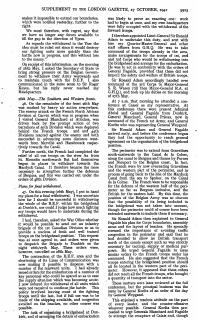
Details
SUPPLEMENT TO THE LONDON GAZETTE, 17 OCTOBER, 1941                                  5925
  makes it impossible to extend our boundaries,       was likely to prove an exacting one: work
  which were notified yesterday, further to the       had to begin at once, and my own headquarters
  right.                                              were fully occupied with the withdrawal of the
      We must therefore, with regret, say that        forward troops.
  we have no longer any forces available to               I therefore appointed Lieut-General Sir Ronald
  fill the gap in the direction of Ypres.              Adam to undertake this duty, and sent with
     As regards the withdrawal to the Yser the.        him my Quarter-Master-General and other
  idea must be ruled out since it would destroy        staff officers from G.H.Q. He was to take
  our fighting units more quickly than the             command of the troops already in the area,
  battle now in progress, and this without loss        make arrangements for the troops of ist, 2nd
  to the enemy."                                       and 3rd Corps who would be withdrawing into
   On receipt of this information, on the morning      the bridgehead and arrange for the embarkation.
of 26th May, I asked the Secretary oi State to         He was to act in conformity with the orders of
bring strong pressure on the Belgian Govern-           General Fagalde, provided that these did not
ment to withdraw their Army westwards and              imperil the safety and welfare of British troops-
to maintain touch with the B.E.F. I also                  Sir Ronald Adam accordingly handed over
communicated in the same sense to Sir Roger            command of the 3rd Corps to Major-General
Keyes, but his reply never reached my                  S. R. Wason (till then Major-General R.A. at
Headquarters.                                          G.H.Q.), and took up his duties on the morning
                                                       of 27th May.
26th May—The Southern and Western fronts.
                                                          At 7 a.m. that morning he attended a con-
   46. On the remainder of the front 26th May          ference at Cassel as my representative. At
was marked by heavy air action everywhere.             this conference there were present Admiral
The enemy attack on the French North African           Abrial and General Fagalde from Dunkirk,
division at Carvin which was in progress when          General Blanchard, General Prioux, now in
I visited General Blanchard at Attiches, was           command of the French ist Army, and General
driven back by the • prompt action of two              Koeltz who was representing General Weygand
battalions of 5oth Division which were deployed
behind the French troops. 2nd and 44th                    Sir Ronald Adam and General Fagalde
Divisions reacted against the enemy and both           arrived early, and before the conference began
succeeded in advancing some distance west-             they had the opportunity to -reach general
wards from Merville and Hazebrouck respec-            'agreement on the organisation of the bridgehead
tively towards the Canal.                              position.
   Further north, the French had completed the            The perimeter was to extend from Gravelines
relief of all our troops on the river Aa from          south-eastwards to the Canal de la Colme,
St. Momelin northwards But had themselves              along the canal to Bergues and thence by Furnes
begun in places to withdraw towards the.               and Nieuport to the Belgian coast. In fact,
Mardyck Canal. It therefore became the more            the French were by now evacuating Gravelines
necessary to strengthen further the defences           and the western part of the perimeter, and in
of Bergues, and this was carried out under the         process of going back to the line of the Mardyck
orders of 48th Division.                               Canal from the sea to Spyker, on the Canal
                                                       de la Colme. The French were to be responsible
 Plans for final withdrawal.                           for the defence of the western half of the peri-
    47. On this evening (26th May), I put in hand      meter as far as Bergues inclusive, and the
 my plans for a final withdrawal. I was uncertain      British for the eastern half. By this time, the
 how far I should be successful in withdrawing         position of the Belgian Army was so obscure
 the whole of the B.E.F. within the bridgehead         that the possibility of its being included in
 at Dunkirk, nor could I judge how much fighting       the bridgehead was not taken into account,
my troops would have to undertake during the           though the perimeter could of course have been
withdrawal.                                            extended eastwards to include them if necessary.
    I had, therefore, asked the War Office whether        Sir Ronald Adam then explained to General
 it would be possible to send out an infantry          Fagalde his plan for Corps boundaries, assembly
 brigade of the ist Canadian Division so as to         areas and the layout of beaches. He specially
 provide a nucleus of fresh and well trained           stressed the importance of avoiding traffic
 troops on the bridgehead position. ~ This request   .congestion in the perimeter and said that he
 was at once agreed to, and orders were given          had decided to allow no British transport
 to despatch the Brigade to Dunkirk on the             north of the canals except such as was strictly
 night 26th/27th May. These orders were,               necessary for tactical, supply or medical pur-
 however, cancelled on 28th May.                       poses. He urged General Fagalde to issue
                                                       similar orders to the French troops under his
    The contraction of the B.E.F. area and the         command. He also suggested that the French
 shortening of its Lines of Communication was          troops entering the bridgehead position should
 now making it possible to dispense with a             all be located in the'western part of the peri-
 number of the rearward units. I had already           meter. However, it appeared that these orders
 issued orders for the embarkation of a number of      did not reach all the French troops, who brought
 key personnel who could be spared so as to ease       a quantity of transport into the sector.
 the supply situation which was becoming acute;
 I now ordered the withdrawal of all units which          These matters were later reviewed at the full
'were not required to continuejihe battle. This        conference, but the principal business was the
 policy involved leaving most of the fighting          issue by General Koeltz of an order of the day
 troops until the last, but if full use was to be      by General Weygand.
 made of the shipping available, and congestion           This enjoined a resolute attitude on the part
 avoided on the beaches, no other course was            of every leader, and the counter-offensive
 possible.                                             wherever possible. General Koeltz then pro-
    The task of organising a bridgehead at Dun-         ceeded to urge Generals Blanchard and Fagalde
 kirk, and of arranging the details of embarkation      to attempt the recapture of Calais and, though
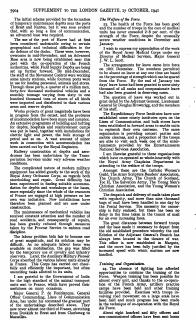
Details
5904          SUPPLEMENT TO THE LONDON GAZETTE, 17 OCTOBER, 1941

    The initial scheme provided for the formation    The Welfare of the Force
 of temporary maintenance dep&ts near the ports         23. The health of the Force has been good
 of Brest and Nantes, but it was soon evident        and the number of troops in the care of medical
that, with so long a line of communication,          units has never exceeded 2-8 per cent, of the
an advanced base was required.                       strength of the Force, despite the unusually
    The use of the port of Havre had at first        severe weather conditions in December and
 been considered undesirable owing to certain        January.
geographical and technical difficulties in the          I wish to express my appreciation of the work
 air defence of the docks. These were, however,      of the Royal Army Medical Corps under my
overcome in mid-November, and an Advanced            Director of Medical Services, Major General
 Base area is now being established near this        J. W. L. Scott.
 port with the co-operation of the French               The arrangements for leave came into force
 authorities, while Field Supply Depdts are being    on i8th December. The numbers permitted
set up further forward. By mid-December,            to be absent on leave at any one time are based
the staff of the Movement Control were working       on the percentage of strength which can be spared
some ninety stations, while fourteen ports were      from the Force. By the end of January ten
in use for landing personnel, animals and stores.   days' leave home had been granted to some sixty
Through these ports, a quarter of a million men,    thousand of all ranks and compassionate leave
forty-five thousand mechanical vehicles and a       had also been granted in deserving cases.
monthly tonnage varying from sixty to one
hundred thousand tons of stores of all kinds            The question of leave was worked out in
were imported and distributed to their various      great detail by the Adjutant General, Lieutenant
areas and reserve dep6ts.                           General Sir Douglas Brownrigg, and the members
                                                    of his staff.
    Works projects of great magnitude have been
in progress from the outset, and the problems           The Expeditionary Force Institutes have now
of accommodation have been many and complex.        established some ninety institutes open on the
An extensive programme of building and hutting      Lines of Communication and bulk stores have
for depdts, hospitals and reinforcement camps       been established in forward areas to enable units
was put in hand, together with installations for    to replenish their own canteens. The same
electric light and power, the bulk storage of       organisation is providing concert parties and
petrol and so on. A vast amount of minor            mobile cinemas, and a proportion of the troops
work in connection with accommodation has           are able to visit each week one of the enter-
been carried out by the Royal Engineers.            tainments provided by the Entertainments
                                                    National Services Association.
    Railway construction at depdts and aero-
dromes has been undertaken by the Trans-                I am likewise grateful to those organisations
portation Services under very adverse weather       which have co-operated so whole-heartedly with
conditions.                                         the Royal Army Chaplains Department in
                                                    attending to the welfare of the troops.
   The complicated nature of modern military
equipment has added greatly to the work of the         Amongst these are the Catholic Women's
Royal Army Ordnance Corps, as regards both          Guild, The Army Scripture Readers' Association,
storeholding and repair. Great difficulty has       The Church Army, The Church of Scotland,
been experienced in finding suitable accommo-       Toe H, The Salvation Army, The Young Men's
dation for depdts and workshops at the bases,       Christian Association, and the Young Women's
more especially since the whole of the resources    Christian Association.
of France are engaged at high pressure on her           The despatch and delivery of mails takes place
own war industries. New installations have          with regularity, and more than nine thousand
therefore been planned and are now under            bags of mail have been handled in one day by
construction.                                       the Postal Service. The necessity for censor-
   The maintenance of mechanical vehicles has       ship is fully realized, but there has been no
received constant attention and the number of       delay in the time taken in the transit of mail
road accidents, and consequently of repairs,        for an ever increasing force.
has been greatly reduced through measures              The great distances between forward troops
taken by the Provost Service to enforce road        and the base made it necessary to depart from
discipline.                                         the old established procedure whereby the 2nd
   The labour problem bids fair to become one       Echelon of the Adjutant General's Branch has
of great magnitude, and its solution may be         always been located in the theatre of war.
difficult. As no adequate labour force was          This office is now established in Margate,
available on mobilisation, the gap was filled       and the move has been fully justified by the
by the temporary use of cavalry and infantry        increased speed with which matters are now
reservists. Later, the Auxiliary Military Pioneer   handled.
Corps absorbed the various labour units already
in France. This Corps has carried out cheer-        Training and Organisation.
fully and efficiently the important, but often         24. The absence of fighting has -afforded
unexciting tasks allotted to its units.             opportunities to continue the training of the
    I am grateful to the Government of India        Force. Weapon training has been possible for
for the high standard of the animal transport       almost every unit, and thanks to the co-opera-
units sent to France, which have proved their       tion of the French Army, artillery practice
usefulness on many occasions.                       camps have been held and other training
   Major General P. de Fonblanque, General          facilities provided. Exercises with troops in-
Officer Commanding, Lines of Communication          volving road movement on a large scale have
Area, has under his command the greatest part       been held and much progress has been made
of the undertakings described above. They           in the technique of co-operation with the Royal
now cover almost one third of France, stretching    Air Force.
from Dunkirk to Brest and from Cherbourg to            About eight hundred and fifty officers and
Marseilles.                                         non-commissioned officers have been sent home
Details
5908          SUPPLEMENT TO THE LONDON GAZETTE, 17 OCTOBER, 1941

   There were also deficiencies in technical          units, including anti-aircraft. My Adjutant-
apparatus for light anti-aircraft requirements,       General's branch, in conjunction with the
such as Kenison Predictors, signal lights,            Adjutant-General's branch at the War Office,
technical and specialised vehicles of many            had in hand plans for the more economical use
types and a number of smaller items. The same         of man-power, the elimination of fit men from
difficulties in provision of equipment were no        sedentary or base duties and the reduction of
doubt the cause of delays in the despatch of new      tradesmen in War Establishments. Investiga-
units to the B.E.F., particularly armoured and        tions made by the War Office, which had my
anti-aircraft units, and while it is to some extent   full co-operation, were directed towards a more
true that the shortness of the campaign pre-          economical and more flexible system of replace-
vented the full effect of the shortages being felt,   ment and repair of vehicles and equipment in
it is I think, justifiable to assume that the         the Force.
presence of the Armoured Division and of a
complete Army Tank Brigade would have been             The Royal Air Force.
an invaluable aid in the difficulties with which          13. On I5th January, 1940, Air Marshal A. S.
we were faced in meeting enemy armoured                Barratt had assumed command of the British
formations.                                            Ah- Force in France, including the Air Com-
                                                       ponent which, however, was to remain under my
 The Administrative Situation.                         operational control. Under this arrangement,
    11. The development of the rearward installa-     in my opinion, the control of available air forces
 tions had been proceeding systematically.             was better allocated to meet the needs not only
    The medical base installations had been            of the British but also of the French Army for
 extended and a hospital area was in course of         whom considerable aerial reconnaissance was
 rapid development near Boulogne in addition           being carried out. The development of the
to the original medical base sub-area at Dieppe.       Allied Central Air Bureau and of its communica-
                                                       tions to the headquarters of higher formations
    The British Army requirements in the port of       in France and to the Royal Air Force at home,
 Brest, a French naval base, had been sub-             was likewise to prove its worth in the 4^ys to
 stantially reduced by the use of other ports          come as an organisation for co-ordinating
 such as St. Malo and Caen ; by May, seventeen        information and requests for air action.
ports in all were being operated and 2,500 tons
of stores were being despatched to railheads              At the same time I felt that the resources of
daily.                                                the Air Component would prove insufficient for
                                                      the requirements of the Force during operations ;
    At the same time, the construction of semi-        so long, therefore, as this state of affairs existed
permanent dep6ts of all kinds in the neighbour-       it was of prime importance that the machinery
hood of Nantes, Rennes and Rouen was in                for obtaining the allotment of additional bomber
progress; this would later on have led to more         and fighter support should be as simple and as
efficient and economical working than was             swift in operation as it could be made.
possible in the temporary accommodation,
taken up in September, 1939. By loth May,                 Throughout the period, construction of new
seven ammunition depdts were open, in addition        aerodromes, landing grounds and communica-
to railhead dumps ; all these were intended, in       tions for the British Air Force in France was
time, to be rail served; while the construction of    proceeding as fast as resources would permit,
the regulating station at Abancourt, by French        concrete runways being constructed in the
railway troops on behalf of the B.E.F., was well      early part of the year until the season allowed
advanced. It opened on a limited scale in the         for the sowing of grass. Upwards of 10,000 men
first week of May. A supply dep6t was being           were employed on this work, and forty-seven
constructed close by so as to relieve the             aerodromes and satellites (including 19 new
dangerous congestion at the ports of Rouen            aerodromes) were under development or con-
and Havre.                                            struction. By I5th May eight of the nineteen
                                                      new aerodromes were capable of use, and at
    The progress of all these undertakings was        least 50,000 tons of concrete had been laid.
adversely affected by the shortage of labour, to      Constructional work was also undertaken on
which I referred in my first despatch, and it         behalf of the Air Ministry at other R.A.F.
was decided, in March, to send three Divisions        installations in central France.
to France to undertake labour duties and
at the same time continue their training, albeit       The Dyle and Escaut Plans.
slowly. The Divisions selected were I2th
(Major-General R. L. Petre), 23rd (Major-                14. Very shortly after the arrival of the B.E.F.
General W. N. Herbert) and 46th (Major-               in their positions on the Belgian frontier I had
General H. O. Curtis). These arrived in April;        been invited by General Georges, commanding
23rd Division was allotted for work on aero-          the French Front of the North East, under
dromes in the forward area, and the remaining         whose Command I was, to study the part to be
two to the Lines of Communication area.               played by the B.E.F. in the event of an advance
                                                      into Holland and Belgium, or into Belgium
                                                      alone. The question of such an advance was
Organisation.                                         one of high policy with a political as well as a
   12. The absence of actual operations up to         military aspect; it was therefore not for me to
 loth May gave opportunities to make a number         comment on it. My responsibilities were con-
of changes in organisation.                           fined to ensuring that the orders issued by the
   Divisional cavalry regiments were grouped          French for the employment of the British
into Armoured Reconnaissance Brigades and the         Expeditionary Force were capable of being
Lines of Communication area was re-organised          carried out; and indeed events proved that the
into two districts.                                   orders issued for this operation were well within
   Infantry battalions were filled up to the new      the capacity of the Force.
and higher establishments, and action was                The subject presented difficulties greatly
initiated to raise the establishment of artillery     complicated by the policy of neutrality to which
Details
ftumb. 38017                                                                                    329.5


                               SUPPLEMENT
                                                TO


The London Gazette      Of TUESDAY, the i$th of JULY, 1947

                              published by ?listi)0rftp
                                    Registered as a newspaper


                              THURSDAY, 17 JULY, 1947

THE EVACUATION OF THE ALLIED                        to synchronise with the ebb. and- flow of the
       ARMIES FROM DUNKIRK AND                      troop concentrations. •
         NEIGHBOURING BEACHES.                         Broadly speaking, for the first 5 days of the
The following despatch was submitted to the         movement, had more beaching craft ibeen avail-
   (Lords Commissioners of the Admiralty on         able to ferry from the beach to offshore vessels,
   the i8th June, 1940, by Vice-Admiral Sir         it would have been possible to have evacuated
   Bertram H. Ramsay, K.C.B., M.V.O., Flag          a greater number. For the last 3 to 4 days,
   Officer Commanding, Dover.                       however, when the main bulk of the
                                                    B.E.F. had already been evacuated, the rate of
                           Office of                lifting was governed 'by the availability of the
              The Flag Officer Commanding,          troops during the limited hours evacuation was
                            Dover.                  possible.
                        i8th June, 1940.
                                                       3. Throughout the operation one of the
   Be pleased to 'lay before Their Lordships        greatest difficulties was the ever changing situa-
the following report on Operation " Dynamo ",       tion presented. Within 24 hours of the start,
namely the evacuation of the Allied Annies          the operation took the shape of a forlorn hope
from Dunkirk and neighbouring *beaches              to rescue the maximum number, say up to
between 26th May and 4th June, 1940. The            45,000 before Dhe whole force was to be over-
report takes the form of this covering letter,      whelmed by the enemy.
together with detailed narrative and appendices.       Next, the military situation became more
                                                    stable, and it appeared that some three to four
2. THE POLICY AND THE PROGRESS OF THE days would be available to complete evacua-
      EVACUATION.                                   tion of the B.E.F., estimated-at some 175,000.
   During the course of the operation some During this stage evacuation by British
330,000 troops* reached safety in England after resources of French troops was introduced,
being evacuated from Dunkirk, and from the some 25,000 being mentioned.
beach stretching 10 miles eastward from the            During the course of the fifth day (30th May)
entrance to Dunkirk Harbour. To those on the a tentative decision to lift the rearguard             of
French coast, when in the early stages any- the B.E.F. off the beaches at a definite1 time,
thing -up to 50,000 troops were waiting to viz. 0130 on ist June, was reached. Twenty-
embark on a 10 mile sea front, the presence four hours later this plan was altered by military
of perhaps 20 small warships off shore, and considerations, involving an extension of the
200 small boats spread along the length of coast period of evacuation. At the same time, the
at any given moment, must have appeared as Naval authority was definitely committed to
a feeble effort to tackle this great task. Further- provide for the evacuation of French forces,
more, it was impossible to adjust the arrival of then mentioned as about 40,000/50,000.
ships, either at Dunkirk or opposite the beaches,      Later, the French -number rose and 150,000
   * Admiralty footnote: About one-quarter of these or   more was quoted. Finally no agreement
troops were carried in ships manned by the Merchant could be reached with the French as to an>
Navy                                                termination of the operation which threatened
Details
SUPPLEMENT TO THE LONDON GAZETTE, 17 JULY, 1947                                            3305
    41. Meantime the Vice Admiral, Dover, had           45. The attempt to maintain an adequate rate
been much exercised regarding the possibility       of lift using only the older destroyers was by
of the continued use of Dunkirk Harbour for         now shown to be impracticable. The destroyers
personnel vessels and" was anxiously awaiting       were lifting about 17,000, personnel vessels
the report from VANQUISHER, who had been            about 9,500 in the 24 hours. Remaining vessels
sent to investigate the reported obstruction.       were estimated to be worth about 15,000 per
VANQUISHER'S report was received at 0610            day. This gave a total lift of about 43,000 per
stating entrance was practicable but that           day. The situation called for a lift of at least
obstruction exists towards outer inside end of      55,000 per day. Verbal representations being
the Eastern Arpi. Pending amplifying reports,       made to the ist Sea Lord, authority was received
the sailing of personnel vessels to Dunkirk was     for the return to the Dover Command of the
resumed, although at this time there were still     modern destroyers released the night before.
4 personnel vessels presumed to be in the               Accordingly Commander-in-Chief, Nore, at
vicinity of Dunkirk Harbour, whose movements        1531 gave orders to HARVESTER, HAVANT,
and whereabouts throughout the night still          IVANHOE, IMPULSIVE,               ICARUS and
remained obscure.                                   INTREPID to proceed at once to Dunkirk.
    The Vice Admiral asked R.A. Dover, who          Subsequently some of these destroyers were
was in HEBE, whether personnel ships could,         diverted to the beaches.
in fact, still use Dunkirk. In -the meantime a         46. Arrangements for the final evacuation of
series of signals from Rear Admiral, Dover,         the Rearguard of the B.E.F. During the fore-
and destroyers off the coast, were received,        noon representatives of the Commander-in-
stating that the beaches were filling up rapidly    Chief of the B.E.F. and staff attended a con-
and more ships and boats were urgently required     ference with the Vice Admiral.
there. Although it was known that the                  The Military officers explained the Com-
destroyers could use Dunkirk, it appeared at        mander-in-Chief's plan and gave daylight on
this time that the best division of transport was   Saturday, ist June, as the latest reasonable date
to send the great majority of destroyers to the     up to which the B.E.F. might be expected to
beaches, where urgent demands could not be          hold the eastern perimeter, the size of the
ignored, and the personnel vessels to Dunkirk       corresponding force being about 4,000.
Harbour, only an occasional destroyer being            'By that date and time the Vice Admiral knew
sent to Dunkirk from the reduced number now         that he should foe in possession of ocean-going
available for the operation.
                                                    tugs, -ships' lifeboats and ships' power life-
    42. At Dunkirk there were no air attacks in     boats which he could specially reserve for the
the early morning and all was quiet. Later,         climax of this critical operation. Accordingly,
when ships began to arrive in quantity, in view     agreement was reached on the following:—
of the massive target presented by a number of             (a) That evacuation should proceed with
ships alongside the East Pier at a time, the            the utmost vigour to ensure that by 0130 on
S.N.O. Dunkirk ordered destroyers alongside             ist June, the British Forces ashore should
only one at a time. At about 0800 a store ship          (have been reduced to the rear guard of
arrived at Dunkirk with provisions but no               4,000.
water ^ This caused so much congestion on the              (b) That special boats and tugs should be
pier that unloading was abandoned when half             accumulated and held aside to ensure them
complete, and the store ship filled with troops.        being available in the early hours of ist
A certain amount of water was obtained from             June.
destroyers.                                                (c) That the plan should provide for lifting
    43. During the forenoon the Military con-           a rear guard of 4,000, plus R.N. beach
structed a long pier of lorries with deck               (parties, in one or more flights between 0130
planking, into the sea off Bray. This was an            and 0300 on the ist June.
 excellent piece of work, but was insufficiently           (d) Final decision based on the progress of
 stable for use by such craft as paddle steamers,       the evacuation of the main body to be made
 nor even smaller, power craft in a lop. It was         •by the Vice Admiral at 1400 on Friday, 3ist
 invaluable later for embarking troops into small       'May, as to the possibility of adhering to the
 boats. As regards general embarkation off the          plan.
 beaches, it was later learnt that it was a com-    Other technical details were settled at the meet-
 mon occurrence for processions of small boats      ing and the Military staff were given the assur-
 loaded with troops to be cast adrift when           ance that the ever increasing rate of lifting
 empty and allowed to float away to seaward,         showed every promise of enabling an affirma-
 owing to the lack of sufficient naval ratings as    tive decision to foe given at the critical hour
 boat-keepers. For the same reason many of           of i4oo/3fist May. After the conference the
 the smaller pulling boats were swamped and          Military officers communicated the plan both to
 sunk due to overloading by uncontrolled             the War Office and the Commander-in-Chief,
  " rush " of soldiers. Both these faults were       B.E.F.
 remedied later.                                        47. Remarks. The organisation of traffic to
    44. Matters proceeded smoothly throughout        and from the beaches was recovering from the
 the day owing to the mist and there being a         setback it had received when all resources had
 big smoke cloud over Dunkirk which prevented        to be thrown upon the beaches and Dunkirk
  the enemy bombers attacking the ships in large     Harbour when the outflanking and forcing back
 numbers.                                            of the B.E.F. was thought to foe imminent con-
    In order to increase the rate of embarkation     sequent upon the surrender of the Belgian
 through the bottleneck of the East Pier gang-       forces. Furthermore, a number of organised,
 way, the troops were urged to quicken their         and freelance groups of small power boats,
 pace and eventually thousands of troops, tired      were commencing to arrive off the coast, who,
 and without food and water for days, broke into     by seizing the abandoned and drifting pulling
 the double and kept it up the whole length of       boats, were able to do much to increase the
 the pier for more than two hours.                   rate of lifting from the beaches.
Details
SUPPLEMENT TO THE LONDON GAZETTE, 17 JULY, 1947                                                3307
would attempt to beach ship to form a lee to          the beach between Bray and one mile East of
try to improve conditions.                            La Panne and also advancing the commence-
   Simultaneously with this bad news the Vice-        ment of the operation by one hour. The risk
Admiral received a signal from S.N.O. Dunkirk         of this change of plan was obvious as the boat
to the effect that Dunkirk was being continu-         tows were not in communication with the Vice
ously and heavily bombarded and that the              Admiral, and reliance had to be placed on the
enemy artillery were gradually finding the range      Minesweepers to inform and see that the escort-
of the loading berth. He stated he wished only        ing M.A.S.B.s would shepherd the tows to the
to enter ships which were necessary for the flow      new positions. The minesweepers had anchored
of troops.                                            so as to serve as guiding marks, as had been
   This latter signal fortified the Vice-Admiral in   explained to the Naval Officers in each tow.
his decision to suspend the sailing of personnel         Apart from the special tow, a very large
vessels to Dunkirk until the accumulation of          number of small power boats despatched, in
those en route had been evened out.                   most cases direct, from the South East ports,
  55. One group of minesweepers who, up to this       Newhaven to Sheerness, were arriving off the
time had been working continuous round trips          beaches, and compensated in a large measure
between Sheerness and La Panne, were diverted         for the heavy losses that had occurred amongst
to round trips /between Dunkirk; beach and            the original towing boats, whalers, cutters, life-
Margate to compensate for the gradual drift of        boats and ships' boats, which had occured on
troops westward along the Coast, and to com-          the beaches during the preceding three days.
pensate for the reduced flow of troops off               On the La Panne beaches after 1600 very
Dunkirk Pier consequent on the artillery bom-         good progress was made. The piers of pontoons
bardment.       At the same time, by using            built by the Military the previous day were
Margate the duration of the round trip was            extremely useful, and were largely responsible
reduced. The Rear-Admiral, Dover, from off            for the rapid evacuation of troops.      All the
the coast was instructed to run a paddle mine-        troops that could be found were embarked by
sweeper bows ashore on rising tide to be used as      midnight and ferried off to the ships.       The
a bridge, deeper draught ships coming to her          local Beachmaster (Captain R. Pirn, R.N.V.R.)
stern, if conditions were suitable. It was not        searched the adjacent beaches for stragglers at
thought, however, that this would be an effec-        midnight, and was informed by a Staff Officer
tive measure of bridging the gap between water-       that no more troops would embark from the La
line and off shore ships, as "the length of a         Panne -beaches, but would march to Dunkirk,
paddle minesweeper was so small compared              as it was anticipated that these beaches would
with -the length of the shallow water to be           be shelled and probably be in German hands
traversed.                                            the following day. This, as it turned out, was
                                                      a correct forecast. The Beachmaster estimates
   56. During the forenoon beaches at La              that 5,000 men were lifted from the La Panne
Panne were subjected to heavy artillery fire.         beaches during the evening and up to midnight.
Action was taken with -the R.A.F. Commands to
locate batteries shelling the beaches and Dun-           59. At 1920 all ships in the fleets were in-
kirk pier and include air bombardment of these        formed by the Vice Admiral that the final
positions in the R.A.F. protective measures           evacuation of the B.E.F. was expected on the
undertaken during the operation.                      night ist/2nd June, and that the evacuation of
                                                      the French from Dunkirk and Malo beach
   57. During the afternoon additional beach          would continue from ist June by both British
parties were sent out, and barges with provi-         and French ships.
sions, ammunition and water arrived at the
beaches during the day, and were grounded.               60. General Lloyd informed the D.M.O. of
Two further drifters were despatched with             the new plan, stating that General Alexander
petrol, diesel oil and lubricants "to the beach       had been placed in command of the final phase
area to refuel the inshore craft.                     of the evacuation. Composition of force not
                                                      known. Further, that it was impossible now
   58. Arrangements were made to be ready to          to say how long the French evacuation would
embark Lord Gort and Staff from La Panne              take but that the Alexander force would remain
1800 or later, by M.T.B. After 1700 weather           till the last.    No firm information could be
conditions off the beaches improved, particu-         obtained from the French as regards: —
larly as the tide rose and it appeared once more             (i) The number of French troops to be
possible to take effective quantities direct from        evacuated.
the beaches, and to use the special tows, ships             (ii) The nature and extent of French sea-
lifeboats, power lifeboats and tugs, which were          borne transport.
on passage from Ramsgate and which had been                 (iii) The French military plan for the
earmarked for lifting the final covering force.           defence of the perimeter and the final with-
   In the afternoon, 'however, it was learned that       drawal of French troops.
the Military plan had been changed, and that it
was no longer possible for the original covering         61. General Remarks: The main features of
position, as planned, to >be held by 4,000 troops     the day were: —
who were then to withdraw to the beaches for                (a) The increased enemy artillety activity
embarkation by boat. Instead, it was learned              on Dunkirk and La Panne beach, and on the
that the Eastern-most Division was to be with-            approach channels.
drawn Westward from the La Panne area, and                  (b) The set-back to evacuation from the
that the special flight of boats was to be used          beaches that occurred during the choppy
to lift this force from the beaches. At the same         weather of the forenoon, followed by an
time, the troops in the Bray and Malo sectors             excellent recovery in the afternoon and even-
were being thinned out by movements West-                 ing when large numbers were lifted from the
ward towards Dunkirk itself. This change of               beaches.
plan involved concentrating the special tows                 (c) The change in the military plan as re-
and the minesweepers—to which they were                   gards the locality and time of lifting the final
to transfer the troops—into the stretch opposite          contingents of the B.E.F.
Details
3298          SUPPLEMENT TO THE LONDON GAZETTE, 17 JULY, 1947
embarkation staff or organisation a strong naval       14. CO-OPERATION OF THE FRENCH NAVY.
party was required to form up and embark the           French warships and other vessels were
troops. Later, no difficulty was experienced        employed evacuating French troops from
when troops of fighting formations were en-         Dunkirk Harbour, and on the last three nights
countered. Difficulty was experienced in con--      from the beach i£ miles eastward from Dunkirk.
trolling some French 'troops, whilst others were    Details are given in Appendix IV.
so rigidly bound by discipline and tradition that
they would not embark except by complete               15. BASE ORGANISATION.
formation under their own unit officers. In
either case the rate of embarkation was much           An operation of this magnitude involving the
slower than with British troops.                    maintenance and movements of close on 900
                                                    vessels and boats could not have been conducted
   12. INITIATIVE SHOWN BY COMMANDING               without the wholehearted and unceasing efforts
OFFICERS AND SUBORDINATE PERSONNEL.                 of the base establishments at Dover and
   A most satisfactory feature of the operation     Ramsgate, as well as those at Sheerness and
>was the high degree of initiative shown by         Harwich in the Nore Command. At all these
Commanding and Subordinate Officers of units        places officers and men, Naval and civilian,
operating off the coast, ranging from H.M.          laboured unceasingly throughout the Operation.
Destroyers to commandeered motor boats. The            In particular I wish to acknowledge the great
majority of officers and ratings in command         assistance received from the Commander-in-
were in situations requiring independent action     Chief, Nore, Admiral the Hon. Sir Reginald
in extremely difficult conditions. Often the        A. R. Plunkett-Ernle-Erle-Drax, K.C.B.,
easiest course was to be satisfied with work        D.S.O., who in many cases anticipated my re-
already achieved and to return to the United        quests for assistance through his constant watch
Kingdom with a final load of troops. The            on the progress of the Operation.
reverse action was invariably executed, namely,        The prompt and unfailing assistance afforded
continued operation off the coast as long as        by the Chatham Depot in providing personnel
there were both -troops ashore to be evacuated      for .the numerous small craft, working parties
and vessels offshore to receive them. If the        and beach parties, was a feature essential to the
craft in use was damaged or sunk the crew in-       successful outcome of the Operation.
variably seized some other boat to continue            The Naval Officer-in-Charge, Ramsgate,
their efforts.                                      Captain W. R. Phillimore, R.N., by taking
   Unaware of the military situation ashore and     over the servicing and control of the great
often forced to move westward by bombard-           majority of the small craft of the inshore
ment from German artillery or even by rifle         flotillas relieved Dover of an immense volume
fire from advancing German forces, the majority     of work which it would otherwise have been
of these boats, commanded often by stokers or       impossible to handle.
" hostility only " seamen, had only one object         It was also brought to my notice that at
an view, to lit from the beach any, and all         Harwich an exceptional Naval and Military
troops, British or Allied, within sight of the      system was in being for assisting those ships
water's edge.                                       which called there to make a quick turn round,
   On their return to the United Kingdom when       relieving the tired ships' companies of the work
asked to report their proceedings it was only       of cleaning and clearing their vessels.
in answer to direct enquiry that it would trans-       16. SERVICES OF STAFF, INCLUDING OFFICERS
pire that these young men had been subjected        TEMPORARILY APPOINTED.
in many cases, to an unparalleled bombard-             I was fortunate in having the services of
ment from the air. They appeared to consider        Roar Admiral W. F. Wake-Walker, C.B.,
that this was part of the day's work requiring      O.B.E., as Flag Officer afloat off Dunkirk, and
no comment.                                         Captain W. G. Tennant, C.B., M.V.O., as
  13. LOSSES OF TROOPS AFTER EMBARKATION.           Senior Naval Officer, Dunkirk on shore.
   It is a distressing fact -that many ships were   Admiral Wake-Walker was responsible for
sunk or damaged on the return voyage when           supervising the embarkation afloat and Captain
laden with troops. But it is fortunate that in      Tennant for organising embarkation from the
most of such cases the majority of troops were      shore, keeping touch with the French Naval
saved owing to the large volume of traffic that     Authorities and the staff of the British
was coming and going between Dunkirk and            Commander-in-Chief.
the United Kingdom. Exceptions to this were            I cannot conclude this despatch without
due to the rapidity with which certain ships        reference to the splendid work of my staff under
sank after having been bombed or torpedoed.         the guidance of my Chief Staff Officer, Captain
Such cases are as follows: —                        L. V. Morgan, C.B.E., M.V.O., D.S.C.
                                                       Augmented by additional officers, including
      WAKEFUL. Torpedoed. Ship broke in             both Army and Royal Air Force, especially
   half and only those on the upper deck were       appointed for the occasion, their task of
   saved. About 600 troops were below.              organising and operating the large and varied
      CRESTED EAGLE. Was bombed and                 collection of H.M. Ships continued without a
   then beached in a burning condition. Only        pause day and night .throughout the 10 days
   about 300 saved out of 600 on board.             that the Operation lasted, and I can never
      SKIPJACK. 250-300 troops on board,            testify adequately to the excellence of their
   most of whom, unfortunately, went down           work, upon the efficiency of which successful
   with the ship when she sank.                     results depended.
      WAVERLEY. 600 troops were on board               Finally I would like to pay tribute to the
   before ship was abandoned in sinking condi-      valuable support and assistance which I received
   tion, but only 200-300 were picked up.           throughout the whole course of the evacuation
   In all it is regretted that about 2,000 troops   from Vice Admiral Sir James Somerville,
must have been lost through these and similar       K.C.B., D.S.O., who was appointed to H.M.S.
disasters on the return voyages to England.         LYNX for special service in connection with
Details
3306            SUPPLEMENT TO THE LONDON GAZETTE, 17 JULY, 1947
Friday, ^ist May.                                        final evacuation plan during the night of
  48. The Admiralty informed the Vice Admiral            31/5-1/6. Accordingly, instructions were
that the policy of H.M. Government was that              issued for the special tows to leave Ramsgate
both British and French troops be given an               at 1300/31 for Dunkirk via Route X, and the
equal opportunity of being evacuated in British          Commander-dn-Chief, Nore and Flag Officer in
ships and boats.                                         Charge, Harwich, were requested to provide
                                                         all available M.T.B.s to escort this convoy
   49. Personnel ships had been sailed the pre-          for as much of the outward passage as possible,
vious evening and throughout the night of the            which was timed to commence from Ramsgate
30th/3ist to provide for a continuous flow into          at 1300/31. Speed of advance—5 knots. A
Dunkirk harbour.        But at 0320 the S.N.O.           party of Naval officers had been assembled at
reported that once again the majority of these           Dover to embark in these tows and had been
personnel ships had failed to enter the harbour          given detailed instructions on the plan. Two
during the dark hours. MALCOLM, however,                 M.A/S. boats and two M.T.B.s in the Dover
left Dunkirk with 1,200 troops at 0300, during           Command were ordered to accompany the boat
heavy shelling, on relief by IVANHOE.                    convoy and subsequently embark the Com-
S.N.O. Dunkirk, however, continued to call for           mander-an-Chief, B.E.F. and Staff off the
more ships. 'No more destroyers were avail-              beaches.
able and there were no means of accelerating
the arrival of the vessels despatched there.1 By           53. Shortly after sunrise an on-shore wind
0700 the Vice Admiral had no news of the fate            arose and boat work became difficult, many
of the personnel ships that had sailed the pre-          whalers capsizing and the prospects of com-
vious evening and during the night. None of              pleting the evacuation to plan began to be less
these ships had reached the U.K. to unload,              favourable. The following extract from the
and it appeared probable that these ships                report of Captain Howson, S.N.O. on the
may thave concentrated in the narrow                     beaches illustrates conditions at Bray at this
waters close to Dunkirk, inviting a repetition           time:
of the heavy air attacks with consequent                       " At 0400 there was a very considerable
damage and loss to transports which had                    number of destroyers, paddlers, trawlers,
occurred on the two previous occasions when                skoots, etc., off Bray, and embarkation was
personnel vessels, together with other ships,              proceeding satisfactorily, but a lop had
had been concentrated in large numbers in the              already started. There were about 10 motor
approaches to Dunkirk.                                     yachts which had arrived from England.
   At this time there were no less than nine               These > craft drew 6-7 feet and were
personnel vessels and three hospital carriers              unable to get close in to any of the beaches.
known to be on the round trip U.K.—Dunkirk                 During the forenoon, considerable towing
and back and one other personnel vessel had                of empty craft towards the beach was carried
been ordered to sail during the night, but her             out, and only about two boats were allowed
whereabouts was unknown. In addition, three                to get adrift and ultimately ground. With
other personnel vessels were under orders to               the falling tide, however, a number of boats
sail between 0900 and 1030. Pending the                    were seen to ground and remain ashore until
return of the ships en passage, and while the              the tide rose in the afternoon. These in-
coal-burners were being rebunkered, the further             cluded an A.L.C.* motor boat and a life-
sailing of personnel vessels was in suspense.              boat. Other power boats broke down. Never-
   Note :—Owing to the casualties to personnel vessels     theless, the embarkation, much hindered by
           at this stage, coal burning cross channel       the lop, proceeded satisfactorily. ; As further
           steamers had to be used for some of the          destroyers and sloops arrived, they were
           trips and short endurance necessitated
           coaling between trips which could not be        directed to lower their motor boats and
            done in the vicinity of Dover, thus            whalers as this had not already been done;
           preventing a quick turn round.                  these boats were quite invaluable. About
   50. During the night a considerable amount              noon, the lop began to subside and with
of enemy mdnelaying activity by air was re-                the rising tide conditions for embarkation
ported. Shelling was heavy during the evening              very greatly improved, more boats were
and night, and operations were greatly ham-                sent in and more boats floated off and matters
pered. Nevertheless, with the cessation of                 were proceeding very well, when the gun at
shelling at about 0300, very good progress was             La Panne started to shell the beaches and
made and by full dawn the beaches were very                foreshore with great accuracy. A certain
nearly clear of troops. At 0530 attacks on                 number of light craft were sunk. The A.L.C.
Dunkirk Harbour and the beach from Dunkirk                 broke down and was towed away by a
to Bray developed more strength and the 'bom-              steamer. MOSQUITO, destroyers and sloops
bardment of Dunkirk continued. Neverthe-                   proceeded westward clear of the firing."
less, the S.N.O. reported that the embarkation              54. Rear-Admiral Wake-Walker was able to
there was proceeding satisfactorily but stressed         make a survey of the general conditions of the
the need for more ships and constant fighter             beaches, and at 1130 the Vice-Admiral received
protection. At this time French troops began
to appear at Dunkirk Pier and on the'beaches,            a signal from him stating that the majority of
and were embarked with the British troops.               the pulling boats were broached to and without
                                                         crews, conditions on the beaches .being very bad
   51. At 0600 VIMY sighted submarine off the            owing to a freshening shore wind, only small
N.W. Goodwins and commenced to hunt.                     numbers being embarked. Under present condi-
   52. The arrivals at the home ports indicated          tions any large-scale embarkation from beach
that in spite of the frequent requests for more          impracticable. Motor boats could not get close
ships and more boats received from the various           in. He considered only hope of embarking any
authorities on the French coast, the rate of             number was at Dunkirk, and further stated he
evacuation was steadily increasing and would               * Admiralty footnote: A.L.C. = Assault Landing
permit, all being well, of implementing the              Craft.
Source: The National Archives, Kew, ADM 199 2429. Contains public sector information licensed under the Open Government Licence v3.0.

Details
| EXULTANT ( ex PROGRESS) (J. Douglas & G. Shepherd) | MFB | R(T98B) " | 22 N If | AP AP | 23.6.40 .11.43 | .11.43 | £15.0.6 |
Source: The National Archives, Kew, ADM 199 788 A. Contains public sector information licensed under the Open Government Licence v3.0.

Details
64
-2-
58
correct lying to four off knots. place a beach and crowded Sighted many with soldiers small craft go and some destroyers was
hailed to out and a few came in as I boats. could. Was
soldiers waded went as near inshore thought this Some
apparently go alongside small coastal rowing
of soldiers aground. Went to her and steamer took
hour we went while she opened fire. In got way
on and I lay when off bombing raid started, destroyer About to
go alongside to be transferred to destroyers. off a boatload
drift in port then starboard engines broke down Returning her
to beach alongside and disembarked soldiers. about half an
while there enough in to be reached easily by pulling. go anchor.
close close to the shore before letting so let Was
could assist in the engine room to volunteer.
engines in a bad condition so I asked any soldiers who
filled up with military. E.R.A. reported boats;
Royal Artillerymen and Royal Engineers came forward Six to help
E.R.A. White. Sand was found in the carburettors and
the distributors required resetting. One engine was
ready in just over one and a half hours, so got under way and
proceeded to a destroyer to discharge men aboard.
Next attempted to get alongside pier made of army
lorries by dropping astern on anchor. Only one side of the
pier was approachable, wind setting on shore difficult sea
running, parted all my ropes in efforts to get alongside
then found pier unusable where my boat could approach.
Received and discharged more soldiers, also
received signal that refuelling drifters were on their way
to assist light craft.
E.R.A. reported only enough fuel remaining for ten
minutes running, then went alongside destroyer where I
received one drum of petrol to carry on for a while.
Received signal for all ships to be ready to leave at a
moments notice.
Both engines failed again as I was proceeding inshore
Dropped anchor in shallow water. Large air battle in
progress about thirty planes involved. Very shortly
after 1700 (time rather uncertain) the enemy opened fire
with a gun ashore. After first shell landed in the sea
I ordered my crew to get below between the engines.
Second shell landed in the water alongside my ship about
three yards off and burst. Able Seaman Todd, and Able
Seaman Holloway were instantly killed, Chief Petty Officer
Dawson received cuts on the face and neck, E.R.A. White
was hit in the leg, I was hit in the nose, hip and foot.
Blinded by blood I was unable to see the extent of
and asked for a report on the ship's condition and
the damage. Ordered charts and secret papers to be the burned
casualties incurred. Was told she was sinking slowly and
my were really dead and he reported there was no doubt, they
two A.B's killed. Told coxswain to make sure they
had been killed outright.
The Stoker burned my papers and charts while the
coxswain hailed for assistance, E.R.A. White remained by me
and kept me informed as to what was happening.
assisted The into her, the remainder of the crew then abandoned motor
coxswain shortly lowered the dinghy and I was
launch ship (Coxswain, and were taken aboard casting the dinghy
E.R.A., Stoker). Pulled over to adrift, a
during this period I could not see and did not see

Details
369
343
16.
At about 1200 Commander Ken and I motored into
29/5
Dunkirk to report progress as embarkation on our beach was
then impossible. On our return our lorry was heavily machine
gunned and hit. At this period a heavy bombing attack took
place on the Fleet and beaches.
17.
On return to our headquarters (a lorry) we decided
to make contact with General H.Q. but unfortunately our car
broke down and we had to walk back 5 miles.
18.
During the night another naval embarkation party
arrived on the beach to the eastward which reduced the
limits of our beach.
30/5
19.
Early on Thursday morning 30th I proceeded to
e
Brigade H.Q. and offered the suggestion that piers be built
by running lorries out to sea. This was quickly done and was
successful.
20.
I then drove Colonel Whitten and Colonel Mackenzie
into Dunkirk to see Captain Tennant and then drove them back
to Brigade H.Q.
21.
During the afternoon and dogwatches the French
poured into our beaches but no boats arrived within 1½ miles
of our H.Q.
22.
During the last dog the Germans directed mos t
accurate artillery fire on our beach. This fire continued
throughout the night and our lorry was hit. The beach was
completely evacuated by allied soldiers.
23.
We had however taken up quarters in a water-boat
that was ashore at low water. No boats had now been in for
16 hours on our beach.
24.
During the night the weather became bad once more -
and a heavy surf was running.
At/
Source: The National Archives, Kew, ADM 199 790. Contains public sector information licensed under the Open Government Licence v3.0.

Details
15
30th May may.
shortly after. Imbarkation proceeded thereafter at a good
steady rate.
TV.A.Dover
Following signal was made at 0930:-
"Troops are concentrated in unlinited mubers just
East of Dunkirk Beach, on Bray Beaches and at
La Panne. Please do your best to distrbute. I am
getting along splendidly here. Send two hospital
ships now. If mist persists I will bring them in on
arrival."
At 0943 the following Situation Report was made:-
"Conour are 1700 k/co. I have no M.Y.B. and can
only communicate with U.K. by French wireless station,
02 when - destroyers are in sight. If conditions
remain as at present a destroyer alongsido continuously
for embarkation would be a magnificant holp. The
moment hombing starts all met shove off".
At 0950 I made following signal:-
"If this weather persists I want = ship every half
an hour".
The whole morning was atoty and 1donl for embaritation
that Card ships arrived and BS great opportunity was again lost.
Hospital ships also did not arrive until attermoon and there
were over one Shousand wounded waiting for transportation.
At 1600 two destroyers arrived.
At 1700 as COP us sent for 200 to go to G.H.Q. and
I traned over the daties of S.N.O. to Consunder Maund.
Valuey at 1836 following signal was made:-
*Am leaving for G.H.Q. for about two days and I have
turned over the job of N.S.O. to Commander Hand who
rully understands the estuation and has everything
well in hand."
At 1846 following signal TRUE made:-
proceeding steadily despite internittent
banbing attacks and bonbardments. Conditions appear
favourable for good progress tonight. Request all
available cruft may be made available both for Dunkirk
and beaches. Number embarked to date only with
destroyers 18,000."
At 2025 a situation Report this made as follows:-
thousand troops have been embarked during last hour.
"Despite intense bombardment and air attack four
Dunicirk will be untenable by Friday morning. Embarkation
Every possible effort will be made. I consider
will be continued until last moment but depend upon large
ships and destroyers at Pier tonight."
AS
********

Details
13
178
Political pressure was now being brought to bear
Telday
on the C.in C. that the evacuation must be on a fifty-fifty
basis with the French. My only stipulation was that at all
costs we should be allowed from use of the Eastern area while
the French used the part, outer harbour and beaches.
I made a signal to Communder Harmd at Dunkirk to
provide personnel for ships for General Laurencie's troops
(some 5,000 in mather) at C.in c's request. I also asked
Admiral Wake-Walker to keep Dunkirk going at 100%.
Little progress you could be unde off the beaches owing
to the surf.
is have
G.H.C. informed = that a plan was being worked out
for naval co-operation to bonbard advancing German tanks in
that Truin troms
the later stages. This, however, was never necessary, as
British ships my
far as am aware at
1041, - have been continually heavily besbirded end
they 020 greatually fining the renge of our londing
I wealt only enter
necessary for the Clos of troups,
Continuose and heavy shelling all the number, but the
evanuation prosected fairly meedily. At List shipe were
in Inrge medere and strong in y protection Rept.
houghting sttack - The only thing necessary was tostep the
making AS 1000 a signed tell received from the Air Landson
occure as Tovor aching for position or energy bettery. This
this Insuire with any certainty as the instity HAS probobity
while, - is was to the details or Less Plage Secure Kork
Such, regity SOUR ede to this event. The
becaus DIVE between end a great doct issued consente.
tory beirg astacks were delivered during the eventing bast wase
consultrated enjoy upon derallet ships in the seartify live
buchingt absorble care carried out on the ships Leading bus address
insurest. The embarbation proceeded subsidity.

Details
15
19
-8-
At 1800 approximately Lord Gort embarked at La Panne for
the U.K.
At 1937 the following signal was mader-
"As it 10 vital to carry on the evacuation of troops
throughout every available moment day and night
it is intended to place two white lights at eastern
and western pier head as a guide to ships in the
hours of darkness. It is requested that all H.M.
ships and other vessels who are likely to enter
port to-night be warned accordingly?
At 1945 a further signal was made:-
"Slow British progress in the port due to shelling,
bombing, and wounded and French troops using quay.
Weather fine and clear, sea moderate, good prospects
for night embarkation from beaches."
I returned Dunkirk with General Alexander and discovered
that totally different instructions had been given to General
Alexander by Lord Cort and by Lord Gort in writing to Admiral
Abrial and General Fagalde.
Lord Cort had told the French authorities that General
assist in
Alexander would hold-the the "PERISTER" for the French to embark
and that he was to place himself md his three divisions under
General Fagalde's orders. General Alexander, however, was told
by Lord Cort in my hearing that be was to do nothing to imperia
his army and was ultimately responsible for their safety and
evacuation.
I suggested to General Alexander that he should at once
return to La Panne before the telephone was cut off to telephone
to the Secretary of State for war, and to get the matter cleared
up. This he did. The Secretary of State instructed General
Alexander to act on his own discretion and to proceed with the
evacuation.
Admiral Abrial asked me to take charge of the British and
French embarkation, which I did. I also asked for French
officers to assist, and they were provided.
The following signals were despatched:-
2028. "I have felt it necessary for the operation to

Details
28
22
16.
At about 1200 Commander Ken and I motored into
Dunkirk to report progress as embarkation on our beach was
then impossible. On our return our lorry was heavily machine
gunned and hit. At this period a heavy bombing attack took
place on the Fleet and beaches.
17.
On return to our headquarters (a lorry) we decided
to make contact with General H.Q. but unfortunately our car
broke down and we had to walk back 5 miles.
18.
During the night another naval embarkation party
arrived on the beach to the eastward which reduced the
limits of our beach.
19.
Early on Thursday morning 30th I proceeded to
Brigade H.Q. and offered the suggestion that piers be built
by running lorries out to sea. This was quickly done and was
successful.
20.
I then drove Colonel Whitten and Colonel Mackenzie
into Dunkirk to see Captain Tennant and then drove them back
to Brigade H.Q.
21.
During the afternoon and dogwatches the French
poured into our beaches but no boats arrived within 11 miles
of our H.Q.
22.
During the last dog the Germans directed mos to
accurate artillery fire on our beach. This fire continued
throughout the night and our lorry was hit. The beach was
completely evacuated by allied soldiers.
23.
We had however taken up quarters in a water-boat
that was ashore at low mter. No boats had now been in for
16 hours on our beach.
84.
During the night the weather became bad once more -
and a heavy surf was running.
At/

Details
42
46
30th may
shortly after. Embarkation proceeded thereafter at a good
steady rate.
IsV.A.,Dorer
Following signal was made at 0930:-
"Troops are concentrated in unlimited numbers just
East of Dunkirk Beach, on Bray Beaches and at
La Panne. Please do your best to distribute. I am
getting along splendidly here. Send two hospital
ships now. If mist persists I will bring them in on
arrival."
At 0943 the following Situation Report was made:-
Concur are 1700 k/cs. I have no M.T.B. and can
only communicate with U.K. by French wireless station,
or when destroyers are in sight. If conditions
remain as at present a destroyer alongside continuously
for embarkation would be a magnificent help. The
moment bombing starts all must shove off".
At 0950 I made following signal:-
"If this weather persists I want a ship every half
an hour".
The whole morning was misty and ideal for embarkation
but few ships arrived and a great opportunity was again lost.
Hospital ships also did not arrive until afternoon and there
were over one thousand wounded waiting for transportation.
At 1600 two destroyers arrived.
At 1700 a car was sent for me to go to G.H.Q. and
I turned over the duties of S.N.O. to Commander Maund.
Friday at 1836 following signal was made:-
"Am leaving for G.H.Q. for about two days and I have
turned over the job of N.S.O. to Commander Maund who
fully understands the situation and has everything
well in hand."
At 1846 following signal was made:-
"Embarkation proceeding steadily despite intermittent
bombing attacks and bombardments. Conditions appear
favourable for good progress tonight. Request all
available craft may be made available both for Dunkirk
and beaches. Number embarked to date only with
destroyers 13,000."
At 2025 a Situation Report was made as follows:-
"Despite intense bombardment and air attack four
thousand troops have been embarked during last hour.
Dunkirk will be untenable by Friday morning. Embarkation
Every possible effort will be made. I consider
will be continued until last moment but depend upon large
ships and destroyers at Pier tonight."
As

Details
44
Political pressure was now being brought to bear
Triday
The
on the C.in C. that the evacuation must be on a fifty-fifty
load
basis with the French. My only stipulation was that at all
costs we should be allowed free use of the Eastern arm while
the French used the port, outer harbour and beaches.
0605.
I made a signal to Commander Maund at Dunkirk to
for
provide personnel ships for General Laurencie's troops
(some 5,000 in number) at C.in C's. request. I also asked
Admiral Wake-Walker to keep Dunkirk going at 100%..
0940,
you
Little progress could be made off the beaches owing
to the surf.
0945, "Sun 1s BOV coning through have
G.H.Q. informed 100 that a plan was being worked out
for
hours
for naval co-operation to bombard advancing German tanks in
"Lord Goart
the later stages. This, however, was never necessary, as
far as / am aware. versels. dusk.
Request
necessary
ships
my
1004. "Wo have been continually heavily boxibarded and
they are gradually finding the range of our leading
berth, would only enter ships 88
necessary for the flow or treops,
Continuous and beary shelling all the morning, but the
evamition proceeded fairly speedily. At Last ships were
arriving in Large numbers and strong a * protection kept
bonging attack away. The only thing necessary use to scop the
shelling. At 1800 a signed was received from the Air Lisison
Officer at Dover asking for position of energy battary, This
was not known with any certainty as the lettery vas probably
mobile, but it vos in the district of Loon Plage larguage Kark
regly use and to this affect, The bechardsent,
nevertheless, become more intense and a great deal more securate.
Very heavy attacks 1820 delivered during the ovening but were
concentrated shiefly upon develist ships in the reads. Dive
hombing attacks here carried out 00 the ships loading but without
sussess. The embarkation processed easethly.

Details
46
50
At 1800 approximately Lord Gort ambarked at La Panne for
U.K.
At 1937 the following signal was made:-
"As it is vital to carry on the evacuation of troops
throughout every available moment day and night
it is intended to place two white lights at eastern
and western pier head as a guide to ships in the
hours of darkness. It is requested that all H.M.
ships and other vessels who are likely to enter
port to-night be warned accordingly"
At 1945 a further signal was made:-
"Slow British progress in the port due to shelling,
bombing, and wounded and French troops using quay.
Weather fine and clear, sea moderate, good prospects
for night embarkation from beaches."
I returned Dunkirk with General Alexander and discovered
at totally different instructions had been given to General
exander by Lord Gort and by Lord Gort in writing to Admiral
rial and General Fagalde.
Lord Gort had told the French authorities that General
assist
exander would hold the "PERIMETER" for the French to embark
id that he was to place himself and his divisions under
eneral Fagalde's orders. General Alexander, however, was told
Lord Gort in my hearing that he was to do nothing to imperia
is army and was ultimately responsible for their safety and
vacuation.
I suggested to General Alexander that he should at once
eturn to La Panne before the telephone was cut off to telephone
o the Secretary of State for War, and to get the matter cleared
p. This he did. The Secretary of State instructed General
lexander to act on his own discretion and to proceed with the
evacuation.
Admiral Abrial asked me to take charge of the British and
French embarkation, which I did. I also asked for French
officers to assist, and they were provided.
The following signals were despatched:-
2028. "I have felt it necessary for the operation to

Details
59
63
3/w May
AS about 0300 11 988 impossible to carry out
16.
At about 1200 Commander Ken and I motored into
embarkation es the bonches.
Dunkirk to report progress as embarkation on our beach was
85.
vere showing signs of extreme exhaustion and
then impossible. On our return our lorry was heavily machine
80 it 989 impossible to communicate with the Senior Navel Officer
gunned and hit. At this period a heavy bombing attack took
we decided to take over * shaler that the had salved and to go
place on the Fleet and beaches.
to the bearest to report to the Senior Seval officer
17.
On return to our headquarters (a lorry) we decided
25.
We wasted vater and 0750 put to 00,
to make contact with General H.Q. but unfortunately our car
There me very heavy surf running and se had only an uneven set
broke down and we had to walk back 5 miles.
of sers, voge arutches and only an 062 to by.
18.
During the night another naval embarkation party
17.
We approached two destroyers but they both 201 underesy.
arrived on the beach to the eastward which reduced the
Tea other destroyers passed de at but paid no
limits of our beach.
stiention to us.
19.
Early on Thursday morning 30th I proceeded to
28.
an hour if appeared the
Brigade H.Q. and offered the suggestion that piers be built
Margate the the Consumin to take 12 to the
by running lorries out to sea. This was quickly done and was
nearest destroyer at this time.
successful.
returning to 80 we case back with him
20.
I then drove Colonel Whitten and Colonel Mackenzie
19,
US28 and
into Dunkirk to see Captain Tennant and then drove them back
were salses within five minutes of being inboard the lifeboat.
to Brigade H.Q.
1 the or Staff
21.
During the afternoon and dogwatches the French
poured Daven and into reported our beaches our return. but no boats arrived within 11 miles
1 usa ordered to return to Chather with by party,
of our H.Q.
22.
During the last dog the Germans directed mon $
accurate artillery fire on our beach. This fire continued
throughout the night and our lorry was hit. The beach was
completely evacuated by allied soldiers.
23.
We had however taken up quarters in a water-boat
that was ashore at low mter. No boats had now been in for
16 hours on our beach.
24.
During the night the weather became bad once more -
and a heavy surf was running.
At/

Details
69
73
SECR &
PAge
8.
6.
second attempt TRU now David to tow the ship
clear but little progress had been made before a third attack
developped at about noon, carried out by 8 equairon of :
dive Dombers. By this time nearly all amunition TRIS expenied
and the 4.7 guns were firing in the hope of keeping the
enemy at a listance. The Germans however, cade 8 determined
diving attack which was well prossed home to about 400 feet.
The ship WAS completely smotherou 00 hits and near misses some
of which were of the "B" bomb type. The ship immidiately bogan
to settle and I gave the order to abanlon ship. Thanks to the
adequate preparations cade by if First ideutenant, Lieutonant-
Commander Moding there TIBUDS plenty of boats and carley
floats ready for survivors. fter collecting all strey swimers
the boats and floats pullod out to sea. LE JOLIE
picked up 8 officers an: 71 ratings and How.3. WHIT HALL" 20
officers and 52 ratings. One wholer and the notor boat had
proceeded to far over the shocls which run parallel to the
count for to piok them up.
7.
cank in about 4 fathers of
wator in approximate youition
with hor uppor Cook smash. Although the sodio and V.C.-V.F.
gear and all important documents had been destroyed I =
anxious to complete the destruction of the vessel. accordingly
I requested the Captain of to fire suns and
torpeloss. This W&J done and the ship 180 left on fire forward.
It 10 not certain whether any of the torredoes hit and I
consider further destruction advisable. 1 intimated this in &
signal time.: 40 6/1 to the log Community :over
despatched DO a secret Sand coosego.
8. the first attach I ordered the destruction of all Signal
when the chip TXC rendered imobile after
Publications except the Fleet Signal Book bridge
machine and current naval Syko card. This was done by Sub-
Lieutenant who burnt then in the two galleys.
All Confidential Books prefixed 10' more dumped overboard in
a weighted sack except those out on loan to officers SS these
could not be got at due to damage aft. The Asdic gear in the
cabinet and on the bridge was diamentied where possible and
thrown overboard and the remainder smashed The oscillator was
removed and brought on the upper dock anidships 80 the finel
attack developped. It is not known for certain whether the
oscillator slid overboard when the ship sant. lenterns
wore unshippod and thrown overboard.
9. on the bridge: C.B. _018 - and certain charge documents in the
The following books and documents were left
Captain's springback and the Meet Signal Book. The bridge was
burning fiercely when last seon and it can be confidently stated
that these documents and papers more lestroyed.
I would like to emphasise that the older
10. doctroyers with pan point using belted ammunition and 4.7° Guns
with only 30 degrees elevation are no match for a determined
air attack. Cur Lowis guno had also been recently surreniored.
when shipo of this type are operating within range of energy
air attack losses must be expected unless adequate fighter
protection is afforded. In all the enemy launched four big
uir attacks at about hourly intervals during the forenoon of
the 1st June. The first, secon: and fourth of these were
unoppeced
apparently unopposed by any British Aircraft

Details
87
91
SECE
P6CO
6.
second attempt TRU now carlo to tow the ship
clear but little progress had been made before & third attach
developped at about noon,carrisi out by S squairon of MICHI
live bonbers. By this time nourly all scrumition TRIS expenied
and the 4.7 gans were firing in the hope of Leopin; the
enemy at B intunce. the German, honever, & determined
diving attack which was well prosued home to about 400 feet.
The ship TRAG completely scotherol By hits and near nisses S000
of which were of the 3 boob type. The ship impediately bogan
to settle and I gave the order to abanton ship. Thanks to the
aloquato preparations code by if First Lieutonant, Licutenant-
Communier there 1800 plenty of boats and carley
floats realy for survivors. fter collecting all strey swimers
the boats and floats pullod out to sou. LES JONES
pickod up C officers an: 71 ratings and SHIP HALL" 2
officers and BC ratings. One shalor and the motor boat had
processed to: for over the should which run parallel to the
count for to piot: them up.
7.
not in about 4 fathers of
mator in sperazizate
with hor upsor look smosh. the Notto and V.C.-V.P.
coar and all important documento had been I =
anxious to complete the destruction of the vessel. accordingly
I the Captain of to fire guns and
torpeloss. This wes done and the ship TOJ left on fire formari.
It is not certain whether any of the torredoeu hit and I
consider further destruction advisable. 1 intimated this in a
airmal time 10 6, to the 110g Community: over
doupatchol 30 a secret hert coorago.
8.
-hen the chip - 1-obile after
the first attack 1 ordere_ the dectruction of all signal
Publications except the flect signal Dook bridge COST2-20
mohine and current naval iyko card. This was Lono by STID-
Lieutenant who burnt then in the two galloys.
All Confidential Books prefixod for more dumped overbourd in
a weighted snok except those out on loan to officers SD these
could not be COD at due to damage aft. The sale gour in the
cabinet end on the bridge was dispential where possible and
thrown overbour. and the remainder smoked. The oscillator T80
removed and brought on the uppor dook anidshipu as the final
attack developped. It is not known for certain whether the
oscillator alid overboard when the this san. lenterns
were unshippod and thrown overboard.
D.
The following books and documento were left
on the bridgo: C.D. 2010 WE and cortain charge locuments in the
Coptain's springback and the Most Signal Book. The bridge TRAD
burning fiercely when last seen and it can be confidently stated
that these locumento and purara more lectroyed.
10.
I mould 11kc to englusise that the older
Soutroyers with DOC 2023 using belted amunition and 4.7° Dana
with only 30 degrees elovation are no match for a determinel
air attuck. our Lawis guna had also been recently surrenCored.
when shipo of this type are operating within range of enecy
air attack logues must be expected unless alequate fighter
protoction is afforiat. In all the enemy launched four big
win attache at about hourly intervals during the forenoon of
the 1st June. The first, secon: and fourth of these were
unoppeced
apparently unopposed by any British Aircraft

Details
88
92
SECRET.
lace 3.
apparently unopposed by any British iroraft. On the third
000usion un intenso air buttle could be heard in progress
above the clouds and no effective bombing took place. I would
also like to state that from my observation the onery aircraft
even when opposed word always more miserous than our own and in
the cubsequent air buttles our fighters although outnumbered
fought most courageously and effectively but concrully lost
moro planes than the enomy. From our point of view the B.B.C.
Aillotins secoribing the air sotions off unkir: entirely
microprosent the truo situation.
11.
The courage end Deheviour of I? officers and
non The a great inspiration to 8 Curing the four hours while
the ship drifted without help under the threat of destruction.
Their checrfulness and efficionay under these trying conditions
W&O cxtruordinary. That GO for were lost TREE alcost miraculous
but IV DO put domn to SOZO extent to the trained courage of the
ship's COMPANY who fought their gans mhore possible and took
cover when they could not otherwise Do 02 uso. It is cost
difficult shore all conductod themolves valiantly to choose
those specially conspicuous for their behaviour, but these I
appond of lict of those specially worthy of contion.
12.
The Collowing promitions are attached:-
spronliz I :-
Verbutim statement by various officors and ratings
appondix In:-
List of known survivoru and known killed.
pronlix 111.
Lict of officers and men specially mentioned.
prondix IV:- Copy of prolicinary report sent to the 145
Officer Communin -ovor.
1 have the honour to DO,
4r,
your obsident servent,
(Nd.)
The Commander in Chief,
Commander,
ostorn peronches.
Royal Savy.
Copios to:- The 20g Officer Commenting, over.
Co tuin 19th outrayer Notilla.
Captain (-), flymouth.
COMMA DER-18-CHERS
3- JUN 1940
WESTERN APPROACHES
VICE ADNIRAL
JUN 1940
.
DOVER

Details
108
112
SECRET.
Inco 3.
apparently unopposed by any British iroraft. On the third
occasion un intense air buttle could be heard in progress
above the clouds and no effective bombing took place. I would
also like to state that from my observation the onemy aircraft
even when opposed wore always more numerous than our own and in
the subsequent air buttles our fighters although outnumbered
fought most courageously and effectively but generally lost
more planes than the onomy. From our point of view the B.B.C.
Bulletins describing the air actions off Dunkirs entirely
microprosentation truo libuation.
11.
The courage and wedffiders and
non The C great inspiration to 20 during the four hours while
the ship drifted without help under the threat of destruction.
Their checrfulness and efficioncy under these trying conditions
was extruordinary. That GO for wore lost was almost miraculous
but may be put down to some extent to the trained courage of the
ship's company who fought their gane where possible and took
cover when they could not otherwise be 02 uso. It is cost
lifficult where all conducted themolves valiantly to choose
those specially conspicuous for their behaviour, but these I
appoil a list of those specially worthy of contion.
12.
The following promitions are attached:-
Appendix I :- Verbutin statement by various officers and ratings
appendix Ii:-
List of known survivoru and known killed.
appondix 111.
-ist of officers and mon specially mentioned.
prondix IV:-
Copy of proliminary report sent to the leg
Officer Communing over.
I have the honour to be,
ir,
your obsdient servant,
(Cite)
The Commander in Chief,
Commender,
western pproaches.
Royal Navy.
Copies to:- The ACE Officer Commending, lover.
Ca tain (2), 19th -outroyer lotillo.
Captain Plymouth.
*
*
WESTERN AFPROACHES
P.T.O...

Details
160
165
4
probably towards the where she might have bean
salved by the enemy 11 she sank in shoul water, I asked
the Commanding Officer 11 I should ink ser where she was.
He agreed and I cut my sweep wires and sunk er.
12. Five minutes after this the "SCOTIA" and RIGHTON
QUEEN" were sunk. I made a report and proceeded to rescue
survivors. My whaler had been damaged and I only had a
skiff left. One bunch of survivors were picked U. and
I then put the ship alongside bridge and must of the
"BRIGHTON QUEEN" and artially on er deck, and took off
men clincin to her. These nen were mostly French
HTON
Colonial troops and must reluctant to let 80 of what
N.
support they had, it was sometimes necessary to make a
line fast to them and pull then off. A carley float and
skiff were used to assist in resoue work, no other boats
were available. Thile "SALTASH" YRS alongable and on
board "BRIGHTON QUEEN" she burped & little on the bilge,
but it is not believed that my damage was done. German
aircraft bombed and machine gunned men in the water.
my shift was machine gunned.
13.
The work of S.B. 1.Hutter at this time is worthy of
mention. He, with the uld of untrained assistants,
including Ldg. Sto. Crowley, dealt with 98 casualties,
CUE.
including 10 recussitation cases and only 3 died. He
worked most successfully until 10 collepsed. Also worthy
of mention is B. Gaughan, Sto. 1. who sma about I mile
from the ship, when the ship might easily have had to
leave him.
14.
I had picked up 350 to 400 survivors by now, many of
them serious casualties, there were no more survivors in
SCUE.
the water SQ I returned to Margate. On the return journey
I closed three trawlers and took on board the Commanding
Officer and crew of M.T.B. 175, these included three
serious casualties and one dead rating. I took the M.T.B
in tow and arrived at Margate at 1855.
15.
About 2000 I left the Pier and about 2200 sailed again
for Duskerque with boats in tow, one motor boat and the
small skiffs. I bad SOMO difficulty with the tow which
VD
MARGATE
light buoy I ran into thick smoke (from Dunkerque) my
delayed no about half an hour. Before getting to the greeen
UNKERQUE
being very unreliable, I had to rely very much on
compass hand lead (all the tubes for the machine slow had and been I used
the in Knock Deep) which made y progress got
1 far Sast.
16.
Orders for this ni that all sweepers had to
be lear at 0400. About 0200 I heard The buoy other and
by 0500 and the destroyer evacuation the whistle would
UNKERQUE
commence was off the Breakwater at Dunkerque. I followed them
at 0245 passed no on the may out, the 30 orders about being as I
did not 0300, even 11 I had an empty having seen
sweepers feel Justified in breaking ship. Daring the
clear by journey a small craft reported found an object a which mine,
return back along ner course and investigation, proved
I turned for a mine, but on closer handles. These broken
I mistook kitchen utensil with broken small craft as horns.
to handles be a may have appeared to the
end. June. 16. I anchored at Margate about 0800 and was toldito wait
instructions.
I understood that this was the final

Details
CONFIDENTIAL
Dynams 108
B14/0/
1173
167
H.M.S.SCIMITAR
8th June 1940
H.M.S.SCIMITAR...REPORT OF PROCEEDINGS
Sir,
Ihave the honour to report on the proceedings of H.M. ship
under my command between 26th May and 4th June as follows.
2. I received orders to sail for Dover at noon/28th
and I arrived at Dover at about 2000 28th May. At about 2100 I
was ordered to leave under the orders of Captain (D) 16 in
"Malcolm". On arrival at Bray at about 0130 I was ordered to
proceed a mile to the eastward and send in boats. My motor boat
with whaler in tow proceeded inshore under Lieutenant J.R.G
Trechman and embarked troops. After about two hours my whaler
was swamped inshore due to being rushed by troops. My motor
boat continued to assist in towing and I embarked troops from
various other boats. Later I secured another whaler and
embarkation proceeded more rapidly.
3. At about 1230/29 I considered the ship was full
(about 350 troops) and I was ordered to return to Dover. I
sailed by route Y in company WIth "Shikari". I arrived at Dover
at about 1630/29 and disembarked troops and then proceeded to
oil.
4. I sailed for Dunkirk again at about 2000/29,
starting via route Y, joining "Worcester" and then proceeding
via route X to the beaches East of Bray. Good progress was made
during the night embarking troops using our own motor boat and
captured whaler and various other boats. In the morning I had
350 troops on board and proceeded via route X leaving my motor
boat and whaler inshore under the command of Hidshipman Ball
R.N.R. Fog patches were encountered on the way back and I
arrived at Dover at about 1000/30.
5. After disembarking troops I sailed again at about
1130 and was ordered to go to Dunkirk harbour via route 8. I
arrived and went alongside at about 1330/30 and embarked about
500 troops very quickly. I returned via route $ being shelled
and bombed off Calais. The shelling was of small calibre but
fairly accurate; no damage was sustained. I arrived at Dover at
about 1630/30 and disembarked troops.
6. I sailed again about 1830/30 for La Panne via
route X. Near Dunkirk 1 sighted my motor boat and recalled it.
After waiting sometime at La Panne, where there were several other
ships, I was ordered by "Worcester" to go to Bray. I collected a
string of derelict boats and sent them in my motor boat
under Sub Lieutenant Coldwell. Good progress was made in
embarking troops and at about 0600/31 I had 500 on board and
sailed after transferring my motor boat and string of other boats
to the trawler "Olvina". I proceeded via route X to Dover in
company with "Harvester".
7. I arrived at Dover at about 0930/31 and after
disembarking troops sailed again about 1030. Whilst proceeding
possible to the starboard hand buoys and just reached the
through the Downs at 25 knots, I was navigating had as close as
N.W. Goodwin buoy when I was overtaken by Icarus, who out
across close, and although I altered towards to starboard him. I as soon
both and buoy went hard a starboard when he was with abreast me
as the very would allow, I was drawn in about stopped
but I sucked over and hit his stern line my stem. I found
that was bows were crumpled in on the water collision with bulkhead. & definite
However of after the operation, I thought 10. I go on speed,
rent allowing securing & collision mat, could at slow extreme
my water pressure on to the in view of the
urgenoy and proceeded at 8 knots, later at
The reasons

Details
169
(2)
. 174
0830. Returned to beaches, contacted 350 troops of R.A.S.C.
and R.A.O.C. detachments, including Montenant Colonol and
officers. with ascistance of 150 troops, large ship's lifebout
was pulled down boach and successfully floated to accident
embarlextion, but after removing good, dr take did not give sufficiont
bucyancy to componsate for stove in gerboard stroke.
Scarlous lack of boats, reducing omborization rate to about 30 por hour
with own bonts only. 227 troops orderhod remainder being cont
off to Salamonder and dostroyers. Somo difficulty exporienced
through persistent attempts of Large masses of French troops to
intercept boats and domand passage Assisted by British troo a
in heading off French submers by riflo fire from 50 yurds further
along beach. Dunkirk burning with much molio. Miximm visibility,
slight cloud. No. R.A.F. support aighted all day.
2600. Lovel bonbing attack on Sutton, Solvenndor, Grogliound
and paddlors from 5000-10000 foot. Coo solvo pattom bombo without
result. One salvo of H.S. straddling Station and paddlors, no lite.
One dive borbing attack on Suttom and Creyhound, noor nice started
fire in Greyhound sundships. One line of 5 bombo aloco to G.H.).
on DOB front, on a line starting from centre of the town down
beach and into don, final too bombo fulling such aldo of Service.
Comperitivoly mll bombo used, with incondinres, 000
of which got light to a drifter cable from Strtton which was
sunk by paddlors gunfire. To R.A.P. support visible. for smll
machine gun hits on Strtton. Greyhound budly damaged by bember
and riddled with mahine on fire.
1706. Procoeded Dover, leaving La Panno during further air redd
of Issu intensity, in company with Sulamander. No R.A.F. support
visible on passage.
2300. Arrived off Dove, only, what. feld in progress, unchored
Chocrved plane at about 1500 foot drop three mignatic nines about
2 cables ahoad, coundo of nines strilling mor clearly andible.
Parashutos soon by several separate observers. signalied position
of mines to V.A. Dovor.
mursday 30th. May. 0600. Proceeded into Dover, discharged troops.
1052. Proceeded Sheernues with one boilor. Drove fires in other
boiler to make repairs to birlowork, damgod by bunb explosion.
1632. arrived Shoomoos, orderlood coal and ammittion.
riday State My. 0205. Left Shoorness in company with Lydd and Booo.
0400. Companyee maddenly produced a and 30 degrees of devintion,
Rose assumed load of dividion, Inter company dovintion improved
and Subton responsed Lead.
0812. Arrived proceeded cust puballol to bonches passing
4 planes wrocked on he boach weat of two with Prench
markings. 29. Passed Dunkisk harbour 1 cuble. Harbour fires. wall intect
and little damage apparent from counard except Imgo
Continued DOID from bouch close work of
0835. high Hurricanes One 0.230 ship ounls alenguide cust plur of Dunicipt. 2
Sinfire, and Spitfires overhead, processing home of harbour, at
Fearch spood. and several cargo ships must court cast. continued
groups Long column on the bonoh. Combinuous column about 1 wills
dectroyers of troops surehing into Dunisive from long along
bouch cast of
3 milon off is punno. wind Items force In frushering, troops with DOG
0906. slight Anchored but considerable mall.. Consenced loading
COMMANDING OFFICER
19 JUN 1940
H.M.S. "SUTTON"

Details
(2)
0830. Returned to beaches, contacted 350 troops of R.A.S.C.
and R.A.O.C. detachments, including Lieutenant Colonel and
officers. With assistance of 150 troops, large ship's lifeboat
was pulled down beach and successfully floated to assist
embarkation., but after removing gear, air tanks did not give
sufficient buoyancy to compensate for store in garboard strake.
Serious lack of boats, reducing embarkation rate to about 30
per hour with own boats only. 227 troops embarked, remainder
being sent off to Salamander and destroyers. Some difficulty
experienced through persistent attempts of large masses of
French troops to intercept boats and demand passage. Assisted
by British troops in heading off French Swimmers by rifle fire
from 50 yards further along the beach. Dunk rk burning with much
smoke. Maximum visibility, slight cloud, No R.A.F. support sighted all day.
1600. Level bombing attack on Sutton, Salamander, Greyhound
and paddlers from 5000-10000 feet. One salvo pattern bombs without
result. One salvo of H.E. straddling Sutton and paddlers, no hits.
One dive bombing attack on Sutton and Greyhound, near miss started
fire in Greyhound amidships. One line of 5 bombs close to G.H.Q.
on sea front, on a line starting from centre of the town down
beach and into sea., final two bombs falling each side of Sutton.
Comparitively small bombs used, with several incendiares, one
of which set light to a drifter 1 cable from Sutton which was
sunk by paddlers gunfire. No R.A.F. support visible. Few small
machine gun hits on Sutton. Greyhound badly damaged by bombs
and riddled with machine gun fire.
1706. Proceeded Dover, leaving La Panne during further air raid
of less intensity, in company with Salamander. No R.A.F. support
visible on passage.
2300. Arrived off Dover, calm, mist, Air raid in progress, anchored.
Observed plane at about 1500 feet drop three magnetic mines about
2 cables ahead, sounds of mines striking water clearly audible.
Parashutes seen by several observers. Signalled position
hursday 30th. May. 0600. Proceeded into Dover, discharged troops.
of mines to V.A.Dover.
1052. Proceeded Sheerness with one boiler. Drew fires in other
boiler to make repairs to brickwork, damaged by bomb explosion
1632. Arrived Sheerness, embarked coal and ammunition.
riday 31st May. 0205. Left Sheerness in company with Lydd and Ross.
0400. Compasses suddenly produced 20 and 30 degrees od deviation,
Ross assumed lead of division, later compass deviation improved
and Sutton re-assumed lead.
0812. Arrived Dunkirk, proceeded east parallel to beaches passing
4 planes wrecked on the beach west od Dunkirk, two with Franch
markings. 0829. Passed Dunkirk harbour distant 1 cable. Harbour wall intact
and little damage apparent from seaward except huge fires.
Continual gunfire, some from beach close west of Dunkirk.
0835. Hurricanes and Spitfires overhead, proceeding homewards at
high speed. One cargo ship sunk alongaide east pier of harbour, 2
French destroyers and several cargo ships sunk east of Dunkirk.
Long columns of troops marching into Dunkirk from east, scattered
groups on the beach. Continuous column about 1 mile long along
0906. Anchored off La Panne. Wind N.W. force 3, freshening, sea
beach 3 miles east of Dunkirk.
slight but considerable swell. Commenced loading troops with

Details
187
191
(2)
0830. Returned to beaches, contacted 350 troops of R.A.S.C.
and R.A.O.C. detachments, including Licutenant Colonel and
officers. With assistance of I50 troops, large ship's lifeboat
was pulled down beach and successfully floated to assist
embarkation, but after removing gear, air tanks did not give
sufficient buoyancy to compensate for store in garboard strake.
Serious lack of boats, reducing embarkation rate to about 30
per hour with own boats only. 227 troops embarked, remainder
being sent off to Salamander and destroyers. Some difficulty
experienced through persistent attempts of large masses of
French troops to intercept boats and demand passage. Assisted
by British troops in heading off French swimmers by rifle fire
from 50 yards further along beach. Dunkirk burning with much
smoke. Maximum visibility, slight cloud. No R.A.F. support
sighted all day.
1600. Level bombing attack on Sutton, Salamander, Greyhound
and paddlers from 5000-I0000 feet. One salvo pattern bombs without
result. One salvo of H.E. straddling Sutton and paddlers, no hits.
One dive bombing attack on Sutton and Greyhound, near miss started
fire in Greyhound amidships. one line of 5 bombs close to G.H.Q.
on sea front, on at line starting from centre of the town down
beach and into sea, final two bombs falling each side of Sutton.
Comparitively small bombs used, with several incendiares, one
of which set light to at drifter 1 cable from Sutton which was
sunk by paddlers gunfire. No R.A.F. support visible. Few small
machine gun hits on Sutton. Greyhound badly damaged by bombs
and riddled with machine gun fire.
I706. Proceeded Dover, leaving La Panne during further air raid
of less intensity, in company with Salamander. No R.A.F. support
visible on passage.
2300. Arrived off Dover, calm, mist. Air raid in progress, anchored.
Observed plane at about 1500 feet drop three magnetic mines about
2 cables ahead, sounds of mines striking water clearly audible.
Parashutes seen by several separate observers. Signalled position
of mines to V.A. Dover.
Thursday 30th May. 0600. Proceeded into Dover, discharged troops.
1052. Proceeded Sheerness with one boiler. Drew fires in other
boiler to make repairs to brickwork, damaged by bomb explosion.
1632. Arrived Sheerness, embarked coal and ammunition.
Friday 31st May. 0205. Left Sheerness in company with Lydd and Ress.
0400. Compasses suddenly produced 20 and 30 degrees of deviation,
HOSS assumed lead of division, later compass deviation improved
and Sutton re-assumed lead.
0812. Arrived Dunkirk, proceeded east parallel to beaches passing
4 planes wrecked on the beach west of Dunkirk, two with French
markings. 0829. Passed Dunkirk harbour distant I cable. Harbour wall intact
and little damage apparent from seaward except huge fires.
0835. Hurricanes gunfire, and Spitfires overhead, proceeding homewards at
Continual some from beach close west of Dunkirk.
high speed. One cargo ship sunk alongside east pier of harbour, 2
French destroyers and several cargo ships sunk east of Dunkirk.
Long columns of troops marching into Dunkirk from east, scattered
groups on the beach. Continuous column about I mile long along
beach 3 miles east of Dunkirk.
0906. Anchored off La Panne. Wind N.W. force 3. freshening, troops sea
slight but considerable swell.. Commenced loading with

Details
(2)
0830. Returned to beaches, contacted 350 troops of R.A.S.C.
and R.A.O.C. detachments, including Lieutenant Colonel and
202
officers. With assistance of 150 troops, large ship's lifeboat
was pulled down beach and successfully floated to assist
embarkation, but after removing gear, air tanks did not give.
sufficient buoyancy to compensate for stove in garboard strake.
Serious lack of boats, reducing embarkation rate to about 30 per
hour with own boats only, 227 troops embarked remainder being sent
off to Salamander and destroyers. Some difficulty experienced
through persistent attempts of large masses of French troops to
intercept boats and demand passage. Assisted by British troops
in heading off French swimmers by rifle fire from 50 yards further
along beach. Dunkirk burning with much smoke. Maximum visibility,
slight cloud, No R.A.F. support sighted all day.
1600. Level bombing attack on Sutton, Salamander, Greyhound
and paddlers from 5000-10000feet. One salvo pattern bombs without
result. One salvo of H.E. straddling Sutton and paddlers, no hits.
One dive bombing attack on Sutton and Greyhound, near miss started
fire in Greyhound smidships. One line of 5 bombs close to G.H.Q.
on sea front, on a line starting from centre of the town down
beach and into sea, final two bombs falling each side of Sutton.
Comparatively small boats used, with several incendiaries, one
of which set light to & drifter - cable from Sutton which was
sunk by paddlers gunfire. No R.A.F. support visible. Few small
machine gunshits on Sutton. Greyhound badly damaged by bombs
and riddled with machine gun fire.
1706. Proceeded Dover, leaving La Panne during further air raid
of less intensity, in company with Salamander. No R.A.F. support
visible on passage.
2300. Arrived off Dover, calm, mist. Air raid in progress, anchored
Observed plane at about 1500 feet drop three magnetic mines about
2 cables ahead, sounds of mines striking water clearly audible.
Parachutes seen by several separate observers. Signalled position
of mines to V.A. Dover.
Thursday 30th. May. 0600. Proceeded into Dover, discharged troops.
1052. Proceeded Sheerness with one boiler. Drew fires in other
boiler to make repairs to brickwork, damaged by bomb explosion.
1632. Arrived Sheerness, embarked coal and ammunition.
Friday 31st. May. 0205. Left Sheerness in company with Lydd and Ross.
0400. Compasses suddenly produced 20 and 30 degrees of deviation,
Roas assumed lead of division, later compass deviation improved
and Sutton re-assumed Lead.
0812. Arrived Dunkirk, proceeded east parallel to beaches passing
4 planes wrecked on the beach west of Dunkirk, two with French
markings. 0829. Passed Dunkrik Harbour distant 1 cable. Harbour wall intast
and little damage done apparent from seaward except huge fires.
Continual gunfire, some from beach close west of Dunkirk.
0835. Hurricanes and Spitfires overhead, proceeding homewards at
the soattered
harbour
Long columns of troops marching into Dunkirk from east, beach 3 miles east groups
on the beach. Continious column about 1 mildalong of
Dunkirk. 0906. Anchored off La Panne, Wind N.W. force 3, freshening, with sea
slight but considerable swell. Commenced loading troops
COMMANDING OFFICER
19 JUN 1940
H.M.S. "SUTTON"

Details
209
224
On arrival at Dunkirk I use ordered to 80 to
West pier. I deemed this inadvisable and said 80.
Also it was suggested that I should pick up French soldiers
from the beach inside the harbour. lithout boats this was
impracticable.
Alongside East pier a full load was taken but
not before I had cast off and returned oring to a
misunderstanding. While alonguide a hulk two cables
east from the pièr TAB heavily bombed by two waves of dive
bombers. The second attack was in progress as I laft
the pier and aircraft were engaged by the entire areasent.
Dive bonber attacks on leaving Dunkirk.
During the next half hour the ship was attacked
by successive waves of dive bonbers consisting of three
or four squadrons of about nine each.
The first attack took place in Dunkirk reads
where avoiding action was not possible. The available
speed was 19 knots. In this attack about half the bonbe
dropped were time delay and the nearest appeared to be
about 50 yards away. Although the ship was lifted
in the water a number of times no structural damage was
done.
Succeeding attacks took place in the channel
leading northward from No.5 buoy. In these attacks
the majority of the bomba burst on impact with the water
and caused great damage to personnel. Some of these
dropped as near as 10 yards.
In all it is estimated that over 100 bombe
were dropped near the ship.
Attacks were pressed well home even down to
200 02 300 feet and it can be said that the bombing was
- 3 -

Details
Pages
231
W (continued)
2010
possibly, already damaged by our fighters.
2105
Proceeded 10th 180 British troops.
Alongaide Eastern Pier embarking troops.
rday 1st. June.
0005
Anchored off Margate.
0133
0240
Alongside Margate Pier, disemberked troops.
0700
Ordered to anchor off Margate and unit orders.
Ordered to proceed to Dunkirk.
1000
troops. Alongaide Eastern Pier, Dunkirk Hartour, embarking
More or less continous High level Bombing in progress
engaged enesy Bombers.
1130
Proceeded with 210 British troops, and 5 stretcher
cases.
1235
In position 342° No.5 Bucy 1 Mile, steering 342° with
two transports ahead. One being a large two funneller
and the other a Paddle steamer (names not know), both
carrying French treeps. To were all attacked w 16
Enery Dive Bonbers which were hotly engaged. Both
transports were hit, and Kingfisher*near missed*. The
smaller ship appeared to be sinking and the larger on
fire, but still under way, and under control. A
number of small Drifters proceeding to Dunkirs, were
close at hand and proceeded to pick up survivors. I
connenced to turn, 10th the same intention but sighted
two destroyerstwo miles to the Northward, one British
and one French, both without troops.I informed them by
light and they closed at full speed. I then decided
that the help Kingfisher, who was already full, could
add, did not justify By risking the loss of By troops
by remaining in the vicinity, 80 proceeded.
1442
Anchored off Margate Pier.
1555
Alongaide Margate Pier disembarking troops.
1635
Proceeded and anchored in Margate Roads, ordered to
remain at 1 hour's notice in case required.
Not included in Saturday light's operations.
iday 2nd June.
No fresh orders received, took the opportunity to
replenish armunition, 113 4ª H.S. Helley return empties,
During the dark hours several Parachute flares were seen
and to oil
seen to drop,off North Foreland.
May 3rd June.
1910
Weighed and in company, to
rendezvous of Man and Auto
1955
Forned Carrier. escort on Auto Carrier, who informed no that
2130
Off"U" Buoy. Salamander firing at floating nine.
Lady of Man was still in Dover.
8149
Sighted two floating Mines about 12 feet apart with
Went a alongaide West Pier, Dunkirk Harbour and
line between them. Ordered Guillemot to sink them.
1255
organised for embarkation, and appeared such fresher
embarked 310 French troops, who were very wall
than They also still possessed practically all their
any of our own.
8319
Slipped equipment. and proceeded. There was considerable

Details
SECRET
243
. 258
manocuvring and one rating near the wall fairly heavy shelling use in
outside the harbour W88 slightly wounded by a splinter. On progress
hemp wreck air the bearing - 30 88 soon 00 I 769 just clear or
round I found the Dort peddle and mony fathoms arriving of
hands the entrance to the Dorto I stopped and got B musber the of
cleared on with knives to clear ito The bearin- ma
the and 2 was able to proceed though Ny half practically In
increasing light the ship WOB shelled from - a speedo
coant I picked m a Service notor Jounch une also lifebox : and
to the west of Dunkirko but was 20% hito Soon after gun 1e position ving the
towad them back to the Worth Copúvino.
the Commanding Officer of Hollod, "Crested Engle" but from the
NAOLE" I have not yet doen the report from
evidence of a survivor it appears that, after I had ordered her
to Dunkirk on May 29th, the proceeded alongaido the sestem side
of the East Mole at Dunkisk and embarited troups and consulties
including many from II 3.3. "Grafton" and a transport which
had both been sunk alongside by boabs. Heavy boaling and shell
fire WUB experienced but "frested Regle" this unhit with the
evening when she had just left the Vole to proceed have with her
for 1 or troops and casualties and TROB his by a boob in the engl 0
TO no A fire was started and It appeared that 18 the engines were
et: 11 working slowly the Companiting Officer decided to beich the
shin. Before or after he ⑈ benched 11 is believed she was hit
again by two borbs. It is thought that only a mail proportion of
the hip's company were committies but that may 02 the streeth "
cases who were accomptated 1nth mardroom and after the
ship were loot in the fire.
H.H.B. "OOLDEN OLN". I would like to & 'il the following return
HOWEIST and Lucas. Although technically Lic to Ludas 10 second in
in Tespect or th report of proceedings formided by Reutenants
First Mentenant and there in no doubt that the initiative and
R.NoV.No Officer), Lieut. Neumen has curried our the Jusice of
commend of the ship (se on R.N.R. Officer #: Lieud being an
by the ship d 128 the absence of have Commiting
2 elmost entirely to Membership Research the took
Belf the commend and we toyally supported by the two
C. vewn. 1 1a 34 years of age and quite inexperienced an Naval
once Lieutenant Nowman had decided white una to be concol Meuts Jo
Officers Lieutenants Lucan and/Denting who did excellent work
matters - but I consider that the part he played in these operations
have Paken any sotive part in the
not been for his highest Seadership and Littletive 001000 agle would not
is We they of the commentation and I on convinced Shirt had is
Lucan 340 & who handles the ship with great abill, and OR the
1 - V 11km S180 to mention the gooder york by Licut.
consider that which the ship that she 803 out enfetly JOB in a great
OCCBR on VOB in Dunidak Surbour it nights I
messure as due to the his fact personal efforts on the DD well
his handling of the ship.
J, Shirley, Ust of men Telegraphist RaNaVaR whose
To the recomended I VOL the to add Fredito
BORION and excreme officer of the flotilla and elso that
efficiency Actin Leading devotion to duty has been 05 the statest
rely Kion Searen Scott 8.2. with any degree of competency €
02 At moo DU no BB Senior 10/31406, who USD the only man I duri could
given , O.P.O. Sereen to and Uttam STATE RNR
the night visit tc take the Lunicipio wheel 1 thoroughts shill insteme the

Details
Dynams 202.
BIGLO
- 337
H.M.S. Albury. H.M.S.
9th June 1940.
Sir,
I have the honour to formed the account of
proceedings of His Majesty's Ship Albury during the
days May 28 th to June 6th 1940.
25
I left Harwich at noon on lay 38th in company
with the Fifth Minesweeping Flotilla, arrived off
Zudecotte Beach at 3130 and, anchoring as close as
possible, sent Doats inshore to embark troops. The
rate of embarkation was then slow as the tide vis low
and a small surf was troublesome 00 the beach. The
troops were in good spirits though short of rations;
I landed a quantity of dry provisions in the skiff.
mile 3. to seamed of the ship, but no interference was
About 2330 a bomb was seen to drop about one
caused to the work in hand.
4. ceeded without incident to Margate, where the troops
At 0830 on May 20th I got under my and pro-
were disembarked.
5. at 1930 on May 29th; a considerable amount of bombing
I then returned to Zudecotte, arriving there
was in progress. On arrival the roads were fairly
empty, as we had passed,on the my,a number of loaded
ships returning.
had 6. grounded and,beirg being full of troops and survivors,
I made towards a burning Paddl -stommer, which
appeared to be in 8 bad my. All boats and Carley
up. Bombs were being dropped continually around the
floats were sent any and many survivors were picked
two Machino-gun attacks were carried out. I have
ship and the Paddle-steamor during this operation, and
but the utmost praise for all concerned, the
majority nothing of whom are very young and had certainly
never fire was kent as by the Twelve Pounder. I sent
been in action before. Continual Anti-aircraft a
signal for Fighter assistance, which arrived later in
the evening.

Details
rt of Proceedings of M.T.B. 107
-
Page
3
401
kships and transferred to H:M. 2020 proceeded in two tow
.M. "VIVACIOUS". 2230 Slipped tow and embarked Captain Dangerfield R.N.
H.M.S. "VIVACIOUS" and proceeded to Dunkirk imdependently. Navigation
rendered difficult by spray obscuring vision and by unknown doviation on
compass which had never been swung. 2330 (approx:) Arrived off Dunkirk
entered harbour and cruised there. Considerable shelling in progress,
icularly in vicinity of East Pier, alongside which M.T.B. 107 secured
and Captain Dangerfield. On his return left harbour and searched for
kships, two only being found, the third having been sunk in collision on
way. During this period M.T.B. 107 was alongside, she was crushed by
e French fishing craft which were engaged in evacuating troops and were
er unable or unwilling to keep clear. After closing the block ships
owed first into harbour and received crew from her boat and transferred
to H.M.S. "VIVACIOUS" lying outside, thereafter going in again and
ing up the remainder of the crew of the second blockship. Thereafter
Dunkirk at 0345 with H.M.S. "VIVACIOUS" and M.A/S.B 07 arriving Dover
3rd June. Considerable difficulty was experienced in manoeuvring
B., 107 in Dunkirkk harbour, of much heavy wreckage, her inability to go
rnand her large turning circle.
ay, 2nd June
Left Dover 1735 and proceeded to embark Captains of blockships,
sfering them to H.M. S"SHIKARI". 2030 Proceeded in the two tow of H.M.S.
KARI" to Dunkirk inz company of blockships. On arrival off Dunkirk
bed tos and empboyed taking messages to blockships. On blockships
hing at about 0245 attended leading blockshep S.S. Gourko to follow her
nd take off crew. During watting period H.M.S. "SHIKARI" bombed without
ct.
H avy shelling rifle and machine gun fire observed. As Hall.S.
rko" was proceeding to enter heavy explosion was observed on board
from mine, torpedo or bomb. At once closed her to render assistance
secured alongside. At about same time M.A/S.B. 10 did the same and
rked part of her ship's company. XXXXXX S.S. "GOURKO" sank rapidly
king one of M.T.B's 107's lines in so doing. As N.A/S.B. 10 had
eeded into harbour to follow the remaining blockship N.T.B. 107
ined to rescue more of S.S. "GOURKO"S crew who had not succeeded in
ing away. 8 were rescued, including the commanding officer, 3 being
busly and 4 less seriously injured. Very considerable difficulty was
rienced in doing this owing to much heavy wreckage, the presence of
wreck of S.S. "KING ORRY" and the lack of manoeuvring power of M.T.B.
When satisfied that no-one remained in the water proceeded to search
H.M.S. "SHIKARI" to transfer survivors, as the small size of the boat and
of accommodation made this highly desirable. Aa no sign of H.M.S.
KARI" any M.A/S.B. 10 could be found, and the blowing up of the remaining
t, the time being between 0350 and 0400, I decided to make for Dover
ship had or already been observed, and it was now practically broad day-
pendently to regretted error in navigation, M.T.B. 107 became involved no
at utmost speed. On passage thick fog was encountered in and, the
vins. I thereupon anchored until the weather cleared, having the sands faith
7 The fog rapidly cleared, and I proceeded across 4th June.
he compass. North Goodwin buoy, thence to Dover, arriving 0730,
lay, 4th June.
At Dover.
esday, 5th June.
Proceeded from Dover to Portsmouth in company with D/C Boat and
B. 102.
eeded
ined
B.
107
was
ing a
were engaged 11 and P
busly
sep clear. After S"SHI
rieno
received crew frooz compa vrem
outside, thereafter takin We
bloor of the second ttendeafter
A/S. IVACIOUS" and Averir Dover
in oor
V wasriencedilty was experiesuvring
awckag, hech heavy wrecksility to June.

Details
52
OPERATION "DYNAMO"
H.M.D.B. "DESPATCH II"
51
1940
MAY
24th p.m. Commissioned at Poole. 1600 sailed from Poole for
Portsmouth. 2100 Berthed at Portsmouth Dockyard.
Ship "Wipped" during the night.
25th 0430 Left Dockyard for Spithead, Adjusted Compasses. Returned
to Dockyard 1700 with defects.
26th 0400 Engines failed to start. 0420 Sailed from Portsmouth for
Newhaven. 1400 Berthed at Newhaven.
27th 1130 Engines failed to start. Air Compressor broken down;
Temporary repairs executed by Southern Rly by 21.45.
28th 0600 Engines failed to start. 0630 Sailed from Newhaven
for Dover. 1740 Arrived off Dover. 2115 Anchored
29th 0410 Started to weigh Anchor; anchor foul of Sub. Cable;
0620 Weighed Anchor, proceeded to Downs for Route Orders.
0930 Left Downs for La Panne by Route "Y".
Ship was not attacked by any of the large number of enemy
aircraft seen being engaged by Naval Patrol vessels hear
W.Hinder and Kwinte Bk Buoys, or by Aircraft seen engaged
by Fighters off La Panne; none of the bad shots aimed?
by Nieuport Battery at 2 Destroyers North of Nieuport Bk Buoy
fell neared than a cable to this vessel.
2000 Anchored 2 miles west of La Panne, and commenced
embarking French troops.
30th 0400 Weighed and Proceeded 0405 Engines broke down, reanchore
Contact was made by Semaphore with a Destroyer close, who
promissed a tow when he had filled-up with troops, but
temporary repairs were eff/ected by 1030, and ship proceeded
under own power. Course was set to return by Route "Y",
but Paschol close ahead being heavily shelled by Nieuport
Battery, in company with Paschol, course was altered NW,
across the banks, to Buoy "Y". About 6 miles S of "Y" Buoy
a low flying aircraft attacked with 2 bombs which went well
over. About 1 mile further on Lewis Gun fire was opened on
another low flying enemy aircraft, who did not attack.
1915 Berthed at Ramsgate.
31st 0915091 Left Ramsgate; set course by Route "X" for Dunkirke.
1640 Dunkirke abeam; air raid in progress, nearest bombs,
aimed at Destroyer,4 to for cable from this vessel.
1725 Anchored 31 East of Dunkirke off Battery de Dunes;
commenced embarking Middlesex Regiment. Constant High
bombing Air Raids till dark; after dark low bombing and
machine gun raids. 23.00 All available Middlesex Regiment
embarked.
June 1st 0001 Weighed, and set course by Route "X" for Ramsgate.
0100 Dunkirke abeam.
0900 Berthed at Ramsgate;
Reported ship unable to proceed to sea without repairs.
June 4th p.m. Operation "Dynamo" cancelled. 22.00 Proceed from
Inner Basin to anchor in Roads.
5th 0400 Sailed from Ramsgate for Newhaven. 2000 Berhhed Newhaven.
6th 0705 Sailed from Newhaven for Poole. 1807 Amchored off Poole.
7th a.m. Proceeded into Poole Harbour.
p.m. Paid Off: Crew returned to R.N.B Portsmouth by train.
HWilmot-Sitwelk
Lieutenant Commander.

Details
289.
-
83
NARRATIVE OF DUTCH BOAT "JAVA"
26th May - 4th June, 1940.
0645, 27th May, the crew of D.B.22 under the command of
Lieut-Commander Drake, RND left Chatham Barracks and travelled via
Portsmouth to Southampton, joining "Java" that evening. The
vessel was then under repair, with orders on completion to load
ammunition in the River.
On the afternoon of 29th May those orders were cancelled
and we were instructed to fuel and proceed light to Dover.
Accordingly about 1700 with Main and Auxilliary machinery
persuaded to function by Diesel experts from the shore "Java" left
dock and proceeded down the Solent to Hamble.
At 0400 on 30th May our troubles started. Our final air
pressure started the Main Engine and we left with the handicap of
being able neither to stop or go astern as the belt driving our
Auxilliarys parted immediately. Eventually our Auxilliary
Diesel was started and ran all day for light and air with the
result that shortly before arrival at Dover our E.R.A. collapsed
owing to fumes. As our Windlass gear was already out of action
the ship was allowed alongside and on the morning of 31st May
"Sandhurst" was notified of our defects. By this time our
Auxilliary engine also had ceased running.
The Main belt was renewed, but as regards the other and
major defects, notably our Ballast Pump, it was pointed out that
as they would take several hours to complete and we were under
1 hours' notice for sea, it was not worth starting on them.
On Saturday morning, 1st June Lieut-Commander Drake was
taken ill and detained sick in "Sandhurst".
I received orders that afternoon to proceed to Dunkirk to
arrive at 0200 on 2nd June and left at 1945, steaming 10 knots
with neither Auxilliary nor Anchor gear working. My confidence
in our new belt was apparently misplaced as being too slack it
failed to drive the Compressor. This lack of air and consequent
inability, if stopped, to restart, either ahead or astern, might
have led to complications if, at midnight, 16 miles off Dunkirk,
No.3 Cylinder had not commenced to seize, shedding bolts from
the Crankcase which my Engineroom staff eventually held in place
with wedges. But our speed was down to 5 knots making an 0200
arrival impossible and I had no choice but to put about, but a
for
minuteslater however presumably with the Engine cooling, some
higher revolutions were obtained, and I rmoceeded another 5 miles
towards the shore. Again however the Engine failed and it was
only at slow speed and with great care that it could be kept
moving at all. Considering further progress unwise I cruised
in the neighbourhood until daylight and then made the best of my
way home, berthing in Dover about 1015, 2nd June. Here repairs
were considered impossible and on Tuesday, 4th June I was towed
by "Gorecht" to Sheerness and on the following day by "Bornrif"
to Tilbury, thence the following morning to Surrey Commercial Docks
ADNIRAL
Raviei
DOVER 14JUN 1940
ft. R.N.V.R.
R

Details
"VREDE"
Page 3
151
145
wound' I5. As only in her enough air the for one start was available the was
@@@@@@@@@@@@@@ berth, operation being carried out ship
comments willing cooperation of our passengers, with whose the
were most instructive.
I6. Outside the harbour entrance I closed a French pilot
for instructions and was boarded by a French pilot who remained vessel
Dover. on board until he was discharged to the Customs Authorities at
I7. No other ships being available into which our troops could
be embarked, and the first intensive bombing attack having
started, I proceeded for Ramsgate, but made the entrance too
late to catch the light or the tide, so proceeded to Dover.
I8. At Dover an air raid appeared to be in progress and I was
unable to enter until daybreak on Thursday 30th.May when the
party was disembarked at Admiralty pier.
I9. Fresh victualling stores were embarked and I was informed
by Captain the Hon. George Fraser that I would be required to
sail with a tow of motor boats for the beaches. Stores and
provisions for the tow were embarked and the party sailed
at IIOO.
20. About two miles off Dover the three forward main engine
bearings statrted to run so I sent the tow back to report to
Captain Fraser and came to an anchor. I was later towed
alongside Admiralty pier by the schoot "RIKA".
2I. I reported "Vrede" to be out of action, and myself and the
company to be available for other duties, to the Vice-Admiral,
Dover and to the Captain, H.M.S. "Lynx". I and the Ist.Lieut:,
Lieut. Hamilton, were employed on various duties, during which
time the ship remained in charge of the coxswain.
22. On Tuesday 4th. June I was instructed by Captain Hallifax R.N
to report with Lieut, Hamilton to Rex House for leave and return for
to previous duty, leaving "Vrede" in charge of the coxswain
disposal.
I have the honour to be,
Sir,
your obedient servant
ce-Admiral
over.
Rampand Lieutenant Commander
0
mander in Chief
Royal Navy.
the Nore
VICE ADMIRAL
26 JUN 1940
*
DOVER

Details
153
147
As considerable enemy air activity was in progress
I ordered troops accommodated on the upper deck to
load their rifles and stand by to protect this vessel.
Course as requisite for Downs.
14:00 - Arrived off Downs.
14:30 - Pilot boarded with orders to take us to Margate.
17:00 - Arrived Margate. Discharged troops and two ladies,
received two ladders, fresh water and stores.
20:00 - Proceeded in company with others for Braye. Crew
employed cleaning hold and decks, rigging ladders and
replacing life belts.
30th May 1940.
05:00 - Anchored in 21 FMS. off Braye beach. Troops commence
boarding from ladders rigged on both sides of the ship.
The service rendered by shore boats and others was
excellent. Between 05:00 and 09:00 vessel was shifted
five times owing to falling tide.
07:00 - Enemy's shore guns commenced firing at ships loading
troops along the beach.
09:00 - We have loaded approximately 420 troops. No more space
on board is available. Weighed anchor and proceeded for
Downs. Course as requisite to avoid enemy's shells.
Troops on upper deck standing by to repel enemy air
attack.
17:00 - Berthed alongside in Ramsgate Harbour. Discharged troops.
Received fresh water and stores. Crew of this ship
entirely fatigued. Borrowed two Naval Ratings from
Naval authorities ashore. Proceeded outside harbour and
anchored for the night. Crew clean hold and deck. All
crew turn in for the night. Look out kept by borrowed
Naval Ratings.
31st May 1940.
Forenoon Crew employed overhauling Brenn Gun and rifles left
on board with /troops. These were placed in positions
to protect vessel against attack from the air.
16:00 - Ordered to proceed to Portsmouth. Proceeded accordingly.
1st June 1940
13:30 - opposite King's Stairs. Instructed concerned. operation
Secured "Dynamo" has concluded where this ship is
NOTE:/...

Details
MOTOR CONVOY.
6/6/40.
Dynamo 188.
Motor Barge Sherfield
#
18
Ex-idghter Y.O. 63.
Ex-Lighter X.95.
Sub It. J.D.F. Kealy, R.N.
Motor Launch Nanette II.
On arriving at Sheerness Motor Boat Dook on Friday, Sist May, 1940, we
received command of the above convoy with instructions to pick up British Troops
from the shores round Dunkirk as soon as possible. This was at 2 p.m; by 2.15 9.
we were under way heading out to sea.
Good progress was made until later that night we lost contact with lighter X.9
although we spent some time in trying to locate her without success.
At 11 a.m. 1st June land was sighted, peniot Where were we? The one and
decidedly irregular compass, the Deviation of which we never knew, which perhaps
was Just as well. brought us to a buny round which was painted -"Ostend". This
Dyroms 188 - 181
REPORT.
SUB LIEUT. P. SNOW. R,N.
Motor Boat "REDA" - 12 ton - speed 8 knots.
Left Sheerness at approx. 1900 on Tuesday
28th. Made first crossing to Dunkirk on Wednesday 29th
leaving Ramsgate at 1000. Arrived in company with five
other small boats at 1700. Whilst proceeding up Dunkirk
roads towards the beaches we were machine-gunned by low
flying aircraft. Bullet stuck in deck-head having failed
to penetrate. Embarked soldiers on destroyers and sloops
for 3 hours under continual bombardment from the air.
Headed for Ramsgate at 2200 with a party of 21 English
soldiers on board. Whilst leaving were deliberately
bombed one salvo falling within 30 yards of the boat.
Loosened several planks but no material damage sustained.
Arrived Ramsgate approx. 0600 Thursday.
Left on second trip at 1100 on Friday 31st,
arriving at Dunkirk at 1730. Took off about 50 Frenchmen
to waiting ships and left for Ramsgate with 23 Frenchmen
on board. Heavy bombers were bombing the beaches when we
left at 2015.
Anchored off N. Goodwin for the night and
proceeded into harbour at 0530.
Crew for 1st trip :-
R.W. Rawlings (P.O Motorman)
1 Civilian Volunteer
Crew for 2nd trip :-
R.W. Rawlings
1. Leading Seaman
1. A.B.
All times are approximate.
(Signed) P.Snow
Sub. Lieut, R,N.

Details
MOTOR CONVOY.
6/6/40. Dynamo 188.
Notor Barge Sherfield
1
# 185
Ex-Lighter Y.O. 63.
Ex-Lighter X.95.
Sub Lt. J.D.F. Kealy, R.N.
Motor Launch Nanette II.
On arriving at Sheerness Motor Boat Dook on Friday, 31st May, 1940, we
received command of the above convoy with instructions to pick up British Troops
from the shores round Dunkirk as soon as possible. This was at 2 p.m; by 2.15 p.m.
we were under way heading out to sea.
Good progress was made until later that night we lost contact with lighter X.95
although we spent some time in trying to locate her without success.
At 11 a.m. 1st June land was sighted, paniol Where were we? The one and
decidedly irregular compass, the Deviation of which we never knew, which perhaps
was tust as well. brought us to a buoy round which was painted -"Ostend". This
*
182
19t.
REPORT OF "SKYLARK" - S/Lee MARES R.N.V.R.
Abandoned in Mid Channel and crew taken on board
1ty
"Strathelliott". S/L Mares was left behind at Dunkirk.
2
(Crew came back on Trawler).

Details
MOTOR CONVOY.
6/6/40. Dynamo 188.
Motor Barge Sherfield
1 - 185
Ex-Lighter Y.O. 63.
Ex-Lighter X.95.
Motor Launch Nanette II.
Sub Lt. J.D.F. Kealy, R.N.
On arriving at Sheerness Motor Boat Dook on Friday, Sist May, 1940, we
received command of the above convoy with instructions to pick up British Troops
we were under way heading out to sea.
from the shores round Dunkirk as soon as possible. This was at 2 p.m; by 2.15 p.m.
Good progress was made until later that night we lost contact with lighter X.95
although we spent some time in trying to locate her without success.
At 11 a.m. 1st June land was sighted, peniol Where were we? The one and
decidedly irregular compass, the Deviation of which we never know, which perhaps
was just as well, brought us to a buny round which was painted - -"Ostend". This
Dynam 193 " 183 196
REPORT OF "MARY ROSE" - S/I H. Mc.Clelland R.N.V.B.
Ity
Engines failed on way over. Ship taken in cow, began
2
making water fast and became unmanageable and was
abandoned in Mid Channel where she sank. Crew taken on
board the Trawler "Strathelliott" where they helped to
take off troops from the beach at Dunkirk.
Journey back made in trawler. No injuries to anyone.
8
on
dng
18
#

Details
MOTOR CONVOY.
6/6/40. Dynams 188.
Notor Barge Sherfield
1
#
Ex-Lighter Y.O. 63.
185
Ex-Lighter X.95.
Motor Launch Nanette II.
Sub Lt. J.D.F. Kealy, R.N.
On arriving at Sheerness Motor Boat Dook on Friday, Sist May, 1940, we
received command of the above convoy with instructions to pick up British Troops
we were under way heading out to sea.
from the shores round Dunkirk as soon as possible. This was at 2 p.m; by 2.15 p.m.
Good progress was made until later that night we lost contact with lighter X.95
although we spent some time in trying to locate her without success.
At 11 a.m. 1st June land was sighted, peniot Where were we? The one and
decidedly irregular compass, the Deviation of which we never knew, which perhaps
was just as well, brought us to a busy round which was painted - -"Ostend". This
Dynamotique
197
184
*
s
7
REPORT OF "SINGAPORE" R.N.V.R.
Ity
No personal injury to self or crew. Engine failed
in North Sea and return had to take tow, Owing to heavy
swell sudden strain WAB put on to tow and the winch was torn
taking with it part of the fore deck, the anchor, cable
and all ropes.
Managed to repair ngine temporarily and returned to
Ramagate.
too

Details
OR CONVOY.
6/6/40. Dynamo 188.
or Barge Sherfield
#
185
Lighter Y.O. 63.
Lighter X.95.
Sub Dr. J.D.F. Kealy, R.N.
or Launch Nanette II.
On arriving at Sheerness Motor Boat Dook on Friday, 31st May, 1940, we
ceived. command of the above convoy with instructions to pick up British Troops
om the shores round Dunkirk as soon as possible. This was at 2 p.m; by 2.15 p.m.
were under way heading out to sea.
Good progress was made until later that night we lost contact with lighter X.95
though we spent some time in trying to locate her without success.
At 11 a.m. 1st June land was sighted, peniot Where were we? The one and
cidedly irregular compass, the Deviation of which we never knew, which perhaps
B just as well, brought us to a buny round which was painted -"Ostend". This
a a most salutary effect on us and putting the wheel to starboard we headed for
e battle. The succession of sunken ships with the oil saturated water covered.
th junk and garbage of all sorts began to have a dampening effect on everybody.
wever, we fortified ourselves with large helpings of Mr. Machonicie's Irish Stew.
Continuing on passed Nieuport we found ourselves between two destroyers and
shore battery in action;during this one of the destroyers was hit and the super-
tructure burst into flames. On closing in it was obvious that there was no one
board and we drew away a magazine explosion. Shells then began to drop round us
rom the remaining destroyer and to further our consternation at this moment at
orpedo passed under the "Sherfield", disappearing up the beach; whether fired by
submarine or the other destroyer is not known.
Next thing on the programs was the finding of a whole lot of chaps who had
een in the oil-covered water for a considerable time and we experienced difficulty
n getting them aboard as there were several wounded amongst them. These - were
ostly off destroyers sunk during the day. During this interlule soldiers were
een gathering on the foreshore, and owing to ebbing tide it was impossible to
each the lighters and the motor boat. commenced to collect the soldiers and take
chem to the lighters at twenty at a time. One young Army officer to whom great
redit is due came along with a motor boat full of wounded, and after putting them
aboard helped with the embarkation.
In the meantime one lighter continued to fish people out of the water and the
ther went alongside the wrecked "Clan MacAlister" and took off 15 wounded
survivors of the "Keith" and other ships.
All was going well when a number of enemy planes started to machine gun the
beach and bombard the vicinity. It would be as well to mention that there were
no other British ships or planes in sight, and being completely unarmed except for
one Boer War rifle, we couldn't do much against them. As the last load was being
gathered it appeared that the enemy were using Trench Mortars and machine guns from
begind the Dunes.
During a lull the second lighter and motor boat made for the open sea; while
the motor barge was receiving her last load of wounded enemy planes started paying
further attention to her. She stopped all movement and drifted about for the next
three quarters of an hour, hoping to be taken for a derelect, which thank God she
wast At length the planes eased off and she made a dash (at 6 knots) for the open
the familiar whine of a power bomber was heard, followed by a pattern of bombe
sea, large quantities of tea being consumed. Peace reigned, but not for long;
exploding round the barge and a nice little machine gun attack followed.
The remainder of the trip was quite uneventful, entering Dover at 7 a.m. on
Sunday morning.
volunteers and the youngest being 17. A fine example was set by the fortitude
Too much praise cannot be given to the Civilian members of the crews, all being of
the Troops waiting on the shore and in the water. All Naval members of the orews
acted as expected.
missed On during the first night, had managed to get to Dunkirk and had had her full
returning to Sheerness we found the third member of our convoy, whan - had
share of excitement.

Details
-3-
to 188
At this time a terrific aerial battle was on, shells from
shore batteries were falling around and bombs dropping all over the
place in close proximity. As I was towing this boat I saw a bomb
hit the pleasure steamer "PRINCE OF WALES". I closed her and took
aboard two badly wounded Officers and two ratings.
I offered to
go aboard as she was sinking slowly, but was told only two dead
remained on board.
Just before this, ordinary seaman Purbrick fell overboard
from exhaustion and I picked him up somehow.
My Cox. was sleeping
on his feet on and off and the two others lay down and stood up as
strength permitted.
The C.O. of the "PRINCE OF WALES", although
covered in blood, offered to try and steer the boat.
I then saw a man swimming naked in the water.
Stopped
and got him.
Next a heavily loaded boat of soldiers turned right
over close inshore, and left the men struggling in the water. I
got down to them and rescued the lot personally hauling them aboard
with my crews feeble assistance.
While doing this, I got a rope
round my Starboard screw and fouled the rudder. I now had a full
load of soldiers on board (six wounded) a full boat load towing
and soldiers clinging to the stern.
With what I thought was the last of my strength, I got my
launch alongside a lifeboat and from there hauled her hand over hand,
by means of a grass rope, up to the sloop "MOSQUITO". I then
discovered the lifeboat's propeller was also fouled. Neither
I
nor my crew could clear the propeller, so I boarded "MOSQUITO" and
asked the 1st Lieutenant to send someone to do so.
Meanwhile,
I
went below for a cup of tea.
I came on deck in fifteen minutes,
but the rope could not be cleared I was told.
Air battle still in progress with bombs dropping all around.
I then with difficulty closed the yacht "GALETA" and asked her to take
me in tow.
The C.O.'s ship was in a very bad position with regard
to German shore batteries, nevertheless, he wanted another boat load
of troops before leaving and asked me to try and close the beach and
get one. I said I would, but asked him to watch out for me in case
I got ashore.
I proceeded towards the beach just then coincident with
an explosion of some kind.
The launch seemed to rise from the
water, fall back, rise again and fall back.
I could only move
slowly now and I saw the yacht was drawing the fire from shore. One
of the crew called out that the yacht was signalling me. I looked
round and saw she was signalling me. With great difficulty I got
alongside and made her fast for towing, then slumped on the yacht's
deck, stupified with exhaustion, want of sleep and food, I suppose.
Unfortunately the tow rope parted a few minutes later.
The C.O. of yacht objected and rightly so to going back to the shealed
area with his ships and troops on board.
So the "TRITON" was left
afloat with a rope round her screw and a badly damaged stem and stern.
I regret exceedingly that I did not get her home again for various
reasons.
It was about 1840 31st May, 1940, when my activities ceased.
I had been on my feet from 0700 29th May, to 1840 31st May, 1940, in
a small craft, without sleep and the only food eaten from 2000 29th
May to that time was one tin of herrings, ont tin of bully beef and
between five and two slices of bread each also four cups of tea without
sugar.
We simply had not time to eat.
A few more remarks and I finish. I was the only
Commissioned Officer (excluding Commodore Skippers) who was constantly
in the boats at La Panne.
I took off more troops than I can
remember there - scores and scores of boat loads and I venture to say
if my boat had not remained there to the last, hundreds would never
have got away.

Details
206
123
would be able to assist us if necessary and realised that
we were the last English boat leaving harbour. Could not
get engine of LADY CABLE to start but after a short while
W.D. boat came nearly alongside her engines were running
and making considerable noise. Their action then appeared
light. to me suspicious - she appeared to be undamaged in the half
By now dawn was nearly breaking. When W.D. boat came
close to us I ordered one of my crew - Cadet Rating Price -
to board her. He managed to jump aboard but the two boats
drifted apart. Price shouted that there was nobody aboard.
Yet her engines were going - in neutral of course. Displaying
great initiative and resourcefulness, Price was able to make
HAIG go slow ahead and was able to steer her close enough
to LADY CABLE for me to jump aboard. Our first efforts
to get a line between the two boats were unsuccessful.
The operation was made difficult by the LADY CABLE being
full of French soldiers who did not of course appreciate what
was happening and were therefore unable to be of much
assistance however willing they might be. After some time
the two boats were secured but in order to pass a line it
had been necessary for Price to swim from the HAIG to the
LADY CABLE with it. Price did this on his own initiative
and displayed great courage and efficiency.
By the time the two boats were secure it was almost
broad daylight and we were still very close to Dunkirk
Harbour and appeared to have drifted inshore to the S.W. and
were very close to the pall of smoke which shrouded the coast
to the West of Dunkirk.
On inspecting condition of HAIG found that she had a fair
amount of water forward and was damaged extensively on the
port bow. However, I got French poilus to work the pump
in relays and towing LADY CABLE and going very slow ahead
were able to make progress and prevent the water forward
from rising.
For some time we did not discover that each engine had
a separate control lever and had been going ahead on one
engine only. For several hours we made slow progress.
Worsall was trying to get LADY CABLE's engine to start again
and Smith was steering her. I left most of the French in
LADY CABLE.
I saw a submarine half surface about half a mile ahead
on one occasion and also a number of German aircraft passed
close ahead of us. Luckily we were either not seen or not
deemed of sufficient importance to attack. A French
destroyer came and had a look at us but I did not signal to
her as we were making fair progress. A flight of 3
Hurricanes flew low over us and later we saw Spitfires
and Defiants, but luckily no German planes approached us.
The starboard engine of HAIG packed up I think about
0730. I had not time to keep a detailed log of events.
By this time Stoker Worsall had got engine of LADY CABLE
to go again and I secured her alongside HAIG as towing her
astern with only our port engine going was too difficult.
For a considerable time we made very slow progress using engines
of both boats. LADY CABLE's engine kept stopping, which
made our progress very slow and steering difficult. At last/ French
4-funnelled light cruiser or large destroyer X 440 (I think)
with bow wave painted on her, saw us and came up to help. I
had/

Details
207
194
I had great difficulty in manoeuvring alongside and this
difficulty was made worse by the attitude of a few of the
French soldiers who had become panicky and kept shouting
"Au Secours" and shouting at me to hurry up and get them
alongside! Only a small section of the soldiers took this
attitude which was formulated by a soldier (Heaven knows
what rank or capacity) who looked at least sixty, having
a pointed grey beard! I found it so difficult to get the
boats alongside while we were secured together that I decided
to cast off the HAIG and left Cadet Rating Price on board
her with orders that I would come back to the HAIG as soon
as the French soldiers were on board the cruiser.
We were very close to X440 and I was alongside her in
about two minutes. The French troops scrambled aboard her
and I spoke to a French Naval Officer and asked him to
wireless Dover that I had the W.D. craft in tow, that we
were in difficulties and needed assistance. He promised
to do this and also told me the course we should follow
from our present position. I noticed that while the French
troops were boarding X440, the HAIG had drifted alongside
X440 further aft and I noticed Price talking to the French
sailors but do not recall seeing him go aboard X440.
As soon as the troops were aboard I shoved off and
X440 went ahead. HAIG was now astern of X440 and I went
alongside her at once. To my amazement there was no sign
of Price, who must either have fallen overboard or else
boarded the X440 and had not been able to get back aboard
HAIG before X440 went ahead. There was no sign of anyone
in the water.
I was now left with Worsall and Smith to manage both
the HAIG and LADY CABLE. There was no chance of the HAIG
towing the LADY CABLE owing to the fact that only HAIG's
port engine was working and this would have made steering
very difficult and also it would not have been possible to
hands to pump. I decided then to try and tow HAIG alongside
prevent the water from rising forward as there were no spare
LADY CABLE. First I stopped HAIG's engine - there was no
object in leaving it running. It took us quite a while to
discover how to stop the engine!
Efforts at towing alongside were unsuccessful - the lines
kept parting and the bollard aft in LADY CABLE was not up
to the strain. The only possible chance left of towing
HAIG was astern but this meant that the tow rope would have
to be secured forward around the mast of LADY CABLE and led
aft along the deck. We could not secure the tow rope aft
owing to the bollards having been carried away by our previous
efforts at towing HAIG alongside.
I realised that there was a considerable risk towing
from forward that the tow rope might jump over the engine
room cabin housing and I took every care to watch for this
happening. We managed to make a little progress but
several times the tow rope nearly jumped the cabin and
unfortunately this finally happened when our engine had almost
stopped and the HAIG yawed away to port. I went overboard
like a shot from a gun and felt the screw of LADY CABLE touch
my left foot. Luckily I caught hold of a fender alongside
HAIG. Worsall quickly got on board HAIG and he and Smith
(who was already aboad HAIG) were able to pull me out of
the water. After this episode I decided reluctantly that
any further efforts at towing HAIG were impossible,
especially/

Details
208
195
my left foot.
especially as I was partially incapacitated by a wound on
As we were a long way from the French coast I decided
that there was very little chance of HAIG falling into enemy
hands and that no doubt help would soon be forthcoming in
reply to the wireless message I had asked X440 to send.
I hauled down HAIG's ensign and took it aboard LADY CABLE and
we tried to make towards the English coast. Unfortunately
the engine kept stopping and we made very slow progress and
finally nothing would make our engine start again. We
drifted helplessly for several hours and then sighted a Bell
Buoy which I believe may have been the N.W. Goodwin Bell
Buoy, but we did not get close enough to make sure. At
last we sighted a warship and waved HAIG's White Ensign to
try to attract stention. We were seen and the ship altered
course towards us and came up close to LADY CABLE. She was
the French transport ROUEN of Dieppe and was packed with
troops from Dunkirk. An officer asked what I wanted and I
told him that we were broken down and asked to be taken
aboard. To my surprise my appeal was met with a blunt
"No" - with no explanation, and the ROUEN steamed away.
My crew and I felt angry at this in view of the fact that
we had rescued over 200 French soldiers during the night.
No doubt the ROUEN had good reasons for not taking us aboard
but no explanation was given and I would like if possible
to discover why she was unable to help us.
Luckily another ship some considerable distance away
had noticed the ROUEN and observed that she had not picked
us up. This ship was the CITY OF CHRISTCHURCH and she
came up and took us in tow to the Downs where she was bound
for in ballast. On arrival in the Downs where CITY OF
CHRISTCHURCH dropped anchor, we were able to start up the
engine of LADY CABLE and I decided once again to try to make
for Dover. However, we broke down after a run of about
15 minutes and were picked up by a tug (Operational I
don't know her name). She had orders to proceed to Ramagate
with H.M. Drifter VIKING in tow and was about to do this
when we broke down near her. She towed us to the VIKING
and I boarded the VIKING to have my injured foot attended
to and get some rest. VIKING and LADY CABLE were towed round
to Ramsgate where we arrived about 2100. I was landed and
taken to "Merrie England" and then to Ramagate General
Hospital.
The Commanding Officer of VIKING at my request reported
the return of LADY CABLE and that one member of my crew,
Cadet Rating Price was missing but might be aboard French
warship X440. He also reported direct to C. in C., Dover,
about HAIG. A little later, while I was still at "Merrie
England", the Commanding Officer of VIKING arrived to tell
me that he had been informed from Dover that HAIG was safe.
Unfortunately he had no news for me of Cadet Rating Price.
The behaviour of my crew throughout the operation had
been magnificent. The taking off of over 200 French troops
and 6 British from the Mole was conducted quickly and
calmly under difficult and hazardous conditions. Later,
Cadet Rating Price's work in helping to get the HAIG along-
side LADY CABLE cannot be too highly praised. Without the
great initiative and efficiency he displayed the operation
would not have been successful and the HAIG would have
drifted ashore to the S.W. of Dunkirk.
After/

Details
221
209
OPERATION DYNAMO
ENCLOSURE NO. 7.
SHIP: EMPRESS, RIVER LAUNCH. LUCY LAVERS 4/B.
OFFICER REPORTING: SUB-LIEUTENANT T.W. BETTS, R.N.V.R.
Leaving H.M.S. KING ALFRED on Friday, May 31st, I
proceeded to Sheerness, to await the arrival of Motor Boats for
the purpose of evacuating troops from Dunkirk. On Saturday, 1st
June, I was placed in command of the River Launch EMPRESS with
a crew of 6. The clutch of the starboard engine had been
giving trouble before I left, but I decided that, at any rate,
I could make Ramsgate. In this assumption I was wrong, as I
broke down when about half the distance was covered.
The trawler escorting the motor boats took me in tow to
Ramsgate, and thence to Dunkirk, where, having had my engineer
repairing his engines on the journey over, I left the trawler
and prepared to pick up troops. Nearing the beach West of
Dunkirk, and judging the water too shallow for further progress
inshore, I rang down "Hard Astern" to the engine room, in order
to take the way off my ship.
The starboard engine, then, not only refused to go astern,
but refused to assume the neutral position, with the consequence
that the ship was carried high and dry on to the beach. Upon
examination I found that it would be quite impossible to salvage
the ship until between 9 and 10 am. on the next day.
After having placed an anchor out well aatern, I and my
crew swam out to deep water where we were soon picked up by a
launch and put aboard a drifter.
The drifter proceeded to Dunkirk Harbour, and I and my
crew assisted in the embarkation of troops, after which we
returned with the drifter to Dover and reported to H.M.S. LYNX.
2nd June, 1940 at 1400 approximately, I was placed in
charge of the R.N.L.I. Motor Lifeboat LUCY LAVER and proceeded
to Dunkirk under tow with the Drifter GOLDEN SUNSHINE.
After/

Details
Page2
266
iday (continued)
.
possibly, already damaged by our fighters.
255
2010
2105
Proceeded with 180 British troops.
Alongside Eastern Pier embarking troops.
aturday 1st. 0005 June.
Anchored off Margate.
0133
Alongside Margate Pier, disemberked troops.
0240
Ordered to anchor off Margate and await orders.
0700
Ordered to proceed to Dunkirk.
1000
troops. Alongside Eastern Pier, Dunkirk Harbour, embarking
More or less continous High level Bombing in progress
engaged enemy Bombers.
1130
Proceeded with 210 British troops, and 5 stretcher
cases.
1235
In position 342° No.5 Buoy 1 Mile, steering 342° with
Scotes
two transports ahead. One being a large two funneller
Queen
and the other a Paddle steamer (names not known), both
carrying French troops. We were all attacked by 16
Enemy Dive Bombers which were hotly engaged. Both
transports were hit, and Kingfisher "near missed". The
smaller ship appeared to be sinking and the larger on
Mare
fire, but still under way, and under control. A
Three anys
number of small Drifters proceeding to Dunkirk, were
close at hand and proceeded to pick up survivors. I
Univerly
commenced to turn, with the same intention but sighted
two destroyerstwo miles to the Northward, one British
and one French, both without troops. I informed them by
light and they closed at full speed. I then decided
that the help Kingfisher, who was already full, could
add, did not justify my risking the loss of my troops
by remaining in the vicinity, so proceeded.
1442
Anchored off Margate Pier.
1555
Alongside Margate Pier disembarking troops.
1635
Proceeded and anchored in Margate Roads, ordered to
remain at 1 hour's notice in case required.
Not included in Saturday Night's operations.
unday 2nd June.
No fresh orders received, took the opportunity to
replenish ammunition, 113 4" H.E. H.A., return empties,
During the dark hours several Parachute flares were seel
and to oil.
seen to drop, off North Foreland.
onday 3rd June.
1910
Weighed and in company, to
rendezvous of Man and Auto
1955
Formed Carrier. escort on Auto Carrier, who informed me that
Lady Buoy. Salamander firing at floating mine.
of Man was still in Dover.
2130
Off'W' floating Mines about 12 feet apart with
2149
2255
Went Sighted a line alongside between two French West them. Pier, troops, Ordered Dunkirk who Guillemot were Harbour very to and well sink fresher them.
organised embarked 210 for embarkation, and appeared much
than They any also still possessed practically all their
of our own.
2319
Slipped equipment. and proceeded. There was considerable

Details
REPORT OF "NONETA" [SubeLdeuteled.PotterImin R.N.V.R.) ON
321
EVACUATION OF DUNKIRK
A
300
All times approximate.
12
May 31. 0400 and Upon arrival at Bray the beaches were thronged with
men a number of floats and boats which had been
brought off to the waiting ships and not taken inshore
again. We collected as many of these as possible and
took them close to the shore, letting them drift in on
the tide.
The shallow water made approach to the shore
difficult, and so we got under way and went to Destroyer
H.42. The Commander of this ship had by then got
four of his ship's boats down and we found that our
best method of getting the men off was to tow the boats
in to the shore, all tied together, stand off until they
were full and then take them in tow back to the destroyer.
We carried out this operation, repeatedly, from day-break
until after mid-day when the destroyer was full and
recalled her boats. I estimate that in this way we got
700 men off. From mid-day onwards we picked up boats
or troops and took them to bigger ships.
At 1620 a large wave of enemy bombers attacked.
We were then just embarking troops from a float which was
sinking---it was impossible to get under way until they
were embarked and by that time a full scale air-raid was
in progress. As we moved away from the shore one bomb
fell very near to us on the starboard quarter. In
consequence of this one man was killed and four wounded.
Damage and casualties summarised:-
One soldier killed.
Petty Officer Lock wounded in the thigh in two places.
Four soldiers wounded.
The damage to the ship was not extensive.
Upon consideration and in view of the fact that there
was a heavy sea running I decided it was out of the
question to move the wounded men. Owing to the fact
that my Petty Officer was incapacitated, leaving me
Lieut. Dawson, in "Seriola", to request that Sub.Lieut.
single-handed, I signalled the C.O. of my Division,
Godman should join me, and that I had decided to leave
for Ramsgate.

Details
332
-2-
310
During German the aircraft, embarkation an aerial battle was in progress between
were being in the basin near the paddler's stern
British and dropped on Dunkirk anti-aircraft (one guns were in action, heavy bombs
when she was and going burnt out), out wreck and a of large fire was seen to break out in the Docks.
The split well sunken a British destroyer was lying alongside the
East Pier as as A a sunken trawler with her White Engsign still flying just
above the water. paddler and a troop ship with two large leaks in
her side were lying off the entrance.
On the return passage soon after rounding No. 5 Buoy, three enemy
planes were seen which dropped some bombs round the "MARE". These must have
been of small size as they made very little splash.
After passing the Dyck Bank Buoy four or five heavy bombs were seen
to fall round ships on the same course about two miles ahead, which included
"THREE KINGS" and "UNICITY". A salvo of seven bombs in line was dropped, and
soon afterwards a pair of enemy planes appeared over the "MARE" and "TWEENWAYS"
which were chased off by a British fighter.
2100. The tow rope of the "TWEENWAYS" boat, which was being towed
astern of a ship's lifeboat carried away, and as it was getting dark with fog
setting in, thought it advisable not to waste time in recovering it and told the
Skipper to carry on.
June 2200. Went alongside at Ramsgate and discharged troops.
Lieutenant J.I. Cruickshank, R.N.V.R. of "SARAH HIDE" reports that
he sailed at 1330, 31st May, in company with the "STRIVE" and other vessels for
Dunkirk.
"At 1920, when in the Dunkirk channel, a force of about 25 enemy
bombers with screen of fighters was sean approaching from the East at a height
of at least 1200 feet. When almost overhead they were attacked by a squadron
of British fighters and during the fight that followed four planes crashed in
the sea, of which three were identified as German.
would estimate that 80 bombs were dropped and the only casualty
observed in I the large number of small craft about was that one drifter was "LORD
50 yards. had a Four bombs were seen to give off a yellowish green vapour gas and
HOOD" fractured steam pipe. The nearest bomb to "SARAH HIDE"
must have been of light weight as there was very little spray.
sent away to the Malo Les Bains Beach at of about 2135.
Salvos 10 of heavy shells 2300 the range was increased and shells West. the
The boats were were bursting on the beach at intervals fell amongat
shipping minutes. waiting At off the beach. "SARAH HIDE" moved 300 yards
in
tow
came
alongside any one soldiers smack At and Four was 0015, on the taken fishing the civilian 1st beach. in June, smacks tow as in no a The put charge her motor other boats 5 rudder Officers boat stated tugs, were was with then that drifters, and smashed. two made he 95 lifeboats men had fast or been on A other thorough astern. board unable small at search 0145 to craft locate and was
made could in be the found vicinity, it was but decided as to return to Ramagate.
of three bombs each were dropped astern channel. and close to
"SARAH HIDE's" Three port salvos quarter as we proceeded down Dunkirk 19 Jun
The troops were landed at Ramsgate at 0850.
Continued:

Details
- 2 -
I
376
-
aircraft attacked which for the quickly rest of made off and we were not again directly
353
us by our
extremely phosphorescent water. and I believe the aircraft detected
the night. The sea surface was
At 2256 a M.T.B. proceeding very fast struck us
glancing blow on the Starboard quarter. This craft did not a stop
or answer any signals but appeared to carry a green light
shining skywards. He was quickly lost in the darkness - marks
and splinters left behind showed that he was painted a dark
grey.
At Dunkirk itself the offing was lit by the burning
oil tanks making ship very conspicuous and as the beaches were
at this time obliterated by heavy smoke from these fires, I
anchored to the Westward at 0110 1st June and waited daybreak.
0350 weighed anchor and entered Dunkirk harbour. At CLUIO, in
company with H.M.S. "Locust". 0500 berthed alongside and
commenced embarking troops - severe air raids in progress all
the time. Two raiders shot down by A.A. fire.
0620 let go and cleared harbour having embarked about
70 soldiers, mostly E. Yorks Regiment. 0750 attacked by enemy
bomber, opened fire and hit him with bursts from Lewis gun. No
received great assistance in this attack from the troops who
mounted their Bren guns on deck. Observed one aircraft shot down
by gunfire from H.M. Ships.
We were now compelled to go slow as our main engine
circulating pumpawas damaged and engines getting extremely
overheated.
1000 took in tow for Ramsgate a disabled motor launch.
1300 entered Ramsgate harbour and disembarked troops. 1315
left Ramsgate for Sheerness going dead slow owing to condition
of engines. 1547 passed W/T signal to C. in C. for H.N.S.
"Ivanhoe" (in tow). 1916 entered Sheerness hargour and secured
to buoy.
During the whole of the operation, I cannot speak too
highly of the conduct of the ship's company. Without exception
they were calm and cool carrying out their duties with ourge
and zeal under most trying conditions.
I wish to specially mention Sub Lieut J.G. Llewellyn
R.N.V.R. for his devotion to duty and coolness; Coxswain F.
Thompson R.N.P.S. for his leadership of the crew; Ordinary
Signalman J.L. Wells R.N.V.R. for quick and efficient and signalling;
R. Matthews R.N.P.S. Lewis Gunner for well controlled
accurate fire with most economical use of amminition. Also,
Engineman Macallister, R.N.P.S. for keeping the engines running and controlling
D. Seaman R.N.P.S. (Helmsman) and H. Topte,
leaks.
I have the 'honour to be, Sir,
Your obedient servant,
(Signed) J.S. ROE
Lieutenant R.N.V.R.
4th June, 1940.

Details
ort of Proceedings of M.T.B. 107
457
Page
2
429
ckships "VIVACIOUS". and transferred 2230 to "VIVACIOUS". 2020 proceeded in tru
om H. M. S. difficult by proceeded to Dunkirk imdependently. Navigation
H. S. "VIVACIOUS" and Slipped tow and embarked Captain Dangerfield R.N. tow
rendered which had spray obscuring vision and by unknown deviation on
compass and never been swung. 2330 (approx:) Arrived off Dunkirk
rticularly in vicinity of East Pier, alongside which M.T.B. 107 secured
entered harbour cruised there. Considerable shelling in progress,
land Captain Dangerfield. On his return left harbour and searched for
ockships, two only being found, the third having been sunk in collision on
way. During this period M.T.B. 107 was alongside, she was crushed by
rge 0 French fishing craft which were engaged in evacuating troops and were
ther unable or unwilling to keep clear. fter closing the block ships
llowed first into harbour and received crew from her boat and transferred
em to H.M.S. "VIVACIOUS" lying outside, thereafter going in again and
cking up the remainder of the crew of the second blockship. Thereafter
ft Dunkirk at 0345 with H.M.S. "VIVACIOUS" and M.A/S.B 07 arriving Dover
30 3rd June. Considerable difficulty was experienced in manoeuvring
T.B. 107 in Dunkirkk harbour of much heavy wreckage, her inability to go
Cornand her large turning circle.
nday, 2nd June
Left Dover 1735 and proceeded to embark Captains of blockships,
ransfering them to H.M. S"SHIKARI". 2030 Proceeded in two two tow of H.M.S.
SHIKARI" to Dunkirk inz company of blockships. On arrival off Dunkirk
lipped tos and empboyed taking messages to blockships. On blockships
eighing at about 0245 attended leading blockship S.S. Gourko to follow her
n and take off crew. During waiting period H.M.S. "SHIKARI" bombed without
ffect. H avy shelling rifle and machine gun fire observed. As HmM.S.
Gourko" was proceeding to enter heavy explosion was observed on board
er from mine, torpedo or bomb. At once closed her to render assistance
nd secured alongside. At about same time M.A/S.B. 10 did the same and
mbarked part of her ship's company. NXMXXX S.S. "GOURKO" sank rapidly
roceeded into harbour to follow the remaining blockship M.T.B. 107
reaking one of M.T.B's 107's lines in so doing. As M.A/S.B. 10 had
emained to rescue more of S.S. "GOURKO"s crew who had not succeeded in
etting 8 were rescued, including the commanding officer, 3 being was
eriously away. and 4 less seriously injured. Very considerable difficulty of
xperienced in doing this owing to much heavy wreckage, the presence M.T.B.
or When satisfied to transfer survivors, as the small size of the boat H.M.S. and
07. wreck of S.S. that no-one remained in the water proceeded to search
he "KING ORRY" and the lack of manoeuvring power of
ack H.M.S. "SHIKARI" accommodation made this highly desirable. As no sign of remaining
lockship or M.A/S.B. been observed, and it was now practically for Dover
SHIKARI" of any 10 could be found, and the blowing up of the broad day-
ight, had already between 0350 and 0400, I decided to encountered make and,
ndependently wing at utmost error in navigation, M.T.B. 107 became having no faith
the time being speed. On passage thick fog was involved in the
oodwins. a my I thereupon rapidly cleared, and I proceeded across 4th June.
to regretted anchored until the weather cleared, the sands
rthe compass. North Goodwin The fog buoy, thence to Dover, arriving 0730,
uesday, 4th June.
At Dover.
ednesday, 5th June.
Proceeded from Dover to Portsmouth in company with D/C Boat and
.T.B. 102.
Source: The National Archives, Kew, ADM 199 792. Contains public sector information licensed under the Open Government Licence v3.0.

Details
112
CONFIDENTIAL
110
Office of
The Flag DOVER. Officer Commanding,
No. A.14/0/876/40.
18th June, 1940.
Sir,
Be pleased to lay before Their Lordships the
following report on Operation "DYNAMO", namely the evacuation
of the Allied Armies from Dunkirk and neighbouring beaches
between 26th May and 4th June, 1940. The report takes the
form of this covering letter, together with detailed
narrative and appendices.
2. THE POLICY AND THE PROGRESS OF THE EVACUATION.
During the course of the operation 316,663 troops
reached safety in England after being evacuated from Dunkirk,
and from the beach stretching 10 miles eastward from the
entrance to Dunkirk Harbour. To those on the French coast,
when in the early stages anything up to 50,000 troops were
waiting to embark on a 10 mile sea front, the presence of
perhaps 20 small warships offshore, and 200 small boats spread
along the length of coast at any given moment, must have
appeared as a feeble effort to tackle this great task.
Furthermore, it was impossible to adjust the arrival of ships,
either at Dunkirk or opposite the beaches, to synchronise with
the ebb and flow of the troop concentrations.
Broadly speaking, for the first 5 days of the move-
ment, had more beaching craft been available to ferry from the
beach to offshore vessels, it would have been possible to have
evacuated a greater number. For the last 3 to 4 days, however,
when the main bulk of the B.E.F. had already been evacuated,
the rate of lifting was governed by the availability of the
troops during the limited hours evacuation was possible.
3.
Throughout the operation one of the greatest
difficulties was the ever changing situation presented.
Within 24 hours of the start, the operation took the shape of
a forlorn hope to rescue the maximum number, say up to
45,000 before the whole force was to be overwhelmed by the
enemy.
Next, the military situation became more stable, and
it appeared that some three to four days would be available
to complete evacuation of the B.E.F., estimated at some
175,000. During this stage evacuation by British resources
of French troops was introduced, some 25,000 being mentioned.
decision to lift the rearguard of the B.E.F. off the beaches
During the course of the fifth day (30/5) a tentative
at a definite time, viz. 0130/1, was reached. 24 hours later
this plan was altered by military considerations, involving an
Naval definitely committed to provide for the
extension of the period of evacuation. At the same time, the
50,000. evacuation or French forces, then mentioned as about 40,000/
Later, the French number rose and 150,000 or more was
quoted. Finally no agreement could be reached with the French
Secretary
as/
London,,Salty, 1.

Details
Report on Operation "DYNAMO".
CONFIDENTIAL18
Page 7.
Boulind
116
WAVERLEY. abandoned 600 in troops were on board before ship
picked up.
sinking condition, but only 200-300 was were
have through these and similar disasters on
In been all lost it is regretted that about 2,000 troops must
the return voyages to England.
14.
CO-OPERATION OF THE FRENCH NAVY.
French warships and other vessels were employed
evacuating French troops from Dunkirk harbour, and on the last
three nights from the beach 1½ miles eastward from Dunkirk.
Details are given in Appendix V.
15.
BASE ORGANISATION.
An operation of this magnitude involving the
maintenance and movements of close on 900 vessels and boats
could not have been conducted without the wholehearted and
unceasing efforts of the base establishments at Dover and
Ramsgate, as well as those at Sheerness and Harwich in the
Nore Command, At all these places officers and men, Naval
and civilian, laboured unceasingly throughout the Operation.
In particular I wish to acknowledge the great
assistance received from the Commander-in-Chief, Nore, who
in many cases anticipated my requests for assistance through
his constant watch on the progress of the Operation.
The prompt and unfailing assistance afforded by
the Chatham Depot in providing personnel for the numerous
small craft, working parties and beach parties, was a feature
essential to the successful outcome of the Operation.
The Naval Officer-in-Charge, Ramsgate, by taking
over the servicing and control of the great majority of the
small craft of the inshore flotillas relieved Dover of an
immense volume of work which it would otherwise have been
impossible to handle.
It was also broughtto my notice that at Harwich an
exceptional Naval and Military system was in being for
assisting those ships which called there to make a quick
turn round, relieving the tired ships' companies of the work
of cleaning and clearing their vessels.
16.
SERVICES OF STAFF, INCLUDING OFFICERS
TEMPORARILY APPOINTED.
I was fortunate in having the services or
Rear Admiral W.F. Wake-Walker, C.B., O.B.E., as Flag Officer
afloat off Dunkirk, and Captain W.G. Tennant, C.B., M.V.O.,
as Senior Naval Officer, Dunkirk on shore. Admiral Wake-
Walker was responsible for supervising the embarkation afloat
and Captain Tennant for organising embarkation from the shore,
keeping touch with the French Naval Authorities and the Staff
of the British Commander-in-Chief.
Detailed particulars of their services were given
in Dover Despatch No. B.23/862/40 of 4th June, 1940.
I cannot conclude this despatch without reference to
the splendid work of my staff under the guidance of my Staff/ Chica

Details
136
25
CONFIDENTIAL.
Page 15.
134
Operation "DYNAMO"
-
Narrative of Events.
30/5
Thursday, 30th May (continued).
48.
Arrangements for the final evacuation of
the Rearguard of the B.E.F.
During the forenoon representatives of the
Commander-in-Chief of the B.E.F. and staff attended a
conference with the Vice Admiral.
The Military officers explained the Commander-in-
Chief's plan and gave daylight on Saturday, 1st June, as the
latest reasonable date up to which the B.E.F. might be
expected to hold the castern porimeter, the size of the corros-
ponding force being about 4,000.
By that date and time the Vice Admiral knew that he
should be in possession of ocean-going tugs, ships' lifeboats
and ships' power lifeboats which he could specially reserve
for the climax of this critical operation. Accordingly, agree-
ment was reached on the following:-
(a) That evacuation should proceed with the utmost
vigour to ensure that by 0130 on 1st June the
British Forces ashore should have been reduced
to the rear guard of 4,000.
(b) That special boats and tugs. should be accumulated
and held aside to ensure them being available
in the early hours of 1st June.
(c) That the plan should provide for lifting the rear
guard of 4,000, plus R.N. beach parties, in one or
more flights between 0130 and 0300 on the 1st June.
(d) Final decision based on the progress of the
evacuation of the main body to be made by the
Vice Admiral at 1400 on Friday, 31st May, as to
the possibility of adhering to the plan.
Other technical details were settled at the meeting and the
Military staff were given the assurance that the ever
increasing rate of lifting showed every promise of enabling
an affirmative decision to be given at the critical hour of
1400/31st May. After the conference the Military officers
communicated the plan both to the War Office and the
Commander-in-Chief ashore.
49. Remarks.
The organisation of traffic to and from the beaches
was recovering from the setback it had recei ved when all
resources had to be thrown upon the beaches and Dunkirk
Harbour when the outflanking and forcing back of the B.E.F.
was thought to be imminent consequent upon the surrender of
the Belgian forces. Furthermore, a number of organised, and
freelance groups of small power boats, were commencing to
arrive off the coast, who, by seizing the abandoned and
drifting pulling boats, were able to do much to increase the
rate of lifting from the beaches.
50/

Details
138
CONFIDENTIAL.
Page 17." 136
Operation "DYNAMO" - Narrative of Events.
31/5
Friday, 31st May.
51. The Admiralty informed the Vice Admiral that the
policy of H. M. Government was that both British and French
troops be given an equal opportunity of being evacuated in
British ships and boats.
52. Personnel ships had been sailed the previous evening
and throughout the night of the 30th/31st to provide for a
continuous flow into Dunkirk harbour. But at 0320 the S.N.O.
reported that once again the majority of these Personnel ships
had failed to enter the harbour during the dark hours. MALCOLM,
however, left Dunkirk with 1,200 troops at 0300, during heavy
shelling, on relief by IVANHOE. S.N.O. Dunkirk, however,
continued to call for more ships. No more destroyers were
available and there were no means of accelerating the arrival
of the vessels despatched there. By 0700 the Vice Admiral
had no news of the fate of the personnel ships that had sailed
the previous evening and during the night, None of these
ships had reached the U.K. to unload, and it appeared probable
that these ships may have concentrated in the narrow waters
close to Dunkirk, inviting a repetition of the heavy air
attacks with consequent damage and loss to transports which
had occurred on the two previous occasions when personnel
vessels, together with other ships, had been concentrated in
large numbers in the approaches to Dunkirk.
At this time there were no less than 9 personnel
vessels and 3 hospital carriers known to be on the round trip
U.K. - Dunkirk and back, and one other personnel vessel had
been ordered to sail during the night, but horwhereabouts was
unknown and it was feared that she had refused to sail.
In
addition, 3 other personnel vessels were under orders to sail
between 0900 and 1030. Pending the return of the ships en
passage, and while the coal-burners were being rebunkered, the
further sailing of personnel vessels was in suspense.
Note: Owing to the casualties to Personnel vessels at
this stage, coal burning cross channel steamers had to be
used for some of the trips and short endurance necessita-
ted coaling between trips which could not be done in the
vicinity of Dover, thus preventing a quick turn round.
53. During the night a considerable amount of enemy
minelaying activity by air was reported. Shelling was heavy
during the evening and night, and operations were greatly
hampered. Nevertheless, with the cessation of shelling at
about 0300, very good progress was made and by full dawn the
beaches were very nearly clear of troops. At 0530 attacks on
Dunkirk harbour and the beach from Dunkirk to Bray developed
more strength and the bombardment of Dunkirk continued.
Nevertheless, the S.N.O. reported that the embarkation there
was proceeding satisfactorily but stressed the need for more
ships and constant fighter protection. At this time French
troops began to appear at Dunkirk pier and on the beaches, and
were embarked with the British troops.
54. At 0600 VIMY sighted submarine off the N.W.
Goodwins/

Details
141
CONFIDENTIAL.
Page
20.
139
Operation "DYNAMO" - Narrative of Events.
31/5
Friday, 31st May (continued).
effective quantities direct from the beaches, and to use the
special tows, ships lifeboats, power lifeboats and tugs, which
were on passage from Ramsgate, and which had been ear-marked
for lifting the final covering force.
In the afternoon, however, it was learned that the
Military plan had been changed, and that it was no longer
possible for the original covering position, as planned, to be
held by 4,000 troops who were then to withdraw to the beaches
for embarkation by boat. Instead, it was learned that the
Eastern-most Division was to be withdrawn Westward from the
La Panne area, and that the special flight of boats was to be
used to lift this force from the beaches. At the same time,
the troops in the Bray and Malo sectors were being thinned out
by movements Westward towards Dunkirk itself. This change of
plan involved concentrating the special tows and the mine-
sweepers - to which they were to transfer the troops - into
the stretch opposite the beach between Bray and one mile East
of La Panne, and also advancing the commencement of the
operation by one hour. The risk of this change of plan was
obvious as the boat tows were not in communication with the
Vice Admiral, and reliance had to be placed on the Minesweepers
to inform and see that the escorting M.A.S.B. would shepherd
the tows to the new positions. The minesweepers had anchored
so as to serve as guiding marks, as had been explained to the
Naval Officers in each tow.
Apart from the special tow, a very large number of
small power boats despatched, in most cases direct, from the
South East Ports, Newhaven to Sheerness, were arriving off the
beaches, and compensated in a large measure for the heavy
losses that had occurred amongst the original towing boats,
whalers, cutters, lifeboats and ships' boats, which had
31MM
occurred on the beaches during the preceding 3 days.
On the La Panne beaches after 1600 very good progress
was made. The piers of pontoons built by the Military the
previous day were extremely useful, and were largely respons-
ible for the rapid evacuation of troops. All the troops
that could be found were embarked by midnight and ferried off
to the ships. The local Beach-master (Captain R. Pim, R.N.V.R)
searched the adjacent beaches for stragglers at midnight, and
was informed by a Staff Officer that no more troops would
embark from the La Panne beaches, but would march to Dunkirk,
as it was anticipated that these beaches would be shelled and
probably be in German hands the following day. This, as it
turned out, was a correct forecast. The Beach-master
estimates that 5,000 men were lifted from the La Panne beaches
during the evening and up to midnight.
62. At 1920 all ships in the fleets were informed by
the Vice Admiral that the final evacuation of the B.E.F. was
expedted on the night lst/2nd June, and that the evacuation
of the French from Dunkirk and Malo beach would continue from
1st June by both British and French ships.
63/

Details
SECRET.
Bage 2.
186
188
June
6.
A second attempt was now made to tow the ship
clear but little progress had been made before a third attack
noon
developped at about noon, carried out by a squadron of HENSCHEL ?
dive bombers. By this time nearly all ammunition was expended
and the 4.7" guns were firing S.A.P. in the hope of keeping the
enemy at a distance. The Germans, however, made a determined
diving attack which was well pressed home to about 400 feet.
The ship was completely smothered by hits and near misses some
of which were of the "B" bomb type. The ship immediately began
to settle and I gave the order to abandon ship. Thanks to the
adequate preparations made by my First Lieutenant, Lieutenant-
Commander W.G.BOAKS, R.N., there were plenty of boats and carley
floats ready for survivors. After collecting all stray swimmers
the boats and floats pulled out to sea. LE JOLIE MASCOTTE
picked up 6 officers and 71 ratings and H.M.S. "WHITEHALL" 2
officers and 52 ratings. One whaler and the motor boat had
proceeded too far over the shoals which run parallel to the
coast for H.M.S. "WHITEHALL" to pick them up.
noon
Sunk
7.
H.M.S. 'BASILISK" sank in about 4 fathoms of
water in approximate position
with her upper deck awash. Although the Asdic and V.C.-V.F.
gear and all important documents had been destroyed I was
anxious to complete the destruction of the vessel. Accordingly
I requested the Captain of H.M.S. "WHITEHALL" to fire guns and
torpedoes. This was done and the ship was left on fire forward.
It is not certain whether any of the torpedoes hit and I
consider further destruction advisable. I intimated this in a
signal timed 2036/1 to the Flag Officer Commanding Dover
despatched as a secret hand message.
8.
When the ship was rendered immobile after
the first attack I ordered the destruction of all Signal
Publications except the Fleet Signal Book bridge copy, Syko
machine and current naval Syko card. This was done by Sub-
Lieutenant W.H.ELLIS, R.N. who burnt them in the two galleys.
All Confidential Books prefixed '0' were dumped overboard in
a weighted sack except those out on loan to officers as these
could not be got at due to damage aft. The Asdic gear in the
cabinet and on the bridge was dismantled where possible and
thrown overboard and the remainder smashed. The oscillator was
removed and brought on the upper deck amidships as the final
attack developped. It is not known for certain whether the
oscillator slid overboard when the ship sank. V.C.-V.F. lanterns
were unshipped and thrown overboard.
9.
The following books and documents were left
on the bridge: C.B. 1618 Q and certain charge documents in the
Captain's springback and the Fleet Signal Book. The bridge was
burning fiercely when last seen and it can be confidently stated
that these documents and papers were destroyed.
10.
I would like to emphasise that the older
destroyers with pom poms using belted ammunition and 4.7" guns
with only 30 degrees elevation are no match for a determined
air attack. OurcLewis guns had also been recently surrendered.
When ships of this type are operating within range of enemy
air attack losses must be expected unless adequate fighter
protection is afforded. In all the enemy launched four big
air attacks at about hourly intervals during the forenoon of
the 1st June. The first, second and fourth of these were
unopposed
apparently unopposed by any British Aircraft

Details
187
SECRET.
Page 3.
189
apparently unopposed by any British Aircraft. On the third
occasion an intense air battle could be heard in progress
above the clouds and no effective bombing took place. I would
also like to state that from my observation the enemy aircraft
even when opposedcwere always more numerous than our own and in
the subsequent air battles our fighters although outnumbered
fought most courageously and effectively but generally lost
more planes than the enemy. From our point of view the B.B.C.
Bulletins describing the air actions off Dunkirk entirely
misrepresent the true situation.
11.
The courage and behaviour of my officers and
men was a great inspiration to me during the four hours while
the ship drifted without help under the threat of destruction.
Their cheerfulness and efficiency under these trying conditions
was extraordinary. That so few were lost was almost miraculous
but may be put down to some extent to the trained courage of the
ship's company who fought their guns where possible and took
cover when they could not otherwise be of use. It is most
difficult where all conducted themselves valiantly to choose
those specially conspicuous for their behaviour, but these I
append a list of those specially worthy of mention.
12.
The following Appendices are attached:-
Appendix I :-
Verbatim statement by various officers and ratings
Appendix II:-
List of known survivors and known killed.
Appendix III-
List of officers and men specially mentioned.
Appendix IV:-
Copy of preliminary report sent to the Flag
Officer Commanding Dover.
I have the honour to be,
Sir,
your obedient servant,
Whachmond
The Commander in Chief,
Commander,
Western Approaches,
Royal Navy.
Copies to:- The Flag Officer Commanding, Dover.
Captain (D), 19th Destroyer Flotilla.
Captain (D), Plymouth.
COMMANDER-IN-CHIEF
3-JUN1940
*
*
WESTERN APPROACHIES

Details
219
217
SECRET.
Appendix II. to report of sinking of H.M.S. GRENADE.
After the explosion aft I observed a large number
of ratings blown into the oily water, several of whom were
badly injured. With the aid of the Gunner T. I cut away
the lashing of the after Carley float and launched it. I
swam after the drifting float and with the mutual help of one
or two ratings we hauled each other on board. I then
collected the seriously injured and one or two uninjured men.
The First Lieutenant was heard to order men to
to
remain in the ship and I took the float back to the ship
collecting a steward en route. The ship lurched heavily
to port as I reached the side and since the forecastle was
blazing I ordered the raft to stand off. At this juncture
another rating was observed in a patch of oil fuel about 40
yards from the ship. I rescued this man with the float and
took in tow a T.S.D.S. float which was supporting two P.Os
who had since abandoned ship. Two destroyers and two trawler
passed without stopping and a French tug landed our party
on the west side of the docks amid the blazing ruins. An
ambulance picked up our party and proceeded towards the heart
of the town. When the ambulance stopped for more casmalties
the party disembarked, and were forced to leave one seriously
injured seaman (Coates) who WELE then taken to the base
military hospital. At this point a lost Bren gun crew
joined forces and the idea of escaping to England in a small
boat was formulated.
I took the whole party, eight sailors and eight
soldiers, and proceeded on the carrier to the docks.
A
gendarme prevented our embarkation in a drifter, the captain
of which had signified his willingness to take us. We then
proceeded on the carrier towards the eastern jetty, but our
progress was halted by a blazing ammunition lorry. The
commencement of intense aerial bombardment forced us to seek
shelter in the vaults where Army officers and men provided us
with dry clothing etc.
I then reported the Naval party to the S.N.O.
Dunkirque and after suggesting we remained in the town he
gave the party full permission to seek a boat and sail to
England. We made our way towards the pier and P.O. Emery
and myself became detached from the main party. In the course
of a talk with a French soldier I discovered he possessed a
motor boat with which he was desirous of escaping to England.
P.O. Emery sought out and brought along the remainder of the
party, including the Bren gun crew and with P.O. Bennion
managed to embark the whole party, with equipment, and
against the wishes of the Frenchman. Then after considerable
tactful persuasion and adjustment of top weight, plus the
encouragement of casting off the painter, the engine was
started and the bows pointed towards England at 21.00/29.
P.O. Bennion took the wheel and I shaped a course
for the harbour mouth and channel buoys. After darkness fell
I checked my compass on the stars and found it had a variation
of about 10° W. I.was then able to set a course for the S.E.
coast of England. All lights were extinguished outside the
small cabin and most of the party fell asleep after having
eaten a little food. The boat was well equipped with fuel
and stores and the small engine gave us an estimated speed of
five knots.

Details
Dynam 208.
B22/1111
CONFIDENTIAL
236
237
FROM: COMMANDING OFFICER, H.M.S. "BRIGHTON BELLE".
238
0
DATE: 28th May 1940.
39
TO : SENIOR OFFICER, 10TH M/S FLOTILLA.
BRIGHTON Bei
LOSS OF H.M.S. "BRIGHTON BELIE"
56
I regret to inform you that H,M.S. "Brighton Belle"
sank at 1300 on 28th May 1940 in a position South of the Gull
Buoy off Ramsgate as a result of damage caused by stricking
a submerged object 3 cables 183° from the Gull Buoy at 1230.
The ship was taken in tow by an Examination Tug after
the troops had been transferred to other vessels but the effort
to save her was futile
"Brighton Belle" was returning from the French Coast
in your company and had on board approximately 350 officers and
men from the British Army evacuated earlier in the day.
At the time of the accident I was closing Ramsgate for
orders re disembarkation of the troops, and as an air attack was
like
in progress was concerned about the number of army people about
the upper deck. This caused relaxation on my part in the conning
of the ship, the loss of which I can only state was due to an
error of judgement.
Pame
There were no casualties.
LIEUT. R.N.V.R.
I.
H.M.S. "SANDOWN. "
4/6/40.
y
VICE ADMIRAL DOVER.
Y
Forwar ded.
is
K.m.frees
on
new
VICE ADMIRAL
COMMANDER.
6- JUN 1940
*
relieved
DOVER

Details
254
1342
FROM:- Commander J. Elliott, R.N.R.
256
DATE:- 4th June 1940.
TO:- V.A. Dover.
KING ORRY
Sir,
I beg to report as follows on the loss of H.M.S.
"KING ORRY".
Proceeding in accordance with your orders on the
afternoon of the 29th May, I arrived in Dunkirk Roads at
730.
The voyage was without incident.
On rounding No. 6 Buoy and approaching Dunkirk it
was evident that considerable aerial activity was in progress,
and one of H.M. Destroyers appeared to be making a smoke
screen.
29/5
I proceeded along the channel and was subjected to
a direct attack from a dive bomber when about half a mile
West of the West Breakwater end. Six bombs straddled
the bow - two to Port and four to Starboard. My thought
at that moment was that we were fortunate to be missed,
especially as two bombs bounced off the water on Port
side - but as it happened, all the bombs exploded under
water at the time the ship had passed into their zone.
This shook the ship convulsively, but as no damage was
reported or seemed evident at the time, I proceeded towards
the harbour.
There was a continuous attack on the harbour and
vicinity in progress. Two ships were in sight sunk at
the East Pier on the inner and outer sides and one of
H.M. Destroyers was burning furiously in the Western Basin.
A Drifter was alongside about half way down the East Pier.
There was no sign of anyone on the pier, nor was any boat
moving in the harbour.
I now
The
"my :- one V.U and 4 seamen wounded
hilitary
:- 4 here killed / Officer and
nt men nounded.
tomage the Ship was rus tained as follows
/. 55. coils severed
2. Two life loats badly holed
3. Boot back hiered Patside
4. are rentilator boled and Duady
minor depects to wining etc

Details
297
This included brought the from General Lees a disparaging which 204
At this no business or justification to Navy. talk Told
he had words "ineptitude of the remark him
were holding time British troops were acting as like that.
of La a line which came down to coast rear guard and
These at midnight on 31st May and fall back on the from
line Panne. Intention was for them to withdraw a little north this
31st
troops (about 5,000) were some of the best, beaches. and Gort
0400
was very anxious they should be got away. 1st SL said
that the Navy would make a supreme effort to get off the
remainder the next day (31st) and the rear guard the
following night: details were being sent over to me by
Bush. Felt daunted at the prospect and the seeming
impossibility of the task. Plan made by Admiralty and
VA, Dover, had every chance of success, but it did not
fall out as planned.
Arranged for Gort to embark from La Panne at 1800 on 31st
and that boats and ships would be there for the purpose:
if that was impossible he would go to Dunkerque. On
returning to WORCESTER informed Stevenson of the arrange-
ments and put him in charge of them: intended to be there
myself also.
(12) 2200 Started back to ship; then getting dark. No boats at the
1035
beach - too precious to be kept hanging about. Tide was
farther out and a number of boats and pontoons were
stranded. Some of the 12th Royal Lancers were trying to
get pontoons afloat, and it was good to see them trying to
help themselves.
With some soldiers got an unused pontoon afloat and 8 men,
Flag-Lt. and myself got in, but soon found that the boat,
which had only 3 inches of freeboard, would inevitably be
swamped before we could get to the ship. Sea was calm,
with a small swell coming in. It was still fairly shallow
so we all jumped out and returned to the beach to empty
the boat of water. Tennant and Lees were still there,
watching our progress, and as we came ashore I remarked
to the latter, "Another example of Naval ineptitude."
Had to reduce crew by 2 and then set off again. Soldiers
2230
(13)
WORCESTER was slowly filling up with troops and I remained
paddled well and we got back on board WORCESTER at 2230.
there till 0100/31: she was then full and I sent her back
Earlier to on 30th I had asked for a ship with 2 lines of W/T
Dover, transferring to EXPRESS.
communication and was told that KEITH would arrive at 2000.
She did not appear and I remained for rest of night in
EXPRESS, which was gradually embarking troops.
There were tens of thousands of men on or near to know the beaches how
Picture as I saw it was as follows:-
and The rear guard were to be withdrawn and night, must
in and around Dunkerque - no one seemed next
many. 24 hours ahead: they were the best troops where
i.e. off. Dunkerque itself was the only place
be got embarkation could take place, and a large and Braye, proportion 10
rapid of the troops were coming down to La Panne
and beaches the only boats available, except ships' for
5 miles away from Dunkerque.
At the and a very few local craft, were crewless boats if
pontoons went away with their ships or were motor boats left.
which cases they had to pull in, as ships' needed.
In many often out of action, and towage was badly
were depended entirely on fair weather - an entirely. onshore
Embarkation of any force would have stopped embarkation shallow
wind stressed the vital necessity for more
draught I had boats and crews, and knew that everything possible
was being the day French destroyers had been coming fired at in from by the
done at home.
During passage and channel and had been at the
Northern They went into Dunkerque and loaded to be
the West shore. Quay: otherwise no French ships seemed there.
Destroyers,

Details
312
309
had hoped to get over to Dunkirk in daylight but the Various dolays
in collecting men and BO on mode this impossible and it was dark whon
we got near. From a long way off the flamos from burning oil tanks at
Dunkirk lighting up the sky, and a black pall of smoko above It, could
be seen.
A3 we got nearor we could also see a ship on fire off shore, and
this eventually proved to be the "CLAN MACALLISTER" at anchor off Erayo.
She continued to burn up till the end and there were accesional pops
of small arm ammunition. She Was deserted but played a very useful part
as a distraction for the Germans who sholled and bombed her continuously
instead of the ships nearby who were embarking non. Often an I passed
her later on I thought of getting her towed away but there was no ship
to spare from the more important work of saving mon, and I expect she is
still there.
you.
30
Another deserted Merchant ship off the entrance to Dunkirk played a
similar useful role and was the target for many bombing attacks.
We approached the Dunkirk beaches from the South and stopping off
each we sent the beach parties ashore in the Destroyer's boats. All
this took time and it was not till 0400 that we found the "HEBE"
0400
(commanded by my old shipmate, Lieutonamt-Commender John Temple) off
Braye and tronsferred to her. At the same time the two Commodores were
put into drifters. It was difficult to see in the daik what the situation
was, except that there were many ships, drifters and boats off the
beaches, end they were joined by the two destroyers. It was flat calm,
In the "HEHE" I found Captain Bush and heard more of the situation, and
he spoke of the ghastly sight of the shore Week with mon standing in
the water up to their waists. He had had to watch the terribly slow
progress of embarkation which I had not then seen, but I as.d not feel
that J. could accept the note of despair which I Becomed to detect in his
voice.
In the "HEBE" we moved eastward to La Panne and there down Sound us
and gave us some idea of the task ahead.
The coast here is a long stretch of Band dunes rining fairly steoply
in places from a gently sholving beach which drice for 200 yards 03' more

Details
-
80
CONFIDENTIAL.
N.L.
10932
No.16/15.AB/40
Harwich.
1940
3rd September, 1940.
Sir,
Enquiry into the loss of .Paddle Minesweeper
"BRIGHTON BELLE" in operation "Dynamo".
With reference to Admiralty Letter N.L. 6245/40 dated bst
August, 1940, be pleased to lay before Their Lordships the following
report resulting from an Enquiry into the loss of .Paddle Minesweeper
"BRIGHTON BELLE" on the 28th May, 1940:-
2.
Temporary Acting Lieutenant Commander L.K.Perrin, R.N.V.R.
who was in command of "BRIGHTON BELLE" was examined on 3rd September, 1940.
3.
At about 1300 on 28th May, the ship with about 350 troops
on board was closing the Examination Vessel off Ramsgate for instructions
when the Commanding Officer saw ahead what he thought to be shoal water
or a submerged object and as he had been previously warned that there were
in this vicinity two or three uncharted wrecks, he stopped engines
immediately, ordered full speed astern, and as the ship was nearly stopped
the stern struck a submerged object and the after part of the ship flooded
rapidly.
4.
About 7 minutes later the engine room bulkend gave and the
engine room was flooded. Engines were stopped and all troops and crew
were transferred to "SANDOWN" and other craft. "SANDOWN" took "BRIGHTON
BELLE" in towbut had not proceeded more than about a quarter of a mile when the
tow was cut off and the latter ship sank in 3 to 4 fathoms, the Commanding
Officer, First Lieutenant and two men being picked up by "SANDOWN".
5.
At the time the ship was holed aft there was an air battle
in progress and bombs were-dropping all around her though none fell near
enough to cause any damage. The ship was zigzagging before engines were
stopped and her stern was still swinging when she was damaged.
6.
There is no evidence of any explosion and it seems almost
certain that the loss of this ship was due to damage caused by striking
a submerged object.
7.
All loose Books and Charts were brought ashore but Books in
the Steel Chest went down in the ship.
8.
I was assisted in my Enquiry by Commander H.J.Cubison, D.S.C.,
R.N. and Lieutenant Commander (E) W.G.H.Nicholson, R.N.
I am, Sir,
Your obedient Servant,
seening (above) 1's 6246/40 for report
aBeatorg VICE ADMIRAL.
The Secretary
of the Admiralty.

Details
1
96
CONFIDENTIAL.
NL
Oa 27/26 AB/40
11387
25th September, 1940.
1940
Enquiry into the loss of
H.M. Armed Yacht PELLAG II
in Operation "Dynamo"
CENTRAL
(27 SEP 1940
Sir,
REGIS
In accordance with Admiralty Letter N.L.6245/40 dated 1st August,
1940, be pleased to lay before Their Lordships the following report
resulting from an enquiry held into the loss of H.M. Armed Yacht PELLAG II
in Operation "Dynamo".
2. Temporary Lieutenant F.W.R. Martino, R.N.V.R. was interviewed on
3rd September, 1940.
3. When PELLAG II was approaching Dunkirk at about 1000 on 31st May,
1940, she went to the assistance of a trawler which was aground. In her
efforts to tow the trawler off, the clutch of Diesel Engine burnt out and
the wire cable of steering gear parted. Effort to tow was then abandoned.
4. The hand tiller was rigged but could not be efficiently operated
on account of the depth charge davit which prevented it passing the
midship position. The ship could only proceed very slowly and the
Commanding Officer asked WORCESTER to take her in tow.
5. WORCESTER was leaving Dunkirk heavily loaded with troops and as
she was being subjected to bombing attack and PELLAG II's defective
steering made towing very difficult, WORCESTER took the Commanding Officer
and men on board and cast PELLAG II off. An effort to sink the yacht was
unsuccessful on account of aerial bombardment.
6. PELLAG II was, at 0600 on the 2nd June, found adrift by a party
of Royal Engineers which, under Major M.C.A. Henniker, R.E., was making
its escape from the French Coast in rowing boats. They boarded the yacht
and managed to get the engines running. PELLAG II was making slow progress
when at 0515 on 2nd June H.M.S. LOCUST closed and examined her. As the
engines and steering gear were found to be defective, officers and other
ranks were taken on board LOCUST and PELLAG II was taken in tow. Shortly
afterwards, the tow parted. Two further attempts were made to tow her
but as enemy aircraft were in the vicinity the Commanding Officer of
LOCUST decided to abandon her. An attempt to sink her by gun-fire was
not successful, and the Commanding Officer of the LOCUST, states, in a
written report he has sent to me;-"with the prevailing set of wind and
"tide it is Klams that she may have subsequently fallen into the hands of"
"the enemy."
7. S.P.'s and Charts were transferred to WORCESTER.
8. I was assisted in my enquiry by Commander A.J. Cubison, D.S.C.,R.N.,
and Lieutenant Commander (E) W.G.H. Nicholson, R.N.
I am, Sir,
Your obedient Servant,
SE
Secretary
a Sesford
of the Admiralty.
VICE-ADMIRAL.

Details
CONFIDENTIAL
Office of
The Flag Officer Commanding,
DOVER.
No. A.14/0/876/40.
18th June, 1940.
Sir,
Be pleased to lay before Their Lordships the
following report on Operation "DYNAMO", namely the evacuation
of the Allied Armies from Dunkirk and neighbouring beaches
between 26th May and 4th June, 1940. The report takes the
form of this covering letter, together with detailed
narrative and appendices.
2. THE POLICY AND THE PROGRESS OF THE EVACUATION.
During the course of the operation 316,663 troops
reached safety in England after being evacuated from Dunkirk,
and from the beach stretching 10 miles eastward from the
entrance to Dunkirk Harbour. To those on the French coast,
when in the early stages anything up to 50,000 troops were
waiting to embark on a 10 mile sea front, the presence of
perhaps 20 small warships offshore, and 200 small boats spread
along the length of coast at any given moment, must have
appeared as a feeble effort to tackle this great task.
Furthermore, it was impossible to adjust the arrival of ships,
either at Dunkirk or opposite the beaches, to synchronise with
the ebb and flow of the troop concentrations.
Broadly speaking, for the first 5 days of the move-
ment, had more beaching craft been available to ferry from the
beach to offshore vessels, it would have been possible to have
evacuated a greater number. For the last 3 to 4 days, however,
when the main bulk of the B.E.F. had already been evacuated,
the rate of lifting was governed by the availability of the
troops during the limited hours evacuation was possible.
3.
Throughout the operation one of the greatest
difficulties was the ever changing situation presented.
Within 24 hours of the start, the operation took the shape of
a forlorn hope to rescue the maximum number, say up to
45,000 before the whole force was to be overwhelmed by the
enemy.
Next, the military situation became more stable, and
it appeared that some three to four days would be available
to complete evacuation of the B.E.F., estimated at some
175,000. During this stage evacuation by British resources
of French troops was introduced, some 25,000 being mentioned.
During the course of the fifth day (30/5) a tentative
decision to lift the rearguard of the B.E.F. off the beaches
at a definite time, viz. 0130/1, was reached. 24 hours later
this plan was altered by military considerations, involving an
extension of the period of evacuation. At the same time, the
Naval authority was definitely committed to provide for the
evacuation of French forces, then mentioned as about 40,000/
50,000.
Later, the French number rose and 150,000 or more was
quoted. Finally no agreement could be reached with the French
e Secretary
as/
of the Admiralty,
London, S. W. 1.

Details
CONFIDENTIAL
Report on Operation "DYNAMO".
Page 7.
WAVERLEY. 600 troops were on board before ship was
abandoned in sinking condition, but only 200-300 were
picked up,
In all it is regretted that about 2,000 troops must
have been lost through these and similar disasters on
the return voyages to England.
14.
CO-OPERATION OF THE FRENCH NAVY.
French warships and other vessels were employed
evacuating French troops from Dunkirk harbour, and on the last
three nights from the beach 1½ miles eastward from Dunkirk.
Details are given in Appendix V.
15.
BASE ORGANISATION,
An operation of this magnitude involving the
maintenance and movements of close on 900 vessels and boats
could not have been conducted without the wholehearted and
unceasing efforts of the base establishments at Dover and
Ramsgate, as well as those at Sheerness and Harwich in the
Nore Command. At all these places officers and men, Naval
and civilian, laboured unceasingly throughout the Operation.
In particular I wish to acknowledge the great
assistance received from the Commander-in-Chief, Nore, who
in many cases anticipated my requests for assistance through
his constant watch on the progress of the Operation.
The prompt and unfailing assistance afforded by
the Chatham Depot in providing personnel for the numerous
small craft, working parties and beach parties, was a feature
essential to the successful outcome of the Operation.
The Naval Officer-in-Charge, Ramsgate, by taking
over the servicing and control of the great majority of the
small craft of the inshore flotillas relieved Dover or an
immense volume of work which it would otherwise have been
impossible to handle.
It was also broughtto my notice that at Harwich an
exceptional Naval and Military system was in being for
assisting those ships which called there to make a quick
turn round, relieving the tired ships' companies of the work
of cleaning and clearing their vessels.
16.
SERVICES OF STAFF, INCLUDING OFFICERS
TEMPORALLY APPOINTED.
I was fortunate in having the services of
Rear Admiral W.F. Wake-Walker, C.B., O.B.E., as Flag Officer
afloat off Dunkirk, and Captain W.G. Tennant, C.B., M.V.O.,
as Senior Naval Officer, Dunkirk on shore. Admiral Wake-
Walker was responsible for supervising the embarkation afloat
and Captain Tennant for organising embarkation from the shore,
keeping touch with the French Naval Authorities and the Staff
of the British Commander-in-Chief.
Detailed particulars of their services were given
in Dover Despatch No. B.23/862/40 of 4th June, 1940.
I cannot conclude this despatch without reference to
the splendid work of my staff under the guidance of my Chica
Staff/

Details
CONFIDENTIAL.
Page 15.
Operation "DYNAMO"
Narrative of Events,
Thursday, 30th May (continued).
48.
Arrangements for the final evacuation of
the Rearguard of the B.E.F.
During the forenoon representatives of the
Commander-in-Chief of the B.E.F. and staff attended a
conference with the Vice Admiral.
The Military officers explained the Commander-in-
Chief's plan and gave daylight on Saturday, 1st June, as the
latest reasonable date up to which the B.E.F. might be
expected to hold the castern porimeter, the size of the corros-
ponding force being about 4,000.
by that date and time the Vice Admiral knew that he
should be in possession of ocean-going tugs, ships' lifeboats
and ships' power lifeboats which he could specially reserve
for the climax of this critical operation. Accordingly, agree-
ment was reached on the following:-
(a) That evacuation should proceed with the utmost
vigour to ensure that by 0130 on 1st June the
British Forces ashore should have been reduced
to the rear guard of 4,000.
(b) That special boats and tugs should be accumulated
and held aside to ensure them being available
in the early hours of 1st June.
(c) That the plan should provide for lifting the rear
guard of 4,000, plus R.N. beach parties, in one or
more flights between 0130 and 0300 on the 1st June.
(a) Final decision based on the progress of the
evacuation of the main body to be made by the
Vice Admiral at 1400 on Friday, 31st May, as to
the possibility of adhering to the plan.
Other technical details were settled at the meeting and the
Military staff were given the assurance that the ever
increasing rate of lifting showed every promise of enabling
an affirmative decision to be given at the critical hour of
1400/31st May. After the conference the Military officers
communicated the plan both to the War Office and the
Commander-in-Chief ashore.
49. Remarks.
The organisation of traffic to and from the beaches
was recovering from the setback it had recei ved when all
resources had to be thrown upon the beaches and Dunkirk
Harbour when the outflanking and forcing back of the B.E.F.
was thought to be imminent consequent upon the surrender of
the Belgian forces. Furthermore, a number of organised, and
freelance groups of small power boats, were commencing to
arrive off the coast, who, by seizing the abandoned and
drifting pulling boats, were able to do much to increase the
rate of lifting from the beaches.
50/

Details
CONFIDENTIAL.
Page 17.
Operation "DYNAMO" - Narrative of Events.
Friday, 31st May.
51. The Admiralty informed the Vice Admiral that the
policy of H. M. Government was that both British and French
troops be given an equal opportunity of being evacuated in
British ships and boats.
52. Personnel ships had been sailed the previous evening
and throughout the night of the 30th/31st to provide for a
continuous flow into Dunkirk harbour. But at 0320 the S.N.O.
reported that once again the majority of these Personnel ships
had failed to enter the harbour during the dark hours. MALCOLM,
however, left Dunkirk with 1,200 troops at 0300, during heavy
shelling, on relief by IVANHOE. S.N.O. Dunkirk, however,
continued to call for more ships. No more destroyers were
available and there were no means of accelerating the arrival
of the vessels despatched there. By 0700 the Vice Admiral
had no news of the fate of the personnel ships that had sailed
the previous evening and during the night. None of these
ships had reached the U.K. to unload, and it appeared probable
that these ships may have concentrated in the narrow waters
close to Dunkirk, inviting a repetition of the heavy air
attacks with consequent damage and loss to transports which
had occurred on the two previous occasions when personnel
vessels, together with other ships, had been concentrated in
large numbers in the approaches to Dunkirk.
At this time there were no less than 9 personnel
vessels and 3 hospital carriers known to be on the round trip
U.K. - Dunkirk and back, and one other personnel vessel had
been ordered to sail during the night, but herwhereabouts was
unknown, and it was feared that she had refused to sail. In
addition, 3 other personnel vessels were under orders to sail
between 0900 and 1030. Pending the return of the ships en
passage, and while the coal-burners were being rebunkered, the
further sailing of personnel vessels was in suspense.
Note: Owing to the casualties to Personnel vessels at
this stage, coal burning cross channel steamers had to be
used for some of the trips and short endurance necessita-
ted coaling between trips which could not be done in the
vicinity of Dover, thus preventing a quick turn round.
53. During the night a considerable amount of enemy
minelaying activity by air was reported. Shelling was heavy
during the evening and night, and operations were greatly
hampered. Nevertheless, with the cessation of shelling at
about 0300, very good progress was made and by full dawn the
beaches were very nearly clear of troops. At 0530 attacks on
Dunkirk harbour and the beach from Dunkirk to Bray developed
more strength and the bombardment of Dunkirk continued.
Nevertheless, the S.N.O. reported that the embarkation there
was proceeding satisfactorily but stressed the need for more
ships and constant fighter protection. At this time French
troops began to appear at Dunkirk pier and on the beaches, and
were embarked with the British troops.
54. At 0600 VIMY sighted submarine off the N.W.
Goodwins/

Details
Page 20.
CONFIDENTIAL.
Operation "DYNAMO" - Narrative of Events.
Friday, 31st May (continued).
effective quantities direct from the beaches, and to use the
special tows, ships lifeboats, power lifeboats and ear-marked tugs, which
were on passage from Ramsgate, and which had been
for lifting the final covering force.
In the afternoon, however, it was learned that the
Military plan had been changed, and that it was no longer
possible for the original covering position, as planned, to be
held by 4,000 troops who were then to withdraw to the beaches
for embarkation by boat. Instead, it was learned that the
Eastern-most Division was to be withdrawn Westward from the
La Panne area, and that the special flight of boats was to be
used to lift this force from the beaches. At the same time,
the troops in the Bray and Malo sectors were boing thinned out
by movements Westward towards Dunkirk itself. This change of
plan involved concentrating the special tows and the mine-
sweepers - to which they were to transfer the troops - into
the stretch opposite the beach between Bray and one mile East
of La Panne, and also advancing the commencement of the
operation by one hour. The risk of this change of plan was
obvious as the boat tows were not in communication with the
Vice Admiral, and reliance had to be placed on the Minesweepers
to inform and see that the escorting M.A.S.B.'s would shepherd
the tows to the new positions. The minesweepers had anchored
so as to serve as guiding marks, as had been explained to the
Naval Officers in each tow.
Apart from the special tow, a very large number of
small power boats despatched, in most cases direct, from the
South East Ports, Newhaven to Sheerness, were arriving off the
beaches, and compensated in a large measure for the heavy
losses that had occurred amongst the original towing boats,
whalers, outters, lifeboats and ships' boats, which had
occurred on the beaches during the preceding 3 days.
On the La Panne beaches after 1600 very good progress
was made. The piers of pontoons built by the Military the
previous day were extremely useful, and were largely respons-
ible for the rapid evacuation of troops. All the troops
that could be found were embarked by midnight and ferried off
to the ships. The local Beach-master (Captain R. Pim, R.N.V.R.)
searched the adjacent beaches for stragglers at midnight, and
was informed by a Starf Officer that no more troops would
embark from the La Panne beaches, but would march to Dunkirk,
as it was anticipated that these beaches would be shelled and
probably be in German hands the following day. This, as it
turned out, was a correct forecast. The Beach-master
estimates that 5,000 men were lifted from the La Panne beaches
during the evening and up to midnight.
62. At 1920 all ships in the fleets were informed by
the Vice Admiral that the final evacuation of the B.E.F. was
expedted on the night lst/2nd June, and that the evacuation
of the French from Dunkirk and Malo beach would continue from
1st June by both British and French ships.
63/

Details
Statement of the operations of Commander
Dove's party at Dunkirk.
Prefatory Note.
The party consisted of Commander Dove,R.N., Sub.Lieutenant
Field, and Sub.Lieutenant Addis, R.N.V.R. The object was to erect
& lethal kite barrage round the port of Dunkirk. Commander Dove
sailed with H.M.D. "Boy Roy" and "Natsuki" on May 2014 with 200
sets of lethal kite year. ,Lieut, Field and ub.Lieut Addis
left Daver with H.M.D. "Gervais Rentaul". On instructions from
Captain A/P Dover, .Lieut. Field took command of the Drifter
(skipper Mr.Burgess,R.N.R)
Report.
Sub.Lieut Field and Addis, sailed from Dover 6345 Friday
May 25th with 9 tons high explosives for the demolition party, 4
tons of medical stores, 1 Medical officer Major Russell, 1 Army
liaison officer Captain Hill, and 3 signal ratings. After an
uneventful passage, we arrived off Dunkirk 0930 to find a large
scale air attack by the enemy in progress. We noted then, and for
the whole time we were in Dunkirk that in spite of the courage and
persistence of the shore A.A.units the great majority of their
salvoes were well astern of their targets. We immediately entered
the harbour and made fast alongside the South Quay.
ratings, we reported to Cdr.
La Rentaul" to keep clear of the
nent which had recommenced. We
emolition party that we had
afterwards made contact with
OFFICE OF
portion of a demolition party.
FLAG OFFICER COMMANDING DOVER.
re-enter the harbour and took
threatening to block completely
a done at once it would have
32" the hospital and personnel
18th June, 1940.
7. The, "Gervaise" was man-
1 side to avoid the risk of her
ion in the fairway. Ammunition
nd handed over to Cdr Banks who
Dear Gleadowe,
y primersor detonators for the
The attached papers have been
a two hospital ships which were
seen by the Vice Admiral, Dover, and note made
ng these was just put in hand
for his list of personnel recommendations.
* available at any time during
himself and with help of his
the necessary work. Now the
Yours sincerely,
ble for further hospital and
During these operations Cdr.
8 situation in Dunkirk was so
he opportunity nor the facilitie
hadch Cres
rk. Furthermore there was a re-
1" dive bombing until Monday 27th
old Cdr.Dove that there was no
ommandeered a car and bought
SECRETARY to
rom estaminets which were still
VICE ADMIRAL.
de tour of inspection and found
property and personnel was
il tanks on the south side of th
atening the railway and timber
S. to S.W. which blew a pall of
scene appear far worse than
evening the work of loading shi
eady a large number of noncom-
our besides an increasing number
quay. The night was quiet
planes circledthe town for over*
ely small number of bombs. Early
ho had been instructed by Odr.
for safety, reported that magnet
mines nad been 1810 near the entrance and that a French merchantmen
had been blown up.
ore dawn, the situation will become extremely grim'

Details
Statement of the operations of Commander
Dove's party at Dunkirk.
Prefatory Note.
The party consisted of Commander Dove, b.Lieutenant
Field, and Sub.Lieutenant Addis, R.N.V.R. The object was to erect
a lethal kite barrage round the port of Dunkirk. Commander Dove
sailed with "Boy Roy" and "Natsuki" on May 2004 with 200
sets of lethal kite gear. Sub,Lieut,Field and Sub.Lieut Addis
left Daver with H.M.D. "Gervais Rentaul". On instructions from
Captain A/P took command of the Drifter
(skipper Mr.Burgess,R.N.R)
Report.
Sub.Lieut Field and Addis, sailed from Dover 6345 Friday
May 25th with 9 tons high explosives for the demolition party, 4
tons of medical stores, 1 Medical officer Major Russell, 1 Army
liaison officer Captain Hill, and 3 signal ratings. After an
uneventful passage, we arrived off Dunkirk 0930 to find a large
scale air attack by the enemy in progress. We noted then, and for
the whole time we were in Dunkirk that in spite of the courage and
persistence of the shore A.A.units the great majority of their
salvoe were well astern of their targets. We immediately entered
the harbour and made fast alongside the South Quay.
Army Officers and signal ratings, we reported to Cdr.
Henderson B.N.L.O. who order "Gervais Rentaul" to keep clear of the
harbour to avoid the aerial bombardment which had recommenced. We
then reported to Cdr. Banks of the demolition party that we had
brought his explosives, and shortly afterwards made contact with
Cdr. Dove who had taken charge of a portion of a demolition party.
Cdr.Dove now signalled the G.R. to re-enter the harbour and took
in tow two sinking tugs which were threatening to block completely
the South Quay. If this had not been done at once it would have
been difficulty if not impossible for the hospital and personnel
ships to make fast to the South Quay. The, "Gervaise" was man-
eeuvred to a small lock on the south side to avoid the risk of her
being hit and exploding the ammunition in the fairway. Ammunition
medical stores were then unloaded and handed over to Cdr. Banks who
up to that time had not received any primersor detonators for the
depth charges.
Cdr.Dove then signalled in two hospital ships which were
in the offing and the work of loading these was just put in hand
inmediately. As there was no. labour dock available at any time during
our stay in Dunkirk Commander Dove himself and with help of his
officers organised and carried out the necessary work. Now the
South Quay was cleared it was possible for further hospital and
personnel ships to enter and load. During these operations Cdr.
Dove reached the conclusion that the situation in Dunkirk was so
grave that we should have neither the opportunity nor the facilitie
to erect a kite barrage round Dunkirk. Furthermore there was a re-
grettable lack of wind and no low or dive bombing until Monday 27th
At midday dr.Henderson told Cdr. Dove that there was no
water in Dunkirk and we therefore commandeered a car and bought
sufficient vichy and perier water from estaminets which were still
open in Malo form H.Q.staff. We made tour of inspection and found
that up to date the damage done to property and personnel was
surprisingly little, although the oil tanks on the south side of th
town were blazing flercely and threatening the railway and timber
yards. There was a light uir from S. to S.W. which blew a pall of
smoke over the harbour and made the scene appear far worse than
reality. During the afternoon and evening the work of loading shi
went on smoothly but there were already a large number of noncom-
batant forces crowded into the harbour besides an increasing number*
of ambulances lined up on the south quay. The night was quiet
except for one air-raid when German planes circledthe town for over
(ca hour before dropping a comparatively small mimber of bombs. Early
next morning May 26th, r.Burgess who had been instructed by Cdr.
Dove to anchor outside the harbour for safety, reported that magnet
mines had been laid near the entrance and that a French merchantmen
had been blown up.
dawn, the situation will become extremely grim'
Source: The National Archives, Kew, ADM 199 795. Contains public sector information licensed under the Open Government Licence v3.0.

Details
VESSEL
OWNER
REMARKS
J.Mears
Returned to owner
MUTT
MYOLA
c/o Toughs
Did not go.
6th Ramsgate Scouts
No trace of return from
MONTAGUE WHALER
Dunkirk.
MARGARET MARY
G.Chantry
A.P.S.
MATA HARI
J.W.Lintott
A.P.S.
M.L. 108
?
A.P.S.
E.F.White &
Returned to Owner 6.6.40.
MINNEDOSA
A.J.Riding
damaged.
ROSE
Lt.Cdr. Gain
Allocated to A/P.
ROSA
MATOYA
MADAME SANSGENE
Guy Shelly
Reported lost by Owner.
RUBY
A.P.S.
Edvy
MARY JANE
Lt.Col.H.S.C.
Richardson
M.F.H. 4B
Messrs. Pickfords
Returned to Owners.
WON
MAY QUEEN S.M.270
F.Leach
Returned to Owners 5.6.40.
KOU
MESORA (Wherry)
T.H.Read
Reported lost by Owner
MIRANDA No. 58 Boat
W.H.Goldsmith
Reported lost.
R.K.Taylor-
Re-allocated to A.P.S.
NAIAD ERRANT
Nightingale
NANETTE II
E.G.Baxter
T.98 Re-allocated to A.P.S.
NARCISSA
H.Allbrow
to V.A.Dover.
NAUTILUB A
J.F.Mardling
Re-allocated to A.P.S.
NEMO IV
Nemo Motor Boats
Abandoned at Dunkirk.
NEW PRINCE OF WALES
Southend Mot.Nav.Co.
Returned to Owners.
Kichy JOH 9 RCO a SON Ro from Sile
Ltd.
NEW WHITE HEATHER
J.Davis & Sons
No. tress. of
A.P.S.
J.Emons
NIN
Returned to Owners
c/o Toughs
NIRVANA
A.P.S.
Mr.Mason
NO NAME II
(Yarmouth & Gorleston
T.98 Returned to Owners.
NORWICH BELLE
(Stm. Boat Co.
A.P.S.
Mr. Wilcox
NANCY BELLE
Returned to Owners.
NEW WINDSOR CASTLE
c/o "oughs
T.98. Returned to Owners
J.L.Shakespeare
OFFEMIA
19/6.
A.P.S.
Mr.Forman
Returned to Owners 3.6.40.
OMEGA
H.J. Gallop
ORATAVA RX 45
Re-allocated to A.P.S.
H.Joynson
Prepared for Dunkirk, did
ORELLANA
H.M. Customs,
not go.
OSPREY
Gravesend
(Yarmouth & Gorleston
T.98 Returned to Owners.
OULTON BELLE
(stm.Boat Co.
(Returned to Owners 19/6
Mr.Beran
OUR LIZZIE
Bob Leach & Son
Released 3.6.40
OUR MAGGIE
Re-allocated Special
(Admiralty Service (6A)
A.P.S.
H.Payne
ONA II
Prepared but did not go
PROSPERITY (WY59)
T.Eglon
to Dunkirk.
-do-
PROVIDER
(WY71)
E.Turner
-do-
PROGRESS
(WY72)
E.Turner
Returned to Owners
W.Walker
PROVIDENCE
Risdon Beazley
Released 1.6.40.
PALMESTON

Details
58
-2-
to four knots. Sighted many small craft and some destroyers
lying off a beach crowded with soldiers so thought this was
correct place and went as near inshore as I could. Some
soldiers waded out and a few came in rowing boats. Was
hailed to go alongside small coastal steamer
apparently aground. Went to her and took off a boatload
of soldiers to be transferred to destroyers. About to
go alongside when bombing raid started, destroyer got way
on and I lay off while she opened fire. In about half an
hour we went alongside and disembarked soldiers. Returning
to beach port then starboard engines broke down so let her
drift in close to the shore before letting go anchor. Was
close enough in to be reached easily by pulling. boats;
while there filled up with military. B.R.A. reported
engines in a bad condition so I asked any soldiers who
could assist in the engine room to volunteer. Six
Royal Artillerymen and Royal Engineers came forward to help
E.R.A. White. Sand was found in the carburettors and
the distributors required resetting. One engine was
ready in just over one and a half hours, so got under way and
proceeded to a destroyer to discharge men aboard.
Next attempted to get alongside pier made of army
lorries by dropping astern on anchor. Only one side of the
pier was approachable, wind setting on shore difficult sea
running, parted all my ropes in efforts to get alongside
then found pier unusable where my boat could approach.
Received and discharged more soldiers, also
received signal that refuelling drifters were on their way
to assist light craft.
B.R.A. reported only enough fuel remaining for ten
Received signal for all ships to be ready to leave at a
received one drum of petrol to carry on for a while.
minutes running, then went alongside destroyer where I
moments notice.
Both engines failed again as I was proceeding in inshore
Dropped about thirty planos involved. Very opened
anchor in shallow water. Large air battle shortly
after ashore. After first shell landed engines.
progress 1700 (time rather uncertain) the enemy in the fire sea
with a gun my crew to get below between the ship
Second off and buret. Able Seaman Todd, Petty
I ordered shell landed in the water alongside my and Able about
three yards Holloway were instantly killed, Chief White Officer
Dawson was hit in the leg, I was hit in the nose, hip
Seaman received cute on the face and neck, B.R.A. and foot.
Blinded Ordered by charts end secret papera and to be the
blood I was unable to see the extent burned of
and asked incurred. Was told she was sinking sure they and
the damage. for a report on the ship's condition slowly
were my two really A.B's dead and he reported there was no they
casualties killed. Told coxswain to make doubt,
had been killed outright.
The hailed Stoker for assistance, B.R.A. White me
burned my papers and charts remained while the by
and coxswain kept me informed as to what was happening.
The into her, the remainder of the crew over then to a motor
coxswain shortly lowered the dinghy and abandoned I was
ship ( )oxswain, and were taken aboard casting the did dinghy not see
assisted E.R.A., Stoker). Pulled adrift,
during launch this period I could not Bee and

Details
Dynam 26%
148
132
Transport AC
H.M.T.Maid of Orleans
he P.S.T.O.
SOUTHAMPTON
OVER
June 6th 40
Narrative of events-Period 26th May-4th June 40
n
Sir
26th May, this vessel received orders to proceed to Dunkirk. for
Prior at that port, together with other stores, cases maps of A.S.C.
On to leaving 6,000 (2gall)cans of water were put aboard of use etc.
A. of detachment troops of troops, in number, consisting of details
Signals at were II00 also and embarked. proceeded to Dunkirk, taking the short falling sea route.
Left Game Dover under fire from a battery near Calais. Shells although close,
registered Arrived off no Dunkirk, hits on but this did vessel. not enter port, but returned to Dover, arriving
off that port during to return the afternoon. to Dunkirk, this time with an escort Queen and at arrived the
Received about 5.30 orders Entered Dunkirk and berthed alongside Monas
Gare Maritime. already loaded with troops and this allowing vessel could this
The dischage latter vessel until was the Mona's Queen had pulled out, and thus stores.
not ship to go alongside interference the quay from to aircraft, land the probably water due to oil the reservoirs fact that a
There thick pall was no of smoke covered the ship from the burning
nearby. collaborated in discharging the water.This This work was proceeded done by
until forming an a order chain from from the quay was given to stop.The water
All hands then the Well deck to the gangway supply being
Troops considered difficulty were sufficient. then was embarked experienced and the on ship leaving left owing about to 3.0am. the low state of
water Some and the port propeller plane was which slightly dropped damaged. two bombs, but did on not this succeed trip
Were attacked by enemy total number of troops carried discharged.
were The same 988, afternoon including (May 27th) this vessel from returned the Dunkirk (Conveyed
in touching this vessel. 8 civilians. The irrived at Dover at 0600 to Dunkirk, and but, on by
arrival at the )not Roads to received enter, 30 orders returned to Dover and enchored to Dunkirk in Harbour. and berth-
S.S. On the Centerbury morning of 29th May.at as 0432 far in this as ship possible.Shirted returned ship three times
as ed Vessel alongside tide was ebbed alongside the making East passed about inner Mole, through berths five hours, at an pier area during untenable. where which a aubmarine time at Dover the pier hunt and was was dis- in
shelled. progress. charged On the Vessel leaving, I372 subjected troops carried to bombing and which attacks. included Arrived a number of stretcher
cases. Left again at for the Dunkirk East Mole at at taking the long to route usable heavy and damage being
arriving the one at the extreme and Embarked as 37 aff 1216 including Restaurant 42 stretcher
from cases) shell The latter fire and were bombs. made as comfortable was as exemplary. possible in the
Subjected and this Saloons. vessel, as which The usual discipline returned to attacks at of to Dover 0030 from the troops on bombing on the the Ist morning planes inst. but of arriving Low May which water 31st. did just and not before wroks touch
Proceeded berthing again to at Dunkirk the end borth of the East berthed Mole. alongaide this ship
daybreak berthing more difficult. destroyers this ship.
making and loaded embarked over I856 the deck troops of (including about became 400 more French active, troops) both
This By this ship time then it was alongside daylight and and after enemy she bombers had left to return to Dover, at
which when On the the port evening ship we arrived was of the during same day the orders morning. were received to proceed to Dunkirk
and While this leaving vessel Dover left Harbour, at 2030 H.M.S. Worcester collided with this ship, holing

Details
Dynam 26%
148
132
Transport A@
H.M.T.Maid of Orleans
he P.S.T.O.
SOUTHAMPTON
OVER
June 6th 40
Narrative of events-Period 26th May-4th June 40
Sir On to 26th leaving 6,000 (2gall) cans of water were put aboard of maps use etc.
May, this vessel received orders to proceed to Dunkirk. for
Prior at that port, together with other stores, cases of A.S.C.
A. of detachment troops of troops, 250 in number, consisting of details
Signals etc.were at II00 also and embarked. proceeded to Dunkirk, taking the short falling sea route.
Came Left Dover under fire from a battery near Calais. Shells although close,
registered Arrived off no Dunkirk, hits on but this did vessel. not enter port, but returned to Dover, arriving
off that port during return the afternoon. to Dunkirk, this time with an escort and at arrived the
Received about 5.30 orders pm.Entered to Dunkirk and berthed alongside Monas Queen
Gare Maritime. was already loaded with troops and thus this allowing vessel could this
The latter vessel until the Mona's Queen had pulled water out, and stores.
not ship dischage to go alongside interference the quay from to aircraft, land the probably due to oil the reservoirs fact that a
There thick was pall no of smoke covered the ship from the burning
nearby. collaborated in discharging the water. This This work was proceeded done by
until All forming hands an a order then chain from from the the quay Well was deck given to the to gangway. stop.The water supply being
Troops considered were sufficient. then was embarked experienced and the on ship leaving left damaged. owing about to 3.0am. the low state of
water Some difficulty and the port propeller plane which was slightly dropped two bombs, carried but did on not this succeed trip
Were attacked by enemy The total number of troops and discharged.
were 988, including 8 (May 27th) this vessel returned the Dunkirk (Conveyed
in touching this vessel. civilians Arrived at Dover at 0600 to Dunkirk, but, on
The same afternoon received orders from anchored in Harbour. by
arrival S.S. Canterbury at the )not Roads to enter, go 0437 returned this ship to Dover returned and to Dunkirk and berth-
On the morning of 29th Mole,a May.at far in as possible.Shirted untenable. ship three times
as Vessel ed alongside tide was ebbed alongside the making East about inner berths five hours, at an pier area during where which a submarine time the hunt pier was was in
shelled. On leaving, passed through to bombing attacks.Arrived included number at Dover of and dis-
progress. charged the Vessel I372 subjected troops carried and which the a long route stretcher
cases. Left again for Dunkirk at the usable being
and
arriving at the East Mole heavy damage
from the cases)! one shell The at latter fire the extreme and were made and as of the troops was as possible exemplary. but in the Restaurant 42 stretcher
Subjected this vessel, as which usual returned to attacks to Dover 0030 on on the the Tat morning inst.arriving 31st. just before touch
and Saloons. The disciplina from bombing planes of May which did not
Proceeded daybreak berthing again to at Dunkirk the end at borth TIME adjusts IND. Sast Mole.Low alongside water this and wroks ship
making berthing more difficult QUESTE can usevel at
and loaded over DDD RESE shing duag
This ship then wasse
when By this the time ship it SEAL THE ÉELIC Dan carwas neibs serve Dewoite aDover,
at
which port we GREE backed CORIA inconce 2010 48 minutse Nasse
and While this leaving vessel LIMIT Via séuides to -
On the evening of VISA MENT anênial was SQRATED the Wilnes

Details
ear
01
Дулам 259.
170
30
ovelved invoice areau 60 importan due
1824 THE GENERA COMPRAY
21
1
and in aw of hub evit in
M/V S.S. Royal Dover Doffodil
716
5.6.40
14t
Dynomo-z68.
163
no
end ent base to office two (nesoñ IIO Devis B Iled feese themoris
ru
Sheet 4.
snignive egnst elderebianoo DUS smidosm B evitoeffe ts litts olldw bus Бездтеко admod хабш
Each time the after part of the ship drained out with the tide, 8.
the visible leaks both in the shell plating and in the bulkheads were
stopped as effectively as possible with the materials at hand, and
do
nigne NJ bsd Dns VISV asw asw qide doidw aaw edd girls TOTAW edt edit To edf otai to meta to smimos sorot 911 9dT of twodliw eache Dettil bequest VIST
three salvage pumps were rigged in the after 'tween decks to deal with
whatever water which leaked past the plugs.
These operations were still in progress on the 4th. June which is
the end of the period about which you desire this narrative of events.
19te gift for ad of
Trusting that our actions will meet with your approval,
Of
Бад as state
I am Sir,
LBW entgue 9TeNT totis Hoebnism 5sd offit of TU 591119 edj gide To SOMOT 9T9W ont атооб edd tird trigitzatew
Your obedient servant
Tedew smait edd off devordt To edd DATE MOOT % odt Ievel enigge nwo5 edt wode eat of othi each as eggisel rejew salt to has Viders JENOSE
lacin at 1998 memexil oals one 9T9W 9T9W of of begsness equar truroms
of Tiedj mi sablem doneTT owT busodievo eldeweerg
Master,
H.N.T.
que xi ешоо evsn atroded mees ON two этот 100 Sexoig SLOW Leven mold Use
VINO SHIOS set Ssw tgex doidw BSW qide emigre 9118 RSOD ent your talt
uasem dove Безаетуота Viwola Title 9T9W Winisiv ent eldisboq the there 8.8T
wemon Isvan Latenes 5ms betrisw troq 97/3 no of of 20 anit fl
of BBW DO ti tegtow Doe grit Batnisz 9880 of asw T9J8W gift Drds ent BD tailt VO uswewod breate of безтра
195mg [lite 08 eftquer qirla VISTOGNIST and DISWTOT VLUO eldiaaog gnivis BB 9TSW agoori trebive yrust
SO altriw agoott ont astansxi give one
B distdo Lle of eldem течанеть STOW SW 29msh efdicaoq eaonw an exit sittle 5as 26
buswot efdisaoq as Jast of Degament reresweents effect
excled Ils eldissoq as Tejsy of R.B. aldieaog wolleds antimesta BBW BBW +1 gife year end 500 unles
Dre mt Visal" Todone soll of Devicest 9dd defay has anwood To grit eblent ont as fostuon otai [Lew smittes of aldow gol
BAYOU Lisme stit of STOW беберости втебто Title DIS edd beflangle 98903 aaw gide 20 0.07
Vd Todora to the BUTUT bedosed add to ddroll vidrigle Joga Lecnado to Sevizzo
odd 598890 to Witney nottauneve new girin end ni and ,Iseq R to ASTON
as that *xen twooxe antilt Vsa taxty of n/ botween
TOJAY Wo.[ thren ont TODITO eldtesoq esevial as

Details
354
328
329
Political My, The pressure was now being brought to bear
on the C.in C. that the evacuation must be on a fifty-fifty
"Request load Ducidek,
basis with the "Story French. My only stipulation was that at all
costs we should be allowed free use of the Eastern arm while
the French 0506, used the port, outer harbour and beaches.
I mde a signal provesting to Commander Maund at Dunkirk to
for
provide personnel ships for General constant Laurencie's troops
"An
(some 5,000 in number) at C.in c's. request. I also asked
and
Admiral Wake-Walker to keep Dunkirk going at 100%
0940, you Inform
Little progress could be made off the beaches owing
benefits.
to the surf.
C945, "Sun is now doming through
G.H.Q. informed no that a plan was being worked out
for naval co-operation to bombard the advancing German tanks in
protection
E
part
0957. "Lard Goart has agreed that 5,000 Project froms
the later stages. This, however, was never necessary, as
in British versels. Request meessanry shipe may
far as /am aware at duck.
1044, *We have boon continually hearily Instituted and
they are gradually finding the range of our loading
barth. 1 reald rether only enter ships 8a
necessary for the flaw of troops.
Continuous and heavy shelling all the serving) but the
avocuntion proceeded fairly speedily. At last stdge vere
arriving in Isrge numbers met strong # protection kept
humbre oftsck any. The only thing necessary une tostep the
shelling. At 1200 a signal DOB reserved Cris the Ate Maisen
at Dover adding car position of essay bettery, This
was not known with sugr certainly as En battery ass probably
modile, but is NAB in the district M Laon Plage Becaus Kurk
both. reply YOU rade se this The comminement,
opvertheless, because wire Inserve MM a great deal while securite.
Texy heavy abroads uses Charking the resulty but vere
educty upsa ships in the boods, Dive
housing assistion various corried est - the Leading but without
I The seauthly.

Details
356
330
At 1800 approximately Lord Gort embarked at La Panne for
the U.K.
At 1937 the following signal was made:-
"As it is vital to carry on the evacuation of troops
throughout every available moment day and night
it is intended to place two white lights at eastern
and western pier head as a guide to ships in the
hours of darkness. It is requested that all H.M.
ships and other vessels who are likely to enter
port to-night be warned accordingly!
At 1945 a further signal was made:-
"Slow British progress in the port due to shelling,
bombing, and wounded and French troops using quay.
Weather fine and clear, sea moderate, good prospects
for night embarkation from beaches."
I returned Dunkirk with General Alexander and discovered
that totally different instructions had been given to General
Alexander by Lord Gort and by Lord Gort in writing to Admiral
Abrial and General Fagalde.
Lord Gort had told the French authorities that General
Alexander would, assistine holdi-the the "PERIMETER" for the French to embark
and that he was to place himself and his divisions under
General Fagalde's orders. General Alexander, however, was told
by Lord Gort in my hearing that he was to do nothing to imperia
his army and was ultimately responsible for their safety and
evacuation.
I suggested to General Alexander that he should at once
return to La Panne before the telephone was cut off to telephone
to the Secretary of State for war, and to get the matter cleared
up. This he did. The Secretary of State instructed General
Alexander to act on his own discretion and to proceed with the
evacuation.
Admiral Abrial asked me to take charge of the British and
French embarkation, which I did. I also asked for French
officers to assist, and they were provided.
The following signals were despatched:-
2028. "I have felt it necessary for the operation to

Details
369
343
29/5
16.
At about 1200 Commander Ken and I motored into
Dunkirk to report progress as embarkation on our beach was
then impossible. On our return our lorry was heavily machine
gunned and hit. At this period a heavy bombing attack took
place on the Fleet and beaches.
17.
On return to our headquarters (a lorry) we decided
to make contact with General H.Q. but unfortunately our car
broke down and we had to walk back 5 miles.
18.
During the night another naval embarkation party
arrived on the beach to the eastward which reduced the
limits of our beach.
30/5
19.
Early on Thursday morning 30th I proceeded to
Brigade H.Q. and offered the suggestion that piers be built
by running Iorries out to sea. This was quickly done and was
successful.
20.
I then drove Colonel Whitten and Colonel Mackenzie
into Dunkirs to see Captain Tennant and then drove them back
to Brigade H.Q.
During the afternoon and dogwatches the French
poured 21. into our beaches but no boats arrived within 11 miles
of our H.Q.
During the last dog the Germans directed me $
accurate 22. artillery fire on our beach. This fire continued
throughout the night and our lorry was hit. The beach was
completely evacuated by allied soldiers.
le had however taken up quarters in a water-boat
23. that was ashore at low water. NO boats had now been in for
16 hours on our beach.
During the night the weather became bad once more -
84.
and a heavy surf was running.
At/

Details
384
MOORGATE HORRABRIDGE GUEST HOUSE page 253
DEVON
TELEPHONE: YELVERTON 313
L partn embarked in Hus. Whither
1830/3rd and arrived of
whirket 2220 as ordered.
me difficulty was found in
curing along side ouring to a
iong tide setting off the jetters
abarkation was not in full
wind until about 2300.
Embarkation proceeded without
terruption until 0300 when
last troops + the pier partw
& Denkirk in HMS. "Express"
The main difficulty was the
teme tiredness of the troops
ich slowed down their progress
mg the jetty. Few ships were
apletely filled but beept at
Source: The National Archives, Kew, ADM 199 xxx. Contains public sector information licensed under the Open Government Licence v3.0.

Details
d
5
TION "DYNAMO"
H.M.D.B. "DESPATCH II"
June
pam. Commissioned at Poole. 1600 sailed from Poole for
Portsmouth. 2100 Berthed at Portsmouth Dockyard.
Ship "Wipped" during the night.
the
0430 Left Dockyard for Spithead, Adjusted Compasses. Returned
to Dockyard 1700 with defects.
0400 Engines failed to start. 0420 Sailed from Portsmouth for
Newhaven. 1400 Berthed at Mewhaven
1130 Engines failed to start. Air Compressor broken down;
Temporary repairs executed by Southern Rly by 21.45.
0600 Ingines failed to start. 0630 Sailed from Newhaven
for Dover. 1740 Arrived off Dover. 2115 Anchored
0410 Started to weigh Anchor; anchor foul of Sub. Cable;
0620 Weighed Anchor, proceeded to Downs for Route Orders.
0930 Left Downs for La Panne by Route "Y"
Ship was not attacked by any of the lar number of enemy
aircraft seen being engaged by Naval Patrol vessels hear
.Hinder and Kwinte Bic Buoys, or by Aircraft seen engaged
by H.A.F. Fighters off La Janne; none of the bad shots simed?
by Nisuport Battery at 2 Destroyers North of Nieuport Bk Buoy
fell neares than a cable to this ves
2000 Anchored 2 miles west of La Panne, and com enced
embarking French troops.
0400 Weighed and Proceeded 0405 Engines broke down, reanchore
Contact was made by Semaphore with a Destroyer close, who
promissed a tow when ne had filled-up with troops, but
temporary repairs were eff/ected by 1030, and ship proceeded
under own power. Course was set to eturn by Route "y",
but D.B. Paschol close shead being heavily shelled by Nieuport
Battery, in company with Paschol, course was altered NW,
across the banks, to Buoy "Y". About 6 miles S of "Y" Buoy
a low flying aircraft lacked with 2 bombs which went well
over. about 1 mile further on Lewis Gun fire was opened on
another low flying enemy aircraft, who did not attack.
915 Berthed at Ramsgate.
915097 Left Ramsgate; set course by Route "X" for Dunkirke.
1640 Dunkirke abeam; air raid in progress, nearest bombs,
aimed at Destroyer,* to 9 cable from this vessel.
725 Anchored 3' East of Dunkirke off Battery de Dunes;
com enced embarking Middlesex Regiment. Constant High
combing Air Raids till dark; after dark low bombing and
eachine gun raids. 23.50 All available Mid lesex Regiment
embarked.
0002 Weighed, and set course by Route "X" for Ramsgate.
0100 Dunkirke abeam. 0900 Berthed at Ramsgate;
Reported ship unable to proceed to sea without repairs.
Dalla Operation "Dynamo" cancelled. 22.00 Proceed from
Inner
Basin
to
anchor
in
Roads.
00 Sailed from Ramsgate for Newhaven. 2000 Berhhed Newhaven.
05 Sailed from Hewhaven for Poble. 1807 Amchored off Poole.
III - Proceeded into Poole Harbour.
Paid Off: Crew returned to R.N.B Portsmouth by train.
Lieutenant
Commander.

Details
homestow 08
WAICE of
spoyen spent brogratt no. noney/can on pain of on
of 6173 payable tyzes used only KNRED
N
vors government greape EUR you cooywoon sugares
# UTI hywored openSee aux
VAS poents cymmo [00 pre Greep woorsport 20 aver
homeston oz
*ZOAOG
und (Les ups Dress
www.box
08
Jesod
every 2010 eyee passporte to $99
The Vice-Admire
persons* 23702 passp excess Deep Domone of
VJT (pt 17307 002 agreem werest or of
COLLER
progress yourse goassp2 way program December Apr
23 doliti
age** ou posser or our Toora 00
departments TO observed applie post 10 break werrus
Dgon
good GELIVER concern of Y DMV virg 8570
our
MAIN a THE TATAL mayer 1719 ABLA
operations en 10 8310 077318
yorra CELTUR gooden' OFFICE NUMBER TOA PT#
E
STEET** essy WISH ANTO 177 HOW COL cus of
not specifice oz week He per
10 170 DR STOR ISTUM 1510 pours) LTDK
- progo ETT) spazion varge S DETAILS #
17 - versing TO ST corristen may the WD company
Bood 200 02 STATES of HIGHT eyes
aseq eus 97%
ATD of THE LLICON. 133 to FPTS
of the soldier
new noumper THE 4023 loog store AUD junusja
*0*£
hywaring purchase 00 cana DIOD any
JO ***prung
170 og: Topo CB72 eyent. CLAIMS
of Officers an
1902 payment USA ' by Exerp gery oz 0170 FEW ACTO
our I
assisting* Dr evers sucred DOLATOR
Buot 18 JOSTE
&* 100 25m Jeep spoes APORT (i) pine specine of
steedde *****
OUTERS Hoblex 37979 peep
моде 0.00A our
mosted
THE experience may Bronged Aboution:
I up
SERVICE OCCIPER gyme Age STATE DD RJ10
00 uo spremess
DI 2002
Page
Itsum JeTTer
quolvanied book WITH 04001130 Decise WAI dett add of
contral It 0791 GD C/T# stay 9886 occesyous
destroyer's me
1025
LONG they DID 0073218 SIX country.
are my EXIT TDS THAT hoserpye
eurSug etc) up
massage # or pm or,
etta Surrisque
tous peuopurage
terrilline of 478 mem good beauting
2"E
m pepases 1500 R 347 87720 probasapho
your IRTS ABJARO 4856 urge struction THIS
petriof frast
08 чапошедло,
52 DIRECTION DYOUR' DO Class 9401089 or DO
Attred SBA 42
THE FIER our considirent upons
recurSug et(:
JVG page mayon no A menyass
TO county of Sharp passport
T40
statemp LOZ PCN way
as pur #344 126
geberations
2001
129 occupation physical FDC FT4 PROTECTO OBSERVATOR
8'2" Lot. FTR Story 00070000 MORE aug
21029 Mais I USA5 united DO CO

Details
(15)
788
Dynamo 252 - 888
Lebils scoght
of a fuck alongide
LE of Torquay
June 2nd
Worrall girls sot
board Has to le or
(who in above
A. Cadell, R.N.
Hairs) were all to
me at of the
After this
Seaman Smi th
from Newfoundland.
idd Tabetals that
efforts at this
were -Lienth
- Din partially
from Mr. Gooding who
She had done one trip
@
79
provisions, water,
Cow
ker Norsall the working
nning on petrol.
e of Wales Pier and was
with two life-boats
drifted It
nkirk at approximately
opy of Sailing
* were were close
th rough sketch map
hell of whe
ul trip arrived off
eived orders to
should Ht Gast
up the Mole to embark
then go in for
list of Dukink
lty in persuading
, the reason apparently
hets endition of
or to act without
D was probably still
form that Le
took four boat loads
and 50 soldiers.
fair and - of
to H.M.S. WISHART when
e to tug after fourth
oon be light and that
forward go th
eply to a question if
Bow How s got
ex toming
on the Mole, I replied
who had asked me not
8 engaged in helping
a not seen him on my
poils to work tt
nother trip to see if
relays & town
as quick as possible
rn to England under
wait a short while.
Cabh 8 going my
about were ath its
es began to go badly
g point of embarkation.
progress & hown t
longside and collected
e was no sign of British
forward from
French on the Mole told
to the Mole to make
For Drin we
ty or tug waiting for
ter number would have
not discover thatach
ower too hazardous. Just
rbour, engines stopped
had a share to
sraft (later found to
lover 5 had bee
tion was witching us and
would/
slow shad - me

Details
(15)
- 788
Dynamo 252 - 808
Like scasht
of. a funder alongide
LE of Torquay
June 2nd
Worrall quickly sot
board Has to le of
(ohe was a heady
A. Cadell, R.N.
Hairs) were abl t
me at of the
After this episoch
Seaman Smi th
from Newfoundland.
idd Tabetals let
the efforts at this
ware Limith
- Din partially
from Mr. Gooding who
She had done one trip
81/
provisions, water,
(11)
ker Norsall the working
11
nning CO petrol.
Define 5 ht
e of Wales Pier and was
with two life-boats
me Gera Alams
nkirk at approximately
opy of Sailing
rechil and The Startard
th rough sketch map
ul trip arrived off
of Have
eived orders to
at atter about
up the Mole to embark
then go in for
E
lty in persuading
, the reason apparently
buh detailog of
or to act without
O was probably still
Bythin t Stoher
took four boat loads
and 50 soldiers.
had got of
to H.M.S. WISHART when
e to tug after fourth
Cabl to gr age
oon be light and that
eply to a question if
second her
on the Mole, I replied
who had asked me not
- town her
S engaged in helping
d not seen him on my
it as w hort
nother trip to see if
as quick as possible
going - too difficult
rn to England under
wait a short while.
ansidenth the we
es began to go badly
my stor progress
be point of embarkation.
ups + bolt bonts
longside and collected
e was no sign of British
Callis eg Bift
French on the Mole told
to the Mole to make
ty or tug waiting for
ill meet mr
ter number would have
my for & Stem
ower too hazardous. Just
rbour, engines stopped
inet At last And
craft (later found to
tion was watching us and
the light animal or
would/
destryer X440 (0th)

Details
(19)
89
Dynamo 252 PM 808
and slould clown
ang & both
LE of Torquay
June 2nd
about Lach Call
tried to make
als it English coast
A. Cadell, R.N.
tts H eg bult
I - we mach my
progress - fulls
Seaman Smith
from Newfoundland.
would abe -
atat again We
ct helplends for
l hours of sighted from Mr. Gooding who
She had done one trip
Bell Bary ie s
provisions, water,
mg have be
ker Worsall the working
nning on petrol.
N.V. Good Bill
e of Wales Pier and was
ht - did at
with two life-boats
nkirk at approximately
also though to above
opy of Sailing
th rough sketch map
At last we sightd
ul trip arrived off
eived orders to
reshil world Hass
up the Mole to embark
then go in for
Eng to to to
lty in persuading
, the reason apparently
at a th tion We were
or to act without
0 was probably still
It shil attend
took four boat loads
and 50 soldiers.
towards - or any
to H.M.S. WISHART when
e to tug after fourth
oon be light and that
ane could'nt wait much longer. In reply to a question if
any British officers were still left on the Mole, I replied
that on earlier trips I had seen one who had asked me not
to leave him behind. This officer was engaged in helping
the embarkation of the troops. I had not seen him on my
last trip but told tug I would make another trip to see if
he was there. Informed tug would be as quick as possible
and if tug could not wait, would return to England under
own power. Tug said she could only wait a short while.
On going in for fifth time engines began to go badly
and stopped altogether before reaching point of embarkation.
Engines got going again and we went alongside and collected
about 24 more French soldiers. There was no sign of British
officer and Price reported to me that French an the Mole told
him he had gone. I sent Price up on to the Mole to make
enquiries. Owing to the improbability of tug waiting for
us, I only took 24 soldiers as a greater number would have
made trip back to England under own power too hazardous. Just
after passing lighthouse at end of harbour, engines stopped
again. Noticed we were close to W.D. craft (later found to
be HAIG) who 1 imagined from her position was witching us and
would/

Details
99
would be able to assist us if necessary and realised that
we were the last English boat leaving harbour. Could not
get engine of LADY CABLE to start but after a short while
W.D. boat came nearly alongside - her engines were running
and making considerable noise. Their action then appeared
to me suspicious she appeared to be undamaged in the half
light.
By now dawn was nearly breaking. When W.D. boat came
close to us I ordered one of my crew - Cadet Rating Price -
to board her. He managed to jump aboard but the two boats
drifted apart. Price shouted that there was nobody aboard.
Yet her engines were going in neutral of course. Displaying
great initiative and resourcefulness, Price was able to make
HAIG go slow ahead and was able to steer her close enough
to LADY CABLE for me to jump aboard. Our first efforts
to get a line between the two boats were unsuccessful.
The operation was made difficult by the LADY CABLE being
full of French soldiers who did not or course appreciate what
was happening and were therefore unable to be of much
assistance however willing they might be. After some time
the two boats were secured but in order to pass a line it
had been necessary for Price to swim from the HAIG to the
LADY CABLE with it. Price did this on his own initiative
and displayed great courage and efficiency.
By the time the two boats were secure it was almost
broad daylight and we were still very close to Dunkirk
Harbour and appeared to have drifted inshore to the S.W. and
were very close to the pall of smoke which shrouded the coast
to the West of Dunkirk.
On inspecting condition of HAIG found that she had a fair
amount of water forward and was damaged extensively on the
port bow. However, I got French poilus to work the pump
in relays and towing LADY CABLE and going very slow ahead
were able to make progress and prevent the water forward
from rising.
For some time we did not discover that each engine had
a separate control lever and had been going ahead on one
engine only. For several hours we made slow progress.
Worsall was trying to get LADY CABLE's engine to start again
and Smith was steering her. I left most of the French in
LADY CABLE.
I saw a submarine half surface about half a mile ahead
on one occasion and also a number or German aircraft passed
close shead of us. Luckily we were either not seen or not
deemed or sufficient importance to attack. A French
destroyer came and had a look at us but I did not signal to
her as we were making fair progress. A flight of 3
Hurricanes flew low over us and later we saw Spitfires
and Defiants, but luckily no German planes approached us.
The starboard engine of HAIG packed up I think about
0730. I had not time to keep a detailed log of events.
By this time Stoker Worsall had got engine of LADY CABLE
to go again and I secured her alongside HAIG as towing her
astern with only our port engine going was too difficult.
For a considerable time we made very slow progress using engines
of both boats. LADY CABLE's engine kept stopping, which French
made our progress very slow and steering difficult. At last
4-funnelled light cruiser or large destroyer X 440 (I think)
with DOW wave painted on her, saw us and came up to help. I
had/

Details
100
I had great difficulty in manoeuvring alongside and this
difficulty was made worse by the attitude of a few of the
French soldiers who had become panicky and kept shouting
"Au Secours" and shouting at me to hurry up and get them
alongside! Only a small section of the soldiers took this
attitude which was formulated by a soldier (Heaven knows
what rank or capacity) who looked at least sixty, having
a pointed grey beard! I found it so difficult. to get the
boats alongside secured together that I decided
to cast off the HAIG and left Cadet Rating Price on board
her with orders that I would come back to the HAIG as soon
as the French soldiers were on board the cruiser.
We were very close to X440 and I was alongside her in
about two minutes. The French troops scrambled aboard her
and I spoke to a French Naval Officer and asked him to
wireless Dover that I had the W.D. craft in tow, that we
were in difficulties and needed assistance. He promised
to do this and also told me the course we should follow
from our present position. I noticed that while the French
troops were boarding X440, the HAIG had drifted alongside
X440 further aft and I noticed Price talking to the French
sailors but do not recall seeing him go aboard X440,
As soon as the troops were aboard I shoved off and
X440 went ahead. HAIG was now astern of X440 and I went
alongside her at once. To my amazement there was no sign
of Price, who must either have fallen overboard or else
boarded the X440 and had not been able to get back aboard
HAIG before X440 went ahead. There was no sign of anyone
in the water.
I was now left with Worsall and Smith to manage both
the HAIG and LADY CABLE. There was no chance of the HAIG
towing the LADY CABLE owing to the fact that only HAIG's
port engine was working and this would have made steering
very difficult and also it would not have been possible to
prevent the water from rising forward as there were no spare
hands to pump. I decided then to try and tow HAIG alongside
LADY CABLE. First I stopped HAIG's engine - there was no
object in leaving it running. It took us quite a while to
discover how to stop the engine:
Efforts at towing alongside were unsuccessful - the lines
kept parting and the bollard aft in LADY CABLE was not up
to the strain. The only possible chance left of towing
HAIG was astern but this meant that the tow rope would have
to be secured forward around the mast of LADY CABLE and led
aft along the deck. We could not secure the tow rope aft
owing to the bollards having been carried away by our previous
efforts at towing HAIG alongside.
I realised that there was a considerable risk towing
from forward that the tow rope might jump over the engine
room cabin housing and I took every care to watch for this
happening. We managed to make a little progress but
several times the tow rope nearly jumped the cabin and
unfortunately this finally happened when our engine had almost
stopped and the HAIG yawed away to port. I went overboard
like a shot from a gun and felt the screw of LADY CABLE touch
my left foot. Luckily I caught hold of a fender alongside
HAIG. Wobsall quickly got on board HAIG and he and Smith
(who was already abord HAIG) were able to pull me out of
the water. After this episode I decided reluctantly that
any further efforts at towing HAIG were impossible,
especially/

Details
101
especially as I was patially incapacitated by a wound on
my left foot.
As we were a long way from the French coast I decided
that there was very little chance of HAIG falling into enemy
hands and that no doubt help would soon be forthcoming in
reply to the wireless message I had asked X440 to send.
I hauled down HAIG's ensign and took it aboard LADY CABLE and
we tried to make towards the English coast. Unfortunately
the engine kept stopping and we made very slow progress and
finally nothing would make our engine start again. We
drifted helplessly for several hours and then sighted a Bell
Buoy which I believe may have been the N.W. Goodwin Bell
Buoy, but we did not get close enough to make sure. At
last we sighted a warship and waved HAIG's White Ensign to
try to attractattention. We were seen and the ship altered
course towards us and came up close to LADY CABLE. She was
the French transport ROUEN of Dieppe and was packed with
troops from Dunkirk. An officer asked what I wanted and I
told him that we were broken down and asked to be taken
abcard. To my surprise my appeal was met with a blunt
"No" with no explanation, and the ROUEN steamed away.
My crew and I felt angry at this in view of the fact that
we had rescued over 200 French soldiers during the night.
No doubt the ROUEN had good reasons for not taking us aboard
but no explanation was given and I would like if possible
to discover why she was unable to help us.
Luckily another ship some considerable distance away
had noticed the ROUEN and observed that she had not picked
us up. This ship was the CITY OF CHRISTCHURCH and she
came up and took us in tow to the Downs where she was bound
for in ballast. On arrival in the Downs where CITY OF
CHRISTCHURCH dropped anchor, we were able to start up the
engine of LADY CABLE and I decided once again to try to make
for Dover. However, we broke down after a run of about
15 minutes and were picked up by a tug (Operational - I
don't know her name). She had orders to proceed to Ramsgate
with H.M. Drifter VIKING in tow and was about to do this
when we broke down near her. She towed us to the VIKING
and I boarded the VIKING to have my injured foot attended
to and get some rest. VIKING and LADY CABLE were towed round
to Ramsgate where we arrived about 2100. I was landed and
taken to "Merrie England" and then to Ramsgate General
Hospital.
The Commanding Officer of VIKING at my request reported
the return of LADY CABLE and that one member of my crew,
Cadet Rating Price was missing but might be aboard French
warship X440. He also reported direct to C. in C., Dover,
about HAIG. A little later, while I was still at "Merrie
England", the Commanding Officer of VIKING arrived to tell
me that he had been informed from Dover that HAIG was safe.
Unfortunately he had no news for me of Cadet Rating Price.
The behaviour of my crew throughout the operation had
been magnificent. The taking off or over 200 French troops
and 6 British from the Mole was conducted quickly and
calmly under difficult and hazardous conditions. Later,
Cadet Rating Price's work in helping to get the HAIG along-
side LADY CABLE cannot be too highly praised. Without the
great initiative and efficiency he displayed the operation
would not have been successful and the HAIG would have
drifted ashore to the S.W. of Dunkirk.
After/

Details
SECRET.
Dysams 233 Alwol 1031s
THE COMMANDING OFFICER, H.M.S.HEBE.
7th June, 1940.
THE VICE ADMIRAL, DOVER. (Copies to:- Senior Officer's
1st & 6th M.S. Flotillas).
JECT. REPORT ON OPERATION "DYNAMO".
Orders were received at approximately 2145 for "HERR"
1 "SHARPSHOOTER" to sail for Dover. The passage which was
Carted at 2250 was made without incident except for thick fog
om Kinnand Head to Bell Rock. Both ships arriwed at Dower at
23 on May 28th and secured to buoys.
2. At 1830/28 I was ordered to raise steam and proceed with
1 dispatch to La Panne, taking cassage by Route Y to embark troops
com the beach. Difficulty was experienced in finding the Whistle
by marking the channel off Braye. This was eventually found and
NBR anchored off La Panne at 011009 On passing the Whistle Buoy
heavy explosion occurred about È mile to Testward which was
liewed to be due to a magnetic mine. No information was forth-
ming as to whether any British ships were damaged.
3. Embarkation of troops continued till dawn, using ship's
Dats about 100 troops were embarked, including a number of stretcher
ses.
4. "HEBE" weighed and proceeded at and arrived alongside
Dover at 1010.24 After disembarking troops, ship secured to
19 buoy and took on board water and fresh provisions.
5. "HEBE" proceeded for La Panne via Y channel at 1410 and
crived off Whistle Buoy at 1840./29 A very intense air raid by dive
ombers was in progress at this time and It was decided to postpone
try into the Roads until this was over. Various enemy aircraft
ere engaged, and "HEBE" was attacked by three Heinkel Bombers, two
C which had already dropped their bombs, and opened fire with
achine guns ; the attacked with what was believed to be
hcendiery bombs. No hits were scored by the enemy.
6. After these attacks, a voice was heard crying for help
nd a floating figure was observed. With the help of the loudspeaker
rescued this man (who turned out to be a wounded R.A.P. Officer) and
Name to his assistance. He was picked up in very shallow water.
7. In accordance with instructions I then proceeded to
unquerque and embarked Capt. 3. Bush, D.S.C. R.N. At 211531 I
mbarked survivors from a troop ship which had been sunk in the
in raid at 1900. There was several severe casualties suffering
rom burns.
8. I arrived at La Panne at 2230 taking my orders from
Sapt.Bush. At 0045/30 a signal was received from ESK to send boat
or R.A. and staff, who arrived on board 0100.26
9. Troopa were embarked from boats at various places from
a Panne to Braye, up till 10000 when "HEBE" proceeded alongside at
Dunquerque and filled to capacity.
10. On leaving Dunquerque proceeded under orders of R.A. until
1515, when he and his staff transferred to "KKITH". "HEBE" then
sailed via Route X for Ver where she arrived at 2000. Des-embark-
ation was completed at 2345 and ship secured to No. 20 buoy, and
60

Details
139
to four mote. Sighted may small creft and some destroye
lying offs beach stanted with soldiers 80 thought this was
correct place and went as need inshare as X could. Some
102
soldiers unded out and 8 few come in rowing boats. Was
hailed to go alemguide mail constel steams WINEST WEST
applicantly aground. Vent to her and took off 8 boatlond
of soldiers to be tematerred to destroyers. About to
go alongside when booking raid started, destroyer got way
on and lay off while due spened fire. In about half an
hour 99 wast alenguide and disemberked soldiers. Returning
dritt in 02000 to the shore before letting go shohor.
to Healt port them startourd enginee broke down 80 let her Was
closs anough in to be reselted easily by pulling boate:
while there filled = with military, B.R.A. reported
enginee to 8 bad condition 90 1 salid any soldièrs who
could accist in the engine room Sa volunteir. Six
Royal Artillergum and Royal Ingineers - formet to help
B.B.A. unite. Sand 988 found in the carburations and
the distributors required resetting. One engine was
realy in just 0987 - and a half hours, 00 get under way
proceeded to a destruges to discharge SM aboord.
Baxt attengted to get slangaide for sinda of the
lossies by drogging naturn B enshops side of the
ytar van approachables visa setting on difficult BOG
running, parted all 17 reges to effects to: get alongside
then found give number share 17 best sould approache
Required and Masharged mre soldiers, also
required signal that refusiting deliters VI79 = their tay
to emist. light ceart.
adduted use true of petrol to DAILY on for 4a 6 Intro Wells
remains, the wat alougside matroyer most 2
S.R.d. reported mly enough first remaining for ten
Required pessived signal for all ships be be may 03
name notice,
tropped: about thesty planes involved. opened
mohor in shallow entor. Largi Very air bettle shortix
Both engines railed again 60 DIE du provouning in firsher
progress 1780 (same rather monthsts) shall the mean Landlod in the Her sea
artive ashore. After first the engineer
with a - 10 upon to m below between alongaide 10 skip
Beautill off and buret. this seamen Chief Potty
$ ordered shall Landed is the water 9000, see Able about
Spends pessived Hallowsy oute - the THE and make hip unit
three yards uses instantly Hillow B.B.A. White Officer
Duran was use to the 108% 215 vas ass is the meet, root,
Blinded " blood I WE unable to 800 the to extent be of
the - for a region's DD the also VAA stating Slowly
Ordered sharts and ship's assees condition VIDATE and the burned
and unked insurence Yes sold to nain address they and
10 committee tue really A.B's deed and to Told reported consumin there usa be doubt, they
had 1920 been milled outsigns.
Stores burned W papers and White charte remined while the by
The helled for assistance, what WAS N.R.A. haypening, no
and eszumain leagh III informed sa 18
assisted The into her, the runninder Store). Fulled 8200 step to abandoned notes
shortly Lookred the the and this Nied THE
ship (Conswain, were B.H.Art taken abourd centing and the did dinghy not iss advise,
during launch and this period I could not ⑉

Details
186
SECRET.
Appendix II. to report of sinking of H.M.S. GRENADE.
After the explosion aft I observed a large number of ratings
blown into the oily water, several of whom were badly injured. With
the aid of the Gunner T. I cut away the lashings of the after Carley
float and launched it. I swam after the drifting float and with the
mutual help of one or two ratings we hauled each other on board.
I then collected the seriously injured and one or two uninjured men.
The First Lieutenant was heard to order men to remain in the
ship and I took the float back to the ship collecting a steward en
route. The ship lurched heavily to port as I reached the side and
since the forecastle was blazing I ordered the raft to stand off.
At this juncture another rating was observed in a patch of oil fuel
about 40 yards from the ship. I rescued this man with the float and
took in tow a T.S.O.'s float which was supporting two P.Os who had
since abandoned ship. Two destroyers and two trawlers passed without
stopping and a French tug landed our party on the west side of the
docks amid the blazing ruins. An ambulance picked up our party and
proceeded towards the heart of the town. When the ambulance stopped
for more casualties the party disambarked, and were forced to leave
one seriously injured seaman (Coates) who was then taken to the base
military hospital. At this point a lost Bren gun crew joined forces
and the idea of escaping to England in a small boat was formulated.
I took the whole party, eight sailors and eight soldiers, and
proceeded on the carrier to the docks. A gendarme prevented our
embarcation in a drifter, the captain of which had signified his
willingness to take us. We then proceeded on the carrier towards the
eastern jetty, but our progress was halted by a blazing ammunition
lorry. The commencement of intense aerial bombardment forced up to
seek shelter in the vaults where Army officers and men provided us
with dry clothing etc.
I then reported the Naval party to the S.N.O. Dunkirque and after
suggesting we remained in the town he gave the party full permission

Details
194
Appendis N. is regard of stating of GRENADE.
After the purplems etc.) 1 a large number
of retings blown 1836 THE only usuary several of then were
badly injured. With the aid of the Connor 2. 3 out away
the Labhing of the after Carley flost and Lamohed it. I
and defining flash help of one
OF tvo passage 10 bauled each other on board. 3 than
collegged the
(B) penetrated chip's cide above the
the First heard to order - to
remain in the shill 2:1ack last Hast: Instrib to
collecting 8 stamed 00 route. The stip Involved heavily
too 200% the
blesing X entimed the saft to stand off, At this june ture
another reting is again the
yards PAR the with the flost and
took 18-top Tiest which was supparting too P.Os
who hair - / vir.lity wither
passed without sughdieties sear
00 the vest stile or Nation
entralance picked up instruct
of the tom. When the this disu Ities
the party and ware forced to leave one suriously
injured I (Contribused median tabe in the Bastoon Flat.
military hospital.") ship
joined forces and the of
bont was formulated) Damaged 50. I Boiler, filling Boiler Room
with steem and SHOWN 16
SE2 took the and eight
soldiers, and
gendarne prevented law exherization in 8 drifter, the captain
of which had Detagoto take - No then
proceeded ⑉ the insurince turards the Sestem Jetty, but our
progress was băsates ef setion,
commonwent of instructional to be loat,
shelter in the veuits share Army officers and MA provided us
with dry III, near niss Post Side AFT,
3 then S.B.O.
Dunicirque and after Sympolic
gave the party full to
Ingland. We
and uyself become deteched from the ISSS party. In the course
of a talk with a 3 discovered is possessed. a
motor boat with which be usa destrous of esosping to England.
P.O. Enery the
party, including STATE been
managed to become is
against the wishinster vitime
encouragement of Registrati badly
testful poid naissity
started und the been Aumorité Encing
Bean caft the after end of Nor III Boilor Room
for the harbour mouth and channe3 buys. After derimes fell
P.O. Bennion seal: the wheel and EXE shiped a squree
DID checked = comples on the stare and found 18 had a-veriation the S.B.
of about of England. All lights 1870 extinguished outside having
10 1. 1 was then able to not a course for the
small oabin food. The boat use wall equipped with speed fuel
coast and most of the party fall deleep after
and esten stores a little and the small engine gave us on estimated. of
five knots.

Details
Dynam. 330.
SECRET
SECRET
Page 2.
TO.
VICE ADMIRAL DOVER
DATE
14th June $940
FROM
COMMANDING OFFICER H.M.S.HEBE
SUBJECT.
REPORT ON OPERATION DYNAMO (Contd.)
use If
S was :
embarked
Further to my report on the above ration, the
to Done
following Recommendations for decorations and Mention
ed at
in Despatches are submitted:-
served
d by E
1.
Recommended for Mention In Despatches
roceeded
Lieutenant Horman Eyre Morley D.S.C. R.N.V.R.
By his tireless efforts and good
ed гаше
organization the embarkation of troops
ng No.5
was carried out smoothly and rapidly.
lying
ed my
2.
Recommended for Distinguished Service Medal
acks.
ere the
C.P.O. Stanley Freeman Piggott Medal O.B.E.
P/J 15784
For his coolness in action, superlative
leadership, and good example to the
rt
and
Ship's Company.
ere
A.B. Luther Andrew Harvood, Royal Victorian
Medal
the
P/J 96116
18
For his coolness in Action, and as the
Gunlayer of the 0.5" Machine Gun in
Bringing down one enemy aircraft.
A
a
sett
3.
Recommended for Mention in Desmatches
le
in
E
of
the
E.R.A. Harold Biles P/MX 4730
oard
80
For his powers of leadership and good
at
example in the Engine Room, during
not
sorts
intensive bombing attacks.
bows
ngside
P.O. John Thomas Gillatt P/JX152881
For his good example and cheerfulness
a
special
as Gunlayer of No.1 Gun.
troops
and
Stoker P.O. Bernard Walkens P/K 66352
hat
as
As Stoker P.O. in charge of "B"
went
Boiler Room, for his powers of
on
leadership and good example to his
others
juniors.
POUR
plating
ith
no
(0.8. Harold PHILLIPSON. P/SSX 25762
0.S. Ernest Howell P/SSX25756
warned
(0.8. Préderick William Carter P/SSX 26795
of
Who volunteered to go ashore in a
whaler, under agrs, to the Beach, at
0580
La Panna, to bring off troops,
while a heavy bombardment was in
ter
progress.
istrat
S.B.A.John Peake Hodgkin P/MX 53848
By whose devotion to duty, and
no
assistance to the Medical Officer,
S.
173
he contributed greatly to the efficient
treatment of casualties.
Source: The National Archives, Kew, ADM 234 360. Contains public sector information licensed under the Open Government Licence v3.0.

Details
THE WEEK BEFORE OPERATION "DYNAMO"
CHAP. II
On the following day (24th May), however, the Prime Minister again con-
ferred with M. Reynaud and General Weygand in Paris ; an extract is quoted
below from the telegraphic report of this conference which Lord Gort received
from the Secretary of State for War :
"Both are convinced that Weygand's plan is still capable of execution and only in
its execution has [?lies] hope. of restoring the situation. Weygand reports French
VII Army is advancing successfully and has captured Péronne, Albert, and
Amiens It is essential that you should make every endeavour to co-operate in
this plan. Should however, situation on your communications make this at any
time impossible you should inform us so that we can inform French and make
Naval and Air arrangements to assist you should you have to withdraw on the
north coast"¹.
Lord Gort says that he fully appreciated the importance of attacking
early, before the enemy could bring up his infantry in strength, but facts had
to be faced "!. These were some of the facts :-
(a) General Weygand's report of the recapture of Péronne, Albert and
Amiens was, says Lord Gort, 'inaccurate None of these three
towns on the line of the Somme had been recaptured.
(b) Two British divisions were still closely engaged with the enemy, and
three others were awaiting relief by the French and Belgians, and
would not become available for a further 48 hours.¹
(c) Only about 300 rounds per gun were immediately available to the
B.E.F., and with communications cut the prospect of further supply
was remote.¹
(d) Serious losses in Allied tanks had already been suffered and could
not be replaced.¹
(e) The Belgian cavalry was unlikely to be able to engage, at short notice,
in a battle 40 miles away, and on French soil.¹
Nevertheless, after consultation with General Blanchard, Lord Gort agreed
that in order to implement their share of the Weygand plan they should attack
southwards with 2 British divisions, one French division and a French Cavalry
Corps. The attack however, could not take place till the 26th May at the
earliest, owing to the reliefs in progress and the need to assemble the 2 British
divisions which were still closely engaged with the enemy.¹ Furthermore,
Lord Gort emphasised, both to the Secretary of State and to General Blanchard,
that the principal effort must come from the south, and that the operation of
the northern forces could be nothing more than a sortie.
It will be seen therefore that the British and the French Governments were
both urging a counter offensive on a large scale, barely 48 hours before the
Dunkirk evacuation became a desperately urgent necessity.
24TH MAY
The Allied position on the canal line was considerably strengthened during
the 24th May. On this day also Lord Gort prepared for the proposed counter-
attack southwards on the 26th May, with the ultimate objective Plouvain -
Marquion - Cambrai. In effect, this attack was never carried out.
Fighting troops hold on at Calais
In the meantime the evacuation of Boulogne was completed. At Calais
evacuation was limited to non-fighting personnel. The fighting troops held
on, and a supply ship [the Benlawers]² with stores and transport unloaded for
them at Calais.
1 Lord Gort's Second Despatch, para. 38.
2 T.M. 6213/40.
11

Details
THE EVACUATION FROM DUNKIRK
CHAP. IV
round trip from 80 to 172 miles, and the for route the had to be swept before it
and thence into the Dunkirk Impulsive, the THE
be used. Orders were therefore given the North Goodwin
route (the middle Route X), from road, and at 1140
commenced by the destroyer Vessel Patricia. This
advantage of shortening the round trip to 108 miles.
Halcyon, and the Trinity House from 172 route X had the great and
Helier¹ and Royal Daffodil, which left at 1054 under escort of the des- St.
Among the earliest ships to use the Dover northern Route Y were the P/V's
The convoy was joined en route by the hospital carriers St. Andrew and St.
troyer Vimy; in company was the destroyer Anthony, escorting the S.S. Kyno.2
Julien. Route Y was certainly, at that time, out of range of gunfire, but two
bombing attacks were made on the hospital carriers between the West Hinder
and Kwint Bank buoys, and when the convoy arrived off Dunkirk heavy air
attacks were in progress there. The Royal Daffodil and the St. Helier entered
the harbour, but the latter was ordered to withdraw, and she and the 2 hospital
carriers returned empty to the Downs under escort of the Vimy. The Royal
Daffodil embarked 840 troops before returning to Dover.
Sea and Air Patrols
The principal patrol line covered in the morning of the 27th May by Fighter
Command, was Calais-Dunkirk, as it was not known that the Calais garrison
had ceased fire. From 1450 onwards, however, Calais fell out of the picture,
and it became possible to concentrate fighter protection more exclusively on
the work of evacuation³. Sixteen squadrons, varying in strength from 9 to 20
aircraft, were engaged on these activities from 0500-2130; patrols were, how-
ever, limited to squadron strength. Most squadrons carried out 2 patrols,
and 287 sorties in all were flown during the day.4
To cover the passage of ships between Dunkirk and the Downs destroyer
patrols had been established to the northward during the forenoon, and Vice-
Admiral, Dover, asked for 6 additional destroyers to strengthen the Dover
forces. The Admiralty immediately ordered 4 destroyers from the Western
Approaches Command, and 2 from the Portsmouth Command, to proceed
to Dover.⁵
Ex-Dutch skoots for Dunkirk
Other vessels were on their way to Dunkirk during the day, among them
being 15 skoots⁶. Of these the Lena, Hebe II, and later the Oranje, arrived
off the beaches and embarked troops during the night of 27th/28th May the
Abel Tasman, Alice and Kaap Falga, loaded with ammunition and food,
arrived off La Panne early in the morning of 28th May; the Hilda and Doggers-
bank reached Dunkirk by noon the 28th May, and were sent to the beaches;
while the remainder⁷, in error, returned to the Downs, after having got within
a few miles of Dunkirk.
2 Off R buoy the Anthony, with the Kyno, was ordered back to the Downs and sub-
I Eleven of the St. Helier's crew had been replaced by naval ratings.
sequently 3 to Portsmouth. The Kyno took no further part in Operation "Dynamo".
R.A.F. Narrative, p. 319.
5 4 R.A.F. Narrative, P. 320.
Scimitar were sent.
Appendices D. 1 and D. 2. The Wakeful, Mackay, Worcester, Montrose, Shikari and
6 7 See Appendix F.
The Bornrif, Brandaris, Hondsrug, Jutland, Patria, Tilly, and Twente.
20

Details
CHAP. IV
THE EVACUATION FROM DUNKIRK
attacked misses, and, twice arrival by dive-bombers at Dunkirk en at route, 1655, receiving found some damage
was
in progress. on an air attack by 21 from aircraft near
enveloped air raid casualties lying about depots the and The was
investigate in the a vast pall of smoke from the oil area of Naval Headquarterters to
Captain Tennant local proceeded situation. ashore The whole to the Bastion
with was blazing, masses of wreckage. were streets, which were littered town
Parminter ; On arrival at Colonel the Bastion, Whitfeld, Captain Sub-Area Tennant Commandant; held a meeting and with Brigadier
H. P. Henderson, R.N., the B.N.L.O. It to was retain decided that the harbour Commander
as a W/T link.
untenable, and that it was impracticable the Wolfhound at Dunkirk was
At 1900 Captain Tennant assumed the duties of S.N.O. Dunkirk,
ordered the Wolfhound and Wolsey to proceed to the beach east of Dunkirk and
and embark troops, using their own boats. This they proceeded to do, but
did not get away unscathed; the Wolfhound grounded as she left Dunkirk
harbour and received further damage from a bomb which struck the jetty six
feet away. She made no more trips to Dunkirk, but on that evening she and
the Wolsey became the pioneers of beach evacuation.
Beach evacuation begins
Meanwhile, during the afternoon, four personnel vessels and two hospital
carriers had sailed for Dunkirk¹. Of these, the personnel vessels Queen of the
Channel and St. Seiriol left Dover at 1330, by Route Y, and entered Channel Dunkirk
at about 1930, during an air raid. The Queen of the beaches. had At
harbour barely embarked 50 troops when both boats ships were had started diverted ferrying, to the S.N.O. Dun-
kirk to troyers' passed 2230, boats, embark signalled however, which this motor 1,000 order were the boats. before men. Wolfhound manned to the the The The St. St. as Queen to Wolfhound, Seiriol's necessary Seiriol send of a beach by the personnel by then megaphone Channel, naval and with ship then, ratings the using to and Wolsey returning the or her commandeered east towed own off pier, to the by except boats, Dunkirk, Dunkirk the beaches des- em- the her
she harbour, destroyers barked was about unfortunately picked Wolfhound 150 up troops a and further sunk Wolsey, from by 700 aircraft the to troops. embark early She next troops was morning from the first the (May ship, beaches, 28th) shortly though
after leaving Dunkirk.
" tomorrow night is problematical "
S.N.O. local By 1958, Dunkirk, and Captain he sent Tennant this dramatic had arrived signal to at immediately.
Evacuation on 27th May, only an hour after he a the duties of the of
situation, available craft to beaches T.O.Of.1988."kirk
" Evacuation tomorrow transmission, night is was not received until 2055, but in and the
Please send every problematical.
This I The signal, Queen delayed of the Channel, in St. Seiriol, Canterbury, Maid of Orleans, Isle of Thanet
Worthing.
22

Details
THURSDAY, 30TH MAY
CHAP. VII
established-two lights being shown at La Panne and one at Bray-and Dover
was informed accordingly.
Later that night Rear-Admiral Wake-Walker transferred from the Worcester,
by that time full of troops, to the Express-his fourth transfer in twenty-four
hours.
Captain Howson, N.O.I.C., Beaches
On the beaches the progress was better than appeared at the time. Captain
Howson, Naval-Officer-in-Charge of beaches, making his first acquaintance
with conditions there, says that on the 30th May, off Bray, in the lightening
dawn, a number of destroyers, sloops and skoots were seen to be lying off, and
embarkation was proceeding in such boats as were available. Several boats
were aground, others were holed, and some had no oars
By about 0600, all
destroyers, sloops, etc., had cleared for England and there were no further
ships available
Before leaving Dover he had understood that there would be 24 signal ratings
along the beaches adequately supplied with Aldis lamps, but he never saw any
of them². Communication along so many miles of flat beaches was very
difficult, if not impossible, with so many troops on the shore.
there
was
no
communication until Thursday afternoon [30th May] between La Panne and
Bray³, and never any between Bray and Dunkirk⁴".
At about 0600 Captain Howson went to Corps Headquarters in a house at
Bray, where he met one of his party, Commander Gorton, and also some naval
officers " who had apparently been working on the beaches for some time
before our arrival".
" About 0800", continues Captain Howson, "I proceeded on a motor bicycle
to La Panne where I met Commander J. S. Dove, R.N., who
took me to
see Q.M.G. [Lieut. General Laidsell] with whom I discussed the position.
off La Panne " there were 2 or 3 destroyers and sloops, and embarkation
appeared to be proceeding satisfactorily
On the return to Bray an hour later
the sky was
overcast and a Scotch mist prevailed which was a Godsend,
for throughout the forenoon vast masses of French troops, quite apart from
British troops, were proceeding along the beaches, and had aircraft attacked
the carnage would have been dreadful. No further ships arrived during the
forenoon off Bray or La Panne and a great opportunity was missed for embark-
ing troops undisturbed.
"During the forenoon
on my way to Dunkirk I found the water lighter
Claude5 high and dry, but with ample supplies of water, and on my return
arranged with the military aurhorities for lorries and cans to collect and dis-
tribute this sorely needed requirement".
Meanwhile, during the forenoon also, the sappers and troops of the First
Division had built a long pier of lorries off Bray into the sea⁶ with plank decking.
This was an excellent piece of work, and though not strong enough for use by
I
Report by S/Lt. E. C. Croswell, R.N. (C.W.23187/40).
2 See p. 67.
3 S/Lt. E. C. Croswell, R.N., on shore at La Panne, says, Lt. Cdr. McCullough [?L. Cdr.
J.W. McClelland R.N.] and signal staff arrived at La Panne on the evening of 30th May.
(C.W.23817/40). The Gossamer reports that she embarked a party of signalmen for La
Panne on 30th May, and arrived there at 1930.
4 1st Corps had a H.Q. at Bray.
5 She had been towed over to Dunkirk on 25th May by the tug Fairplay I.
6
This was done at the suggestion of Cdr. H. du P. Richardson R.N., who was in charge of
a section of Bray beach. (R.O.III, p.369).
59

Details
THURSDAY, 30TH MAY
CHAP. VII
established-two lights being shown at La Panne and one at Bray-and Dover
was informed accordingly.
Later that night Rear-Admiral Wake-Walker transferred from the Worcester,
by that time full of troops, to the Express-his fourth transfer in twenty-four
hours.
Captain Howson, N.O.I.C., Beaches
On the beaches the progress was better than appeared at the time. Captain
Howson, Naval-Officer-in-Charge of beaches, making his first acquaintance
with conditions there, says that on the 30th May, off Bray, " in the lightening
dawn, a number of destroyers, sloops and skoots were seen to be lying off, and
embarkation was proceeding in such boats as were available. Several boats
were aground, others were holed, and some had no oars.
By about 0600, all
destroyers, sloops, etc., had cleared for England and there were no further
ships available
Before leaving Dover he had understood that there would be 24 signal ratings
along the beaches adequately supplied with Aldis lamps, but he never saw any
of them². " Communication along so many miles of flat beaches was very
difficult, if not impossible, with so many troops on the shore.
there was no
communication until Thursday afternoon [30th May] between La Panne and
Bray³, and never any between Bray and Dunkirk⁴".
At about 0600 Captain Howson went to Corps Headquarters in a house at
Bray, where he met one of his party, Commander Gorton, and also some naval
officers who had apparently been working on the beaches for some time
before our arrival".
" About 0800", continues Captain Howson, " I proceeded on a motor bicycle
to La Panne where I met Commander J. S. Dove, R.N., who
took me to
see Q.M.G. [Lieut. General Laidsell] with whom I discussed the position.
off La Panne " there were 2 or 3 destroyers and sloops, and embarkation
appeared to be proceeding satisfactorily
On the return to Bray an hour later
the sky was
overcast and a Scotch mist prevailed which was a Godsend,
for throughout the forenoon vast masses of French troops, quite apart from
British troops, were proceeding along the beaches, and had aircraft attacked
the carnage would have been dreadful. No further ships arrived during the
forenoon off Bray or La Panne and a great opportunity was missed for embark-
ing troops undisturbed.
"
"During the forenoon
on my way to Dunkirk I found the water lighter
Claudes high and dry, but with ample supplies of water, and on my return
arranged with the military aurhorities for lorries and cans to collect and dis-
tribute this sorely needed requirement".
Meanwhile, during the forenoon also, the sappers and troops of the First
Division had built a long pier of lorries off Bray into the sea⁶ with plank decking.
This was an excellent piece of work, and though not strong enough for use by
I Report by S/Lt. E. C. Croswell, R.N. (C.W.23187/40).
2 See p. 67.
3 S/Lt. E. C. Croswell, R.N., on shore at La Panne, says, Lt. Cdr. McCullough [?L. Cdr.
J.W. McClelland R.N.] and signal staff arrived at La Panne on the evening of 30th May.
(C.W.23817/40). The Gossamer reports that she embarked a party of signalmen for La
Panne on 30th May, and arrived there at 1930.
4 1st Corps had a H.Q. at Bray.
5 She had been towed over to Dunkirk on 25th May by the tug Fairplay I.
6 This was done at the suggestion of Cdr. H. du P. Richardson R.N., who was in charge of
a section of Bray beach. (R.O.III, p.369).
59

Details
THE EVACUATION FROM DUNKIRK
CHAP. VII
heavy craft, nor even by small craft similar in a pier lop, was it was invaluable
ing troops into small boats. A was completed and commenced in use on the morning of later for embark-
the 30th May at La Panne, and by the the same day the the same same d the morning day the morning day
(See p. 47).
2 or 3 motor yachts and paddlers to
Bray; none proceeded east of the Bray pier, where the
Captain Howson goes on to say that arrived in the and afternoon anchored one Fortwo skoots and the weskoots and
waited many hours patiently. One tried or two without destroyers or sloops passed from had
the westward to La Panne, and he he success with a lamp to
Admiral Wake-Walker asking him to arrange for this. Captain Howson also
them to anchor off the pier. Eventually managed to get a signal to Rear- tell
sent an officer to Dunkirk to represent learned the urgent need for destroyers off Bray.
It was not until 2 days later that he that all the destroyers, etc., had
been given specific instructions as to which beach they were to anchor off.
Later a certain number of destroyers, sloops and skoots anchored off Bray and
the embarkation proceeded satisfactorily. Unfortunately, time after time,
owing to a lack of naval ratings, he saw a procession of boats going off loaded
with troops, only to be cast adrift and left floating empty out to seaward¹.
Later that evening Captain Howson got in touch with Rear-Admiral Wake-
Walker, then in the Worcester, and obtained permission to embark the following
day in a motor boat off the beaches SO as to prevent a recurrence of this waste
of beaching craft².
In spite of the difficulties and shortcomings emphasised in the above reports
great progress was being made. In fact, beach evacuation reached its peak
on this day; 29,500 troops were lifted from the beaches (as against 24,300
from the harbour) ; and some 50 ships, including destroyers, minesweepers,
skoots, trawlers, drifters, personnel and special service vessels, were engaged
continuously in the arduous work.
The armada grows, but service of ships to Dunkirk is slowed up
Meanwhile the build-up of ships continued, and some 31 additional craft
reached of Dunkirk and the beaches this day. They included two minesweepers
of the 8th M.S.F.³, the Fleet Air Arm training vessel Grive, 4 yachts and a drifter
the Dover M/S Command4, the corvette Kingfisher, (with the ex-Belgian
canal the boat Sambre in tow), the Yarmouth Examination Service yacht Laroc,
and M/V Scottish Co-operator, the S/M tender Dwarf, the drifters Fair Breeze
minesweeper barge Skipjack), the motor coasters Seine and Sheila, (in the coasting
Ocean Breeze, the ex-Belgian canal boats Ambleve and Escaut tow of the
the Viking, the ex-Dutch eel-boat Johanna (in tow Lady of the skoot Jutland),
water, and (R.N.L.I.) lifeboat Prudential (towing barges 7 Sark and with fresh
Ramsgate sailing barge Beatrice Maud, and the dumb Shetland. hopper The
the oyster dredging smacks Seasalter and Vanguard, the steam W.24,
borough, the punt Carama), and the Margate wherries loaded Lord South-
wherries. were The manned by their own crews, but (R.N.L.I.) naval lifeboat manned the
appeared on the scene. and picked up 244 troops. Another A/S patrol, to
Bray beach in error trawler Olvina, which should have been on ratings went
I At long last a dozen of the long awaited important motor contingent boats
R.O.III, p.396.
2 R.O.III, p.397.
4 3 The The Glen Avon and Glen Gower.
and 5 The the danlaying danlaying Constant yachts drifter Gulzar and Sargasso, the echo and Conidaw
Triton, Silver Pauleter Adventuress, and sounding Ma Black Joie. yachts Arrow, Chico Sunshine, Reda,
60

Details
THURSDAY, 30TH MAY
CHAP. VII
SUMMARY OF TROOPS LANDED IN ENGLAND
From the
From the
Total for
beaches
harbour
the day
26th May
Nil
Nil
Nil
27th May
Nil
7,699
7,669
28th May
5,930
11,874
17,804
29th May
13,752
33,558
47,310
30th May
29,512
24,311
53,823
By that date and time the Vice-Admiral knew that he would have available
ocean-going tugs, ships' lifeboats and ships' power lifeboats which he could
specially reserve for the climax of this critical operation.
The conference made the following decisions:
(a) That evacuation should proceed with the utmost vigour to ensure that
by 0130 on 1st June the British forces ashore should have been reduced
to the rearguard of 4,000.
(b) That special boats and tugs should be accumulated and held aside to
ensure them being available in the early hours of 1st June.
(c) That the plan should provide for lifting the rearguard of 4,000, plus R.N.
beach parties, in one or more flights between 0130 and 0300 on 1st June.
(d) Final decision, based on the progress of the evacuation of the main body
to be made by the Vice-Admiral at 1400 on Friday, 31st May, as to the
possibility of adhering to the plan.
Other technical details were settled at the meeeting, and the Military staff
were assured that the ever increasing rate of lifting made it probable that an
affirmative decision would be reached at the critical hour of 1400 on the 31st
May. In the event, the Military plan was changed on the 31st May, as it
was found to be impossible to hold the original covering position with 4,000
troops and then withdraw them to the beaches for embarkation by boat.
65

Details
CHAPTER XII
THE FINAL NIGHT, 3RD - - 4TH JUNE
Decision to terminate evacuation after night 3rd-4th June (Appendix V)
After the last ship quitted Dunkirk at daylight on 3rd June a large number
of French troops still remained behind, and it was decided at Dover that the
evacuation must continue.
There was no certainty that the coming night would see the end of the
operation. Admiral Nord stated in a situation report timed 0403 June 3rd,
that as enemy attacks were probable during the day the situation concerning
munitions might become critical; but the message was much mutilated, and
the possibility that exhaustion of ammunition might prevent the continuance
of resistance after the night 3rd-4th June was apparently not taken into account
at Dover.
Vice-Admiral Ramsay, who had no reliable information of the number of
French troops still to be evacuated but was aware that the figure was con-
siderable and conscious that it was his duty to our Allies to continue evacuation
as long as any French troops offered themselves for embarkation, was faced
with a situation with which the forces remaining at his disposal might, with the
best will in the world, be unable to cope.
The operation which had been in progress for the past nine days was of a
nature unprecedented in naval warfare, and imposed on the crews of ships
engaged an unprecedented strain. Officers and men had not only to cope with
the ordinary hazards of the war-such as bombing on an unparalleled scale,
frequent shelling, constant working in mined waters, and rescue work under
most unpleasant conditions-but were also exposed to the exhaustion pro-
duced through having their mess decks and every other available space in
their ships constantly crowded with troops. This precluded rest for the watch
below, the preparation and enjoyment of proper meals, and such meagre
amenities as a small ship operating in face of the enemy could offer. Stokers
suffered equally with the seamen because, owing to the physical exhaustion
of boats' crews after hours of work, relief crews of stokers were frequently
provided from amongst the many who volunteered.
Even as early as the 28th May the strain was beginning to tell. Lieutenant
P. F. S. Gould, R.N. of M.T.B. 16, working off Bray Beach, reported: "Com-
paratively fresh appearance of troops.
contrasted increasingly as the evacua-
tion progressed with the evidence of strain shown by ship's companies of H.M.
ships"¹. Exhaustion was particularly marked in the destroyer force, the
remnants of which had been executing a series of round trips without inter-
mission for several days. Some of the ships had been working off the coasts
of France and the Low Countries for the two weeks preceding the beginning
of Operation "Dynamo", engaged on various duties such as evacuating
refugees and giving supporting fire to the army and evacuating Boulogne,
work which had imposed an intense strain and resulted in heavy losses of ships
and men. Vice-Admiral Ramsay consequently represented to the Admiralty
that continuance after the night of 3rd-4th June of the demands made by the
evacuation would subject a number of officers and men to a test that might be
beyond the limit of human endurance, and he requested that fresh forces should
be employed if evacuation continued after the coming night, any consequent
delay being accepted.
I M.011883/40, p.38.
E
113

Details
PLAN 2
Scale ofMiles
to
5
o
10
20
30
40
N
The Allied
withdrawal into
18th MAY
the Dunkirk
KENT
GSTEND
.
30ᵗMAY
BRUGES
ANTWERP
PANNE
perimeter on the
+
NIEUPORT
23rd MAY
30th May
May
+
4.
FURNES
MALINES
Yser
GAND
BASED ON MAPS IN LORD GORT'S DESPATCH
LINES
C
GRAVE
STATES
BERGUES
R.Lys
ALOST
R
WORMHOUTE
LOUVAIN
CHANNEL
YPRES
COURTRAI
Escant
R.Dyle
WATTE
MENIN
BRUSSELS
.
R
St. OMER
CASSEL
COMINES
Dandre
WAVRE
BOULDONE
.
ZEBROUCK
INS
ARMENTIERES
R.
R
AIRE
MERVILLE
ATH
LILLE
23rd:MAY
Meuse
23rd MAY
St. AMAND
NAMUR
.
BASSEE
CARVIN
.
18th MAY
R.
Sambre
St.POL
.
VALENCIENNES
DOUAI
BARRAS
Escaut
a
CAMBRAI
OULLENS
BEVILLE
B
ALBERT
R.Somme
PERONNE
him
AMIENS
StQUENTIN
French 10th Arm
MEZIERES
SEDAN
R.Oise
Mause
The Dunkirk Perimeter on 30th May.
Allied line on 18th Щау
French 3rd Army R.Aisne
Approximate British, French and Belgiantine on 23rd May
German progress shewn in blue
TSD/HS (ESG)
C.B.H.16675

Details
PLAN 2
Scale ofMiles
to
5
o
10
20
30
40
&
The Allied
withdrawal into
18th MAY
the Dunkirk
KENT
GSTEND
30thmay
BRUGES
ANTWERP
PANNE
perimeter on the
NIEUPORT
23rd MAY
+ 30th May May +
+
x
FURNES
GAND
MALINES
LINES
Yser
BASED ON MAPS IN LORD GORT'S DESPATCH
C
SAYKER
BERGUES
R.Lys
ALOST
a
WORMHOUTE
LOUVAIN
CHANNEL
YPRES
COURTRAI
R.Dyle
WATTE
MENIN
BRUSSELS
.
R
St. OMER
CASSEL
COMINES
WAVRE
BOULDONE
.
Dandre
ZEBROUCK
IVS
ARMENTIERES
R.
AIRE
LALT
MERVILLE
ATH
LILLE
23rd:MAY
Meuse
23rd MAY
.
St. AMAND
NAMUR
BASSEE
CARVIN
.
18th MAY
R
Sambre
St.POL
VALENCIENNES
DOUAI
ARRAS
R.Escaut
CAMBRAI
DOULLENS
BEVILLE
B
ALBERT
Somme
PERONNE
AMIENS
him
St.QUENTIN
French 10th Army
MEDIERES
SEDAN
R.Oise
RMause
The Dunkirk Perimeter on 30th May
Allied line on 18th Щау
French 3rd Army R.Aisne
Approximate British, French and Belgiantine on 23rd May
German progress shown in blue
TSD/HS (E56)
C.B.H.16675
Source: The National Archives, Kew, ADM 334 83. Contains public sector information licensed under the Open Government Licence v3.0.

Details
8
about the same as when we arrived, but owing to the presence of numerous
ecks and the incessant bombing of ships in & around it, I did not
think it would be possible or sensible to embark more troops from there.
When embarkation was actually in progress the quay was a tight mass of
troops & they were an easy target to machine guns & bombs. The most re-
markable thing was that though there were 2 machines 'attending' to us
when the troops were comfing aboard, I did not see a single man hurt,
though bullets were flying all round, not to mention chunks of shrapnel.
Our own fire was I am sure pretty telling as we were armed with 4 Lewis
guns and a special A.A. gun firing 480 shells a minute. It certainly
made the attackers keep their distance. A Lt-Colonel who was the senior
officer aboard Lord Grey, said we had 450 men aboard. They came down the
quay in batches of 50 & we took on 9 batchest, so he said. All were
dead tired & had no idea where they were being taken. Many of them never
imagined they were behing home, they were quite ready fo us ton take
them along the French coastwhence they would continue the fight.
There was a mist on the sea and the homeward voyage was uneventful save
for 4 or 5 colossal splashes as of heavy shells which fell round us soon
after we has left. We sighted one floating mine which we reported to a
sweeper that seemed to be interested in such things.
It was late afternoon when we got back to Dover and the congestion was
terrific but quite understandable. As we disembarked our troops I came
to the conclusion, half asleep as I was, that there were about 4,500!
Loaded as we were the voyage took 6 hours & we were passed by destroyers
returning full of troops who discharged at Dover & passed us again out-
ward bound for more.
9.21
s/o/
$/10
also,

Details
2
all gear except, fortunately, the galley stove, and one or two
lates and cups and one knife. Life, therefore, was to be very
simple.
We arrived at Gravesend at about 1800, and on finding
"Eternal Wave" deserted, reported to the Naval Control Office
immediately above where she was moored. We were sent across the
river to wait for instructions at the River Emergency Service,
where we were given a warm welcome by the two Jeffreys brothers
in the motor yacht to which they were attabhed. Our principal
need was tea, which they satisfied nobly. Shortly afterwards we
received instructions to collect petrol from the River Emergency
Service stores, and then hold ourselves in readiness. As there
was no accommodation on board, we were to stay at the Tilbury
Hotel.
Sunday, 2nd June There we remained until the following mornining
until, just as we were about to sit down to lunch, we were given
instructions to take on board necessary provisions, and proceed
immediately to Sheerness. The Jeffreys brothers had fortunately
been allowed to join us. We crossed over to X Gravesend, took
on provisions (for which we had been given a voucher) and our
duties were detailed by the officer in charge of the Pier: the
elder Jeffreys (they always addressed one another as Jeff, so I
never learnt their names) as Skipper, the other as Mate, Brown
as Engineer, and myself as cook and deck-hand.
We set off at about 1400 with a strong tide under us
against a fresh North Easterly wind. In spite of the unpleasant
chop, the vessel behaved extremely well, and we made excellent
progress to Sheerness, which we reached at about tea-time. There
a machine gun and ammuni tion -
masts and putting on quay and fixing machine
all ready to sail at 2.30 p.m. Orders came to proceea
outside harbour at 4 p.m. to the Tug "SUN XV" to be towed
across in company with other yachts. Three other yachts
make fast astern of us, under way 6.35 p.m. Engines running
at half-speed to ease the strain of the tow ropes. Slight
swell. The tow ropes of two of the yachts broke and they
were told to proceed on under own power. Arrived off Dunkin
at 11.30 p.m. and cast off from Tug. Proceeded into Dunkir
past the Mole, and up the Canal for about 2 miles. Moored
alongside the quay and proceeded to take troops on board.
Could find no Englishmen so took on board 40 Frenchmen.
Source: The National Archives, Kew, CAB 103 191. Contains public sector information licensed under the Open Government Licence v3.0.

Details
Register No.
DYNAMO.
Minute Sheet No.
1.
Dynamo Movement Instruction No.1. dated 24.5.40.
ENCL.1.A.
2.
"
11
11
No.2.
11
27.5.40.
Encl.2.A.
3.
Copy of Cipher from Gen. Lloyd to D.M.O. & P.
Situation Report 1720/27.
Encl.3.A.
4.
Instructions concerning the accommodation and disposal
of personnel evacuated from the B.E.F. Dated 28.5.40.
Encl.4.A.
5.
Progress Report Midnight 19/20 May to Midnight 26/27 May. Encl.5.A.
6.
11
11
11
26/27
11
to
11
27/28. 11
Encl.6.A.
7.
11
11
"
27/28
11
"
11
28/29
11
Encl.7.A.
8
11
11
11
28/29
"
11
11
29/30. "
Encl.8.A.
9.
11
11
1/
29/30
11
" Midday
30th
"
Encl.9.A.
10.
"
11
Midday
30th
"
"
Midnight
30/31
11
Encl.10.A.
11.
Instructions as at Enc. 4.A.
Encl.11.A.
12.
Copy of Telephone conversation with C. in C.
Encl.12.A.
13
Progress Report Midnight 30/31 to Midday 31 May.
Encl.13.A.
14.
11
11
Midday
31
to Midnight 31/1st June.
Encl.14.A.
15.
11
"
Midnight 30/31 to 31st May.
Encl.15.A.
16.
11
11
31/1st June to 1.6.40.
Encl.16.A.
17.
If
"
Midnight 31/1 June Midday 1.6.40.
Encl.17.A.
18.
11
"
Midday 1.6.40. to Midnight 132 June.
Encl.18.A.
19.
11
"
Midnight 132 to Midday 2.6.40.
Encl.19.A.
"
"
20.
Midday 2.6.40. to Midnight 2/3.
Encl.20.A.
"
11
21.
24. Hours ending Midnight 2/3.6.40.
Encl.21.A.
"
"
22.
Midnight 2/3.6.40. to Midday 3.6.40.
Encl.22.A.
"
"
23.
Midday 3.6.40. to Midnight 3/4.6.40.
Encl.23.A.
"
11
24.
Midday 4.6.40. to Midnight 4/5.6.40.
Encl.24.A.
25.
Admiralty Cypher dated 4.6.40. ( cmored)
Encl.25.A.
26. Progress Report Midnight 3/4 June to midday 4/6/40.
Encl.26A.
27. Notes on Dynamo Plan. d. 1/6/40.
Encl.27A.
28. Copy of minute re Evacuation of Allies from North Area.
d. 2/6/40.
Encl.28A.
(6441) Wt. 27714/4338. 300M. 9/39. P.I. 51-4832.
[P.T. Over

Details
150
the
Movement Control,
War Office.
SECRET
Personnel returned from B.E.F. (Dynamo Plan).
FINAL PROGRESS REPORT, MIDDAY 4 JUNE to MIDNIGHT 4/5 JUNE 1940.
British
Allies
Trains
Remarks
Fit
Casualties
Fit
Casualties
Harwich
Sheerness
1
470
Margate
1
538
Ramsgate
4
5
1516
Dover
10
5654
Folkestone
3
1333
Hastings
Eastbourne
Newhaven
Brighton
=
Southampton
Clacton
27
Total
19
5
9538
9,543
Total to date
572
211,265
13,053
110,877
1,230
336,425
Q(M) 2a.
5/6/40.
SEARAIL.
NOTE: The evacuated totals from to date includo Fit 21,410, Casualties 4,992, Allies 1534
midnight 19th/20th May to midnight 26/27th May.
The finures are based on check into trains and may not be accurate.
Distribution:
P.S. to P.M.
P.S. to S. of S.
D.G.
C.I.G.S.
D.H.D. & A.A.
A.G.
D.G.A.M.S.
Q.M.G.
D.S.T.
P.U.S.
D.O.S.
D.M.O. D.S.D. & P. (2 copies)
D.P.R.
S.D. 1.
D.R.O.
A.K. 1.
D.Q.M.G. (A)
M.O. 4.
D.G.M.G. (B)
Mob. 1.
D. Nov.
Admiralty (Capt. Joffroy) (4 copies)

Details
This should have cone
Hynamofil Kepthy
14
MOUG. who SECRET 416
26A
Personnel returned from B.E.F. (Dynamo Plan).
PROGRESS REPORT, midnight 3/4 June to midday 4 June, 1940.
British
Allies
Trains
Remarks
Fit
Casualties
Fit
Casualties
Harwich
Sheerness
Margate
4
2135
Ramsgate
4
2184
Dover
17
2
9518
Folkestone
6
2827
Hastings
Eastbourne
Newhaven
Brighton
Southampton
=
Total today
31
2
16664
16666
Total to date
553
211260
13053
101339
1230
326882
Q(M)2.a.
SEARAIL.
4/6/40
NOTE: The totals to date include Fit 21,410, Casualties 4,992, Allies 1,534
evacuated from midnight 19th/20th May to midnight 26th/27th May.
The figures are based on check into trains and may not be accurate,
Distribution: P.S. to P.M.
D.Q.
P.S. to S. of S.
D.H.D. & A.A.
C.I.G.S.
D.G.A.M.S.
A.G.
D.S.T.
Q.M.G.
D.O.S.
P.U.S.
D.P.R.
D.M.O. & P. (2 copies)
S.D.1.
D.S.D.
A.G.1.
D.R.O.
M.O.4.
D.Q.M.G. (A).
Mob.1.
D.Q.M.G.(B).
D. Mov,
Admiralty (Capt. Jeffrey) (4 copies)

Details
Dynamo. File R/666
SECRET
Personnel returned from B.E.F. (Dynamo Plan).
PROGRESS REPORT, midday 3rd June to midnight 3rd/4th June.
British
Allies
Trains
Remarks
Fit
Casualties
Fit
Casualties
Harwich
Sheerness
2
15
960
Margate
Ramsgate
4
1691
Dover
5
106
49
2619
101
Folkestone
Hastings
Eastbourne
Newhaven
Brighton
Southampton
Total today
11
121
49
5270
101
5541
Total to date
522
211,258
13,053
84,675
1,230
310,216.
Q(M)2.a.
SEARAIL.
4/6/40.
Note : The totals to date include Fit 21,410, Casualties 4,992, Allies 1,53
evacuated from midnight 19th/20th May to midnight 26th/27th May.
The figures are based on check into trains and may not be accurate.
Distribution: P.S. to P.M.
D.Q.
P.S. to S. of S.
D.H.D. & A.A.
C.I.G.S.
D.G.A.M.S.
A.G.
D.S.T.
Q.M.G.
D.O.S.
P.U.S.
D.P.R.
D.M.O. & P (2 copies)
S.D.1.
D.S.D.
A.G.1.
D.R.O.
M.O.4.
D.Q.M.G. (A).
Mob.1.
D.Q.M.G. (B).
D. Mov.
Admiralty (Capt. Jeffrey) (4 copies).

Details
R. 65b
251/8
SECRET
MOVEMENT CONTROL,
WAR FFICE.
Personnel returned from B.E.F. (Dynamo Plan).
PROGRESS REPORT, Midnight 2nd/3rd June to midday 3rd June.
British
Allies
Trains
Remarks
Fit
Casualties
Fit
Casualties
arwich
Sheerness
1
403
Margate
6
3166
334
Ramsgate
4
1992
Dover
20
4388
240
7092
Folkestone
10
2046
2578
Hastings
Eastbourne
Newhaven
Brighton
Southampton
Total today
41
6434
240
15231
334
22,239
TOTAL TODATE
512
211,137
13,004
79,808
1,129
305,078
Q(M) 2a.
SEARAIL.
3/6/40.
NOTE: The totals to date include Fit 21,410, Casualties 4,992, Allies 1,534
evacuated from midnight 19th/20th May to midnight 26th/27th May.
The figures are based on check into trains and may not be accurate.
Distribution: P.S. to P.M.
D.Q.
P.S. to S. of S.
D.H.D. & A.A.
C.I.G.S.
D.G.A.M.S.
A.G.
D.S.T.
Q.M.G.
D.O.S.
P.U.S.
D.P.R.
D.M.O. & P (2 copies)
S.D. 1.
D.S.D.
A.G. 1.
D.R.O.
M.O. 4.
D.Q.M.G. (A).
Mob. 1.
D.Q.M.G. (B).
Admiralty (Capt.Jeffrey) (4 copies)
D. Mov.

Details
| of ship | B.E.F. | MUSICH ARMY. | REMARKS. |
| E | 8 | XI | |
| Isle | 1173 | 41 | 66 stretcher, 42 WW. |
| 4 Doad. | |||
| Pylica | II6 | 23 | I Stretcher. |
| Codrington | 04 | 34 | |
| Cutton | 32b, | 131 | |
| Tearus | 343 | 334 | |
| vindsor | 460 | 164 | |
| Charfield | 74 | I stretcher, I Wife | |
| Venanous | 5x0 | I22 | 5 stretcher |
| Shilmri | 470 | ||
| 0y63 | 65 | 47 | |
| Whitshed | 170 | 342 | 2 Stretcher I W. |
| Winchelsea | 445 | 17 | I stretcher |
| sabre | 47 | 278 | |
| Lord Howard | 203 | ||
| 102 Fromin | 109 | ||
| L'Incenfrise | ZOZ | ||
| Jean Ribert | 4 | 93 | |
| St. Holder | 773 | 56% | 9 Stretcher, 23 m. |
| Lord Howard | 106 | ||
| Morthire Lass | 203 | ||
| sheftridies | 3 | ||
| Golden Sumbern | 88 | ||
| Higer | I24 | 22 | I Stretcher, I WW. |
| Emperor of India | 205 | 8 | 2 Stretcher, 3 Wife |
| Hamien | 225 | ||
| Locust | 86 | 7 | |
| Totroy XI. | 3 | 139 | |
| Quisiana | ao | 120 | |
| Young than | 208 | ||
| Luebens | |||
| Caparal Paugent | 205 9 | ||
| Monomen | Z68 | ||
| Cote D'Argent | 1250 452 | ||
| Sexteme | |||
| Chasse naboo | 391 x | 39 Stretcher, 2 W. | |
| Hendwiven | 715 | 280 | I Dead |
| Hobo N.O. | 62 | ||
| Girl Cladys | 2 Stretcher, 3 w | ||
| Cation titule and Barge | 227 | I Stretcher | |
| lian 86. | I8 22 | 12 | IO Stretcher, 9 ww, |
| loan | 2 Dead, Buried at Sea. | ||
| nover life Boat | 15 | 27 | |
| Total | 6959 | 6560 |

Details
| British | Allies | Remarks | ||||
| Trains | Fit | Casualties | Fit | Casualties | ||
| Harwich | 2 | 1102 | 88 | |||
| Sheerness | 1 | 16 | 403 | |||
| Margate | ||||||
| Ramsgate | 4 | 639 | 1495 | |||
| Dover | 5 | 235 | 2684 | |||
| Folkestone | ||||||
| Hastings | ||||||
| Eastbourne | ||||||
| Newhaven | 106 | 41 | ||||
| Brighton | ||||||
| Southampton | ||||||
| Total today | 12 | 2098 | 4711 | 6,809 | ||
| Total to date | 471 | 204,703 | 12,764 | 64,577 | 795 | 282,839 |

Details
30.
19
SECRET.
Personnel returned from B.E.F. (Dynamo Plan).
PROGRESS REPORT, midnight 1/2 June to midday 2 June, 1940.
British
Allies
Trains
Remarks
Fit
Casualties
Fit
Casualties
Harwich
Sheerness
Margate
6
1288
1535
Ramsgate
8
2154
1983
Dover
21
8698
122
4212
Folkestone
Hastings
Eastbourne
Newhaven
Brighton
Southampton
Total today
35
12140
122
7730
-
19992
Total to date
459
202605
12764
59866
795
276030
21410
4992
27936
181195
7.772
Note. The totals to date include - Fit 21,410, Casualties 4992,
245099
Allics 1534 evacuated from midnight 19/20 to midnight 26/27 May.
The figuros are based on check into trains and may not be accurate.
27,936
Q(M)2.a.
2/6/40
SEARAIL.
Di
Distribution:- P.S. to S. of S.
D.Q.
C.I.G.S.
D.H.D. & A.A.
A.G.
D.G.A.M.S.
Q.M.G.
D.S.T.
P.U.S.
D.O.S.
D.M.O. & P. 2 copies
D.P.R.
D.S.D.
S.D.1.
D.R.O.
A.G.1.
D.Q.M.G. (A)
M.O.4.
D.Q.M.G. (B)
Mob.1.
D.Mov.
Admiralty (Capt.Jeffrey) 4 copies

Details
15%
Passed to CIOS
7155
SECRET.
with morning 18 Telepams
Personnel returned from B.E.F. (Dynamo Plan).
PROGRESS REPORT, MIDDAY 1 JUNE to MIDNIGHT 1/2 JUNE 1940
British
Allios.
Trains
Ramarks,
Fit
Casualties
Fit.
Casualties,
Harwich
Sheerness
5
1694
594
Margate
9
2761
2052
.
Ramsgate
10
1061
4112
Dover
26
9513
609
6236
256
Folkestone
14
1748
4711
Hastings
Eastbourne
Newhaven
Brighton
Southampton
Total today
64
16,777
609
17,705
256
35,347
Total to date
424
190,465
12,642
52,136
795
256,038
197,876
12,850
55,179
795
06002
Amendments
Report for period midnight 19/20 to 26/27 May, on 24. May Dover
266700
S
for 1284 read 29 and reduce total of fit by 1255 to read 21 ,410.
Totals have been corrected in this report.
S
Note.
The totals to date include - Fit 21,410, Casualties 4992,
Allies 1534 evacuated from midnight 19/20 to midnight 26/27 May.
The figures are based on check into trains and may not be accurate.
Q(M)2(a)
2/6/40.
"SEARAIL"
Note:- Figures are based on check into trains and may not be accurate.
Distribution:-
P.S. to S. of S.
D.Q.
C.I.G.S.
D.H.D. & A.A.
A.G.
D.G.A.M.S.
Q.M.G.
D.S.T.
P.U.S.
D.O.S.
D.M.O. &P. 2 copies
D.P.R.
D.S.D.
S.D.1.
D.R.O.
A.G.1.
D.Q.M.G. (A)
M.O.4,
D.Q.M.G. (B)
Mob.1.
D.Mov.
Admiralty (Capt.Jeffrey) 4 copies

Details
| Trains | Fit | Casualties | Allies | Remarks | |
| Harwich | |||||
| Sheerness | |||||
| Margate | 8 | 3240 | 692 | ||
| Ramsgate | 11 | 4414 | 1618 | ||
| Dover | 27 | 6080 | 1302 | 9211 | Plus 539 Allied casualties |
| Folkestone | 2 | 246 | 252 | ||
| Hastings | |||||
| Eastbourne | |||||
| Newhaven | 111 | ||||
| Brighton | |||||
| Southampton | |||||
| Total today | 48 | 13980 | 1413 | 11773 | 27166 + 539 Allied casualties |
| Total to | date 360 | 174943 | 12033 | 34431 | 221407 + 539 Allied casualties |

Details
| Name of Ship. | B.E.F. | French Army. | Remarks. |
| CHASSE MARIE. | 180. | 22 French Raly: | |
| GOUDIA | 6 | Officials. 8 Merchantmen | |
| LORD HOWE | 275 | 2 | |
| LORD HOWARD | 163 | 2 Spaniards. | |
| WOLSEY | I060 | 5 P. O. W. | |
| FOUDNEYANT | 763 | ||
| FRISO | 356 | I | |
| AWESONY | II37 | ||
| WINKLESSEA | 925 | ||
| M 2 B 102 | 20 | ||
| BRAULEBAD | 520 | ||
| CODRINGTON & KEITH | I897 | 4 | |
| ESK | 932 | 6 | I3 Polish Army |
| IMPULSIVE | III2 | ||
| SHIPMATE | I27 660 | ||
| MALCOLM | 680 | I | |
| LADY SHERTEN | I83 | 2 | |
| SKINJACK | 445 | 3 | 2 R. N. |
| DERIA PANIA | 177 | ||
| PRESIDENT BUARD | 166 | ||
| SHIKARI | 537 | 6 | |
| WIDGHON | 5 | 146 | |
| GRIVE | 322 | 2 | |
| DENIS PAPEN | 177 | ||
| TYNEWOLD | II49 | 2 | 2 P. O. W. |
| EMPEROR OF INDIA | 217 | ||
| SALAMANDER | 289 | I | |
| GOSSAMER | 433 | 15 | I Algerian |
| PERSIA | 27 | ||
| FITZAGY | 3 | D | |
| WORCESTER | 820 | 15 | 6 Belgian |
| HALGYON | 404 | 4 | 2 R.N. |
| IVANHON | 1283 | 3 | 4 civilians |
| WHITEHALL | 938 | 1 | 4 R.H. |
| VEHONOUS | 666 | 3 | 1 R.N. |
| TRANUS | 775 | 5 | 1 R.N. |
| VISIUS | 105 | ||
| SOTHOTAR | 547 | 11 | 10 R.N. |
| HTTE | 263 | 7 | |
| BASILISK | 311 | 12 | 16 R.N. |
| HARVESTER | 800 | 8 | |
| 19,129 | 2,448 | ||
| GREEP | 54 | ||
| YORKBHILDE LASS | 147 | 1 | 46 Refugees |
| UTPRESINE | 219 | ||
| EXPRESS | 2 | 1 R.N., 1 Belgis | |
| MAID OF ORLEANS | 1242 | ||
| LOGUST | 524 | 2 R.N. | |
| L'IMPETURNE | 650 | ||
| DILIGISTS | 251 | ||
| NIGER | 204 | 1 | |
| EXDISPORD | 58 | 351 | 27 R.N. |
| HYTHE | 744 | 4 | 1 R.N. |
| LA BENDEUSE | 281 | ||
| DILIGINE | 346 | ||
| WIHDBOR | 651 | 1 | 1 R.N., 3 off |
| CODRINGTON | 440 | 2 | |
| WELSEY | 425 | ||
| DELAGE | 287 | ||
| GULSA | 217 | 9 | |
| HAVAN'T | 927 | 5 |

Details
| Name of Ship | Personnel | Remarks |
| ward) | ||
| INTREPID | 24 | 3 R.N. |
| MALCOLM | 514 | 3 Lascars |
| 1 Belgian | ||
| 64 French | ||
| TEARCES | 839 | 2 R.N. |
| 9 French | ||
| 4 Belgian | ||
| MAHOUD | 192 | 1 Belgian |
| 129 French | ||
| VERITY | 52 | |
| EXPRESS | 1067 | |
| GARTERBURY | 1793 | 4 R.N. |
| CYCLONE | 144 | 11 R.N. |
| EMPEROR OF INDIA | 195 | 19 French |
| LOCH GARRY | 994 | 3 French |
| 7 R.N. | ||
| SARRE | 16 | 1 R.N. |
| 5 French | ||
| WOLSEY | 4 R.N. | |
| HAVANT | 1 | 248 French |
| 42 Merchant Navy | ||
| FYLDEA | 41 | |
| GREYHOUND | 494 | 8 French |
| 11 R.N. | ||
| VRADE | 473 | |
| FOSSA | 44 | 22 French |
| SULTAN | 192 | 1 French |
| ARLEY | 45 | |
| SALAMANDER | 321 | 2 French |
| 1 R.N. | ||
| ST.LEIRIEL | 142 | 36 R.N. |
| SIROCEO | 509 French | |
| HALCYON | 209 | 1 R.N. |
| 2 French | ||
| HILDA | 385 | 5 French |
| COLDEN SUNBBAM | 74 | 28 French |
| 5 R.N. | ||
| RIHA | 295 | |
| MIDAS | 51 | |
| ROCK Singles | 6 | |
| SKIPJACK | 297 | 41 French |
| SCIMITAR | 314 | |
| SHARPSHOOTER | 261 | 12 Algerians |
| WHITEHALL | 643 | 7 French |
| 5 Merchant Navy | ||
| VANQUISHER | 581 | 1 R.N. |
| GERECHT | 47 | |
| JOHN CATTLING | 60 | 10 French |
| 7 R.N. | ||
| MOSQUITO | 556 | 4 R.N. |
| 3 French | ||
| GOSSAMER | 418 | 3 French |
| P AHGBOURN | 145 | 13 R.M. |
| 17 French | ||
| 24 Lascars | ||
| VIVAGIOUS | 534 | |
| WINCHELSEA | 330 | 4 R.N. |
| 32 Merchant Navy | ||
| 92 French |

Details
| PROGRESS | PEPORT, | Kinday 32 May to | Midnight | 31 Kay/2 June. |

Details
14 R/64
R/64b,
mr
14
SECRET.
Personnel returned from B E.F. (Dynamo Plan).
PROGRESS REPORT, Midday 31 May to Midnight 31 May/1 June.
Trains
Fit
Casualties
Allies
Remarks
Harwich
4
1896
23
6
Sheerness
2
831
82
Margate
10
3931
603
Ramsgate
4
2436
13
Dover
28
9776
592
5759
Folkestone
8
2224
1384
Hastings
Eastbourne
Newhaven
597
Brighton
Southampton
Total today
56
21094
1212
7847
30,153.
Total to date 312
160963
10620
22658
194,241.
The totals to date include Fit 22625 Casualties 4992 Allies 1534.
Evacuated from m.n.19/20 May to m.n.26/27 May already published.
Amendments.
In last report - Margate - for 7 trains read 6 and for 2559 Fit read 2194.
Totals have been corrected in this report.
Q(H)2(a)
"SEARAIL"
1/6/40.
Note :- Figures are based on check into trains
and may not be quite accurate.
Distribution :-
P.S. to S. of S.
D.Q.
C.I.G.S.
D.H.D.&A.A.
A.G.
D.G.A.M.S.
Q.M.G.
D.S.T.
P.U.S.
D.O.S.
D.M.O.& P.
D.P.R.
D.S.D.
S.D.1.
D.R.O.
A.G.1.
D.Q.M.G. (A)
M.O.4.
D.Q.M.G. (B).
M.I.L.
D. Mov.

Details
R/64 6.
SECRET.
Personnel roturned from B.E.F. (Dynamo Plan).
PROGRESS REPORT, MIDNIGHT 30/31i to MIDDAY 31 MAY 1940
Trains
Fit
Casualties
Allies
Remarks
Harwich
Sheerness
2
990
2194
Margate
7
2559
529
Ramsgate
5
2694
Dover
37
18203
2334
Folkestone
4
618
1539
Hastings
Eastbourne
Newhaven
1
178
Brighton
Southamphon
5/6
24694
Total today
55
25064
178
4402
Total to date.
257
140234
9408
14811
These figures include Fit 22625 Casualties 4992 Allios 1534
evacuated from midnight 19/20 May to midnight 26/27 May already publishod
(M)2(a)
31/5/40.
SEARAIL.
Note :- Figures are based on check into trains and may not be accurate.
Distribution:- P.S. to S. of S.
D.Q.
C.I.G.S.
D.H.D.& A.A.
A.G.
D.G.A.M.S.
Q.M.G.
D.S.T.
P.U.S.
D.O.S.
D.M.O. &P. 2 copies
D.P.R.
D.S.D.
S.D.1.
D.R.O.
A.G.1.
D.Q.M.G, (A)
M.O.4.
D.Q.M.G. (B)
Mob.1.
D.Mov.
Admiralty (Capt,Jeffroy) 4 copies

Details
R/636
SECRET.
Personnel returned from B.E.F. (Dynamo Plan)
PROGRESS REPORT, MIDDAY 30 MAY to MIDNIGHT 30/31 MAY.
Trains
fit
Casualties
All.es
Remarks.
Harwich
Sheerness
Margate
9
4442
Ramsgate
9
2533
2048
Dover
32
14938
269
2780
Folkestone
6
667
1130
Hastings
Eastbourive
Newhaven
49
449
Brighton
Southampton
Total
56
22,629
718
5,958
Total to date 202
115,170
9,230
10,409
Amendments.
In last report - Harwichfor 650 read 549 fit and 4 Allies. In previous report
- Ramsgate for 5 read 6 trains.
Totals have been corrected in this report.
Q(M)2 A.
3135/40.
SEARAIL
Note:- Figures are based on check into trains and may not be accurate,
Distribution:- P.S. to S of S.
D. Q.
C. I. G. S.
D. H. D. & A. A.
A. G.
D. D. A. M. S.
Q. M. G.
D. S. T.
P. U. S.
D. O. S.
D. M. O. & P.
D. P. R.
D. S. D.
S. D. 1.
D. R. O.
A. G. 1.
D. Q. M. G. (A)
M. O. 4.
D. Q. M. G. (B)
Mob 1.
D. Mov.
Admiralty (Captain Jeffrey) 4 copies

Details
8/150
9
and
SECRET.
Personnel returned from B.E.F. (Dynamo Plan).
PROGRESS REPORT, midnight 29/30 May tomidday 30. May, 1940.
Trains
Fit
Casualties
Allies
Remarks
Harwich
1
650-549 650-
4
Sheerness
Margate
3
1343
Ramsgate
7
2745
560
Dover
21
9920
258
1539
Folkestone
Hastings
Eastbourne
Newhaven
Brighton
Southampton
Total today
32
14658
258
2099
14557
2103
Total to date
145
92642
8512
4447
Q(M)2.a.
30/5/40
SEARAIL.
Note:- Figures are based on check into trains and may not be accurate.
Distribution:- P.S. to S. of S.
D.Q.
C.I.G.S.
D.H.D. & A.A.
A.G.
D.G.A.M.S.
Q.M.G.
D.S.T.
P.U.S.
D.O.S.
D.M.O. &P.
D.P.R.
D.S.D.
S.D.1.
D.R.O.
A.G.1.
D.Q.M.G. (A)
M.O.4.
D.Q.M.G. (B)
D.Mov.
Admiralty (Capt.Jeffrey) 4 copies

Details
SECRET.
8
Personnel returned from B.E.F. (Dynamo Plan).
Progress Report, Midnight 28/29 to Midnight 29/30
Trains
Fit
Casualties
Allies
Remarks
Harwich
Sheerness
2
903
Margate
12
6429
Ramsgate
5
2508
5
Dover
44
21897
791
748
Folkestone
10
5393
Hastings
Eastbourne
Newhaven
1
326
716
#
:
Brighton
Southampton
Total today
74
37456
1507
753
Total to date
113
77984
8254
2348
Q(M)2.a.
SEARAIL.
30/5/40
Note:- Figures are based on check into trains and may not be accurate.
Distribution: - P.S. to S. of S.
D.R.O.
C.I.G.S.
D.G.A.M.S.
D.Q.M.G. (A)
A.G.
D.S.T.
D.Q.M.G. (B)
Q.M.G.
D.O.S.
D.Mov.
P.U.S.
D.P.R.
Admiralty (Capt.Jeffroy).4 copies
D.M.O. &P.
S.D.1.
D.Q.
D.S.D.
A.G.1.
D.H.D.&A.A.
M.O.4.

Details
7
SECRET.
Personnel returned from B.E.F. (Dynamo Plan).
PROGRESS REPORT, midnight 27/28 to midnight 28/29 May,1940.
Trains
Fit
Casualties
Allies
Remarks
Harwich
-
Sheerness
2
581
Margate
1
280
Ramsgate
2
827
Dover
26
12360
505
57
Folkestone
1
493
Hastings
Eastbourne
Newhaven
-
Brighton
-
Southampton
=
=
Total today
32
14441
505
57
Total to date
39
40528
6747
1595
Q(M)2.a.
29/5/40
SEARAIL.
Note:- Figures are based on check into trains and may not be accurate.
Distribution:- P.S. to S. of S.
D.Q.
C.I.G.S.
D.H.D. & A.A.
A.G.
D.G.A.M.S.
Q.M.G.
D.S.T.
P.U.S.
D.O.S.
D.M.O. &P.
D.P.R.
D.S.D.
S.D.1.
D.R.O.
A.G.1.
D.Q.M.G. (A)
M.O.4.
D.Q.M.G. (B)
D.Mov.
Admiralty (Capt.Jeffrey) 4 copies

Details
6
SECRET
Personnel returned from B.E.F. (Dynomo Plan)
PROGRESS REPORT, midnight 26/27 to midnight 27/28 May, 1940.
Personnel
Fit
Trains
Casualties
Allies
Remarks
Harwich
Sheerness
Margate
Ramsgate
Dover
7
3324
300
4
Folkestone
Hastings
Eastbourne
Newhaven
950
Brighton
Southampton
ID
Total today
7
3324
1250
4
Total to date
25,987
6242
1538
Q(M)2.a.
SEARAIL.
28/5/40
Note :- Figures are based on check into trains and may not be accurate.
Distribution
P.S. to S. of S.
D.Q.
C.I.G.S.
D.H.D. & A.A.
A.G.
D.G.A.M.S.
Q.M.G.
D.S.T.
P.U.S.
D.O.S.
D.M.O. & P.
D.P.R.
D.S.D.
S.D.1.
D.R.O.
A.G.1.
D.Q.M.G.(A).
M.O.4.
D.Q.M.G.(B).
D. Mov.
Admiralty (Captain Jeffrey) 4 copies.

Details
| Day | Port | Fit | Casualties | Allies |
| 20 | Dover | 2089 | 1 | |
| Southampton | 196 | |||
| 21 | Dover | 2593 | ||
| Southampton | 175 | |||
| 22 | Dover | 3818 | 344 | 187 |
| Folkestone | 6 | |||
| Southampton | 50 | |||
| 23 | Dover | 3498 | 189 | 1117* |
| Folkestone | 5 | |||
| 24 | Dover | 1284 | 200 | |
| Folkestone | 292 | |||
| Newhaven | 851 | |||
| Southampton | 1233 | 467 | ||
| 25 | Dover | 6272 | ||
| Newhaven | 1489 | |||
| 26 | Dover | 1580 | 95 | 224 |
| Newhaven | 936 | |||
| 22,665 | 4,992 | 1,534 |

Details
ESSEL
OWNER
REMARKS
VANTE
MUTT
J.Mears
Returned to owner
MYOLA
c/o Toughs
Did not go.
MONTAGUE WHALER
6th Ramsgate Scouts
No trace of return from
Dunkirk.
MARGARET MARY
G. Chantry
A.P.S.
MATA HARI
J.W. Lintott
A.P.S.
M.L. 108
?
A.P.S.
MINNEDOSA
E.F.White &
Returned to Owner 6.6.40.
A.J.Riding
damaged.
MATOYA
Lt.Cdr. Gain
Allocated to A/P.
MADAME SANSGENE
Guy Shelly
Reported lost by Owner.
MARY JANE
Lt.Col.H.S.C.
A.P.S.
Richardson
M.F.H. 4B
Messrs. Pickfords
Returned to Owners.
MAY QUEEN S.M.270
F.Leach
Returned to Owners 5.6.40.
MESORA (Wherry)
T.H.Read
Reported lost by Owner
MIRANDA No. 58 Boat
W.H. Goldsmith
Reported lost.
NAIAD ERRANT
R.K.Taylor-
Re-allocated to A.P.S.
Nightingale
NANETTE II
E.G. Baxter
T.98 Re-allocated to A.P.S.
NARCISSA
H.Allbrow
to V.A.Dover.
NAUTILUS A
J.F. Mardling
Re-allocated to A.P.S.
NEMO IV
Nemo Motor Boats
Abandoned at Dunkirk.
NEW PRINCE OF WALES
Southend Mot.Nav.Co.
Returned to Owners.
Ltd.
NEW WHITE HEATHER
J.Davis & Sons
No trace of return from
Dunkirk.
NIN
J.Emons
A.P.S.
NIRVANA
C/o Toughs
Returned to Owners
NO NAME II
Mr.Mason
A.P.S.
NORWICH BELLE
(Yarmouth & Gorleston T.98 Returned to Owners.
Stm.Boat Co.
NANCY BELLE
Mr.Wilcox
A.p.s.
NEW WINDSOR CASTLE
c/o Toughs
Returned to Owners.
OFFEMIA
J.L.Shakespeare
T.98. Returned to Owners
19/6.
OMEGA
Mr.Forman
A.P.S.
ORATAVA RX 45
H.J.Gallop
Returned to Owners 3.6.40.
ORELLANA
H.Joynson
Re-allocated to A.P.S.
OSPREY
H.M. Customs,
Prepared for Dunkirk, did
Gravesend
not go.
OULTON BELLE
Yarmouth & Gorleston T.98 Returned to Owners.
Stm. Boat Co.
OUR LIZZIE
Mr.Beran
Returned to Owners 19/6
OUR MAGGIE
Bob Leach & Son
Released 3.6.40
Re-allocated Special
Admiralty Service (6A)
ONA II
H.Payne
A.P.S.
PROSPERITY (WY59)
T.Eglon
Prepared but did not go
to Dunkirk.
PROVIDER
(WY71)
E.Turner
-do-
PROGRESS
(WY72)
E.Turner
-do-
PROVIDENCE
W.Walker
Returned to Owners
PALMESTON
Risdon Beazley
Released 1.6.40.
Source: The National Archives, Kew, MT 40 36. Contains public sector information licensed under the Open Government Licence v3.0.

Details
VESSEL
OWNER
REMARKS
MUTT
J.Mears
Returned to owner
MYOLA
%TOUGHS.
Did not go.
R
MONTAGUE WHALER
6th RAMSGATE SCOUTS
No trace of return from Dunkirk.
R
MARGARET MARY
G.Chantry
A.P.S.
R
MATA HARI
J.W.LINTOTT
A.P.S.
R
M.L. 108
?
A.P.S. ADMIRALTY OWNED.
R
MINNEDOSA
E.F.White &
Returned to Owner 6.6.40. damaged
A.J.Riding
MATOYA
Cdr. Gain
Allocated to A/P. D.N.G.
MADAME SANSGENE
Guy Shelly
Reported lost by Owner.
MARY JANE
Lt.Col.H.S.C.
A.P.S.
S.
Richardson
M.F.H. 4B
Messrs.Pickfords
Returned to Owners.
MAY QUEEN S.M.270
F.Leach
Returned to Owners 5.6.40.P
MEDORA (Wherry)
T.H.Read
Reported lost by Owner
MIRANDA No. 58 Boat
W.H.Goldsmith
Reported lost
MOTOR LAUNCH, EXTIRADENTES
OWNERS (buta) TIREDENTES'
DAMAGED.
S.
S
NAIAD ERRANT
R.K.Taylor-
Re-allocated to A.P.S.
Nightingale
S
NANETTE II
E.G. Baxter
T.98 Re-allocated to A.P.S.
NARCISSA
H.Allbrow
to V.A.Dover.
into
S
NAUTILUS A
J.F. Mardling
Re-allocated to A.P.S.
NEMO IV
Nemo Motor Boats
Abandoned at Dunkirk
NEW PRINCE OF WALES
Southend Mot.Nav.Co.
Returned to Owners
to
Ltd.
--- WHITE HEATHER
J.Davis & Sons
No trace of return from Dunkirk.
PORT
MEM
J.Emons
A.P.S.
NIRVANA
c/o Toughs
Returned to Owners
NO NAME II
Mr. Mason
A.P.S.
NORWICH BELLE
(Yarmouth & Gorleston
T.98 Returned to Owners.
(Stm.Boat Co.
NANCY BELLE
Mr. Wilcox
A.P.S.
NEW WINDSOR CASTLE
c/o Toughs
Returned to Owners.
NELLIE (Sauding
F.C.WILSON?
(
E
6
G
OFFEMIA
6
J.L.Shakespeare
T.98. returned to Owners 19/6.
OMEGA
a
Mr. Forman
A.P.S.
ORATAVA RX 45
a
H.J.Gallop
Returned to Owners 3.6.40
ORELLANA
R.Joynson
Re-allocated to A.P.S.
OSPREY
H.M. Customs,
Prepared for Dunkirk, did not go.
E
Gravesend
OULTON BELLE
Yarmouth & Gorleston T.98 Returned to Owners.
R
(Stm. Boat Co.
R
OUR LIZZIE
Mr. Beran
Returned to Owners 19/6
R
OUR MAGGIE
Bob Leach & Son
Released 3.6.40 Re-allocated
R
R
ONA II
(Special Admiralty Service (6A)
H.PAYNE
A.S.P. APS.
RI
OUR JOHN
STEVENS
STOOD BY. DIDNOT GO
RI
our
Boys
(Row boat)
(Row
boat)
H.J.VERRION.
Reported
RC
(NOIC
Ramagate)
RC
PROSPERITY (WY59)
T.Eglon
Prepared but did not go to
RO
Dunkirk.
PROVIDER
(WY71)
E.Turner
do 1 I
PROGRESS
(WY72)
E.Turner
do 1 I
RO
PRO VIDENCE
W.Walker
R
Returned to Owners.
PALMESTON
NW
Risdon Beazley
Released 1.6.40

Details
VESSEL
OWNER
JTT
J.Mears
I
YOLA
% Sougho.
I
MONTAGUE WHALER
6th RAMSGATE SCOUTS
I
G.Chantry
&
MARGARET MARY
MATA HARI
J.W.LINTOTT
m
M.L. 108
?
MINNEDOSA
E.F.White &
A.J.Riding
MATOYA
Lt. Cdr. Gain
MADAME SANSGENE
Guy Shelly
MARY JANE
Lt.Col.H.S.C.
Richardson
M.F.H. 4B
Messrs.Pickfords
I
MAY QUEEN S.M.270
F.Leach
MEDORA (Wherry)
T.H.Read
MIRANDA No. 58 Boat
W.H.Goldsmith
I
C
NAIAD ERRANT
R.K.Taylor-
]
Nightingale
NANETTE II
E.G. Baxter
NARCISSA
H.Allbrow
D
NAUTILUS A
J.F.Mardling
]
DI
NEMO IV
Nemo Motor Boats
DO
NEW PRINCE OF WALES
Southend Mot.Nav.Co.
and
Ltd.
NEW WHITE HEATHER
J.Davis & Sons
]
NIN
J.Emons
NIRVANA
c/o Toughs
NO NAME II
Mr. Mason
FE
NORWICH BELLE
(Yarmouth & Gorleston
FR
(Stm. Boat Co.
NANCY BELLE
Mr.Wilcox
NEW WINDSOR CASTLE
c/o Toughs
GOP
OFFEMIA
J.L.Shakespeare
OMEGA
Mr.Forman
ORATAVA RX 45
H.J.Gallop
ORELLANA
R.Joynson
HEB
OSPREY
H.M. Customs,
HON
Gravesend
HOR
OULTON BELLE
(Yarmouth & Gorleston
(Stm. Boat Co.
OUR LIZZIE
Mr.Beran
OUR MAGGIE
Bob Leach & Son
ONA II
H. PAYNE.
JAVA
JUTL
PROSPERITY (WY59)
T.Eglon
KAAFA
PROVIDER
(WY71)
E.Turner
PROGRESS
(WY72)
E.Turner
PROVIDENCE
W.Walker
PALMESTON
Risdon Beazley
Source: The National Archives, Kew, MT 40 36 Pt 2. Contains public sector information licensed under the Open Government Licence v3.0.

Details
Sanders Navments and od thenight could money hat that so
- 2
2nd June.
Several vessels were found to have developed serious engine defects, nd
.ed
OZ
ng to the long passages, for which some of the engines were unsuitable. Also,
bulden
consultation with Naval Authorities at Harwich it was decided that some of
Han
the craft were not likely to be useful, owing to age, small size, or lack of power
the
Fine vessels were selected to continue the voyage to Ramsgate and after standing
for orders these nine vessels proceeded.
1255. Left Harwich harbour.
Ace (Leader) Q. and J.J., Rose (LN.76), Bessie, Malvina,
Jane Hannah, Amity,
Narcissa,
Winston.
2010. Entered Ramsgate.
3rd June.
On request four vessels and crews volunteered for service in Commander Le
Mesurier's opration; but finally were not required. Warton, engineer of
Narcissa, tool part in Vice-Admiral Taylor's operation.
4th June.
0930. Eght vessels and "Boy Fred" HH.15 took part in landing French soldiers
from troopshis at anchor outside in the fog.
1100. Fllowing vessels selected for operations under Captain Selby:-
Ace, Bessie Rose, Q. & J.J., Malvina, Narcissa, Winston, Boy Fred.
The folloing men volunteered to go in the vessels:-
Bessie
T.lielsen.
Rose
R.
Pegg
Ace C. Warton
W.1. Cox
J. Bishop
M. Graham
W. Long
J. Barnes
Narcissa Albrow.
T.E. Scotte:and J.T. Greengrass not required.
Later on le Jane Hannah was also taken and G. Long was anxious to go in her,
bu was not ruired.
General sisfaction was expressed with the work of the volunteers and there
wer no casualies.
5t₂ June.
Aperationn progress. Malvina and Winston were discarded in Dover,
Q. & J.J. in msgate and Jane Hannah was brought in so that six vessels were used:-
Jane Hanna Bessie, Rose, Boy Fred,
Narcissa,
Ace.
6th June.
Operation ompleted.
7th June.
Heard "JanHannah" had been lost. Reported loss of "Jane Hannah" and
damage to all her vessels to S.T.
1530. Le: Dover.
Narcissa (lader).
Bessie towig Ace.
of
Rose towingMalvina.
Boy Fred toing Winston.
Later Narcissa ad to take both Boy Fred and Winston in tow.
2200. Arrved Ramsgate.
8th June.
1045.
Left Ramsgate.
a
Narcissa (lealer). Q. & J.J.
Rose and Malvina towing Winston.
Bessie towing Ace.
Amity.
Later Narcissa helped tow Winston.
2000. Arrivel Harwich.
9th June.
don
1030. Left Harwich.
Rose (leader) with Narcissa, Bessie, Ace, Malvina, Winston all in tow and
Q. & J.J., Amity, Aunty Guss.
1820. Arrived Lowestoft.
10th June.
Ministry of Shipping surveyors visited vessels and noted the damage.
1300. Vessels proceeded to home ports.
All vessels named in this report have been reported as having reached their home
rts, except the Boy Fred. This boat was left in Ramsgate on 8th June and
T.o. Harwich was notified that evening. He promised to inform her owner.
M. GRAHAM.
/Before

Details
October, 1935.,
(Revised
NAVAL MESSAGE.
55
a
are
115
sayth back The Officer in charge
the Course he was steering
of and it was soon apparens from
Cutle had no charts
char he and not know he Course
B.
back. He admitted that the was
so d radily let me take the helm
5
He said he had intended following
00
the but general lost stream cand in boals the going darkness back
105
dam Came when we were alour
we made very slow progress and
LIO
115
half way back. It was interesting
12
la see reactions of th Hereh
12
Adin aking Johoulder when us a Jerry plane started
a
Shem the plane was still
king when nothing seemed to worry
X
medway he off it suddenly
8
nds.
Course and rose inks the
we eventually made Ramsege
ds 11/
of
K.
"Naiad Errant" being second, and
"Westerly" was with us when we began but what became of he
I don't know, for I never saw her again.
About three miles outside Dunkirk I saw a plane
burst into flames and come tumbling out of the sky, with :
a dark object which I took to be the pilot. As he landed
the water I made my way over to him and fished him out wi.

Details
(34
S.T. "DUKE"
VETO
Sirs,
We left Dagenham at 10.30 a.m., May 31st, arriving at
Gravesend at 11.10 a.m. where we picked up as Pilot. We then
proceeded to Southend, arriving there at 12.30 p.m.
Acting on orders from the Admiralty, we put two hands aboard
the Sailing Barge "Ashingdon" and took her in tow, and proceeded
to Ramsgate Harbour, arriving off the Harbour about 6.40 p.m.
Acting upon instructions received from the authorities, we left
the S.B. "Ashi ngdon" at anchor in the downs below the Harbour, and
took the tug into the Harbour about 8 p.m. to await further orders.
On Saturday morning, 1st June, we had orders to stand by at
daylight, and received further orders to take stores, water and
armoury together with some amunition, aboard, and stand by to tow
the Ferry Boat ishbourne' to Dunkirk. We had four Naval ratings
put aboard and at 9.20 a.m., together with the S.T. "Princess",
we took the F.B. "Fishbourne" in tow. After towing for about 70
minutes, we put our rope into the S.T. "Princess" and then went
ahead of the S.T. Princess with our two ropes in her head. About
11.20 a.m., owing to the starboard rope of the S.T. Princess"
breaking, we were forced to slip our rope to enable them to get
another rope aboard the Ferry Boat; the S.T. Princess" then came
alongside and took our place.
After steaming for about 12 hours, we were ordered up alongside
the Ferry Boat where the Commander gave us orders to turn back and
find the Steam Tug "Sun III" and four Sailing Barges, and also keep
in contact with him. We sighted the Steam Tug and Sailing Barges
off our starboard bow, and went over and took the S.B. "Haste-Away"
ying
from S.T. "Sun III" and left him with the other three. Owing to
bad visability and the difficulty in keeping the Sailing Barges in
tow, we lost contact with our other gugs and the Ferry Boat. After
the S.B. "Ada Mary" had broken adrift twice from the "Sun III", I
decided to keep her in my tow, proceeding to our destination with
two barges each.
Firemen
At. about 2.40 p.m., when approximately 2 miles north of
Dunkirk (according to the reckoning of the Master of the S.T. "Sun III)
we found a violent air raid in progress, with bombing off our star-
board side, during which our own fighting aircraft split up the
enemy craft. At the same time we sighted a life boat adrift with
about 40 English soldiers aboard and one Naval rating. We picked up
20 soldiers and left the rest aboard the S.T. "Sun III". Things were
looking very bad, and upon the advice of an officer in charge of the
soldiers, and owing to the fact that we did not know the exact
whereabouts of our destination - having lost contact with our
Commander who was abroad the Ferry Boat, we steamed about for an
hour and then followed the S.T. "Sun III". About 4.20 p.m. we
sighted amother life boat which turned out to be from the destroyer
"Basilisk" which had been sunk in an air raid off Dunkirk Harbour.
There were 12 survivors aboard - 11 sailors and 1 midshipmany whom
rated
we took abroad. Their boat was then put astern of sailing craft.
r our
ed
We again proceeded on our course, and at 5.5 p.m. two British
aircraft circled round us and signalled us to set our course for
South. This we did, and the +Sun III" followed. After steaming
for a
for about 70 minutes, and with the help of the aircraft, we sighted
ke a
two life boats, and leaving the larger of the two to the S.T. "Sun III'
in the
we took from the other 11 Spaniards and 1 Canadian soldier.
ter
eing/

Details
139
On the evening of May 30th I arrived home at 6 p.m. being
met as usual by the dog to collect the evening paper. Having
finished my meal and whilst reading the evening paper a ring
came from the front door. My wife answered and found two
Naval Officers armed with their revolvers waiting. The Officers
asked for, and my wife called, me.
Although surprised to see the callers I was not astonished,
for I had, after reading the news from France, some suspicion of
what might be on foot by the Royal Navy.
After identifying myself and giving the assurance that I
was the owner of the M.V. "Quest", the Officers asked if I had
a photograph of the vessel. The expression "Just the type of
boat for the job" was made after seeing a small snapshot. I
was hereupon handed a paper and requested to consider both
myself and "Quest" at the disposal of the Naval Authorities.
I was given, in confidence, a brief outline of the situation and
the intentions of the Authorities with the usual Naval advice
to "Keep it under your hat".
I was requested to get under way as early as possible with
the instruction that if necessary I was to commandeer crew,
food and fuel. Any refusal to be met by the showing of the
paper to the nearest Police Officer. I mentioned the business
on hand to my chum Ted Avery who immediately volunteered to
come along with me.
After donning our boating kit and sweaters we went along
to the Hurlingham Yacht Club, got "Quest" off her moorings,
and brought her alongside the landing stage, where, with the
assistance of women members of the Club we unloaded all masts,
sails and anything movable, which, as mentioned by the Naval
Officers, would impede numbers of troops scrambling aboard and
packing themselves as tightly as cabin space would permit.
Life jackets and Life Buoys were left on board.
While the unloading was in progress I was hailed by a
Naval Pinnace from the river and asked to hurry my departure
as things were getting rather desperate. A further Naval
Officer appeared at the Club Jetty again emphasising the
necessity for all speed.
After saying Au Revoir to our women folk and others at the
Club we got under way at approx. 8.50 p.m. The tide being
against us our speed was not too good, normal speed being only
approx. 7 knots. Just below Wandsworth Bridge the Naval
Pinnace came up with us and asked if we were making our maximum
speed. We replied this was so but of course we were receiving
no help from the tide. The Officer in command thereupon
suggested he take us in tow as far as Tower Bridge, by which
time we should have the tide under us. As a conversion "Quest"
was never intended to travel at a speed of 12 knots which we
did in tow of the Pinnace.
over with them to Dunkirk. He returned on Tuesday and "
to C.O. Davies who informed us that as the weather had deteriorated
no more small boats would be used and he had no further use for our
services. We obtained our clearance paper and, with a borrowed
chart and compass started for London.
Here began one of the worst experiences of the whole job for a
heavy sea was running and our little boat was tossed about like a
cork but we made it and at 10 p.m. Tuesday night we anchored in the
Swale. An early start was made on Wednesday morning and, after
being/

Details
to
SW
eds
2018
aNeq
OU
(2)
140
88
We found great difficulty in keeping "Quest" to a true course
waked
GQ
Иалат
at such speed and feared the steering gear might give way.
NEB
With the assistance of a temporary tiller and Ted Avery holding
fast to the wheel we made Tower Bridge without mishap.
We cast off from the Pinnace and proceeded unaccompanied
downstream with the parting warning to stop if challenged by
the Naval Authorities. We expected many such challenges but
received none throughout the journey. With navigation lights
burming dim and engine working smoothly we made good progress.
Off Barking we were hailed by another small vessel bent
upon the same errand but whose crew, were in the darkness,
finding themselves in strange waters. Although making for the
same port they were travelling the wrong course, upstream.
They asked if they might tuck in behind, we of course agreed.
The absence of any land lights and marks being unrecognisable
in the inky blackness made navigation a tedious business
necessitating a continuous look out.
We reached the waters of, and were logged as sighted, by
the Naval Control Station, Southend Pier, at 3.40 a.m. We
tied up at the Jetty at 4 a.m. We waited here while the
Officer on duty sought instructions for our destination. We
received instructions to proceed to Sheerness, O.C. H.M.S.
Wildfire. It was very noticeable to see so many craft in
these waters. Vessels of all tonnage and shapes apparently
awaiting orders. We saw two "Sun" Tugs going out each having
in tow ten small craft, also the arrival from the Oxford
district of a number of small flat bottom up-river craft.
We cast off from Southend Pier and were amazed to find the
hundreds of vessels lying off to have vanished from sight.
We arrived at Sheerness at approx. 5 a.m. where civilian
mechanics came aboard to try the engine, locate petrol,
Water etc., We handed over to the Officer on duty being
given a receipt for the vessel. Returning to "Quest" we found
signs that a naval crew had taken possession, their arms and
ammunition being aboard.
Whilst at Sheerness we witnessed the arrival of several
shiploads, including one or two paddle steamers from home
waters, of our forces from Dunkirk.
Before saying "Goodbye old girl, do your stuff" we nailed
the club burgee to the mast stepping. We left Sheerness
having been given free travel warrants back to London, we being
termed as Motor Boat ratings.
The last seen of "Quest" was by a rating on board H.M.S.
Galatia when, to use his words," she was proudly flying the
White Ensign with a machine gun mounted on her foredeck."
over with them to Dunkirk. He returned on Tuesday amu we
to C.O. Davies who informed us that as the weather had deteriorated
no more small boats would be used and he had no further use for our
services. We obtained our clearance paper and, with a borrowed
chart and compass started for London.
Here began one of the worst experiences of the whole job for a
heavy sea was running and our little boat was tossed about like in a
cork but we made it and at 10 p.m. Tuesday night we anchored the
Swale. An early start was made on Wednesday morning and, after being/

Details
Cadogen the our taken has off
STATE
ONGI
and the
the London being As cleared about we moored 4.30 by the p.m. Naval Control at Holehaven,
2161
visualised under rudder Still the the the all said happening up and at sea steering avod We got part
3rd January, 152 1941
0 n, who
achts She the go, a part spe a w 2
Satisfied the with the Government petrol. it and was 48990 rations, a great experience considered made
thing about Diese 1 of a about Diese a about Diese a
ISTOR
bre
daum)
<<<<<<<<<<<<<<<<<<<<<<<<< THE <<<<<<<<<<<<<<<<<<<<<<<<< <<<<<<<<<<<<<<<<<<<<<<<<< on these you The ders Putstanding April gines Voss's ikum" each. each The  have at Again 900 Skip exam only said I
caroo
.0.0
AuMay
operations.
and
sir
obedient
the
*
I
amyour
at
adds
that milar
to
th
C
Seen
Placed
out
Reserve
Force
being
hear
trode
smigned
beldeeto
with
the
THE My
in
nottleod
May, 55A for Director. the 400 Stall-equipped and will
everything, a
bo
at
t1
Dunkisk Recognity sugges
saw
cri
the
A.
the
small
poport ork
all of
should
VITIST
dmod
services
1940
the
Isreves
of
93
receive aid work range, and They other with folloy activities have nould to
Some recognith
I have other acti
think
before To of betnew Nasmer erom Ow
life-saving stations, in evervice.gaged course of a few motor in week she suitable as feared, over. From
Motor B
Hitherto,
nisse of
engines developeloped fr
the main exa t
Merlin and
There
Tieds
dot
have for Mr. THE when Mris motor THE THE THE <<<<<<<<<<<<<<<<<<<<<<<<< WILL a the / / lost, was not sunk only by a for a
engine is an
БЛОД
Now had a
Co.
for this CO
V" the progress of the the progress of tht Augrogress of the such
to do so. T
progress of the hands progress of the hand support. successes most competent did not
of The
manufac the high
эло
<<<<<<<<<<<<<<<<<<<<<<<<< recent convenient floating keen
develop It will
THE
bed
residences, the as a to the
boats recently b
them.
Packa in the I
U.S.
B
interest Campeador V recruited. crew the
treaxe
&
Wh
Whilst these operations

Details
T.O.9144/STN.6B.
The MOTOR BOAT and
1940.
YACHTING
SEA. ROAME
rested in developing these markets. He states that
vessel to the Admiralty at the outbreak of war and was
has had 10 years' marine engineering and commercial
serving aboard her. Another of her officers who was
experience, speaks Spanish and is accustomed to com-
reported lost was Surgeon Rear-Admiral J. R Muir, of
piling sales literature in that language, the appointing
Paignton, who was over 70 years of age.
and training of local agents and other matters
Bearing the unmistakable stamp of her designer,
connected with overseas distribution.
Norman Hart, Campeador V," which was built by
I shall be pleased to place anyone who may be
Philip's of Dartmouth, was a greyhound amongst motor
interested in touch with my correspondent.
yachts. She was not particularly large as wealthy
How America is Preparing
men's yachts go, being a 213-tonner with a length of
126 ft., but she had a speed of 14 knots. The most
America is apparently learning a lesson from what
unusual thing about her was the power plant, which
is happening in the war. I understand that plans are
consisted of a pair of Diesel engines with no fewer than
being made for the building up of a fleet of motor tor-
16 cylinders each. These were Gleniffer units develop-
pedo boats and anti-submarine craft on a scale which
ing 320 h.p. each at 900 r.p.m. The whole installation
might be expected from America when she really
was an outstanding example of potted power"; the
decides to do things properly. The Naval authorities
main engines stood only about 3 ft. above the floor
have at last realized that, with their long eastern and
plating.
western coasts, their only guarantee of safety is a pos-
session of a very large number of boats which can pre-
The "Tilikum" Again
vent capital ships and submarines approaching too
In April The Skipper" made some reference to
closely to the shore. It is at least gratifying to us that
the first big order for motor torpedo boats in America
Capt. Voss's famous boat "Tilikum" and published
should have been placed for craft built to the design
an illustration. have heard from a correspondent in
South Africa, who said that Capt. Voss once brought
of an Englishman.
the boat up by rail from Durban and exhibited her
Yachtsmen's Big Reserve Force
at the Wanderers Sports Group in Johannesburg. He
Enormous enthusiasm, I hear, is being shown among
adds that the Tilikum was not a built boat, but a
yachtsmen in connection with the U.S. Coastguard
dug out, similar to those seen in Madagascar and parts
Reserve Force which has been established. In the New
of Polynesia. My correspondent doubts if she could
York district alone, which embraces the greatest part
have stood upright in the water without her very large
of New York and Pennsylvania and the States of New
catamaran outrigger, which extended nearly from stem
Jersey, Connecticut and Delaware, 400 well-equipped
to stern on the port side, about 12-15 ft. from the gun-
motor boats have been made available and 500 mem-
wale. When Capt. Voss met with bad weather he tied
bers have been enrolled in the 24 flotillas. It is
down everything, and put out a very large canvas sea
expected that before the end of the year there will be
anchor over the bow. This sea anchor was exhibited
a thousand men in this service.
with the craft at the time.
Under peace conditions the Reserve members assist
in patrolling regatta courses, report hazards to navi-
Dunkirk Recognition
gation and generally aid in the work of the coast-
guards. They also receive instruction in semaphore
I saw a suggestion in a journal the other day that
all of the small craft which were engaged in the Dunkirk
signalling and Morse code work. They follow the
work of the coastguards at close range, with visits to
evacuation should have emblazoned on the bow or stern,
Dunkirk, 1940."
life-saving stations, lighthouses, and other activities
in this branch of the service.
Some recognition would certainly be appreciated, but
If America were ever engaged in war, have no
I think the time is not yet. Many of these boats will
doubt that within the course of a few weeks she would
have other activities to their credit before the war is
over.
have a force of many thousand motor boats suitable
for patrolling her coasts.
From Motor Boat Engine to Aeroplane Motor
Mr. V. W. MacAndrew
Hitherto, practically all of the high-powered
If Mr. V. W. MacAndrew was indeed lost, as feared,
engines used in motor torpedo boats have been
when his motor yacht Campeador was sunk by a
developed from the corresponding aeroplane engines,
mine recently, Britain has been deprived of not only a
the main examples being the Power-Napier, Rolls-Royce
great yachtsman, but a great patron of the sport.
Merlin and the Isotta-Fraschini types. The Thornycroft
When I last met him, at the trials of Campeador
engine is an exception.
V" in August, 1938, he told me how pleased he was
Now it appears that the position will be reversed. It
with the progress of the artmouth establishment for
was recorded in the Press last month that as the Ford
the training of yacht hands, to which he gave such
Co. had refused to produce Rolls-Royce aircraft engines
valuable material and moral support.
for this country, the Packard Motor Car Co. was asked
Although an enthusias of sail and a most competent
to do so. According to the New York correspondent
racing helmsman-he scored many successes with his
of The Times the engineers of the company state that
12-metre yacht Trivla in recent years-he did not
the high-speed engines it (the Packard Co.) is now
regard his motor yachts merely as convenient floating
manufacturing for torpedo boats are capable of being
residences, as some yachtsmen do, but took a keen
developed into aircraft engines."
interest in them.
It will be recalled that the American motor torpedo
" Campeador V
boats built by the Higgins Industries Inc., illustrated
The loss of Campeador V." is a heavy blow to the
recently in The Motor Boat, are equipped with these
people of the Dartmouth district, from which the crew
Packard marine engines, and they are also being utilized
was largely recruited. Mr. MacAndrew offered the
in the Scott-Paine-designed craft being built for the
U.S. Navy.
Whilst these operations were being carried out we

Details
you could complete the Committee
Reference
your ofrectations ) Mopose
w.a. wand shall he secretary to
1
with amilance as from
I agree that this has been a useful piece of
the
work and thanks are due to the members of the Committee
Wholen
and its Secretary.
1/6/40
should like to be informed a month hence of out- the
d.
I made in dealing with the schemes still A.G.
him Burgess wishes he Riddell to
progress standing and to have any comments which the
t
t
or D. of F. may wish to make.
to
est
8/6/40
2th work outh Danhia
Sir Julian Foley.
12th June, 1941.
if enclosed herear th.
The Committee certainly 'ems to have done ben no c frod
the
bhloard
as lav a branch Lt-v Her rounding Leve board
ice
a of wak, 10/6/41.
jr. from humber 1 Comm.
practical different, efficients
complaints for then - the Home of J.J.Ll 12-6.
klydoe with the minimum
L.
20/6/41
Jassum about
In claimants have been
(1584) 53157/1273
Thank hasber Commulto
2,000,000 4/40
- as was describle in nine
JC&SLtd. (REGIMITE) 644/230
Code 5.35.0
readinen tain with which that hanks
Sir Julian sent its secretary.
Junury craft. Damages and Losses.
In all 9 craft . are involved in this claim. Although the our
craft an no notice aballo
Surveyor met the Owners and concluded a settlement in sum
incurred were not the result of the Dunkirk operations, although
of £321.18.-. it was later found that the damages and losses
total cort is small.
of the craft had originally been inspected and considered for
some that operation. They subsequently became involved in, firstly,
are the members of the Chee, and
the evacuation of Ramsgate Harbour, following Dunkirk and then in
the bombing of the Port of London. It has been found necessary
to look further into the history of these craft.
cretery, are the complimented.
that the Government is liable for the sum involved, either under by way
Investigations are not yet complete, but if it is considered
of preparation for the Dunkirk service, or for treatment
seeM
SMP
the War Damage Act, the case will go to the Treasury for special
consideration. It will be very difficult to separate the
incidence of liability.
minster
"/b/41
(1502) 28899/1063
1,500,000 939 JC&SLed
Gp644229
(REGIMINT)
CODE 5-34-0
Contd... [OVER
Source: The National Archives, Kew, MT 40 66. Contains public sector information licensed under the Open Government Licence v3.0.

Details
STATE
STATE
131
OF
UPOX
55
For
COPY.
OF
H.C.T.S.S. ISLE OF THANET.
Report of Trips to and from Dunkirk,
On 23rd May left Newhaven at 00.08 bound for Dover for orders and
arrived off Dover at 03.38. Immediately we received orders to proceed
to. the Downs and anchor. 10.45 destroyer L.0.2. gave orders to follow
him to Dunkirk. At 14.17 we arrived at Dunkirk and an air raid was in
progress. H.C.T.S.S. Worthing lying at quayside berth and H.C.T.S.S.
Isleoof Thanet took outer berth, both vessels lying alongside each
other. At 14.49 we hove astern to quayside berth to await casualties.
There were continuous air raid warnings and numerous German planes
kept hovering overhead but no bombs were dropped. Ship moored head up
by Gare Maritime which had been bombed before our arrival. Gun firing
id
continued from ships and shore batteries at frequent intervals,
18.00 we commenced embarking casualties and at 19.50 the embarkation
was completed. Number of wounded on board totalled 296. At 20.37
in
order given Standby below and we were outside harbour at 21.05. Heavy
ne
pall of smoke hung over the coast this coming from fires around the
docks caused by bombing. At 22.57 arrived off Dover and received
S
orders to proceed to Newhaven. At 23.15 we were on our course. At
ond
02.20 on 24th we arrived off Newhaven but were detained for 45 mins.
r,
for signals. At 03.48 we moored alongside at No. 2 berth and at 6.20
ck
the disembarkation was completed. Vessel on immediate notice.
besga
On morning of the 25th we again left Newhaven at 11.46 and arrived off
Dover at 15.16. At 15.56 received orders to proceed to Dunkirk
adcompanied by s/s PARIS. Ships off Calais between us and the shore
being shelled by German batteries in wood west of Calais.
Arrived at Dunkirk at 18.15 "Canterbury" moored at Gare Maritime on our
arrival. We moored alongside her with the s/s "Paris" on the outside
berth. s/s "Canterbury" sailed at 19.10 and we took quayside berth.
X
At 22.00 commenced loading and air raid attacks were frequent during
the whole period of embarkation. One salvo of bombs fell close to
vessel, but although vessel was sprayed with shrapnel no damage was
done. Fires were raging all around the docks and lit the quayside where
we were lying, the white painted vessels shewing up prominently.
Loading of casualties was completed at 01.00 on the 26th. total number
on board 608 casualties. Left Dunkirk quay at 01.15 and proceeded to
Newhaven. Arrived off Newhaven at 07,20 received signals to enter
at 07.30 and moored at No. 2 berth at 08.00. At about 08.30
disembarkation of casualties commenced and at 11.15 completed.
Again, on the morning of the 27th at 01.10 we left Newhaven
for Dover for orders, arriving off Dover at 04.38. We received
orders to proceed to the Downs until 06.30 and at 06.34 left the
Downs and proceeded to Dunkirk. At 08.00 when off Calais we were
shelled from batteries on the French coast, several shells falling
close to my vessel. At the same time a vessel ahead of me between
Calais and Gravelines was being subjected to shell fire from another
battery on the coast. I deemed it prudent to return to Dover for
alternative route instructions and at 08.59 arrived off Dover.
At/

Details
127
COPY.
S.S. MAID OF ORLEANS
60
Southampton
June 20th '40.
R.P. Biddle Esq.,
Docks and Marine Mngr.
Southampton.
EVACUATION OF B.E.F. FROM DUNKIRK.
Sir,
On May 26th, this vessel received orders to proceed to Dunkirk.
Prior to leaving 6.000 (2 gall) cans of water were put aboard for use
of troops at that port, together with other stores, cases of maps etc.
A detachment of troops 250 in number, consisting of details of A.S.C.
Signals etc. were also embarked. Left Dover at 1100 and proceeded to
Dunkirk, taking the short sea route. Came under fire from a battery
near Calais. Shells although falling cloas. registered no hits on
the ship.
Arrived off Dunkirk, but did not enter port, but returned to
Dover, arriving off the port during the afternoon.
Received orders to return to Dunkirk, this time with an escort
and arrived off there at about 1730. Entered and berthed alongside
Mona's Queen at the Gare Maritime. She was already loaded with
troops and we could not discharge until she had pulled out, thus
allowing us to go alongside the quay to land the water and stores.
There was no interference from aircraft, probably due to the
fact that a thick pall of smoke covered the ship from the oil
reservoirs burning nearby. All hands then discharged the cans of
water. This was done by forming a chain quay from the Well deck to
the gangway. Work proceeded until an order from the quay was given
to stop. The water supply being considered sufficient. Troops were
embarked and the ship left about 0300.
Some difficulty was experienced on leaving owing to the low
state of water and the port propeller was slightly damaged on vessel
sunk in fairway. The total number carried on this trip was 988,
including 8 civilians. Arrived at Dover at 0600 and discharged.
The same afternoon (May 27th) we returned to Dunkirk, but on
arrival at the Roads received orders from the S.T.O. Dunkirk
(transmitted by S.S. CANTERBURY) not to enter, so returned to Dover
and anchored in Harbour.
On the morning of the 29th May, at 0437, returned to Dunkirk,
and berthed alongside East Mole, as far inshore as possible. Shifted
ship three times as tide ebbed making inner berths at pier untenable.
Vessel was alongside about five hours, during which time the pier
was shelled. On leaving, passed through an area where a submarine
hunt was in progress. Stopped off Nieuport and picked up two French
officers who were attempting crossing in a small open boat.
The vessel was subjected to bombing attacks. Arrived at Dover
and discharged the 1372 troops carried and which included a number
of stretcher cases. On May 30th, at 2145 we left again for Dunkirk
and arrived at the East Mole at approximately 0100. The only berth
now usable being the one at the extreme end as the pier had been
subjected to heavy damage from shell fire and bombs.
Embarked 37 Officers and 1216 O.R. (including 42 stretcher cases)
The/

Details
126
62
COPY.
S.S. "MAID OF ORLEANS".
13.6.40.
To
R.P. Biddle, Esq.,
Docks and Marine Manager,
Southern Railway,
Southampton.
EVACUATION OF B.E.F. FROM DUNKERQUE.
Sir,
I have to report that with reference to the above, I made two
trips to Dunkerque. About 1500 Officers and men were carried.
On the first trip, I left Dover with 250 Officers and men, and also
about 30,000 cans of fresh water. There was no escort, and when
shelled by an enemy coastal battery, two Hospital ships bound for
after arriving off the French coast just East of Calais, I was heavily
Dunkerque, under the same shelling, returned to Dover, but I carried
on up to the West Pass approaching Dunkerque. There was an extensive
Air Raid in progress on the Port and I was being bombed myself. I
was unable to effect an entrance and returned to Dover, being shelled
again on route, and after about 2 hours returned to Dunkerque
accompanied by a Destroyer. On arriving in the West Pass approaching
the Port, both vessels were bombed and machine gunned, but this time
I managed to get in, with difficulty owing to the pall of dense smoke
blowing across thefairway. Fresh water cans were landed, being man -
handled by all available ships' Company. Officers and men were
embarked and I returned to Dover, was again bombed along the French
coastal route.
I made no more trips to Dunkerque as owing to previous pressure
of work, acting on medical advice, was obliged to report sick,
suffering from exhaustion.
the
I
am,
Sir,
the
Yours obediently.
for
A.E. Larkins.
Master.
left
20.30,
by
P.T.O

Details
Contrast
2.
105
6, School Terrace,
School Road,
also by salvos from shore batteries. Shells were flying all around
us, the first salvo went over us, the second, astern of us. I
thought the next salvo would hit us, but fortunately it dropped
PO
short, right under our stern. The ship was riddled with shrapnel,
as bever
mostly all on the boat and promenade decks. Then we were attacked
from the air. A Junker bomber made a power dive towards us and
my
dropped five bombs, but he was off the mark too, I should say about
150 feet from us. All this while we were still being shelled,
although we were getting out of range. The Junker that bombed us
was shot down and crashed into the water just ahead of us (no
state
survivors). Then another Junker attacked us, but before he reached
us he was brought down in flames. Then the tension eased a little.
von
from the Owing to the bombardment, I could see that the nerves of
and some to of my men were badly shaken. I did not feel too well myself,
but I mustered the crew and told them that Dunkirk was being bombed
and wasxon fire. On being asked if they would volunteer to go in
they did so to a man and I am glad to say we took off as many as
the "MONA'S QUEEN" could carry. Coming back from Dunkirk, I made
a route for myself and am glad to say we arrived safely at Dover
and in the early hours of Monday morning. Our degaussing wires were
damaged and it was necessary to have them made good; there was
and also some machinery defect which was repaired. Captain Holkham
ouldrrived to relieve me about 10-30 p.m. on the 27th. and I left
vessthe "MONA'S QUEEN on the morning of Tuesday, the 28th. May. On
me the 29th. she was sunk by enemy action while entering Dunkirk.
and as my and
I consulted with the Chief Engineer and If
we could do the trip, there and back, hoard,
and he told D6 that providing we Yours respectfully,
speed we might just be able to manage. 1 Chief
and Second Officers and we decided (signed) R. DUGGAN.
We arrived off Dunkitk at about 1.00 pom., but we were delayed from
entering the Port to avoid a heavy bombing raid Master. then in
progress. When this WS.8 over, we berthed on the of the
East jetty and commenced to embark troops and stratcher esces
and continued to do SO throughout the siternoon, the embariation
being slowed up considerably by continuous heavy bombing attacks,
We had between six and asses hundred troops on board when the
enemy dive boinbers scored a direct bit on "TENELLA's promenade
deck, doing considerable damage, at about 5.00 p.m. They also
scored a hit on the jetty causing it to split in two, parts of
the concrete being blown through the sip's side below the water
line and into the engine room which immediately began to flood
with water. Another bomb fall between the ship and the jetty, Use
force of the explosion blowing out the oil cooler from the ship's
side and completely wrecking almost every pipe and pump in the
angine room, rendering the engines useless.
I inspected the damage in company with the Chief and Second
Officer - the ship was listing badly 5a fortunately inclining
howards the jetty and WAS rapidly making water.
Our examination of the damage proved that the ship was doomed
and the only course open was to disembark all troops and abandon
ship, I instructed the 0.0. troops to this affect.
As the jetty abroant of gangways had been blown away, the only
method of diestbhrkation with to climb over the rails on the
forecastle head which fortunately YRS level with the jetty.
The enemy WLB particularly active 9.5 this time and Liase
his boarding any held DD the disemberking of the
troops, but owine to the skilful handling of by Chief and Become
/Officers, all troops and stretcher cases were safely

Details
STATE
COPY.
Po
data
and
97
ing
Frigue
the only casualty School Road,
6, School Terrace,
ODL
throughout leg all injury of these through bomb ONCHAN.
Roy
Motion
and J. Cowell who were members of the Lewis and 22nd August, 1940.
R. W. to the ship by the Southamoton 106
won't
OAL
General Manager, the enemy
Cannell, Esq., in very exposed and
VIUS
board landed, I reported the fact to the Embark- on
On Isle of Man Steam Packet Co. Ltd. aure that every
ation Officer in charge of the jetty, I then suggested to him
215
Dear Sir, or we to tow
by the steamer "FENELLA" during the evacuation of Dunkirk.
I beg to submit the following report of the part played
At about 8.00 a.m., Tuesday, 28th May, I received a signal
from the Shore Signal Station to enter Dover Harbour for orders
and to obtain fuel oil. We berthed alongside Government Quay at
about 9.00 p.m. and at 10.30 p.m. received orders that I was to
proceed alongside the oil store ship anchored in the harbour at
12.30 a.m., Wednesday, fill up with oil, then proceed for Dunkirk
to embark troops. We left the berth as ordered but when about to
berth alongside the Oiler, I was hailed by an Officer on board
and told that we were to anchor as they were not ready to receive
us alongside. They were busy oiling H.M. Destroyers at this time
and we did not get alongside until After berthing along-
side, we found that the oiler's pipe connections were not suitable
and would not couple up with our connections. This meant that we
could not take in any oil, and as there was a continual stream of
vessels coming into the Port, requiring oil and water, it seemed to
me that we would stand a poor chance of getting any oil that day,
and as my Officers and crew were anxious to make the trip to Dunkirk,
I consulted with the Chief Engineer and asked him if he considered
we could do the trip, there and back, with what oil he had on board,
and he told me that providing we steamed at a slightly reduced
speed we might just be able to manage. I then consulted the Chief
and Second Officers and we decided to proceed immediately.
We arrived off Dunkitk at about 1.00 p.m., but we were delayed from
entering the Port to avoid a heavy bombing raid which was then in
progress. When this was over, we berthed on the east side of the
East jetty and commenced to embark troops and stretcher cases
and continued to do so throughout the afternoon, the embarkation
being slowed up considerably by continuous heavy bombing attacks.
We had between six and seven hundred troops on board when the
enemy dive bombers scored a direct hit on "FENELLA's promenade
deck, doing considerable damage, at about 5.00 p.m. They also
scored a hit on the jetty causing it to split in two, parts of
the concrete being blown through the ship's side below the water
line and into the engine room which immediately began to flood
with water. Another bomb fell between the ship and the jetty, the
force of the explosion blowing out the oil cooler from the ship's
side and completely wrecking almost every pipe and pump in the
engine room, rendering the engines useless.
I inspected the damage in company with the Chief and Second
Officer - the ship was listing badly - fortunately inclining
towards the jetty - and was rapidly making water.
Our examination of the damage proved that the ship was doomed
and the only course open was to disembark all troops and abandon
ship. I instructed the O.C. troops to this effect.
As the jetty abreast of gangways had been blown away, the only
method of disembarkation was to climb over the rails on the
forecastle head which fortunately was level with the jetty.
The enemy was particularly active at this time and several times
his bombing and machine-gunning held up the disembarking of the
troops, but owing to the skilful handling of my Chief and Second
Officers, all troops and stretcher cases were safely disembarked,
1.

Details
DITATE
7,000 pads of 250
LONDON & NORTH EASTERN RAILWAY
B 1152
LONDON DEPARTMENT & NORTH To
144
DEPARTMENT STATION
To
Oit
tod
STATION193
UR REFERENCE
TELEPHONE
YOUR REFERENCE
.0.5°
turn and very skilfully managed to transfer all except a handful of troops
Last at OF STATE STORE THE SECURITY
while the ship was steaming as fast as possible towards the Downs. This
being completed it was possible to concentrate all efforts on saving the
gota
"PRAGUE" by getting into as shallow water as possible before we found
Tew
Id
ourselves unable to control the inflow of water.
of
By 1331 the ship was well inside the Downs and the Tug "LADY BRASSEY"
SOTO? eng that tuo
made fast. Dover was signalled and orders were received to anchor in the
Downs. On receipt of these the ship proceeded to the Small Downs and
Tat Sw add
entered the Ramsgate Channel.
Having arrived at a spot slightly North of the ruins of Sandown Castle,
beganam
about a mile North of Deal, the ship was gently beached, port anchor laid
out and all active participation in the evacuation of Dunkirk ceased by
SNT
1730 June 1st.
OTH
of the ensuing period there is little to say except that the ship was
boarded by the Admiralty Salvage Officer first thing next morning and the
ship examined as thoroughly as possible the next low water.
Each time the after part of the ship drained out with the tide, all the
visible leaks both in the shell plating and in the bulkheads were stopped
as effectively as possible with the materials at hand, three salvage pumps
were rigged in the after 'tween deeks to deal with whatever water which
leaked past the plugs.
These operations were in progress until Friday June 7th. when we were
towed off the beach by Tug "LADY BRASSEY" and afterwards with the
assistance of two tugs towed to London finally arriving at SW India Dock
at 6 R.M.
wisting and turning to clear the bombs. I paddled in towards the shore
th
of
the
S.N.T.
a bit, as I could see our crew of the barge and the soldier stevedores
It 1 7
to
as gentin
were rowing off in their boat towards us. I picked them up, also boat
and crew of barge "DUCHESS" that had anchored in the Roads, and then the
next wave of bombers were overhead.
il Fri
SEY"
(Continued)
fi

Details
COPY.
61
EXTRACTS FROM LOG WHILE AT DOVER
s.t. "FOREMOST 87"
160
Wednesday, 22nd May.
Lying in Dover Harbour awaiting orders. At 8-30 a.m., rec-
eived orders to proceed to Calais. Cleared Eastern Entrance Dover
Harbour at 8-45 a.m., arrived Calais Harbour 11-0 a.m. Air Raid on.
Received instructions immediately ón entering Harbour to force lock
gates which had been disabled by bombing by Enemy aircraft, air raid
still in progress. Forded locked gates, time taken being 12 hours,
and received orders to get S.S. "KATOWICE" loaded with refugees out
of Dock as soon as possible. I did this and towed S.S. "KATOWICE"
clear of Galais Harbour and into Calais Roads, finishing at 2-0 p.m.
then returned to Calais Harbour. Aerial combat going on overhead.
Immediately on entering Harbour again, received orders to
proceed to Calais Roads to assist S.S. "CITY OF CHRISTCHURCH" from
Roads to Harbour and to get her in at all costs. "CITY OF CHRIST-
CHURCH" in company of Dëstwoyer being bombed from the air. Took
hold of steamer at 2-45 p.m. and towed same into Calais Harbour.
While endeavour to do this, three mines (magnetic) were exploded
by French Trawlers ahead of "FOREMOST 87" and "CITY OF CHRISTCHURCH".
Things looked very uncomgortable. We managed to berth steamer
in outer Dock Calais, finishing at 4-30 p.m. I then received orders
to proceed to Calais Roads again for s.m. "WILLIAMSTOWN" as things
were a bit quieter. Took hold of vessel at 5-30 p.m. and towed same
from anchorage in Calais Roads to berth in Outer Dock Calais Harbour,
finishing at 7-30 p.m. Made fast astern of S.S. "CITY OF CHRISTCHURCH"
at 7-45 p.m.
Thursday, 23rd May.
Lying in Calais Harbour. At 2-30 a.m. told to take hold
of S.S. "CITY OF CHRISTCHURCH" and tow at once out of Harbour. While
taking hold of S.S. "CITY OF CHRESTCHURCH", orders were to let ship
lay. There was a 'Fifth column' scare and two men were put under
arrest. "FOREMOST 87", however, still kept ropes made fast to the
steamer. At 1-30 p.m., ordered to take hold of "CITY OF CHRISTCHURCH",
official this time, and to tow out clear of Harbour to Calais Roads.
Got vessel clear of Harbour and into Roads. At 2-40 p.m. returned
to Harbour and received orders from Naval Authority to proceed to Dover
for Water and Stores. Left Calais at 3-10 p.m. and arrived at Dover
at 5-30 p.m. Air Raid in progrees when leaving Calais.
Friday, 24th May.
Lying in Dover Harbour. Received on board stores and water.
At 11-6 a.m. received orders to proveed to Calais. Cleared Eastern
Entrance to Dover Harbour at 11-D a.m. and arrived Calais Roads at
12-30 p.m. Heavings Heavy gunning and bombardment on the shore.
Situation too bad for "FOREMOST 87" to attempt making entrance to
Calais. Steamed about vicinity of Calais Roads. Situation getting
worse, with gunfire and aerial bombing. I decided to return to Dover,
arriving there at 4-50 p.m.
Saturday, 25th May.
Lying in Dover Harbour, awaiting orders. At 4-30 p.m.
received orders to tow "O.R.P.BUZA" (Polish Destroyer) from Dover to
Portsmouth. "BURZA" having been bombed on the Forecastle head,
damaging plates and bulk head under water. Took Destroyer in tow,
stern first, at 5-80 p.m. and cleared Dover Harbour Eastern Entrance
6-0 p.m. (Arrived Portsmouth with "O.R.P. BUZA" 10-0 p.m. on 26th
May, Sunday.
(Continued)

Details
COPY.
EXTRACTS FROM LOG.
161
t.FOREMOST 87"
Sunday, 26th May.
Arrived at Portsmouth towing "O.R.P. BUZA" stern first at
10 p.m. Slight Fog.
Monday, 27th May.
Coaling and storing in Portsmouth Harbour.
Tuesday, 28th May.
Left Portsmouth Harbour 6-0 a,m. Steamed towards Dover
Harbour, arriving and making fast 6-0 p.m.
Wednesday, 29th May.
Lying Submarine Dock Dover Harbour. At 3-30 p.m. Ordered
to assist m.v. "RUYA" from berth to berth. Tooke hold of vessel at
4-0 p.m., finishing 4-15 p.m. At 4-20 p.m. took hold of S.S. "KING ORRY"
and assisted from Eastern Arm Dover Harbour to Sea, eastern Entrance
Dover, finishing at 4-50 p.m.
Thursday, 30th May.
At 8-0 a.m. received orders to proceed from Dover Harbour
to Dunkirk. On nearing Dunkirk Harbour heavy bombing and shelling in
progress. Went inside Harbour and received instructions to take barges
"SARK" and "SHETLAND", which were at anchor off St. Malo beach, in tow
and to beach same on the shore 100 yards apart on St. Malo shore,.
Dunkirk, - Heavy aerial bombing and ground gunfire going on while doing
this job, shrapnel splinters hitting deck very hard. Finished this and
steamed inside Harbour again. Things getting worse but everybody
happy. Troopship "PRAGUE" unable to get away from Eastern Arm Dunkirk
Hatbour, loaded with troops, so took same in tow and towed out clear to
Dunkirk Roads. Told to stand by and assist in any way. One or two
little jobs leading Destroyers to berths in the dark rendered - heavy
shelling and air raids still in progress. At 12 midnight told to return
to Dover.
Friday, 31st May.
Returned from Dunkirk arrived Dover at 6-0 a.m. At 2-0 p.m.
received orders to take two sailing barges in tow to Dunkirk. Took
hold of same at 2-45 p.m. and towed to Dunkirk. Orders received were
t beach them at St. Malo Beach. This was accomplished under heavy
bombing and shelling. The beach was one mass of troops. Time of
beaching barges was 11-0 p.m. The sky was lit up with fires caused
through bombing and shelling. Returned to Dunkirk Harbour, told to
keep clear of heavy barrage which was prevailing and to stand by out-
side Harbour. Still steaming outside Harbour at midnight.
Saturday, 1st June.
At Dunkirk standing by. Assisting in anything and every-
thing possible. At 2-0 a.m. received orders to return at once to
Dover. Arriving at Dover at 7-30 a.m.
Sunday, 2nd June.
Lying at Dover Harbour. At 3-30 p.m. received orders to
take lifeboats R.N.L.B. "CECIL and "LILLIAN PHILPOTT" and "R.N.L.B.
THOMAS KIRK WRIGHT" in tow to Dunkirk Towed same to given position
then did job of work with Hospital ship "PARIS" survivors who had been
bombed and machine-gunned by Enemy aircraft.
(Continued)

Details
STATE UNITED
G.W.R.
- 4 -
180
O.W.Mly Docks Manager's
that it would have been impossible to load even had the occupants
of the ambulances been alive. Again the ves el shifted to another
.0. 908,
part of the Harbour. This also was done during 8. heavy raid.
CIM.C/3077/3.
In the new borth, impromptu gangways were rigged by the
crew from planks, or any handy material which could be produced
BOOKS
from ship or store.
B.23/272.
2800
There again all hands assisted in carrying the stretchers,
gas
and carry was a. long one, and made more difficult by the large
091
number of Troops that were passing along to embark on other vessels;
and by bombs and shrapnel which were still falling.
Dear Sir, While this was in progress the tide was falling and the
daylight going. This was important, as the ship would have been in
danger of grounding or hitting submerged wreckage close under her
stern when leaving. On these grounds the S.T.O. decided it would be
better for the ANDREW" to leave, and instructed the "STDAVID",
by morse, where to berth, in order that she may embark the remainder
of the wounded and sailvat daylight. By this time the enemy was on
the outskirts of the town and was bombarding the quay with shore
batteries, but owing to large fires, clouds of dense smoke, and the
confusion of shipping on the Pier Heads, it was impossible to say if
the message was properly received.
On her way out, when passing along the Grawe-
lines sho Navigat on the homeward passage was both difficult,
and dangerous, as there were no aids to navigation, and the risk of
over-running the hundreds of small craft, heavily laden with Troops,
and which carried ordights, was very great. out of the Channel
to avoid gan fure. Later on, air craft (apparently French)
escorted During these fourteen days, very little rest was had by
any of the crew - double look-outs were kept, work as stated was done
in the French Ports, and while atusea it yas too dangerous to allow
the men to use the forecastles; but all carried on with 8. good
will.
The next morning she proceeded to the Downs, and the
day after It is evident from the foregoing that the fficers and
men of sour ST. ANDREW" were exposed to great danger, and it was only
g
due to their untiring devotion to duty that thousands of wounded
were hurriedly evacuated from France, who otherwise would have been
left on the piers to die. sok or the usual aids to navigation and
the fact that many vessels had been sunk in the fair-ways since
her last leaving that Port. At 8.00/0100k that evening she
entered Dünkirk, where Yours faithfully, morning.
Duting the whole (SGD.) J.D. REED. town, quays, etc.
were subjected to terrific bombardment by air and Land, and It
became necessary, owing to the laok of for the
reamen, Fireman, Stewards etc. to load the wounded themselves.
I hope to be able to report on the Item DAVID" in the course on
of ca few daysing the wounded and placing they in the nots etc.
to
wed
This work was exceedingly difficult, as the whole area
1g the
was in a bad condition, and there was not even any gangways available
nd
for passing the stretcher cases on board, However, the Ingineers
n of
whole time of the embarkation.
constructed & wide and useful gangway, which was used during the
scor
the
W.J. THOMAS, ESQ.,
craft
CARDIFF.

Details
-2-
ear
189
About 1.00 p.m. I was ordered to shift alongside the S.S.
ROEBUCK" to avoid taking the ground, as I was drawing more than 14
'eet of water. Destroyers, Trawlers and Hospital Ships were arriving
continuously, and the embarkation of the troops and wounded proceeded
1990
without interruption, notwithstanding the efforts of the German Bombers
TO
who were continually coming over the port and dropping their bombs.
Lewis Gunner Mellis was continually in action with his Gun and soon had
some willing assistants from amongst the troops, who collected ammuni-
tion from the other troops and kep the Lewis Gun trays full. About
3.00 p.m. I berthed alongside again and on being asked by the Pier
Commander when I would be ready to sail, replied "I have come for a
full load of troops so why sail before I am full up it only means more
ships will be required".
The Commander informed me that he had to dispatch the
Destroyers as quickly as possible, and that I could assist the embarka-
tion by taking troops whenever a jam occurred on the Pier, so I carried
on accordingly. About this time, the Germans were particularly active,
and shore A.A. Guns, Destroyers and ships were hitting back with every-
thing they had. Occasionally a few shells whined overhead and fell into
the Harbour, but did no material damage. Numerous air battles were in
progress and several machines came down, some of the Pilots baling out.
At 6.00 p.m. the Pier was crowded with French Troops, most of
them keen to board the Destroyers in the hope they would be landed in
French Ports. Observing a lot of them coming on board, having a feed
and going ashore again, I had a conference with a British Army Captain
and a French Major, and decided that if the French Troops would not
embark that the ship should sail. I estimated that I had 500 Troops
on board, about 70 of them French, and the French still refusing to
embark I reluctantly cast off and steamed out of the Harbour.
The homeward roûte was a wonderful sight, hundreds of small
craft of every description were seen making towards Dunkirk. Meanwhile
the German Bombers were busy, large flights of them appearing and
dropping their loads all over the place. I organised a party of ten
sildiers on the Forecastle Head with orders to fire at any aircraft
coming within ranage. Gunner Mellis was putting in some great work
with his gun, and it was afterwards reported to me by an Army Officer
that he had registered hits on three enemy 'planes, two of which came
down; in fact, the Officer hearing of his excellent shooting went to
stand by him with his glasses and observed him shoot down an enemy
fighter plane. The Pilot baling out was eventually picked up by a
tug about half a mile astern of us. At this time there were more
than seventy enemy planes overhead dropping their bombs all around us
like hailstones, but our luck held good and we escaped undamaged, but
I feel sure that some of the small boats being towed towards Dunkirk
were either hit by the bombs or swamped with the huge columns of water
caused by the explosions.
At Dusk the North Goodwin Lt. V. was sighted and navigating
the vessel through the Downs in the dark I dropped anchor off Deal at
11.30 p.m. to await daylight to proceed to Dover. Most of the troops

Details
33
m.v. "QUEEN OF THE CHANNEL"
203
This vessel was requisitioned for Government Service as a troop
and
carrying transport on 8th January, 1940, when lying in the river
Fal.
She proceeded to Dover, where she arrived on 15th January and
fitted out for the Service. Fitting out was completed on the 20th
February, compasses adjusted on the 21st, and the first passage
made on the 23rd February to Boulogne with 492 troops returning
from leave. Five Lewis Guns and Sixteen R.A. Gunners were
attached to the ship for defensive purposes.
The vessel continued in this service fairly regularly during
March and April, one voyage being made each day, and carried on an
average about 500 troops per passage, and about 13,000 in all.
After leave for troops was stopped, about lstMay, the vessel ran
with mails, King's Messenger and troop details until 18th May.
The Irish Guards were carried to Boulogne for final defence of
that port, and wounded and R.A.M.C. details brought back to Dover
on the 22nd May.
On the 19th May a special voyage was commenced to Dunkirk for
refugees, but the ship was stopped off Gravelines and eventually
returned to Dover without proceeding to Dunkirk.
On 23rd May, the vessel proceeded to the Downs anchorage,
returning to Dover on the 24th and anchoring in the Cuter Harbour
until the morning of the 27th. The vessel's Lewis guns were in
action against enemy aircraft on the nights of the 23rd and 26th.
On the morning of the 27th May at 5,00a.m. orders were
received to stand by to proceed to Dunkirk, vessel victualled
and watered and proceeded at 2.00p.m. Arrival at Dunkirk was
about 3.00p.m., making fast to Eastern breakwater, about 50
troops were taken on board, after which the ship was ordered to
anchor off the beach and send boats ashore for troops. Four
boats were sent away and made several trips bringing off about
200 troops.
Fresh orders were then received to return to the Eastern
Breakwater and complete. Poats were hoisted inboard, except one
which could not be traced in the dark. Vessel re-secured to
breakwater, the balance of men were taken on board, making a total of
about 920, and at 2.55a .m. on the 28th proceeded on the return
voyage.
During the whole of the time in Dunkirk Air Raids were in
progress, bombs being dropped through thick smoke indiscriminately
and several wrecks on the banks being also machine-gunned.
For tunately none fell close to the ship.
After sailing, at about 4.15a .m., half-an-hour before sunrise,
an aeroplane was observed approaching on the starboard bow about
2,000 feet up, distinguishing marks not being decipherable, this
plane circled and dived when on the port beam. Lewis gun fire was
then opened from the ship, but 3 or 4 bombs had then been released
which straddled the ship a little abaft the mainmast. The slight
delay action of these bombs caused an upward explosion which broke
the vessel's back, the starboard propellor shaft and rudder, the
stern dipping into the water. The wireless aerial had also carried
away and No.5. boat was blown across the deck.
-1-

Details
eport from J.McNamee. Chief
165, isiington,
fficer. "St.Selrioi"
Liverpool.3.
13th June, 1940.
To.mr.T.G.Brew. To.
234
Dear Sir,
1 submit the following report as equested by you.
Monday 2/ th May. at 1.30 pm. We proceeded to Dunkirk and arrived
alongside the Pier about 7.30 pm. There was an Air Raid in
progress. Our guns with others were in action. We landed a man
on the Pier to hang on our Ropes. About 8.0 pm. Lieut.Comm.Williams.RN
came on board and told the Captain to proceed out of the Harbour,
lower his boats and get the men on board from the beach. We got to
the Anchorage. I lowered the first boat i/c 2nd Officer H. Roberts A.B.
J. Wishart Fireman. The 2nd boat i/c R. Thomas. J.Kelly A.B.
J. Lewis Signalman. The third boat was taken by the crew of a Trawler.
When 1 was about to lower the 4th boat we received
information that there were a number of troops arriving at the Pier.
With the remainder of the Crew we still had on board we proceeded
alongside the Pier. We got about 600 men on board, they were
arriving in batches, about 11.0 pm. we were told there were no more
men in the vicinity, so we cut our mooring ropes. On hearing more
men running along the Pier we got the ship alongside the Pier again
and got about ou more men on board. During our stay alongside the
Pier we had four Air Raids. While we were leaving the Pier the
enemy dropped illuminated parashutes which lit up the whole sea
front. Our Captain backed the vessel up the Harbour under the
smoke screen made available to us from the burning town of Dunkirk.
We then proceeded to try and pick up our boats and crew,
but was ordered by a destroyer to proceed to Dover via Calais. When
off Calais we were attacked by bombs and Machine gunfire, the plane
coming doen to the level of the Navigation Bridge, but fortunately
for us a Destroyer was passing at the time and came into action and
the plane was destroyed.
About 5.0 am. Tuesday 28th May. We arrived at Dover and were
ordered to disembark at Folkestone.
We remained at Folkestone all day getting Fresh Water, Oil
Fuel and Stores. At 9.0 pm. we went to Anchor East of Pier at
Folkestone.
Source: The National Archives, Kew, Unclassified 1. Contains public sector information licensed under the Open Government Licence v3.0.

Details
rt of Proceedings of M.T.B. 107
Page 3
401
kships and transferred to H:M. S"VIVACIOUS". 2020 proceeded in two tow
M.S. "VIVACIOUS". 2230 Slipped tow and embarked Captain Dangerfield R.N.
H.M.S. "VIVACIOUS" and proceeded to Dunkirk imdependently. Navigation
rendered difficult by spray obscuring vision and by unknown doviation on
compass which had never been swung. 2330 (approx:) Arrived off Dunkirk
entered harbour and cruised there. Considerable shelling in progress,
icularly in vicinity of East Pier, alongside which M.T.B. 107 secured
and Captain Dangerfield. On his return left harbour and searched for
kships, two only being found, the third having been sunk in collision on
way. During this period M.T.B. 107 was alongside, she was crushed by
e French fishing craft which were engaged in evacuating troops and were
er unable or unwilling to keep clear. After closing the block ships
owed first into harbour and received crew from her boat and transferred
to H.M.S. "VIVACIOUS" lying outside, thereafter going in again and
ing up the remainder of the crew of the second blockship. Thereafter
Dunkirk at 0345 with H.M.S. "VIVACIOUS" and 1.A/S.B 07 arriving Dover
3rd June. Considerable difficulty was experienced in manoeuvring
B. 107 in Dunkirkk harbour, of much heavy wreckage, her inability to go
rnand her large turning circle.
ay, 2nd June
Left Dover 1735 and proceeded to embark Captains of blockships,
sfering them to H.M. S"SHIKARI". 2030 Proceeded in the two tow of H.M.S.
KARI" to Dunkirk inz company of blockships. On arrival off Dunkirk
ped tos and empboyed taking messages to blockships. On blockships
hing at about 0245 attended leading blockshep S.S. Gourko to follow her
nd take off crew. During watting period H.M.S. "SHIKARI" bombed without
ct. Heavy shelling rifle and machine gun fire observed. As Hall.S.
rko" was proceeding to enter heavy explosion was observed on board
from mine, torpedo or bomb. At once closed her to render assistance
secured alongside. At about same time M.A/S.B. 10 did the same and
rked part of her ship's company. XXXXXX S.S. "GOURKO" sank rapidly
king one of M.T.B's 107's lines in so doing. As N.A/S.B. 10 had
eeded into harbour to follow the remaining blockship N.T.B. 107
ined to rescue more of S.S. "GOURKO"S crew who had not succeeded in
ing away. 8 were rescued, including the commanding officer, 3 being
busly and 4 less seritously injured. Very considerable difficulty was
rienced in doing this owing to much heavy wreckage, the presence of
wreck of S.S. "KING ORRY" and the lack of manoeuvring power of M.T.B.
When satisfied that no-one remained in the water proceeded to search
H.M.S. "SHIKARI" to transfer survivors, as the small size of the boat and
of any accommodation made this highly desirable. Aa no sign of H.M.S.
KARI" or M.A/S.B. 10 could be found, and the blowing up of the remaining
ship had already been observed, and it was now practically broad day-
t, the time being between 0350 and 0400, I decided to make for Dover
pendently at utmost speed. On passage thick fog was encountered and,
bn to regretted error in navigation, M.T.B. 107 became involved in the
vins. I thereupon anchored until the weather cleared, having no faith
/ compass. The fog rapidly cleared, and I proceeded across the sands
he North Goodwin buoy, thence to Dover, arriving 0730, 4th June.
lay, 4th June.
At Dover.
esday, 5th June.
Proceeded from Dover to Portsmouth in company with D/C Boat and
B. 102.
Po
DO
servacus
rk closing
from her boat
aufter going
coecond blocksu,
Sand A/S.age the
sexperienn, M.T.B.
rkea Util the weat]
in
king ceared, and I
eeded to Dover, arriv

Details
52
OPERATION "DYNAMO"
H.M.D.B. "DESPATCH II"
51
1940
MAY
24th p.m. Commissioned at Poole. 1600 sailed from Poole for
Portsmouth. 2100 Berthed at Portsmouth Dockyard.
Ship "Wipped" during the night.
25th 0430 Left Dockyard for Spithead, Adjusted Compasses. Returned
to Dockyard 1700 with defects.
26th 0400 Engines failed to start. 0420 Sailed from Portsmouth for
Newhaven. 1400 Berthed at Newhaven.
27th 1130 Engines failed to start. Air Compressor broken down;
Temporary repairs executed by Southern Rly by 21.45.
28th 0600 Engines failed to start. 0630 Sailed from Newhaven
for Dover. 1740 Arrived off Dover. 2115 Anchored
29th 0410 Started to weigh Anchor; anchor foul of Sub. Cable;
0620 Weighed Anchor, proceeded to Downs for Route Orders.
0930 Left Downs for La Panne by Route "Y".
Ship was not attacked by any of the large number of enemy
aircraft seen being engaged by Naval Patrol vessels hear
W.Hinder and Kwinte Bk Buoys, or by Aircraft seen engaged
by Fighters off La Panne; none of the bad shots aimed?
by Nieuport Battery at 2 Destroyers North of Nieuport Bk Buoy
fell neared than a cable to this vessel.
2000 Anchored 2 miles west of La Panne, and commenced
embarking French troops.
30th 0400 Weighed and Proceeded 0405 Engines broke down, reanchore
Contact was made by Semaphore with a Destroyer close, who
promissed a tow when he had filled-up with troops, but
temporary repairs were eff/ected by 1030, and ship proceeded
under own power. Course was set to return by Route "Y",
but D.B. Paschol close ahead being heavily shelled by Nieuport
Battery, in company with Paschol, course was altered NW,
across the banks, to Buoy "Y". About 6 miles S of "Y" Buoy
a low flying aircraft attacked with 2 bombs which went well
over. About 1 mile further on Lewis Gun fire was opened on
another low flying enemy aircraft, who did not attack.
1915 Berthed at Ramsgate.
31st 0915091 Left Ramsgate; set course by Route "X" for Dunkirke.
1640 Dunkirke abeam; air raid in progress, nearest bombs,
aimed at Destroyer, to for cable from this vessel.
1725 Anchored 31 East of Dunkirke off Battery de Dunes;
commenced embarking Middlesex Regiment. Constant High
bombing Air Raids till dark; after dark low bombing and
machine gun raids. 23.00 All available Middlesex Regiment
embarked.
June 1st 0001 Weighed, and set course by Route "X" for Ramsgate.
0100 Dunkirke abeam.
0900 Berthed at Ramsgate;
Reported ship unable to proceed to sea without repairs.
June 4th p.m. Operation "Dynamo" cancelled. 22.00 Proceed from
Inner Basin to anchor in Roads.
5th 0400 Sailed from Ramsgate for Newhaven. 2000 Berhhed Newhaven.
6th 0705 Sailed from Newhaven for Poole. 1807 Amchored off Poole.
7th a.m. Proceeded into Poole Harbour.
p.m. Paid Off: Crew returned to R.N.B Portsmouth by train.
HWilmot-Sitwell
Lieutenant Commander.

Details
289.
-
83
NARRATIVE OF DUTCH BOAT "JAVA"
26th May - 4th June, 1940.
0645, 27th May, the crew of D.B.22 under the command of
Lieut-Commander Drake, RND left Chatham Barracks and travelled via
Portsmouth to Southampton, joining "Java" that evening. The
vessel was then under repair, with orders on completion to load
ammunition in the River.
On the afternoon of 29th May those orders were cancelled
and we were instructed to fuel and proceed light to Dover.
Accordingly about 1700 with Main and Auxilliary machinery
persuaded to function by Diesel experts from the shore "Java" left
dock and proceeded down the Solent to Hamble.
At 0400 on 30th May our troubles started. Our final air
pressure started the Main Engine and we left with the handicap of
being able neither to stop or go astern as the belt driving our
Auxilliarys parted immediately. Eventually our Auxilliary
Diesel was started and ran all day for light and air with the
result that shortly before arrival at Dover our E.R.A. collapsed
owing to fumes. As our Windlass gear was already out of action
the ship was allowed alongside and on the morning of 31st May
"Sandhurst" was notified of our defects. By this time our
Auxilliary engine also had ceased running.
The Main belt was renewed, but as regards the other and
major defects, notably our Ballast Pump, it was pointed out that
as they would take several hours to complete and we were under
1 hours' notice for sea, it was not worth starting on them.
On Saturday morning, 1st June Lieut-Commander Drake was
taken ill and detained sick in "Sandhurst".
I received orders that afternoon to proceed to Dunkirk to
arrive at 0200 on 2nd June and left at 1945, steaming 10 knots
with neither Auxilliary nor Anchor gear working. My confidence
in our new belt was apparently misplaced as being too slack it
failed to drive the Compressor. This lack of air and consequent
inability, if stopped, to restart, either ahead or astern, might
have led to complications if, at midnight, 16 miles off Dunkirk,
No.3 Cylinder had not commenced to seize, shedding bolts from
the Crankcase which my Engineroom staff eventually held in place
with wedges. But our speed was down to 5 knots making an 0200
arrival impossible and I had no choice but to put about, but a
for
minuteslater however presumably with the Engine cooling, some
higher revolutions were obtained, and I receeded another 5 miles
towards the shore. Again however the Engine failed and it was
only at slow speed and with great care that it could be kept
moving at all. Considering further progress unwise I cruised
in the neighbourhood until daylight and then made the best of my
way home, berthing in Dover about 1015, 2nd June. Here repairs
were considered impossible and on Tuesday, 4th June I was towed
by "Gorecht" to Sheerness and on the following day by "Bornrif"
to Tilbury, thence the following morning to Surrey Commercial Docks
ADNIRAL
Havri
DOVER 14JUN 1940
ft. R.N.V.R.

Details
"VREDE"
Page 3
151
145
wound' I5. As only in her enough air the for one start was available the was
@@@@@@@@@@@@@@ berth, operation being carried out ship
comments willing cooperation of our passengers, with whose the
were most instructive.
I6. Outside the harbour entrance I closed a French pilot
for instructions and was boarded by a French pilot who remained vessel
Dover. on board until he was discharged to the Customs Authorities at
I7. No other ships being available into which our troops could
be embarked, and the first intensive bombing attack having
started, I proceeded for Ramsgate, but made the entrance too
late to catch the light or the tide, so proceeded to Dover.
I8. At Dover an air raid appeared to be in progress and I was
unable to enter until daybreak on Thursday 30th.May when the
party was disembarked at Admiralty pier.
I9. Fresh victualling stores were embarked and I was informed
by Captain the Hon. George Fraser that I would be required to
sail with a tow of motor boats for the beaches. Stores and
provisions for the tow were embarked and the party sailed
at IIOO.
20. About two miles off Dover the three forward main engine
bearings statrted to run so I sent the tow back to report to
Captain Fraser and came to an anchor. I was later towed
alongside Admiralty pier by the schoot "RIKA".
2I. I reported "Vrede" to be out of action, and myself and the
company to be available for other duties, to the Vice-Admiral,
Dover and to the Captain, H.M.S. "Lynx". I and the Ist.Lieut:,
Lieut. Hamilton, were employed on various duties, during which
time the ship remained in charge of the coxswain.
22. On Tuesday 4th. June I was instructed by Captain Hallifax R.N
to report with Lieut, Hamilton to Rex House for leave and return for
to previous duty, leaving "Vrede" in charge of the coxswain
disposal.
I have the honour to be,
Sir,
your obedient servant
ce-Admiral
over.
Rampand Lieutenant Commander
0
mander in Chief
Royal Navy.
the Nore
VICE ADMIRAL
26 JUN 1940
*
DOVER

Details
153
147
As considerable enemy air activity was in progress
I ordered troops accommodated on the upper deck to
load their rifles and stand by to protect this vessel.
Course as requisite for Downs.
14:00 - Arrived off Downs.
14:30 - Pilot boarded with orders to take us to Margate.
17:00 - Arrived Margate. Discharged troops and two ladies,
received two ladders, fresh water and stores.
20:00 - Proceeded in company with others for Braye. Crew
employed cleaning hold and decks, rigging ladders and
replacing life belts.
30th May 1940.
05:00 - Anchored in 21 FMS. off Braye beach. Troops commence
boarding from ladders rigged on both sides of the ship.
The service rendered by shore boats and others was
excellent. Between 05:00 and 09:00 vessel was shifted
five times owing to falling tide.
07:00 - Enemy's shore guns commenced firing at ships loading
troops along the beach.
09:00 - We have loaded approximately 420 troops. No more space
on board is available. Weighed anchor and proceeded for
Downs. Course as requisite to avoid enemy's shells.
Troops on upper deck standing by to repel enemy air
attack.
17:00 - Berthed alongside in Ramsgate Harbour. Discharged troops.
Received fresh water and stores. Crew of this ship
entirely fatigued. Borrowed two Naval Ratings from
Naval authorities ashore. Proceeded outside harbour and
anchored for the night. Crew clean hold and deck. All
crew turn in for the night. Look out kept by borrowed
Naval Ratings.
31st May 1940.
Forenoon Crew employed overhauling Brenn Gun and rifles left
on board with /troops. These were placed in positions
to protect vessel against attack from the air.
16:00 - Ordered to proceed to Portsmouth. Proceeded accordingly.
1st June 1940
13:30 - opposite King's Stairs. Instructed concerned. operation
Secured "Dynamo" has concluded where this ship is
NOTE:/...

Details
MOTOR CONVOY.
6/6/40. Dynamo 188.
Motor Barge Sherfield
1
M
185
Ex-idghter Y.O. 63.
Ex-Lighter X.95.
Sub Dr. J.D.F. Kealy, R.N.
Motor Launch Nanette II.
On arriving at Sheerness Motor Boat Dook on Friday, Sist May, 1940, we
received command of the above convoy with instructions to pick up British Troops
from the shores round Dunkirk as soon as possible. This was at 2 p.m; by 2.15 p.m.
we were under way heading out to sea.
Good progress was made until later that night we lost contact with lighter X.95
although we spent some time in trying to locate her without success.
At 11 a.m. 1st June land was sighted, peniot Where were we? The one and
decidedly irregular compass, the Deviation of which we never knew, which perhaps
was Just as well. brought us to a buny round which was painted -"Ostend". This
Dyroms 188 181
REPORT.
SUB LIEUT. P. SNOW. R,N.
Motor Boat "REDA" - 12 ton - speed 8 knots.
Left Sheerness at approx. 1900 on Tuesday
28th. Made first crossing to Dunkirk on Wednesday 29th
Ity
leaving Ramsgate at 1000. Arrived in company with five
other small boats at 1700. Whilst proceeding up Dunkirk
roads towards the beaches we were machine-gunned by Low
flying aircraft. Bullet stuck in deck-head having failed
to penetrate. Embarked soldiers on destroyers and sloops
for 3 hours under continual bombardment from the air.
Headed for Ramsgate at 2200 with a party of 21 English
soldiers on board. Whilst leaving were deliberately
bomhed one salvo falling within 30 yards of the boat.
Loosened several planks but no material damage sustained.
Arrived Ramsgate approx. 0600 Thursday.
Left on second trip at 1100 on Friday 31st,
arriving at Dunkirk at 1730. Took off about 50 Frenchmen
to waiting ships and left for Ramsgate with 23 Frenchmen
on board. Heavy bombers were bombing the beaches when we
left at 2015.
Anchored off N. Goodwin for the night and
proceeded into harbour at 0530.
Crew for 1st trip :-
R.W. Rawlings (P.O Motorman)
1 Civilian Volunteer
Crew for 2nd trip :-
R.W. Rawlings
1. Leading Seaman
1. A.B.
All times are approximate.
(Signed) P.Snow
Sub. Lieut, R,N.

Details
MOTOR CONVOY.
6/6/40. Dynamo 188.
Motor Barge Sherfield
1 # 185
Ex-Lighter Y.O. 63.
Ex-Lighter X.95.
Sub Lt. J.D.F. Kealy, R.N.
Motor Launch Nanette II.
On arriving at Sheerness Motor Boat Dook on Friday, Fist May, 1940, we
received command of the above convoy with instructions to pick up British Troops
from the shores round Dunkirk as soon as possible. This was at 2 p.m; by 2.15 p.m.
we were under way heading out to sea.
Good progress was made until later that night we lost contact with lighter X.95
although we spent some time in trying to locate her without success.
At 11 a.m. 1st June land was sighted, panic! Where were we? The one and
decidedly irregular compass, the Deviation of which we never knew, which perhaps
was Just as well. brought us to a busy round which was painted -"Ostend". This
*
182
19t.
REPORT OF "SKYLARK" - S/L. MARES R.N.V.B.
Abandoned in Mid Channel and crew taken on board
Ity
"Strathelliott". S/L Mares was left behind at Dunkirk.
2
(Crew came back on Trawler).

Details
MOTOR CONVOY.
6/6/40. Dynams 188.
Motor Barge Sherfield
1
# 185
Ex-Lighter Y.O. 63.
Ex-Lighter X.95.
Motor Launch Nanette II.
Sub it J.D.F. Kealy, R.N.
On arriving at Sheerness Motor Boat Dook on Friday, Sist May, 1940, we
received command of the above convoy with instructions to pick up British Troops
from the shores round Dunkirk as soon as possible. This was at 2 p.m; by 2.15 p.m.
we were under way heading out to sea.
Good progress was made until later that night we lost contact with lighter X.95
although we spent some time in trying to locate her without success.
At 11 a.m. 1st June land was sighted, peniol Where were we? The one and
decidedly irregular compass, the Deviation of which we never knew, which perhaps
was just as well, brought us to a buny round which was painted - -"Ostend". This
Dynam 193 " 183 196
:
REPORT OF "MARY ROSE" - S/I H. Mc.Clelland R.N.V.B.
Ity
Engines failed on way over. Ship taken in cow, began
2
making water fast and became unmanageable and was
abandoned in Mid Channel where she sank. Crew taken on
board the Trawler "Strathelliott" where they helped to
take off troops from the beach at Dunkirk.
Journey back made in trawler. No injuries to anyone.
8
dng
if
-

Details
MOTOR CONVOY.
6/6/40. Dynamo 188.
Notor Barge Sherfield
&
Ex-Lighter Y.O. 63.
185
Ex-Lighter X.95.
Motor Launch Nanette II.
Sub Lt. J.D.F. Kealy, R.N.
On arriving at Sheerness Motor Boat Dook on Friday, Sist May, 1940, we
received command of the above convoy with instructions to pick up British Troops
we were under way heading out to sea.
from the shores round Dunkirk as soon as possible. This was at 2 p.m; by 2.15 p.m.
Good progress was made until later that night we lost contact with lighter X.95
although we spent some time in trying to locate her without success.
At 11 a.m. 1st June land was sighted, peniol Where were we? The one and
decidedly irregular compass, the Deviation of which we never knew, which perhaps
was just as well, brought us to a busy round which was painted -"Ostend". This
Synamotique
184
REPORT OF "SINGAPORE" B/L.F.E. R.N.V.R.
Ity
No personal injury to self or crew. Engine failed
in North Sea and return had to take tow, Owing to heavy
swell sudden strain was put on to tow and the winch was torn
taking with it part of the fore deck, the anchor, cable
and all ropes.
Managed to repair ngine temporarily and returned to
Remagate.
e
our a
too
du
the

Details
OR CONVOY.
6/6/40. Dynamo 188.
or Barge Sherfield
M
185
Lighter Y.O. 63.
Lighter X.95.
Sub Dr. J.D.F. Kealy, R.N.
or Launch Nanette II.
On arriving at Sheerness Motor Boat Dook on Friday, Sist May, 1940, -
ceived command of the above convoy with instructions to pick up British Troops
om the shores round Dunkirk as soon as possible. This was at 2 p.m; by 2.15 p.m.
were under way heading out to sea.
Good progress was made until later that night we lost contact with lighter X.95
though we spent some time in trying to locate her without success.
At 11 a.m. 1st June land was sighted, peniot Where were we? The one and
cidedly irregular compass, the Deviation of which we never know, which perhaps
B just as well, brought us to a buny round which was painted - -"Ostend". This
a a most salutary effect on us and putting the wheel to starboard we headed for
e battle. The succession of sunken ships with the oil saturated water covered.
th junk and garbage of all sorts began to have a dampening effect on everybody.
wever, we fortified ourselves with large helpings of Mr. Machonicie's Irish Stew.
Continuing on passed Nieuport we found ourselves between two destroyers and
shore battery in action;during this one of the destroyers was hit and the super-
tructure burst into flames. On closing in it was obvious that there was no one
board and we drew away a magazine explosion. Shells then began to drop round us
rom the remaining destroyer and to further our consternation at this moment a
orpedo passed under the "Sherfield", disappearing up the beach; whether fired by
submarine or the other destroyer is not known.
Next thing on the programs was the finding of a whole lot of chaps who had
een in the oil-covered water for a considerable time and we experienced dirfi ulty
n getting them aboard as there were several wounded amongst them. These - were
ostly off destroyers sunk during the day. During this interlule soldiers were
een gathering on the foreshore, and owing to ebbing tide it was impossible to
each the lighters and the motor boat. commenced to collect the soldiers and take
them to the lighters at twenty at a time. One young Army officer to whom great
redit is due came along with a motor boat full of wounded, and after putting them
board helped with the embarkation.
In the meantime one lighter continued to fish people out of the water and the
ther went alongside the wrecked "Clan MacAlister" and took off 15 wounded
survivors of the "Keith" and other ships.
All was going well when a number of enemy planes started to machine gun the
beach and bombard the vicinity. It would be as well to mention that there were
no other British ships or planes in sight, and being completely unarmed except for
one Boer War rifle, we couldn't do much against them. As the last load was being
gathered it appeared that the enemy were using Trench Mortars and machine guns from
begind the Dunes.
During a lull the second lighter and motor boat made for the open sea; while
the motor barge was receiving her last load of wounded enemy planes started paying
further attention to her. She stopped all movement and drifted about for the next
three quarters of an hour, hoping to be taken for a derelect, which thank God she
wast At length the planes eased off and she made a dash (at 6 knots) for the open
sea, large quantities of tea being consumed. Peace reigned, but not for long;
the familiar whine of a power bomber was heard, followed by a pattern of bombo
exploding round the barge and a nice little machine gun attack followed.
The remainder of the trip was quite uneventful, entering Dover at 7 a.m. on
Sunday morning.
Too much praise cannot be given to the Civilian members of the crews, all being
volunteers and the youngest being 17. A fine example was set by the fortitude of
the Troops waiting on the shore and in the water. All Naval members of the orews
acted as expected.
On returning to Sheerness we found the third member of our convoy, whan - had
missed during the first night, had managed to get to Dunkirk and had had her full
share of excitement.

Details
a
188
At this time a terrific aerial battle was on, shells from
shore batteries were falling around and bombs dropping all over the
place in close proximity. As I was towing this boat I saw a bomb
hit the pleasure steamer "PRINCE OF WALES". I closed her and took
aboard two badly wounded Officers and two ratings.
I offered to
go aboard as she was sinking slowly, but was told only two dead
remained on board.
Just before this, ordinary seaman Purbrick fell overboard
from exhaustion and I picked him up somehow.
My Cox. was sleeping
on his feet on and off and the two others lay down and stood up as
strength permitted. The C.O. of the "PRINCE OF WALES", although
covered in blood, offered to try and steer the boat.
I then saw a man swimming naked in the water.
Stopped
and got him.
Next a heavily loaded boat of soldiers turned right
over close inshore, and left the men struggling in the water. I
got down to them and rescued the lot personally hauling them aboard
with my crews feeble assistance.
While doing this, I got a rope
round my Starboard screw and fouled the rudder. I now had a full
load of soldiers on board (six wounded) a full boat load towing
and soldiers clinging to the stern.
With what I thought was the last of my strength, I got my
launch alongside a lifeboat and from there hauled her hand over hand,
by means of a grass rope, up to the sloop "MOSQUITO". I then
discovered the lifeboat's propeller was also fouled.
Neither
I
nor my crew could clear the propeller, so I boarded "MOSQUITO" and
asked the 1st Lieutenant to send someone to do so.
Meanwhile,
I
went below for a cup of tea. I came on deck in fifteen minutes,
but the rope could not be cleared I was told.
Air battle still in progress with bombs dropping all around.
I then with difficulty closed the yacht "GALETA" and asked her to take
me in tow. The C.O.'s ship was in a very bad position with regard
to German shore batteries, nevertheless, he wanted another boat load
of troops before leaving and asked me to try and close the beach and
get one.
I said I would, but asked him to watch out for me in case
I got ashore.
I proceeded towards the beach just then coincident with
an explosion of some kind.
The launch seemed to rise from the
water, fall back, rise again and fall back.
I could only move
slowly now and I saw the yacht was drawing the fire from shore. One
of the crew called out that the yacht was signalling me. I looked
round and saw she was signalling me.
With great difficulty I got
alongside and made her fast for towing, then slumped on the yacht's
deck, stupified with exhaustion, want of sleep and food, I suppose.
Unfortunately the tow rope parted a few minutes later.
The C.O. of yacht objected and rightly so to going back to the shealed
area with his ships and troops on board.
So the "TRITON" was left
afloat with a rope round her screw and a badly damaged stem and stern.
I regret exceedingly that I did not get her home again for various
reasons.
It was about 1840 31st May, 1940, when my activities ceased.
I had been on my feet from 0700 29th May, to 1840 31st May, 1940, in
a small craft, without sleep and the only food eaten from 2000 29th
May to that time was one tin of herrings, ont tin of bully beef and
between five and two slices of bread each also four cups of tea without
sugar.
We simply had not time to eat.
A few more remarks and I finish.
I was the only
Commissioned Officer (excluding Commodore Skippers) who was constantly
in the boats at La Panne.
I took off more troops than I can
remember there - scores and scores of boat loads and I venture to say
if my boat had not remained there to the last, hundreds would never
have got away.

Details
206
123
would be able to assist us if necessary and realised that
we were the last English boat leaving harbour. Could not
get engine of LADY CABLE to start but after a short while
W.D. boat came nearly alongside her engines were running
and making considerable noise. Their action then appeared
to me suspicious she appeared to be undamaged in the half
light.
By now dawn was nearly breaking. When W.D. boat came
close to us I ordered one of my crew Cadet Rating Price -
to board her. He managed to jump aboard but the two boats
drifted apart. Price shouted that there was nobody aboard.
Yet her engines were going in neutral of course. Displaying
great initiative and resourcefulness, Price was able to make
HAIG go slow ahead and was able to steer her close enough
to LADY CABLE for me to jump aboard. Our first efforts
to get a line between the two boats were unsuccessful.
The operation was made difficult by the LADY CABLE being
full of French soldiers who did not of course appreciate what
was happening and were therefore unable to be of much
assistance however willing they might be. After some time
the two boats were secured but in order to pass a line it
had been necessary for Price to swim from the HAIG to the
LADY CABLE with it. Price did this on his own initiative
and displayed great courage and efficiency.
By the time the two boats were secure it was almost
broad daylight and we were still very close to Dunkirk
Harbour and appeared to have drifted inshore to the S.W. and
were very close to the pall of smoke which shrouded the coast
to the West of Dunkirk.
On inspecting condition of HAIG found that she had a fair
amount of water forward and was damaged extensively on the
port bow. However, I got French poilus to work the pump
in relays and towing LADY CABLE and going very slow ahead
were able to make progress and prevent the water forward
from rising.
For some time we did not discover that each engine had
a separate control lever and had been going ahead on one
engine only. For several hours we made slow progress.
Worsall was trying to get LADY CABLE's engine to start again
and Smith was steering her. I left most of the French in
LADY CABLE.
I saw a submarine half surface about half a mile ahead
on one occasion and also a number of German aircraft passed
close ahead of us. Luckily we were either not seen or not
deemed of sufficient importance to attack. A French
destroyer came and had a look at us but I did not signal to
her as we were making fair progress. A flight of 3
Hurricanes flew low over us and later we saw Spitfires
and Defiants, but luckily no German planes approached us.
The starboard engine of HAIG packed up I think about
0730. I had not time to keep a detailed log of events.
By this time Stoker Worsall had got engine of LADY CABLE
to go again and I secured her alongside HAIG as towing her
astern with only our port engine going was too difficult.
For a considerable time we made very slow progress using engines
of both boats. LADY CABLE's engine kept stopping, which
made our progress very slow and steering difficult. At last/ French
4-funnelled light cruiser or large destroyer X 440 (I think)
with bow wave painted on her, saw us and came up to help. I
had/

Details
207
194
I had great difficulty in manoeuvring alongside and this
difficulty was made worse by the attitude of a few of the
French soldiers who had become panicky and kept shouting
"Au Secours" and shouting at me to hurry up and get them
alongside! Only a small section of the soldiers took this
attitude which was formulated by a soldier (Heaven knows
what rank or capacity) who looked at least sixty, having
a pointed grey beard! I found it so difficult to get the
boats alongside while we were secured together that I decided
to cast off the HAIG and left Cadet Rating Price on board
her with orders that I would come back to the HAIG as soon
as the French soldiers were on board the cruiser.
We were very close to X440 and I was alongside her in
about two minutes. The French troops scrambled aboard her
and I spoke to a French Naval Officer and asked him to
wireless Dover that I had the W.D. craft in tow, that we
were in difficulties and needed assistance. He promised
to do this and also told me the course we should follow
from our present position. I noticed that while the French
troops were boarding X440, the HAIG had drifted alongside
X440 further aft and I noticed Price talking to the French
sailors but do not recall seeing him go aboard X440.
As soon as the troops were aboard I shoved off and
X440 went ahead. HAIG was now astern of X440 and I went
alongside her at once. To my amazement there was no sign
of Price, who must either have fallen overboard or else
boarded the X440 and had not been able to get back aboard
HAIG before X440 went ahead. There was no sign of anyone
in the water.
I was now left with Worsall and Smith to manage both
the HAIG and LADY CABLE. There was no chance of the HAIG
towing the LADY CABLE owing to the fact that only HAIG's
port engine was working and this would have made steering
very difficult and also it would not have been possible to
prevent the water from rising forward as there were no spare
hands to pump. I decided then to try and tow HAIG alongside
LADY CABLE. First I stopped HAIG's engine there was no
object in leaving it running. It took us quite & while to
discover how to stop the engine!
Efforts at towing alongside were unsuccessful - the lines
kept parting and the bollard aft in LADY CABLE was not up
to the strain. The only possible chance left of towing
HAIG was astern but this meant that the tow rope would have
to be secured forward around the mast of LADY CABLE and led
aft along the deck. We could not secure the tow rope aft
efforts at towing HAIG alongside.
owing to the bollards having been carried away by our previous
I realised that there was a considerable risk towing
from forward that the tow rope might jump over the engine
room cabin housing and I took every care to watch for this
happening. We managed to make a little progress but
several times the tow rope nearly jumped the cabin and
unfortunately this finally happened when our engine had almost
stopped and the HAIG yawed away to port. I went overboard
like a shot from a gun and felt the screw of LADY CABLE touch
my left foot. Luckily I caught hold of a fender alongside
HAIG. Worsall quickly got on board HAIG and he and Smith
(who was already abord HAIG) were able to pull me out of
the water. After this episode I decided reluctantly that
any further efforts at towing HAIG were impossible,
especially/

Details
208
195
my left foot.
especially as I was partially incapacitated by a wound on
As we were a long way from the French coast I decided
that there was very little chance of HAIG falling into enemy
hands and that no doubt help would soon be forthcoming in
reply to the wireless message I had asked X440 to send.
I hauled down HAIG's ensign and took it aboard LADY CABLE and
we tried to make towards the English coast. Unfortunately
the engine kept stopping and we made very slow progress and
finally nothing would make our engine start again. We
drifted helplessly for several hours and then sighted a Bell
Buoy which I believe may have been the N.W. Goodwin Bell
Buoy, but we did not get close enough to make sure. At
last we sighted a warship and waved HAIG's White Ensign to
try to attract stention. We were seen and the ship altered
course towards us and came up close to LADY CABLE. She was
the French transport ROUEN of Dieppe and was packed with
troops from Dunkirk. An officer asked what I wanted and I
told him that we were broken down and asked to be taken
aboard. To my surprise my appeal was met with a blunt
"No" - with no explanation, and the ROUEN steamed away.
My crew and I felt angry at this in view of the fact that
we had rescued over 200 French soldiers during the night.
No doubt the ROUEN had good reasons for not taking us aboard
but no explanation was given and I would like if possible
to discover why she was unable to help us.
Luckily another ship some considerable distance away
had noticed the ROUEN and observed that she had not picked
us up. This ship was the CITY OF CHRISTCHURCH and she
came up and took us in tow to the Downs where she was bound
for in ballast. On arrival in the Downs where CITY OF
CHRISTCHURCH dropped anchor, we were able to start up the
engine of LADY CABLE and I decided once again to try to make
for Dover. However, we broke down after a run of about
15 minutes and were picked up by a tug (Operational I
don't know her name). She had orders to proceed to Ramsgate
with H.M. Drifter VIKING in tow and was about to do this
when we broke down near her. She towed us to the VIKING
and I boarded the VIKING to have my injured foot attended
to and get some rest. VIKING and LADY CABLE were towed round
to Ramsgate where we arrived about 2100. I was landed and
taken to "Merrie England" and then to Ramsgate General
Hospital.
The Commanding Officer of VIKING at my request reported
the return of LADY CABLE and that one member of my crew,
Cadet Rating Price was missing but might be aboard French
warship X440. He also reported direct to C. in C., Dover,
about HAIG. A little later, while I was still at "Merrie
England", the Commanding Officer of VIKING arrived to tell
me that he had been informed from Dover that HAIG was safe.
Unfortunately he had no news for me of Cadet Rating Price.
The behaviour of my crew throughout the operation had
been magnificent. The taking off of over 200 French troops
and 6 British from the Mole was conducted quickly and
calmly under difficult and hazardous conditions. Later,
Cadet Rating Price's work in helping to get the HAIG along-
side LADY CABLE cannot be too highly praised. Without the
great initiative and efficiency he displayed the operation
would not have been successful and the HAIG would have
drifted ashore to the S.W. of Dunkirk.
After/

Details
221
209
OPERATION DYNAMO
ENCLOSURE NO. 7.
SHIP: EMPRESS, RIVER LAUNCH. LUCY LAVERS 4/B.
OFFICER REPORTING: SUB-LIEUTENANT T.W. BETTS, R.N.V.R.
Leaving H.M.S. KING ALFRED on Friday, May 31st, I
proceeded to Sheerness, to await the arrival of Motor Boats for
the purpose of evacuating troops from Dunkirk. On Saturday, 1st
June, I was placed in command of the River Launch EMPRESS with
a crew of 6. The clutch of the starboard engine had been
giving trouble before I left, but I decided that, at any rate,
I could make Ramsgate. In this assumption I was wrong, as I
broke down when about half the distance was covered.
The trawler escorting the motor boats took me in tow to
Ramsgate, and thence to Dunkirk, where, having had my engineer
repairing his engines on the journey over, I left the trawler
and prepared to pick up troops. Nearing the beach West of
Dunkirk, and judging the water too shallow for further progress
inshore, I rang down "Hard Astern" to the engine room, in order
to take the way off my ship.
The starboard engine, then, not only refused to go astern,
but refused to assume the neutral position, with the consequence
that the ship was carried high and dry on to the beach. Upon
examination I found that it would be quite impossible to salvage
the ship until between 9 and 10 a.m. on the next day.
After having placed an anchor out well astern, I and my
crew swam out to deep water where we were soon picked up by a
launch and put aboard a drifter.
The drifter proceeded to Dunkirk Harbour, and I and my
crew assisted in the embarkation of troops, after which we
returned with the drifter to Dover and reported to H.M.S. LYNX.
2nd June, 1940 at 1400 approximately, I was placed in
charge of the R.N.L.I. Motor Lifeboat LUCY LAVER and proceeded
to Dunkirk under tow with the Drifter GOLDEN SUNSHINE.
After/

Details
Page2
266
day (continued)
2010
possibly, already damaged by our fighters.
- 255
2105
Proceeded with 180 British troops.
Alongside Eastern Pier embarking troops.
aturday 1st. 0005 June.
Anchored off Margate.
0133
Alongside Margate Pier, disemberked troops.
0240
Ordered to anchor off Margate and await orders.
0700
Ordered to proceed to Dunkirk.
1000
troops. Alongside Eastern Pier, Dunkirk Harbour, embarking
More or less continous High level Bombing in progress
engaged enemy Bombers.
1130
Proceeded with 210 British troops, and 5 stretcher
cases.
1235
In position 342° No.5 Buoy 1 Mile, steering 342° with
Scote
two transports ahead. One being a large two funneller
Queen
and the other a Paddle steamer (names not known), both
carrying French troops. We were all attacked by 16
Enemy Dive Bombers which were hotly engaged. Both
transports were hit, and Kingfisher near missed". The
smaller ship appeared to be sinking and the larger on
fire, but still under way, and under control. A
Three
anys
number of small Drifters proceeding to Dunkirk, were
close at hand and proceeded to pick up survivors. I
Univerly
commenced to turn, with the same intention but sighted
two destroyerstwo miles to the Northward, one British
and one French, both without troops. informed them by
light and they closed at full speed. I then decided
that the help Kingfisher, who was already full, could
add, did not justify my risking the loss of my troops
by remaining in the vicinity, so proceeded.
1442
Anchored off Margate Pier.
1555
Alongside Margate Pier disembarking troops.
1635
Proceeded and anchored in Margate Roads, ordered to
remain at 1 hour's notice in case required.
Not included in Saturday Night's operations.
unday 2nd June.
No fresh orders received, took the opportunity to
replenish ammunition, 113 4" H.E. H.A., return empties,
During the dark hours several Parachute flares were seel
and to oil
seen to drop, off North Foreland.
onday 3rd June.
1910
Weighed and proceeded, "Cuillemot" in company, to
rendezvous with, and escort, Lady of Man and Auto
1955
Formed Carrier. escort on Auto Carrier, who informed me that
2130
Off'W' Buoy. Salamander firing at floating mine.
Lady of Man was still in Dover.
Mines about 12 feet apart with
2149
Went Sighted a line alongside between two floating West them. Pier, Ordered Dunkirk Guillemot were Harbour very to and well sink them.
2255
organised embarked for embarkation, and appeared much fresher
210 French troops, who
They than also still possessed practically all their
any of our own.
equipment.
2319
Slipped and proceeded. There was considerable

Details
REPORT OF "NONETA" Lieut. Potter-Irwin, R.N.V.R.) ON
321
EVACUATION OF DUNKIRK
- 300
All times approximate.
12
May 31. 0400 Upon arrival at Bray the beaches were thronged with
men and a number of floats and boats which had been
brought off to the waiting ships and not taken inshore
again. We collected as many of these as possible and
took them close to the shore, letting them drift in on
the tide.
The shallow water made approach to the shore
difficult, and so we got under way and went to Destroyer
H.42. The Commander of this ship had by then got
four of his ship's boats down and we found that our
best method of getting the men off was to tow the boats
in to the shore, all tied together, stand off until they
were full and then take them in tow back to the destroyer.
We carried out this operation, repeatedly, from day-break
until after mid-day when the destroyer was full and
recalled her boats. I estimate that in this way we got
700 men off. From mid-day onwards we picked up boats
or troops and took them to bigger ships.
At 1620 a large wave of enemy bombers attacked.
We were then just embarking troops from a float which was
sinking---it was impossible to get under way until they
were embarked and by that time a full scale air-raid was
in progress. As we moved away from the shore one bomb
fell very near to us on the starboard quarter. In
consequence of this one man was killed and four wounded.
Damage and casualties summarised:-
One soldier killed.
Petty Officer Lock wounded in the thigh in two places.
Four soldiers wounded.
The damage to the ship was not extensive.
Upon consideration and in view of the fact that there
was a heavy sea running I decided it was out of the
question to move the wounded men. Owing to the fact
that my Petty Officer was incapacitated, leaving me
Lieut. Dawson, in "Seriola", to request that Sub.Lieut.
single-handed, I signalled the C.O. of my Division,
Godman should join me, and that I had decided to leave
for Ramsgate.
two p.Bnued).
times aces.
May 31. 0400
May
31.
400
men
men and
ct
bi.
brought
g me
again.
ision,
took th
at Sub.Lieut.
ided to leave
the
N OF DUNKIRK
di

Details
332
-2-
310
British and dropped on Dunkirk anti-aircraft (one guns were in action, heavy bombs
During German the aircraft, embarkation an aerial battle was in progress between
were being out), and in the basin near the paddler's stern
when she was and going burnt out wreck a of large fire was seen to break out in the Docks.
The split well as a sunken a British destroyer was lying alongside the
East Pier water. as A sunken trawler with her White Engaign still flying just
above the paddler and a troop ship with two large leaks in
her side were lying off the entrance.
On the return passage soon after rounding No. 5 Buoy, three enemy
planes were seen which dropped some bombs round the "MARE". These must have
been of small size as they made very little splash.
After passing the Dyck Bank Buoy four or five heavy bombs were seen
to fall round ships on the same course about two miles ahead, which included
"THREE KINGS" and "UNICITY". A salvo of seven bombs in line was dropped, and
soon afterwards a pair of enemy planes appeared over the "MARE" and "TWEENWAYS"
which were chased off by a British fighter.
2100. The tow rope of the "TWEENWAYS" boat, which was being towed
astern of a ship's lifeboat carried away, and as it was getting dark with fog
setting in, thought it advisable not to waste time in recovering it and told the
Skipper to carry on.
June
2200. Went alongside at Ramsgate and discharged troops.
Lieutenant J.I. Cruickshank, R.N.V.R. of "SARAH HIDE" reports that
he sailed at 1330, 31st May, in company with the "STRIVE" and other vessels for
Dunkirk.
"At 1920, when in the Dunkirk channel, a force of about 25 enemy
bombers with screen of fighters was sean approaching from the East at a height
of at least 1200 feet. When almost overhead they were attacked by a squadron
of British fighters and during the fight that followed four planes crashed in
the sea, of which three were identified as German.
I would estimate that 80 bombs were dropped and the only casualty
observed in the large number of small craft about was that one drifter "LORD
HOOD" had a fractured steam pipe. The nearest bomb to "SARAH HIDE" was
50 yards. Four bombs were seen to give off a yellowish green vapour gas and
must have been of light weight as there was very little spray.
The boats were sent away to the Malo Les Bains Beach at 2135.
Salvos of heavy shells were bursting on the beach at intervals of about
10 minutes. At 2300 the range was increased and shells fell amongat the
shipping waiting off the beach. "SARAH HIDE" moved 300 yards West.
alongside At and 0015, the civilian in charge stated that he had been unable to locate
1st June, a motor boat with two lifeboats in tow came
any soldiers on the beach. The boats were then made fast astern.
smacks put 5 Officers and 95 men on board at search 0145 and
one Four fishing her rudder was smashed. A thorough small craft was
made smack in the was vicinity, taken in but tow as as no other tugs, drifters, or other
could be found it was decided to return to Ramagate.
of three bombs each were dropped astern channel. and close to
"SARAH HIDE's" Three port salvos quarter as we proceeded down Dunkirk 19 Jun
The troops were landed at Ramsgate at 0850.
Continued:

Details
- 2 -
I
376
A
353
aircraft which for the quickly made off and we were not again directly
attacked rest of the night. The sea surface was
extremely phosphorescent and I believe the aircraft detected
us by our water.
At 2256 a M.T.B. proceeding very fast struck us a
glancing blow on the Starboard quarter. This craft did not stop
or answer any signals but appeared to carry a green light
shining skywards. He was quickly lost in the darkness - marks
and splinters left behind showed that he was painted a dark
grey.
At Dunkirk itself the offing was lit by the burning
oil tanks making ship very conspicuous and as the beaches were
at this time obliterated by heavy smoke from these fires, I
anchored to the Westward at 0110 1st June and waited daybreak.
0350 weighed anchor and entered Dunkirk harbour. At OLUIO, in
company with H.M.S. "Locust". 0500 berthed alongside and
commenced embarking troops - severe air raids in progress all
the time. Two raiders shot down by A.A. fire.
0620 let go and cleared harbour having embarked about
70 soldiers, mostly E. Yorks Regiment. 0750 attacked by enemy
bomber, opened fire and hit him with bursts from Lewis gun. No
received great assistance in this attack from the troops who
mounted their Bren guns on deck. Observed one aircraft shot down
by gunfire from H.M. Ships.
We were now compelled to go slow as our main engine
circulating pump was damaged and engines getting extremely
overheated.
1000 took in tow for Ramsgate a disabled motor launch.
1300 entered Ramsgate harbour and disembarked troops. 1315
left Ramsgate for Sheerness going dead slow owing to condition
of engines. 1547 passed W/T signal to C. in C. for H.N.S.
"Ivanhoe" (in tow). 1916 entered Sheerness hargour and secured
to buoy.
During the whole of the operation, I cannot speak too
highly of the conduct of the ship's company. Without exception
they were calm and cool carrying out their duties with ourge
and zeal under most trying conditions.
I wish to specially mention Sub Lieut J.G. Llewellyn
R.N.V.R. for his devotion to duty and coolness; Coxswain F.
R. Matthews R.N.P.S. Lewis Gunner for well controlled
Signalman J.L. Wells R.N.V.R. for quick and efficient and signalling;
Thompson R.N.P.S. for his leadership of the crew; Ordinary
accurate fire with most economical use of unminition. Also,
Engineman Macallister, R.N.P.S. for keeping the engines running and controlling
D. Seaman R.N.P.S. (Helmsman) and H. Topte,
leaks.
I have the 'honour to be, Sir,
Your obedient servant,
(Signed) J.S. ROE
Lieutenant R.N.V.R.
4th June, 1940.

Details
ort of Proceedings of M.T.B. 107
Page
2
429
to H&M. SM"VIVACIOUS". 2020 proceeded in tru tow
om M. S. proceeded to Dunkirk imdependently. Navigation
H. "VIVACIOUS" and Slipped tow and embarked Captain Dangerfield R.N.
rendered difficult by spray obscuring vision and by unknown deviation on
compass which had never been swung. 2330 (approx:) Arrived off Dunkirk
entered harbour and cruised there. Considerable shelling in progress,
rticularly in vicinity of East Pier, alongside which M.T.B. 107 secured
land Captain Dangerfield. On his return left harbour and searched for
ockships, two only being found, the third having been sunk in collision on
way. During this period M.T.B. 107 was alongside, she was crushed by
rge 0 French fishing craft which were engaged in evacuating troops and were
ther unable or unwilling to keep clear. After closing the block ships
llowed first into harbour and received crew from her boat and transferred
em to H.M.S. "VIVACIOUS" lying outside, thereafter going in again and
cking up the remainder of the crew of the second blockship. Thereafter
ft Dunkirk at 0345 with H.M.S. "VIVACIOUS" and M. A/S.B 07 arriving Dover
30 3rd June. Considerable difficulty was experienced in manoeuvring
T.B. 107 in Dunkirkk harbour of much heavy wreckage, her inability to go
Fornand her large turning circle.
onday, 2nd June
Left Dover 1735 and proceeded to embark Captains of blockships,
ransfering them to H.M. S"SHIKARI". 2030 Proceeded in two two tow of H.M.S.
SHIKARI" to Dunkirk inz company of blockships. On arrival off Dunkirk
lipped tos and employed taking messages to blockships. On blockships
eighing at about 0245 attended leading blockship Gourko to follow her
n and take off crew. During waiting period H.M.S. "SHIKARI" bombed without
Gourko" ffect. was proceeding to enter heavy explosion was observed on board
H avy shelling rifle and machine gun fire observed. As HmM.S.
er from mine, torpedo or bomb. At once closed her to render assistance
ns secured alongside. At about same time M.A/S.B. 10 did the same and
mbarked part of her ship's company. MXMXXX S.S. "GOURKO" sank rapidly
reaking one of M.T.B's 107's lines in so doing. As M.A/S.B. 10 had
roceeded into harbour to follow the remaining blockship M.T.B. 107
emained to rescue more of S.S. "GOURKO"s crew who had not succeeded in
etting 8 were rescued, including the commanding officer, 3 being
eriously away. and 4 less seriously injured. Very considerable difficulty was of
xperienced in this owing to much heavy wreckage, the presence
he wreck doing "KING ORRY" and the lack of manoeuvring power of M.T.B.
or When satisfied to transfer survivors, as the small size of the boat H.M.S. and
07. of S.S. that no-one remained in the water proceeded to search
ack H.M.S. of "SHIKARI" accommodation made this highly desirable. As no sign of remaining
lockship or M.A/S.B. been observed, and it was now practically for Dover
SHIKARI" any 10 could be found, and the blowing up of the broad day-
ight, had already between 0350 and 0400, I decided to encountered make and,
ndependently wing to at utmost error in navigation, M.T.B. 107 became having no faith
the time being speed. On passage thick fog was involved in the
oodwins. regretted anchored until the weather cleared, the sands
namy I thereupon rapidly cleared, and I proceeded across 4th June.
the compass. North Goodwin The fog buoy, thence to Dover, arriving 0730,
uesday, 4th June.
At Dover.
ednesday, 5th June.
Proceeded from Dover to Portsmouth in company with D/C Boat and
.T.B. 102.
Operation Dynamo Map — Movement Logs
Movements recorded for Progress during the evacuation period, as plotted on the Operation Dynamo map.
No reviewed movement log is currently published for this vessel.
Log in to suggest an evidence-backed edit or a new movement log.